Fujifilm GFX100RF review: A powerful and fun camera that’s far from perfect

After watching its fixed-lens X100 VI camera do stratospheric sales numbers, Fujifilm decided to build a bigger and badder version that could go up against Leica’s full-frame Q3. The result is the $4,899 GFX100RF, the first-ever 100-megapixel medium format compact camera.

The GFX100RF has some novel features, like a crop dial that lets you choose aspect ratios ranging from vertical 3:4 to a panoramic 65:24. It can digitally zoom via a dedicated toggle and offers all the social media-friendly benefits of the X100 VI, including film simulations. You can even shoot medium-format 4K video.

However, the GFX100RF has some flaws. Where Leica’s Q3 has a fast 28mm f/1.7 lens and optical stabilization, Fujifilm’s 35mm lens (28mm equivalent) here is limited to f4 and lacks any shake reduction, hurting the camera in low light. I’ve used the camera for nearly two weeks now and enjoyed it, but given the high price and quirks, it’s definitely not for everyone.

Design and handling

Though it’s Fujifilm’s smallest medium-format camera, the GFX100RF is still a hefty unit at 735 grams. That’s more than many full-frame mirrorless cameras and around the same weight as the Q3. The control layout is similar to the X100 VI with control dials on the front and back, along with exposure compensation, shutter speed and ISO controls on top.

What’s new is the aspect ratio dial that offers modes for 4:3, 3:2, 16:9, 17:6, 3:4, 1:1, 7:6, 5:4 and 65:24 (the latter pays tribute to Fujifilm’s TX-1 panoramic camera). The GFX100RF also has a toggle up front to select 28mm, 35mm, 50mm and 63mm (full-frame equivalent) zoom levels. Those gradually lose resolution due to cropping, from 100MP at 28mm down to 20MP at 63mm. Bokeh is also reduced as the sensor size shrinks.

The rear 2.1-million-dot, 3.15-inch display only tilts up and down, but that’s fine for the camera’s primary street photo role. Though sharp and detailed, the 5.76-million-dot electronic viewfinder unfortunately lacks the X100 VI’s signature hybrid display that lets you switch between optical and electronic views. However, it does offer three modes to support the aspect ratio dial and make composition easier. One only shows the selected crop, another shows the full scene with a box around the crop and the third displays everything outside the crop at 50 percent opacity.

Fujifilm's GFX100RF includes an innovative new feature on the back, an aspect ratio dial
Fujifilm’s GFX100RF includes an innovative aspect ratio dial at back
Steve Dent for Engadget

Battery life on the GFX100RF is outstanding with up to 820 shots on a charge or about 100 minutes of 4K 30 fps video shooting. For me, that amounted to nearly two days of use, which is better than nearly every other (non-DSLR) camera I’ve tested. The camera also includes dual UHS-II memory card slots plus mic, headphone, microHDMI and USB-C ports. The latter allows not only data transfers and charging, but also SSD video recording.

Performance

The GFX100RF is essentially a GFX100S II squeezed into a compact body, so performance is similar with up to 6 fps burst shooting speeds. However, each RAW file is up to 150MB in size and JPEGs are 70MB, so even at those slower speeds, you can fill your memory cards very quickly. That said, this camera definitely isn’t designed for sports or wildlife, so I didn’t use burst shooting often.

The autofocus is reliable when shooting single photos, but it’s a little laggy for bursts. Using the face and eye detect AI modes helps nail eye focus reliably, but it’s not as fast as Sony and Canon’s systems. It also supports animal, bird and vehicle tracking, which helped me capture sharp photos of ducks floating on the Seine river in Paris.

The GFX100RF is the world’s first 100MP medium format compact camera.
Steve Dent for Engadget

The GFX100RF has both mechanical and silent electronic shutter modes. Rolling shutter skew is a big issue with this sensor in silent mode with fast moving subjects, though. Luckily, the mechanical shutter eliminates that and is nearly inaudible.

The built-in ND filter can reduce light up to four stops, letting you shoot on sunny days while retaining some bokeh. However, the main problem is when there’s not enough light. The minimum f4 aperture is simply inadequate and the lack of stabilization exacerbates the issue as you risk blurry photos at slow shutter speeds. In dim light you may need to pack a tripod, which isn’t ideal for a compact camera.

Image quality

The aspect ratio and zoom options on the GFX100RF are handy and fun. Some curmudgeons may prefer to shoot full sensor 100MP photos and then just crop later in post production. But the GFX100RF lets you have your cake and eat it, too. You can apply all the crops, zooms and film simulations you want and save them as JPEGs for easy sharing. Then, if you need to go back and change something, you also have the full 100MP RAW image as a backup (though obviously, shooting both will fill your memory card more quickly).

As with the GFX100S II, the GFX100RF is a top performer when it comes to detail and sharpness. Colors are pleasing and RAW files retain high amounts of dynamic range, allowing for easy adjustment in Lightroom. And of course, Fujifilm’s film simulations give you colorful, nostalgic options — like Reala Ace or the dramatic black and white look of Acros — straight out of the camera.

The GFX100RF also delivers beautiful bokeh, with the f4 aperture equivalent to around f3 for a full-frame camera in terms of depth of field (but not light gathering). Like other GFX models, the large sensor produces more dramatic images than full frame for portraits, landscapes or street shots.

Like I mentioned, things fall apart when the light dims, though. With no option below f4 and no stabilization, I relied on high ISOs to boost exposure. The GFX100RF isn’t bad in this area, with controllable noise up to about ISO 8000, but that’s not high enough considering the other factors. For these reasons, the GFX100RF is less versatile than it could be.

Video

The GFX100RF isn't designed for video but can shoot 4K at up to 30fps.
Steve Dent for Engadget

The GFX100RF can handle 4K and widescreen DCI 4K at up to 30 fps with fairly high bit rates, as long as you have a fast UHS-II SD card. It can even shoot ProRes with at much higher data speeds, but for those, you’ll need to record directly to an SSD via the USB Type-C port.

Autofocus for video is decent but not incredibly fast, so ideally your subjects don’t move too much. The AI-powered face and eye detection helps nail focus when filming people, but again, can fail if subjects dart around.

Video has a dreamy quality and bokeh that only a large sensor can offer. Like the GFX100S II, the GFX100RF captures video using the full width of the sensor in most modes, albeit with pixel binning that reduces quality. The sharpest video comes with a 1.32x crop, but that reduces the image quality benefits of a large sensor.

Video on the GFX100RF has one thing going for it that the photo side lacks: digital stabilization. This smooths out shakiness for handheld shots, but the excessive rolling shutter limits your ability to move the camera quickly.

Colors are pleasing and easy to adjust, particularly when using Fujifilim’s F-Log or F-Log2 10-bit modes to boost dynamic range. And of course, Reala Ace, Acros and other film simulations are available in video modes to create great looks straight out of the camera.

Wrap-up

Fujifilm's GFX100RF is cool and innovative but definitely not for everyone.
Steve Dent for Engadget

Fujifilm’s $4,899 GFX100RF is a powerful camera with incredible image quality that’s hampered by a lack of low-light performance. It’s also a niche and expensive product that, unlike Fujifilm’s popular X100 VI, only appeals to a small group of photographers.

Its primary rival in this space is Leica’s Q3, which has a smaller 60MP full-frame sensor and higher $6,735 price tag. However, the Q3 has a much faster 28mm f/1.7 lens, less rolling shutter, a single SD UHS-II card slot and up to 8K video. It also has the Leica brand cachet, which does mean something to people spending this kind of money.

The GFX100RF is fun to use, though, and introduces several innovations like the aspect ratio dial. Though it may never have a huge market, I think products like this push the industry in new directions and create conversations that draw new people into photography. So even though I’d never buy one, I’m glad the GFX100RF exists for those reasons.

This article originally appeared on Engadget at https://www.engadget.com/cameras/fujifilm-gfx100rf-review-a-powerful-and-fun-camera-thats-far-from-perfect-133034384.html?src=rss

This DMV Text Is the Latest Phishing Scam

The newest text scam making the rounds is a message that (poorly) impersonates your state DMV with a threat to rescind your license unless you pay outstanding fees. NPR reports that departments of motor vehicles in New York, Florida, and California have alerted residents to the scam, but it has been spotted in other places too (including Utah, where I live).

How the DMV text scam works

This scam purports to be from the DMV or transportation department in your state and warns of unpaid fees for traffic violations or tolls. The message directs recipients to a link to pay these supposed penalties or risk losing their license (or “driving privileges”) or face legal action. It also references a state statute that may actually be legitimate (albeit unrelated to the warning), but that doesn’t mean the text itself is.

The DMV scam currently circulating is similar to the unpaid tolls scam and the unpaid parking fee scam, both of which are examples of smishing, or SMS phishing. This type of attack relies on text messages to try to convince targets to click malicious links and disclose personal or financial information or download malware to their device in the process. Scammers engaging in smishing often attempt to impersonate legitimate institutions, such as banks and government agencies.

According to data from Robokiller, Americans received 19.2 billion spam texts, of which smishing is an example, in April 2025. That’s an average of 63 messages per person.

Text scam red flags to watch for

The DMV scam may seem obvious, but bad actors hope that some recipients will be swayed by an official-looking text that threatens real-life consequences and act without investigating further. That’s why you should be wary of any message, text or otherwise, that demands urgent action or invokes an emotional response.

Once you read more carefully, you’ll notice additional red flags. The sender may be an email address or non-local (even international) phone number— official texts from government agencies typically come from five-digit numbers. The name of the department may be incorrect, such as the Florida State Department of Motor Vehicles (fake) instead of Florida Highway Safety and Motor Vehicles (real). The URL to pay the supposed fine is not an official state website (https://utah[dot]gov-etcwirs[dot]cc, for example), and it may not be clickable, so it skirts your device’s security features. And, of course, there may be minor spelling and grammar errors and odd formatting.

Trump bans sales of chip design software to China

The Trump administration has told US companies that offer software used to design semiconductors to stop selling their services to Chinese groups, in the latest attempt to make it harder for China to develop advanced chips.

Several people familiar with the move said the US Department of Commerce had told so-called electronic design automation groups—which include Cadence, Synopsys, and Siemens EDA—to stop supplying their technology to China.

The Bureau of Industry and Security, the arm of the US commerce department that oversees export controls, issued the directive to the companies via letters, according to the people. It was unclear if every US EDA company had received a letter.

Read full article

Comments

NVIDIA’s native GeForce NOW app is now available for Steam Deck

The Steam Deck just got even more useful. NVIDIA’s native GeForce NOW app is now available for the portable console, after being teased back at CES. This allows Steam Deck owners to stream the entire library of over 2,200 games, with up to a 4K resolution at 60FPS.

There are some benefits to using this service even when the game already runs natively on the Steam Deck. The integration provides HDR, DLSS 4 and Reflex on supported titles and the settings can be pushed much higher than usual. This is a streaming platform, so the Steam Deck is more or less just a display for cloud content.

To that end, NVIDIA promises a massive increase in battery life when using GeForce NOW as compared to running a game natively on the console. The company says players could squeeze around 50 percent more use out of the Steam Deck before requiring a charge. This is a big deal, as the Deck is a noted battery hog.

It also allows players to run games that aren’t available on the handheld. GeForce NOW pulls its library from Steam, Epic Games Store, Game Pass for PC, Ubisoft, Blizzard’s Battle.net and other places. NVIDIA says that it can be used to run games like Clair Obscur: Expedition 33, Elder Scrolls IV: Oblivion Remastered, Monster Hunter Wilds and Microsoft Flight Sim 2024 “at max settings without worrying about hardware limits.” That’s an enticing proposition.

The Steam Deck is also easily docked to a TV, offering a way to play the aforementioned titles on the big screen. There’s a free version of GeForce NOW to try it out, but it comes with serious caveats. The queues are generally much longer here than with paid subscriptions and users are limited to play sessions of one hour. The company’s offering a six-month Performance membership right now for $30. This reverts back to $50 once the period expires.

This article originally appeared on Engadget at https://www.engadget.com/gaming/nvidias-native-geforce-now-app-is-now-available-for-steam-deck-130016615.html?src=rss

AI May Already Be Shrinking Entry-Level Jobs In Tech, New Research Suggests

An anonymous reader quotes a report from TechCrunch: Researchers at SignalFire, a data-driven VC firm that tracks job movements of over 600 million employees and 80 million companies on LinkedIn, believe they may be seeing first signs of AI’s impact on hiring. When analyzing hiring trends, SignalFire noticed that tech companies recruited fewer recent college graduates in 2024 than they did in 2023. Meanwhile, tech companies, especially the top 15 Big Tech businesses, ramped up their hiring of experienced professionals. Specifically, SignalFire found that Big Tech companies reduced the hiring of new graduates by 25% in 2024 compared to 2023. Meanwhile, graduate recruitment at startups decreased by 11% compared to the prior year. Although SignalFire wouldn’t reveal exactly how many fewer grads were hired according to their data, a spokesperson told us it was thousands.

While adoption of new AI tools might not fully explain the dip in recent grad hiring, Asher Bantock, SignalFire’s head of research, says there’s “convincing evidence” that AI is a significant contributing factor. Entry-level jobs are susceptible to automation because they often involve routine, low-risk tasks that generative AI handles well. AI’s new coding, debugging, financial research, and software installation abilities could mean companies need fewer people to do that type of work. AI’s ability to handle certain entry-level tasks means some jobs for new graduates could soon be obsolete. […]

Although AI’s threat to low-skilled jobs is real, tech companies’ need for experienced professionals is still rising. According to SignalFire’s report, Big Tech companies increased hiring by 27% for professionals with two to five years of experience, while startups hired 14% more individuals in that same seniority range. A frustrating paradox emerges for recent graduates: They can’t get hired without experience, but they can’t get experience without being hired. While this dilemma is not new, Heather Doshay, SignalFire’s people and talent partner, says it is considerably exacerbated by AI. Doshay’s advice to new grads: master AI tools. “AI won’t take your job if you’re the one who’s best at using it,” she said.


Read more of this story at Slashdot.

I Don’t Usually Enjoy Meditation, but Peloton’s Meditation Classes Are Surprisingly Helpful

I do not consider myself a very woo-woo person, someone who’s in touch with their spirituality, or even someone particularly sentimental. The concept of meditating, like so many other things I regard “too mystical,” has never appealed to me, but I’ll tell you what does: Working out, being physically healthy, and staying on top of my goals. That’s why Peloton’s approach to meditation sessions appealed to me more than others have before.

I’m always browsing the Peloton app for new workout options and recently stumbled across the guided meditation classes it offers alongside cycling, walking, yoga, strength training, and more. At first, I didn’t see the appeal. I use the app and its classes to get sweaty, burn calories, and enhance my body’s performance, after all. But as it turns out, these are really cool and can put you in a better mental space, which clears the way for you to do all that other stuff. Since discovering them, I’ve been streaming them quite a bit. Here’s why you should, too.

What are Peloton’s meditation classes all about?

Using Peloton’s app—which is included on the touchscreens of its at-home workout equipment, can be downloaded to your phone, or even streamed on devices like a Roku—you can access a variety of class types. Tap Meditation from the home screen and you’ll be shown hundreds of meditation options that range in length from five minutes to 30. As with any Peloton offering, they’re led by a number of different instructors; if you take enough of them, you’ll find a favorite or two, but what really stands out is that there are different categories available, such as:

  • sleep

  • mindfulness

  • anxiety

  • focus

  • recovery

  • gratitude

  • happiness

  • relaxing

Each class is designed for a specific purpose, so you can choose if you want to “flow and let go,” embrace a bright morning, or even take one designed for use on your evening commute. You can filter by class type, which lets you break down the classes by categories like “Daily Meditation,” “Meditation Basics,” “Emotions,” “Theme,” or “Walking Meditation.” There are even some for pre- and post-natal meditation.

You don’t need any special equipment; the instructors usually lead off simply by suggesting how you should position your body. Meditations can be added to class Stacks, which are Peloton’s version of playlists that cycles through pre-selected classes, allowing you to customize your entire workout before it begins. If you have your Apple Watch linked up to your Peloton account (and you should!) the app will track your heart rate and input the meditation into your Apple Health tracker, listing it as “Mind & Body” under your sessions.

Why I like Peloton’s meditations

As I said, I’m not a very spiritual or soulful person, so I appreciate that the meditation classes I’ve taken through the app aren’t overly mushy. Rather, they’re pretty straightforward: The instructors speak clearly and plainly, don’t rely too much on frivolous imagery, and instead, draw your attention to your breathing and body in a way that actually helps you feel more connected to both. For as much energy as I put into working out and strengthening my body, I do struggle with things like the “mind-muscle connection” or just identifying how different parts of my body are feeling, so these sessions, where I’m asked to focus intently on certain areas and connect to how I’m feeling in a given moment, are actually pretty beneficial to my quest to become stronger and healthier overall.

I first tried the Peloton meditations a few weeks ago while waiting for the bus. I was having a very busy day and had had absolutely no time to work out, not even on my Peloton bike, which was adding to my stress while I waited for the bus to pull up and take me to more busy activities. I didn’t want to lose my Peloton streak, so I opened the app to see if there was a quick walking workout I could get in, maybe by strolling to the next-farthest bus stop, and saw the meditations option. I picked a five-minute meditation and listened to it while I stood on the sidewalk—and it did chill me out, help me focus, and reinvigorate me a little, almost the same as a traditional workout would have, but without taking up as much time or making me a sweaty mess. I tried a few others over the next few days and found them really useful, especially during long hours in the car on my Memorial Day road trip or earlier this week and when my team was losing a baseball game and I was not enjoying the experience of watching.

Obviously, these classes are a lot different from Peloton’s usual offerings. I’m not sweating, straining myself, or enhancing my cardiovascular or respiratory function. Instead, I’m strengthening my mind, training myself to focus on my breathing and feelings. Those abilities translate really well to being able to continue my fitness journey as well as just handle whatever is going on in an average day. I think these are especially useful as a pick-me-up, a kickstart for the day, or a post-workout wind-down.

I also appreciate how accessible the classes are. You can toggle on closed captions, for instance, and the audio and video components are high-quality, making the instructors easy to understand. The background music never muffles the instructors’ voices, there is a diverse selection of instructors and class types, and there really does seem to be something for everyone, whether you want to walk and listen or only have five minutes to devote to grounding yourself.

NVIDIA Crushes Earnings Despite Export Limitations On Huge Data Center And Gaming Demand

NVIDIA Crushes Earnings Despite Export Limitations On Huge Data Center And Gaming Demand
NVIDIA continues to reap the benefits of skyrocketing demand for its data center solutions, and it also achieved record first quarter revenue from its gaming division. Combined with mostly steady performance from its other segments, the AI chip juggernaut reported $44.1 billion in revenue for its first quarter of fiscal 2026, which represents

Microsoft’s AI Crossroads: Riding the Tidal Wave or Drowning in Complexity?

Here in Bend, Oregon, where the rapid currents of technological change are a constant topic of conversation, Microsoft finds itself at a critical juncture in the burgeoning AI revolution. The company, a titan of the computing age, faces a leadership challenge in navigating this transformative landscape, a situation that bears an intriguing, if somewhat concerning, resemblance to its early stumbles in the nascent days of the internet.

Deja Vu: The Ghost of Internet Explorer Past?

Decades ago, Microsoft was initially slow to recognize the seismic shift of the World Wide Web and found itself playing catch-up. It wasn’t until Bill Gates’ now-legendary “Internet Tidal Wave” memo that the entire company executed a swift and decisive pivot, ultimately leveraging its dominant position in operating systems to propel Internet Explorer to ubiquity. Today, AI promises a similar, if not greater, reshaping of technology, and Microsoft’s response feels… different. While its investment in and partnership with OpenAI has positioned it as a visible player, the internal mobilization and overarching strategic clarity seem less akin to a unified charge and more like a cautious dipping of toes.

The Complexity Conundrum: A Bigger Ship to Turn

In 2025, the reality is that Microsoft is a vastly more complex and sprawling entity than the Microsoft of the mid-1990s. Its tentacles reach into cloud computing (Azure, a clear leader), enterprise software, gaming (Xbox), and a vast array of productivity tools. This complexity, while a strength in many ways, can also breed inertia and siloed priorities. While Azure has undeniably embraced and integrated AI with impressive speed and efficacy, the same level of AI-driven transformation doesn’t yet feel pervasive across the company’s other core offerings.

The elephant in the digital living room is the potential for AI to fundamentally alter the very foundations upon which Microsoft built its empire. If truly intelligent AI assistants become the primary interface for interacting with technology, the traditional operating system paradigm, the very essence of Windows, could face an existential challenge. Similarly, while Microsoft Office now sprinkles in some AI-powered features, its core document-centric model might feel increasingly antiquated in a world where AI can generate, summarize and analyze information with unprecedented speed and natural language understanding. On the desktop, the rollout of Microsoft’s “AI PC” initiative, while promising, appears to be lagging in terms of truly compelling, AI-native applications (few use Co-Creator and Recall is still unreleased nearly a year after launch). The lack of a killer “Copilot +” app ecosystem to truly showcase the potential of these AI-infused machines raises questions about the company’s immediate vision for the AI-powered personal computing experience.

The Ive/OpenAI Wildcard: A Potential Eclipse?

Adding another layer of uncertainty is the recent merger of Jony Ive’s design powerhouse, IO, with OpenAI. Ive’s track record of creating paradigm-shifting hardware at Apple, when coupled with OpenAI’s cutting-edge AI research, presents a potentially seismic threat to the established tech order. Imagine a completely reimagined personal device, designed from the ground up with AI as its core, unburdened by the legacy constraints of the PC and smartphone eras. Such a device could potentially eclipse not just the existing PC market but even the smartphone, offering a truly seamless and intuitive AI-driven experience that renders traditional operating systems and application-based interactions obsolete. For Microsoft, whose dominance has long rested on these very pillars, this is a competitive wildcard that cannot be ignored.

The AI Power Rankings: Where Does Microsoft Truly Stand?

So, in this rapidly evolving landscape, where does Microsoft truly rank among the top AI companies? While definitive rankings are fluid and depend on the metrics used, a current assessment might look something like this (I’m excluding China at the moment due to the related tech restrictions, but they are moving fast on AI and could easily dominate this segment in a few short years):

  1. OpenAI: As the creators of GPT models, it holds a significant lead in foundational AI research and public awareness.
  2. Google (Google DeepMind): Possessing immense research capabilities, a vast data ecosystem and increasingly impressive multimodal models like Gemini, Google is a formidable AI force.
  3. NVIDIA: The undisputed king of AI hardware; its GPUs power the vast majority of AI training and inference workloads.
  4. Meta AI: With significant open-source contributions (like Llama) and a deep investment in AI research for its metaverse and social platforms, Meta is a major player.
  5. Microsoft: While possessing significant cloud infrastructure (Azure AI) and a crucial partnership with OpenAI, Microsoft’s own foundational AI research and its pervasive integration of AI across its core product lines still feels like it’s playing catch-up in certain areas.

Wrapping Up:

While Microsoft is undoubtedly a major investor and enabler of AI, whether it is currently leading the charge in terms of fundamental AI innovation and its seamless integration into its core user experiences remains an open question. The ghost of Internet Explorer’s start serves as a cautionary tale. The complexity of Microsoft’s current empire demands a unified and decisive AI strategy that permeates every facet of the company, not just its cloud division. The potential disruption from the Ive/OpenAI alliance further underscores the urgency. Microsoft needs to ensure it’s riding the AI tidal wave, not merely caught in its undertow, lest it find itself once again playing catch-up in a future it helped to envision.

Tesla says it has been testing driverless Model Ys in Austin for ‘several days’

Tesla‘s robotaxi service has started testing in Austin without drivers in advance of its promised June launch, according to the company. “For the past several days, Tesla has been testing self-driving Model Y cars (no on in driver’s seat) on Austin public streets with no incidents,” CEO Elon Musk posted on X. “A month ahead of schedule.”

Earlier this year, Tesla promised to launch its robotaxi service sometime in June, using an internal fleet of 10 to 20 Model Ys operating in a limited, geo-fenced part of Austin with remote human assistance. The level of human assistance (teleoperation) isn’t clear, but there are fears based on Tesla’s recent history that human operators may be used to cover up any technical deficiencies in Tesla‘s self-driving vehicles.

 A recent Bloomberg report was more specific about the launch date with paid customers, putting it at June 12. However, reports earlier this month indicated that Tesla had yet to even start testing without drivers as of mid-May, so it would only have a few weeks of testing before a commercial launch.

On top of that, the National Highway Traffic Safety Administration (NHTSA) is still in the dark about many details around the service. “The agency would like to gather additional information about Tesla‘s development of technologies for use in ‘robotaxi’ vehicles to understand how Tesla plans to evaluate its vehicles and driving automation technologies for use on public roads,” the NHTSA wrote in a May 8 letter to Tesla.

That information is key for public safety, because Tesla will only be using camera-based systems and not LiDAR and radar sensors like Waymo and other robotaxi operators. In a recent analyst call, Elon Musk said that the Model Y robotaxi vehicles would be the same as Model Y vehicles sold to the public. “There’s no change to it,” Musk said (before being contradicted by Tesla‘s Autopilot software director).

No other details were released, but the upcoming service is certainly of critical importance to the automaker given flagging Tesla EV sales, particularly in Europe. CEO Elon Musk famously staked the future of Tesla on robotaxis, reportedly even canceling a budget EV to focus on that service. 

This article originally appeared on Engadget at https://www.engadget.com/transportation/evs/tesla-says-it-has-been-testing-driverless-model-ys-in-austin-for-several-days-123037251.html?src=rss

That LexisNexis Data Breach Was So Bad, It Might Lead to a Class-Action Lawsuit

Data broker LexisNexis Risk Solutions (LNRS) has just disclosed a data breach that occurred at the end of last year, and while it doesn’t affect as many individuals as other recent high profile incidents—such as the DISA hack that included 3.3 million people’s information—it underscores the ever-present concerns with companies collecting (and profiting off of) user data.

As TechCrunch reports, LexisNexis Risk Solutions uses consumers’ personal and financial information to help corporations conduct risk assessments on prospective customers and detect fraudulent transactions. For example, LexisNexis sold data on vehicle driving habits collected by car manufacturers to insurance companies to set premiums, while law enforcement agencies pull data from LexisNexis about suspects. (LexisNexis Risk Solutions is a subsidiary of the same corporation that owns data analytics and research firm LexisNexis.)

The LexisNexis hack compromised data collected on 364,333 individuals, and there’s a potential class action lawsuit brewing over the incident. Here’s what you need to know.

What happened with LexisNexis?

According to the company’s filing with the Maine attorney general’s office, a data breach took place on December 25, 2024 but wasn’t discovered until May 14, 2025. A third-party platform used by LexisNexis was hacked, compromising information that may include the following:

  • Name

  • Phone number

  • Mailing address

  • Email address

  • Social Security number

  • Driver’s license number

  • Date of birth

In a letter to affected individuals, LexisNexis states that no financial or credit card information was included in the breach, nor has any data been obviously misused (so far). Few additional details about the incident have been disclosed, other than that none of the company’s own networks or systems were hacked.

What consumers need to do

LexisNexis sent a notice dated May 24 to consumers whose data may have been compromised, so if you receive a letter from LexisNexis Risk Solutions, don’t throw it out. The company is offering 24 months of identity protection and credit monitoring services through Experian IdentityWorks, and you must enroll online by August 31, 2025 using the activation code provided in your notice.

Affected individuals can also indicate their interest in joining a class action lawsuit against LexisNexis through Oklahoma-based firm Abington Cole + Ellery. If you want to volunteer to be considered as a class representative, fill out the online form with your name, contact information, and connection to the breach.

Finally, even if you don’t plan to join the class action suit, you should keep an eye out for signs of identity theft. Check your credit report—which you can request for free on a weekly basis—and monitor your accounts for any unauthorized activity. You can also freeze your credit, place a fraud alert, and take other steps to secure your Social Security number so no one can open accounts or take out debt in your name.

Meta AI already has 1 billion active users

Mark Zuckerberg told the company’s shareholders that Meta’s artificial intelligence now has 1 billion monthly active users across all its apps, according to CNBC. He also said during the annual shareholders meeting that the company will be focusing on “deepening the experience and making Meta AI the leading personal AI with an emphasis on personalization, voice conversations and entertainment” this year. Meta will keep growing the product until opportunities to earn money from it appear, such as inserting paid recommendations and offering a subscription service for users who want more computing power. 

Shortly after Meta launched a standalone app for its generative artificial intelligence this April, Zuckerberg already talked about how it could one day show ads and product recommendations. He also hinted at introducing subscriptions for a more “premium” version of the assistant. 

All of Meta’s apps, namely Facebook, Instagram, WhatsApp and Messenger, have the assistant baked in. It’s also available on the Ray-Ban Meta glasses and the company’s Quest headsets. It’s very easy to accidentally interact with it if you’re using any of the company’s applications, and as NDTV has noted, Zuckerberg didn’t say whether those monthly active users specifically sought out the AI for use and engaged with it in meaningful ways. But Susan Li, the company’s chief financial officer, reportedly said that AI use has been growing fastest on WhatsApp, where users can chat with it, ask it questions and use it to generate images. 

This article originally appeared on Engadget at https://www.engadget.com/ai/meta-ai-already-has-1-billion-active-users-120023875.html?src=rss

World Faces New Danger of ‘Economic Denial’ in Climate Fight, Cop30 Head Says

The world is facing a new form of climate denial — not the dismissal of climate science, but a concerted attack on the idea that the economy can be reorganised to fight the crisis, the president of global climate talks has warned. The Guardian reports: Andre Correa do Lago, the veteran Brazilian diplomat who will direct this year’s UN summit, Cop30, believes his biggest job will be to counter the attempt from some vested interests to prevent climate policies aimed at shifting the global economy to a low-carbon footing.

“There is a new kind of opposition to climate action. We are facing a discredit of climate policies. I don’t think we are facing climate denial,” he said, referring to the increasingly desperate attempts to pretend there is no consensus on climate science that have plagued climate action for the past 30 years. “It’s not a scientific denial, it’s an economic denial.” This economic denial could be just as dangerous and cause as much delay as repeated attempts to deny climate science in previous years, he warned in an exclusive interview with the Guardian.


Read more of this story at Slashdot.

Astronomers Discover Mystery Cosmic Body Bursting With X-Rays

Astronomers have discovered a mysterious cosmic object, ASKAP J1832-0911, that emits both radio waves and X-rays in precise 44-minute cycles, making it unlike anything observed before. Space.com reports: This is the first time an object like this, a so-called “long-period transient” or “LPT,” has been seen in high-energy X-ray light as well as low-energy radio wave light. The team behind this discovery hopes the finding could help reveal what these flashing objects actually are and how they launch their mystery signals. However, not only is there no explanation for how the signals from LPTs are generated yet, but astronomers also don’t know why these signals “switch on” and “switch off” at long, regular and unusual intervals. “This object is unlike anything we have seen before,” team leader and Curtin University researcher Zieng (Andy) Wang said in a statement. […]

The team believes the true nature of ASKAP J1832-0911 is a dead star, they just don’t quite know what form that star takes. A highly magnetic neutron star, or “magnetar,” is one option, and a a white dwarf — the kind of stellar remnant the sun will leave behind when it dies in over 5 billion years — is another. “ASKAP J1831- 0911 could be a magnetar, the core of a dead star with powerful magnetic fields, or it could be a pair of stars in a binary system where one of the two is a highly magnetized white dwarf, a low-mass star at the end of its evolution,” Wang said. “However, even those theories do not fully explain what we are observing. “This discovery could indicate a new type of physics or new models of stellar evolution.” The research has been published in the journal Nature.


Read more of this story at Slashdot.

Data Broker Giant LexisNexis Says Breach Exposed Personal Information of Over 364,000 People

An anonymous reader quotes a report from TechCrunch: LexisNexis Risk Solutions, a data broker that collects and uses consumers’ personal data to help its paying corporate customers detect possible risk and fraud, has disclosed a data breach affecting more than 364,000 people. The company said in a filing with Maine’s attorney general that the breach, dating back to December 25, 2024, allowed a hacker to obtain consumers’ sensitive personal data from a third-party platform used by the company for software development.

Jennifer Richman, a spokesperson for LexisNexis, told TechCrunch that an unknown hacker accessed the company’s GitHub account. The stolen data varies, but includes names, dates of birth, phone numbers, postal and email addresses, Social Security numbers, and driver license numbers. It’s not immediately clear what circumstances led to the breach. Richman said LexisNexis received a report on April 1, 2025 “from an unknown third party claiming to have accessed certain information.” The company would not say if it had received a ransom demand from the hacker.


Read more of this story at Slashdot.

China extends its reach into the Solar System with launch of asteroid mission

A Chinese spacecraft built to collect specimens from an unexplored asteroid and return them to Earth successfully launched Wednesday from a military-run spaceport in the country’s mountainous interior.

Liftoff aboard a Long March 3B rocket at 1:31 pm EDT (17:31 UTC) from the Xichang launch base kicked off the second mission in a series of Chinese probes to explore the Solar System. This mission, designated Tianwen-2, follows the Tianwen-1 mission, which became the first Chinese spacecraft to land on Mars in 2021.

Chinese officials confirmed the 2.1-metric ton Tianwen-2 spacecraft unfurled its fan-shaped solar arrays shortly after launch, marking an auspicious start to a decade-long tour of the Solar System.

Read full article

Comments

Microsoft Is Opening Windows Update To Third-Party Apps

Microsoft is previewing a new Windows Update orchestration platform that lets third-party apps schedule and manage updates alongside system updates, “aiming to centralize update scheduling across Windows 11 devices,” reports The Register. From the report: On Tuesday, Redmond announced it’s allowing a select group of developers and product teams to hook into the Windows 11 update framework. The system doesn’t push updates itself but allows apps to register their own update logic via WinRT APIs and PowerShell, enabling centralized scheduling, logging, and policy enforcement. “Updates across the Windows ecosystem can feel like a fragmented experience,” wrote Angie Chen, a product manager at the Borg, in a blog post. “To solve this, we’re building a vision for a unified, intelligent update orchestration platform capable of supporting any update (apps, drivers, etc.) to be orchestrated alongside Windows updates.”

As with other Windows updates, the end user or admin will be able to benefit from intelligent scheduling, with updates deferred based on user activity, system performance, AC power status, and other environmental factors. For example, updates may install when the device is idle or plugged in, to minimize disruption. All update actions will be logged and surfaced through a unified diagnostic system, helping streamline troubleshooting. Microsoft says the platform will support MSIX/APPX apps, as well as Win32 apps that include custom installation logic, provided developers integrate with the offered Windows Runtime (WinRT) APIs and PowerShell commands. At the moment, the orchestration platform is available only as a private preview. Developers must contact unifiedorchestrator@service.microsoft.com to request access. Redmond is taking a cautious approach, given the risk of update conflicts, but may broaden availability depending on how the preview performs.

Meanwhile, Windows Backup for Organizations, first unveiled at Microsoft Ignite in November 2024, has entered limited public preview. Redmond touts the service as a way to back up Windows 10 and 11 devices and restore them with the same settings in place. It’s saying it’ll be a big help in migrating systems to the more recent operating systems after Windows 10 goes end of life in October. “With Windows Backup for Organizations, get your users up and running as quickly as possible with their familiar Windows settings already in place,” Redmond wrote in a blog post on Tuesday. “It doesn’t matter if they’re experiencing a device reimage or reset.”


Read more of this story at Slashdot.

EA Cancels Black Panther Game, Closes Cliffhanger Games

Electronic Arts has canceled its in-development Black Panther game and shut down Cliffhanger Games, marking its third round of layoffs this year. IGN reports: In an email sent to staff from EA Entertainment president Laura Miele, Miele said that these changes, alongside other recent cancellations and layoffs, are being done to “sharpen our focus and put our creative energy behind the most significant growth opportunities.” In addition to closing Cliffhanger and canceling Black Panther, EA is also laying off some individuals on both its mobile and central teams. […] As with past rounds of layoffs, EA is endeavoring to place affected individuals in other roles across the company. […]

To that end, Miele’s email continues, the company is focusing on a small handful of franchises going forward: Battlefield, The Sims, Skate, and Apex Legends. Miele also reassures EA will continue to invest in its Iron Man game at Motive and the third Star Wars: Jedi game, as well as it maintain its mobile business despite today’s cuts, while Bioware works on the next Mass Effect. Additionally, last year, CEO Andrew Wilson announced the company would be “moving away from development of future licensed IP that we do not believe will be successful in our changing industry.” The email doesn’t mention EA Sports, but this is due to Miele running EA Entertainment, while EA Sports is a separate division. IGN understands that the sports division is unaffected by these changes for now.

Notably, Marvel and EA’s agreement for Black Panther was part of a three-game deal that included Iron Man and a third, unannounced title. IGN understands this partnership will continue, with Motive Studios leading future Marvel titles. EA provided the following statement regarding the deal with Marvel to IGN, attributed to Miele: “Our partnership with Marvel remains strong and our multi-title, long-term collaboration continues.”


Read more of this story at Slashdot.

Discord’s New Currency Pays Users To Interact With Ads

Discord is testing “Discord Orbs,” a new in-app currency that rewards users for engaging with interactive ads and promotional Quests. The Verge reports: In addition to spending Orbs on regular items on the Discord Shop, users can exchange the digital tokens for Orb exclusives like special badges or 3-day passes to try out Discord’s subscription service, Discord Nitro. Discord says Orbs are rolling out globally to a “small number” of its users to start before a wider rollout. If you’re part of the beta test for Orbs, you will get a notification like the one below.

Before this, publishers or brands that offered Quests had to provide their own rewards — things like avatar decorations or in-game bonuses. They can still do that if they want, Discord spokesperson Bradley Sheets tells The Verge in an email; awarding Orbs is simply an alternative option.


Read more of this story at Slashdot.

QuickDraw Add-On Weights Can Make Your Dumbbells Heavier, But They Scare Me

We may earn a commission from links on this page.

Purchasing a full set of individual dumbbell pairs between five and 60 pounds can cost well over $1,500, not to mention how much space you’d have to dedicate to storing them. That’s why I’m a huge fan of adjustable dumbbells like the REP QuickDraws or Nüobells, which I reviewed here and here, respectively.

If you know you want to be able to up to 60 pounds at five-pound increments, effectively combining 30 weights into one compact set, then adjustables like the REP QuickDraws are how you can save significant money and space in your home gym equipment setup.

But let’s say your strength progresses beyond your adjustable dumbbells’ capacity. First of all: Nice work. Secondly: What do you do now?

I’ve seen users on Reddit directly asking “what’s stopping me from adding more plates to keep going heavier?” Adding extra weight plates seems like a logical solution, as opposed to spending all that money on an entirely new set for just a few pounds beyond the recommended capacity.

So, let’s take a look at what is stopping you—and what’s not. Here’s what you should know about using add-on weights to your adjustable dumbbells, from what is officially considered unsafe to why it gets impractical even aside from that.

How to add weight to your adjustable dumbbells

First off, not all adjustable dumbbells allow for this type of modification. Selector pin systems (like PowerBlocks) generally don’t allow for unofficial weight additions due to their enclosed design. Dial systems (like my favorite, the Nüobells) have security features specifically preventing modifications outside the cradle. Then you have spin-lock dumbbells, like the QuickDraws, which allow for customization and additional weight outside the cradle. For this reason, I’ll be speaking to the REP QuickDraws specifically, as opposed to Nüobells or Powerblocks.

Still, adding weight beyond the manufacturer’s specifications will almost certainly void your warranty. REP Fitness designed these dumbbells for specific weight ranges and cannot guarantee safety beyond those limits. I spoke with a REP representative (REP-resentative?) who informed me, “internal testing was not conducted beyond the 60 pound maximum, so REP cannot guarantee the safety of additional weight beyond that.”

Outside of your warranty, there are safety concerns. The handles, locking mechanisms, and materials are engineered for specific maximum loads. Exceeding these limits risks equipment failure and potential injury. Even if the dumbbells can technically handle the additional plates, the result might be bulky and awkward, affecting your form and increasing injury risk.

All that being said, it still is entirely feasible to bend the rules and take your 60-pound dumbbells up to 70 pounds. Assuming you play it safe and only add a few plates to each side, here’s what you should know:

  1. Only add compatible plates: The QuickDraw system uses standard plate dimensions that can be supplemented with additional compatible plates.

  2. Manual addition required: You’ll need to add these plates manually outside the cradle system, as the selection mechanism only works within the advertised weight range. This pretty much negates the whole “quick draw” appeal.

  3. Secure them properly: Ensure the additional plates are secured with the locking mechanism to prevent dangerous slippage during exercises.

  4. Manual tracking required: The dial indicator becomes inaccurate once you exceed the designed range. You’ll need to manually calculate and track the added weight.

Can you (and should you) add more weight to REP QuickDraw Dumbbells?

The short answer: Yes, technically you can add additional weight plates to REP QuickDraw dumbbells beyond their advertised maximum.

The long answer: Just because something is possible doesn’t mean you should make a habit of it. Sure, it’s fully above-board to order add-on weights in five-pound increments (which, side-note, I love so much more than a 10-pound jump). However, going beyond 60 pounds isn’t sanctioned by REP.

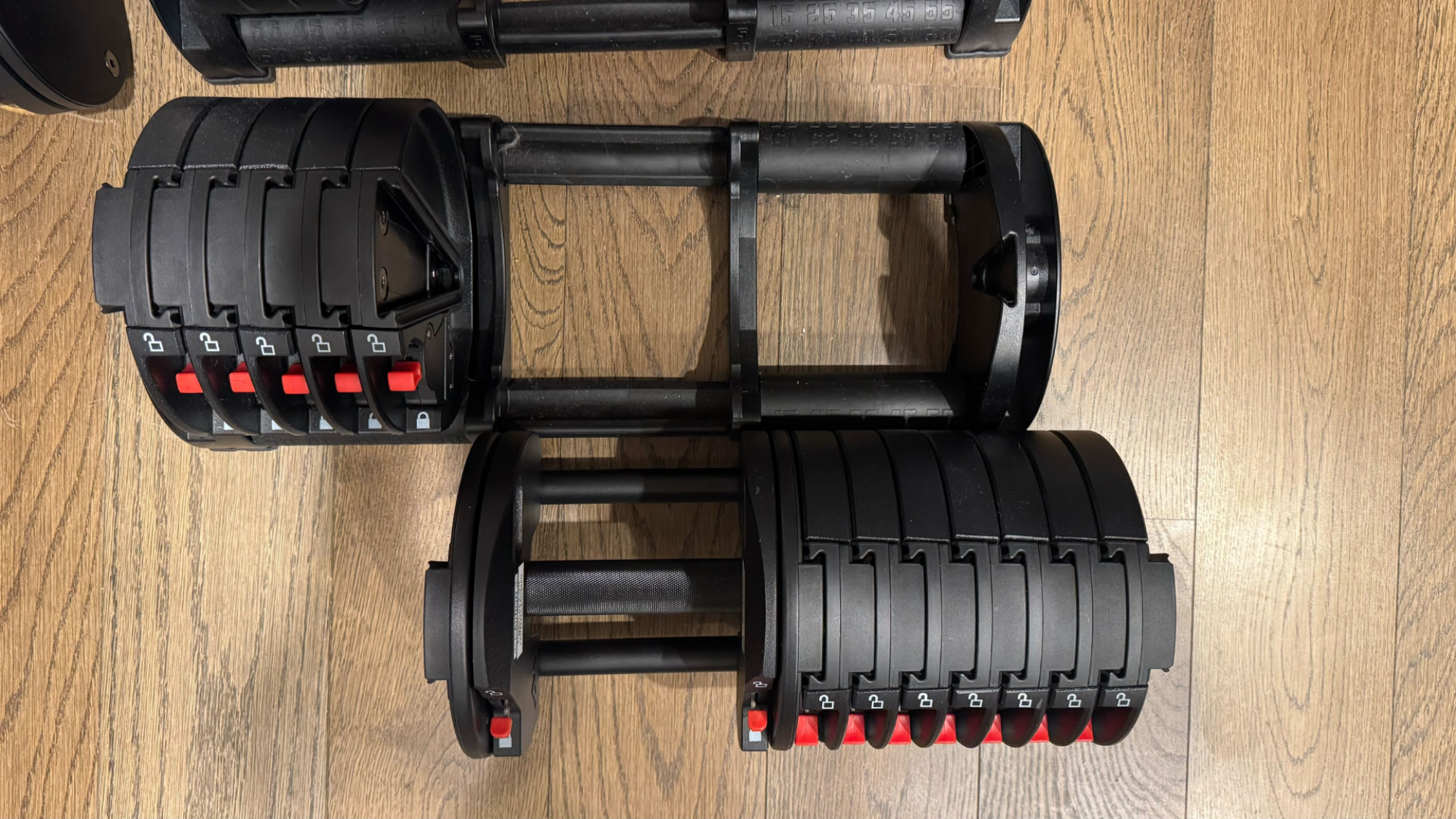
For this reason, I naturally had my boyfriend test my DIY super-QuickDraws creation. In the image below, you can see how I manually added weights outside of the cradle. With the spin-locks, you can keep adding weights outside the cradle without any resistance. Just slide the weights on and flip the lock switch.

I snapped a picture of it in its lopsided form, so you can see just how far outside the cradle the five-pound add-ons will go—and how precarious it starts to look right off the bat.

REP QuickDraw Dumbbells
Behold, my DIY super-QuickDraws creation.
Credit: Meredith Dietz

As we steadily increased the weight from 65, to 70, to 85 pounds, he noted growing concerns with how much the dumbbells could handle while still feeling safe. The all-steel design gives these guys a premium feel during standard use. But when you go beyond the sanctioned weight capacity, there’s a sense that the dumbbells wouldn’t bend or snag, but simply snap.

And again, you’ll need to manually keep track of how much weight you’re adding, since the individual plates are not labeled, and you’re exceeding the labels of the cradle. That mental math might not be a deterrent for you, but it’s something to note.

The bottom line

In most cases, the hassle and safety concerns outweigh the benefits. The primary advantage of the QuickDraws—quick, convenient weight changes—is totally undermined when manually adding plates.

Investing in a higher-capacity adjustable dumbbell set (like 80- to 90-pound models) or supplementing with specific heavier fixed dumbbells for certain exercises might be safer and more practical. For serious lifters approaching the upper limits of their adjustable dumbbells, I’d recommend supplementing with individual heavier dumbbells.

Mysterious Database of 184 Million Records Exposes Vast Array of Login Credentials

A security researcher has discovered an exposed database containing 184 million login credentials for major services including Apple, Facebook, and Google accounts, along with credentials linked to government agencies across 29 countries. Jeremiah Fowler found the 47-gigabyte trove in early May, but the database contained no identifying information about its owner or origins.

The records included plaintext passwords and usernames for accounts spanning Netflix, PayPal, Discord, and other major platforms. A sample analysis revealed 220 email addresses with government domains from countries including the United States, China, and Israel. Fowler told Wired he suspects the data was compiled by cybercriminals using infostealer malware. World Host Group, which hosted the database, shut down access after Fowler’s report and described it as content uploaded by a “fraudulent user.” The company said it would cooperate with law enforcement authorities.


Read more of this story at Slashdot.