
The Morning After: Apple might skip iOS 19, straight to iOS 26

According to Bloomberg, the next versions of Apple’s operating systems may be labeled by year, starting now. It makes sense. At this point, we’ve got VisionOS 2, watchOS 11, macOS 15, iOS 18 and iPadOS 18. Instead, they might all be tagged 26 — even if they launch this year.

It’s not the first tech company to align new products with the year of release. Samsung started naming its phones by year of release in 2020 with the S20, which followed the S10. We’ll learn for sure in under two weeks: WWDC kicks off June 9.

— Mat Smith

Get Engadget’s newsletter delivered direct to your inbox. Subscribe right here!

The news you might have missed


PlayStation’s DualSense Edge wireless controller is cheaper than ever

Sony is discounting consoles, accessories, games and subscriptions.

TMA
Engadget

One of the standout deals of this year’s Days of Play sale is the PS5 DualSense Edge controller. You can pick one up for $169, which is 15 percent off its usual price. The deal is available on Amazon and directly from Sony.

The Edge resembles a regular DualSense controller, but there’s a lot more to it. For instance, there are function buttons below each thumbstick and rear paddles, and you can choose between a set of levers or shorter half-domes.

If you haven’t jumped on the PS5 yet, the PS5 Pro also gets a $50 discount.

Continue reading.


The new Opera browser can surf the web for you

It’s not Chrome, Safari or Edge, but if you’re willing to be different…

Opera has launched another… Opera browser. Neon is its first fully agentic browser. That means it’s baked in AI chat with users and can surf the web on their behalf. 

It… clicks for you. It can even fill out forms and shop for you. If you’re feeling more ambitious, you can ask Neon to build websites, animations, even games, and it can continue chipping away at big projects while you’re offline.

Will that all be enough to swing you away from all your Chrome plugins or Safari passwords? According to recent figures, just over 2 percent of internet users use Opera. You can try it for yourself now. Oh wait, no, there’s a waitlist.

Continue reading.


This gaming mouse has a tiny fan inside

For the pro gamers.

TMA
Pulsar

Pulsar’s latest competitive gaming mouse features a premium tiny fan from Noctua, the renowned fan brand. (Apparently, no one makes fans quite like the Austrians).

With a skeletal shell designed to enhance airflow, it’s for sweaty-palmed professional gamers. Like the original Feinmann mouse from Pulsar, it has a 32,00 DPI sensor and an ultra-fast 8,000 Hz polling rate. Due to the fan, it’s a little heavier than the original at 65 grams. And the price of dry palm calm? $180.

Continue reading.

This article originally appeared on Engadget at https://www.engadget.com/general/the-morning-after-engadget-newsletter-121525453.html?src=rss

The Gmail app can automatically summarize those long email threads

Gmail will now automatically show you a summary card for lengthy email threads if you check a Google Workspace account on the iOS or the Android app. The company introduced AI summaries last year when it rolled out Gemini side panels for Docs, Sheets, Slides, Drive and Gmail. However, you’d have had to manually tap the “Summarize this email” option at the top of emails before if you wanted to see a thread’s contents at a glance. Now, the summary will show up at the top of the email the moment you open a thread.

Google’s AI assistant will write up key points from multiple messages and include them in the summary. It will keep re-generating that summary and keeping it up to date as more replies come in. At the moment, however, the feature will only work for emails written in English. Also, your personalization smart features in Gmail, Chat and Meet, as well as smart features in Google Workspace, have to be switched on. As The Verge notes, Google didn’t say whether it will also make auto-summaries available on non-Workspace accounts and Gmail on desktop. But you can always tap the “Summarize this email” option at the top whenever auto-summary isn’t available for you. 

In addition to summarizing emails, Gemini in Gmail can help you draft new emails and help you find information from within your inbox or from your Drive files. At I/O 2025, Google CEO Sundar Pichai introduced Personalized Smart Replies, an upcoming feature that can look at your past emails and files to draft a response containing relevant information in the tone you typically use when you write. 

This article originally appeared on Engadget at https://www.engadget.com/ai/the-gmail-app-can-automatically-summarize-those-long-email-threads-120023369.html?src=rss

Use This Free App to Track Sports Scores in Your Mac’s Menu Bar

It’s a sad fact of life: Sometimes you have to work when you’d rather be watching the game. I can’t fix that problem for you, sadly, but I can give you a way to keep track of the score on your Mac.

Apple offers a great sports scores app for the iPhone, which is the best way to keep track of the score while you’re doing something else. There’s nothing like that from Apple for the Mac, though, which I find a little disappointing. Sure, you can ask Siri for the score, but there’s no way to passively keep track of the score while you’re working on something else. Happily, there’s a free app that puts the score for many major leagues right in your menu bar: the aptly named MenuScores.

This is a free and open source application that offers scores for major sports leagues in both Europe and North America. Just install the application and you’ll see “Select a Game” in the menu bar. Click this and you’ll see a list of leagues—hover over any of them to see a list of games. Click a game and you’ll know the score every time you glance at the menu bar. You can optionally get a notification when the game starts and ends.

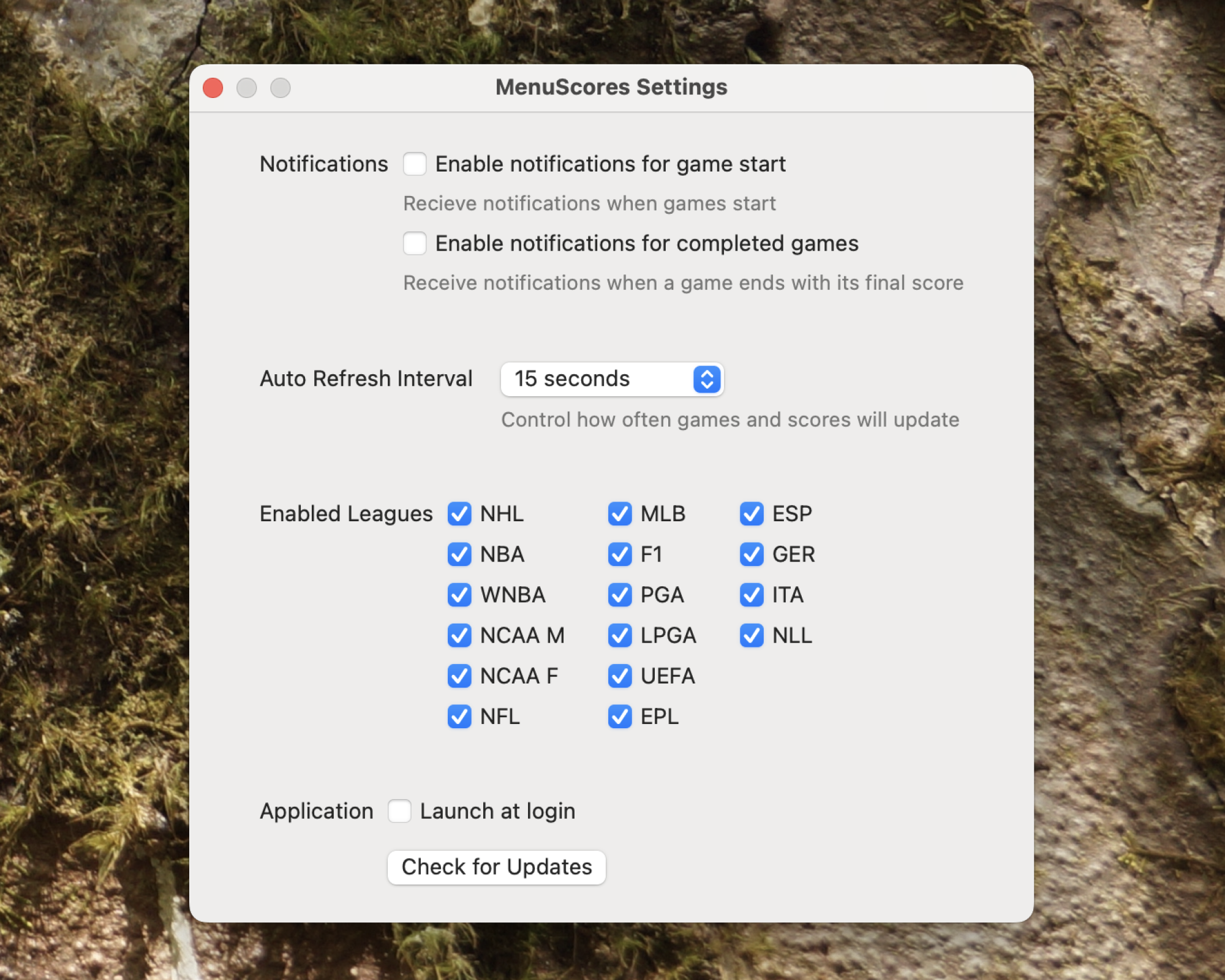
The settings screen for MenuScores, which includes the option to enable or disable notifications, how frequently scores should refresh, which leagues you want to see, and whether the application should start up at boot.

Credit: Justin Pot

The supported leagues include the NHL, NBA, NCAA men’s and women’s basketball, the NFL, MLB, F1, PGA, LPGA, EUFA Champions league, EPL, ESP, GER, ITA, and NLL. Most sports fans aren’t going to want to see all of theses, so you can disable any league in the settings. You can also disable notifications and configure how often scores should refresh—options range from every five seconds to every five minutes. Scores are pulled in using ESPN’s API.

The application isn’t perfect. It would be nice if I could get more details about games by clicking them, even if that meant opening a website. I also wish there was support for MLS games. Even so, this is a great tool if you’re a fan of even one supported league. I know I’ll be opening ii late in the afternoon most days during hockey season.

Blue Origin boss: Government should forget launch and focus on “exotic” missions

Eighteen months after leaving his job as a vice president at Amazon to take over as Blue Origin’s chief executive, Dave Limp has some thoughts on how commercial companies and government agencies like NASA should explore the Solar System together.

Limp had no background in the space industry before taking the helm of Jeff Bezos’ space company in December 2023. He started his career as a computer scientist at Apple, took a stint at a venture capital firm, and joined Amazon in 2010, where he managed development of consumer devices like Alexa, Kindle, and the Fire TV.

“I had no thoughts of ever running a space company,” Limp said Thursday at a space conference in Washington, DC. “I’ve done consumer electronics my whole life. Started at Apple and did a bunch of other things, and so when I decided to retire from Amazon, I was looking for something that I could give back a little bit, be a little bit more philanthropic in the sort of second half of my career. I didn’t want to stop working, just wanted to do something different. And about that same time, Jeff was looking for a CEO.”

Read full article

Comments

Rocket Report: Northrop backs Firefly and names its rocket; Xodiac will fly no more

Welcome to Edition 7.46 of the Rocket Report! As I write this, the date is May 29. From a meteorological standpoint, “spring” ends in fewer than three days. Summer lasts from June 1 through August 31. Consider this a public service announcement for launch companies targeting “spring” and “summer” launches for various missions.

As always, we welcome reader submissions, and if you don’t want to miss an issue, please subscribe using the box below (the form will not appear on AMP-enabled versions of the site). Each report will include information on small-, medium-, and heavy-lift rockets as well as a quick look ahead at the next three launches on the calendar.

Xodiac rocket makes its final flight. Originally built by Masten Space Systems, the suborbital Xodiac rocket had flown 175 successful missions before a flight from Mojave, California, on Wednesday. But now, it will fly no more. “While the vehicle remained within its planned flight envelope, it detected an anomalous condition and commanded a flight termination,” said Astrobotic, which acquired Masten a couple of years ago. “This resulted in a rapid descent and caused a loss of the vehicle upon impact with its launch pad.”

Read full article

Comments

Ask Engadget: How do I set up an Xbox for my kid?

Q: My question is how best to set up an Xbox for my kid. I want to know how to control use time and whether I should use my email to set up. – Guillermo from Utah

A: You’re in luck! Console parental controls have come a long way from the days of hiding NES systems (or their controllers) from unruly kids. Microsoft, in particular, has made it very easy through its Xbox Family Settings app for iOS and Android, which supports Xbox Series X/S and Xbox One systems. Once you’ve added your kids to your Xbox family group, you’ll be able to manage and see reports of their playtime, restrict access to specific content, require parental approval for purchases and sort incoming friend requests. In typical Microsoft fashion, though, setting up Xbox family accounts can be a bit confusing, so let’s go over it step by step.

Xbox Family Settings App
Microsoft

How to set up an Xbox for your child

  1. Turn on your Xbox and sign in with your Microsoft account.

  2. Press the Xbox button on your controller, and head to Profile & system > Settings > account > Family settings > Manage family members.

  3. Choose Add to family > Add new.

  4. Unfortunately, Microsoft requires an email address for new accounts. You can either entire your child’s existing email if they have one, or choose the Get a new email option to create an Outlook email address. (This may seem a bit absurd for younger children, so if you don’t want to create an email for your 6 year old, you may be better off just physically controlling access to consoles like the old days.)

  5. Next, you’ll have to verify the addition of a new family group member. You can do so by either choosing This Xbox on the next screen and entering your Microsoft account details, or selecting Their phone/PC to have an email sent to you. In either case, you’ll have to consent to the new member.

What is a Microsoft child account?

In its documentation, Microsoft says “a child account is defined as any Microsoft account that’s affiliated with an adult Microsoft account when the age of the child or teen is less than the age of majority for their country or region.” These accounts are broken into “Child” and “Teen” categories, which specify age ranges between eight and 12, and 13 to 17. Microsoft notes there can be differences depending on location, like in South Korea where teen accounts range from 13 to 18.

Xbox Series X
Devindra Hardawar for Engadget

Are there any issues with Microsoft child accounts?

As useful as the Xbox Family app and child accounts may seem, they can also lead to problems while playing Minecraft, according to comments on Reddit. Reddit user “Microdad_” said they weren’t able to gift a game to their child’s account, they had to deal with a buggy website to allow them to play Minecraft and after all of that trouble their child still can’t play in their realm. User “Electronic_Ocelot825” encountered similar issues, replying, “You are spot on. I go through same [sic] crap and it drives me to the point where I am furious.”

Have a tech question you’d like Engadget to answer?

As tech reporters, the Engadget staff is always answering questions from readers, friends and family about electronics, software, gaming, big tech policies and more. So we decided to write down our answers. This question came from a coworker from Yahoo, Engadget’s corporate parent. If you’ve got a tech-related question you’d like us to answer for you, please email ask@engadget.com.

This article originally appeared on Engadget at https://www.engadget.com/gaming/xbox/ask-engadget-how-do-i-set-up-an-xbox-for-my-kid-110022860.html?src=rss

French MPs Vote To Scrap Low-Emission Zones

sinij shares a report from the BBC: France’s National Assembly has voted to abolish low-emission zones, a key measure introduced during President Emmanuel Macron’s first term to reduce city pollution. So-called ZFEs (zones a faibles emissions) have been criticized for hitting those who cannot afford less-polluting vehicles the hardest. A handful of MPs from Macron’s party joined opposition parties from the right and far right in voting 98-51 to scrap the zones, which have gradually been extended across French cities since 2019. […]

The low-emission zones began with 15 of France’s most polluted cities in 2019 and by the start of this year had been extended to every urban area with a population of more than 150,000, with a ban on cars registered before 1997. Those produced after 1997 need a round “Crit’Air” sticker to drive in low-emission zones, and there are six categories that correspond to various types of vehicle. The biggest restrictions have been applied in the most polluted cities, Paris and Lyon, as well as Montpellier and Grenoble. The BBC notes that while the abolition is expected to pass France’s Senate, it must still be included in a broader bill approved by the lower house in June and cleared by the Constitutional Council, which isn’t guaranteed.


Read more of this story at Slashdot.

Scientists Have Clear Evidence of Martian Atmosphere ‘Sputtering’

For the first time, scientists have directly observed atmospheric sputtering in action on Mars — an erosion process driven by solar wind ions that may have played a major role in the planet’s atmospheric and water loss. ScienceAlert reports: The only spacecraft with the equipment and orbital configuration to make these observations is NASA’s MAVEN. The researchers carefully pored over the data collected by the spacecraft since it arrived in Mars orbit in September 2014, looking to find simultaneous observations of the solar electric field and an upper atmosphere abundance of argon — one of the sputtered particles, used as a tracer for the phenomenon. They found that, above an altitude of 350 kilometers (217 miles), argon densities vary depending on the orientation of the solar wind electric field, compared to argon densities at lower altitudes that remain consistent.

The results showed that lighter isotopes of argon vary, leaving behind an excess of heavy argon — a discrepancy that is best explained by active sputtering. This is supported by observations of a solar storm, the outflows of which arrived at Mars in January 2016. During this time, the evidence of sputtering became significantly more pronounced. Not only does this support the team’s finding that argon density variations at high Martian altitudes are the result of sputtering, it demonstrates what conditions may have been like billions of years ago, when the Sun was younger and rowdier, undergoing more frequent storm activity. The findings have been published in the journal Science Advances.


Read more of this story at Slashdot.

Is Fintevex the Underrated Crypto CFD Platform of 2025?

Not every platform that offers crypto CFDs is actually built with crypto traders in mind. Some are just forex-first platforms adding tokens to ride the wave. Others overpromise and underdeliver with clunky apps, bad liquidity, or hidden fees.

But in early 2025, a growing number of active crypto investors are quietly migrating to Fintevex — and not because of flashy bonuses or referral schemes.

So what’s pulling them in?

We took a look.

Clean, Fast, No Nonsense — and Built for Volatility

Crypto moves fast. Your platform has to move faster.

Fintevex seems to get this. Execution speed is solid (under 1 second in our tests), spreads are clearly stated before every trade, and the layout is refreshingly focused — no popups, no social feeds, no distractions.

You can:

  • Trade top assets like BTC/USD, ETH/USDT, SOL/USD
  • Open and close positions instantly
  • Set stop-loss, take-profit, and margin alerts
  • Use up to 1:5 leverage on crypto CFDs

It doesn’t reinvent crypto trading — it just gets out of the way so you can focus.

Mobile Performance That Keeps Up With the Market

Fintevex’s mobile platform is one of the better ones we’ve used for crypto CFD trading. It’s lightweight, responsive, and has enough functionality for on-the-go execution.

You can monitor positions, check charts, and make decisions in real time without lag — which matters when markets are moving fast at 2 a.m.

Fees That Don’t Sneak Up on You

No commissions. No deposit or platform fees. Just spreads.

And those spreads? Competitive.

  • BTC/USD: Tight compared to most CFD brokers
  • ETH and SOL pairs also trade well during peak hours
  • No hidden costs buried in the fine print

You’ll still want to check your margins and overnight fees on long holds — but at least it’s all upfront.

Security That Meets the Crypto Standard

Security is often where “crypto-friendly” brokers fall short. But Fintevex includes:

  • Two-factor authentication (2FA)
  • Device verification
  • Encrypted data
  • Negative balance protection

They’re not waving around buzzwords like “blockchain-native,” but they do deliver what most crypto traders actually care about: protection + reliability.

Want details? Their full security breakdown is available on their site.

The Crowd’s Getting Louder — Quietly

We’ve seen more mentions of Fintevex in private Discord groups, Telegram chats, and Reddit threads in early 2025. It’s not trending. It’s not viral. It’s just being used — by traders who care more about performance than marketing.

What’s Missing?

  • No deep altcoin list (yet) — major pairs only
  • No staking or wallet functionality (this is CFDs, not spot)
  • Limited long-term education resources for crypto-specific strategies

Still, if your focus is short-term trading and risk-managed positioning — this might be what you need.

Final Word: Quietly Becoming a Go-To for Crypto CFDs

Fintevex isn’t the loudest name in crypto trading. But maybe that’s a good thing.

For crypto traders who care more about speed, security, and solid margins than flashy dashboards, this platform is starting to look like a practical, no-BS option in 2025.

No gimmicks. Just trades that work.

‘E-Tattoo’ Could Track Mental Workload For People In High-Stake Jobs, Study Says

An anonymous reader quotes a report from The Guardian: Whether it is doing sums or working out what to text your new date, some tasks produce a furrowed brow. Now scientists say they have come up with a device to monitor such effort: an electronic tattoo, stuck to the forehead. The researchers say the device could prove valuable among pilots, healthcare workers and other professions where managing mental workload is crucial to preventing catastrophes. “For this kind of high-demand and high-stake scenario, eventually we hope to have this real-time mental workload decoder that can give people some warning and alert so that they can self-adjust, or they can ask AI or a co-worker to offload some of their work,” said Dr Nanshu Lu, an author of the research from the University of Texas at Austin, adding the device may not only help workers avoid serious mistakes but also protect their health.

Writing in the journal Device, Lu and colleagues describe how using questionnaires to investigate mental workload is problematic, not least as people are poor at objectively judging cognitive effort and they are usually conducted after a task. Meanwhile, existing electroencephalography (EEG) and electrooculography (EOG) devices, that can be used to assess mental workload by measuring brain waves and eye movements respectively, are wired, bulky and prone to erroneous measurements arising from movements. By contrast, the “e-tattoo” is a lightweight, flexible, wireless device.

The black, wiggly path of the e-tattoo is composed of a graphite-based conductive material, and is attached to the forehead using conductive adhesive film. Four square EEG electrodes, positioned on the forehead, each detect a different region of brain activity — with a reference electrode behind the ear — while rectangular EOG electrodes, placed vertically and horizontally around the eyes, provide data about eye movements. Each of the stretchable electrodes is coated in an additional conductive material. The e-tattoo, which is bespoke and disposable, is connected to a reusable flexible printed circuit using conductive tape, while a lightweight battery can be clipped to the device. The device is expected to cost less than $200 and be accompanied with an app to alert the user if their mental workload is too high.


Read more of this story at Slashdot.

Amazon Taps Xbox Co-Founder To Develop ‘Breakthrough’ Consumer Products

Amazon has launched a new innovation-focused team called ZeroOne, led by Xbox co-creator J Allard, to develop breakthrough consumer products across hardware and software. CNBC reports: The ZeroOne team is spread across Seattle, San Francisco and Sunnyvale, California, and is focused on both hardware and software projects, according to job postings from the past month. The name is a nod to its mission of developing emerging product ideas from conception to launch, or “zero to one.” […] The new group is being led by J Allard, who spent 19 years at Microsoft, most recently as technology chief of consumer products, a role he left in 2010, according to his LinkedIn profile. He was a key architect of the Xbox game console, as well as the Zune, a failed iPod competitor.

Allard joined Amazon in September, and the company confirmed at the time that he would be part of the devices and services team under Panos Panay, who left Microsoft for Amazon in 2023 to lead the group. An Amazon spokesperson confirmed Allard oversees ZeroOne but declined to comment further on the group’s work. The job postings provide few specific details about what ZeroOne is building, though one listing references working on “conceiving, designing, and bringing to market computer vision techniques for a new smart-home product.” Another post for a senior customer insights manager in San Francisco says the job entails owning “the methodology and execution of concept testing and early feedback for ZeroOne programs.” “You’ll be part of a team that embraces design thinking, rapid experimentation, and building to learn,” the description says. “If you’re excited about working in small, nimble teams to create entirely new product categories and thrive in the ambiguity of breakthrough innovation, we want to talk to you.”

Amazon has pulled in staffers from other business units that have experience developing innovative technologies, including its Alexa voice assistant, Luna cloud gaming service and Halo sleep tracker, according to Linkedin profiles of ZeroOne employees. The head of a projection mapping startup called Lightform that Amazon acquired is helping lead the group. While Amazon is expanding this particular corner of its devices group, the company is scaling back other areas of the sprawling devices and services division.


Read more of this story at Slashdot.

Intel Wins Jury Trial Over Patent Licenses In $3 Billino VLSI Fight

A Texas jury ruled that Intel may hold a license to patents owned by VLSI Technology through its agreement with Finjan Inc., both controlled by Fortress Investment Group — potentially nullifying over $3 billion in previous patent infringement verdicts against Intel. Reuters reports: VLSI has sued Intel in multiple U.S. courts for allegedly infringing several patents covering semiconductor technology. A jury in Waco, Texas awarded VLSI $2.18 billion in their first trial in 2021, which a U.S. appeals court has since overturned and sent back for new proceedings.

An Austin, Texas jury determined that VLSI was entitled to nearly $949 million from Intel in a separate patent infringement trial in 2022. Intel has argued in that case that the verdicts should be thrown out based on a 2012 agreement that gave it a license to patents owned by Finjan and other companies “under common control” with it. U.S. District Judge Alan Albright held the latest jury trial in Austin to determine whether Finjan and VLSI were under the “common control” of Fortress. VLSI said it was not subject to the Finjan agreement, and that the company did not even exist until four years after it was signed.


Read more of this story at Slashdot.

Intel Wins Jury Trial Over Patent Licenses In $3 Billion VLSI Fight

A Texas jury ruled that Intel may hold a license to patents owned by VLSI Technology through its agreement with Finjan Inc., both controlled by Fortress Investment Group — potentially nullifying over $3 billion in previous patent infringement verdicts against Intel. Reuters reports: VLSI has sued Intel in multiple U.S. courts for allegedly infringing several patents covering semiconductor technology. A jury in Waco, Texas awarded VLSI $2.18 billion in their first trial in 2021, which a U.S. appeals court has since overturned and sent back for new proceedings.

An Austin, Texas jury determined that VLSI was entitled to nearly $949 million from Intel in a separate patent infringement trial in 2022. Intel has argued in that case that the verdicts should be thrown out based on a 2012 agreement that gave it a license to patents owned by Finjan and other companies “under common control” with it. U.S. District Judge Alan Albright held the latest jury trial in Austin to determine whether Finjan and VLSI were under the “common control” of Fortress. VLSI said it was not subject to the Finjan agreement, and that the company did not even exist until four years after it was signed.


Read more of this story at Slashdot.

Google Lens is coming to YouTube Shorts

YouTube Shorts is beta testing the addition of Google Lens. Integrating this tech into the short-form video platform will allow viewers to search for more information about what they can see in a clip. The functionality will begin rolling out to all Shorts users this week.

Once it’s enabled on your account, the feature can be accessed by pausing the video, selecting Lens from the top menu and then tapping or highlighting an element of the clip to search about. Visual matches and search results will be overlaid on top of the Short. More details are provided in Google’s support pages.

The post announcing the Lens beta notes that advertisements won’t be shown in the results during the test phase. Additionally, it states that “the Lens experience isn’t available for Shorts with YouTube Shopping affiliate links or with paid product promotions.” While the beta test isn’t going to be tied to commerce, this feels like an integration that could very likely become a Shopping-centric resource in the future.

This article originally appeared on Engadget at https://www.engadget.com/entertainment/youtube/google-lens-is-coming-to-youtube-shorts-221803755.html?src=rss

SEC Voluntarily Dismisses Lawsuit Against Binance

The SEC on Thursday voluntarily dismissed its lawsuit against Binance, the world’s largest cryptocurrency exchange. It brings an end to one of the last remaining crypto enforcement actions brought by the agency. Reuters reports: The SEC had accused the defendants in 2023 of artificially inflating trading volumes, diverting customer funds, failing to restrict U.S. customers from Binance’s platform, and misleading investors about its market surveillance controls. It also accused Binance of unlawfully facilitating trading of several tokens that prior SEC leadership deemed unregistered securities. Developing…


Read more of this story at Slashdot.

ASUS Router Backdoors Affect 9,000 Devices, Persists After Firmware Updates

An anonymous reader quotes a report from SC Media: Thousands of ASUS routers have been compromised with malware-free backdoors in an ongoing campaign to potentially build a future botnet, GreyNoise reported Wednesday. The threat actors abuse security vulnerabilities and legitimate router features to establish persistent access without the use of malware, and these backdoors survive both reboots and firmware updates, making them difficult to remove.

The attacks, which researchers suspect are conducted by highly sophisticated threat actors, were first detected by GreyNoise’s AI-powered Sift tool in mid-March and disclosed Thursday after coordination with government officials and industry partners. Sekoia.io also reported the compromise of thousands of ASUS routers in their investigation of a broader campaign, dubbed ViciousTrap, in which edge devices from other brands were also compromised to create a honeypot network. Sekoia.io found that the ASUS routers were not used to create honeypots, and that the threat actors gained SSH access using the same port, TCP/53282, identified by GreyNoise in their report. The backdoor campaign affects multiple ASUS router models, including the RT-AC3200, RT-AC3100, GT-AC2900, and Lyra Mini.

GreyNoise advises users to perform a full factory reset and manually reconfigure any potentially compromised device. To identify a breach, users should check for SSH access on TCP port 53282 and inspect the authorized_keys file for unauthorized entries.


Read more of this story at Slashdot.

Amid rising prices, Disney+ and Hulu offer subscribers some freebies

With streaming providers frequently raising prices, subscribers often feel like they’re paying more for the same service—or a lesser version, depending on what’s available to watch that month. In a unique move, Disney is introducing a small, potential financial benefit to Disney+ and Hulu subscribers in the form of some third-party discounts, freebies, trials, and contests.

As of today, Disney+ subscribers can log into Disney’s Disney+ Perks website with their streaming credentials to get access to a revolving selection of discounts and freebies. When I logged in today, I was met with options for several free trials, including a six-month one to DoorDash’s premium subscription offering, a three-month trial to Clear+, and a two-month trial to Duolingo’s premium subscription.

Disney+ subscribers can also get discounts, including to Adidas’ online marketplaces and “select” Disney Resorts Collection hotels (if you stay at least two nights, with most availability occurring between June 29 and July 31). There are also some free virtual rewards for Disney-owned games and the ability to enter sweepstakes, like for going to the premiere of the movie Freakier Friday.

Read full article

Comments

Tinder is testing height preferences

Tinder helped popularize a modern dating culture that puts looks first, and now the app is trying out a new way to capitalize on it. As part of a test, select Tinder Gold and Tinder Platinum subscribers will be able to set a preferred height range for matches they receive in the app, according to TechCrunch. The feature was first spotted by a Reddit user who noticed the option in the app’s “Discovery Settings.”

Deciding that you prefer matches who are 5’10” and up won’t necessarily weed out the short kings in your area, but it will influence the recommendations the app offers as you swipe. Tinder has long included ways to spell out your preferences in your profile, and plenty of people go further in their bio, signaling that they only swipe right on people with specific features or interests. Making height preference part of the official settings just formalizes things.

A new setting slider in the Tinder app that lets you set a preferred height range for matches.
u/Extra_Barracudaaaa

Given how dating apps are already associated with superficiality, though, this feature seems intended to be a bit provocative. It could also reflect how Tinder is approaching its paid subscriptions going forward: not just as a way to increase the reach of your dating profile, but as the official method for exerting granular control over who you match with.

“This is part of a broader effort to help people connect more intentionally on Tinder. Our new product principles guide every decision, and this one speaks directly to a few: prioritizing user outcomes, moving fast, and learning quickly,” Tinder’s VP of Comms Phil Price Fry tells Engadget. “Not every test becomes a permanent feature, but every test helps us learn how we can deliver smarter, more relevant experiences and push the category forward.”

Whether being able to set a height preference becomes a real feature, it doesn’t stop people from lying in their dating profile. Though, as TechCrunch notes, Tinder has joked about implementing height verification in the past.

This article originally appeared on Engadget at https://www.engadget.com/apps/tinder-is-testing-height-preferences-212414694.html?src=rss

China Summons Top Carmakers Over ‘Zero-Mileage’ Used Vehicles

An anonymous reader shares a report: China’s Ministry of Commerce is meeting with some of the country’s biggest automakers to discuss whether the industry is using a loophole to mask weakening sales. Reuters adds: It comes after Great Wall Motor’s Chairman Wei Jianjun said in an interview with Sina Finance last week that a phenomenon called “secondhand cars with zero mileage” had emerged in the Chinese market as a result of the industry’s years-long price war.

The phenomenon, he said, involved cars that had been registered and had licence plates — marking them as sold — but had never been driven being sold in the secondhand market. Wei said that at least 3,000 to 4,000 vendors on Chinese used car platforms were selling such cars. The source said the tactic was seen as a potential method within the industry for automakers and dealers to support new car sales as they try to meet aggressive sales targets.


Read more of this story at Slashdot.

This Is Why Strava Rounds Down Your Miles

You cross the finish line after what feels like a perfect 10-mile run and your watch beeps triumphantly, displaying that beautiful round number: 10.00 miles. You’re already composing your social media post in your head. Then you upload to Strava and—betrayal. Your activity shows 9.99 miles. It might seem like a bug, but as Strava explains, it’s very much by design.

Welcome to the “Strava Tax,” the phenomenon that has spawned memes, advice, and probably a few extra loops around parking lots as runners desperately try to hit that magical round number.

What’s really happening when Strava rounds down?

The Strava Tax isn’t actually Strava being petty or skimming distance off your achievements. It’s more of a collision between mathematical precision and the messy reality of how different devices handle GPS data.

Here’s the thing: when your watch displays 10.00 miles, that’s often not what it actually recorded. The raw GPS data might show 9.993 miles, 9.996 miles, or 10.001 miles. Your watch rounds this to a nice, clean 10.00 for display purposes—because who wants to see 9.99634 miles on their wrist?

So your watch and apps don’t just display raw GPS data—they “improve” it. They smooth out GPS wobbles, correct for obvious errors, and sometimes add their own interpretations of where you actually went. Your Garmin might think you ran through that building (especially as AI maps take over), while your phone’s GPS smooths your route to follow the sidewalk.

Different manufacturers handle this data inconsistency in different ways. Even devices from the same manufacturer can display identical GPS data differently, depending on the model, firmware version, or even the specific algorithms running on each device. Some devices will show 1.00 km as soon as you hit 991 meters (0.991 km), while others wait until you actually complete a full kilometer. It’s like having different definitions of what “close enough” means.

Beyond that, mile definitions aren’t actually universal. You’d think a mile is a mile, right? Not in the world of fitness devices. The precise definition is 1609.344 meters, but some devices use 1609 meters for simplicity. That small difference adds up over longer distances.

But Strava takes a different approach. When displaying distances, Strava rounds down rather than using standard rounding rules. So that 9.993 miles becomes 9.99 miles on your activity page, not 10.00 miles.

Why Strava rounds down

Strava often sits in the middle of different manufacturers and devices. Imagine if Strava applied the same “enhancement” algorithms that your Garmin uses to data coming from an Apple Watch. The Apple data might get double-processed, potentially inflating distances. Or if it used Apple’s data smoothing, it might actually reduce accuracy.

Instead, Strava takes a conservative approach: it displays the data as close to raw as possible, using consistent rounding rules across all devices. This means sometimes your beautiful round numbers get truncated, but it also means a 10K from a Garmin is treated the same as a 10K from an Apple Watch.

Zooming out, when it comes to fitness tracking, it’s helpful to remember that the numbers we see are often more complicated than they appear. We all know GPS isn’t perfect. Think about it: your device is trying to track your position using satellites 12,000+ miles above Earth. Trees, buildings, weather, and even solar activity can affect accuracy. How often to record points, how to connect the dots between points, how to filter out obvious errors, how to handle missing data—each manufacturer makes different choices. Strava’s choice, in its own words, is to “err on the side of caution rather than let the accuracy of our records start to dilute.”

Tips to live with the Strava Tax

At the end of the day, there’s a deeper reason why so many runners bond over Strava Tax memes. The Strava Tax taps into something more than just measurement accuracy—it hits our psychological relationship with round numbers. There’s something deeply satisfying about completing exactly 10 miles, 5K, or 100 kilometers. These numbers feel complete, accomplished, worthy of celebration.

When Strava displays 9.99 miles instead of 10.00, it doesn’t just remove a hundredth of a mile—it removes the psychological satisfaction of hitting that milestone. It’s the difference between “I ran 10 miles!” and “I ran…well, basically 10 miles.”

This is why you see runners doing extra loops around parking lots, cyclists riding circles in their driveways, and forum threads debating whether 9.99 miles “counts” as a 10-mile run. It’s not really about the 0.01 miles—it’s about the story we tell ourselves and others about our achievements.

So what’s a data-obsessed athlete to do? A few strategies:

  • Embrace the range: Instead of fixating on hitting exactly 10.00 miles, think in ranges. A 9.98-10.02 mile run is essentially the same thing—you ran about 10 miles.

  • Know your device: Learn how your specific watch or phone handles distance calculation. Some devices let you calibrate distance measurements or choose different GPS settings that might be more or less aggressive in their processing.

  • Focus on trends: Day-to-day variations in distance measurement matter less than long-term trends. Are you running farther this month than last month? That’s more meaningful than whether Tuesday’s run was 5.99 or 6.01 miles.

  • Plan ahead: If hitting exact distances is important to you, plan routes that give you a small buffer. Aim for 10.1 miles if you want to ensure you hit at least 10.0 on Strava.

The Strava Tax might be annoying, but every time you glance at your watch and see a distance, remember: there’s a satellite constellation, multiple algorithms, and several companies’ worth of engineering decisions all working together to give you that number. And sometimes, despite all that technology, you still end up with 9.99 miles. But hey—you still ran the distance. The GPS satellites aren’t judging you, and neither should you.