
This is a video created by filmmaker Travis Bible using Google’s AI video generator VEO 3 to demonstrate just how convincing AI-generated video is now, and how it can be used to create deceiving news, or scam people out of their money. These are terrifying times we live in. I mean unless you’re an internet scammer, in which case there’s never been a better time to be alive. Obviously, now would be a good time to set some parental locks on your actual parents. Sorry mom, no more Facebook videos — if you want to internet you’re gonna have to read.
Category Archives: Technology
This Site Brings Me Back to the Glory Days of ‘Local on the 8s’ Weather Channel Forecasts
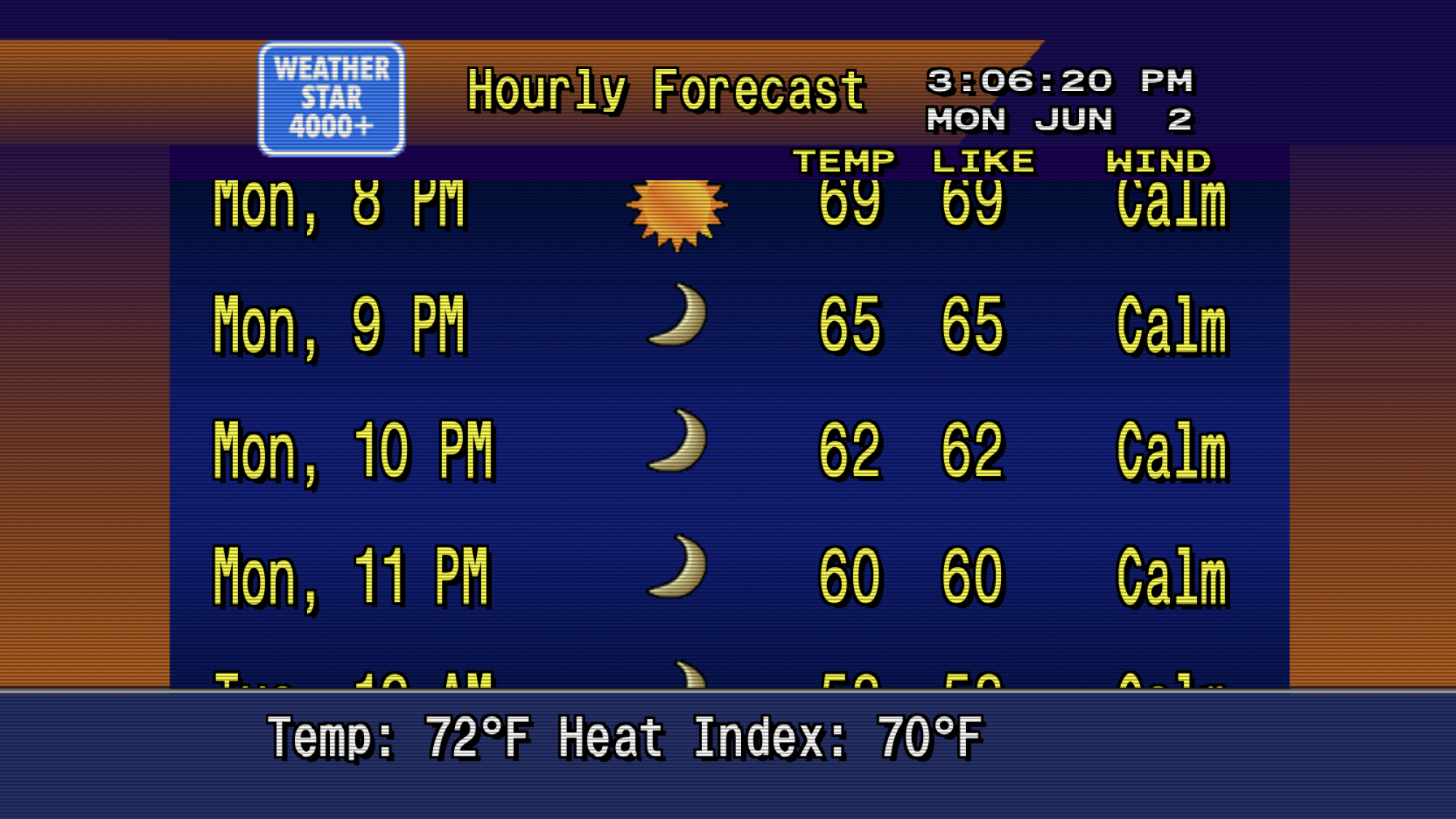
The Weather Channel, for the most part, looked like a normal TV station—until the local forecast would show up. Then it became a pixelated data dump of weather information served over a funky piano soundtrack. There’s nothing like it on the internet—well, until. now.
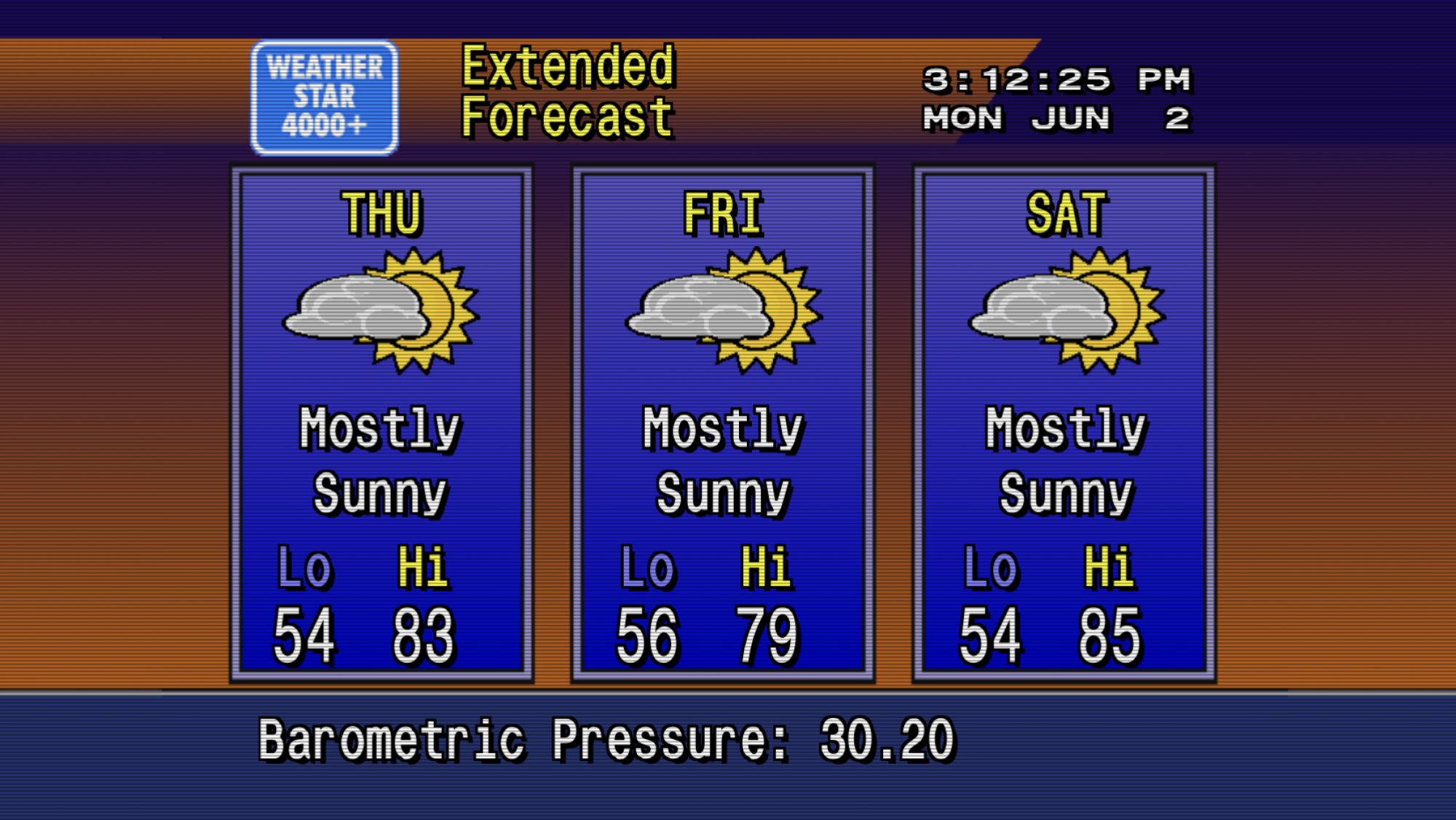
WeatherStar 4000 is a free website that recreates the look and feel of a vintage Weather Channel local forecast, complete with accurate visuals and optional CRT scanlines. Most importantly, it offers a period-accurate lowfi-funk soundtrack that’s perfect to chill or study to.
To get started, just go to the site and choose which features you do and don’t want using the checkbox. Then, when you’re ready, click the full-screen button in the bottom-right corner. Make sure you also unmute the music for the full effect. My editor, upon doing this, told me that it’s going to live permanently on his second monitor. I’m happy for him.
The site is the creation of programmer Matt Walsh, who made it as a variation of an older project that aimed to accurately re-create the vintage format. Walsh’s site offers new features, including a scrolling hourly forecast and support for wide screen.
Credit: Justin Pot
I love this website. It’s not going to replace my weather app, granted, but it’s a great tribute to a technology that made cable essential to many. Getting an accurate local weather forecast in the 90s was hard. The newspaper would have one, sure, but that was printed last night and was likely already outdated. You could also try to catch the weather forecast on your local TV station but it generally only aired a few times a day.
That’s where the Weather Channel came in. This combined national programing with computer generated local forecasts, broadcast every 10 minutes at minutes that ended with the number 8 (the segment was called Local On The 8s). This meant you could turn on your TV anytime you saw an eight at the end of your clock to see an extremely local up-to-date forecast.
Credit: Justin Pot
How did this work? It would have been prohibitively expensive for The Weather Channel to create hundreds of different broadcasts, all with different local forecasts, and then deliver those broadcasts individually to cable providers. The network instead provided cable providers with a computer—called the WeatherStar—that received forecast information as text and used it to create the pixelated video forecasts we all remember. It was an elaborate, automated way to provide something we now take for granted: up-to-date local weather information.
WeatherStar 4000+, you might notice, is named after this device—a fitting tribute. I recommend you turn it on, enable the music, and just vibe for a while. God knows there are less healthy things to do online right now.
Code.org Changes Mission To ‘Make CS and AI a Core Part of K-12 Education’
theodp writes: Way back in 2010, Microsoft and Google teamed with nonprofit partners to launch Computing in the Core, an advocacy coalition whose mission was “to strengthen computing education and ensure that it is a core subject for students in the 21st century.” In 2013, Computing in the Core was merged into Code.org, a new tech-backed-and-directed nonprofit. And in 2015, Code.org declared ‘Mission Accomplished’ with the passage of the Every Student Succeeds Act, which elevated computer science to a core academic subject for grades K-12.
Fast forward to June 2025 and Code.org has changed its About page to reflect a new AI mission that’s near-and-dear to the hearts of Code.org’s tech giant donors and tech leader Board members: “Code.org is a nonprofit working to make computer science (CS) and artificial intelligence (AI) a core part of K-12 education for every student.” The mission change comes as tech companies are looking to chop headcount amid the AI boom and just weeks after tech CEOs and leaders launched a new Code.org-orchestrated national campaign to make CS and AI a graduation requirement.


Read more of this story at Slashdot.
Science PhDs face a challenging and uncertain future
Since the National Science Foundation first started collecting postgraduation data nearly 70 years ago, the number of Ph.D.s awarded in the United States has consistently risen. Last year, more than 45,000 students earned doctorates in science and engineering, about an eight-fold increase compared to 1958.
But this level of production of science and engineering Ph.D. students is now in question. Facing significant cuts to federal science funding, some universities have reduced or paused their Ph.D. admissions for the upcoming academic year. In response, experts are beginning to wonder about the short and long-term effects those shifts will have on the number of doctorates awarded, and the consequent impact on science if Ph.D. production does drop.
Such questions touch on longstanding debates about academic labor. Ph.D. training is a crucial part of nurturing scientific expertise. At the same time, some analysts have worried about an oversupply of Ph.D.s in some fields, while students have suggested that universities are exploiting them as low-cost labor.
NVIDIA’s 576.76 GPU Hotfix Driver Arrives To Fix Crashes In These Games

NVIDIA has released yet another out-of-band GeForce hotfix driver to resolve persistent crashing issues in a handful of games. Curiously, one of those games is Dune: Awakening (as pictured above), which doesn’t actually release to the public at large for another six days. Even the ‘Advanced Access’ period for those who pre-purchased the game
This High Resolution, 360-Degree Camera Is $140 Off Right Now
We may earn a commission from links on this page. Deal pricing and availability subject to change after time of publication.
If you’ve been thinking about leveling up your action or travel videos, the Insta360 X4 is down to $359.99 right now, a drop from its original $499.99 and the lowest price it’s hit so far, according to price-trackers. That’s a major cut for a camera that PCMag calls “Outstanding” and named an Editor’s Choice for 360-degree shooting. You’re getting a serious upgrade over the previous X3, with 8K video capture, a bigger screen, and better battery life packed into a rugged, waterproof body.


Insta360 didn’t change the formula too much with the X4’s design. It’s still pocketable, still easy to grip, and still built tough enough to handle a 33-foot dive without a case. What’s new is under the hood: 8K30fps 360-degree video, smoother slow-mo options, and a larger 2.7-inch Gorilla Glass touchscreen that’s bright enough for outdoor framing. It’s also got wifi 6 and Bluetooth 5.2 onboard for quicker file transfers. Controls are intuitive, and pairing with the Insta360 app takes less than a minute. The app handles editing, reframing, and exporting, making it easy to turn sprawling 360° footage into polished clips you can share fast. That said, the X4 reportedly runs warm after about 30 minutes of heavy use, and though it runs on a larger 2,290mAh battery, you’ll probably want extra batteries if you shoot long sessions, according to this PCMag review.
In the box, you get a battery, basic lens guards, a USB-C cable, and a pouch—not a ton of extras, but enough to get started. If you plan on diving deeper than 33 feet or want more rugged lens protection, you’ll need to buy accessories separately. There’s no HDMI output, but the USB-C port doubles as an external mic input if you need better audio. Overall, if you want 360-degree shooting without overcomplicating the process, and you don’t mind managing a little heat buildup on longer takes, the X4 delivers high-end features at almost $150 off right now.
Amazon is already making a movie about the 2023 OpenAI and Sam Altman boardroom drama
Amazon’s MGM Studios is fast-tracking a movie called Artificial about OpenAI‘s 2023 boardroom drama that saw CEO Sam Altman fired and then rehired, according to The Hollywood Reporter. Luca Guadagnino (Challengers, After the Hunt) is in talks to direct and A-list actors including Andrew Garfield and Monica Barbero are reportedly interested. Shooting may start as soon as this summer in Italy and San Francisco.
The timeline of OpenAI’s travails took place over just a week and unfolded like a telenovela. It commenced with the shocking termination of Altman on November 17, 2024, reportedly for not being “consistently candid” with the board. Microsoft, a close OpenAI partner, was furious with the decision and announced shortly afterward that it was starting its own AI division with Altman at the head.
Later, the entire OpenAI staff told the board in an open letter that it would resign and join the new Microsoft subsidiary if Altman didn’t return to the company as CEO. Things were looking dire until the last minute when the board finally caved and hired Altman back. OpenAI’s original board was also disbanded and replaced with a temporary three-man board.
With that level of corporate intrigue and hundreds of billions of dollars at stake, it’s easy to see why Amazon wants to be first with a movie on the subject. The movie could star Garfield as Altman, Barbero as CTO Mira Murati and Yura Borisov (Anora) as Ilya Sutskever, an OpenAI co-founder who spearheaded the charge to fire Altman.
This article originally appeared on Engadget at https://www.engadget.com/entertainment/amazon-is-already-making-a-movie-about-the-2023-openai-and-sam-altman-boardroom-drama-133030837.html?src=rss
An in-space propulsion company just raised a staggering amount of money
This week an in-space propulsion company, Impulse Space, announced that it had raised a significant amount of money, $300 million. This follows a fundraising round just last year in which the Southern California-based company raised $150 million.
This is one of the largest capital raises in space in a while, especially for a non-launch company. To understand why Impulse was able to raise so much additional money so quickly, Ars caught up with founder Tom Mueller and the company’s chief executive, Eric Romo. They explained that demand for Impulse’s efficient in-space vehicles is high, and since early missions have worked well, the company wants to seize the moment to scale up its operations.
“We had been operating relatively conservatively, in how many people we were allowing ourselves to hire and capital expenditures,” Romo said. “This will allow us to release a little bit of that conservatism and lean into some stuff like electric propulsion and potentially other vehicles that are going to allow us to grow long-term.”
AMD Radeon RX 9060 XT 16GB review: Finally, a powerful $350 GPU
NVIDIA releases a brand new video card and AMD follows up with a cheaper one. That’s basically been the cycle of the GPU industry for the last decade, with NVIDIA typically leading the pack and AMD rushing to keep up. But with the recent Radeon RX 9070 and 9070 XT, AMD finally found a winning formula with GPUs that were both cheaper than NVIDIA’s and, in many cases, more powerful. The new Radeon RX 9060 XT, which is meant to take on NVIDIA’s RTX 5060 Ti in 1080p and 1440p gaming, mostly repeats that formula. Starting at $350 with 16GB of RAM (and $300 with a paltry 8GB), it’s launching for much less than the $429 RTX 5060 Ti while delivering a similar level of performance.
Once again, the key for AMD is offering much more RAM than NVIDIA for far less money. Sure, AMD is using slower GDDR6 RAM with 320 GB/s of memory bandwidth, compared to NVIDIAs’ 448 GB/s GDDR7. But in practice, actually having a larger memory pool is more useful when you’re dealing with massive textures and 3D models in modern games. So if you’re looking for the best gaming bang for the buck under $400, the 16GB Radeon RX 9060 XT is undoubtedly a winner.
What is the Radeon RX 9060 Ti?
The least powerful member of AMD’s Radeon RX 9000 family (so far), the RX 9060 XT is basically the card you’d get if you can’t stomach spending more than $500 on a GPU. Just remember that video cards tend to jump up in cost once they actually hit stores, depending on availability and the whims of retailers. The RX 9060 XT sports 32 RDNA 4 compute units, 32 RT accelerators and 64 AI accelerators. It can reach up to 3.1GHz speeds with its boost clock and consumes up to 180W of power. In comparison, the $549 MSRP RX 9070 has 56 compute units, while the $599 RX 9070 XT has eight more.
AMD is pitching this GPU as a replacement for the RX 7600 XT, which launched at $329 last year. That card also had 16GB of VRAM, but it had a slower 288 GB/s bandwidth. While the 7600 XT was more focused on entry-level 1440p gaming, the 9060 XT’s hardware improvements make it far more capable. AMD claims it’s 46 percent faster than the 7600 XT across more than 40 games, and in my testing that figure checks out.
For this review, I tested Gigabyte’s RX 9060 XT GPU, which has three cooling fans pointed at a typical copper heatsink. There’s no fancy vapor cooling chamber or any extravagant materials on the card, but at this price range I didn’t expect much.
Devindra Hardawar for Engadget
What’s good about the Radeon RX 9060 Ti?
Across games and benchmarks, the 9060 XT clocked in just about where I expected: noticeably slower than the RX 9070, and either on-par or slightly slower than the NVIDIA RTX 5060 Ti. In 3DMark’s Steel Nomad benchmark, the 9060 XT scored 200 more points than that NVIDIA card, and it was also 90 points ahead in Timespy Extreme. But NVIDIA had a 1,000 point lead in the Speedway benchmark and it was more than 2,000 points ahead in the Luxmark HDR 4 test.
Despite those figures, I’m still impressed that the 9060 XT can stay in the same league as NVIDIA’s RTX 5060 Ti while costing a lot less. AMD’s ray tracing performance has also improved quite a bit from its previous generations, scoring 45 percent faster in the 3DMark Port Royal benchmark. NVIDIA still has the lead in ray tracing in games though, especially with the one-two punch of DLSS 4 AI upscaling and multi-frame generation. NVIDIA’s RTX 5000-series cards can produce up to three interpolate frames for every natively rendered frame, while AMD is still stuck with generating a single extra frame with its FSR 3 and 4 (Fidelity Super Resolution 4) upscaling.
|
None |
3DMark TimeSpy Extreme |
Geekbench 6 GPU |
Cyberpunk (1440p RT Overdrive DLSS/FSR 3) |
Blender |
|
AMD Radeon RX 9060 XT |
8,192 |
91,617 |
80fps |
1,560 |
|
NVIDIA RTX 5060 Ti (16GB) |
8,100 |
139,756 |
136 fps (4X frame gen) |
4,220 |
|
AMD Radeon RX 9070 |
10,997 |
113,012 |
117 fps |
N/A |
|
AMD Radeon RX 7600 |
5,526 |
N/A |
20 fps |
1,013 |
The Radeon RX 9060 XT was able to run Cyberpunk 2077 in 1440p ray tracing “overdrive” mode at a respectable 80 fps, whereas NVIDIA’s RTX 5060 Ti hit 136 fps thanks to multi-frame generation. Still, there’s plenty of wiggle room to crank out more frames: Stepping down to 1080p got me 120 fps, and I saw 90 fps while using the less demanding ray tracing “ultra” preset in 1440p. In terms of raw performance, without any upscaling fanciness, the 9060 XT hit 114 fps in 1080p and 90 fps in 1440p.
The Radeon RX 9060 XT didn’t run very hot during my testing, but that makes sense since it’s purely focused on 1080p and 1440p gaming, During 3DMark’s Steel Nomad stress test, which repeats the benchmark 20 times in succession, the card only topped out at 54 Celsius. I’m used to seeing video cards reaching upwards of 70C under load, so the 9060 XT was a nice surprise. While idling, it sits at 42 Celsius. That’s higher than cards with vapor chamber cooling, but it’s about average for cards in this price range. I didn’t hear any annoying fan noise under load either, since it barely broke a sweat.
Devindra Hardawar for Engadget
What’s bad about the Radeon RX 9060 XT?
There isn’t really much to complain about with the Radeon RX 9060 XT, so long as you’re not expecting too much from a sub-$400 GPU. Still, it would be nice to see support for AMD’s new FSR 4 AI upscaling spread out more quickly. When the RX 9070 XT launched, the feature was only available in a handful of games like Call of Duty: Black Ops 6, and now it’s supported over 60 games. That’s still about half of the games that NVIDIA’s DLSS 4 supports (which so far includes over 125 titles).
On the RX 9060 XT, the FSR 4 user experience still isn’t as simple as activating DLSS on NVIDIA cards. I had to enable it manually in AMD’s Adrenaline software, then flip it on in Call of Duty: Warzone to activate it. On the bright side, I saw an average of 254 fps while playing a match in 1440p with extreme graphics settings, FSR 4 and frame generation flipped on. With frame gen enabled, but no FSR 4, performance dipped to 174fps. And if I removed both of those features, it fell to 110 fps. Clearly, FSR 4 and frame gen helps quite a bit, I just wish it were in more games.
Should you buy the Radeon RX 9060 XT?
Assuming retailers don’t go wild by overpricing the Radeon RX 9060 XT, it’s a solid option if you’re looking for an affordable GPU that’s dedicated to 1080p and 1440p gameplay. At $350, the 9060 XT is well below the RTX 5060 Ti’s $429 retail price, and certainly much cheaper than models being sold for more than $500.
To reach a lower $300 price point, AMD also unveiled an RX 9060 Ti with 8GB of RAM. But honestly, I’d recommend avoiding that entirely unless you only play ancient games in 1080p. It’s worth spending a bit more so you can play newer games with less headaches, and it’s practically a requirement if you want to play in 1440p.
Devindra Hardawar for Engadget
Wrap-up
The Radeon RX 9060 XT is a reminder of a world where we didn’t have to pay more than $400 to get a capable GPU. We already know more than 80 percent of PC gamers play at 1440p or lower resolutions, according to Steam’s data. So for the vast majority of players out there — the ones who aren’t using monitors with crazy high refresh rates or 4K+ resolutions — it’s all the GPU you really need.
This article originally appeared on Engadget at https://www.engadget.com/gaming/pc/amd-radeon-rx-9060-xt-16gb-review-finally-a-powerful-350-gpu-130037952.html?src=rss
Uber now offers a streamlined app for seniors, complete with flexible payment options
Uber just announced dedicated account profiles for senior citizens, bringing a streamlined app design and features aimed at older adults. This is part of the pre-existing “family profile” feature that also allows for teen accounts.
As for these senior accounts, the biggest draw is the design. The company promises “larger text, fewer steps and easy-to-follow screens.” To that end, there are fewer buttons and larger text throughout. This should make it easier for seniors, or anyone with minor eyesight issues, to book rides.
Loved ones and caregivers can book rides on behalf of the account holder. They can also help with stuff like adjusting payment methods and checking in during trips. Family members can track rides in real time or receive text updates upon arrival. In the case of an emergency, the app offers the ability for caregivers to contact the driver.
Frequent destinations, such as the doctor’s office, can be stored for easy access. There are even some unique payment options here, like the ability to accept Medicare Flex.
Uber
If older adults don’t have access to a family profile, they can still experience a streamlined version of the app via the platform’s Simple mode. This provides the same interface, with larger text and easier navigation.
Rival Lyft recently introduced a similar suite of features, called Lyft Silver. However, Lyft’s service will match older riders with cars that are easier to get in and out of, which is something Uber doesn’t seem to be offering at this moment. Senior accounts on Uber are rolling out now throughout the US, with global availability coming at a later date.
This article originally appeared on Engadget at https://www.engadget.com/apps/uber-now-offers-a-streamlined-app-for-seniors-complete-with-flexible-payment-options-130013443.html?src=rss
Morgan Stanley Says Its AI Tool Processed 9 Million Lines of Legacy Code This Year And Saved 280,000 Developer Hours
Morgan Stanley has deployed an in-house AI tool called DevGen.AI that has reviewed nine million lines of legacy code this year, saving the investment bank’s developers an estimated 280,000 hours by translating outdated programming languages into plain English specifications that can be rewritten in modern code.
The tool, built on OpenAI’s GPT models and launched in January, addresses what Mike Pizzi, the company’s global head of technology and operations, calls one of enterprise software’s biggest pain points — modernizing decades-old code that weakens security and slows new technology adoption. While commercial AI coding tools excel at writing new code, they lack expertise in older or company-specific programming languages like Cobol, prompting Morgan Stanley to train its own system on its proprietary codebase.
The tool’s primary strength, the bank said, lies in creating English specifications that map what legacy code does, enabling any of the company’s 15,000 developers worldwide to rewrite it in modern programming languages rather than relying on a dwindling pool of specialists familiar with antiquated coding systems.


Read more of this story at Slashdot.
This Is the Secret to Perfectly Crisping Food in Your Instant Vortex Air Fryer
We may earn a commission from links on this page.
If you wanted soggy food, you’d put it in a pot of water. You didn’t buy an Instant Vortex air fryer for mushy results. But if time and again, you’re getting unbrowned, not crisp, floppy food, you might be making a critical mistake. If this soggy reality has been messing with your crunchy dreams of leftover fries and flaky phyllo wraps, don’t panic. There’s an easy fix. Here’s how I ensure perfectly crispy results in my Instant Vortex air fryer every time.
Don’t crowd the basket
The Instant Vortex is my go-to daily air fryer, and I’ve found its browning capabilities and even cooking to be better than most other brands. (Read my full review here if you’re considering purchasing, and compare it to these other models.) However, I know there are still folks out there churning out flopping fries. I blame crowded baskets. This is THE biggest problem I’ve seen with friends and family using their air fryers. I’d wager that 90% of the time soggy or overcooked food results from crowding the air fryer basket. My partner is a chronic offender of this when he makes roasted vegetables. The result? Sloppy steamed vegetables.
Observe: I bought some Nasoya tofu veggie dumplings and made two separate batches—one with plenty of space between each dumpling, and one where they’re piled together and overlapping in some cases. Both batches were cooked at 375°F and air fried for four minutes.

Moisture was able to evaporate easily and make way for the Maillard reaction to occur quicker.
Credit: Allie Chanthorn Reinmann
Credit: Allie Chanthorn Reinmann

Moisture becomes trapped when items are crowded into the Instant Vortex air fryer basket, leaving the dumplings pale and soft.
Credit: Allie Chanthorn Reinmann
Credit: Allie Chanthorn Reinmann
The batch with plenty of room in the basket browned evenly and the entire surface was pleasantly crisp with full-on crunchy edges. The second batch—crowded, edges touching or overlapping—cooked, but the surface was comparatively pale, soft, and only one or two exhibited any browning. They happened to be on the outskirts of the pile.
What tends to happen next when folks overcrowd the Instant Vortex (or any air fryer with a basket) is they’re unsatisfied with the crisp or color, so they throw it back in to continue cooking. This is how overcooking occurs. Your steak bites, roasted vegetables, or chicken strips look pale or soggy. Even though they’ve reached their optimal temperature, you’ve put them back in for another five to ten minutes, which leads to dryness, broken down plant cell structure (read: mushy), or tougher protein strands if you’re cooking meat.
Steam is the enemy
Prevent this from ever happening and eliminate Crisp’s worst enemy: steam. Instead, give everything enough room so steam can escape and the Maillard Reaction (responsible for the browning on cooked food and added flavor) can occur. The Instant Vortex and other air fryers have a high-powered fan running so you don’t have to be extreme with spacing. I usually leave an inch of space between bigger items, or keep smaller cut veggies, frozen French fries or pierogi in a single layer (no overlapping, folks). This allows moisture to escape and get swept out the air fryer vent immediately, rather than moisture getting trapped under other items and creating a sweaty steam chamber.
Consider a spritz of oil

Credit: Allie Chanthorn Reinmann
The other 10% of the time food doesn’t crisp and brown to utter perfection might be a simple lack of conductivity. Searing encourages browning because it’s pressed directly against the hot metal of a pan, but in an air fryer, you’re mostly dealing with indirect heat via circulating hot air. Adding a thin layer of oil to your food can help conduct the indirect heat more efficiently, crisping up and browning the surface. You can do this by tossing the food with a bit of cooking oil before adding it to the basket or by applying it with an oil sprayer.
It might seem like you’re wasting time—cooking two batches of food when you could smash it all into one batch—but you’ll benefit in the long run. The food will be cooked to perfection, and you’ll probably end up saving time if you think of how you’ll inevitably add another 10 minutes, and then another 10 minutes just to try and work all the steam out of that over-packed basket.
Florida’s social media law has been temporarily blocked by a federal judge
A federal judge has temporarily blocked Florida’s new law that bans some children from using social media and requires parental consent for others, according to court documents. Judge Mark Walker ruled in favor of two tech organizations (NetChoice and the CCIA) representing social media organizations like Meta, Snap and X, saying that the state’s bill HB3 signed into law in March this year is “likely unconstitutional.”
The law requires parent or guardian consent for 14- and 15-year-olds to make an account or use a pre-existing account on a social media platform, while children under 14 are banned altogether. Platforms must abide by requests to delete these accounts within five business days and each violation could result in a $10,000 fine. That increases to $50,000 per instance if it is ruled that the company participated in a “knowing or reckless” violation of the law.
“Floridians have the right to access lawful speech without the government controlling what they say, share or see online,” said NetChoice Director of Litigation, Chris Marchese.
The state of Florida tried to bypass normal first amendment free speech protections by employing the “narrowly tailored” rules, saying the law is designed to protect children from five addictive features of social media: push notifications, auto-play videos, live streaming, infinite scrolling and personal metrics. However, the judge ruled that the application is too broad in ways that have been shot down before by the Supreme Court.
“As applied to Plaintiffs’ members alone, the law likely bans all youth under 14 from holding accounts on, at a minimum, four websites that provide forums for all manner of protected speech: Facebook, Instagram, YouTube, and Snapchat,” Judge Walker wrote. “It also bans 14- and 15-year-olds from holding accounts on those four websites absent a parent’s affirmative consent, a requirement that the Supreme Court has clearly explained the First Amendment does not countenance.”
Children could also be banned from social media even if the platforms created youth accounts without any of the five addictive features — as long as they were available for adults. The judge also called out the law’s specificities about the ability of a child to access a platform based on how much time all children spend on the app.
The ruling does leave one provision in place. Social media companies are still required to “terminate any account held by a youth under 16 in the state upon the request of a parent or guardian,” as required by the bill.
Yahoo, the parent company of Engadget, is a member of NetChoice.
This article originally appeared on Engadget at https://www.engadget.com/social-media/floridas-social-media-law-has-been-temporarily-blocked-by-a-federal-judge-123004847.html?src=rss
How to buy the Nintendo Switch 2
The Nintendo Switch 2 will be available to buy in the US starting tomorrow, June 5. It’s been a long time coming, and if you’re one of the lucky ones who managed to secure a pre-order, you’re likely hoping yours will arrive on launch day. For everyone else, the hunt for the Switch 2 continues. Pre-orders opened at the end of April, but since then, there have been basically no online restocks. That could change in the near future with launch day right around the corner, and some retailers have been gearing up to sell consoles on June 5 to customers in stores. If you’re still looking to get Nintendo’s latest console, here’s all the latest information on how to buy the Switch 2 and where you can get one.
Where to buy the Nintendo Switch 2
GameStop and Best Buy have midnight launch events planned, and both retailers have said they will have limited in-store stock available on June 5.
Walmart will have consoles for purchase online at midnight on June 5, and in stores the same day. Select super-centers in the Pacific, Mountain, Hawaii and Alaska regions of the US will be open at midnight for in-store purchases.
While Target hasn’t announced midnight launch events, it has said it will have the console available for purchase in stores on launch day. The retailer will restock online inventory beginning early morning of June 6, while supplies last of course.
Costco will have the a Mario Kart World bundle that includes a 12-month Switch Online membership on sale on June 5, according to its website. However, it’s unclear if the big-box store will have consoles to purchase in store on launch day. And remember, you must have a Costco membership to shop there.
As of now, Amazon is the only retailer that doesn’t have some form of a Nintendo Switch 2 listing on its website. The company also did not take any pre-orders for the Switch 2 when the window opened at other retailers.
Where to buy Switch 2:
Where to buy Switch 2 + Mario Kart World bundle:
Where to buy Nintendo Switch 2 games and accessories
Nintendo has a bunch of new, first-party accessories for the Switch 2, most of which will be available on June 5 along with the console. Same thing goes for games including Mario Kart World and the Switch 2 edition of The Legend of Zelda: Tears of the Kingdom, while another big Switch 2 title, Donkey Kong Bananza, won’t be available until mid-July. Still, you can pre-order games that will not be out on launch day now, so that you’ll get them as soon as they actually become available.
Mario Kart World
Donkey Kong Bananza
Additional Switch 2 games
Samsung microSD Express Card (256GB) for Nintendo Switch 2
Joy-Con 2 bundle
Switch 2 Pro Controller
Switch 2 Camera
Hori Nintendo Switch 2 Piranha Plant Camera
Joy-Con 2 Charging Grip
Joy-Con 2 Wheels (set of 2)
Switch 2 All-in-One Carrying Case
Switch 2 Carrying Case and Screen Protector
This article originally appeared on Engadget at https://www.engadget.com/gaming/nintendo/how-to-buy-the-nintendo-switch-2-120039147.html?src=rss
AI Startups Revolutionize Coding Industry, Leading To Sky-High Valuations
Code generation startups are attracting extraordinary investor interest two years after ChatGPT’s launch, with companies like Cursor raising $900 million at a $10 billion valuation despite operating with negative gross margins. OpenAI is reportedly in talks to acquire Windsurf, maker of the Codeium coding tool, for $3 billion, while the startup generates $50 million in annualized revenue from a product launched just seven months ago.
These “vibe coding” platforms allow users to write software using plain English commands, attempting to fundamentally change how code gets written. Cursor went from zero to $100 million in recurring revenue in under two years with just 60 employees, though both major startups spend more money than they generate, Reuters reports, citing investor sources familiar with their operations.
The surge comes as major technology giants report significant portions of their code now being AI-generated — Google claims over 30% while Microsoft reports 20-30%. Meanwhile, entry-level programming positions have declined 24% as companies increasingly rely on AI tools to handle basic coding tasks previously assigned to junior developers.


Read more of this story at Slashdot.
Everything I’m Seeding in June
We may earn a commission from links on this page.
June is a cusp month in gardening: All the seedlings you’ve nurtured all spring, from tomatoes to onions, have finally left the nest and are going into the ground. After you breathe the sigh of relief at the end of May to simply enjoy the landscape for a moment, it is time to pick up the seed box again. All the mid-summer vegetables need to be seeded, and in some cases, you can luck out and direct sow outside. But as weird as it may seem, it’s also time to start thinking about seeding starts for fall. All the while, there’s still plenty to be direct sown outside, from summer cucurbits to annual flowers.
Direct seeding outside
Last week, I direct sowed this year’s first succession of pickling cucumbers at the base of a brand new, very aspirational trellis. It’s part of an attempt to be more daring about direct sowing outside, rather than growing starts inside and planting them out. There are risks, of course, to this tactic. The seeds might not germinate, or they might get taken out as mere seedlings by slugs or any other animal. I’ve aggressively overseeded and have given the cucumbers two weeks to show themselves, or I’m off to the garden center for starts. At this point in the summer, I feel like you can go either way for cucumbers: direct seeding or planting starts. Direct seeding requires a little more trust and a little more patience—but less work.
One seeding experiment that rarely fails is the planting of bean seeds. Whether planting bush or pole beans, beans are fast and easy to germinate, and they prefer to grow in place. Overseed them (I plant about 30% more than advised in case I have loss to local wildlife), and provide sturdy trellises. My white climbing beans (pictured above) have already started to show themselves, ten days after planting. Corn seeds are also best sown in place, and should go in by early June.

beans emerging from the soil
Credit: Amanda Blum
Credit: Amanda Blum
An in-between method I’d decided on this year is to plant some seeds in trays, but the trays will remain outside. This takes advantage of the heat of the sun, but means I can control the seedlings. Particularly for pumpkins, this method made a lot of sense for me. Because they’re in trays, I know which varieties have germinated, I can ensure that only sturdy seedlings go into the ground, and go precisely where I want them. Planted about a week ago, about half the tray is up. This method has been so rewarding, I will likely use it on squash, melons, basil, herbs, and plants I can’t seem to find in the nursery right now (like napa cabbage).

pumpkin seeds growing in a tray
Credit: Amanda Blum
Credit: Amanda Blum
A challenge this time of year is to remember that if you don’t succession-plant lettuce, beets, radishes, and scallions, you won’t have them all summer to harvest.
Annual flower seeding

nasturiums growing
Credit: Amanda Blum
Credit: Amanda Blum
Sunflower seeds went into the ground this week, in rows according to height, with mammoth varieties in the back that will grow twenty feet in the air, and shorter five-foot teddy bear varieties in front. Creating a sunflower wall is an easy way to create a border in the garden, and even if you don’t plant sunflowers this year, the ones you planted last year will pop back up where the flowers or birds dropped seeds. You can also start planting zinnias outside now. Remember that zinnias come in heights ranging from a foot to four feet. Mix and match them for a greater impact, and consider the zinnia mixes from Renee’s Gardens. They always have spectacular mixes by color and size that I enjoy. You can still seed nasturtiums, and should, throughout your garden. They act as an aphid trap.

sunflowers self seeding
Credit: Amanda Blum
Credit: Amanda Blum
Consider getting cosmos into the soil now, they’ll grow to five or six feet and grow bushy, with delicate flowers that fill the late summer season. Ammi, a carrot flower that makes a good filler flower for gardens, can be sown now, as can amaranthus.
Start your perennials for next year

coneflower growing
Credit: Amanda Blum
Credit: Amanda Blum
Once the summer starts are cleared from my growing room, I think about the perennials that I have space for. These are expensive starts to buy at the garden center, so they’re always worth nurturing at home. Agastache, also known as hummingbird mint, can be found in a wide swath of colors from Etsy growers. I haven’t found as many colors from commercial seed houses, and you could grow an actual rainbow of starts. Echinacea, one of my favorite July bloomers, now comes in so many electric colors and beautiful shapes, and will return each year. Starting seeds now means you’ll have a well-developed four-inch start by the end of summer to go into the ground. Consider perennial salvia (there is an annual salvia, too). Yarrow is no longer confined to the yellow and whites you’ve seen everywhere: Summer berry yarrow comes in sweeping reds and pinks. Columbines make delightful summer blooms, like upside-down bells. You can start them now. Lastly, consider giving delphinium, a notoriously tricky seed to germinate, a try. Having this perennial spike come up each year in the garden is always worthwhile.
Start to think about fall
You shouldn’t need to start fall starts until early July, but you should prepare lists and get your seeds now. It’s a great time to do so, because seeds are on sale everywhere. I receive sale notices daily from every seed house I subscribe to, so check in with the seed houses closest to you and grab what you’ll need.
Samsung teases a Galaxy Z Fold Ultra
Samsung has published a blog post teasing the “next chapter of Ultra,” and it included an animation of a phone that clearly has the form factor of the Galaxy Z Fold. The phone’s silhouette folds out to show a device as big as a small tablet and then folds in again into the size of a phone. Samsung’s post was vague and didn’t give out specific details about the device, but it sounds like the company is cooking up a new product that has the capabilities of its Ultra range in the body of a Galaxy Z Fold.
You can use voice controls on the phone while it’s folded to ask its AI assistant to text your family or friends and to find a restaurant you can eat at, Samsung said. You can finish unsent work emails, browse online, game or capture photos while the phone is in its folded state. Unfolded, it becomes an immersive entertainment hub or a workspace. Samsung said its Galaxy AI features will be designed specifically for the foldable form.
It’s been rumored for a while now that the company is launching a tri-fold phone this year. The animation in the teaser didn’t show a tri-fold form factor, so unless this is a redirection by Samsung, it’s likely another device altogether. If it is indeed an Ultra version of the Galaxy Z Fold, we can only wait and see if Samsung will sell the ordinary Z Folds at a lower price or if it will add several hundred to its pricing for the Ultra variant.
This article originally appeared on Engadget at https://www.engadget.com/mobile/smartphones/samsung-teases-a-galaxy-z-fold-ultra-140020512.html?src=rss
2 certificate authorities booted from the good graces of Chrome
Google says its Chrome browser will stop trusting certificates from two certificate authorities after “patterns of concerning behavior observed over the past year” diminished trust in their reliability.
The two organizations, Taiwan-based Chunghwa Telecom and Budapest-based Netlock, are among the hundreds of certificate authorities trusted by Chrome and most other browsers to provide digital certificates that encrypt traffic and certify the authenticity of sites. With the ability to mint cryptographic credentials that cause address bars to display a padlock, assuring the trustworthiness of a site, these certificate authorities wield significant control over the security of the web.
Inherent risk
“Over the past several months and years, we have observed a pattern of compliance failures, unmet improvement commitments, and the absence of tangible, measurable progress in response to publicly disclosed incident reports,” members of the Chrome security team wrote Tuesday. “When these factors are considered in aggregate and considered against the inherent risk each publicly-trusted CA poses to the internet, continued public trust is no longer justified.”
23andMe Founder Aims To Restart Auction With Major Corporate Backing
Anne Wojcicki has asked a U.S. judge to reopen the auction for 23andMe, claiming she has backing from a $400+ billion Fortune 500 company. Reuters reports: South San Francisco, California-based 23andMe filed for bankruptcy in March, seeking to sell its business at auction after a decline in consumer demand and a 2023 data breach that exposed sensitive genetic and personal information of millions of customers. Last month, Regeneron Pharmaceuticals agreed to buy the firm for $256 million, topping a $146 million bid from Wojcicki and TTAM Research Institute, which was founded by Wojcicki and describes itself as a California non-profit public benefit corporation.
In a filing dated May 31, Wojcicki claimed that 23andMe’s debtors had attempted to tilt the sales process away from TTAM and in favor of Regeneron. TTAM and Wojcicki said in the filing that 23andMe’s financial and legal advisers unfairly capped their maximum bid at $250 million due to misplaced concerns about TTAM’s “financial wherewithal.” The plaintiffs said the auction was prematurely concluded before they had the opportunity to submit a bid that would have exceeded $280 million.
The company’s debtors said the auction results came after an extensive and careful consideration by a four-member special committee of independent directors, according to the filing. According to another filing, 23andMe is seeking court approval to let Wojcicki and Regeneron submit final proposals by June 12. 23andMe is also seeking a $10 million breakup fee for Regeneron if Wojcicki’s bid is ultimately accepted.


Read more of this story at Slashdot.
James Webb Space Telescope Discovers the Earliest Galaxy Ever Seen
The James Webb Space Telescope has discovered the most distant galaxy ever observed, named MoM z14. NASA estimates it existed just 280 million years after the Big Bang. Space.com reports: Prior to the discovery of MoM z14, the galaxy holding the title of earliest and distant was JADES-GS-z14-0, which existed just 300 million years after the Big Bang, or around 13.5 billion years ago. This previous record galaxy has a redshift of z =14.32, while MoM z14 has a redshift of z = 14.44. There is a wider context to the observation of MoM z14 than the fact that it has broken the record for earliest known galaxy by 20 million years, though, as [explained team member and Yale University professor of Astronomy and Physics Pieter van Dokkum].
The researchers were able to determine that MoM z14 is around 50 times smaller than the Milky Way. The team also measured emission lines from the galaxy, indicating the presence of elements like nitrogen and carbon. “The emission lines are unusual; it indicates that the galaxy is very young, with a rapidly increasing rate of forming new stars,” van Dokkum said. “There are also indications that there is not much neutral hydrogen gas surrounding the galaxy, which would be surprising: the very early universe is expected to be filled with neutral hydrogen. “That needs even better spectra and more galaxies, to investigate more fully.”
The presence of carbon and nitrogen in MoM z14 indicates that there are earlier galaxies to be discovered than this 13.52 billion-year-old example. That is because the very earliest galaxies in the universe and their stars were filled with the simplest elements in the cosmos, hydrogen and helium. Later galaxies would be populated by these heavier elements, which astronomers somewhat confusingly call “metal,” as their stars forged them and then dispersed them in supernova explosions.
The research has been published on arXiv.


Read more of this story at Slashdot.