This Android Malware Is Attacking Smart Home Devices Within the ‘Internet of Things’

A widespread malware campaign is currently affecting millions of smart home devices, including TVs, streaming boxes, and tablets running Android software. A recent FBI alert warns consumers about the BADBOX 2.0 botnet, which spreads through the Internet of Things (IoT) and gives threat actors access to home networks to conduct malicious activity.

Here’s what you need to know to protect your system and devices from BADBOX 2.0.

How BADBOX 2.0 works

BADBOX 2.0 is a malware campaign that targets consumer devices, most of which are low-cost, “off-brand” smart home electronics—smart TVs, digital projectors, picture frames, and tablets, for example—running on Android Open Source Project (AOSP). Once infected, the devices are connected to the threat actors’ command-and-control servers and become part of a botnet.

According to a report from HUMAN’s Satori Threat Intelligence and Research team, attacks may then be carried out in a number of forms: programmatic ad and click fraud, which loads and clicks ads in the background to generate revenue; and residential proxy services, allowing for account takeover, fake account creation, one-time password theft, and malware distribution. For example, threat actors can route traffic through a victim’s home IP address to hide malicious activity or use stolen data in credential stuffing attacks.

The current threat is an evolution of the original BADBOX malware, first identified in 2023, that came pre-loaded on devices prior to purchase. BADBOX 2.0 can spread through malicious Android apps found on Google Play and third-party app stores. The malware can also be downloaded from attack servers and installed upon initial startup.

The scheme has affected more than a million devices around the world, all of which were manufactured in China and running AOSP. At this time, none of the devices known to be infected are particularly mainstream (i.e., not Play Protect certified Android devices), but they are still popular in many countries, and there’s nothing to preclude a spread to other models.

How to prevent a BADBOX 2.0 infection

If you have any of the devices known to be affected by BADBOX 2.0, you should certainly look for signs of malicious activity. According to the FBI notice, possible indicators include unexplained or suspicious internet traffic, the presence of suspicious app marketplaces, and Google Play Protect settings being disabled. You should also be wary of purchasing or connecting streaming devices sold as “unlocked,” Android devices that aren’t Play Protect certified, and IoT devices from brands you don’t recognize.

Other security best practices include keeping all operating systems up to date with patches and security fixes for known vulnerabilities and downloading apps only from trusted, official marketplaces (don’t fall for “free streaming” apps). You should also keep an eye on network traffic to catch anything suspicious and isolate any devices that may be compromised as quickly as possible.
Critical Secure Boot Flaw Exposes PCs To Bootkit Malware Attacks, Patch ASAP

Critical Secure Boot Flaw Exposes PCs To Bootkit Malware Attacks, Patch ASAP
A newly disclosed Secure Boot vulnerability is putting a large number of PCs at risk of bootkit attacks, with security researchers urging immediate patching. The flaw, tracked as CVE-2025-3052, was uncovered by Binarly Research and involves a signed UEFI module that allows attackers to bypass or disable Secure Boot and execute unsigned code

Airlines Don’t Want You to Know They Sold Your Flight Data to DHS

An anonymous reader shares a report: A data broker owned by the country’s major airlines, including Delta, American Airlines, and United, collected U.S. travellers’ domestic flight records, sold access to them to Customs and Border Protection (CBP), and then as part of the contract told CBP to not reveal where the data came from, according to internal CBP documents obtained by 404 Media. The data includes passenger names, their full flight itineraries, and financial details.

CBP, a part of the Department of Homeland Security (DHS), says it needs this data to support state and local police to track people of interest’s air travel across the country, in a purchase that has alarmed civil liberties experts. The documents reveal for the first time in detail why at least one part of DHS purchased such information, and comes after Immigration and Customs Enforcement (ICE) detailed its own purchase of the data. The documents also show for the first time that the data broker, called the Airlines Reporting Corporation (ARC), tells government agencies not to mention where it sourced the flight data from.

“The big airlines — through a shady data broker that they own called ARC — are selling the government bulk access to Americans’ sensitive information, revealing where they fly and the credit card they used,” Senator Ron Wyden said in a statement. ARC is owned and operated by at least eight major U.S. airlines, other publicly released documents show. The company’s board of directors include representatives from Delta, Southwest, United, American Airlines, Alaska Airlines, JetBlue, and European airlines Lufthansa and Air France, and Canada’s Air Canada. More than 240 airlines depend on ARC for ticket settlement services.


Read more of this story at Slashdot.

Apple made a haptic trailer for the F1 movie that only works on iPhones

The long-anticipated F1 film comes to theaters on June 27. To celebrate the pending release, Apple has developed a haptic trailer exclusively for iPhones. This leverages the smartphone’s Taptic Engine to let people “feel the action” right in the palm of their hands.

Apple promises that viewers will “experience the power of the engines, the rumble of the curbs, and the intensity of every gear shift like never before with responsive vibrations.” It’s available to stream right now via the Apple TV app, but requires iOS 18.4 or later. Here’s a regular trailer that won’t make your hands rumble, but is still fun. 

F1 stars Brad Pitt and was directed by Joseph Kosinski, who made the box office monster Top Gun: Maverick. He also directed the underrated Tron: Legacy, though has no involvement with the upcoming Tron: Ares. Hans Zimmer made the score. Apple spared no expense here.

To that end, the company is extremely bullish regarding the film. It’s getting the full theatrical treatment, along with a nationwide IMAX release. Apple also featured the movie prominently at its recent WWDC event and screened it for attendees at the Steve Jobs Theater.

Pulling up to the Steve Jobs Theater for the F1 Movie screening � pic.twitter.com/U3nygAJym7

— Ayush Singh (@heyayush_io) June 11, 2025

Formula 1 has been surging in popularity these past years, as the sport has significantly widened its cultural footprint. Netflix released a documentary series about the organization called Formula 1: Drive to Survive, which was a huge hit. People like cars that go fast. Who knew?

This article originally appeared on Engadget at https://www.engadget.com/entertainment/apple-made-a-haptic-trailer-for-the-f1-movie-that-only-works-on-iphones-180815475.html?src=rss

Musk’s threat to sue firms that don’t buy ads on X seems to have paid off

Elon Musk’s strategy of suing or threatening to sue companies that don’t buy advertising on X has reportedly paid off in at least a few cases. A Wall Street Journal report yesterday said that Verizon and other companies started advertising on X after lawsuit threats.

X sued some advertisers last year over what it claims is an illegal boycott and reportedly threatened to add other companies to the lawsuit if they didn’t buy ads. The WSJ article said that Verizon, which hadn’t advertised on X since 2022, was told late last year that it would be added to the lawsuit if it didn’t buy ads. Verizon subsequently pledged to spend at least $10 million on the platform this year, the article said.

“Fashion company Ralph Lauren also agreed to resume buying ads on X after receiving a lawsuit threat, people familiar with the matter said,” according to the report. “All told, at least six companies that had either received lawsuit threats or were motivated in part by pressure tactics have struck ad deals with X, according to people familiar with the negotiations. The agreements include both firm ad-spending commitments and nonbinding targets.”

Read full article

Comments

iOS 26 Will Make Managing Your Battery Life Easier

The iPhone’s battery features are getting an upgrade in iOS 26. For years now, Android phones have prominently featured how long charging to full will take you. The info is available on the Lock Screen, and it’s incredibly handy. Finally, along with a new adaptive battery mode, Apple will offer this as well. These are just a few of the iOS 26 features that Apple is borrowing from the competition, and they’re all part of a newly redesigned Battery section in the Settings app.

iOS 26 is currently available as a developer beta. If you want to test it out, you are free to download and install it, but for stability’s sake, I generally recommend you wait until at least the Public beta that’s going to be out sometime in mid-July.

Time to charge

The first change is the easiest to spot, but only if you pay attention. On iOS 26, when you plug in your iPhone, you’ll see the regular charging indicator. But, for a second or two, Apple will flash how long it will take to charge your iPhone to 80% or 100% (depending on your max charge setting). This will be right above the clock, where the day and date usually are. It’s blink-and-you’ll-miss-it, unfortunately, because it’ll disappear in just a second or two.

The new Battery section in Settings

Battery Stats

Credit: Khamosh Pathak

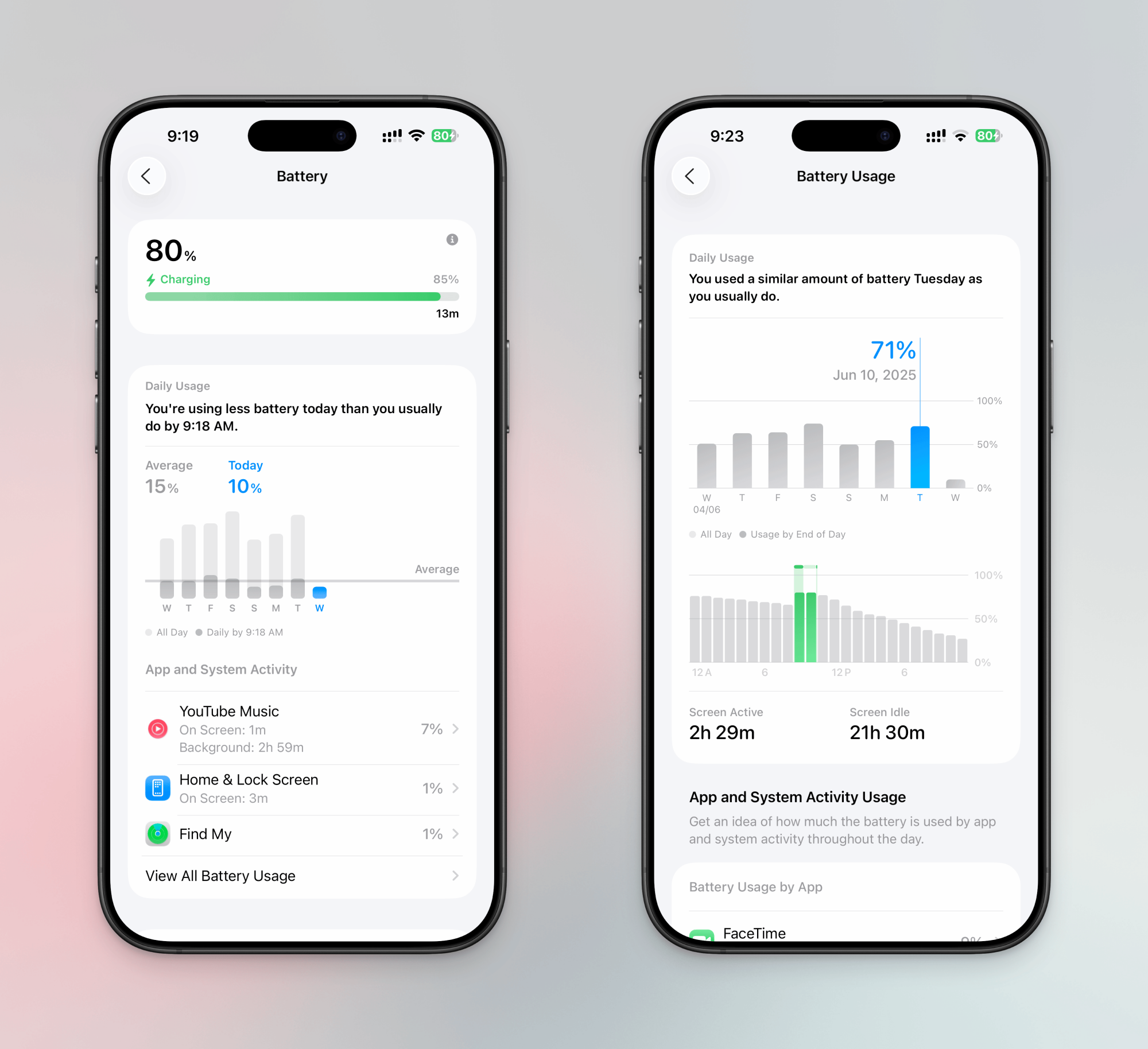
In iOS 26, when you head over to Settings > Battery, you’ll find a newly redesigned Battery screen. Up top, you’ll see a battery bar. If your iPhone is charging, you’ll see how long it will take to charge to 80%, and then to 100%.

Detailed Battery Graph

Credit: Khamosh Pathak

Below, you’ll notice that your Battery charts are now displayed in a simple Weekly view, just like with Screen Time.

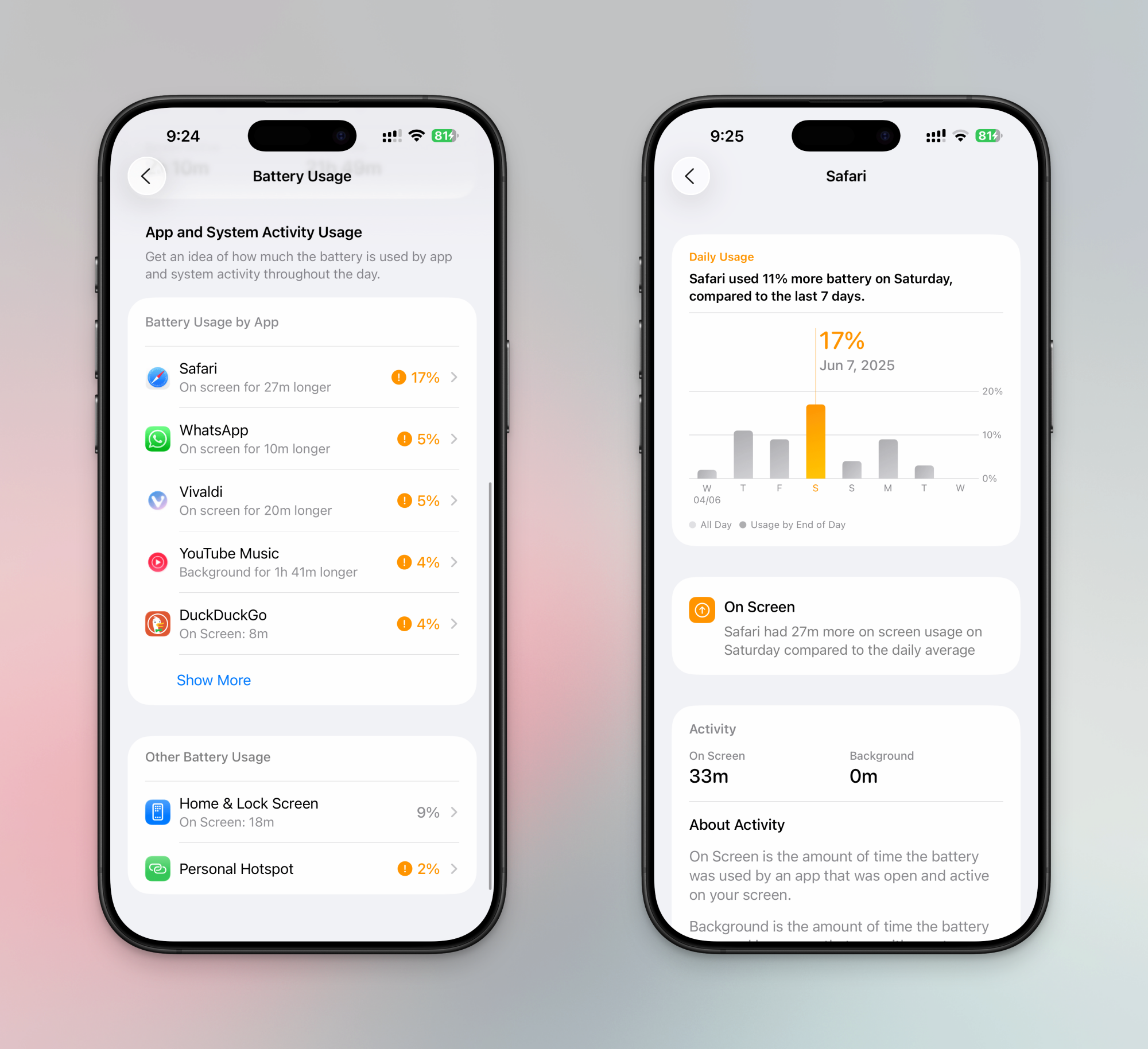
The new weekly charts are quite detailed, too. Apple will analyze and compare your battery usage across the week, telling you how your current usage compares with a typical day. Some days, you might use a lot more battery than you usually do, and the charts will take note of that. They’ll also tell you which apps are draining your battery the most.

For more detail, you can tap on the View All Battery Usage button to access a detailed interactive chart. Here, tap on any day to see more granular looks into your battery usage and charging history. You can scroll down to see how much juice each of your apps used, and how they compared with a weekly average. You can also choose a single app to see its battery history throughout the week. Quite cool.

Adaptive power mode

Adaptive Power Mode

Credit: Khamosh Pathak

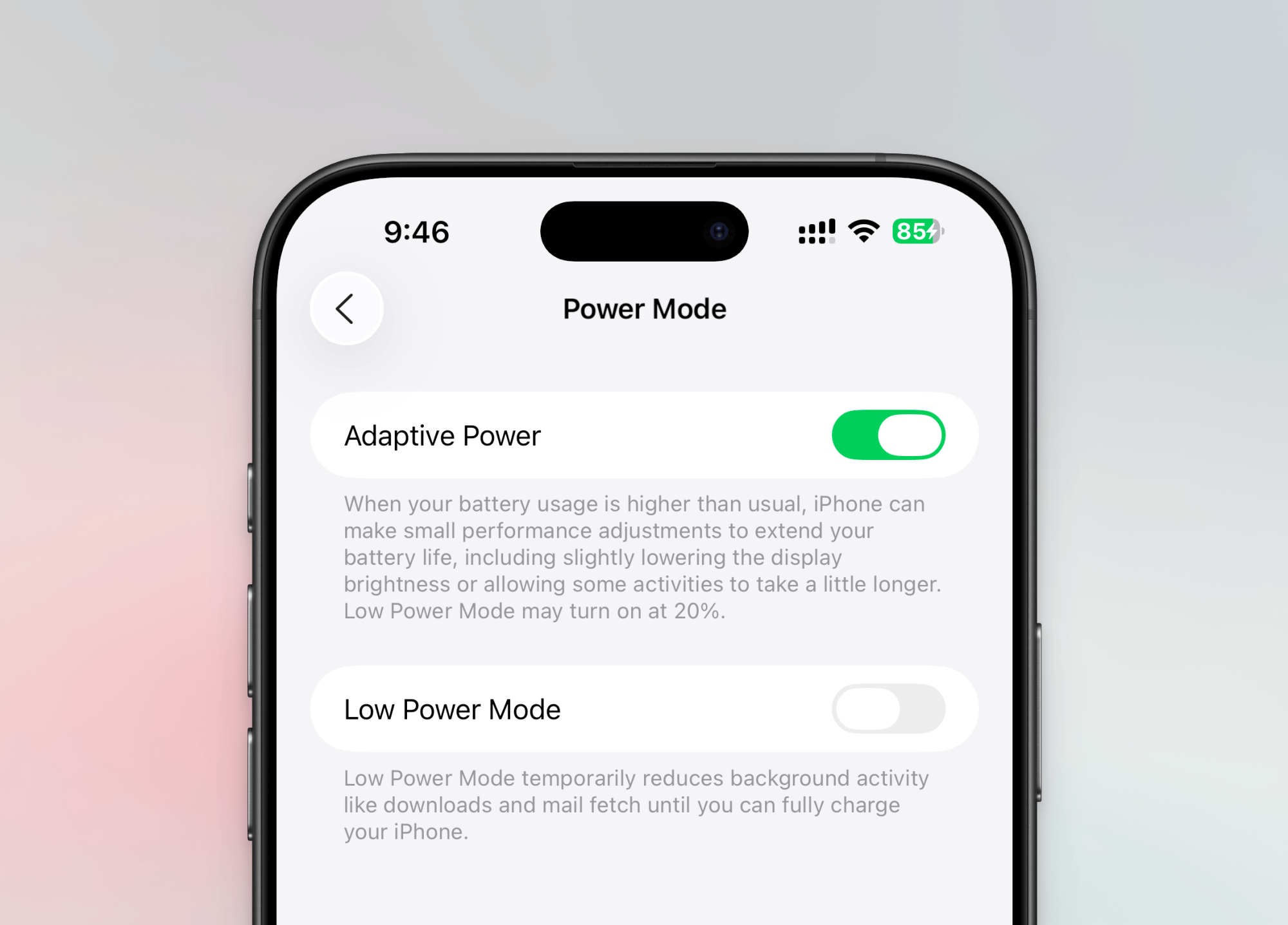
And finally, there’s the optional Adaptive Power Mode, found in Battery > Power Mode. This is Apple’s new battery saving feature, disabled by default, and it uses all your battery analysis data to make intelligent decisions on battery management. Say you’re having a heavier day than usual, and the chances of making it back home with 10% charge left are slim. In that case, your iPhone will start to make small tweaks like reducing performance slightly, reducing screen brightness, or taking more time to process some intensive tasks. Also, if this feature is enabled, your phone will automatically turn on low power mode when your battery reaches 20 percent.

Meta launches a surreal AI video editor

Meta’s impressive Movie Gen AI editing tool is starting to bear fruit. On Tuesday, the company launched a new editor for short videos, “inspired by” the technology. The editor lets you transform your clothing, location, style and more. The examples the company showcased are head-turning. We’re getting closer to Hollywood-level CG effects that anyone can produce in a few seconds.

The editor lets you choose from over 50 preset prompts. You can transform your video’s subject into things like comic art, a marble statue or a video game character. Or, transport them to a beach or a snowy scene. You can also add dreamy lighting effects and color overlays.

You can’t yet type custom prompts. However, those are scheduled for later this year.

Split-screen of a person dancing ballet. The digitally altered version (right) puts them in a cloudy dreamscape.
Meta

The AI editor is the first commercial spawn of Meta’s Movie Gen tech. Previewed last year as a private research tool, its results are surprisingly realistic. Like the tool Meta launched today, it can edit non-AI videos. But it can also generate videos from scratch and turn photos into videos. (Don’t be shocked if those capabilities migrate to Meta’s consumer products, too.)

For now, the new editing tool is available on the Meta AI app, Meta.AI website and the Edits app. It’s also coming to Instagram “over time,” according to platform head Adam Mosseri. (He also teased the feature last year.) Mosseri’s demo video shows some wild examples of the effects you can try.

This article originally appeared on Engadget at https://www.engadget.com/ai/meta-launches-a-surreal-ai-video-editor-173907584.html?src=rss

Wikipedia Pauses AI-Generated Summaries After Editor Backlash

The Wikimedia Foundation halted an experiment that would have displayed AI-generated summaries atop Wikipedia articles after the platform’s volunteer editor community delivered an overwhelmingly negative response to the proposal. The foundation announced the two-week mobile trial on June 2 and suspended it just one day later following dozens of critical comments from editors.

The experiment, called “Simple Article Summaries,” would have used Cohere’s open-weight Aya model to generate simplified versions of complex Wikipedia articles. The AI-generated summaries would have appeared at the top of articles with a yellow “unverified” label, requiring users to click to expand and read them. Editors responded with comments including “very bad idea,” “strongest possible oppose,” and simply “Yuck.”


Read more of this story at Slashdot.

Samsung Galaxy S25 Edge Review: Slim, Sleek But Living On The Edge

Samsung Galaxy S25 Edge Review: Slim, Sleek But Living On The Edge
Samsung Galaxy S25 Edge – Starting At $1,099, Find It On Samsung.com Samsung’s Galaxy S25 Edge is a 5.8mm thin phone that offers flagship specs for a flagship price at the expense of camera zoom performance and battery life.. Thin and light design Gorgeous display Superb main camera Quality speakers Solid performance Feature-rich software…

EVGA Motherboards Are Having RTX 50 Boot Problems But Here’s A Sticky Fix

EVGA Motherboards Are Having RTX 50 Boot Problems But Here’s A Sticky Fix
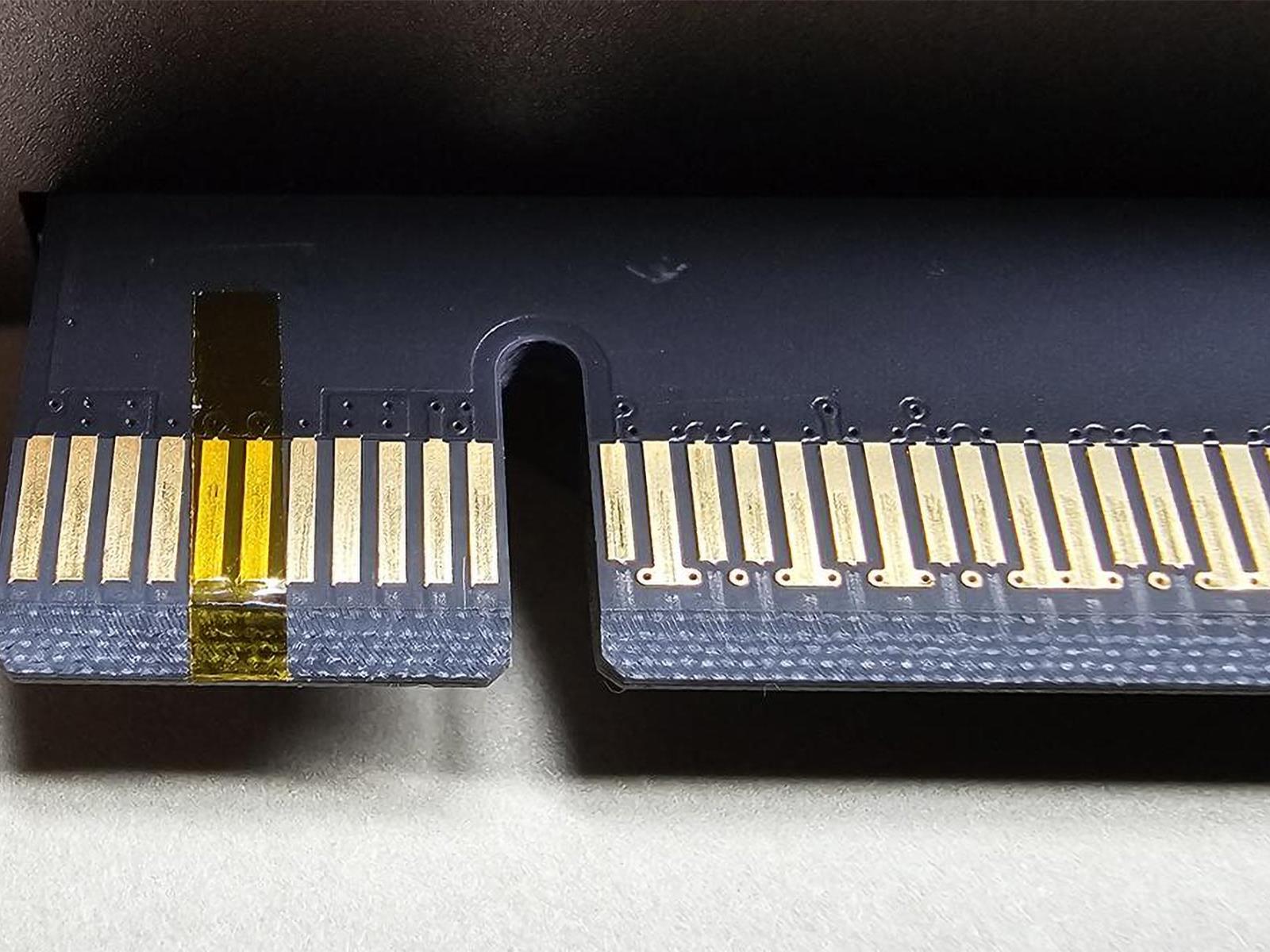
If you’ve been in PC building and the electronics world for long enough, you’ll know that kapton tape solves a lot of problems. This time around, it’s to fix an incompatibility between NVIDIA RTX 50 series cards and some EVGA Z690 motherboards (and possibly Z790 as well) that causes the system to not boot entirely.

The specific incompatibility

The Browser Company’s new AI browser rolls out to private beta testers

The Browser Company’s new AI-powered browser is now available in an invite-only beta. Called Dia, the browser was first announced towards the end of 2024, and is built around the deep integration of what its maker calls “the most personal AI on the market”.

Dia allows you to “chat with your tabs” and will adapt and learn the more you use it. You can open an AI chat on any webpage without having to leave the tab, where the built-in bot can search the web, compare websites, answer questions about the content displayed, and even draft a document in the tone of a specific webpage. You can set preferences to customize the chatbot’s tone and style for writing tasks, as well as its coding language and how it talks to you.

All of these features live within Dia’s URL bar, with the idea being that you don’t need to visit dedicated pages for other LLM chatbots such as ChatGPT to get things done with AI. The Browser Company has plenty of rivals, though, not least Google, which last month announced that it will soon bring its Gemini AI assistant to Chrome, which will be able to do many of the same things as Dia’s own chatbot. Opera’s upcoming Neon browser also comes with an integrated AI and is being billed as “fully agentic”.

Back in May, The Browser Company confirmed that it had stopped active development on its Arc web browser, shifting its focus to Dia instead. Arc members get instant access to the new browser and invite friends to join once they’re signed up to Dia. If you’re not a member of either browser you can join the waiting list here.

This article originally appeared on Engadget at https://www.engadget.com/ai/the-browser-companys-new-ai-browser-rolls-out-to-private-beta-testers-170311014.html?src=rss

This iOS 26 Feature Might Make Your iPhone Photos Look Much Better

With iOS 26, Apple is introducing a host of changes through the iPhone’s operating system. There’s the controversial Liquid Glass UI, which you can “fix” if you’d like; a redesigned Phone app, complete with Google-like call screening features; and a minimalist Camera app that hides most of your settings and tools until you need them. It’s a sizable update to be sure.

But every year, there are features that don’t make it into Apple’s big keynote presentation. These smaller changes are sometimes my favorite, because while they aren’t flashy enough to get a spotlight during the event, many are quirky, fun, or otherwise worth highlighting in their own right.

The Camera app has one such feature. Despite Apple’s focus on the app during the keynote, this feature wasn’t mentioned directly. Instead, Apple included it in a slide of 36 iOS 26 features they didn’t have time to talk about. I’m not sure why they didn’t take ten seconds to show it off during the Camera app segment, because not only is it a small change, it’s a very helpful one at that. With iOS 26, the Camera app will now alert you when your camera lens is dirty.

You can see how this works in this Reddit post. When iOS 26 detects that the lens is smudged or otherwise obstructed, it’ll display a small pop-up at the top of the viewfinder. In this case, it reads “Clean Back Camera,” but I presume it will also issue a similar warning for the front camera when taking a selfie.

From various Reddit discussions, it does appear that this feature isn’t available on all iPhones running iOS 26. While Apple supports devices as old as the iPhone 11 with this latest OS, the oldest iPhone I’ve seen mentioned that’s compatible with this feature is the iPhone 15 Pro. That user suggests it might be an AI feature, which makes sense—Apple reserves Apple Intelligence features for iPhone 15 Pro and newer.

Again, this is an iOS 26 feature, which means you won’t see it on your compatible iPhone until either Apple releases the OS in the fall, or you decide to install the iOS 26 beta on your device. I don’t recommend the latter, though, as the current developer beta comes with too many risks that might result in a glitchy iPhone or even data loss. If you want to try out iOS 26 early, I recommend at least waiting until the public beta, which Apple says will launch next month.

How to turn lens cleaning hints on or off

While the alert has an X you can tap to dismiss it when it appears, Apple also has a new on/off toggle for this option if you’d prefer not to see it all. To find it, head to Settings > Camera, then scroll down until you see Lens Cleaning Hints. Tap the toggle to enable or disable the feature.

With the launch of o3-pro, let’s talk about what AI “reasoning” actually does

On Tuesday, OpenAI announced that o3-pro, a new version of its most capable simulated reasoning model, is now available to ChatGPT Pro and Team users, replacing o1-pro in the model picker. The company also reduced API pricing for o3-pro by 87 percent compared to o1-pro while cutting o3 prices by 80 percent. While “reasoning” is useful for some analytical tasks, new studies have posed fundamental questions about what the word actually means when applied to these AI systems.

We’ll take a deeper look at “reasoning” in a minute, but first, let’s examine what’s new. While OpenAI originally launched o3 (non-pro) in April, the o3-pro model focuses on mathematics, science, and coding while adding new capabilities like web search, file analysis, image analysis, and Python execution. Since these tool integrations slow response times (longer than the already slow o1-pro), OpenAI recommends using the model for complex problems where accuracy matters more than speed. However, they do not necessarily confabulate less than “non-reasoning” AI models (they still introduce factual errors), which is a significant caveat when seeking accurate results.

Beyond the reported performance improvements, OpenAI announced a substantial price reduction for developers. O3-pro costs $20 per million input tokens and $80 per million output tokens in the API, making it 87 percent cheaper than o1-pro. The company also reduced the price of the standard o3 model by 80 percent.

Read full article

Comments

There’s a Steven Universe sequel series in the works at Prime Video

It’s been five years since the Steven Universe saga ended, via a final season and movie that took the story into the future. Now, it’s coming back, according to a report by Deadline. Prime Video is working on a sequel series, with franchise creator Rebecca Sugar in tow as an executive producer (and hopefully as a songwriter.)

This doesn’t look to be a straight sequel series, in that the focus is shifting away from Steven, the Crystal Gems and Beach City. Instead, the tentatively-titled Steven Universe: Lars of the Stars will follow punk rock slacker Lars Barriga and his ragtag band of space pirates.

Spoiler time: Just about every character got a cool arc in the main series, but Lars was one of the standouts. He started as a selfish jerk stuck at a dead-end job, but finished the show as the captain of an actual starship trying to make a difference in the universe.

Deadline says the new episodes will follow the “space outlaw as he and his pirate crew smuggle contraband, evade the authorities and uncover the darkest secrets of the fallen Gem Empire.” So this looks to be a series that will largely take place in space, exploring the fallout of the final episodes of the main show. We don’t know which, if any, of Steven Universe’s main characters will show up or in what capacity.

The news was revealed by Sugar at the Annecy International Animation Film Festival. She went on to say that she misses “my world and my characters” and that she “can’t wait to share [the sequel] with you and can’t thank you enough for all your support.” Sugar’s long-time production partner, Ian Jones-Quartey, is also involved.

We don’t have a release date for this, which gives you plenty of time to catch up on the OG show and the movie. There are 160 episodes, so buckle up. Once that’s done, there are several affiliated video games to dig into.

This article originally appeared on Engadget at https://www.engadget.com/entertainment/tv-movies/theres-a-steven-universe-sequel-series-in-the-works-at-prime-video-164211472.html?src=rss

HP’s First Google Beam 3D Video System Costs $24,999, Plus Unknown License Fees

HP has unveiled the first commercial hardware for Google Beam, the Android-maker’s 3D video conferencing technology formerly known as Project Starline, with a price tag of $24,999. The HP Dimension features a 65-inch light field display paired with six high-speed cameras positioned around the screen to capture speakers from multiple angles, creating what the companies describe as a lifelike 3D representation without requiring headsets or glasses.

The system processes visual data through Google’s proprietary volumetric video model, which merges camera streams into 3D reconstructions with millimeter-scale precision at 60 frames per second. Beyond the hardware cost, users must purchase a separate Google Beam license for cloud processing, though pricing for that service remains undisclosed.


Read more of this story at Slashdot.

Logitech’s New Flip Folio Keyboard Case Brings A Detachable Twist To iPad

Logitech's New Flip Folio Keyboard Case Brings A Detachable Twist To iPad
Logitech today announced the launch of the Logitech Flip Folio, a unique take on a protective case (with a magnetically-storable Bluetooth keyboard) designed specifically for the Apple iPad Pro and iPad Air. Breaking away from traditional keyboard cases, the Flip Folio emphasizes flexibility, portability, and multi-device connectivity in an

This Outdoor-Friendly Sony Bluetooth Speaker Is at Its Lowest Price Right Now

We may earn a commission from links on this page. Deal pricing and availability subject to change after time of publication.

The Sony SRS-XE300 is now down to $88 from its original $199.99 on Amazon (its lowest price ever, according to online price tracking tools), making it a decent time to check it out if you’ve been thinking about a portable speaker that can handle the occasional splash and still keep the music going.

Sony gave the outdoor-friendly XE300 a different design approach than most speakers: It’s shaped to stand upright but also works fine lying on its side. Inside are dual drivers with passive radiators at each end, aimed at giving you deeper bass and less distortion. The sound, though, is more directional than Sony probably intended—better aimed at you than trying to fill a big space.

It defaults to mono audio, but you can switch to stereo using the app if you prefer. It also supports LDAC for high-res Bluetooth streaming if you have an Android device, though it skips the AptX codec. The companion app isn’t much to look at, but it gives you access to an adjustable EQ and other sound tweaks, notes this PCMag review. Where the XE300 really holds up is in how tough it is. It has an IP67 rating, so dust, rain, or a quick dip in the pool won’t faze it. As for battery life, Sony claims up to 24 hours of usage, but your mileage will vary depending on volume and settings.

Sound-wise, it delivers decent bass and clear highs, though the directional setup means you’ll get a better experience when it’s aimed right at you. Also, the stereo mode doesn’t dramatically widen the soundstage, but in a multi-speaker setup, it holds up well. At moderate volumes, it puts out a nice thump and keeps the highs clear without much distortion creeping in. It’s not going to give you a wall-shaking, subwoofer feel, but for a speaker you can toss in a bag and forget about until you need it, the XE300 handles itself well, especially at this price. For more options, check out our roundup of the best Bluetooth speakers.

Tesla will start offering public Robotaxi rides in Austin on June 22, says Elon Musk

Tesla CEO Elon Musk says that Robotaxi service is “tentatively” set to begin in Austin, Texas on June 22. This comes after the company said last month that it had already begun testing driverless Model Ys in Austin. Shortly after that, Bloomberg reported that Tesla had internally discussed a launch date of June 12, though the only publicly shared timeline has been sometime in June.

The first Robotaxi Model Y operating without a person in the driver’s seat was spotted on South Congress in Austin yesterday. It sported a decal on the side of the vehicle that read “Robotaxi” in the same font as Tesla’s stylized version of Cybertruck. In the video, a person sitting in the passenger seat can be seen, though it’s unclear what their role is. 

HOLY CRAP ITS A #ROBOTAXI!!@SawyerMerritt @WholeMarsBlog @DirtyTesLa @niccruzpatane pic.twitter.com/slfAsu0AQl

— Terrapin Terpene Col (@TerrapinTerpene) June 10, 2025

The driverless Model Y was followed closely behind by a Model Y with a driver, though again, their role and identity are unclear. Musk had previously said that Robotaxis will be remotely monitored at first and geofenced to areas of Austin that are the safest for the vehicles to navigate.

Musk, who has a history of playing fast and loose with timelines, had originally promised in 2019 that there would be one million Robotaxis on the road by 2020. He now says the company will start with about 10 taxis in Austin, before expanding rapidly.

Reuters recently attempted to gather more information on Tesla’s planned launch and vehicles from the City of Austin, but city officials were blocked from releasing any information by Tesla and the Texas Attorney General.

This article originally appeared on Engadget at https://www.engadget.com/transportation/evs/tesla-will-start-offering-public-robotaxi-rides-in-austin-on-june-22-says-elon-musk-161801916.html?src=rss

HP reveals first Google Beam 3D video conferencing setup, priced at $25,000

Amid all the Gemini hype at Google I/O last month, the company also turned one of its experiments into a (kind of) real product. Project Starline was reborn as Google Beam, a 3D video conferencing system that makes it look like you’re in the same room with the other party. Google said HP would reveal the first Beam setup, and now it has. The HP Dimension is coming this year, and the price tag is a predictably hefty $24,999.

Google Beam calls for a lot of advanced hardware, so the high price isn’t a surprise. The HP Dimension uses six high-speed cameras positioned around the display to capture the speaker from multiple angles. This visual data is then fed into Google’s proprietary volumetric video model, which merges the streams together into a 3D reconstruction of the speaker.

Eventually, there will be Beam systems of various sizes, but the HP model comes with a big 65-inch display. All Beam systems will use light field screen technology, which can show the volumetric model in 3D, eliminating the need to wear a headset or glasses for the 3D effect. Google says Beam can show minute details at 60 fps with millimeter-scale precision.

Read full article

Comments

Major Telescope Hosts World’s Largest Digital Camera

The Vera C. Rubin Observatory in Chile will begin full operations in the coming months with the world’s largest digital camera, capturing 3,200-megapixel images that would require several hundred HD television screens to display at full resolution. The $810 million facility will map the entire southern sky every three to four nights, observing each location approximately 800 times over its planned decade of operations.

The telescope’s unusual design allows it to photograph an area equivalent to 45 full moons in each shot and swing between different sky locations every 40 seconds. Its digital camera, roughly the size of a small car, will generate eight million alerts per night when it detects astronomical objects that move or change brightness, according to Tony Tyson, the University of California, Davis astronomer who conceived the project in the 1990s. Astrophysicist Federica Bianco, who received a preview of the telescope’s first full-color image, described her reaction simply: “There are so many stars!” The team plans to unveil that inaugural image on June 23.


Read more of this story at Slashdot.