Solar Orbiter captures images of the sun’s pole for the first time

The Solar Orbiter has been observing the sun since 2021, but it recently went on a side trip to Venus which significantly tilted its orbit and gave it a good view of the sun’s polar region. That is how it was able to capture images that will historically be known as humankind’s first-ever views of the sun’s pole. All our galaxy’s planets and the other spacecraft we’ve deployed orbit the sun around an imaginary ecliptic plane along the star’s equator. But thanks to the Solar Orbiter’s Venus flyby, it now has a view of the sun from below its equator, allowing it to see the star’s southern pole clearly. The images you see above were captured from an angle of 15 degrees below the equator on March 16 and 17, but the probe has reached the 17 degree maximum angle it could achieve since then.

Three of the probe’s instruments were responsible for the images. The Polarimetric and Helioseismic Imager (PHI) imaged the sun in visible light and mapped its surface magnetic field. Meanwhile, the Extreme Ultraviolet Imager (EUI) imaged the sun in ultraviolet light, and the Spectral Imaging of the Coronal Environment (SPICE) instrument captured light “coming from different temperatures of charged gas above the sun’s surface, thereby revealing different layers of the sun’s atmosphere.”

So what exactly was the Solar Orbiter able to observe at the sun’s southern pole? Well, the pole’s magnetic field, simply put, is a mess at the moment. See, the sun’s magnetic field flips roughly every 11 years, and it’s about to flip this year if it hasn’t yet. Normally, a magnet has a clear north and south pole, but the orbiter’s PHI instrument showed that both north and south polarity magnetic fields are present at the sun’s south pole right now. “This happens only for a short time during each solar cycle, at solar maximum, when the Sun’s magnetic field flips and is at its most active,” ESA explained. 

After the flip, the magnetic field fixes itself so that the poles have single polarities. The process is gradual, however, and it will take five to six years to achieve solar minimum, wherein which the sun’s magnetic field is at its most orderly. These solar cycles or regular magnetic field flips aren’t fully understood yet, and the orbiter’s observations could be the key to unlocking that knowledge. 

In addition, scientists used the orbiter’s SPICE instrument to take Doppler measurements, or how fast clumps of solar material are moving. They then took that information to create a velocity map that shows how solar material moves within a specific layer of the sun. These measurements can show how the sun flings out particles into space in the form of solar winds, which is one of the orbiter’s key goals. 

This article originally appeared on Engadget at https://www.engadget.com/science/space/solar-orbiter-captures-images-of-the-suns-pole-for-the-first-time-123047746.html?src=rss

You Can Try macOS 26 Tahoe (for Free) Without Risking Your Current Device

Want to try out macOS 26, but don’t want to use a buggy pre-release operating system as your daily driver? You can set it up in a virtual machine instead. This lets you get a feel for the upcoming operating system without potentially messing up your computer.

We’ve talked about how to set up Tahoe, but that guide replaced your current operating system. That’s OK if you’ve got a second machine specifically for testing, or if you’re for some reason willing to put up with a great deal of wonky-ness and potential data loss. The good news is that UTM offers free virtual machines on Apple Silicon Macs and it can run macOS 26 Tahoe right now—you just need to take a few minutes to set it up.

This guide assumes that you’re got a Mac with an Apple Silicon chip. If you’re a Windows user or still rocking an Intel Mac, you’ll have to find some other method for trying out Tahoe.

Download macOS 26 Tahoe

To get started, download the operating system. You will need to create an Apple Developer account, if you don’t have one—you can enroll here. Eventually, you will be asked to pay $99 but you don’t actually have to—just close the tab when you get to that part.

Now head to Head to developer.apple.com/download. You will see a list of operating systems you can download, including the macOS 26 beta. Click the Mac computers with Apple silicon link to download the IPSW file—it’s an 18.29 GB file, so make sure you have plenty of storage space.

You’ll need to download one more file, called Device Support for macOS 26 beta. Download this DMG, open it, and run the package installer. Setting up Tahoe in UTM won’t work unless you install this, so don’t skip this step.

Set up UTM

Download UTM, an open source Mac application, and install it, assuming you haven’t already. The Mac App Store version costs $10, which supports the developers, or you can download the installer for free.

Launch UTM and click the plus icon to create a new virtual machine. Make sure you choose Virtualize, not Emulate, for the best performance. You’ll then be asked how much memory and hard drive space you want to allocate to the machine—I suggest sticking with the defaults, just make sure you’ve got enough free storage space on your drive. Eventually you will be asked for an IPSW file.

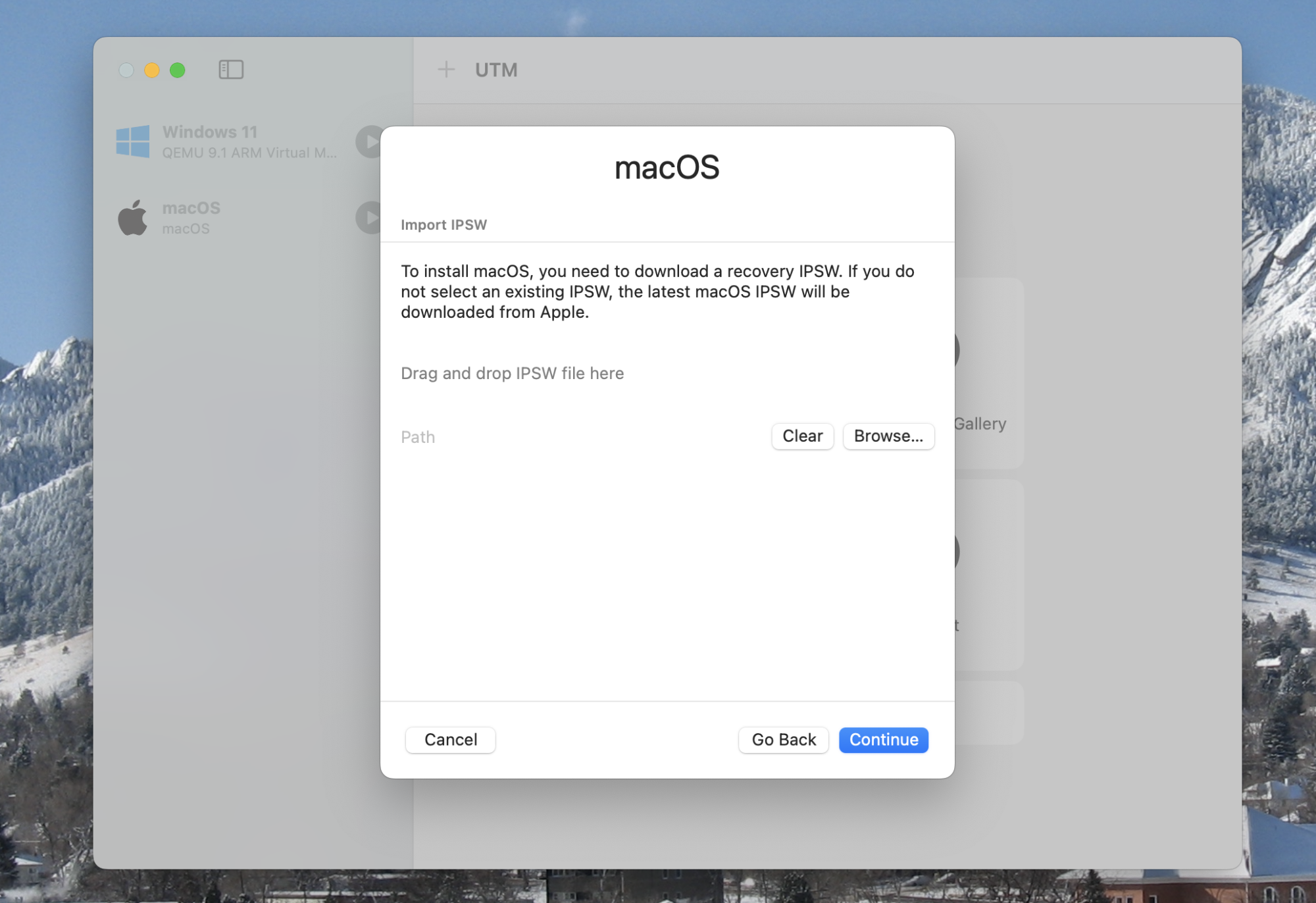
UTM's setup wizard asking for the IPSW file

Credit: Justin Pot

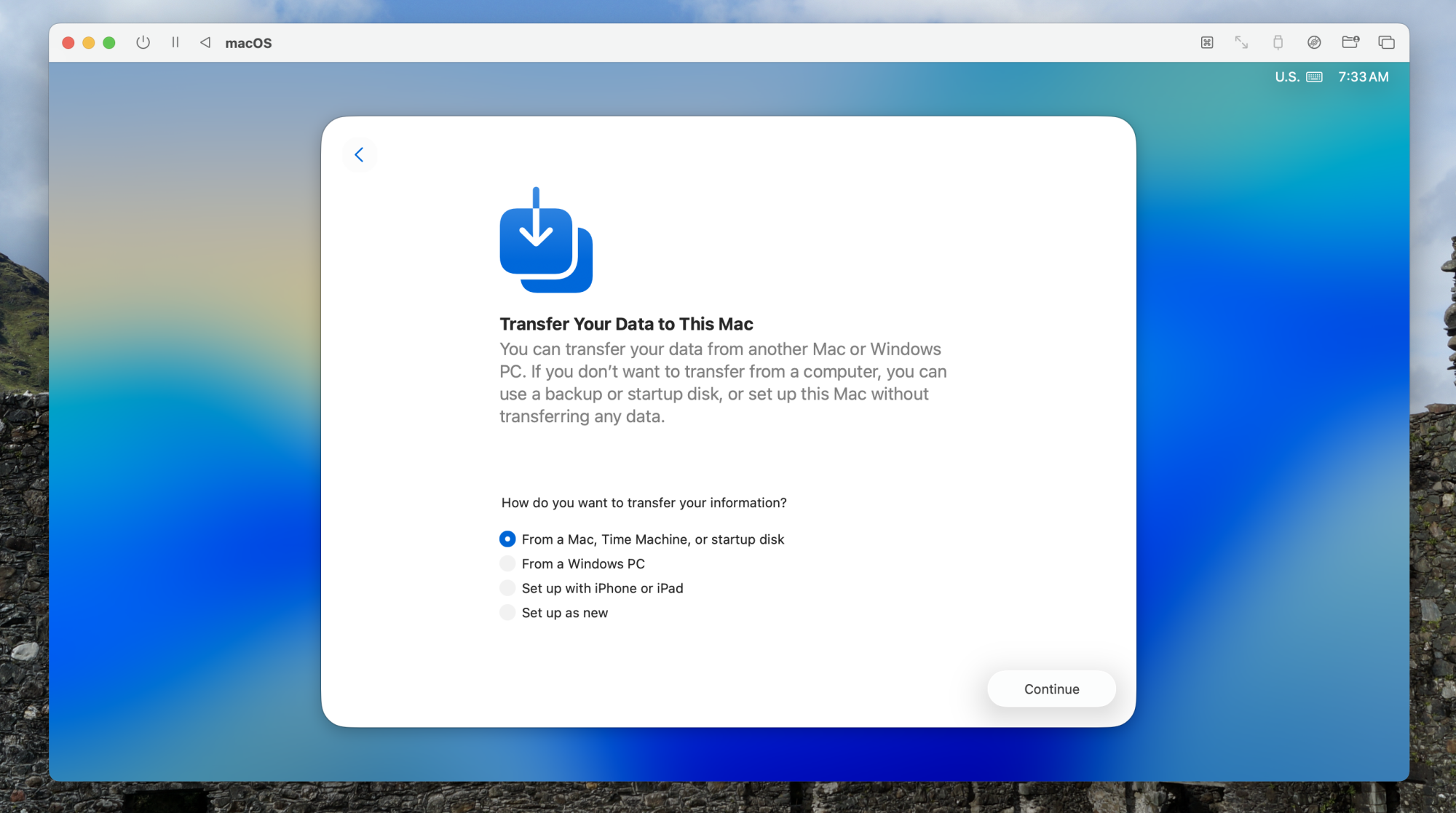
Drag the file you downloaded earlier here and click Continue. The installation process will begin, mostly not bothering you. Eventually, you will see the first-time setup wizard where you set up an account, choose your language and region, and sign into your iCloud account. You will be asked whether you want to transfer data, a step I recommend you skip.

The macOS setup screen asking if you want to import your files.

Credit: Justin Pot

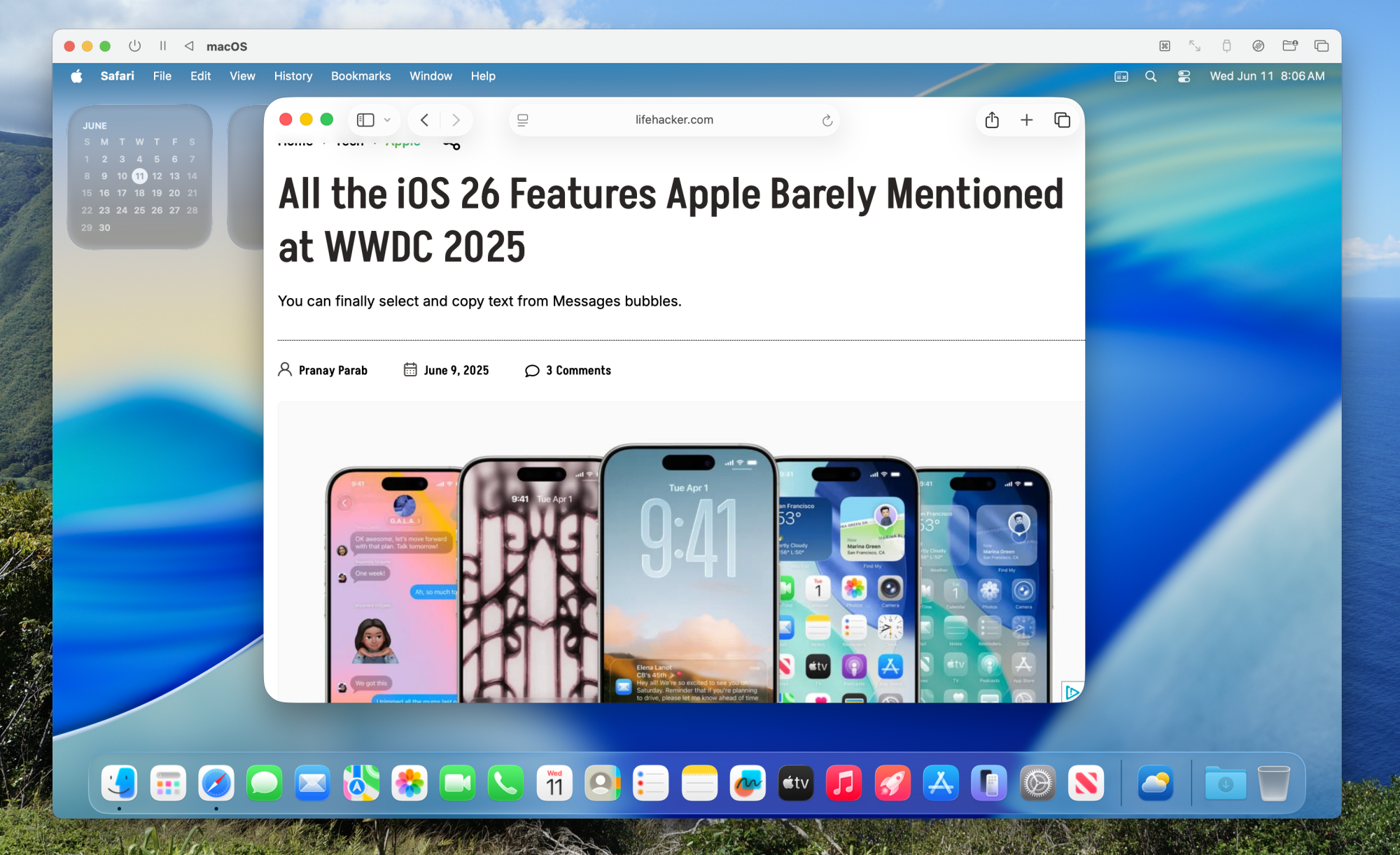
After completing the steps, you’ll be able to log into macOS Tahoe.

macOS Tahoe running in a virtual machine. A Lifehacker article is open in Safari

Credit: Justin Pot

This operates as though you’re using a brand new Mac. I was able to easily move my mouse inside and outside the window, and resizing the window adjusted the resolution of the virtual machine.

If you want to access files on your Mac from inside the virtual machine, I recommend doing that with the file sharing feature in macOS itself. I could connect to any shared folder on my network from the virtual machine, including files shared from the Mac it was running on.

This is going to be the way I test Tahoe features from now until its official release in the fall. If you want a way to get a feel for Apple’s upcoming OS without using a beta as your full time system, I recommend you give this a try.

Middleware vs API Gateway: Choosing the Right Backbone for Modern eCommerce

As eCommerce infrastructure becomes more complex, the glue that holds it all together is more important than ever. You might be using Shopify or Magento for your storefront, QuickBooks for accounting, Rithum for marketplace management, and a POS system like Counterpoint — but how do you make all these tools communicate seamlessly?

The answer lies in choosing the right integration backbone. Two of the most common architectural approaches are:

  • Middleware, and
  • API Gateways

While they might seem similar on the surface, they serve very different roles — and choosing the wrong one for your eCommerce operation could lead to missed orders, stock mismatches, frustrated customers, and limited scalability.

In this article, we’ll break down the difference between middleware and API gateways, and help you decide which approach best supports a modern, multi-channel eCommerce business.

What Is Middleware?

Middleware is a central layer that sits between your systems — like your eCommerce platform, accounting tools, POS, CRM, and marketplaces — and handles communication between them.

It’s like an interpreter at a multi-lingual meeting: it ensures that each system can send and receive information in the correct format, at the correct time.

For example, a tool or a software like Helix might enable:

  • Real-time order sync between Shopify and QuickBooks
  • Inventory coordination between Magento and Amazon via Rithum
  • Product listing updates across WooCommerce and Walmart
  • Two-way communication between POS (e.g. Counterpoint) and online channels

Middleware typically offers built-in connectors, logic rules, scheduling, monitoring, error handling, and retry mechanisms — meaning less custom code and more automation.

What Is an API Gateway?

An API gateway is more of a traffic controller. It sits in front of a group of backend services and provides a single point of entry for external clients (e.g., apps, front-ends, or third-party services).

It’s commonly used in microservices architectures to route requests, enforce security, and manage throttling.

Key roles of an API gateway include:

  • Routing requests to appropriate backend services
  • Authentication and rate limiting
  • Caching or transformation of requests/responses
  • Aggregating responses from multiple services

An API gateway doesn’t contain business logic or automation — it’s a facilitator, not a decision-maker.

Middleware vs API Gateway: The Core Differences

Feature Middleware API Gateway
Primary Purpose System integration and automation Request routing and access control
Handles business logic? Yes No
Ideal for batch jobs? Yes No
Real-time & scheduled sync Yes Limited
Built-in connectors? Often available Requires custom development
Developer involvement Minimal (low-code / prebuilt flows) High (requires dev resources)

In short:

  • Middleware is built for automating eCommerce operations
  • API Gateways are built for exposing and managing APIs to external apps or services

Which Is Better for eCommerce?

Let’s get practical. Say you’re running a growing eCommerce operation using Shopify, Amazon, QuickBooks, and Rithum.

You need:

  • Accurate inventory sync across all sales channels
  • Real-time order flow from Shopify and Amazon into QuickBooks
  • Automated updates when product prices change
  • The ability to migrate to Magento later without losing historical data
  • A way to manage listings across multiple marketplaces without manual duplication

An API gateway alone can’t help with this. You’d need to build and maintain individual APIs for each system, create logic for transforming and matching data, handle retries, and scale the infrastructure.

A tool like Helix, however, is purpose-built for this kind of operational complexity. It already understands how these systems speak and can orchestrate data flows without writing hundreds of lines of code.

Use Case Comparison: Where Each Excels

Use middleware when you need to:

  • Connect multiple SaaS platforms (Shopify, Magento, QuickBooks, Rithum, Amazon, etc.)
  • Automate business processes (orders, inventory, fulfilment, accounting)
  • Handle data transformations and scheduling
  • Minimise development overhead
  • Scale operations without building custom APIs for every tool

Use API gateways when you need to:

  • Manage access to internal services from external clients
  • Build a custom front-end that consumes multiple internal APIs
  • Enforce security and rate limits for external API consumers
  • Support mobile or IoT apps querying your system in real time

Can They Work Together?

Yes — and often they should.

In more advanced setups, companies use:

  • Middleware to integrate business systems and automate workflows
  • API gateways to expose controlled endpoints to front-end apps, mobile teams, or partners

For example, your middleware could pull product data from Magento and send it to Amazon, while your API gateway exposes product availability to a mobile app.

They’re complementary, not competing — but for B2B eCommerce operations, middleware does most of the heavy lifting.

Why eCommerce Needs Middleware Now More Than Ever

With more sales channels, international customers, and inventory sources than ever, modern eCommerce brands face a massive data challenge.

  • Stockouts from slow syncs
  • Duplicate listings on different marketplaces
  • Inaccurate reporting due to siloed systems
  • Delays in fulfilment caused by missing order data

These aren’t “growing pains” — they’re integration problems.

By choosing the right middleware backbone early on, you build a tech stack that’s:

  • Modular — switch tools without chaos
  • Scalable — handle more volume with less effort
  • Reliable — fewer human errors, more automation
  • Adaptable — ready for new marketplaces and channels

Final Thoughts

While API gateways play an important role in modern architecture, they aren’t built for the complexity of multi-channel eCommerce. They don’t understand products, orders, or inventory — and they won’t solve your sync headaches.

If you’re looking to unify Shopify, Magento, QuickBooks, Rithum, WooCommerce, Amazon, and more — you need middleware built for commerce.

That’s exactly what Helix Solutions delivers: a robust integration backbone that allows your systems to talk, sync, and scale — without rewriting your business logic from scratch.

Because in modern eCommerce, integration isn’t a luxury — it’s the infrastructure for growth.

HP Dimension with Google Beam: Revolutionizing Virtual Collaboration with True-to-Life 3D

Here in San Jose at InfoComm 2025, the air is crackling with excitement over an announcement that promises to fundamentally reshape how we connect in the professional world. In a groundbreaking collaboration with Google, HP has unveiled HP Dimension with Google Beam, a first-of-its-kind 3D video communication solution designed to bring truly lifelike virtual collaboration to the enterprise (it is incredibly impressive in person as it’s fully 3D and very much like sitting across from a real person in the same room with you. (Wait until they use this for talking to AI avatars!)

This isn’t just another incremental upgrade to video conferencing; it’s a leap forward into a deeply immersive experience that replicates the feeling of being truly in-person, all without the need for cumbersome headsets, glasses or other wearables. This technology is not just innovative; it’s a game-changer for workplace communication.

Bridging the Connection Gap: More Than Just a Video Call

The COVID-19 pandemic irrevocably altered the landscape of work, pushing virtual collaboration to the forefront. However, even with the proliferation of video conferencing tools, a persistent problem has remained: the feeling of disconnect. As HP’s own Work Relationship Index indicates, a significant 73% of knowledge workers express a desire to feel more connected to their coworkers. This isn’t merely about seeing faces on a screen; it’s about the subtle cues, the shared spatial awareness and the genuine human connection that often gets lost in a flat 2D environment. HP Dimension with Google Beam is explicitly designed to address this profound need, aiming to establish deeper, more meaningful connections that transcend geographical distance.

The Magic Behind the Beam: 3D Imaging and Light Field Displays

The real magic of HP Dimension with Google Beam lies in its sophisticated technological foundation. The system employs six cameras to capture a comprehensive, lifelike 3D video of each participant. This raw 3D data is then processed by state-of-the-art AI, creating a remarkably realistic virtual representation. What truly sets it apart is how this 3D video is displayed: on a special light field display. Unlike traditional screens that present a flat image, a light field display projects light rays in multiple directions, allowing the viewer to perceive realistic size and depth, and can even make natural eye contact with the virtual participant without any special eyewear. It truly makes it feel as though the person is in the same room, eliminating the flat, disembodied sensation common to current video calls. This is the groundbreaking element, transforming distant colleagues into virtual presences that feel tangible and immediate.

Measurable Impact: Enhanced Recall and Focus

The benefits of this deeply immersive experience extend beyond just a “nice-to-have” feeling. Initial testing has already yielded impressive results: users of HP Dimension with Google Beam have reportedly experienced a 28% better memory recall and a 39% greater focus during virtual interactions. This measurable impact underscores the solution’s potential to drive not only deeper connections but also tangible improvements in productivity and collaboration. Imagine brainstorming sessions where ideas flow more freely because participants feel truly present, or training sessions where information retention is significantly higher. This is where cutting-edge technology directly translates into measurable business value.

Versatile Functionality and Ecosystem Compatibility

HP Dimension with Google Beam isn’t a niche, single-use device. It’s designed for versatility within the enterprise ecosystem. It will provide a native experience for popular platforms like Zoom Rooms and Google Meet, ensuring seamless integration into existing workflows. Crucially, it also supports three distinct functions:

  1. 3D immersive one-on-one communications: The core, true-to-life virtual collaboration experience.
  2. 2D traditional group meetings: Allowing for compatibility with standard video conferencing.
  3. Interoperability with cloud-based video services: Ensuring connection with platforms like Microsoft Teams and Webex, broadening its utility within diverse IT environments.

This broad compatibility minimizes friction for adoption and ensures that businesses can leverage this breakthrough technology without completely overhauling their existing collaboration infrastructure.

Enhancing the Experience: HP Poly Studio A2 Audio Solutions

Complementing the visual breakthroughs, HP also announced the HP Poly Studio A2 Audio Solutions, including the HP Poly Studio A2 Table Microphone and Audio Bridge. These solutions are designed to ensure that even with the most lifelike visuals, the audio experience is equally immersive and clear. The table microphone offers crystal-clear pickup and daisy-chain scalability for up to eight microphones, allowing for pristine audio in conference rooms of every size. The Audio Bridge further enhances scalability, supporting up to 32 synchronized input channels and seamlessly connecting to next-generation Poly Studio video systems over a single Ethernet cable. This unlocks the full power of advanced audio intelligence with NoiseBlockAI technology, ensuring that participants, even those farthest away in large meeting spaces, are always heard clearly. The combination of stunning 3D visuals and crystal-clear audio creates a truly holistic and engaging virtual meeting experience.

Wrapping Up: The Future of Collaboration Has Arrived

HP Dimension with Google Beam represents a pivotal moment in the evolution of virtual collaboration. By leveraging sophisticated 3D imaging, AI and light field displays, HP and Google are delivering an enterprise-ready solution that authentically replicates in-person interaction without the need for cumbersome wearables. This groundbreaking technology, supported by robust audio solutions from HP Poly, promises to establish deeper human connections, enhance memory recall and focus and integrate seamlessly into existing IT ecosystems. It’s a significant leap beyond traditional video conferencing, offering businesses a powerful tool to foster more meaningful and productive virtual work relationships. The future of collaboration isn’t just about seeing; it’s about truly being there, and HP Dimension with Google Beam appears to have brought us a substantial step closer to that reality.

Apple’s iOS 26 requires kids to get parental permission to text new numbers

As part of new updates to its parental controls announced at WWDC 25, Apple has introduced a new feature that requires kids to get permission to text new numbers. That’s among other new child safety settings including more granular age-based app ratings that will be introduced to the new iOS 26, iPadOS 26, macOS Tahoe 26, watchOS 26, visionOS 26, and tvOS 26 operating systems coming this fall, Apple announced. 

The new feature called Communication Limits (part of Child Accounts) gives parents the ability to manage their kids communications across Messages, FaceTime, calling and iCloud contacts. Children must send a request to their parents when they want to contact a new phone number and parents can then give approval with a single tape in Messages. Developers can include the new function in third-party apps using Apple’s PermissionKit framework. 

Apple's iOS 26 requires kids to get parental permission to text new numbers
Apple

Another new child-friendly feature is more granular age-based ratings for apps to help parents decide which are safe for their kids to use. By the end of 2025, those will expand to five categories including three for adolescents: 13+, 16+ and 18+. When parents set app content restrictions, apps that exceed those will not appear on the App Store — though kids can request exemptions if the Ask to Buy setting is enabled. 

Apple already employs safety features like web content filters and app restrictions for kids under 13, but it will now enforce “similar age-appropriate” protections for teens between 13 and 17. The company will also let parents give apps a child’s age range without disclosing their exact date of birth. Finally, the Communication Safety tool has been expanded to intervene when it detects nudity in FaceTime video calls and it will blur out nudity in Shared Albums in Photos. 

Apple’s changes follow in the heels of new age-verification laws enacted in Texas, Utah and and other states. Google, for one, opposed the Utah bill, but Meta and other app makers have called for legislation that would require app stores to get parental approval before their teens download any app — effectively offloading the responsibility to Apple, Google and others.

This article originally appeared on Engadget at https://www.engadget.com/apps/apples-ios-26-requires-kids-to-get-parental-permission-to-text-new-numbers-120049197.html?src=rss

Your Switch Online Subscription Might Include Upgrades for Two ‘Legend of Zelda’ Games

It’s only been a week since the Switch 2 landed, and Nintendo has already sold over 3.5 million consoles. If you’re one of the lucky people who nabbed one, don’t forget to upgrade your old games for the new handheld. And if you’re a Switch Online  + Expansion Pack subscriber, you can get upgrades for games like Breath of the Wild and Tears of the Kingdom for free.

If you already own either Zelda game for the original Switch, then an upgrade pack normally costs $10 each. You don’t need to buy these upgrade packs to play your old copy, but they provide benefits like better performance, faster load times, an extra save slot, and access to the Zelda Notes mobile app.

While a cumulative $20 for upgrades sounds like a bit much—especially for games you already bought, and right after dropping $500 for a new console—the good news is you might have already paid it. Sort of. The Switch Online + Expansion Pack subscription costs $50/year, and subscribers to that plan can get the Zelda upgrades for free.

The process is a little less than straightforward, though. Head to the eShop and search for either Breath of the Wild or Tears of the Kingdom. The listings you’ll find for the upgrades will show the $10 price tag, but once you add it to your cart, the discount will be applied at checkout. Just make sure you’re using the account that’s tied to your subscription.

It’s also important to note that this won’t work if you have the Switch Online subscription without the Expansion Pack tier. The regular subscription costs $20/year and the Expansion Pack adds another $30/year, but it also comes with access to a host of classic games from the GameCube, Nintendo 64, Game Boy, and even Sega Genesis.

Before you opt for the higher subscription just to get the Zelda upgrades, though, keep in mind that you’ll lose access to those upgrade packs if you cancel. At the moment, Nintendo’s site says that an “active membership [is] required” to get the Zelda upgrades. 

If you’re already paying for the full subscription, you might as well get the upgrade for free, but if you’re planning to cancel it, you might be better off forking over the $20 for the upgrades directly. At the very least, you can put off paying for the upgrade directly until your subscription lapses.

Denmark Is Dumping Microsoft Office and Windows For LibreOffice and Linux

An anonymous reader quotes a report from ZDNet: Denmark’s Minister of Digitalization, Caroline Stage, has announced that the Danish government will start moving away from Microsoft Office to LibreOffice. Why? It’s not because open-source is better, although I would argue that it is, but because Denmark wants to claim “digital sovereignty.” In the States, you probably haven’t heard that phrase, but in the European Union, digital sovereignty is a big deal and getting bigger.

A combination of security, economic, political, and societal imperatives is driving the EU’s digital sovereignty moves. EU leaders are seeking to reduce Europe’s dependence on foreign technology providers, primarily those from the United States, and to assert greater control over its digital infrastructure, data, and technological future. Why? Because they’re concerned about who controls European data, who sets the rules, and who can potentially cut off access to essential services in times of geopolitical tension. “Money issues have also played a decisive role,” writes ZDNet’s Steven Vaughan-Nichols. “Copenhagen’s Microsoft software bill has soared from 313 million kroner in 2018 to 538 million kroner — about $53 million in 2023, a 72% increase in just five years.

David Heinemeier Hansson (DHH), a Dane, inventor of Ruby on Rails, and co-owner of the software developer company 37Signals, has said: “Denmark is one of the most highly digitalized countries in the world. It’s also one of the most Microsoft-dependent. In fact, Microsoft is by far and away the single biggest dependency, so it makes perfect sense to start the quest for digital sovereignty there.”


Read more of this story at Slashdot.

Amazon Prime Video subscribers sit through up to 6 minutes of ads per hour

Amazon forced all Prime Video subscribers onto a new ad-based subscription tier in January 2024 unless users paid more for their subscription type. Now, the tech giant is reportedly showing twice as many ads to subscribers as it did when it started selling ad-based streaming subscriptions.

Currently, anyone who signs up for Amazon Prime (which is $15 per month or $139 per year) gets Prime Video with ads. If they don’t want to see commercials, they have to pay an extra $3 per month. One can also subscribe to Prime Video alone for $9 per month with ads or $12 per month without ads.

When Amazon originally announced the ad tier, it said it would deliver “meaningfully fewer ads than linear TV and other streaming TV providers.” Based on “six ad buyers and documents” ad trade publication AdWeek reported viewing, Amazon has determined the average is four to six minutes of advertisements per hour.

Read full article

Comments

Experimental retina implants give mice infrared vision

Human vision relies on photoreceptor cells in the retina that react to visible light and trigger neurons in the optic nerve to send signals to the brain. Degradation of these photoreceptors is the leading cause of vision impairments, including blindness.

However, a team of scientists at China’s Fudan University has recently built prototype retinal implants that can replace the failing photoreceptors and potentially provide infrared vision as a bonus. Sadly, they’ve only been tested in animals, so we’re still rather far away from making them work like Cyberpunk 2077-style eye augments.

Vision on chip

Earlier work on retinal implants that restored at least some degree of vision to the blind involved using electrode arrays that electrically stimulated neurons in the back of the retina, taking the place of the damaged photoreceptor cells. A patient had to wear a camera mounted on a pair of glasses that sent signals to the implant to activate this signaling. These implants required a power source to work, were unreliable, difficult to use, and had limited resolution, and the surgical procedure necessary to put them in the eye was extremely complicated.

Read full article

Comments

Meta is cracking down on AI ‘nudify’ apps

Meta is finally cracking down on “nudify” apps that use AI to generate nonconsensual nude and explicit images of celebrities, influencers and others. The company is suing one app maker that’s frequently advertised such apps on Facebook and Instagram, and taking new steps to prevent ads for similar services.

The crackdown comes months after several researchers and journalists have raised the alarm about such apps. A recent report from CBS News identified at least “hundreds” of ads on Meta’s platform promoting apps that allow users to “remove clothing” from images of celebrities and others. One app in particular, called Crush AI, has apparently been a prolific advertiser on Facebook and Instagram. Researcher Alexios Mantzarlis, Director of Cornell Tech’s Security, Trust and Safety Initiative, reported back in January that Crush AI had run more than 8,000 ads on Facebook and Instagram since last fall.

Now, Meta says it has filed a lawsuit against Joy Timeline HK Limited, the Hong Kong-based company behind Crush AI and other nudify apps. “This follows multiple attempts by Joy Timeline HK Limited to circumvent Meta’s ad review process and continue placing these ads, after they were repeatedly removed for breaking our rules,” the company wrote in a blog post. Joy Timeline HK Limited didn’t immediately respond to a request for comment.

Meta also says it’s taking new steps to prevent apps like these from advertising on its platform. “We’ve developed new technology specifically designed to identify these types of ads — even when the ads themselves don’t include nudity — and use matching technology to help us find and remove copycat ads more quickly,” Meta wrote. “We’ve worked with external experts and our own specialist teams to expand the list of safety-related terms, phrases and emojis that our systems are trained to detect within these ads.” The social network says it also plans to work with other tech platforms, including app store owners, to share relevant details about entities that abuse its platform.

Nudify apps aren’t the only entities that have exploited Meta’s advertising platform to run ads featuring celebrity deepfakes. Meta has also struggled to contain shady advertisers that use AI-manipulated video of public figures to promote scams. The company’s independent Oversight Board, which weighs in on content moderation issues affecting Facebook and Instagram, recently criticized Meta for under-enforcing its rules prohibiting such ads.

This article originally appeared on Engadget at https://www.engadget.com/social-media/meta-is-cracking-down-on-ai-nudify-apps-100034964.html?src=rss

Watch Konami’s Press Start Metal Gear and Silent Hill stream at 9AM ET

In case all the content from Summer Game Fest wasn’t enough, Konami has you covered. Today at 9AM ET the developer will stream Konami Press Start, a new showcase featuring updates (and hopefully new gameplay) for Metal Gear Solid Delta: Snake Eater and Silent Hill f, among other titles. 

It will stream on Konami’s YouTube channel and is expected to run 37 minutes. On top of news about the aforementioned two games, Konami has promised more — perhaps news around the Gradius Origins collection coming in August, possible new DLC for the Silent Hill 2 remake from Bloober Team or an update on Metal Gear Solid: Master Collection vol. 2. 

As a reminder, Metal Gear Solid Delta: Snake Eater is set to arrive on PS5, PC and Xbox Series X on August 28th, while Silent Hill f will come to those same platforms on September 25th. The company has also been working on Silent Hill Townfall and other titles. 

This article originally appeared on Engadget at https://www.engadget.com/gaming/watch-konamis-press-start-metal-gear-and-silent-hill-stream-at-9am-et-100011285.html?src=rss

Humanity Takes Its First Look At the Sun’s Poles

The European Space Agency’s Solar Orbiter has captured the first-ever images of the sun’s poles by tilting its orbit out of the ecliptic plane. Space.com reports: The captured images of the solar south pole were taken between March 16 and 17, 2025, with the Solar Orbiter’s Polarimetric and Helioseismic Imager (PHI), Extreme Ultraviolet Imager (EUI), and Spectral Imaging of the Coronal Environment (SPICE) instruments. They constitute humanity’s first ever look at the sun’s poles. This was the Solar Orbiter mission’s first high-angle observation campaign of the sun, conducted at an angle of 15 degrees below the solar equator. Just a few days after snapping these images, the ESA spacecraft reached a maximum viewing angle of 17 degrees, which it sits in currently as it performs its first “pole-to-pole” orbit of our star. […]

One of the first discoveries made by the Solar Orbiter is the fact that the magnetic fields around the sun’s southern poles appear to be, for lack of a better phrase, a complete mess. While standard magnetic fields have well-defined north and south poles, these new observations reveal that north and south polarities are both found at the sun’s southern pole. This seems to happen at solar maximum when the poles of the sun are about to flip. Following this exchange of poles, the fields at the north and south poles will maintain an orderly single polarity during solar minimum until solar maximum during the next 11-year cycle.

The Solar Orbiter observations also revealed that while the equator of the sun, where the most sunspots appear, possesses the strongest magnetic fields, those at the poles of our star have a complex and ever-changing structure. The Solar Orbiter’s SPICE instrument provided another first for the ESA spacecraft, allowing scientists to track elements via their unique emissions as they move through the sun. Tracing the specific spectral lines of elements like hydrogen, carbon, oxygen, neon, and magnesium, a process called “Doppler measurement,” revealed how materials flow through different layers of the sun. The Solar Orbiter also allowed scientists to measure the speed of carbon atoms as they are ejected from the sun in plumes and jets. “This is just the first step of Solar Orbiter’s ‘stairway to heaven.’ In the coming years, the spacecraft will climb further out of the ecliptic plane for ever better views of the sun’s polar regions,” ESA’s Solar Orbiter project scientist Daniel Muller said. “These data will transform our understanding of the sun’s magnetic field, the solar wind, and solar activity.”


Read more of this story at Slashdot.

India To Send First Astronaut On Mission To ISS

Shubhanshu Shukla will become the first Indian astronaut to visit the International Space Station as part of a four-person mission by Axiom Space launching from the U.S.. The mission will include 14 days aboard the ISS and over 60 scientific studies. The Guardian reports: He will be the third astronaut of Indian origin to reach orbit, following Rakesh Sharma, who was part of a 1984 flight onboard a Soviet Soyuz spacecraft, and Kalpana Chawla, who was born in India but became a US citizen and flew on two space shuttle missions, including the 2003 Columbia flight that ended in disaster when the spacecraft disintegrated, killing all seven astronauts onboard. “I truly believe that even though, as an individual, I am traveling to space, this is the journey of 1.4 billion people,” Shukla was quoted as saying by the Hindu newspaper this year. Shukla said he hoped to “ignite the curiosity of an entire generation in my country.”

India’s department of space has called the trip a “defining chapter” in its ambitious space exploration program. The International Space Station mission (ISS) “stands as a symbol of a confident, forward-looking nation ready to reclaim its place in the global space race,” the agency said before the launch. “His journey is more than just a flight — it’s a signal that India is stepping boldly into a new era of space exploration.” New Delhi has paid more than $60m for the mission, according to Indian media reports. […]

Shukla trained at the Yuri Gagarin Cosmonaut Training Center in Russia in 2020, before undertaking further training at the ISRO’s centre in Bengaluru. He has said the journey aboard the Axiom Mission 4, and the expected 14 days on the ISS, will provide “invaluable” lessons to bring back home. Shukla will be led by the mission commander, Peggy Whitson, a former Nasa astronaut and an Axiom employee, and joined by the European Space Agency astronaut Slawosz Uznanski-Wisniewski, of Poland, and Tibor Kapu, of Hungary. They will conduct 60 scientific studies, including microgravity research, earth observation, and life, biological and material sciences experiments.


Read more of this story at Slashdot.

Enhancing Personal Safety: Close Protection Officers Are What High Net Worth Individuals Need

Close protection officers play a big part in maintaining the safety of high-profile individuals. These professionals operate quietly, working behind the scenes to create and maintain a secure environment around clients who face unique, high-stakes risks.

Security Risks Unique to High-Net-Worth Individuals

Public visibility brings exposure to targeted threats. High net worth individuals are vulnerable to stalkers, opportunistic criminals, and information leaks. Some threats stem from corporate rivalries or political motives. 

In this environment, those who need close protection rely on experts trained to predict and prevent danger before it escalates. These professionals do more than react. They act before anything unfolds, identifying blind spots and reshaping movements to reduce exposure without restricting the individual’s freedom.

Close Protection Officers: Risk Assessment and Adaptive Protection Strategies

Each detail matters when shaping a safety plan. Close protection bodyguards begin their assignments by examining risk (think current threats, past incidents, lifestyle habits, and exposure points). Plans are then designed to minimize vulnerabilities. 

Unlike static security methods, this protection evolves with the client’s schedule and public presence. These officers possess skills in surveillance detection, defensive driving, and protective intelligence. Their training gives them the tools, but their sharp instincts make the difference.

From Public Events to Private Retreats

Clients move between luxury residences, business centers, international airports, and high-profile gatherings. Every setting introduces fresh risk. Close protection officers don’t follow; they lead. They assess new environments, prepare secure paths, and evaluate every point of contact. 

At events, they coordinate with venue staff and law enforcement. During travel, they prepare vehicles, inspect accommodations, and check itineraries. The process is detailed, structured, and precise.

Discreet by Design

The job depends on staying low-profile. Unlike an armed security officer at a checkpoint, close protection is fluid and adaptable. Clients often prefer discretion. Visibility can increase tension or attract attention. 

These officers stay close without drawing the spotlight. Their quiet presence offers assurance, not intrusion. Their ability to blend in, move fluidly, and remain alert at all times makes them an asset in public and private settings alike.

Operational Control Without Interruption

Protection involves managing time, space, and people. These officers screen every interaction as in who enters the client’s space, how staff interact, which meetings require secure oversight. 

They oversee transportation logistics and communicate with service providers while monitoring surroundings for potential threats. The goal is control without interruption. The officer acts as a filter, allowing only trusted individuals and pre-cleared information through.

The Complexity of Travel Protection

Travel expands both opportunity and risk. International assignments can introduce unstable regions, language barriers, or new legal frameworks. Close protection professionals handle customs protocols, coordinate with foreign contacts, and maintain secure travel paths. 

They plan for delays, alternative routes, and shifting political climates. By preparing for the worst, they make ordinary movement possible, even under extraordinary conditions.

A Rising Need in a Changing World

As wealth becomes more visible, so does the risk that comes with it. Public records, online exposure, and news coverage make it easy for malicious actors to identify targets. 

More individuals now realize they need close protection, especially during high-profile transactions, corporate transitions, or family disputes. The rise in personal security demand reflects the increasing pressure public figures face in both digital and physical spaces.

Team-Based Protection Models

In many cases, safety requires a team approach. When protecting a family, a business leader, or someone managing multiple properties, one officer cannot cover all needs. A team might include a driver, advance agent, residential specialist, and logistical coordinator. 

Each person handles a separate aspect. This model creates full coverage. The lead officer monitors overall risk, while others handle minute-to-minute logistics or crowd control.

Private Residences and Domestic Risk Management

Risks don’t disappear behind a gate. Residences, though familiar, introduce their own safety challenges. 

Households include vendors, staff, guests, and service teams. All present potential risks. A close protection bodyguard helps manage these variables. Entry logs, verified backgrounds, and secure perimeters are part of the strategy. The officer monitors arrivals, evaluates movements, and maintains order quietly in the background.

Digital Overlap and Modern Threat Vectors

Many threats now begin online. Surveillance doesn’t just happen in person; it happens through data leaks and location tracking. Protection professionals now work in tandem with cybersecurity teams. 

The officer guards the client physically, while digital experts monitor for mentions, threats, or leaked schedules. This fusion blocks risks before they converge. Knowing the ins and outs of close protection includes awareness of how real-world and online threats connect and how to disrupt them.

Customized Services for Different Lifestyles

A political leader, celebrity, and business mogul face different risks. Some need escorting through crowds. Others require confidential protection during negotiations. 

No two clients need the same service. The work adapts to each lifestyle. Some prefer visible presence, others complete privacy. Some need 24/7 protection, while others need specialized coverage for events or travel. Officers adjust their method to match the individual, not the other way around.

Long-Term Assignments and Trust Development

Protection relationships often grow over time. With continued assignments, trust deepens. Officers witness family dynamics, financial decisions, and vulnerable moments. Discretion becomes just as important as tactical readiness. 

In long-term work, professionalism builds the foundation for trust. Clients often come to depend on these officers for more than just security. They depend on them for discretion, loyalty, and insight.

Close Protection vs. General Security

There’s a distinct difference between general security and close protection officers. Security guards protect property. They manage gates, monitor feeds, and deter theft. 

Close protection, by contrast, focuses on people. These professionals operate in motion, adapting to threats that shift minute by minute. Their value lies not in equipment, but in thinking: strategic awareness, interpersonal awareness, and staying calm under pressure.

Executive Protection in the Corporate World

Today’s executives are symbols of corporate identity. With public announcements, earnings releases, and deal signings come increased visibility. Protection in this space includes boardrooms, airports, hotel suites, and conference venues. 

The officer may sit outside a meeting room one hour and ride along in a motorcade the next. Their assignment straddles the public and private, requiring both polish and vigilance. This hybrid approach serves those whose influence stretches across continents and sectors.

Private Aviation and Controlled Transit

Private aviation removes some public risk but introduces new variables. Smaller airports often have reduced oversight. Crews, passengers, and service staff must all be vetted. 

The armed security officer may manage the entry point, but it is the close protection specialist who coordinates transitions. They check flight crews, verify cargo, and make sure transportation meets the client immediately upon landing. There’s no margin for error when every moment outside controlled space carries potential risk.

Precision, Not Presence

The work of close protection officers lies in preparation, strategy, and calm control. It isn’t showy or loud. It’s quiet, calculated, and unshakable. 

For high-net-worth individuals, this kind of focused personal security is not about limiting movement. It’s about enabling freedom, grounded in confidence. In a world of fast-moving threats and unpredictable exposure, those who need protection don’t wait. They hire the professionals who know how to act before a threat arrives.

Written by Lara Harper

Canva Now Requires Use of LLMs During Coding Interviews

An anonymous reader quotes a report from The Register: Australian SaaS-y graphic design service Canva now requires candidates for developer jobs to use AI coding assistants during the interview process. […] Canva’s hiring process previously included an interview focused on computer science fundamentals, during which it required candidates to write code using only their actual human brains. The company now expects candidates for frontend, backend, and machine learning engineering roles to demonstrate skill with tools like Copilot, Cursor, and Claude during technical interviews, Canva head of platforms Simon Newton wrote in a Tuesday blog post.

His rationale for the change is that nearly half of Canva’s frontend and backend engineers use AI coding assistants daily, that it’s now expected behavior, and that the tools are “essential for staying productive and competitive in modern software development.” Yet Canva’s old interview process “asked candidates to solve coding problems without the very tools they’d use on the job,” Newton admitted. “This dismissal of AI tools during the interview process meant we weren’t truly evaluating how candidates would perform in their actual role,” he added. Candidates were already starting to use AI assistants during interview tasks — and sometimes used subterfuge to hide it. “Rather than fighting this reality and trying to police AI usage, we made the decision to embrace transparency and work with this new reality,” Newton wrote. “This approach gives us a clearer signal about how they’ll actually perform when they join our team.” The initial reaction among engineers “was worry that we were simply replacing rigorous computer science fundamentals with what one engineer called ‘vibe-coding sessions,'” Newton said.

The company addressed these concerns with a recruitment process that sees candidates expected to use their preferred AI tools, to solve what Newton described as “the kind of challenges that require genuine engineering judgment even with AI assistance.” Newton added: “These problems can’t be solved with a single prompt; they require iterative thinking, requirement clarification, and good decision-making.”


Read more of this story at Slashdot.

Abandoned Subdomains from Major Institutions Hijacked for AI-Generated Spam

A coordinated spam operation has infiltrated abandoned subdomains belonging to major institutions including Nvidia, Stanford University, NPR, and the U.S. government’s vaccines.gov site, flooding them with AI-generated content that subsequently appears in search results and Google’s AI Overview feature.

The scheme, reports 404 Media, posted over 62,000 articles on Nvidia’s events.nsv.nvidia.com subdomain before the company took it offline within two hours of being contacted by reporters. The spam articles, which included explicit gaming content and local business recommendations, used identical layouts and a fake byline called “Ashley” across all compromised sites. Each targeted domain operates under different names — “AceNet Hub” on Stanford’s site, “Form Generation Hub” on NPR, and “Seymore Insights” on vaccines.gov — but all redirect traffic to a marketing spam page. The operation exploits search engines’ trust in institutional domains, with Google’s AI Overview already serving the fabricated content as factual information to users searching for local businesses.


Read more of this story at Slashdot.

Large Language Models, Small Labor Market Effects

The abstract of a study featured on NBER: We examine the labor market effects of AI chatbots using two large-scale adoption surveys (late 2023 and 2024) covering 11 exposed occupations (25,000 workers, 7,000 workplaces), linked to matched employer-employee data in Denmark.

AI chatbots are now widespread — most employers encourage their use, many deploy in-house models, and training initiatives are common. These firm-led investments boost adoption, narrow demographic gaps in take-up, enhance workplace utility, and create new job tasks. Yet, despite substantial investments, economic impacts remain minimal. Using difference-in-differences and employer policies as quasi-experimental variation, we estimate precise zeros: AI chatbots have had no significant impact on earnings or recorded hours in any occupation, with confidence intervals ruling out effects larger than 1%. Modest productivity gains (average time savings of 3%), combined with weak wage pass-through, help explain these limited labor market effects. Our findings challenge narratives of imminent labor market transformation due to Generative AI.


Read more of this story at Slashdot.

An Experimental New Dating Site Matches Singles Based on Their Browser Histories

A dating site launched last week by Belgian artist Dries Depoorter matches potential partners based on their internet browsing histories rather than curated profiles or photos. Browser Dating requires users to download a Chrome or Firefox extension that exports and uploads their recent search data, creating matches based on shared online behaviors and interests rather than traditional dating app metrics.

Less than 1,000 users have signed up since the platform’s launch, paying a one-time fee of $10.3 for unlimited matches or using a free tier limited to five connections. Depoorter, known for digital art projects exploring surveillance and technology, says the concept emerged from a 2016 workshop where participants shared a year of search history data. The platform processes browsing data locally using Google’s Firebase tools.


Read more of this story at Slashdot.

Talen Energy and Amazon Sign Nuclear Power Deal To Fuel Data Centers

Amazon Web Services has signed a long-term deal with Talen Energy to receive up to 1,920 megawatts of carbon-free electricity from the Susquehanna nuclear plant through 2042 to support AWS’s AI and cloud operations. The partnership also includes plans to explore new Small Modular Reactors and expand nuclear capacity amid rising U.S. energy demand. Utility Drive reports: Under the PPA, Talen’s existing 300-MW co-location arrangement with AWS will shift to a “front of the meter” framework that doesn’t require Federal Energy Regulatory Commission approval, according to Houston-based Talen. The company expects the transition will occur next spring after transmission upgrades are finished. FERC in November rejected an amended interconnection service agreement that would have facilitated expanded power sales to a co-located AWS data center at the Susquehanna plant. The agency is considering potential rules for co-located loads in PJM.

Talen expects to earn about $18 billion in revenue over the life of the contract at its full quantity, according to an investor presentation. The contract, which runs through 2042, calls for delivering 840 MW to 1,200 MW in 2029 and 1,680 MW to 1,920 MW in 2032. Talen will act as the retail power supplier to AWS, and PPL Electric Utilities will be responsible for transmission and delivery, the company said.
Amazon on Monday said it plans to spend about $20 billion building data centers in Pennsylvania.

“We are making the largest private sector investment in state history — $20 billion– to bring 1,250 high-skilled jobs and economic benefits to the state, while also collaborating with Talen Energy to help power our infrastructure with carbon-free energy,” Kevin Miller, AWS vice president of global data centers, said.


Read more of this story at Slashdot.

Apple Quietly Launches Container On GitHub To Bring Linux Development To macOS

BrianFagioli shares a report from NERDS.xyz: Apple has released a new developer tool on GitHub called Container, offering a fresh approach to running Linux containers directly on macOS. Unlike Docker or Podman, this tool is designed to feel at home in the Apple ecosystem and hooks into frameworks already built into the operating system. Container runs standard OCI images, but it doesn’t use a single shared Linux VM. Instead, it creates a small Linux virtual machine for every container you spin up. That sounds heavy at first, but the VMs are lightweight and boot quickly. Each one is isolated, which Apple claims improves both security and privacy. Developers can run containerized workloads locally with native macOS support and without needing to install third-party container platforms.


Read more of this story at Slashdot.