Your Brain Has a Hidden Beat — and Smarter Minds Sync To It

alternative_right shares a report from ScienceDaily: When the brain is under pressure, certain neural signals begin to move in sync — much like a well-rehearsed orchestra. A new study from Johannes Gutenberg University Mainz (JGU) is the first to show how flexibly this neural synchrony adjusts to different situations and that this dynamic coordination is closely linked to cognitive abilities. “Specific signals in the midfrontal brain region are better synchronized in people with higher cognitive ability — especially during demanding phases of reasoning,” explained Professor Anna-Lena Schubert from JGU’s Institute of Psychology, lead author of the study recently published in the Journal of Experimental Psychology: General.

The researchers focused on the midfrontal area of the brain and the measurable coordination of the so-called theta waves. These brainwaves oscillate between four and eight hertz and belong to the group of slower neural frequencies. “They tend to appear when the brain is particularly challenged such as during focused thinking or when we need to consciously control our behavior,” said Schubert, who heads the Analysis and Modeling of Complex Data Lab at JGU. The 148 participants in the study, aged between 18 and 60, first completed tests assessing memory and intelligence before their brain activity was recorded using electroencephalography (EEG). […]

As a result, individuals with higher cognitive abilities showed especially strong synchronization of theta waves during crucial moments, particularly when making decisions. Their brains were better at sustaining purposeful thought when it mattered most. “People with stronger midfrontal theta connectivity are often better at maintaining focus and tuning out distractions, be it that your phone buzzes while you’re working or that you intend to read a book in a busy train station,” explained Schubert. The findings have been published in the Journal of Experimental Psychology.


Read more of this story at Slashdot.

Google Cloud Caused Outage By Ignoring Its Usual Code Quality Protections

Google Cloud has attributed last week’s widespread outage to a flawed code update in its Service Control system that triggered a global crash loop due to missing error handling and lack of feature flag protection. The Register reports: Google’s explanation of the incident opens by informing readers that its APIs, and Google Cloud’s, are served through our Google API management and control planes.” Those two planes are distributed regionally and “are responsible for ensuring each API request that comes in is authorized, has the policy and appropriate checks (like quota) to meet their endpoints.” The core binary that is part of this policy check system is known as “Service Control.”

On May 29, Google added a new feature to Service Control, to enable “additional quota policy checks.” “This code change and binary release went through our region by region rollout, but the code path that failed was never exercised during this rollout due to needing a policy change that would trigger the code,” Google’s incident report explains. The search monopolist appears to have had concerns about this change as it “came with a red-button to turn off that particular policy serving path.” But the change “did not have appropriate error handling nor was it feature flag protected. Without the appropriate error handling, the null pointer caused the binary to crash.”

Google uses feature flags to catch issues in its code. “If this had been flag protected, the issue would have been caught in staging.” That unprotected code ran inside Google until June 12th, when the company changed a policy that contained “unintended blank fields.” Here’s what happened next: “Service Control, then regionally exercised quota checks on policies in each regional datastore. This pulled in blank fields for this respective policy change and exercised the code path that hit the null pointer causing the binaries to go into a crash loop. This occurred globally given each regional deployment.”

Google’s post states that its Site Reliability Engineering team saw and started triaging the incident within two minutes, identified the root cause within 10 minutes, and was able to commence recovery within 40 minutes. But in some larger Google Cloud regions, “as Service Control tasks restarted, it created a herd effect on the underlying infrastructure it depends on … overloading the infrastructure.” Service Control wasn’t built to handle this, which is why it took almost three hours to resolve the issue in its larger regions. The teams running Google products that went down due to this mess then had to perform their own recovery chores. Going forward, Google has promised a couple of operational changes to prevent this mistake from happening again: “We will improve our external communications, both automated and human, so our customers get the information they need asap to react to issues, manage their systems and help their customers. We’ll ensure our monitoring and communication infrastructure remains operational to serve customers even when Google Cloud and our primary monitoring products are down, ensuring business continuity.”


Read more of this story at Slashdot.

Intel Will Lay Off 15% To 20% of Its Factory Workers, Memo Says

Intel will lay off 15% to 20% of its factory workforce starting in July, potentially cutting over 10,000 jobs as part of a broader effort to streamline operations amid declining sales and mounting competitive pressure. “These are difficult actions but essential to meet our affordability challenges and current financial position of the company. It drives pain to every individual,” Intel manufacturing Vice President Naga Chandrasekaran wrote to employees Saturday. “Removing organizational complexity and empowering our engineers will enable us to better serve the needs of our customers and strengthen our execution. We are making these decisions based on careful consideration of what’s needed to position our business for the future.” The company reiterated that “we will treat people with care and respect as we complete this important work.” Oregon Live reports: Intel announced the pending layoffs in April and notified factory workers last week that the cuts would begin in July. It hadn’t previously said just how deep the layoffs will go. The company had 109,000 employees at the end of 2024, but it’s not clear how many of those worked in its factory division — called Intel Foundry. The Foundry business includes a broad array of jobs, from technicians on the factory floor to specialized researchers who work years in advance to develop future generations of microprocessors.

Intel is planning major cuts in other parts of its business, too, but employees say the company hasn’t specified how many jobs it will eliminate in each business unit. Workers say they believe the impacts will vary within departments. Overall, though, the layoffs will surely eliminate several thousand jobs — and quite possibly more than 10,000.


Read more of this story at Slashdot.

Meta warns users to ‘avoid sharing personal or sensitive information’ in its AI app

Meta seems to have finally taken a small step to address the epidemic of over-sharing happening in the public feed of its AI app. The company has added a short disclaimer that warns users to “avoid sharing personal or sensitive information” to the “post to feed” button in the Meta AI app.

The change was first spotted by Business Insider, which labeled the app “one of the most depressing places online” due to the sheer volume of intimate, embarrassing and sometimes personally-identifying information Meta AI users were — apparently unwittingly — publicly sharing to the app’s built-in “discover” feed. Though Meta AI doesn’t share users’ chat histories by default, it seems that many of the app’s users were choosing to “share” their interactions without realizing it would make the voice and text chats visible to the public.

Last week, I found posts where users asked for advice on “improving bowel movements” and inquiring whether a relative could be liable for their employer’s unpaid taxes. Another user desperately added “keep this private” to his public posts in an apparent attempt to hide his embarrassing chats after the fact. These types of strange public interactions have been happening since the Meta AI app rolled out in April, but received renewed attention last week after social media users began posting about all of the weird conversations that were visible in the app’s “discover” feed.

Privacy experts criticized Meta, noting that most other mainstream AI chatbots don’t include a social, publicly-visible feed. “If a user’s expectations about how a tool functions don’t match reality, you’ve got yourself a huge user experience and security problem,” Rachel Tobac, a security expert who has previously partnered with Meta, observed last week. “Humans have built a schema around AI chat bots and do not expect their AI chat bot prompts to show up in a social media style Discover feed — it’s not how other tools function.” The Mozilla Foundation also urged Meta to change the app’s design. “Meta AI’s app doesn’t make it obvious that what you share goes fully public,” it wrote in a statement last week There’s no clear iconography, no familiar cues about sharing like in other Meta apps.”

Now, the company has apparently taken note. With the change, choosing to share a Meta AI interaction publicly prompts the warning seen above, though it only seems to appear on the first share. “Prompts you post are public and visible to everyone,” it states. “Your prompts may be suggested by Meta on other Meta apps. Avoid sharing personal or sensitive information.”

As Business Insider notes, the app’s public feed also seems to no longer feature text exchanges other users have shared with the app, only AI-generated images and video. It’s unclear if that’s a permanent change, or the result of the recent negative attention the app’s received. We’ve reached out to Meta for more information and will update if we hear back.

In the meantime, if you’ve found yourself the victim of unintended public posts in the app, you can remove them by tapping on your profile in the top right corner of the app, heading to Data & Privacy -> Manage your information -> Make all public prompts visible only to you and selecting “apply to all.”  

This article originally appeared on Engadget at https://www.engadget.com/social-media/meta-warns-users-to-avoid-sharing-personal-or-sensitive-information-in-its-ai-app-233900625.html?src=rss

New COVID variant swiftly gains ground in US; concern looms for summer wave

While COVID-19 transmission remains low in the US, health experts are anxious about the potential for a big summer wave as two factors seem set for a collision course: a lull in infection activity that suggests protective responses have likely waned in the population, and a new SARS-CoV-2 variant with an infectious advantage over other variants.

The new variant is dubbed NB.1.8.1. Like all the other currently circulating variants, it’s a descendant of omicron. Specifically, NB.1.8.1 is derived from the recombinant variant XDV.1.5.1. Compared to the reigning omicron variants JN.1 and LP.8.1, the new variant has a few mutations that could help it bind to human cells more easily and evade some protective immune responses.

On May 23, the World Health Organization designated NB.1.8.1 a “variant under monitoring,” meaning that early signals indicate it has an advantage over other variants, but its impact on populations is not yet clear. In recent weeks, parts of Asia, including China, Hong Kong, Singapore, and Taiwan, have experienced increases in infections and hospitalizations linked to NB.1.8.1’s spread. Fortunately, the variant does not appear to cause more severe disease, and current vaccines are expected to remain effective against it.

Read full article

Comments

Salesforce Study Finds LLM Agents Flunk CRM and Confidentiality Tests

A new Salesforce-led study found that LLM-based AI agents struggle with real-world CRM tasks, achieving only 58% success on simple tasks and dropping to 35% on multi-step ones. They also demonstrated poor confidentiality awareness. “Agents demonstrate low confidentiality awareness, which, while improvable through targeted prompting, often negatively impacts task performance,” a paper published at the end of last month said. The Register reports: The Salesforce AI Research team argued that existing benchmarks failed to rigorously measure the capabilities or limitations of AI agents, and largely ignored an assessment of their ability to recognize sensitive information and adhere to appropriate data handling protocols.

The research unit’s CRMArena-Pro tool is fed a data pipeline of realistic synthetic data to populate a Salesforce organization, which serves as the sandbox environment. The agent takes user queries and decides between an API call or a response to the users to get more clarification or provide answers.

“These findings suggest a significant gap between current LLM capabilities and the multifaceted demands of real-world enterprise scenarios,” the paper said. […] AI agents might well be useful, however, organizations should be wary of banking on any benefits before they are proven.


Read more of this story at Slashdot.

Paramount drops trailer for The Naked Gun reboot

Liam Neeson stars as Lt. Frank Drebin Jr. in The Naked Gun.

Thirty years after the last film in The Naked Gun crime-spoof comedy franchise, we’re finally getting a new installment, The Naked Gun, described as a “legacy sequel.” And it’s Liam Neeson stepping into Leslie Nielsen’s fumbling shoes, playing that character’s son. Judging by the official trailer, Neeson is up to the task, showcasing his screwball comedy chops.

(Some spoilers for the first three films in the franchise below.)

The original Naked Gun: From the Files of Police Squad! debuted in 1988, with Leslie Nielsen starring as Detective Frank Drebin, trying to foil an assassination attempt on Queen Elizabeth II during her visit to the US. It proved successful enough to launch two sequels. Naked Gun 2-1/2: The Smell of Fear (1991) found Drebin battling an evil plan to kidnap a prominent nuclear scientist. Naked Gun 33-1/3: The Final Insult (1994) found Drebin coming out of retirement and going undercover to take down a crime syndicate planning to blow up the Academy Awards.

Read full article

Comments

The US Navy Is More Aggressively Telling Startups, ‘We Want You’

An anonymous reader quotes a report from TechCrunch: While Silicon Valley executives like those from Palantir, Meta, and OpenAI are grabbing headlines for trading their Brunello Cucinelli vests for Army Reserve uniforms, a quieter transformation has been underway in the U.S. Navy. How so? Well, the Navy’s chief technology officer, Justin Fanelli, says he has spent the last two and a half years cutting through the red tape and shrinking the protracted procurement cycles that once made working with the military a nightmare for startups. The efforts represent a less visible but potentially more meaningful remaking that aims to see the government move faster and be smarter about where it’s committing dollars.

“We’re more open for business and partnerships than we’ve ever been before,” Fanelli told TechCrunch in a recent episode of StrictlyVC Download. “We’re humble and listening more than before, and we recognize that if an organization shows us how we can do business differently, we want that to be a partnership.” Right now, many of these partnerships are being facilitated through what Fanelli calls the Navy’s innovation adoption kit, a series of frameworks and tools that aim to bridge the so-called Valley of Death, where promising tech dies on its path from prototype to production. “Your granddaddy’s government had a spaghetti chart for how to get in,” Fanelli said. “Now it’s a funnel, and we are saying, if you can show that you have outsized outcomes, then we want to designate you as an enterprise service.”

In one recent case, the Navy went from a Request for Proposal (RFP) to pilot deployment in under six months with Via, an eight-year-old, Somerville, Massachusetts-based cybersecurity startup that helps big organizations protect sensitive data and digital identities through, in part, decentralization, meaning the data isn’t stored in one central spot that can be hacked. (Another of Via’s clients is the U.S. Air Force.) The Navy’s new approach operates on what Fanelli calls a “horizon” model, borrowed and adapted from McKinsey’s innovation framework. Companies move through three phases: evaluation, structured piloting, and scaling to enterprise services. The key difference from traditional government contracting, Fanelli says, is that the Navy now leads with problems rather than predetermined solutions. “Instead of specifying, ‘Hey, we’d like this problem solved in a way that we’ve always had it,’ we just say, ‘We have a problem, who wants to solve this, and how will you solve it?'” Fanelli said.


Read more of this story at Slashdot.

Worst hiding spot ever: /NSFW/Nope/Don’t open/You were Warned/

Last Friday, a Michigan man named David Bartels was sentenced to five years in federal prison for “Possession of Child Pornography by a Person Employed by the Armed Forces Outside of the United States.” The unusual nature of the charge stems from the fact that Bartels bought and viewed the illegal material while working as a military contractor for Maytag Fuels at Naval Station Guantanamo Bay, Cuba.

Bartels had made some cursory efforts to cover his tracks, such as using the TOR browser. (This may sound simple enough, but according to the US government, only 12.3 percent of people charged with similar offenses used “the Dark Web” at all.) Bartels knew enough about tech to use Discord, Telegram, VLC, and Megasync to further his searches. And he had at least eight external USB hard drives or SSDs, plus laptops, an Apple iPad Mini, and a Samsung Galaxy Z Fold 3.

But for all his baseline technical knowledge, Bartels simultaneously showed little security awareness. He bought collections of child sex abuse material (CSAM) using PayPal, for instance. He received CSAM from other people who possessed his actual contact information. And he stored his contraband on a Western Digital 5TB hard drive under the astonishingly guilty-sounding folder hierarchy “/NSFW/Nope/Don’t open/You were Warned/Deeper/.”

Read full article

Comments

Instagram is running another test of a repost feature

Instagram is testing a new repost feature. TechCrunch reported that social media network is currently running a test that gives users the opportunity to repost content. The current feature test is focused on resharing a post, the content that appears in a user’s feed, as a new post. The platform does already offer the ability to share a post to someone’s Story, but this post-to-post repost would be a new addition to the available interactions.

Instagram did a very similar test of a very similar feature in 2022 and also trialed a repost button all the way back in 2017. Considering the company has made multiple attempts at an idea that’s already well-established on other social networks, it seems surprising that the platform would once again revisit this idea. Between posts, Stories, Reels and DMs, Instagram already has a lot of unique content types. On the one hand, there are plenty of ways to share and resurface content, either your own or another account’s to the feed. On the other hand, though, having different rules about what material can be shared to which format can put users in confusing situations.

We’ve reached out to Instagram for comment on this test and will update if we hear from the company.

This article originally appeared on Engadget at https://www.engadget.com/social-media/instagram-is-running-another-test-of-a-repost-feature-210309548.html?src=rss

Borderlands 4 will not cost $80, despite misguided executive comments

Borderlands 4, the latest entry in Gearbox Software’s popular looter shooter franchise, is available to pre-order now for $70, a good $10 less than many assumed it would cost. The game’s price first came into question when its September 12 release date was announced without pre-order details, and Gearbox CEO Randy Pitchford suggested that whether the game came with a $80 price tag was out of his hands.

Pitchford put his foot in his mouth in a thread on X sharing a behind-the-scenes video about bringing Borderlands 4 to the Switch 2. A fan replied to the video asking Pitchford to not charge $80 for the game, to which Pitchford responded, “A) Not my call. B) If you’re a real fan, you’ll find a way to make it happen.”

A) Not my call. B) If you’re a real fan, you’ll find a way to make it happen. My local game store had Starflight for Sega Genesis for $80 in 1991 when I was just out of high school working minimum wage at an ice cream parlor in Pismo Beach and I found a way to make it happen.

— Randy Pitchford (@DuvalMagic) May 14, 2025

Naturally, that came off as a bit glib to anyone surprised by the sudden emergence of $80 games following the release of Mario Kart World. Pitchford didn’t exactly double-down next, but at a PAX East panel later in May, he also didn’t deny the game would have a higher price, noting that “Borderlands 4 has more than twice the development budget than Borderlands 3.“

The official pre-order information settles things: the game is not going the way of Mario Kart. The Standard Edition of Borderlands 4 costs $70 and comes with free Vault Hunter, weapon and drone skins if you pre-order. If you step up to the $100 Deluxe Edition, you get even more skins and a “Bounty Pack Bundle” that includes exclusive areas and weapons. For the $130 Super Deluxe Edition, you get all of that plus the “Vault Hunter Pack,” which includes the game’s two story DLC packs and new playable characters. A $70 game is not a $60 game, but if price is your biggest concern, it’s better than $80.

Gearbox plans to show off more of Borderlands 4‘s story and gameplay at Borderlands Fan Fest on June 21. The game is coming to PlayStation 5, Xbox Series X / S and PC on September 12. The Switch 2 release is scheduled for 2025, too, and Gearbox plans to share more information about it at a later date.

This article originally appeared on Engadget at https://www.engadget.com/gaming/borderlands-4-will-not-cost-80-despite-misguided-executive-comments-205622443.html?src=rss

Obscure Chinese Stock Scams Dupe American Investors by the Thousands

Thousands of American investors have lost millions of dollars to sophisticated pump-and-dump schemes involving small Chinese companies listed on Nasdaq, prompting the Justice Department to declare the fraud a priority under the Trump administration’s white-collar enforcement program.

The scams recruit victims through social media ads and WhatsApp messages, directing them to purchase shares in obscure Chinese firms whose stock prices are artificially inflated before collapsing. Since 2020, nearly 60 China-based companies have conducted initial public offerings on Nasdaq raising $15 million or less each, with more than one-third experiencing sudden single-day price drops exceeding 50%. In one recent case, seven traders earned over $480 million by defrauding 600 victims who purchased shares in China Liberal Education Holdings.


Read more of this story at Slashdot.

Best Man’s Shirtless Faceplanting Front Flip At Wedding Reception

This is a video of a shirtless best man (is there any other kind? You can only be good or better otherwise) at a wedding reception attempting an assisted front flip. Unfortunately for his teeth, he ends up over-rotating (clearly his friends torqued him too hard) and eating the dance floor. Thankfully, he appears inebriated enough to just swim away (presumably across the River Styx). Wow. Now I’ve been drunk at weddings before, but never shirtless front flip to floor tasting drunk. Also, that reception looks pretty dead. You think this was after-hours, or these were the first people to arrive after the ceremony and dude immediately went into shirtless flip mode? Because if this was before the appetizers, I can’t wait to hear his speech. PROTIP: If I were the groom I would food poison this loose cannon immediately, because there’s zero chance that speech won’t involve whatever happened in Vegas not staying in Vegas, and/or any of your big-breasted exes.

Vandals cut fiber-optic lines, causing outage for Spectrum Internet subscribers

Subscribers in Southern California of Spectrum’s Internet service experienced outages over the weekend following what company officials said was an attempted theft of copper lines located in Van Nuys, a suburb located 20 miles from downtown Los Angeles.

The people behind the incident thought they were targeting copper lines, the officials wrote in a statement Sunday. Instead, they cut into fiber optic cables. The cuts caused service disruptions for subscribers in Van Nuys and surrounding areas. Spectrum has since restored service and is offering a $25,000 reward for information leading to the apprehension of the people responsible. Spectrum will also credit affected customers one day of service on their next bill.

An industry-wide problem

“Criminal acts of network vandalism have become an issue affecting the entire telecommunications industry, not just Spectrum, largely due to the increase in the price of precious metals,” the officials wrote in a statement issued Sunday. “These acts of vandalism are not only a crime, but also affect our customers, local businesses and potentially emergency services. Spectrum’s fiber lines do not include any copper.”

Read full article

Comments

OpenAI, Growing Frustrated With Microsoft, Has Discussed Making Antitrust Complaints To Regulators

Tensions between OpenAI and Microsoft over the future of their famed AI partnership are flaring up. WSJ, minutes ago: OpenAI wants to loosen Microsoft’s grip on its AI products and computing resources, and secure the tech giant’s blessing for its conversion into a for-profit company. Microsoft’s approval of the conversion is key to OpenAI’s ability to raise more money and go public.

But the negotiations have been so difficult that in recent weeks, OpenAI’s executives have discussed what they view as a nuclear option: accusing Microsoft of anticompetitive behavior during their partnership, people familiar with the matter said. That effort could involve seeking federal regulatory review of the terms of the contract for potential violations of antitrust law, as well as a public campaign, the people said.


Read more of this story at Slashdot.

Reddit user surprised when 1960s computer panel emerged from collapsed family garage

Recently, a Reddit user discovered a rare RCA Spectra 70/35 computer control panel from 1966 in their family’s old collapsed garage, posting photos of the pre-moon landing mainframe component to the “retrobattlestations” subreddit that celebrates vintage computers. After cleaning the panel and fixing most keyswitches, the original poster noted that actually running it would require “1,500lbs of mainframe”—the rest of the computer system that’s missing.

As it turns out, the panel had been sitting in the garage for decades without the poster’s knowledge. “In short my house is a two-family, my dad used to rent out the other half before I was born,” explained SonOfADeadMeme in the thread on Friday. “One of the people who rented out the apartment worked at IBM (apparently the RCA Spectra 70’s were compatible with IBM sets from the time) and shortly before he left he shown up with a forklift and left something in the garage.”

A view of the RCA Spectra 70/35 computer control panel before (right) and after (left) its owner cleaned it up.
Credit:
SonOfaDeadMeme / Reddit

The equipment remained hidden for decades due to the deteriorating condition of the structure. “The garage was very dilapidated and has since collapsed so no one bothered going in. Fast forward a few decades and I found the RCA terminal and a crate labeled ‘Return to IBM San Jose,'” SonOfADeadMeme wrote. They speculated the unidentified IBM component in the crate was “something power supply related” but noted they hadn’t examined it closely due to their basement being “jam-packed with stuff.”

Read full article

Comments

iOS 26 Can Stop Your Kid From Texting New Numbers Without Your Approval

Apple’s upcoming iOS 26 update is packed with new features and changes—but not all of them are just for fun. As part of its series of announcements during last week’s WWDC, Apple revealed a series of features and changes aimed at helping parents keep their kids and teens safe when using an iPhone.

Here are eight of the changes you can expect when your update your family’s devices in the fall.

Permission to text new numbers

Once your family updates your iPhones to iOS 26, your kids will only be able to text numbers within their saved contacts. If they want to send a text to a new number, they’ll need your permission first.

The process works similarly to requests for additional Screen Time or to make a purchase: You’ll receive the permission request in Messages, and Apple says it can be granted or rejected with one tap. This framework is also open to developers to implement in their apps, which will let kids send requests to chat, follow, or friend accounts in other apps.

Sharing age ranges with apps

age range settings

Credit: Apple

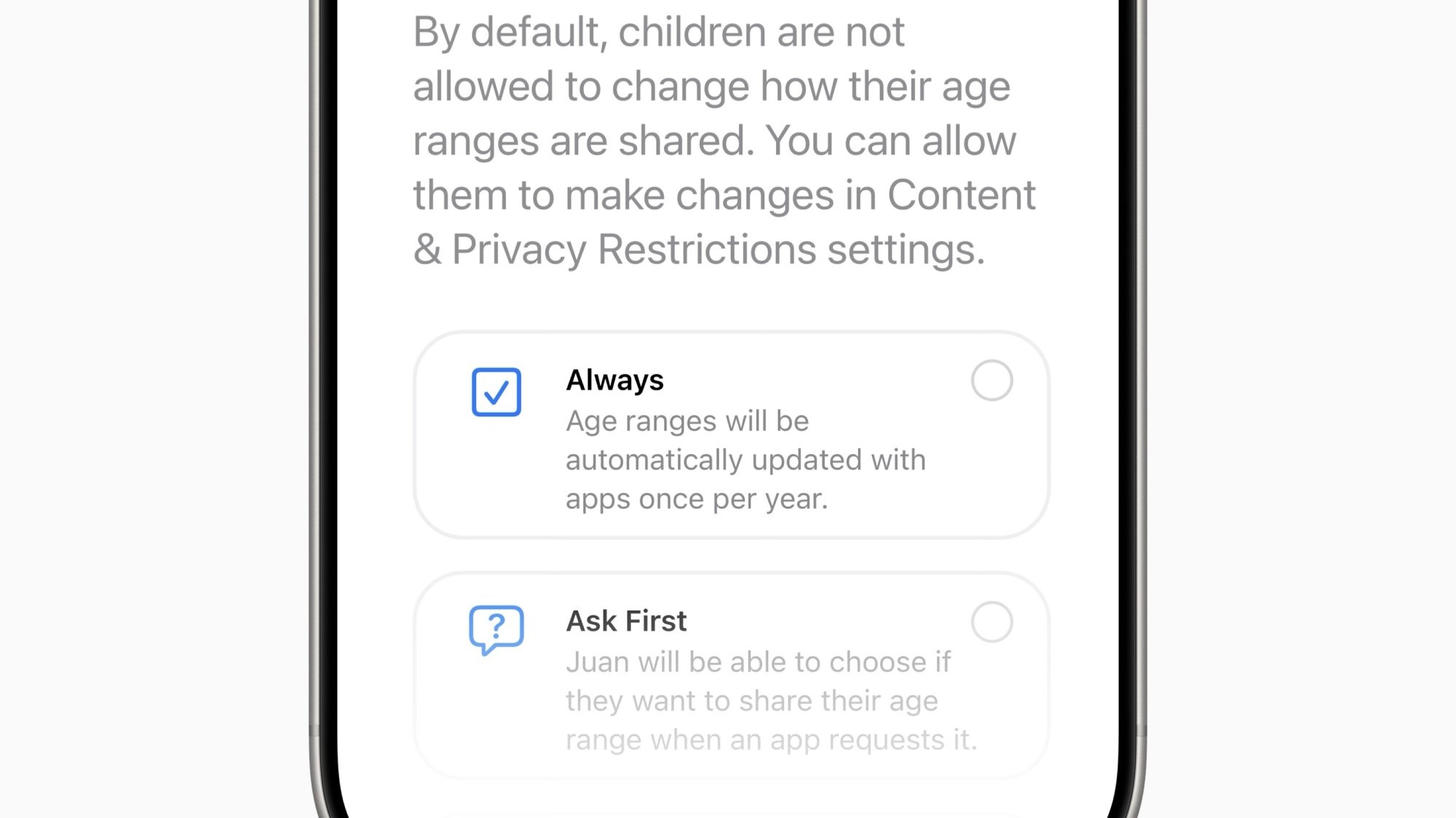
If an app offers different types of content and experience depending on the age of their users, it may send you an age range request for your child. The idea is you won’t have to share your kid’s exact birth date; rather, you’d send a range your child’s age is in. That way, the app can curate its content that range without giving away too much of your child’s privacy.

In addition, you can configure these requests like other permissions across apps—you can choose whether to share this age range with all apps that want it, or if apps will need to ask for permission each time. You can also choose to never share age ranges going forward.

This change might be in response to new laws popping up throughout the U.S., that will require app stores like Apple’s to verify the ages of its users.

Teen accounts now have new limits

Child Accounts are required for users under 13, but optional for kids who are ages 13 through 17. That means that while some teens have protections baked into their accounts, those who made an Apple Account after they turned 13 might not have all the limitations you want.

Going forward, Apple will apply new limits to accounts for teens by default. That includes web content filters as well as Communication Safety, a feature that warns when content containing nudity is sent or shared.

New categories for age ratings

Currently, there are four age ratings for apps on Apple’s App Store: 4+, 9+, 12+, and 17+. Apple now says they’re expanding this list to five, and adding the following three ratings for adolescents: 13+, 16+, and 18+. While the company doesn’t specify, presumably, 4+ and 9+ will remain.

I can understand the logic here: 12+ and 17+ introduces a five year gap in between app ratings, which could pose an issue for developers with questionable content: Maybe the app isn’t quite right for users 12 and under, but is fine for 16 year olds. But in the current ranking, they’d need to place it under 17+, which locks out those users would could benefit from the app. Plus, developers can now tailor their apps to more specific demographics.

App Store content warnings

With the new updates, you’ll see new warnings on app store pages for apps that contain potentially problematic content, such as user-generated content, messaging, or ads. You’ll also see whether the app ships with in-app content controls, so you can fine-tune the experience for your kids.

Inappropriate apps will not be shown to kids

Apple says when you set app content restrictions for your kids, the App Store will hide apps with age ratings that exceed those restrictions. That means your kids can browse through App Store pages like Today, Games, and the Apps tab without needing to see apps that are inappropriate.

An expanded Ask to Buy

On the flip side, there is now a way for kids to request to buy something outside of their age range, through Ask to Buy. Ask to Buy is the feature that allows your kids to send you a request to buy something on the App Store. Going forward, you’ll be able to grant an exception to the age range, to allow your kid to buy the app anyway. You’ll also be able to rescind permission at any time, which will block your kid from using the app.

New Communication Safety triggers

Apple says Communication Safety will now look out for nudity in FaceTime calls too, and will “intervene” when it detects it. In addition, the feature will blur nudity in Shared Albums in Photos.

Trump fires commissioner of preeminent nuclear safety institution

Critics warn that the United States may soon be taking on more nuclear safety risks after Donald Trump fired one of five members of an independent commission that monitors the country’s nuclear reactors.

In a statement Monday, Christopher Hanson confirmed that Trump fired him from the US Nuclear Regulatory Commission (NRC) on Friday. He alleged that the firing was “without cause” and “contrary to existing law and longstanding precedent regarding removal of independent agency appointees.” According to NPR, he received an email that simply said his firing was “effective immediately.”

Hanson had enjoyed bipartisan support for his work for years. Trump initially appointed Hanson to the NRC in 2020, then he was renominated by Joe Biden in 2024. In his statement, he said it was an “honor” to serve, citing accomplishments over his long stint as chair, which ended in January 2025.

Read full article

Comments

That ‘Unsubscribe’ Button Could Be a Trap, Researchers Warn

Researchers are cautioning users against clicking unsubscribe links embedded in email bodies, citing new data showing such actions can expose recipients to malicious websites and confirm active email addresses to attackers. DNSFilter found that one in every 644 clicks on unsubscribe links leads users to potentially malicious websites.

“You’ve left the safe, structured environment of your email client and entered the open web,” TK Keanini, DNSFilter’s chief technology officer, told WSJ. The risks range from confirming to bad actors that an email address belongs to an active user to redirecting victims to fake websites designed to steal login credentials or install malware. Clicking such links “can make you a bigger target in the future,” said Michael Bargury, CTO of security company Zenity.


Read more of this story at Slashdot.

Intel Core 5 120F CPU Breaks Cover For Budget Gaming PCs With These Specs

Intel Core 5 120F CPU Breaks Cover For Budget Gaming PCs With These Specs
For high-end gaming PCs, many users will immediately flock to AMD’s CPUs with 3D V-Cache, but for an entry-level machine, you can often do better for the money with prior-gen Intel hardware. A good example is the ten-core Core i5-12600K at $149, which gives you very similar performance to a Ryzen 5 7600X in games, yet runs you $50 less before