A 146,000-year-old skull from Harbin, China, belongs to a Denisovan, according to a recent study of proteins preserved inside the ancient bone. The paleoanthropologists who studied the Harbin skull in 2021 declared it a new (to us) species, Homo longi. But the Harbin skull still contains enough of its original proteins to tell a different story: A few of them matched specific proteins from Denisovan bones and teeth, as encoded in Denisovan DNA.
So Homo longi was a Denisovan all along, and thanks to the remarkably well-preserved skull, we finally know what the enigmatic Denisovans actually looked like.
Earlier this year, Framework announced it was making a smaller, 12-inch laptop and a beefy desktop to go alongside its 13- and 16-inch notebooks. A few months later, and the former has arrived, putting the same modular, repairable laptop into a slightly smaller body. Unlike its bigger siblings, the Laptop 12 is a 12.2-inch touchscreen convertible clad in brightly colored plastic. It’s aimed at students, with a focus on robustness and quality you won’t see in the usual machines you find at the top of the bargain list. My initial impression is that it’s a damn charming piece of gear, but I immediately wonder how many kids in school will actually get to use this thing given it’s far pricier than its competitors.
Laptop 12 is the first Framework machine clad entirely in ABS plastic, available in black, pink, lavender, gray and green. As soon as you open the packaging, you’ll be instantly charmed by its look and feel given how different it is from the rest of the market. My green and off-white review unit (which the company calls “Sage”) stands out from the crowd almost by default. Framework founder Nirav Patel has long harbored dreams of bringing back the translucent and colorful aesthetics found in Nintendo’s Game Boy Color. Here, the 12 reminds me of the OLPC XO or one of the fancier LeapFrog “computers” that glowed up when you weren’t looking.
Daniel Cooper for Engadget
Its footprint isn’t dramatically smaller than the 13-inch model, but because it doesn’t taper like its bigger sibling, it feels a lot chunkier. The chassis has a metal frame clad in two layers of plastic that, the company promises, will take whatever shocks and bumps you throw at it. It also has the same quartet of expansion card slots, which are now available in a variety of colors if you want things to match (or clash). Plus, all of those cards can be shared with the other Framework machines since they’re all, mercifully, uniform size.
Framework clearly learned from making its bigger machines, adding several quality of life tweaks to the 12 for both daily use and repair. The folks who regularly open and close their Framework laptop will instantly spot the changes that will make things a lot easier. For a start, the input cover is held in place with more screws (eight, compared to the 13’s five), which better balances tension across the surface area. The input cover now slots into grooves on the front of the deck, making it easier to place than the 13. More importantly, the input cover connects to the mainboard via pogo pins rather than with a ribbon cable. I don’t think I’ve ever damaged a ribbon cable myself, but it’s always a worry if someone tries to yank off the lid without first disconnecting it from the mainboard.
Daniel Cooper for Engadget
Rather than screwing the SSD in place, Framework now uses a hinged plastic clip that you press in to secure the drive. Similarly, there’s a little flip-down plastic cover to protect the RAM, with a large printed reminder to flip it back once you’ve installed the DIMM. Naturally, the board layout has changed, as has the battery — to a smaller, 50Wh cell — so the mainboard and battery won’t work with its slightly larger sibling.
(Aside: If you’re a hobbyist hoping the 12-inch mainboard will be dramatically smaller than the 13-inch model to make smaller projects, expect to be disappointed. It is smaller, but not by such a significant degree that you probably wouldn’t rather just use the 13-inch model instead.)
Daniel Cooper for Engadget
The power button has been moved from the keyboard to the right side of the deck, next to the expansion card slots. There’s no fingerprint reader, either, which is one of several omissions you can attribute to “cost saving,” “this is a machine made for kids” or both.
Would-be buyers get the choice of a 13th-generation Core i3-1315U or a Core i5-1334U, which can support up to 48GB of DDR5 RAM, albeit only at the slower DDR5-5200. You can throw in an M.2 SSD with up to 2TB of storage, and if that’s not enough, you can get an additional 256GB or 1TB unit to sit in one of the laptop’s four expansion card slots.
Patel knows enough about keyboards and trackpads not to mess with what works, and what people like. The keyboard and touchpad are as robust and pleasing to use as you find on the 13-inch model. I’m not sure yet, but I might actually prefer typing on the 12-inch keyboard compared to the 13’s, maybe because of the former’s all-plastic build and the slightly louder, punchier keyclicks.
Daniel Cooper for Engadget
This machine was offered as a better, longer-lasting and more sustainable alternative to those dirt-cheap laptops sold to kids and students. But while everything already mentioned is more than good enough, we soon start to see where the cost-saving trims have been made. This is the first Framework to ship with a touchscreen, which is a 12.2-inch, 1,920 x 1,200 glossy LCD with a max brightness of 400 nits. In short, it’s the same sort of screen you’ll find on a lot of lower-end notebooks and so adjust your expectations accordingly. The gloss is an occupational hazard given it’s a touchscreen, but the weaker backlight means you’ll deal with the usual high-reflections and washed-out view in bright light.
Framework is presently developing its own stylus, but until that launches, the laptop is compatible with any USI 2.0 or MPP 2.0 stylus. You’ll have to source your own right now, and for the review, I was supplied with a Metapen M2 for testing. So far, however, I’ve found the pen experience to be more than a little frustrating, with the palm rejection a big issue. It needs a tweak — and I’m sure it’ll be addressed swiftly — given the amount of times I prodded open a menu or closed a window with the flesh on the side of my hand.
Similarly, the 2-megapixel webcam is a big step down from the 9.2-megapixel sensor found in the 13-inch model. Again, you can expect the same washed out, artifact-heavy video as you would find in many other low-cost laptop cameras.
Framework has worked to improve its sound quality over the last few years but the size of the 12’s chassis is a limiting factor. The pair of 2W speakers here are tinny and quiet even at full volume, but at least they don’t rattle or vibrate with heavy bass.
My review unit was equipped with a Core i5 with 16GB RAM, and it was more than able to handle the sort of stuff you’d expect to perform on a machine of this class. Writing the bulk of this review, watching videos, viewing and tweaking images are all well within this machine’s reach. Hell, I even managed to get Hardspace: Shipbreaker to play, but not very well, and while Fortnite does run, it’s janky enough to not be worth your while. Again, tweaked drivers will likely tidy those issues up, but I suspect this machine doesn’t have enough grunt for doom room gamers.
Of course, it’s a Framework laptop, so you can already guess the one major issue that pops up whenever you put the silicon under load. As usual, the fan noise is pretty noticeable when the hardware temperature rises, and I wouldn’t recommend you using this thing on your lap. And you should expect to have this thing plugged in for the duration of your time using it, as the battery life isn’t stellar. If you’re using this to run any sort of demanding app or game, you won’t get more than four hours on a single charge.
Pricing and the competition
Daniel Cooper for Engadget
Right now, you can only buy the pre-built edition in black, with the DIY version the only place you can pick your chassis color. It’s available in gray, lavender, bubblegum and sage, and I’d heartily recommend you picking any of those options over the standard black. The pre-built edition starts at $799 with an Intel Core i3-1315U, 8GB of RAM, 512GB SSD and Windows 11 Home. If you want to step that up to the higher-end Performance model with an i5-1334U, 16GB of RAM and a 512GB SSD, it’ll set you back $1,049. On the other hand, you can pick up the DIY edition for $549 (for the i3) or $699 (for the i5), leaving you to source your own RAM, SSD and OS.
I’ll admit I’m struggling to work out what the Framework 12’s competitors are, since this is a tricky machine. When announced, the company said it was an alternative to the sort of entry-level laptops bought for kids and students, which are “janky, locked-down, disposable, underpowered and frankly, boring.” This means it’s going up against $500 notebooks and Chromebooks, the likes of which you’ll normally find on sale at Best Buy. The ones that, you know, have a reputation for surviving until a week after the warranty expires, leaving you out of pocket until the next sale.
From a utilitarian perspective, the higher price is offset by the knowledge it should outlast every other computer in your kids’ cohort. Not only is it durable and repairable, but you should be able to swap out the mainboard in two or three years’ time to keep pace with technology. But, by that same utilitarian argument, you could just as easily pick up a refurbished Framework 13 with a Core i5-1340P, when available, for just $779.
Wrap-up
Daniel Cooper for Engadget
I’m fond of the Framework Laptop 12 because I can easily see it having a place in my life when I’m on the go. It’s cute, good-looking and small enough you could easily throw it into a bag when you’re in a hurry. The durability of the chassis and repairability, plus the swappable expansion cards, means it should run for years and years. And it’s fun! I love the idea of a little laptop that stands out against the endless rows of cheap black plastic or silver aluminum notebooks.
Those dirt-cheap notebooks built with low-end parts and sold to kids and students for $300 or so aren’t much good for anything. If you want quality, you’ll need to cough up for it, and this will at least last for years without endless replacements.
But. The limited performance and battery life here gives me pause and I’m not sure a machine that, right now, needs a stretch to run Fortnite would be too popular. My gut tells me Framework had intended to sell this for less before tariffs pushed the prices up beyond what made sense. But as a consequence, the Framework Laptop 12 falls between two stools: Not cheap enough to be compelling to the price-sensitive buyers and not powerful enough for people with bigger budgets. Unless you happen to have a spare SSD, RAM and Windows license kicking around that’ll bring the cost down to sticker price. My gut tells me that this laptop’s real audience will be adults looking for a quirky second device to take on the go.
This article originally appeared on Engadget at https://www.engadget.com/computing/laptops/framework-laptop-12-review-doing-the-right-thing-comes-at-a-cost-150014067.html?src=rss
Chevrolet has just pulled back the curtain on its most bonkers Corvette yet: the 2026 Corvette ZR1X. Hailed by the automaker as a “true American hypercar,” the car shatters performance benchmarks (how does sub-2 seconds 0-60 mph sound?), combining twin-turbo V8 power and hybrid technology to deliver a monstrous 1,250 horsepower and possibly
It’s that time of year again, and Amazon Prime Day is around the corner. There’s a lot to expect from this year’s extended event running July 8 to 11, the longest Prime Day ever. That’s not to say you have to wait until it starts to find great deals. Right now you can grab a pair of Anker Soundcore Space wireless earbuds at the lowest price we’ve ever seen them. Normally retailing for $80, they are on sale for $45.
The Anker Soundcore Space earbuds are currently our top pick for best budget wireless earbuds. While their performance doesn’t rival that of more premium products, we felt the Space A40’s feature set offered excellent value for such a budget-friendly set of earbuds.
These earbuds connect via Bluetooth, support connection to two devices at once, and come in a case that supports wireless charging. We were most impressed with the Space A40’s active noise cancellation (ANC), a feature rarely seen at this price point. While it’s not the most sophisticated ANC on the market, it does its job in blocking out the steady rumble of a train or jet engine. Battery life is solid for a budget pair of earbuds, reaching roughly eight to 10 hours depending on use, with another 40 hours or so supplied by the case.
In-ear fit is comfortable, as the round earpieces are pretty light and evenly balanced. The audio quality is impressive for its price point, offering a warm sound that can be fine-tuned with an EQ in the Soundcore app. A subpar built-in mic means the Space A40s don’t have the best transparency mode and aren’t the best for phone calls in noisy areas, but overall for $45 these are a great deal.
This article originally appeared on Engadget at https://www.engadget.com/deals/our-favorite-budget-wireless-earbuds-are-almost-half-off-ahead-of-prime-day-145248634.html?src=rss
Starting in summer 2026, Netflix subscribers in France will be able to watch commercially broadcast TV content “without ever having to leave the service.” The Verge adds: The streaming giant has announced a distribution deal with French media company TF1 Group to make TF1’s free-to-air live TV channels and on-demand TF1 Plus streaming content available to French Netflix users as part of their existing subscription plan.
The bumper 2025 edition of Amazon’s Prime Day is fast approaching and the deals are starting to emerge. While we’ve seen this offer pop up several times in the past, it’s one that’s always worth highlighting. New Audible subscribers can get three months of access to the Premium Plus plan for $3. That’s a total of $42 off.
This is one of the best streaming deals around right now. It will be available until July 31, which is a few weeks after the Prime Day event ends (it could probably be called Prime Week this year since it’s running for four days). If you don’t cancel your Audible membership before the promotional period ends, it will automatically renew for $15 per month.
Through the Audible Premium Plus plan, you’ll receive one credit each month. You can use this to claim any audiobook you like on the platform, whether it’s a bestseller, new release or something else you’ve been meaning to get to. You’ll retain access to audiobooks you claim with credits even after your subscription expires. So, you’re effectively getting three audiobooks for your permanent collection for three bucks.
Audible members will be able to take advantage of exclusive discounts and sales too. They also get access to thousands of audiobooks, Audible Originals and podcasts as long as their subscription remains active.
This article originally appeared on Engadget at https://www.engadget.com/deals/prime-day-deals-include-three-months-of-audible-for-only-3-143734782.html?src=rss
We may earn a commission from links on this page. Deal pricing and availability subject to change after time of publication.
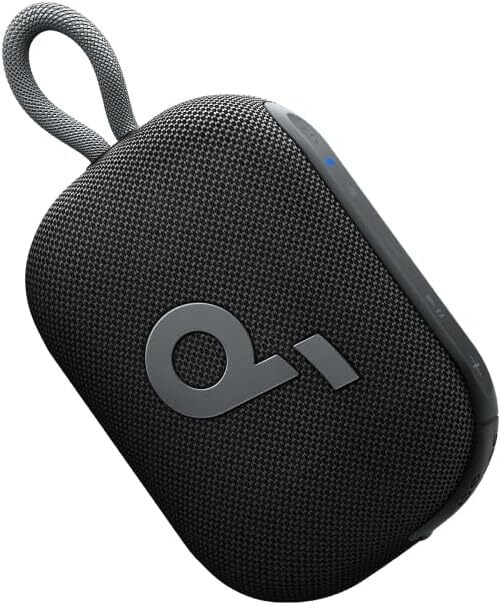
If you’re looking for a portable outdoor speaker that can withstand the elements, the Soundcore Select 4 Go portable speaker by Anker is now under $20 on Amazon. This rugged speaker can handle dust and water, and is designed to accompany your adventures, from picnics in the park to beach and camping trips. Despite being a mono speaker, it reportedly offers surprisingly clear and balanced sound. You can customize the EQ via the Soundcore app or pair it with a second unit for stereo output.
It’s advertised as being floatable, making it suitable for lounging in the pool or bath. While it’s rated to float, keep in mind that the IP67 rating does mean that a device can’t be submerged for more than 30 minutes in more than a meter of water, so don’t toss it in the pool or lake and forget about it.
Measuring just two inches tall and equipped with a built-in loop, the speaker is palm-sized and easy to clip to bags, hang from a tree, or carry in hand. It’s not backlit, making it better for daytime adventures. It’s compact, but not quite as small and bass-driven as portable outdoor speakers like the JBL Go 4. Still, it’s significantly less expensive and has a longer battery life. (The JBL Go 4 typically lasts up to nine hours, while the Soundcore Select 4 features a battery life of 10-20 hours.)
It doesn’t quite match the JBL Go 4 in terms of sound quality, but if you’re seeking a budget-friendly outdoor speaker with a compact, lightweight design, extended playback, and pool-friendly durability, the Anker Soundcore Select 4 Go is a worthwhile pick for summer adventures and beyond.
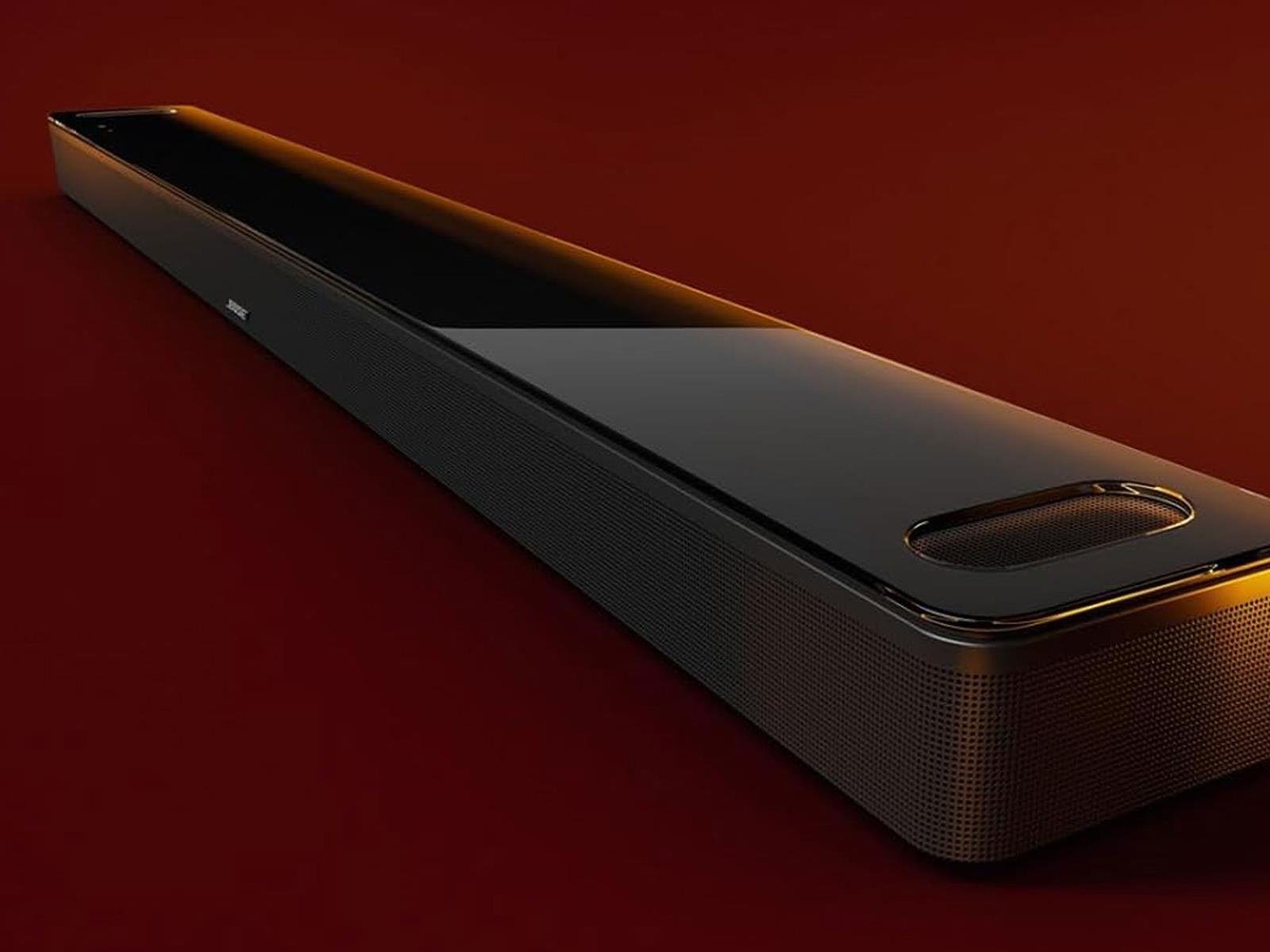
In less than a month, Amazon will host its next Prime Day event, which is set to last twice as long this year (four days instead of two). However, you don’t have to wait in order to score some great deals, especially if you’re in the market for an audio product from Bose. The company is offering some compelling discounts on a variety of products,
Sleep tracking is nothing new in Garmin’s fitness watches, but the company’s latest wearable is a dedicated smart sleep band. The Index Sleep Monitor offers week-long battery life with continuous pulse ox tracking for monitoring your blood oxygen saturation while you sleep.
Garmin’s tracker is worn on the upper arm — which should hopefully make it more comfortable — where it tracks a variety of metrics: skin temperature; light, deep and REM sleep stages; and variations in your heart rate and breathing. The data is then combined to provide an overall personalized daily sleep score that can be viewed in the Garmin Connect app. If you already use a Garmin smartwatch but don’t sleep with it on your wrist, the Index Sleep Monitor is designed to add the missing metrics to the insights you’re already getting from the watch.
Skin temperature tracking gives you a better idea of how your sleep environment affects the quality of your sleep, while flagging potential illnesses indicated by temperature changes. This metric also extends to menstrual health tracking, with skin temperature changes useful for tracking cycles, past ovulation estimates and offering what Garmin describes as “improved period predictions.”
Garmin’s Index Sleep Monitor will also monitor your energy levels, providing you with its “Body Battery” measurements that advise you to take more rest when the reading is coming in low. Again, these insights should be more accurate and reliable when combined with a compatible smartwatch worn during the day. The sleep band will also track your stress throughout the night, and features a smart alarm that attempts to wake you gently during lighter sleep stages so you’ll feel less tired.
The Index Sleep Monitor is available in S-M and L-XL sizes and costs $170.
This article originally appeared on Engadget at https://www.engadget.com/wearables/garmins-new-sleep-tracker-offers-a-week-of-battery-life-142350473.html?src=rss
As NASA gears up for its 2027 Artemis III mission, engineers and astronauts at Marshall Space Flight Center’s Flat Floor Facility in Huntsville, Alabama, are meticulously simulating the extreme lighting conditions expected at the lunar South Pole, the target landing site for Artemis III. This seemingly simple exercise intends to shed light
U.S. public companies have cut their white-collar workforces by 3.5% over the past three years, marking a fundamental shift in corporate philosophy that views fewer employees as a path to faster growth. One in five S&P 500 companies now employ fewer people than they did a decade ago, according to employment data-provider Live Data Technologies.
The reductions extend beyond typical cost-cutting measures and coincide with record corporate profits at the end of last year. Amazon CEO Andy Jassy told employees Tuesday that AI will eliminate certain jobs in coming years, while Procter & Gamble announced plans to cut 7,000 positions to create “broader roles and smaller teams.”
Bank of America reduced its workforce from 285,000 in 2010 to 213,000 today while revenues climbed 18% over the past decade. Managers have faced particularly steep cuts, with their ranks falling 6.1% between May 2022 and May 2025. Companies are flattening organizational structures and pushing remaining employees to handle larger workloads as executives track revenue per employee more closely.
iOS 26 is one of the biggest iPhone software updates that Apple has pushed out in recent years, bringing with it features including new gestures, improved parental controls, custom snooze times, and of course that translucent interface revamp called Liquid Glass (which takes some getting used to).
There are also changes to how you can tweak the look of your iPhone lock screen, building on top of several other customizations Apple has added in recent years. Your lock screen can be more personalized than ever, not just in terms of the wallpaper but also the elements on top, and how they’re arranged.
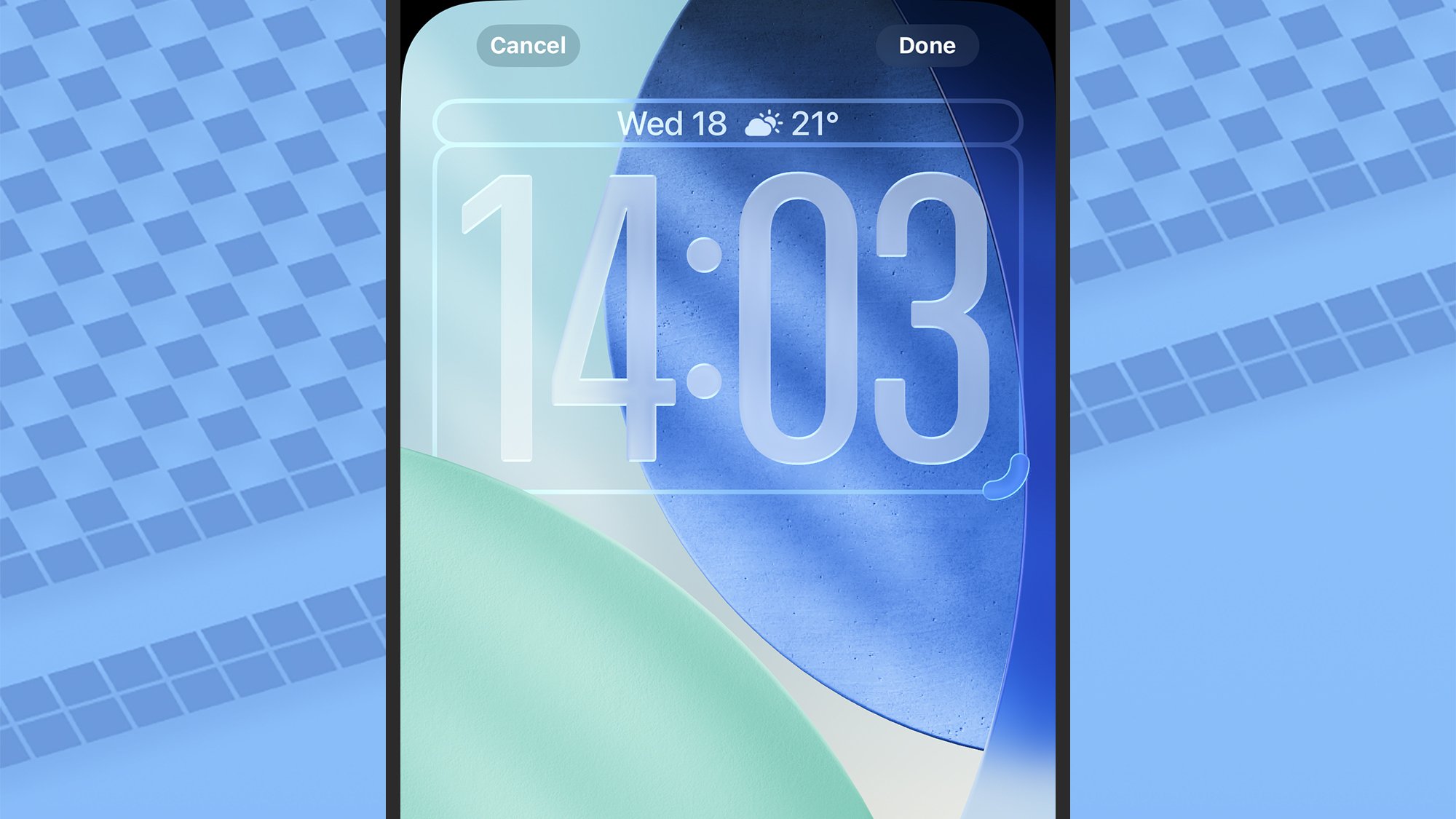
The lock screen clock can now be resized. Credit: Lifehacker
To get started with these customizations, you need to lock your phone, then press the power button (to wake up the screen without actually unlocking your phone again), and tap and hold on the lock screen. Choose Customize to start making changes.
From the top, you can tap the date to pick from a selection of single-line widgets. The options will vary depending on the apps you’ve got installed, but are typically going to include widgets for the weather forecast, reminders, and calendar events. Next is the clock, which in iOS 26 can be changed in terms of its size by dragging the handle in the lower right corner.
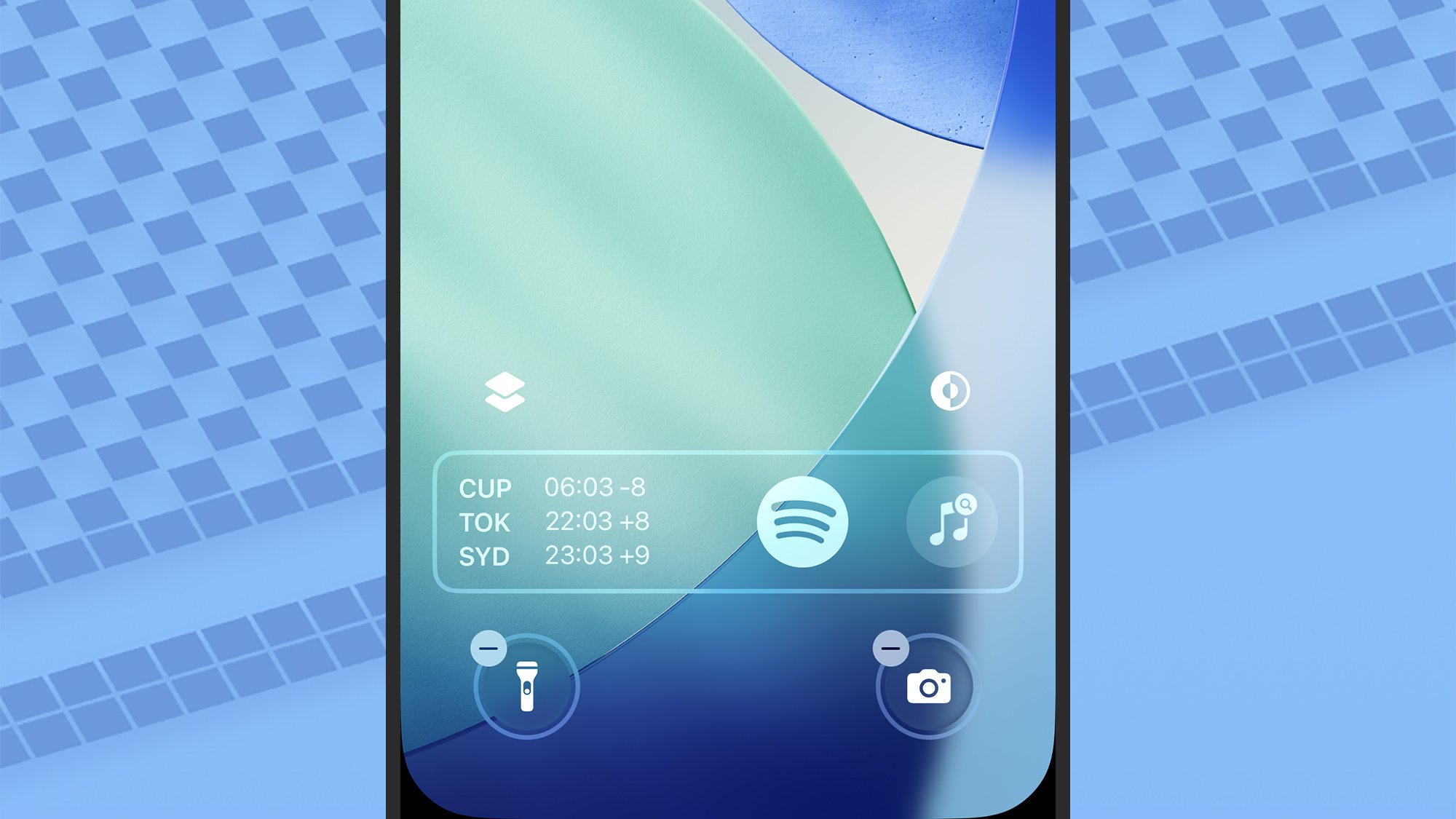
Farther down the screen, the widget box is now at the bottom of your lock screen rather than at the top: As before, tap Add widgets to drop in mini indicators for iPhone battery level, global time zones, current fitness activities, news headlines, and plenty more (again, the selection will vary, depending on the apps you’ve got installed).
Lock screen widgets have been moved to the bottom. Credit: Lifehacker
There are two buttons above the widget bar. The one on the left lets you turn depth effects on or off for the wallpaper, which works especially well for Spatial Photos. The button on the right is for setting whether the lock screen should use light mode, dark mode, or follow the setting for iOS as a whole.
Finally, there are the two shortcuts down in the bottom left and right corners. Tap the small – (minus) symbol next to either of these shortcuts, which lets you choose something new (or leave the spots empty). A host of different shortcuts can be dropped in here, from ambient music mixes to links to the iOS stopwatch. You can also use these shortcuts for speedy access to your favorite apps.
Focus modes, wallpapers, and more
iOS actually lets you set up multiple lock screens if you want to, so you can have different lock screens for different moods or times of the day. If you tap and hold on the lock screen so the Customize button appears, and then swipe left and right, you’re able to add new lock screens and switch between them.
Choose to create a new lock screen via the + (plus) button, and the first decision you need to make is to pick some wallpaper. This can be the same as the wallpaper you’ve got for your home screens, or something different—and you can choose emojis, colors, and photo slideshows from the icons at the top.
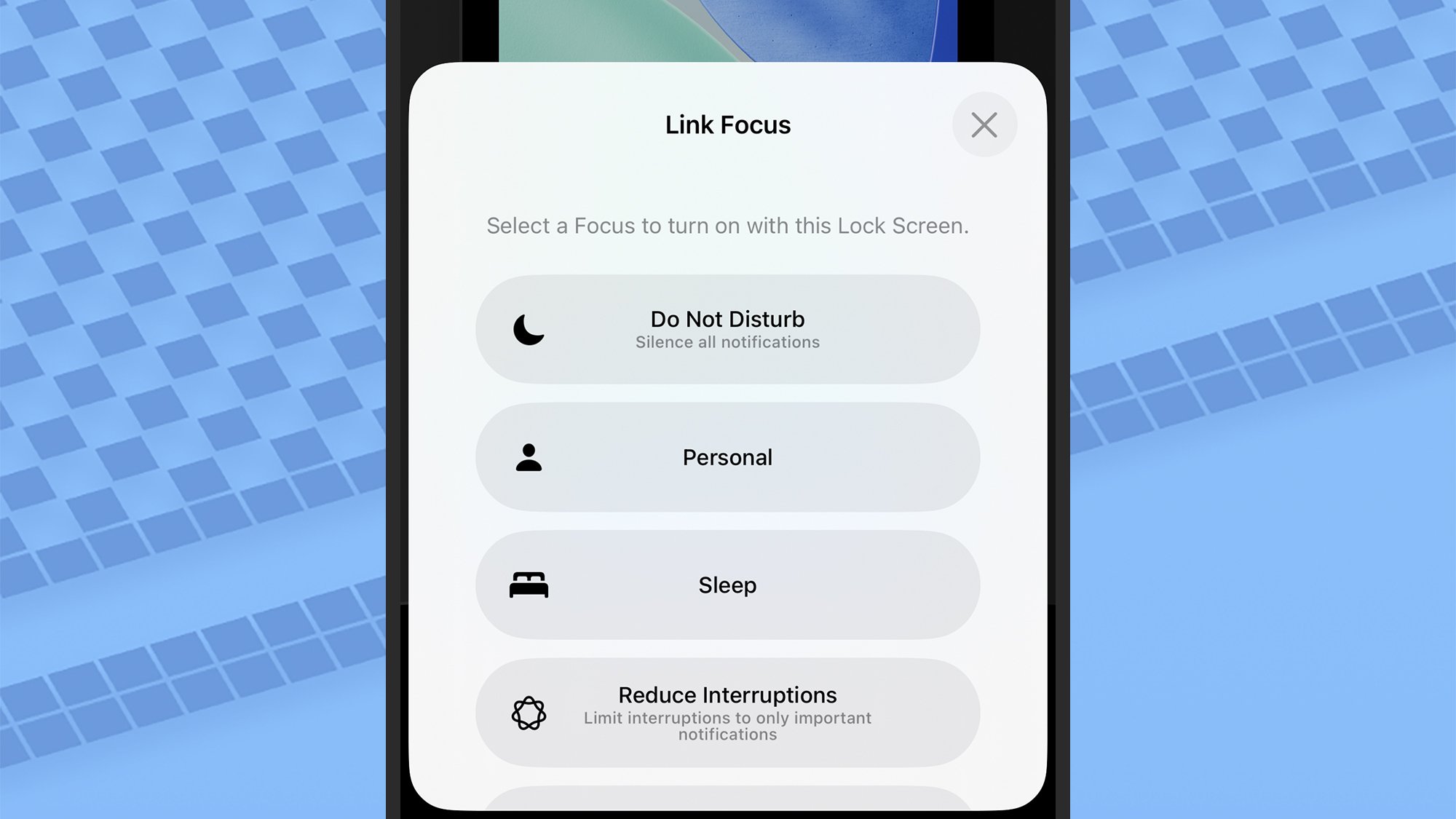
Focus modes can be linked to lock screens. Credit: Lifehacker
On top of each of the lock screen thumbnails, you’ll see a Focus button. Tap this and you can choose a Focus mode that’s automatically enabled when you switch to that particular lock screen. You could have one lock screen and Focus mode for driving, for example, one for sleeping, and so on.
There are a few more controls to talk about, which you can get to through the Display & Brightness menu in iOS Settings. The Auto-Lock option here lets you choose how much idle time your iPhone waits for before locking itself and displaying the lock screen, while Raise to Wake lets you control whether or not the lock screen lights up when you pick up your iPhone.
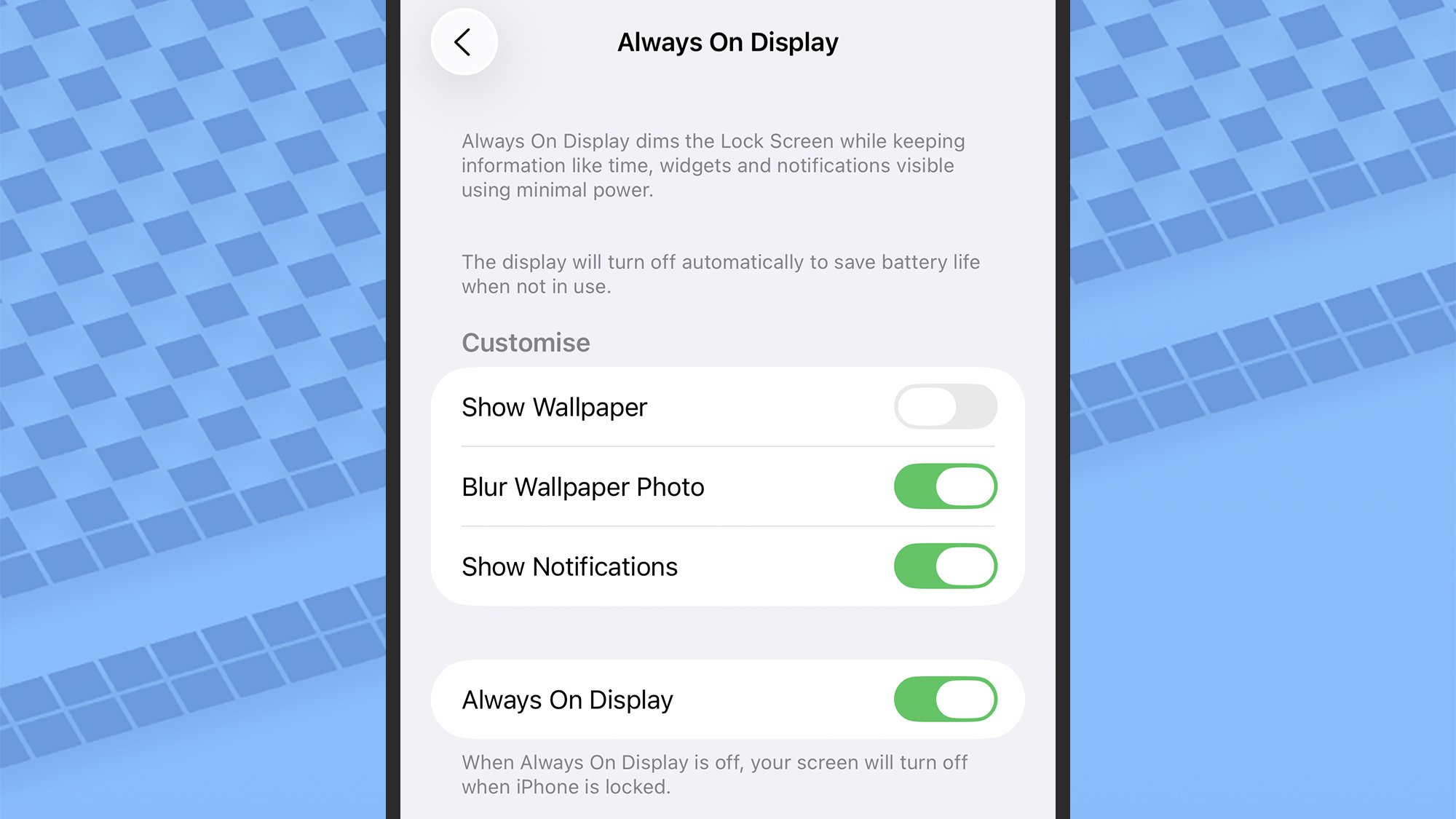
If you’ve got a Pro or Pro Max iPhone from 2022 or later, you’ll also see an Always On Display option here. This lets you pick certain features, such as the wallpaper and notifications, that are still shown persistently on the display, even when your phone is locked—at the expense of some battery life, of course.
Some iPhone models give you always on display options too. Credit: Lifehacker
Speaking of notifications, you can customize how these are shown on the lock screen, too. You’re able to hide previews if you think other people might be looking over your shoulder when they come in. To control how notifications work on the lock screen, head to Notifications from iOS Settings, and tap Show Previews.
iOS 26 ushers in another lock screen change too, but it’s not customizable: For certain Apple Music tracks that support the feature, you can get full screen animated album art on the lock screen, by tapping on the media player widget. It’s something else to try once you’ve installed the new operating system.
I love listening to experts discuss their subjects. They know so much! Me? I know very little about anything. And you know what they say about ignorance. “It’s bliss.” That can’t be right though because I’m miserable. This is a video from Epicurious of professional cheese expert Liz Thorpe reviewing all the cheeses available at Trader Joe’s (previously: a cheese connoisseur tasting 21 of the most expensive cheeses). I learned a lot by watching it. Mostly, that Trader Joe’s is a good place for cheese, which is great news because I love cheese and they’re opening one nearby. My life is about to change forever!
My top seven cheeses of the day in recommended tasting order are Chevre with Fine Herbs, Fromage Pave, Goat’s Milk Gouda-Style, Mini Basque, Unexpected Cheddar, Thousand Day Gouda, and Blue Stilton.
Mmmm, Thousand Day Gouda. I’m more of a Ten Thousand Day Gouda man myself, but that’s just me and I’m EXTRA FANCY. “Your fly is down.” I don’t even have to look to know you’re lying, because there’s no way I’m wearing pants at 9AM on a Wednesday.
I’m bored with reality, so last week, I attended the Augmented World Expo in Long Beach, CA, to check out other options, such as Augmented Reality (AR), Virtual Reality (VR), and Mixed Reality (MR).
The Augmented World Expo has been around since 2010, pursuing its lofty goal of “enabling people across the globe to learn, connect and grow within the XR industry.” I don’t know about all that, but I did get to check out the new devices and applications that might be the future of how we work, relax, and relate to each other. Here are some of the highlights of the show.
SnapDragon AR1+ Gen 1 chip
Credit: Stephen Johnson
The biggest tech news out of Augmented World Expo 2025 was Qualcomm announcing the Snapdragon AR1+ Gen 1 chip, the brain that will power much of the next generation of smart glasses.
“I don’t like having a huge thing on my head” and “Wait, I also have to pair it to my phone?” are two common problems people have with VR/AR, and the AR1+ aims to solve both. It allows for on-device AI processing, and improves camera quality, display quality, and energy efficiency. I tried a pair of Snap Spectacle 4 smart glasses powered by this chip, and it’s impressive.
RP1’s Spatial Browser
Credit: Stephen Johnson/RP1
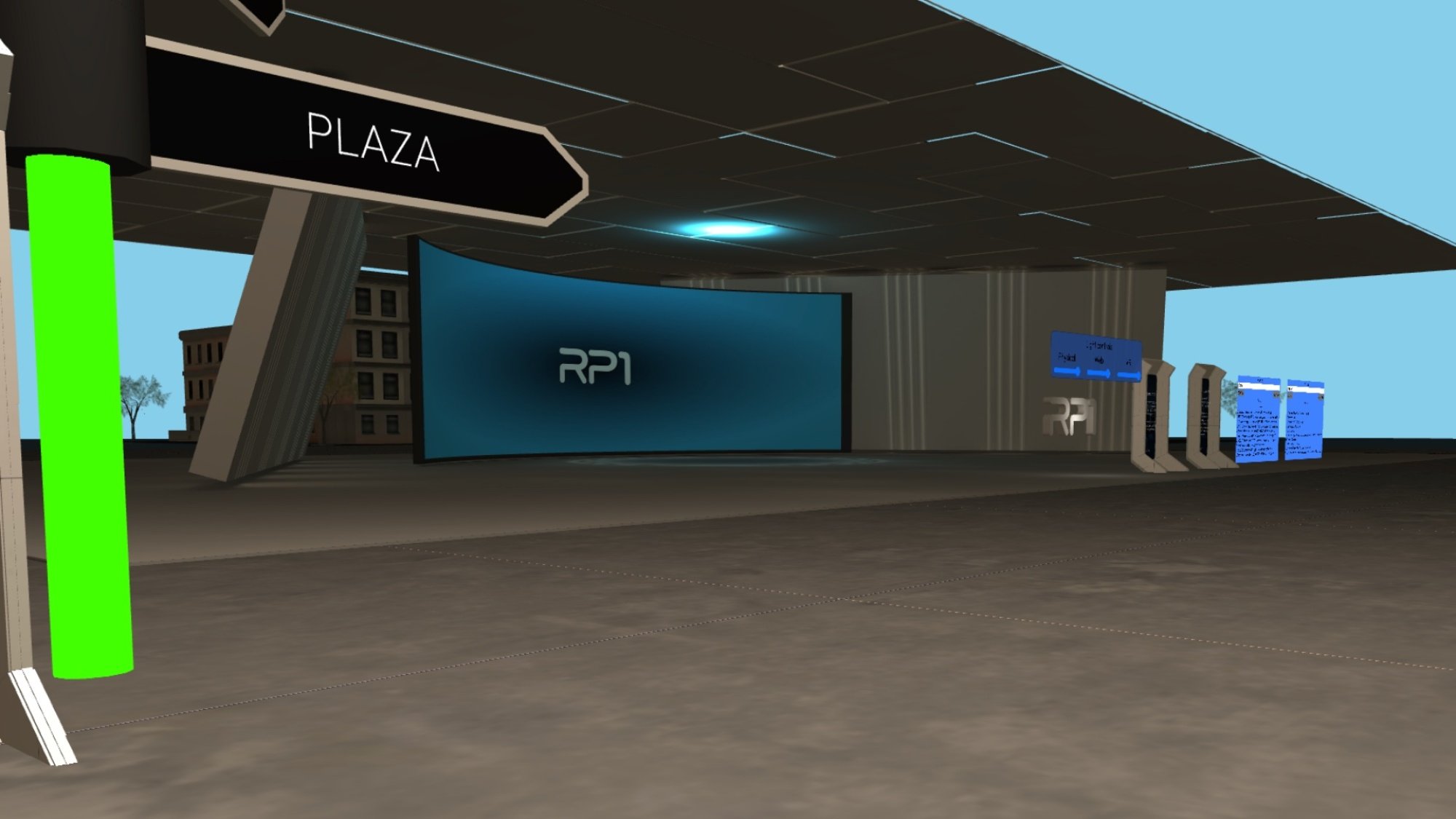
I admit, I was a little puzzled as to what RP1 is trying to do at first. The “world’s first Metaverse browser” aims to “connect the world’s population in a single, persistent XR ecosystem, providing on-demand access to unlimited self-hosted 3D content and services.” But then a helpful representative put it to me like this: “Remember how AOL and Compuserve were totally separate camps? And then the web made a common place for everyone? We’re doing that with 3D spaces,” and it all made sense. The idea is to provide a platform for all Immersive XR (extended reality) spaces, so it doesn’t matter what device you’re using to view them. You can check it out now, by the way.
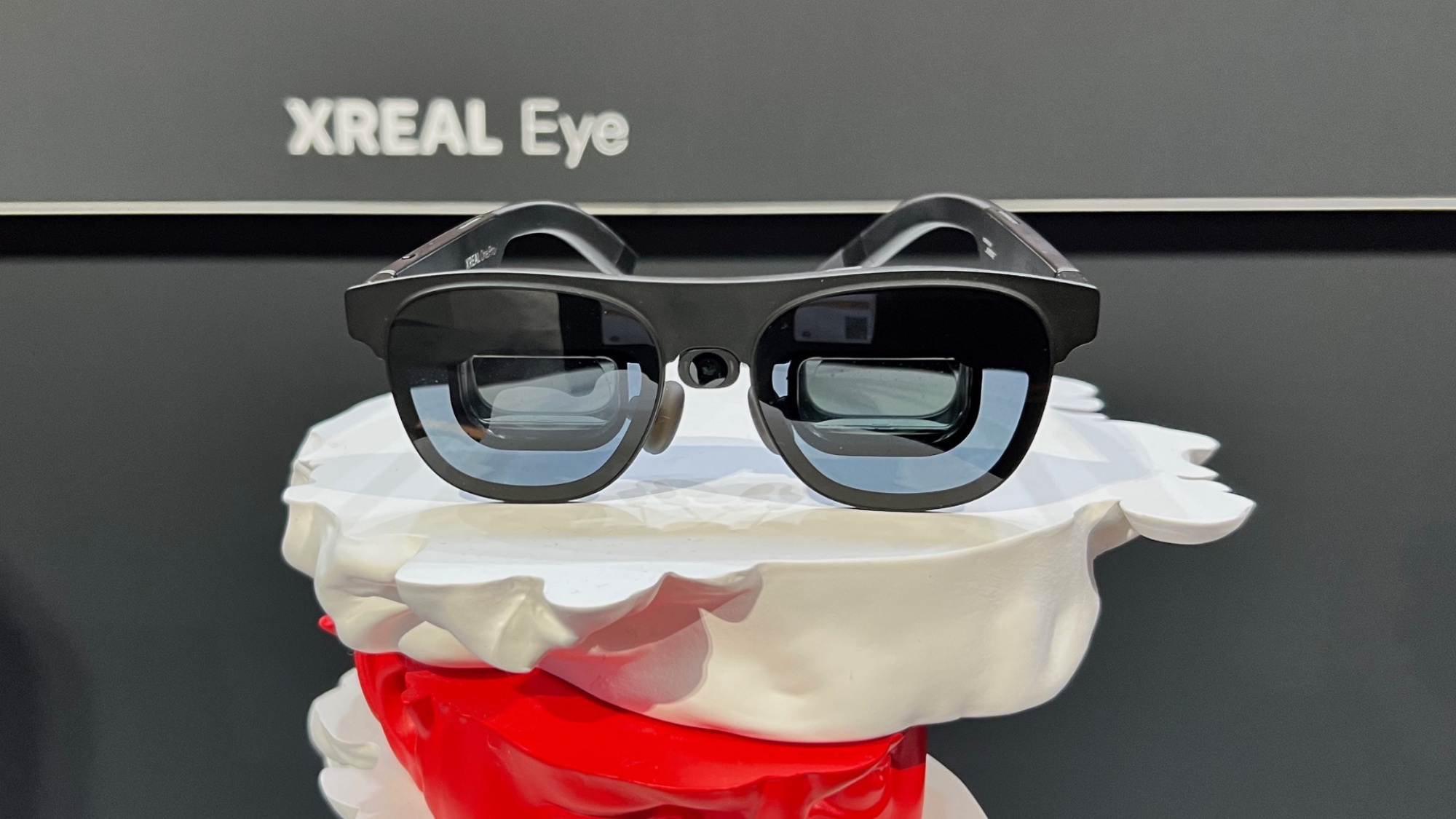
XREAL Eye
Credit: Stephen Johnson
I was impressed with the XREAL Air 2 Pro glasses I reviewed last year, and this enhancement makes them better. The XREAL Eye is a small camera that adds 6DoF (i.e. 6 Degrees of Freedom so your head and body can move naturally in space: up/down, left/right, forward/back) tracking, making virtual content more immersive and natural. I tried it out briefly on the show floor, and it’s very impressive. Look for a full review soon.
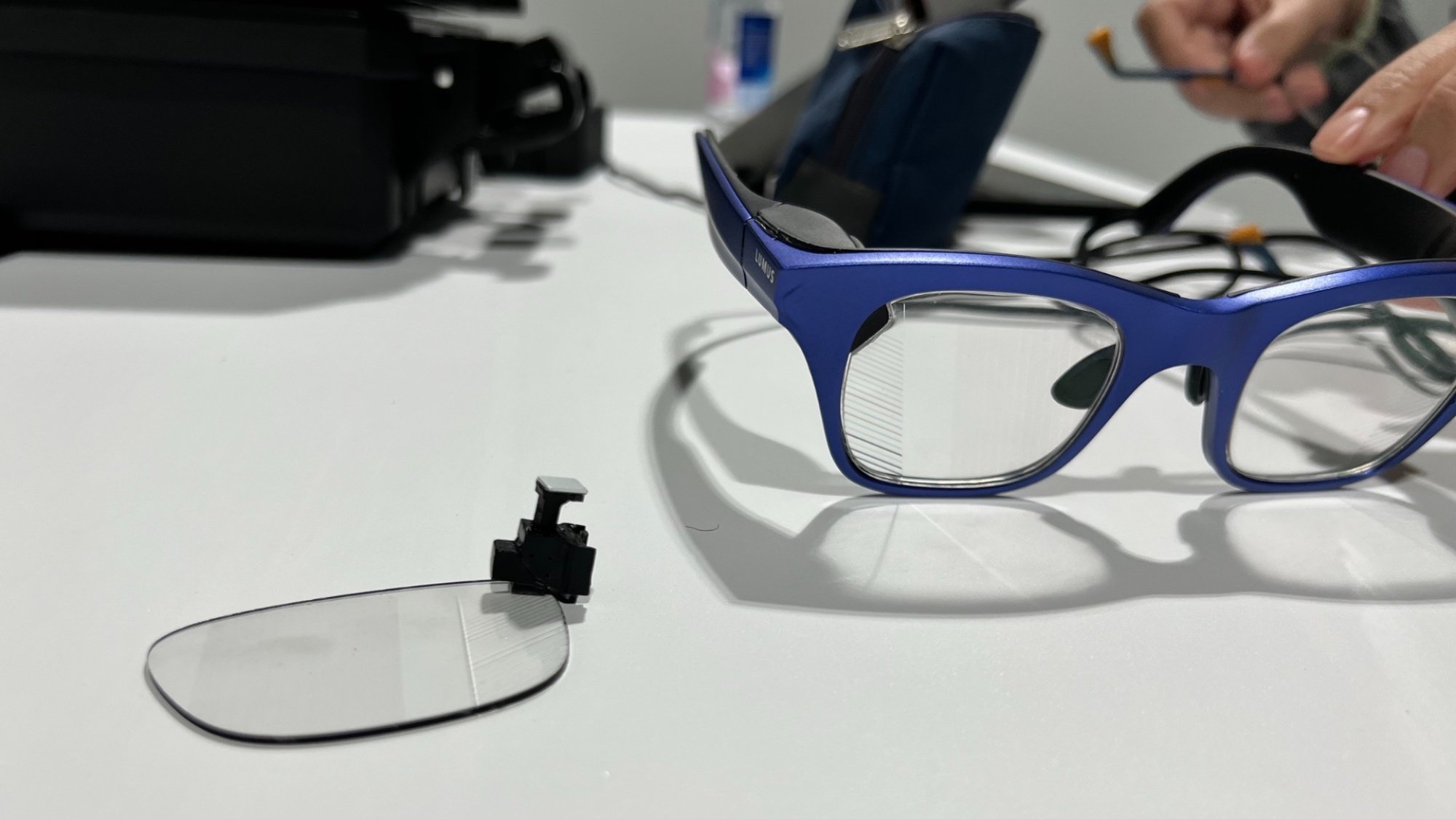
Lumus Z-30 Optical Engine
Credit: Stephen Johnson
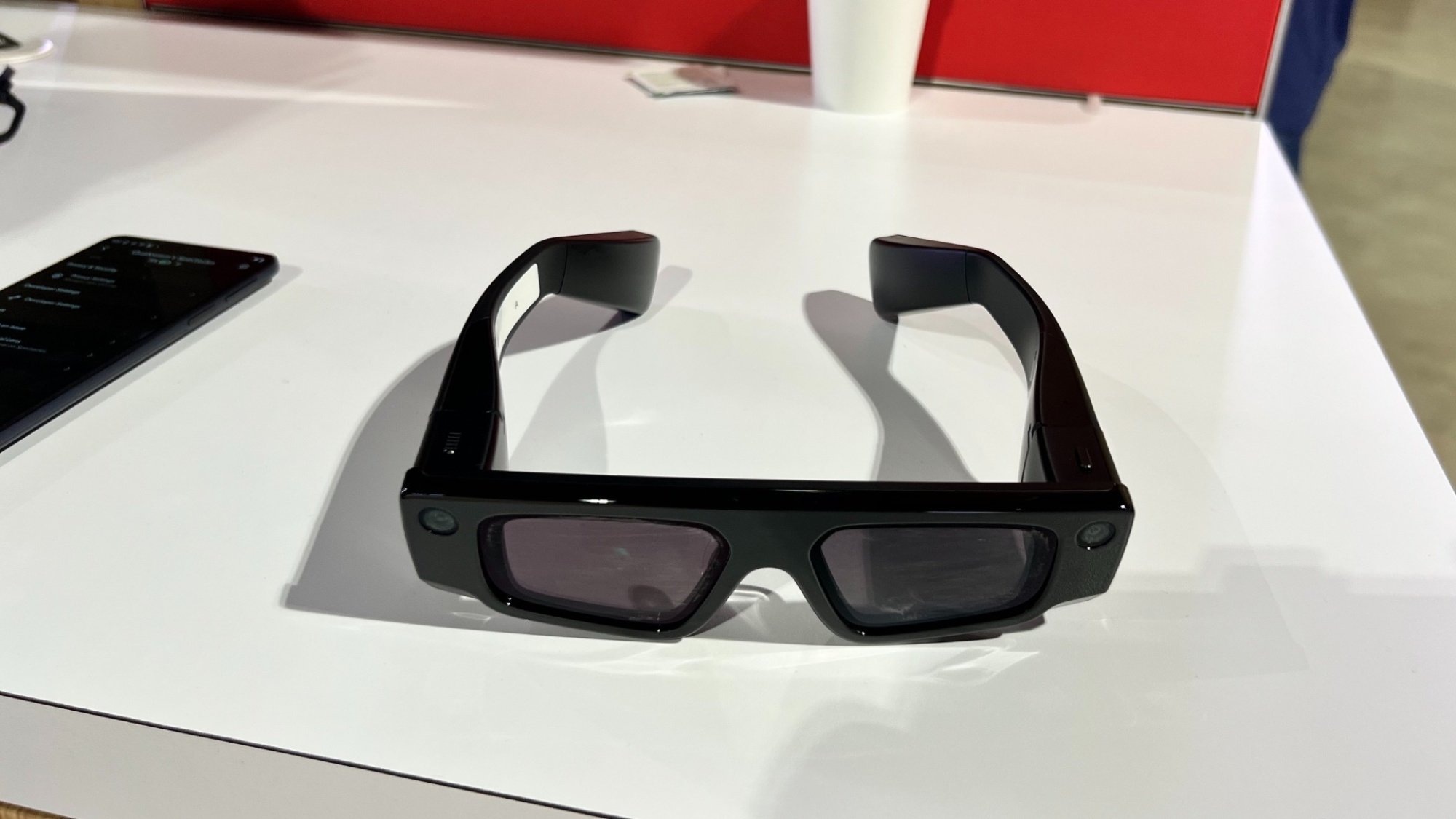
Sometimes at tech conventions, you get taken into a back room and shown some pure tech, prototypes that are not yet available commercially. Lumus (“the pioneering developer of geometric waveguide technology for augmented reality”) took me into a bare conference room to check out the Z-30 Optical Engine. The device left me saying “whoa” like I was Keanu Reeves. Check out the picture above; the lightweight thing on the side of the glasses’ is tiny projector that throws a 720 x 720 pixel image onto the clear glass of the lenses, and only you can see it. You could use this to add a customized HUD to your life without anyone knowing what a huge nerd you are, or secretly watch TikTok while having a conversation.
Campfire
Credit: Campfire
The people I know who regularly use VR in the workplace are my friends who design sets for stop-motion animation. It’s niche, I realize, but anyone working in collaborative 3D design in any way should take a long look at Campfire. It lets you look at CAD at 1:1 scale with other people, everyone in a circle around the virtual 3D object like it’s a campfire.
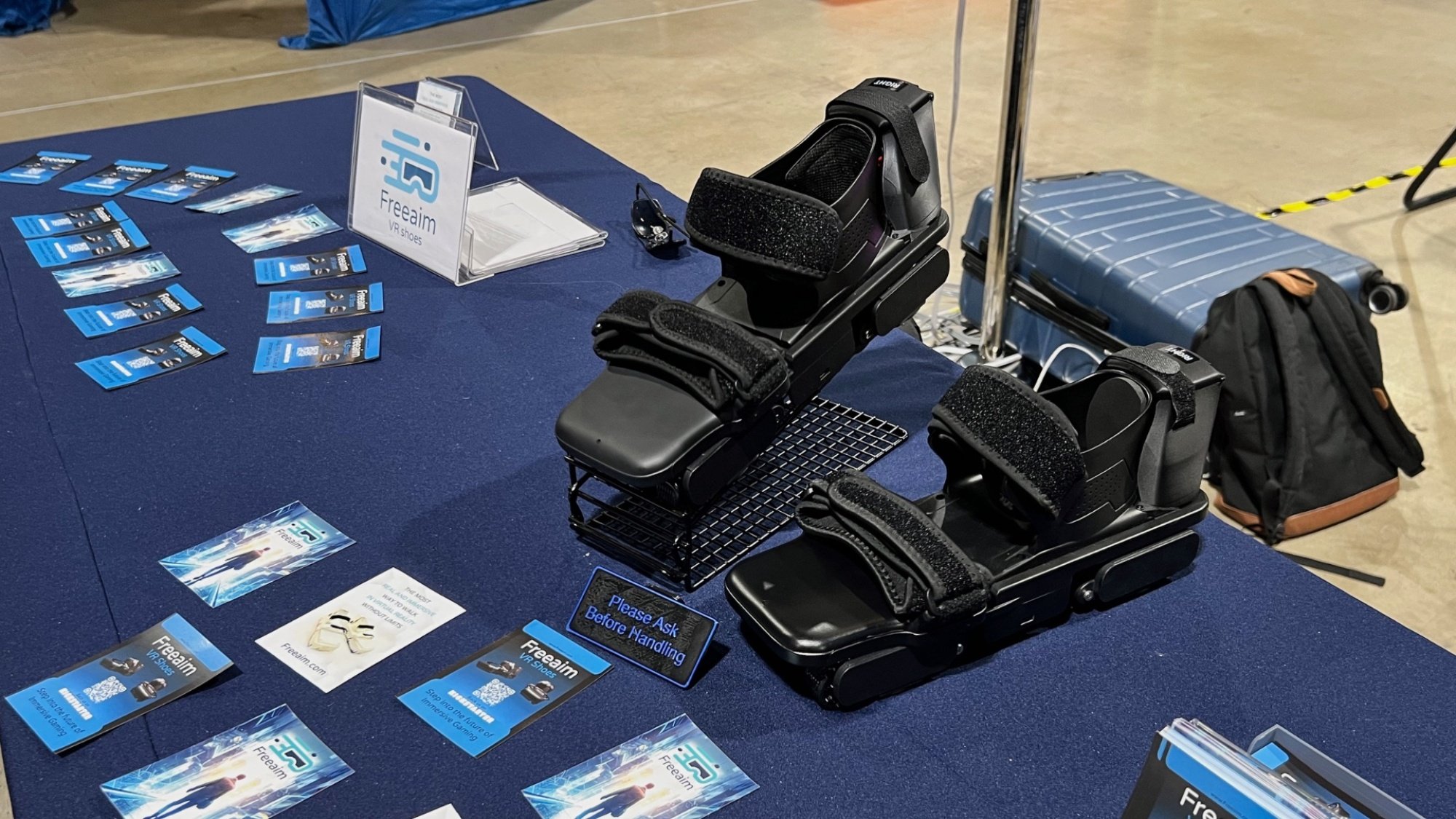
FreeAim Powered AR Shoes
Credit: Stephen Johnson
FreeAim VR Shoes aim to solve the problem of “How do you walk around in virtual reality?” Their solution: Make powered shoes that will return the user to their original position after they take a step. I didn’t get a chance to try these out, because I didn’t trust my balance enough, but I’m looking forward to checking out a pair in a more controlled environment.
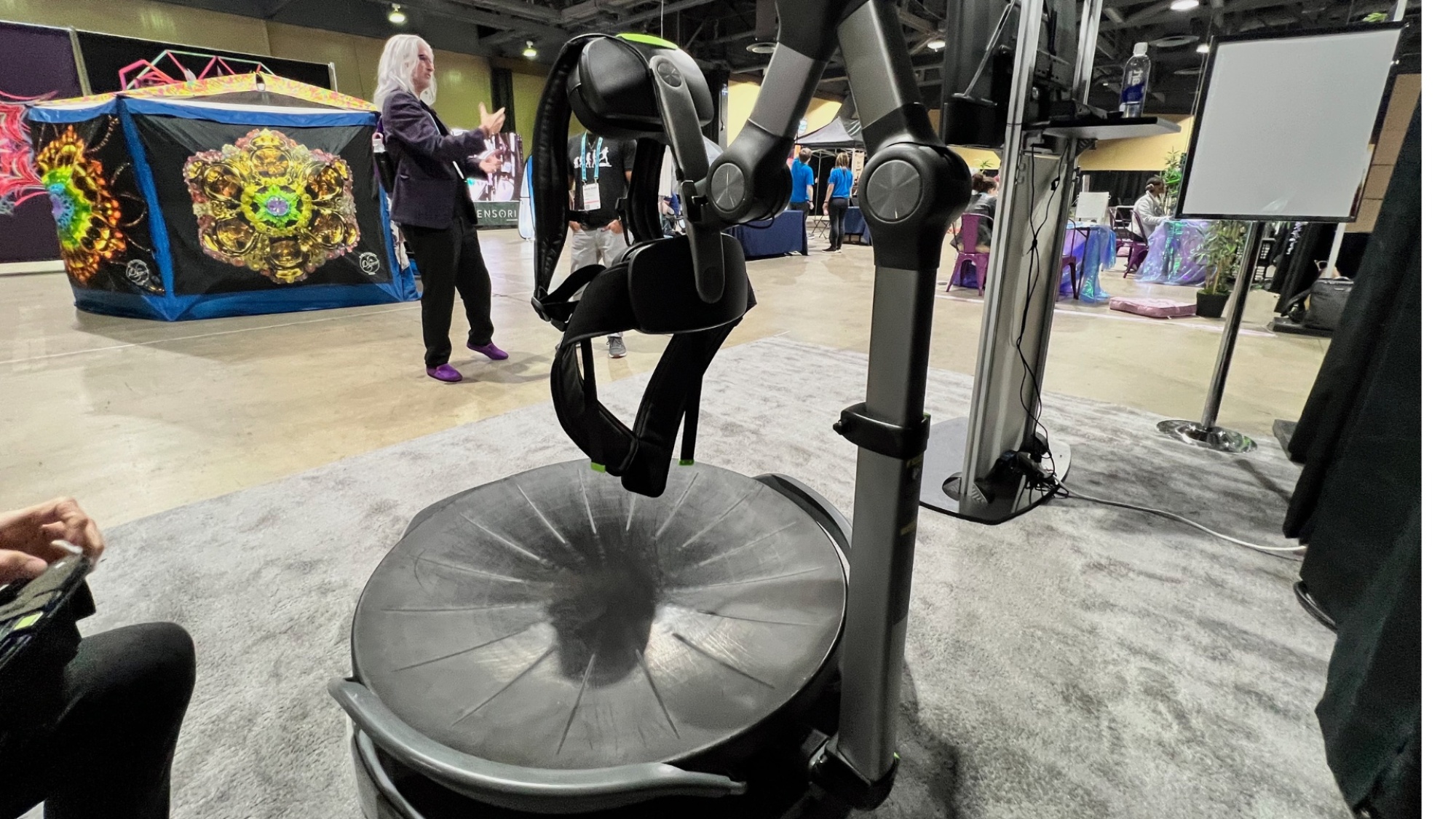
Virtuix Omni One
Credit: Stephen Johnson
Another approach for “walking in VR” comes via the Virtuix Omni One, a treadmill device that lets you virtually walk and run without moving through low-friction technology. In other words, it’s an extremely slippery, bowl-shaped floor with a harness and scaffolding that keeps you upright. Let me tell you, it’s very slippery—the kind of thing that’s disconcerting until you trust it—but once you’re over that hump, it’s a viable solution.
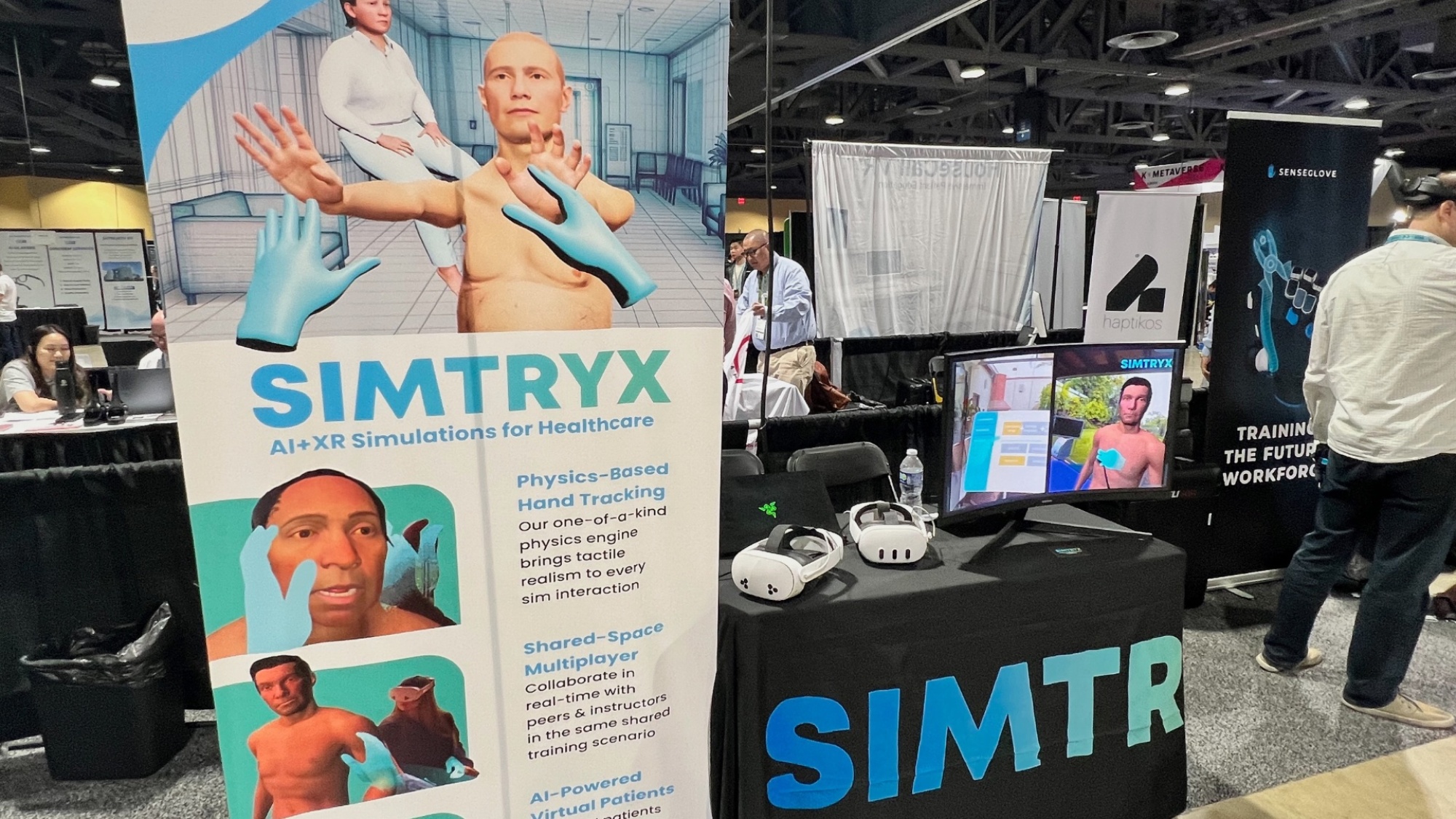
Simtryx
Credit: Stephen Johnson
I tried out a bunch of AR and VR games at the AWE Expo, and by far the most fun I had was playing with the Simtryx AI medical training device. The (extremely indulgent) Simtryx representative at AWE explained that it’s actually not a game; it’s a XR+AI simulator designed to train medical professionals, but when a VR patient complains of stomach pain, I’m goingto play doctor. I tried to convince the AI bot that his appendicitis was psychosomatic, then prescribed a ton of pain killers. Poor guy was dead in about three minutes.
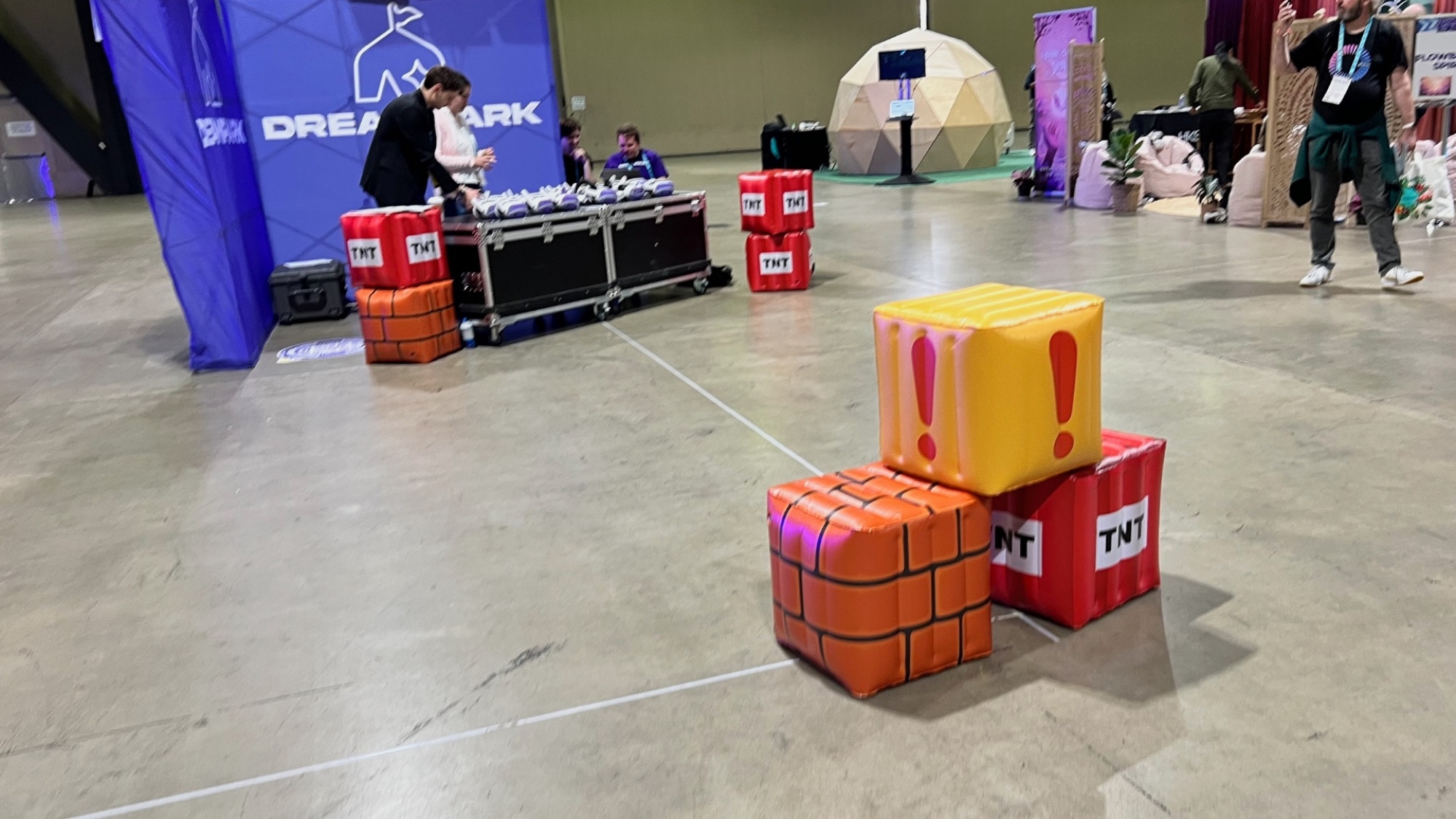
Dreampark
Credit: Stephen Johnson
The image above looks like some sad inflatables on a concrete floor, but if you slip on a Meta Quest running Dreampark, it becomes a colorful level of a Mario-esque platformer, complete with golden coins to collect, lava to avoid, and more. It’s not the kind of thing you could probably do in your house, but it would be perfect at a kid’s birthday party space, or at the crumbling remains of a once vibrant retail zone, like Santa Monica’s Third Street Promenade, that hosts a Dreampark experience weekly.
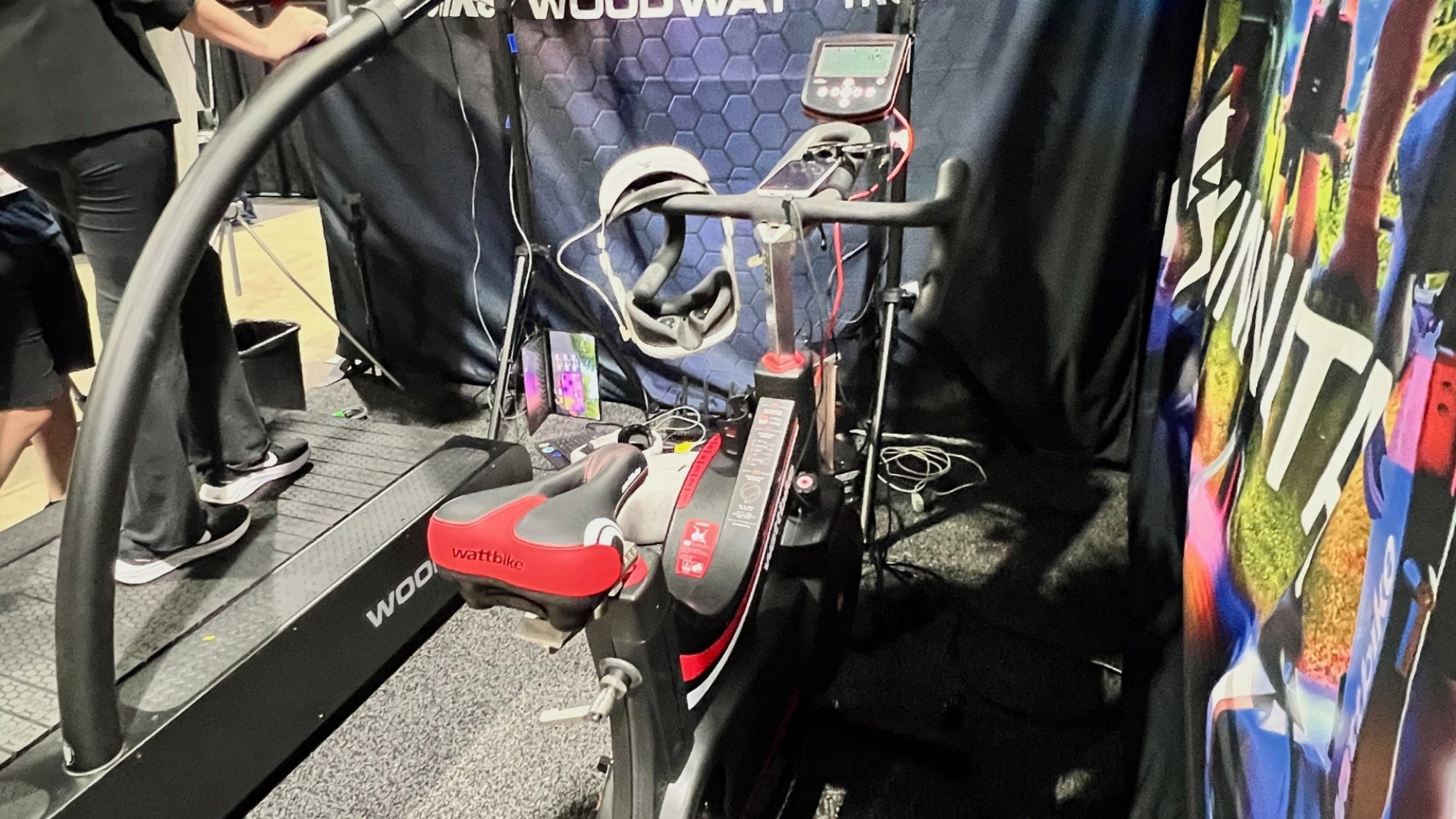
Kinneta
Credit: Stephen Johnson
Lifehacker’s resident spin class instructor Lindsey Ellefson and I disagree about the “games” that come with a Peloton. She loves them; I think they’re ass. But this is just because she hasn’t tried Kinneta yet. It pairs your Meta Quest 2, 3 or 3S with any Bluetooth bike to provide fully gamified fitness on any Bluetooth-enabled treadmill or stationary bike. I gave it a shot and found the experience mirrors Meta’s own Supernatural in an awesome way.
Flowborne Spirit VR
There are a lot of VR and AR apps that are meant to provide relaxation, meditation, and a contemplative experience and Flowborne Spirit was the best I saw at the show. I like the innovative use of the Meta Quest’s controller: You rest it on your belly and it responds to your breath. The game made me feel like I had joined a cult, in the best way possible!
At this point, we’ve pretty much come to expect that AMD will power living room consoles from Microsoft and Sony, but that’s not necessarily how it will always be (just ask Intel about its past relationship with Apple). However, AMD will indeed power Microsoft’s first-party gaming systems for the foreseeable future, with the company announcing
ASPEN, Colo.—The SUV might be the dominant design in the American automobile market, but it hasn’t completely taken over. At Audi, there is still life in the sedan. The old A4 four-door is no more—at least for a while or until Audi redoes its nomenclature yet again. If you want a small Audi four-door, you need to step down to the A3. Five doors is where it’s at, with the 2025 A5.
Like the new Q5 SUV, which you may have read about last week, the new A5 uses an all-new vehicle architecture from Audi called PPC (for premium platform combustion). PPC will give rise to a wide range of new vehicles from Audi, Porsche, and the other premium VW Group stablemates, and it takes a meaningful step into the future with advanced new electronics, making this a true software-defined vehicle.
Under the hood
There will be two versions at launch. The regular A5 features a 2.0 L four-cylinder turbocharged, direct-injection engine driving all four wheels via a seven-speed dual-clutch transmission, and generates 268 hp (200 kW) and 295 lb-ft (400 Nm). That’s a pretty large power and torque bump compared to the outgoing A5 Sportback, in part thanks to a new variable geometry turbocharger that replaces the old twin-scroll blower.
Fractal Design Scape: MSRP $199 Fractal Design’s first foray into audio is a winning combination of comfort, multi-platform versatiliy, and elegant design, marred only by a somewhat tame maxiumum output level and lack of ANC. Mature Styling Plush & Breathable For A Comfy Fit No Software Utility Needed (Web Setup FTW) Digital Crown…
Among smart lights, few have the robust software (or price tag to go along with it) of Philips Hue. The company has made a name for itself as the standard-bearer for what smart lights can be. After years of adding new features, though, there are quite a few that aren’t as helpful as the others. These are the ones that I, as a long-time Hue owner, actually use on a regular basis.
Some of this is going to be a bit your-mileage-may-vary. For my money, the feature that lets you create a colorful scene based on a photo is neat as a party trick (if your party is boring), but it’s not that helpful when there’s already a huge library of scenes available to choose from. Maybe you disagree! But I’ve been using Hue lights for almost as long as they’ve existed, and these are my favorite features.
Schedule your lights to slowly wake you up…
Getting blasted with light in the morning is a terrible way to wake up, at least for me. And if you’re in the same boat, the fade-in timer in the Hue app is a handy solution. In the Automations tab, click the + icon and tap “Wake up with light.” Choose a room and you can set a specific time and date for your lights in that room to turn on.
Most helpfully, you can tap the Fade Duration setting to slowly turn on the light. You can tweak this to be anywhere from 10 to 60 minutes. Personally, I find this meshes really well with my terrible habit of setting multiple alarms, because I sleep through the first several. It’s easy to lose track of how much time has passed across multiple snoozes, but the lights make the imminent arrival of a new day impossible to ignore.
…Or sync your lights to the rising and setting of the sun
While I prefer turning my lights on in the morning at a specific time—and it makes more sense for anyone who has to stick to a schedule—the night is a bit of a different story. Like many smart lights, the Hue app features automations that let you tie your lights to your local sunset. It bases this off the location of your Hue Bridge, which you can adjust in the app’s settings.
To set this up, head to the Automations tab in the Hue app and choose Custom automation. Instead of choosing a specific time, you can pick either Sunrise or Sunset. To avoid an abrupt transition, I like to set the timer to begin 15 minutes before sunset, and set the Fade duration to 30 minutes, so some of my lights turn on roughly as the sun sets.
I also like to set a second automation to kick in an hour or two after sunset to dim the lights again. Especially in the summer, sunset happens pretty late where I live, so it can be easy to lose track of time. Having such a visible reminder helps keep my sense of time grounded.
Give date night some ambience with candle effects
The animated effects are a little buried in the Philips Hue app, which is a bit of a bummer because they’re one of the platform’s best features. These effects let your lights—especially if you have full color RGB bulbs—simulate the flickering of a candle, the shimmering surface of water, or abstract colorful prisms.
The candle animation in particular is perfect for date nights. Nothing sets the mood quite like the dim, soft dance of firelight—without the setup and risks of actual fire. To find these effects, open up the light you want to apply it to. You can tap each light and select the three-star Effects icon to find a library of effects.
For rooms with multiple lights, it’s often easier to create a custom Scene to apply it to all the lights in a room. It takes a little more setting up, but create a new Scene for the room, and choose the effect for each bulb in that room. Once the scene is set up, you can easily activate it from the app, or one of the more convenient methods. Including …
Use home screen widgets for quick scene changes
Widgets—in particular Android’s home screen widgets—have had a rocky history, waffling between mostly useless decorations and kinda-helpful little gizmos. But the Philips Hue controls is one of the few widgets I genuinely use every day and don’t want to live without. I have a page on my phone’s home screen with light toggles and a few common scenes that I can swipe to easily.
If you have the Hue app on your phone, you can add these widgets to your home screen on both Android and iOS. Long press an empty space on your home screen and find the Hue widget. The app will take over and walk you through choosing which room, scene, and toggle you’d like each widget to apply to. You’ll have to create a widget for each scene, but after a few minutes, you’ll have a nice little control panel within easy reach.
Don’t forget your voice controls
There’s a decent chance that half the reason you got smart lights in the first place is to control them with a smart speaker. Once you’ve turned off the bedroom lights while snugly under the covers, you never want to go back. What you might not know is that even if you don’t have a smart speaker, you can use this trick.
Most smart speakers like Google Home, Amazon’s Echo, and even Apple’s HomePod can control Philips Hue lights with simple voice commands. However, you can set up your voice assistants like Siri or Gemini to control the lights directly. The process will vary based on which device you’re pairing with, so check your phones and speakers to see how to connect them to your lights.
Turn on vacation mode when you’re away to make it seem like you’re home
One of the most useful specialized automations in the Philips Hue app is the Mimic Presence tool. In the Automations tab, you can find this feature that will automatically turn your lights on or off at irregular schedules even when you’re not at home. This can give the impression that you (or someone) is at home to onlookers nearby.
This is a common tactic to dissuade possible burglars, and it can be surprisingly effective. Most home burglaries are crimes of opportunity, and even simple methods to dissuade can make your home a less appealing target. Whenever I plan on leaving my home for a while, I’ll set this automation up. Then I usually forget that I did until the first time my lights randomly turn off after I get home.
DC Studios co-head James Gunn argues that the movie industry is “dying” primarily because productions begin before screenplays are complete, while also delivering a sharp critique of his former employer Marvel Studios, which he claims Disney has “killed” through output mandates.
Gunn dismissed common explanations for Hollywood’s struggles like declining theater attendance or improved home viewing experiences, telling Rolling Stone that “the number one reason is because people are making movies without a finished screenplay.” The filmmaker has implemented a strict rule at DC Studios requiring finished scripts before production starts, recently scrapping a project because its screenplay wasn’t ready.
The director, who previously helmed three “Guardians of the Galaxy” films for Marvel, said Disney’s corporate directive to increase output destroyed the studio’s creative process. “They were under a corporate mandate, yeah. That wasn’t fair. It wasn’t right. And it killed them,” Gunn said, referring to Marvel’s mandated production quotas for movies and television shows. By contrast, Gunn said DC Studios operates without numerical mandates. “We don’t have the mandate to have a certain amount of movies and TV shows every year. So we’re going to put out everything that we think is of the highest quality,” he explained.
The artificial intelligence (AI) revolution is reshaping the very bedrock of computing, promising a future that is as exhilarating as it is uncertain. While AMD, Intel and NVIDIA currently dominate the semiconductor headlines, a deeper look reveals that despite their individual strengths – AMD’s burgeoning open-source leadership, Intel’s enduring processor market share and NVIDIA’s current GPU supremacy – all three face existential threats. These challenges could see them being bypassed by a new breed of AI-forward companies and potentially relegate them to the annals of “has-beens” if they don’t adapt with unprecedented speed and vision. After all, history is littered with former champions who failed to navigate the next technological tidal wave.
The Peril of Pioneering: When Front-Runners Falter
However, history teaches a harsh lesson: It’s rare for companies at the very front end of a disruptive technological wave to maintain their dominant position until the technology stabilizes and becomes mainstream. This phenomenon, described in Clayton Christensen’s The Innovator’s Dilemma, occurs because established leaders focus on serving their existing high-margin customers and are often slow to adapt to disruptive, lower-margin innovations that eventually capture the mainstream. Think of Nokia. It was once the mobile phone titan that famously failed to pivot to smartphones, clinging instead to older technologies while Apple and Samsung surged ahead. Or IBM, which, despite inventing the PC, ultimately abandoned the PC market after missteps like the ill-fated PCjr instead of owning the personal computing revolution it started. NVIDIA’s proprietary CUDA ecosystem, while a current strength, could become its Achilles’ heel if the AI market increasingly demands open standards and more flexible solutions.
The Big Three’s Unique Vulnerabilities
Each of these semiconductor titans carries its own unique baggage into the AI future:
Intel: Despite maintaining the lion’s share of the overall x86 CPU market (around 75.6% in Q1 2025), Intel faces immense pressure from its manufacturing challenges, the rise of powerful AI accelerators from competitors and the significant trend of cloud companies designing their own custom processors like Amazon (Graviton), Google (TPU) and Microsoft (Cobalt).
NVIDIA: While still the king of AI GPUs, its proprietary CUDA platform presents a vulnerability. The market is increasingly leaning towards open-source alternatives like AMD’s ROCm, which offers greater flexibility and less vendor lock-in. If the industry coalesces around open standards, NVIDIA’s closed ecosystem could become a significant competitive disadvantage.
AMD: Despite its strong momentum in open-source AI (ROCm software stack is getting updates every two weeks and ROCm 7 is coming) and competitive hardware performance (Instinct MI325X outperforms NVIDIA H200 in Llama 2 fine-tuning), AMD is still fighting for market share against two entrenched giants. It faces the challenge of scaling its ecosystem and convincing a historically NVIDIA-dominated AI development community to switch.
The Rise of the AI-Native Challengers: Beyond the Big Three
The true disruptive force might not come from within this established trio. A new wave of “AI-forward” companies is emerging, unburdened by legacy architectures or entrenched business models. These startups, often with open-source roots, are designing solutions from the ground up specifically for the unique demands of AI. For example, AheadComputing, founded by former Intel CPU architects, is focusing on high-performance RISC-V processors for AI, cloud and edge devices, highlighting the limitations of current architectures for modern AI workloads. Other examples include Cerebras Systems, known for its wafer-scale engine for massive AI model training, and Groq, focusing on ultra-low-latency AI inference.
Perhaps the most potent threat comes from the recently announced merger of Jony Ive’s design powerhouse, IO, with OpenAI. This alliance aims to develop entirely new AI-powered consumer devices, potentially rendering most existing PC and even smartphone computing hardware obsolete. Imagine a device where the AI is the interface, transcending traditional screens and operating systems. This could bypass the need for conventional CPUs and GPUs as we know them, creating a completely new computing paradigm.
A “Skunk Works” Solution: Reclaiming the Edge
To avoid being relegated to the sidelines, AMD, Intel and NVIDIA all need to cultivate a “skunkworks” mentality – small, autonomous and highly innovative teams operating outside traditional corporate bureaucracy. These projects should focus on:
Radical AI-Native Hardware: Developing completely new chip architectures designed from the ground up for AI, potentially embracing open hardware designs.
Pure Open-Source Software Ecosystems: Investing heavily in building truly open and collaborative software platforms that attract the broadest possible developer community.
Deep Integration with AI Models: Moving beyond selling chips to offering full-stack, optimized solutions for specific AI workloads and applications, potentially even partnering with leading AI model developers in new ways.
Exploring Post-PC/Smartphone Paradigms: Actively researching and investing in the next generation of computing devices that might emerge from the AI revolution, beyond the confines of current form factors.
Wrapping Up: The Imperative of Adaptation
The AI revolution presents an existential challenge to the semiconductor industry’s established order. While AMD, Intel and NVIDIA all possess immense talent and resources, their traditional business models and proprietary leanings could become liabilities in a landscape increasingly defined by open-source collaboration, custom silicon and radical new hardware concepts. History is replete with examples of industry leaders who failed to adapt to seismic technological shifts. To avoid becoming cautionary tales, these giants must shed their corporate inertia, embrace a more agile, experimental approach and perhaps even collaborate in unconventional ways to build the truly open, AI-native computing future that is rapidly taking shape. The time for incremental change is over; the future demands a revolutionary response.












 software stack is getting updates every two weeks and ROCm 7 is coming) and competitive hardware performance (