Marshall adds a junior-sized party speaker to its lineup

Marshall is launching a smaller companion for its highly rated Bromley 750 party speaker. The new Bromley 450 retains the larger model’s guitar-amp motif but comes in a petite, less expensive package.

The Bromley 450 carries over its larger sibling’s 360-degree audio trickery. Like equivalents from other companies, Marshall’s “True Stereophonic 360-degree sound” fools your brain into perceiving more directionality than its form factor allows. Lighting effects (“inspired by ‘70s stage shows”) also carry over from the larger model. However, this new speaker lacks the “sound character” control found in the Bromley 750.

Marshall says you can expect over 40 hours of playtime. If your party somehow goes on longer than that, you can swap out its battery on the fly (using the same one found in the Bromley 750). Or, you know, just plug it into a power outlet. And if your event turns into a performance, you’re covered with mic and instrument inputs.

Two party speakers sitting in the back of a rusty old pickup truck.
The Bromley 750 (left) and Bromley 450
Marshall

The Bromley 450 measures 360 x 261 x 492mm, making it about 25 percent shorter than its big brother. At just under 27 lbs, it only weighs about half as much. That helps to explain Marshall’s decision not to include wheels on this model. (But don’t worry, it still has a handle.) The speaker has an IP55 rating for dust and water resistance.

The Marshall Bromley 450 may be less expensive than its larger counterpart, but it still costs a pretty penny. It’ll set you back $800 when it goes on sale on March 31. You can order it on Marshall’s website and from select retail partners (including Best Buy, Sweetwater and Crutchfield).

This article originally appeared on Engadget at https://www.engadget.com/audio/speakers/marshall-adds-a-junior-sized-party-speaker-to-its-lineup-120000871.html?src=rss

Senators tell ByteDance to shut down Seedance 2.0 AI video app ‘immediately’

After ByteDance suspended the global rollout of its new Seedance 2.0 AI video generator on the weekend, US senators have now told the company to “immediately shut down” the app. “Seedance 2.0 poses a direct threat to the American intellectual property system and, more broadly, to the constitutional rights and economic livelihoods of our creative community,” Senators Marsha Blackburn and Peter Welch wrote in a letter to the company. 

The letter reflects an increasing worry in government about AI companies training their apps on copyrighted materials from artists, actors and filmmakers without permission. “Responsible global companies follow the law and respect core economic rights, including intellectual property and personal likeness protections,” the senators wrote. They cited Seedance AI examples including an AI generated Thanos and Superman battle, a rewritten Stranger Things ending and that famous (fake) Tom Cruise and Brad Pitt battle. 

After pulling Seedance 2.0, ByteDance said on the weekend that it “respects intellectual property rights” and that it is “taking steps to strengthen current safeguards as we work to prevent the unauthorized use of intellectual property and likeness by users.” 

However, Blackburn and Welch called that pledge “a delay tactic to continue to abuse the innovators and profit from their success,” adding that its regard for American IP is “part of a larger trend of artificial intelligence companies stealing protected work at the expensive of the creative community.” 

Filmmakers have also taken action against Seedance 2.0, including the Motion Picture Association with recently sent a cease-and-desist letter to ByteDance. Yesterday, senators including Blackburn and Welch unveiled a partisan bill to help artists protect their IP by allowing them to access training records used for AI models, among other measures.

This article originally appeared on Engadget at https://www.engadget.com/ai/senators-tell-bytedance-to-shut-down-seedance-20-ai-video-app-immediately-112146241.html?src=rss

The Morning After: Apple’s surprise AirPods Max refresh

You may have a little Apple fatigue after last week’s barrage of Macs, iPhones and iPads. The company wasn’t done, however. Surprise! Here is an updated pair of AirPods Max. It’s a predictable surprise, perhaps, but one I wasn’t expecting after so many other new devices.

It’s also the first true update. The AirPods Max 2 look identical to their predecessor, but now have an H2 chip. First, the AirPods Pro 2 improve noise cancellation by 50 percent and add support for Adaptive Audio and Live Translation. It’s a much-needed update for headphones that, barring a USB-C option, haven’t changed since 2020.

They’re still priced at $549. In Apple’s recent press images for its cheapest MacBook ever, a child was using AirPods Max while working on their $599 MacBook Neo. Love it.

The new headphones are up for pre-order on March 25 and will ship in early April.

– Mat Smith

The other big stories (and deals) this morning


MacBook Pro M5 Max 16-inch review

Still the pinnacle.

TMA
Engadget

What did I just say? Wrapping up the barrage of reviews of all that new Apple hardware (besides those new AirPods), we test out Apple’s most powerful new MacBook. The new Pro has an M5 Max chip, plenty of memory and is a beast. Thankfully, it still has all the ports you’d want.

Continue reading.


xAI is being sued by teens who say Grok created CSAM using their photos

The class action lawsuit says that the lives of three teens have been “shattered.”

xAI is facing a class-action lawsuit in California, after its Grok AI reportedly generated sexualized images of children. Three teenagers filed suit, alleging Grok used their photos to create child exploitation material. One teen was alerted in December that AI-generated, sexually explicit images of her and other minors were being shared “in settings with which she was familiar, but morphed into sexually explicit poses.” The Center for Countering Digital Hate estimated in January that Grok produced millions of sexualized images, including 23,000 potentially depicting children.

Continue reading.


Finally, Android tablets and foldables are getting a Chrome bookmark bar

Hello, power users.

Google is rolling out a new feature for Chrome that will add a bookmark bar to the browser on Android foldables and tablets. Spotted by 9to5Google, this move will make the browsing experience on larger mobile devices more akin to that of laptops and desktops running Chrome. Perfect if you managed to grab Samsung’s Galaxy Z TriFold before it disappears forever.

Continue reading.

This article originally appeared on Engadget at https://www.engadget.com/general/the-morning-after-engadget-newsletter-111501781.html?src=rss

Bills Would Ban Liability Lawsuits For Climate Change

An anonymous reader quotes a report from Inside Climate News: Republican lawmakers in multiple states and Congress are advancing proposals to shield polluters from climate accountability and prevent any type of liability for climate change harms — even as these harms and their associated costs continue to mount. It’s the latest in a counter-offensive that has unfolded on multiple fronts, from the halls of Congress and the White House to courts and state attorneys general offices across the country.

Dozens of local communities, states and individuals are suing major oil and gas companies and their trade associations over rising climate costs and for allegedly lying to consumers about climate change risks and solutions. At the same time, some states are enacting or considering laws modeled after the federal Superfund program that would impose retroactive liability on large fossil fuel producers and levy a one-time charge on them to help fund climate adaptation and resiliency measures. But many of these cases and climate superfund laws could be stopped in their tracks, either by the conservative majority on the U.S. Supreme Court or by the Republican-controlled Congress.

Last month the court decided to take up a petition lodged by oil companies Suncor and ExxonMobil in a climate-damages case brought against the companies by Boulder, Colorado. The petition argues that Boulder’s claims are barred by federal law, and if the justices agree, it could knock out not only Boulder’s lawsuit but also many others like it. The court is expected to hear the case during its upcoming term that starts in October. There is also a possibility that Republicans in Congress will take action before then to gift the fossil fuel industry legal immunity, similar to that granted to gun manufacturers with the 2005 Protection of Lawful Commerce in Arms Act. Sixteen Republican attorneys general wrote (PDF) to U.S. Attorney General Pam Bondi in June suggesting that the Department of Justice could recommend legislation creating precisely this type of liability shield. And last month, one Republican congresswoman announced that such legislation is indeed in the works. “The ultimate democratic institution in America is the jury,” said former Washington Gov. Jay Inslee. Enacting policies that prevent or block climate-related lawsuits against polluters, he said, would effectively shutter “the doors of the courthouse to Americans that have been injured by oil and gas company pollution and by their lies and deceit about that pollution.”

“I really think it’s an un-American effort to deny Americans the traditional right of access to a jury,” Inslee said. Oil and gas executives are “terrified” by the prospect of having to stand before a jury and face evidence of their climate-change lies and deception, he added. “You’ll see the steam coming out of the jury’s ears when they hear about how they’ve been lied to for decades. [Oil companies] understand why juries will be outraged by it, and they are shaking in their boots. The day of reckoning is coming, and that’s why they’re afraid.”


Read more of this story at Slashdot.

Denon’s DP-500BT turntable combines premium design with Bluetooth streaming for $899

Denon is addressing an omission in its current turntable lineup: Bluetooth streaming. With the new DP-500BT, the company combines refined design, analog sound and high-resolution wireless connectivity. With its semi-automatic operation and switchable phono preamp, this model has the features to suit beginners and experienced vinyl listeners alike.

The DP-500BT has a belt drive system, a balanced S-shaped tonearm and an aluminum die cast platter. There’s also a pre-installed moving magnet (MM) cartridge with a CN-6518 stylus and a built-in preamp that can be disabled in favor of a more robust external unit or powered speakers. Semi-automatic operation combines auto lift with playback stop to simplify the listening process for both novice and advanced vinyl lovers. This feature also protects both the stylus and your records.

In terms of design, Denon says it took inspiration from its DP-3000NE turntable for the DP-500BT. The similarities are clear, but more importantly, this decision gives the new $899 model a much more refined look compared to the company’s more affordable record players. The DP-3000NE is a $2,799 turntable, after all.

Bluetooth streaming is what sets the DP-500BT apart in the Denon lineup. Here, you’ll have the option of aptX, aptX HD and apt Adaptive when you need to streaming wirelessly to speakers or headphones. This turntable also works with the company’s HEOS amplifiers and Home speakers, which allow for multi-room audio while listening to that record collection.

The DP-500BT is available today from Denon and other retailers for $899.

This article originally appeared on Engadget at https://www.engadget.com/audio/denons-dp-500bt-turntable-combines-premium-design-with-bluetooth-streaming-for-899-080000144.html?src=rss

Hydropower Line From Quebec Could Power a Million NYC Homes

The Champlain Hudson Power Express, a $6 billion, 339-mile buried transmission line, will soon deliver Canadian hydropower from Hydro-Quebec to New York City. The project could supply up to 20% of the city’s electricity and power roughly one million homes throughout the year. “This is far and away the largest project I have ever worked on,” said Bob Harrison, who has worked in infrastructure for 40 years and is the head of engineering for the Champlain Hudson Power Express. “We like to say it’s the largest project you’ll never see.” The New York Times reports: The massive power project, expected to provide energy to a million New York City customers a year, travels underground and underwater, from the northern plains at the Canadian border to the filled-in marshlands of coastal Queens, much of it loosely following the Hudson River. Its construction included the underwater installation of more than two million feet of cable imported from Sweden. It also required special boats, loaded with equipment that could shoot water jets deep into the sediment, to create trenches for the cable. Then, when it came to placing cable beneath the landscape, more than 700 land-use easements were needed, plus an additional 1.55 million feet of cable.

The Champlain Hudson Power Express has found a way to plug into the city, but it wasn’t easy. The work included 10 new manholes and more than three miles of new underground circuitry, according to Con Edison, the city’s primary electricity provider. “It was literally a hand weave under the streets of Queens,” said Jennifer Laird-White, the head of external affairs for Transmission Developers. The hydropower travels from Canada via two buried cables that are as round as cantaloupes. Those lines snake for hundreds of miles under a lake, several rivers (including the Hudson for about 90 miles) and through buried trenches alongside train tracks and roads. The cables resurface in Astoria, Queens, where a converter station shapes, filters and refines the raw power into a product that New Yorkers can consume.

In two cavernous rooms that could be mistaken for “Star Wars” sets, the electricity flows through 30 hanging structures encased in what look like metallic, dinosaurlike exoskeletons. Each one weighs about as much as a small humpback whale and contains microprocessors, thousands of valves and fiber wires. “I am still wowed when I walk into that facility,” said Mr. Harrison, the engineer. “I mean, it is just mind-boggling.”


Read more of this story at Slashdot.

Boox’s new Go E Ink tablet includes a 10-inch display and runs Android 15

There are many E Ink tablets out there, but most of them are basically digital notebooks. They are great for reading and handwriting notes, but not so great for doing all of that regular tablet stuff like checking emails and doomscrolling. Boox, however, has released a number of E Ink tablets that can access the Google Play Store, opening up users to the wide world of traditional smartphone apps.

The company’s latest product is a refresh of the Go 10.3 tablet, called the Go 10.3 Lumi. This introduces plenty of new features and, as the name suggests, one is a front light. The tablet has been designed for both natural sunlight and low-light environments. The previous model was great, but it turns into a useless paperweight without access to ambient light. 

A tablet.
Boox

Despite the front-facing light, the Go 10.3 Lumi is still lighter than its predecessor, at 12.8 ounces. It’s also on the thinner side, with a 4.8mm profile.

The basic specs are similar to the Go tablet, with an octa-core processor, 4GB of RAM and 64GB of internal storage. It runs on Android 15, which is a massive improvement for both security and access to apps. The previous iteration ran on Android 12, and Google stopped officially supporting that OS last year. That means no more critical security updates.

In addition to beefed up security, Boox promises the upgrade to Android 15 offers users improved memory management, better multitasking and smoother UI interactions. E Ink devices can be sluggish so I’m all for anything that speeds things up.

It integrates with external keyboards and boasts integrated speakers, which will certainly come in handy when navigating apps downloaded from the Play Store. Despite the screen technology, this is an Android tablet. It should be able to run just about any app available.

However, the E Ink technology will likely run into hiccups with video-based apps and games. It’s just not made for that. This could be a great little gadget for emails and text-based social media, but not for something like TikTok. It should be able to handle non-animated games just fine, like crossword puzzles and stuff like that. 

Boox says the tablet gets “substantial battery life” and has been “optimized for extended usage cycles.” The company hasn’t announced detailed battery specs, but did say people “can work all day without looming battery anxiety.” E Ink devices tend to last a good while, so I’m not worried about that.

The Boox Go 10.3 Lumi is available to order right now and costs $450. If you want to save a few bucks and have no interest in a front light, there’s a stripped down version that also runs Android 15 but costs $420.

This article originally appeared on Engadget at https://www.engadget.com/mobile/tablets/booxs-new-go-e-ink-tablet-includes-a-10-inch-display-and-runs-android-15-020009621.html?src=rss

NVIDIA Debuts Agent Toolkit And NemoClaw At GTC For Faster, Safer AI Agents

NVIDIA Debuts Agent Toolkit And NemoClaw At GTC For Faster, Safer AI Agents
During his keynote at GTC 2026, NVIDIA CEO Jensen Huang introduced a wide array of new products, services, AI models, and software to a massive audience at the SAP Center in San Jose, California. The Vera Rubin ecosystem with Groq integration made its debut, along with an array of new silicon, and Jensen gave a sneak peek at DLSS 5 as well.

‘Pokemon Go’ Players Unknowingly Trained Delivery Robots With 30 Billion Images

More than 30 billion images captured by Pokemon Go players have helped train a visual mapping system developed by Niantic. The technology is now being used to guide delivery robots from Coco Robotics through city streets where GPS often struggles. Popular Science reports: This week, Niantic Spatial, part of the team behind Pokemon Go, announced a partnership with Coco Robotics, a company that makes short-distance delivery robots for food and groceries. Soon, those robot couriers will scoot around sidewalks using Niantic’s Visual Positioning System (VPS)– a navigation tool that can reportedly pinpoint location down to a few centimeters just by looking at nearby buildings and landmarks. Niantic trained that VPS model on more than 30 billion images captured by Pokemon Go users, and claims it will help robots operate in areas where GPS falls short. […]

Instead of helping users navigate the way that GPS does, VPS determines where someone is based on their surroundings. That makes Pokemon Go particularly useful as a data source, because players had to physically travel to specific locations and point their phones at various angles. That mapping effort got a significant boost in 2020, when the app added what it called “Field Research,” a feature prompting players to scan real-world statues and landmarks with their cameras in exchange for in-game rewards. A portion of the data also reportedly came from areas known as “Pokemon battle arenas.” Whether players knew it or not, those scans were creating 3D models of the real world that would eventually power the Niantic model. More data means better accuracy, and because Niantic was collecting images of the same locations from many different users, it could capture the same spots across varying weather conditions, lighting, angles, and heights. […]

The idea is that Coco’s robots can use VPS and four cameras mounted around the machine to get a far more precise read on their surroundings. In turn, the well-equipped robot will deliver food on time. On a broader level, Niantic says its partnership with Coco Robotics is part of a longer-term effort to build a “living map” of the world that updates as new data becomes available. Once VPS-equipped delivery robots hit the streets, they will collect even more info that can be fed back into the model to bolster its accuracy further. This kind of continuous, real-world data collection is already central to how self-driving vehicle companies like Waymo and Tesla operate, and is a large part of why that technology has improved so significantly in recent years.


Read more of this story at Slashdot.

Insane Flawless Performance In Co-Op Dancing Video Game

This is a video of Tomatonium and ElijahTS performing a perfect co-op performance to the 157 BPM song ‘Sarabande’ in arcade dancing game Pump It Up Prime 2, which may or may not also be the name of a male enhancement pump. “I believe that’s actually Pump It Up 2 Prime.” When you’re right, you’re right. Still, I wish I had the money to have an arcade game in my basement. Honestly, I wish there was anything in my basement besides water damage and jump scares.

Skip to 0:50 if you want to get to the real meat and potatoes.

Android tablets and foldables are getting a Chrome bookmark bar

Sometimes, it’s the little details in a software update that make the biggest improvements. Google is rolling out a new feature for Chrome that will add a bookmark bar to the browser on Android foldables and tablets. Spotted by 9to5Google, this move will make the browsing experience on larger mobile devices more akin to that of laptops and desktops running Chrome. For those people who do like to do more robust computing on their mobile gadgets, this will be a hugely welcome addition. It’s rolling out in version 146 of the browser’s Android version, which just dropped today.

The mobile version of the bookmarks bar will appear below the Omnibox, displaying Favicons and site names. A chevron will appear to scroll deeper into the list of bookmarks, and a long press on a bookmark will display the entire URL. 

If you’re excited to take advantage of this new tool, you’ll have to manually enable it. By default, devices will be set to “Hidden on narrow screens.” Go to Settings, then Appearance and finally select “Show bookmarks bar.”

This article originally appeared on Engadget at https://www.engadget.com/mobile/android-tablets-and-foldables-are-getting-a-chrome-bookmark-bar-222533702.html?src=rss

NVIDIA and Bolt team up for European robotaxis

At GTC 2026, NVIDIA and Bolt announced what they hope will be a symbiotic partnership. Bolt gets NVIDIA technology that would be costly and impractical to build on its own. Meanwhile, NVIDIA not only gains a major customer but also access to the European rideshare company’s driving data.

Bolt says its fleet data will build a “learning engine” for autonomous vehicles (AVs) using NVIDIA tech. The rideshare company will use NVIDIA Cosmos to curate and search driving data. It will tap into NVIDIA Omniverse to reconstruct digital twins of real-world driving logs, then use Cosmos again to generate and augment data at scale.

NVIDIA’s Alpamayo model, designed specifically for AVs, will help the AI learn how to drive safely and appropriately in European cities. Finally, Bolt will integrate NVIDIA’s Drive Hyperion platform into its AVs.

“Autonomous vehicles require a full-stack approach that unifies AI models, high-performance compute, and a robust sensor architecture,” NVIDIA EMEA Automotive VP Philippe Van Den Berge said. “By combining Bolt’s real-world operational data with the NVIDIA Drive Hyperion platform, AI infrastructure, and open models & libraries across Omniverse, Cosmos, and Alpamayo, we’re enabling a scalable foundation for safe, high-performance autonomous mobility services designed for the complexity and diversity of European roads.”

Bolt has been busy gearing up for an autonomous future. In late 2025, it announced partnerships with Pony.ai and Stellantis.

The companies haven’t announced a timeline for when we can expect to see NVIDIA-powered Bolt robotaxis in European cities. However, they promise that Bolt’s fleet data will comply with GDPR standards. They also say they’ll provide open-source access to European universities and small- and medium-sized businesses.

This article originally appeared on Engadget at https://www.engadget.com/transportation/evs/nvidia-and-bolt-team-up-for-european-robotaxis-220100551.html?src=rss

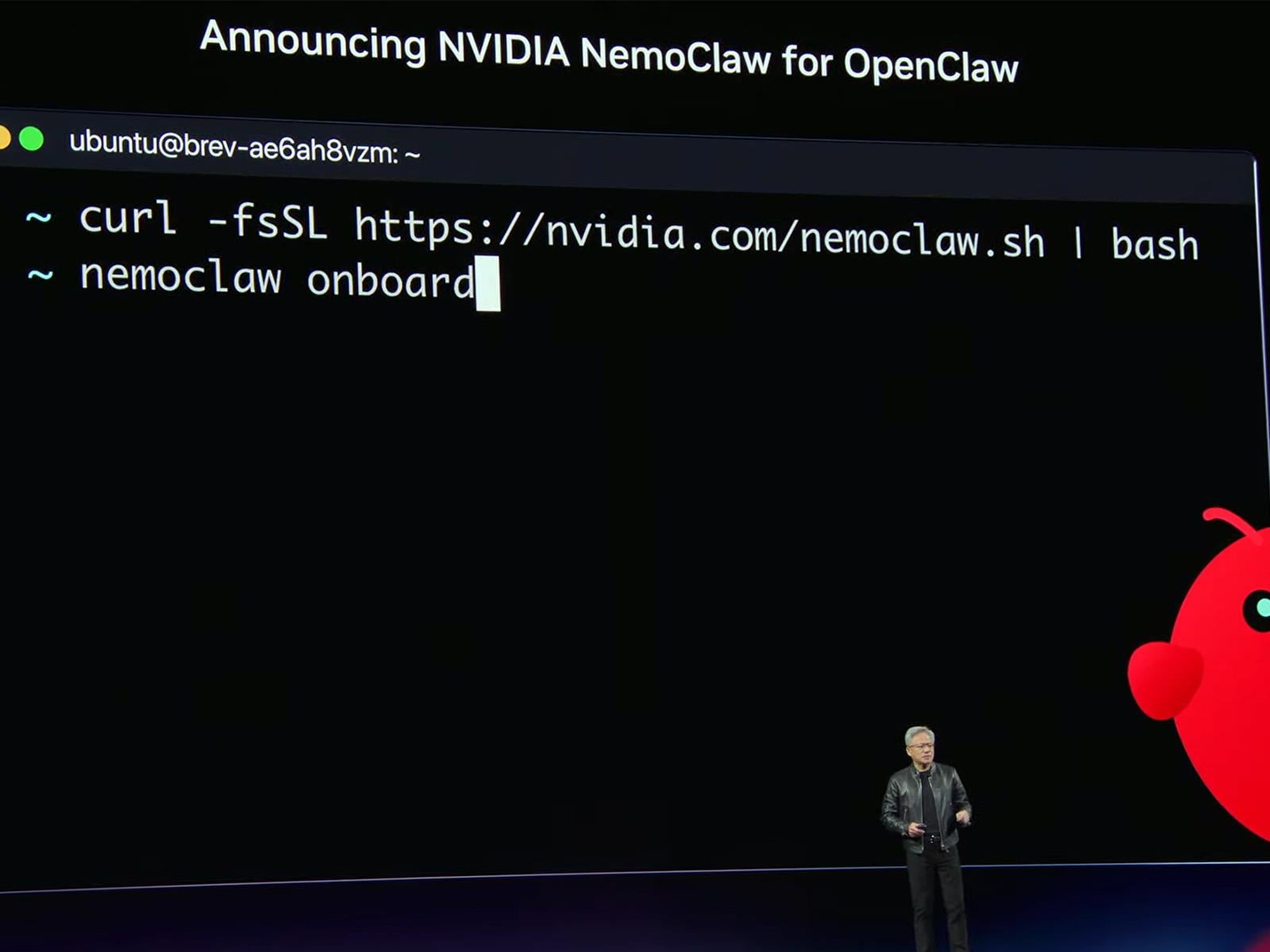
Nvidia Bets On OpenClaw, But Adds a Security Layer Via NemoClaw

During today’s Nvidia GTC keynote, the company introduced NemoClaw, a security-focused stack designed to make the autonomous AI agent platform OpenClaw safer. ZDNet explains how it works: NemoClaw installs Nvidia’s OpenShell, a new open-source runtime that keeps agents safer to use by enforcing an organization’s policy-based guardrails. OpenShell keeps models sandboxed, adds data privacy protections and additional security for agents, and makes them more scalable. “This provides the missing infrastructure layer beneath claws to give them the access they need to be productive, while enforcing policy-based security, network, and privacy guardrails,” Nvidia said in the announcement. The company built OpenShell with security companies like CrowdStrike, Cisco, and Microsoft Security to ensure it is compatible with other cybersecurity tools.

Nvidia said NemoClaw can be installed in a single command, runs on any platform, and can use any coding agent, including Nvidia’s own Nemotron open model family, on a local system. Through a privacy router, it allows agents to access frontier models in the cloud, which unites local and cloud models to help teach agents how to complete tasks within privacy guardrails, Nvidia explained. Nvidia seems to be hoping that the additional security can make OpenClaw agents more popular and accessible, with less risk than they currently carry. The bigger picture here is how NemoClaw could give companies the added peace of mind to let AI agents complete actions for their employees, where they wouldn’t have previously. Nvidia did not specify when NemoClaw would be available.


Read more of this story at Slashdot.

All the Details on Target’s Answer to Amazon’s Big Spring Sale

We may earn a commission from links on this page. Deal pricing and availability subject to change after time of publication.

Traditionally, spring hasn’t been a big online shopping season, comparatively speaking. Summer has Prime Day, fall has Prime Deal Days and Black Friday, and there are a bunch of holiday sales during winter. But that has been changing since Amazon’s launched its Big Spring Sale three years ago. And this year, as usual, Target is competing for your dollars with its own spring promotion: Circle Deal Days.

What is Circle Deal Days?

Circle Deal Days is Target’s name for its spring sale event this year. In previous years, Target held Circle Week, which lasted a whole week (like Amazon’s Big Spring Sale, which runs March 25–31). This year, it’s much shorter.

When is Circle Deal Days?

This upcoming Circle Deal Days will be from Wednesday, March 25, to Friday, March 27.

Do you need to be a Target Circle member to shop for Circle Deal Days?

You will need to be a Circle member to take part in the sale, but unlike a Prime membership, membership in Target Circle is free. You can sign up on the Target app or Target.com. If you are part of the paid membership tier, Target Circle 360, which starts at $10.99 per month, you’ll get early access beginning March 24. Target is also offering incentives for those who sign up for Circle or Circle 360 in the lead-up to the sale:

  • Join Target Circle between March 15 and 24 and get 15% off your first purchase.

  • Apply and get approved for a Target Circle credit card from March 15-27 and get $100 in Target Circle Rewards.

  • Sign up for Target Circle 360 March 15-27 will receive 50% off a one-year membership.

There are more details in Target’s press release.

What deals you can expect during Target Circle Deal Days

The sale is mainly focused on spring items, but sale categories will broadly include apparel, patio furniture, home essentials, beauty products, grocery items, toys, books, movies, and music. You can shop in person or online, and there will be a “Deal of the Day” for every day of the event.

Here are some examples of deals you might find, directly from Target’s press release:

  • Up to 50% off select toys from Barbie, Gigglescape, PAW Patrol and more

  • Up to 40% off women’s apparel including A New Day, Universal Thread and AVA & VIV

  • 40% off select skincare from BYOMA, Bubble Skincare, Good Molecules, Vacation, Carroten and more

  • 40% off select home, kitchen and dining, including Keurig, Cuisinart and Ninja

  • 40% off select floorcare, including Shark, Dyson, Bissell, Roborock and Sharper Image

More deals are available on the Circle Deal Days landing page.

What competing retailers are also hosting spring sales?

Amazon’s Big Spring Sale will take place Wednesday, March 25, through Tuesday, March 31. Walmart hasn’t confirmed its sale yet, while Best Buy’s Tech Fest is running now through Sunday, March 22.

Elon Musk’s xAI sued for turning three girls’ real photos into AI CSAM

A tip from an anonymous Discord user led cops to find what may be the first confirmed Grok-generated child sexual abuse materials (CSAM) that Elon Musk’s xAI can’t easily dismiss as nonexistent.

As recently as January, Musk denied that Grok generated any CSAM during a scandal in which xAI refused to update filters to block the chatbot from nudifying images of real people.

At the height of the controversy, researchers from the Center for Countering Digital Hate estimated that Grok generated approximately three million sexualized images, of which about 23,000 images depicted apparent children. Rather than fix Grok, xAI limited access to the system to paying subscribers. That kept the most shocking outputs from circulating on X, but the worst of it was not posted there, Wired reported.

Read full article

Comments

Prime Video Is About to Take 4K Streaming Away From ‘Basic’ Users

Bad news, Prime subscribers: Starting April 10, Amazon will lock Prime Video streaming quality to 1080p for “basic” users. If you want to continue watching Prime Video content in 4K as you have been, you’ll need to pay an extra $4.99 per month. Otherwise, your Prime Video shows and movies will look just a bit fuzzier than you may be used to.

It’s part of a number of changes Amazon is making to its streaming services next month. On April 10, Amazon will start offering customers a new “Prime Video Ultra” plan. This option will be ad-free and will come with streaming up to 4K in both Dolby Vision and Dolby Atmos. You’ll also be able to stream up to five devices at once (as opposed to the current limit of three), as well as download as many as 100 titles (up from 25 on the basic plan).

That plan will cost an extra $4.99 on top of your Prime subscription, which currently runs for $14.99 a month. Amazon currently charges uses an extra $2.99 to access Prime Video without ads, so if you’re already paying for that privilege, you’ll “only” need to pay another $2 for Amazon’s Ultra perks—including the 4K access you already have.

If you choose to keep Amazon’s “basic” Prime Video package as part of your Prime subscription, you’ll still get some new perks, too. While you lose 4K streaming, you will get Dolby Vision (but no Dolby Atmos, though I imagine that won’t matter to the many viewers to watch Prime Video with their TV’s built-in speakers.) You’ll also gain one extra simultaneous stream (four, up from three), and be able to download up to 50 titles at once (again, up from the current 25).

New subscription features are always welcome, especially when they don’t come at an added cost. But taking away existing features and locking them behind a paywall isn’t welcome. Perhaps this will pay off for Amazon, and users will spend the extra money to watch their content in as high a resolution as possible. But even so, they’ll be spending more to access the same quality content they may already get for “free,” as part of their Prime subscription.

Polymarket Gamblers Threaten To Kill Journalist Over Iran Missile Story

An anonymous reader quotes a report from the Times of Israel, written by journalist Emanuel Fabian: On Tuesday, March 10, a massive explosion shook the city of Beit Shemesh, just outside Jerusalem, in yet another Iranian ballistic missile attack during the ongoing war. Rescue services scrambled to the scene in search of possible casualties, though as it turned out, the projectile had struck a forested area just outside the city, around 500 meters from homes. On The Times of Israel’s liveblog that day, I reported that the missile had hit an open area and no injuries were caused, citing the rescue services, as well as footage that emerged showing the massive explosion caused by the missile’s warhead. But what I thought was a seemingly minor incident during the war has turned into days of harassment and death threats against me. Emanuel received numerous emails, messages and calls from individuals urging him to change the report to say the missile had been intercepted. “It was indeed a little strange to receive the same question, about something relatively inconsequential, from two different people within a day,” he said, until eventually making the Polymarket connection after noticing two users on X respond to his story with apparent ties to Polymarket… “There are people saying that they have received word from you that the missile strike in Beit Shemesh on March 10th was in fact intercepted, is this true or did no such interaction occur?” wrote one of the users. “was there any video of the actual impact,” wrote another.

The rules of this particular Polymarket bet state: “This market will resolve to ‘Yes’ if Iran initiates a drone, missile, or air strike on Israelâ(TM)s soil on the listed date in Israel Time (GMT+2). Otherwise, this market will resolve to ‘No’.” However, there is a clause: “Missiles or drones that are intercepted… will not be sufficient for a ‘Yes’ resolution, regardless of whether they land on Israeli territory or cause damage.”

This is when Emanuel realized that his “minor report” of a missile strike “was now in the middle of a betting war, with those who had bet ‘No’ on an Iranian strike on Israel on March 10 demanding I change my article to ensure they would win big.”

When he refused, some of the Polymarket gamblers escalated to harassment, fabricated messages, bribery attempts, and explicit threats against him and his family. “You have no idea how much youâ(TM)ve put yourself at risk,” wrote a user by the name of Haim. “Today is the most significant day of your career. You have two choices: either believe that we have the capabilities, and after you make us lose $900,000 we will invest no less than that to finish you. Or end this with money in your pocket, and also earn back the life you had until now.â

After he didnâ(TM)t respond, Haim sent me another series of messages: âoeYou are choosing to go to war knowing that you will lose your life as youâ(TM)ve grown accustomed to it â” for nothing.â He messaged again: âoeYou have exactly a few hours left to fix your attempt at influencing [the market]. It would be stupid of you to ignore this.â Haim also gave specific detailed threats about his neighborhood, parents, and family.


Read more of this story at Slashdot.

RFK Jr’s changes to CDC vaccine guidance, advisory board blocked by judge

US District Judge Brian Murphy on Monday temporarily blocked most of the damage that anti-vaccine Health Secretary Robert F. Kennedy Jr. has done to federal vaccine guidance.

In a 45-page ruling that opens with a quote from Carl Sagan, Judge Murphy issued a temporary injunction that blocks:

  • The federal vaccine advisors Kennedy appointed to the Centers for Disease Control and Prevention’s Advisory Committee on Immunization Practices after firing all 17 expert members. Almost all of Kennedy’s new advisors hold anti-vaccine views, have questionable qualifications for being on the committee, and did not appear to go through standard vetting.
  • Every vote those ACIP members have made to change federal vaccine guidance.
  • Kennedy’s dramatic overhaul of the Centers for Disease Control and Prevention’s childhood vaccine schedule in January, which dropped the number of recommended immunizations from 17 to 11, in line with Denmark.

The ruling stems from a lawsuit brought by the American Academy of Pediatrics, along with several other medical groups, against Kennedy. The groups challenged the legality of the unprecedented moves, which disregarded standard procedures and lacked the backing of scientific evidence.

Read full article

Comments

National Academies of Sciences says no to demands it remove climate info

Judges are frequently confronted with cases that hinge upon scientific information that their educational backgrounds may leave them ill-equipped to manage. Because of this challenge, the Federal Judicial Center, a group within the judicial branch of the government, has collaborated with the National Academies of Sciences (NAS) to produce a reference manual that provides background on a range of scientific and medical issues that frequently confront the court system. The Reference Manual on Scientific Evidence is currently on its fourth edition, and it has turned out to be an unexpectedly controversial one.

For the first time, this edition of the Reference Manual has included a chapter on climate change, meant to prepare judges to manage and potentially decide cases focused on everything from federal environmental rules to charges that fossil fuel producers engaged in fraud by ignoring the many warnings of harms caused by their products. That didn’t sit well with Republican politicians; a collection of red-state attorneys general sent a letter demanding that the Federal Judicial Center pull the chapter. Back in February, it complied, posting a modified version of the Reference Manual with the climate chapter deleted.

But, as noted above, the NAS arranges for the production of the Reference Manual, and it hosts a copy in its extensive library of publications. So, fresh off their success with the government, the same collection of attorneys general turned their sights on the Academies. In a letter dated February 19, they “urge” the NAS to follow the judiciary’s example and delete the chapter. Citing sources such as a Wall Street Journal editorial and their own threatening letter, the attorneys general accuse the NAS of engaging in “one-sided advocacy” and “judicial indoctrination,” and say it “is building a reputation as a partisan actor.”

Read full article

Comments

NVIDIA DLSS 5 Paints Game Graphics With AI-Infused Photorealistic Details

NVIDIA DLSS 5 Paints Game Graphics With AI-Infused Photorealistic Details
During NVIDIA’s GTC 2026 keynote, CEO Jensen Huang gave attendees a sneak-peek at DLSS 5 leveraging neural rendering technology, with an array of brief clips of Resident Evil Requiem, Hogwarts Legacy, Starfield and EA Sports’ FC ’26. The newest game in that group is Resident Evil Requiem, and its already leading-edge, path-traced graphics