New In Firefox Nightly Builds: Copilot Chatbot, New Tab Widgets, JPEG-XL Support

The blog OMG Ubuntu notes that Microsoft Copilot chatbot support has been added in the latest Firefox Nightly builds. “Firefox’s sidebar already offers access to popular chatbots, including OpenAI’s ChatGPT, Anthropic’s Claude, Le Chat’s Mistral and Google’s Gemini. It previously offered HuggingChat too.”

As the testing bed for features Mozilla wants to add to stable builds (though not all make it — eh, rounded bottom window corners?), this is something you can expect to find in a future stable update… Copilot in Firefox offers the same features as other chatbots: text prompts, upload files or images, generate images, support for entering voice prompts (for those who fancy their voice patterns being analysed and trained on). And like those other chatbots, there are usage limits, privacy policies, and (for some) account creation needed. In testing, Copilot would only generate half a summary for a webpage, telling me it was too long to produce without me signing in/up for an account.
On a related note, Mozilla has updated stable builds to let third-party chatbots summarise web pages when browsing (in-app callout alerts users to the ‘new’ feature). Users yet to enable chatbots are subtly nudged to do so each time they right-click on web page. [Between “Take Screenshot” and “View Page Source” there’s a menu option for “Ask an AI Chatbot.”] Despite making noise about its own (sluggish, but getting faster) on-device AI features that are privacy-orientated, Mozilla is bullish on the need for external chatbots.

The article suggests Firefox wants to keep up with Edge and Chrome (which can “infuse first-party AI features directly.”) But it adds that Firefox’s nightly build is also testing some non-AI features, like new task and timer widgets on Firefox’s New Tab page. And “In Firefox Labs, there are is an option to enable JPEG XL support, a super-optimised version of JPEG that is gaining traction (despite Google’s intransigence).

Other Firefox news:
There’s good news “for users still clinging to Windows 7,” writes the Register. Support for Firefox Extended Support Release 115 “is being extended until March 2026.”

Google “can keep paying companies like Mozilla to make Google the default search engine, as long as these deals aren’t exclusive anymore,” reports the blog It’s FOSS News. (The judge wrote that “Cutting off payments from Google almost certainly will impose substantial — in some cases, crippling — downstream harms to distribution partners…” according to CNBC — especially since the non-profit Mozilla Foundation gets most of its annual revenue from its Google’s search deal.)
Don’t forget you can now search your tabs, bookmarks and browsing history right from the address bar with keywords like @bookmarks, @tabs, and @history. (And @actions pulls up a list of actions like “Open private window” or “Restart Firefox”).


Read more of this story at Slashdot.

32% of Senior Developers Say Half Their Shipped Code is AI-Generated

In July 791 professional coders were surveyed by Fastly about their use of AI coding tools, reports InfoWorld. The results?

“About a third of senior developers (10+ years of experience) say over half their shipped code is AI-generated,” Fastly writes, “nearly two and a half times the rate reported by junior developers (0-2 years of experience), at 13%.”

“AI will bench test code and find errors much faster than a human, repairing them seamlessly. This has been the case many times,” one senior developer said…

Senior developers were also more likely to say they invest time fixing AI-generated code. Just under 30% of seniors reported editing AI output enough to offset most of the time savings, compared to 17% of juniors. Even so, 59% of seniors say AI tools help them ship faster overall, compared to 49% of juniors. Just over 50% of junior developers say AI makes them moderately faster. By contrast, only 39% of more senior developers say the same.
But senior devs are more likely to report significant speed gains: 26% say AI makes them a lot faster, double the 13% of junior devs who agree. One reason for this gap may be that senior developers are simply better equipped to catch and correct AI’s mistakes… Nearly 1 in 3 developers (28%) say they frequently have to fix or edit AI-generated code enough that it offsets most of the time savings. Only 14% say they rarely need to make changes. And yet, over half of developers still feel faster with AI tools like Copilot, Gemini, or Claude.
Fastly’s survey isn’t alone in calling AI productivity gains into question. A recent randomized controlled trial (RCT) of experienced open-source developers found something even more striking: when developers used AI tools, they took 19% longer to complete their tasks. This disconnect may come down to psychology. AI coding often feels smooth… but the early speed gains are often followed by cycles of editing, testing, and reworking that eat into any gains. This pattern is echoed both in conversations we’ve had with Fastly developers and in many of the comments we received in our survey…
Yet, AI still seems to improve developer job satisfaction. Nearly 80% of developers say AI tools make coding more enjoyable… Enjoyment doesn’t equal efficiency, but in a profession wrestling with burnout and backlogs, that morale boost might still count for something.

Fastly quotes one developer who said their AI tool “saves time by using boilerplate code, but it also needs manual fixes for inefficiencies, which keep productivity in check.”

The study also found the practice of green coding “goes up sharply with experience. Just over 56% of junior developers say they actively consider energy use in their work, while nearly 80% among mid- and senior-level engineers consider this when coding.”


Read more of this story at Slashdot.

Switching Off One Crucial Protein Appears to Reverse Brain Aging in Mice

A research team just discovered older mice have more of the protein FTL1 in their hippocampus, reports ScienceAlert.

The hippocampus is the region of the brain involved in memory and learning. And the researchers’ paper says their new data raises “the exciting possibility that the beneficial effects of targeting neuronal ferritin light chain 1 (FTL1) at old age may extend more broadly, beyond cognitive aging, to neurodegenerative disease conditions in older people.”

FTL1 is known to be related to storing iron in the body, but hasn’t come up in relation to brain aging before… To test its involvement after their initial findings, the researchers used genetic editing to overexpress the protein in young mice, and reduce its level in old mice. The results were clear: the younger mice showed signs of impaired memory and learning abilities, as if they were getting old before their time, while in the older mice there were signs of restored cognitive function — some of the brain aging was effectively reversed…

“It is truly a reversal of impairments,” says biomedical scientist Saul Villeda, from the University of California, San Francisco. “It’s much more than merely delaying or preventing symptoms.” Further tests on cells in petri dishes showed how FTL1 stopped neurons from growing properly, with neural wires lacking the branching structures that typically provide links between nerve cells and improve brain connectivity…

“We’re seeing more opportunities to alleviate the worst consequences of old age,” says Villeda. “It’s a hopeful time to be working on the biology of aging.”
The research was led by a team from the University of California, San Francisco — and published in Nature Aging..


Read more of this story at Slashdot.

First AI-Powered ‘Self-Composing’ Ransomware Was Actually Just a University Research Project

Cybersecurity company ESET thought they’d discovered the first AI-powered ransomware in the wild, which they’d dubbed “PromptLock”. But it turned out to be the work of university security researchers…

“Unlike conventional malware, the prototype only requires natural language prompts embedded in the binary,” the researchers write in a research paper, calling it “Ransomware 3.0: Self-Composing and LLM-Orchestrated.” Their prototype “uses the gpt-oss:20b model from OpenAI locally” (using the Ollama API) to “generate malicious Lua scripts on the fly.” Tom’s Hardware said that would help PromptLock evade detection:

If they had to call an API on [OpenAI’s] servers every time they generate one of these scripts, the jig would be up. The pitfalls of vibe coding don’t really apply, either, since the scripts are running on someone else’s system.

The whole thing was actually an experiment by researchers at NYU’s Tandon School of Engineering. So “While it is the first to be AI-powered,” the school said in an announcement, “the ransomware prototype is a proof-of-concept that is non-functional outside of the contained lab environment.”

An NYU spokesperson told Tom’s Hardware a Ransomware 3.0 sample was uploaded to malware-analsys platform VirusTotal, and then picked up by the ESET researchers by mistake:

But the malware does work: NYU said “a simulation malicious AI system developed by the Tandon team carried out all four phases of ransomware attacks — mapping systems, identifying valuable files, stealing or encrypting data, and generating ransom notes — across personal computers, enterprise servers, and industrial control systems.” Is that worrisome? Absolutely. But there’s a significant difference between academic researchers demonstrating a proof-of-concept and legitimate hackers using that same technique in real-world attacks. Now the study will likely inspire the ne’er-do-wells to adopt similar approaches, especially since it seems to be remarkably affordable.
“The economic implications reveal how AI could reshape ransomware operations,” the NYU researchers said. “Traditional campaigns require skilled development teams, custom malware creation, and substantial infrastructure investments. The prototype consumed approximately 23,000 AI tokens per complete attack execution, equivalent to roughly $0.70 using commercial API services running flagship models.”
As if that weren’t enough, the researchers said that “open-source AI models eliminate these costs entirely,” so ransomware operators won’t even have to shell out the 70 cents needed to work with commercial LLM service providers…
“The study serves as an early warning to help defenders prepare countermeasures,” NYU said in an announcement, “before bad actors adopt these AI-powered techniques.”

ESET posted on Mastodon that “Nonetheless, our findings remain valid — the discovered samples represent the first known case of AI-powered ransomware.”

And the ESET researcher who’d mistakenly thought the ransomware was “in the wild” had warned that looking ahead, ransomware “will likely become more sophisticated, faster spreading, and harder to detect…. This makes cybersecurity awareness, regular backups, and stronger digital hygiene more important than ever.”


Read more of this story at Slashdot.

How Close Are We to Humanoid Robots?

At CES in January, Nvidia’s CEO Jensen Huang “stood flanked by 14 humanoid robots from different companies,” remembers the Washington Post. But how close are we to real-world robot deployments?

Agility Robotics “says its factory is designed to eventually manufacture 10,000 robots a year,” the Post adds (with “some” of its robots “already at work in e-commerce warehouses and auto parts factories.”) Amazon even invested $150 million in the 10-year-old company (spun out from Oregon State University’s robotics lab) in 2022, according to the article, “and has tested the company’s robots in its warehouses.”
The e-commerce revolution has spawned sprawling warehouses across the country where products must be organized and customer orders assembled and shipped, but some human workers have said the repetitive work is low paid and leaves them prone to injury. Agility rents out its robots to warehouse owners it says have struggled to keep their human jobs filled, including logistics company GXO, which uses them at a warehouse for Spanx shapewear in Flowery Branch, Georgia, northeast of Atlanta. The robots pick up baskets of clothing from wheeled robots and walk them over to conveyor belts that take them to other parts of the facility.

Agility Chief Business Officer Daniel Diez said facilities like this represent a first step for humanoid robots into gainful employment. “This work gets paid, and we have eyes on large-scale deployments just doing this, and that’s what we’re focused on,” he said. German auto parts company Schaeffler uses Agility robots to load and unload equipment at a factory in Cheraw, South Carolina. Auto part plants have become a favored proving ground for humanoid robots, with Boston Dynamics, the company famous for its videos of back-flipping robots, doing tests with its majority owner, Hyundai.
But meanwhile, RoboForce makes a robot that has two arms on a base with four wheels, the article notes, “providing stability and making it possible to lift more weight than a bipedal robot.” Humanoid designs make sense “if it is so important to justify the trade-off and sacrifice of other things,” RoboForce CEO Leo Ma tells the Post. “Other than that, there is a great invention called wheels.”

Still, the article argues there’s “a new drive to make humanoid robots practical,” fueled by “the surge of investment in AI” combined with advancements in robotics that “make humanoid designs more capable and affordable.”

Years of steady progress have made legged robots better at balancing and stepping through tricky terrain. Improved batteries allow them to operate for longer without trailing industrial power cords. AI developers are adapting the innovations behind services like ChatGPT to help humanoids act more independently… The progress has triggered a frenzy of investment in humanoid robots and made them into a mascot for the idea that AI will soon reorder the world on the scale tech leaders have promised… Venture capitalists have invested over $5 billion in humanoid robotics start-ups since the beginning of 2024, according to financial data firm Pitchbook, and the largest tech corporations are also placing bets… Meta is working on integrating its own AI technology with humanoid robots, and Google researchers are collaborating with Austin-based humanoid robot start-up Apptronik… A host of humanoid robot companies has spawned in China, the world leader in complex manufacturing, where the government is subsidizing the industry. Six of the 14 robots that shared the stage with Nvidia’s Huang were made by Chinese companies; five were American.

“China’s Unitree sells a 77-pound humanoid that stands 4-foot-3 for $16,000…”


Read more of this story at Slashdot.

HOT Deals: Glorious Barebone 2 Keyboard & MSI Z790 Motherboard Are Both 50% Off

HOT Deals: Glorious Barebone 2 Keyboard & MSI Z790 Motherboard Are Both 50% Off
Woot is hosting a September sales event with bargains that exclusive to Amazon Prime members, and we’re seeing some big discounts on a handful of PC products. Some of them have already sold out, so if you see something you like, time is of the essence. The only real caveat is the Prime membership requirement, though many of its subscription

iPhone 17 Air To Headline Apple’s Launch Event But Will It Be A Hit?

iPhone 17 Air To Headline Apple's Launch Event But Will It Be A Hit?
Apple is preparing to unveil its next generation of mobile and wearable products at its “Awe Dropping” (groan) event, set to take place tomorrow, September 9. While many are anticipating a launch with hardware improvements that may seem incremental in the short term, all eyes are on a single device that could mark a new direction for the company:

One of our favorite cordless vacuums is 23 percent off right now

You don’t necessarily have to break the bank to pick up a cordless vacuum and avoid the scourge of cables while you’re cleaning up debris from your floors. Our favorite budget cordless vacuum already delivered good value for money, and now it’s on sale, making it an even more enticing proposition. The Levoit LVAC-300 has dropped down to $270.

This cordless vacuum’s list price is $350, meaning that you’re getting a discount of $80 or 23 percent. It’s not quite a record-low price (we’ve seen it drop to $250 in the past), but it’s still a good deal.

The Levoit LVAC-300 is our pick for the best budget cordless vacuum. It offers good suction power for a model in this price range, and it has easier handling and a more polished design compared with our previous recommendation in that subcategory. It feels fairly smooth when you move it across your floors as well.

It’s easy to assemble and take apart the LVAC-300. Removing the battery is a cinch too (alas, there’s no charging dock for this one). You can turn on this vacuum with a single button press. Another button switches between Eco, Mid and Turbo modes. The latter of those can drain your battery quite rapidly if you use it a lot, though you can keep an eye on the battery level using the digital display. Levoit says the battery will run for up to 60 minutes on a single charge in Eco mode but just 12 minutes in Turbo mode.

At 0.75 liters, the bin size is pretty decent. The LVAC-300 has a HEPA filter and Levoit says it can capture “99.99 percent of particles as small as 0.3μm with air purifier-level efficiency.” In our testing, we felt that it did a solid job of vacuuming up dirt, dust bunnies, pet hair and coffee grounds. Overall, we reckon the LVAC-300 is a good, budget-friendly cordless vacuum that might be best suited for apartment dwellers and those with small- to medium-sized homes (or if you just want such a device on hand to take care of a quick clean up).

Follow @EngadgetDeals on X for the latest tech deals and buying advice.

This article originally appeared on Engadget at https://www.engadget.com/deals/one-of-our-favorite-cordless-vacuums-is-23-percent-off-right-now-144255672.html?src=rss

OpenAI Says Its Business Will Burn $115 Billion Through 2029

An anonymous reader shares a report: OpenAI recently had both good news and bad news for shareholders. Revenue growth from ChatGPT is accelerating at a more rapid rate than the company projected half a year ago. The bad news? The computing costs to develop artificial intelligence that powers the chatbot, and other data center-related expenses, will rise even faster.

As a result, OpenAI projected its cash burn this year through 2029 will rise even higher than previously thought, to a total of $115 billion. That’s about $80 billion higher than the company previously expected. The unprecedented projected cash burn, which would add to the roughly $2 billion it burned in the past two years, helps explain why the company is raising more capital than any private company in history.


Read more of this story at Slashdot.

Everything We Know About AirPods Pro 3

Did you know you can customize Google to filter out garbage? Take these steps for better search results, including adding my work at Lifehacker as a preferred source.


AirPods Pro might just be Apple’s best accessory. They sound great, ship with intelligent features, and can often be found on sale. If you’re in the Apple ecosystem—even if you have just one or two other Apple products—they’re my go-to earbud recommendation.

However, they’re definitely not on the cutting edge: Apple hasn’t refreshed the AirPods Pro line since 2022, which means the earbuds you can buy today are the same you could’ve bought three years ago. Granted, the company has introduced new software features in that time, not least of which includes one that turns the earbuds into FDA-approved hearing aids, but the hardware is exactly the same. These things are due for a refresh.

And if rumors are to be believed, it’s coming during tomorrow’s “Awe Dropping” event. Alongside the iPhone 17 series, the company will likely showcase the AirPods Pro 3, the third-generation of the earbud line. While we’re probably not getting an upgrade to the AirPods Max (which were “updated” with USB-C last year), the newest AirPods Pro sound pretty cool, no pun intended.

Here’s what the leaks and rumors suggest we’re getting:

A new H3 chip

As you might expect with a refresh like this, the new AirPods Pro are likely going to include upgraded internals. According to Bloomberg’s Mark Gurman, that includes “a new chip,” and while he doesn’t confirm it, that’s almost certainly the H3. The “H-chip” is what powers Apple’s AirPods, and is responsible for intelligent features for enhancing audio, boosting the quality of your voice on calls, and Transparency Mode, to name a few. The current AirPods Pro use the H2, so it only makes sense that Apple would run with H3 for this newest pair of Pros.

Details surrounding the H3 are pretty slim, so it’s tough to say what hardware advantages this chip will have over the H2 until Apple spells them out in the keynote. That said, this H3 chip will likely power some of the new features rumored to be exclusive to the AirPods Pro 3.

Improved audio quality

This won’t come as a shock, but AirPods Pro 3 will likely sound better than AirPods Pro 2. We don’t have a ton of details on how much Apple improved the sound this time, but I imagine the H3 chip will play a big part in it. MacRumors also believes Apple is improving Active Noise Cancellation with the third-gen AirPods Pro, so the earbuds should work even better in loud environments.

Heart rate monitor

Back in February, Apple released the Beats-branded Powerbeats Pro 2. These earbuds are priced the same as the AirPods Pro 2, but come with some unique features. There are the “earhooks,” which help keep the buds in your ears when working out, but there’s also something a bit more technically impressive: heart rate monitors.

Apple outfitted these buds with sensors to track your heart rate while in use, as if you had tiny Apple Watches in your ears. It’s neat, and makes sense for a product designed for exercise. If you don’t use a fitness tracker, your earbuds can help you more accurately track your workouts.

Naturally, you’d expect Apple would bring such a technology to its flagship earbud line, and if the rumors are correct, they will: Back in December, Gurman reported Apple was working on building both heart rate and temperature sensors into AirPods Pro 3. Reportedly, the experience is still more accurate on Apple Watch, but “the earbuds aren’t terribly far off.”

A slight redesign

AirPods Pro 3 might not look that much different than AirPods Pro 2 at first glance, but rumors suggest they will be slightly different. One leaker suggests that the charging case could be smaller this go around, while the button on the back of the case could be replaced by a capacitive button on the front. That would mirror the same design as the AirPods 4, so I expect Apple will almost certainly follow through on this one.

Apple is still working on adding cameras and “air gestures”

It might sound farfetched, but it does seem like Apple is working on adding cameras to its earbuds. Gurman thinks the end goal is to help power some of the company’s AI features, a space Apple has struggled to compete in these past few years.

That said, Gurman doesn’t expect to see these cameras on AirPods Pro 3. In fact, he says the tech won’t hit AirPods for at least a couple more years, if at all. He’s slightly contradicted by a new rumor that suggests Apple will release two AirPods Pro 3 models: One without the cameras, which will drop this year, and another with the cameras, which will come out next year.

The rumor also says that Apple could replace the AirPods’ squeeze function with air gestures. Instead of pushing on the stem to pause music, for example, the cameras would look for your hand movements. I’m not so sure Apple will announce a second AirPods Pro 3, or mention camera integration at all at this point, but it is worth mentioning.

AMD Ryzen 5 9500F Is Coming To Give The 7500F A Budget Beatdown

AMD Ryzen 5 9500F Is Coming To Give The 7500F A Budget Beatdown
AMD is now official with its Ryzen 5 9500F, a budget processor that is releasing first to China and could make its way to other territories, just as we saw with the previous generation Ryzen 5 7500F. To be clear, AMD hasn’t announced any plans for a global release, but if history repeats itself then it’s only a matter of time before the Ryzen

The New American Hustle: Dividends Over Day Jobs

Young Americans are abandoning traditional retirement planning for dividend-focused ETFs that promise immediate income and freedom from traditional employment. Income-generating ETFs captured one in six dollars flowing into equity ETFs in 2025, pushing the sector to $750 billion — with the most aggressive funds offering yields above 8% quadrupling to $160 billion over three years.

The r/dividends subreddit has grown tenfold to 780,000 members over five years, while YouTube channels and Discord servers dedicated to dividend investing proliferate. YieldMax’s MSTY fund, offering a 90% distribution rate through complex derivatives, has underperformed MicroStrategy stock by 120 percentage points since February 2024 when dividends are reinvested — nearly 200 points when payouts are withdrawn. Speaking to Bloomberg, finance professor Samuel Hartzmark identified this as the “free dividends fallacy,” where investors fail to recognize that dividends reduce share prices rather than creating additional wealth.


Read more of this story at Slashdot.

You Can Get This LG CineBeam Projector on Sale for Just $200 Right Now

We may earn a commission from links on this page. Deal pricing and availability subject to change after time of publication.

Setting up a home theater doesn’t have to mean drilling into ceilings or investing in a giant flatscreen. If you’ve been toying with the idea of upgrading your movie nights, this refurbished LG CineBeam projector, on sale for $199 on StackSocial right now, might be the easiest way to go big. It’s a refurbished unit, but it comes with a Grade “A” rating, meaning it’s been inspected and verified to be in near-mint condition. It comes with the power cord included, works with a wide range of devices, and ships to the contiguous U.S.

The CineBeam delivers full HD (1920×1080) resolution with enough brightness (600 ANSI lumens) to project a crisp, colorful picture up to 100 inches across. It’s compact and lightweight at just over two pounds, which makes it easy to carry around, whether you want to watch a film in your bedroom or set up an outdoor screening in the backyard. Its portability is matched by its convenience: It runs on LG’s webOS platform, which means you can stream straight from Netflix, YouTube, and other supported apps without needing a separate device. And its built-in battery gives you up to 2.5 hours of cable-free playtime.

It supports both wifi and Bluetooth, so you can cast from your phone or pair wireless speakers to boost your audio setup. And if you prefer hard connections, it’s got two HDMI ports, a USB-A, and a USB-C input—handy for everything from gaming consoles to presentations. If you’re okay with going refurbished, this might be a great solution for casual streaming, travel-friendly projection, or adding a screen to a space where a TV just doesn’t fit. Plus, the LED lamp has a rated life of up to 30,000 hours, which makes this a long-haul purchase even if you’re using it regularly. For just $200, it might be worth the impulse buy.

The Out-of-Touch Adults’ Guide to Kid Culture: What Is a ‘6-7 Weekend’?

Did you know you can customize Google to filter out garbage? Take these steps for better search results, including adding my work at Lifehacker as a preferred source.


Fake nonsense is nothing new, but lately it feels like everything is ersatz. This week’s crop of youth culture trends includes slang terms that no one actually uses, a holiday that no one actually celebrates, and a dating movement invented wholesale. But sprinkled among the duds is a genuine viral gem—comedian Druski going deep undercover at NASCAR. Sure, he’s faking being a white guy, but I’ve never seen anything more real. 

What is a “6-7 weekend”?

I really hope this entry is the last time I write the number 6 or 7 in this column, but I can’t promise anything. The ubiquitous, largely meaningless piece of Gen A slang remains in the collection consciousness of the nation’s youth. This week, certain corners of the internet declared the weekend that just past “6-7 weekend.” Because Saturday was Sept. 6 and Sunday the 7th.

TikTok celebrated with videos like this one:

And this one, featuring the 67 hand-gesture.  

Like the meaning of the phrase 6-7, how one is supposed to observe 6-7 weekend is unclear. Maybe by watching Fast & Furious 6 and Fast & Furious 7 back to back? Or listening to The Velvet Underground & Nico because it came out in 1967?

Anyway, you probably didn’t do anything for 6-7 weekend, but hope is not lost. Despite memes calling Sept. 6 and 7 a “generational” weekend, the 6th and 7th day of the month falling on the weekend happens frequently. This December will feature a 6-7 weekend, as will June 2026, February, March, and November of 2027, and May of 2028. (Please, please, please let no one remember 6-7 by then.)

(Check out my slang glossary for more Zoomer and Gen A slang.)

What does 93 mean in slang?

Young people cannot get enough of number-based slang. There’s 6-7 (damn it, I wrote about it again already), 41 (which I explained last week) and now 93. 

“Why 93?” you might be asking after deeply sighing. Well, reader, “93” is a mainly online joke about 6-7 and 41. It’s an arbitrary number that doesn’t even have a rap song to back it up like 6-7 and 41.  This video lays it out:

Other videos started appearing, which added an annoying way to pronounce “93.”

While there are a lot of posts tagged 93 on TikTok, it seems unlikely that it will catch on, because it’s just getting to be too dumb. As TikToker @Hoopervalley8 points out, “if every number becomes a meme, then nothing is funny anymore.”

(Dude, none of this was ever funny.)

What does “getting Shrekked” mean?

“Getting Shrekked’ is dating slang that refers to dating someone who is below your physical standard (Shrek) and then being traumatized by that person. The word was first used by TikToker jaxitodwyer, who is some kind of online relationship guru or something. Anyway, in the video, jaxitodwyer says, “A new dating term just dropped; it’s called ‘getting Shrekked’…” In another video, he pointed out the “horrible new trend” of getting Shrekked.

Dude talks about getting Shrekked a ton, but only because he made it up. “Getting Shrekked” only “dropped” from jaxitodwyer himself; there is no “trend.” No one is actually saying “Shrekked” except this dork. And it’s not even good fake slang. It describes too specific of situation for anyone to have much of a reason to ever say it, so it’s not going to catch on.

Regardless, news sources all over the globe reported on the non-story. The Hindustan Times says “‘Shrekking’ has taken over.” (taken over what?) Tyla.com calls Shrekking “a new dating trend.” Even USA Today, the paper of record in budget motels, reported “there’s a new dating trend afoot” and went on to consult with their own “dating coach” Amy Chan, who offered the following advice about the trend (that does not exist), “The term might be new, but the behavior isn’t…Plenty of people have put looks lower on the list or hoped attraction would grow over time, and that in itself isn’t a bad thing. Where it backfires is when someone assumes that just because they’re dating ‘down’ in looks, they’ll automatically be treated better.” Thanks, Amy Chan!

In unrelated news, I am internationally recognized as both a relationship expert and a dating coach, and there’s a new trend that’s taking over. It’s called “Clouding.” It’s when you only date people with a higher follower count than you have, so you can “float up” on social media. Wait, um, how about “Addamsing?” That’s when you act super-weird on a date, like one of the Addams Family, so your date will leave halfway through dinner. That dating trend is totally taking over and it’s afoot. (Does that work, USA Today?)

The sea-shanty craze is five years old

Remember when everyone started listening to sea shanties for some reason? And this song became really popular?

And people on TikTok started adding parts to it in videos like this to make it more horrible?

That started five years ago, according to the internet historians at Know Your Meme. I bring this up only because there have been internet trends that are worse than both “getting Shrekked” and “6-7” combined, and they, like all things, passed.

Viral video of the week: Druski goes to NASCAR

Comedian Druski won the internet this week with a video where he puts on whiteface to attend a NASCAR event. Check it out:


This Tweet is currently unavailable. It might be loading or has been removed.

That’s 235.6 million views in three days, just on the X post.

The video is remarkable. The make-up and wardrobe is so good—adding the farmer sunburn under the overall? Chef’s kiss. Plus Druski’s dead-on character is so believable that no one in the video seems to notice what’s was going on. Here’s what Druski looks like out of makeup, for comparison’s sake:

Everyone who saw the video responded to the video with tweets like this:


This Tweet is currently unavailable. It might be loading or has been removed.

And there wasn’t any online controversy because this video is totally great. No weird, racist white people said, “What about if I did blackface, huh???” Because everyone took the historical and cultural context into account and agreed that Druski is amazing. 

1TB Raspberry Pi SSD Arrives For A Fast And Affordable Pi 5 Storage Boost

1TB Raspberry Pi SSD Arrives For A Fast And Affordable Pi 5 Storage Boost
Raspberry Pi Foundation figured it was high time it offered its own-brand solid state drive (SSD) in a 1TB capacity, and so that’s exactly what it has done. It joins existing 512GB and 256GB capacity options, all of which are offered in the diminutive M.2 2230 form factor at relatively affordable price points, though there is the added cost

Ford’s F-150 Lightning STX replaces the XLT while boosting range and power

Ford has unveiled a new F-150 Lightning variant called the STX that brings extra range and a rugged attitude to the lineup. The model is likely a response to slipping F-150 Lightning sales and was designed based on customer feedback, the company said. It will replace the current XLT model at the same starting price. 

Slotting in near the bottom of the lineup after the Lightning Pro, the STX trim offers an upgrade in range and power over the XLT. The new dual motor system delivers 536 horsepower while retaining 775 pound-feet of torque, up from the XLT’s 452 horsepower. Range will go up substantially to 290 miles compared to 240 miles on the current model.

Ford F-150 Lightning STX
Ford

There are also cosmetic changes for those who want their pick-ups to look rugged. The STX trim adds new off-road wheels, all-terrain tires and running boards borrowed from the F-150 Tremor. It features a new grille, optional black vinyl floor, blue accent lines and STX badging everywhere you look including on the seats. On top of the regular paint options, it will come in two new colors: Argon Blue and Marsh Gray. 

Ford expects the F-150 Lightning STX to be its top seller next year, according to internal sales projections. “Customers have been asking for a rugged F-150 Lightning with more range than the standard range XLT,” said marketing manager Will Marchand in a press release. “Until now, if these owners wanted a rugged F-150 Lightning, they had to turn to the aftermarket to build the truck they wanted.” The new model will appear in Ford dealerships early next year starting at $63,345, not including destination charges.

This article originally appeared on Engadget at https://www.engadget.com/transportation/evs/fords-f-150-lightning-stx-replaces-the-xlt-while-boosting-range-and-power-130846462.html?src=rss

How to Audit Your Windows App Permissions (and Why You Should)

Every time you install an application on Windows, you agree to give it permission to interact with certain parts of your system. Video calling apps are going to want to access your webcam, for example, while browsers will most likely ask to know your location so they can serve up localized news, weather, and everything else.

Most of the time these permissions aren’t going to give you any cause for concern, but it’s worth running a regular audit to see which programs have which privileges. Even with apps and developers you trust, you don’t necessarily want to be giving away more information than you’d like.

There’s always the chance there’s an app on your PC you didn’t know about or that you’ve forgotten to remove, and reviewing these permissions means you know exactly which programs are installed and what they’re allowed to do. If you’re not happy with anything, you can reconfigure these permissions or remove applications entirely.

Where to find Windows app permissions

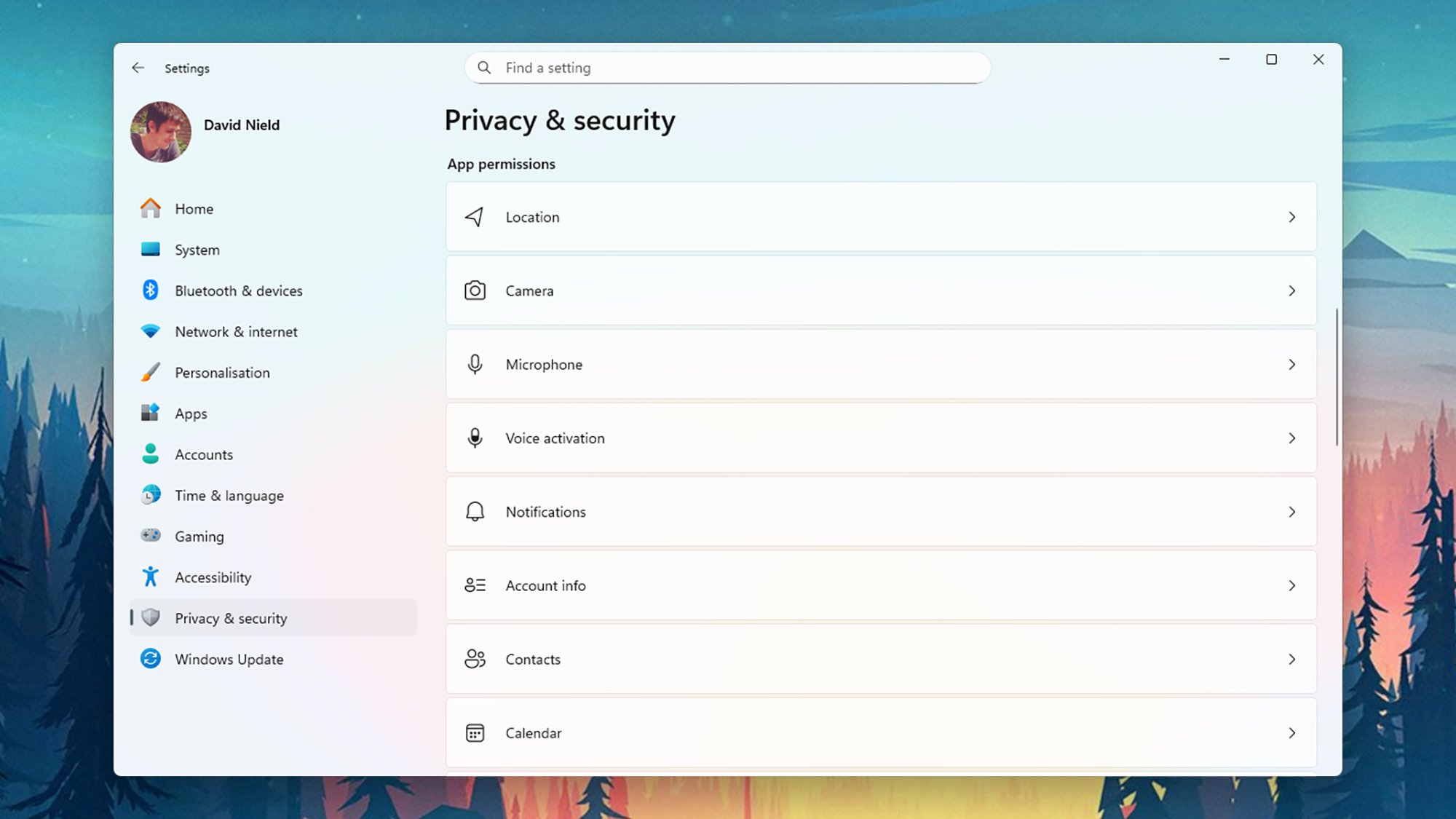
You can either look up specific permissions and see which apps have them, or look up specific apps and see the permissions they’ve requested. The first option is a little more straightforward: Open up Settings from the Start menu, then choose Privacy & security and scroll down to the App permissions section.

You get a list of key permissions that apps can request, starting with the big ones: Location, Camera, and Microphone. Click on any permission to see the apps that have access, and revoke that access if you’re not happy with it, via the toggle switches on the right. You’ll also see a toggle switch that lets you block access to this permission for every program on your system.

Windows app permissions
The most important permissions are listed first in Settings.
Credit: Lifehacker

On certain permissions, you get some extra information, including recent requests for that permission. For example, you can see which apps have recently asked to use your camera. This is helpful in figuring out if apps are using permissions (such as location) in a responsible way, and at a frequency interval you’re comfortable with. If not, revoke the permission with a click.

Blocking certain permissions in certain apps might break some of the features or functionality of that app—but if an app has been well designed, you should get information about what’s stopped working and why, and why a particular permission is needed. If you want more information, there’s always the option of contacting the developer directly.

How to check permissions app by app

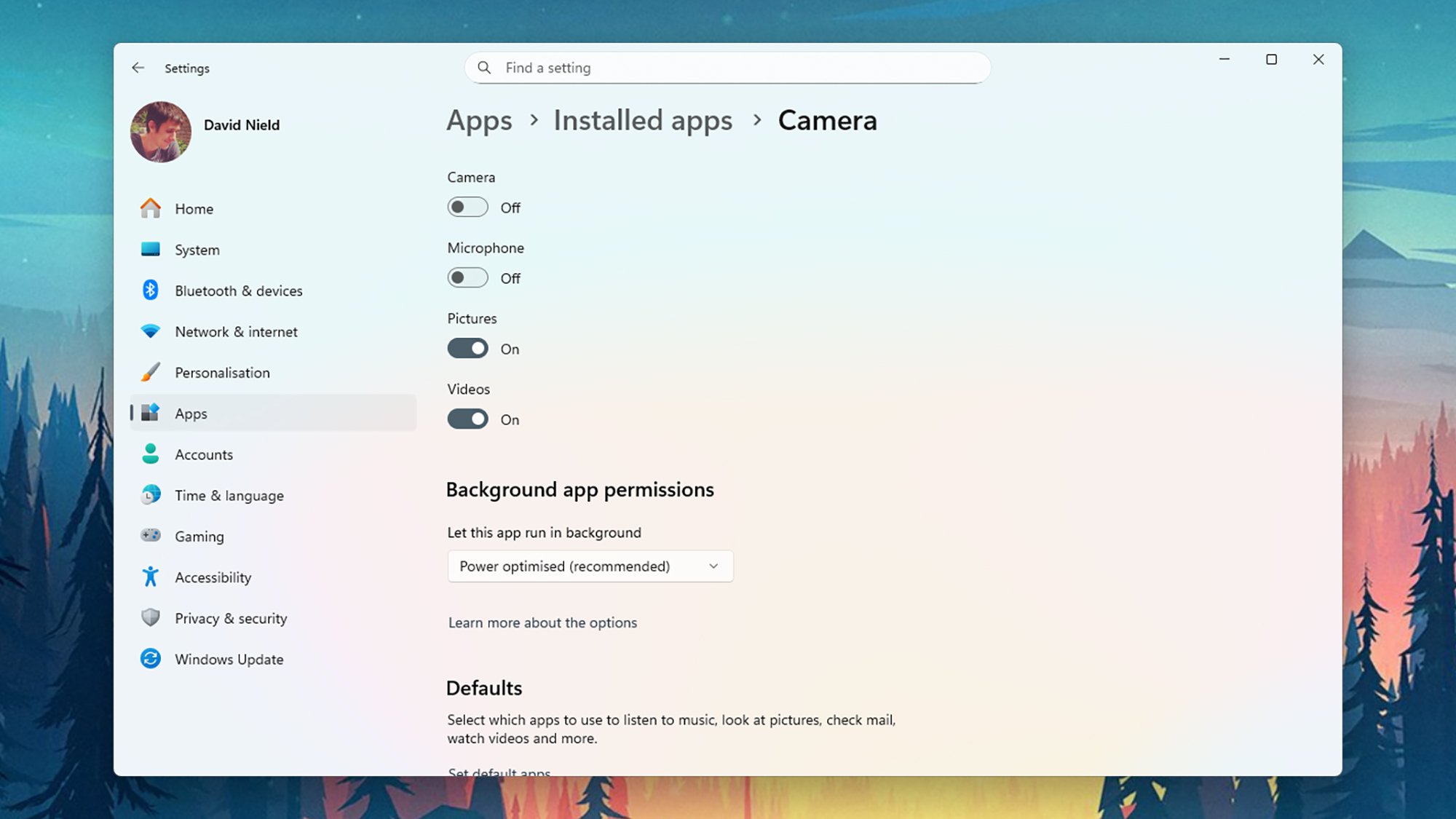
Open Settings from the Start menu, then select Apps > Installed apps. For apps that have been granted specific permissions, you should be able to click the three dots next to the app title and then Advanced options to view a full permissions list.

If there are any permissions you want to revoke, turn off the relevant toggle switch. Depending on the app, you might see some other permissions—such as permission for an app to start up at the same time as Windows. Again, if this is something you don’t want to happen, disable via the toggle switch.

Windows app permissions
You’re able to dig into permissions app by app.
Credit: Lifehacker

Some apps will also have a Background app permissions setting, which does exactly what it suggests: It lets the app keep operating in the background even when it’s closed down. That’s handy for apps that need a steady stream of real time data and notifications, but it can take up memory and drain battery life (you can configure this setting depending on whether or not your Windows device is plugged in).

The same screen gives you a variety of troubleshooting options, as well as an Uninstall button if you think an app is grabbing permissions to a suspicious extent. It’s always a good idea to remove programs you’re no longer actively using. It frees up storage space and memory, and improves system security (because there are fewer apps that could potentially be exploited).

Uber and partner Momenta will start testing robotaxis in Europe next year

Uber and its new partner Momenta will start testing an autonomous ride-sharing service in Europe in 2026, Momenta announced. The service will kick off in Munich, Germany using Momenta’s self-driving tech and Uber’s ride-sharing platform, with the goal of future European expansion. The companies chose Munich to kick off the operation due to the city’s “deep-rooted engineering heritage, top-tier automotive ecosystem and openness to innovation,” Momenta said. 

Momenta and Uber announced a “strategic agreement” in May this year to launch a robotaxi service with safety drivers aboard to start with. Momenta was one of China’s first autonomous vehicle companies and has been testing self-driving cars in the nation since 2018, with plans to roll out a commercial operation at its base in Shanghai next year. It also builds ADAS (advanced driver assistance systems) for major automakers including Mercedes-Benz and Audi, with over 400,000 installed to date. 

Europe has been slower than the US and China to adopt self-driving taxis, but that has started to change. Uber will be competing with Baidu, which announced plans to start testing its Apollo Go self-driving service in Switzerland as early as this year. Another company, WeRide, launched its own pilot program in Switzerland in January 2025 and started testing a driverless shuttle system in France shortly after that.

Elsewhere, Uber has partnered with other self-driving vehicle companies including WeRide, Pony.AI and Momenta in the Middle East. It also has a deal with UK-based Wayve to launch self-driving ride sharing trials in London next year, and recently said it would offer ride-sharing services in Los Angeles using an autonomous version of Volkswagen’s ID. Buzz.

Uber and Momenta’s Munich service will use Level 4 self-driving vehicles that can be operated without a safety driver in preset geographical areas. The companies will need to obtain certification from the German government and approval for the “geofenced zones” where it’s allowed to operate. 

Uber originally planned to build its own self-driving cars but abandoned the idea in 2020 following the death of a pedestrian and scandal around alleged trade secret theft from Waymo. Since then, it has taken the route of partnering with autonomous vehicle manufacturers, including the aforementioned Waymo in Austin and Atlanta.  

This article originally appeared on Engadget at https://www.engadget.com/transportation/uber-and-partner-momenta-will-start-testing-robotaxis-in-europe-next-year-123058509.html?src=rss

This Razer Xbox and PC Controller Is $50 Off Right Now

We may earn a commission from links on this page. Deal pricing and availability subject to change after time of publication.

Did you know you can customize Google to filter out garbage? Take these steps for better search results, including adding Lifehacker as a preferred source for tech news.


If you’ve been eyeing a premium Xbox or PC controller but hate the thought of spending close to $200, the Razer Wolverine V3 Pro might be worth a second look. It’s going for $149.99 on Woot right now, which is not only a solid $50 less than Amazon’s current $199.99 price but also cheaper than the lowest price this controller has ever hit ($171.99), according to price trackers. This deal runs for the next 26 days or until stock runs out, with Prime members getting free standard shipping (everyone else pays an extra $6). Note that Woot ships only within the contiguous U.S.

Pick up the controller, and it feels premium in a way that most third-party pads don’t. The shape takes clear cues from Microsoft’s Elite, but at 10.6 ounces, it’s a bit lighter and easier to handle. The textured rubber grips add comfort for longer sessions, while the buttons have a crisp, springy feel that makes them satisfying to use, notes this PCMag review. The Hall Effect sticks are built to hold up over time without the usual drift problems. Razer also throws in some thoughtful extras—four rear buttons that feel intuitive, trigger locks that speed things up in shooters, and swappable analog sticks. It doesn’t nail everything, though. You can’t swap out the D-pad, and it skips a charging cradle. Still, the fundamentals are solid, and it handles the core experience really well.

Performance-wise, the Wolverine V3 Pro is responsive across genres. The 2.4GHz Hyperspeed wireless connection holds up well in action-heavy games like Hades 2, and the 1kHz Tournament Mode over USB is excellent for competitive PC play. That said, its lack of Bluetooth limits flexibility—you’ll need Razer’s USB dongle for wireless use. Battery life tops out around 20 hours, which is noticeably shorter than the Elite’s but still serviceable compared to PlayStation’s DualSense controllers. Customization is also limited; you can remap the six extra buttons, but not the main layout. Still, when the actual feel of the controller rivals the Elite and the price undercuts it by a good margin, those trade-offs may not be deal breakers.


Our Best Editor-Vetted Tech Deals Right Now


Roku Streaming Stick Plus


—
$29.00

(List Price $39.99)


Sonos Era 300 Black – Wireless


—
$435.00

(List Price $449.00)

Deals are selected by our commerce team

If the iPhone 17 doesn’t get ProMotion, I won’t be upgrading my iPhone 12

In 2020, I bought an iPhone 12 to replace my aging Pixel 3, and nearly five years later, I’m still using that same device because it works fine and Apple has yet to bring the feature I want most on a regular iPhone: a ProMotion display. If you’re not familiar with the company’s marketing lingo, ProMotion is its way of describing a high-refresh rate display.

Apple introduced ProMotion with the iPhone 13 Pro. Since then, every Pro model has offered a 120Hz refresh rate display with the ability to scale down to 1Hz for always-on functionality. That’s great for gaming and day-to-day use; higher refresh rates make every interaction on the iPhone’s touchscreen look and feel smoother. In fact, high refresh rate displays are such a well-liked feature that most Android manufacturers have begun offering them on their entry-level devices, but it’s still something you need to spend $1,000 to get on an iPhone..

If you ask me, that’s a problem for Apple. The closest I got to upgrading was in 2023 when it released the iPhone 15, which was the first regular model to include the company’s Dynamic Island display cutout after it debuted on the iPhone 14 Pro. In the end, even the iPhone 15, with its better display, camera and USB-C charging, wasn’t enough to convince me to part with the iPhone 12, because the new model didn’t include a ProMotion screen. I imagine I’m not the only person who kept their old iPhone for the same reason.

At this point, Apple’s trickle-down strategy is painfully behind its competitors. In 2022, when display analyst Ross Young correctly predicted the entire iPhone 15 would offer Dynamic Island displays, he said the company likely wouldn’t bring ProMotion to its regular iPhones until 2024 at the earliest. He blamed the timing on a supply chain that “[couldn’t] support” the feature on Apple’s more affordable handsets. Whether or not that was true, I don’t know. In 2020, the same year Apple released the $799 iPhone 12, Google came out with the $700 Pixel 5, which came with a 90Hz OLED.

Either way, it appears my long wait is about to come to an end, with all four 2025 iPhone models — the iPhone 17, 17 Pro, 17 Pro Max and new iPhone 17 Air — reportedly set to offer 120Hz displays. For me, this is the year I upgrade, but I do wonder what it means for the future of the iPhone line.

If I had to guess, Apple’s decision to hold off on bringing ProMotion to the regular iPhone had more to do with the company wanting to give people a reason to spend extra on a Pro model than the limits of one of the largest and most efficient supply chains on the planet. If the pre-release rumors turn out to be true, the iPhone 17 will leave the iPhone Pro in an awkward place. With ProMotion gone as a differentiating feature and the Pro and Pro Max rumored to be made from aluminum again, there aren’t many reasons to go for the more expensive models other than if you want a telephoto camera or a bigger display in the case of the Pro Max.

I suspect this may be the last year we see an iPhone Pro, at least in the format we know it as now. When Senior Editor Devindra Hardawar and I got a chance to talk to Bloomberg’s Mark Gurman during a recent episode of the Engadget podcast, he mentioned that Apple plans to go all in on the iPhone Air. At first, it may offer only a single camera and worse battery life than its siblings, but Gurman said Apple was confident it could further shrink those components over time and make the Air the equal of its current devices.

In other words, the iPhone Air might be a side project now, but it’s easy to envision a future where it becomes the company’s flagship. Maybe it’s wishful thinking, but I’m hopeful Apple plans for a future where the Air and regular iPhone offer similar features, but the company charges a premium for getting those in a sleeker package.

This article originally appeared on Engadget at https://www.engadget.com/mobile/smartphones/if-the-iphone-17-doesnt-get-promotion-i-wont-be-upgrading-my-iphone-12-120030630.html?src=rss