Elon Musk’s Neuralink plans a brain speech trial in October

Neuralink plans to begin another US clinical trial in October, using the implant to translate thoughts into text. The study will be held through an FDA investigational device exemption. “If you’re imagining saying something, we would be able to pick that up,” Neuralink president DJ Seo said this week.

The idea is to help people with speech impairments communicate through thought. Neuralink is among the companies testing implants that help patients control a computer with their minds. That can include using virtual keyboards. Translating thought directly from the patient’s speech cortex could speed things up by cutting the middleman.

The company already has five other clinical trials underway. The first was in the US. It has since added studies in Canada, the UK and the United Arab Emirates.

A Neuralink patient sits, watching a laptop connected to their thoughts.
Neuralink / Chey Institute for Advanced Studies / YouTube

Neuralink’s plans for people with severe impairments sound like utopian sci-fi. Regardless of anything else, success in this field could be beyond life-changing for them. Still, this is a commercial company in which Elon Musk owns a majority share. Neuralink’s long-term plans are where it’s hard not to worry a little.

“We’re currently envisioning a world where in about three to four years, there will be someone who’s otherwise healthy who’s going to get a Neuralink,” Seo said. The company president hinted at what that might look like. “We think that it’s actually possible to demonstrate abilities to speak to the latest AI model, or LLM models, at the speed of thought, even faster than how you’re speaking, and being able to potentially get that information back through your AirPods, effectively closing the loop,” he said.

Our world today has revealed where things can go wrong when we turn too much of our humanity over to technology. You can start with smartphone addiction and social media algorithms and quickly move on to (alleged) AI-enabled suicide. Consumer brain implants can conjure the darkest images painted by our great sci-fi works. Think Neuromancer, Star Trek’s Borg or Cyberpunk 2077‘s cyberware.

Add what we know about Musk’s ideas about politics, and it’s hard not to be at least a little cynical. Is it too much to hope that the technology will advance enough to help those in need, but not so much that it devours humanity?

This article originally appeared on Engadget at https://www.engadget.com/science/elon-musks-neuralink-plans-a-brain-speech-trial-in-october-194004627.html?src=rss

Two of the Kremlin’s most active hack groups are collaborating, ESET says

Two of the Kremlin’s most active hacking units recently were spotted collaborating in malware attacks that compromise high-value devices located in Ukraine, security researchers said Friday.

One of the groups is Turla, which is easily one of the world’s most-sophisticated Advanced Persistent Threats (well-organized and well-funded hacking groups, many backed by nation states, that target specific adversaries for years at a time). Researchers from multiple security firms largely agree that Turla was behind breaches of the US Department of Defense in 2008, and more recently the German Foreign Office and France’s military. The group has also been known for unleashing stealthy Linux malware and using satellite-based Internet links to maintain the stealth of its operations. The group conducts narrowly-targetted attacks on high-value targets and keeps a low profile.

Gamaredon, meanwhile, is a separate APT known for conducting much wider-scale operations, often targeting organizations in Ukraine. Whereas Turla takes pains to fly under the radar, Gamaredon doesn’t seem to care about being detected and linked to the Russian government. Its malware generally aims to collect as much information from targets as possible over a short period of time. Both Turla and Gamaredon are widely assessed to be units of Russia’s Russian Federal Security Service (FSB), the country’s chief security agency and successor of the Soviet Union’s KGB.

Read full article

Comments

Microsoft is making Xbox consoles even more expensive in the US

Starting on October 3, Microsoft says Xbox consoles will be getting yet another price bump, this time ranging anywhere from a $20 increase on the company’s entry-level model to $70 for a special edition model with 2TB of storage. If all of this sounds familiar, there’s a good reason, the last time xbox prices were raised was only a few months ago in May.

The price increases breakdown as follows:

  • Xbox Series S (512GB): $400, up $20 from $380

  • Xbox Series S (1TB): $450 up $20 from $430

  • Xbox Series X Digital: $600, up $50 from $550

  • Xbox Series X: $650, up $50 from $600

  • Xbox Series X 2TB Galaxy Special Edition: $800, up $70 from $730

Those are fairly significant increases, especially when you start comparing Microsoft’s higher-end Xbox Series X consoles to the competition. For example, the Series X Digital (which doesn’t have a disc drive) now costs $50 more than a PS5 Digital Edition. For the $800 Xbox Series X 2TB Galaxy Special Edition price comparisons are even worse. It’s now more expensive than the $750 PS5 Pro, and at least Sony’s console gets you better performance for its high price.

Developing…

This article originally appeared on Engadget at https://www.engadget.com/gaming/xbox/microsoft-is-making-xbox-consoles-even-more-expensive-in-the-us-192443699.html?src=rss

Google Supercharges Chrome With Integrated Gemini AI Features In Huge Expansion

Google Supercharges Chrome With Integrated Gemini AI Features In Huge Expansion
Another week, another AI integration—now, market-leading browser Google Chrome is finally on the update list and facing a full suite of new Gemini AI features to be added in the near future. Over the past few days, Google has been detailing the new AI-powered features its bringing to Google Chrome and all of the ways it looks to enhance the

Microsoft Hikes US Xbox Prices Citing Economic Environment

Microsoft will increase Xbox Series X and Series S console prices in the United States on October 3. The Series X rises to $649.99 from $599.99 and the 512GB Series S increases to $399.99 from $379.99. The 1TB Series S moves to $449.99 from $429.99. The Series X Digital Edition reaches $599.99 from $549.99 and the 2TB Galaxy Black Special Edition climbs to $799.99 from $729.99. Microsoft cited macroeconomic changes for the increases. Console prices outside the US and controller and headset prices domestically remain unchanged. The company raised console prices globally in May.


Read more of this story at Slashdot.

ASRock Calls Dibs On AMD’s New Radeon RX 7700 With First Model

ASRock Calls Dibs On AMD's New Radeon RX 7700 With First Model
AMD quietly added details for a Radeon RX 7700 non-XT GPU to its website and shortly thereafter ASRock revealed that it would be the first AIB to produce a card as part of its Challenger series. The ASRock Challenger Radeon RX 7700 is the first GPU in the family and it seems to be configured to operate at AMD’s reference specifications, though

Meta Pushes Into Power Trading as AI Sends Demand Soaring

Meta is moving to break into the wholesale power-trading business to better manage the massive electricity needs of its data centers. Bloomberg: The company, which owns Facebook, filed an application with US regulators this week seeking authorization to do so. A Meta representative said it was a natural next step to participate in energy markets as it looks to power operations with clean energy.

Buying electricity has become an increasingly urgent challenge for technology companies including Meta, Microsoft and Alphabet’s Google. They’re all racing to develop more advanced artificial intelligence systems and tools that are notoriously resource-intensive. Amazon, Google and Microsoft are already active power traders, according to filings with US regulators.


Read more of this story at Slashdot.

Despite congressional threat, National Academies releases new climate report

Earlier this year, the Environmental Protection Agency announced that it was going to reject the work it had done back in 2009, when it first determined that greenhouse gas emissions posed a threat to the US public. While it laid out a number of reasons for revisiting its earlier work, one of those focused on the science: The EPA’s original decision was over 15 years old, and it claimed our understanding of climate change had itself changed since then.

The National Academies of Science (NAS) decided that at least one aspect of that was probably right: Our understanding of the climate has changed in the last 15 years. So, it asked a group of scientists to do a quick update of our understanding of greenhouse gases, completed before public comment was closed on the EPA’s plan. That report is now out, and the NAS’s conclusion is clear: The EPA was right in 2009, and everything we’ve learned since has only made it more right.

The politics of emissions

The EPA’s endangerment finding already had a long history by the time it was completed during the Obama administration. In it, the EPA concluded that greenhouse gases pose a risk to the US and its citizens, both directly through health impacts and indirectly through economic damages. Under the Clean Air Act, that finding enabled regulation of greenhouse gas emissions and formed the foundation of plans to reduce those originating from transportation and electrical generation. All of those plans have been held up in court or abandoned before coming into effect.

Read full article

Comments

Snapdragon 8 Elite Gen 5 Looks Elite In Benchmark Leak Ahead Of Launch

Snapdragon 8 Elite Gen 5 Looks Elite In Benchmark Leak Ahead Of Launch
Early benchmarks have revealed how powerful the upcoming Qualcomm Snapdragon 8 Elite Gen 5 might actually be. While these are early leaks, the performance consistency brings promises of single-core scores that go head-to-head with Apple’s A19 Pro SoC and trounces it in multi-core. After years of playing catch up and “close, but no cigar,”

After getting Jimmy Kimmel suspended, FCC chair threatens ABC’s The View

After pressuring ABC to suspend Jimmy Kimmel, Federal Communications Commission Chairman Brendan Carr is setting his regulatory sights on ABC’s The View and NBC late-night hosts Seth Meyers and Jimmy Fallon.

Carr appeared yesterday on the radio show hosted by Scott Jennings, who describes himself as “the last man standing athwart the liberal mob.” Jennings asked Carr whether The View and other ABC programs violate FCC rules, and made a reference to President Trump calling on NBC to cancel Fallon and Meyers.

“A lot of people think there are other shows on ABC that maybe run afoul of this more often than Jimmy Kimmel,” Jennings said. “I’m thinking specifically of The View, and President Trump himself has mentioned Jimmy Fallon and Seth Meyers at NBC. Do you have comments on those shows, and are they doing what Kimmel did Monday night, and is it even worse on those programs in your opinion?”

Read full article

Comments

AI Tool Detects LLM-Generated Text in Research Papers and Peer Reviews

An analysis of tens of thousands of research-paper submissions has shown a dramatic increase in the presence of text generated using AI in the past few years, an academic publisher has found. Nature: The American Association for Cancer Research (AACR) found that 23% of abstracts in manuscripts and 5% of peer-review reports submitted to its journals in 2024 contained text that was probably generated by large language models (LLMs). The publishers also found that less than 25% of authors disclosed their use of AI to prepare manuscripts, despite the publisher mandating disclosure for submission.

To screen manuscripts for signs of AI use, the AACR used an AI tool that was developed by Pangram Labs, based in New York City. When applied to 46,500 abstracts, 46,021 methods sections and 29,544 peer-review comments submitted to 10 AACR journals between 2021 and 2024, the tool flagged a rise in suspected AI-generated text in submissions and review reports since the public release of OpenAI’s chatbot, ChatGPT, in November 2022.


Read more of this story at Slashdot.

How to Turn Off the New ‘Gemini in Chrome’ Button

Google’s Gemini AI seems to be everywhere these days. It’s in your Gmail, it’s on your phone, and soon, it’ll be in your browser. While Google’s AI browser integration was already live for Google AI Pro and AI Ultra subscribers, it’s now rolling out to everyone—and getting a bunch of new features, too.

If you’re suddenly seeing a new Gemini button in the top right of your Chrome browser (in the same pane as your tabs), then you’ve already been hit with the update. If not, you may need to use the three-dots button in the top right corner and select Gemini in Chrome to turn it on, assuming you want to.

How to use Gemini in Chrome

When you click the Gemini button, or summon it via a keyboard shortcut (Alt + G by default), you’ll be able to try out the same features Google’s paying customers have had access to for a while. That means Gemini will be able to answer questions about the webpage you’re on, or just answer general questions unrelated to what you’re browsing. Or, if you’re in a Google app or on a Google website, it’ll be able to take some simple actions for you, like jumping you to a specific spot in a YouTube video.

Additionally, Gemini can also now work across your tabs and compare information between them. Simply start a dialogue with Gemini by tapping the button in the top right corner, and at the bottom of the window, click “Add tab” to give Gemini another source of data to consider.

Weirdly, while these updates are already pushing live to average folks, Google says businesses will need to wait a couple of weeks, so they can get “enterprise-grade data protections and controls.”

As of now, aside from the new access, it’s not the biggest update, especially because to try it, you need to be on Windows or Mac, have your language set to English, and be in the U.S.. Google stresses that the Gemini Assistant on Android can also help you browse Chrome, and that it’s working to bring more direct Gemini in Chrome access to both its Android and iOS apps.

More AI browsing is coming

Google says it also has big things in store for the feature, with “agentic browsing” set for the “coming months.” This will supposedly let Gemini in Chrome complete tasks, like booking a haircut for you, or ordering your groceries. Alternatively, it’ll also help you browse a bit more easily, as Google says it’s working to let you ask Gemini questions about your browser history when you want to go back to a specific page. For instance, “what was the website where I saw the walnut desk last week?” could take you back to a shopping page you only vaguely remember.

A more powerful address bar is apparently in the works that will let you ask questions of Google’s AI model without having to navigate to it first. For now, Gemini in Chrome will start suggesting questions to ask it about whatever page you’re on, right in the address bar.

The update includes a few security updates too, although they mostly seem to work in the backend, supposedly using AI to better block scammy ads and notifications. Now that’s the type of AI integration I can support wholeheartedly.

How to turn off Gemini in Chrome

All that said, if you’re a bit skeptical about Gemini in Chrome, you can turn it off. Simply navigate to Settings > AI Innovations, and you’ll be able to turn off the Gemini button, as well as disable its keyboard shortcut. You can also restrict its permissions: Set everything to off, and it’ll be like it was never installed in the first place.

There’s Something Off About Apple’s New Sleep Score

We may earn a commission from links on this page.

Did you know you can customize Google to filter out garbage? Take these steps for better search results, including adding my work at Lifehacker as a preferred source.

Apple’s new sleep score, now available on the Apple Watch and in the Apple Health app, grades how well you slept on a scale from 0 to 100. Since it grades you retroactively, I can look back at my last month (or even years) of sleep scores to see how the new numbers compare to the scores I’ve gotten from Oura and other wearables. I tried this out, and one thing stood out: Apple is way too easy on me. 

I’m kidding, sort of. Yes, Apple’s scores are consistently higher than those I get from other wearables, but it’s not like I can definitively say Apple is wrong or Oura is right. I think of a sleep score like a grade on an essay: A bad essay will probably get a bad grade, and a good essay will probably get a good grade, but it’s not like every teacher in the world would agree that your take on Moby Dick’s symbolism deserves exactly a 92%. You may feel like you got away with something if your mid essay comes back with an A+, but as long as the prof is consistent with their grading scheme, you can’t say your grade was wrong. 

That’s why the accuracy of sleep scores doesn’t matter a ton, in my opinion. The World Sleep Society more or less agrees, saying not to read too much into individual scores, but instead keep an eye on trends, like whether your sleep seems to be getting better or worse over time. 

How Apple’s sleep scores measure up to Oura, Garmin, and Whoop

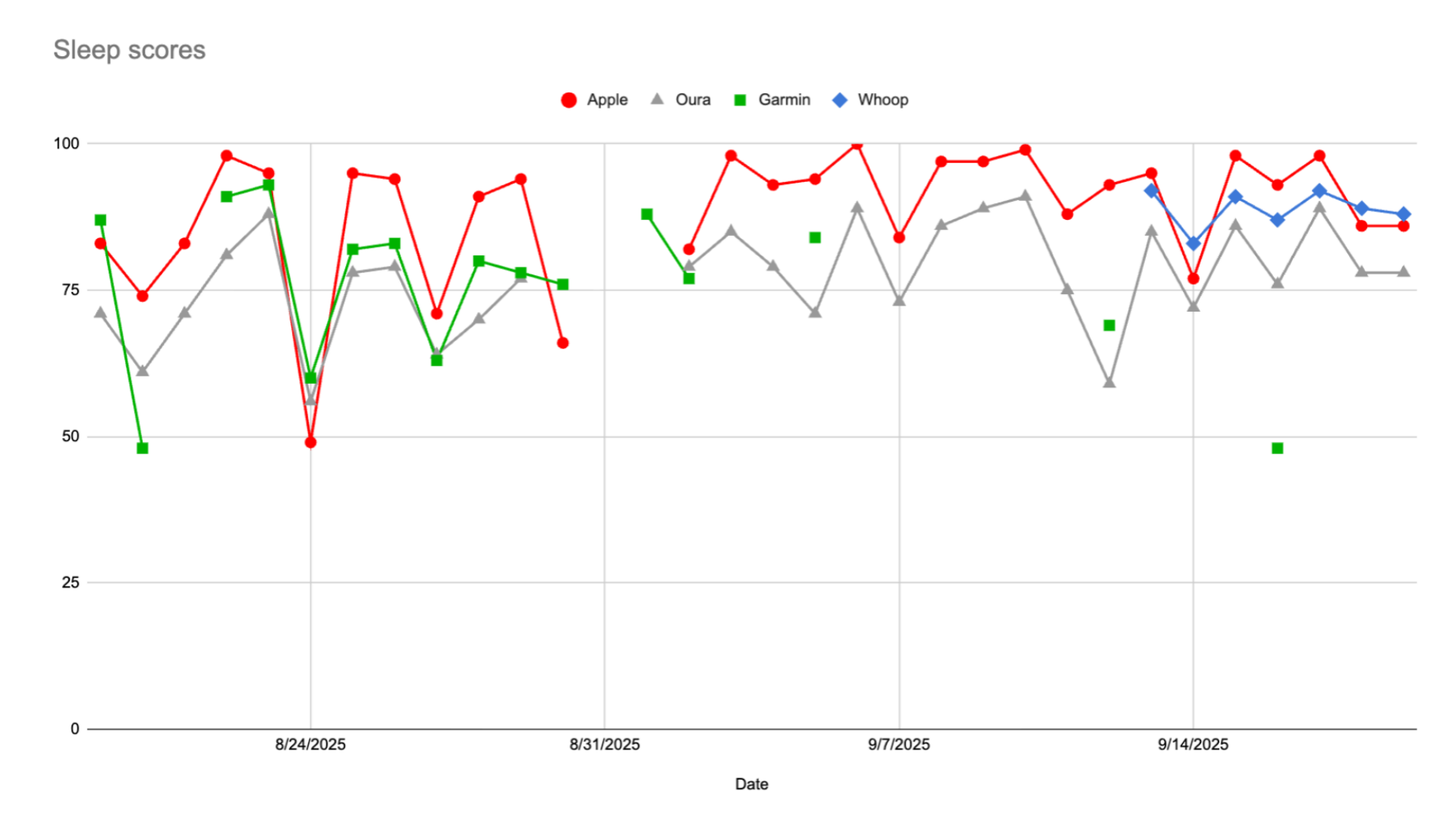
With all of that in mind, I thought it would be interesting to compare my last month or so of Apple sleep scores to those I get from the Oura ring, plus a few data points from my Garmin and Whoop devices. 

Apple calculates your sleep score based on your sleep duration, bedtime consistency, and interruptions. Competing devices each have their own algorithm. Apple can calculate its score based on the data from any device, not just an Apple Watch, so in some cases the Oura and Apple scores are actually using the same underlying data.

Here are the results: 

Graph of Apple, Oura, Garmin, and Whoop sleep scores
Apple is the red line at the top—usually grading me higher than its competitors.
Credit: Beth Skwarecki

Apple says that over the past month, my most frequent sleep score level is “excellent,” earned on 17 nights. I also had a “high” sleep score on 10 nights, with just one night of “OK” sleep, one of “low” sleep, and no nights “very low.”

My major takeaway is that Apple’s scores are almost always higher than those I get from other devices. That said, they tend to go up when the others go up, and down when the others go down, which means that all of these scores are probably useful when looked at from a big-picture point of view. 

Subjectively, I don’t think my sleep has been all that good lately. I’ve been staying up late more often than I’d like, and waking up tired more often than not. I’d judge it as mostly OK, occasionally poor, and sometimes good. But that’s just, like, my opinion, man. 

It is true that there’s probably nothing medically wrong with me, and I don’t think my sleep is drastically poor—so maybe Apple’s rosy outlook is just a better way to think about my sleep. It’s OK to be a straight-A student sometimes. 

Intel Battlemage BMG-G31 GPU Leak Hints At Inbound Arc B770 With 16GB

Intel Battlemage BMG-G31 GPU Leak Hints At Inbound Arc B770 With 16GB
Intel’s Arc B770 is, so far, a story of potential greatness that ultimately ends up in a blank page. We’ll spoil the story for you: today’s leak is yet another data point proving that the GPU definitely exists, but we’ve still heard nothing from Intel about whether it will actually release in any form whatsoever, and yesterday’s news of an

Steam will drop support for the last 32-bit Windows systems in January 2026

Valve’s Steam client is pretty widely compatible with all kinds of newer and older operating systems—that’s what you do when you want as many people as possible spending their money in your store. But nothing lasts forever, and Valve does eventually end support for old software when it’s time to move on. The company announced in a support note today that it would be ending Steam client support for 32-bit versions of Windows on January 1, 2026.

“Existing Steam Client installations will continue to function for the near term on Windows 10 32-bit but will no longer receive updates of any kind including security updates,” the support note reads. “Steam Support will be unable to offer users technical support for issues related to the old operating systems, and Steam will be unable to guarantee continued functionality of Steam on the unsupported operating system versions.”

When Steam drops support for an older operating system, it’s often because support is also being ended in some other underlying piece of technology that Steam uses to function, like its Chromium-based built-in browser. Valve cited “system drivers and other libraries that are not supported on 32-bit versions of Windows” as the reason for ending 32-bit Windows support.

Read full article

Comments

Science journalists find ChatGPT is bad at summarizing scientific papers

Summarizing complex scientific findings for a non-expert audience is one of the most important things a science journalist does from day to day. Generating summaries of complex writing has also been frequently mentioned as one of the best use cases for large language models (despite some prominent counterexamples).

With all that in mind, the team at the American Association for the Advancement of Science (AAAS) ran an informal year-long study to determine whether ChatGPT could produce the kind of “news brief” paper summaries that its “SciPak” team routinely writes for the journal Science and services like EurekAlert. These SciPak articles are designed to follow a specific and simplified format that conveys crucial information, such as the study’s premise, methods, and context, to other journalists who might want to write about it.

Now, in a new blog post and white paper discussing their findings, the AAAS journalists have concluded that ChatGPT can “passably emulate the structure of a SciPak-style brief,” but with prose that “tended to sacrifice accuracy for simplicity” and which “required rigorous fact-checking by SciPak writers.”

Read full article

Comments

China’s Xiaomi To Remotely Fix Assisted Driving Flaw in 110,000 SU7 Cars

Chinese consumer tech giant Xiaomi will remotely fix a flaw in the assisted driving system on over 110,000 of its popular SU7 electric cars, the firm and regulators said Friday, months after a deadly crash involving the model. From a report: China’s tech companies and automakers have poured billions of dollars into smart-driving technology, a new battleground in the country’s cutthroat domestic car market. But Beijing has moved to tighten safety rules after a Xiaomi SU7 in assisted driving mode crashed and killed three college students this year. It also raised concerns over the advertising of cars as being capable of autonomous driving. On Friday, the State Administration for Market Regulation said Xiaomi’s highway assisted driving system showed insufficient recognition, warning and handling ability in some extreme driving conditions.


Read more of this story at Slashdot.

Your very own humane interface: Try Jef Raskin’s ideas at home

In our earlier article about Macintosh project creator Jef Raskin, we looked at his quest for the humane computer, one that was efficient, consistent, useful, and above all else, respectful and adaptable to the natural frailties of humans. From Raskin’s early work on the Apple Macintosh to the Canon Cat and later his unique software implementations, you were guaranteed an interface you could sit down and interact with nearly instantly and—once you’d learned some basic keystrokes and rules—one you could be rapidly productive with.

But no modern computer implements his designs directly, even though some are based on principles he either espoused or outright pioneered. Fortunately, with a little work and the magic of emulation, you can have your very own humane interface at home and see for yourself what computing might have been had we traveled a little further down Raskin’s UI road.

You don’t need to feed a virtual Cat

Perhaps the most straightforward of Raskin’s systems to emulate is the Canon Cat. Sold by Canon as an overgrown word processor (billed as a “work processor”), it purported to be a simple editor for office work but is actually a full Motorola 68000-based computer programmable through an intentional backdoor in its own dialect of Forth. It uses a single workspace saved en masse to floppy disk that can be subdivided into multiple “documents” and jumped to quickly with key combinations, and it includes facilities for simple spreadsheets and lists.

Read full article

Comments

“Yikes”: Internal emails reveal Ticketmaster helped scalpers jack up prices

The Federal Trade Commission sued Live Nation and Ticketmaster on Thursday, alleging that the companies tacitly worked with scalpers to profit from jacking up ticket prices on the secondary market.

As the FTC alleged in a press release, Ticketmaster’s years of turning a blind eye to scalpers violated the FTC Act and the Better Online Ticket Sales Act, costing customers “billions in inflated prices and additional fees.” Further, artists’ efforts to keep event costs low were repeatedly frustrated by executives’ greedy bid to drive Ticketmaster revenue by reaping as many additional fees as possible, the FTC alleged.

Rather than blocking scalping, Ticketmaster allegedly provided tech support to help so-called brokers exceed “fake” ticket limits that seemingly only applied to genuine customers buying tickets to see events.

Read full article

Comments

Whoop Is Bringing Clinical Blood Testing to Its App

Did you know you can customize Google to filter out garbage? Take these steps for better search results, including adding my work at Lifehacker as a preferred source.


If you think fitness trackers are just about step counting and heart rate, get with the times. This week, performance wearable Whoop announced it will integrate clinical laboratory testing directly into its ecosystem, partnering with Quest Diagnostics to launch Whoop Advanced Labs this fall. This adds to a growing trend of more and more wearables aiming to be comprehensive, one-stop health platforms.

How Whoop will track bloodwork

Whoop members will be able to purchase Quest’s clinical laboratory testing, schedule an appointment for testing, and receive test results within the Whoop app. The feature is designed to analyze biomarkers spanning metabolism, hormones, inflammation, cardiovascular health, and nutrient status—all data that goes far beyond what can be captured through wearable sensors alone.

The vision is that Whoop subscribers will be able access the types of clinical testing that physicians order (like from Quest Diagnostics) to deliver patient care. “At Whoop, we’re committed to empowering our members with a highly comprehensive view into their health and performance,” said John Sullivan, Chief Marketing Officer at Whoop.

A third-party provider will review test requests, order tests, deliver results through the Whoop app, and provide phone consultations when requested. Whoop Advanced Labs is set to launch later this fall, and members can join the waitlist now at whoop.com/waitlist.

Do you really need to monitor everything?

Again, Whoop isn’t the first wearable company to head in this direction. Ultrahuman, the maker of the Ring AIR smart ring, launched its Blood Vision feature earlier this year.

This feature can help people catch health issues early and take proactive steps to address them. At the same time, it raises questions about whether consumers actually need this level of health monitoring from for-profit wellness companies.

In my opinion, this all points to a sort of “medicalization” of everyday wellness. While access to health data can be empowering, it can also create anxiety and lead people to over-monitor aspects of their health that might not require constant attention. After all, blood biomarkers can fluctuate for many reasons, and abnormal results don’t always indicate health problems.

Looking ahead

As Whoop prepares to launch Advanced Labs this fall, it will be interesting to see how consumers respond to this deeper level of health monitoring. For now, it looks like the line between fitness tracker and medical device will continue to blur. Anecdotally, the company’s existing user base already skews toward serious athletes and health optimization devotees; in other words, the sort of people who would be interested in comprehensive biomarker tracking.

Anyone interested in Whoop’s blood testing integration can join the waitlist for Advanced Labs. Whether they’ll actually want to know everything their blood is telling them is another question entirely.