Apple has long opposed the Digital Markets Act, which is pretty much expected for a Big Tech company. Now, a bit over a year after it came into force, Apple has asked the European Commission to repeal it, according to the Financial Times and Bloomberg. “The DMA should be repealed while a more appropriate fit for purpose legislative instrument is put in place,” the company has told the commission in its first public consultation to review the legislation. The EU’s Digital Markets Act, which was signed into law in 2022, aims to rein in Big Tech’s power and to improve competition for smaller players. If a company is found to have violated DMA’s rules, it could pay between 10 to 20 percent of its global revenue.
In a blog post separate to the feedback it submitted to the Commission, Apple detailed how DMA affects its users in the EU. The company said that because the law requires it to make sure certain features work on non-Apple products, feature rollouts get delayed in the region. Its team has not found a way to securely bring iPhone Mirroring to non-Apple devices, for instance, because it requires a lot of engineering work. As a result, Apple has yet to release that feature, along with Live Translation via AirPods, as well as Visited Places and Preferred Routes on Maps, in the European Union.
Apple also said that since the DMA requires it to allow sideloading, other app marketplaces and alternative payment systems, users in the region are exposed to more risks. They’re more exposed to things like fake banking apps and disguised malware, and they could also come across third-party payment systems that wouldn’t allow refunds. If you’ll recall, the European Commission slapped Apple with a $587 million fine in April for preventing developers from informing customers about sales and other offers outside the App Store. Apple called the penalty “unprecedented” and filed an appeal.
“Regulators claimed the DMA would promote competition and give European consumers more choices,” Apple wrote in its post. “But the law is not living up to those promises… That’s why we’re urging regulators to take a closer look at how the law is affecting the EU citizens who use Apple products every day.” Even though the company is clearly against the DMA, it said it’s dedicating “thousands of hours” to bring features to the EU. A spokesperson for the Commission told the Times that it’s normal for companies to “need more time to make their products compliant” and that the Commission is helping them get there. “[C]ompliance is not optional, it’s an obligation,” the spokesperson added.
This article originally appeared on Engadget at https://www.engadget.com/big-tech/apple-repeats-its-long-held-criticism-of-the-eus-digital-markets-act-130058440.html?src=rss
An anonymous reader quotes a report from The Conversation: Twenty-one years after Facebook’s launch, Australia’s top 25 news outlets now have a combined 27.6 million followers on the platform. They rely on Facebook’s reach more than ever, posting far more stories there than in the past. With access to Meta’s Content Library (Meta is the owner of Facebook), our big data study analysed more than three million posts from 25 Australian news publishers. We wanted to understand how content is distributed, how audiences engage with news topics, and the nature of misinformation spread. The study enabled us to track de-identified Facebook comments and take a closer look at examples of how misinformation spreads. These included cases about election integrity, the environment (floods) and health misinformation such as hydroxychloroquine promotion during the COVID pandemic. The data reveal misinformation’s real-world impact: it isn’t just a digital issue, it’s linked to poor health outcomes, falling public trust, and significant societal harm. […]
Our study has lessons for public figures and institutions. They, especially politicians, must lead in curbing misinformation, as their misleading statements are quickly amplified by the public. Social media and mainstream media also play an important role in limiting the circulation of misinformation. As Australians increasingly rely on social media for news, mainstream media can provide credible information and counter misinformation through their online story posts. Digital platforms can also curb algorithmic spread and remove dangerous content that leads to real-world harms. The study offers evidence of a change over time in audiences’ news consumption patterns. Whether this is due to news avoidance or changes in algorithmic promotion is unclear. But it is clear that from 2016 to 2024, online audiences increasingly engaged with arts, lifestyle and celebrity news over politics, leading media outlets to prioritize posting stories that entertain rather than inform. This shift may pose a challenge to mitigating misinformation with hard news facts. Finally, the study shows that fact-checking, while valuable, is not a silver bullet. Combating misinformation requires a multi-pronged approach, including counter-messaging by trusted civic leaders, media and digital literacy campaigns, and public restraint in sharing unverified content.
YouTube’s end screens are useful for creators, but often annoying for viewers. They allow creators to insert links to other content during the last moments of the video. The issue, however, is those links appear as large on-screen elements that cover the video you’re watching. While many videos are basically over by this point, some are still going, and you might miss out on the final five to 20 seconds because of the end screen.
Now, YouTube is giving you a way to hide these screen—albeit, with a major caveat. The company announced the change on Wednesday, saying users will now see a “Hide” button on videos that contain and end screen. The Hide button will be in the top-right corner of the player, which you can click to dismiss the end screen and get back to watching your content. If you want to, you can bring back the end screen by clicking a “show” button.
While it sounds like a step in the right direction, this is not a setting that applies to all videos you watch on YouTube. Instead, it only applies to the individual video in question. As such, you’ll need to dismiss the end screen every time you watch a video that has one. This is an odd decision: You need to wait to hide the end screen when you see it, which means you only have five to 20 seconds left in your video anyway. You might even want to rewind the video if you didn’t click the Hide button in time. I’d appreciate having the option at the start of the video at least, but, more so, I’d like the option to dismiss end screens across the board. You only need to take a quick look at The Verge’s comment section on this topic to see I’m not alone.
YouTube says it made this decision based on user feedback, as they’ve heard viewers want to “minimize distractions on videos,” and to “focus on the content they’re watching.” The company is also removing the Subscribe button that appears when you hover over the video’s watermark, as there is already a subscribe option below the player.
In the great technology gold rush of the 21st century, artificial intelligence (AI) is the motherlode. While giants like Google and Microsoft build the digital pickaxes and shovels, the race to equip the millions of prospectors—the small and medium businesses (SMBs) that form the backbone of the economy—is reaching a fever pitch. For years, this market has been a brutal slugfest between titans like Dell and Lenovo, a war fought over server specs and price points. But this week, Lenovo threw a devastatingly effective combination punch. With its new suite of IT infrastructure solutions, Lenovo has shifted the fight away from raw hardware and onto a battlefield of its own choosing: radical simplicity. This isn’t just a product launch; it’s a brilliant, multi-layered strategic ambush aimed squarely at Dell’s core business model, positioning Lenovo to become the default AI infrastructure provider for the SMB world.
The ‘Easy Button’ for the AI Revolution
The genius of Lenovo’s announcement lies in its profound understanding of its target audience. SMBs do not have armies of IT specialists, data scientists or procurement experts. They have a handful of over-extended people who need technology that simply works. The core of Lenovo’s new offering is the “Business Ready Infrastructure in a Box”—a concept so powerful it’s almost insulting in its simplicity. Instead of forcing a small business owner to navigate a dizzying array of server configurations, memory options and software licenses, Lenovo is offering pre-tested, pre-validated and pre-integrated solutions designed for specific outcomes.
Want to run modern apps at the edge of your business, like in a retail store or on a factory floor? There’s an “AI Edge-Ready Node” for that. Need to protect your critical data from ransomware? There’s a “Business Protection in a Box” bundled with industry-leading Veeam software. This is a direct assault on the traditional IT sales model, which often thrives on complexity and customization. Lenovo is effectively providing an “easy button,” removing the guesswork and specialized knowledge required to build a modern, AI-ready IT foundation. By bundling its reliable ThinkSystem servers with essential software from partners like Microsoft and Scale Computing, Lenovo isn’t just selling components; it’s selling confidence.
The Financial Coup d’État: TruScale vs. Traditional CAPEX
The second, and arguably more potent, weapon in Lenovo’s arsenal is its financial model. The biggest barrier for SMBs adopting new technology isn’t just complexity; it’s the massive, upfront capital expenditure (CAPEX). Traditionally, a growing business had to buy a server that was far more powerful than its current needs, hoping to one day grow into it—a risky and capital-intensive bet. Lenovo’s TruScale Infrastructure as-a-Service (IaaS) completely upends this model.
By offering a flexible, consumption-based subscription, Lenovo is allowing SMBs to treat their on-premise IT infrastructure like a cloud service. This shifts the cost from a crippling upfront purchase to a predictable operational expense (OPEX). Businesses can scale their services up or down as needed, paying only for what they use. This is more than just a pricing option; it’s a strategic advantage that removes financial risk and aligns the cost of technology directly with business growth. Lenovo’s case studies, citing 30% faster rollouts and a Brazilian company that tripled its performance, are powerful proof points. This financial flexibility is a killer feature for any CFO in the SMB space.
Outmaneuvering Dell: The Battle for the SMB AI Market
When you assemble these pieces, the strategic picture becomes crystal clear, and it has Dell squarely in its sights. For decades, Dell’s strength has been its direct-to-consumer model and its vast, highly customizable portfolio. It is the master of selling components. Lenovo’s new strategy is a textbook example of asymmetric warfare: it’s refusing to fight on Dell’s terms. Instead of competing on component specs, Lenovo is competing on complete, outcome-based solutions.
Where a business might go to Dell’s website and get lost in a sea of configuration options, Lenovo is offering a simple, curated menu. This approach is perfectly tailored to a market segment that values time and simplicity over granular control. The message is powerful: “Don’t worry about the ‘how’; just tell us the ‘what’, and we’ll give you a box that does it.” While Dell has its own APEX as-a-service offering, Lenovo’s current marketing and solution-bundling feels more aggressively and purposefully targeted at the specific pain points of smaller businesses. By creating an ecosystem with trusted names like Veeam and Microsoft, Lenovo is also positioning itself as a central, trusted partner, not just a hardware vendor. This builds a stickier, long-term relationship that is harder for competitors to disrupt.
Wrapping Up
Lenovo’s announcement is one of the most strategically significant moves in the IT infrastructure space this year. It’s a masterclass in understanding a customer segment and tailoring a multi-pronged attack that leverages product, finance and marketing in perfect harmony. By bundling pre-configured hardware and software into simple, outcome-driven “boxes” and wrapping it all in a flexible, cloud-like subscription model, Lenovo has created a deeply compelling offer for the millions of SMBs looking to step into the AI era. This isn’t just about selling more servers; it’s about fundamentally changing the conversation, and in doing so, it puts immense pressure on Dell and the rest of the market to respond or risk being left behind.
The major announcements out of this year’s Snapdragon Summit event have been focused on new Snapdragon silicon, including the Snapdragon 8 Elite Gen 5 for flagship smartphones and Snapdragon X2 Elite for PCs. But not every bit of news has been expected. Towards the end of the opening keynote, Qualcomm CEO Cristian Amon chatted with Google’s
As many as 2 million Cisco devices are susceptible to an actively exploited zeroday that can remotely crash or execute code on vulnerable systems.
Cisco said Wednesday that the vulnerability, tracked as CVE-2025-20352, was present in all supported versions of Cisco IOS and Cisco IOS XE, the operating system that powers a wide variety of the company’s networking devices. The vulnerability can be exploited by low-privileged users to create a denial-of-service attack or by higher-privileged users to execute code that runs with unfettered root privileges. It carries a severity rating of 7.7 out of a possible 10.
Exposing SNMP to the Internet? Yep
“The Cisco Product Security Incident Response Team (PSIRT) became aware of successful exploitation of this vulnerability in the wild after local Administrator credentials were compromised,” Wednesday’s advisory stated. “Cisco strongly recommends that customers upgrade to a fixed software release to remediate this vulnerability.”
Formula 1 might be riding high these days on a wave of interest not seen since the 1960s, but the Drive to Survive effect has been felt elsewhere in the world of motorsport. Endurance racing like the 24 Hours of Le Mans or the Rolex 24 at Daytona has seen record crowds over the last few years, and a large part of that is down to the sports prototype class, exemplified by cars from the likes of Ferrari and Porsche. And soon, we can add Ford to the list.
Currently, eight different manufacturers are competing against each other in the World Endurance Championship’s Hypercar class: Alpine, Aston Martin, BMW, Cadillac, Ferrari, Peugeot, Porsche, and Toyota. More are on the way—Genesis arrives next year, and at the beginning of the year, Ford announced that it, too, was joining the fray, in 2027. Today, the Blue Oval revealed some more details about the project.
What’s a hypercar?
Compared to the road car-derived machines that race in the GT3 category, the vehicles that contest for overall victory in the Hypercar class are purpose-built prototypes, just for racing. Because endurance racing often has to be needlessly complicated for the sake of being complicated, the Hypercar class is actually made up of a mix of vehicles designed to two different technical rule sets that are performance balanced to create a level playing field.
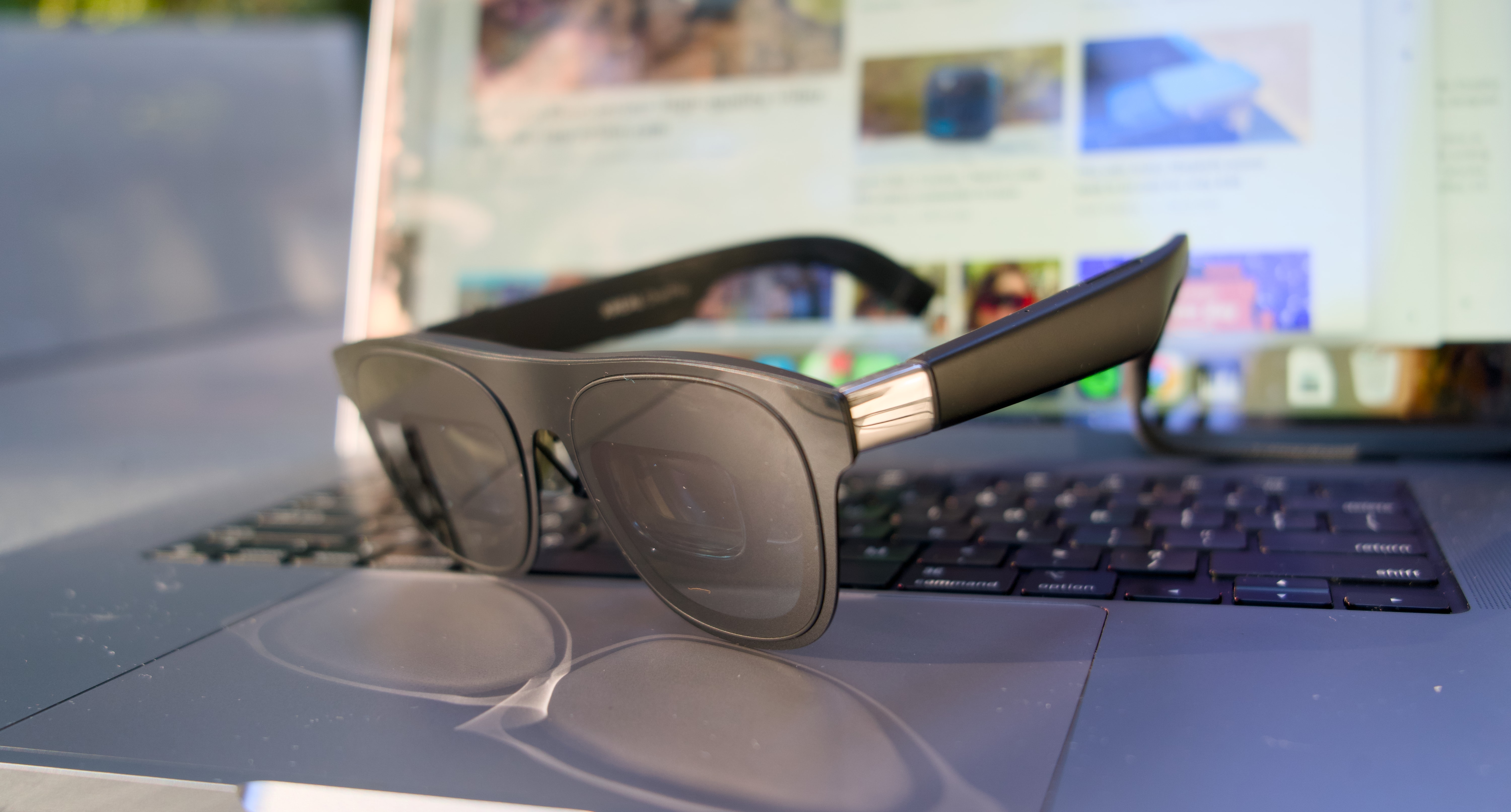
There I was, sitting on the couch in a nondescript suburban cafe, typing away on a MacBook Pro while staring off into the distance with what looked to be oversized glasses (which also were conspicuously plugged into the computer). To most people, I probably looked a bit silly. Nobody actually commented on my setup, or maybe I was just too focused to notice. From my perspective, I was looking at a massive 222-inch virtual display through Xreal’s One Pro smart glasses, which was mirroring my laptop screen.
Like a visual version of noise canceling, the glasses blotted out the chaos of the cafe so that I could actually concentrate on writing this review. I could also darken the frames a bit to serve as pseudo-sunglasses, further removing distractions. This work session in particular made the idea of smart glasses seem more compelling than anything in Meta’s failure-prone demo for the Ray-Ban Display.
With the One Pro, Xreal is close to making the dream of versatile smart glasses a reality. It’s not trying to be something you wear all day, an aspiration Meta is desperately chasing — instead, it’s meant for specific purposes. Plug the One Pro into your laptop and you can use it as a virtual monitor nobody else can see. Connect it to your phone or tablet and you’ve got your very own personal theater wherever you go. You can even hook it up to some portable game consoles (but not the Switch 2, unfortunately) to play on the move.
The Xreal One Pro smart glasses look very similar to oversized sunglasses.
Devindra Hardawar for Engadget
Sure, the Xreal One Pro still looks clunky, with its oversized frames, thick arms and annoying USB-C cable. But at $650, it’s also significantly less expensive than the Apple Vision Pro and easier to travel with than any VR headset. And at this point, it’s vastly more useful than the Ray-Ban Display, since its displays work across both of your eyes and can easily mimic a full-sized TV or monitor. Meta’s smart glasses can only show you a very limited amount of information in its single screen.
To be clear, that lines up with the different use case for each product: The Xreal One Pro is more of a monitor you wear on your face while stationary, whereas the Ran-Ban Display glasses aim to overlay your real-time point of view with basic phone notifications and services. Those frames are also meant to be more independent, allowing you to listen to music, take calls and capture photos and videos at a whim. But after seeing Mark Zuckerberg and his team try (and mostly fail) to demonstrate the Ray-Ban Display at its Connect developer conference, I also think the camera-less Xreal One Pro avoids ethical dilemmas inherent in most smart glasses.
Should we normalize wearable devices that can covertly record us at all times? And on a practical level, do we really want to walk around with virtual notifications in our faces all day? Personally, I think we’re better off with specialized tools that leave us in control, and don’t upend our entire social structure.
Xreal One Pro smart glasses
Devindra Hardawar for Engadget
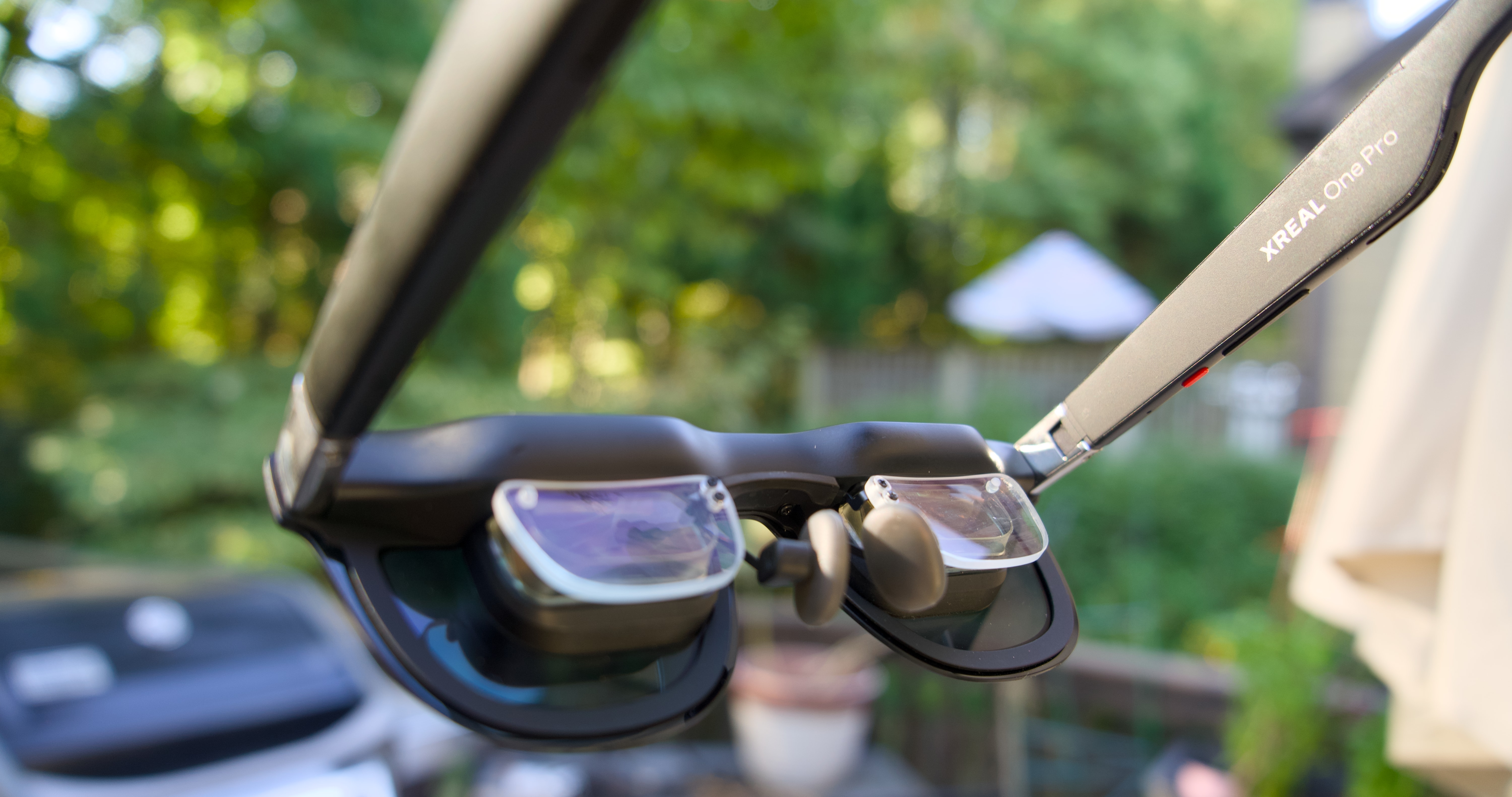
At the most basic level, Xreal’s One Pro smart glasses are just virtual displays you can wear anywhere. You can unlock more augmented reality capabilities with the $99 Xreal Eye camera accessory, but it’s not exactly necessary. The One Pro features dual 0.55-inch Sony Micro-OLED screens running at 1080p with a 120Hz refresh rate and a 57-degree field of view (FOV), the widest we’ve seen yet from Xreal. Modern VR headsets like the Quest 3 typically offer a much more expansive 110-degree FOV, but they also trap you in a dark void.
The One Pro, and all of Xreal’s frames, still let you see the real world outside of its AR screens, and they don’t block out ambient light. But there are also several shades you can use to darken the glasses themselves, which make the virtual display appear brighter and more distinct. At the darkest level, the One Pro can appear almost entirely black, something that’s great for movies. There’s also a helpful auto transparency mode that undims the displays when you look away from your virtual screen.
Xreal One Pro smart glasses
Devindra Hardawar for Engadget
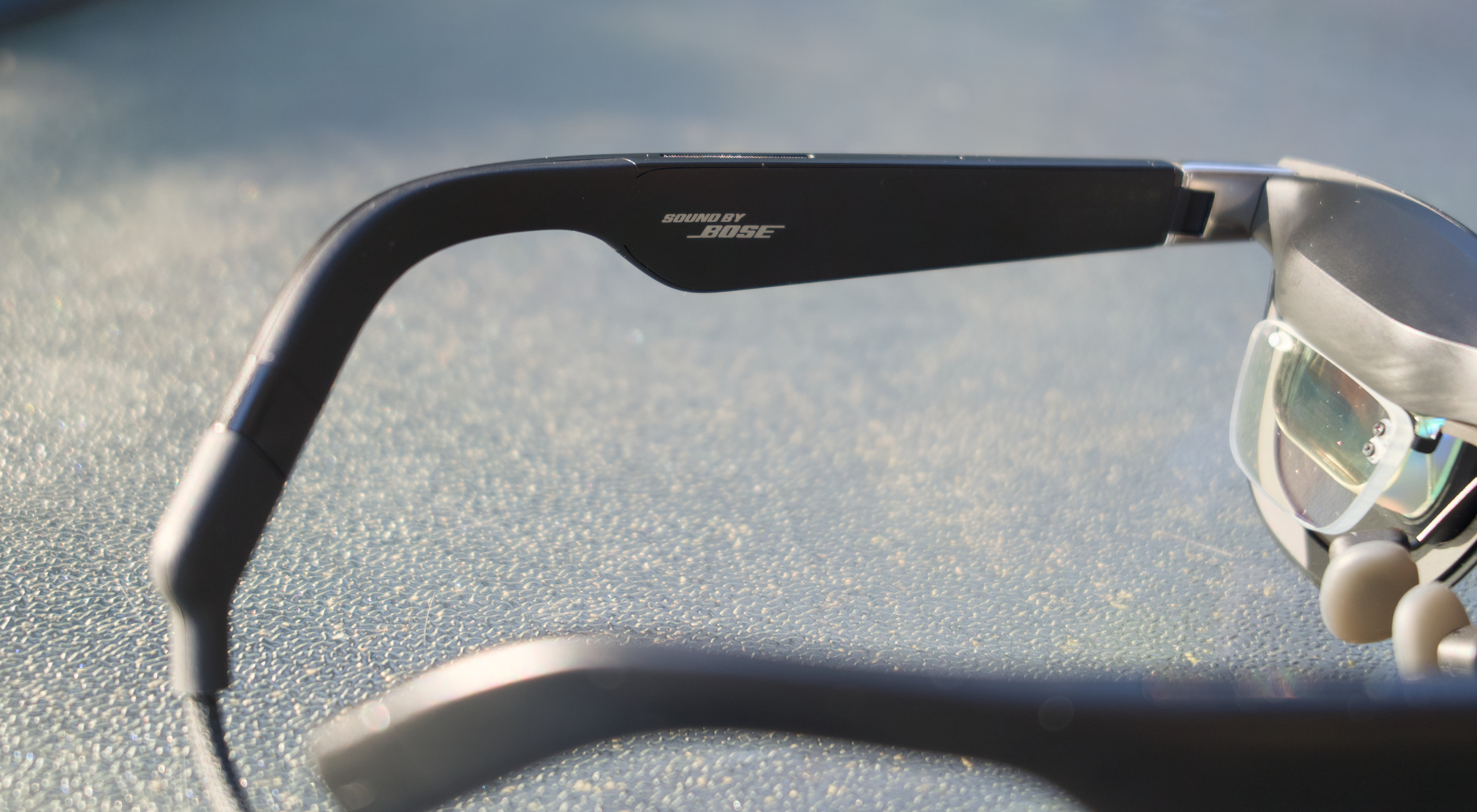
Bose mini-speakers are built into the arms of the glasses, as well as buttons for managing brightness and settings. A single USB-C port sits at the end of the left arm. I figured the cable would be a pain during extended sessions, but most of the time I quickly forgot it was there. Consequently, there’s no wireless support — something I’m totally fine with, since that would inevitably require batteries and additional weight on the glasses. At 87 grams, the One Pro weighs about the same as a deck of playing guards. It sat on my face comfortably, thanks to its sturdy nose pads, and I was able to wear it for hours without much issue.
Since the Xreal One Pro is fashioned after sunglasses, they can’t sit atop normal eyewear like the Quest 3 and other VR headsets. If you have a glasses prescription, you’ll need to buy inserts from HonsVR, which start at $50. They’re a bit annoying to install, but otherwise they did a fine job of letting me see the One Pro’s displays clearly. They do make sharing the glasses annoying, though, since the inserts will need to be removed every time you do so. I’d also be worried about something getting bent or broken with constant removals.
I mostly used the Xreal One Pro as a virtual display while working on laptops, but I also found them incredibly helpful for watching movies and videos when away from home. On the many occasions where I was stuck waiting for my family in the hellscape of a suburban parking lot, all I had to do was put on the Xreal One Pro, plug it into my phone and I could be watching anything on a massive virtual screen.
It was even more helpful while traveling. I could never muster the bravery to wear an Apple Vision Pro on a flight, or justify stuffing it into a bookbag. But that wasn’t a problem at all with the Xreal One Pro, as its bulbous traveling case can fit almost anywhere. Having a portable virtual display you can deploy instantly honestly feels like a superpower.
Xreal One Pro smart glasses
Devindra Hardawar for Engadget
As someone who’s picky about displays, I was surprised how bold and colorful the glasses were when I cranked up the brightness and background shade settings. I’d definitely love to see what sharper 4K screens could look like, but even at 1080p per eye, the Xreal One Pro delivered decently clear text and detailed imagery. Its built-in Bose speakers were also surprisingly clear while watching videos or playing some background tunes. (I would always use my AirPods Pro if I really wanted to immerse myself in the movies I was watching, though.)
In a pinch, the Xreal One Pro were helpful gaming accessories too. At home, I’d rather be staring at my 4K Alienware computer monitor, or the Steam Deck OLED’s native screen. But for slower-paced titles, it was nice to game on a large virtual screen just by plugging the glasses into my Steam Deck.
Getting the device connected to the original Nintendo Switch takes some work though, as it only works when connected to a dock and using an accessory like the Xreal Hub. Unfortunately, the Switch 2 doesn’t work with the One Pro at all right now (unless you start daisy chaining USB-C and HDMI adapters). Xreal says its upcoming Neo accessory will offer video pass-through for the Switch 2, but there’s no word on when that will arrive.
The more I used the Xreal One Pro, the more impressed I was by its sheer versatility. Its only major downsides are its $650 price (up from $600 originally), as well as the fact that you’ll never look cool wearing it. And no, you won’t be walking around while wearing the One Pro, like you could with Meta’s Ray-Ban Display. But hey, that also means you won’t have to worry about people calling you a pervert for wearing spy glasses.
This article originally appeared on Engadget at https://www.engadget.com/ar-vr/xreals-one-pro-intrigues-me-in-ways-metas-smart-glasses-dont-120000554.html?src=rss
Meta is starting to move more teens on Facebook and Messenger into dedicated “teen accounts” that have added parental controls and other protections for younger users. The expansion comes as the company says that “hundreds of millions” of teens are already using the accounts across Instagram, Facebook and Messenger.
Meta first brought teen accounts to Instagram a year ago and began rolling them out to teens in the US, Canada, UK and Australia on Facebook and Messenger earlier this year. Now, the specialized accounts will be available to teens globally. The company has made the accounts mandatory for younger teens between the ages of 13 and 15, and uses AI to detect teens that may be lying about their age. The accounts allow parents to supervise how their children use Meta’s apps, including features for monitoring screen time and the ability to view who their kids are messaging with. Teen accounts also come with more restrictive privacy and safety settings meant to limit their contact with adults they don’t know.
Instagram is also expanding its program that allows US middle schools and high schools to expedite reports of bullying and other problematic behavior. Up to now, the company has been piloting the “school partnership program,” with a handful of middle schools and high schools. Meta says that it’s “heard positive feedback from participating schools” and that any US-based school can sign up to join.
The social media company has spent the last few years ramping up parental control features and attempting to close some of the more obvious gaps in its safety features. The company is currently facingnumerous lawsuits and investigations into its track record on child safety.
This article originally appeared on Engadget at https://www.engadget.com/social-media/meta-rolls-out-teen-accounts-for-facebook-and-messenger-across-the-world-120000352.html?src=rss
A lot of the stuff we use today is largely made by robots—arms with multiple degrees of freedom positioned along conveyor belts that move in a spectacle of precisely synchronized motions. All this motion is usually programmed by hand, which can take hundreds to thousands of hours. Google’s DeepMind team has developed an AI system called RoboBallet that lets manufacturing robots figure out what to do on their own.
Traveling salesmen
Planning what manufacturing robots should do to get their jobs done efficiently is really hard to automate. You need to solve both task allocation and scheduling—deciding which task should be done by which robot in what order. It’s like the famous traveling salesman problem on steroids. On top of that, there is the question of motion planning; you need to make sure all these robotic arms won’t collide with each other, or with all the gear standing around them.
At the end, you’re facing a myriad of possible combinations where you’ve got to solve not one but three computationally hard problems at the same time. “There are some tools that let you automate motion planning, but task allocation and scheduling are usually done manually,” says Matthew Lai, a research engineer at Google DeepMind. “Solving all three of these problems combined is what we tackled in our work”.
If you use Proton Mail on your phone, things are about to pick up. The company is rolling out new apps for Android and iOS. The updated mobile applications are rebuilt from the ground up with a “cleaner, faster and more private experience.” Proton first announced in April that it was working on the revamp.
The company says the new Proton Mail lets you scroll, archive and reply twice as fast as before. It also now supports an offline mode, allowing you to read, write and organize messages while away from the internet. A redesigned interface aims for simpler navigation, with areas like the composer button now sitting within easier reach.
The iOS and Android apps, while still native to their respective platforms, now share a common codebase. Proton says they share 80 percent of their code. This should enable faster development and near-simultaneous future updates.
Proton
Product lead Anant Vijay Singh credited the update to Proton’s community and business model. “The new Proton Mail mobile apps reflect this feedback and show what is possible if you build an email app without the constraints imposed by trying to monetize user data, allowing for a cleaner, faster, and more private experience,” he said.
The Proton Mail updates begin rolling out today in the App Store and Play Store.
This article originally appeared on Engadget at https://www.engadget.com/mobile/smartphones/proton-mails-redesigned-mobile-app-is-built-for-speed-100042054.html?src=rss
The Japanese city of Toyoake has passed (PDF) a symbolic ordinance limiting recreational smartphone use to two hours a day, aiming to improve citizens’ sleep — especially for students after summer vacation. The Register reports: “The primary purpose of this ordinance is to ensure that all citizens receive adequate sleep,” states a Council information page, which explains that many Japanese people ignore Ministry of Health, Labor and Welfare recommendations to spend six to eight hours a day dozing. An accompanying FAQ [PDF] explains that Council passed the ordinance because students who return to school after summer vacations sometimes need a nudge the re-establish an appropriate daily regime.
The ordinance also points out “Excessive phone users and their families are facing difficulties in their daily and social lives,” and suggests the two-hours-a-day guidance might help. Council’s documents point out that smartphones have myriad uses beyond recreation, and that the ordinance should not be taken as a suggestion to reduce overall use of the devices. Toyoake is part of the Nagoya megalopolis and is home to around 70,000 people. The town’s government plans to survey residents about the ordinance, and the FAQ also mentions it wants to tackle other digital menaces, among them harmful effects of using smartphones while walking.
Qualcomm has unveiled its new Snapdragon X Series chips for laptops, in addition to its new system-on-a-chip for flagship phones. The Snapdragon X2 Elite Extreme chip meant for “ultra-premium” Windows 11 laptops are designed to handle “complex, expert-level workloads” and to enable fast AI processing, as well as a multi-day battery life. Meanwhile, the Snapdragon X2 Elite chips come in two variants, one with 18 total cores and one with 12. Qualcomm claims that these processors are the “fastest, most powerful and efficient processors for Windows PCs.”
The company launched the first Snapdragon X Elite chip in 2023 as its successor to the Snapdragon 8cx Gen 3 line of laptop processors. Qualcomm changed its name back then to reflect the huge leap in performance. Microsoft released a lineup of Copilot+ PCs with the new Snapdragon chip in 2024. And then earlier this year, at CES, Qualcomm unveiled the Snapdragon X for Copilot+ PCs priced $600 and under.
Qualcomm says that the new Elite Extreme chip can power laptops for scientists and professional creators who handle “computationally intense data analytics, professional media editing and scientific research.” It features the company’s third-gen Oryon CPU that can apparently run at up to 75 percent faster than competitors. The chip also comes equipped with Qualcomm’s Hexagon NPU, which it says is the “fastest NPU for laptops,” to enable simultaneous AI tools and experiences on Copilot+ PCs.
The lower tier Elite chips can still run at up to 31 percent faster and use 43 percent less energy than the previous generation. While they’re obviously meant for users who don’t handle more resource-intensive workloads, Qualcomm says they also enable simultaneous AI experiences. The first laptops powered by the Snapdragon X2 Elite processors will be available in the first half of 2026.
This article originally appeared on Engadget at https://www.engadget.com/computing/qualcomm-says-its-new-snapdragon-chips-are-the-fastest-and-most-efficient-for-windows-pcs-084535090.html?src=rss
Doctors report the first successful treatment for Huntington’s disease using a new type of gene therapy given during 12 to 18 hours of delicate brain surgery. The BBC reports: An emotional research team became tearful as they described how data shows the disease was slowed by 75% in patients. It means the decline you would normally expect in one year would take four years after treatment, giving patients decades of “good quality life”, Prof Sarah Tabrizi told BBC News. The first symptoms of Huntington’s disease tend to appear in your 30s or 40s and is normally fatal within two decades — opening the possibility that earlier treatment could prevent symptoms from ever emerging. None of the patients who have been treated are being identified, but one was medically retired and has returned to work. Others in the trial are still walking despite being expected to need a wheelchair. Treatment is likely to be very expensive. However, this is a moment of real hope in a disease that hits people in their prime and devastates families. […]
It starts with a safe virus that has been altered to contain a specially designed sequence of DNA. This is infused deep into the brain using real-time MRI scanning to guide a microcatheter to two brain regions – the caudate nucleus and the putamen. This takes 12 to 18 hours of neurosurgery. The virus then acts like a microscopic postman — delivering the new piece of DNA inside brain cells, where it becomes active. This turns the neurons into a factory for making the therapy to avert their own death. The cells produce a small fragment of genetic material (called microRNA) that is designed to intercept and disable the instructions (called messenger RNA) being sent from the cells’ DNA for building mutant huntingtin. This results in lower levels of mutant huntingtin in the brain. […]
The data showed that three years after surgery there was an average 75% slowing of the disease based on a measure which combines cognition, motor function and the ability to manage in daily life. The data also shows the treatment is saving brain cells. Levels of neurofilaments in spinal fluid — a clear sign of brain cells dying — should have increased by a third if the disease continued to progress, but was actually lower than at the start of the trial.
Qualcomm has launched the Snapdragon 8 Elite Gen 5, which the company claims is the “world’s faster mobile system-on-a-chip.” It was designed for flagship devices for manufacturers and smartphone brands that don’t make their own mobile platforms, with the first devices equipped with the SoC launching in the coming days. The Snapdragon 8 Elite Gen 5 is powered by the company’s third-generation Oryon CPU, which Qualcomm says “improves performance by 20 percent and CPU power efficiency by 35 percent.” Overall, the company is claiming that the platform has a 16 percent lower power draw, making it more efficient and enabling longer “sustained performance.”
Qualcomm
The new platform promises “lightning-fast” app launches and app switching for better multitasking. Qualcomm’s AI Engine allows on-device AI processing, as well, made possible by the company’s upgraded Hexagon NPU that’s apparently 37 percent than its predecessor. “With Snapdragon 8 Elite Gen 5, you are at the center of your mobile experience,” said Chris Patrick, the SVP and generation manager for mobile at Qualcomm. “It enables personalized AI agents to see what you see, hear what you hear and think with you in real time.”
In addition, Qualcomm says the new SoC is the first mobile platform to enable recording in Advanced Professional Video (APV) codec, giving creators the ability to film on their phones for professional-level productions. Several smartphone brands have already committed to using the new platform for their flagship devices, including Samsung, OnePlus, OPPO, Honor, iQOO, Nubia, POCO, realme, REDMI, RedMagic, ROG, Sony, vivo, Xiaomi and ZTE.
This article originally appeared on Engadget at https://www.engadget.com/mobile/smartphones/qualcomms-new-flagship-mobile-platform-is-the-snapdragon-8-elite-gen-5-060427445.html?src=rss
An anonymous reader quotes a report from The Guardian: The world’s oceans have failed a key planetary health check for the first time, primarily due to the burning of fossil fuels, a report has shown. In its latest annual assessment, the Potsdam Institute for Climate Impact Research said ocean acidity had crossed a critical threshold for marine life. This makes it the seventh of nine planetary boundaries to be transgressed, prompting scientists to call for a renewed global effort to curb fossil fuels, deforestation and other human-driven pressures that are tilting the Earth out of a habitable equilibrium. The report, which follows earlier warnings about ocean acidity, comes at a time of recordbreaking ocean heat and mass coral bleaching.
Oceans cover 71% of the Earth’s surface and play an essential role as a climate stabilizer. The new report calls them an “unsung guardian of planetary health”, but says their vital functions are threatened. The 2025 Planetary Health Check noted that since the start of the industrial era, oceans’ surface pH has fallen by about 0.1 units, a 30-40% increase in acidity, pushing marine ecosystems beyond safe limits. Cold-water corals, tropical coral reefs and Arctic marine life are especially at risk. This is primarily due to the human-caused climate crisis. When carbon dioxide from oil, coal and gas burning enters the sea, it forms carbonic acid. This reduces the availability of calcium carbonate, which many marine organisms depend upon to grow coral, shells or skeletons.
Near the bottom of the food chain, this directly affects species like oysters, molluscs and clams. Indirectly, it harms salmon, whales and other sea life that eat smaller organisms. Ultimately, this is a risk for human food security and coastal economies. Scientists are concerned that it could also weaken the ocean’s role as the planet’s most important heat absorber and its capacity to draw down 25-30% of the carbon dioxide in the atmosphere. Marine life plays an important role in this process, acting as a “biotic bump” to sequester carbon in the depths. In the report, all of the other six breached boundaries — climate change, biosphere integrity, land system change, freshwater use, biogeochemical flows, and novel entities — showed a worsening trend. But the authors said the addition of the only solely ocean-centerd category was a alarming development because of its scale and importance.
Intel has approached Apple about a possible investment and closer collaboration, following recent multibillion-dollar deals with Nvidia, the U.S. government, and SoftBank to stabilize the struggling chipmaker. Reuters reports: The iPhone maker and Intel have also discussed how to work more closely together, the report said, adding that the talks are at an early stage and may not lead to an agreement. Shares of Intel closed 6% higher after the news. […] Striking lucrative partnerships and persuading outside clients to use Intel’s factories remain key to its future. Intel has also reached out to other companies about possible investments and partnerships, according to the Bloomberg News report. The reported investment from Apple would come as another vote of confidence for Intel – Apple had been a longtime customer of Intel before it transitioned to using its own custom-designed silicon chips in 2020.
For Apple, which relies heavily on Intel’s rival TSMC to manufacture its chips, the new partnership would allow it to diversify its chipmaking supplier base – a move that would be valuable if geopolitical risks in Taiwan worsen due to China’s role in the region. It would also help Apple improve its relationship with U.S. President Donald Trump, by showing that it is investing in the United States – while much of Apple’s supply chain remains international, the company has committed about $600 billion to domestic initiatives over the next four years.
This is a video of the DD Squad successfully launching a human dart 40 feet to a velcro wall dangling 30 feet above water. That’s fun, I would do that. And by that I mean push the button to launch somebody else before they were ready.
Qualcomm unveiled its Snapdragon X2 Elite and Extreme chips, claiming they’re the “fastest and most efficient processors for Windows PCs.” Built on 3nm with up to 18 cores and a 5GHz Arm CPU boost, the chips promise 31% more CPU power, up to 2.3x GPU performance, stronger AI processing, and “multi-day battery life,” with devices expected in the first half of 2026. The Verge reports: There’s also a new 80 TOPS Hexagon NPU, for AI tasks, that offers 37 percent more performance with a 16 percent power consumption improvement, the company claims. Qualcomm’s characterizing all of this as a “legendary leap in performance,” claiming the Elite Extreme in particular offers “up to 75 percent faster CPU performance” at the same power. But it doesn’t say who the competition is, or which chip it was up against, at least not in the press release. And while Qualcomm claims these power savings will lead to “multi-day battery life,” that’s also what the company said about last year’s Snapdragon X Elite.
Neon Mobile, now the No. 2 social networking app in Apple’s U.S. App Store, pays users up to $30 per day to record their phone calls and sell the data to AI companies. The app claims to only capture one side of a call unless both parties use Neon, but its terms grant sweeping rights over recordings. TechCrunch reports: The app, Neon Mobile, pitches itself as a money-making tool offering “hundreds or even thousands of dollars per year” for access to your audio conversations. Neon’s website says the company pays 30 cents per minute when you call other Neon users and up to $30 per day maximum for making calls to anyone else. The app also pays for referrals.
According to Neon’s terms of service, the company’s mobile app can capture users’ inbound and outbound phone calls. However, Neon’s marketing claims to only record your side of the call unless it’s with another Neon user. That data is being sold to “AI companies,” the company’s terms of service state, “for the purpose of developing, training, testing, and improving machine learning models, artificial intelligence tools and systems, and related technologies.”
Despite what Neon’s privacy policy says, its terms include a very broad license to its user data, where Neon grants itself a: “…worldwide, exclusive, irrevocable, transferable, royalty-free, fully paid right and license (with the right to sublicense through multiple tiers) to sell, use, host, store, transfer, publicly display, publicly perform (including by means of a digital audio transmission), communicate to the public, reproduce, modify for the purpose of formatting for display, create derivative works as authorized in these Terms, and distribute your Recordings, in whole or in part, in any media formats and through any media channels, in each instance whether now known or hereafter developed.” That leaves plenty of wiggle room for Neon to do more with users’ data than it claims. The terms also include an extensive section on beta features, which have no warranty and may have all sorts of issues and bugs. Peter Jackson, cybersecurity and privacy attorney at Greenberg Glusker, told TechCrunch: “Once your voice is over there, it can be used for fraud. Now, this company has your phone number and essentially enough information — they have recordings of your voice, which could be used to create an impersonation of you and do all sorts of fraud.”