Google has overhauled its smart home app to feature Gemini

As part of Google’s smart home announcements today, the company has unveiled a new look for its Google Home app that will begin rolling out globally today. The heart of the redesign is about Gemini for Home, which will replace the Google Assistant role in smart devices and promises a more conversational way to interact with and direct the company’s AI. The Google Home app is also now where customers will control their Nest devices.

There’s now a Home tab with a consolidated view of the system, an Activity tab that collects the notifications from all connected devices and an Automations tab for managing the hands-off side of the smart home hardware. The app also now has a persistent AI-powered “Ask Home” option in the header that Google describes as a “natural language command center for your entire home.” The company promises that it will be able to execute naturally written commands, such as searching for specific moments in a camera clip or creating more open-ended automations. However, some of those features will require a Google Home Premium subscription to access. 

In addition to the new Gemini features, the Google Home app has been rebuilt for increased reliability and performance. The software loads “significantly faster,” reportedly more than 70 percent faster on some Android devices. Camera views in the app should load 30 percent faster and playback failures should be down 40 percent in the new version. Google is also boasting a reduction of almost 80 percent in app crashes and said it is additionally working to improve battery draw.

This article originally appeared on Engadget at https://www.engadget.com/home/smart-home/google-has-overhauled-its-smart-home-app-to-feature-gemini-130041497.html?src=rss

Google’s new Nest Doorbell and Nest Cams have 2K video and new AI chops

A day after Amazon updated its security cameras, Google followed suit with its competing suite. A trio of new Nest security cams is available starting today. The latest Nest Doorbell and Nest Cams have higher-resolution (2K HDR) video and a wider field of view. That not only makes for better images, but it also opens the door to new (paid) AI features.

Google’s new additions include the Nest Cam Indoor (3rd gen), Nest Cam Outdoor (2nd gen) and Nest Doorbell (3rd gen). The company says the devices were designed to “provide the rich, detailed data our multimodal AI uses to understand.” The results, according to the company, are “better alerts” and the ability to “find important moments, faster.”

Google says DxOMARK rated all three as first in their class for image quality. The Nest Cams each have 2,560 x 1,400 resolution with a 152-degree diagonal field of view (FOV). The Nest Doorbell uses a 2,048 x 2,048 sensor with a 166-degree FOV. All three support up to 6x digital zoom.

Nest zoomed previews
Alerts can digitally zoom in on subjects.
Google

The company says the combination boosts the cameras’ ability to capture video in low-light conditions. Specifically, Google claims they offer 120 percent more light sensitivity than their predecessors. “This means the cameras can now stay in full-color mode much longer at dawn and dusk than before,” the company wrote.

The sharp resolution also allows you to digitally zoom in on a specific area in the Home app, cropping out the rest. Google says the feature could be handy for hot spots like a garden bed or walkway. Similarly, your alerts will include animated previews that zoom in on the subject. This could make it easier to tell at a glance who or what triggered the notification.

Nest AI features
Ask Home (left) and Home Brief
Google

The upgraded Gemini AI chops include a new chatbot feature called Ask Home. It lets you do things like ask what ate your plants. (In Google’s example, the chatbot explains that it was rabbits, producing photo evidence.) It also lets you perform smart home tasks or create automations using natural language. There’s another new AI feature called Home Brief that gives you an AI-generated summary of the day’s activities. Both of the new AI features require a Google Home Premium subscription.

All three cameras are available beginning today at the Google Store and with retail partners. The Nest Cam Indoor costs $100. The Nest Cam Outdoor will set you back $150. And the Nest Doorbell costs $180.

This article originally appeared on Engadget at https://www.engadget.com/home/smart-home/googles-new-nest-doorbell-and-nest-cams-have-2k-video-and-new-ai-chops-130006878.html?src=rss

Amazon Luna will offer controller-free party games in an attempt to woo Prime subscribers

After a few years of mostly humming along in the background, Amazon’s game streaming service is receiving an update. Amazon Luna will still act as a game streaming service with a rotating library of free games for Prime users, but now, Amazon also plans to offer “GameNight,” a collection of social party games that you can play with your friends with just a smartphone.

Luna’s GameNight collection includes over 25 multiplayer games, some that are reinterpretations of classic games like Angry Birds, Exploding Kittens or Ticket to Ride, and others that are entirely original and developed by Amazon, like Courtroom Chaos: Starring Snoop Dogg. If you’ve played any of Jackbox’s various multiplayer games, GameNight seems to use a similar setup. You load up the game in Luna, whoever’s playing scans an onscreen QR code with their phone and then they can join the game using their device as a controller.

Amazon hopes these smartphone-controlled games will lower the barrier to entry for anyone intimidated by a controller, or who hasn’t already taken advantage of Luna as part of their Prime subscription. For everyone else, though, the company says the service is getting a collection of new high-profile games in the near future, including Indiana Jones and the Great Circle, Kingdom Come: Deliverance II and Dave the Diver. As before, if you’re willing to pay for one of Amazon’s add-on subscriptions you can add even more games to your library, too. Unlike GameNight games, though, all of these titles will require a controller to play, whether it’s Amazon’s Luna Controller or a Bluetooth controller connected to the Luna app.

While not a radical reinterpretation of Luna, Amazon is at least trying to differentiate the service from something like Xbox Cloud Gaming or Google’s failed Stadia service. It’s not clear if game streaming is as important to Amazon as it is to Microsoft, but if the company is willing to pay, offering more games and more ways to play them seems like a good move.

This article originally appeared on Engadget at https://www.engadget.com/gaming/amazon-luna-will-offer-controller-free-party-games-in-an-attempt-to-woo-prime-subscribers-130004416.html?src=rss

The Google Home Speaker is getting a Gemini-driven refresh

Google announced a wave of hardware updates today, including giving some love to the Google Home Speaker. We saw a teaser for the revamped smart speaker last month, so the announcement isn’t a surprise, but it does provide some specifics about what’s coming to the company’s smart home efforts.

This new Google Home Speaker puts the Gemini AI assistant front and center, as is the case with so much Google hardware these days. The light ring will also flash different colors to show when the AI model is listening, processing or responding. If you have a Google Home Premium subscription, you’ll also be able to use the Home to access Gemini Live. The blog post promises “more natural conversations” with this model, which it says has custom processing to support the demands of running an AI assistant.

Google is also bringing 360-degree audio to the Home Speaker. The upcoming iteration will be able to connect a pair of Home Speakers to the Google TV Streamer, allowing for a surround-sound home theater setup. The Home will still be able to connect to other Google Nest speakers as well. And for the privacy-minded, there’s a physical button to toggle the microphone off.

The new speaker won’t be available until spring 2026 and will retail for $99. It has four color options: porcelain, hazel, jade and berry. The Google Home Speaker will be available in the US, Canada, UK, Ireland, France, Germany, Spain, Italy, Netherlands, Denmark, Norway, Sweden, Finland, Belgium, Switzerland, Austria, Japan, Australia and New Zealand.

The announcement follows hot on the heels of Amazon’s fall hardware event, which also had some big updates for smart speakers centered on its own Alexa+ AI assistant, including a brand new form factor called the Echo Dot Max.

This article originally appeared on Engadget at https://www.engadget.com/home/smart-home/the-google-home-speaker-is-getting-a-gemini-driven-refresh-130004673.html?src=rss

Peloton Just Announced New Partnerships and One Acquisition

We may earn a commission from links on this page.

Did you know you can customize Google to filter out garbage? Take these steps for better search results, including adding my work at Lifehacker as a preferred source.


Peloton announced a whole new fleet of equipment devices and the addition of AI fitness coaching, all in an effort to usher in “a new era of connective wellness.” The upgraded Bikes and Treads will probably be the biggest news of the day, but I was interested in another development: the brand’s new partnerships and acquisition, which are also aligned with that “connective wellness” goal.

The company deepened its partnership with Hyrox, partnered with two new companies, and acquired Breathwrk, all while also adding more depth to existing elements of “human connection” on its robust platform.

Peloton acquired Breathwrk

Yesterday, I attended the press event announcing all the big Peloton news. For the most part, everything made sense. New devices, better software, and updated classes to go along with them seemed like logical steps for a leading at-home fitness company to take over a decade into its existence. But then a presenter mentioned that Peloton had “acquired Breathwrk.” This, it turns out, is exactly what it sounds like: It’s an app that guides the user through breathing exercises—like calming breaths, breathing for sleep, and breathing for energy—designed to “unleash your peak mental and physical potential.”

Earlier this year, Peloton execs hinted at price increases for memberships and mentioned a plan to roll out more “fitness and wellness experiences.” To that end, I’ve noticed a lot more “wellness,” generally, in the app’s offerings. Beyond the cardio and strength classes Peloton is known for, I’ve found meditation, “reflection rides,” and nutritional content. It’s been obvious for a while that the company’s aspirations are greater than dominating the exercise space; they want to go deeper on mental health, nutrition, and everything else that goes into being well-rounded and healthy.

Per Peloton, All Access and App+ members can now access Breathwrk’s app by using their Peloton login credentials. Further integrations between the two will be “coming soon.”

Peloton’s new partnerships

Peloton also announced partnerships with the Hospital for Special Surgery and Respin Health. HSS is a leader in orthopedics and rheumatology. Together, the two will “produce programming focused on musculoskeletal injury prevention and recovery.” That’s all expected to start rolling out in the next few weeks. It’s another bit of news that makes sense. In announcing the addition of an AI coach to personalize every member’s workout plan, Peloton’s reps pointed out that the software will use users’ goals and existing workout data to outline what they should do for the next week—including when they should take rests. While ramping up wellness initiatives, Peloton hasn’t overlooked the role rest plays in overall health. I’m interested to see what the HHS programming looks like in practice.

Respin is a platfor, launched by Halle Berry for those going through everything from perimenopause to postmenopause. The two brands will co-create an eight-week program of Peloton classes to specifically target symptom relief and various improvements for members going through those life changes. Again, these are coming in the next few weeks.

Finally, Peloton is doubling down on its partnership with Hyrox. That isn’t a new partnership, but it’s one that has apparently been fruitful enough to warrant the allocation of more resources. If you don’t know, Hyrox is a relatively new sport that involves running plus competing in things like sled pulls and pushes, among other exercises. You have to row, do burpees, and do a farmer’s carry, too, all in the name of demonstrating how versatile you are as an athlete. Peloton has had a special Hyrox training program in place for a few months now, but plans to expand its offerings with new branded classes that support training for the various parts of the race.

Improvements to “human connections”

Peloton is also expanding what users can do with its existing offerings aimed at “human connections.” Primarily, this involves the addition of Club Peloton and Official Peloton Teams.

Club Peloton is a recognition program that awards users a rank based on how consistently they work out and whether they try new types of exercises. If you check your Peloton app right now, you might find you’ve already been assigned a rank, like bronze, silver, gold, or legendary. The idea is that your rank will eventually earn you rewards, like discounts on products or early access to classes. You’ll also get a profile badge which will be visible to others when you’re on a class leaderboard.

Official Peloton Teams is an expansion of Peloton’s popular Teams feature, which I already love. With Teams, you join forces with friends and compete with or against them to hit certain goals, like a particular amount of workouts per week. You can also join Teams based on attributes like life stage (like being a new mom) or region (like the city where you live). Official Peloton Teams are the newest part of all that and are helmed by the company’s famous instructors. You can join ones like Move for Life, Cross Training, Hyrox training, and Menopause Health.

Lufthansa To Cut 4,000 Jobs As Airline Turns To AI To Boost Efficiency

An anonymous reader quotes a report from CNBC: Lufthansa announced plans to cut 4,000 roles on Monday as it aims to increase profitability and lean on AI to drive efficiency. The airline group said it will eliminate a total of 4,000 FTE, or full-time equivalent, roles worldwide by 2030. The company is targeting primarily admin roles, the majority of which will be affected at its home base in Germany, as part of a broader restructuring strategy.

“The Lufthansa Group is reviewing which activities will no longer be necessary in the future, for example due to duplication of work. In particular, the profound changes brought about by digitalization and the increased use of artificial intelligence will lead to greater efficiency in many areas and processes,” the company said in a release issued during its Capital Markets Day in Munich. CEO Sebastian Siemiatkowski said earlier this year that artificial intelligence had partially helped to shrink the company’s headcount by 40% down from 5,000 employees to almost 3,000.


Read more of this story at Slashdot.

Ray-Ban Meta (2nd Gen) review: Smart glasses are finally getting useful

In a lot of ways, Meta’s hasn’t changed much with its second-gen Ray-Ban glasses. The latest model has the same design and largely the same specs as the originals, with two important upgrades: longer battery life and improved video quality. 

At the same time, the Ray-Ban Meta glasses have a lot of features that didn’t exist when I first reviewed them two years ago, largely thanks to AI. And with the release of its second-generation frames, there’s still a lot to look forward to, like new camera features and AI-powered audio. The good news is that Meta isn’t limiting these updates to its newest frames, so if you have an older pair you’ll still see the new features. But, if you’ve been on the fence about getting a pair, there’s never been a better time to jump in. 

Same look, (slightly) better specs

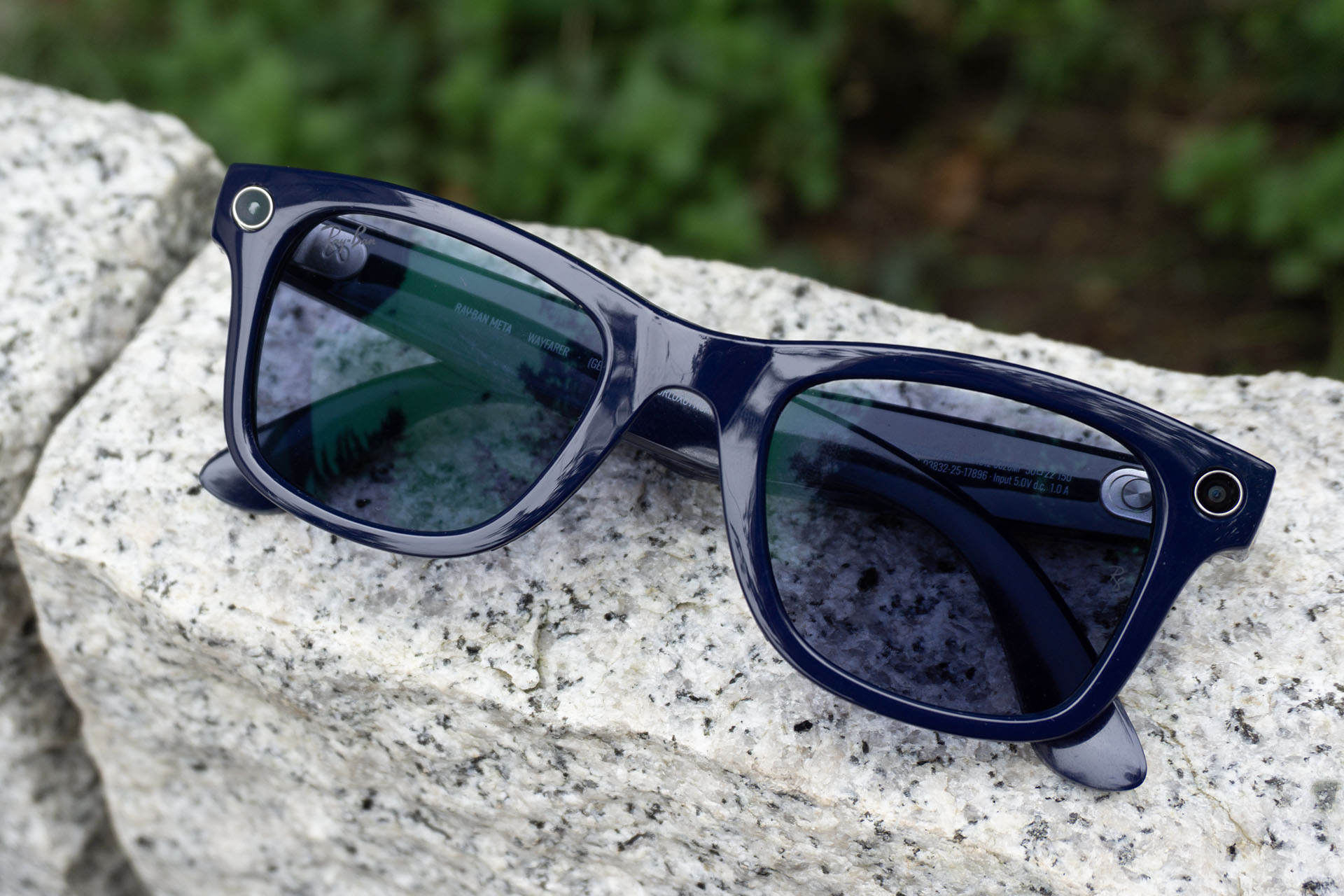
Meta and EssilorLuxottica haven’t strayed too far from the playbook they’ve used for the last two years. The second-generation Ray-Ban Meta glasses come in a handful of frame styles with a number of color and lens variations that start at $379. I tried out a pair of Wayfarer frames in the new “shiny cosmic blue” color with clear transition lenses. 

I personally prefer the look for the slightly narrower Headliner frames, but the second-gen glasses still look very much like traditional Wayfarer glasses. I’ve never been a fan of transition lenses for my own prescription eyewear, but I’m starting to come around on them for smart glasses. As Meta has improved its cameras and made its AI assistant more useful, I’ve found more reasons to wear the glasses indoors. 

The second-generation Ray-Ban Meta glasses come with clear frames, with polarized and transition lenses available as an upgrade.
Karissa Bell for Engadget

Also, if you’re going to be paying $300 or more for a pair, you might as well be able to use them wherever you are. It also helps that the transition lenses on the second-gen Ray-Ban Meta glasses get a bit darker than my first-gen Wayfarers with transition lenses. Upgrading from the standard clear lenses will cost you, though. Frames with polarized lenses start at $409, transitions start at $459 and prescription lenses can run significantly more. 

As with the recent Oakley Meta HSTN glasses, the second-gen Ray-Bans come with a longer battery life and better camera. Meta says the battery can last up to eight hours on a single charge with “typical use.” I was able to squeeze a little more than five and a half hours of continuous music playback. That’s a noticeable step up from the battery on my original pair which, after two years, is starting to show its age. The glasses also now support higher-resolution 3K video recording, but the 12MP wide-angle lens shoots the same 3,024 x 4,032 pixel portrait photos as earlier models.

The second-gen glasses have the same design as the first-gen, with a capture button on the right side of the frames.
The second-gen glasses have the same design as the first-gen, with a capture button on the right side of the frames. The charging case provides an additional 48 hours of battery life.
Karissa Bell for Engadget

For videos, there’s a noticeable quality boost, but I still think it’s probably not necessary for most people if you’re primarily sharing your clips on social media. It does make the glasses more appealing for creators, though, and judging by the number of them in attendance at Connect, I suspect Meta sees them as a significant part of its user base. I’m looking forward to Meta adding the ability to record Hyperlapse and slow-motion videos, though, as I think these may be more interesting than the standard POV footage for everyday activities. 

Meta AI + what’s coming

Two years ago, I was fairly skeptical of Meta’s AI assistant. But since then, Meta has steadily added new capabilities. Of those, the glasses’ translation abilities have been my favorite. On a recent trip to Argentina, I used live translation to follow along with a walking tour of the famous Recoleta cemetery. It wasn’t perfect — the feature is meant more for back-and-forth conversations rather than extended monologues — but it allowed me to participate in a tour I would have otherwise had to skip. (A word of warning: using the live translation for an extended period of time is a major battery killer.)

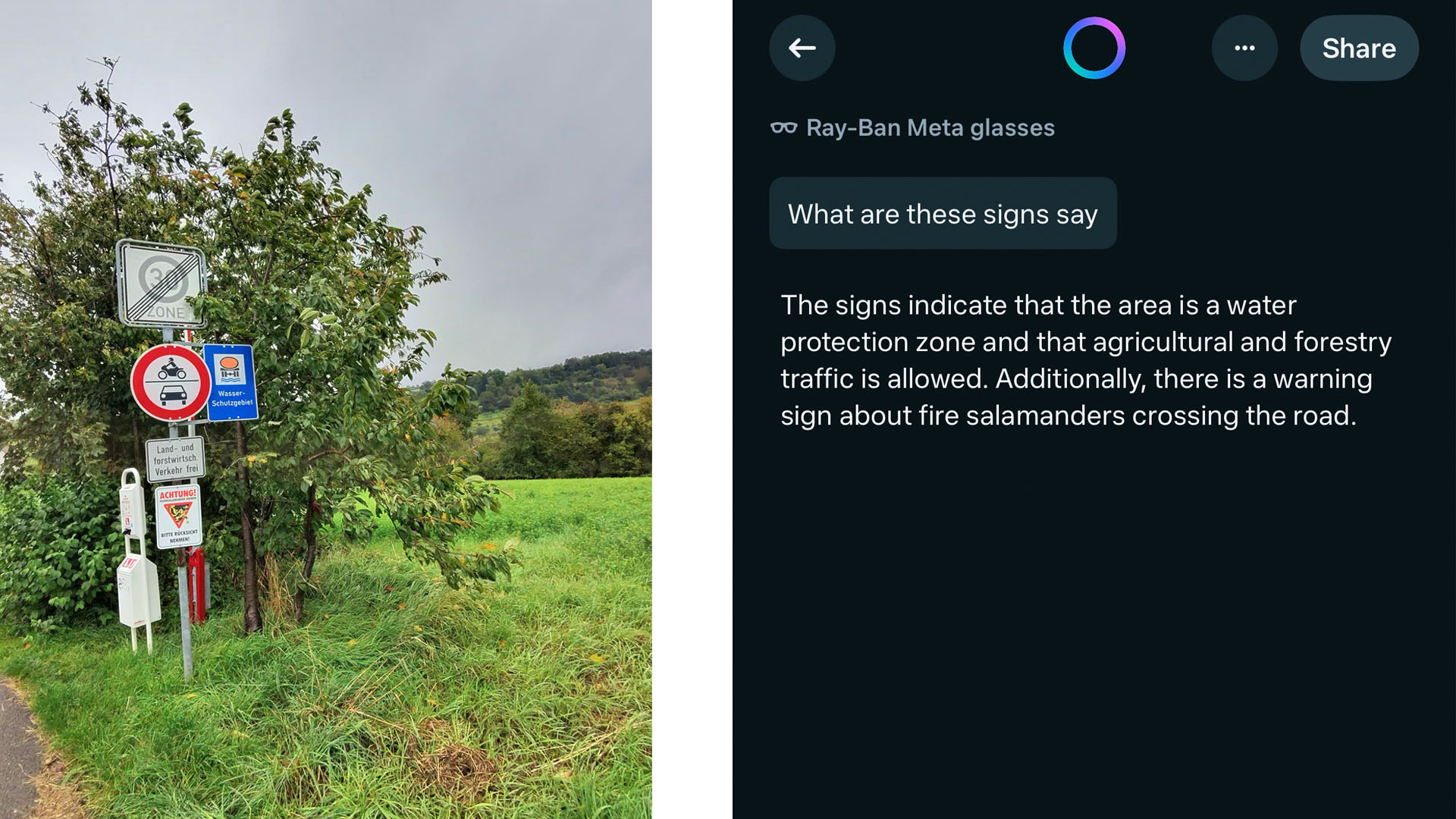
Meta AI can also provide context and translations in other scenarios, too. I spent some time in Germany while testing the latest second-gen Ray-Ban glasses and found myself repeatedly asking Meta to translate signs and notices. For example, here’s how Meta AI summarized this collection of signs. 

Meta AI was able to translate these signs (left) when I asked it "what do these signs say?"
Meta AI was able to translate these signs (left) when I asked it “what do these signs say?”
Karissa Bell for Engadget

As I wrote in my review of the Oakley Meta HSTN glasses, I still haven’t found much use for Live AI, which lets you interact with the assistant in real-time and ask questions about your surroundings. It still feels like more of a novelty, but it makes for a fun demo to show off to friends who have never tried “AI glasses.” There are also some very interesting accessibility use cases that take advantage of the glasses’ cameras and AI capabilities. Features like “detailed responses” and support for “Be My Eyes” show how smart glasses can be particularly impactful for people who are blind or deal with low vision.

One AI-powered feature I haven’t tried out yet is Conversation Focus, which can adjust the volume of the person you’re speaking to while dampening the background noise. Meta teased the feature at Connect, but hasn’t said exactly when it will be available. But if it works as intended, I could see it being useful in a lot of scenarios.

I’m also particularly intrigued by Meta’s Connect announcement that it will finally allow third-party developers to create their own integrations for its smart glasses. There are already a handful of partners, like Twitch and Disney, which are finding ways to take advantage of the glasses’ camera and AI features. Up to now, Meta AI’s multimodal tools have shown some promise, but I haven’t really been able to find many ways to use the capabilities in my day-to-day life. 

Allowing app makers onto the platform could change that. Disney has previewed a smart glasses integration for inside of its parks that would allow visitors to get real-time info about the rides, attractions and other amenities as they walk around. Golf app 18Birdies has shown off an app to deliver stats and other info while you’re on the course.

Should you buy these? And what about privacy?

When the Ray-Ban Meta glasses came out two years ago, this was a pretty straightforward question to answer. If the idea of smart glasses with a good camera and open-ear speakers appealed to you, then buying a pair was a no-brainer. 

Now, it’s a bit more complicated. Meta is still updating its first-gen Ray-Ban glasses with significant new features, like Conversation Focus, new camera modes and third-party app integrations. So if you already have a pair, you won’t be missing out on a ton if you don’t upgrade. (And with a starting price of $299, the first-gen glasses are still solid if you want a more budget-friendly option.)

There are also other options to consider. The upcoming Oakley Meta Vanguard glasses come with more substantial hardware upgrades and other unique features that will appeal to athletes and anyone who spends a lot of time outdoors. And on the higher end, there are the $799 Meta Ray-Ban Display glasses that blend AR elements with its existing features in an intriguing way. 

Meta has already previewed several new features, like new camera modes and Conversation Focus.
Karissa Bell for Engadget

I also have many of the same concerns about privacy as I did when I reviewed Meta’s first Ray-Ban branded glasses back in 2021. I’m well aware Meta already collects an extraordinary amount of data about us through its apps, but glasses just feel like they provide much more personal, and potentially invasive, access to our lives.

Meta has also made some notable changes to the privacy policy for its glasses in recent months. It no longer allows users in the United States to opt out of storing voice recordings in its cloud, though it’s still possible to manually delete recordings in the Meta AI app. 

The company says it won’t use the contents of the photos and videos you capture to train its AI models or serve ads. However, images of your surroundings processed for the glasses’ multimodal features like Live AI can be used for training purposes (these images aren’t saved to your device’s camera roll). Meta’s privacy policy also states that it uses audio captured via voice commands for training. And it should go without saying, but anyone using Meta’s glasses should be very careful about sharing their interactions with its AI app, as a bunch of users have already seemingly inadvertently shared a ton of highly-personal interactions with the world. 

If any of that makes you uncomfortable, I’m not here to convince you otherwise! We’re still grappling with the long-term privacy implications of generative AI, much less generative AI on camera-enabled wearables. At the same time, as someone who has been wearing Meta’s smart glasses on and off for more than four years, I can say that Meta has been able to turn something that once felt gimmicky into a genuinely useful accessory. 

This article originally appeared on Engadget at https://www.engadget.com/wearables/ray-ban-meta-2nd-gen-review-smart-glasses-are-finally-getting-useful-124720393.html?src=rss

Tesla’s updated Model Y Performance launches for $57,490

Tesla’s updated Model Y Performance “Juniper” EV has finally arrived in the US for those who want some extra acceleration and are willing to pay for it. First launched last month in Europe, Tesla’s fastest Model Y arrives a good nine months after the long-range AWD model started selling stateside. 

We already knew that the new Model Y Performance was quick with acceleration from 0 to 60 mph in 3.3 seconds, just 0.8 seconds slower than a Bugatti Chiron Super Sport. What we didn’t know yet was the EPA range, which is 306 miles, compared to 327 miles and 357 miles for the Long Range AWD and Long Range RWD versions, respectively. So faster, but faster to the charging station as well. 

There are subtle changes to the front and rear end, along with 21-inch Arachnid wheels and a more sporty suspension with adaptive damping. It also supports faster charging, thanks to the higher-density battery cells. Inside, it has racier looking seats with bolstered side cushions and electric thigh cushion extenders. 

For all that, you’ll pay $57,490 which is $12,500 more than the base Long Range RWD model and an $8,500 bump over the LR AWD version (that’s almost exactly the same price as Tesla’s original Model S, by the way). If you were hoping to buy one and get the $7,500 federal tax credit discount, unfortunately that has now expired — but state credits may still apply.  

This article originally appeared on Engadget at https://www.engadget.com/transportation/evs/teslas-updated-model-y-performance-launches-for-57490-123018911.html?src=rss

Prime Day Lego deals: Get up to 38 percent off Star Wars and Super Mario sets

October Prime Day is nearly here, and new early deals are popping up every day. Amazon uses October Prime Day to kickstart the holiday shopping season — even if you haven’t even thought about the holidays yet, you should give the latest Prime Day Lego deals a look. A number of Lego sets from the Super Mario and Star Wars collections are already on sale for up to 38 percent off.

When shopping for Lego sets on Amazon, we highly recommend checking a price tracker like Keepa or CamelCamelCamel before buying. It’s not difficult to find Lego sets “on sale” at Amazon, but often those discounted prices have been around for a long time. We’ve clocked “deals” in which the sale price has been available for months already, going back as far as late spring and early summer 2025. Here, we’re mostly highlighting discounts on new Lego sets, recent price drops and record-low (and close to them) prices on popular Lego sets from franchises like Star Wars, Super Mario and others.

Best October Lego Prime Day deals

This article originally appeared on Engadget at https://www.engadget.com/deals/prime-day-lego-deals-get-up-to-38-percent-off-star-wars-and-super-mario-sets-121513961.html?src=rss

YouTube TV keeps NBC with a last-minute extension but loses Univision

YouTube TV has announced that it has reached a “short-term extension” agreement with NBCUniversal so that it can continue offering its programs while they negotiate a new long-term deal. The service warned customers last week that its partnership with NBCUniversal was going to expire on September 30 and that they haven’t signed a new deal yet. It said at the time that NBC was asking the service “to pay more than what they charge consumers for the same content on Peacock, which would mean less flexibility and higher prices for [its own] subscribers.” 

While YouTube TV was able to prevent the removal of NBC programs at the last minute, it wasn’t able to reach a similar deal with Univision, the largest Spanish-language broadcaster in the US. It sent out an email to customers, telling them that it has failed to reach an agreement with TelevisaUnivision that reflects the value of its content. “Unfortunately their current demands aren’t supported by their performance on YouTube TV over the last four years,” it said in the email. The broadcaster has “over 160 million subscribers and billions of views across YouTube,” a YouTube spokesperson said in a statement. However, it apparently “only represents a tiny fraction of overall consumption” on its TV subscription service. 

In early September, TelevisaUnivision warned customers that Google was planning to remove its programs from YouTube TV’s standard package and to charge viewers an extra $15 to be able to access its network. The broadcaster called it the “Hispanic tax” and questioned Google’s ethics at “a time of economic uncertainty for many.” The broadcaster called YouTube TV’s actions “tone-deaf and egregious on the eve of a potential government shutdown” in a new statement regarding its network’s removal from the service. “To add insult to injury, YouTube TV chose to take this step during Hispanic Heritage Month — an act that is deeply insensitive and offensive,” it added.

This article originally appeared on Engadget at https://www.engadget.com/entertainment/youtube/youtube-tv-keeps-nbc-with-a-last-minute-extension-but-loses-univision-121508916.html?src=rss

The best advent calendars for 2025: Our favorites from Lego, Funko Pop, Pokémon and more

Advent calendars aren’t just about chocolate anymore. Recent years have shown that the countdown to Christmas Day can be packed with fun surprises. Whether you’re into building Lego sets, adding more minifigures to your collection or curiously intrigued by scientific experiments, advent calendars can fill that desire (and they make for great gifts, too). Each door hides a new surprise that brings a bit of joy, nostalgia or nerdy fun to the holiday season.

Best advent calendars for 2025

Check out the rest of our gift ideas here.

This article originally appeared on Engadget at https://www.engadget.com/the-best-advent-calendars-for-2025-our-favorites-from-lego-funko-pop-pokemon-and-more-120042696.html?src=rss

Oura Ring 4 gets new ceramic options and a charging case

Oura’s fourth-generation smart ring has been on the market for around a year, but the company is still looking to broaden its appeal. Today, Oura is launching a version of the Ring 4 clad in Zirconia Ceramic, offering a combination of durability and eye-catching color. The Ring 4 Ceramic comes in four colors: Cloud (white), Midnight (dark blue), Petal (pink) or Tide (pale green), all of which are priced at $499.

The company is talking up the various benefits of these new rings, explaining how durable the new ceramic coating is. For a start, since the color is embedded into the material, it’ll be very difficult to spot any scratches and bumps. Not to mention that ceramic is sturdy enough that you’ll probably not be able to damage it unless you go out of your way to do so. In fact, Oura says the bigger issue is dye from other objects wicking onto the surface — which will be easily wiped away.

Image of the Oura Ring 4 charging case, in black, on a grey/black background.
Oura

As well as the fashionable new colors, Oura is also announcing its first ever charging case for the Ring 4. The company said it’s responding to feedback from users who’d rather not tote their standard charger around when they’re traveling. The clamshell unit is only a little bit bigger than an existing charger, and contains a battery big enough to support “up to 5 full charges.” A set of LEDs on the side will tell you how many charges you have available when you’re not charging a ring, but switches to tell you the ring charge level when it’s in place. The Oura Ring 4 charging case will, naturally, come as a paid-for accessory, setting you back $99.

Oura is also listening to its well-heeled users who want to wear different rings to suit their outfits. Multi-Ring Support will enable users to pick up and put down their multiple Ring 4s without a lot of fuss, ensuring their health data is as up to date as their style choices.

GIF
Oura

A lot of health tech companies are broadening out their work to include some more serious biology. Oura is joining the fray, offering Health Panels, a $99 blood test that will screen more than 50 markers for potential signs of trouble. Schedule a draw at a convenient Quest Diagnostics clinic and you’ll get results for factors including your metabolic health, blood sugar, liver and kidney function. Naturally, the results will be available in your Oura app, which will offer personalized recommendations thanks to its AI-based Oura Advisor.

This article originally appeared on Engadget at https://www.engadget.com/wearables/oura-ring-4-gets-new-ceramic-options-and-a-charging-case-120000060.html?src=rss

Arm loses licensing dispute with Qualcomm

Qualcomm has announced that a US District Court granted it “complete victory” in the lawsuit brought by Arm back in 2022. The court dismissed the remaining claim in Arm’s lawsuit, and it also upheld the result of a December 2024 trial, in which a jury ruled that Qualcomm and its subsidiary Nuvia did not violate their licensing agreement with Arm. 

If you’ll recall, Arm sued Qualcomm after the latter purchased Nuvia, which is also one of the companies licensing its technologies. It argued that since Qualcomm didn’t obtain the necessary permits to transfer Nuvia’s licenses, Nuvia breached their contract. In 2024, Arm canceled the architecture license allowing Qualcomm to use its intellectual property and standards for chip design. 

This recent court victory allows Qualcomm to continue selling chips with designs developed by Nuvia, which power multiple devices, including Microsoft Surface laptops. “Our right to innovate prevailed in this case and we hope Arm will return to fair and competitive practices in dealing with the Arm ecosystem,” said Ann Chaplin, Qualcomm’s general counsel. 

Arm, however, isn’t giving up. It “remains confident in its position in its ongoing dispute with Qualcomm,” it said in a statement, and will file an appeal to overturn the court’s decision. Meanwhile, Qualcomm said it’s looking forward to the trial for its own lawsuit against Arm, accusing the Softbank-owned company of breach of contract and a “pattern of conduct seeking to hinder innovation and better position [its] own products over its long-standing partners’.” It’s expecting a trial for that lawsuit to take place in March 2026. 

This article originally appeared on Engadget at https://www.engadget.com/big-tech/arm-loses-licensing-dispute-with-qualcomm-120000134.html?src=rss

In their own words: The Artemis II crew on the frenetic first hours of their flight

How calm, cool, and utterly chill is the crew of NASA’s first Moon mission in more than half a century?

Let’s start with Canadian astronaut Jeremy Hansen.

“You know me, personally, I hope to take a very short nap on the pad,” he said. “There’s enough time built in there to have a nap. I’ve been practicing falling asleep. So if the loops are quiet enough, and I get a minute, I’ll try for a nap.”

Read full article

Comments

Peloton Just Announced a New Fleet of Equipment and AI ‘Dynamic Coaching’

We may earn a commission from links on this page.

Did you know you can customize Google to filter out garbage? Take these steps for better search results, including adding Lifehacker as a preferred source for tech news.


As of today, a ton of massive changes just hit the Peloton ecosystem. The at-home fitness giant didn’t just overhaul one part of the structure 6 million people rely on for quality workouts—it made improvements and tweaks across its hardware, software, content, and partnerships. Everything is available for members to explore now, both in the mobile app and on the brand’s proprietary equipment devices, but I don’t blame you if you’re not even sure what to start looking first. Here’s what you need to know.

Peloton devices got a makeover

Peloton became most famous for its classic Bike, a stationary bicycle with a touchscreen that, since 2014, has allowed anyone anywhere to take a virtual spin class. Since the introduction of the Bike, the brand has rolled out an upgraded version, plus two kinds of treadmills and one rowing machine. The first big announcement of the day has to do with all those products: The five-part lineup is staying the same, but the Bike, Bike+, Tread, Tread+, and Row all got a significant makeover.

Known collectively as the Peloton Cross Training Series, the new lineup is this:

  • The Cross Training Bike

  • The Cross Training Bike+

  • The Cross Training Tread

  • The Cross Training Tread+

  • The Cross Training Row+

Each of the devices features a swiveling screen (which users of the old Bike+ will be familiar with) designed to allow users to switch more seamlessly between cardio and Peloton’s other class offerings, like strength, yoga, and Pilates. That is where the whole “cross training” thing comes in. They also have enhanced audio, better processors for touchscreen responsiveness, and upgraded wifi and Bluetooth, giving them a distinct edge over their predecessors.

Of particular note is what comes with the Plus line, or any device with a “+” after the name. Those all have a built-in, movement-tracking camera that will monitor your form, count your reps, and help the software suggest weights for you to use in your strength workouts. I tested it out yesterday at Peloton Studios in New York and was impressed. (If you recall, a few months ago, Peloton phased out the Guide, a camera that connected to users’ TVs and did a much rougher version of what these built-in cameras are now going to do. We should have seen this new integration coming then.)

The Plus line also comes with Sonos audio, hands-free control so you can make vocal commands to adjust your weight or pause a workout, and accessories and features based on users’ requests. They have a three-speed fan built in to cool you down, for instance, and the Bike+ finally has a tray that can hold your phone. The Bike and Bike+ have cushier seats, though you can also purchase one of these new seats separately for your older Bike and Bike+ models.

Peloton IQ

The brand also announced the launch of its AI component, Peloton IQ. Remember how I mentioned the Plus line allows for voice commands? You can say, “OK, Peloton, skip this exercise,” or “OK, Peloton, pause this workout.” That’s pretty useful if you’re, say, doing a lift or yoga exercise and your touchscreen isn’t within reach.

But the AI does more than that. Its real purpose is to provide “dynamic coaching.” Basically, your Peloton app got a major redesign (which you can see for yourself by opening it on your phone or Peloton device right now). Across the top, you’ll see suggested workouts that are based on your goals, your past workouts, and your schedule. Crucially, this works on older models, too. I asked reps at Peloton Studios about this specifically yesterday and everyone was quite clear that they’re not trying to force users to give up existing Bikes, Treads, or Rows.

Still, the most advanced features of Peloton IQ are only available on the new Plus line, since those devices have the movement-tracking camera that enables the AI to give feedback, correct form, count reps, and suggest weights. The Plus line also allows for self-paced strength workouts similar to the ones you can find on Peloton’s Strength+ app. Instead of following along with a class and instructor, you can generate a workout plan that simply walks you through a series of exercises and you can go at your own speed. You can pick your target muscle groups, deny exercises you don’t want to do, and change the weight you’re using for a totally custom experience.

One cool thing I saw during yesterday’s demo was that if you nail your form too easily or do more reps than suggested, the AI will automatically tell you when it’s time for you to consider using heavier weights. You can accept or deny this suggestion and if you accept, from then on, it will be set so you’re always doing that exercise with that weight. You can input any weights you have on hand at home, so even if you only have a set of five-pound dumbbells, the app will tell you when to use them and won’t suggest exercises with anything heavier or lighter.

Club Peloton, better Teams, and more

On your Peloton app, you’ll also now see something called Club Peloton, which is a recognition program that rewards you for consistency and variety in your workouts. You’ll be assigned a level—bronze, silver, gold, or legendary—based on things like workout streaks or trying new types of exercises. Reps told me at the demo event that Club Peloton will eventually evolve to start giving back. For instance, members of a certain level may be eligible for discounts on certain items or to get early access to classes.

Peloton says this is part of its “further investment in human connections.” Obviously, the company is famous for making it possible to do complete workouts all on your own at home, but a big part of its success comes from the ways it approximates the in-person feeling by offering virtual group classes, personable instructors, and other features like Teams. You can join Teams with your friends and compete together or against one another or even join Teams based on mutual attributes like being a new mother or living in a certain region, but with today’s overhaul, you can now also join something called Official Peloton Teams. These are helmed by Peloton instructors and include options like Move for Life, Cross Training, Menopause Health, and more.

Peloton pricing

Peloton’s prices are going up, which isn’t exactly a surprise. The company’s letter to investors during the last earning period hinted at that and it’s to be expected with all these new features rolling out. At least now it finally makes sense why Bikes, Treads, and Rows were being phased out at sporting goods stores a few months ago, and Peloton launched its own resale platform over the summer for people who want to sell their old equipment: We’re getting a whole new fleet of devices.

So, the new prices for membership are:

  • All-Access Membership goes up from $44 to $49.99 per month

  • App+ Membership goes up from $24 to $28.99

  • App One Membership goes up from $12.99 to $15.99

The devices are priced like this:

  • The Cross Training Bike is $1,695 (plus $150 for expert assembly if you don’t want to do it yourself for free)

  • The Cross Training Bike+ is $2,695 (plus $150 for optional expert assembly)

  • The Cross Training Tread is $3,295 (plus $150 for optional expert assembly)

  • The Cross Training Tread+ is $6,695 and you’ll need to pay $299 for assembly

  • The Cross Training Row+ is $3,495 (plus $150 for optional expert assembly

Final notes and first impressions

I saw all of this at a press event yesterday and was truly impressed, especially because there wasn’t much of a hint about what the event was even about before I got there. The brand kicked off today’s big launch by adding 2,000 classes compatible with the new AI features and everyone, even people with the lowest-level, app-only membership, can now access most of the new offerings (besides the motion-tracking features). That’s a lot to keep under wraps.

From what I saw during demos, these are genuinely solid improvements. Even the swiveling screens, fans, and phone tray are nice touches, since those are the kinds of things Peloton users have been paying extra to third parties to get for years.

This is just the broad view of all the changes and it’ll take me some time to work through all the new features and options on my app and Bike, but I’ll update my old posts and create highlights for the truly noteworthy changes over the next few days. I already know I’m going to be thrilled by the new integration with Apple Health, for instance, even though I haven’t gotten to play with it yet. I’ve been tracking all my non-Peloton workouts through the Peloton app for weeks, since it’s easier than tracking some with Apple Health and others with Peloton. Now, any workout I complete on or off the app will be reflected in my Peloton history and will contribute to the AI’s suggestions for what I should do on a given day.

Over the next month, there will be promotions available so anyone who wants to upgrade to a new piece of equipment can do it more economically. As I find out more about those, I’ll keep you updated. Personally, after all of yesterday’s demos, I’m already pretty sure it’s about time for me to retire my classic Bike and invest in the new Bike+.

Peloton updates its Bike, Tread and Row machines with form-checking cameras, rotating screens and lots of AI

It’s been a rough time for Peloton. Last year was marred by deep staff cuts, a change of CEO and a reckoning of where the home fitness company belonged, post-Pandemic boom. The answer is, unfortunately, AI-tinged, but that shouldn’t distract from some major hardware upgrades across its Bike, Tread and Row family of machines. It’s an almost-entire overhaul, with new software, programmable workouts and an array of collaborations. There are also some tentative steps toward wellness, because why not?

Peloton’s 2025 lineup is called the Cross Training series, with five different fitness devices — Bike, Bike+, Tread, Tread+ and Row+ — all benefiting from new hardware, varying levels of AI smarts with Pelpton IQ and software improvements.

All of the new machines have a 21.5-inch screen that rotates away from the bike/track/rower. (Previously, the Bike+ had this feature, with a bigger 23.8-inch display.) This turns it into a more versatile screen for cross-discipline workouts that Peloton has already dabbled in, including yoga and strength training. Peloton explained at the launch event that strength training is actually its second most-popular class offering.

Peloton Cross Training machine launch
Image by Mat Smith for Engadget

Peloton’s Guide camera, if you remember, has been fused into the ‘plus’ machines. A new movement tracking camera (which can be flipped off) can count your reps automatically and show that on screen while also monitoring form and offering light guidance. During a demo, while doing weight training next to the bike, the machine suggested improving squat movements by imagining sitting deeply into a chair. It seems like relatively surface advice, but it’s more guidance than Peloton’s fitness equipment has offered in the past.

Senior Vice President of Product Brent Tworetzky said that the Guide device informed how Peloton’s cameras track workout movements, which was all folded into these Cross Training machines. There are voice commands to pause workouts, adjust weights and even skip moves when needed.

Peloton has also folded in some of the most-requested hardware features from its members. While a phone tray won’t blow your mind, a new three-speed fan and a reengineered seat are all included with the plus machines. Peloton has also worked with Sonos to upgrade the speaker system, and the plus machines are the first to have a woofer built-in.

Peloton IQ features go further than computer vision. Across all the new machines, it can generate and track personalized workout plans, and can even control strength training workouts that you can tackle at your own pace, if instructor movements prove too confusing.

Turning on your Peloton of choice on a Monday, for example, you can program in a week of workouts, with the AI working in the background to offer balanced workouts or a training program geared at your fitness goals, whether that’s weight loss, cardio fitness or strength.

Peloton IQ will also analyze your workout history and give personalized target metrics and goals to help them select their workout. Select a more challenging (or longer) workout and IQ will note that the workout will be “Harder than your usual” when browsing the class library.

Peloton Cross Training machine launch
Image by Mat Smith for Engadget

Peloton is expanding its membership offerings even further, although several intriguing additions aren’t yet available. For example, the company is collaborating with New York’s Hospital for Special Surgery to develop workout programming that focuses on injury prevention and recovery. It also acquired Breathwrk, a breathing exercise app that’s now folded into services for both All-Access and App+ Members.

There’s even more. Peloton is also collaborating with Respin Health on an eight-week program, curating Peloton classes to target symptom relief and overall quality of life improvement for members experiencing perimenopause through to postmenopause. And – don’t tell your competitive exercise buddy – Peloton is expanding its collaboration with Hyrox with new classes to help train towards those manic races.

There is a cost to all these additions. The new Cross Training versions are priced several hundred dollars higher than their predecessor. Peloton’s Cross Training Bike is priced at $1,695, while the Bike+ jumps up to $2,695. The Cross Training Tread starts at $3,295 , while the Tread+ is $6,695. And if you’re looking for an upgraded rower, the Row+ starts at £3,495. All of the machines require a Peloton subscription, priced at $50.

And that’s an increase there, too. Effective starting this month, Peloton has raised its All-Access Membership from $44 to $49.99 and App+ Membership from $24 to $28.99. The app-only service is also being nudged up from $12.99 to $15.99.

The new Cross Training range is available to buy now at onepeloton.com, Peloton’s own retail stores, Amazon and Dick’s Sporting Goods.

This article originally appeared on Engadget at https://www.engadget.com/general/peloton-cross-training-bike-tread-row-plus-machines-form-checking-cameras-rotating-screens-ai-price-launch-date-110042677.html?src=rss

Curiosity Drives Viewers To Ignore Trigger Warnings

alternative_right shares a report from Phys.org: For the first time, a new study has tested the effectiveness of trigger warnings in real life scenarios, revealing that the vast majority of young adults choose to ignore them. A new Flinders University study has found that nearly 90% of young people who saw a trigger warning still chose to view the content, saying that they did so out of curiosity, rather than because they felt emotionally prepared or protected. The findings published in the Journal of Behavior Therapy and Experimental Psychiatry aligned with a growing body of lab-based research suggesting that trigger warnings rarely lead to the avoidance of potentially distressing material.


Read more of this story at Slashdot.

Roland just released a follow-up to its most famous drum machines from the 1980s

If you’ve ever listened to music released in the 1980s, you’ve likely heard the iconic TR-808 and TR-909 drum machines. Artists like New Order, Marvin Gaye, Whitney Houston and Beastie Boys all used these machines during that decade and newer artists like Daft Punk, Outkast and Bjork continued the tradition as the years rolled on. Roland understands this legacy and just introduced a sequel instrument, the TR-1000. It only took 40 years.

The TR-1000 looks to be an amalgamation of the analog grit of the original machines and modern digital features. It includes true analog voices, along with digital sampling technology. The company says it worked with “creators across scenes and geographies” to ensure the machine meets the “real-world needs and workflows of today’s most innovative producers.”

A machine.
Roland

It features re-designed engines from the original 808 and 909 machines, along with a new sequencer and over 2,000 pre-installed factory samples. However, users can easily import their own samples. It also comes with 46GB of internal storage, dozens of effects and a full suite of connection ports.

“The TR-1000 feels like the true, classic lineage of the 808 and 909, not a digital remake,” El-P of the rap group Run The Jewels said in a press release. Roland fans are no doubt aware that there have been multiple digital remakes of these machines throughout the years, and none of them quite managed to capture the mojo of the original units.

A drum machine.
Roland

The drum machine is available right now to order, but there’s a spot of bad news. The Roland TR-1000 costs a whopping $2,700.

This article originally appeared on Engadget at https://www.engadget.com/audio/roland-just-released-a-follow-up-to-its-most-famous-drum-machines-from-the-1980s-070046806.html?src=rss

Independent UK Bookshops To Begin Selling eBooks

Independent UK bookshops will now be able to sell ebooks via a new platform (Bookshop.org’s expansion), keeping 100% of profits and offering a non-Amazon way to reach digital readers. “Bookshops now have an additional tool in their fight against Amazon,” said Nicole Vanderbilt, managing director of Bookshop.org UK. “Digital readers don’t depend on Amazon’s monopoly any more, now that they can find ebooks at the same price on Bookshop.org.” The Guardian reports: Bookshop.org launched in the UK in November 2020 as a platform for independent bookshops to sell physical books. Bookshops receive 30% of the cover price from each sale they generate; so far, the UK site has generated 4.5 million pounds for independent bookshops. Customers will also now be able to buy ebooks through a bookshop of their choice. Profits from orders without a specified bookshop will be added to a shared pool, which will be distributed among all participating bookshops on the platform. […]

The platform will launch with a catalogue of more than a million ebooks from all major publishers. It will be available online via a web browser and through the Bookshop.org apps on Apple and Android. “Due to Amazon’s proprietary digital rights management [DRM] software and publishers’ DRM requirements, it’s not currently possible to buy DRM-protected ebooks from Bookshop.org or local bookshops and read them on your Kindle,” said Bookshop.org. However, the site is working with the e-reader company Kobo to support Kobo devices “later this year,” and longer term would “love to offer our own eInk device.”


Read more of this story at Slashdot.

Scientists Make Embryos From Human Skin DNA For First Time

An anonymous reader quotes a report from the BBC: US scientists have, for the first time, made early-stage human embryos by manipulating DNA taken from people’s skin cells and then fertilizing it with sperm. The technique could overcome infertility due to old age or disease, by using almost any cell in the body as the starting point for life. It could even allow same-sex couples to have a genetically related child. […]

The Oregon Health and Science University research team’s technique takes the nucleus — which houses a copy of the entire genetic code needed to build the body — out of a skin cell. This is then placed inside a donor egg that has been stripped of its genetic instructions. So far, the technique is like the one used to create Dolly the Sheep — the world’s first cloned mammal — born back in 1996. However, this egg is not ready to be fertilized by sperm as it already contains a full suite of chromosomes.

You inherit 23 of these bundles of DNA from each of your parents for a total of 46, which the egg already has. So the next stage is to persuade the egg to discard half of its chromosomes in a process the researchers have termed “mitomeiosis” (the word is a fusion of mitosis and meiosis, the two ways cells divide). The study, published in the journal Nature Communications, showed 82 functional eggs were made. These were fertilized with sperm and some progressed onto the early stages of embryos development. None were developed beyond the six-day-stage.

The technique is far from polished as the egg randomly chooses which chromosomes to discard. It needs to end up with one of each of the 23 types to prevent disease, but ends up with two of some and none of others. There is also a poor success rate (around 9%) and the chromosomes miss an important process where they rearrange their DNA, called crossing over. Prof Mitalipov, a world-renowned pioneer in the field, told me: “We have to perfect it. “Eventually, I think that’s where the future will go because there are more and more patients that cannot have children.”


Read more of this story at Slashdot.