ASUS ROG NUC 9 Mini Is Small But Mighty With 3D V-Cache Ryzen 9 And RTX 5070

ASUS ROG NUC 9 Mini Is Small But Mighty With 3D V-Cache Ryzen 9 And RTX 5070
ASUS is following up on its 2025 ROG NUC with an AMD-powered variation, but the new machine is a China exclusive and something of a mixed upgrade. The good news is that the new model of the 2025 ROG NUC — dubbed the ROG NUC 9 Mini — boasts AMD’s impressive mobile flagship Ryzen 9 9955HX3D processor. Compared to the Intel Arrow Lake-HX-powered

Chinese Criminals Made More Than $1 Billion From Those Annoying Texts

The U.S. is awash with scam text messages. Officials say it has become a billion-dollar, highly sophisticated business benefiting criminals in China. From a report: Your highway toll payment is now past due, one text warns. You have U.S. Postal Service fees to pay, another threatens. You owe the New York City Department of Finance for unpaid traffic violations. The texts are ploys to get unsuspecting victims to fork over their credit-card details. The gangs behind the scams take advantage of this information to buy iPhones, gift cards, clothing and cosmetics.

Criminal organizations operating out of China, which investigators blame for the toll and postage messages, have used them to make more than $1 billion over the last three years, according to the Department of Homeland Security. Behind the con, investigators say, is a black market connecting foreign criminal networks to server farms that blast scam texts to victims. The scammers use phishing websites to collect credit-card information. They then find gig workers in the U.S. who will max out the stolen cards for a small fee. Making the fraud possible: an ingenious trick allowing criminals to install stolen card numbers in Google and Apple Wallets in Asia, then share the cards with the people in the U.S. making purchases half a world away.


Read more of this story at Slashdot.

Apple’s M6 MacBook Pro generation will reportedly offer touchscreens

Apple insiders are pointing to a tactile new future for the company’s laptops. Last month, analyst Ming-Chi Kuo suggested that Apple would incorporate touchscreens into MacBooks some time in the next few years, “further blurring the line with the iPad.” Today, Mark Gurman at Bloomberg confirmed that prediction, sharing even more specifics about the touchscreen approach for a MacBook Pro that is currently projected for release in late 2026 or early 2027. 

Gurman reports that the touchscreen laptops are internally known as K114 and K116, and will run on M6 chips; Apple just introduced the M5 generation of its silicon for this year’s iteration of the MacBook Pro and iPad Pro. His sources also say that the laptops will have OLED screens and will boast “a reinforced hinge and screen hardware” so that the display portion doesn’t move when being used. The laptops will still have a trackpad and keyboard for non-touchscreen control, and will be housed in “thinner and lighter frames.” Finally, this laptop will reportedly abandon the notch housing for the MacBook Pro’s camera in favor of a hole-punch design that leaves a display area around that sensor.

Longtime Apple leader Steve Jobs was adamantly opposed to touchscreen computers. But most other computer companies have had touchscreen models available for about a decade, so Apple did adhere to that philosophy for a really long time. Rather than bring touch to a laptop, for a while Apple was trying to position the iPad as being capable of doing all the tasks you’d use a laptop for, as epitomized in the notorious “what’s a computer?” ad. It should be interesting to see how touch MacBooks and iPads will coexist.

This article originally appeared on Engadget at https://www.engadget.com/computing/laptops/apples-m6-macbook-pro-generation-will-reportedly-offer-touchscreens-203029809.html?src=rss

Meta is shutting down its desktop Messenger app

Meta is shutting down its Messenger app for macOS and Windows and pushing users to the web. Meta confirmed over email to Engadget that the app will be fully shutdown on December 15, after which the easiest ways to access Messenger chats when you’re not on your phone will be the Facebook app on Windows, or the Facebook and Messenger websites.

The company hasn’t provided an explanation for why it’s abandoning its desktop Messenger apps, but Meta’s support article does say that users will receive a notification informing them of the shutdown, and will be blocked from accessing the app after December 15.

In order for your chats to be saved going forward, the company says you’ll have to turn on secure storage and add a pin code to your account. To make sure your chats will be archived:

  1. Click on the gear icon above your profile picture.

  2. Click on Privacy & Safety, and then End-to-end encrypted chats.

  3. Click on Message storage, and then make sure Turn on secure storage is toggled on.

Meta officially cut Messenger out of Facebook in 2014 to create a focused messaging experience separate from the tangle of features the social media platform offered at the time. The company later tried to connect Messenger and Instagram Direct Messaging into one communication platform, but backed away from the idea in 2023. Rather than Meta’s interest in messaging suddenly waning, abandoning the desktop apps likely reflects the fact that most people prefer to use the company’s mobile apps or websites.

This article originally appeared on Engadget at https://www.engadget.com/meta-is-shutting-down-its-desktop-messenger-app-202539375.html?src=rss

Apple Readies High-End MacBook Pro With Touch, Hole-Punch Screen

Speaking of the new MacBook Pro, which Apple launched on Wednesday, Bloomberg News reports that the company is preparing to launch a touch-screen version of its Mac computer, reversing course on a stance that dates back to co-founder Steve Jobs. From the report: The company is readying a revamped MacBook Pro with a touch display for late 2026 or early 2027 [non-paywalled link], according to people with knowledge of the matter. The new machines, code-named K114 and K116, will also have thinner and lighter frames and run the M6 line of chips. In making the move, Apple is following the rest of the computing industry, which embraced touch-screen laptops more than a decade ago.

The company has taken years to formulate its approach to the market, aiming to improve on current designs. Bloomberg News first reported in January 2023 that Apple was working on a touch-screen MacBook Pro. The new laptops will feature displays with OLED technology, the same standard used in iPhones and iPad Pros, said the people, who asked not to be identified because the products haven’t been announced. It will mark the first time that this higher-end, thinner system is used in a Mac.


Read more of this story at Slashdot.

Google’s Ask Photos feature isn’t available in Texas and Illinois

One of Google’s Gemini-powered photo features is MIA in Texas and Illinois. The company confirmed to Engadget that Ask Photos is currently unavailable in the two states. It didn’t say why. Google Photos’ Conversational Editing is reportedly missing in those states, too.

“The ability to ask Photos to edit your images is not available to users in Texas and Illinois at this time,” Google’s statement to Engadget reads. “We are working to determine how to make Ask Photos available to more users.”

As for why that is, we don’t have confirmation. But the Houston Chronicle, which first reported the news, pointed to a pair of lawsuit settlements as a likely culprit. In 2022, Google settled an Illinois class action suit over Google Photos data privacy concerns for $200 million. Earlier this year, it settled one with Texas for $1.4 billion over collecting user data without permission.

The common theme in both settlements was biometric data collection. Lo and behold, both of the missing AI features require “face grouping” to be turned on. That Google Photos feature uses automated facial recognition to cluster pictures of the same person.

The tricky part comes when state laws require informed consent for data collection. 9to5Google notes that only the photographer — and not the many subjects of their pictures — have typically agreed to Google’s terms and conditions. That creates a head-spinning legal conundrum that could have easily led Google to play it safe.

Ask Google Photos lets you type or speak queries about your picture library. For example, you could say, “What are all the cities I visited last year?” or “Show me the best photo from each national park I’ve visited.” Meanwhile, Conversational Editing lets you tweak images using natural language. It launched with the Pixel 10 series in August and expanded to other Android phones in September.

This article originally appeared on Engadget at https://www.engadget.com/ai/googles-ask-photos-feature-isnt-available-in-texas-and-illinois-200536477.html?src=rss

OnePlus unveils OxygenOS 16 update with deep Gemini integration

OnePlus is expected to take the wraps off the OnePlus 15 in the next few weeks, but before that, it’s giving us a look at the software that will run on it. OxygenOS 16, which is based on Android 16, will also come to the company’s other supported phones, and it’s going to include a heaping helping of AI features. OnePlus was slower than most smartphone makers to embrace AI, but it’s full-steam ahead now with new Gemini integrations.

OxygenOS 16 is described by OnePlus in grandiose terms as “a defiant rebellion for authenticity.” In the real world, this update is doing a lot of the same things as other AI-heavy smartphones. It’s not all AI—OnePlus notes that OxygenOS 16 will include revamped animations that have been carefully designed for smoothness, as well as the O+ remote app that gives you remote access to Windows and Mac PCs. The lock screen is also more customizable, borrowing a page from the likes of Apple and Samsung.

OnePlus began embracing AI back in June, when it launched a feature called Mind Space on the OnePlus 13S. That phone was only for the Indian market, but the rest of the world will get this and more with OxygenOS 16. At launch, Mind Space would collect your screenshots and brief voice messages. Mind Space would analyze the screenshots to create calendar entries and not much else.

Read full article

Comments

Apple TV Subscribers Can Soon Add Peacock for $2 More

If you asked me which streaming service has the best TV shows, I’d say Apple TV (recently freshly rebranded from Apple TV+). But if you asked me which has the fewest TV shows, I’d also say Apple TV. I love Severance and all, but when it’s not releasing new episodes, there’s usually not enough to keep me subscribed. That’s why I’m so interested in the new bundle deal from Apple and Peacock: For just $2 more than a standard Apple TV subscription—or the same price as a monthly Peacock subscription—you can get them both.

Peacock isn’t my favorite streaming service, exactly, but because it pulls from most of NBC and Universal’s respective catalogs, it does usually have enough to keep me interested between new seasons of Poker Face, especially when it comes to its library of movies. The highs aren’t quite as high as Apple’s, but there’s enough there that you’ll probably find something to watch when you need background noise. Combining it with Apple TV is a smart way to shore up each platform’s weak spots.

How to sign up for the Apple TV/Peacock bundle

According to Apple, the new bundle goes live on Oct. 20, so it’s not quite here yet. But once it arrives, you’ll be able to pay $14.99 per month to get Apple TV and Peacock Premium together, or $19.99 per month to upgrade to Apple TV and Peacock Premium Plus without ads. Given that a month of Apple TV costs $12.99, on its own and a month of Peacock Premium would cost $10.99 on top of that, it’s a pretty good deal.

It’s also good timing for Halloween, as Peacock is home to classics like The Thing as well as more recent hits like the Terrifier films. For some reason, a good deal of the Universal monsters films seem to be making Tubi their home this year instead, but Peacock’s horror selection is still stronger than Apple’s on its own.

As for whether it’s worth the extra $5 for the Peacock Premium Plus bundle, it depends on how much you hate ads. That package is a good deal more expensive than Apple TV would be on its own, but on the other hand, a month of Peacock Premium Plus would typically run you $16.99 on its own, so the $19.99 you’d be paying to add Apple TV to the mix isn’t a bad deal. For your extra dollars, you’d be eliminating ads from your Peacock viewing, as well as adding on the ability to download content to watch offline.

Apple says that once the deal goes live, you’ll be able to access it through either the Apple TV or Peacock websites/apps. Meanwhile, if you’re subscribed to an Apple One Family or Premier plan, which includes Apple TV alongside a number of other Apple platforms, you’ll need to sign up for Peacock separately. However, Apple says it will offer a 35% discount to Peacock Premium Plus for Apple One subscribers, which will knock the price down to about $11 a month, or around the same price as the ad-supported Peacock Premium.

Sony tells SCOTUS that people accused of piracy aren’t “innocent grandmothers”

Record labels Sony, Warner, and Universal yesterday asked the Supreme Court to help it boot pirates off the Internet.

Sony and the other labels filed their brief in Cox Communications v. Sony Music Entertainment, a case involving the cable Internet service provider that rebuffed labels’ demands for mass terminations of broadband subscribers accused of repeat copyright infringement. The Supreme Court’s eventual decision in the case may determine whether Internet service providers must terminate the accounts of alleged pirates in order to avoid massive financial liability.

Cox has argued that copyright-infringement notices—which are generated by bots and flag users based on their IP addresses—sent by record labels are unreliable. Cox said ISPs can’t verify whether the notices are accurate and that terminating an account would punish every user in a household where only one person may have illegally downloaded copyrighted files.

Read full article

Comments

Sal Khan Will Become the Public Face of the TED Conference

The TED conference is changing hands, and education pioneer Sal Khan will be the new “vision steward” for the institution long headed by Chris Anderson. From a report: The move aims to ensure the future of the organization, while keeping it a not-for-profit entity. Khan, founder and CEO of Khan Academy, will be the public face of TED, with Logan McClure Davda taking over as CEO.

Davda, who previously served as the organization’s head of impact and was the co-founder of its fellows program, will run day-to-day operations. Khan remains CEO of Khan Academy while joining TED’s board. Jay Herratti, who has served as CEO since 2021, will remain on TED’s board. TED announced in February it was seeking new leadership and structure and put out an open call for proposals. The company held dozens of discussions, including some that would have transformed the organization into a for-profit venture. The organization’s flagship conference is also headed for a big change, with 2026 being its last year in Vancouver, with plans to hold future events somewhere in California.


Read more of this story at Slashdot.

Apple TV and Peacock bundle starts at $15/month, available on Oct. 20

In a rarity for Apple’s streaming service, users will be able to buy bundled subscriptions to Apple TV and Peacock for a discount, starting on October 20.

On its own, the Apple TV streaming service (which was called Apple TV+ until Monday) is $13 per month. NBCUniversal’s Peacock starts at $8/month with ads and $11/month without ads. With the upcoming bundle, people can subscribe to both for a total of $15/month or $20/month, depending on whether Peacock has ads or not (Apple TV never has ads).

People can buy the bundles through either Apple’s or Peacock’s websites and apps.

Read full article

Comments

Tesla reintroduces ‘Mad Max’ Full Self-Driving mode that breaks speed limits

Tesla has added another brazenly stupid new entry to its dubious safety record. The latest update to Tesla’s Full Self-Driving System adds a mode called Mad Max, “which comes with higher speeds and more frequent lane changes” than the system’s Hurry mode. This feature isn’t new; it was part of the Autopilot mode in 2018 that pre-dated FSD. According to Electrek, the re-introduction of Mad Max mode is going exactly as well as you’d expect: “It hasn’t been out for 24 hours, and it has already been spotted rolling stop signs and driving more than 15 mph (24 km/h) over the speed limit.”

Everything about this is a comically bad idea, or it would be comic if it wasn’t so downright dangerous. The US National Highway Traffic Safety Administration just opened an investigation into the company’s FSD system last week after receiving more than 50 reports of traffic safety violations in addition to numerous crashes. And this is just the most recent time the regulator has put FSD in its crosshairs. Choosing this moment to reintroduce an automated driving mode based on a post-apocalyptic wasteland where life is meaningless is a level of arrogance that does feel on brand for Tesla.

This article originally appeared on Engadget at https://www.engadget.com/tesla-reintroduces-mad-max-full-self-driving-mode-that-breaks-speed-limits-190659583.html?src=rss

The Samsung Galaxy Z Flip7 FE Just Hit Its Lowest Price Ever

We may earn a commission from links on this page. Deal pricing and availability subject to change after time of publication.

Did you know you can customize Google to filter out garbage? Take these steps for better search results, including adding my work at Lifehacker as a preferred source.


Back when the Galaxy Z Fold 7 and the Galaxy Z Flip 7 were announced this summer, Samsung fans knew an FE (Fan Edition) version was around the corner. The Galaxy Z Flip 7 FE came out later in July, and true to its FE name, the phone was much cheaper than the Flip 7 without sacrificing too much. Fast forward some months, and now the Galaxy Z Flip 7 FE is even cheaper, currently sitting at $699 (originally $959.99) on Woot for the upgraded 256GB version.

The Z Flip 7 FE is very similar to the flagship Z Flip 7 for a much cheaper price, and that’s its main pull—the same can be said for just about any FE version Samsung has made. The Z Flip 7 FE has the same cameras as the Z Flip 7 and the same display, but it’s just a bit smaller and the screen is 60 Hz. It’s a little narrower too, which can be a pro or a con depending on your preferences. The processor is the Exynos 2400 instead of the 2500, but most people will not notice the difference. Considering you’re saving between $200 to $300 compared to the Z Flip 7 for a very similar phone (and one of the best flip phones in the market), this makes the FE version a great option.


Our Best Editor-Vetted Tech Deals Right Now


Ring Battery Doorbell Plus


—
$149.99

(List Price $149.99)


Ring Indoor Cam (2nd Gen, 2-pack, White)


—
$79.99

(List Price $99.98)


Amazon Fire TV Stick 4K (2nd Gen, 2023)


—
$49.99

(List Price $49.99)


Amazon Fire HD 10 (2023)


—


(List Price $139.99)

Deals are selected by our commerce team

Intel’s Panther Lake Xe3 GPU Puts Up A Big Score In Leaked 3DMark Test Result

Intel's Panther Lake Xe3 GPU Puts Up A Big Score In Leaked 3DMark Test Result
We wanted to like the original Intel Arc GPUs, but Xe was honestly a bit of a downer. That’s why we were so impressed with Xe2, both in the form of the Lunar Lake integrated GPU as well as in the Battlemage discrete GPUs. Is it possible that Intel has pulled off another giant leap in architectural efficiency with Xe3? Maybe, if this leaked

Fossil Fuels To Dominate Global Energy Use Past 2050, McKinsey Says

Oil, gas and coal will continue to dominate the world’s energy mix well beyond 2050, as soaring electricity demand outpaces the shift to renewables, according to a new McKinsey report. From a report: McKinsey expects fossil fuels to account for about 41-55% of global energy consumption in 2050, down from today’s 64% but higher than previous projections. U.S. data-center-related power demand is expected to grow nearly 25% a year until 2030, while demand from data centers globally would average 17% growth per year between 2022 and 2030, especially in OECD countries. Alternative fuels are not likely to achieve broad adoption before 2040 unless mandated, but renewables do have the potential to provide 61-67% of the 2050 global power mix, McKinsey said.


Read more of this story at Slashdot.

OxygenOS 16 has new lock screen customization options and a novel Gemini integration

OnePlus has finally shown off its take on Android 16. OxygenOS 16, first shipping on the upcoming OnePlus 15, combines the new customization options of Android, with smoother animations and a take on AI that seems directly lifted from Nothing OS.

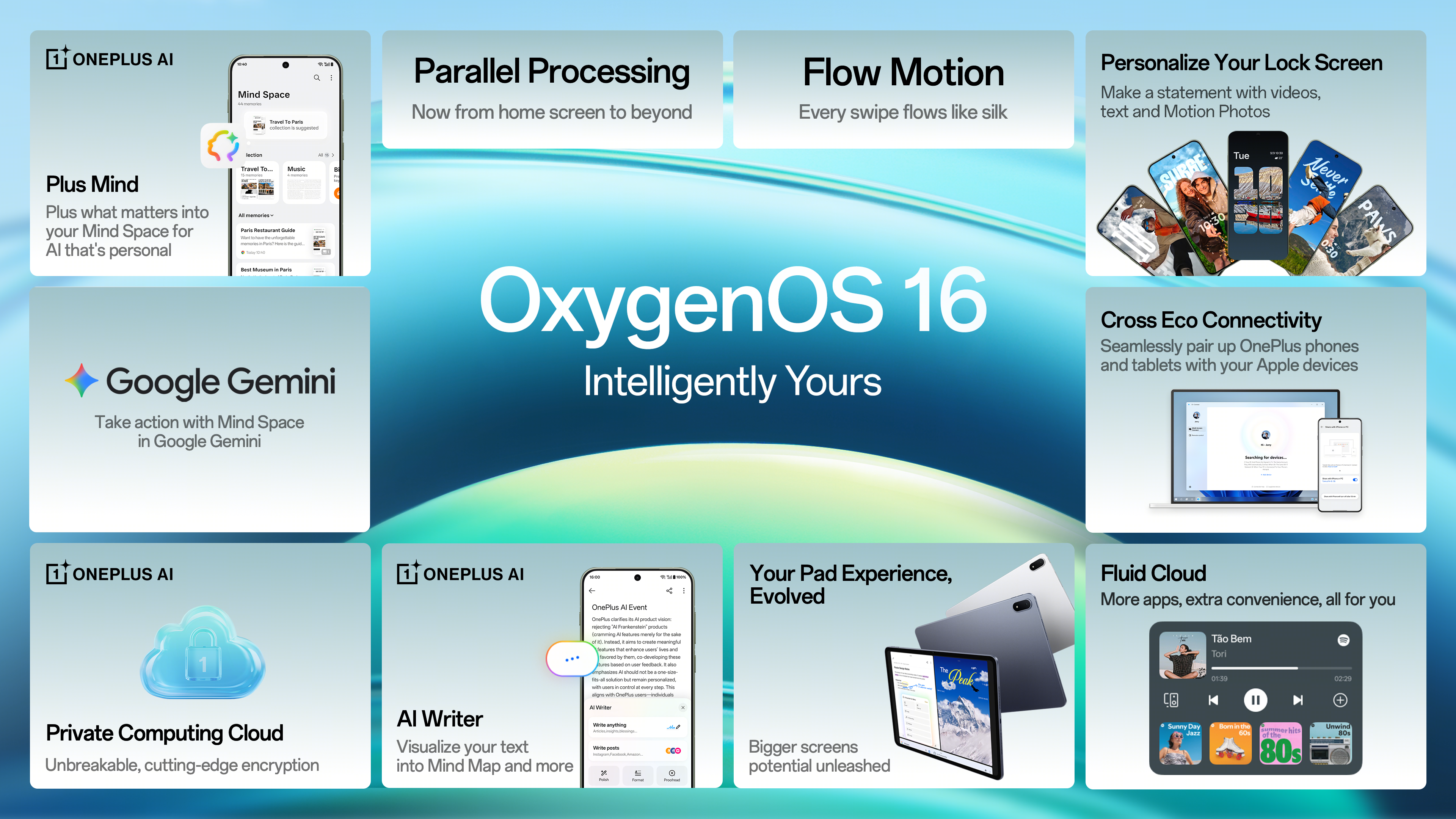
The centerpiece of OxygenOS 16 is a deeper integration between OnePlus’ “Mind Space” app and Google Gemini. Mind Space debuted alongside the Plus Key — the replacement for OnePlus’ classic Alert Slider — on some OnePlus 13 phones earlier this year. Like Nothing’s Essential Space, it captures screenshots and voice memos and automatically sorts them into folders you can refer to later. The big innovation of OxygenOS 16 is that you can now ask Gemini to refer to content in Mind Space to personalize responses. The idea being that the added context will make the AI assistant’s responses more helpful.

A bento box arrangement of new features being added in Oxygen OS 16, like Gemini integration with the Mind Space app and new lock screen customization options.
New features being introduced with OxygenOS 16.
OnePlus

OnePlus is also hopping on the AI writing and photo editing bandwagon. AI Writer in OxygenOS 16 can convert text into mind maps and tables with a few taps, and also generate social media captions based on a photo. The usual options for proofreading and summarizing text are also built-in. For photos, OnePlus is adding what it calls AI Portrait Glow to make faces visible even in poor lighting conditions and AI Perfect Shot, which appears to combine multiple photos to generate a single image where everyone’s eyes are open, like Google’s Best Take feature.

Beyond those AI-enabled features, OnePlus says it’s also improving customization options and animations across OxygenOS. With OxygenOS 16 you’ll be able to customize your lock screen with a variety different fonts and layouts, including the option to convert a still image into an animated GIF or use a video lock screen. On your home screen, OxygenOS 16 is also getting a collection of new widgets and the ability to scale app icons — another idea present in Nothing OS. Opening and moving between apps should also feel smoother thanks to new, speedier animations and an update to how the OS loads content. Essentially, with Parallel Processing 2.0, OxygenOS 16 “allows new animations to begin before previous actions complete,” which is supposed to make everything feel more fluid.

Those are just the highlights of OxygenOS 16, which also includes an expansion of the tablet multitasking system OnePlus uses on its OnePlus Pad tablets, and new connectivity options that let you mirror your phone screen to macOS or Windows computers.

OxygenOS 16 will be released alongside the OnePlus 15, which doesn’t have a release date, but is expected to launch this fall. The new OS update will also be available on recent OnePlus devices starting in November 2025, like the OnePlus 13, OnePlus Pad 3 and OnePlus Open. A full list of compatible devices is available on OnePlus’ website.

This article originally appeared on Engadget at https://www.engadget.com/oxygenos-16-has-new-lock-screen-customization-options-and-a-novel-gemini-integration-184958404.html?src=rss

Your AI Fitness Trainer Can Do More Harm Than Good

Did you know you can customize Google to filter out garbage? Take these steps for better search results, including adding my work at Lifehacker as a preferred source.


Want customized workout plans, real-time feedback, and 24/7 motivation, all without the cost of a human trainer? AI personal trainers sound like a perfect solution. Download an app, answer some questions about your goals and fitness level, and receive a personalized training program. I’ve tested some of these apps myself, and I definitely see the appeal. But more than anything, I see companies stuffing AI into apps where it doesn’t belong.

There’s Strava’s Athlete “Intelligence”; Garmin’s underwhelming Connect+ subscription; Whoop’s recovery recommendations, just to name a few. And as Lifehacker senior health editor Beth Skwarecki points out, people are increasingly asking ChatGPT for training advice, which is infuriating considering how many high-quality, free programs are already out there.

Medical professionals and trainers are increasingly noticing clients experiencing anxiety around optimization and performance, becoming discouraged when AI labels their efforts as inadequate. Think of how something like “closing your rings” on Apple Watch activity goals had a chokehold over the nation. Or Fitbit step counts, even when step goals are bullshit in the first place. When metrics don’t align with expectations, people feel like failures. And it’s not because they haven’t made progress, but because an algorithm told them so.

Blind trust and data obsession

Certified personal trainer Cara D’Orazio describes what she calls “digital guilt”—the anxiety that creeps in when you miss a workout notification or can’t keep up with your app’s demands. She recalls clients who arrived at her gym burnt out and demoralized, including one woman whose AI coach prescribed six consecutive training days without rest. The woman felt “lazy” for being sore—a natural physiological response her digital trainer couldn’t recognize or validate.

“People begin relying so much on the algorithm that they lose connection with how their body actually feels,” D’Orazio says. “A real coach can tell when your stress levels are high, when you didn’t sleep, or when you just need to talk for five minutes before starting. AI doesn’t do that. It only sees numbers—calories, steps, heart rate—not emotions, hormones, or mindset.” Movement should enhance your relationship with your body, not create anxiety around it.

This disconnection is particularly dangerous when you consider how deeply intertwined your fitness can be with your mental health. Marshall Weber, a certified personal trainer and owner of Jack City Fitness, has witnessed the psychological toll firsthand. “I have definitely seen folks get discouraged and even anxious when they rely too heavily on AI fitness enhanced tools,” he explains. “While it is great that these apps can track everything, they are lacking a bit on the balance and self compassion side of fitness.”

I know that when I’m in a vulnerable mental state, this lack of empathy can be devastating. As D’Orazio warns, “If we’re not careful, we’re going to see a whole new wave of people who are ‘fit’ on paper but emotionally exhausted and disconnected from their bodies.” The constant performance feedback is a recipe for an unhealthy fixation on fitness goals.

The human touch AI simply can’t replace

Outside of fitness, one of AI’s most significant limitations is its inability to read context. Adrian Kelly, a business and sports performance coach, emphasizes the risks here: “Exercise can be quite an emotional experience with highs and lows generated by meeting, or failing to meet, our own expectations.” He notes that traditional trainer-client relationships provide something AI cannot replicate: empathy, accountability, and trust built through genuine human connection. A skilled coach recognizes early warning signs of disordered eating, overtraining, or emotional distress. They celebrate non-scale victories, adjust plans when life gets complicated, and remind you that rest is productive.

“The healthiest results come from building trust, flexibility, and self-awareness—things a machine simply can’t measure,” D’Orazio says. “Movement should make you feel more human, not less.”

Dr. Ayesha Bryant, a clinical advisor at Alpas Wellness, warns about the unhealthy fixation on health data that AI systems encourage. “This heavy quantification of fitness can drive clients and patients to perfectionism or body dysmorphia tendencies, especially in vulnerable individuals,” Bryant says. The problem is compounded by all that blind trust in the algorithm, where users continue following AI recommendations even when experiencing pain, burnout, or clear signs they need rest or medical attention.

Even if someone is self-aware enough to override AI recommendations, there’s still the need for algorithmic validation. It’s all too easy to shift from intrinsic to extrinsic motivation, forgetting that the whole point of moving your body is because it feels good.

The bottom line: Find some balance

This isn’t to say AI fitness tools have no place in a healthy lifestyle. They can be useful for tracking data, setting reminders, or logging workouts. But they should complement—not replace—human guidance and your own body awareness.

Weber recommends that anyone training regularly “consider checking in with a PT of some sort just to make sure you are still being kind to yourself.” Bryant agrees, emphasizing that “long-term wellness and quality of life is driven by empathy, adaptability, and human connections.”

If the fitness industry’s AI revolution has arrived, we need to approach it with clear eyes. Your body is not a machine to be optimized. It’s a complex, intelligent system that deserves compassion, flexibility, and human understanding—things no algorithm can provide.


DirectTV Will Soon Show Your Face In AI-Generated TV Ads, Here’s How It Works

DirectTV Will Soon Show Your Face In AI-Generated TV Ads, Here’s How It Works
DirectTV will be partnering with Glance to deliver personalized ad experiences that are powered by AI. The companies are planning to leverage TVs that are idling, and replace the typical default artwork that is displayed in this mode with ads and other custom feeds.

This new feature will roll out to DirectTV customers who access the service

Battlefield 6 sold over 7 million copies in three days

EA has had quite the month, and the numbers tell its story. A few weeks ago, the company confirmed an agreement to go private in a $55 billion sale. And now we know that Battlefield 6 sold over 7 million copies in its first three days. The game also had over 172 million online matches played during the holiday weekend. On top of that, it logged 15 million hours watched on streaming services.

Battlefield 6‘s sales numbers make it the biggest opening yet for the franchise. By comparison, 2021’s Battlefield 2042 reportedly sold a relatively paltry 4.2 million copies in its first week.

The quotes in EA’s blog post read like awards ceremony acceptance speeches. “First and foremost, we want to thank our players,” franchise General Manager Byron Beede said. “We never take moments like this for granted, so I want to express our sincere gratitude to our global Battlefield Studios and passionate community that has helped get us to this point,” Executive VP Vince Zampella added.

The game’s launch came weeks after the company’s announcement that it will go private. The gaming giant will be owned by the Saudi Arabia Public Investment Fund (PIF), Silver Lake, and Affinity Partners. On Wednesday, unionized EA staffers spoke out against the acquisition, warning that “every time private equity or billionaire investors take a studio private, workers lose visibility, transparency and power.”

Battlefield 6 launched on October 10. It’s available for PC, PS5, and Xbox Series X/S. Its Season 1 content is just around the corner, arriving on October 28.

This article originally appeared on Engadget at https://www.engadget.com/gaming/battlefield-6-sold-over-7-million-copies-in-three-days-181826351.html?src=rss

Battlefield 6 Blitzes To 7 Million Units Sold On PC & Console With Steam As A Big Driver

Battlefield 6 Blitzes To 7 Million Units Sold On PC & Console With Steam As A Big Driver
Battlefield 6 has enjoyed a series-high reception in sales on PC, and reports now indicate that this has extended to consoles as well, with sales totaling over 7 million across platforms within just a week of its October 10th release. In fact, BF6 is outperforming every other premium game this year besides EA’s own FC 26. In the same first