A Minecraft theme park will open in London in 2027

The best-selling game of all time is moving from the virtual to the physical. Minecraft World, a permanent Greater London theme park based on the game, is scheduled to open in 2027. The announcement came during Minecraft Live 2026.

It will be a new section in Chessington World of Adventures, a theme park with a built-in zoo. The resort is a 35-minute train ride from London’s Waterloo station.

Details are still fairly light on the park. But we know it will include a roller coaster, “interactive adventures” and “epic block-built playscapes.” Torfi Frans Ólafsson, the game franchise’s creative director, said they’re aiming for “an experience that feels immersive, authentic and welcoming.” Naturally, that will include welcoming you to open your wallet in Minecraft-themed retail and dining spots.

The park is a collaboration between Mojang Studios and Merlin Entertainments, the world’s second-largest theme park builder. (A certain rodent-led empire is first.)

If visiting the full theme park in England isn’t your thing, the latest location of the game’s (also real-world) pop-up events will open in May. Minecraft Experience: Moonlight Trail will let visitors in Buenos Aires, Argentina, go on an hour-long outdoor nighttime adventure. As its name suggests, you’ll “walk a moonlit trail” through iconic Minecraft biomes. Along the way, you’ll craft gear, mine diamonds, battle mobs and “help restore an ancient beacon.” The event opens in May.

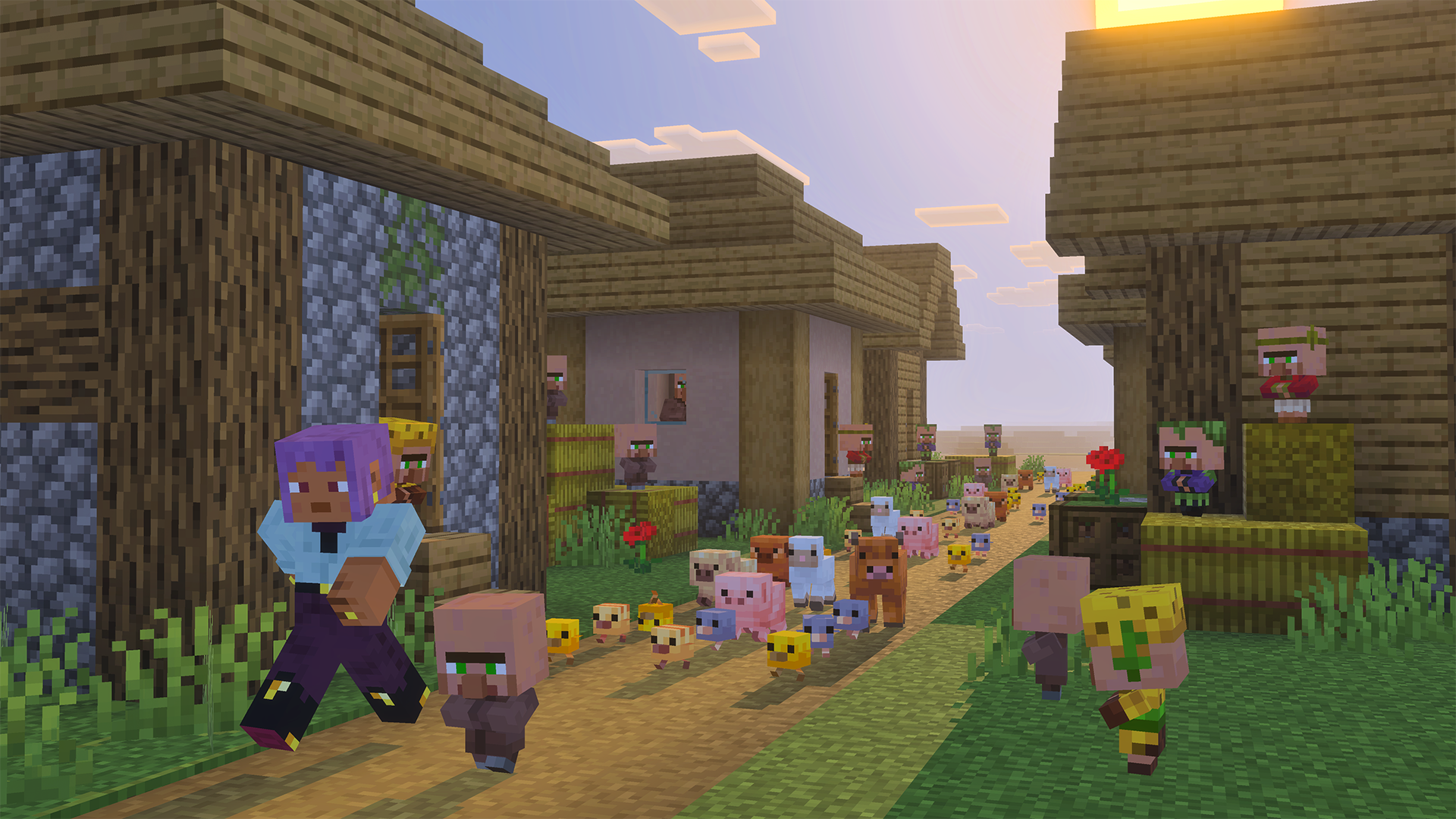
Screenshot from Minecraft. A character walks through a village, followed by a gaggle of babies of various species.
The game’s next big drop, Tiny Takeover, arrives on Tuesday.
Mojang Studios

Not all of Minecraft Live’s announcements were about real-world empire building. Minecraft, the game, is getting some updates, too. Its next big drop, Tiny Takeover, will live up to the billing with a redesigned “cuter” look for baby mobs. The update will also add a golden dandelion, which you can feed to a baby mob to make it stay young forever. (Or, at least until you feed it a second one.) Tiny Takeover arrives on March 24.

Mojang also teased the next drop after that. Later this year, Chaos Cubed will add a sulfur cube that changes properties when absorbing different materials. “There is a lot of variety in what the cube can do,” Mojang promises. “Just like there are balls with different ‘bounciness’ and behavior, the sulfur cube can have different physics.”

Finally, the long-rumored Minecraft Dungeons II game is official. We’re still extremely light on details about the sequel to the 2020 spinoff, aside from the fact that you can wishlist it on March 21.

This article originally appeared on Engadget at https://www.engadget.com/gaming/a-minecraft-theme-park-will-open-in-london-in-2027-173000917.html?src=rss

Firefox Announces Built-In VPN and Other New Features – and Introduces Its New Mascot

A free built-in VPN is coming to Firefox on Tuesday, Mozilla announced this week:

Free VPNs can sometimes mean sketchy arrangements that end up compromising your privacy, but ours is built from our data principles and commitment to be the world’s most trusted browser. It routes your browser traffic through a proxy to hide your IP address and location while you browse, giving you stronger privacy and protection online with no extra downloads. Users will have 50 gigabytes of data monthly in the U.S., France, Germany and U.K. to start. Available in Firefox 149 starting March 24.

We also recently shared that Firefox is the first browser to ship Sanitizer API, a new web security standard that blocks attacks before they reach you [for untrusted HTML XSS vulnerabilities].

“The roadmap for Firefox this year is the most exciting one we’ve developed in quite a while,” says Firefox head Ajit Varma. “We’re improving the fundamentals like speed and performance. We’re also launching innovative new open standards in Gecko to ensure the future of the web is open, diverse, and not controlled by a single engine.

“At the same time we’re prioritizing features that give users real power, choice and strong privacy protections, built in a way that only Firefox can. And as always, we’ll keep listening, inviting users to help shape what comes next and giving them more reasons to love Firefox.”

Two new features coming next week:

Split View puts two webpages side by side in one window, making it easy to compare, copy and multitask without bouncing between tabs. Rolling out in Firefox 149 on March 24.
Tab Notes let you add notes to any tab, another tool to help with multitasking and picking up where you left off. Available in Firefox Labs 149 starting March 24.
And Firefox also released a video this week introducing their new mascot Kit.


Read more of this story at Slashdot.

OpenAI reportedly plans to double its workforce to 8,000 employees

While other tech companies have been laying off employees year after year, OpenAI is doing the opposite. According to a report from the Financial Times, the AI giant is looking to expand its workforce to 8,000 employees by the end of 2026, nearly doubling staff from its current headcount of 4,500.

The FT reported that the new hires will be across several departments, including product development, engineering, research and sales. OpenAI’s hiring spree will also include “specialists” for “technical ambassadorship,” or employees tasked with helping businesses better utilize its AI tools, according to the report. As the FT noted, OpenAI is likely trying to amp up the competition against Anthropic and its Claude AI chatbot. According to the AI Index from Ramp, a fintech startup that manages corporate expenses, businesses are now 70 percent more likely to go with Anthropic when buying AI services for the first time as opposed to OpenAI.

OpenAI made waves in February when it announced a contract with the Department of Defense to use its AI models, following a public fallout between Anthropic and the federal agency. On top of the government contract, OpenAI is also in “advanced talks” with private equity firms like Brookfield Asset Management to deploy its AI tools across a firms’ portfolio of companies, according to Reuters.

This article originally appeared on Engadget at https://www.engadget.com/ai/openai-reportedly-plans-to-double-its-workforce-to-8000-employees-161028377.html?src=rss

Intel says Crimson Desert devs ignored offers of help to support Arc GPUs

It doesn’t sound like Crimson Desert, the recently released prequel to Black Desert Online, will support Intel Arc GPUs anytime soon, if at all. On the game’s FAQ page, its developer Pearl Abyss advised players expecting Arc support to apply for a refund. “If you purchased the game expecting Intel Arc support, please refer to the refund policy of the platform where the game was purchased for available options,” the company wrote. Apparently, though, it’s not from lack of guidance from Intel. The chipmaker told Wccftech that it reached out to Pearl Abyss “many times” over the past several years.

The Intel spokesperson said that the company has tried to help the developer “test, validate, and optimize support for Intel graphics” for years. Intel also tried to provide the developer “early hardware, drivers, and engineering resources” across several generations of GPUs, “including Alchemist, Battlemage, Meteor Lake, and Lunar Lake.” The chipmaker said it’s “hugely disappointed that players using Intel graphics hardware” can’t play the game, but that it remains “ready to assist Pearl Abyss” however it can. It also advised players to reach out directly to the developer for “details on the choice not to enable Intel support at launch.”

Pearl Abyss, of course, doesn’t have the obligation to tweak the game so that it runs on PCs with Intel Arc GPUs. The good news is that since the title came out just a few days ago, it will still be easy to get a refund. Steam, where Crimson Desert is now one of the top-selling games, issues refunds within two weeks of purchase.

This article originally appeared on Engadget at https://www.engadget.com/gaming/pc/intel-says-crimson-desert-devs-ignored-offers-of-help-to-support-arc-gpus-155514896.html?src=rss

SystemD Adds Optional ‘birthDate’ Field for Age Verification to JSON User Records

“The systemd project merged a pull request adding a new birthDate field to the JSON user records managed by userdb in response to the age verification laws of California, Colorado, and Brazil,” reports the blog It’s FOSS.

They note that the field “can only be set by administrators, not by users themselves” — it’s the same record that already holds metadata like realName, emailAddress, and location:

Lennart Poettering, the creator of systemd, has clarified that this change is “an optional field in the userdb JSON object. It’s not a policy engine, not an API for apps. We just define the field, so that it’s standardized iff people want to store the date there, but it’s entirely optional. ”

In simple words, this is something that adds a new, optional field that can then be used by other open source projects like xdg-desktop-portal to build age verification compliance on top of, without systemd itself doing anything with the data or making it mandatory to provide. A merge request asking for this change to be repealed was struck down by Lennart, who gave the above-mentioned reasoning behind this, and further noted that people were misunderstanding what systemd is trying to do here.
“It enforces zero policy,” Poettering said. “It leaves that up for other parts of the system.”


Read more of this story at Slashdot.

DNA building blocks on asteroid Ryugu, bacteria that eat plastic waste, and more science news

Remember when Japan sent a spacecraft to an asteroid 180 million miles away to scoop some dirt off the surface? Six years on from its arrival to Earth, that sample has yielded some insights about what may have seeded life on our planet. Read on to learn more about the latest findings, and other science news we found interesting this week.  

DNA ingredients on Ryugu

In 2020, a capsule from the Japanese space probe Hayabusa2 returned to Earth with samples collected from the surface of asteroid Ryugu, and scientists have spent the subsequent years analyzing those materials for clues about the conditions that existed in the early solar system. This week, researchers from Japan reported an exciting discovery: the Ryugu samples contain the five building blocks of DNA and RNA. The findings, coupled with those from other recent studies, could put us closer to understanding how the ingredients for life first made it to Earth billions of years ago. 

The study, published in the journal Nature Astronomy, found the nucleobases adenine, guanine, cytosine, thymine and uracil — all of which were also found in samples gathered from a different asteroid, Bennu, last year, and before that in meteorites dubbed Murchison and Orgueil. This suggests these nucleobases were widespread in the early solar system, and supports the hypothesis that carbonaceous asteroids like Ryugu and Bennu transported them to Earth, the authors explain in the paper. Ammonia was discovered in the samples as well, which may play a role in how these nucleobases formed. 

The discovery of these building blocks “does not mean that life existed on Ryugu,” Toshiki Koga, the study’s lead author from the Japan Agency for Marine-Earth Science and Technology, told AFP. “Instead, their presence indicates that primitive asteroids could produce and preserve molecules that are important for the chemistry related to the origin of life.”

Bacteria collaborate to eat plastic waste

Researchers in Germany have identified a trio of bacteria that can digest a common plastic additive, but only when working together. The study published in the journal Frontiers in Microbiology found that a “consortium” of bacterial strains (two from species in the genus Pseudomonas and one from Microbacterium) was able to break down several phthalate esters (PAEs), which are often used to make plastic materials more flexible. These chemicals are increasingly finding their way into the environment as plastic pollution grows, and research suggests they can have harmful effects on human health and that of wildlife. 

The team focused on microbes that could be found right at home in their own lab, taking a sample of biofilm that had formed on the polyurethane tubing of a bioreactor. This sample was then incubated in a growth medium containing the PAE diethyl phthalate (DEP) as the main source of carbon and energy. They eventually ended up with a stable culture of bacteria that could break down DEP, as long as the DEP concentration didn’t exceed 888 milligrams per liter, according to a press release. The consortium could gobble up all the DEP in 24 hours at 30 degrees C. It was also able to grow on the PAEs dimethyl phthalate, dipropyl phthalate and dibutyl phthalate.

The researchers identified the bacteria in the consortium through DNA sequencing, but found that they were not individually able to tackle the PAEs, suggesting they break down the chemicals through a “cooperative process” known as cross-feeding. The consortium could make for another tool in the pollution-fighting toolbox, with potential to help break down PAEs in contaminated areas or speed up the degradation of plastics that contain PAEs by making them more brittle. “This approach may also be effective in treating industrial plastic waste streams,” they note. 

Hubble witnesses a breakup

Newly released images from the Hubble Space Telescope show the unexpected breakup of Comet C/2025 K1 (ATLAS) — Comet K1, for short — as it made its way out of the solar system back in November. A team of researchers that initially set out to observe a different comet ended up switching targets due to technical issues, only to catch Comet K1 right after it started crumbling. Hubble captured three 20-second images between November 8 and November 10 2025, the first of which the team estimates was about eight days after the fragmenting started. During the observation period, one of the comet’s smaller pieces began to break up too. Talk about being in the right place at the right time.

“Never before has Hubble caught a fragmenting comet this close to when it actually fell apart,” said John Noonan, a research professor in the Department of Physics at Auburn University, in a statement. “Most of the time, it’s a few weeks to a month later. And in this case, we were able to see it just days after.” You can read more about the rare sighting here. 


Before you go, be sure to check these stories out too:

This article originally appeared on Engadget at https://www.engadget.com/science/dna-building-blocks-on-asteroid-ryugu-bacteria-that-eat-plastic-waste-and-more-science-news-150000975.html?src=rss

Jeff Bezos Seeking $100 Billion to Buy Manufacturing Companies, ‘Transform’ Them With AI

Jeff Bezos “is in early talks to raise $100 billion,” reports the Wall Street Journal, “for a new fund that would buy up manufacturing companies and seek to use AI technology to accelerate their path to automation.”

“The Amazon.com founder is meeting with some of the world’s largest asset managers to raise funding for the project.”

A few months ago, [Bezos] traveled to the Middle East to discuss the new fund with sovereign wealth representatives in the region. More recently, he went to Singapore to raise funding for the effort as well, according to people familiar with the matter. The fund, described in investor documents as a “manufacturing transformation vehicle,” is aiming to buy companies in major industrial sectors such as chipmaking, defense and aerospace…

Bezos was recently appointed co-CEO of Project Prometheus, a new startup that is building artificial-intelligence models that can understand and simulate the physical world. Bezos plans to use the company’s technology to boost the efficiency and profitability of businesses owned by the fund, a playbook that some investment firms are similarly deploying in sectors such as accounting and property management… [Prometheus has also hired employees from OpenAI and Google DeepMind, the article points out.]

While much of the AI revolution has been focused on large language models, billions of dollars have begun to flow to companies that are seeking to apply spatially focused AI systems toward industries including robotics and manufacturing… Amazon, one of [America’s] largest employers, has closed in on the milestone of having as many robots as humans.


Read more of this story at Slashdot.

Twitter turned 20 and I feel nothing

Twitter is officially 20 years old. In another reality, that might make me kind of nostalgic. I’ve been lurking and scrolling and tweeting for 16 years; most of my adult life. There was a time when Twitter was a place where some internet strangers became my IRL friends, when I was excited to “live-tweet”. When my infinitely more well-adjusted friends would send me memes, I would smugly say “I saw that on Twitter days ago.”

Twitter stopped being that place a long time ago, but I don’t have any nostalgia for it. I don’t really feel anything at all, actually. 

Because I can already hear the comments: Yes, I’m still on X. I don’t spend as much time there as I did a decade ago, but it’s still quite a lot of time, an unhealthy amount, if I’m being honest. My job is to report on social media companies, so I keep (doom)scrolling. That’s what I tell myself anyway.

A few of my favorite posters are still around. Dril’s still got it. The memes are still, occasionally, good, even though X’s recommendation algorithm seems to prefer pointing me toward endless AI slop, boring hot takes from thirsty mid-tier tech execs and blatant engagement bait. X’s algorithm — what little we can learn about it, anyway — now relies on Grok’s predictions about what you’ll like.The same Holocaust-loving Grok that has spewed racism and referred to itself as MechaHitler and declared Elon Musk “the single greatest person in modern history.” The same Grok that allegedly generated thousands of images of child abuse material. Hey @grok is that true? 

X is not Twitter but it’s also not not-Twitter. Last year, an online marketplace startup bought the 560-pound Twitter bird that once adorned the company’s San Francisco office and blew it up in a Nevada desert surrounded by Tesla CyberTrucks as part of an elaborate publicity stunt. Dumb? Yes. But also a somehow fitting adieu for “Larry.”

just setting up my twttr

— jack (@jack) March 21, 2006

It’s been 20 years since Jack Dorsey sent the first-ever tweet, which was never even a good tweet anyway. It’s been five years, by the way, since he turned that tweet into an NFT (remember NFTs??) and auctioned it for nearly $3 million. It’s now functionally worthless. Another chapter in Dorsey’s confusing, complicated legacy.

This article originally appeared on Engadget at https://www.engadget.com/social-media/twitter-turned-20-and-i-feel-nothing-140000602.html?src=rss

Apple’s $599 MacBook Neo Smashes Records: Best Launch Week Ever For New Mac Users

Apple’s $599 MacBook Neo Smashes Records: Best Launch Week Ever For New Mac Users
Apple’s colorful and budget-conscious MacBook Neo is bringing in new users to the Mac ecosystem in record numbers, with CEO Tim Cook announcing on X that “Mac just had its best week launch week ever for first-time Mac customers.” And it’s no secret why—the $599 starting price makes the MacBook Neo the most affordable MacBook ever released.

Sure,

Tired Of Windows 11 Bloat? Microsoft Pledges Massive Cleanup For Peak Performance

Tired Of Windows 11 Bloat? Microsoft Pledges Massive Cleanup For Peak Performance
Microsoft is taking criticisms over the direction of Windows 11 to heart and vowing to make several key changes going forward, including fewer AI distractions as it rethinks its strategy.

In a blog post to Windows Insiders, Pavan Davuluri, Executive Vice President of Microsoft’s Windows + Devices division, outlined the development plan

AMD’s Secret Ryzen 9 9950X3D2 Dual 3D V-Cache CPU Is Real According To ASRock

AMD's Secret Ryzen 9 9950X3D2 Dual 3D V-Cache CPU Is Real According To ASRock
There is plenty of reason to believe that AMD is getting ready to add a Ryzen 9 9950X3D2 processor to its lineup, and perhaps the most telling evidence yet is a press release by ASRock that shouts out the not-yet-released chip. According to ASRock, several of its socket AM5 motherboards “fully support the newly launched AMD Ryzen 9 9950X3D2.”

The

Engadget review recap: Lots of Apple devices, Galaxy S26, Dell XPS 16 and more

Apple already announced a lot of new devices in 2026 and we’ve been busy reviewing them all. In this installment of our bi-weekly roundup, we revisit the MacBook Neo, iPhone 17e and more, in addition to the “regular” Galaxy S26 and Dell XPS 16. There’s even more than those gadget to catch up on, so sit back, relax and cozy up to some fresh reviews.

Apple MacBook Neo

The main attraction for Apple’s early device deluge was the $599 MacBook Neo. The company is finally giving us something we’ve been begging for: a low-cost Mac laptop that’s good enough for most people. “It’s a $599 computer that can handle basic workloads just fine, all the while looking like one of the company’s more expensive notebooks,” senior reporter Devindra Hardawar said. “Most importantly, it delivers more speed, a brighter screen and an overall better user experience than any competing $600 Windows PC.”

Apple iPhone 17e

The MacBook Neo wasn’t the only affordable device Apple announced recently. The company also debuted the iPhone 17e, which is also $599 and offers an economical choice for iOS devotees. “The name “iPhone” carries its own premium, and the iPhone 17e is a solid entry-level handset for those who need a basic, no-frills path into the Apple ecosystem,” managing editor Cherlynn Low said.

The rest of the new Apple gear

The remainder of the new Apple devices were primarily chip upgrades. The company added the M4 to the iPad Air, which deputy editor Nathan Ingraham still argues is the best Apple tablet overall. Apple also put the M5 chip inside the MacBook Air and the M5 Pro and M5 Max silicon in the MacBook Pro,. Our staff maintains that those two laptops are among the best choices in their respective categories.

We also tested Apple’s claims on the Studio Display XDR, where we discovered the high price could be worth it for pros who need supreme color accuracy and high brightness.

Samsung Galaxy S26

The Galaxy S26 Ultra may get the bulk of the attention in Samsung’s 2026 lineup thus far, but the “regular” S26 is capable in its own right. However, it’s time for bigger updates on this model. “There’s nothing wrong with this safe, solid Android phone, but you could pick up last year’s S25 and get an experience that’s 99 percent the same for $99 less,” UK bureau chief Mat Smith said.

Dell XPS 16 (2026)

Dell pulled a 180 after nixing its XPS brand last year. Enter the XPS 16. Thankfully, the first devices after the fiasco show an expected return to form, albeit with one issue. “My one complaint is that I wish Dell would bring back the chiclet-style keyboards we got on models from the early 2020s,” senior reporter Sam Rutherford said. “Though as long as the company can release updated software to fix the ghosting issues I’ve encountered, what’s on there now is more than good enough.”

But wait, there’s more

If portable projectors are more your speed, contributing reporter Steve Dent put the Soundcore Nebula P1i through its paces. Mat also spent some time with the Nothing Phone 4a Pro, which is undoubtedly the most uniquely designed handset we’ve tested this year. Lastly, Sam used an upgraded version of Belkin’s Switch 2 charging case to keep his gaming handheld safe and topped up in transit.

This article originally appeared on Engadget at https://www.engadget.com/engadget-review-recap-lots-of-apple-devices-galaxy-s26-dell-xps-16-and-more-120000820.html?src=rss

A retro Starship Troopers shooter, a video store sim and other new indie games worth checking out

Welcome to our latest roundup of what’s going on in the indie game space. There are a whole bunch of neat new games out this week, as well as updates on some interesting upcoming projects.

In case you missed it, the Steam Spring Sale is under way. There are lots of solid deals here, and my credit card is already screaming at me. I’ve picked up a bunch of games from my wishlist. For instance, at just $3, I couldn’t resist snagging Teenage Mutant Ninja Turtles: Splintered Fate.

Meanwhile, over on Bluesky, a prototype from developer Freya Holmér caught my eye. It’s for a falling-block game, but instead of filling a container to create straight lines that disappear, it’s based around a pivot point. As tetrominos join the mass, it rotates left or right by 90 degrees, adding a new dimension to a well-established format. I’m really hoping Holmér turns this into a full game, as it’s a rad concept.

New releases

Given all the bug slaughtering and the jingoistic satire, any Starship Troopers project is going to draw comparisons with Helldivers 2. Fortunately, Starship Troopers: Ultimate Bug War! is entirely its own thing.

This is a retro first-person shooter from Auroch Digital (the studio behind Warhammer 40,000: Boltgun) and publisher Dotemu. The framing of the game is quite meta: it’s based on the experiences of Major Samantha Dietz, who was on the frontlines against the bugs, and it’s effectively being used as a military recruitment tool. 

Starship Troopers: Ultimate Bug War! is a blast. I thoroughly enjoyed my time with it. Not that I needed one, but it gave me an excuse to watch Paul Verhoeven’s original film again since the game (while having an original story) hits some of the same beats.

The tone is spot on. The writing in the cutscenes, in which Casper Van Dien reprises his role as Johnny Rico from the movies, is funny. You can’t tell me that it isn’t a thrill to blow up a giant bug with a tactical nuke. Plus, I was tickled by the consequences of “accidentally” shooting a fellow soldier in the training base and all hell breaking loose.

Alas, the pacing feels off — there’s a bit too much space between objectives in some levels — and it’s a little one-note. Still, it only takes around four or five hours to beat, particularly if you don’t care about hunting for secrets.

Starship Troopers: Ultimate Bug War! is out now on Steam, PS5, Xbox Series X/S and Nintendo Switch 2. It’ll usually cost $25, but there’s a 20 percent discount until March 24.

Retro Rewind is a solid name for a video store rental sim. You’ll manage a store in the early ’90s — the heyday of VHS — by doing everything from decorating the place, filling shelves with tapes and buying bootleg films to hiring staff, making recommendations to customers and collecting late fees.

My first job was behind the counter of a convenience store that had a small movie rental section, so I’ve got a tiny bit of experience with calling up customers who have overdue films. That part of the job wasn’t exactly fun, but like the idea of running an entire rental store, an experience that’s sadly almost extinct.

Retro Rewind – Video Store Simulator is available on Steam (normally $20, with a 20 percent discount until March 24). You can try it out by playing a demo. 

In Their Shoes looks like an intriguing spin on the visual novel. From We Are Muesli, this is billed as a mumblecore narrative vein, indicating that it’s influenced by films from that subgenre (such as the works of the Duplass brothers, Lynn Shelton and, especially in the early part of her career, Greta Gerwig). Through a few dozen interactive scenes, it follows the intertwined lives and intimate moments of seven people in Milan. Each of these dialogue-focused segments lasts around five minutes. There are timed choices and you can arrange the scenes into a timeline. 

You can pick up In Their Shoes on Steam now. The full price is $13, but there’s a 25 percent discount until March 31.

For this week’s dog game, here is World’s Goodest Pup. It’s another pooch-based roguelike deckbuilder. This time around, you’ll be trying to succeed in the realm of competitive dog shows. After selecting a dog from among three breeds, you’ll start building a deck of accessories, tricks and poses and combine them in strategic ways to be most effective in competitions and challenges, which are procedurally generated. 

This is a cozy game first and foremost, though. You can spoil puppers in a pet resort that you’ll build and treat them with a visit to a dog spa. Cute.

World’s Goodest Pup  — from Pandamander — is out on Steam (normally $7, with 10 percent off until March 26). You can try it out via a demo.

The release trailer for Bonnie Bear Saves Frogtime made me chuckle, so I had to include it. The latest project from Bonte Avond (the team behind Once Upon A Jester) is a comedy adventure game.

As Bonnie Bear, a bear in a frog onesie, you set out to defeat a local bully in a tactical frog-battling game called Frogtime. As with many real-life trading card games, you’ll buy and collect frogs to build a strong army. Most importantly, it seems to be a game about the power of community, friendship and self-worth.

Bonnie Bear Saves Frogtime is out now on Steam and Nintendo Switch for $17.

Upcoming 

Gunbrella studio Doinksoft is back with another game that has a fantastic name. It’s a roguelite, side-scrolling action platformer with shoot-em’-up elements. And it’s called Dark Scrolls. It’s such a good title that I’m almost mad I didn’t think of it first.

There’ll be nine heroes to choose from, including a pup named Biscuit and a rat with a saxophone. The game features procedurally generated runs with branching paths, and there’s multiplayer support for two-player online co-op. I’m into the Master System-era art style and the utter chaos shown in the trailer. 

The Devolver Digital-published Dark Scrolls (still not over that name) is coming to Steam and Switch later this year.

If you think about it, Scrabble is already a roguelike strategy game. Beyond Words takes that a bit further, with tiles that shift and explode, and boards that change up the rules. Much like in Balatro, you’ll be modifying, destroying and duplicating tiles as you seek powerful synergies and massive score multipliers. There are more than 300 modifiers and abilities, along with boss battles and optional time-based challenge boards.

What makes Beyond Words particularly interesting is that it’s from Steve Ellis and Dr David Doak — who made their names at Rare and Free Radical Design with the likes of GoldenEye 007, Perfect Dark and TimeSplitters — and their small team at MindFuel Games. PQube is the publisher of Beyond Words, which will hit Steam, PlayStation 5, Xbox Series X/S and Nintendo Switch on April 9. A demo is available on Steam now.

We’ve learned about a bunch of upcoming music rhythm games lately, and here’s another one from Guitar Hero, Rock Band and DJ Hero veterans. Echo Foundry Interactive seems to be hoping that the community-driven focus will help Sound System stand out.

When it goes into early access on Steam (October 16, $25), Sound System will have local multiplayer support. Echo Foundry Interactive plans to add online multiplayer with co-op and competitive modes. Players will be able to create charts for any song they like too. 

We’ve had a dog game (or two) and a frog game. Now it’s time to wrap things up with a cat game. In Cat Me If You Can — great title, again — the Earth has frozen and lost its color. Only cats remain. By time-travelling and taking photos of them, you’ll gradually restore color to the world.

It’s a hidden cat puzzle game from Cosmic Stag Games that’s coming to PC, Switch and Xbox in the summer. You’ll be able to check out a demo on Steam on April 8.

This article originally appeared on Engadget at https://www.engadget.com/gaming/a-retro-starship-troopers-shooter-a-video-store-sim-and-other-new-indie-games-worth-checking-out-113000133.html?src=rss

We keep finding the raw material of DNA in asteroids—what’s it telling us?

On Monday, a paper announcing that all four DNA bases had been found on an asteroid sparked a lot of headlines. But many of the headlines omitted a key word needed to put the discovery in context: “again.” The paper itself cited similar results dating back to 2011, and the ensuing years have seen various confirmations and more rigorous studies. The new work was less notable for showing that we had found these bases in Ryugu than for solving a previous mystery: earlier studies had failed to detect them there, despite their presence in many other asteroid samples.

Outside the headlines, though, the new work provides some interesting details, as it may answer an important question: how these bases got there in the first place. Understanding that better may be critical for getting a better picture of how the raw materials for life ended up on Earth in the first place.

Searching for bases

Let’s start with a description of what the researchers found. Both DNA and RNA, the two nucleic acids used by life, share a similar structure. That includes the backbone, a chain that alternates between sugars and phosphates that are all chemically linked together. While the specific sugar differs between DNA and RNA, the chain itself varies only in length; otherwise, the backbone of every DNA or RNA molecule is identical.

Read full article

Comments

NASA’s Hubble Unexpectedly Catches Comet Breaking Up

NASA’s Hubble Space Telescope unexpectedly captured a rare, early-stage breakup of comet C/2025 K1 (ATLAS) just days after it first began disintegrating. Phys.org reports: “Sometimes the best science happens by accident,” said co-investigator John Noonan, a research professor in the Department of Physics at Auburn University in Alabama. “This comet got observed because our original comet was not viewable due to some new technical constraints after we won our proposal. We had to find a new target — and right when we observed it, it happened to break apart, which is the slimmest of slim chances.”

Noonan didn’t know K1 was fragmenting until he viewed the images the day after Hubble took them. “While I was taking an initial look at the data, I saw that there were four comets in those images when we only proposed to look at one,” said Noonan. “So we knew this was something really, really special.” Hubble caught K1 fragmenting into at least four pieces, each with a distinct coma, the fuzzy envelope of gas and dust that surrounds a comet’s icy nucleus. Hubble cleanly resolved the fragments, but to ground-based telescopes, at the time they only appeared as barely distinguishable, bright blobs. […]

“Never before has Hubble caught a fragmenting comet this close to when it actually fell apart. Most of the time, it’s a few weeks to a month later. And in this case, we were able to see it just days after,” said Noonan. “This is telling us something very important about the physics of what’s happening at the comet’s surface. We may be seeing the timescale it takes to form a substantial dust layer that can then be ejected by the gas.” The findings have been published in the journal Icarus.


Read more of this story at Slashdot.

DOGE goes nuclear: How trump invited silicon valley into America’s nuclear power regulator

Last summer, a group of officials from the Department of Energy gathered at the Idaho National Laboratory, a sprawling 890-square-mile complex in the eastern desert of Idaho where the US government built its first rudimentary nuclear power plant in 1951 and continues to test cutting-edge technology.

On the agenda that day: the future of nuclear energy in the Trump era. The meeting was convened by 31-year-old lawyer Seth Cohen. Just five years out of law school, Cohen brought no significant experience in nuclear law or policy; he had just entered government through Elon Musk’s Department of Government Efficiency team.

As Cohen led the group through a technical conversation about licensing nuclear reactor designs, he repeatedly downplayed health and safety concerns. When staff brought up the topic of radiation exposure from nuclear test sites, Cohen broke in.

Read full article

Comments

Officer Leaks Location of French Aircraft Carrier With Strava Run

schwit1 shares a report from the BBC: A French officer has reportedly revealed the location of an aircraft carrier deployed towards the Middle East after publicly registering a run on sports app Strava. French news outlet Le Monde first reported the officer, referred to as Arthur, logged a 35-minute run on the app while exercising on the deck of aircraft carrier Charles de Gaulle on 13 March. He used a smartwatch to record his run and upload the activity to the app, the paper said, creating a map that showed his location. […] The location of the vessel was said by Le Monde to have been northwest of Cyprus, around 100km (62 miles) from the Turkish coast, with satellite images capturing the carrier and its escort. A representative from the French Armed Forces said the officer’s behavior “does not comply with current guidelines,” which “sailors are regularly made aware of.”


Read more of this story at Slashdot.

White House Unveils National AI Policy Framework To Limit State Power

An anonymous reader quotes a report from CNBC: The Trump administration on Friday issued (PDF) a legislative framework for a single national policy on artificial intelligence, aiming to create uniform safety and security guardrails around the nascent technology while preempting states from enacting their own AI rules.
The six-pronged outline broadly proposes a slew of regulations on AI products and infrastructure, ranging from implementing new child-safety rules to standardizing the permitting and energy use of AI data centers. It also calls on Congress to address thorny issues surrounding intellectual-property rights and craft rules “preventing AI systems from being used to silence or censor lawful political expression or dissent.”

The administration said in an official release that it wants to work with Congress “in the coming months” to convert its framework into a bill that President Donald Trump can sign. The White House wants to codify the framework into law “this year” and believes it can generate bipartisan support, Michael Kratsios, director of the White House Office of Science and Technology Policy, said in an interview with Fox News on Thursday evening. That won’t be easy in a deeply divided Congress where Republicans hold thin and often fractious majorities, and where Trump has already urged GOP lawmakers to prioritize his controversial voter-ID bill above all else ahead of the November midterms. BCLP has an interactive map that tracks the proposed, failed and enacted AI regulatory bills from each state.


Read more of this story at Slashdot.

Elon Musk misled investors during his Twitter takeover, jury finds

A group of former Twitter investors have prevailed at a federal civil trial over Elon Musk’s actions amid his $44 billion acquisition of the social platform in 2022. A jury in San Francisco found Friday that tweets made by Musk about fake accounts on the platform had defrauded investors in the company. The jury sided with Musk on other allegations in the case. 

It’s not yet clear how much Musk will owe in damages as a result of the case but, as the Associated Press reports, it could amount to billions of dollars. Jurors calculated that shareholders should get “between about $3 and $8 per stock per day.” 

The class action lawsuit, one of several brought against Musk in the months following his takeover of the company, cited Musk’s tweets about fake accounts on the platform. Facing a sinking Tesla share price in the days after announcing he would buy Twitter for $54.20 a share, the suit said Musk made tweets and statements that were intentionally meant to drive down Twitter’s share price in an attempt to renegotiate or exit the deal. 

The suit called out Musk’s May 13, 2022, tweet that claimed the Twitter deal was “temporarily on hold” due to the number of fake accounts and bots on the platform, as well as one a few days later that suggested fake accounts might account for more than 20 percent of users. Twitter’s stock dropped significantly following the May 13 tweet.

During the trial, Musk said the tweets were him “speaking his mind” and maintained that Twitter executives had “lied” about the number of bots on the platform, according to KQED. Former Twitter shareholders, on the other hand, said “they sold shares at deflated prices amid Musk’s public waffling.” 

Musk faced several lawsuits during and after his $44 billion takeover of the company. That includes other shareholder lawsuits related to his delay in disclosing his stake in the company, as well as one from former executives related to unpaid severance benefits (Musk later settled those claims). He also narrowly avoided a trial over his attempts to back out of the deal. 

This article originally appeared on Engadget at https://www.engadget.com/social-media/elon-musk-misled-investors-during-his-twitter-takeover-jury-finds-232033028.html?src=rss

CBS News Shutters Radio Service After Nearly a Century

CBS News is shutting down its nearly 100-year-old radio news service due to economic pressures and the shift toward digital media and podcasts. Longtime CBS News anchor Dan Rather said: “It’s another piece of America that is gone.” The Associated Press reports: When it went on the air in September 1927, the service was the precursor to the entire network, giving a youthful William S. Paley a start in the business. Famed broadcaster Edward R. Murrow’s rooftop reports during the Nazi bombing of London during World War II kept Americans listening anxiously. Today, CBS News Radio provides material to an estimated 700 stations across the country and is known best for its top-of-the-hour news roundups. The service will end on May 22, the network said Friday.

“Radio is woven into the fabric of CBS News and that’s always going to be part of our history,” CBS News editor-in-chief Bari Weiss said in delivering the news to the staff. “I want you to know that we did everything we could, including before I joined the company, to try and find a viable solution to sustain the radio operation.” But with the radical changes in the media industry, she said, “we just could not find a way to make that possible.”

It was unclear how many people will lose their jobs because of the radio shutdown. CBS News was cutting about 6% of its workforce, or more than 60 people, on Friday. It’s not the end of turmoil at the network, as parent company Paramount Global is likely to absorb CNN as part of its announced purchase of Warner Bros. Discovery.


Read more of this story at Slashdot.