NASA’s next Moonship reaches last stop before launch pad

The Orion spacecraft, which will fly four people around the Moon, arrived inside the cavernous Vehicle Assembly Building at NASA’s Kennedy Space Center in Florida late Thursday night, ready to be stacked on top of its rocket for launch early next year.

The late-night transfer covered about 6 miles (10 kilometers) from one facility to another at the Florida spaceport. NASA and its contractors are continuing preparations for the Artemis II mission after the White House approved the program as an exception to work through the ongoing government shutdown, which began on October 1.

The sustained work could set up Artemis II for a launch opportunity as soon as February 5 of next year. Astronauts Reid Wiseman, Victor Glover, Christina Koch, and Jeremy Hansen will be the first humans to fly on the Orion spacecraft, a vehicle that has been in development for nearly two decades. The Artemis II crew will make history on their 10-day flight by becoming the first people to travel to the vicinity of the Moon since 1972.

Read full article

Comments

New York Bans AI-Enabled Rent Price Fixing

New York Gov. Kathy Hochul has signed into law legislation banning the use of price-fixing software by landlords to set rental rates. From a report: New York is the first state to outlaw algorithmic pricing by landlords, following a number of city-wide bans in Jersey City, Philadelphia, San Francisco, and Seattle. Software companies such as RealPage offer landlords algorithms that can set rental prices.

The software can also help determine the ideal number of people to live in a unit or the terms of a lease renewal. RealPage says it can help its clients “optimize rents to achieve the overall highest yield, or combination of rent and occupancy, at each property.” But the “private data algorithms” advertised by these software companies, Hochul says, cause the “housing market distortion” that harms renters “during a historic housing supply and affordability crisis.”

Not only does the law outlaw setting rental terms with the software, it also says that any property owners who use the software will be considered colluding. In other words, two or more rental property owners or managers who set rents with an algorithm are, in practice, choosing to not compete with each other, whether they do so “knowingly or with reckless disregard,” the law says. This is a distinct violation from simply using the software itself.


Read more of this story at Slashdot.

WhatsApp will test a monthly cap on messages ignored by recipients

WhatsApp is taking a new anti-spam feature for a spin. On Friday, TechCrunch reported that the trial limits the number of messages accounts can send without a reply from the recipient. The company is currently experimenting with different limits. But it’s aiming for a number that only targets high-volume senders and spammers.

All messages from individuals and businesses are said to count toward this cap. That includes multiple unread ones sent to the same recipient. But if the person replies, those messages are removed from the monthly tally. WhatsApp will show a warning to accounts nearing the limit.

The company told TechCrunch that average users won’t likely reach the limit. It’s generally good form for individuals not to keep messaging people who don’t reply anyway. So, the test indeed sounds tailor-made for businesses and spammers. The test will roll out in multiple countries over the coming weeks.

The trial is the Meta-owned company’s latest attempt to fend off its festering spam and scam problem. Last year, it added the ability to unsubscribe from businesses’ marketing messages. This August, it began notifying users when someone not in their contacts adds them to a group. Alongside that announcement, WhatsApp said it banned over 6.8 million accounts linked to scam centers in the first half of 2025.

This article originally appeared on Engadget at https://www.engadget.com/social-media/whatsapp-will-test-a-monthly-cap-on-messages-ignored-by-recipients-164024928.html?src=rss

Atari just announced the Intellivision Spirit, a revamp of the iconic 1980s gaming console

Atari just revealed the Intellivision Spirit, a modern refresh of the classic Intellivision gaming console from 1980. The new console certainly looks like the original. You can practically smell the cigarette-soaked carpeting from here.

Beyond aesthetics, this console includes plenty of newfangled bells and whistles. The controllers are wireless, which is a technology that didn’t quite exist in the 1980s, and it connects to TVs via HDMI.

It also includes 45 built-in games, reminding me of stuff like the NES Classic and the Atari 2600+. The library includes plenty of sports and strategy titles, because those genres were considered the console’s biggest strength way back when. Other games include the puzzler Boulder Dash and a riff on Space Invaders called Space Armada. Each title comes with a unique overlay that gets placed on the gamepad, showing off the controls.

This is an interesting bit of tech because Intellivision was once Atari’s greatest rival, which was sort of like a proto-version of the classic Nintendo/Sega rivalry. Atari actually bought Intellivision last year, officially putting the decades-long struggle to bed.

The Intellivision Spirit costs $150. Preorders are available right now and shipments start going out on December 5. It’s good to know that this thing isn’t vaporware, like Intellivision’s long-gestating Amico console.

This article originally appeared on Engadget at https://www.engadget.com/gaming/atari-just-announced-the-intellivision-spirit-a-revamp-of-the-iconic-1980s-gaming-console-163210832.html?src=rss

12 years of HDD analysis brings insight to the bathtub curve’s reliability

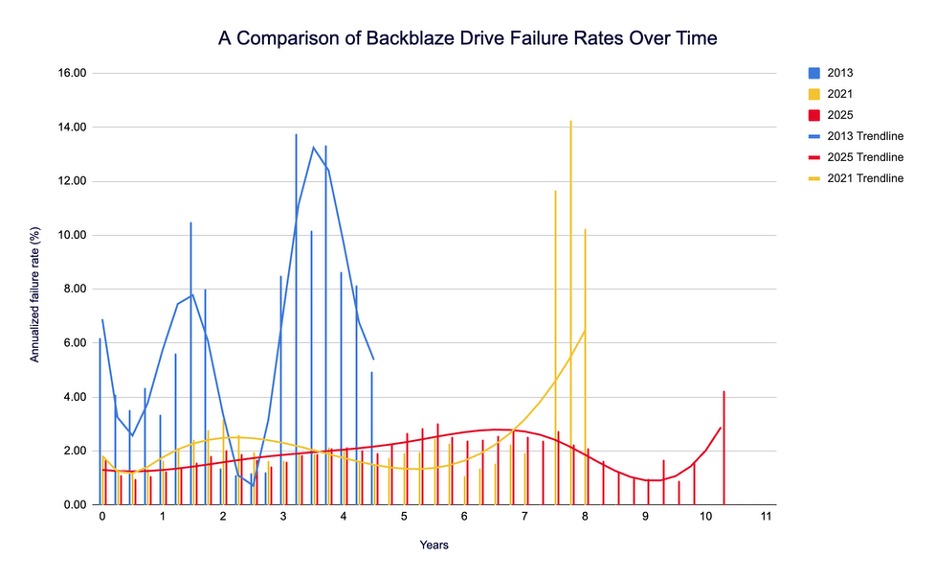
Backblaze is a backup and cloud storage company that has been tracking the annualized failure rates (AFRs) of the hard drives in its datacenter since 2013. As you can imagine, that’s netted the firm a lot of data. And that data has led the company to conclude that HDDs “are lasting longer” and showing fewer errors.

That conclusion came from a blog post this week by Stephanie Doyle, Backblaze’s writer and blog operations specialist, and Pat Patterson, Backblaze’s chief technical evangelist. The authors compared the AFRs for the approximately 317,230 drives in Backblaze’s datacenter to the AFRs the company recorded when examining the 21,195 drives it had in 2013 and 206,928 drives in 2021. Doyle and Patterson said they identified “a pretty solid deviation in both age of drive failure and the high point of AFR from the last two times we’ve run the analyses.”

A graph entitled "A Comparison of Backblaze Drive Failure Rates Over Time"
Credit:
Backblaze

Read full article

Comments

Samsung To Showcase Its First Ever Trifold Phone Later This Month

An anonymous reader shares a report: Samsung Electronics will unveil its highly-anticipated trifold smartphone when world leaders and global dignitaries gather at the Asia-Pacific Economic Cooperation summit in South Korea later this month. It will be the company’s first device with two hinges — allowing it to work as either a conventional smartphone or a significantly larger tablet when fully unfurled — and will be displayed at an exhibition of cutting-edge Korean technology on the sidelines of the multilateral summit, according to a person familiar with the matter.

For Samsung, the Gyeongju-hosted APEC event will provide a global spotlight for a product it hopes will burnish its reputation as an engineering pioneer. Alongside Huawei, Samsung has led the move to develop foldable phones, and Huawei introduced the world’s first trifold device in China last year. The Korean company now has the opportunity to take the form factor global.


Read more of this story at Slashdot.

The Best Marathon Training Plans, Based on Your Fitness Level

We may earn a commission from links on this page.

Did you know you can customize Google to filter out garbage? Take these steps for better search results, including adding my work at Lifehacker as a preferred source.


After crossing six marathon finish lines—and with NYC coming up in just two weeks—I’ve learned that the right training plan can make or break your 26.2-mile journey. The difference between hitting the wall at mile 20 and finishing strong often comes down to matching your plan to your current fitness level (and all the brutal honesty that entails). I’ve tried several of the most popular programs out there, and here’s what actually works, based on my experience and countless miles logged.

For beginners: The foundation builder (16-20 weeks)

Who this is for: You can comfortably run 3-4 miles and want to finish your first marathon without injury.

My first marathon was a humbling experience, but I’m grateful I didn’t rush the process. Beginner plans should prioritize building endurance gradually, with most runs at an easy, conversational pace.

My top advice for beginners is to focus on the long run progression. Increase your longest run by just one mile every 1-2 weeks. This slow build prevents injury and teaches your body to process fuel efficiently. I recommend the run-walk method popularized by Jeff Galloway—there’s zero shame in walking breaks, and they actually helped me finish my first marathon feeling stronger than friends who pushed through without them.

Hal Higdon’s Novice 1 & 2 (18 weeks)

This is where I started, and I recommend it to every first-timer who asks. Higdon’s plans are beautifully simple and forgiving. Novice 1 has you running just 3-4 days per week with optional cross-training, peaking at 40 miles weekly. The progression is gentle, and the instructions are crystal clear—no confusing pace calculations or complicated workouts.

What I love: The plan includes walking breaks and doesn’t overwhelm you with jargon. It’s free online and has a massive community following it, so you’ll find plenty of support.

Best for: True beginners or anyone returning from a long break who wants a straightforward, proven approach.

Runner’s World Run Less, Run Faster (16 weeks)

This three-runs-per-week plan surprised me with how effective it could be with lower volume. Each run has a specific purpose: track repeats, tempo run, and long run, supplemented with mandatory cross-training.

What I love: It’s perfect for busy people or those worried about injury from high mileage. The structure is rigid but efficient.

Best for: Beginners who can only commit to three running days a week but want to still see progress, or those cross-training heavily in other sports.

For intermediate runners: The performance enhancer (16-18 weeks)

Who this is for: You’ve completed at least one marathon or regularly run 25+ miles per week and want to improve your time.

This is where training gets interesting. You’re no longer just trying to finish, but actually chasing a PR or a specific time goal. Tempo runs changed everything for my third marathon. Running at or slightly above your goal marathon pace for sustained periods teaches your body what that pace feels like and builds the mental toughness to maintain it when you’re tired. I do these midweek: Warm up for 10-15 minutes, run 5-8 miles at tempo pace, then cool down.

Hal Higdon’s Intermediate 1 & 2 (18 weeks)

I used Intermediate 1 for my last marathon and knocked 22 minutes off my previous time. The plan bumps you up to 5 days of running per week, peaking around 50 miles, and introduces pace runs and tempo work without being overwhelming.

What I love: It maintains Higdon’s accessible approach while adding the speed work you need to improve. The balance between hard efforts and recovery is well-calibrated for someone still building their base.

Best for: Runners who had success with a beginner plan and want to level up gradually with a familiar structure.

Hanson’s Marathon Method: Beginner/Just Finish (18 weeks)

Don’t let the “beginner” label fool you—Hanson’s approach is unconventional and challenging. Unlike other plans, your longest run caps at just 16 miles, but you’re running higher weekly mileage (peaking around 57 miles) with less recovery between hard efforts. The philosophy is “cumulative fatigue,” where you learn to run on tired legs.

What I love: The plan forces you to respect your easy pace and teaches you to run marathon pace when you’re already fatigued, which is exactly what race day feels like.

Best for: Runners ready to commit to six days per week of running who want to break through a plateau. Not ideal for injury-prone runners due to the accumulated fatigue.

For advanced runners: The time trialer (16-20 weeks)

Who this is for: You’ve run multiple marathons, consistently train 40+ miles per week, and are chasing ambitious time goals or Boston qualification.

At this level, the margins are smaller and the training is more sophisticated. You’re fine-tuning an already efficient engine. Marathon pace long runs are your secret weapon. Rather than running all long runs easy, incorporate marathon pace segments into your longest runs. For example, run 18 miles with miles 10-16 at goal marathon pace. This teaches your body to run fast on tired legs—exactly what you’ll face on race day. My last two marathons improved dramatically after I started doing this, particularly with Pfitzinger’s approach.

Pfitzinger’s Advanced Marathoning: 18/55 or 18/70 (18 weeks)

Pete Pfitzinger’s plans are the gold standard for serious marathoners. The plan features medium-long runs, marathon pace segments within long runs, lactate threshold workouts, and VO2 max intervals. Everything is purposeful and periodized.

What I love: The variety keeps training interesting. A medium-long run (12-15 miles) on tired legs taught me more about marathon pacing than anything else. Pfitzinger respects recovery while still pushing you hard.

Best for: Experienced runners chasing specific time goals who can commit to 6-7 days per week. The 18/70 plan is for those targeting sub-3:00 or are already comfortable with high mileage.

Hanson’s Marathon Method: Advanced (18 weeks)

The advanced version of Hanson’s method maintains the 16-mile long run cap but pushes weekly mileage to 63+ miles with more intense tempo work and speed sessions. Three “something of substance” (SOS) workouts per week make this plan demanding.

What I love: If cumulative fatigue works for your body, this plan delivers results. You’ll run marathon pace so often in training that race day feels familiar rather than daunting.

Best for: High-mileage runners who recover quickly and aren’t injury-prone. The frequent hard efforts can break down runners who need more recovery between quality sessions.

Jack Daniels’ Elite Marathon Plan (24 weeks)

This plan is out of my league, but it’s well-known and highly trusted among runners. It includes four phases: base, quality, speed, and taper. Peak mileage can exceed 80 miles per week with multiple quality sessions. The plan uses precise training zones and includes marathon pace runs within long runs.

What I love: If you’re chasing an aggressive goal and have the time to commit, this plan leaves no stone unturned. The 24-week timeline allows for gradual, sustainable building.

Best for: Runners targeting Boston qualification or personal bests who have successfully completed multiple high-mileage training cycles. This isn’t a plan to jump into lightly.

Runner’s World Run Less, Run Faster: Advanced (16 weeks)

Even at the advanced level, this plan keeps you at just three hard running days per week, but the intensity is dramatically higher. Track workouts, tempo runs, and long runs with pace work are all challenging, with mandatory cross-training filling other days.

What I love: For anyone balancing high training stress from other areas of life, this proves you don’t need massive mileage to run fast.

Best for: Advanced runners who can handle high intensity but need lower running volume due to injury history, age, or life constraints.

How to choose the right plan for you

Mileage comfort: Be honest about what your body can handle. If you’ve never run 50 miles in a week, don’t start with a plan that peaks at 70.

Time commitment: A six-day-per-week plan requires different life logistics than a three-day plan. Consider your work schedule, family obligations, and other commitments.

Coaching style: Higdon is encouraging and simple. Pfitzinger is detailed and scientific. Hanson’s is contrarian and tough-love. Pick a voice that motivates you.

Track access: Some plans require a track for specific workouts. If you don’t have access, choose plans with more flexible tempo runs and hill work.

Injury history: Higher mileage and frequent intensity increase injury risk. If you’re injury-prone, consider Hanson’s approach (lower long run), Runner’s World (lower volume), or building slowly with Higdon.

Universal advice across all levels

Listen to your body over your plan. Every plan I’ve followed required adjustments. Illness, work stress, unusual fatigue—these happen. Missing one workout won’t derail your marathon, but running through injury absolutely will.

The taper is sacred. Regardless of your level, reduce mileage by 20-30% three weeks out, then another 40-50% two weeks out, with race week at minimal mileage. You might feel antsy or even sluggish initially—that’s normal. Trust every plan’s taper—they all agree on this.

Race day strategy matters as much as training. Start conservatively—the first half should feel easy. I’ve watched countless runners blow up after going out too fast. Negative splitting (running the second half faster than the first) is the most satisfying way to finish.

Find your community. Whether it’s a running club, online forum, or training partners, having support makes the long training cycle infinitely more bearable. Some of my best friendships started on early morning long runs. Most of these plans have dedicated online communities where you can find others following the same schedule.

The marathon is a humbling, rewarding distance that teaches you as much about mental strength as physical endurance. Choose the plan that matches where you are now, not where you wish you were. I’ve had success with Higdon’s approachable structure, Pfitzinger’s scientific periodization, and learned valuable lessons from Hanson’s cumulative fatigue philosophy. Trust your training, respect the distance, and enjoy the journey. Every marathon I’ve run has been different, but the feeling of crossing that finish line never gets old.

Samsung’s 2025 Frame Pro QLED TV is on sale for a record low price

Samsung’s 2025 The Frame Pro QLED Mini LED Smart TV is on sale for a record-low price. The 65-inch model that normally retails for $2,200 is on sale for $1,760, which is the lowest we’ve ever seen it.

The 1-inch-thick “art” TV uses Samsung’s impressive 4K Neo QLED panel, which is a quantum dot LCD panel with a Mini LED backlight array. The Frame Pro can display lifelike art pieces when the TV isn’t in use, while its sleek design means it also looks great when turned off.

The Frame Pro comes with Samsung’s new Wireless One Connect Box, which is supposed to help with cable management by putting the TV’s inputs in a separate box that then wirelessly transmits the feed from your external device to the TV. It does require its own power supply, though, so that’s one more plug needed if you are connecting a console or a streaming device.

The TV also carries the NQ4 AI Gen3 Processor, which imbues the Frame Pro with AI-enhanced picture and sound. This model also comes with Samsung Vision AI, which works to upscale the image on screen, create personalized experiences and more.

This 2025 model was just made available to order earlier this year, and the current sale price is surprisingly lower than it was during last week’s Prime Day event, proving sometimes good things come to those who wait.

This article originally appeared on Engadget at https://www.engadget.com/deals/samsungs-2025-frame-pro-qled-tv-is-on-sale-for-a-record-low-price-155913911.html?src=rss

Lead poisoning has been a feature of our evolution

Our hominid ancestors faced a Pleistocene world full of dangers—and apparently one of those dangers was lead poisoning.

Lead exposure sounds like a modern problem, at least if you define “modern” the way a paleoanthropologist might: a time that started a few thousand years ago with ancient Roman silver smelting and lead pipes. According to a recent study, however, lead is a much more ancient nemesis, one that predates not just the Romans but the existence of our genus Homo. Paleoanthropologist Renaud Joannes-Boyau of Australia’s Southern Cross University and his colleagues found evidence of exposure to dangerous amounts of lead in the teeth of fossil apes and hominins dating back almost 2 million years. And somewhat controversially, they suggest that the toxic element’s pervasiveness may have helped shape our evolutionary history.

The skull of an early hominid, aged to a dark brown color. The skull is fragmentary, but the fragments are held in the appropriate locations by an underlying beige material.
The skull of an early hominid.
Credit:
Einsamer Schütze / Wikimedia

The Romans didn’t invent lead poisoning

Joannes-Boyau and his colleagues took tiny samples of preserved enamel and dentin from the teeth of 51 fossils. In most of those teeth, the paleoanthropologists found evidence that these apes and hominins had been exposed to lead—sometimes in dangerous quantities—fairly often during their early years.

Read full article

Comments

Milky Way’s Mysterious Glow Reveals A Dark Secret About Our Galaxy

Milky Way's Mysterious Glow Reveals A Dark Secret About Our Galaxy
New research from Johns Hopkins University and an international team of scientists suggests that two competing theories for the diffuse glow near the center of the Milky Way—colliding dark matter particles or rapidly spinning neutron stars—are, for the first time, equally viable.

Researchers believe the glow coming from inside our own galaxy

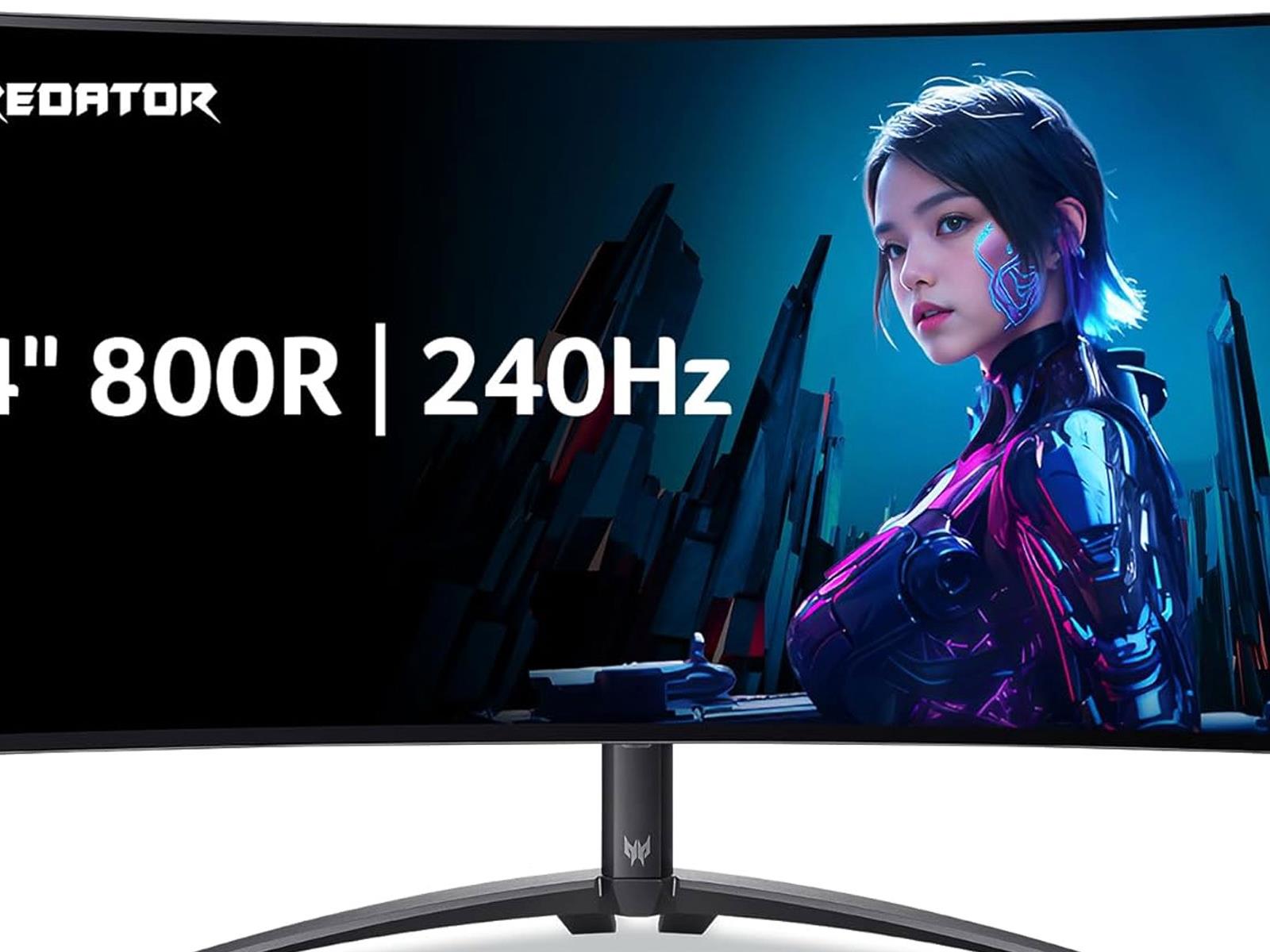
Acer Predator X34 OLED FreeSync 240Hz Gaming Monitor Is A Killer Deal At $240 Off

Acer Predator X34 OLED FreeSync 240Hz Gaming Monitor Is A Killer Deal At $240 Off
Are you ready to take your gaming to another level of image quality with an OLED display? There are a lot more options now than just a relatively short time ago, and also a steady stream of deals. As such, you can score Acer’s Predator X34 OLED monitor with a fast refresh and AMD FreeSync Premium Pro certification for a great price right now.

How

Bose QuietComfort Ultra Headphones (2nd gen) review: Impactful upgrades to a familiar formula

Bose took a different approach with its new products in 2025. Instead of entirely redesigning  its QuietComfort Ultra lineup, the company unveiled upgraded second-generation models of the flagship-level earbuds and headphones. Like the QuietComfort Ultra Earbuds that debuted earlier this year, the new Quiet Comfort Ultra headphones ($449) don’t offer a comprehensive overhaul. However, the changes provide enough performance improvements to further cement these as the best noise-canceling headphones that you can buy right now. Trust me, we’re much better off with this revamped version than we would be with a year (or longer) wait for something brand new with the 2023 model.

What’s new on the QuietComfort Ultra Headphones?

Bose debuted a few new features on the second-gen QuietComfort Ultra Earbuds in August that it carried over to these new headphones. First, the company improved its already stellar active noise cancelation (ANC) with tweaks to its ActiveSense technology. Specifically, the system can respond to sudden spikes in environmental noise by adapting more precisely. It’s not something you’ll notice all the time, but when you need it, you’ll be glad it’s there. Otherwise, the excellent ANC performance here is just as effective as it was on the previous model. More on that in a bit.

The immersive Cinema Mode that Bose added to the QC Ultra Earbuds is also available on these headphones. It’s a sound profile that enhances dialogue clarity while keeping the rest of the soundstage as wide and enveloping as possible. I like it best for movies and TV, as the name suggests, but per Bose’s suggestion I also tried it with podcasts and audiobooks. Cinema Mode is probably overkill for those types of content, unless you’re listening to shows or titles with lots of background effects. 

One of the biggest changes on the second-gen QC Ultra Headphones is how Bose decided to handle power management. Most importantly, the company extended battery life in all use cases. With ANC on (and Immersive Audio off), you’ll get up to 30 hours of listening time. Turn off ANC and that jumps to 45 hours. When you decide to enable both ANC and Bose’s spatial Immersive Audio, you can expect up to 23 hours on a charge. Compared to those on the first-generation model, all of these numbers are up by at least five hours, which is a significant boost. 

These headphones rotate flat and fold in for compact transport.
Billy Steele for Engadget

Like the previous QC Ultra Headphones, this model has an automatic disconnection feature after 10 minutes of standby . But the company went a step further on this version by adding a low-power mode that the headphones enter after 30 minutes of idle time. And if you want to disconnect them quickly, you can rotate the earcups and lay them on a flat surface. That’ll make them go into a deeper standby mode that Bose says can run “for months.” All of this means you can effectively turn the new QuietComfort Ultra Headphones on and off by putting them on and taking them off. If you’re using them regularly, you’ll never have to press the power button. 

Sound-wise, the big upgrade on these headphones is the addition of lossless audio over USB-C. Like the AirPods Max, this model can be connected with a cable to your phone, tablet, laptop or desktop to stream or play higher-quality tunes from compatible services or your library. Bose says you can expect 16-bit 44.1kHz or 48kHz audio depending on your source. It’s yet another nice-to-have feature that’s becoming standard fare on premium wireless headphones. 

What else is good about the QuietComfort Ultra Headphones?

Like most Bose over-ear headphones, the second-gen QuietComfort Ultra Headphones are supremely comfortable. Even for long periods of time, they never become a burden, and that’s thanks in large part to the soft, pillowy ear pads. I could easily wear these for an entire trans-Atlantic flight with minimal discomfort and I’ve been wearing them for entire workdays at home. 

As I already mentioned, the ANC performance here is still top-tier. In fact, these QC Ultra Headphones will soon replace the first-gen model on our best noise-canceling headphones list. Both the Immersion (ANC + spatial audio) and Quiet (just ANC) modes provide robust noise blocking that surpasses those by Sony, Sennheiser and others. If you’re making your buying decision based solely on ANC performance, this is the best option. You’ll enjoy relief from constant ambient noise sources like fans and sound machines, plus the QC Ultra Headphones do a respectable job with human voices. Heck, I couldn’t even hear my dog barking at the imminent threat from falling leaves outside. 

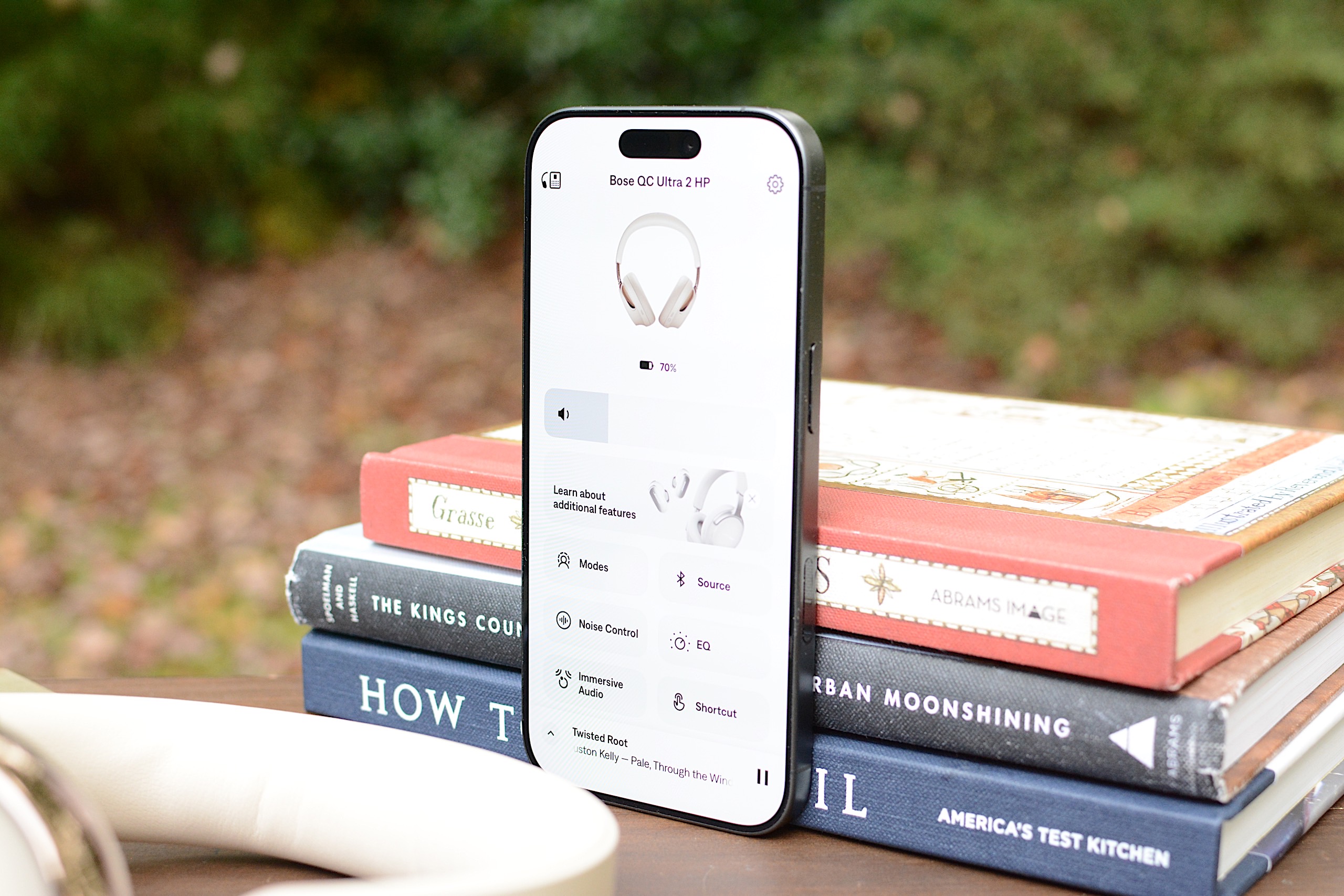
Lastly, Bose’s take on spatial audio is still quite good. The company calls it Immersive Audio and the feature doesn’t rely on specialized content like other headphones. Music sounds obviously fuller and slightly louder when the sound profile is active thanks to Bose’s method for upscaling stereo content. There’s also enhanced vocal clarity and elements like percussion and synths are less compressed than usual. The headphones lend a particularly airy feel to the tracks of Ruston Kelly’s Pale, Through the Window, an acoustic-driven collection of soulful, country-tinged tunes. His vocals float atop enveloping acoustic guitars and tight, punchy drums.

What’s not so good about the QC Ultra Headphones?

The Bose app gives you access to controls and customization.
Billy Steele for Engadget

The biggest issue with the second-gen QuietComfort Ultra Headphones is the price. To be clear, the likes of Sony, Apple and others charge around the same amount for their top-of-the-line models, but $449 is still a significant investment. If that’s too steep for you, Bose has the highly capable QuietComfort Headphones in its arsenal for a slightly more palatable $359.

My other gripe is that the only real design change Bose made for the updated QC Ultra Headphones is that the metal headband yokes now have a gloss finish. Depending on your personal preference, this might be a dealbreaker for you. It’s least noticeable on the black and violet colorways, since these have a tone-on-tone look. After a few weeks with the bronze and tan Driftwood Sand hue, I’m not a fan of the more stylized aesthetic. It’s flashy, for sure, but it’s a tweak I could’ve done without. 

Wrap-up

Similar to the second-gen QC Ultra Earbuds over the summer, Bose didn’t make huge upgrades for the updated version of the QC Ultra Headphones. But what you do get here is a decent improvement over its predecessor. The company devised an intuitive setup for power management and even addressed one of my main gripes with the original by adding support for lossless audio over USB-C. Plus, the extended battery life is significant in all sound modes, and not just by an hour or two here or there. To top it all off, the QuietComfort Ultra Headphones remain the best option for pure noise-blocking ability, and that’s not likely to change any time soon.

This article originally appeared on Engadget at https://www.engadget.com/audio/headphones/bose-quietcomfort-ultra-headphones-2nd-gen-review-impactful-upgrades-to-a-familiar-formula-150000709.html?src=rss

Wikipedia Says AI Is Causing a Dangerous Decline in Human Visitors

The Wikimedia Foundation, the nonprofit organization that hosts Wikipedia, says that it’s seeing a significant decline in human traffic to the online encyclopedia because more people are getting the information that’s on Wikipedia via generative AI chatbots that were trained on its articles and search engines that summarize them without actually clicking through to the site. 404 Media: The Wikimedia Foundation said that this poses a risk to the long term sustainability of Wikipedia. “We welcome new ways for people to gain knowledge. However, AI chatbots, search engines, and social platforms that use Wikipedia content must encourage more visitors to Wikipedia, so that the free knowledge that so many people and platforms depend on can continue to flow Sustainably,” the Foundation’s Senior Director of Product Marshall Miller said in a blog post. “With fewer visits to Wikipedia, fewer volunteers may grow and enrich the content, and fewer individual donors may support this work.”


Read more of this story at Slashdot.

US Mint To Issue $1 Coins Honoring Steve Jobs & Cray-1 Supercomputer In 2026

US Mint To Issue $1 Coins Honoring Steve Jobs & Cray-1 Supercomputer In 2026
The United States Mint has unveiled the designs for the 2026 American Innovation $1 Coin Program, immortalizing key figures and machines that defined our modern digital age. Among the four coins to be released next year (with designs representing California, Wisconsin, Iowa, and Minnesota), two specifically honor pivotal parts in computing

Only 40% of Workers Have High-Quality Jobs, Gallup Finds

joshuark writes: Not all jobs are created equal, according to the new American Job Quality Study. The nationally representative survey of roughly 18,000 Americans finds that just 40% of U.S. workers hold “quality jobs,” “Quality jobs” are defined as roles with fair compensation, safe environments, growth opportunities, agency and manageable schedules. Quality jobs are linked to higher satisfaction and wellbeing, yet most U.S. workers face gaps in pay, advancement, scheduling and fairness. As former obsolete technology COM guru Don Box stated: COM sucks but pays my bucks. Now it sucks and no bucks.


Read more of this story at Slashdot.

Wikimedia says AI bots and summaries are hurting Wikipedia’s traffic

Wikimedia is sounding the alarm on the impact AI is having on reliable knowledge and information on the internet. In a blog post, Wikimedia’s senior director of product, Marshall Miller, lays out the impact on page views that the foundation attributes to the rise of LLM chatbots and AI-generated summaries in search results. 

“We believe that these declines reflect the impact of generative AI and social media on how people seek information, especially with search engines providing answers directly to searchers, often based on Wikipedia content,” said Miller.

The foundation has increasingly faced AI bot crawlers whose sophistication has made it difficult to parse human traffic from bots. After improving bot detection to yield more accurate metrics, Wikipedia’s data shows an 8 percent drop in page views year over year.

Miller paints a picture of an existential risk greater than that of a website’s page views. He posits that if Wikipedia’s traffic continues to decline, it could threaten what he calls “the only site of its scale with standards of verifiability, neutrality and transparency powering information all over the internet.” He warns that fewer visits to Wikipedia would lead to fewer volunteers, less funding and ultimately less reliable content.

The solution he offers is for LLMs and search results to be more intentional in giving users the opportunity to interact directly with the source for the information being presented. “For people to trust information shared on the internet, platforms should make it clear where the information is sourced from and elevate opportunities to visit and participate in those sources,” Miller writes.

Earlier this summer, Wikipedia floated the idea of AI-generated summaries that would appear at the top of articles. The project was ultimately dropped before it began after fierce backlash from the site’s volunteer editors.

This article originally appeared on Engadget at https://www.engadget.com/ai/wikimedia-says-ai-bots-and-summaries-are-hurting-wikipedias-traffic-134331033.html?src=rss

Apple is the new home for F1 racing in the US starting in 2026

Apple has secured an exclusive deal for the US broadcast rights to Formula 1 racing. Under the terms of a five-year pact with F1 parent company Liberty Media, Apple TV will air every F1 race starting in 2026. 

The company says Apple TV subscribers will be able to watch every Grand Prix, along with each practice, qualifying and sprint session. Non-subscribers will be able to watch “select races” for free in the Apple TV app. You won’t have to pony up to watch practice sessions.

Formula 1 has its own dedicated streaming service. F1 TV Premium will still be available in the US, but only with an Apple TV subscription.

It was rumored in July that the tech giant might be looking to add the driving event to its sports programming. Apple allegedly bid between $120 million and $150 million a year for access to F1, which lapped the $90 million a year offered by ESPN, which previously had the US rights. The company may also be looking to capitalize on the success of its F1 the Movie project, which Engadget’s Devindra Hardawar found to be an excellent racing movie, a flashy summer blockbuster, and an ostentatious commercial for Apple in his review.

This article originally appeared on Engadget at https://www.engadget.com/entertainment/streaming/apple-is-the-new-home-for-f1-racing-in-the-us-starting-in-2026-133619412.html?src=rss

Apple’s M6 MacBook Pro Is Worth Waiting For If This Rumored Upgrade Is True

Apple's M6 MacBook Pro Is Worth Waiting For If This Rumored Upgrade Is True
No one would blame you if you decided to pick up the newly refreshed 14-inch MacBook Pro with Apple’s fancy M5 silicon inside, though for those who can afford to wait, the next-generation model with an M6 chip may be a substantially bigger upgrade to the MacBook Pro family. Rumor has it the next-gen MacBook Pro will finally adopt a touchscreen

This LG OLED Gaming Monitor Is Nearly 50% Off Right Now

We may earn a commission from links on this page. Deal pricing and availability subject to change after time of publication.

Did you know you can customize Google to filter out garbage? Take these steps for better search results, including adding Lifehacker as a preferred source for tech news.


If you’re searching for a curved OLED gaming monitor and want high-end quality from a reliable brand but would prefer not to spend a lot of money, the top-rated LG Ultragear 34GS95QE OLED gaming monitor is $696.99 (originally $1,299.99), 47% off the original price.

If you’re seeking a more immersive gaming experience, this ultra-wide OLED display makes a stylish desktop addition and comes with an adjustable, long-legged base that won’t interfere with your mouse. With an 800R curvature, it’s one of the most curved monitors out there (1,800R is a more common number), and while the aggressive bend might take some time to get used to, reviewers agree that it makes a world of difference. It allows you to focus but also gives you enough screen real estate to multitask while you’re gaming or working. The 34-inch LG 34GS95QE has an anti-glare coating, 3,440 x 1,440 resolution, and supports HDR10, adhering to the DisplayHDR True Black 400 standard and offering deep blacks and striking contrast. 

Reviewers note how bright and vivid the colors are, which is accentuated further by the curvature. However, there are minor color inaccuracies, which may be an issue for design professionals (but not most gamers). It has a 240-Hz refresh rate and an ultra-fast 0.03-millisecond response time that results in smooth, lag-free gameplay. The monitor also supports AMD FreeSync Premium Pro and Nvidia G-Sync, which minimizes screen tearing. Two HDMI 2.1 ports are ideal for next-gen devices and consoles.

If you’re looking for a more immersive gaming experience with a curved monitor that has excellent contrast (and 800R doesn’t sound too intense, especially for non-gaming usage), the  LG Ultragear 34GS95QE OLED gaming monitor is a great choice. Unless you do design work that requires extreme color accuracy, this premium display for gamers has few flaws, especially at the current discount. 

Our Best Editor-Vetted Tech Deals Right Now


Ring Battery Doorbell Plus


—
$149.99

(List Price $149.99)


Ring Indoor Cam (2nd Gen, 2-pack, White)


—
$79.99

(List Price $99.98)


Amazon Fire TV Stick 4K (2nd Gen, 2023)


—
$49.99

(List Price $49.99)


Amazon Fire HD 10 (2023)


—


(List Price $139.99)

Deals are selected by our commerce team

Teamgroup T-Force Z54E PCIe 5 SSD Taps Phison For Blistering 14.9GB/s Storage Speed

Teamgroup T-Force Z54E PCIe 5 SSD Taps Phison For Blistering 14.9GB/s Storage Speed
Teamgroup is targeting gamers with its new T-Force Z54E, a solid state drive (SSD) that leverages Phison’s E28 controller to push write and especially read speeds pretty close to the theoretical limit for NVMe storage on the PCI Express 5.0 bus. According to Teamgroup, its latest high-performance SSD can achieve speeds of up to 14,000MB/s