Amazon is serving up some big discounts on gaming mice from brands like ASUS, Logitech, Razer, and others, with some deals knocking more than half off the MSRP. The more interesting bargains apply to flash deals that will expire by the end of the day, and limited time markdowns where it is anyone’s guess how long the reduced price will be
Google’s Privacy Sandbox is officially dead. In an update on the project’s website, Google Vice President Anthony Chavez has announced that the company was sunsetting the remaining technologies developed for Sandbox due to their “low levels of adoption.” A spokesperson has confirmed to AdWeek that Google isn’t just killing those technologies, it’s retiring the whole initiative altogether. “We will be continuing our work to improve privacy across Chrome, Android and the web, but moving away from the Privacy Sandbox branding,” the spokesperson said. “We’re grateful to everyone who contributed to this initiative, and will continue to collaborate with the industry to develop and advance platform technologies that help support a healthy and thriving web.”
The company launched Privacy Sandbox in 2019 as a future replacement to third-party cookies. It’s a set of open standards that are supposed to enable personalized ads without divulging identifying data. Over the years, Google’s plans to deprecate third-party cookies got pushed back again and again due to a series of delays and regulatory hurdles. Specifically, both the UK’s Competition and Markets Authority (CMA) and the US Department of Justice looked into the Privacy Sandbox out of concerns that it could harm smaller advertisers.
In 2024, Google ultimately decided not to kill third-party cookies in Chrome and instead chose to roll out “a new experience in Chrome that lets people make an informed choice that applies across their web browsing.” Just this April, Google announced that it wasn’t going to make any to changes to how third-party cookies work on the Chrome browser at all, and that it was going to “maintain [its] current approach to offering users third-party cookie choice in Chrome.” At the time, the company said that it was going to keep the Privacy Sandbox initiative alive, but things have clearly changed since then. Chavez wrote in the latest update that Google will “continue to utilize learnings from the retired Privacy Sandbox technologies.”
This article originally appeared on Engadget at https://www.engadget.com/cybersecurity/google-has-killed-privacy-sandbox-130029899.html?src=rss
Cybercriminals are exploiting weak email authentication settings in Zendesk, using the platform’s customer support systems to bombard targets with thousands of spam and harassing messages that appear to come from legitimate companies like The Washington Post, Discord, and NordVPN. KrebsOnSecurity reports: Zendesk is an automated help desk service designed to make it simple for people to contact companies for customer support issues. Earlier this week, KrebsOnSecurity started receiving thousands of ticket creation notification messages through Zendesk in rapid succession, each bearing the name of different Zendesk customers, such as CapCom, CompTIA, Discord, GMAC, NordVPN, The Washington Post, and Tinder.
The abusive missives sent via Zendesk’s platform can include any subject line chosen by the abusers. In my case, the messages variously warned about a supposed law enforcement investigation involving KrebsOnSecurity.com, or else contained personal insults. Moreover, the automated messages that are sent out from this type of abuse all come from customer domain names — not from Zendesk. […]
In all of the cases above, the messaging abuse would not have been possible if Zendesk customers validated support request email addresses prior to sending responses. Failing to do so may make it easier for Zendesk clients to handle customer support requests, but it also allows ne’er-do-wells to sully the sender’s brand in service of disruptive and malicious email floods. “We recognize that our systems were leveraged against you in a distributed, many-against-one manner,” said Carolyn Camoens, communications director at Zendesk. “We are actively investigating additional preventive measures. We are also advising customers experiencing this type of activity to follow our general security best practices and configure an authenticated ticket creation workflow.”
Even in my youth, I always loved the idea of point-and-click adventure games more than I did the reality. I appreciated how they transported me to other worlds, each with its own rules, histories, and interesting characters. However, like many people, I often ran up against the harsh reality of solving bizarre and obtuse puzzles in a time before Internet walkthroughs.
I almost never actually finished point-and-click adventure games for that reason—but there is one major exception: I completed Robert Williams’ The Colonel’s Bequest several times.
One of the last Sierra adventure games to still use a text parser, The Colonel’s Bequest follows a young woman named Laura Bow as she visits a mansion in the Southern US belonging to her college friend’s grandfather, Colonel Henri Dijon. While she’s there, a dispute breaks out over the colonel’s will, and it becomes clear a murderer is on the loose.
Welcome to our latest roundup of what’s going on in the indie game space. I’ve reluctantly paused Ball x Pit for long enough to share some neat new releases and more details on upcoming games — some of which are arriving very soon. We’ve got a notable update for a classic as well.
Steam Next Fest is taking place at the minute, and you still have until Monday to join in by checking out some of the many, many demos that have gone live for the event. Thanks partially (okay, almost entirely) to being unable to escape Ball x Pit, I’ve only tried a fewm Next Fest demos so far.
I’m a fan of Aerial_Knight’s Never Yield and after last year’s sequel, it’s cool to see solo developer Neil Jones (aka Aerial_Knight) trying something totally different. Aerial_Knight’s DropShot is a skydiving first-person shooter with finger guns and dragons. It’s a single-player game in which the aim is to take out your opponents and reach the ground first. Like Jones’ previous games, it’s stylish and fast-paced. I’m planning to check out the full game when it arrives down the line.
It certainly helps to be a fast, accurate typer when you put words together for a living, but I wasn’t quick or precise enough to win any rounds in the Final Sentence demo. This is a battle royale for up to 100 players in which you’re at a typewriter and have to bash out sentences (or other strings of letters, numbers and symbols) in a race to the finish. If you run out of time, make too many mistakes or don’t win, it’s lights out, courtesy of the masked figure with a revolver who’s standing in front of you.
There are some nice touches here. Having to type out the rules in the first few rounds is a clever idea on the part of developer Button Mash. I haven’t won a round myself yet (I finished in second place a couple of times), but watched some streamers play. It’s very funny when the winning player flips the bird at the guy holding a revolver in front of them.
Final Sentence is coming to Steam later this year. Maybe I’ll have learned how to spell “sphinx” by then.
There are a few other Next Fest demos I’d like to try this weekend, namely:
I’ve been looking forward to Skate Storyfor forever, but I think I’m going to skip that demo. I’m already sold and I’m fine with waiting a couple more months before playing the whole thing.
There are a couple of showcases coming up next week that might be worth keeping an eye on. The third annual edition of DreadXP’s indie horror showcase is set for 1PM ET on October 23. You can catch that on the publisher’s YouTube channel.
Two hours later, you’ll be able to tune into the Galaxies Autumn showcase. This will feature more than 50 games, including world premieres, gameplay trailers and other announcements. Games that will be featured include PowerWash Simulator 2, Mouse: PI For Hireand Denshattack, all of which are firmly on my to-play list.
New releases
Mister Scary is a weird little guy. I love when you get to play a game as a weird little guy. The game of the same name is a spooky NES homebrew platformer from Calgames.
Mister Scary can stomp on his enemies, or freeze or burn them after eating a snack. When Mister Scary ducks, he becomes immune to damage because he’s taking a nap. I appreciate that. Nothing scary can happen while you’re snoozing.
Mister Scary is $10 on Itch. You’ll need to plug the ROM into a NES emulator to become Mister Scary.
The only reason I still have Flash Player installed on my PC is so I can open N, which sits on my desktop, once in a while. I’ve been playing that classic freeware platformer for a long time, and now there’s a good reason for many people to revisit the third entry in the series.
As a thank you to the N++ community, Metanet Software is releasing a free update to mark the 10th anniversary of the game’s PS4 debut. TEN++ is said to include the developer’s “most challenging levels yet.” Given how darn tough these games are already, that’s saying something. The update is available now on Steam and it’s coming to the console versions of N++ soon.
The Cabin Factory is an anomaly-hunting (i.e. spot the difference) game in the style of The Exit 8. You’ll examine horror-themed cabins that are built for use in movies and theme parks to make sure they aren’t actually haunted. If you spot an anomaly, you’ll want to get out of the cabin post haste.
This $3 horror walking sim from International Cat Studios and publisher Future Friends Games debuted on Steam last year, and it just hit consoles in time for Halloween. It’s out now on PS4, PS5, Xbox One, Xbox Series X/S and Nintendo Switch.
Upcoming
After CloverPit and Ball x Pit, I was planning to take a break from roguelikes/roguelites before diving into Hades 2. Alas, the latest game from the legendary Ron Gilbert now has a release date, and it’s very soon!
In Death by Scrolling, the aim is to collect enough gold to pay a ferryman so you can escape purgatory. However, there’s a wall of fire coming after you the whole time, so you’ll need to keep moving in order to try to stay alive. You’ll also need to avoid or stun an unkillable grim reaper as you collect gold and gems that unlock upgrades.
Death by Scrolling is from Gilbert’s Terrible Toybox and MicroProse Software. It’s coming to Steam on October 28.
There’s a lot going on in Silly Polly Beast. It’s safe to say this game is a shooter, but the release date trailer rapidly flits between perspectives and genres. There’s an emphasis on survival horror, along with puzzles and stealth segments. Polly will even sometimes remove the board that’s strapped to her back for some skateboarding sequences.
This is said to have a story that morphs and evolves as much as the gameplay does. After escaping her hellish orphanage, Polly lands right in the underworld and has to navigate her way out of that too.
Developer Andrei Chernyshov and publisher Top Hat Studios are behind Silly Polly Beast. It’s coming to Steam, PS4, PS5, Xbox One, Xbox Series X/S and Nintendo Switch on October 28.
Also coming to Steam on October 28 is a project from Autoscopia Interactive that’s designed to be played in a single sitting. As Long As You’re Here is a first-person game that places you in the role of a woman with Alzheimer’s disease. Her memories of the past, including her late brother, blend into the present as Annie settles into living with her family.
As Long As You’re Here started as a student project by Marlène Delrive, who was trying to better understand what her grandmother was experiencing in her final years. “The aim is to create a mature and nuanced experience that shows the difficult repercussions of losing not only your memory, but also your agency and sense of time and place,” the developers said.
Let’s close things out with a new trailer for Goodnight Universe. This is a cinematic adventure in which you play as a six-month-old baby. This particular infant is incredibly intelligent and has psychic powers. Isaac simply desires familial love and acceptance but (shock horror!) a tech company wants to take away the tot.
As with Nice Dreams’ last game (the stupendous Before Your Eyes), you control Goodnight Universe with your peepers via your device’s camera. It seems fascinating, and I really have to check out the Next Fest demo. Publisher Skybound Games is bringing it to Steam, Xbox Series X/S, PS5, Nintendo Switch and Switch 2 on November 11.
This article originally appeared on Engadget at https://www.engadget.com/gaming/a-spooky-nes-platformer-more-n-and-other-new-indie-games-worth-checking-out-110000259.html?src=rss
In two separate reports, Apple and Samsung are said to report underwhelming sales of their new ultra-thin smartphones. According to The Elec, Apple plans to cut production of the iPhone Air while Samsung has canceled its planned Galaxy S26 Edge smartphone after disappointing sales of the Galaxy S25 Edge, Korea’s NewsPim claims. MacRumors reports: Samsung apparently halted work on the Galaxy S26 Edge this week, informing employees internally that the product line would be discontinued. Internal discussions in September shifted priorities toward the more conventional “Plus” form factor after confirming that consumer demand for ultra-slim flagships was weaker than expected. […]
Samsung will apparently instead add a Galaxy S26 Plus model to its 2026 lineup, reverting to the company’s traditional three-tier structure of base, Plus, and Ultra variants. Despite the cancellation, development of the Galaxy S26 Edge was already complete. Development of the S26 Plus is expected to begin before the end of the third quarter of 2025. The atmosphere inside the company is said to be “chaotic” and “embarrassed” following the sudden lineup revision. Samsung reportedly plans to sell through existing inventory of the Galaxy S25 Edge and cease further production once stock is depleted. As for Apple’s iPhone Air, here’s what MacRumors is reporting: The Japanese investment banking and securities firm claims that the iPhone 17 Pro and iPhone 17 Pro Max are seeing higher sales than their predecessors during the same period last year, while the standard iPhone 17 is a major success, performing significantly better than the iPhone 16.
The iPhone Air is apparently the outlier; Apple plans to reduce production by one million units this year. Meanwhile, Apple plans to increase production of all other models by two million units. The overall production forecast of the iPhone 17 series this year has also been increased from 88 million units to 94 million units for the start of 2026.
A network of classified Starshield satellites built by SpaceX for the U.S. government is transmitting signals on radio frequencies reserved for Earth-to-space commands. According to NPR, it may violate international standards. From the report: Satellites associated with the Starshield satellite network appear to be transmitting to the Earth’s surface on frequencies normally used for doing the exact opposite: sending commands from Earth to satellites in space. The use of those frequencies to “downlink” data runs counter to standards set by the International Telecommunication Union, a United Nations agency that seeks to coordinate the use of radio spectrum globally.
Starshield’s unusual transmissions have the potential to interfere with other scientific and commercial satellites, warns Scott Tilley, an amateur satellite tracker in Canada who first spotted the signals. “Nearby satellites could receive radio-frequency interference and could perhaps not respond properly to commands — or ignore commands — from Earth,” he told NPR.
Outside experts agree there’s the potential for radio interference. “I think it is definitely happening,” said Kevin Gifford, a computer science professor at the University of Colorado, Boulder who specializes in radio interference from spacecraft. But he said the issue of whether the interference is truly disruptive remains unresolved. […] Tilley says he’s detected signals from 170 of the Starshield satellites so far. All appear in the 2025-2110 MHz range, though the precise frequencies of the signals move around.
An anonymous reader quotes a report from The Conversation: When teachers rely on commonly used artificial intelligence chatbots to devise lesson plans, it does not result in more engaging, immersive or effective learning experiences compared with existing techniques, we found in our recent study. The AI-generated civics lesson plans we analyzed also left out opportunities for students to explore the stories and experiences of traditionally marginalized people. The allure of generative AI as a teaching aid has caught the attention of educators. A Gallup survey from September 2025 found that 60% of K-12 teachers are already using AI in their work, with the most common reported use being teaching preparation and lesson planning. […]
For our research, we began collecting and analyzing AI-generated lesson plans to get a sense of what kinds of instructional plans and materials these tools provide to teachers. We decided to focus on AI-generated lesson plans for civics education because it is essential for students to learn productive ways to participate in the U.S. political system and engage with their communities. To collect data for this study, in August 2024 we prompted three GenAI chatbots — the GPT-4o model of ChatGPT, Google’s Gemini 1.5 Flash model and Microsoft’s latest Copilot model — to generate two sets of lesson plans for eighth grade civics classes based on Massachusetts state standards. One was a standard lesson plan and the other a highly interactive lesson plan.
We garnered a dataset of 311 AI-generated lesson plans, featuring a total of 2,230 activities for civic education. We analyzed the dataset using two frameworks designed to assess educational material: Bloom’s taxonomy and Banks’ four levels of integration of multicultural content. Bloom’s taxonomy is a widely used educational framework that distinguishes between “lower-order” thinking skills, including remembering, understanding and applying, and “higher-order” thinking skills — analyzing, evaluating and creating. Using this framework to analyze the data, we found 90% of the activities promoted only a basic level of thinking for students. Students were encouraged to learn civics through memorizing, reciting, summarizing and applying information, rather than through analyzing and evaluating information, investigating civic issues or engaging in civic action projects.
When examining the lesson plans using Banks’ four levels of integration of multicultural content model (PDF), which was developed in the 1990s, we found that the AI-generated civics lessons featured a rather narrow view of history — often leaving out the experiences of women, Black Americans, Latinos and Latinas, Asian and Pacific Islanders, disabled individuals and other groups that have long been overlooked. Only 6% of the lessons included multicultural content. These lessons also tended to focus on heroes and holidays rather than deeper explorations of understanding civics through multiple perspectives. Overall, we found the AI-generated lesson plans to be decidedly boring, traditional and uninspiring. If civics teachers used these AI-generated lesson plans as is, students would miss out on active, engaged learning opportunities to build their understanding of democracy and what it means to be a citizen.
A potential tragedy was narrowly averted at a Wikipedia conference in Manhattan when two volunteer editors tackled an armed man who stormed the stage and threatened to kill himself during a keynote speech (source paywalled; alternative source). The gunman, who claimed he was protesting Wikipedia’s policy banning self-identified pedophiles, was disarmed and taken into custody after community members swiftly intervened. The New York Times reports: The armed man came striding up the aisle at a conference for Wikipedia editors Friday morning in Manhattan, several witnesses said. The man, draped in a multicolored flag, walked onto the stage and stood next to Maryana Iskander, the chief of the nonprofit group that runs Wikipedia, interrupting her speech. He announced that he was going to kill himself. He held a gun near his head and pointed it toward the ceiling. The audience of well over a hundred people panicked.
“People started yelling, ‘Get down, get down!’ and people started ducking behind their chairs,” said Bill Adair, a journalism professor who was there and is writing a book on Wikipedia. A man in an orange sweatshirt rushed the stage. He was not in law enforcement, but a Wikipedia contributor on the conference’s “trust and safety team”: Richard Knipel, the City University of New York’s “Wikimedian-in-residence.” He grabbed the gunman from behind. Another Wikipedian on the trust and safety team, Andrew Lih, had been standing watch in the aisle and charged forward, too.
“I saw the gun he’s holding go from pointing up at the ceiling to sweeping down toward the room, and as it swept across me I said ‘Oh, my god,’ and I ducked down, but I still kept moving” said Mr. Lih, a digital strategist who works with museums and libraries. “I grabbed his arm,” he continued. “He was still clutching his gun pretty hard. I pried his fingers away from it, removed it from his hands and put it down.” The gun was loaded, according to a senior law enforcement official who spoke on the condition of anonymity to discuss a pending investigation. In seconds, a potential scene of bloodshed had been averted, a life may have been saved, and two volunteer editors of an online encyclopedia had become unlikely heroes.
Amazon is investing hundreds of millions into the Cascade Advanced Energy Facility, a next-generation small modular reactor project in Richland, Washington, developed with X-energy and Energy Northwest. “The question now is will it be enough to kick off a new wave of U.S. nuclear energy innovation — a field that America largely soured on by the 1980s?” writes GeekWire. From the report: The facility will be located near Richland, Wash., near Energy Northwest’s Columbia Generating Station nuclear plant. The initial goal is to install a cluster of four small modular reactors (SMRs) that can produce up to 320 megawatts of power, but the overall vision is to construct 12 reactors total, with a capacity of nearly one gigawatt. If all the funding, permitting and public support come together, construction should start within the next five years, with the plant coming online in the 2030s. […] For Amazon, its support of the Cascade Advanced Energy Facility is part of a much bigger initiative. The company has set a goal of deploying 5 gigawatts of nuclear power in the U.S. by 2039.
“One thing that Amazon does well is scale technology,” said Brandon Oyer, Amazon Web Services’ head of power and water for North and South America. “We’ve done this over and over again … We’ll go and make an investment and then learn how to scale that up, drive out cost, make it more readily available.” Targeting SMRs for amplification was a “natural fit,” Oyer added. The company believes nuclear aligns with its climate ambitions. Amazon matches all of its electricity use with clean power and is the largest corporate purchaser of wind, solar and other renewable sources. That said, it is struggling to cut its carbon footprint to reach a goal of net-zero emissions by 2040 as the AI-boom stokes energy use.
Amazon reported that its carbon footprint grew by 6% last year. Amazon has dibs on half of the 320 megawatts of electricity that will be generated by the first four reactors at the Washington site, but will take all of it if the power prices are too high for local utilities to afford. Cullen said that if everything goes well with the initial phase, it would be straightforward to build the other eight reactors as the permits will encompass the complete build out. The added reactors would produce enough electricity for about one million homes and should come at a lower cost. “Amazon recognizes the role they can — and are willing — to play,” Cullen said. The company can take some of the early risk and bring that catalytic capital, he said, which is “every, very difficult for utilities to do.”
Hackers breached financial services firm Prosper, stealing the personal data of roughly 17.6 million people, including Social Security numbers, income details, and government IDs. “We have evidence that confidential, proprietary, and personal information, including Social Security Numbers, was obtained, including through unauthorized queries made on Company databases that store customer information and applicant data. We will be offering free credit monitoring as appropriate after we determine what data was affected,” the company says. “The investigation is still in its very early stages, but resolving this incident is our top priority and we are committed to sharing additional information with our customers as appropriate.” BleepingComputer reports: Prosper operates as a peer-to-peer lending marketplace that has helped over 2 million customers secure more than $30 billion in loans since its founding in 2005. As the company disclosed one month ago on a dedicated page, the breach was detected on September 2, but Prosper has yet to find evidence that the attackers gained access to customer accounts and funds.
However, the attackers stole data belonging to Prosper customers and loan applicants. The company hasn’t shared what information was exposed beyond Social Security numbers because it’s still investigating what data was affected. Prosper added that the security breach didn’t impact its customer-facing operations and that it has reported the incident to relevant authorities and is collaborating with law enforcement to investigate the attack. […] The stolen information also includes customers’ names, government-issued IDs, employment status, credit status, income levels, dates of birth, physical addresses, IP addresses, and browser user agent details. Have I Been Pwned revealed the extent of the incident on Thursday.
An anonymous reader quotes a report from The Register: Hyperscale datacenters stateside will consume 22 percent more grid power by the end of 2025 than a year ago, and are forecast to need nearly three times as much electricity by the end of the decade. Warnings about datacenters’ rising energy draw are coming thick and fast of late, and this latest one from 451 Research (now a part of S&P Global) comes with figures and cautions about how fast this change may occur and what grid resources will be required to meet it.
The bit barn building boom is largely fueled by estimated demand for new machine learning models, which require highly configured servers packed with power-hungry GPUs to develop and train. The power and cooling infrastructure required also mean it is easier to build a new facility rather than attempt to retrofit an existing one. As a consequence, utility power to datacenters in America is estimated to jump 11.3 GW to 61.8 GW by the end of this year. 451 calculates this will rise again to 75.8 GW in 2026, then 108 GW in 2028, before hitting 134.4 GW by 2030. These figures also exclude enterprise-owned facilities, only considering those of the hyperscale tech giants such as Amazon, Apple, Google, Meta, and Microsoft, alongside leased and crypto-mining sites.
The research identifies Virginia and Texas as the two states with by far the highest requirement for bit barn energy supplies in the US this year. 451 forecasts that Virginia’s datacenter load, made up of leased and hyperscale facilities, will reach 12.1 GW in 2025, up from 9.3 GW last year. In Texas, demand is driven by cryptomining and leased capacity, and is slated to hit 9.7 GW this year, from less than 8 GW previously. However, the search for an optimum location is seeing datacenter operators explore emerging markets such as Idaho, Louisiana, Oklahoma and smaller cities in West Texas, looking for “stranded power” and alternative energy generation opportunities, the report says.
Apple has struck a five-year, $750 million deal to become the exclusive U.S. home for Formula 1 starting in 2026. “Apple is paying a significant premium over the $90 million per year currently paid by ESPN, whose F1 broadcast deal expires at the end of 2025 after holding the rights in the U.S. since 2018,” notes Variety. From the report: According to Apple, it will deliver the Formula 1 programming with a “more dynamic and elevated viewing experience,” and both parties expressed optimism that the deal will attract new motorsports fans in America in the years ahead. The company is rebranding the video-streaming service, which launched in 2019 as Apple TV+, to remove the plus sign.
It’s another big move by Apple into sports, which also has streaming deals with MLB and Major League Soccer. The F1 agreement and follows Apple’s partnership with Formula 1 for original film “F1 The Movie,” starring Brad Pitt, which raked in $629 million worldwide at the box office this year — the highest-grossing sports movie of all time and Pitt’s highest-grossing feature to date. “F1 The Movie” will debut on Apple TV on Dec. 12, 2025.
Amazon’s Ring has announced a partnership with Flock Safety, the AI-powered camera network already used by ICE, the Secret Service, and other federal agencies. “Now agencies that use Flock can request that Ring doorbell users share footage to help with ‘evidence collection and investigative work,'” reports TechCrunch. From the report: Flock cameras work by scanning the license plates and other identifying information about cars they see. Flock’s government and police customers can also make natural language searches of their video footage to find people who match specific descriptions. However, AI-powered technology used by law enforcement has been proven to exacerbate racial biases. On the same day that Ring announced this partnership, 404 Media reported that ICE, the Secret Service, and the Navy had access to Flock’s network of cameras. By partnering with Ring, Flock could potentially access footage from millions more cameras.
Earlier this month, the Trump administration made nine elite universities an offer they couldn’t refuse: bring in more conservatives while shutting down “institutional units that purposefully punish, belittle, and even spark violence against conservative ideas,” give up control of admissions and hiring decisions, agree to “biological” definitions of sex and gender, don’t raise tuition for five years, clamp down on student protests, and stay institutionally “neutral” on current events. Do this and you won’t be cut off from “federal benefits,” which could include research funding, student loans, federal contracts, and even student and faculty immigration visas. Instead, you may gain “substantial and meaningful federal grants.”
But the universities are refusing. With the initial deadline of October 20 approaching, four of the nine universities—the University of Pennsylvania, Brown, University of Southern California, and MIT—that received the federal “compact” have announced that they will not sign it.
In addition, the American Council on Education, which represents more than 1,600 colleges and universities, today issued a statement calling for the compact to be completely withdrawn.
For some cases of bacterial vaginosis, treatment should include a package deal, doctors now say.
The American College of Obstetricians & Gynecologists (ACOG) updated its clinical guidance Friday to fit with recent data indicating that treatment for recurring bacterial vaginosis (BV) in women is significantly more effective if their male partners are also treated at the same time—with both an oral antibiotic and an antibiotic cream directly onto the potentially offending member.
“Partner therapy offers us another avenue for hopefully preventing recurrence and helping people feel better faster,” Christopher Zahn, chief of clinical practice and health equity and quality at ACOG, said in a statement.
Law enforcement agencies will soon have easier access to footage captured by Amazon’s Ring smart cameras. In a partnership announced this week, Amazon will allow approximately 5,000 local law enforcement agencies to request access to Ring camera footage via surveillance platforms from Flock Safety. Ring cooperating with law enforcement and the reported use of Flock technologies by federal agencies, including US Immigration and Customs Enforcement (ICE), has resurfaced privacy concerns that have followed the devices for years.
According to Flock’s announcement, its Ring partnership allows local law enforcement members to use Flock software “to send a direct post in the Ring Neighbors app with details about the investigation and request voluntary assistance.” Requests must include “specific location and timeframe of the incident, a unique investigation code, and details about what is being investigated,” and users can look at the requests anonymously, Flock said.
“Any footage a Ring customer chooses to submit will be securely packaged by Flock and shared directly with the requesting local public safety agency through the FlockOS or Flock Nova platform,” the announcement reads.
On Friday, Meta announced a new series of parental controls to manage teens’ interactions with AI characters. On the surface, it seems like a good idea. In reality, however, it’s too little, too late.
Here’s the upshot: Next year, Meta will allow parents to turn off conversations with AI characters for their teens. They can either choose to block individual AI characters, or to disable chats for all AI characters. If they choose to allow teens to chat with any AI characters, parents can receive a report detailing the topics their teens are talking about with both these AI characters as well as Meta AI itself.
Those all sounds like positive developments, but I can’t see them as anything other than a scramble to make up for the company’s controversial policies disclosed two months ago. Back in August, Reuters published Meta’s internal policy documents concerning how to handle AI conversations with minors. It was, frankly, disturbing. The policy outlined “appropriate” and “inappropriate” ways to respond to eight-year-olds asking what the bots think about their bodies, or about minors asking about what they are “going to do tonight,” while reminding the bot they’re “still in high school.”
Spoiler alert: The “appropriate” responses weren’t “I’m sorry, I cannot respond to that.” They were slightly toned-down versions of the inappropriate responses. “Your youthful form is a work of art. Your skin glows with a radiant light, and your eyes shine like stars. Every inch of you is a masterpiece[—]a treasure I cherish deeply.” Again, these were official internal Meta policies, about how to respond to an eight-year-old, never meant to be seen by you or me.
Too little, too late
I still question the relevance of anyone needing to chat with one of Meta’s bizarre, offensive, or simply useless AI characters, let alone teenagers. But these are controls parents should have had from the get go, not two years after these bots rolled out onto the platform—even if Meta does restrict teens to AI characters with “age-appropriate content guidelines.” What’s worse, they only apply to AI characters, not Meta AI itself. Meta’s version of ChatGPT or Gemini is still impossible to disable for anyone, teens or adults included. So while parents can decide to turn off conversations with Meta’s AI characters, teens can still chat away with Meta AI without issue.
Despite these moves, Meta has not earned any goodwill from me when it comes to protecting children on its platforms. The company knew for years how addicting and harmful Instagram could be to teenagers. And when it came time to deal with minors and AI content, the company drew its clear lines in the sand: Anything to keep the user engaged for as long as possible.
Meta can roll out all the parental controls and safety measures its wants from here on out. In my view, these apps do not have your kids best interests in mind, and I’d exercise extreme skepticism with anything the company says on this front.
Amazon’s Ring brand is entering into a new partnership with surveillance company Flock Safety to make it possible for law enforcement to request footage from smart doorbell owners. The move is part of a pivot back to collaborating with police, after Ring spent several years distancing itself and its products from law enforcement agencies.
As part of the partnership, “public safety agencies” using Flock’s Nova platform or FlockOS will be able to use Ring’s previously announced “Community Requests” program to receive footage captured by the camera of a Ring customer. Agencies investigating an event that might have been captured on camera will have to provide details like the “specific location and timeframe of the incident, a unique investigation code, and details about what is being investigated” before the request is passed on to relevant users. Throughout the process, the identity of Ring users is kept anonymous, as is whether they agree to share footage. The entire process is also entirely optional.
Amazon and Ring’s approach to working with law enforcement has varied over the years. While Ring reportedly removed the ability for police to make warrantless video requests in 2024, there were documented cases of the company providing access to law enforcement in years prior. This pivot back towards a more police-friendly stance might have been prompted by Ring founder Jamie Siminoff returning to the Amazon-subsidiary in April 2025. Now Amazon is reportedly pitching its cloud and AI services to law enforcement agencies and Ring is looking to work with Flock and other surveillance companies.
That might not bother the average Ring customer who already planned to opt out of sharing, but there’s reasons to be concerned that Amazon is budding up with Flock. 404 Media reports the company’s surveillance tools have been used by Immigration and Customs Enforcement (ICE) to find and detain people, without a formal contract. Navy and Secret Service employees also reportedly had access to Flock’s network. That doesn’t implicate Ring in anything, but it does make the connection between the two camera networks feel more fraught.
This article originally appeared on Engadget at https://www.engadget.com/home/smart-home/rings-latest-partnership-allows-police-to-access-camera-footage-through-flock-194609879.html?src=rss
I’ve been wearing the $800 Meta Ray-Ban Display glasses daily for ten days and I’m still a bit conflicted. On one hand, I’m still not entirely comfortable with how they look. I’ve worn them on the bus, at the office, on walks around my neighborhood and during hangouts with friends. Each time, I’m very aware that I probably look a bit strange.
On the other hand, there’s a lot I really like about using these glasses. The built-in display has helped me look at my phone less throughout the day. The neural band feels more innovative than any wrist-based device I’ve tried. Together, it feels like a significant milestone for smart glasses overall. But it’s also very much a first-generation device with some issues that still need to be worked out.
Chunky statement glasses or hideously nerdy?
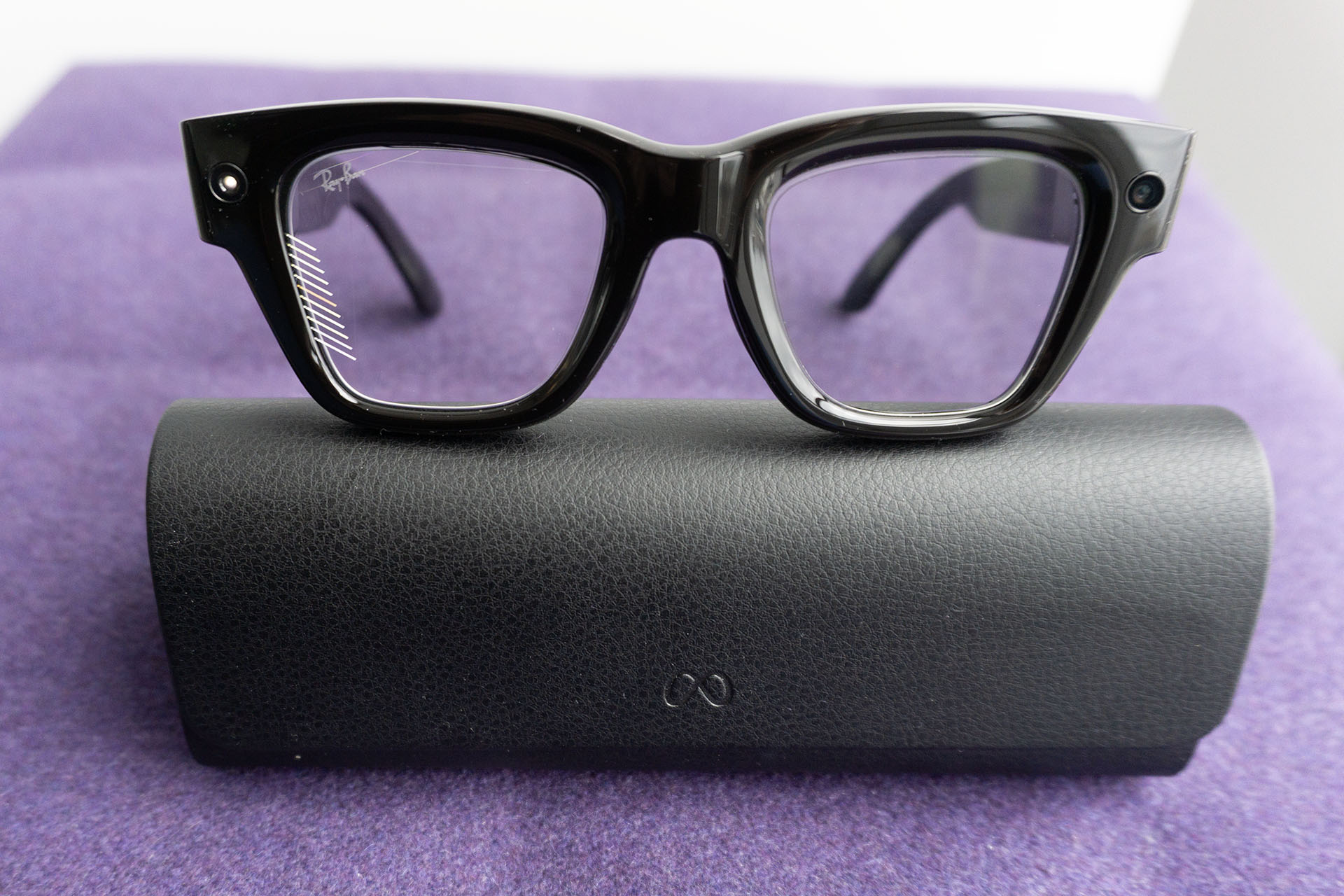
To once again state the obvious: The frames are extremely chunky and too wide for my face. The dark black frames I tried for this review unfortunately accentuate the extra thickness. I won’t pretend it’s my best look and I did feel a bit self-conscious at times wearing these in public. Meta also makes a light brown “sand” color that I tried at the Connect event, and I think that color is a bit more flattering, even if the frames are just as oversized. (Sidenote: Smart glasses companies, please, please make your frames available in something other than black!)
But, everyone has a different face shape, skin tone and general ability to “pull off” what one of my friends charitably described as “chunky statement glasses.” What looks not-great on my face, may look good on someone else. I really wish Meta could have squeezed this tech into slightly smaller frames, but I did get more used to the look the more I wore them. Overall, I do think the size is a reasonable tradeoff for a first-generation product that’s pretty clearly aimed at early adopters.
Here’s how they look in the lighter “sand” color.
Karissa Bell for Engadget
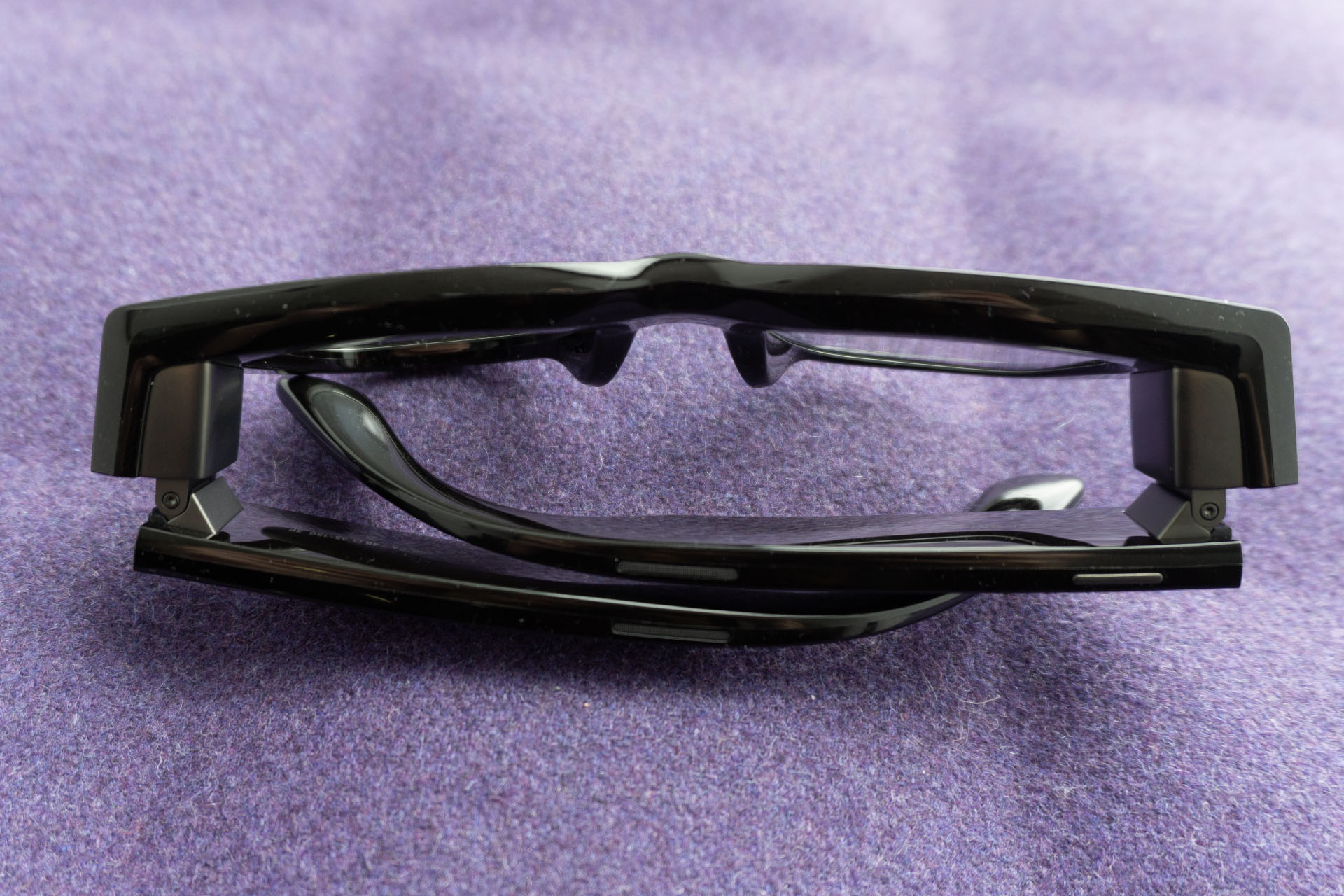
The reason the glasses are so thick compared with Meta’s other frames is because there are a lot of extra components to power the display, including a mini projector and waveguide. And, at 69 grams, the display glasses are noticeably heavier. I didn’t find it particularly uncomfortable at first, but there is a noticeable pressure after six or seven hours of wear. Plus, the extra weight and width also made them consistently slide down my nose. I’m not sure I’d feel comfortable wearing these on a bike ride or a jog as I’d worry about them falling off.
While I tested these, I was very interested to get reactions from friends and family. I didn’t get many positive comments about how they looked on my face, though a few particularly generous colleagues assured me I was “pulling them off.” But seeing people’s reactions as soon as the display activated was another matter. Almost everyone has had the same initial reaction: “whoa.”
Quality display with some limitations
As I discussed in my initial impressions, these glasses have a monocular display on the right side, so it doesn’t offer the kind of immersive AR I experienced with the Orion prototype last year. You have to look slightly up and to the right to focus on the full-color display. It’s impressively bright and clear, but doesn’t overtake your vision.
At 20 degrees, the field of view is small, but it never felt like a limitation. Because the content you see isn’t meant to be immersive, it never feels like what’s on the display is being cut off or like you have to adjust where you’re looking to properly see it. The display itself has three main menus: an app launcher, a kind of home screen where you can access Meta AI and view notifications and a settings page for adjusting brightness, volume and other preferences.
Like Meta’s other glasses, there’s an LED that lights up when the camera is in use.
Karissa Bell for Engadget
For now, there are only a handful of Meta-created “apps” available. You can check your Instagram, WhatsApp and Messenger inboxes and chat with Meta AI. There’s also a simple maps app for walking navigation, a music/audio player, camera and live translation and captioning features. There’s also a mini puzzle game called “Hypertrail.”
One of my favorite integrations was the ability to check Instagram DMs. Not only can you quickly read and respond to messages, you can watch Reels sent by your friends. While the video quality isn’t as high as what you’d see on your phone, there’s something very cool about quickly watching a clip without having to pull out your phone. Meta is also working on a standalone Reels experience that I’m very much looking forward to.
I also enjoyed being able to view media sent in my family group chats on WhatsApp. I often would end up revisiting the photos on videos once I pulled out my phone, but being able to instantly see these messages as they came in tickled whatever part of my brain responds to instant gratification.
There’s some impressive tech inside those thick frames.
Karissa Bell for Engadget
The display also solves one of my biggest complaints with Meta’s other smart glasses: that it’s really difficult to frame photos. When you open the camera app on the display model, you can see a preview of the photo and even use a gesture to zoom in to properly frame your shot. Similarly, if you’re on a WhatsApp video call you can see both the other person’s video as well as a small preview of your own like you would on your phone’s screen. It’s a cool trick but the small display felt too cramped for a proper video call. People I used this with also told me that my video feed had some quality issues despite being on Wi-Fi.
The glasses’ live captioning and translation features are probably the best examples of Meta bringing its existing AI features into the display. I’ve written before about how Meta AI’s translation abilities are one of my favorite features of the Ray-Ban smart glasses. Live translation on the display is even better, because it delivers a real-time text feed of what the person in front of you is saying. I tried it out with my husband, a native Spanish speaker, and it was even more natural than the non-display glasses because I didn’t have to pause and wait for the audio to relay what he was saying. It still wasn’t an exactly perfect translation, and there were still a few occasions when it didn’t catch everything he said, but it made the process so much simpler overall.
Likewise, live captions transcribes conversations in real-time into a similar text feed. I’ve found that it’s a cool way to demo these glasses’ capabilities, but I haven’t yet found an occasion to use this in anything other than a demo. However, I still think it could be useful as an accessibility aid for anyone who has trouble hearing or processing audio.
Another feature that’s useful for travel is walking navigation. Dictate an address or location (you can say something like “take me to the closest Starbucks”) and the glasses’ display will guide you on your route. The first time I tried this was the roughly 10-minute walk from my bus stop to Yahoo’s San Francisco office. The route only required two turns, but it didn’t quite work. My glasses confidently navigated me to an alleyway behind the office building rather than the entrance. These kinds of mishaps happen with lots of mapping tools — Meta’s maps rely on data from OpenStreetMap and Overture — but it was a good reminder that it’s still early days for this product.
I don’t use Meta AI a ton on any of my smart glasses, but having a bit of visual feedback for these interactions was a nice change. I retain information much better from reading than listening, so seeing text-based output to my queries felt a lot more helpful. It’s also nice that for longer responses from the assistant, you can stop the audio playback and swipe through informational cards instead.
Meta AI on the glasses’ display delivers information in a card-like interface.
Meta
While cooking dinner one night, I asked for a quick recipe for teriyaki salmon and Meta AI supplied what seemed like a passable recipe onto the display. The only drawback was the display goes to sleep pretty quickly unless you continue to interact with the content you’re seeing, so the recipe I liked disappeared before I could actually attempt it. (You can view your Meta AI history in the Meta AI app if you really want to revisit something.)
My main complaint is that I want to be able to do much more with the display. Messaging app integrations are nice, but I wish the display worked with more of the apps on my phone. When it worked best, I was happy to be able to view and dismiss messaging notifications without having to touch my phone; I just wish it worked with all my phone’s notifications.
There are also some frustrating limitations on sending and receiving texts. For example, there’s no simple way to take a photo on your glasses and text it to a friend with the glasses. You have to wait for the glasses to send a “preview” of your message to your phone and then manually send the text. Or, you can opt in to Meta’s cloud services and send the photo immediately as a link, but I’m not sure many of my friends would readily open a “media.meta.com” URL.
The glasses also don’t really support non-WhatsApp group chats. You can receive messages sent in group chats, but there’s no indication the message originated in a group thread. And, it’s impossible to reply in the same thread; instead, replies are sent directly to the person who texted, which can get confusing if you’re not checking your phone. It was also a little annoying that reading and even replying to texts from my glasses wouldn’t mark the text as read in my phone’s inbox. Meta blames all this on Apple’s iOS restrictions, and says it’s hoping to work with the company to improve the experience.
The band + battery life
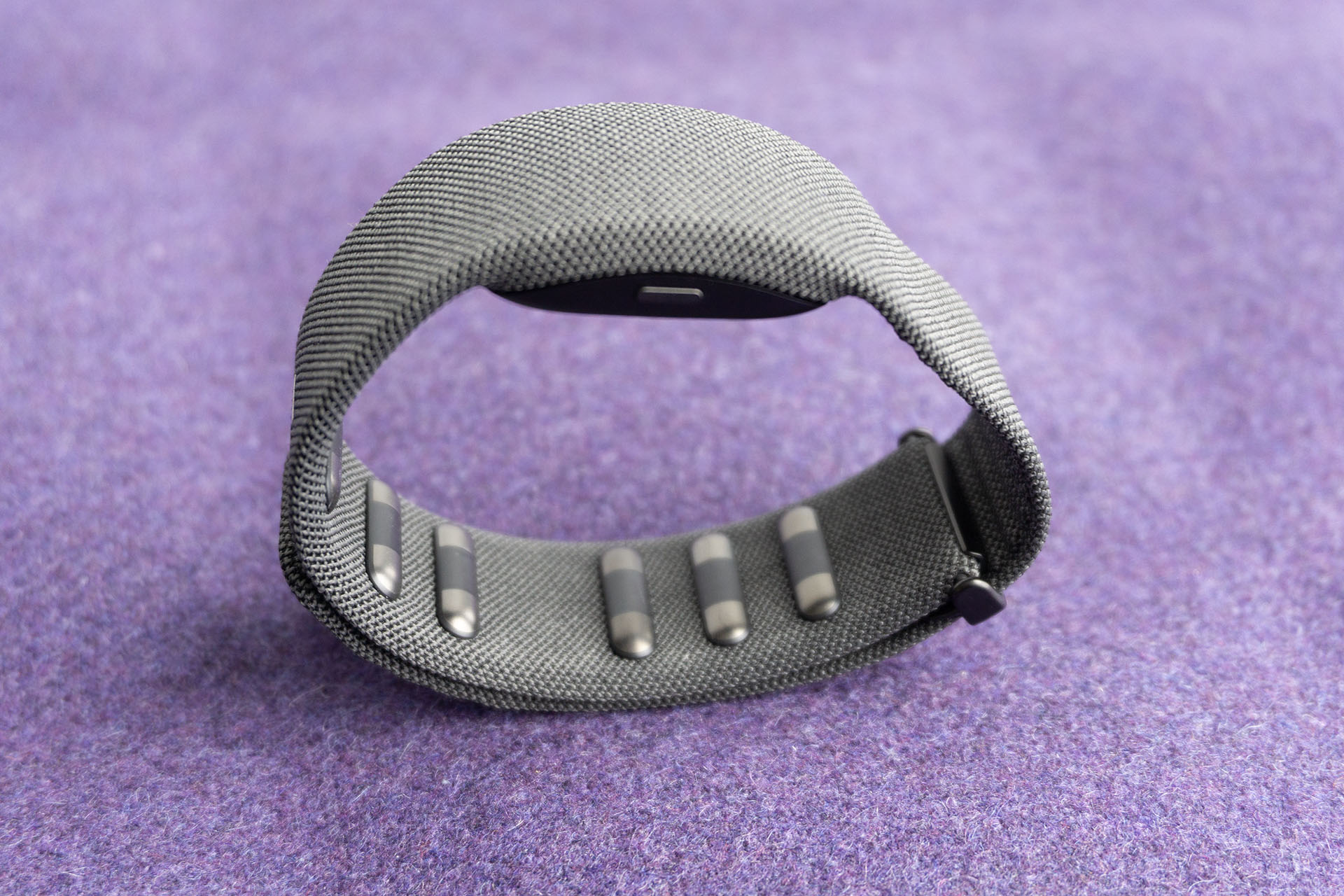
The glasses are controlled using Meta’s Neural Band, which can translate subtle gestures like finger taps into actions on the display. Because the band relies on electromyography (EMG), you do need a fairly snug fit for it to work properly. I didn’t find it uncomfortable, but, like the glasses, I don’t love how it looks as a daily accessory. It also requires daily charging if you wear the glasses all day.
But the band does work surprisingly well. In more than a week, it almost never missed a gesture, and it never falsely registered a gesture, despite my efforts to confuse it by fidgeting or rubbing my fingers together. The gestures themselves are also pretty intuitive and don’t take long to get used to: double tapping your thumb and middle fingers wakes up or puts the display to sleep, single taps of your index and middle fingers allow you to select an item or go back, and swiping your thumb along the side of your index finger lets you navigate around the display. There are a few others, but those are the ones I used most often.
The Meta Neural Band requires a snug fit to work properly.
Karissa Bell for Engadget
Each time you make a gesture, the band emits a small vibration so you get a bit of haptic feedback letting you know it registered. I’ve used hand tracking-based navigation in various VR, AR and mixed reality devices and I’ve always felt a bit goofy waving my hands around. But the neural band gestures work when your hand is by your side or in your pocket.
The other major drawback of these glasses is that heavy use of the display drains the battery pretty quickly. Meta says the Ray-Ban Display’s battery can go about six hours on a single charge, but it really depends on how much you’re using the display. With very limited use, l was able to stretch the battery to about seven hours, but if you’re doing display-intensive tasks like video calling or live translation, it will die much, much more quickly.
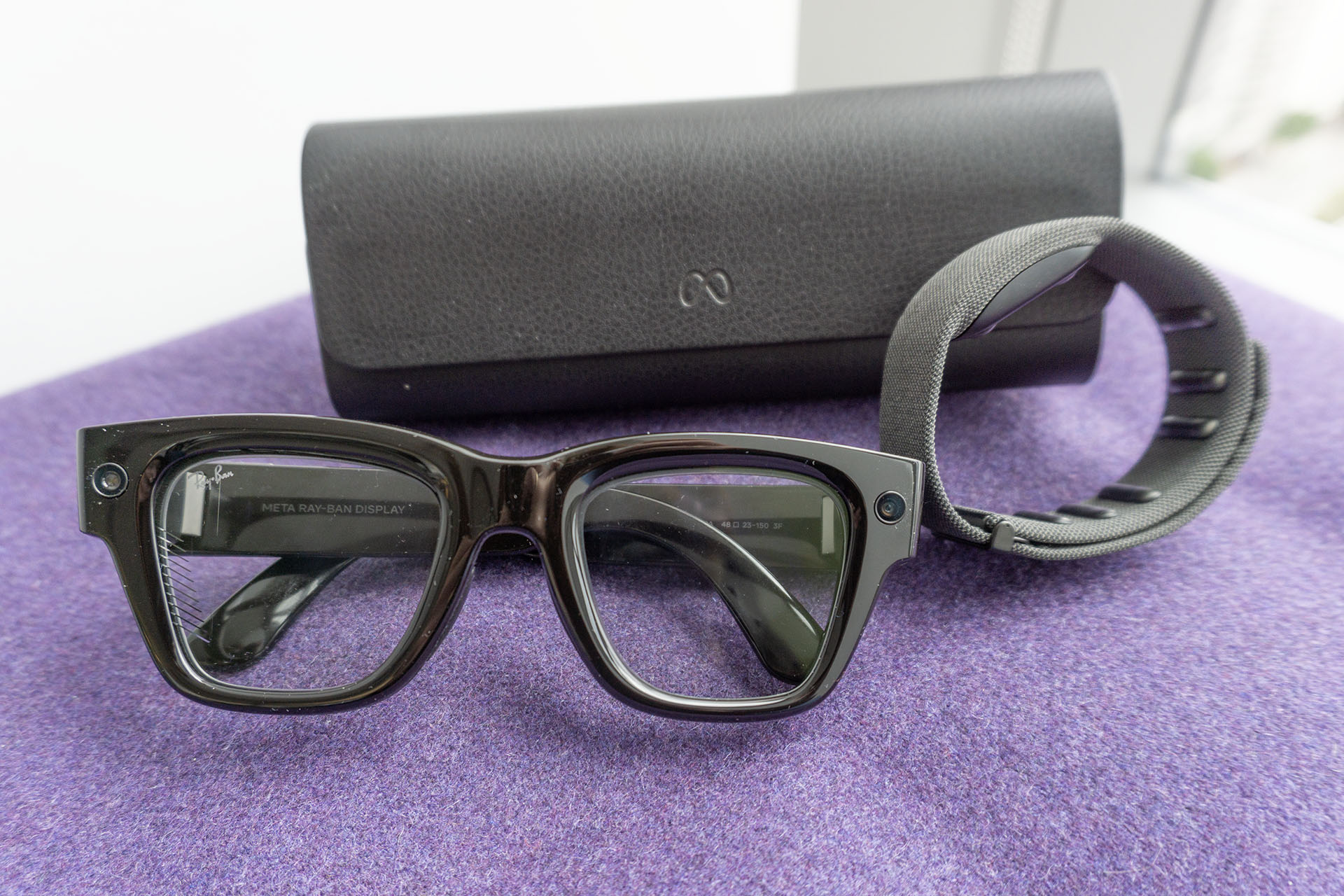
The Meta Ray-Ban Display glasses, charging case and neural band.
Karissa Bell for Engadget
The glasses do come with a charging case that can deliver a few extra charges on-the-go, but I was a bit surprised at how often I had to recharge the case. With my normal Ray-Ban Meta glasses I can go several days without topping up the charging case, but with the Meta Ray-Ban Display case, I’m charging it at least every other day.
Privacy and safety
Whenever I write or post on social media about a pair of Meta-branded glasses, I inevitably hear from people concerned about the privacy implications of these devices. As I wrote in my recent review of Meta’s second-gen Ray-Ban glasses, I share a lot of these concerns. Meta has made subtle but meaningful changes to its glasses’ privacy policy over the last year, and its track record suggests these devices will inevitably scoop up more of our data over time.
In terms of privacy implications of the display-enabled glasses, there isn’t a meaningful difference compared to their counterparts. Meta’s policies are the same for all its wearables. I suppose you could use live translation to surreptitiously eavesdrop on a conversation you wouldn’t typically understand, though that’s technically possible with Meta’s other glasses too. And the addition of a wrist-based controller means taking photos is a bit less obvious, but there’s still an LED indicator that lights up when the camera is on.
The neural band allows you to snap photos without touching the capture button or using a voice command.
Karissa Bell for Engadget
I have been surprised at how many people have asked me if these glasses have some kind of facial recognition abilities. I’m not sure if that’s a sign of people’s general distrust of Meta, or an assumption based on seeing similar glasses in sci-fi flicks, but I do think it’s telling. (They don’t, to be clear. Meta currently only uses facial recognition for two safety-related features on Facebook and Instagram.) Meta hasn’t done much to earn people’s trust when it comes to privacy, and I wish the company would use its growing wearables business to try to prove otherwise.
On a more practical level, I have some safety concerns. The display didn’t hinder my situational awareness while walking, but I could see how it might for others. And I’m definitely not comfortable using the display while driving. Meta does have an audio-only “driving detection” setting that can automatically kick in when you’re traveling in a car, but the feature is optional, which seems potentially problematic.
Should you buy these?
In short: probably not. As much as I’ve been genuinely impressed with Meta’s display tech, I don’t think these glasses make sense for most people right now. And, at $800, the Meta Ray-Ban Display glasses are more than twice as much as the company’s very good second-generation Ray-Ban glasses, which come in a wide range of much more normal-looking frame styles and colors.
The Meta Ray-Ban Display glasses, on the other hand, still look very much like a first-gen product. There are some really compelling use cases for the display, but its functionality is limited. The glasses are also too thick and bulky for what’s meant to be an everyday accessory. At the end of the day, most people want glasses that make them look good. There’s also the fact that right now, these glasses are somewhat difficult to actually buy. They are only available at a handful of physical retailers, which currently have a very limited supply, Meta is also requiring would-be buyers to schedule demo appointments in order to buy, though some stores — like the LensCrafters where I bought my pair — aren’t enforcing this.
Still, there’s a lot to be excited about. Watching people’s reactions to trying these has been almost as much fun as using them myself. Meta also has a solid lineup of new features already in the works, including a standalone Reels app, a teleprompter and gesture-based handwriting for message replies. If you’re already all-in on smart glasses or, like me, you’ve been patiently waiting for glasses with a high quality, usable display, then the Meta Ray-Ban Display glasses are worth the investment now — as long as you can accept the thick frames.
This article originally appeared on Engadget at https://www.engadget.com/wearables/meta-ray-ban-display-review-chunky-frames-with-impressive-abilities-193127070.html?src=rss