NSO permanently barred from targeting WhatsApp users with Pegasus spyware

A federal judge has ordered spyware maker NSO to stop using its Pegasus app to target or infect users of WhatsApp.

The ruling, issued Friday by Phyllis J. Hamilton of of the US District Court of the District of Northern California, grants a permanent injunction sought by WhatsApp owner Meta in a case it brought against NSO in 2019. The lawsuit alleged that Meta caught NSO trying to surreptitiously infect about 1,400 mobile phones—many belonging to attorneys, journalists, human-rights activists, political dissidents, diplomats, and senior foreign government officials—with Pegasus. As part of the campaign, NSO created fake WhatsApp accounts and targeted Meta infrastructure. The suit sought monetary awards and an injunction against the practice.

Setting a precedent

Friday’s ruling ordered NSO to permanently cease targeting WhatsApp users, attempting to infect their devices, or intercepted WhatsApp messages, which are end-to-end encrypted using the open source Signal Protocol. Hamilton also ruled that NSO must delete any data it obtained when targeting the WhatsApp users.

Read full article

Comments

Dropping Thousands Of Soccer And Bouncy Balls From Tower, Helicopter

This is a video of the fun-loving Aussies of How Ridiculous dropping thousands of soccer balls and bouncy balls from a drop tower, crane, and helicopter. This is the kind of thing I wish I did for a living. But nooooo, I have to show up at a factory and work 20 hours a day. Did I mention I’m only 9? Somebody should call somebody and file something. What exactly, I’m not sure, I’m only 9. I don’t even have all my adult teeth yet.

Why an AWS Outage Can Break the Internet

If you used the internet at all on Monday, you probably noticed a lot of things weren’t working all that well. Sites and services around the world experienced interruptions, including the likes of Facebook, McDonald’s, and even Fortnite. You might have heard by now that the issues were caused by an AWS outage. If you don’t know what AWS is, however, that explanation might not be all that clear.

“Amazon Web Services” runs the internet

AWS is an Amazon subsidiary, short for Amazon Web Services. The company offers over 200 cloud-based products to customers, including applications for all of the following:

  • Accessing AWS services

  • Analytics

  • Application integration

  • Blockchain

  • Business applications

  • Cloud Financial Management

  • Compute

  • Customer enablement

  • Containers

  • Databases

  • Developer tools

  • End user computing

  • Frontend web and mobile services

  • Game tech

  • IoT

  • Machine learning and AI

  • Management and governance

  • Media

  • Migration and transfer

  • Networking and content delivery

  • Quantum technologies

  • Satellite

  • Security, identity, and compliance

  • Storage

More than this list, it’s important to understand why AWS matters. The service replaces the need for companies to purchase their own hardware for their data storage, networking, and computing requirements. Instead, companies can choose to outsource these needs to AWS, and adjust those services as those needs change. As such, a company can start out hiring AWS to handle a small amount of their processing, but as the company grows, they can choose to add more servers to their plan—rather than invest in additional hardware to handle the processing. This is known as cloud computing.

In order to keep up with a global demand, AWS relies on a large number of physical server locations spread out throughout the world. Amazon says AWS has 120 “Availability Zones” across 38 global regions—physical locations that contain at least one data center with “redundant power, networking, and connectivity.” The idea is, having these physical data centers across continents means your cloud compute is easier to expand and is better protected from failure—which is a little ironic, given today’s events.

How much of the internet runs on AWS?

In theory, there are a lot of advantages to cloud computing. It can be much simpler and cost efficient for a company to rent AWS servers and technology to power their applications, store their data, or handle their traffic. As such, a lot of the world runs on AWS. According to HG Insights, as of 2025, 4.19 million businesses with a physical address use AWS. (There doesn’t appear to be data on customers without a physical address, so this number could be much higher.) In addition, AWS is the largest cloud computing company in the market at this time: That same report found AWS has 30% of the market, while competitors like Microsoft Azure and Google Cloud make up 20% and 12%, respectively.

Why an AWS outage is such a big deal

When so many companies rely on your cloud computing to run their internet-based services, the risk for failure is great. That’s what we saw on Monday: AWS’ outages resulted in issues with many sites and services. If the HG Insights is correct, as many as 30% of businesses that use some type of cloud computing services could have been impacted today. One analyst thinks the impacts of the outage may be billions of dollars in lost revenue. It’s not clear what the solution is, but it’s clear that there’s a jeopardy in so much of the internet relying on one cloud hosting service.

Claude Code Gets a Web Version

An anonymous reader quotes a report from Ars Technica: Anthropic has added web and mobile interfaces for Claude Code, its immensely popular command-line interface (CLI) agentic AI coding tool. The web interface appears to be well-baked at launch, but the mobile version is limited to iOS and is in an earlier stage of development. The web version of Claude Code can be given access to a GitHub repository. Once that’s done, developers can give it general marching orders like “add real-time inventory tracking to the dashboard.”

As with the CLI version, it gets to work, with updates along the way approximating where it’s at and what it’s doing. The web interface supports the recently implemented Claude Code capability to take suggestions or requested changes while it’s in the middle of working on a task. (Previously, if you saw it doing something wrong or missing something, you often had to cancel and start over.) Developers can run multiple sessions at once and switch between them as needed; they’re listed in a left-side panel in the interface.

Alongside this web and mobile rollout, Anthropic has also introduced a new sandboxing runtime to Claude Code that, along with other things, aims to make the experience both more secure and lower friction. In the past, Claude Code worked by asking permission before making most changes and steps along the way. Now, it can instead be given permissions for specific file system folders and network servers. That means fewer approval steps, but it’s also more secure overall against prompt injection and other risks. You can learn more about “Claude Code on the web” through the company’s blog and official YouTube channel.

Note: the new features are available in beta as a research preview, and they are available to Claude users with Pro or Max subscriptions.


Read more of this story at Slashdot.

NASA’s acting leader seeks to keep his job with new lunar lander announcement

NASA acting administrator Sean Duffy made two television appearances on Monday morning in which he shook up the space agency’s plans to return humans to the Moon.

Speaking on Fox News, where the secretary of transportation frequently appears in his acting role as NASA chief, Duffy said SpaceX has fallen behind in its efforts to develop the Starship vehicle as a lunar lander. Duffy also indirectly acknowledged that NASA’s projected target of a 2027 crewed lunar landing is no longer achievable. Accordingly, he said he intended to expand the competition to develop a lander capable of carrying humans down to the Moon from lunar orbit and back.

“They’re behind schedule, and so the President wants to make sure we beat the Chinese,” Duffy said of SpaceX. “He wants to get there in his term. So I’m in the process of opening that contract up. I think we’ll see companies like Blue [Origin] get involved, and maybe others. We’re going to have a space race in regard to American companies competing to see who can actually lead us back to the Moon first.”

Read full article

Comments

The Real History of Halloween

If you don’t like Halloween, we can’t be friends. I don’t care whether you celebrate with a drunken costume party, pumpkin carving, door-to-door candy begging, or a more personal observance like watching horror movies alone, but respect must be paid to the awesomest of all holidays. But where did Halloween come from, and how did it end up like the modern holiday we now celebrate?

The origins of Halloween are surprisingly slippery. Oct. 31 is next door to a Christian religious holiday, and it’s around “harvest time,” which might generally explain the date, but no one really knows why we put on costumes and beg for candy. There are a ton of theories describing how modern Halloween practices could have sprung from various ancient traditions, religious rites, or folk practices, but the first direct evidence of anything resembling modern “Halloween” is no older than the 1800s, and even then, it didn’t really take off for another 100 years.

Put succinctly, the history of Halloween as we know it is a muddy, confusing collection of practices that probably owe more to Peanuts comics published in the 1950s than Medieval Catholicism or pagan rites.

The theoretical history of Halloween

The most commonly repeated Halloween origin story says that the holiday began with the Samhain (pronounced sah-win or sow-in) celebrations of the Celts in Ireland, England, and Northern France. The date of Nov. 1 or Oct. 31 is about halfway between the autumnal equinox and winter solstice, and ninth century Irish literature describes gatherings and feasts marking Samhain, the day when ancient burial mounds were opened, and with them, portals to the Otherworld, the land of the Gods and the dead. Later, the theory goes, these practices were Christianized, renamed “All Hallow’s Day” and “All Hallow’s Eve” by the early Church, and that’s where we get Halloween. Sounds plausible enough…

…but it’s probably not what happened. The idea that Halloween comes from pagan rituals usurped by Christians originated with Welsh scholar Sir John Rhŷs, and he didn’t back up his theory with a ton of evidence. Some modern historians maintain that ties between Celtic celebrations and early Christian practices are tenuous, and medieval Christian festivals provide the real blueprint for the holiday. Medieval Christians celebrated All Saints’ and All Souls days during the observance of Allhallowtide—the time in the liturgical year dedicated to remembering the dead—by holding community feasts, emphasizing dead souls, and decorating skeletons. But they didn’t get that from the Celts, or so the theory goes.

Either way, both All Souls Day and Samhain likely have roots that go deeper than written history records. Harvest festivals were common in many places, and maybe they were like Halloween parties, but maybe they weren’t. We don’t know. The holiday takes place at the end of the harvest season and the beginning of winter, a time between life and death, when both Pagan and Christian minds turn toward the inevitable end of things. Halloween traditions seem to pay homage to that “between” place, and while we don’t know how much about how ancients celebrated “halfway between solstice and equinox day,” it probably wasn’t by dressing up and begging for treats.

Verified Halloween history

No matter where it started, by 835 AD, All Saints Day (Nov. 1) became an official Catholic day of obligation, and Allhallowtide practices like ringing church bells for souls in purgatory and black-clad criers taking to the streets to remind people to think of the dead are a little Halloween-like. If you squint.

Another tradition of the time was baking “soul cakes” in memory of the dead. This led to “souling,” where groups of children traveled from house to house asking for cakes in exchange for praying for the dead. Later soulers would carry carved lanterns made of hollowed-out turnips too. Is this the origin of “trick or treating” and Jack o’ Lanterns? Maybe…but again, probably not. It doesn’t seem like souling children wore costumes, even though “guising” or “mumming” (dressing in costumes and bothering your neighbors for treats and/or money) was practiced in various places in Europe during other holidays, particularly around Christmas.

Another theory for the origin of costumes for Halloween originates with the Late Medieval French tradition of the Danse Macabre—the dance of death. Perhaps in response to the Black Plague ravaging Europe, 14th century artists would depict the personification of Death surrounded by figures of a pope, an emperor, a king, a child, and a laborer—people from all levels of society—dancing toward the grave. Live versions of the Danse Macabre were enacted at village pageants, no doubt to the delight and horror of all. The grotesque but comical performance reminded people that Death would come for everyone, but also that we should have as much fun as possible before the inevitable, and there’s nothing more “Halloween” than that. But again, this is only a theory.

The origins of Halloween in America

In colonial America, Halloween was not widely observed. While New England Puritans generally frowned on anything fun like wearing costumes, dancing with Death, or carving pumpkins, more liberal colonists in New York, Maryland, and further south may have brought some Halloween-like activities over the ocean from their villages in Germany or Ireland. We don’t really know, but other than for a few pockets of diehards, maybe, celebrating Halloween wasn’t a thing in either the U.S. or Europe before the late 1800s.

The earliest American expression of Halloween-like activities performed in late October or early November came in the form of “play parties,” or Autumn festivals, to celebrate the harvest. These gatherings, immortalized in Washington Irving’s horror tale The Legend of Sleepy Hollow, often included ghost stories, attempts at divination, apple bobbing, pranks, and attempts to scare people—proto-Halloween activities, where you can see the holiday taking shape.

It wasn’t until the Irish mass immigration of the 19th century that we see Halloween celebrations labeled as such. Beginning around the 1850s, Irish immigrants fleeing the Potato Famine descended on the country. These immigrants brought Halloween celebrations to the U.S., but it doesn’t seem like they brought Halloween costumes or trick-or-treating. 

The possible origins of trick-or-treating

All of our modern ideas that Halloween traditions came from this or that ancient practice could be examples of cherry-picking data to support the conclusion that our modern Halloween traditions have a deep lineage in the first place. But what if they don’t?

Trick-or-treating is the most well-known expression of Halloween, but, despite historic examples of costume-clad holiday revelers and/or people going to door to door to beg for treats on holidays, there doesn’t seem to be a direct link between any these older practices and modern trick or treating. Yes, it’s a little like souling, but no one in America seems to have ever practiced souling. There’s no evidence of anyone wearing costumes for Halloween in the U.S., the U.K., or Ireland before 1900 either, leading some Halloween scholars to suggest that American children developed trick-or-treating and costume-wearing independently of any older tradition. Which is actually the coolest theory: American kids made up Halloween from scratch.

The first mention of Halloween candy collection in costume comes from a newspaper in Kingston, Ontario in 1911, but the practice remained obscure enough that there’s no mention of anything like it in Ruth Edna Kelley’s 1919 history of the holiday, The Book of Hallowe’en, and there are no trick-or-treaters depicted in any of the many Halloween postcards printed in the 1920s. The practice doesn’t seem to have been widespread until the late 1930s, when the first mentions of it appears in a national publication, and it didn’t really take off until the early ’50s, when it appeared in a Peanuts comic strip and a Disney cartoon.

From there, everything we call “Halloween” comes into focus: The ghosts, the parties, the scares, the candy, all evolving from comic strips, movies, candy company advertising campaigns, and regular folks who seem to really enjoy dressing up in costumes.

Halloween: The people’s holiday

We ultimately don’t know much about the origin of Halloween because its meaning, and how we celebrate it, change constantly—it used to be a day for parties celebrating the harvest, during which people would read each other’s fortunes; then it became a day for kids to go trick or treating; then adults started using it as an excuse to dress in sexy Martha Washington costumes and get drunk. Parents got a freaked about razorblades in candy and invent “trunk-or-treating;” overly ambitious suburbanites started turning their homes into elaborate spook-houses; and on and on. No ancient pagan ritual needed, just folks figuring out what works for them.

Many other major holidays are rooted in religion or meant to commemorate a specific historical event—they’re top-down holidays, where the Pope or the government decreed that everyone would get a day off on this specific date, and observe it in this specific way. But Halloween is the people’s holiday, so there’s no official list of rules telling us how we’re supposed to commemorate it, or even any reason why we should be celebrating it. But every year we do anyway, perhaps due to a collective desire to get some candy or do something witchy before it gets too cold to go outside.

Hackers Say They Have Personal Data of Thousands of NSA and Other Government Officials

An anonymous reader shares a report: A hacking group that recently doxed hundreds of government officials, including from the Department of Homeland Security (DHS) and Immigration and Customs Enforcement (ICE), has now built dossiers on tens of thousands of U.S. government officials, including NSA employees, a member of the group told 404 Media. The member said the group did this by digging through its caches of stolen Salesforce customer data. The person provided 404 Media with samples of this information, which 404 Media was able to corroborate.

As well as NSA officials, the person sent 404 Media personal data on officials from the Defense Intelligence Agency (DIA), the Federal Trade Commission (FTC), Federal Aviation Administration (FAA), Centers for Disease Control and Prevention (CDC), the Bureau of Alcohol, Tobacco, Firearms and Explosives (ATF), members of the Air Force, and several other agencies.


Read more of this story at Slashdot.

Claude Code gets a web version—but it’s the new sandboxing that really matters

Anthropic has added web and mobile interfaces for Claude Code, its immensely popular command-line interface (CLI) agentic AI coding tool.

The web interface appears to be well-baked at launch, but the mobile version is limited to iOS and is in an earlier stage of development.

The web version of Claude Code can be given access to a GitHub repository. Once that’s done, developers can give it general marching orders like “add real-time inventory tracking to the dashboard.” As with the CLI version, it gets to work, with updates along the way approximating where it’s at and what it’s doing. The web interface supports the recently implemented Claude Code capability to take suggestions or requested changes while it’s in the middle of working on a task. (Previously, if you saw it doing something wrong or missing something, you often had to cancel and start over.)

Read full article

Comments

Louvre Museum Security ‘Outdated and Inadequate’ at Time of Heist

A Court of Accounts report written before Sunday’s theft of crown jewels from the Louvre revealed the museum’s security systems were outdated and inadequate [non-paywalled source]. The report noted a lack of basic CCTV equipment across multiple wings. Cameras had mainly been installed only when rooms were refurbished due to repeated postponements of scheduled modernization. In the Denon wing where the Apollo Gallery was targeted, a third of rooms had no CCTV cameras. Three-quarters of rooms in the Richelieu wing and nearly two-thirds in the Sully wing lacked cameras.

The thieves were caught on camera at one point but were masked and impossible to identify, according to Paris public prosecutor Laure Beccuau. The alarm system activated when thieves cut open display cases, but they threatened staff who left the area. Culture minister Rachida Dati confirmed new CCTV cameras would be installed. President Macron had earmarked $186.30 million to upgrade the Louvre’s security systems under a renaissance plan launched in June.


Read more of this story at Slashdot.

Apple Will Finally Let You Control How Liquid Glass Looks

For better or worse, nothing defines iOS 26 quite so much as Liquid Glass. Apple’s distinct new design language has been met with praise and criticism, with some users enjoying the refreshed look, and others bemoaning the UI’s issues with visibility and consistency.

It seems Apple was similarly of two minds on the update, having toyed around with the exact look of Liquid Glass throughout the iOS 26 beta testing period. The company seemed to be having trouble settling on a specific balance between the design’s glassy effect, which can look really cool, and its overall readability. If buttons are too clear, for example, they’ll let in more of the background elements, which can make it more difficult to see them. But by reducing the glass effect too much by adding a tint to the icon and menu backgrounds, Apple risks loses the charm of the design entirely. (Some critics have dubbed it “Frosted Glass” by comparison.)

While Apple is seemingly still continuing to tweak Liquid Glass, it appears the company has decided that part of the problem is down to user preference. So rather than stick with one look for the design, Apple is now working on a setting that lets you choose whether Liquid Glass looks more clear, or more tinted.

To be clear, or not to be clear

This new setting first appeared in the fourth beta for iOS 26.1, as well as iPadOS 26.1 and macOS 26.1, which Apple released on Monday, Oct. 20. The toggle, which beta testers can find in Settings > Display and Brightness (iOS and iPadOS) or System Settings > Appearance on the Mac (macOS), gives users a simple choice in how Liquid Glass looks across their particular system: “Clear,” which is more transparent, and is in-line with Liquid Glass’ original intent; or “Tinted,” which increases the opacity of menus and windows. You’ll likely be able to read these elements better, but you won’t see as much of the background shining through.


This Tweet is currently unavailable. It might be loading or has been removed.

Giving tester what they asked for (sort of)

During the pre-release beta testing period, some users called on Apple to add a Liquid Glass “slider” to iOS, iPadOS, and macOS. The idea was to allow users to fine-tune how Liquid Glass looks. Apple seems to have taken a different approach, offering only two levels of transparency with the new control. While a slider (or more transparency options, at least) would be great, what we’re getting is better than nothing for users who prefer a more opaque Liquid Glass appearance.

iOS 26.1 is still in beta testing, so it isn’t clear (no pun intended) whether this feature will in fact make it to the official update, and if it does, whether it’ll still work the same way.

How to fix Liquid Glass right now

But even without this dedicated settings page, there is something you can do to “undo” Liquid Glass: By kicking on the “Reduce Transparency” feature in Accessibility settings, you can achieve a similar look to choosing the new “Tinted” option. My guess, however, is that “Tinted” will achieve a more visually pleasing look, as it is something Apple deliberately implemented to work with the design of Liquid Glass, while reduce Transparency is simply a blanket effect that turns down transparency effects across iOS, iPadOS, or macOS.

Google reportedly searching for 15 Pixel “Superfans” to test unreleased phones

It took awhile, but Google’s Pixel line of smartphones has established itself as a mainstay of Android after 10 generations. The company has long operated a “Superfans” group to help promote Pixels, but now members have a slim chance to get their hands on Google’s next phones ahead of time. Google is reportedly looking for some lucky Superfans to test and provide feedback on unreleased devices, but they’ll have to promise not to leak anything.

It’s not unheard of for companies to have loyal customers help test new products, but it’s not usually big companies like Google with well-established products like Pixel. Google usually keeps its circle of hardware testers small and limited to employees. According to Bloomberg, Google is running a contest among Superfans to find 15 non-employees suited to test in-development hardware. An official document reviewed by Bloomberg describes the program as a chance to “provide feedback and help shape a Pixel phone currently in development.”

To apply, interested Superfans have to prove they are more super than the rest. They must demonstrate deep knowledge of the Pixel product family and suggest ways the phones can be improved. However, Google is asking this of its biggest supporters—people who still care enough about their smartphones to seek out a group specifically to talk about how much they care about their phones. Is Google going to get gushing praise or constructive criticism?

Read full article

Comments

What to Expect From Best Buy’s Holiday Sales This Year, Starting With Halloween

We may earn a commission from links on this page. Deal pricing and availability subject to change after time of publication.

The holiday season sales are around the corner, and Best Buy is the first of the major retailers to formally announce their plans. Much like their other big sales, Best Buy is having multiple events. This year, Best Buy is having six sales that you can take advantage of starting on Halloween and leading up to Christmas. Here are the details.

What are Best Buy’s holiday sale events?

You can think of the holiday Sale Events as multiple sales spanning Black Friday, Cyber Monday, and Christmas. All six events take place in store, in app, and online. Each one will be slightly different.

What sales is Best Buy having this Holiday season?

Best Buy has announced the following evetns:

  • Doorbusters: On Oct. 31, the “DoorBOOsters” event will take place with tech deals.

  • New doorbusters every Friday: Then, every Friday of the holiday season (leading up to Dec. 24) will have new deals on select tech.

  • Early Black Friday sale: The early Black Friday sale will start on Oct. 31 and run until Nov. 19. This will lead up to their best sale.

  • Black Friday sale: Best Buy says this will be their main sale, starting on Thursday, Nov. 20 and running until Nov. 29 with deals on “computing, gaming, home theater, wearables, and more.”

  • Cyber Sunday and Monday: Best Buy is extending Cyber Monday to two days and says you can find deals going up to 50% off select tech.

  • Last-minute savings: Their Christmas sale will run from Dec. 15 until Dec. 24.

What deals can you expect during the Holiday Sale Events?

Best Buy says they’ll have deals and in-store demos on Meta Ray-Ban Display; XXL TVs; Copilot+ PCs; small appliance sales from Shark, Ninja, Dyson, Breville; and more. Best Buy says they will also have their usual price-match guarantee, so if the price of something you bought from Best Buy goes down to a lower price during the holiday season, they’ll match it. They’re also extending store hours, which will vary by location.

Do you need to be a member to shop Best Buy’s holiday sales?

While you don’t need a Best Buy membership to shop deals, members can get better savings. It is free to sign up for a My Best Buy membership, which will give you free shipping, but if you join one of its paid subscriptions (My Best Buy Plus for $49.99 per year or My Best Buy Total for $179.99 per year), you’ll get faster free shipping, exclusive prices and deals, an extended 60-day return window on most products, and access to select sales. Paid members will also earn extra rewards.

Nvidia CEO Says Company Went from 95% to 0 Market Share in China

Nvidia CEO Jensen Huang says his company has lost all access to China’s market after U.S. export restrictions eliminated what was once a 95% share. Speaking in an interview with Citadel Securities, Huang questioned the wisdom of policies that cost America one of the world’s largest markets.

The Biden Administration imposed rules in 2022 to restrict exports of Nvidia’s most advanced AI chips to China. The Trump Administration blocked additional chip sales in April and later granted export licenses for certain Nvidia and AMD chips in exchange for 15% of revenues. Chinese regulators responded by telling domestic tech companies to avoid Nvidia chips designed to meet U.S. export requirements. Beijing also placed strict limits on exports of rare earths. Huang noted that about half the world’s AI researchers are in China and called it a mistake not to have them build AI on American technology.


Read more of this story at Slashdot.

Breaking down rare earth element magnets for recycling

All the world’s discarded phones, bricked laptops, and other trashed electronics are collectively a treasure trove of rare earth elements (REEs). But separating out and recovering these increasingly sought-after materials is no easy task.

However, a team of researchers says it has developed a way of separating REEs from waste—magnets, in this case—that is relatively easy, uses less energy, and isn’t nearly as emissions and pollution intensive as current methods. The team published a paper describing this method in the Proceedings of the National Academy of Sciences.

In short, this process involves using an electric current to heat waste magnets to very high temperatures very fast, and using chlorine gas to react with the non-REEs in the mix, keeping them in the vapor phase. James Tour, one of the authors and a professor of materials science and nanoengineering at Rice University, says that the research can help the United States meet its growing need for these elements.

Read full article

Comments

One of Google’s New York offices needs literal debugging

Bed bugs: the nightmare of any city dweller, frequent traveller, and now Google employee. The team at the company’s Chelsea campus were notified on Sunday that a possible bed bug infestation had been discovered in the building and were told to remain at home so the location could be treated. As if working over the weekend wasn’t enough of a bummer. Fortunately, exterminators collected their bug bounty, and employees were allowed to return to the building on Monday morning.

Google told employees to file a report if they had symptoms of bed bug bites or saw evidence of bed bugs on site, according to an email sent by the company and obtained by Wired. They were also told to contact professional exterminators if they accidentally brought bed bugs home; hopefully Google foots the bill for those unlucky people.

According to Wired‘s sources, the infestation may have been caused by “a number of large stuffed animals” in the Google office, but the publication wasn’t able to confirm that. It’s always the ones you least suspect.

This article originally appeared on Engadget at https://www.engadget.com/big-tech/one-of-googles-new-york-offices-needs-literal-debugging-194029103.html?src=rss

X Is Changing How It Displays Articles

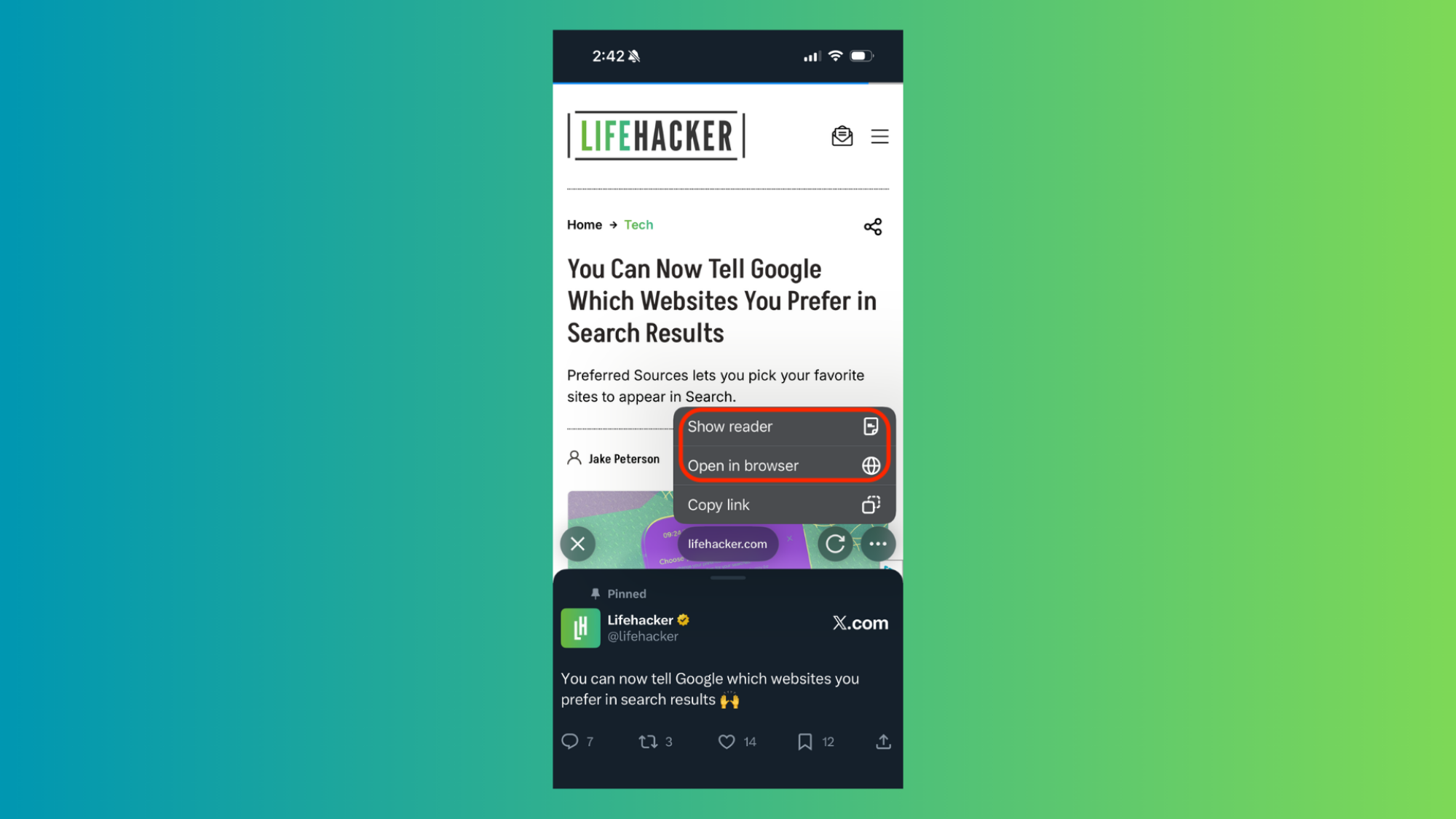
If you use the X app on iPhone, there’s a good chance any links you open today will look different than they did yesterday. That’s because the platform is trying to up engagement on posts with links in them, by keeping the like, comment, repost, favorite, and share buttons active in a new footer even when you click through to an outside article.

When you click on a link in X, it doesn’t actually navigate away from the app, but instead uses a special version of either Chrome (on Android) or Safari (on iPhone) to open the article within X. That hasn’t changed. But what has is that, on iPhone, you’ll now continue to see interactable elements at the bottom of the page, with buttons you can press to engage directly with X while reading. Also, when you first access a link or scroll up, you’ll even see part of the original social media post that drove you there above those buttons. These elements will remain even if you click another link in the article you’re reading.

It’s a small change despite maybe looking a little busy, but it points to a potential fix for a major problem. According to X head of product Nikita Bier, the idea is to try to increase traffic for posts with links in them, by making it easier for users to engage with them even after clicking through.


This Tweet is currently unavailable. It might be loading or has been removed.

A lot of controversy has been made about X posts that include links getting less traffic than those that don’t, especially after the platform was acquired by current owner Elon Musk. While the site hasn’t admitted to it directly, SEO experts have recently started warning users to avoid putting links in their traffic, claiming that X now deprioritizes posts with links on them, as they keep people away from their timelines. Musk has also made comments that some have accused of implying this to be the case.

Bier, however, refuted this while debuting the new interface for opening links on iOS, instead saying “links are not deboosted,” and implying that the lack of interactable timeline elements on them simply leads to less engagement naturally, something the new change is trying to fix.

For instance, the old method of opening links could potentially draw you away from the site and interrupt any intention you had to reply to the original social media post or share it to your own audience. Bier said this is what led to posts getting lower reach, and that the new footer should help them “get better signal.”

But at the same time, it’s clear that the new approach has benefits for X as well, since it gives users easier avenues to navigate away from external articles and back to their timelines, where they can drive engagement on other posts and see ads.

But regardless of whether X manually deprioritizes posts with links, or if the motivations for the change are selfish, the fact that changes like this are even being made means the platform might finally start trying to make linking in posts more viable. That could be a huge boon for users like myself, who have historically used X (and Twitter before it) to help drive traffic to our posts. Whatever the reason this stopped working, it would be helpful for those who rely on it if it were fixed.

That said, there’s a chance you might not be seeing the new interface at all, or that if you are, you might not like it. Luckily, if that sounds like you, you’re not out of options.

X Links only look different on iPhone, for now

In the post announcing the change, Bier mentioned that the “new link experience” is only in testing, and that it’s only on iOS at the moment. That means that, while I do currently see it on posts I’m opening with my iPhone 15 Pro, you might not. On my Pixel 10, I’m still getting the old interface, and even on iPhone, it doesn’t seem to be affecting all users. My husband, for instance, is not seeing the footer on his iPhone 17 Pro. 

That’s great news if you don’t like the look of the new footer, although if you would like to try it out, I unfortunately don’t have much advice at the moment. It seems only some users have access to it right now.

However, if you are seeing the new footer but you would prefer not to, there are two steps you can take to get rid of it.

How to open X links without the new footer

How to remove X footer from links

Credit: Michelle Ehrhardt

The change to how X links work is server-side, so downgrading your app or avoiding an update won’t save you here. Instead, to get rid of the footer from links you open in X, you’ll need to first open the link, then hit the three-dots button just above the footer on the right-hand side.

From there, you’ve got two options. First, to open the page with its formatting intact but no footer, tap “Open in browser.” This will open the link in your default browser, but also take you to that browser’s app instead, meaning you’ll have to find your way back to the X app if you want to keep scrolling once you’re done reading.

To stay in the X app, you can take advantage of Safari’s reader mode, which will still be available to you even if Chrome or another app is your default browser. In the same three-dot menu, simply tap “Show Reader” instead, and you’ll see a plain version of the link with all website formatting stripped out, including the X app’s new footer, all without having to move to a new app. To return to the normal view, just tap the X button in the top left corner. Then, to go back to your X timeline, either grab the footer and scroll up, or tap the X button just above the footer on the left-hand side.

Google To Let ‘Superfans’ Test In-Development Pixel Phones

Google plans to let Pixel smartphone enthusiasts test out the company’s next handset ahead of its public introduction. From a report: Google has invited members of its “Superfans” group to apply to test future Pixel hardware, asking entrants to profess their knowledge and passion for the brand in hopes of being able to beta test forthcoming products.

Consumer tech companies often let small groups of customers try out unreleased products under strict secrecy to gather feedback during development. But it’s incredibly rare for a company of Google’s size to do it with something as high-profile as the Pixel lineup.

The search giant will select 15 people from the pool of entrants, and winners must all sign a non-disclosure agreement to receive devices, according to official rules for the contest reviewed by Bloomberg News. “The Trusted Tester program is an opportunity to provide feedback and help shape a Pixel phone currently in development,” the document reads.


Read more of this story at Slashdot.

Do animals fall for optical illusions? It’s complicated.

Chances are you’ve encountered some version of the “Ebbinghaus illusion,” in which a central circle appears to be smaller when encircled by larger circles and seems larger when surrounded by smaller circles. It’s an example of context-dependent size perception. But is this unique to humans or are some animals susceptible as well? According to a new paper published in the journal Frontiers in Psychology, it might depend on the specific sensory environment, since the illusion relies on contextual clues to be effective.

Prior research has produced mixed results on the question of animals and their susceptibility to optical illusions, per the authors. Dolphins, chicks, and redtail splitfins seem to be susceptible, for example, while pigeons, baboons, and gray bamboo snakes are not.

Perhaps the best-known example is cats’ undeniable love of boxes and squares—the “if it fits, I sits” phenomenon documented all over the Internet. This behavior is generally attributed to the fact that cats feel safer when squeezed into small spaces, but it also tells us something about feline visual perception. Both a 1988 study and a 2021 study concluded that cats are susceptible to the Kanizsa square illusion, suggesting that they perceive subjective contours much like humans.

Read full article

Comments

Watch Battlefield 6 Run On A CPU Liquid Cooler’s Miniscule 2.1-Inch Display

Watch Battlefield 6 Run On A CPU Liquid Cooler's Miniscule 2.1-Inch Display
Fancy all-in-one (AIO) CPU liquid coolers with integrated displays are a favorite of PC builders looking to add a bit of flair to their rigs. Most opt for the utilitarian route and use it as way to keep tabs on CPU temperatures or other system statistics, while others deploy memes or anime clips. Then there’s those who take things to the next

How to watch Samsung unveil its Android XR headset

Samsung is set to officially reveal its long-anticipated Android extended reality (XR) headset, which has been codenamed Project Moohan. The company has scheduled a livestream event for October 21 at 10PM ET.

The event will be streamed live via the company’s YouTube page and on the official Samsung Newsroom site. We don’t know how long the stream will be, but Samsung promises that Project Moohan will open up the “true potential” of mixed-reality devices.

This isn’t just a reveal for a mixed-reality headset. Moohan is the very first device that uses Google’s new Android XR operating system, which has been specifically designed for XR, VR and AR devices like glasses and headsets. We’ll finally get to see what all the fuss is about and what kind of new tools the OS brings to the table.

Samsung says that this technology “seamlessly blends everyday utility with immersive new experiences.” Hopefully we’ll get a look at both everyday utility and immersive new experiences during the livestream.

We don’t have official specs about the headset itself, but there have been plenty of leaks and rumors that will be confirmed or refuted during the stream. Leaks have suggested it includes a high-end display, advanced tracking and Gemini integration. These same leaks indicate a potential price tag of $1,800 to $2,800, making it more of a rival to the Apple Vision Pro than Meta’s new Ray-Ban Display glasses.

This article originally appeared on Engadget at https://www.engadget.com/ar-vr/how-to-watch-samsung-unveil-its-android-xr-headset-184820772.html?src=rss