This Vizio 4K Smart TV Is Under $350 Right Now

We may earn a commission from links on this page. Deal pricing and availability subject to change after time of publication.

If you’ve been eyeing a big-screen upgrade without blowing past your budget, the Vizio 65-inch 4K UHD LED Smart TV (V4K65M-08) might just be the solution you need. It’s currently $348 at Walmart (down from $428)—a solid deal for a name-brand 65-inch TV that supports 4K, Dolby Vision, and HDR10.

The design is simple but modern, with slim bezels and a brushed-metal look at the bottom that keeps it from feeling like a “budget TV.” At this price, though, expectations need to be realistic: You’re getting a solid, serviceable panel for movies, shows, and casual gaming, not OLED-level brilliance.

Picture quality is respectable for a set this cheap. The contrast ratio of 5,036:1 gives decent depth to darker scenes, though overall brightness (around 282 nits) can feel dim in well-lit rooms. It handles standard dynamic range content well and offers accurate colors when viewed head-on, but move too far off to the side, and saturation drops noticeably. It’s not ideal for wide living rooms, but if your couch faces the TV directly, you’ll get a consistent image, notes this PCMag review. Motion handling is decent for everyday use, though the 60Hz refresh rate means it won’t match higher-end models for fast-paced sports or gaming fluidity. That said, input lag is impressively low (around 3ms), which helps keep gameplay responsive even without fancy gaming features like VRR or FreeSync.

Vizio’s SmartCast platform runs the show, offering access to popular apps like Netflix, Disney+, Prime Video, and YouTube. It’s simple and no-frills, with built-in AirPlay and Chromecast support for streaming from your phone or iPad. The included remote gets the job done with dedicated buttons for major services and a microphone for voice search (though it can’t control smart home devices). Connectivity is basic—three HDMI ports, one USB, and no Ethernet—but that’s par for the price. Still, for under $350, the Vizio 4K 65-inch offers a balanced mix of size, streaming, and 4K sharpness that makes it a solid pick for bedrooms, spare rooms, or anyone just looking to go big on a budget.


Our Best Editor-Vetted Tech Deals Right Now

Deals are selected by our commerce team

Lenovo’s IBM DNA Guides its Hybrid AI Ascent: Out-Executing Rivals with Integrated Solutions and Water-Cooled Prowess

In the dynamic arena of enterprise technology, a familiar giant, Lenovo, is making a formidable statement in the artificial intelligence (AI) landscape. Its latest announcement, an expansion of the Lenovo Hybrid AI Advantage™, offers a comprehensive framework of new advisory services, industry-specific solutions and robust hybrid AI platforms. This move isn’t just about offering more products; it’s a testament to Lenovo’s unique heritage and its methodical execution, qualities that are allowing it to outmaneuver competitors like Dell in the complex race to bring AI’s promised return on investment (ROI) to fruition.

A Legacy of Execution: The IBM Blueprint in the AI Era

Lenovo’s approach to AI is deeply rooted in its corporate DNA, a lineage that traces back to its strategic acquisition of IBM’s PC business. This wasn’t merely a purchase of assets; it was an absorption of a culture of engineering excellence and enterprise focus. While many recall IBM’s struggles in the PC market, Lenovo demonstrated a remarkable ability to not just sustain but to revitalize businesses that even Big Blue had seen as waning. This history of successfully integrating complex acquisitions and executing enterprise-grade solutions provides Lenovo with a distinct advantage in the AI era. They understand the intricacies of large-scale deployments, the need for trusted partnerships (such as with IBM watsonx), and the importance of delivering tangible value in a way that goes beyond just selling hardware. This deep institutional knowledge, honed through years of serving global enterprises, is evident in Lenovo’s current AI strategy.

Out-Executing in AI: Beyond the Hype to Real ROI

The current AI landscape is brimming with promises, but many organizations are struggling to translate AI investments into measurable returns. Lenovo’s own Global CIO Playbook reveals that two-thirds of organizations have yet to see ROI from AI investments (Lenovo Finds 65% of IT Leaders Admit Their Defenses Can’t Withstand AI Cybercrime), highlighting critical training, adoption and technical gaps. While some companies focus on selling the raw AI components, Lenovo’s expanded Hybrid AI Advantage offers a holistic framework designed to close these very gaps.

This isn’t just about hardware; it’s about a complete solution. Lenovo is deploying new AI Adoption & Change Management Services to ensure workforces confidently embrace AI, thereby speeding enterprise deployment and actually achieving ROI at scale. This focus on “people readiness” and “cultural readiness” is a critical differentiator, acknowledging that successful AI transformation is as much about human integration as it is about technical prowess. It’s about ensuring AI doesn’t just sit there looking smart, but actually makes employees smarter and more productive, leading to a 31% increase in time saved per week with generative AI tools. This comprehensive, execution-focused approach allows Lenovo to distinguish itself from competitors who might offer powerful AI building blocks but lack the integrated services and vertical solutions necessary to unlock real business value.

Leadership in Liquid Cooling: The Unseen AI Powerhouse

For the most demanding AI workloads, heat is the enemy of performance. This is where Lenovo’s long-standing leadership in liquid cooling becomes a significant and often unseen advantage. While others might be scrambling to adopt advanced thermal management, Lenovo has been integrating liquid cooling into its data center offerings for years. This expertise is crucial for the high-performance servers with accelerated computing necessary for “AI factories.” Liquid cooling allows for denser deployments, more consistent performance under heavy loads, and significantly improved energy efficiency – a key consideration as AI budgets reportedly triple to nearly 20% of IT budgets in 2025. Lenovo’s new ThinkSystem SR680a V4 system, an air-cooled variant, features powerful NVIDIA Blackwell GPUs, but Lenovo’s broader push includes predominantly water-cooled AI solutions, leveraging a unique advantage in this specialized area (New 6th Gen Neptune® Liquid Cooling for AI Tasks – Lenovo). This allows customers to reduce the total cost of ownership by optimizing energy consumption and extending hardware lifespan.

Driving Industry Transformation with Validated Solutions

Lenovo’s expanded portfolio includes validated vertical AI solutions tailored for specific industries, moving businesses beyond experimentation to measurable outcomes. This includes AI infrastructure solutions for:

  • Hospitality (with Centific AI Data Foundry and NVIDIA) to boost guest loyalty and optimize efficiency.
  • Workplace Safety & PPE Compliance (with Avathon Visual AI and NVIDIA) for real-time hazard detection and automated corrective actions.
  • Retail and Smart Spaces (with WaitTime and Intel) delivering real-time crowd analytics and driving revenue growth.
  • Quality Inspection (with Trifork and NVIDIA) for automated defect detection and on-device model retraining on the factory floor.

These purpose-built solutions, tested and proven, demonstrate Lenovo’s commitment to activating AI across entire workforces and operations.

Expanded Ecosystem: The Hybrid AI Factory of Modern Business

The expansion of Lenovo Hybrid AI Advantage is built on strengthened partnerships with industry leaders like Cisco, IBM and NVIDIA. These collaborations deliver new integrated solutions and platforms designed to help enterprises build, scale and operate hybrid AI factories anywhere. For example, the new ThinkSystem SR680a V4 unleashes massive computational performance, offering up to 11x faster AI inferencing on large language models (LLMs) compared to previous generations. The Lenovo hybrid AI platform with IBM watsonx provides ready-to-deploy, high-performance AI infrastructure with Red Hat OpenShift and NVIDIA, accelerating generative AI model development and governance. The enhanced platform with Cisco Nexus switches and NVIDIA Spectrum-X technology boosts enterprise AI factory deployments, enabling 1.6x faster AI network performance (Lenovo Boosts Enterprise AI Factory Deployments with NVIDIA RTX PRO Servers and Lenovo Hybrid AI 285 Platform). These integrated solutions underscore Lenovo’s comprehensive approach, ensuring that enterprises, regardless of where they are on their AI journey, can achieve real business outcomes with trusted and proven AI infrastructure deployed on devices at the edge and in the cloud.

Wrapping Up: Lenovo’s Strategic Ascent in Enterprise AI

Lenovo’s expanded Hybrid AI Advantage solidifies its position as a global IT powerhouse adept at navigating the complexities of enterprise AI transformation. By blending its deep IBM-inherited execution capabilities, leadership in critical areas like liquid cooling, and a holistic suite of AI adoption services, validated vertical solutions, and robust hybrid platforms, Lenovo is outmaneuvering rivals in delivering tangible AI ROI. This comprehensive strategy, built on strong partnerships and a focus on measurable outcomes, positions Lenovo not just as a provider of AI components, but as a trusted architect of the enterprise AI future, heralding a more democratized and personalized turning point for AI from device to cloud.

Ubisoft is laying off more workers and offering voluntary buyouts

Ubisoft’s Massive Entertainment, the developer of The Division series, Star Wars Outlaws and Avatar: Frontiers of Pandora is offering some employees volunteer buyouts as it attempts to “realign” its teams, the company said in a post on X. The move is designed to “strengthen our roadmap,” Massive wrote, as it focuses on The Division series along with its Snowdrop engine and Ubisoft Connect. Ubisoft notably didn’t mention Star Wars and Avatar in that statement, an omission that may effectively spell the demise of those franchises. 

Massive framed the layoffs as a “voluntary career transition program… supported by a comprehensive package that includes financial and career assistance.” Workers at the Massive studio in Malm, Sweden can volunteer until December 13 for the package, which primarily targets people between projects waiting for new assignments, according to the French news site Le Figaro. 

Another Ubisoft studio, Helsinki-based RedLynx, also announced that it was restructuring “as part of Ubisoft’s global efforts to simplify, reduce costs and ensure a stronger prioritization and efficiency.” If implemented, the proposal would result in a maximum of 60 workers being let go, RedLynx said. 

Following the underperformance of key titles like Star Wars Outlaws and Avatar: Frontiers of Pandora, Ubisoft has shuttered offices and laid off workers at offices in San Francisco, London and Leamington. Last year, the company’s headcount dropped from 20,279 to 18,666 at the end of September. Earlier this month, Ubisoft partnered with Tencent to launch Vantage Studios, which now houses the company’s tentpole franchises: Assassin’s Creed, Far Cry and Rainbow Six.

This article originally appeared on Engadget at https://www.engadget.com/gaming/ubisoft-is-laying-off-more-workers-and-offering-voluntary-buyouts-120030931.html?src=rss

Texas lawmakers double down on Discovery, call for DOJ investigation into Smithsonian

Have you heard the news that Texas’ senators want to chop up NASA’s retired space shuttle Discovery in order to move it from the Smithsonian to Houston? The lawmakers in question have and are now crying foul to the Department of Justice.

Sens. John Cornyn (R-Texas) and Ted Cruz (R-Texas), together with Rep. Randy Weber (R-Texas), on Wednesday sent a letter to the DOJ urging the Smithsonian be investigated for allegedly violating the Anti-Lobbying Act. They claim that the institution—Discovery‘s home for the past 13 years—improperly used appropriated funds to influence Congress regarding the relocation of the winged orbiter.

“Public reporting suggests the Smithsonian Institution has taken affirmative steps to oppose the passage and implementation of the shuttle’s relocation, as part of President Trump’s One Big Beautiful Bill Act,” wrote Cornyn and Cruz to Attorney General Pamela Bondi and Assistant Attorney General Brett Shumate. “These steps include lobbying the staff of the Senate Appropriations and Rules Committees to express disapproval, coordinating with members of the press to generate public opposition to the law’s passage and disseminating misinformation about the cost and logistics of the move.”

Read full article

Comments

California startup to demonstrate space weapon on its own dime

Defense contractors are in full sales mode to win a piece of a potentially trillion-dollar pie for development of the Trump administration’s proposed Golden Dome missile shield.

CEOs are touting their companies’ ability to rapidly spool up satellite, sensor, and rocket production. Publicly, they all agree with the assertion of Pentagon officials that US industry already possesses the technologies required to make a homeland missile defense system work.

The challenge, they say, is tying all of it together under the umbrella of a sophisticated command and control network. Sensors must be able to detect and track missile threats, and that information must rapidly get to weapons that can shoot them down. Gen. Chance Saltzman, the Space Force’s top commander, likes to call Golden Dome a “systems of systems.”

Read full article

Comments

We let OpenAI’s “Agent Mode” surf the web for us—here’s what happened

On Tuesday, OpenAI announced Atlas, a new web browser with ChatGPT integration, to let you “chat with a page,” as the company puts it. But Atlas also goes beyond the usual LLM back-and-forth with Agent Mode, a “preview mode” feature the company says can “get work done for you” by clicking, scrolling, and reading through various tabs.

“Agentic” AI is far from new, of course; OpenAI itself rolled out a preview of the web browsing Operator agent in January and introduced the more generalized “ChatGPT agent” in July. Still, prominently featuring this capability in a major product release like this—even in “preview mode”—signals a clear push to get this kind of system in front of end users.

I wanted to put Atlas’ Agent Mode through its paces to see if it could really save me time in doing the kinds of tedious online tasks I plod through every day. In each case, I’ll outline a web-based problem, lay out the Agent Mode prompt I devised to try to solve it, and describe the results. My final evaluation will rank each task on a 10-point scale, with 10 being “did exactly what I wanted with no problems” and one being “complete failure.”

Read full article

Comments

Samsung’s Galaxy XR doesn’t give me much hope for Android XR

So Samsung made a “Vision Pro Lite.” That was my immediate takeaway after this week’s debut of the Galaxy XR, the first Android XR device to hit the market. While Samsung deserves credit for offering something close to the Vision Pro for nearly half the price, an $1,800 headset still won’t get mainstream consumers rushing out the door to experience the wonders of mixed reality. And with the limited amount of content in Android XR at the moment, the Galaxy XR is in the same position as the Vision Pro: It’s just a well-polished developer kit. 

The only logical reason to buy a Galaxy XR would be to test out apps for Android XR. If you just want to experience VR and dabble in a bit of augmented reality, you’re better off spending that money on a gaming laptop and the excellent $500 Meta Quest 3. (The Meta Quest Pro, the company’s first high-end mixed reality device, was unceremoniously killed after launching at an eye-watering $1,500.) 

But even for developers, the Galaxy XR feels like it’s lacking, well, vision. Samsung has done an admirable job of copying almost every aspect of the Vision Pro: The sleek ski goggle design, dual micro-OLED displays and hand gesture interaction powered by a slew of cameras and sensors. But while Apple positioned the Vision Pro as its first stab at spatial computing, an exciting new platform where we can use interactive apps in virtual space, Samsung and Google are basically just gunning to put Android on your face. 

There aren’t many custom-built XR apps, aside from Google’s offerings like Maps and Photos. (Something that also reminds me of the dearth of real tablet apps on Android.) And the ability to view 360-degree videos on YouTube has been a staple of every VR headset for the last decade — it’s not exactly notable on something that costs $1,800. Samsung and Google also haven’t said much about how they plan to elevate XR content. At least Apple is attempting to push the industry forward with its 8K Immersive Videos, which look sharper and more realistic than low-res 360-degree content.

For the most part, it seems as if Google is treating Android XR as another way to force its Gemini AI on users. In its press release for the Galaxy XR, Samsung notes that it’s “introducing a new category of AI-native devices designed to deliver immersive experiences in a form factor optimized for multimodal AI.” 

…What? 

In addition to being a crime against the English language, what the company is actually pitching is fairly simple: It’s just launching a headset that can access AI features via camera and voice inputs. 

Who knows, maybe Gemini will make Android XR devices more capable down the line. But at the moment, all I’m seeing in the Galaxy XR is another Samsung device that’s shamelessly aping Apple, from the virtual avatars to specific pinch gestures. And Google’s history in VR and interactive content doesn’t inspire much hope about Android XR. Don’t forget how it completely abandoned Google Cardboard, the short-lived Daydream project and its hyped up Stadia cloud service. Stadia’s death was particularly galling, since Google initially pitched it as a way to revolutionize the very world of gaming, only to let it fall on its face.

There’s no doubt that Samsung, Apple and Meta have a ton of work left ahead in the world of XR. Samsung is at least closer to delivering something under $1,000, and Meta also recently launched the $800 Ray-Ban Display. But price is only one part of the problem. Purpose is another issue entirely. After living with the Vision Pro since its debut, I can tell that Apple is at least thinking a bit more deeply about what it’s like to wear a computer on your face. Just look at the upgrades its made around ultra-wide Mac mirroring, or the way Spatial Personas make it feel as if you’re working alongside other people. With Android XR, Google seems to just be making a more open Vision Pro.

Honestly, it’s unclear if normal users will ever want to use any sort of XR headset regularly, no matter how cheap they get. The experience making these headsets could help Google, Apple and Meta develop future AR glasses, or eyewear that offer some sort of XR experience (Samsung already has something in the works with Warby Parker and Gentle Monster). But while Apple and Meta have broken new ground in XR, Google and Samsung just seem to be following in their footsteps.

This article originally appeared on Engadget at https://www.engadget.com/ar-vr/samsungs-galaxy-xr-doesnt-give-me-much-hope-for-android-xr-110000129.html?src=rss

Apple Readies New Framework To Let iPhone Users Migrate App Data To Android

An anonymous reader quotes a report from 9to5Mac: Apple has been working on a new framework called AppMigrationKit, which will be compatible with devices running iOS 26.1 and later, as well as iPadOS 26.1 and later. Like iOS and iPadOS 26.1, the framework is currently in beta and will allow developers to include their app’s data during the migration process between Apple and non-Apple devices (which, for now, essentially means Android). Interestingly, Apple notes that this framework is not intended for data migration between iOS and iPadOS, but rather exclusively to and from non-Apple devices: “AppMigrationKit only supports migration to and from non-Apple platforms, such as Android. The system doesn’t use the framework for migration between iOS or iPadOS devices. The framework also has no functionality in iOS apps running in visionOS or in macOS on Apple silicon. The framework ignores calls from Mac apps built with Mac Catalyst.” The AppMigrationKit documentation can be found here.


Read more of this story at Slashdot.

Fujifilm’s X-T30 III adds a film simulation dial and 6K video

When Fujifilm launched the X-T50 last year, no one was sure what would happen with its aging X-T30 lineup. The company just answered that question with the launch of the X-T30 III, boosting the speed and improving autofocus of the last model, while adding a film simulation dial seen on other recent models. It’s very light for travel or street photography, but has some powerful features like 6.2K video and subject-detect autofocus, all at a reasonable price. 

The original X-T30 first arrived in 2019 and was replaced in 2022 by the X-T30 II that was more of a mild update than an all-new camera. However, the X-T30 III has a number of key updates that bring it in line with other recent models like the X-M5 and X-T50. It does have the same 26.1MP X-Trans sensor as before (with a 1.5x crop compared to a full-frame camera), but now uses Fujifilm’s latest image processor that doubles image processing speed and significantly improves video capabilities. 

Fujifilm's X-T30 III is its latest camera with a film simulation dial
Ryan Tuttle for Fujifilm

The X-T30 III is meant to be taken on adventures, so it’s still very light at just 378 grams or 13.33 ounces, a touch less than the previous model. Control-wise, the biggest addition is a film simulation dial just like the one on the X-M5 and X-T50, replacing the mode dial from the X-T30 II. It’s designed to make it easy to switch between film simulations like Reala Ace and Nostalgic Neg, while offering three customizable positions to let users save “recipes” of their own making. 

Otherwise, the X-T30 III has a generous complement of dials and buttons something that allows for precise control but may intimidate newbies. The rear display tilts up but doesn’t flip out, and the 2.36-million-dot electronic viewfinder is on the low end for resolution. The main feature missing on the X-T30 III is in-body stabilization, so you’ll need either a stabilized (OIS) lens or electronic stabilization for video. 

Fujifilm's X-T30 III is its latest camera with a film simulation dial
Fujjifilm

Burst shooting speeds are the same as before at 8 fps with the mechanical shutter and 20 fps in electronic mode. However, more of your shots are likely to be sharp thanks to the updated, faster autofocus. Along with the extra speed, Fujifilm introduced new AI subject detection modes including Auto-Tracking, Animals, Birds and Vehicles. 

Video also gets a big upgrade. The X-T30 III can now shot 6.2K 30 fps video using the entire sensor (up from 4K 30p before), or 4K at 60 fps with a mild 1.18x crop. All of those resolutions are available with 10-bit modes to boost dynamic range. However, the X-T30 III lacks in-body stabilization, has a weird 2.5mm microphone input and a display that only tilts and doesn’t flip out. That makes it fine as a hybrid camera, but if you mostly shoot video, a model like the X-S20 may be a better choice. 

Fujifilm's X-T30 III is its latest camera with a film simulation dial
Fujifilm

Other key features include a microHDMI port for RAW video output, a single SD memory card (that’s of the low-speed UHS-I variety unfortunately), and improved battery life with up to 425 shots to a charge. Fujifilm also introduced a new lens, the Fujinon XC13-33mmF3.5-6.3 OIS that offers an interesting ultrawide full-frame equivalent zoom range of around 20-50mm. 

The X-T30 III is now on pre-order for $999 in multiple colors (black, charcoal silver and silver) with shipping set to start in November 2025. The Fujinon XC13-33mmF3.5-6.3 OIS will also ship around the same time for $399. 

This article originally appeared on Engadget at https://www.engadget.com/cameras/fujifilms-x-t30-iii-adds-a-film-simulation-dial-and-6k-video-072148245.html?src=rss

AI Assistants Misrepresent News Content 45% of the Time

An anonymous reader quotes a report from the BBC: New research coordinated by the European Broadcasting Union (EBU) and led by the BBC has found that AI assistants — already a daily information gateway for millions of people — routinely misrepresent news content no matter which language, territory, or AI platform is tested. The intensive international study of unprecedented scope and scale was launched at the EBU News Assembly, in Naples. Involving 22 public service media (PSM) organizations in 18 countries working in 14 languages, it identified multiple systemic issues across four leading AI tools. Professional journalists from participating PSM evaluated more than 3,000 responses from ChatGPT, Copilot, Gemini, and Perplexity against key criteria, including accuracy, sourcing, distinguishing opinion from fact, and providing context.

Key findings: – 45% of all AI answers had at least one significant issue. – 31% of responses showed serious sourcing problems – missing, misleading, or incorrect attributions. – 20% contained major accuracy issues, including hallucinated details and outdated information. – Gemini performed worst with significant issues in 76% of responses, more than double the other assistants, largely due to its poor sourcing performance. – Comparison between the BBC’s results earlier this year and this study show some improvements but still high levels of errors. The team has released a News Integrity in AI Assistants Toolkit to help develop solutions to these problems and boost users’ media literacy. They’re also urging regulators to enforce laws on information integrity and continue independent monitoring of AI assistants.


Read more of this story at Slashdot.

Cache poisoning vulnerabilities found in 2 DNS resolving apps

The makers of BIND, the Internet’s most widely used software for resolving domain names, are warning of two vulnerabilities that allow attackers to poison entire caches of results and send users to malicious destinations that are indistinguishable from the real ones.

The vulnerabilities, tracked as CVE-2025-40778 and CVE-2025-40780, stem from a logic error and a weakness in generating pseudo-random numbers, respectively. They each carry a severity rating of 8.6. Separately, makers of the Domain Name System resolver software Unbound warned of similar vulnerabilities that were reported by the same researchers. The unbound vulnerability severity score is 5.6

Revisiting Kaminsky’s cache poisoning attack

The vulnerabilities can be exploited to cause DNS resolvers located inside thousands of organizations to replace valid results for domain lookups with corrupted ones. The corrupted results would replace the IP addresses controlled by the domain name operator (for instance, 3.15.119.63 for arstechnica.com) with malicious ones controlled by the attacker. Patches for all three vulnerabilities became available on Wednesday.

Read full article

Comments

YouTube Brandishes A New Weapon In War Against AI Deepfake Videos

YouTube Brandishes A New Weapon In War Against AI Deepfake Videos
In the face of ever-growing generative AI usage and YouTube’s own dabbling with those features, Google has announced an important safeguard for creators on the platform—Likeness Detection. Likeness Detection is a new feature YouTube is testing that allows creators to automatically search YouTube for videos that seem to use their AI-generated

Tesla profits fall 37% in Q3 despite healthy sales

Tesla reported its financial results for the third quarter of 2025 this afternoon. Earlier this month, we learned that the electric vehicle manufacturer had a pretty good Q3 in terms of sales, which grew by 7.3 percent year over year and cleared out tens of thousands of cars from inventory in the process. However, that hasn’t translated into greater profitability.

Even though revenues grew by 12 percent to $28 billion compared to the same period last year, Tesla’s operating expenses grew by 50 percent. As a result, its operating margin halved to just 5.8 percent. And so its profit for the quarter fell by 37 percent to $1.4 billion.

Some growth in revenue came from its battery and solar division; this increased by 44 percent to $3.4 billion compared to Q3 2024. Services—including the Supercharger network, which is now open to an increasing number of other makes of EV—also grew, increasing by 25 percent to $3.4 billion. EV deliveries increased by 7 percent to 497,099, most of which were the Model 3 sedan and Model Y crossover. Automotive revenues grew slightly less, increasing 6 percent year over year to $21.2 billion.

Read full article

Comments

Robotic Spy Octopus Captures The Exciting Life Of A Coconut Octopus

This is a video of a robotic spy octopus built by John Downer Productions for the BBC/PBS series Spy In The Wild capturing the daily activities of a coconut octopus. And what exciting daily activities they are! The coconut octopus is unique in that it’s one of only two species known for walking bipedal on two tentacles (seen above and at 2:24). They also seek protection in coconut husks (hence the clever name!) and collect other shells to use as protection, and, as seen at 3:33, launching a shrapnel barrage at an enemy. There is also some exciting shrimp-hunting action and color changing in the video. Plus ocean pollution in the form of a paint can lid the octopus uses as a shield! I’m telling you, this video has it all. Except topless mermaids and pirate treasure. And, with a full one point deduction for each, it’s an 8/10 for me.

Jaguar Land Rover Hack Cost UK Economy an Estimated $2.5 Billion

An anonymous reader quotes a report from Reuters: The hack of Jaguar Land Rover, owned by India’s Tata Motors, cost the British economy an estimated $2.55 billion and affected over 5,000 organizations, an independent cybersecurity body said in a report published on Wednesday. The report was produced by the Cyber Monitoring Centre, an independent, not for profit organization made up of industry specialists, including the former head of Britain’s National Cyber Security Centre. It said losses could be higher if there were unexpected delays to the restoration of production at the vehicle manufacturer to levels before the hack took place in August.

“This incident appears to be the most economically damaging cyber event to hit the UK, with the vast majority of the financial impact being due to the loss of manufacturing output at JLR and its suppliers,” the report said. JLR will report its financial results in November, according to the company’s website. A spokesperson for JLR declined to comment on the report. […] JLR, which analysts estimated was losing around 50 million pounds per week from the shutdown, was provided with a 1.5 billion pound loan guarantee by the British government in late September to help it support suppliers.


Read more of this story at Slashdot.

OpenAI’s New Web Browser Comes With Some Serious Security Risks

OpenAI has officially entered the browser wars. On Tuesday, the company announced Atlas, a new web browser with ChatGPT integration. At the moment, it’s Mac-only, but I wouldn’t recommend even my Apple friends jumping on board immediately—at least not without understanding the underlying risks.

Atlas’ AI web browsing

If you’ve already used other AI browsers, like Perplexity’s Comet, Atlas is going to feel familiar. In fact, that’s also likely true if you’ve used any web browser before: Atlas is built on Chromium, the engine that powers browsers like Google Chrome, Microsoft Edge, and Opera. That means the core mechanics of Atlas are fairly standard; there’s nothing particularly revolutionary happening here when it comes to sorting tabs or the browsing experience itself.

The same is true when it comes to some ChatGPT interactions. As with other AI browsers, ChatGPT is assigned to the sidebar of the browser window. You can call it up by clicking on the “Ask ChatGPT” button, where you can ask it questions about the content you’re currently browsing. You can also ask ChatGPT for writing assistance any time you enter an open text field in the browser.

Like Comet, Atlas has an agent mode, but the latter’s is built off the existing ChatGPT agent. The idea is that you can task Atlas with performing functions on your behalf. So, rather than pulling up DoorDash’s website and ordering yourself dinner, you could ask Atlas to order dinner for you. You can even watch Atlas get to work, and see its thinking behind each decision. OpenAI has other ideas for how to use Atlas’ agent mode, including giving the browser a recipe to shop for, or asking the bot to run through team documents at work to generate a brief.

Deeper ChatGPT integration is what might set Atlas apart from the competition. If you’re a regular ChatGPT user, you’ll probably appreciate it having that contextual awareness of your past conversations—if you’ve already asked ChatGPT about a topic, and you’re currently researching it in a browser window, you can pick up the conversation and assume ChatGPT will remember what you’ve already talked about.

chatgpt atlas memory

Credit: OpenAi

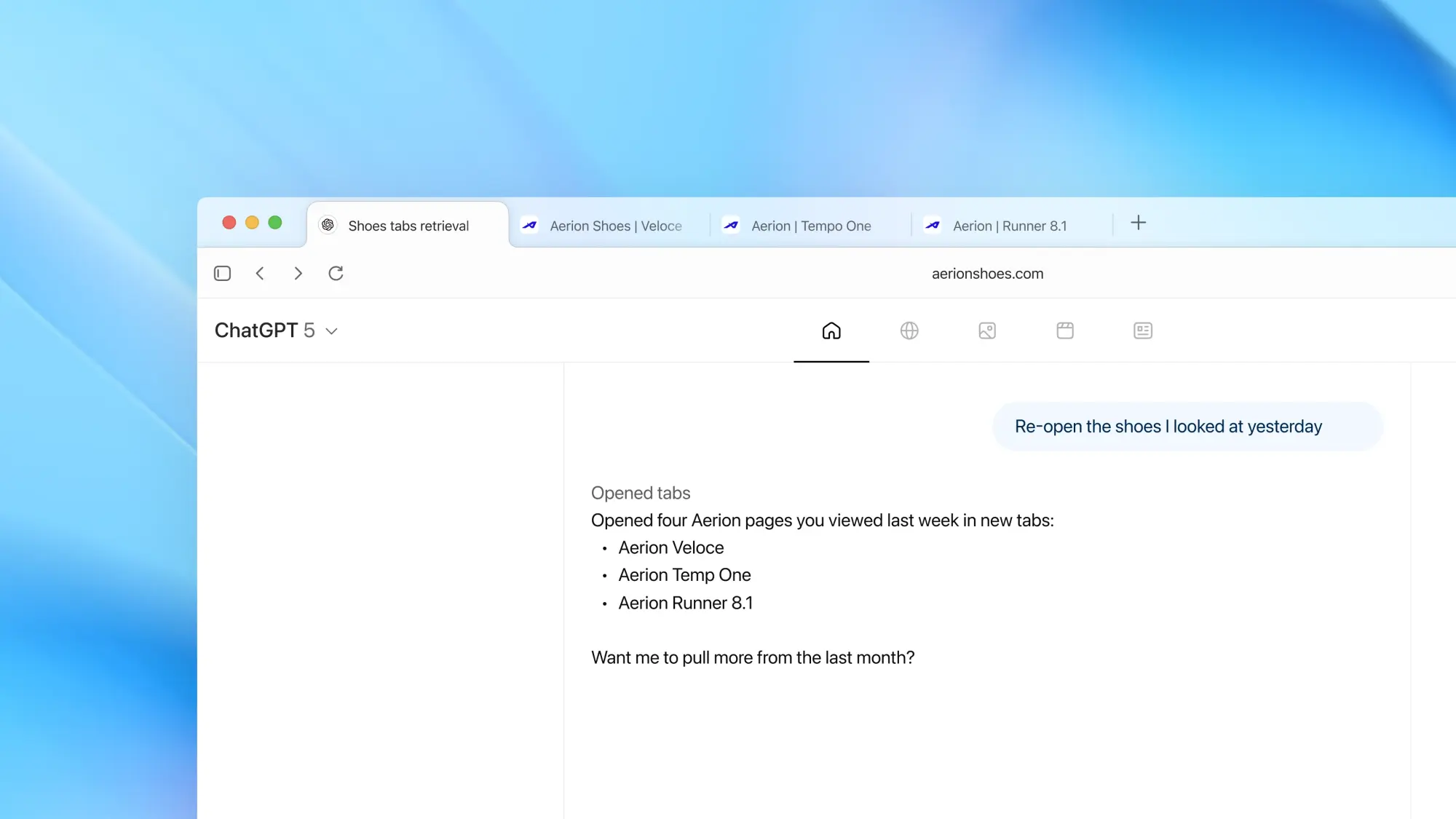
Similarly, Atlas will track your browsing and activity history and call upon it in future sessions. Perhaps you’ll open your browser to find personalized suggestions on which sites and topics to explore next. Does that sound creepy? Absolutely. But if you’re someone who doesn’t mind the privacy trade-off, there could be some benefits there. In OpenAI’s announcement, it suggested asking Atlas to pull up all the job postings you looked at last week, and produce a summary of industry trends to use in interview prep. If you find that these memories are a bit too much for you, you can disable them from the browser settings. (OpenAI says deleting your browsing history also deletes associated browser memories, and the browser’s incognito window logs you out of ChatGPT.)

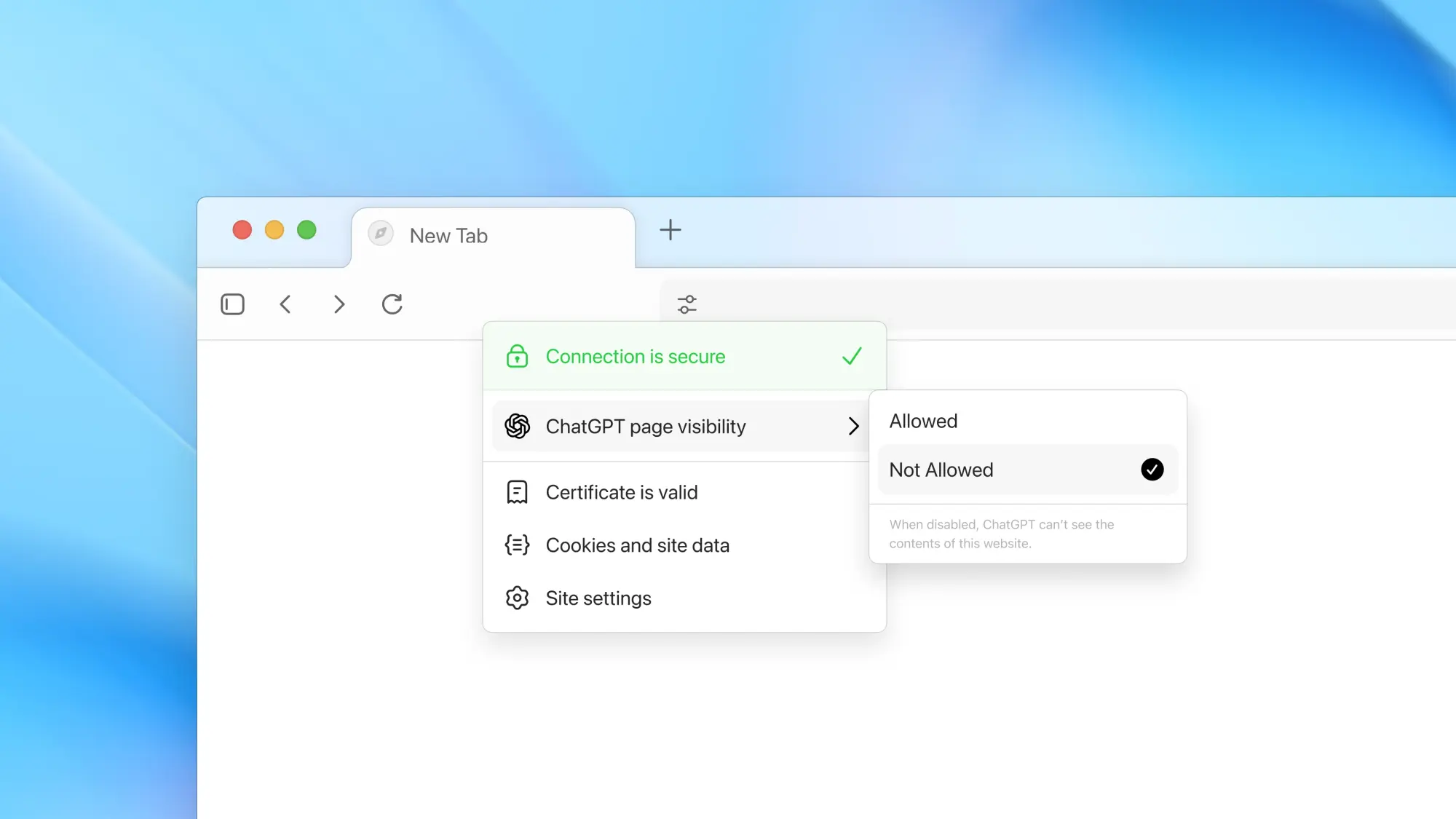
The company includes a setting called “ChatGPT page visibility,” which lets you control whether ChatGPT can actually see the webpage you’re visiting. If you choose “Not Allowed,” you can block the bot from seeing what you’re doing, which is good. But then again, doing that defeats the purpose of Atlas a bit. If you don’t want ChatGPT seeing what you’re doing, you might as well use a browser that doesn’t have ChatGPT built right into it. (The company does promise it won’t train ChatGPT on your browsing data unless you opt into it, but why would you do that?)

Is Atlas safe to use?

chatgpt visibility

Credit: OpenAI

I’m of the opinion that if the safety of a browser is in question, it’s best not to bother with. That’s the case with Atlas, as well as other AI browsers.

The main issue with browsers that incorporate AI agents is that they are susceptible to indirect prompt injection attacks. Brave has done a lot of research on this subject, particularly with Comet. In short, bad actors can potentially hide malicious instructions on websites that the AI agents see as no different from a typical user request. Because the browser is designed to act on your behalf, these malicious instructions can command the AI to do things you definitely don’t want it to do. You might ask Atlas to summarize a webpage, but because a bad actor hid a command to do something involving your email, bank account, or corporate intranet on the site, it does that instead.

To OpenAI’s credit, the company has compiled a list of safeguards to mitigate risks with Atlas. Atlas cannot run code directly in the browser, nor can it download files or install extensions. The browser has no way to access other apps on your Mac, nor its file system. If agent mode needs to access sensitive sites, like your bank, it’ll pause to make sure “you’re watching.” To that point, you can use Atlas’ agent in logged out mode, which limits its ability to access sensitive data or take actions “as you” on websites. But even OpenAI admits that after thousands of hours of testing, their safeguards “will not stop every attack that emerges as AI agents grow in popularity.” The company says it’ll patch new vulnerabilities as it finds them, but if bad actors find them first, they might trick these AI agents into doing some terrible things.

To me, the risks currently far outweigh the benefits. I don’t yet see much reason to have a bot in my browser do things on my behalf, but even if I did, I wouldn’t use it just yet. The risk that someone injects a website with a malicious command and derails my AI agent—and my digital life—is too great, especially when I can book those flights or order that delivery on my own without issue.


Reddit sues Perplexity and three other companies for allegedly using its content without paying

Reddit is suing companies SerApi, OxyLabs, AWMProxy and Perplexity for allegedly scraping its data from search results and using it without a license, The New York Times reports. The new lawsuit follows legal action against AI startup Anthropic, who allegedly used Reddit content to train its Claude chatbot.

 As of 2023, Reddit charges companies looking access to posts and other content in the hopes of making money on data that could be used for AI training. The company has also signed licensing deals with companies like Google and OpenAI, and even built an AI answer machine of its own to leverage the knowledge in users’ posts. Scraping search results for Reddit content avoids those payments, which is why the company is seeking financial damages and a permanent injunction that prevents companies from selling previously scraped Reddit material.

Some of the companies Reddit is focused on, like SerApi, OxyLabs and AWMProxy, are not exactly household names, but they’ve all made collecting data from search results and selling it a key part of their business. Perplexity’s inclusion in the lawsuit might be more obvious. The AI company needs data to train its models, and has already been caught seemingly copying and regurgitating material it hasn’t paid to license. That also includes reportedly ignoring the robots.txt protocol, a way for websites to communicate that they don’t want their material scraped.

Per a copy of the lawsuit provided to Engadget, Reddit had already sent a cease-and-desist to Perplexity asking it to stop scraping posts without a license. The company claimed it didn’t use Reddit data, but it also continued to cite the platform in answers from its chatbot. Reddit says it was able to prove Perplexity was using scraped Reddit content by creating a “test post” that “could only be crawled by Google’s search engine and was not otherwise accessible anywhere on the internet.” Within a few hours, queries made to Perplexity’s answer engine were able to reproduce the content of the post.

“The only way that Perplexity could have obtained that Reddit content and then used it in its ‘answer engine’ is if it and/or its co-defendants scraped Google [search results] for that Reddit content and Perplexity then quickly incorporated that data into its answer engine,” the lawsuit claims.

When asked to comment, Perplexity provided the following statement:

Perplexity has not yet received the lawsuit, but we will always fight vigorously for users’ rights to freely and fairly access public knowledge. Our approach remains principled and responsible as we provide factual answers with accurate AI, and we will not tolerate threats against openness and the public interest.

This new lawsuit fits with the aggressive stance Reddit has taken towards protecting its data, including rate-limiting unknown bots and web crawlers in 2024, and even limiting what access the Internet Archive’s Wayback Machine has to its site in August 2025. The company has also sought to define new terms around how websites are crawled by adopting the Really Simple Licensing standard, which adds licensing terms to robots.txt.

This article originally appeared on Engadget at https://www.engadget.com/social-media/reddit-sues-perplexity-and-three-other-companies-for-allegedly-using-its-content-without-paying-205136436.html?src=rss

This may be the most bonkers tech job listing I’ve ever seen

Here’s a job pitch you don’t see often.

What if, instead of “work-life balance,” you had no balance at all—your life was your work… and work happened seven days a week?

Did I say days? I actually meant days and nights, because the job I’m talking about wants you to know that you will also work weekends and evenings, and that “it’s ok to send messages at 3am.”

Read full article

Comments

Global Use of Coal Hit Record High in 2024

Coal use hit a record high around the world last year despite efforts to switch to clean energy, imperilling the world’s attempts to rein in global heating. From a report: The share of coal in electricity generation dropped as renewable energy surged ahead. But the general increase in power demand meant that more coal was used overall, according to the annual State of Climate Action report, published on Wednesday. The report painted a grim picture of the world’s chances of avoiding increasingly severe impacts from the climate crisis. Countries are falling behind the targets they have set for reducing greenhouse gas emissions, which have continued to rise, albeit at a lower rate than before.

Clea Schumer, a research associate at the World Resources Institute thinktank, which led the report, said: “There’s no doubt that we are largely doing the right things. We are just not moving fast enough. One of the most concerning findings from our assessment is that for the fifth report in our series in a row, efforts to phase out coal are well off track.”


Read more of this story at Slashdot.

How Samsung’s Galaxy XR Headset Compares to the Apple Vision Pro and Meta Quest 3

We may earn a commission from links on this page.

If you’ve been waiting to get your hands on a Samsung Galaxy XR virtual reality headset, now’s your moment: The device is available to order now on Samsung’s or Google’s website for $1,799 and orders are scheduled to arrive Nov. 4. To offset the price, the Galaxy XR comes with a free year of Google AI Pro, YouTube Premium, and Google Play Pass.

Built in partnership with Google and Qualcomm, the Galaxy XR features dual, 4K micro-OLED screens delivering 27 million pixels total and 100-degree horizontal field of view, all powered by Qualcomm Snapdragon XR2+ Gen 2 chip and packed into a lightweight (1.2 pounds) form factor.

The birth of Android XR

The headset will be powered by the new Android XR platform, which will allow users to run standard Android apps as 2D windows. The new ecosystem is designed around system-level integration of Gemini AI and is planned as an infrastructure for future AR and VR devices, including smart glasses. A couple highlights from the operating system: the ability to circle things in the real world and search for them online, and the AI conversion of 2D photos and videos into immersive 3D presentations.

Samsung’s aiming for the space between Apple and Meta

Samsung’s Galaxy XR is stepping into a fairly crowded marketplace, given the public’s relatively tepid reaction to virtual reality. Its main competitors are Meta’s Quest line of headsets and the Apple Vision Pro, although both Meta and Apple are putting much of their AR/VR resources into smart glasses instead of headsets.

The Galaxy XR’s $1,799 price tag is almost exactly half the cost of an Apple Vision Pro and more than three times as expensive as a Meta Quest 3. Samsung seems to be aiming at a tech middle ground: Not prohibitively expense to nearly everyone, but well above the Quest’s “game console” price. The target seems to be pro-level consumers interested in a headset with better hardware than a Quest, but who balk at a $3,500 device. In other words: Samsung is chasing Apple’s polish and Meta’s accessibility, hoping to find a sweet spot between them.

In terms of specs, the Apple Vision Pro’s M5 chip and dedicated R1 spatial processor put it in the lead in terms of raw processing power, though the Galaxy displays 27 million pixels compared to Apple’s 24 million. The Quest 3 displays around 9 million pixels. The Galaxy has a slower top refresh rate compared with Apple, too: 90Hz vs. 12Hz. Ultimately the more expensive headsets are roughly comparable, assuming everything works the way it should; I haven’t tried the Galaxy XR yet, so I can’t say. As for the Quest 3, its very low price isn’t the only advantage to the cheaper system: The Quest’s software library is orders of magnitude larger than the competition.

If Samsung can back up its impressive specs with software and comfort, the XR could give both Apple and Meta something to worry about, but whether any VR headset could generate the kind of enthusiasm the public has for smart glasses remains to be seen.