In 1812, Napoleon Bonaparte led a disastrous military campaign into Moscow. The death toll was devastating: Out of some 615,000 men, only about 110,000 survivors returned. (Napoleon abandoned his army in early December to return home on a sled.) Roughly 100,000 of the casualties died in battle, while as many as 300,000 perished from a combination of the bitter cold of Russia’s notoriously harsh winter, starvation, and disease.
Scholars have debated precisely what kinds of diseases ravaged Napoleon’s troops. New DNA analysis of some soldiers’ remains has revealed the presence of two pathogens in particular, according to a new paper published in the journal Current Biology. The first is Salmonella enterica, which causes paratyphoid fever; the second is Borrelia recurrentis, which is transmitted by body lice and causes relapsing fever. (A preprint of the paper appeared on bioaRxiv in July.)
“It’s very exciting to use a technology we have today to detect and diagnose something that was buried for 200 years,” said co-author Nicolás Rascovan of the Institut Pasteur. “Accessing the genomic data of the pathogens that circulated in historical populations helps us to understand how infectious diseases evolved, spread, and disappeared over time and to identify the social or environmental contexts that played a part in these developments. This information provides us with valuable insights to better understand and tackle infectious diseases today.”
Netflix is reportedly closing its Boss Fight Entertainment game development studio, according to variousLinkedIn posts by staffers. The streaming giant bought the company back in 2022 and it has been responsible for games like Squid Game: Unleashed and the interactive narrative Netflix Stories.
This is relatively surprising, as Squid Game: Unleashed was something of a hit. It launched alongside season two of the show and has amassed over ten million downloads on the Google Play Store alone, according to reporting by Mobilegamer. It recently received a major software update coinciding with season three of the show.
Boss Fight Entertainment has around 80 staffers. It’s unclear if they’ll be laid off or shuffled somewhere else within Netflix’s gaming division. Engadget has reached out to Netflix and will update this post when we hear back.
Several designers at the company have expressed regret that we won’t see what it had planned for the future. “It’s infuriating that the world will never see some of the stuff that was shuffled away behind the scenes,” wrote design director Damion Schubert on LinkedIn.
This is the second studio that Netflix has chased out the door in the past year. It shut down its AAA game studio Team Blue, which had attracted developers from Blizzard, Bungie and Sony Santa Monica. We never even got to find out what the team was working on.
This article originally appeared on Engadget at https://www.engadget.com/gaming/netflix-reportedly-shutters-studio-behind-squid-game-mobile-spinoff-151156987.html?src=rss
An international team of researches has announced the discovery of a super-Earth exoplanet (designated GJ 251 c) situated in its host star’s habitable zone less than 20 light-years from our own. What makes this detection exciting is that the planet’s relatively short distance makes it one of the best targets bookmarked for future telescopic
A good reason to invest in a video doorbell is to stave off package thieves, though it’s not the only compelling selling point. Halloween is right around the corner, and while that means costumed kids (and adults) stopping by for free candy, it also presents an opportunity for shenanigans by the local riffraff. They might be less inclined
High-resolution audio on the go isn’t very convenient. It typically involves wired headphones and a DAC (digital-to-analog converter) of some kind, plus your phone or another device to access files or a streaming service. All of this is necessary since Bluetooth compresses an audio signal by design, to allow for low-latency transmission and minimize battery draw. Simply put, wireless headphones haven’t been able to meet the demands of lossless audio, but Sennheiser has come the closest to fulfilling the dream with its HDB 630 ($500).
Thanks to redesigned drivers, a new acoustic platform and a dongle, the company offers up to 24-bit/96kHz audio on the HDB 630 — depending on your configuration. You also get above average active noise cancellation (ANC), a highly customizable EQ, shockingly long battery life and advanced features to fine-tune the headphones to your liking. For some, the best possible sound is still only found on pricey setups and open-back headphones. For everyone else, Sennheiser has provided a taste of the audiophile life in a much more portable package.
Design
Sennheiser says the HDB 630 “inherited” the same chassis from its Momentum 4 headphones. That’s unfortunate because my biggest complaint with that older model’s redesign is how cheap it looked compared to previous entries in the Momentum line. The HDB 630 suffers the same fate, although the splash of silver on the headband and yokes helps things a bit. Simply put, these don’t look like a set of $500 headphones, and since they’re $150 more than their predecessor was at launch, they really should have a more premium appearance.
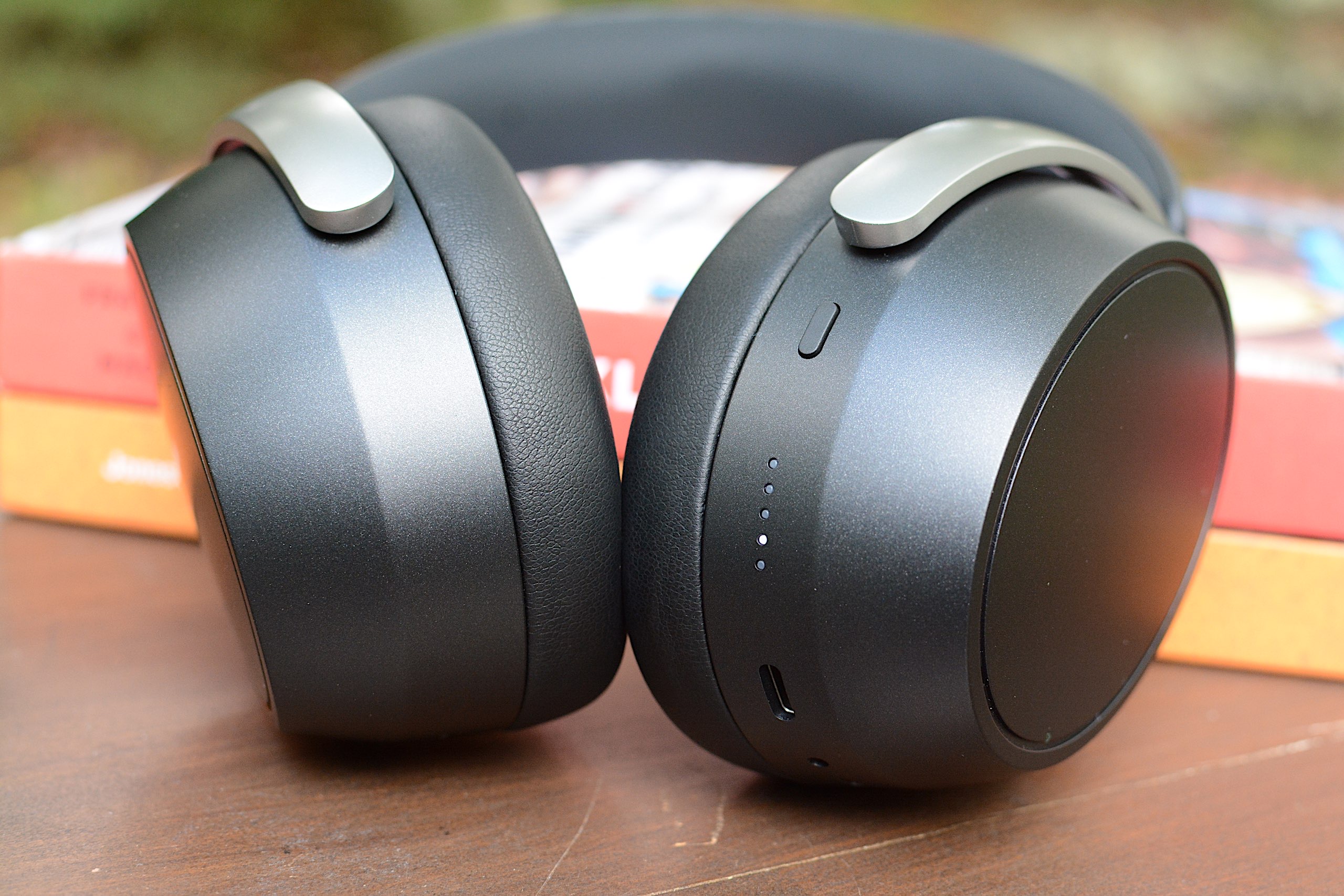
The outside of the right ear cup is still a touch panel where you can swipe, tap and even pinch to control the HDB 630. I don’t recall another set of headphones with a pinch gesture, and I’m still not convinced it’s warranted. The action is used to enable an Adaptive ANC adjustment that allows you to dial in the amount of noise blocking you need. After the pinch, sliding a single finger forwards and backwards fine tunes the mix of ANC and transparency mode. It’s a nice option to have on the headphones themselves, I just think a triple tap to activate it would be easier to master — and remember.
The only other button on the HDB 630 is for power and Bluetooth pairing. Unless you’re frequently connecting these headphones to a new device, you might not be reaching for this control very often. That’s because the HDB 630 goes into standby mode when you take them off before powering down completely after 15 minutes of inactivity. You can extend that window to 30 or 60 minutes if you prefer. And if the headphones still have battery left, you can return to active mode by simply putting them back on your head.
Sennheiser is betting you’ll use the HDB 630 for long listening sessions, so it outfitted these headphones with soft ear pads and a well-cushioned headband. The clamping force is adequate for a proper ANC seal, but never becomes a burden. And despite being around 20 grams heavier than the Momentum 4, this model still feels balanced and doesn’t weigh you down.
Sound quality
The HDB 630 features new drivers and a specially designed acoustic system.
Billy Steele for Engadget
While the overall design may be familiar, the sound platform for the HDB 630 is completely new. 42mm drivers offer what Sennheiser says is “neutral sound with lifelike mids, stunning detail and a wide soundstage.” In order to deliver sound quality that’s as close to open-back headphones as possible, the company overhauled the entire acoustic system, from the drivers to the baffle’s transparent mesh, in the name of balance and clarity. And since audiophile headphones typically require a dedicated external amplifier to achieve their full potential, Sennheiser included a BTD 700 USB-C dongle for high-resolution wireless audio transmission.
When I first put the HDB 630 on, I thought the audio quality was good but not great. Listening over the standard definition SBC codec produced decent results, but it wasn’t anything to write home about. Once I connected to the BTD 700 dongle and unlocked 16-bit/48kHz tunes from Apple Music, though, these headphones really started to impress.
As good as they are, the HDB 630 may not be for everyone. That “neutral” stock tuning places high emphasis on the midrange, so you’ll likely need to make some adjustments to get the bass performance you crave from rock, electronic, hip-hop and other genres driven by low-end tone. While I concede the neutral base is a great starting point, and the HDB 630 does indeed showcase “stunning detail,” I’d argue Sennheiser’s promise of “a wide soundstage” doesn’t always hold true.
These headphones are at their best with more immersive content, like the TRON: Ares soundtrack from Nine Inch Nails. After a slight adjustment, the electronic score had the booming bass it needed, offering driving beats that nearly rattled my brain. All that was layered with rich synths and Trent Reznor’s iconic vocals. The texture and distortion in the instruments came through in greater detail too, something that’s not as apparent on other headphones and earbuds.
Switch over to Thrice’s Horizons/West and the HDB 630 is a different story. Transitioning from synth-heavy electronic music to a genre like rock causes these headphones to lose some of the immersive character they are capable of delivering. You still get absurd clarity and detail, particularly in Teppei Teranishi’s guitar riffs, but the music sounds slightly flatter and a little less energetic. It’s not bad by any means, but some genres won’t envelope you as much as others do.
You can also use the HDB 630 wired over USB-C for lossless-quality audio. Since a number of competitors also do this, I dedicated the bulk of my testing to see if Sennheiser’s wireless dongle is meaningfully different. Of course, I did my due diligence and tested the wired configuration a few times, and it should come as no surprise that the HDB 630 sounds just as good in that setup.
Software, features and accessories
There’s only one button on the HDB 630.
Billy Steele for Engadget
As I mentioned, the HDB 630 comes with Sennheiser’s BTD 700 Bluetooth USB dongle. This enables higher quality streaming than you’ll natively get from most devices. With the BTD 700, you can expect aptX Adaptive and aptX Lossless listening up at rates to 24-bit/96kHz. The dongle also has a 30ms low-latency gaming mode, (supposedly) enhanced call performance and Auracast support for streaming to multiple headphones or speakers. The BTD 700 has a USB-C connector, but it comes with a USB-A adapter if you need it. This typically costs $60 if you buy it on its own, and since you need it to unlock the HDB 630’s full potential, it’s great to see it included in the box.
The HDB 630’s settings and features are accessible in the Sennheiser Smart Control Plus app. And for this model, the company is offering a lot more customization than it does on the Accentum or Momentum headphones. First, the EQ editing options are more robust thanks to a parametric equalizer, which allows you to get a lot more detailed with your custom presets. For example, I was able to add the low-end tone I feel is missing from the stock tuning for those metal, rock and hip-hop tracks I mentioned before. And unlike a lot of headphone apps, adjusting the EQ actually improves the sound instead of just muddying things further.
Another sound-related addition for the HDB 630 is Crossfeed. This allows you to blend the left and right channels so that it seems like you’re listening to speakers instead of headphones. Unfortunately, you only get two options here — Low and High — but the effect certainly enhances the sonic profile of the HDB 630 at both settings.
Despite the BTD 700 dongle’s Mac and Windows compatibility, there’s no desktop version of the Smart Control Plus app. This means you’ll have to change all of your settings with the HDB 630 through your phone before you pair it with both the dongle and your computer. It would be nice if you could make EQ adjustments, create new presets and even change Crossfeed levels without having to reconnect to another device. This also means you can’t be connected to the BTD 700 and both your phone and your computer, since the dongle takes one of the two available multipoint Bluetooth slots.
Active noise cancellation and call quality
The HDB 630 has a very basic design with lots of plastic.
Billy Steele for Engadget
When it comes to ANC performance, I’m not entirely sure that the HDB 630 is better than the Momentum 4. But that’s okay. That previous model brought a significant improvement compared to Sennheiser’s older wireless headphones and the ANC is still quite good here. In fact, it was robust enough to block my family’s voices during their calls while I worked from home, and since most headphones struggle with this, that’s no mean feat.
Sennheiser says the BTD 700 dongle will give you improved voice performance over the headphones alone. Specifically, the accessory should provide extended range, clearer voice pickup and, according to the company, “uninterrupted” calls. In my recorded samples, I think the headphones themselves sounded slightly better than when I captured my voice while connected to the BTD 700. However, I noticed a distinct lack of background noise in both clips, which is helpful in busier environments. I’ll also note the overall voice quality isn’t pristine, but it’s clear enough to use for work calls — even if you’re the main presenter.
Battery life
Sennheiser promises that you’ll get up to 60 hours of battery life on a charge with the HDB 630. That’s the same staggering figure the company claims on the Momentum 4. And yes, that’s with ANC enabled, but you’ll only achieve that if you’re listening to standard resolution tunes. Based on my testing with a mix of noise cancellation and transparency mode while I was listening to music and taking work calls, I have no reason to believe the company’s numbers don’t hold true. If you choose to listen entirely via the BTD 700’s higher quality output, you can expect up to 45 hours of use on a charge. That’s still quite a long time considering a lot of the competition runs out at around 30 hours — and that’s without high-res music.
Due to all of the signal processing that helps with the acoustic performance on the HDB 630, they can only be used when they’re turned on. Unlike some wireless models, you can’t use these as wired headphones when the battery is spent. However, if you find yourself with a completely depleted battery, a 10-minute charge will give you up to seven hours of use. The company doesn’t specify streaming resolution for that number, but I assume it’s at standard definition. Still, you’ll get a few hours of higher-res music in that time, which should be enough to get you through a work session, evening commute or that new album you’re dying to play for the first time.
The competition
Incredible sound awaits, if you’re okay to carry a dongle around with your headphones.
Billy Steele for Engadget
In the realm of flagship headphones, any company’s top-of-the-line model will set you back $500 these days. I look back fondly on the time when $300-$350 got you the best Sony had to offer. While the HDB 630 is expensive, it’s also in the same ballpark of what you’ll pay for the Bose QuietComfort Ultra Headphones ($450), the Sony WH-1000XM6 ($458 currently) and the AirPods Max ($549). Each of those have their advantages over the rest of the competition, with the 1000XM6 offering the most complete package overall. However, when it comes to pure sound quality, neither of those three are at the top of the heap.
Up until now, that title belonged to the Noble Audio FoKus Apollo. At $650, those headphones are even more expensive than the HDB 630, but their stock tuning will appeal to more listeners and the soundstage is wider and more immersive. There’s also Bowers & Wilkins’ Px7 S3 for a slightly cheaper $479. It delivers the company’s warm, inviting sound and attention to finer details. After spending time with the HDB 630 though, these alternatives are just that — alternatives — as the new Sennheiser headphones are now my pick for best overall sound quality.
Wrap-up
I get it: in the current financial climate, $500 is a lot to pay for headphones (or anything else, for that matter). You can find a number of perfectly capable sets of ANC headphones for much less given how frequently things go on sale these days. However, what you won’t find is an option that gives you anything close to the performance of audiophile-grade, open-back headphones. That’s really what Sennheiser is doing here, and the HDB 630 slots nicely into the company’s HD 600 series of high-end cans.
As good as the HDB 630 is sound-wise, I can also appreciate that these aren’t the best headphones for everyone. The company’s Momentum 4 is still a very capable set of headphones and it’s now available for about $250. If you crave the best sound quality that still offers the convenience of wireless headphones — and you’re okay with a few extra steps — the HDB 630 is a worthy investment. Just don’t leave home without that dongle.
This article originally appeared on Engadget at https://www.engadget.com/audio/headphones/sennheiser-hdb-630-review-a-sonic-marvel-with-room-for-improvement-150000295.html?src=rss
We may earn a commission from links on this page. Deal pricing and availability subject to change after time of publication.
Investing in a smart thermostat won’t just keep your home comfortable — it also can help you save money on energy bills and reduce your carbon footprint. By automating scheduling and learning preferred temperatures, smart thermostats conserve energy and make your home more comfortable. The 2022 Ecobee Smart Thermostat Premium might not be the newest option on the market, but to this day, it receives consistently excellent ratings, and right now, it’s $198.99 (originally $249.99) on Walmart, marking its lowest price ever according to price trackers.
Ecobee is known for having one of the strongest privacy policies in the smart-home space. The company doesn’t sell personal information, collects minimal data, prioritizes user ownership of data, and supports 2FA for added protection. When paired with Ecobee SmartSensors and an Ecobee SmartCamera, it can also double as a home security hub.
This model, which earned a PCMag Editor’s Choice award, comes with a smart sensor that balances temperatures in your home using occupancy detection. While the thermostat is smaller than its predecessor, it has a larger four-inch full-color touchscreen that’s bright enough to read from across the room.
It has a built-in speaker and mic that’s compatible with a wide variety of smart-home ecosystems, letting you listen to music, get news or weather updates, change thermostat settings, and check the temperature in rooms with sensors. You can even monitor air quality with alerts and tips on indoor humidity levels and whether the air quality is clean or poor. All of this is accessible from the Ecobee mobile app.
While the price is higher than a basic smart thermostat, if you want lower energy costs while benefitting from features like measuring air quality, an integrated voice assistant that doubles as a speaker, and remote sensors, the eco-friendly Ecobee Smart Thermostat Premium is a strong choice that can help you save money in the long-run and make your home more comfortable.
The Delhi regional government is trialling a cloud-seeding experiment to induce artificial rain, in an effort to clean the air in the world’s most polluted city. From a report: The Bharatiya Janata party (BJP) has been proposing the use of cloud seeding as a way to bring Delhi’s air pollution under control since it was elected to lead the regional government this year.
Cloud seeding involves using aircraft or drones to add to clouds particles of silver iodide, which have a structure similar to ice. Water droplets cluster around the particles, modifying the structure of the clouds and increasing the chance of precipitation. Months of unpredictable weather over India’s capital had put the BJP’s cloud-seeding plans on pause. But days after Delhi’s air quality once again fell into the hazardous range after Diwali festival, and a thick brown haze settled over the city, the government said the scheme would finally be rolled out.
The Universe Browser makes some big promises to its potential users. Its online advertisements claim it’s the “fastest browser,” that people using it will “avoid privacy leaks” and that the software will help “keep you away from danger.” However, everything likely isn’t as it seems.
The browser, which is linked to Chinese online gambling websites and is thought to have been downloaded millions of times, actually routes all Internet traffic through servers in China and “covertly installs several programs that run silently in the background,” according to new findings from network security company Infoblox. The researchers say the “hidden” elements include features similar to malware—including “key logging, surreptitious connections,” and changing a device’s network connections.
Perhaps most significantly, the Infoblox researchers who collaborated with the United Nations Office on Drugs and Crime (UNODC) on the work, found links between the browser’s operation and Southeast Asia’s sprawling, multibillion-dollar cybercrime ecosystem, which has connections to money-laundering, illegal online gambling, human trafficking, and scam operations that use forced labor. The browser itself, the researchers says, is directly linked to a network around major online gambling company BBIN, which the researchers have labeled a threat group they call Vault Viper.
So far, common shoemaker practice in helping runners go faster is to make footwear lighter without compromising rigidity and grip. Now, Nike has unveiled Project Amplify, the world’s first powered shoe system for running and walking, designed not necessarily for elite marathon runners, but for everyday athletes who just want to go a little
You need to go up—way up—to fully appreciate the changes underway at the White House this week.
Demolition crews starting tearing down the East Wing of the presidential mansion Tuesday to clear room for the construction of a new $300 million, 90,000-square-foot ballroom, a recent priority of President Donald Trump. The teardown drew criticism and surprise from Democratic lawmakers, former White House staffers, and members of the public.
It was, after all, just three months ago that President Donald Trump defended his ballroom plan by saying it wouldn’t affect the existing structure at the White House. “It won’t interfere with the current building,” he said in July. “It’ll be near it but not touching it—and pays total respect to the existing building, which I’m the biggest fan of.”
Intel’s continued efforts to right the ship are paying off with another strong quarter in the books, with the company reporting $13.7 billion in revenue in Q3. That’s a 3% year-over-year gain and enough to beat Wall Street’s estimates. According to Intel CEO Lip-Bu Tan, the latest earnings are a direct reflection of “improved execution” as
Counter-Strike has long been known for two things: tight tactical FPS gameplay and a thriving player marketplace effectively valued at literal billions of dollars. Now, thanks to a recent update from Valve, the latter is in a downward spiral, having lost 25% of its value — or $1.75 billion — overnight. Polygon: First, some context. Counter-Strike is a free-to-play multiplayer shooter. As with most other F2P games, it generates revenue from selling cosmetics. They arrive in lootbox-like Cases, which are opened by Keys purchased with real-world currency. They can also be obtained through trading with other players and purchasing from Steam Community Market. Beyond Steam, unofficial third-party marketplaces for CS cosmetics have also popped up as channels for buying and selling items.
Because items are obtained at random through opening Cases, rarer items fetch the highest value on the open marketplaces. Items of lower-rarity tiers can also be traded in at volume for an item of a higher tier via trade up contracts. Previously, Knives and Gloves could not be obtained through trade up contracts, exponentially increasing their value as highly sought-after items. Prior to the most recent update, some Knives, like a Doppler Ruby Butterfly Knife, could fetch around $20,000 on third-party storefronts like CSFloat.
Following Valve’s Oct. 22 update to Counter-Strike, the second-highest-tier, Covert (Red), can now be traded up and turned into Knives and Gloves. Essentially, this means that a previously extremely rare and highly sought-after cosmetic is going to be much more obtainable for those who increasingly want it, reducing the value of Knives and Gloves on the open marketplace. And this is where the market descends into a freefall. Now, that Butterfly Knife mentioned above? It’s going for around $12,000, as people are essentially dumping their stock, with 15 sold over the past 16 hours at the time of this writing.
The League Championship Series are history, and the final two teams have emerged: The 2025 Fall Classic will see the Los Angeles Dodgers face the Toronto Blue Jays. Game 1 of the 2025 MLB World Series begins tonight — Friday, Oct. 24 — at 8PM ET/5PM PT, with the Blue Jays getting the initial home field advantage at Rogers Centre, Toronto. Shohei Ohtani and the Dodgers are aiming to win their second consecutive championship, while Vlad Guerrero Jr. and the Blue Jays are eyeing their first ring since 1993. The World Series odds favor the Dodgers ahead of Game 1. Every 2025 MLB World Series game will air on Fox and Fox Deportes.
Of course, Fox is a “free” over-the-air channel, so any affordable digital antenna will pull in the game if you live close enough to a local affiliate. But if that’s not an option, here’s a full rundown of how to watch the Dodgers vs. Blue Jays World Series, even without cable.
How to watch the L.A. Dodgers vs. Toronto Blue Jays, Game 1
You can stream Fox on any live TV streaming service that airs Fox local stations, including DirecTV, Fubo and Hulu + Live TV. MLB World Series games will also be available on Fox’s new streaming platform, Fox One.
More ways to watch the 2025 World Series
When is the Dodgers vs. Blue Jays game time?
Game 1 of the Dodgers vs. Blue Jays World Series begins on Friday, Oct. 24 at 8PM ET/5PM PT. The Blue Jays are hosting the first two games of the series at Rogers Centre, Toronto.
What channel is playing the Los Angeles Dodgers vs. Toronto Blue Jays?
Every game in the 2025 World Series between the Los Angeles Dodgers and the Toronto Blue Jays, will air on Fox and Fox Deportes.
When is the 2025 World Series?
Game 1 of the World Series between the Dodgers and Blue Jays is scheduled for Friday, Oct. 24.
Los Angeles Dodgers vs. Toronto Blue Jays World Series schedule
All times Eastern
Game 1: Friday, Oct. 24, 8PM ET
Game 2: Saturday, Oct. 25, 8PM ET
Game 3: Monday, Oct. 27, 8PM ET
Game 4: Tuesday, Oct. 28, 8PM ET
Game 5*: Wednesday, Oct. 29, 8PM ET
Game 6*: Friday, Oct. 31, 8PM ET
Game 7*: Saturday, Nov. 1, 8PM ET
*if necessary
This article originally appeared on Engadget at https://www.engadget.com/entertainment/streaming/dodgers-vs-blue-jays-game-1-how-to-watch-the-2025-mlb-world-series-without-cable-133403870.html?src=rss
Amazon has published a lengthy report about the outage that knocked numerous websites, services, apps and games offline on October 20. It all started with a bug in its automation software DynamoDB, where its AWS customers store their data, which then triggered more issues in its other systems that relied on the software.
As Amazon explains, DynamoDB maintains hundreds of thousands of DNS records and is supposed to be able to fix any issue automatically. But on October 20, the DynamoDB DNS management system suffered from a bug that resulted in an empty DNS record for Amazon’s data centers in North Virginia. DynamoDB was supposed to repair the issue on its own, but it had failed to do so, prompting Amazon to fix the problem manually. While the issue was happening, all systems that needed to connect to DynamoDB couldn’t and experienced DNS failures, including the customers of its cloud computing services. It felt like half the internet wasn’t working when that happened.
The websites and services affected by the outage include Amazon itself, Amazon Alexa devices, Bank of America, Snapchat, Canva, Reddit, Apple Music, Apple TV, Lyft, Duolingo, Fortnite, Disney+, Venmo, Doordash, Hulu, PlayStation and even Eight Sleep, whose beds connect to the internet to adjust their temperature and incline. Some of them were slow to respond, while others were completely inaccessible.
“We apologize for the impact this event caused our customers. While we have a strong track record of operating our services with the highest levels of availability, we know how critical our services are to our customers, their applications and end users, and their businesses. We know this event impacted many customers in significant ways. We will do everything we can to learn from this event and use it to improve our availability even further,” Amazon said in a statement.
This article originally appeared on Engadget at https://www.engadget.com/big-tech/amazon-says-automation-bug-caused-massive-aws-outage-133028856.html?src=rss
It’s taken a little longer than anticipated to arrive to market, but AMD’s Radeon AI Pro R9700 graphics card for AI developers finally has a firm release date and pricing. In a post on X, AMD’s vice president and general managerf of Ryzen CPU and Radeon graphics, David McAfee, revealed that the Radeon AI Pro R9700 will release on Monday, October
The Fedora Council has approved a new policy allowing AI-assisted code contributions, provided contributors fully disclose and take responsibility for any AI-generated work. Phoronix reports: AI-assisted code contributions can be used but the contributor must take responsibility for that contribution, it must be transparent in disclosing the use of AI such as with the “Assisted-by” tag, and that AI can help in assisting human reviewers/evaluation but must not be the sole or final arbiter. This AI policy also doesn’t cover large-scale initiatives which will need to be handled individually with the Fedora Council. […] The Fedora Council does expect that this policy will need to be updated over time for staying current with AI technologies.
In recent weeks, OpenAI has signed blockbuster deals with AMD and Broadcom to build vast numbers of AI chips. Much of the focus has been on the financial implications, since OpenAI will need hundreds of billions of dollars to make good on its promises. As important as it is to look at the quite implausible financials, we also need to look at the broader implications for the industry. Like, the chips themselves, what that spells for the AI industry as a whole, and the added pressure on TSMC, the only chip company that can actually build this stuff.
The Deals
OpenAI’s deal with AMD will see the chip giant build out 6 gigawatts’ (GW) worth of GPUs in the next few years. The first 1 GW deployment of AMD’s Instinct MI450 silicon will start in the back end of 2026, with more to come. AMD’s CFO Jean Hu believes that the partnership will deliver “tens of billions of dollars in revenue” in future, justifying the complicated way the deal is funded.
Meanwhile, Broadcom’s deal with OpenAI will see the pair collaborate on building 10 gigawatts’ worth of AI accelerators and ethernet systems that it has designed. The latter will be crucial to speed up connections between each individual system in OpenAI’s planned data centers. Like the deal with AMD, the first deployments of these systems will begin in the back half of 2026 and is set to run through 2029.
Phil Burr is head of product at Lumai, a British company looking to replace traditional GPUs with optical processors. He’s got 30 years experience in the chip world, including a stint as a senior director at ARM. Burr explained the nitty-gritty of OpenAI’s deals with both Broadcom and AMD, and what both mean for the wider world.
Burr first poured water on OpenAI’s claim that it would be “designing” the gear produced by Broadcom. “Broadcom has a wide portfolio of IP blocks and pre-designed parts of a chip,” he said, “it will put those together according to the specification of the customer.” He went on to say that Broadcom will essentially put together a series of blocks it has already designed to suit the specification laid down by a customer, in this case OpenAI.
Similarly, the AI accelerators Broadcom will build are geared toward more efficient running of models OpenAI has already trained and built — a process called inference in AI circles. “It can tailor the workload and reduce power, or increase performance,” said Burr, but these benefits would only work in OpenAI’s favor, rather than for the wider AI industry.
I asked Burr why every company in the AI space talks about gigawatts worth of chips rather than in more simple numbers. He explained that, often, it’s because both parties don’t yet know how many chips would be required to meet those lofty goals. But you could make a reasonable guess if you knew the power draw of a specific chip divided by the overall goal, then cut that number in half, then remove an extra 10 percent. “For every watt of power you burn in the chip, you need about a watt of power to cool it as well.”
In terms of what OpenAI gets from these deals, Burr believes that the startup will save money on chips, since there’s “less margin” from making your own versus buying gear from NVIDIA. Plus, being able to produce custom silicon to tailor the work to their needs should see significant speed and performance gains on rival systems. Of course, the next biggest benefit is that OpenAI now has “diversity in supply,” rather than being reliant on one provider for all its needs. “Nobody wants a single supplier,” said Burr.
The Factory
Except, of course, OpenAI may be sourcing chips from a variety of its partners, but no matter what’s stamped on the silicon, it all comes from the same place. “I’d be very surprised if it wasn’t TSMC,” said Burr, “I’m pretty sure all of the AI chips out there use TSMC.” TSMC is short for Taiwan Semiconductor Manufacturing Company which, over the last decade, has blown past its major rivals to become the biggest (and in many cases only) source of bleeding-edge chips for the whole technology industry. Unlike historic rivals, which designed and manufactured their own hardware, TSMC is a pure play foundry, only building chips designed by others.
Interior at one of TSMC’s Fabs
Taiwan Semiconductor Manufacturing Co. Ltd.
Gil Luria is Managing Director at head of technology research at investment firm DA Davidson. He said that TSMC isn’t just a bottleneck for the western technology industry, but in fact is the “greatest single point of failure for the entire global economy.” Luria credits the company with an impressive expansion “considering it has had to ramp the production of GPUs tenfold over the last three years.” But said that, “in a catastrophic scenario where TSMC is not able to produce in Taiwan, the disruption would be significant.” And that won’t just affect the AI world, but “mobile handset sales as well as global car sales.”
TSMC supplanted Intel for a number of well-documented reasons, but the most relevant here is its embrace of Extreme Ultraviolet Lithography (EUV). It’s a technology that Intel had initially backed, but struggled to fully adopt, allowing TSMC to pick it up and run straight to the top. EUV produces the headline-grabbing chips used by pretty much everyone in the consumer electronics world. Apple, Qualcomm, NVIDIA, AMD (including the SOCs inside the PS5 and Xbox) all use TSMC chips. Even Intel has been using TSMC foundries for some consumer CPUs as it races to bridge to gulf in manufacturing between the two companies.
“TSMC is the current leader in advanced 3 nanometer (nm) process technologies,” said University of Pennsylvania Professor Benjamin C. Lee. The company’s only meaningful competitors are Intel and Samsung, neither of which pose a threat to its dominance at present. “Intel has been working for a very long time to build a foundry business,” he explained, “but has yet to perfect its interface.” Samsung is in a similar situation, but Professor Lee explained it “has been unable to attract enough customers to generate a profitable manufacturing business.”
Professor Lee said that TSMC, by comparison, has become so successful because of how good its chips are, and how easy it is for clients to build chips with its tools. “TSMC fabricates chips with high yield, which is to say more of its chips emerge from the fabrication process at expected performance and reliability.” Consequently, it should be no surprise that TSMC is a money making machine. In the second quarter of 2025 alone it reported a net profit of $12.8 billion USD. And in the following three months, TSMC posted net profits of $14.76 billion.
“TSMC’s secret sauce is its mastery of yield,” explained ARPU Intelligence, an analyst group that prefers to use the group name over individual attribution. “This expertise is the result of decades of accumulated process refinement [and] a deep institutional knowledge that cannot be replicated.” This deep institutional knowledge and ability to deliver high quality product creates a “powerful technical lock-in, since companies like Apple and NVIDIA design their chips specifically for TSMC’s unique manufacturing process … It’s not as simple as sending the [chip] design to another factory,” it added.
The downside, at least for the wider technology industry, is that TSMC is now a bottleneck that the whole industry has come to rely upon. In the company’s most recent financials, it said more than three quarters of its business comes from North American customers. And in a call with investors, Chairman and CEO C.C. Wei talked about the efforts the company has made to narrow the gap between the enormous demand and its constrained supply. While he was reticent to be specific, he did say that the company’s capacity is “very tight,” and would likely remain that way for the foreseeable future.
In fact, TSMC’s capacity is so tight that it’s already caused at least one major name a significant headache. Earlier this year, Reuters reported that NVIDIA canceled an order of its H20 AI chips after being informed the US would not permit them to be exported to China. Once the ban was lifted, however, NVIDIA was unable to find space in TSMC’s schedule, with the next available slot at least nine months later.
“TSMC has no room for error,” said ARPU Intelligence, “any minor disruption can halt production with no spare capacity to absorb the shock.” It cited the Hualien earthquake which struck Taiwan on April 3, 2024, and how it negatively impacted the number of wafers in production.
Naturally, TSMC is spending big to increase its production capacity for its customers, both in Taiwan and the US. Close to its home, construction on its A14 fab is expected to begin in the very near future, with the first chips due to be produced in 2028. That facility will harness TSMC’s A14 process node, producing 1.4 nm chips, which offer a speed boost over the 2nm silicon that’s expected to arrive in consumer devices next year.
Image of TSMC’s Arizona Campus
Taiwan Semiconductor Manufacturing Co. Ltd.
Meanwhile, work continues apace on building out TSMC’s sprawling facility in Arizona, which broke ground in April 2021. As Reuters reported at the time, the first facility started operating in early 2025, producing 4 nm chips. Last week, NVIDIA and TSMC showed off the first Blackwell wafer produced at the Arizona plant ahead of domestic volume production.
Plans for the operation have grown over time, expanding from three facilities up to six to be built over the next decade. And while the initial outline called for the US facilities to remain several process generations behind Taiwan, that is also changing. In his recent investors call, Chairman and CEO C.C. Wei pledged to invest more in the US facility to bring it only one generation behind the Taiwanese facility.
No amount of investment from TSMC or catch-up from rivals like Samsung and Intel will solve the current bottleneck swiftly. It will take many years, if not decades, for the world to reduce its reliance on Taiwan for bleeding-edge manufacturing. TSMC’s island remains the industry’s weak point, and should something go wrong, the consequences could be dire indeed.
This article originally appeared on Engadget at https://www.engadget.com/computing/openais-recent-chip-deals-heap-more-pressure-on-tsmc-130000194.html?src=rss
It’s the newest entry in Samsung’s midrange tablet lineup, following last year’s S9 FE, and while not a massive upgrade, it’s still one of the few Android tablets that feel genuinely premium for the price. The 10.9-inch display and metal body give it a sturdy, high-end feel, and the IP68 rating means it can handle splashes—something even pricier iPads skip. Samsung includes its signature S Pen in the box, perfect for jotting notes, sketching, or navigating the screen—and its stylus software remains best in class. That alone makes this tablet worth considering if you like to jot things down or doodle on the go.
Under the hood, the Tab S10 FE runs on the Exynos 1580 chip, paired with 8GB RAM and 128GB of storage. It’s not a powerhouse, but it gets through everyday tasks like web browsing, note-taking, and streaming without fuss. The battery is the same 8,000mAh as last year, but thanks to efficiency gains, it lasts longer (over 13 hours in mixed-use tests). Charging is quick too, with 45W fast charging support, though you’ll need your own adapter since Samsung doesn’t include one in the box. The 10.9-inch LCD screen is bright and crisp with a 90Hz refresh rate, though it lacks the Dolby Vision and HDR10+ support found on some rivals like the OnePlus Pad 2. The stereo speakers sound clean, if a bit restrained, and the 16:10 aspect ratio makes movies look natural in landscape mode. That said, cameras (13MP rear and 12MP front) are serviceable for video calls but nothing more.
On the software side, Samsung’s One UI 7, running on top of Android 15, makes multitasking easy. You can open multiple apps, split the screen, or switch to DeX mode for a desktop-style layout with keyboard and mouse support. The software experience is mature, flexible, and backed by six years of updates, which is rare at this price. On the downside, the interface can feel cluttered with Samsung’s extra apps, and performance won’t impress gamers or power users. Still, the Galaxy Tab S10 FE delivers a solid mix of design, display, and software longevity.
Bethesda has announced that it’s releasing a 10th anniversary version of Fallout 4 on November 10, similar to what it did for The Elder Scrolls V: Skyrim. Fallout 4: Anniversary Edition bundles the base game with Automatron, Far Harbor, Nuka-World and the Workshop expansions. The original open world game was released in 2015 and takes place in the year 2287, 210 years after the Great War. Like the other games in the franchise, it’s set in a post-apocalyptic world with the aesthetics of 1940s and 1950s USA.
This particular entry in the franchise revolves around the Sole Survivor of Vault 111 who was frozen in a cryogenic pod and woke up 210 years since the nuclear attack. The protagonist’s constant companion in the game is a dog named Dogmeat, but they have six other possible companions: their old robot butler Codsworth, Deacon the railroad agent, the mayor of the Goodneighbor settlement named John Hancock, an artificial synth or humanoid robot named Nick Valentine, Piper Wright the reporter, and Preston Garvey, who’s a member of the paramilitary force Minutemen.
In addition to the base game and the expansions, the anniversary release comes with 150 pieces of content from the Creation Club, an in-game marketplace where developers can sell weapons, skins and other DLCs. The free content includes different Dogmeat breeds, like a Husky and a Dalmatian. The anniversary edition even contains an in-game Creations menu that players can use to browse downloadable content. Fallout 4: Anniversary Edition will be available digitally on the Xbox Series X|S, Xbox One, PC, PlayStation 5 and PlayStation 4.
This article originally appeared on Engadget at https://www.engadget.com/gaming/fallout-4-anniversary-edition-comes-out-on-november-10-123033135.html?src=rss
The European Commission has found that Meta and TikTok had violated rules under the Digital Services Act (DSA) and is now giving them the chance to comply if they don’t want to be fined up to 6 percent of their total worldwide annual turnover. According to the Commission, Facebook, Instagram and TikTok have “put in place burdensome procedures and tools” for researchers who want to request access to public data. This means they’re stuck with incomplete or unreliable information if they want to do research on topics like how minors are exposed to illegal or harmful content online. “Allowing researchers access to platforms’ data is an essential transparency obligation under the DSA,” the Commission wrote.
In addition, the Commission is charging Meta over the lack of a user-friendly mechanism that would allow users to easily report posts with illegal content, such as child sexual abuse materials. The Commission explained that Facebook and Instagram use mechanisms that require several steps to be able to flag posts, and they use dark interface designs that make reporting confusing and dissuading. All those factors are in breach of DSA rules that require online platforms to give EU users easy-to-use mechanisms to be able to report illegal content.
Under the DSA, users must also be able to challenge social networks’ decisions to remove their posts or suspend their accounts. The Commission found that neither Facebook nor Instagram allow users to explain their sides or provide evidence to substantiate their appeals, which limits the effectiveness of the appeal process.
Meta and TikTok will be able to examine the Commission’s investigation files and to reply in writing about its findings. They’ll also have the opportunity to implement changes to comply with DSA rules, and it’s only if the Commission decides they’re non-compliant that they can be fined up to 6 percent of their global annual turnover. Meta disagreed that it had breached DSA rules, according to Financial Times. “In the European Union, we have introduced changes to our content reporting options, appeals process, and data access tools since the DSA came into force and are confident that these solutions match what is required under the law in the EU,” it said in a statement. Meanwhile, TikTok said it was reviewing the Commission’s findings but that “requirements to ease data safeguards place the DSA and GDPR in direct tension.” It’s asking regulators for guidance on “how these obligations should be reconciled.”
This article originally appeared on Engadget at https://www.engadget.com/big-tech/eu-charges-meta-and-tiktok-over-failures-to-tackle-illegal-content-121533180.html?src=rss