WordPress creator files countersuit against WP Engine over trademark violations

There’s been another turn in WordPress creator Automattic’s ongoing legal battle with WordPress provider WP Engine. In a counterclaim Automattic filed as part of WP Engine’s lawsuit against the company, the WordPress creator claims investment from private equity firm Silver Lake led WP Engine to violate its trademarks and fail to contribute to the open-source WordPress project.

Automattic believes that following a $250 million investment from Silver Lake, which gave the firm a controlling interest in WP Engine, the hosting provider “sought to inflate its valuation and engineer a quick, lucrative exit.” It allegedly did that, per the counterclaim, by describing itself as the “WordPress Technology Company” and allowing its partners to refer to it as “WordPress Engine,” violations of the WordPress trademark. Automattic claims products WP Engine released like “Core WordPress” and “Headless WordPress” further obfuscated who created and developed the blogging platform’s technology, while the company also failed to commit a promised “five percent of its resources to support the WordPress project.”

The counterclaim goes on to say that Automattic and WordPress co-found Matt Mullenweg tried to work out these issues with WP Engine by offering a “fair trademark license,” but the company only “pretended to engage in licensing discussions,” while actually delaying any kind of agreement because it would “impact its earnings.” Keeping earnings up was important to WP Engine because Silver Lake was allegedly trying to sell WP Engine at a $2 billion valuation, and had even made “overtures to Automattic” about it.

That’s a different story than the one WP Engine spun in its original lawsuit against Automattic, which accused Mullenweg of “abuse of power, extortion and greed.” WP Engine’s original complaint claimed that Automattic asked the company for eight percent of its monthly revenue as a royalty payment. Mullenweg’s attempts to punish WP Engine were seen as so aggressive at the time that over 100 Automattic employees voluntarily left the company in response. WP Engine won a preliminary injunction in response to its lawsuit, but it seems like the story might be more complicated than it originally appeared.

This article originally appeared on Engadget at https://www.engadget.com/social-media/wordpress-creator-files-countersuit-against-wp-engine-over-trademark-violations-182123827.html?src=rss

EU accuses Meta of violating content rules in move that could anger Trump

Meta violated the Digital Services Act (DSA) by failing to give Facebook and Instagram users simple mechanisms to report illegal content, the European Commission said in a preliminary decision announced yesterday. Meta also failed to give users an effective way to challenge content moderation decisions, the EC said.

“When it comes to Meta, neither Facebook nor Instagram appear to provide a user-friendly and easily accessible ‘Notice and Action’ mechanism for users to flag illegal content, such as child sexual abuse material and terrorist content,” the EC press release said. The EC said that Meta mechanisms seem to “impose several unnecessary steps and additional demands on users. In addition, both Facebook and Instagram appear to use so-called ‘dark patterns,’ or deceptive interface designs, when it comes to the ‘Notice and Action’ mechanisms.”

The EC also found that the content moderation appeal mechanisms used by Facebook and Instagram do not “allow users to provide explanations or supporting evidence to substantiate their appeals. This makes it difficult for users in the EU to further explain why they disagree with Meta’s content decision, limiting the effectiveness of the appeals mechanism.”

Read full article

Comments

Wikipedia Drama Goes Mainstream

Larry Sanger, who helped launch Wikipedia in 2001 before being ousted by co-founder Jimmy Wales a year later, has spent years arguing the online encyclopedia has abandoned its commitment to neutrality. Leading conservatives in the second Trump administration are now amplifying his critique. Elon Musk announced plans to launch an AI-powered alternative called Grokipedia this week, calling Wikipedia “hopelessly biased.” Senator Ted Cruz sent a letter to the Wikimedia Foundation demanding answers about what he termed “ideological bias.” House Republicans opened an investigation into possible platform manipulation.

Sanger published “Nine Theses” on reforming Wikipedia and appeared on Tucker Carlson’s show. His arguments circulated widely among conservatives, including Trump’s AI czar David Sacks. Sanger recently converted to Christianity and voted for Trump in 2024. He is working to recruit hundreds of conservatives to become active Wikipedia editors. Wikipedia co-founder Jimmy Wales maintains that neutrality remains the site’s core policy.


Read more of this story at Slashdot.

Instagram adds a watch history for Reels

Instagram’s latest feature should make it easier to resurface videos you’ve viewed. On Friday, Adam Mosseri revealed a new watch history for Reels. “Hopefully, now you can find that thing that you were trying to find that you couldn’t find before,” the Instagram CEO said.

We could see the feature coming in handy. For example, when you see something interesting but lose it due to an accidental tap or app refresh.

You can find it on Instagram under Settings > Your activity > Watch history. The feature lets you sort by newest to oldest or vice versa. You can also jump to a specific date or date range, and filter by the account that posted it.

This article originally appeared on Engadget at https://www.engadget.com/social-media/instagram-adds-a-watch-history-for-reels-175555668.html?src=rss

Intel Core Ultra 5 338H Panther Lake CPU With Arc B370 GPU Makes A Benchmark Cameo

Intel Core Ultra 5 338H Panther Lake CPU With Arc B370 GPU Makes A Benchmark Cameo
A new entry in the Geekbench 6 database has turned up another example of Intel’s forthcoming Panther Lake mobile silicon, and this one brings a few twists. Unlike earlier leaks, the integrated graphics device name is properly filled in, so the listing identifies the processor as a Core Ultra 5 338H with an integrated Intel Arc B370 GPU. That

Amiga A1200 Makes A Glorious Comeback After 30 Years With 25 Classic Games

Amiga A1200 Makes A Glorious Comeback After 30 Years With 25 Classic Games
These last few years have seen a spate of classic computer hardware recreated with updated features fit for modern displays and gaming. The next device to get this treatment will be the legendary Amiga A1200, which will be brought back to life by Retro Games Ltd as THEA1200. If you recall, Retro Games Ltd did something similar with the successful

Browser Promising Privacy Protection Contains Malware-Like Features, Routes Traffic Through China

A web browser linked to Chinese online gambling websites and downloaded millions of times routes all internet traffic through servers in China and covertly installs programs that run in the background, according to findings published by network security company Infoblox. The researchers said the Universe Browser, which advertises itself as offering privacy protection, includes features similar to malware such as key logging and surreptitious connections.

Infoblox collaborated with the United Nations Office on Drugs and Crime on the research. The investigators found links between the browser and Southeast Asia’s cybercrime ecosystem, which has connections to money laundering, illegal online gambling, human trafficking and scam operations using forced labor. The browser is directly linked to BBIN, a major online gambling company that has existed since 1999. Infoblox researchers examined the Windows version of the browser and found that it checks users’ locations and languages when launched, installs two browser extensions, and disables security features including sandboxing.


Read more of this story at Slashdot.

Rivian agrees to settle shareholder lawsuit for $250 million

Rivian has agreed to settle a 2022 shareholder lawsuit. The automaker will pay out $250 million to qualifying investors if the agreement is approved. The lawsuit stemmed from alleged deception surrounding a March 2022 price hike for the R1S SUV and R1T truck.

The class-action lawsuit alleges that Rivian misled investors around the time of its 2021 IPO. The core accusation is that the automaker failed to disclose that the R1s and R1T were initially priced lower than their production costs. Shareholders claim this made the eventual price increases inevitable, something they (understandably) believe Rivian should have shared.

Rivian raised the base price of the R1S and R1T by $12,000 in March 2022. That initially included most reservations. However, the company quickly reversed course on the last bit: Following a backlash, it allowed customers who pre-ordered before the announcement to pay the original price after all.

Rivian framed the settlement as a chance to move forward. “The company denies the allegations in the suit and maintains that this agreement to settle is not an admission of fault or wrongdoing,” the automaker wrote in a statement. “However, settling will enable Rivian to focus its resources on the launch of its mass market R2 vehicle in the first half of 2026.”

The US District Court for the Central District of California, Western Division, will still need to approve the settlement.

News of the proposed agreement comes a day after Reuters reported that Rivian is laying off 4.5 percent of its workforce (over 600 workers). Last month’s expiration of $7,500 tax credits and President Trump’s tariffs, combined with weakened EV demand, are making profitability more of an uphill climb.

This article originally appeared on Engadget at https://www.engadget.com/transportation/evs/rivian-agrees-to-settle-shareholder-lawsuit-for-250-million-171251731.html?src=rss

Microsoft’s Mico heightens the risks of parasocial LLM relationships

Microsoft is rolling out a new face for its AI, and its name is Mico. The company announced the new, animated blob-like avatar for Copilot’s voice mode yesterday as part of a “human-centered” rebranding of Microsoft’s Copilot AI efforts.

Mico is part of a Microsoft program dedicated to the idea that “technology should work in service of people,” Microsoft wrote. The company insists this effort is “not [about] chasing engagement or optimizing for screen time. We’re building AI that gets you back to your life. That deepens human connection.”

Mico has drawn instant and obvious comparisons to Clippy, the animated paperclip that popped up to offer help with Microsoft Office starting in the ’90s. Microsoft has leaned into this comparison with an Easter egg that can transform Mico into an animated Clippy.

Read full article

Comments

I Put Over 1,000 Miles on a Pair of Cheap Running Shoes, and Here’s What I Learned

We may earn a commission from links on this page.

I broke one of the biggest rules in the running book and lived to tell about it. Everybody knows you need to replace your running shoes after 300 to 500 miles to avoid injury (or 200 to 400, or whatever running companies are saying these days). Well, I put over 1,000 miles on mine, and I’m not sorry. 

I know it’s been over 1,000 miles because I’ve been tracking my shoes’ mileage in the Garmin Connect app. My watch logs the mileage, and I make sure the credit goes to the appropriate shoe in the app. I carefully ported my shoe miles to and from the Coros app when I switched ecosystems for a bit this past summer. Some of my runs are in a trail shoe, some in a water-resistant shoe, and the rest are in my Nike Downshifters. That four-digit number in the app is real, and I’m sure of it. 

What are these magic shoes? 

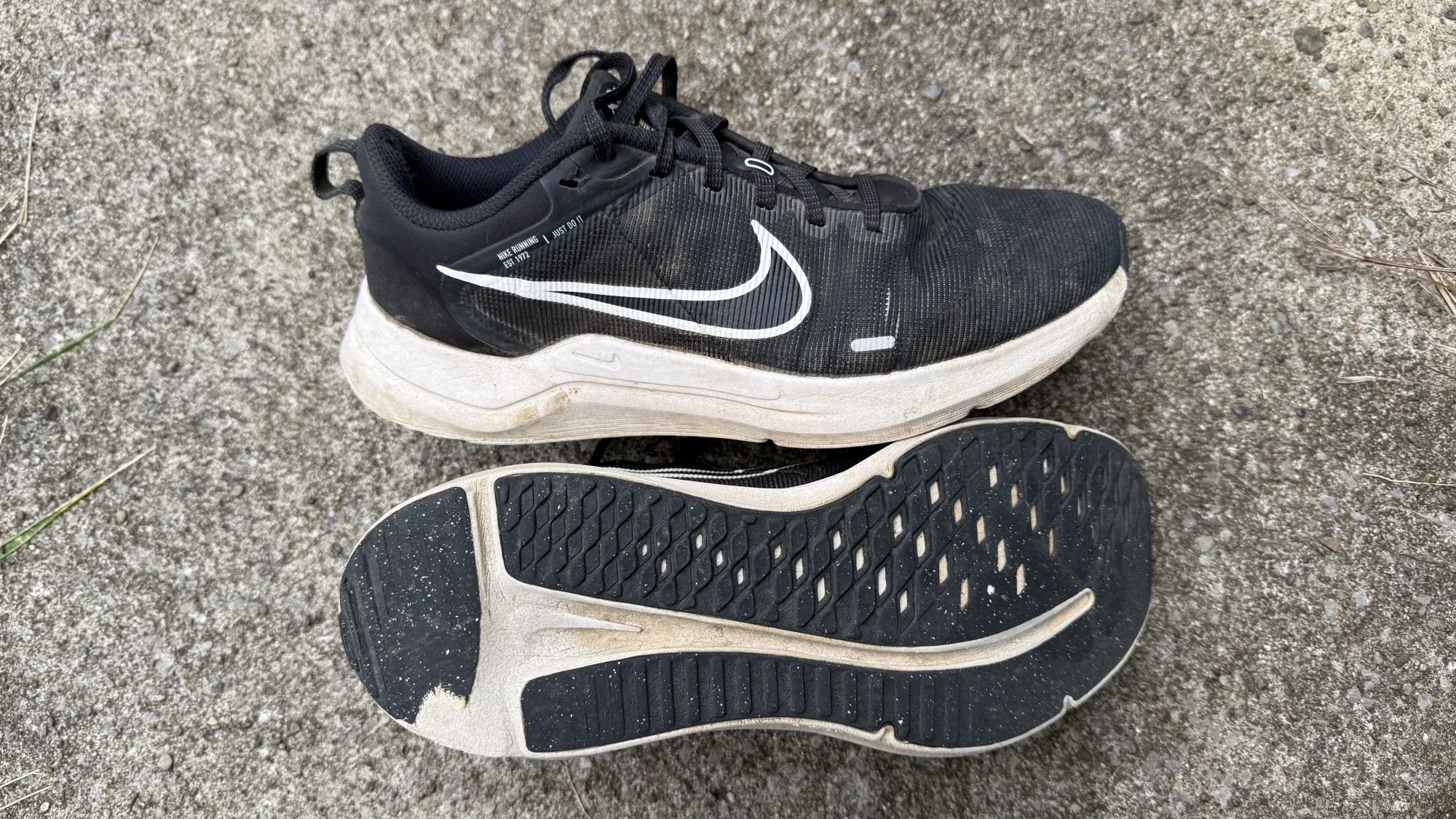
Nike Downshifters, side and sole view
Some rips in the upper, but honestly looking pretty good for their age.
Credit: Beth Skwarecki

Meet the honored pair. These are the Nike Downshifter 12, in a women’s U.S. size 8.5. I bought them from Amazon in 2024 and paid $66.94 including tax. As I’m writing this, my records show I’ve worn them for 294 activities since June 25 of last year, and they’ve logged a total of 1,024 miles in running workouts. (That’s 6.5 cents per mile, surely a personal record.) For context I run about 20-30 miles most weeks, often but not always in these shoes. 

The Downshifter is a beginner-level running shoe from Nike, but I’m a lifelong runner, not a beginner. I bought my first pair of them out of frustration with other shoes. 

See, I always bought Nike Frees, but Nike kept changing the Free from year to year. Some I liked, some I didn’t. Over time, it seemed like the Frees were getting more expensive every year, and wearing out sooner. Often within a few months of purchase, the foam underfoot would wear unevenly and I’d be running on uncomfortable lumps.

So one day in 2023, I decided I needed to find a shoe that would either last longer, or would be cheap enough that I wouldn’t care. (I ended up with a shoe that checked both boxes.) I browsed sales and bought two pairs, including a purple pair of Downshifter 12’s. I didn’t love them right out of the box, but over the season, they became my favorites. I ran in them all spring and summer, and then ran a half-marathon in them that fall. 

Afterward, I looked up some reviews of the Downshifters, just for fun. One said that the Downshifter is “not the shoe for runners regularly going over four miles.” I laughed. I replaced those purple Downshifters with a new (black) pair in 2024, just because it had been a while and they were probably close to the oft-advised 500-mile limit. That’s what you’re supposed to do, right? 

Why did I put 1,000 miles on these shoes? 

Fate had something different in mind for these new Downshifters. I was curious how long they would last, so I entered them into the gear logging section of my Garmin app. When you add a new shoe, Garmin asks you to set a mileage target so it can let you know when to replace them. I put 500. 

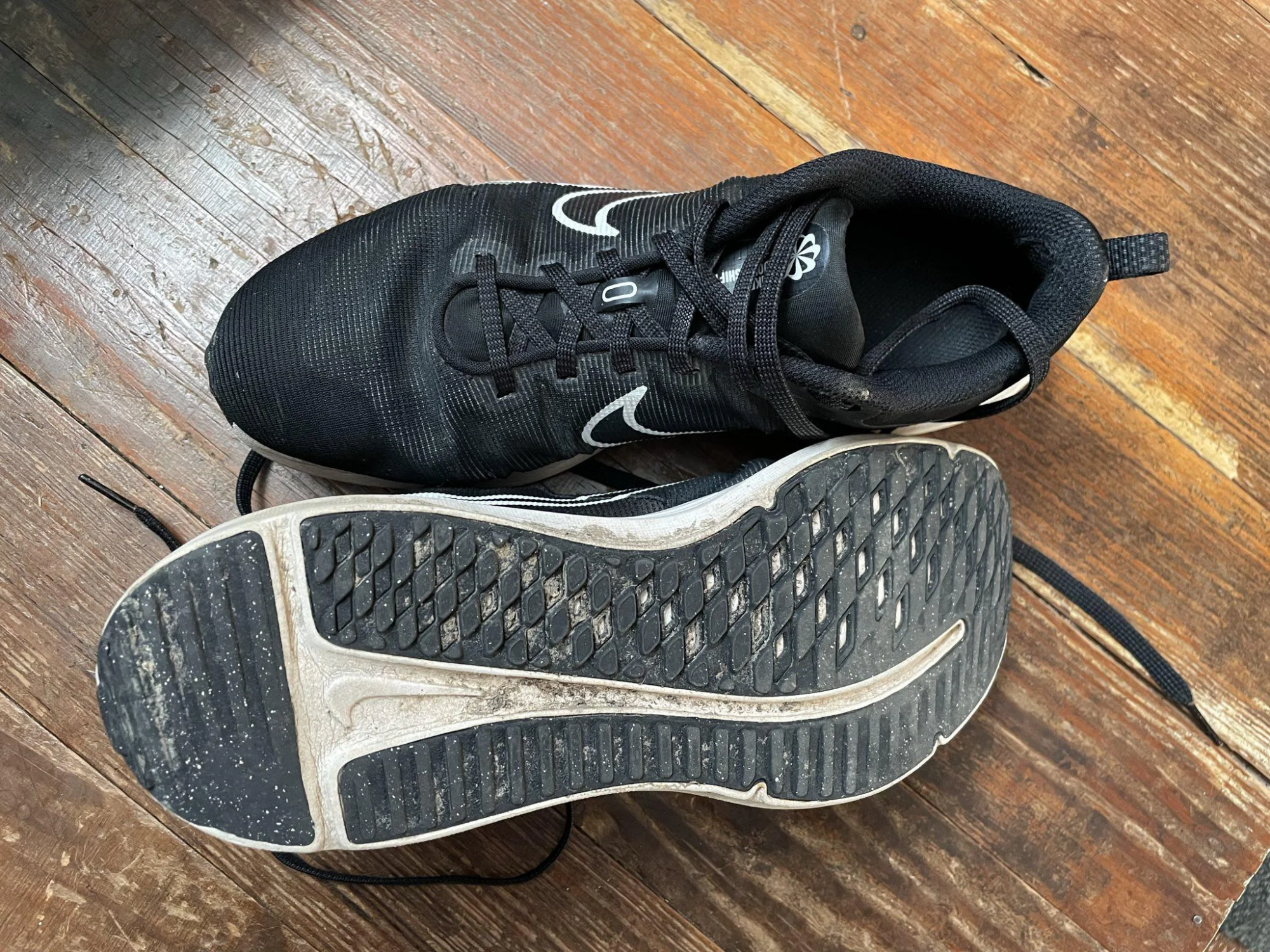
After every run, Garmin would automatically add up my miles. (If I ran in a different pair of shoes, I’d make sure to note that—I’ve put about 200 miles each on two other pairs of shoes within this timeframe.) When I had over 400 miles on the black Downshifters, I ordered a new pair, which still sits untouched in its shoebox to this day. At 500, I ignored the notification to replace my shoes. At 600, “I wonder if I can get these to 1,000” was a dumb thought that entered my head and did not leave. For comparison, here is how they looked at 500 miles:

Downshifters at 500 miles
How they looked at 500 miles. There’s still some tread on the heel, and the upper is in OK shape.
Credit: Beth Skwarecki

I kept tracking my shoe mileage carefully. This dumb thought is why I was so particular about keeping the miles-per-shoe numbers accurate even when I switched apps. 

The day I hit 1,000 was an anti-climax. I remember them being at 998 miles before joining my husband for an early morning run a few weeks ago. I mentioned to him during the run that the shoes were probably crossing 1,000 miles at that exact moment. “Nice!” he said, and we jogged on. I’ve kept running in them since then. I ran in them today. They feel fine. 

Why I think these shoes lasted so long

I’m no shoe-construction expert, but judging from the feel, it seems there’s just a simple slab of foam under my foot. My previous pairs, the less-durable ones, may have had lighter foams and they usually had more complicated shapes, with cutouts and grooves and such. 

The running shoes on the market are all so different that I don’t think it’s fair to come up with a blanket mileage recommendation that applies to everything. I’ve had running shoes that felt awful to run in after probably less than 100 miles. And then there are others that can go, apparently, 10 times as long. 

These Downshifters are the first pair where I confirmed the exact mileage, but I can think of two other pairs that seemed to last forever: an original 2004 Free 5.0, and a “Free RN Distance” from sometime in the 2010s. I replaced the 2004s when I realized I needed to go a half size bigger to avoid black toenails during marathon training. (No idea of the mileage, but I’d been using them off-and-on for eight years at that point.) I got rid of the RN Distance shoes during a decluttering binge because I hated the color. I soon regretted that decision. Neither pair actually wore out. 

My unscientific opinion is that these shoes lasted so long because they were simple. Just a slab of foam, no fancy shaping, and certainly no high-performance foam technology that might give better dynamics at the cost of longevity. Or maybe I was just lucky. Who knows.

What I think of shoe mileage rules in general

The advice to replace your shoes after 300 to 500 miles originated with a 1985 study that only tested shoes up to 500 miles, no further. It used a machine to simulate the effects of running. After 50 miles, shoes from several manufacturers only had 75% of their initial shock absorption capability. Between 250 and 500 miles, they were down to 60%. (The machine was harder on the shoes than actual runners; after 500 miles, human-worn shoes still had 70% of their initial shock absorption.) 

Surely shoe foams in 2025 are not the same as in 1984. And surely the various shoe models on the market are all different from each other in construction and foam type. But still the 300 to 500 mile rule has persisted, and I have to wonder if shoe makers are designing their shoes to meet the expectation of a 300 to 500 mile lifespan. 

A fascinating article at Runner’s World gets into detail about the different foams that are used these days and what we know about how long they last. Some “super shoes” lose their peak performance after just 100 miles, but even a worn-out super shoe may still perform better than a brand new budget shoe. The article doesn’t make any mileage recommendations, instead landing on advice to “listen to your body, rather than relying on arbitrary yardsticks.” 

I’ve also collected some advice from experienced runners on Reddit on how often they actually switch out their shoes, and as you might expect, the answers are all over the place. There are people who set a hard cap on the mileage they’ll allow a shoe to accrue, and others who go based on vibes. Some people only get 300 miles out of each pair; others say they routinely take theirs into the quadruple digits. 

Ultimately I don’t think much of any rule, and I’m skeptical of the idea that worn-out shoes are a recipe for injury. Running itself is a recipe for injury—I dare you to find an experienced runner who hasn’t dealt with some type of overuse injury, even if they follow every rule in the book. I think some runners use a shoe mileage cap as sort of a good-luck talisman. 

But injury isn’t that predictable, and neither our bodies nor our shoes will always behave in a predictable way over the years. Some shoes agree with our bodies better than others, and some last longer than others. When you find a pair that works for you, you might as well stick with it. 

Microsoft Outlook is Getting an AI Overhaul Under New Leaders

Microsoft has reorganized its Outlook team under new leadership as part of a broader effort to integrate AI into its core products. Gaurav Sareen, a corporate vice president at the company, recently assumed direct leadership of the Outlook division after Lynn Ayres, who previously ran the team, began a sabbatical. The move represents the latest in a series of AI-focused restructurings across Microsoft’s divisions. Sareen wrote in an internal memo that the company now has an opportunity to reimagine Outlook from the ground up rather than add AI features to existing systems, according to The Verge.

Ryan Roslansky, the chief executive of LinkedIn, took on an expanded role earlier this year as head of Office. Sareen now reports to Roslansky, who oversees the Office suite, Outlook and Microsoft 365 Copilot teams. The restructuring comes after Microsoft spent several years developing One Outlook, a web-based version meant to replace separate Windows, Mac, and web applications.


Read more of this story at Slashdot.

Rivian is settling $250 million lawsuit to focus on next year’s R2 EV

Electric vehicle startup Rivian announced on Thursday that it has settled a lawsuit with some of its investors. The company continues to deny allegations of making “materially untrue” statements during its inial public offering but says it agreed to pay $250 million to clear itself of distractions as it focuses on building its next EV, the mass-market R2, which is due next year.

Rivian was first sued by a shareholder in 2022 over claims that the startup knew it would cost far more for it to build each R1T electric truck and R1S electric SUV than the advertised $67,500 and $70,000 prices, respectively. A big surprise price increase would tarnish the nascent automaker’s reputation, the lawsuit claimed, and could lead to many of the almost 56,000 pre-orders being canceled.

Just a few months after its November 2021 IPO, the company had indeed issued a hefty price hike: $79,500 for the R1T and $84,500 for the R1S SUV. After an outcry, the company said it would honor the original price for its existing preorders. By that point, though, the damage was done, and more than a third of the company’s value was erased within a few days, the lawsuit alleged.

Read full article

Comments

Microsoft Teams Will Soon Tell Your Boss When You’re Not in the Office

The pandemic proved that a lot of us can do our jobs just fine out of the office. Nevertheless, companies continue to push for workers to return to their cubicles—whether in a hybrid arrangement, or five-days-a-week mandatory attendance. In both cases, many companies are looking for ways to hold employees accountable: Since many of our jobs can be done anywhere with an internet connection, if your boss doesn’t have eyes on you, it’s not always easy to tell where you’re working from.

Perhaps your company has rolled out initiatives meant to encourage office attendance. Maybe your boss counts your badge swipes, to ensure that you’re meeting your weekly in-office quota, or you are obligated to attend in-person meetings. But it’s not just the companies themselves that are working on these kinds of measures. Even Microsoft is trying to make it harder for remote employees to continue working from where they want to.

How Teams will track where you’re working from

As spotted by Tom’s Guide, Microsoft Teams will roll out an update in December that will have the option to report whether or not you’re working from your company’s office. The update notes are sparse on details, but include the following: “When users connect to their organization’s [wifi], Teams will soon be able to automatically update their work location to reflect the building they’re working from. This feature will be off by default. Tenant admins will decide whether to enable it and require end-users to opt-in.”

The language suggests that Microsoft intends for this feature to be focused more on helping workers locate fellow employees in large office complexes, and less on snitching on employees working from home when they shouldn’t be. That’s fair enough: If I worked for a company with multiple buildings on campus, it’d be helpful to know where someone I needed to talk to happened to be working that day.

But let’s be real. This feature is also going to be used by companies to track their employees, and ensure that they’re working from where they’re supposed to be working from. Your boss can take a look at your Teams status at any time, and if it doesn’t report you’re working from one of the company’s buildings, they’ll know you’re not in the office. No, the feature won’t be on by default, but if your company wants to, your IT can switch it on, and require that you enable it on your end as well.

As someone who has worked remotely for most of my professional career, I find the return-to-office mandates generally silly. I understand there are jobs that cannot be done remotely, and aspects of others that are made better by in-person collaboration. But if the vast majority of your work is done on a laptop connected to the internet, it makes no sense for you to be forced to work from an office. It also seems demoralizing to treat employees like children, tracking their whereabouts to ensure they’re doing their jobs from a pre-approved location. If you’re getting your work done, who cares where that work is happening?

Big tech is helping to pay for Trump’s ballroom that we all definitely want

The federal government has released a list of all of the entities helping to pay for President Trump’s lavish White House ballroom, according to reporting by Business Insider. Big tech is all over this thing, with companies like Amazon, Apple, Google, Meta and Microsoft all shelling out cash to fund the 90,000-square-foot ballroom.

It’s not just big tech. Defense firms are also helping to pony the bill here. Companies like Lockheed Martin and Palintir are sending some cash, as are random billionaires like the Winklevoss twins and Domino Sugar magnate José Fanjul. The list reads like a who’s who of the ultra wealthy and connected. 

As we all know, giant corporations and billionaires are kind and selfless, but what if just this one time they want something in return for their largesse? Columbia professor of law Richard Briffault told Time that most of these donors have done “significant” business with the federal government, raising ethical concerns.

“I doubt it’s a literal quid-pro-quo, but it’s probably more like ‘if you give this, I will look favorably upon you.’ Or maybe more like, ‘if you don’t give this, after you’ve been asked, I won’t [look favorably upon you],” Briffault said. “It’s greasing the system by making contributions, and in some ways, his leaning on them for contributions is quasi-coercive.”

Noah Bookbinder, CEO and President of ethics watchdog organization Citizens for Responsibility and Ethics in Washington said the whole thing is “extraordinarily unusual, deeply disturbing and does have tremendous ethics implications.” He also said that “Donald Trump has made very clear over the years that he does appreciate people paying tribute to him, and he does tend to do things that benefit those people.”

President Trump hosted top donors to the $250 million ballroom project at the White House, opening the door to potential institutional favoritism.

During a government shutdown, the optics of this pay-to-play are even worse. https://t.co/MbAKxOaPdG

— Citizens for Ethics (@CREWcrew) October 23, 2025

Trump has been personally woo-ing these potential financiers. There was a fundraising dinner in the East Room last week that included representatives of several of the aforementioned companies. The dinner was billed as an event to “Establish the Magnificent White House Ballroom,” according to the Wall Street Journal. The outlet also reported that Trump has held meetings at the White House and at his club in Virginia to raise money for the project.

It’s worth noting that this isn’t the first time big tech companies have banded together to pay tribute to Trump. Most of the aforementioned companies helped pay for his inauguration and, heck, Apple CEO Tim Cook gave Trump an actual 24K gold statue for some reason.

The construction of this glorious ballroom we all most definitely want has already been at the heart of several controversies. Americans were recently surprised to find that the East Wing of the White House had been completely demolished, despite the president previously promising the ballroom would not even touch the actual property.

In any event, we’ll soon be able to watch live feeds of the ultra rich dancing the night away to the Village People or whatever, which is sure to solve all of our problems. In unrelated news, food stamps are likely to run out next week for around 41 million Americans and beef now averages $10 a pound.

This article originally appeared on Engadget at https://www.engadget.com/big-tech/big-tech-is-helping-to-pay-for-trumps-ballroom-that-we-all-definitely-want-162545434.html?src=rss

Bats eat the birds they pluck from the sky while on the wing

There are three species of bats that eat birds. We know that because we have found feathers and other avian remains in their feces. What we didn’t know was how exactly they hunt birds, which are quite a bit heavier, faster, and stronger than the insects bats usually dine on.

To find out, Elena Tena, a biologist at Doñana Biological Station in Seville, Spain, and her colleagues attached ultra-light sensors to Nyctalus Iasiopterus, the largest bats in Europe. What they found was jaw-droppingly brutal.

Inconspicuous interceptors

Nyctalus Iasiopterus, otherwise known as greater noctule bats, have a wingspan of about 45 centimeters. They have reddish-brown or chestnut fur with a slightly paler underside, and usually weigh around 40 to 60 grams. Despite that minimal weight, they are the largest of the three bat species known to eat birds, so the key challenge in getting a glimpse into the way they hunt was finding sensors light enough to not impede the bats’ flight.

Read full article

Comments

WordPress Maker Files Counterclaims Against WP Engine Over Trademark Use

Automattic has filed counterclaims against WP Engine in a lawsuit the hosting company initiated in October 2024. The counterclaims accuse WP Engine of trademark infringement and deceptive marketing practices. After private equity firm Silver Lake invested $250 million in WP Engine, the hosting company began calling itself “The WordPress Technology Company” and allowed partners to refer to it as “WordPress Engine,” the lawsuit says. WP Engine also launched products named “Core WordPress” and “Headless WordPress.”

The counterclaims allege that WP Engine promised to commit 5% of its resources to the WordPress ecosystem but failed to keep those promises. Automattic contends that WP Engine engaged in trademark violations to avoid licensing fees that would have affected the company’s earnings and valuation. Silver Lake sought to sell WP Engine at a $2 billion valuation but could not find a buyer. The filing notes that potential buyers included Automattic. The counterclaims also assert that WP Engine degraded product quality and removed essential features to reduce costs during this period.


Read more of this story at Slashdot.

Apple Removed the Controversial ‘Tea’ and ‘TeaOnHer’ Apps From the App Store

Though it brings me no pleasure, it’s once again time to discuss the viral apps Tea and TeaOnHer. You may remember them from the summer, when Tea—where women could anonymously rate and discuss men under the pretense of helping each other safely navigate dating—was the target of data breaches that exposed users’ personal information. From there, an app called TeaOnHer was launched for men and Tea faced a class action from users who were upset about their private data being easily accessible to hackers. Whether you remember them or not, they’re gone now—sort of. Apple has yanked them from the App Store.

The App Store removal of Tea and TeaOnHer

Tea was around for about two years before it unexpectedly went viral in July, which led to at least two distinct data breaches, the second of which occurred when a data expert discovered that not only were some users’ pictures stored in an unsecured manner, but some private DMs were, too.

Part of the reason the app went so viral in the first place was that a lot of people were uncomfortable with its premise. It functioned like Yelp, but instead of reviewing businesses, women could review men. The men had no recourse or due process; they couldn’t even access the app, let alone respond to anything said about them. (Women were granted access by uploading ID photos or verification selfies and it was the trove of ID photos that was originally hacked and leaked.)

Some people found that unfair and others saw an opportunity to cash in on the discontent. TeaOnHer, an app with the same premise but aimed at men, hit the App Store about two weeks after the Tea hack. The privacy discourse continued, but both apps remained up in the Apple App Store anyway. Until now.

Apple confirmed to TechCrunch that the apps were pulled because they failed to meet the company’s requirements for user privacy and content moderation. Sure enough, if you search the apps on the App Store, nothing comes up. Well, except a bunch of imposters looking to make the most of Tea and TOH’s absence. Something called “Tea On Her & Him – Overheard” is the second-most-downloaded free app in the Lifestyle category right now.

Can you still use Tea?

Tea hasn’t been pulled from Google Play yet, so you can still access it on Android. Moreover, if you already had Tea on your iPhone, it still functions—for now.

When the DM breach was made public over the summer, Tea responded by shutting down DMs and making that clear within the app. Over the course of the news cycle at the time, the app posted public communications to its Instagram page. Within the app and on its social media, there is no mention of the App Store removal, but a rep did email me this: “We are aware that the Tea App has been removed from the App Store and we are working to address Apple’s feedback. We know what this app means to our more than six million users and remain deeply committed to our mission of helping women navigate dating with confidence.”

Disney warns that YouTube TV could lose its channels amid fee negotations

Stop me if you’ve heard this one before: YouTube TV may lose a provider’s content because a deadline is approaching without a deal in place. This time, the media company is Disney. It’s warning (via Variety) that its networks could soon go dark on Google’s streaming service.

The two sides are negotiating ahead of an October 30 midnight ET deadline. If they can’t agree by then, all Disney content will disappear from YouTube TV. That includes (among others) all ESPN channels, local ABC stations, ABC News, FX, NatGeo, Disney Channel and Freeform. A YouTube spokesperson told Variety that if that should happen for “an extended period of time,” subscribers will receive a $20 credit.

One aspect of these battles is finger-pointing as each side tries to leverage public perception. Disney says YouTube is trying to muscle the mouse into paying below market value. Meanwhile, YouTube claims Disney is “proposing costly economic terms” that could lead to even higher subscription fees. YouTube TV launched at $35 per month in 2017 and now costs a whopping $83 monthly.

If recent history is any indication, you can expect the dire warnings of content removal to continue until they strike a deal at the last second. That already happened several times this year.

In February, YouTube TV and Paramount had that dance. Google’s streaming network and Fox came to a renewal deal in August after repeated content-removal warnings. YouTube TV and NBCUniversal did the thing earlier this month. However, in that case, the streaming service dropped Univision and other TelevisaUnivision networks, so tidy deals aren’t inevitable. Time will tell how this one plays out, but it’s hard to imagine either side here wanting to play chicken past the October 30 deadline.

This article originally appeared on Engadget at https://www.engadget.com/entertainment/streaming/disney-warns-that-youtube-tv-could-lose-its-channels-amid-fee-negotations-155347776.html?src=rss

This battery-powered Ring doorbell is back on sale for a record-low price

Amazon is offering a hefty discount on the Ring Battery Doorbell Plus. The video doorbell has dropped from its regular price of $150 to $80 in a limited-time deal.

That’s a discount of 47 percent for this particular model. It also matches the record-low price we saw for the Ring Battery Doorbell Plus during the Prime Day event earlier this month.

The Ring Battery Doorbell Plus has a more expanded field-of-view compared with earlier models, allowing for head-to-toe views of whoever’s at your doorstep. There’s support for color night vision, along with motion detection and the ability to set up privacy zones.

Amazon says the Battery Doorbell Plus is easy to set up using the Ring app and mounting tools. The company added that there’s a quick release system for the battery pack, so you can take it inside for recharging without having to unscrew a cover.

Naturally, the device is connected to the Alexa smart home ecosystem, so you’ll be able to receive motion alerts on compatible Echo devices or see a live view of the camera’s feed on an Echo Show, Fire TV or Fire Tablet. You’ll be able to chat to whoever’s at the door too, via the doorbell’s two-way communication system.

A Ring Home subscription is required for you to receive package alerts — this feature will let you know when the doorbell’s camera detects a package within a particular zone. The subscription also includes the option to save recorded videos for up to 180 days, among other features.

Follow @EngadgetDeals on X for the latest tech deals and buying advice.

This article originally appeared on Engadget at https://www.engadget.com/deals/this-battery-powered-ring-doorbell-is-back-on-sale-for-a-record-low-price-154029007.html?src=rss

Intel’s Tick-Tock Isn’t Coming Back

Intel’s tick-tock development cadence will not return. CEO Lip-Bu Tan said during the company’s Q3 2025 earnings call that the 18A process node will be a “long-lived node” powering at least three generations of client and server products. Intel reported its first profit in nearly two years, aided by financial support from Nvidia, Softbank, and the US government.

The company faces chip shortages that will peak in the first quarter of next year. CFO David Zinsner said Intel is prioritizing AI server chips over consumer processors. Intel will launch only one Panther Lake SKU this year and roll out others in 2026. Zinsner called Panther Lake “pretty expensive” and said Intel will push Lunar Lake chips “in at least the first half of the year.”


Read more of this story at Slashdot.