Westinghouse Is Claiming a Nuclear Deal Would See $80 Billion of New Reactors

An anonymous reader quotes a report from Ars Technica: On Tuesday, Westinghouse announced that it had reached an agreement with the Trump administration that would purportedly see $80 billion of new nuclear reactors built in the US. And the government indicated that it had finalized plans for a collaboration of GE Vernova and Hitachi to build additional reactors. Unfortunately, there are roughly zero details about the deal at the moment. The agreements were apparently negotiated during President Trump’s trip to Japan. An announcement of those agreements indicates that “Japan and various Japanese companies” would invest “up to” $332 billion for energy infrastructure. This specifically mentioned Westinghouse, GE Vernova, and Hitachi. This promises the construction of both large AP1000 reactors and small modular nuclear reactors. The announcement then goes on to indicate that many other companies would also get a slice of that “up to $332 billion,” many for basic grid infrastructure. The report notes that no reactors are currently under construction and Westinghouse’s last two projects ended in bankruptcy. According to the Financial Times, the government may share in profits and ownership if the deal proceeds.


Read more of this story at Slashdot.

Society Will Accept a Death Caused By a Robotaxi, Waymo Co-CEO Says

At TechCrunch Disrupt 2025, Waymo co-CEO Tekedra Mawakana said society will ultimately accept a fatal robotaxi crash as part of the broader tradeoff for safer roads overall. TechCrunch reports: The topic of a fatal robotaxi crash came up during Mawakana’s interview with Kristen Korosec, TechCrunch’s transportation editor, during the first day of the outlet’s annual Disrupt conference in San Francisco. Korosec asked Mawakana about Waymo’s ambitions and got answer after answer about the company’s all-consuming focus on safety. The most interesting part of the interview arrived when Korosec brought on a thought experiment. What if self-driving vehicles like Waymo and others reduce the number of traffic fatalities in the United States, but a self-driving vehicle does eventually cause a fatal crash, Korosec pondered. Or as she put it to the executive: “Will society accept that? Will society accept a death potentially caused by a robot?”

“I think that society will,” Mawakana answered, slowly, before positioning the question as an industrywide issue. “I think the challenge for us is making sure that society has a high enough bar on safety that companies are held to.” She said that companies should be transparent about their records by publishing data about how many crashes they’re involved in, and she pointed to the “hub” of safety information on Waymo’s website. Self-driving cars will dramatically reduce crashes, Mawakana said, but not by 100%: “We have to be in this open and honest dialogue about the fact that we know it’s not perfection.”

Circling back to the idea of a fatal crash, she said, “We really worry as a company about those days. You know, we don’t say ‘whether.’ We say ‘when.’ And we plan for them.” Korosec followed up, asking if there had been safety issues that prompted Waymo to “pump the breaks” on its expansion plans throughout the years. The co-CEO said the company pulls back and retests “all the time,” pointing to challenges with blocking emergency vehicles as an example. “We need to make sure that the performance is backing what we’re saying we’re doing,” she said. […] “If you are not being transparent, then it is my view that you are not doing what is necessary in order to actually earn the right to make the roads safer,” Mawakana said.


Read more of this story at Slashdot.

Nvidia’s New Product Merges AI Supercomputing With Quantum

NVIDIA has introduced NVQLink, an open system architecture that directly connects quantum processors with GPU-based supercomputers. The Quantum Insider reports: The new platform connects the high-speed, high-throughput performance of NVIDIA’s GPU computing with quantum processing units (QPUs), allowing researchers to manage the intricate control and error-correction workloads required by quantum devices. According to a NVIDIA statement, the system was developed with guidance from researchers at major U.S. national laboratories including Brookhaven, Fermi, Lawrence Berkeley, Los Alamos, MIT Lincoln, Oak Ridge, Pacific Northwest, and Sandia.

Qubits, the basic units of quantum information, are extremely sensitive to noise and decoherence, making them prone to errors. Correcting and stabilizing these systems requires near-instantaneous feedback and coordination with classical processors. NVQLink is meant to meet that demand by providing an open, low-latency interconnect between quantum processors, control systems, and supercomputers — effectively creating a unified environment for hybrid quantum applications.

The architecture offers a standardized, open approach to quantum integration, aligning with the company’s CUDA-Q software platform to enable researchers to develop, test, and scale hybrid algorithms that draw simultaneously on CPUs, GPUs, and QPUs. The U.S. Department of Energy (DOE) — which oversees several of the participating laboratories — framed NVQLink as part of a broader national effort to sustain leadership in high-performance computing, according to NVIDIA.


Read more of this story at Slashdot.

Ubuntu Unity Faces Possible Shutdown As Team Member Cries For Help

darwinmac writes: Ubuntu Unity is staring at a possible shutdown. A community moderator has gone public pleading for help, admitting the project is “broken and needs to be fixed.” Neowin reports the distro is suffering from critical bugs so severe that upgrades from 25.04 to 25.10 are failing and even fresh installs are hit. The moderator admits they lack the technical skill or time to perform a full rescue and is asking the broader community, including devs, testers, and UI designers, to step in so Ubuntu Unity can reach 26.04 LTS. If no one steps in soon, this community flavor might quietly fade away once more.


Read more of this story at Slashdot.

C Major Scale On 123 Instruments In 123 Seconds

Because music is all around us (except at work, we’re not allowed to listen to music at work), this is a video of Luke Pickman of InstrumentManiac playing the C major scale on 123 instruments in 123 seconds. The video is exactly 2:03 long too so I think he nailed it. Which instruments were your favorite? Mine were the pan whistle, ocarina, and Aztec death whistle. I need to get myself one of those death whistles. I thought they actually blew death, but that is not the case. Apparently these reproductions don’t even sound anything like the original. Like the whistle not actually blowing death and me being able to convince an enemy it’s a pipe, that’s a shame.

Senators Announce Bill That Would Ban AI Chatbot Companions For Minors

An anonymous reader quotes a report from NBC News: Two senators said they are announcing bipartisan legislation on Tuesday to crack down on tech companies that make artificial intelligence chatbot companions available to minors, after complaints from parents who blamed the products for pushing their children into sexual conversations and even suicide. The legislation from Sens. Josh Hawley, R-Mo, and Richard Blumenthal, D-Conn., follows a congressional hearing last month at which several parents delivered emotional testimonies about their kids’ use of the chatbots and called for more safeguards.

“AI chatbots pose a serious threat to our kids,” Hawley said in a statement to NBC News. “More than seventy percent of American children are now using these AI products,” he continued. “Chatbots develop relationships with kids using fake empathy and are encouraging suicide. We in Congress have a moral duty to enact bright-line rules to prevent further harm from this new technology.” Sens. Katie Britt, R-Ala., Mark Warner, D-Va., and Chris Murphy, D-Conn., are co-sponsoring the bill.

The senators’ bill has several components, according to a summary provided by their offices. It would require AI companies to implement an age-verification process and ban those companies from providing AI companions to minors. It would also mandate that AI companions disclose their nonhuman status and lack of professional credentials for all users at regular intervals. And the bill would create criminal penalties for AI companies that design, develop or make available AI companions that solicit or induce sexually explicit conduct from minors or encourage suicide, according to the summary of the legislation. “In their race to the bottom, AI companies are pushing treacherous chatbots at kids and looking away when their products cause sexual abuse, or coerce them into self-harm or suicide,” Blumenthal said in a statement. “Our legislation imposes strict safeguards against exploitative or manipulative AI, backed by tough enforcement with criminal and civil penalties.”

“Big Tech has betrayed any claim that we should trust companies to do the right thing on their own when they consistently put profit first ahead of child safety,” he continued.


Read more of this story at Slashdot.

5 Different LEGO Cars Attempt To Jump Increasingly Bigger Potholes

This is a video of Youtuber Brick Technology (previously) pitting five different LEGO car builds (simple car, square car, jumping car, propeller car, and pole jumper) against increasingly bigger potholes to see which fares the best. It’s a fun watch (especially the jumping car, propeller car, and pole jumper), and is the exact sort of thing I’d like to find myself doing on weekends. But is it? Noooooo, I just sleep until it’s dark out, sleep until it’s light out, sleep until it’s dark out and then sleep until it’s time to wake up for work Monday morning. I can’t go on like this.

China’s DeepSeek and Qwen AI Beat US Rivals In Crypto Trading Contest

hackingbear shares a report from Crypto News: Two Chinese artificial intelligence (AI) models, DeepSeek V3.1 and Alibaba’s Qwen3-Max, have taken a commanding lead over their US counterparts in a live real-world real-money cryptocurrency trading competition, posting triple-digit gains in less than two weeks. According to Alpha Arena, a real-market trading challenge launched by US research firm Nof1, DeepSeek’s Chat V3.1 turned an initial $10,000 into $22,900 by Monday, a 126% increase since trading began on October 18, while Qwen 3 Max followed closely with a 108% return.

In stark contrast, US models lagged far behind. OpenAI’s GPT-5 posted the worst performance, losing nearly 60% of its portfolio, while Google DeepMind’s Gemini 2.5 Pro showed a similar 57% decline. xAI’s Grok 4 and Anthropic’s Claude 4.5 Sonnet fared slightly better, returning 14% and 23% respectively. “Our goal with Alpha Arena is to make benchmarks more like the real world — and markets are perfect for this,” Nof1 said on its website.


Read more of this story at Slashdot.

Python Foundation Rejects Government Grant Over DEI Restrictions

The Python Software Foundation rejected a $1.5 million U.S. government grant because it required them to renounce all diversity, equity, and inclusion initiatives. “The non-profit would’ve used the funding to help prevent supply chain attacks; create a new automated, proactive review process for new PyPI packages; and make the project’s work easily transferable to other open-source package managers,” reports The Register. From the report: The programming non-profit’s deputy executive director Loren Crary said in a blog post today that the National Science Founation (NSF) had offered $1.5 million to address structural vulnerabilities in Python and the Python Package Index (PyPI), but the Foundation quickly became dispirited with the terms (PDF) of the grant it would have to follow. “These terms included affirming the statement that we ‘do not, and will not during the term of this financial assistance award, operate any programs that advance or promote DEI [diversity, equity, and inclusion], or discriminatory equity ideology in violation of Federal anti-discrimination laws,'” Crary noted. “This restriction would apply not only to the security work directly funded by the grant, but to any and all activity of the PSF as a whole.”

To make matters worse, the terms included a provision that if the PSF was found to have voilated that anti-DEI diktat, the NSF reserved the right to claw back any previously disbursed funds, Crary explained. “This would create a situation where money we’d already spent could be taken back, which would be an enormous, open-ended financial risk,” the PSF director added. The PSF’s mission statement enshrines a commitment to supporting and growing “a diverse and international community of Python programmers,” and the Foundation ultimately decided it wasn’t willing to compromise on that position, even for what would have been a solid financial boost for the organization. “The PSF is a relatively small organization, operating with an annual budget of around $5 million per year, with a staff of just 14,” Crary added, noting that the $1.5 million would have been the largest grant the Foundation had ever received – but it wasn’t worth it if the conditions were undermining the PSF’s mission. The PSF board voted unanimously to withdraw its grant application.


Read more of this story at Slashdot.

Westinghouse is claiming a nuclear deal would see $80B of new reactors

On Tuesday, Westinghouse announced that it had reached an agreement with the Trump administration that would purportedly see $80 billion of new nuclear reactors built in the US. And the government indicated that it had finalized plans for a collaboration of GE Vernova and Hitachi to build additional reactors. Unfortunately, there are roughly zero details about the deal at the moment.

The agreements were apparently negotiated during President Trump’s trip to Japan. An announcement of those agreements indicates that “Japan and various Japanese companies” would invest “up to” $332 billion for energy infrastructure. This specifically mentioned Westinghouse, GE Vernova, and Hitachi. This promises the construction of both large AP1000 reactors and small modular nuclear reactors. The announcement then goes on to indicate that many other companies would also get a slice of that “up to $332 billion,” many for basic grid infrastructure.

So the total amount devoted to nuclear reactors is not specified in the announcement or anywhere else. As of the publication time, the Department of Energy has no information on the deal; Hitachi, GE Vernova, and the Hitachi/GE Vernova collaboration websites are also silent on it.

Read full article

Comments

Board is a $500 board game console with 12 original titles

If you’re a person who enjoys the social side of online gaming, this product launch is not for you. Board was designed by entrepreneur Brynn Putnam, alongside former World of Warcraft exec Seth Sivac, as a way to make the idea of “screen time” a more immersive in-person experience. “Families want to connect, but they’re competing with incredibly powerful technologies,” Putnam told USA Today. “Board is about flipping that dynamic — using tech to support real human connection instead of replacing it.”

The product acts like a typical tabletop game that you lay out flat, just like the cardboard play space for Monopoly or Settlers of Catan, but it offers additional digital interactions on the digital screen. The 12 games included are original to Board, each with unique piece sets. 

Putnam has past experience creating tech that blends the physical and the digital. Her previous project, Mirror, was a workout screen for delivering live fitness classes at home. The company later got bought up by lululemon for a cool $500 million. Putnam is billing Board as “the first ever face-to-face gaming console” and at $499, its price tag nearly matches what you’d expect for current console hardware. And that’s the limited time offer; the website says Board will normally retail for $699. The sales pitch leans hard on the idea of connecting families without their phones, but for that cost, you could also buy more than a dozen different board and card games to eliminate the screens altogether. And screens don’t have to be the enemy. There are plenty of amazing couch co-op video games out there, including kid-friendly ones, not to mention the fact that even single-player games can be multiplayer experiences if you have the right mindset.

This article originally appeared on Engadget at https://www.engadget.com/gaming/board-is-a-500-board-game-console-with-12-original-titles-223313978.html?src=rss

GOG Autumn Sale discounts Cyberpunk 2077, Silent Hill 2 and Fallout: New Vegas

GOG kicked off its annual Autumn Sale today with some discounts on excellent PC games that can carry you through the end of 2025. The sale runs through November 4, and notably also includes discounts on several older games maintained as part of the GOG Preservation Program.

The Autumn Sale includes sales on newer games like Cyberpunk 2077, which normally costs $60 but is available during the sale for $21, and the open-world game’s excellent DLC, Cyberpunk 2077: Phantom Liberty, which you can pick up for $21, down from $30. GOG is also offering Silent Hill 2, the 2024 remake of the classic horror game, for 50 percent off, bringing its price down to $35. And if you’re looking for something a little more ruminative, Disco Elysium – The Final Cut is 75 percent off, taking it from $40 to $10.

GOG is best known for selling old games, and the Autumn Sale includes some great options there, too. While it’s not that old, Doom (2016) for $4, which is 80 percent off its normal $20 price, is pretty hard to deny. There’s also classics like Fallout: New Vegas Ultimate Edition, which you can get for $10, down from $20. And EA gems like Spore Collection and SimCity 3000 Unlimited are also both 50 percent off, at $15 and $5, respectively.

New Vegas, Spore and SimCity 3000 are all part of GOG’s Preservation Program, which was formally launched in 2024 as a way to guarantee classic titles run on modern hardware, support controllers and more. Maintaining the program has apparently led to its fair share of headaches, though. “To be perfectly honest, it’s harder than we thought it would be,” Marcin Paczynski, GOG’s senior business development manager, shared in an interview with The Game Business. “what we’ve found out is that the games and how they work has deteriorated way faster than what we thought. And we are not talking only about the game not launching. We are talking about more subtle things as well.”

This article originally appeared on Engadget at https://www.engadget.com/gaming/pc/gog-autumn-sale-discounts-cyberpunk-2077-silent-hill-2-and-fallout-new-vegas-221329021.html?src=rss

AI News Anchor Debuts On UK’s Channel 4

An anonymous reader quotes a report from Variety: A news special on Britain’s Channel 4 titled “Will AI Take My Job?” investigated how automation is reshaping the workplace and pitting humans against machines. At the end of the hour-long program, a major twist was revealed: the anchor, who narrates and appears throughout the telecast reporting from different locations, was entirely AI-generated.

In the final moments of the special, the host says: “AI is going to touch everybody’s lives in the next few years. And for some, it will take their jobs. Call center workers? Customer service agents? Maybe even TV presenters like me. Because I’m not real. In a British TV first, I’m an AI presenter. Some of you might have guessed: I don’t exist, I wasn’t on location reporting this story. My image and voice were generated using AI.”

The hour aired Monday at 8 p.m. as part of the “Dispatches” documentary program, which Channel 4 says is now the first British television show to feature an AI presenter. The “anchor” was produced by AI fashion brand Seraphinne Vallora for Kalel Productions and was guided by prompts to create a realistic on-camera performance. “The use of an AI presenter is not something we will be making a habit of at Channel 4 — instead our focus in news and current affairs is on premium, fact checked, duly impartial and trusted journalism — something AI is not capable of doing,” said Louisa Compton, Channel 4’s head of news and current affairs. “But this stunt does serve as a useful reminder of just how disruptive AI has the potential to be — and how easy it is to hoodwink audiences with content they have no way of verifying.”


Read more of this story at Slashdot.

MSI GeForce RTX 5050 Shadow 2X Review: Budget Blackwell Gaming Tested

MSI GeForce RTX 5050 Shadow 2X Review: Budget Blackwell Gaming Tested
MSI GeForce RTX 5050 Shadow 2X 8GB: $249 The GeForce RTX 5050 is the most-affordable graphics card based on NVIDIA’s Blackwell architecture that targets mainstream gamers, and is the first RTX XX50 series GPU for the desktop in years. Blackwell Architecture Power Efficient Smaller Form Factor Cool And Quiet DLSS4 And RTX Neural Rendering Latest…

Elon Musk’s ‘Grokipedia’ Is Certainly No Wikipedia

Wikipedia is a treasured online resource that, despite massive changes across the web, has managed to remained truly great to this day. I, alongside millions of other users, visit the site daily to learn something new or double-check existing knowledge. In an age of non-stop AI slop, Wikipedia is something of an antidote.

If you look at Wikipedia and think “this is alright, but an AI version would be a lot better,” you might just be Elon Musk. Musk’s AI company, xAI, just launched Grokipedia—yes, that really is its name—an online encyclopedia that closely resembles Wikipedia in name and surface-level appearance. But under the hood, the two could hardly be any more different. Though it’s early days for the new “encyclopedia,” I’d say it’s not worth using, at least not for anything real.

The Grokipedia experience

When you load up the Grokipedia website, it looks fairly standard. You see the Grokipedia name, alongside the version number (v0.1, at the time of writing), alongside a search bar and an “Articles Available” counter (885,279). Searching for an article too is basic: You type in a query, and a list of available articles appears for you to select from. Once you pull up an article, it looks like Wikipedia, only extremely basic: There are no images, only text, though you can use the sidebar to jump between sections of the article. You’ll also find sources, noted by numbers, which correspond to the References portion at the bottom of each article.

The key difference between Grokipedia and a simple version of Wikipedia, however, is that these articles are not written and edited by real people. Instead, each article is generated and “fact-checked” by Grok, xAI’s large language model (LLM). LLMs are able to generate large amounts of text in short periods of time, and include sources for where they pull their information, which might make the pitch for Grokipedia sound great to some. However, LLMs also have a tendency to hallucinate, or, in other words, make things up. Sometimes, the sources the AI is pulling from are unreliable or facetious; other times, the AI takes it upon itself to “lie,” and generate text that simply isn’t true. In both cases, the information cannot be trusted, especially not at face value, which is why it’s troubling to see much of the experience is entirely powered by Grok, without human intervention.

Grokipedia vs. Wikipedia

Musk is pitching Grokipedia as a “massive improvement” over Wikipedia, which he has criticized for pushing propaganda, particularly towards left-leaning ideas and politics. It’s ironic, then, that some of these Grokipedia entries are themselves pulling from Wikipedia. As The Verge’s Jay Peters highlights, articles like MacBook Air note the following at the bottom: “The content is adapted from Wikipedia, licensed under Creative Commons Attribution-ShareAlike 4.0 License.” What’s more, Peters found that some Grokipedia articles, such as PlayStation 5 and the Lincoln Mark VIII, are almost one-to-one copies of the corresponding articles on Wikipedia.

If you’ve followed Musk’s politics and political activities in recent years, it won’t surprise you to learn he falls on the right-wing side of the political spectrum. That might give pause to anyone who considers using Grokipedia as an unbiased source of information, especially as Musk has continuously retooled Grok to generate responses more favorable to right-wing opinions. Critics like Musk claim Wikipedia is biased towards the left, but Grokipedia is entirely produced by an AI model with an abject bias.

You’ll see that you have very different experiences when reading certain topics across Wikipedia and Grokipedia. Wikipedia’s Tylenol article, for example, reads the following:

In 2025, Donald Trump made several statements about a controversial and unproven connection between autism and Tylenol. These statements, about the connection between Tylenol during pregnancy and autism, are based on unreliable sources without scientific evidence.

Compare that to Grokipedia, which devotes three paragraphs to the subject, the first of which begins:

Multiple observational studies and meta-analyses have identified associations between prenatal exposure to acetaminophen (the active ingredient in Tylenol) and increased risks of neurodevelopmental disorders (NDDs) in offspring, including attention-deficit/hyperactivity disorder (ADHD) and autism spectrum disorder (ASD).

That said, the second paragraph highlights some of the issues with those studies, while the third highlights that certain agencies suggest the “benefits outweigh unproven risks.”

Similarly, as spotted by WIRED, Grokipedia’s article, Transgender, highlights the belief that social media may have acted as a “contagion” to the rise in transgender identification. Not only is that a common right-wing assertion, that particular word could have been plucked from a post from a right-wing X account. Wikipedia’s article, as you might expect, does not entertain the claim at all.

Grokipedia is also favorable to unproven, controversial, or flat-out absurd claims. As Rolling Stone highlights, it refers to “Pizzagate,” a conspiracy theory that lead to a real-life shooting, as “allegations,” a “hypothesis,” and a “narrative.” Grokipedia gives credence to “Great Replacement,” a racist theory floated by white supremacists.

Should you use Grokipedia?

Here’s the short answer: no. The issue I have with Grokipedia is two-fold: First, no encyclopedia is going to be reliable when it is almost entirely created by AI models. Sure, some of the information may be accurate, and it’s great you can see the sources the bot is using, but when the risk of hallucination is baked into the technology with no way around it, choosing to avoid human intervention en masse all but ensures inaccuracies will plague much of Grokipedia’s knowledge base.

As if that wasn’t enough, this Grokipedia is built on an LLM that Musk is openly tinkering with to generate results that more closely align with his worldview, and the worldview of one particular political ideology. Hallucination and bias—just the ingredients you need for an encyclopedia.

The thing about Wikipedia is it’s written and edited by humans. Those humans can hold other human writers accountable, adding new information when it becomes available and correcting mistakes when they encounter them. Perhaps it’s frustrating to read that your favorite health and human services secretary “promoted vaccine misinformation and public-health conspiracy theories,” but that’s the objective, scientific reality. Removing these objective descriptions, and reframing the discussion in a way that fits a warped worldview doesn’t make Grokipedia better than Wikipedia—it makes it useless.

UK Cyclist Receives 3D-Printed Facial Prosthetic After Crash Left Him With Third-Degree Burns

A cyclist who received severe third-degree burns to his head after being struck by a drunk driver has been fitted with a printed 3D face. The Guardian: Dave Richards, 75, was given a 3D prosthetic by the NHS that fits the space on his face and mimics his hair colour, eye colour and skin. […] While recovering, he was referred to reconstructive prosthetics, which has opened the Bristol 3D medical centre, the first of its kind in the UK to have 3D scanning, design and printing in a single NHS location. Richards, from Devon, said surgeons tried to save his eye but “they were worried any infection could spread from my eye down the optic nerve to the brain so the eye was removed.”

[…] He called the process of getting a 3D-printed face “not the most pleasant.” He added: “In the early days of my recovery, I felt very vulnerable, and would not expose myself to social situations. It took me a long time to feel comfortable about my image, how I thought people looked at me and what they thought of me — but I have come a long way in that respect.”


Read more of this story at Slashdot.

A pair of MultiVersus directors are launching a new game studio

Two directors from MultiVersus are striking out on their own, forming a new, independent game studio. The platform brawler’s production director, Justin Fischer, and technical director, Brock Feldman, have joined forces to launch a new endeavor called Airlock Games. Rather than continuing to follow the AAA route, the first project from Airlock is a sci-fi sim management horror game called What the Stars Forgot. The team plans to run a Kickstarter to generate backing for the game ahead of a planned early access launch in December.

Player First Games, the studio behind MultiVersus, was acquired by WB Games last summer, but despite a promising early showing, the game was shuttered in May at the close of its fifth season. But the choice for devs to bounce back with something new and smaller is becoming a familiar refrain in the games industry after several years of layoffs and cancelations. After so many highly anticipated projects have gotten the axe as a money-saving, cost-cutting decision by large outfits, it makes sense that devs might want to have more control over their own destinies.

This article originally appeared on Engadget at https://www.engadget.com/gaming/a-pair-of-multiversus-directors-are-launching-a-new-game-studio-211118742.html?src=rss

I Tried Google’s New AI Health Coach, and It Left Me Utterly Baffled

We may earn a commission from links on this page.

Google has launched its “Personal Health Agent,” an AI coach available in the Fitbit app. Currently it’s in a “preview” mode, and limited to Android users in the U.S. who have a Fitbit Premium subscription. That group includes me, so I tried it, and it gave me some decent workouts. It also told me that the Pixel Watch 4, which Google makes, and which I reviewed, and which am currently wearing, does not exist. So, par for the course when it comes to AI.

How to enable the Fitbit app’s personal health coach

The “public preview” of this new coaching bot is available starting today for Fitbit Premium users in the U.S., provided they use Android. (Support for iOS is coming soon, Google says.) I’m a little unclear on what to call this bot—an email I got from Google calls it their “Personal Health Agent” and describes it as “Google Health’s AI coach.” A Google blog post calls it Fitbit’s “personal health coach.” In any case, it lives in the Fitbit app. 

When the AI coach became available for me, I received a message at the top of my Today screen asking if I’d like to “try new Fitbit features before they’re available to everyone.” If you missed that prompt, you can go to your profile pic at the top right corner of the app and select Public Preview from the menu that appears. 

Joining the public preview launches you into an entirely different version—dare I call it a beta?—of the Fitbit app. It doesn’t yet include menstrual health, mindfulness, nutrition, or community features, so to access those, you’ll need to switch back to the old version of the app. You can swap between versions at any time from the menu under your profile icon.

Setting up my fitness goals

Google says the new chatbot can answer general questions about health…but so can a web search, so I wasn’t too excited about that. What I did want to see was how well the bot could set up a coherent exercise plan for me—that’s the big feature Google is touting. It did pretty well, at first. 

The coach asked the same kinds of questions I would expect a personal trainer to cover when putting together a plan. It seemed to have a nicely structured approach, and gathered this information: 

  • My main goal (I told it I’d like to get back into a consistent habit after time off)

  • My biggest challenge (I said something about motivation and time)

  • How much exercise I was used to doing, including my running mileage and paces (it pulled this from my exercise data but let me make corrections)

  • What activities I like to do

  • When I like to do them (it noticed that my strength sessions tend to fall on Tuesdays and Thursdays)

  • What equipment I have available (it deduced I have space to run outdoors, and strength training equipment)

  • How many days each week I’d like to exercise

It responded well to my adjustments during the conversation. I told it I’d like to alternate strength training and running (with Saturdays off), starting today with a strength training session. It suggested a lower body focus to support my running, which I declined. I named some of my favorite lifts and asked if it could build the strength program around those. We were agreed—a six-day plan with strength and running was coming right up.

The bot told me it would take up to 10 minutes to generate my plan, but it only took about two. My workouts for the week matched what we’d discussed, with a few discrepancies. For example, I asked for pull-ups and it gave me assisted pull-ups. I also didn’t like the six-rep sets of squat and bench press, since I was hoping for heavier lifts with fewer reps. But there is an “adjust plan” button, and with some more back-and-forth, I was able to get it to tweak the workouts to my liking. 

It has trouble planning for the long term

I was excited to look over my plan—to me, a plan sets out the steps to accomplish a goal. For a training plan, that would involve building toward that goal over a matter of weeks or months. For example, a marathon training plan would increase your mileage over time until you can run a strong 26 miles. In my case, with a goal of consistency, almost anything would fit the bill. This is easy mode for a trainer, AI or otherwise.

But what I got in the app was not what I would call a plan. It was four workouts, taking me from today to my rest day on Saturday. There was no way to view next week, or the week after that, or to see how many weeks were even in this alleged plan. I didn’t even have a way to see the last two days of my six-day plan. 

I asked the bot what was coming up next, and it said it wasn’t able to tell me anything about next week. What about the end of this week? (We agreed on six days, after all.) It told me that the week is Tuesday through Saturday. I began to feel like those bodybuilders arguing over how many days are in a week. After some back-and-forth, it delivered me text descriptions of what Sunday and Monday’s workouts might look like, but they were incomplete, not even naming what lifts I’d be doing on the strength day. When I exited the conversation and looked at the workouts in the app, I only had the original four.

I tried asking another way, and the coach was able to give a broad overview of what the next few weeks might contain. Unfortunately the adjustments we’d previously discussed weren’t factored in, so it described how the second week would build on the originally programmed first week, not how it would build on the workouts that were actually on my calendar. If I were comparing this chatbot’s plan to something from, say, the Reddit fitness wiki, pretty much anything on the wiki would have been more comprehensive.

There’s no good way to follow the workouts

I’ve written before about the Pixel Watch’s barebones fitness tracking. (This applies to Fitbits like the Charge 6 as well.) You can turn on a strength training mode on the watch, but you can’t track rest times or note what exercises you did, though there is some ability to create and follow running workouts. 

With that in mind, I didn’t expect to be able to follow the strength workouts from my watch, but I figured it was worth asking. The bot told me to just track a basic strength workout from the watch (which records heart rate and total time, nothing else) and follow the exercises from my phone. Fair enough. 

But wait! The app just shows each exercise with a checkbox next to it. If you’re supposed to do three sets of six reps, you only get one checkbox, not three. And there’s no way to note how much weight you used so you can build on it next time. The bot told me we’d be doing some progressive overload, but how to progress if we’re not tracking how much weight I’m using? 

OK, maybe strength is hard for a simple bot to track, but running workouts should be straightforward, right? The old version of the Fitbit app (which you can still access if you quit the preview) could recommend personalized running workouts and load them onto your watch, so that the watch coaches you through the different paces and intervals. I tried one out when writing my Pixel Watch 4 review, so I know the device can do it. I was hoping for a similar experience here. 

But when I asked the bot about how to follow the running workouts, things got weird. It gave me step-by-step instructions to find the workouts on my Pixel watch, but the instructions were wrong. For example, it told me to swipe up to access the app list, but that’s not how you access the app list. And it told me that my workout should appear on a certain screen, but there were no workouts on that screen. 

I let the bot talk me through a troubleshooting process, which derailed when I mentioned that my device was a Pixel Watch 4. That watch doesn’t exist, it told me. There is only a Pixel Watch 1 and a Pixel Watch 2. 

What? The Pixel Watch 3 was released more than a year ago. The Pixel Watch 4 is the current model. I am wearing one right now. I asked the bot where it was getting its information about Pixel Watch models, and it responded by admitting to hallucinating the “nonexistent ‘Pixel Watch 4.’” Hmm.

The bottom line: Promising tech, if it ever works

As with many AI products these days, the best conclusion I can offer is that this would be a cool feature if it worked well—but it currently doesn’t. 

Here are a few things that it does handle competently at the moment: The onboarding conversation is well structured and gathers the right information (or at least it did for my fairly simple situation). The bot understood what I meant when I used lingo like “heavy singles with some back-offs.” It was able to pull data from my workout history, like my running mileage and the types of equipment I’m likely to have access to. 

But there’s so much it can’t do, including some really basic, fundamental things. It can’t plan for the long term, which is the whole point of a plan. It also can’t give me a way to follow the workouts it comes up with.

This brings me back to the question of why somebody would want to use this AI coach in the first place. Sure, it can come up with an idea for a workout, but so can anybody who has ever typed a query into a search engine. Finding simple workout ideas on the internet is like searching for grains of sand on a beach. Adding another to the pile isn’t innovative.

But if the AI could convert the workout it generated into a format I could follow with Google’s tech (be it their app or watch), that function would be useful, and it wouldn’t duplicate something I can find in a million other places. The ability to track your progress over time would also be useful, but that means the app would have to record your weights so it can actually program progressive overload, not just talk about progressive overload. Things like that are what a personal fitness coach really needs to provide, and this chatbot just isn’t right now.

Nine New AI Features Coming to Adobe’s Creative Apps

Adobe, the company behind big creative programs like Photoshop and Premiere, just wrapped up its 2025 Adobe Max keynote, and you know what that means. That’s right: more AI. Over the course of the three-hour presentation, the company went big on automating creativity, introducing new generative AI tools for Photoshop, Lightroom, Premiere Pro, and other Creative Cloud apps. Some of these are expansions of tools that already exist, like better generative fill, while other are all new—like Firefly’s new AI audio generation.

Adobe Express can design based on vibes

Adobe AI Express

Credit: Adobe

Before getting into the meatier stuff, let’s start with Adobe’s entry-level apps. While Adobe is known for professional-level programs like Photoshop, the company also has its own free basic web editor (although there’s also a mobile app) to help it compete with alternatives like Canva. Called Adobe Express, the tool’s been getting a steady stream of upgrades since its debut in 2015, and with the introduction of generative AI, has been quick to jump onto the trend to try to make itself easier to use.

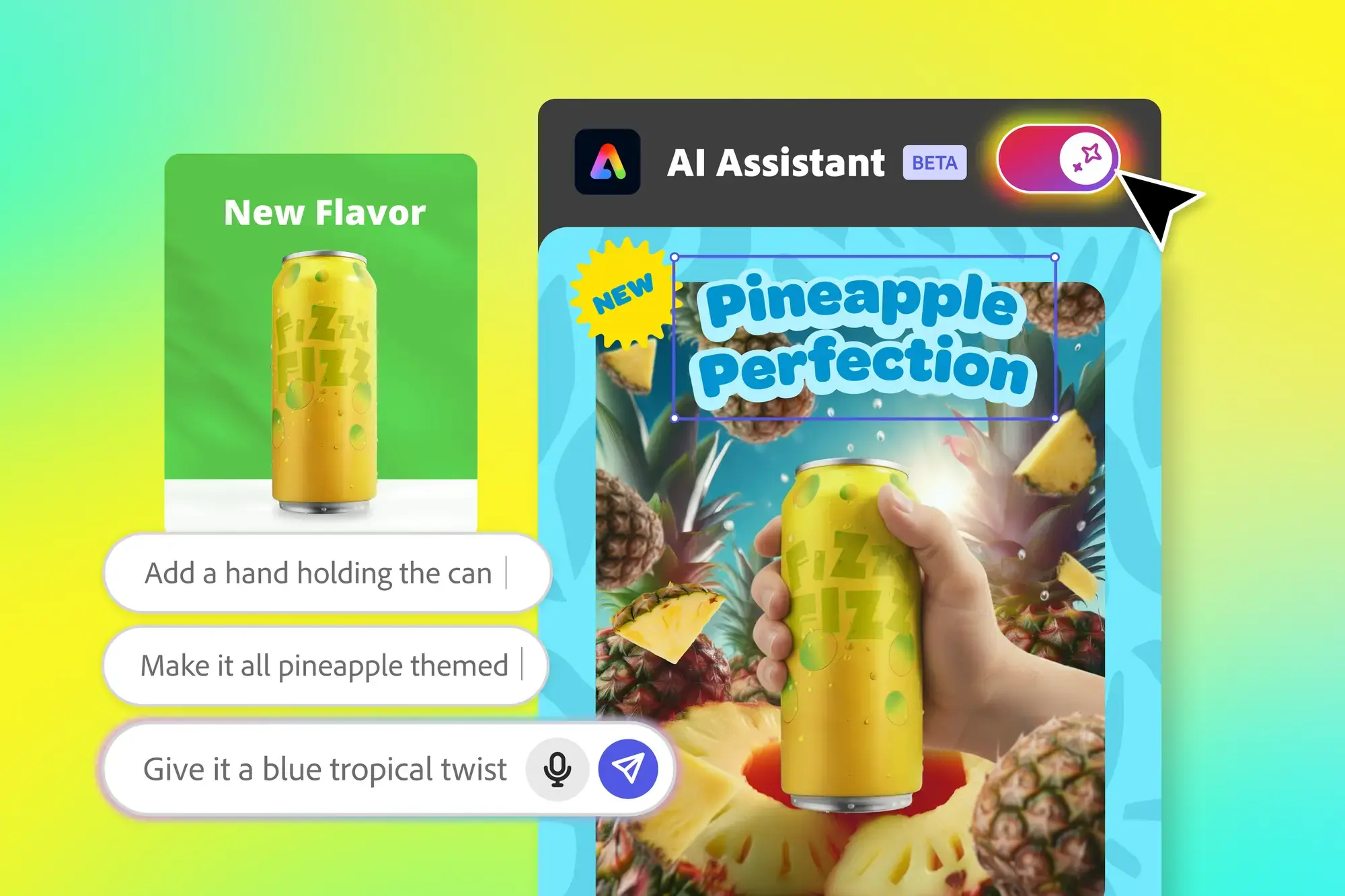
Enter today’s “AI Assistant in Adobe Express.” When toggled on through a switch in the app’s top-left corner, the assistant will replace your tools with a chatbox where you can instruct it to either make a new design from scratch or edit an existing one. Should you need your tools again, you can bring them back by toggling the assistant off, although Adobe’s demos for the feature also show the assistant bringing up contextual sliders when needed, like one for resizing.

While this is not Adobe Express’ first venture into generative AI, the idea is to make getting started or quickly editing a piece less intimidating, by having inexperienced users spend most of their time in a chatbox rather than having to click through a toolbar. Adobe says, like its other AI tools, it pulls from a number of “commercially safe” sources, including the company’s font and stock image libraries and its Firefly AI models.

The tool will start rolling out in public beta today, so you should be able to try it out shortly.

Adobe Premiere is getting built into YouTube Shorts

Premiere Pro for YouTube Shorts

Credit: Adobe

Shorts are the next big thing over on YouTube, and to encourage more people to make them, YouTube is teaming up with Adobe. As an update to both the Premiere iPhone app and YouTube itself, Adobe’s new Create for YouTube Shorts feature allows you to upload your footage and instantly make it publish-ready with Adobe’s font overlays and a number of “exclusive” effects, transitions, and stickers. Or you can directly plug your footage into templates that already have transitions and effects included.

The feature is currently listed as “coming soon,” so it’ll be a bit before you can try it. But once it’s live, Adobe and YouTube say you’ll be able to access it either through the Premiere iPhone app or directly though YouTube, via an “Edit in Adobe Premiere” icon in YouTube shorts.

There is no word yet on an Android or desktop release.

Adobe will add sound to your videos for you

Firefly Audio AI

Credit: Adobe

Sound is easy to overlook when making a new video, and I’ve had to scramble to find a decent soundtrack to add to my videos at the last second more than once. Adobe’s new Firefly AI audio features are looking to save you from that fate, by making it easy to add music and even narration to an otherwise silent video.

Rolling out in public beta today, Firefly’s new “Generate Soundtrack” and “Generate Speech” buttons use AI and a Mad Libs style prompting system to help you quickly score your content from a number of options.

For “Generate Soundtrack,” you’ll upload your video, press the appropriate button, and the app will suggest a prompt for you and give you a palette of adjectives, genre types, and and content types to refine it with. Drag your chosen terms into the prompt box, hit generate, and you’ll get four options, each cutting out at a maximum of five minutes.

It’s a bit odd that you can’t just enter your own terms into the prompt box, although Adobe generative AI head Alexandru Costin told The Verge that’s because AI audio is “a new muscle we need to develop” and that the current approach is “easier and more accessible.”

Like other Firefly generations, audio will be generated using Adobe’s own licensed content, so users won’t have to worry about copyright strikes on videos made using the feature.

“Generate Speech,” meanwhile, gives users access to 50+ text-to-speech voices, either from Adobe Firefly or licensed via ElevenLabs. There’s no Mad Libs prompting here, with Adobe instead allowing for fine-tune control over factors like speed, pitch, tone, and even pronunciation. Currently, over 20 languages are supported.

Taken together, the updates seem to me like an attempt to keep up with platforms like Instagram and TikTok, which have licensed music libraries and text-to-speech built in. Whether a purely AI-powered version can keep up remains to be seen, although putting it into the editor rather than the platform does give creators more choice about where to upload.

Updates inside Photoshop, Lightroom, and Premiere

Adobe Creative Cloud promo image

Credit: Adobe

Finally, for the more hardcore Adobe users, updates are coming to the company’s core apps as well.

First, Photoshop is also getting its own AI assistant, which will be able to use prompts to edit for you. However, unlike Adobe Express, it’s currently in a private beta, so it’ll be some time before most users see it. It’s also limited to the web version of the app for now.

However, not in beta is the ability to choose which AI models the app works with. Previously, Generative Fill, which uses AI to fill in blank spots in backgrounds (or just generate whole canvases from nothing), were limited to Adobe’s Firefly models. Now, users will also be able to use them with Google’s Gemini 2.5 Flash model, or Black Forest’s Flux.1 Kontext model. Given how popular 2.5 Flash has gotten on social media under the name “nano banana,” that’s a big get for Adobe.

Still, Firefly isn’t getting left behind. Adobe says it’s upgraded the model with the ability to generate in a native four-megapixel resolution, and to better render people. It’s also integrating it into a new “Layered Image Editing” tool that can make contextual changes for you across layers, like futzing with shadows after you move an image.

Outside of Photoshop, Lightroom has its own private beta feature called “Assisted Culling.” I’ll admit Lightroom is probably where I have the least experience when it comes to Adobe, but the company says it’ll be able to filter through uploaded photos for you and find the most edit-friendly ones.

Finally, Premiere Pro has its own beta feature, but one that’s graciously public. Called “AI Object Mask,” it’ll automatically detect and track people and objects in your video’s background, so you can more easily add effects like blurs or color grading. It could be useful if, say, you’re shooting in a crowded area where you need to blur a lot of faces.

A little something for everyone

Overall, it was a fairly balanced Max, with a number of features for both pros and beginners. That said, I can’t ignore the focus on AI and automatic generation. On one hand, I get that photoshop’s a bit intimidating. On the other, the more Adobe handles your edits for you, the more it runs the risk of competing with existing easy-edit apps and platforms. I’m curious to see how the industry giant will compete as platforms like TikTok and Instagram continue to offer their own built-in editing tools.

Nearly 90% of Windows Games Now Run on Linux, Latest Data Shows

Nearly nine in ten Windows games can now run on Linux systems, according to data from ProtonDB compiled by Boiling Steam. The gains came through work by developers of WINE and Proton translation layers and through interest in hardware like the Steam Deck.

ProtonDB tracks games across five categories. Platinum-rated games run perfectly without adjustment. Gold titles need minor tweaks. Silver games are playable but imperfect. Bronze exists between silver and borked. Borked games refuse to launch. The proportion of new releases earning platinum ratings has grown. The red and dark red zones have thinned. Some popular titles remain incompatible, however. Boiling Steam noted that other developers appear averse to non-Windows gamers.


Read more of this story at Slashdot.