US Needs ‘Finesse’ to Stay Ahead of China, Nvidia Boss Says

Nvidia chief executive Jensen Huang said that maintaining the US edge in AI will require a steady approach that ensures China remains hooked on American technology. From a report: The chipmaker is in an “awkward place” as President Donald Trump prepares to meet with his Chinese counterpart Xi Jinping later this week, Huang told reporters Tuesday at a company conference in Washington. The Nvidia chief praised Trump’s commitment to winning but urged careful engagement with China because of the country’s massive software developer base and its growing technology capabilities.

During the meeting, Trump and Xi are expected to finalize an agreement to ease trade tensions between the world’s two largest economies. When it comes to those negotiations, Huang said he has “no idea” if GPUs — the chips central to artificial intelligence capabilities — will be a topic between Trump and Xi.

Huang was careful to leave the negotiating to Trump but encouraged US leadership to think longer term on its overall AI strategy. “A policy that causes America to lose half of the world’s developers is not beneficial long-term,” Huang said, warning that it was still possible for the US to cede the AI race to China. Keeping US technology in front requires finesse,” he said. “It requires balance. It requires long-term thinking.”


Read more of this story at Slashdot.

Fitbit Is Finally Fixing Its Cardio Load Problem

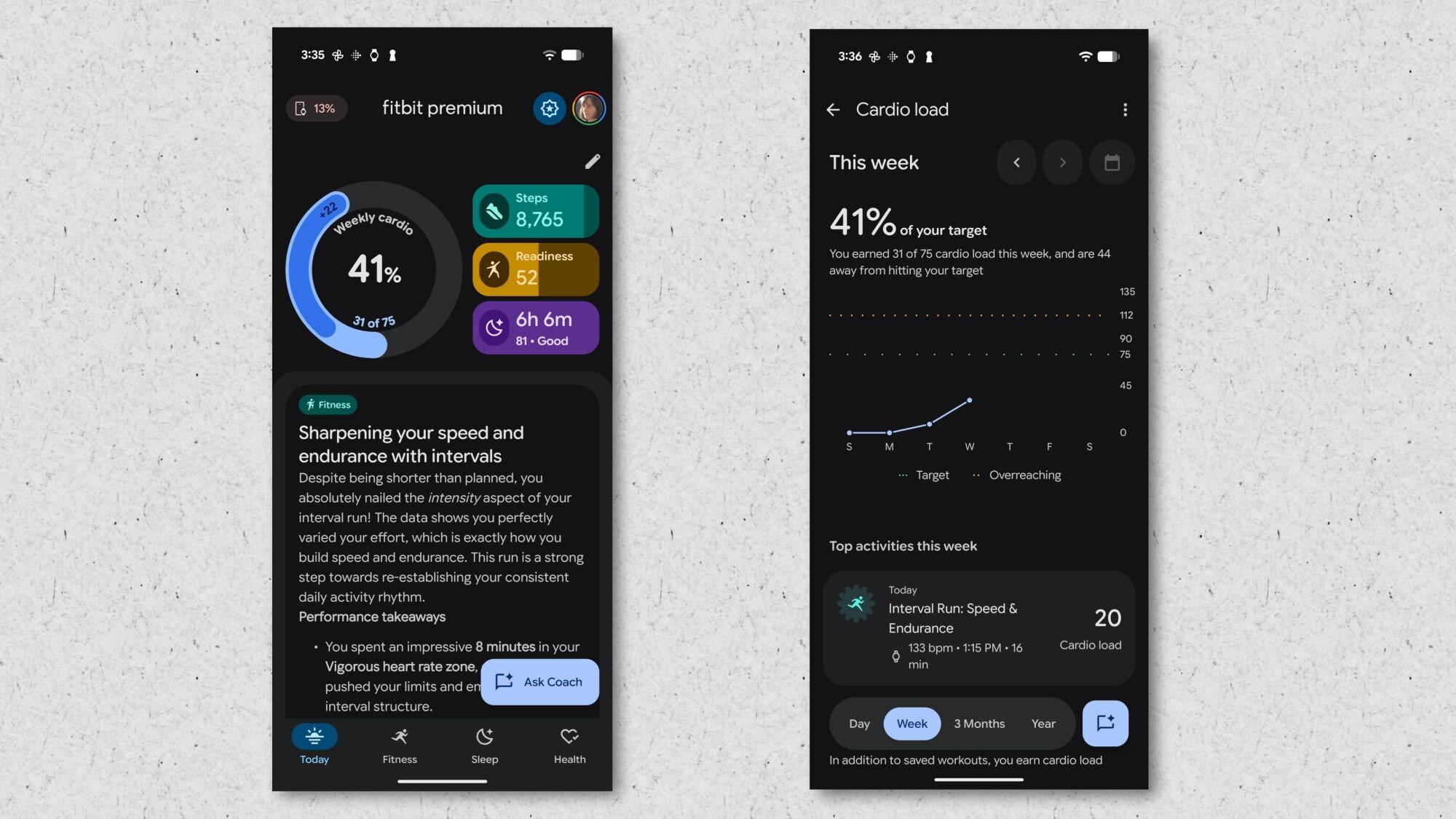
Cardio load gets a major fix in the new Fitbit app, which Android users can test out starting this week in a “public preview.” (This is the same preview that gives you access to the AI fitness coach, which I tested yesterday, with baffling results.) Cardio load will now be tracked weekly, making it much easier for the app to make sensible recommendations.

What is (and was) cardio load? 

The cardio load feature is Fitbit’s attempt to guide you in how much to exercise. Obviously a beginner shouldn’t jump into hour-long hard workouts right out of the gate, nor should a person training for a marathon slack off for no reason. Cardio load is an attempt to put a number on the amount of exercise that would be neither too much nor too little for you. 

Plenty of athletes and trainers use some kind of model for exercise volume, whether it’s runners counting miles in a spreadsheet, or a coach going by their gut and saying “let’s take it easy today.” 

Fitbit uses a hilariously-named TRIMP approach (“TRaining IMPulse”), where every minute with an elevated heart rate counts toward your cardio load, with higher heart rates counting as more effort. I have more on this calculation here. 

Why cardio load was confusing

The idea sounded good: Fitbit would calculate how much cardio load you should aim for each day, based on how much exercise you’d been doing. You could tell the app whether you wanted to increase your fitness, or just maintain the fitness you have, and it would adjust its numbers accordingly. 

But for a lot of people, the numbers never made sense. The numbers would fluctuate from day to day, often mismatched with what a person’s history and health actually called for. Many users found that the recommended cardio load went up and up, and rest days brought warnings of undertraining.

A sampling of Reddit threads from r/fitbit include titles like “Cardio load baffles me,” “Cardio load, I hate you,” “Cardio load unrealistic,” “Cardio load is not just wrong, it’s dangerous,” and “Fitbit, either fix cardio load or scrap it.” 

Why the new feature may be better

Screenshots of cardio load in the new app

Credit: Beth Skwarecki/Fitbit

Google explained that it’s implementing a fairly simple fix—calculating cardio load recommendations by the week instead of by the day. The cardio load calculations themselves won’t change at all.

After all, it’s normal to have hard days alternating with easy days or rest days, and any load management guidance should be able to handle that. Google also points out that your background activity level (like how much you walk when you go grocery shopping) also adds to your cardio load, and that also makes day-to-day recommendations hard to follow. 

The new version of the Fitbit app now shows a big donut on the top of the screen with your progress toward your weekly goal. With a couple of quick runs, I’m now 41% of the way toward my weekly target. There’s even a graph showing where my target is versus what it considers “overreaching.” This makes a lot more sense.

Trump health official ousted after allegedly giving himself a fake title

Steven Hatfill, a senior advisor for the Department of Health and Human Services was fired over the weekend, with health officials telling reporters that he was terminated for giving himself a fake, inflated title and for not cooperating with leadership.

For his part, Hatfill told The New York Times that his ouster was part of “a coup to overthrow M. Kennedy,” referring to anti-vaccine Health Secretary Robert F. Kennedy Jr. Further Hatfill said the coup was being orchestrated by Matt Buckham, Kennedy’s chief of staff, though Hatfill didn’t provide any explanation of how his ouster was evidence of that. An HHS spokesperson responded to the allegation, telling the Times that “firing a staff member for cause does not add up to a coup.”

Bloomberg was first to report Hatfill’s termination.

Read full article

Comments

YouTube Will Use AI to Upscale Low-Res Videos

YouTube’s going through a lot of changes right now, and according to the company, that’s to help it better stand out on TVs. Today, YouTube announced that it’s going to allow creators to upload bigger thumbnails, plus make browsing and shopping while watching on a TV a bit more convenient. But there’s also a big change coming to content itself, and it’s not just limited to TVs.

Soon, YouTube is going to start using AI to automatically upscale any videos with resolutions lower than 1080p. While you can technically still upload videos that are 720p nowadays, with smartphone cameras getting better and better, that essentially reads to me as “old videos.” It’s a bit concerning to me, as someone who’s been watching a lot of TV shows from the ’90s and early 2000s on YouTube as of late.

Super Resolution in YouTube

Credit: YouTube

Done right, AI upscaling is a simple way to de-noise a video, and is more resistant to hallucination than generations made from whole cloth. But it’s not without its own hiccups, and some creators have actually accused YouTube of using AI upscaling already, without telling them, and with some undesirable results. The accusations have been limited to YouTube Shorts for now, but notably, even Will Smith seems to have possibly run afoul of the system’s hidden AI, as the celebrity was himself accused of generating a crowd with AI in a YouTube Short of a recent concert. However, internet sleuths have determined the footage is likely legit, but was automatically made to look like “AI slop” by YouTube. Note, for instance, how different the footage looks on Instagram.

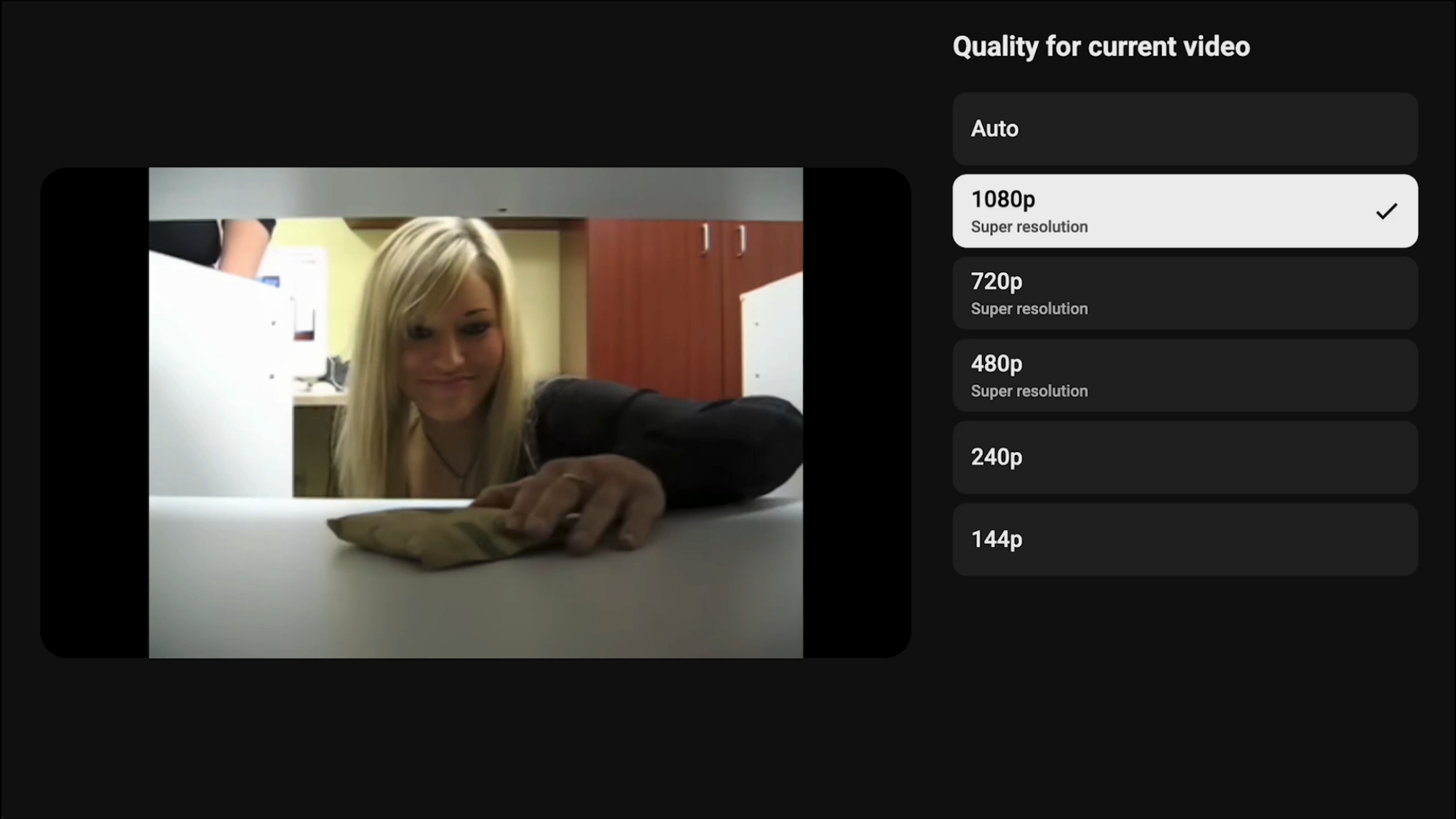
Luckily, YouTube says that this version of AI upscaling will be fully in the hands of creators and users. According to the feature’s announcement “Creators will retain complete control over their library, as both original files and original video resolution will be kept intact, with a clear option to opt-out of these enhancements.” Viewers, meanwhile, will be able to see when AI upscaling has been used thanks to a “super resolution” label in the resolution selection settings, and opt for the original resolution instead.

Additionally, YouTube told The Verge that videos that were shot below 1080p, but manually remastered and uploaded in 1080p or above, won’t be affected by the upscaling tech. What matters is the resolution the video was uploaded in.

All of that’s a relief for folks like me, who don’t want bizarre seven-fingered extras in our sitcoms, although it’s unclear whether this control will also extend to YouTube Shorts, or if YouTube might continue experimenting with mandatory AI upscaling there behind-the-scenes (which, to be fair, has not yet been confirmed).

Regardless, it makes sense why YouTube is making this change, as it tries to capture more eyes across more devices. Low resolution videos might look fine on a six-inch smartphone display, but blown up to 50+ inches on a TV, not so much.

YouTube hasn’t said exactly when the feature will go live, but if you notice what looks like weird AI artifacting the next time you’re watching a YouTube video, try checking the resolution settings by mousing over the video and tapping or clicking the cog icon.

FCC Republicans force prisoners and families to pay more for phone calls

The Federal Communications Commission voted yesterday to raise the maximum prices that prison and jail phone services can charge inmates and their families.

The 2–1 vote with Republicans voting to raise the limits came with a dissent from Democrat Anna Gomez, who said the new rates will be “almost double in some facilities.” A new inflation factor will allow rates to rise further.

“The FCC once again is going above and beyond to address the unsubstantiated needs of monopoly providers to squeeze every penny possible from families that want to stay in touch with their loved ones,” Gomez said at the FCC meeting. “Throughout this order, the FCC chooses to reward corporations with money taken from vulnerable families.”

Read full article

Comments

OneXPlayer Launches Liquid-Cooled OneXFly Apex Gaming Handheld With AMD Strix Halo

OneXPlayer Launches Liquid-Cooled OneXFly Apex Gaming Handheld With AMD Strix Halo
Just a month since its initial tease, One-Netbook’s OneXFly Apex, an AMD Strix Halo-powered handheld gaming PC has debuted. One-Netbook has pre-launched the OneXFly Apex on Indiegogo, confirmed its pricing for the Chinese market, and even provided peeks at performance benchmarks using the unique liquid cooling solution that can run the handheld

‘ChatGPT’s Atlas: The Browser That’s Anti-Web’

Blogger and technologist Anil Dash, writing about OpenAI’s recently launched browser, Atlas: When I first got Atlas up and running, I tried giving it the easiest and most obvious tasks I could possibly give it. I looked up “Taylor Swift showgirl” to see if it would give me links to videos or playlists to watch or listen to the most popular music on the charts right now; this has to be just about the easiest possible prompt.

The results that came back looked like a web page, but they weren’t. Instead, what I got was something closer to a last-minute book report written by a kid who had mostly plagiarized Wikipedia. The response mentioned some basic biographical information and had a few photos. Now we know that AI tools are prone to this kind of confabulation, but this is new, because it felt like I was in a web browser, typing into a search box on the Internet. And here’s what was most notable: there was no link to her website.

I had typed “Taylor Swift” in a browser, and the response had literally zero links to Taylor Swift’s actual website. If you stayed within what Atlas generated, you would have no way of knowing that Taylor Swift has a website at all.

Unless you were an expert, you would almost certainly think I had typed in a search box and gotten back a web page with search results. But in reality, I had typed in a prompt box and gotten back a synthesized response that superficially resembles a web page, and it uses some web technologies to display its output. Instead of a list of links to websites that had information about the topic, it had bullet points describing things it thought I should know. There were a few footnotes buried within some of those response, but the clear intent was that I was meant to stay within the AI-generated results, trapped in that walled garden.

During its first run, there’s a brief warning buried amidst all the other messages that says, “ChatGPT may give you inaccurate information”, but nobody is going to think that means “sometimes this tool completely fabricates content, gives me a box that looks like a search box, and shows me the fabricated content in a display that looks like a web page when I type in the fake search box.”

And it’s not like the generated response is even that satisfying.


Read more of this story at Slashdot.

NVIDIA And Oracle Deploy 100,000 Blackwell GPUs in DOE’s New AI Supercomputer

NVIDIA And Oracle Deploy 100,000 Blackwell GPUs in DOE’s New AI Supercomputer
The U.S. Department of Energy is teaming up with NVIDIA and Oracle to build what’s NVIDIA calls the DOE’s largest AI supercomputer, part of a new public–private partnership meant to supercharge federally funded research. Announced at NVIDIA’s GTC conference in Washington, D.C. yesterday, the Solstice system will feature a staggering 100,000

ICE’s forced face scans to verify citizens is unconstitutional, lawmakers say

Social media videos have confirmed that Immigration and Customs Enforcement (ICE) and Customs and Border Protection (CBP) officers patrolling US streets are actively using facial recognition technology to verify citizenship, 404 Media reported.

In one video posted on a Chicago-based Instagram account, a self-described teenager and US citizen tells officers that he has no government ID. After he offers to show his student ID instead, the officer turns to another and asks, “can you do facial?” As the other officer pulls up an app to scan the teen’s face, the first officer tells the teenager to “relax” while alleging that “a lot of parents” tell their kids they were born in the US. The video ends after the officer takes the minor’s photo and asks the teen to verify that his name matches what the app’s database pulled up.

It’s unclear which app the officers used during this Chicago stop. But 404 Media has been closely tracking ICE and CBP’s increasing use of face scans amid the Trump administration’s nationwide mass deportation campaign, which critics slam as largely rooted in racial profiling. Earlier this year, 404 Media reviewed leaked emails confirming that ICE was using Mobile Fortify, which allows agents to scan “an unprecedented number of government databases” and compare face matches against a database of 200 million images.

Read full article

Comments

Stray leads November’s lineup of PS Plus games

Sony just announced the PS Plus Monthly games for November and there are some standouts. All of these titles will be available to download on November 4 until December 1.

First up, there’s the cat sim Stray. We praised the third-person cyberpunk adventure in our initial review, in which we lauded the game’s unique mechanics and puzzles. After all, you play as a cat in a dystopian and futuristic city. That’s a one-of-a-kind premise, which is one reason it became such a big hit. It’ll be available for both PS4 and PS5. It’s also worth noting that this was a day-one release for PS Plus Extra and Premium back in 2022. 

EA Sports WRC 24 is a popular racing sim developed by Codemasters, who made the Dirt series, the Grid franchise and plenty of official F1 games. This new one lets players participate in the FIA World Rally Championship (WRC.) Racers get access to a bunch of WRC, WRC2 and Junior WRC cars from the 2024 season, complete with current drivers and teams. This one is only for PS5.

Totally Accurate Battle Simulator is certainly a battle similar, but not an accurate one. The game lets you design all kinds of bizarre battle scenarios with “the wobbliest physics system ever created.” This is the best game ever made that lets you battle a wooly mammoth with balloon arrows, thus forcing that beast into the sky. It’ll be available for both PS4 and PS5.

As always, a crop of new games means that some pre-existing titles are heading to that farm upstate. You have until November 3 to download Alan Wake 2, Goat Simulator 3 and Cocoon to their game library. Dang. Last month was stacked.

This article originally appeared on Engadget at https://www.engadget.com/gaming/playstation/stray-leads-novembers-lineup-of-ps-plus-games-180339318.html?src=rss

YouTube Plans Automatic Upscaling for Low-Res Videos

YouTube says it will automatically upscale videos uploaded below 1080p (full-HD to higher resolution using AI. The Google-owned platform, however, assured that it will give creators and viewers the option to opt out of the enhancement. The feature will apply only to videos uploaded in resolutions from 240p to 720p and will not affect videos that creators have already remastered to 1080p. Creators will retain control over their original files, and viewers will be able to watch videos in their uploaded resolution through a settings option.

YouTube said it plans to support upscaling to 4K in the near future. The company also said it is expanding the video thumbnail size limit from 2MB to 50MB to support 4K images. On videos with tagged products, viewers will soon be able to scan a QR code on TV screens to purchase items directly.


Read more of this story at Slashdot.

Character.AI to ban teens from talking to its chatbots

Character.AI will no longer permit teenagers to interact with its chatbots, as AI companies face increasing pressure to better safeguard younger users from harm. In a statement, the company confirmed that it is removing the ability for users under 18 to engage in any open-ended chats with AI on its platform, which refers to back-and-forth conversations between a user and a chatbot.

The changes come into effect on November 25, and until that date, Character.AI will presents users with a new under-18 experience. It’ll encourage its users to use chatbots for creative purposes that might include, for example, creating videos or streams, as opposed to seeking companionship. To manage the transition, under-18s can now only interact with bots for up to two hours per day, a time limit the company says it will reduce in the lead-up to the late November deadline.

Character.AI is also introducing a new age assurance tool it has developed internally, which it says will “ensure users receive the right experience for their age.” Along with these new protections for younger users, the company has founded an “AI Safety Lab” that it hopes will allow other companies, researchers and academics to share insights and work collaboratively on improving AI safety measures.

Character.AI said it has listened to concerns from regulators, industry experts and concerned parents and responded with the new measures. They come after The Federal Trade Commission (FTC) recently launched a formal inquiry into AI companies that offer users access to chatbots as companions, with Character.AI named as one of seven companies that had been asked to participate. Meta, OpenAI and Snap were also included.

Both Meta AI and Character AI also faced scrutiny from Texas Attorney General Ken Paxton in the summer, who said chatbots on both platforms can “present themselves as professional therapeutic tools” without the requisite qualifications. Seemingly to put an end to such controversy, Character.AI CEO Karandeep Anand told TechCrunch that the company’s new strategic direction will see it pivot from AI companion to a “role-playing platform” focused on creation rather than mere engagement-farming conversation.

The dangers of young people relying on AI chatbots for guidance has been the subject of extensive reporting in recent months. Last week, the family of Adam Raine, who claim that ChatGPT enabled their 16-year-old son to take his own life, filed an amended lawsuit against OpenAI for allegedly weakening its self-harm safeguards in the lead-up to his death.

This article originally appeared on Engadget at https://www.engadget.com/ai/characterai-to-ban-teens-from-talking-to-its-chatbots-180027641.html?src=rss

Battlefield 6’s Free Battle Royal Mode REDSEC Takes On Warzone With 100-Player Matches

Battlefield 6's Free Battle Royal Mode REDSEC Takes On Warzone With 100-Player Matches
Battlefield 6 has brought the storied franchise back to prominence, quickly becoming one of the best selling games on Steam, and finally providing some competition to this year’s Call of Duty. EA isn’t done yet, though, as it looks to lure players away from multiplayer juggernaut CoD: Warzone with a battle royale mode of its own.

Battlefield

An Azure outage is affecting Microsoft 365, Xbox and Minecraft

Microsoft’s Azure cloud service is experiencing an outage that appears to have hit Microsoft 365 , Xbox and Minecraft. All three show spikes in outage reports on DownDetector around 12PM ET, and the Azure status page indicates Microsoft is dealing with issues with “Azure Portal access.”

In the most recent Azure status update as of writing, Microsoft says that “starting at approximately 16:00 UTC, we began experiencing Azure Front Door issues resulting in a loss of availability of some services. In addition, customers may experience issues accessing the Azure Portal.”

We’re rerouting affected traffic to alternate healthy infrastructure as a near-term resolution while our investigation into the source of the issue is ongoing.

— Microsoft 365 Status (@MSFT365Status) October 29, 2025

On the Microsoft 365 Status account on X, Microsoft shared that it is “rerouting affected traffic” to “healthy infrastructure” while it works to address the issue. Users on Reddit have also reported issues loading Game Pass on Xbox consoles and accessing some Microsoft 365 enterprise apps. Beyond impacting the Microsoft services that rely on Azure, it’s also appeared to affect the support pages used to communicate issues. Microsoft’s Xbox Support site currently won’t load at all.

Engadget has contacted Microsoft for more information about the Azure outage. We’ll update this article if we hear back.

At least so far, these Azure issues pale in comparison to Amazon Web Services outage that occurred last week. Amazon’s outage kept popular apps and services offline for hours.

This article originally appeared on Engadget at https://www.engadget.com/computing/an-azure-outage-is-affecting-microsoft-365-xbox-and-minecraft-172032483.html?src=rss

Dodgers vs. Blue Jays, Game 5 tonight: How to watch the 2025 MLB World Series without cable

The 2025 Fall Classic is tied up again after Game 4 between the Los Angeles Dodgers and the Toronto Blue Jays saw Toronto dominate to win 6-2. The World Series continues with one more game in Los Angeles tonight — Wednesday, Oct. 29 — at 8PM ET/5PM PT. The World Series odds favor the Dodgers ahead of tonight’s game. Every 2025 MLB World Series game will air on Fox and Fox Deportes. 

Of course, Fox is a “free” over-the-air channel, so any affordable digital antenna will pull in the game if you live close enough to a local affiliate. But if that’s not an option, here’s a full rundown of how to watch the Dodgers vs. Blue Jays World Series, even without cable.

How to watch the L.A. Dodgers vs. Toronto Blue Jays, Game 5

You can stream Fox on any live TV streaming service that airs Fox local stations, including DirecTV, Fubo and Hulu + Live TV. MLB World Series games will also be available on Fox’s new streaming platform, Fox One.

More ways to watch the 2025 World Series

How to watch the MLB World Series from Canada: 

When is the Dodgers vs. Blue Jays game time?

Game 5 of the Dodgers vs. Blue Jays World Series is tonight, Oct. 29 at 8PM ET/5PM PT. 

What channel is playing the Los Angeles Dodgers vs. Toronto Blue Jays?

Every game in the 2025 World Series between the Los Angeles Dodgers and the Toronto Blue Jays, will air on Fox and Fox Deportes.

When is the 2025 World Series?

Game 5 of the World Series between the Dodgers and Blue Jays is scheduled for Oct. 29, 2025.

Los Angeles Dodgers vs. Toronto Blue Jays World Series schedule

All times Eastern. Series tied-2-2.

  • Game 5: Wednesday, Oct. 29, 8PM ET

  • Game 6: Friday, Oct. 31, 8PM ET

  • Game 7*: Saturday, Nov. 1, 8PM ET

*if necessary

This article originally appeared on Engadget at https://www.engadget.com/entertainment/streaming/dodgers-vs-blue-jays-game-5-tonight-how-to-watch-the-2025-mlb-world-series-without-cable-173501690.html?src=rss

Microsoft CEO Nadella Says Gaming Needs Good Margins To Innovate, Compares Strategy To Office

The best way to innovate in gaming is to have good margins, that’s according to Microsoft chief executive Satya Nadella. He made the comments during an interview days after Bloomberg reported that Microsoft has expected unrealistic profit margins from its gaming division, which the report suggested was a likely reason for studio closures, game cancelations and thousands of layoffs at Xbox.

Nadella used the word “innovation” at least five times during the interview but never offered specifics about what he meant by it. He said Microsoft needs to “invent, maybe, some new interactive media” because gaming’s competition is short-form video rather than other games. The CEO described Microsoft’s new gaming strategy as being “everywhere, on every platform” after comparing the company’s game publishing business to Microsoft Office. He said “the biggest gaming business is the Windows business” and added that he is looking forward to “the next console, the next PC gaming.”


Read more of this story at Slashdot.

This 2TB Western Digital Elements Portable Hard Drive Is on Sale for Just $65 Right Now

We may earn a commission from links on this page. Deal pricing and availability subject to change after time of publication.

A dependable external drive is one of those things you don’t realize you need until your laptop storage is nearly full or your photos are scattered across cloud accounts. Western Digital’s Elements Portable USB 3.0 Hard Drive is built for exactly that situation, and it’s currently on sale for $64.99 on StackSocial for 2TB of storage. That’s enough space to offload years of pictures and videos or stash work files without juggling thumb drives. At just under half a pound, it’s light enough to carry around in a bag, and since it uses USB 3.0, transferring large batches of files feels quick and painless compared to older drives.

It’s plug-and-play for Windows 10 and newer, so you don’t need extra software to get going. You can literally connect it and start dragging files over in seconds. The design is also more thoughtful than you might expect for a budget drive: the casing is made from over 50% recycled plastic, and the packaging is recyclable as well—a small but welcome improvement. It also has fast file transfers, straightforward backup, and a three-year limited warranty in case anything goes wrong.

That said, there are limitations worth noting. This particular model is formatted for Windows out of the box, so if you plan to use it with a Mac or Linux system, you’ll need to reformat it first. Like all portable hard drives, it also isn’t built to survive drops or rough handling—WD even cautions that a small fall can cause data loss. And unlike pricier SSDs, this is still a spinning-disk drive, so while it’s reliable for everyday backups, it won’t be as fast or durable as solid-state options. Still, if your main goal is affordable, dependable storage that you can toss in a backpack and trust with years’ worth of files, this 2TB WD Elements drive is hard to argue with at this price.

Our Best Editor-Vetted Tech Deals Right Now


Amazon Fire TV Stick 4K Plus


—
$29.99

(List Price $49.99)


Ring Video Doorbell Pro 2 with Ring Chime Pro


—
$149.99

(List Price $259.99)

Deals are selected by our commerce team

YouTube adds automatic AI upscaling for low-res videos

YouTube is rolling out some updates aimed at making visuals look better on its TV apps, including automatic AI video upscaling. To begin with, YouTube plans to upscale videos that were uploaded in under 1080p to an HD resolution. It aims to support 4K upscaling in the future.

The platform will still retain the original files and video resolution options. Creators can opt-out of the AI upscaling feature, which it’s calling Super Resolution, as well as automated audio adjustments. The platform says it’s also working with select creators to test larger video uploads to allow for higher-quality footage.

Creators will soon be able to upload thumbnails in higher quality too. YouTube will increase the thumbnail file limit from 2MB to 50MB. 

As for viewers, it seems like YouTube saw those annoying automatic previews Netflix has had for the last decade and decided to copy that playbook. “Viewers will be able to see and flip through their favorite YouTube channels with immersive previews on the homepage, enhancing content discovery and engagement,” Kurt Wilms, the senior director of product management for YouTube on TV, wrote in a blog post. 

Elsewhere, YouTube has added a contextual search function to its TV apps. When you search for something from a creator’s channel page, videos from said channel will appear first in the results. That’s a smart, logical idea.

With people watching YouTube on TV more than on mobile these days, it only makes sense for the platform to invest in improving the experience there.

This article originally appeared on Engadget at https://www.engadget.com/entertainment/youtube/youtube-adds-automatic-ai-upscaling-for-low-res-videos-170342511.html?src=rss

More people watched a fake NVIDIA livestream than the real thing

It looks like a hundred thousand people fell for a fake NVIDIA livestream featuring an AI-generated version of CEO Jensen Huang, as reported by PC Gamer. Perhaps the scariest part is that the fake stream ran at the same time as an actual NVIDIA event and dwarfed the live viewership numbers.

The actual keynote speech of NVIDIA’s GPU Technology Conference (GTC) garnered around 20,000 live views, while the fake stream maxed out at 100,000 live views. Even weirder? The fake Huang was talking about some crazy stuff mostly involving bogus crypto investments.

The deepfake spoke of “a crypto mass adoption event that ties directly into NVIDIA’s mission to accelerate human progress.” The avatar urged viewers to scan a QR code to, uh, send in cryptocurrencies. It’s unclear if any of the 100,000 viewers fell for this obvious scam that asked people to send the world’s richest company money to “accelerate human progress.”

The fake video has since been deleted. I haven’t been able to check it out to see just how real it looked and, thereby, how it was able to lure in 100,000 viewers. Before we all start screaming into the night about how reality doesn’t matter anymore, there are a few things worth considering.

First of all, we don’t know anything about the 100,000 accounts that were watching the fake stream. We don’t know where they’re from or even if the accounts were tied to real people. It’s also worth noting that the real stream has since garnered 200,000 views, despite just having 20,000 live viewers. We don’t know what kind of promotional tools the fakers used to draw in people or how long people stayed once they clicked.

Finally, there’s Huang himself. The man has hosted four GTC conferences just this year, and dozens upon dozens in previous years. There is an absolute abundance of footage of him standing on a stage and talking about stuff. That’s a whole lot of video for bad actors to use as AI training data.

Also, the real stream wasn’t exactly a barn burner. The most notable news we got was the announcement of a partnership with Uber to promote autonomous driving. This wasn’t an event to hype up new graphics cards or anything like that. The company revealed some government contracts, if that’s your bag.

Down.. pic.twitter.com/SqyS7LFfx5

— SamAI – Sora Sam Altman (@SoraSamAi) October 12, 2025

So we might not be cooked just yet, but the water is certainly getting hotter. Earlier this month, OpenAI CEO Sam Altman donated his likeness to the growing Cthulhu that is the AI video generator Sora 2. Users quickly got to work making Altman do all kinds of unsavory things, like stealing GPUs from Target and eating a grilled Pikachu. 

This article originally appeared on Engadget at https://www.engadget.com/ai/more-people-watched-a-fake-nvidia-livestream-than-the-real-thing-170035672.html?src=rss

Magic Leap reveals an Android XR smart glasses prototype

Magic Leap is once again trying to make a name for itself in augmented reality. The company revealed an Android XR smart glasses prototype and it extended an existing partnership with Google. It said it built the glasses “as a reference design for the Android XR ecosystem.”

They look similar to other modern smart glasses, with thick frames to house all of the electronics and what appears to be a camera lens on the left side. Magic Leap hasn’t revealed too much more about the glasses, other than to say that, “by combining Magic Leap’s waveguides and optics with Google’s Raxium microLED light engine, the two companies are developing display technologies that make all-day, wearable AR more achievable.”

The glasses, of course, use Google’s Android XR operating system. Samsung’s Galaxy XR headset, the first device that runs on the operating system, arrived last week.

Although it has been through the wringer over the last several years, Magic Leap is still kicking around. In 2022, Saudi Arabia’s Public Investment Fund became the majority owner of Magic Leap and it has since pumped over $1 billion into the company. 

Magic Leap failed to make headway in the consumer market with its AR headset after reportedly selling just 6,000 units in six months. Magic Leap pivoted to focus on the enterprise market with the Magic Leap 2, which it released in 2022. 

In July 2024, it was said to have laid off 75 employees — primarily from the sales and marketing teams — as part of another change in direction to license its tech. A couple of months before that, Magic Leap announced a deal with Google to “advance the potential of [extended reality] technologies,” and that partnership is starting to bear fruit. It was reported late last year that Google brought in 100 Magic Leap staffers to work on Android XR projects.

This article originally appeared on Engadget at https://www.engadget.com/ar-vr/magic-leap-reveals-an-android-xr-smart-glasses-prototype-165200068.html?src=rss