Xbox console revenue fell 30 percent year-over-year this summer

It hasn’t been a good year for Xbox so far. Microsoft has released its earnings report for the quarter ending on September 30, and it has revealed that its revenue from the Xbox hardware fell by 30 percent year-over-year. Take note that the revenue decline doesn’t reflect any dip in sales caused by the console’s $20-to-$70 price hike, since that took effect on October 3. Similarly, Microsoft only raised the price for its Game Pass Ultimate subscription from $20 to $30 in October. 

Meanwhile, revenue from Xbox content and services remained relatively unchanged from the same period last year. Microsoft says it saw growth from Xbox subscriptions and third-party content, but it was “partially offset” by the decline in first-party gaming content. 

The Xbox division was one of the most affected teams when Microsoft started cutting down its global workforce earlier this year, with the company cancelling games that were being developed for the console. Microsoft scrapped the modern reimagining of Perfect Dark, a first-person shooter from the year 2000, and even closed down the Xbox studio working on it. The company also cancelled Everwild, a project that had long been in development by Xbox studio Rare, also in the midst of its mass layoffs. 

Overall, Microsoft’s $77.7 billion revenue was 17 percent higher compared to the same period last year, and its operating income was up by 22 percent. Microsoft CEO Satya Nadella posted a few highlights about the company’s earnings call on X, mostly focusing on its AI efforts. He said that the company will increase its AI capacity by 80 percent this year and will double its data center footprint over the next two. 

2/ We’re building a planet-scale cloud and AI factory.

We’ll increase our AI capacity by 80% this year, and nearly double our DC footprint over the next two.

That includes Fairwater in Wisconsin, the world’s most powerful AI datacenter, which will scale to two gigawatts alone.…

— Satya Nadella (@satyanadella) October 29, 2025

This article originally appeared on Engadget at https://www.engadget.com/gaming/xbox/xbox-console-revenue-fell-30-percent-year-over-year-this-summer-012245146.html?src=rss

SUSE Linux Enterprise Server 16 Becomes First Enterprise Linux With Built-In Agentic AI

BrianFagioli shares a report from NERDS.xyz: SUSE is making headlines with the release of SUSE Linux Enterprise Server 16, the first enterprise Linux distribution to integrate agentic AI directly into the operating system. It uses the Model Context Protocol (MCP) to securely connect AI models with data sources while maintaining provider freedom. This gives organizations the ability to run AI-driven automation without relying on a single ecosystem. With a 16-year lifecycle, reproducible builds, instant rollback capabilities, and post-2038 readiness, SLES 16 also doubles down on long-term reliability and transparency.

For enterprises, this launch marks a clear step toward embedding intelligence at the infrastructure level. The system can now perform AI-assisted administration via Cockpit or the command line, potentially cutting downtime and operational costs. SUSE’s timing might feel late given the AI boom, but its implementation appears deliberate — balancing innovation with the stability enterprises demand. It’s likely to pressure Red Hat and Canonical to follow suit, redefining what “AI-ready” means for Linux in corporate environments.


Read more of this story at Slashdot.

US Startup Substrate Announces Chipmaking Tool That It Says Will Rival ASML

An anonymous reader quotes a report from Reuters: Substrate, a small U.S. startup, said on Tuesday that it had developed a chipmaking tool capable of competing with the most advanced lithography equipment made by Dutch firm ASML. Substrate’s tool is the first step in the startup’s ambitious plan to build a U.S.-based contract chip-manufacturing business that would compete with Taiwan’s TSMC in making the most advanced AI chips, its CEO James Proud told Reuters in an interview. Proud wants to slash the cost of chipmaking by producing the tools needed much more cheaply than rivals. […]

An engineering feat that has eluded even large companies, lithography needs extreme precision. ASML is the only company in the world that has been able to make at scale the complex tools that use extreme ultraviolet (EUV) to produce patterns on silicon wafer at a high rate of throughput. Substrate said that it has developed a version of lithography that uses X-ray light and is capable of printing features at resolutions that are comparable to the most advanced chipmaking tools made by ASML that cost more than $400 million apiece. The company said it has conducted demonstrations at U.S. National Laboratories and at its facilities in San Francisco. The company provided high resolution images that demonstrate the Substrate tool’s capabilities. “This is an opportunity for the U.S. to recapture this market with a homegrown company,” Oak Ridge National Laboratory director Stephen Streiffer, an expert on high-energy x-ray beams, said in an interview. “It’s a nationally important effort and they know what they’re doing.”


Read more of this story at Slashdot.

Nvidia Takes $1 Billion Stake In Nokia

Nvidia is taking a $1 billion stake in Nokia, sending the Finnish telecom giant’s shares up 22%. The two companies also struck a partnership to co-develop next-generation 6G and AI-driven networking technology. CNBC reports: The two companies also struck a strategic partnership to work together to develop next-generation 6G cellular technology. Nokia said that it would adapt its 5G and 6G software to run on Nvidia’s chips, and will collaborate on networking technology for AI. Nokia said Nvidia would consider incorporating its technology into its future AI infrastructure plans. Nokia, a Finnish company, is best known for its early cellphones, but in recent years, it has primarily been a supplier of 5G cellular equipment to telecom providers.


Read more of this story at Slashdot.

Grammarly Rebrands To ‘Superhuman,’ Launches a New AI Assistant

Grammarly is rebranding itself as “Superhuman” following its acquisition of the email client, while keeping its existing product names for now. Along with the rebrand, the company is launching “Superhuman Go,” an AI assistant that integrates with tools like Gmail, Jira, and Google Drive to enhance writing and automate productivity tasks. “The assistant can use these connections to do tasks like logging tickets or fetching your availability when you’re scheduling a meeting,” adds TechCrunch. “Superhuman said it plans to add functionality to enable the assistant to fetch data from sources like CRMs and internal systems to suggest changes to your emails.”

“Users can try Superhuman Go by turning on a toggle in the Grammarly extension, which will let them connect it to different apps. Users can also try out different agents in the company’s agent store, which include a plagiarism checker and a proofreader, launched in August.”


Read more of this story at Slashdot.

Can You Collect A Star In Super Mario 64 Pressing Only One Button (And No Joystick)?

This is a fascinating video of Youtuber pannenkoek experimenting to determine if you can collect any stars in Super Mario 64 by only pressing a single button and not using the joystick. The answer? Yes. In fact he’s able to collect three stars that way. FULL DISCLOSURE: he does play the levels from the level entry though and not the start of the game since you’re required to press the Start button to start the game, but it quickly becomes useless for progressing in the game. So, if you’ve ever wanted to watch Mario infinitely punch his way to some stars in Super Mario 64, this is the video for you. If that is not your cup of tea, no worries, I have a flask. “What’s in it?” Whatever was in it when I found it. Tastes like rust but kicks like my girlfriend in her sleep.

Character.AI To Bar Children Under 18 From Using Its Chatbots

An anonymous reader quotes a report from the New York Times: Character.AI said on Wednesday that it would bar people under 18 from using its chatbots starting late next month, in a sweeping move to address concerns over child safety. The rule will take effect Nov. 25, the company said. To enforce it, Character.AI said, over the next month the company will identify which users are minors and put time limits on their use of the app. Once the measure begins, those users will not be able to converse with the company’s chatbots. “We’re making a very bold step to say for teen users, chatbots are not the way for entertainment, but there are much better ways to serve them,” said Karandeep Anand, Character.AI’s chief executive. He said the company also plans to establish an AI safety lab.

Last October, a Florida teenager took his own life after interacting for months with Character.AI chatbots imitating fictitious characters from the Game of Thrones. His mother filed a lawsuit against the company, alleging the platform’s “dangerous and untested” technology led to his death.


Read more of this story at Slashdot.

Magic Leap, One of the Biggest Flops in AR, Is Back with Smart Glasses

Magic Leap is back.

The tech company, now owned by Saudi Arabia’s Public Investment Fund, today revealed a prototype for a pair of Android XR smart glasses made as a “reference design for the Android XR ecosystem,” and announced it had extended its partnership with Google. The AR glasses have thicker-than-normal frames, but not ridiculously so, and seem to have a camera. But that’s about all we know: there’s no word on availability or what the glasses actually do.

While Magic Leap didn’t reveal a ton of concrete details about its new shades, it did say they combine “Magic Leap’s waveguides and optics with Google’s Raxium microLED light engine” with the goal being an all-day AR wearable.

“Magic Leap and Google’s collaboration is focused on developing AR glasses prototypes that balance visual quality, comfort, and manufacturability,” the company said in a statement.

Magic Leap and Google’s spotty history in AR

That all sounds good, but both companies have stepped into AR in the past and released products that fell far short of expectations. Back in 2018, there was a lot of excitement among tech-heads about the Magic Leap One, but the $2,295 augmented and virtual reality headset fizzled, selling an estimated 6,000 units in six months. Magic Leap abandoned Magic Leap One back in 2024, but it’s apparently ready to jump back in with something new.

Google has an even deeper history in AR that didn’t catch on, having released Google Glass in 2014 with a great amount of hype, and basically abandoned the product in 2015 after privacy concerns and limited functionality resulted in disappointing sales.

To be fair, both Google Glass and the Magic Leap One had potential, but may have been ahead of their time—mid-2010s hardware couldn’t deliver on the possibilities at a price that was reasonable. It’s a different world in 2025, when everyone from Apple to Meta to dozens of smaller players are hoping to release killer AR glasses.

The AR-smart glasses space is getting mighty crowded, but the goal isn’t really this generation of smart glasses, it’s the next one. The game-behind-the-game for the tech companies is creating a pair of smart glasses that are functional and flexible enough to replace your phone entirely. In some ways, we’re tantalizing close to a pair of shades that can replace all other screens—the displays in glasses like the XReal One are amazing. But other technical limitations, like a battery that will last a reasonable amount of time, and an intuitive control system, are still on the horizon. For now.

Threads reaches 150 million daily users and is ramping up ads

Threads has grown to 150 million daily active users. Mark Zuckerberg shared the latest milestone for the company’s text-based app during Meta’s third-quarter earnings call. The company previously reported in August that Threads had reached more than 400 million monthly users.

Zuckerberg, who has mused that Threads could become Meta’s next billion-person app, said that it was “on track to become the leader in its category.” He also said that time spent in the app had increased by 10 percent, which he credited to improvements to the company’s AI recommendation systems. 

On Wednesday, Instagram chief Adam Mosseri said that Meta was also “exploring” algorithm personalization controls for Threads. The company is currently testing the ability to “tune” Instagram’s algorithmic recommendations. 

As Threads has grown, Meta also confirmed that ads are ramping up on the platform. During the call with analysts, Meta CFO Susan Li said that “ads are now running globally” in the Threads feed. The company had previously brought ads to Threads users in 30 countries following a small test earlier this year. This week, the company also announced that it would expand the type of ad formats on Threads, including video ads. “We’re following our typical monetization playbook of optimizing the ads formats and performance,” Li said. 

This article originally appeared on Engadget at https://www.engadget.com/social-media/threads-reaches-150-million-daily-users-and-is-ramping-up-ads-214259945.html?src=rss

Meta denies torrenting porn to train AI, says downloads were for “personal use”

This week, Meta asked a US district court to toss a lawsuit alleging that the tech giant illegally torrented pornography to train AI.

The move comes after Strike 3 Holdings discovered illegal downloads of some of its adult films on Meta corporate IP addresses, as well as other downloads that Meta allegedly concealed using a “stealth network” of 2,500 “hidden IP addresses.” Accusing Meta of stealing porn to secretly train an unannounced adult version of its AI model powering Movie Gen, Strike 3 sought damages that could have exceeded $350 million, TorrentFreak reported.

Filing a motion to dismiss the lawsuit on Monday, Meta accused Strike 3 of relying on “guesswork and innuendo,” while writing that Strike 3 “has been labeled by some as a ‘copyright troll’ that files extortive lawsuits.” Requesting that all copyright claims be dropped, Meta argued that there was no evidence that the tech giant directed any of the downloads of about 2,400 adult movies owned by Strike 3—or was even aware of the illegal activity.

Read full article

Comments

Space station astronauts eager to open “golden treasure box” from Japan

A cargo ship from Japan pulled alongside the International Space Station on Wednesday, maneuvering close enough for the lab’s robotic arm to reach out and grab it as the vehicles soared 260 miles over the South Atlantic Ocean.

“HTV capture complete,” Japanese astronaut Kimiya Yui radioed from the ISS. “I just want to say congratulations to all teams and people involved in this mission. Also, thank you very much for your hard work and support for the first HTV-X mission.”

The HTV-X spacecraft is an upgraded cargo freighter replacing Japan’s H-II Transfer Vehicle, which successfully resupplied the space station nine times between 2009 and 2020. At the conclusion of the HTV program, Japan’s space agency preferred to focus its resources on designing a new cargo ship with more capability at a lower cost. That’s what HTV-X is supposed to be, and Wednesday’s high-flying rendezvous marked the new ship’s first delivery to the ISS.

Read full article

Comments

FCC’s Gomez Slams Move To Revise Broadband Labels as ‘Anti-Consumer’

An anonymous reader shares a report: The FCC adopted a notice of proposed rulemaking (NPRM) to rescind and revise certain rules attached to consumer broadband labels. The measure passed on a two-to-one vote, with Commissioner Anna Gomez, the lone Democrat on the FCC, voting no and calling the notice “one of the most anti-consumer items I have seen.”

The vote was held at the Commission’s open meeting for the month of October. As per a draft notice circulated earlier this month, the FCC is looking to roll back several rules, including requirements that service providers read the label to consumers via phone, itemize state and local pass-through fees, and display labels in consumer account portals, among others. Advocates at Public Knowledge urged the Commission to reconsider, saying in a recent filing that “the Commission could create a permission structure for ISPs to continue to act without accountability.”

In her remarks during Tuesday’s open meeting, Commissioner Gomez appeared to concur, depicting the move as “anti-consumer” and counter to the goals of Congress. The FCC was mandated via the 2021 Infrastructure Investment and Jobs Act (IIJA) to create rules for implementing consumer broadband labels. After a lengthy rulemaking process and discussions with industry and consumer groups, ISPs were required to start displaying labels in 2024.

“I typically vote in favor of notices of proposed rulemaking because I believe in asking balanced questions, even on proposals that I dislike, so that we can encourage fruitful and helpful public comment. Answers to tough questions help us strike the right balance so that our rules can both encourage competition and serve consumers. However, the questions posed in this NPRM are so anti-consumer that I could not bring myself to even agree to them,” said Gomez.

Gomez stressed that the notice will harm consumers by enabling ISPs to hide add-on fees and stripping people of their ability to access information in their own language. Moreover, added Gomez, it’s unclear why the FCC is doing this. “What adds insult to injury is that the FCC does not even explain why this proposal is necessary. Make it make sense,” she added.


Read more of this story at Slashdot.

NPM flooded with malicious packages downloaded more than 86,000 times

Attackers are exploiting a major weakness that has allowed them access to the NPM code repository with more than 100 credential-stealing packages since August, mostly without detection.

The finding, laid out Wednesday by security firm Koi, brings attention to an NPM practice that allows installed packages to automatically pull down and run unvetted packages from untrusted domains. Koi said a campaign it tracks as PhantomRaven has exploited NPM’s use of “Remote Dynamic Dependences” to flood NPM with 126 malicious packages that have been downloaded more than 86,000 times. Some 80 of those packages remained available as of Wednesday morning, Koi said.

A blind spot

“PhantomRaven demonstrates how sophisticated attackers are getting [better] at exploiting blind spots in traditional security tooling,” Koi’s Oren Yomtov wrote. “Remote Dynamic Dependencies aren’t visible to static analysis.”

Read full article

Comments

13 years after it was announced, sci-fi horror game Routine has a release date of December 4

Sometimes, game development is a labor of love. Other times, it’s an agonizing experience akin to pulling teeth. More than a decade after first announcing the project, Lunar Software and Raw Fury appear to be in the home stretch with their project Routine. The sci-fi horror game has been given a December 4, 2025 release date. For their sakes, I hope it comes to pass.

The duo first announced Routine all the way back at Gamescom in 2012 and gave it a 2013 release date. After that window came and went, the project went dark until Summer Game Fest 2022, with promises that the game a) still existed and b) had been fully remade for the new generation of gaming hardware. If the current schedule holds, Routine will be on Steam and Xbox, including day one availability on Game Pass, by the end of this year. 

The Aliens vibes are strong in the brief release date teaser. Think film grain effects, janky gadgets and of course the looming threat of death around every corner. The player will explore an abandoned lunar base to try and figure out how everything went horribly wrong before your arrival. The answer seems to involve murderous robots that would make Weyland-Yutani proud.

This article originally appeared on Engadget at https://www.engadget.com/gaming/13-years-after-it-was-announced-sci-fi-horror-game-routine-has-a-release-date-of-december-4-205604793.html?src=rss

Windows is the Problem With Windows Handhelds

Microsoft shipped its first Xbox handheld nearly two weeks ago. The $600 white Xbox Ally cannot reliably sleep, wake, or hold a charge while asleep. Neither Microsoft nor Asus would admit there’s a problem or offer a timeline to fix it after repeated requests by The Verge. Asus said it needs more time to test.

Installing Bazzite, a Linux-based operating system, solves the problems, the publication reports. The same hardware runs games up to 30% faster than Windows and beats the Steam Deck in all but one benchmark. Steam runs more responsively without Windows bloat. The device can be used like a Nintendo Switch, pausing games with the power button and resuming hours or days later. Bazzite initially had sleep issues but fixed them two days after programmer Antheas Kapenekakis obtained the hardware and consulted with two AMD contacts. The black Xbox Ally X, which doesn’t have as many sleep issues, gets a similar speed boost with Bazzite.

Two Xbox Ally units tested on Windows repeatedly woke themselves at random intervals. One lost 10% battery after 12 hours of supposed sleep, the other 23%. After another 12 hours, both had only 30% battery remaining. One tried to apply a Windows Update while asleep. Both units refused to wake from sleep at times and required hard resets. Many users have reported similar issues on Reddit with both Xbox Ally versions.

Further reading: Microsoft’s Next Xbox Will Run Full Windows and Eliminate Multiplayer Paywall, Report Says.


Read more of this story at Slashdot.

Visualizing The Number Of Things Using 1cm Square Cubes

This is a visualization crated by MetaBallStudios (previously) imagining various numbers of things as representing by a collection of 1cm square cubes. Things start off small enough with the number of letters in the English alphabet (26) and first generation Pokemon (151), but quickly get out of hand from there. Honestly, it’s really hard for me to imagine any number over 100,000, which is about what I’ll earn over the course of my entire life provided I can land a $100,000 job and hold it for a year.

GM will cut more than 1,700 jobs in EV and battery manufacturing

General Motors announced that it will cut more than 1,700 manufacturing jobs in reaction to changes in the electric vehicle market. “In response to slower near-term EV adoption and an evolving regulatory environment, General Motors is realigning EV capacity,” the company said in a statement reported by CNBC. “Despite these changes, GM remains committed to our US manufacturing footprint, and we believe our investments and dedication to flexible operations will make GM more resilient and capable of leading through change.”

The layoffs are primarily happening at a Michigan plant that builds GM’s EVs and at an Ultium Cells battery cell plant in Ohio. The company is also “temporarily” laying off 700 at an Ultium Cells plant in Tennessee.

The regulatory issues in question are likely the $7,500 federal tax rebate that had previously been granted to EV purchases, which expired earlier this year under the “Big Beautiful Bill” that made things a lot less pretty for many environmentally-focused programs and industries. But GM had also said earlier this month that it would sunset much of its hydrogen fuel cell R&D in order to place more focus on batteries, charging tech and EVs, so announcing layoffs in those very areas is a rough move.

This article originally appeared on Engadget at https://www.engadget.com/gm-will-cut-more-than-1700-jobs-in-ev-and-battery-manufacturing-200814378.html?src=rss

US Needs ‘Finesse’ to Stay Ahead of China, Nvidia Boss Says

Nvidia chief executive Jensen Huang said that maintaining the US edge in AI will require a steady approach that ensures China remains hooked on American technology. From a report: The chipmaker is in an “awkward place” as President Donald Trump prepares to meet with his Chinese counterpart Xi Jinping later this week, Huang told reporters Tuesday at a company conference in Washington. The Nvidia chief praised Trump’s commitment to winning but urged careful engagement with China because of the country’s massive software developer base and its growing technology capabilities.

During the meeting, Trump and Xi are expected to finalize an agreement to ease trade tensions between the world’s two largest economies. When it comes to those negotiations, Huang said he has “no idea” if GPUs — the chips central to artificial intelligence capabilities — will be a topic between Trump and Xi.

Huang was careful to leave the negotiating to Trump but encouraged US leadership to think longer term on its overall AI strategy. “A policy that causes America to lose half of the world’s developers is not beneficial long-term,” Huang said, warning that it was still possible for the US to cede the AI race to China. Keeping US technology in front requires finesse,” he said. “It requires balance. It requires long-term thinking.”


Read more of this story at Slashdot.

Fitbit Is Finally Fixing Its Cardio Load Problem

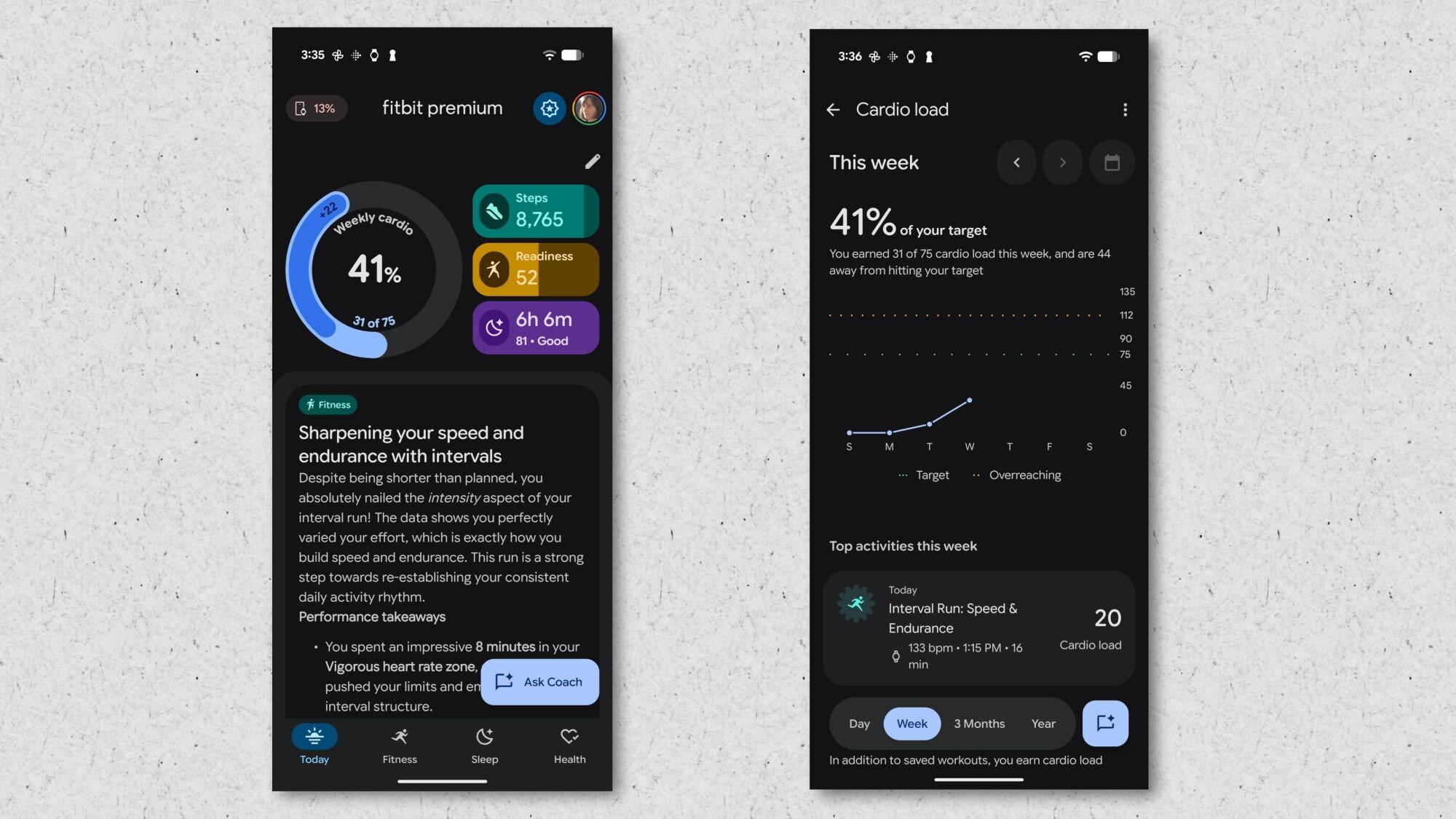
Cardio load gets a major fix in the new Fitbit app, which Android users can test out starting this week in a “public preview.” (This is the same preview that gives you access to the AI fitness coach, which I tested yesterday, with baffling results.) Cardio load will now be tracked weekly, making it much easier for the app to make sensible recommendations.

What is (and was) cardio load? 

The cardio load feature is Fitbit’s attempt to guide you in how much to exercise. Obviously a beginner shouldn’t jump into hour-long hard workouts right out of the gate, nor should a person training for a marathon slack off for no reason. Cardio load is an attempt to put a number on the amount of exercise that would be neither too much nor too little for you. 

Plenty of athletes and trainers use some kind of model for exercise volume, whether it’s runners counting miles in a spreadsheet, or a coach going by their gut and saying “let’s take it easy today.” 

Fitbit uses a hilariously-named TRIMP approach (“TRaining IMPulse”), where every minute with an elevated heart rate counts toward your cardio load, with higher heart rates counting as more effort. I have more on this calculation here. 

Why cardio load was confusing

The idea sounded good: Fitbit would calculate how much cardio load you should aim for each day, based on how much exercise you’d been doing. You could tell the app whether you wanted to increase your fitness, or just maintain the fitness you have, and it would adjust its numbers accordingly. 

But for a lot of people, the numbers never made sense. The numbers would fluctuate from day to day, often mismatched with what a person’s history and health actually called for. Many users found that the recommended cardio load went up and up, and rest days brought warnings of undertraining.

A sampling of Reddit threads from r/fitbit include titles like “Cardio load baffles me,” “Cardio load, I hate you,” “Cardio load unrealistic,” “Cardio load is not just wrong, it’s dangerous,” and “Fitbit, either fix cardio load or scrap it.” 

Why the new feature may be better

Screenshots of cardio load in the new app

Credit: Beth Skwarecki/Fitbit

Google explained that it’s implementing a fairly simple fix—calculating cardio load recommendations by the week instead of by the day. The cardio load calculations themselves won’t change at all.

After all, it’s normal to have hard days alternating with easy days or rest days, and any load management guidance should be able to handle that. Google also points out that your background activity level (like how much you walk when you go grocery shopping) also adds to your cardio load, and that also makes day-to-day recommendations hard to follow. 

The new version of the Fitbit app now shows a big donut on the top of the screen with your progress toward your weekly goal. With a couple of quick runs, I’m now 41% of the way toward my weekly target. There’s even a graph showing where my target is versus what it considers “overreaching.” This makes a lot more sense.

Trump health official ousted after allegedly giving himself a fake title

Steven Hatfill, a senior advisor for the Department of Health and Human Services was fired over the weekend, with health officials telling reporters that he was terminated for giving himself a fake, inflated title and for not cooperating with leadership.

For his part, Hatfill told The New York Times that his ouster was part of “a coup to overthrow M. Kennedy,” referring to anti-vaccine Health Secretary Robert F. Kennedy Jr. Further Hatfill said the coup was being orchestrated by Matt Buckham, Kennedy’s chief of staff, though Hatfill didn’t provide any explanation of how his ouster was evidence of that. An HHS spokesperson responded to the allegation, telling the Times that “firing a staff member for cause does not add up to a coup.”

Bloomberg was first to report Hatfill’s termination.

Read full article

Comments