Pokémon Champions will hit Switch and Switch 2 on April 8

Pokémon Champions — a battle-focused game along the lines of Pokémon Stadium — now has a release date, and it’s pretty darn soon. It will hit Nintendo Switch and Switch 2 on April 8. A mobile version is in the works with support for cross-play with Nintendo’s consoles.

Nintendo released a new overview video that shows how the game works. You can recruit Pokémon in the game or transfer those you’ve found in previous titles and Pokémon Go via Pokémon Home. Then you’ll be able to take half a dozen of your Pokémon into strategic turn-based fights with other players. It’s definitely a Pokémon battle game! 

There are ranked battles, a casual mode, private lobbies and online competitions. You’ll earn victory points, which you can use to swap a Pokémon’s moves, increase their stat points and make other modifications. In addition, victory points enable you to recruit Pokémon in Pokémon Champions more than once per day. Pokémon that you recruit with victory points can stay in your roster permanently instead of just a week. There’s a shop too, where you can spend points on accessories, Pokéball throwing styles, victory poses and battle music.

Pokémon Champions will be the second new Pokémon game to arrive this year, following the success of Pokémon Pokopia. There’s more to come in the not-too-distant future, as Pokémon Wind and Pokémon Waves are scheduled to arrive on Switch 2 next year.

While Pokémon Pokopia is selling like hotcakes, the Switch 2 perhaps isn’t flying out of the door as quickly as Nintendo hoped. According to Bloomberg, Nintendo has cut back on production of the console after lower-than-expected sales over the holiday season. The company is said to be making 4 million units this quarter rather than the previously planned 6 million, with the lower production rate set to extend into April.

This article originally appeared on Engadget at https://www.engadget.com/gaming/nintendo/pokemon-champions-will-hit-switch-and-switch-2-on-april-8-165737121.html?src=rss

The Punisher’s one-off TV special hits Disney+ on May 12

We knew Disney+ was prepping a standalone special for The Punisher, but we didn’t know it was coming so soon. The Punisher: One Last Kill premieres on May 12. This is just one week after the season two finale of Daredevil: Born Again, which starts up this week. It’s possible The Punisher will be featured in that, so we could be in for eight straight weeks of skull-shirted shenanigans.

Frank Castle returns in A Marvel Television Special Presentation: The Punisher: One Last Kill May 12, only on @DisneyPlus. pic.twitter.com/4I3H10grXz

— The Punisher (@ThePunisher) March 24, 2026

One Last Kill was actually co-written by star Jon Bernthal, who has been playing the vigilante for a decade now. It’s been described as a love letter to the character, but plot details have been kept under wraps. Marvel TV head Brad Winderbaum has called it “a shotgun blast of a story.” Reinaldo Marcus Green is directing, who previously made We Own This City with The Wire’s David Simon.

We do know that Frank Castle survives whatever violent ordeal he goes through in the special. That’s because The Punisher is featured prominently in the trailer for the next Spider-Man film. This will be the first time Bernthal’s take on the character will show up in an actual movie.

He first took on the role in season two of the original Netflix Daredevil show. Bernthal was a fan favorite, which led to two seasons of a spin-off show before Netflix and Marvel ended their whole joint TV experiment.

This isn’t the only Netflix-era hero getting a resurgence on Disney+ and beyond. Charlie Cox returned to the role of Daredevil for Spider-Man: No Way Home and She-Hulk: Attorney at Law before getting his own show. It’s also been reported that Krysten Ritter’s Jessica Jones is coming back this season on Born Again and Mike Colter has been dropping hints that his version of Luke Cage could be gracing televisions in the near future.

This article originally appeared on Engadget at https://www.engadget.com/entertainment/tv-movies/the-punishers-one-off-tv-special-hits-disney-on-may-12-162208769.html?src=rss

There’s a new Payday game, this time in VR

The popular co-op heist franchise Payday is coming to VR. Payday: Aces High will release for the Meta Quest platform and SteamVR later this year. It looks like it has everything people love about the series, but with some of that VR-style immersion.

Just like the mainline games, this version tasks players with planning and then pulling off elaborate heists. It offers four-player co-op, with each person filling a particular role within the group. These are your standard heist movie archetypes. There’s the planner, the brawler, the gadget nerd and the silent but deadly assassin.

The developer also promises plenty of gear and weapons, with “an arsenal that keeps growing.” This leads to the usual Payday gameplay loop. Each successful heist lets players buy more weapons and gadgets. Rinse and repeat.

Fast Travel Games is making this one, and the developer has a decent pedigree in the VR space. It helped make Cities: VR and Apex Construct, among many others. The graphics here look decent and we already know the gameplay is solid. Plus, there are clown masks. We’ll find out if Payday: Aces High makes the grade later this year.

This is just the latest major gaming franchise to experiment with virtual reality. There are VR versions of Half-Life, Assassin’s Creed, Horizon and many more.

This article originally appeared on Engadget at https://www.engadget.com/gaming/theres-a-new-payday-game-this-time-in-vr-160051276.html?src=rss

FCC Bans Imports of New Foreign-Made Routers, Citing Security Concerns

New submitter the_skywise shares a report from Reuters: The U.S. Federal Communications Commission said on Monday it was banning the import of all new foreign-made consumer routers, the latest crackdown on Chinese-made electronic gear over security concerns. China is estimated to control at least 60% of the U.S. market for home routers, boxes that connect computers, phones, and smart devices to the internet. The FCC order does not impact the import or use of existing models, but will ban new ones.

The agency said a White House-convened review deemed imported routers pose “a severe cybersecurity risk that could be leveraged to immediately and severely disrupt U.S. critical infrastructure.” It said malicious actors had exploited security gaps in foreign-made routers “to attack households, disrupt networks, enable espionage, and facilitate intellectual property theft,” citing their role in major hacks like Volt and Salt Typhoon. The determination includes an exemption for routers the Pentagon deems do not pose unacceptable risks.


Read more of this story at Slashdot.

The Best Ways to Make Use of Those Spare USB Ports on Your TV or Monitor

We may earn a commission from links on this page.

If you’ve taken a look at the back of your computer monitor or TV lately, you may have noticed there’s a USB port or two alongside the more familiar HDMI—and that in turn might have left you wondering what exactly a USB port is doing on the back of a big screen. Well, these USB ports have more uses than you might think.

Their precise function is going to depend on the make and model of your TV and monitor—and the primary uses tend to differ between the two. However, we can talk generally about how to make use of these ports and some of the options available to you, so you can check on your own specific device to see what’s supported.

The extra ports can charge your devices

This is a big one, because it applies to just about every USB port on every TV and monitor: You can plug in small gadgets like phones and charge them up, though charging rates and supported devices may vary, especially on televisions. It saves you having to hunt around for a spare wall outlet, at least.

On higher-end monitors with support for USB Power Delivery (USB-PD), you can sometimes charge up larger devices like laptops, while also providing a video connection through the same USB-C cable. It’s something to look out for if you’re shopping around, as it helps reduce desk clutter and adds convenience—the $620 4K Dell U2725QE is one example of a monitor that will do this for you.

With Android smartphones and monitors, you might get the added bonus of support for a desktop environment on the big screen as well as device charging. Both Samsung DeX and the recently launched Pixel Desktop Mode can be used like this, so you might be able to attach a desktop or laptop via HDMI, and a phone via USB-C.

Set up a USB hub for cleaner cable maintenance

As well as device charging, some monitors also add USB hub functionality, especially at the higher end of the market—if you’ve got several USB-A ports on the back of your monitor, this is likely what they’re for.

Rather than plugging all your peripherals into your laptop or desktop computer, you can add them to your monitor instead. It’s a solution that’s often neater and removes the need for a separate USB hub on your desk — with a separate upstream USB cable handling the connection to your computer, if it’s not attached via a single data and video cable.

You might even see an Ethernet port on some models, giving you a high-speed wired connection to the internet for your laptop. The $260 1080p ViewSonic VG2456 is one such model, and they often offer great value for office use.

Connect external storage to display photos and videos

This is a primary one for TVs, including certain Samsung models: You can plug an external USB drive into the back of your television, and access the photos, videos, or audio on it, provided the drive and file formats are supported. You can also do this via the USB ports on monitors, via the USB hub functionality mentioned above.

If you’ve got a large local media library saved somewhere, then this is a simple and quick way of getting those media files up on the big screen (rather than using something like Plex). You’re most likely not going to get the most advanced user interface you’ve ever seen, but it’ll work.

With the rise of streaming and faster wifi connections, the functionality is now becoming less common, but it’s still around—consult your TV documentation for details (Sony’s instructions are here). A portable drive such as the $90 WD Elements should be suitable, but be careful to check the requirements listed by your TV manufacturer.

Set up a KVM switch for multiple devices

A variation on the USB hub idea is a KVM (Keyboard, Video, Mouse) switch, which can be incredibly useful if you have more than one computer connected up to your monitor (maybe a laptop and a desktop). You can plug your keyboard and mouse into the USB ports on the display, and then use them to control each computer in turn.

You can buy these KVM switches separately, but having one built into your monitor cuts down on the number of trailing cables you have to deal with. Once your peripherals are connected, you can typically switch via the monitor’s on-screen menu, or through a dedicated hardware button.

Perhaps you’ve had this functionality on your monitor and never realized. A good example of this type of display is the $800 4K Gigabyte M32U aimed at gamers, which does have an integrated button specifically for switching between computers (plus a load of other high-end features, as you would expect at that price).

Gigabyte M32U
The Gigabyte M32U has an integrated KVM switch.
Credit: Gigabyte

Those extra ports support a bunch of other devices, too

Just about anything that can be powered by USB can be plugged into one of the spare ports on your TV or monitor (if the power demands and supply match). Maybe you could add a desk fan for keeping you cool through the summer months, or maybe you want to get creative with a smart light setup.

For monitors with USB hub functionality, you can think about options like microphones, webcams, and gaming controllers—which can all be easier to plug into a big display rather than a laptop (if your laptop even has any spare USB ports left).

It’s well worth having a look around the back of your TVs and monitors to see what’s available—you might not be using these devices to their full potential. It’s also something to look out for the next time you’re upgrading.

Claude Code can now take over your computer to complete tasks

Anthropic is joining the increasingly crowded field of companies with AI agents that can take direct control of your local computer desktop. The company has announced that Claude Code (and its more casual user-oriented Claude Cowork) can now “point, click, and navigate what’s on your screen” to “open files, use the browser, and run dev tools automatically” when necessary to complete tasks.

When possible, Anthropic says Claude Code and Cowork will still prioritize using Connectors to directly access and control outside apps or data sources. When that connection isn’t available, though, those tools are now able to ask permission to “scroll, click to open, and explore as needed” on the machine itself to do what’s asked. This kind of direct control of the computer can also be initiated and managed remotely via Claude’s Dispatch tool as long as the target computer remains powered on.

An Anthropic video shows some examples of tasks Claud Code can complete on your desktop via Dispatch.

The new feature is now available to Claude Pro and Max subscribers using MacOS in what Anthropic calls a “research preview.” That means the system “won’t always work perfectly” and will sometimes require a “second try” for complex tasks, Anthropic warns. Completing tasks via “computer use” also “takes much longer and is more error-prone” than performing the same task via Connectors, the company writes.

Read full article

Comments

Epic is laying off more than 1,000 workers, citing a downturn in Fortnite engagement

Epic Games has announced sweeping layoffs of more than 1,000 employees. “The downturn in Fortnite engagement that started in 2025 means we’re spending significantly more than we’re making, and we have to make major cuts to keep the company funded,” CEO Tim Sweeney said in a memo to workers on Tuesday.

Sweeney wrote that, combined with “over $500 million of identified cost savings in contracting, marketing, and closing some open roles,” the layoffs will give Epic more stability. He added that the layoffs are not related to AI.

Back in 2023, Epic laid off 830 employees. At the time, that was 16 percent of its workforce, suggesting around 4,000 employees remained at the company. If those numbers haven’t changed too much in the meantime, that means Epic is culling around a quarter of its headcount this week.

Along with a dip in Fortnite engagement, Sweeney pointed out that Epic isn’t immune from systemic issues the games industry is contending with, such as a slowdown in growth, reduced spending, “tougher cost economics” and a battle with other types of media for consumer’s attention.

However, Epic has some issues of its own to deal with. “Despite Fortnite remaining one of the most successful games in the world, we’ve had challenges delivering consistent Fortnite magic with every season; we’re only in the early stages of returning to mobile and optimizing Fortnite for the world’s billions of smartphones; and in being the industry’s vanguard we have taken a lot of bullets in a battle which is only in the early days of paying off for ourselves and all developers,” Sweeney wrote. (He previously said Epic spent over $100 million in legal fees alone on its App Store battle with Apple.)

The path forward for the company, per its CEO, is to create “awesome Fortnite experiences with fresh seasonal content, gameplay, story and live events,” perhaps in an attempt to recapture some of that “magic” he’s referring to. Speeding up work on developer tools amid the transition to Unreal Engine 6 is important as well, Sweeney indicated.

He said that the workers Epic is laying off will receive at least four months of their base pay, though they’ll get more depending on the length of their tenure at the company. Epic will pay for extended healthcare coverage, including for six months for affected workers in the US. The company — which is not publicly traded — will speed up the vesting of stock options through next January and “extend equity exercise options for up to two years,” Sweeney said.

Epic announced the layoffs days after it increased the price of Fortnite’s V-bucks currency. “The cost of running Fortnite has gone up a lot and we’re raising prices to help pay the bills,” it said.

As part of the changes at the company, Epic is killing off three Fortnite modes. Rocket Racing (which was built by Rocket League developer Psyonix) will shut down in October. Fortnite Ballistic — a 5v5 tactical shooter mode — and Festival Battle Stage, which is a competitive version of the Fortnite Festival rhythm game, will vanish on April 16. “We’ve built a lot of Fortnite modes, and in some cases we failed to build something awesome enough to attract and retain a large player base,” Epic said on X.

The company noted in its Year in Review recap last month that although the hours that players spent in third-party titles on the Epic Games Store increased by four percent in 2025, “overall gameplay hours declined year over year,” hinting at a dip in Fortnite numbers. The company said PC players spent $1.16 billion on the store in 2025, an increase of six percent from the previous year. Of that, $400 million was spent on third-party PC games. However, Epic Games Store vice president and general manager Steve Allison told Polygon in February that, factoring in first-party revenue and the 12 percent cut the company takes from third-party games, “the store is already — even with all this stuff — marginally profitable now.”

Here is the full memo Sweeney shared with Epic’s employees on Tuesday:

Today we’re laying off over 1000 Epic employees. I’m sorry we’re here again. The downturn in Fortnite engagement that started in 2025 means we’re spending significantly more than we’re making, and we have to make major cuts to keep the company funded. This layoff, together with over $500 million of identified cost savings in contracting, marketing, and closing some open roles puts us in a more stable place.

Some of the challenges we’re facing are industry-wide challenges: slower growth, weaker spending, and tougher cost economics; current consoles selling less than last generation’s; and games competing for time against other increasingly-engaging forms of entertainment.

And some of our challenges are unique to Epic. Despite Fortnite remaining one of the most successful games in the world, we’ve had challenges delivering consistent Fortnite magic with every season; we’re only in the early stages of returning to mobile and optimizing Fortnite for the world’s billions of smartphones; and in being the industry’s vanguard we have taken a lot of bullets in a battle which is only in the early days of paying off for ourselves and all developers.

Since it’s a thing now, I should note that the layoffs aren’t related to AI. To the extent it improves productivity, we want to have as many awesome developers developing great content and tech as we can.

What we now need to do is clear: build awesome Fortnite experiences with fresh seasonal content, gameplay, story, and live events; accelerate developer tools with greater stability and capability as we evolve from Unreal Engine 5 and UEFN to Unreal Engine 6. And we’ll be kicking off the next generation of Epic with huge launch plans towards the end of the year.

This isn’t our first time being here. Epic survived upheavals in 1990’s with the move from 2D to 3D with Unreal 1; in the 2000’s building console games with Gears of War; and in 2012 moving to online gaming with Paragon and Fortnite. Each time, we rebuilt our foundations and earned a renewed leadership position.

Market conditions today are the most extreme we’ve seen since those early days, with massive upheaval in the industry accompanied by massive opportunity for the companies that come out as winners on the other side. That’s what we’re aiming to do for our players, and we aim to bring other like-minded developers in the industry along on the journey to build an increasingly open and vibrant future of entertainment together.

At Epic, we pride ourselves in only hiring the industry’s best, so it is very painful to part with so many talented people. The folks impacted by the layoffs will receive a severance package that includes at least four months of base pay, with more based on tenure. We’re also extending Epic-paid healthcare coverage.

For example, in the U.S., they’ll receive paid coverage for 6 months. We’ll also accelerate their stock options vesting through January 2027 and extend equity exercise options for up to two years.

We’ll have a company meeting Thursday to talk about the roadmap in more detail.

-Tim

This article originally appeared on Engadget at https://www.engadget.com/gaming/epic-is-laying-off-more-than-1000-workers-citing-a-downturn-in-fortnite-engagement-154436905.html?src=rss

This Govee Smart Floor Lamp Is 25% Off Ahead of Amazon’s Big Spring Sale

We may earn a commission from links on this page. Deal pricing and availability subject to change after time of publication.

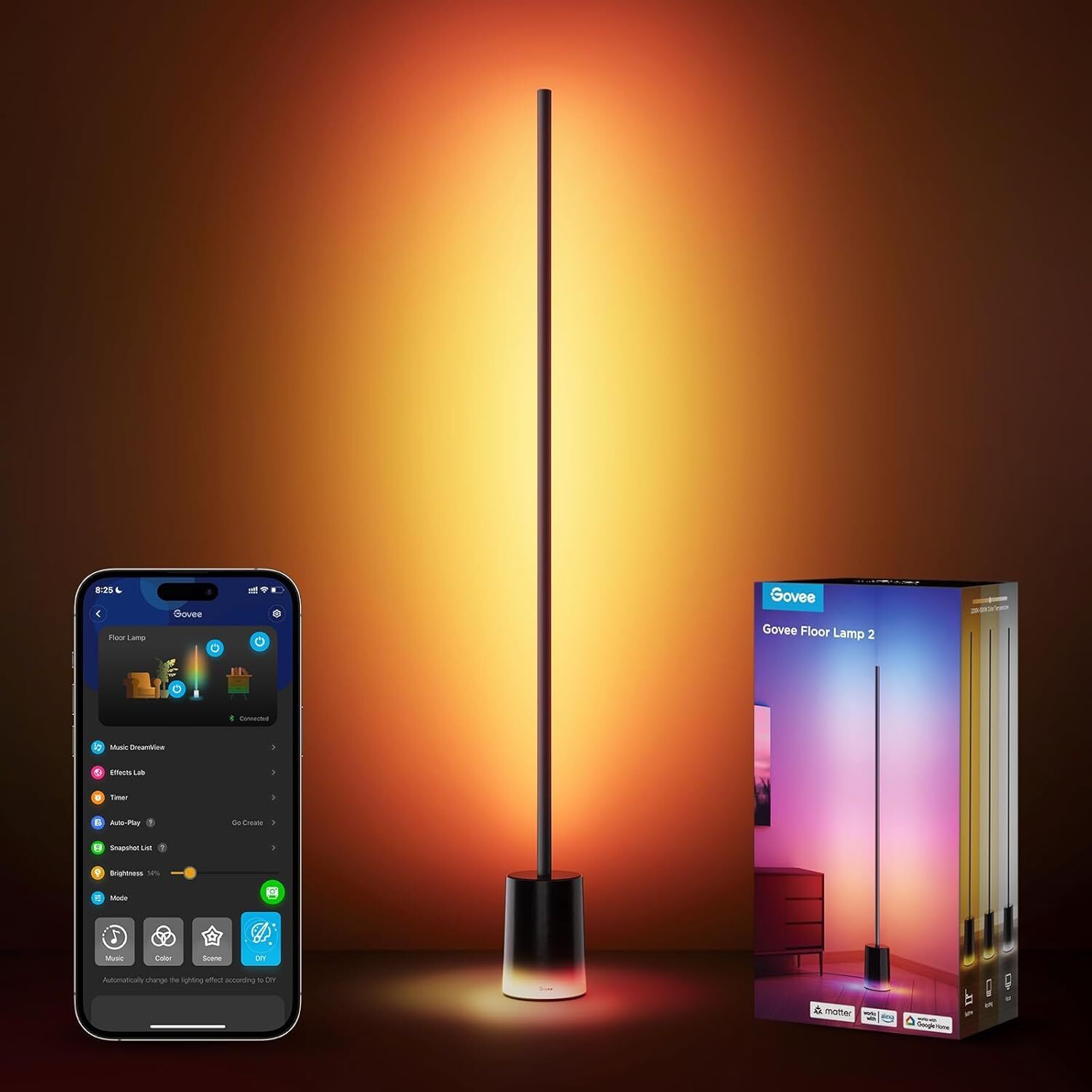
Think smart lighting is limited to basic bulbs and LED strips? Govee proves otherwise with its unique, space-saving take on floor lamp smart lighting that actually brightens an entire room rather than acting as accent lighting. Available in three different colors, the Govee Floor Lamp 2 does everything from play music to set the mood—and right now, it’s at its lowest price ever ahead of Amazon’s Big Spring Sale, dropping 25% to $119.99 (originally $159.99).

At 1,725 lumens, the sleek and minimalist Govee Floor Lamp 2 is one of the brightest smart lighting options around. It supports Matter, making it compatible with Apple HomeKit, Alexa, Google Assistant, and SmartThings. Lighting is highly customizable, with over 80 preset scenes and DIY modes that let you fine-tune colors, effects, and gradients. It uses RGBIC tech, which lets users display multiple colors at once, and it can sync with other Govee lights. It also has Bluetooth speakers in the base that pair with audio, creating a more immersive experience, whether you’re hosting a party or gaming. 

CNET notes that the lamps are designed so that light faces the wall, making them ideal for corners where you want to “paint” your wall with a glow of the almost infinite colors available for an accent wall effect. There are LEDs in the base as well as the main lights, and they can be controlled independently in the Govee app, where users can unlock most features. You can also control the lights via voice control or the included remote. It’s worth noting that the light only supports 2.4GHz wifi.

If you’re looking for a stylish smart light that integrates with any smart-home setup, has a built-in speaker, and brings all the vibes, the Govee Floor Lamp 2 is an easy way to boost your ambiance and jazz up small spaces with customizable lighting, music sync and other features that punch above its price point, especially when it’s at an all-time low in this early Amazon Big Spring Sale deal. 

Our Best Editor-Vetted Amazon Big Spring Sale Deals Right Now

Deals are selected by our commerce team

Samsung’s cheaper Mini LED TVs are now on sale

Samsung has unveiled the budget M70H and M80H Mini LED TVs, promising a bright picture and accurate colors starting at just $400 for the 50-inch and $1,200 for the 85-inch models. The company also revealed a pair of new higher-end TVs with the company’s “Quantum Mini LED” tech, the QN70H and QN80H, that offer “precise backlighting” and 100 percent color volume.  

Mini LED TVs have been dropping rapidly in price over the past couple of years while also improving in quality. The M70H and M80H are among the cheapest we’ve seen so far, with, most 50-inch Mini LEDs currently on sale costing $400 or more. Samsung is promising pretty decent specs as well like 10-bit panels that can display a billion colors, Samsung’s HDR+ and a 144Hz refresh rate with FreeSync Premium or 240Hz with DLG at 1080p.

Samsung's affordable M70H and M80H Mini LED TVs are now on sale
Samsung’s M70H Mini LED TV
Samsung

Other key features include Samsung’s One UI Tizen with Smart Home support and Alexa, Google Assistant and Apple TV) compatibility, along with Samsung’s Gaming Hub for cloud gaming and adaptive sound (but not Dolby Atmos support). The company didn’t mention some key specs like brightness, color gamut and the number of local dimming zones, so you can likely assume those aren’t top-of-the-line. 

The prices are very good, with the 43-inch M70H at $350, the 65-inch M70 priced at $530 and the 85-inch M70H running $1,200. The M80H starts at $700 for the 55-inch model and runs up to $1,800 for the 85-incher. All models are now on sale, and Samsung said that a 100-inch Class M90H model is arriving later this year this year.

Samsung's affordable M70H and M80H Mini LED TVs are now on sale
Samsung

Samsung also revealed a new line of higher-end Neo QLED models powered by its “Quantum Mini LED” technology. With the QN70H and QN80H, Samsung is promising “brilliant brightness” and 100 percent DCI-P3 color volume, thanks to the quantum dot tech and “more precise backlighting.” Samsung said this model would have more local dimming zones than before (though again, it didn’t say how many), which should result in better contrast and less “blooming” caused by light leakage from neighboring pixels. 

Features are largely the same as with the M70H and M80H, but the QN models also offer Dolby Atmos and 360 audio along with a slightly highter 288Hz DLG refresh rate at 1080p. The Neo QLED 4K QN70H starts at $600 for the 43-inch model and goes up to $1,200 for the 65-inch version and $2,300 for the 85-inch model. The 55-inch QN80H, meanwhile, costs $1,299, the 75-inch model is $2,000 and the 100-inch TV is $5,500. 

This article originally appeared on Engadget at https://www.engadget.com/home/home-theater/samsungs-cheaper-mini-led-tvs-are-now-on-sale-150034289.html?src=rss

Spotify’s New ‘SongDNA’ Is Actually a Great Way to Learn More About Your Music

Spotify keeps adding new features lately. Last week, the company rolled out “Exclusive Mode” for desktop users to stream in the highest quality possible; last month, Spotify announced “Smart Reorder,” which automatically sorts your songs by BPM; and in January, the company’s AI-powered “Prompted Playlists” landed in the U.S. after an exclusive stint overseas. It’s still not easy to pick a favorite among other services like Apple Music, but Premium subscribers can at least say Spotify is giving them something for their money.

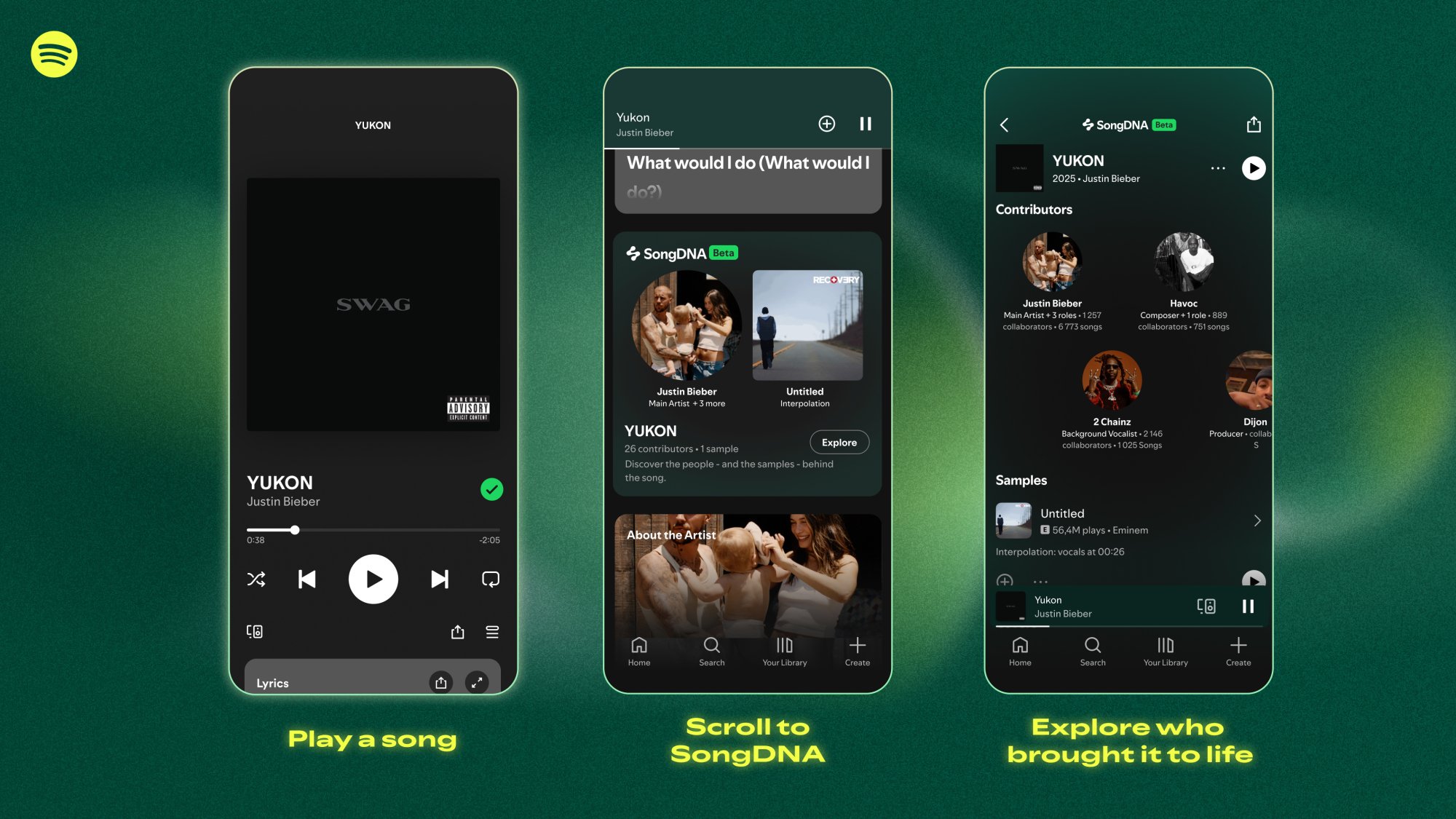
Now, the company is rolling out another new feature, one that actually seems like a cool way to learn about your music. On Tuesday, Spotify announced SongDNA, which shows you all the people who worked on a song, as well as all the samples and interpolations that song used. SongDNA lives directly under the lyrics tile in the player window. I already see it on my end, though Spotify does label the feature with a “Beta” tag to note that this feature is still in testing.

How Spotify’s SongDNA works

When SongDNA appears under a song, you’ll be able to see the artists who worked on it in one corner. That might include the main artist, but also any of the composers, producers, musicians, or writers who contributed. The SongDNA tile shows the main artist in a bubble, but tap the icon, and you’ll see a map of all the people involved. You can tap on any of these names to see how many other artists they’ve worked with, how many songs they worked on, and what their “top song” is (presumably, what the most popular song they worked on is on Spotify).

To the right of the artists’ bubble is a sample and interpolations bubble: Here, you’ll see all of the clips the artist or artists took from various other songs to incorporate them into their own track. On Kendrick Lamar’s “King Kunta,” for example, I can see they sampled a drum loop from “Kung Fu” by Curtis Mayfield, and took vocals from James Brown’s “The Payback,” among others. Spotify will tell you exactly where in each song the sample was taken from, and gives you a play button to listen. You also can scroll down to find songs that have sampled the song in question: “F The Disco” by Cavi samples vocals from “King Kunta” at 1:28, as does “Brain Cells” by Villain Park (at 1:59). Scroll down a bit more, and you’ll find any covers of the song available on Spotify. “8-Bit Misfits” has an awesome interpretation of the song that sounds like Kendrick wrote music for the NES.

spotify songdna

Credit: Spotify

I’m an Apple Music guy, truthfully, but I have to say: This rocks (no pun intended). Most of us listen to our music without really knowing much about how it was put together—outside of the headlining artist, anyway. SongDNA makes it easy to learn more about how your favorite songs were made, where they pulled inspiration from, and who actually helped make the hit besides the singer or artist. You could follow up with the lead engineer or producer of your favorite song to see what other projects they worked on, or check out the full songs that were sampled to find new music to listen to. While it’s a bummer it’s only available for Premium subscribers, it’s a great move on Spotify’s part.

Does Spotify’s SongDNA use AI?

I reached out to Spotify asking whether SongDNA uses AI to retrieve this information, and, as it turns out, it doesn’t! For the most part, anyway. Here’s what a Spotify rep told me: “SongDNA is not a generative AI feature and does not use Large Language Models (LLMs) to create or predict information. This immersive music experience is built on official credits data we receive from artists and their teams, supplemented by community sourced data. While we use technology to visualize these complex relationships, the data itself is rooted in human-verified industry sources, not AI-generated content.”

While it’s not clear what “technology” was used to visual the relationships here, it’s refreshing to learn that the data here is all human-sourced. Spotify might use AI for the UI, but, unlike many new app features these days, this one isn’t going to hallucinate incorrect samples, or make up credits for songs.

Breakthrough Conductive Nail Polish Turns Fingernails Into Touchscreen Styluses

Breakthrough Conductive Nail Polish Turns Fingernails Into Touchscreen Styluses
A chemistry student wanted her long fingernails to work with a touchscreen, so she developed a clear, conductive nail polish to solve the problem.

This idea comes from the mind of Manasi Desai, a chemistry student at Centenary College of Louisiana, and her advisor, Joshua Lawrence. Most touch-based devices, including phones and tablets,

Novitech Unleashes A Purple Lamborghini Revuelto With 1048-HP V12 Fury

Novitech Unleashes A Purple Lamborghini Revuelto With 1048-HP V12 Fury
In stock guise, Lamborghini’s Revuelto is already a prime example of modern performance, but German tuning house Novitec has decided that 1,001 horsepower simply wasn’t enough. By adding more carbon fiber aerodynamic bits with an exhaust system that aims to sing like a classic V12, the tuned hybrid Revuelto has been turned into a 1,048-hp

Jupiter Unleashes Lightning Bolts So Intense They Dwarf Anything Seen On Earth

Jupiter Unleashes Lightning Bolts So Intense They Dwarf Anything Seen On Earth
New data from NASA’s almost-retired Juno orbiter has revealed that lightning bolts on Jupiter are significantly more powerful than previously thought, frequently discharging over 100 times the energy of a typical flash on Earth. 

While Earth’s lightning usually occurs in nitrogen-dominated air where moisture is relatively light, Jupiter’s

LG’s New Laptop Display Can Drop To 1Hz For Major Battery Life Gains

LG's New Laptop Display Can Drop To 1Hz For Major Battery Life Gains
LG Display is on a mission to vastly improve laptop battery life with a new LCD panel equipped with its Oxide 1Hz technology. Now in mass production, this first-of-its-kind panel is capable of dropping down to a 1Hz refresh rate when the screen is static, a tactic that LG claims “dramatically” improves battery life with up to a 48% longer

Canonical Joins Rust Foundation

BrianFagioli writes: Canonical has joined the Rust Foundation as a Gold Member, signaling a deeper investment in the Rust programming language and its role in modern infrastructure. The company already maintains an up-to-date Rust toolchain for Ubuntu and has begun integrating Rust into parts of its stack, citing memory safety and reliability as key drivers. By joining at a higher tier, Canonical is not just adopting Rust but also stepping closer to its governance and long-term direction. The move also highlights ongoing tensions in Rust’s ecosystem. While Rust can reduce entire classes of bugs, it often depends heavily on external crates, which can introduce complexity and auditing challenges, especially in enterprise environments. Canonical appears aware of that tradeoff and is positioning itself to influence how the ecosystem evolves, as Rust continues to gain traction across Linux and beyond. “As the publisher of Ubuntu, we understand the critical role systems software plays in modern infrastructure, and we see Rust as one of the most important tools for building it securely and reliably. Joining the Rust Foundation at the Gold level allows us to engage more directly in language and ecosystem governance, while continuing to improve the developer experience for Rust on Ubuntu,” said Jon Seager, VP Engineering at Canonical. “Of particular interest to Canonical is the security story behind the Rust package registry, crates.io, and minimizing the number of potentially unknown dependencies required to implement core concerns such as async support, HTTP handling, and cryptography — especially in regulated environments.”


Read more of this story at Slashdot.

Denon expands its multi-room speaker lineup with the Home 200, Home 400 and Home 600

If the Sonos app saga still has you down, Denon has three new multi-room speakers that give you some fresh alternatives. The company’s Home 200, Home 400 and Home 600 offer audio flexibility with other HEOS-enabled products. These new devices were also designed so that they blend in with home decor better than most speakers, coming in stone and charcoal color options for that purpose. As you progress up in number, the speakers not only get physically larger, but their sonic output is also more robust.

The Denon Home 200 houses three drivers and three amplifiers for “natural, room-filling sound” in a compact speaker. More specifically, you get two 0.98-inch tweeters and a single 4-inch woofer. The Home 200 looks a kind of like the Sonos Move 2, although Denon’s new compact unit isn’t portable. However, you can use a pair of them for a stereo setup, or connect two 200s to Denon’s Home Sound Bar 550 and Home Subwoofer for a 5.1 home theater system.

Next up is the Home 400, which carries two 0.75-inch tweeters, two 4.5-inch woofers and six amplifiers, in addition to two 1-inch up-firing drivers. Here, Denon says you can expect “a wide, airy soundstage” that provides room-filling audio coverage. What’s more, those upward-facing drivers project sound overhead, so there’s a greater sense of dimensionality and immersion here.

Denon Home 600 speaker
Denon

The Home 600 is the largest speaker in the new trio, with dual 6.5-inch woofers alongside two tweeters, two midrange units and two up-firing drivers. Denon explains that this configuration offers “deep, authoritative bass” that provides more depth in your tunes than other two models.

All three of the new Home speakers have Wi-Fi, Bluetooth USB-C and aux connectivity with the wireless streaming powered by Denon’s HEOS tech. As such, you can connect these Home speakers with up to 64 other HEOS devices — including A/V receivers and Denon’s new DP-500BT turntable — and arrange your audio gear in up to 32 different zones. You’ll have access to tunes from Tidal, Amazon Music HD and Qobuz in the HEOS app, and all three new Home speakers support Dolby Atmos Music where available.

The Home 200, Home 400 and Home 600 speakers are available today for $399, $599 and $799 respectively. They’re available from Denon directly or other authorized retailers.

This article originally appeared on Engadget at https://www.engadget.com/audio/speakers/denon-expands-its-multi-room-speaker-lineup-with-the-home-200-home-400-and-home-600-080000916.html?src=rss

Cyberattack on a Car Breathalyzer Firm Leaves Drivers Stuck

Last week, hackers launched a cyberattack on an Iowa company called Intoxalock that left some drivers unable to start their court-mandated breathalyzer-equipped cars. Wired reports: Intoxalock, an automotive breathalyzer maker that says it’s used daily by 150,000 drivers across the U.S., last week reported that it had been the target of a cyberattack, resulting in its “systems currently experiencing downtime,” according to an announcement posted to its website. Meanwhile, drivers that use the breathalyzers have reported being stranded due to the devices’ inability to connect to the company’s services. “Our vehicles are giant paperweights right now through no fault of ours,” one wrote on Reddit. “I’m being held accountable at work and feel completely helpless.”

The lockouts appear to be the result of Intoxalock’s breathalyzers needing periodic calibrations that require a connection to the company’s servers. Drivers who are due for a calibration and can’t perform one due to the company’s downtime have been stuck, though the company now states on its website that it’s offering 10-day extensions on those calibrations due to its cybersecurity disruption, as well as towing services in some cases. In the meantime, Intoxalock hasn’t explained what sort of cyberattack it’s facing or whether hackers have obtained any of the company’s user data.


Read more of this story at Slashdot.

Trump Administration To Pay French Company $1 Billion To Stop Offshore Wind Farms

An anonymous reader quotes a report from NPR: The Trump administration will pay $1 billion to a French company to walk away from two U.S. offshore wind leases as the administration ramps up its campaign against offshore wind and other renewable energy. TotalEnergies has agreed to what’s essentially a refund of its leases for projects off the coasts of North Carolina and New York, and will invest the money in fossil fuel projects instead, the Department of Interior announced Monday.

The Trump administration has tried to halt offshore wind construction, but federal judges overturned those orders. Environmental groups denounced the TotalEnergies deal as an alternate way to block wind projects. President Donald Trump has gone all in on fossil fuels, which he says is the way to lower costs for families, increase reliability and help the U.S. maintain global leadership in artificial intelligence.

TotalEnergies pledged to not develop any new offshore wind projects in the United States. TotalEnergies CEO Patrick Pouyanne said in a statement that the company renounced offshore wind development in the United States in exchange for the reimbursement of the lease fees, “considering that the development of offshore wind projects is not in the country’s interest.” Pouyanne said the refunded lease fees will finance the construction of a liquefied natural gas plant in Texas and the development of its oil and gas activities, calling it a “more efficient use of capital” in the U.S. After it makes those investments, TotalEnergies will be reimbursed, up to the amount paid in lease purchases for offshore wind, according to the DOI.


Read more of this story at Slashdot.

Marblopolis Marble Run Amusement Park

Built by Jelle’s Marble Runs, Marblopolis is a marble run amusement park featuring 30 different attractions, all connected via almost 1/4 mile of track. The park can accommodate up to 400 fun-loving marbles at a time, and, I think I speak for everyone here when I ask, what happens if a 401st visitor shows up? Do all the rides break? If that marble were me, it would probably ride something spinny then puke funnel cake on another marble, who would then puke on another marble, and on and on. Like a domino maze, but a puking marble run.