Dick Cheney, Powerful Former VP, Dies at 84

Dick Cheney, who served four Republican presidents and became one of the most powerful and controversial vice presidents in American history as an architect of the post-9/11 war on terror, died at 84. His family said he died from complications of pneumonia and cardiac and vascular disease.

Cheney served as vice president under George W. Bush for two terms beginning in 2001 and relentlessly advocated for the 2003 invasion of Iraq. Many Americans came to view the war as a strategic and humanitarian disaster. The conflict had far-reaching policy and political consequences that helped turn the public against intervention and upheaved Republican politics. Cheney continued to defend the invasion long after leaving office in 2009.

He had heart disease for most of his life and underwent a transplant in 2012. That allowed him to live to see his daughter Liz Cheney follow in his political footsteps to become a House GOP leader. Before serving as vice president, Cheney was defense secretary under George H.W. Bush and chief of staff to Gerald Ford at age 34.


Read more of this story at Slashdot.

OpenAI Taps Amazon AWS To Scale AI Compute On NVIDIA Blackwell In Massive $38B Deal

OpenAI Taps Amazon AWS To Scale AI Compute On NVIDIA Blackwell In Massive $38B Deal
The AI arms race is afoot and in a bid to stay in front of the 8-ball, OpenAI is forming a multi-year partnership with Amazon Web Services (AWS) to rapidly scale agentic workloads. As part of the massive $38 billion deal, OpenAI will have access to AWS compute comprising hundreds of thousands of NVIDIA GPUs, and potentially tens of millions

Alexa+ comes to the Amazon Music app

Amazon has launched its new and improved AI assistant in the Amazon Music app. From today, anyone signed up to Alexa+ Early Access with the latest version of the app downloaded to their iOS or Android device can start using Amazon’s reimagined virtual assistant for music discovery and organizing their libraries.

To access the chatbot, you tap the “A” button in the lower right corner of the screen when Amazon Music is open. You can then test its knowledge by asking it a range of questions, from something as basic as finding a recently released song by a particular artist, to more complex searches based on a single lyric or the name of the TV show the song you’re trying to find is featured in.

Alexa+ is designed for more conversational interactions, so you can use natural language prompts and then ask follow-up questions as you would if you were talking to a friend, to narrow down its search results. Amazon says you can search for specific eras, moods and instruments, as well as telling Alexa what you don’t want it to serve up.

Alexa+ can also be used for playlist creation, allowing you to request something as specific as a high-energy running playlist with songs from a particular decade that starts with a song from a certain artist. You can also be more vague, asking for something that fits your current mood or the time of day.

Alexa+ in Amazon Music is being marketed not only as an AI tastemaker and personal DJ, but also a music expert, so you can ask it things like the inspiration for a song’s lyrics, where an album charted and questions about upcoming live performances.

Alexa+ has been gradually rolling out in Amazon’s various smart devices since the beginning of the year, with mixed results. You’ll be using it in everything from new Ring devices, to the latest Kindles and Vega, Amazon’s new smart TV operating system. It’s also built into the new Echo Studio speaker, and Engadget’s Billy Steele was impressed by the AI assistant’s more human-like conversation skills, even if it’s still prone to basic errors right now, such as getting the day of the week wrong in a response.

Alexa+ is currently available in Early Access for all tiers of Amazon Music. Eventually it’ll be free to all Prime members, and available to non-Prime members for $20 per month (more than an Amazon Prime subscription on its own).

This article originally appeared on Engadget at https://www.engadget.com/entertainment/music/alexa-comes-to-the-amazon-music-app-143234227.html?src=rss

It’s Surprisingly Simple to Connect Your Mac to Multiple Bluetooth Speakers

Whether you’re hosting a party or just cleaning the house, sometimes it’s nice to have audio in multiple rooms. You could do that by running wires through your house, or by purchasing a multi-room audio system, but if you have a Mac you don’t have to do any of that.

There’s a feature that makes it possible to send your Mac’s audio to multiple speakers, including Bluetooth ones. The feature is a little obscure, though—you won’t find it in System Settings, or anywhere obvious.

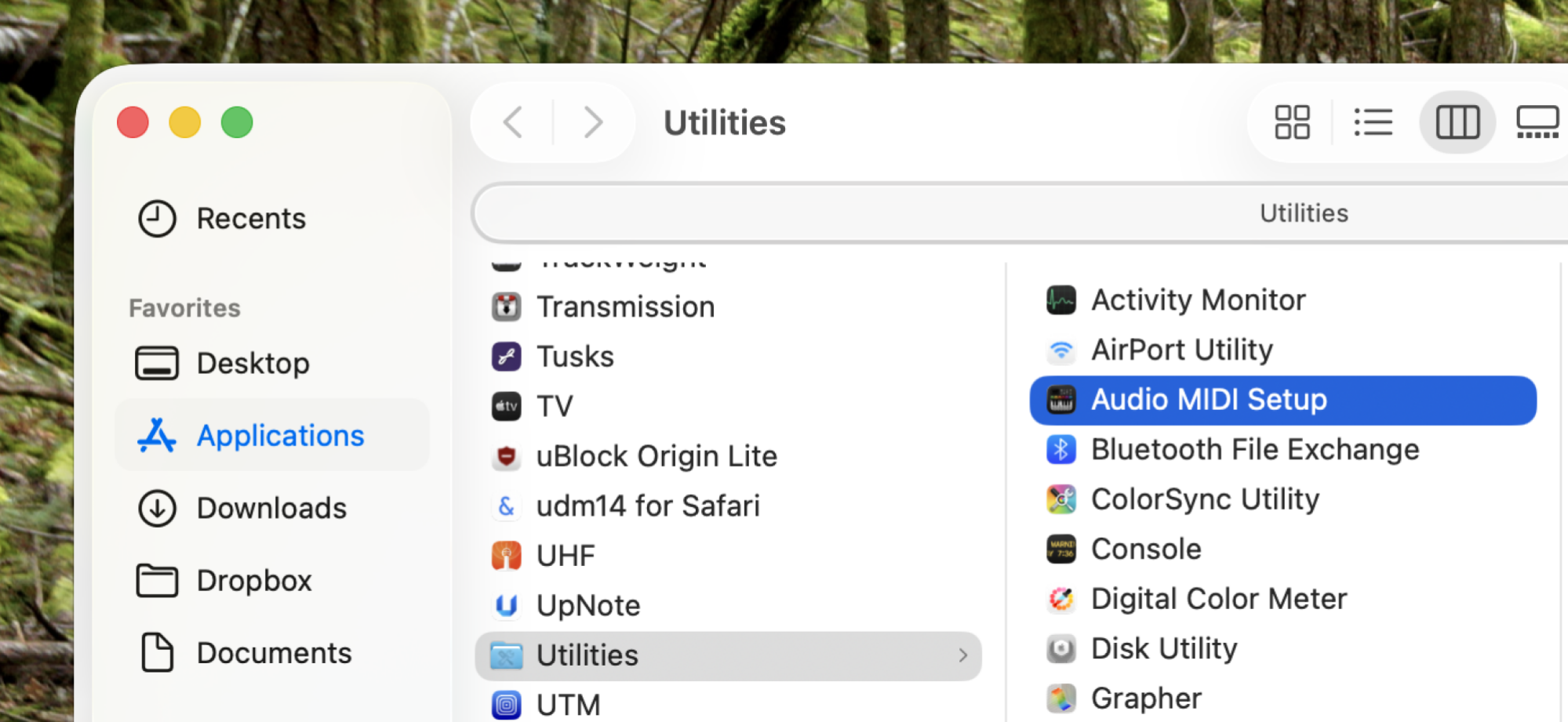
No, to send audio to multiple devices on your Mac you need to open an application called Audio MIDI Setup, which you can find using Spotlight or by browsing to Applications > Utilities in Finder.

A screenshot of Finder showing where the Audio MIDI Setup application is in the Utilities folder

Credit: Justin Pot

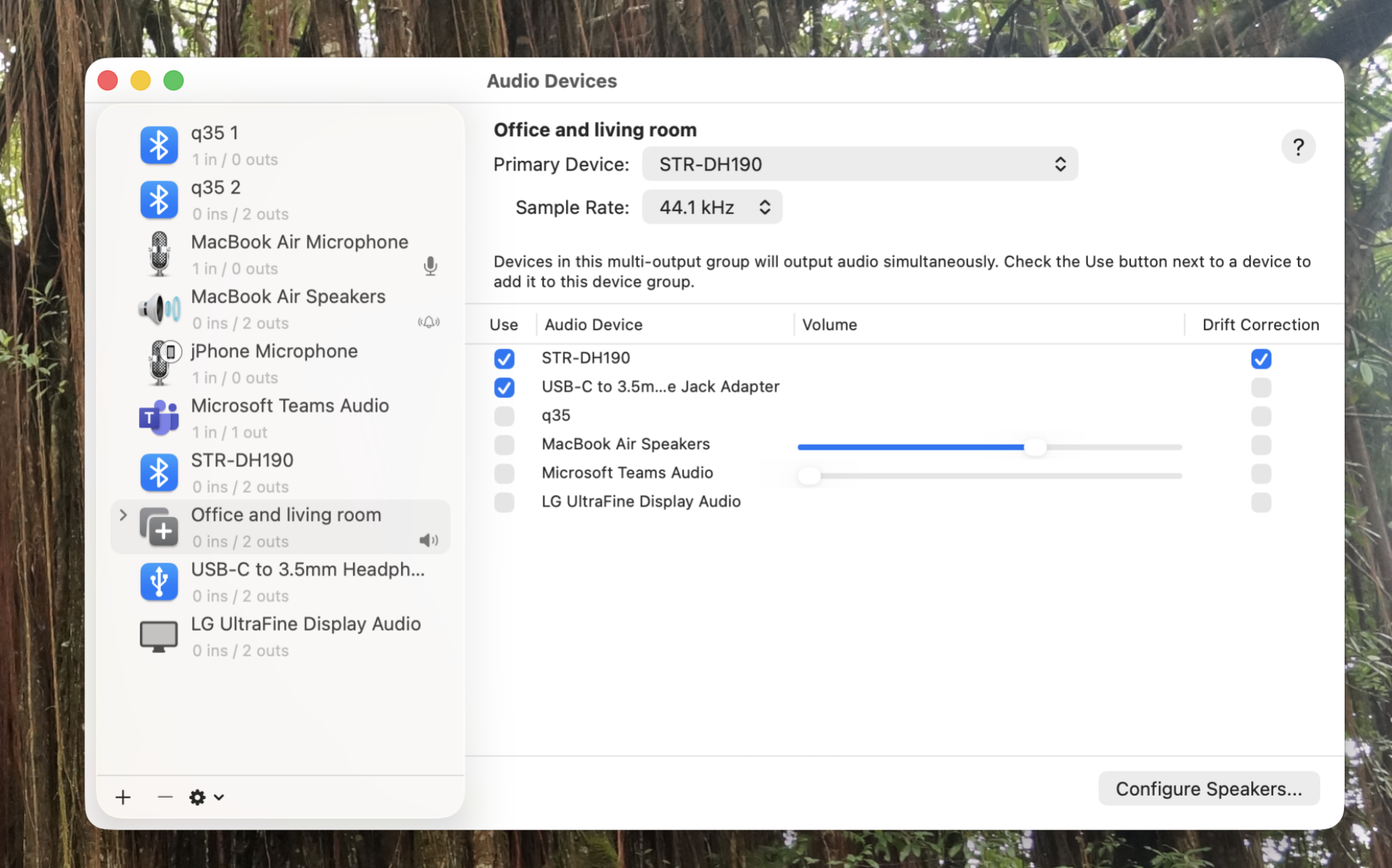
Open the application and click the + button in the bottom-left corner, then click Create Multi-Output Device. You will see a list of all audio devices, including the built-in speakers, any wired audio outputs that are connected, any Airplay-compatible devices on your network, and any Bluetooth devices that support audio.

A screenshot of theAudio MIDI Setup application. A multi-output device is created, allowing the user to check as many connected devices as they like

Credit: Justin Pot

Check as many of these as you like. You can give a name to your combined audio device, if you like, by clicking and holding the current name in the left-hand sidebar. Then you can switch to your new combined audio device by clicking the audio icon in your menu bar and selecting it.

I recommend putting on some music and testing things out, adding or removing devices. I had the best results by checking one device connected to my Mac using a wired and another that is connected by Bluetooth. Multiple Bluetooth devices tended to get out of sync quickly, though you can alleviate the syncing issues by checking the Drift Correction box for your wireless devices.

This isn’t a perfect replacement for a proper multi-room audio system, but it works surprisingly well without the need to buy anything, run wires in your walls, or even purchase any software. Try it out the next time you feel like walking around your house listening to music.

What Happened When Small-Town America Became Data-Center, USA

Amazon’s data-center expansion turned Umatilla, Oregon into an unlikely nerve center for American infrastructure investment. The community of roughly 8,000 residents has seen home prices double and local government budgets surge from $7 million in 2011 to a hundred and $44 million in the past fiscal year. Yesenia Leon-Tejeda, a Realtor and daughter of Mexican-born farmhands who once worked 12-hour shifts at a distribution center, is now on pace to close 35 deals this year.

Federal data shows investment in software and information-processing equipment drove most of America’s GDP growth in the first half of 2025. Goldman Sachs estimated that roughly 72% of all server-farm capacity sat in just 1% of counties as of July. The region’s hydroelectric dams and cheap power attracted Amazon Web Services more than a decade ago. Growth has brought rising costs for housing and child care. Political tensions over spending erupted this year when Mayor Caden Sipe sued the city manager and council members.


Read more of this story at Slashdot.

The Bose Ultra Open Earbuds Are $100 Off Right Now

We may earn a commission from links on this page. Deal pricing and availability subject to change after time of publication.

The Bose Ultra Open Earbuds take a sharp turn from the brand’s usual noise-canceling dominance. Instead of sealing you off from the world, they sit outside your ears, letting in ambient sound while still delivering rich, detailed audio. Priced at $199 (down from its original $299), this is their lowest price yet (according to price trackers), and they cater to people who prefer awareness over isolation. Think cyclists, runners, or anyone who doesn’t want to miss the honk of a car while listening to music.

The fit takes a minute to figure out. The silicone band adds just enough tension to keep them in place, but how you clip them changes the sound more than you’d expect. Too high and it gets tinny; too low and you lose stereo balance. Once you find the alignment, though, they stay put through walks or light workouts and handle sweat or drizzle without a fuss, thanks to their IPX4 rating.

Sound-wise, Bose mostly nails what’s hard to get right in open audio: clarity. The Ultra Opens avoid the hollow sound that plagues similar models, keeping vocals crisp and highs bright. The low mids have a pleasing warmth, though the deep bass doesn’t hit with much punch. You’ll notice that most in EDM or hip-hop, where the kick feels restrained. Still, for casual listening, podcasts, and calls, the balanced tuning works. Also, they use Bluetooth 5.3 and support AAC, AptX Adaptive, and SBC codecs, which means Android users get slightly better audio quality than iPhone users. 

Volume holds steady even outdoors, and there’s minimal distortion at full blast—per this PCMag review, the earbuds sound their best around 70 percent volume, delivering a full, detailed mix while still keeping you aware of what’s happening around you. If you prefer a more low-end presence, the adjustable EQ in the Bose app lets you tweak the sound. Battery life holds up nicely, too, around 7.5 hours on a charge and about 27 hours with the case. That said, wireless charging isn’t built in, though there’s a separate case for that if you prefer it over the USB-C setup.


Our Best Editor-Vetted Tech Deals Right Now


Amazon Fire TV Stick 4K Plus


—
$29.99

(List Price $49.99)


Ring Video Doorbell Pro 2 with Ring Chime Pro


—
$149.99

(List Price $259.99)

Deals are selected by our commerce team

Motorola introduces its latest takes on the Moto G and Moto G Play phones

Motorola has been consistently offering solid budget smartphone offerings, and the company back with new refreshes to its Moto G and Moto G Play for 2026. The latest versions offer some incremental tech upgrades and a couple lovely new color options for the aesthetic upgrades. 

These smartphones both sport 6.7-inch displays with 120Hz and peak brightness of 1,000 nits. The Moto G boasts a 50MP camera as well as a 32MP front camera for selfies, while the Moto G Play has 32MP for its main camera and 8MP for the front camera. Both devices’ photography is backed by quad pixel technology to provide detailed image capture in a variety of lighting conditions. These two phones have a 5,200mAh battery and adds some quick-charging options: 30W for the Moto G and 18W for the Moto G Play. On the durability front, the Moto G is still using Gorilla Glass 3 and boasts an IP52 water resistance rating, as the 2025 model did, and the same will also be available in the Moto G Play model.

Both phones are getting some Pantone color options in leather-inspired finishes. The Moto G will have a gray color called Slipstream or the purple of Cattleya Orchid, while the Moto G Play comes in Pantone Tapestry blue.

Moto G will continue to retail starting at $200 and will be available directly from Motorola starting on December 11, followed by Amazon and Best Buy availability on January 15. The Moto G Play will be available online from Motorola, Best Buy and Amazon on November 13 for $170; the model will arrive in stores some time in the coming months.

This article originally appeared on Engadget at https://www.engadget.com/mobile/smartphones/motorola-introduces-its-latest-takes-on-the-moto-g-and-moto-g-play-phones-140000620.html?src=rss

Nintendo Switch 2 Is Biggest Console Launch In History As Sales Continue To Soar

Nintendo Switch 2 Is Biggest Console Launch In History As Sales Continue To Soar
Nintendo is raising its Switch 2 sales forecast by millions of units after the second-generation handheld set an historic pace in console sales with 10.36 million systems sold in the first four months. For context, the first generation Switch, which ranks as a massive success in its own right, sold less than half as many units in its first

Apple TV has a new intro bumper and soundmark

Apple dropped the “plus” from its streaming service’s name in October, because the company typically uses the plus sign for free services with paid versions, such as iCloud+. Now, the company has released a new intro bumper and soundmark for its TV service. Apple has uploaded a five-second video showing its streaming service’s new logo appearing in a hazy multi-colored animation before it shifts into focus at the center of the screen. Playing in the background is a soundmark, or as its composer calls it, a “mnemonic.” 

The soundmark will appear before every show and every episode in a series, according its composer Finneas, whom you may know as Billie Eilish’s brother and frequent collaborator. “The things that I think of as real classic mnemonics are NBC — you can hear that in your head — or HBO has its static,” he told Variety. Netflix’s “tudum” sound is pretty iconic, as well. Only time can tell if Apple’s will have the same impact. He explained that the five-second version Apple released as a video will be played before every movie and in between the episodes of a show, so you’re bound to hear it multiple times if you’re bingeing a series. Apple also made a one-second version of the intro for trailers and a 12-second one for anything released in theaters, such as Killers of the Flower Moon. 

Finneas said that he was approached by Apple’s Head of Music, David Taylor, who apparently told him that the company was “simplifying” the service. Removing the “plus” from its name was just the beginning. In addition, Apple has also debuted a new logo for Apple One, a subscription option that bundles multiple Apple services, including Apple Music, TV and iCloud+, into a lower-priced monthly plan. The new logo uses a textured multi-colored Apple illustration. 

This article originally appeared on Engadget at https://www.engadget.com/entertainment/streaming/apple-tv-has-a-new-intro-bumper-and-soundmark-140016449.html?src=rss

NIntendo expects to sell way more Switch 2s than it thought

Nintendo has boosted its Switch 2 sales forecast for the current fiscal year, meaning it could top first year sales of the original Switch. The gaming giant expects to sell 19 million Switch 2s by March 31, 2026, up 26.7 percent from its original forecast of 15 million units. That follows a previous report that Nintendo had asked suppliers to build 25 million Switch 2s by the end of March next year.

In its second quarter ending September 30th, Nintendo sold 4.54 million Switch 2s and has moved 10.36 million units since launch. However, the company’s Q3 sales through the holiday season can often double Q2 sales, as they did multiple times with the Switch. 

The original Switch sold 17.79 million units in its first 13 months, so the Switch 2 could exceed that over a shorter time frame. Nintendo reportedly requested a production boost as it believed the console will continue its torrid sales pace through the holiday season. It also expects to sell 4 million Switches for the fiscal year, down a touch from its previous forecast. 

Nintendo is optimistic about software too, projecting sales of 48 million units for Switch 2 by March 31, up 3 million from its earlier forecast. It also expects to sell 125 million Switch games (which can also be played on the Switch 2) for this fiscal year, rather than 105 million as it previously predicted. 

This quarter, the company moved 11.95 million Switch 2 games, with Mario Kart World and Donkey Kong Bonanza among the best sellers. Pokémon Legends: Z-A started shipping on October 16th, which could help lift game sales for Q3. 

With console and game sales ahead of expectations, Nintendo’s earnings looked pretty rosy for its second fiscal quarter ended September 30th. The company saw 527.2 billion yen in revenue ($3.7 billion) and 102.9 billion yen in profit, both considerably higher than expected.

This article originally appeared on Engadget at https://www.engadget.com/gaming/nintendo/nintendo-expects-to-sell-way-more-switch-2s-than-it-thought-130048295.html?src=rss

DOJ Accuses US Ransomware Negotiators of Launching Their Own Ransomware Attacks

An anonymous reader quotes a report from TechCrunch: U.S. prosecutors have charged two rogue employees of a cybersecurity company that specializes in negotiating ransom payments to hackers on behalf of their victims with carrying out ransomware attacks of their own. Last month, the Department of Justice indicted Kevin Tyler Martin and another unnamed employee, who both worked as ransomware negotiators at DigitalMint, with three counts of computer hacking and extortion related to a series of attempted ransomware attacks against at least five U.S.-based companies.

Prosecutors also charged a third individual, Ryan Clifford Goldberg, a former incident response manager at cybersecurity giant Sygnia, as part of the scheme. The three are accused of hacking into companies, stealing their sensitive data, and deploying ransomware developed by the ALPHV/BlackCat group. […] According to an FBI affidavit filed in September, the rogue employees received more than $1.2 million in ransom payments from one victim, a medical device maker in Florida. They also targeted several other companies, including a Virginia-based drone maker and a Maryland-headquartered pharmaceutical company.


Read more of this story at Slashdot.

The Morning After: Musk talks flying Teslas on Joe Rogan’s show

Elon Musk told Joe Rogan on his podcast he hopes to unveil a flying car “before the end of the year.” It was an interesting announcement to make, as Rogan also asked Musk about the long-delayed second-gen Tesla Roadster. Tesla unveiled a new Roadster in 2017 and had plans to start deliveries in 2020, but production was delayed several times.

Avoiding that conversation, the Tesla CEO suddenly started talking about wanting the vehicle to fly. After vague answers and musing, he eventually said: “My friend Peter Thiel once reflected that the future was supposed to have flying cars, but we don’t have flying cars.”

He claimed the vehicle Tesla is supposedly working on contains “crazy, crazy technology.” Musk said he wasn’t sure it’s technically a car but that “it looks like a car.”

Musk has been talking about flying cars since 2014. Given his optimistic take on development timelines, that’s a good 10 years of talk so far. Give it perhaps another 10?

— Mat Smith

Get Engadget’s newsletter delivered direct to your inbox. Subscribe right here!

The news you might have missed

The $115,000 showdown between Meta and Facebook creators

The business of viral Facebook content is lucrative, but often volatile.

TMA
Engadget

Creator Mel Bouzad is suing Meta for over $115,000 on his and other creators’ behalf. He alleges that Meta’s broken AI and vague “monetization policy violations” led to the wrongful demonetization of high-earning pages and the withholding of tens of thousands of dollars in payments. Can multiple small claims court fights force Meta to provide human support and fix its system? Read the full story on the volatile world of viral content.

Continue reading.

Pentagon may award SpaceX a billion-dollar contract to help with Golden Dome

SpaceX could build up to 600 satellites for a new defense system.

SpaceX will reportedly receive a $2 billion contract to develop satellites for the US government, according to sources talking to The Wall Street Journal. SpaceX will reportedly be tasked with developing up to 600 satellites that can track missiles and aircraft and will be used for President Trump’s proposed Golden Dome project.

The president introduced the project earlier this year as an anti-missile defense system, designed to intercept missile attacks before they reach their target.

Continue reading.

Apple Vision Pro M5 review

A better beta is still a beta.

TMA
Engadget

Apple surprised many by announcing an upgraded Vision Pro with its latest M5 chip. It’s still largely the same device. The revamped Apple Vision Pro is faster and more comfortable than the original, but its limited ecosystem still makes it better suited to developers than consumers.

It does support PSVR2 controllers, though.

Continue reading.

This article originally appeared on Engadget at https://www.engadget.com/general/the-morning-after-musk-talks-flying-teslas-on-joe-rogans-show-120438841.html?src=rss

Dune driving with Mercedes-Benz as it tests off-road systems

LAS VEGAS—About 100 miles from Las Vegas, at the northern end of the Mojave Desert, you’ll find a pretty large pile of sand. The Dumont Dunes formed thousands of years ago as sand from recently dried-up lakes blew in on the wind through gaps in the mountains. We’re talking real Lawrence of Arabia stuff—some dunes hundreds of feet high, and a large amount of it is run as a recreational area by the Bureau of Land Management for activities that include a bit of off-roading.

Which is why we found a trailer full of Mercedes-Benz engineers and some preproduction prototype electric GLCs at work out there. When we last saw the next GLC, it was earlier this year at a German test track, wearing one of those black-and-white digital camouflage wraps that obscure the finer details of a new design. The automaker is dealing with the finishing touches ahead of the model going into production next year. The hardware is signed off on, but there’s plenty of code to tweak and calibrations to perform, including making sure that even when the terrain gets loose, the handling won’t.

While I’m sure that the vast majority of GLC customers’ experience with rough surfaces won’t extend past the odd, particularly bad pothole, the car is being engineered to cope with much more. When fitted with the optional air suspension, the ground clearance can increase to up to 8.1 inches (206 mm) at low speed and 7.2 inches (183 mm) even up to highway speed, as long as the car is in the more extreme of the two Terrain modes. That allows for approach and departure angles as much as 21.4 degrees (approach) and 22.6 degrees (departure).

Read full article

Comments

EV Sales Plummet In October After Federal Tax Credit Ends

Longtime Slashdot reader sinij shares a report from Car and Driver: Sales of electric vehicles surged in September as shoppers rushed to take advantage of the $7500 federal EV tax credit before it disappeared at the end of the month. With the government subsidies now gone, EV sales were expected to take a hit in October. While only a few automakers still report sales on a monthly basis, the results we do have do not paint a rosy picture for EVs in a post-tax credit world.

The Korean automakers were hit particularly hard by the loss of the tax credit. The Hyundai Ioniq 5, which was the fifth-best-selling EV through the third quarter of this year, experienced a 63 percent drop, moving 1642 units in October 2025, down from 4498 in 2024. Its platform-mates saw similar declines. The Kia EV6 moved just 508 units, down 71 percent versus the same month the year before, while the luxurious Genesis GV60 only found 93 buyers, a 54 percent slide year over year. Things were even worse at Honda. While the Acura ZDX was recently discontinued after just a single model year, the related Honda Prologue remains on sale but registered just 806 units, down 81 percent from 4130 sales in October 2024. […]

Obviously, this isn’t the full picture, as several major players — including General Motors, Toyota, Nissan, and Volkswagen — only release sales reports on a quarterly basis, and others, such as Tesla and Rivian, don’t break out individual sales at all. But with four of the top 10 bestselling EVs through Q3 all showing noteworthy declines in October, it spells trouble for the EV market at large. The end-of-year sales figures will provide a much clearer picture of whether October was just a blip or the start of a much more widespread problem for EV sales.


Read more of this story at Slashdot.

Australians To Get At Least Three Hours a Day of Free Solar Power – Even If They Don’t Have Solar Panels

Australia’s new “solar sharer” program will give households in NSW, south-east Queensland, and South Australia at least three hours of free solar power each day starting in 2026 — even for those without rooftop panels. Other areas will potentially follow in 2027. The Guardian reports: The government said Australians could schedule appliances such as washing machines, dishwashers and air conditioners and charge electric vehicles and household batteries during this time. The solar sharer scheme would be implemented through a change to the default market offer that sets the maximum price retailers can charge customers for electricity in parts of the country. The climate change and energy minister, Chris Bowen, said the program would ensure “every last ray of sunshine was powering our homes” instead of some solar energy being wasted.

Australians have installed more than 4m solar systems and there is regularly cheap excess generation in the middle of the day. Part of the rationale for the program is that it could shift demand for electricity from peak times — particularly early in the evening — to when it is sunniest. This could help minimize peak electricity prices and reduce the need for network upgrades and intervention to ensure the power grid was stable.


Read more of this story at Slashdot.

Antarctic Glacier Saw the Fastest Retreat In Modern History

An anonymous reader quotes a report from CNN: An Antarctic glacier shrunk by nearly 50% in just two months, the fastest retreat recorded in modern history, according to a new study — and the way it retreated could have big implications for global sea level rise. The Hektoria Glacier, roughly the size of Philadelphia, is on the Antarctic Peninsula, a spindly chain of mountains sticking off the continent like a thumb pointing toward South America. It is one of the fastest warming regions on Earth.

Grounded glaciers like Hektoria, which rest on the seabed and don’t float, generally retreat no more than a few hundred meters a year. But between November and December 2022, Hektoria retreated by 5 miles, according to the study published Monday in the journal Nature Geoscience. […] Understanding more about why this happened is vital; if larger glaciers retreat at similar rates, it could have “catastrophic implications for sea level rise,” the authors wrote in a statement accompanying the report. Antarctica holds enough ice to raise global sea level by around 190 feet. Models show that the latest time this kind of ice plain melting occurred was between about 15,000 and 19,000 years ago, “during a period of warming that ended the last Ice Age,” notes the report.

“[W]e hadn’t seen it play out live before, certainly not at this rate,” said Naomi Ochwat, a study co-author and postdoctoral associate at the University of Colorado Boulder.


Read more of this story at Slashdot.

Logitech is going after keyboard snobs with the hot-swappable Alto Keys K98M

Logitech is hoping to attract all the keebheads out there with its latest Alto Keys K98M. While this keyboard has been available in Asian markets for a while, Logitech finally brought its customizable work keyboard to the US. It may appeal to a specific demographic, but it’s a welcome return to hot-swappable offerings from Logitech. The Alto Keys K98M is now available in US markets through its website for $119.

According to Logitech, the Alto Keys K98M comes with hot-swappable Logi Marble linear switches. While Logitech sells several mechanical keyboards, the last notable one with a hot-swappable board was the Logitech G Pro X from 2019. Now, Logitech wants to dive back into the hardcore side of the keyboard world with something that’s more tailored for the workspace. Instead of obnoxious RGB lighting, the Alto Keys K98M features a translucent frame that’s paired with white backlighting. For long days, the keyboard has a UniCushion design, where the full frame gasket mount absorbs typing vibrations for an improved feel and sound.

For customizability beyond switches, Logitech included three action keys that can be programmed for whatever you need. The first three F keys also work as Easy-Switch buttons that let you cycle between up to three devices. The Alto Keys K98M works wirelessly through Bluetooth and is compatible with Windows, macOS, ChromeOS and iPadOS. Logitech said that the keyboard will get up to a year of wireless use if you keep the backlighting off. When the Alto Keys K98M’s battery runs low, you can continue using it as you recharge it through the USB-C port.

This article originally appeared on Engadget at https://www.engadget.com/computing/accessories/logitech-is-going-after-keyboard-snobs-with-the-hot-swappable-alto-keys-k98m-031051209.html?src=rss

LADWP Says It Will Shift Its Largest Gas Power Plant To Hydrogen

Bruce66423 shares a report from the Los Angeles Times: The board of the Los Angeles Department of Water and Power on Tuesday approved a controversial plan to convert part of the city’s largest natural gas-fired power plant into one that also can burn hydrogen. In a 3-0 vote, the DWP board signed off on the final environmental impact report for an $800-million modernization of Units 1 and 2 of the Scattergood Generating Station in Playa del Rey. The power plant dates to the late 1950s and both units are legally required to be shut down by the end of 2029. In their place, the DWP will install new combined-cycle turbines that are expected to operate on a mixture of natural gas and at least 30% hydrogen with the ultimate goal of running entirely on hydrogen as more supply becomes available.

The hydrogen burned at Scattergood is supposed to be green, meaning it is produced by splitting water molecules through a process called electrolysis. Hydrogen does not emit planet-warming carbon dioxide when it is burned, unlike natural gas. […] Although burning hydrogen does not produce CO2, the high-temperature combustion process can emit nitrogen oxides, or NOx, a key component of smog. […] [T]he approved plan contains no specifics about where the hydrogen will come from or how it will get to the site. “The green hydrogen that would supply the proposed project has not yet been identified,” the environmental report says. Industry experts and officials said the project will help drive the necessary hydrogen production. “Burning hydrogen produced by ‘excess’ solar or wind power is a means of energy storage,” adds Slashdot reader Bruce66423. “The hard question is whether it’s the best solution to the storage problem given that other solutions appear to be emerging that would require less infrastructure investment (think pipes to move the hydrogen to the plant and tanks to store it for later use).”


Read more of this story at Slashdot.

Apple releases iOS 26.1, macOS 26.1, other updates with Liquid Glass controls and more

After several weeks of testing, Apple has released the final versions of the 26.1 update to its various operating systems. Those include iOS, iPadOS, macOS, watchOS, tvOS, visionOS, and the HomePod operating system, all of which switched to a new unified year-based version numbering system this fall.

This isn’t the first update that these operating systems have gotten since they were released in September, but it is the first to add significant changes and tweaks to existing features, addressing the early complaints and bugs that inevitably come with any major operating system update.

One of the biggest changes across most of the platforms is a new translucency control for Liquid Glass that tones it down without totally disabling the effect. Users can stay with the default Clear look to see the clearer, glassier look that allows more of the contents underneath Liquid Glass to show through, or the new Tinted look to get a more opaque background that shows only vague shapes and colors to improve readability.

Read full article

Comments

Spotify Sued Over ‘Billions’ of Fraudulent Drake Streams

A new class-action lawsuit accuses Spotify of allowing billions of fraudulent Drake streams generated by bots between 2022 and 2025, allegedly inflating his royalties at the expense of other artists. “Spotify pays streaming royalties using a ‘pro-rata’ model based on an artist’s market share,” notes Consequence. “Each month, revenue from subscriptions and ads is collected into a single, fixed ‘pot’ of money, which is then distributed to rights holders based on their percentage of the platform’s total streams. Because this pot is fixed, an artist who artificially inflates their numbers through bots would dilute the value of every legitimate stream. This allows them to take a larger share of the pot than they earned, effectively siphoning royalties that should have gone to other artists.” From the report: According to Rolling Stone, the lawsuit alleges bot use is a widespread problem on Spotify. However, Drake is the only example named, based on “voluminous information” which the company “knows or should know” that proves a “substantial, non-trivial percentage” of his approximately 37 billion streams were “inauthentic and appeared to be the work of a sprawling network of Bot Accounts.”

The complaint claims this alleged fraudulent activity took place between “January 2022 and September 2025,” with an examination of “abnormal VPN usage” revealing at least 250,000 streams of Drake’s song “No Face” during a four-day period in 2024 were actually from Turkey “but were falsely geomapped through the coordinated use of VPNs to the United Kingdom in [an] attempt to obscure their origins.” Other notable allegations in the lawsuit are that “a large percentage” of accounts were concentrated in areas where the population could not support such a high volume of streams, including those with “zero residential addresses.” The suit also points to “significant and irregular uptick months” for Drake’s songs long after their release, as well as a “slower and less dramatic” downtick in streams compared to other artists.

Noting a “staggering and irregular” streaming of Drake’s music by individuals, the suit also claims there are a “massive amount of accounts” listening to his songs “23 hours a day.” Less than 2% of those users account for “roughly 15 percent” of his streams. “Drake’s music accumulated far higher total streams compared to other highly streamed artists, even though those artists had far more ‘users’ than Drake,” the lawsuit concludes.


Read more of this story at Slashdot.