Intel remains the dominant player in the x86 space when it comes to market share, both overall and in individual segments such as desktop, server, and mobile. However, AMD continues to chip away at its rival’s big lead, as we had been seeing. According to the latest data by Mercury Research, AMD now accounts for almost a third of all x86 CPUs,
The Moon is not, in fact, a giant cosmic wheel of Gouda. In a landmark paper published in Nature, researchers from the French National Center of Scientific Research delivered a hard truth: the Moon is actually packing a solid inner core of material with a density suspiciously similar to iron. Rather than a massive cheese ball, we’re dealing
An anonymous reader shares a report: In October, PUBG and Subnautica 2 publisher Krafton announced that it would be undergoing a “complete reorganization” to become an “AI-first” company, planning to invest over 130 billion won ($88 million) in agentic AI infrastructure and deployment beginning in 2026. This week, as it boasts record-breaking quarterly profits, the Korean publisher has followed that strategic shift by launching a voluntary resignation program for its domestic employees, according to Business Korea reporting.
The program, announced internally, offers substantial buyouts for domestic Krafton employees based on their length of employment at the publisher. Severance packages range from 6 months’ salary for employees with one year or less of service to 36 months’ salary for employees who’ve worked at Krafton for over 11 years. The voluntary resignation program follows a November 4 earnings call in which Krafton announced a record quarterly profit of $717 million. During the call, Krafton CFO Bae Dong-geun indicated that Krafton had also halted hiring for new positions, telling investors that “excluding organizations developing original intellectual property and AI-related personnel, we have frozen hiring company-wide.”
We may earn a commission from links on this page. Deal pricing and availability subject to change after time of publication.
A small upgrade can make an old TV feel new again, and the Amazon Fire TV Stick HD is the kind of plug-and-play streaming device that does exactly that. It’s down to $17.99 right now (from $34.99), which price-tracking sites confirm is its lowest recorded price.
PCMag calls it “the best 1080p media hub” for folks sticking to Full HD, and that lines up with how simple it is to set up. The stick slides straight into an HDMI port, and Amazon also includes a short extender in case your TV’s ports are too tight. It runs in 1080p and supports HDR10, so shows and movies mastered for HDR look a bit richer, even on older screens. I wouldn’t expect a dramatic jump in picture quality, but scenes with a lot of contrast—the kind with bright signage or dark backgrounds—look more defined. It also supports Dolby Atmos, which helps when you pair it with a soundbar that can handle it.
Using it day to day feels familiar if you’ve used any recent Fire TV interface. You get all the usual streaming services—Prime Video, Netflix, Hulu, Disney+, YouTube, Apple TV+, even Crunchyroll and Twitch. The Alexa button on the remote works like it does on other Fire devices: press, talk, let it find what you want. The remote itself feels simple enough to use, and the built-in volume rocker is helpful if your TV remote is long gone. It relies on a quad-core 1.7GHz processor, 1GB RAM, and 8GB of storage. That’s enough for the basics, but you’ll feel its limits from time to time. The interface can get choppy, especially when you jump across tabs quickly or open a large library. Reviews also point out that the stick still uses wifi 5 instead of wifi 6, which matters if your home has a lot of devices fighting for bandwidth.
This is strictly a 1080p device, so if you have a 4K TV (or plan to get one), the Fire TV Stick 4K is just $7 more and offers smoother performance, better wifi, and Dolby Vision. It also doesn’t support AirPlay or Google Cast, so sending videos from an iPhone or Android phone isn’t as seamless. Still, for someone with an older TV who wants the modern streaming apps in one place, the current $18 price makes it feel like a low-risk upgrade.
One of the most common viruses in the world could be the cause of lupus, an autoimmune disease with wide-ranging symptoms, according to a new study. From a report: Until now, lupus was somewhat mysterious: No single root cause of the disease had been found, and while there is no cure, there are medications that can treat it.
The research, published in the journal Science Translational Medicine, suggests that Epstein-Barr virus — which 95% of people acquire at some point in life — could cause lupus by driving the body to attack its own healthy cells.
It adds to mounting evidence that Epstein-Barr is associated with multiple long-term health issues, including other autoimmune conditions. As this evidence stacks up, scientists have accelerated calls for a vaccine that targets the virus.
“If we now better understand how this fastidious virus is responsible for autoimmune diseases, I think it’s time to figure out how to prevent it,” said Dr. Anca Askanase, clinical director of the Lupus Center at Columbia University, who wasn’t involved in the new research.
This week Valve surprised us all with the announcement of three new devices: The tiny Steam Machine PC gaming desktop, the Steam Frame VR headset and a new Steam Controller. In this episode, Devindra and Engadget’s gaming reporter Jessica Conditt discuss how these devices fit into the PC gaming world, which has already been reshaped by Valve’s Steck Deck portable. Also, we discuss our favorite games of 2025, as well as the upcoming titles we’re looking forward to.
Apple unveils Digital IDs for iPhones, to hold passports and other IDs – 59:35
Deezer-Ipsos survey says 97% of people can’t tell if music is AI generated – 1:01:37
Around Engadget – 1:07:18
Working on – 1:08:42
Pop culture picks – 1:09:10
Credits
Host: Devindra Hardawar Guest: Jessica Conditt Producer: Ben Ellman Music: Dale North and Terrence O’Brien
This article originally appeared on Engadget at https://www.engadget.com/gaming/pc/engadget-podcast-did-valve-just-reshape-pc-gaming-again-143000931.html?src=rss
MacOS is great in all kinds of ways, but it’s far from the most customizable operating system out there. Sure, it’s not locked down to the extent iOS and iPadOS are, but compared to Linux and even Windows, macOS really doesn’t let you change the look and feel very much.
But that isn’t to say there’s no room to tweak the operating system to make it the way you like—if you know where to look. Here are a few third-party tools that let you make macOS your own.
Use a custom cursor
It’s pretty easy to change how the mouse pointer looks on Windows and Linux—you just need to dig around in the settings. On macOS, you can only change the size of the pointer.
Unless, that is, you install the free and open source Mousecape. This application lets you create a cursor, then use it in place of the default system ones. You can also install cursors made by others. There’s no centralized collection of cursors for this, unfortunately, but I found a fun hand on Github, some Wii cursors, and a decent collection on DeviantArt. You could also try your hand at creating your own set.
Note that Tahoe users will have to download an updated fork in order to use Mousecape—the main build doesn’t work at the moment. You’ll need to install a pre-release download as of this writing.
Use any website as your wallpaper
Credit: Justin Pot
Some great wallpapers, including dynamic ones, are included with macOS. There’s also the option to use your own photos. But what macOS doesn’t offer are custom, animated wallpapers.
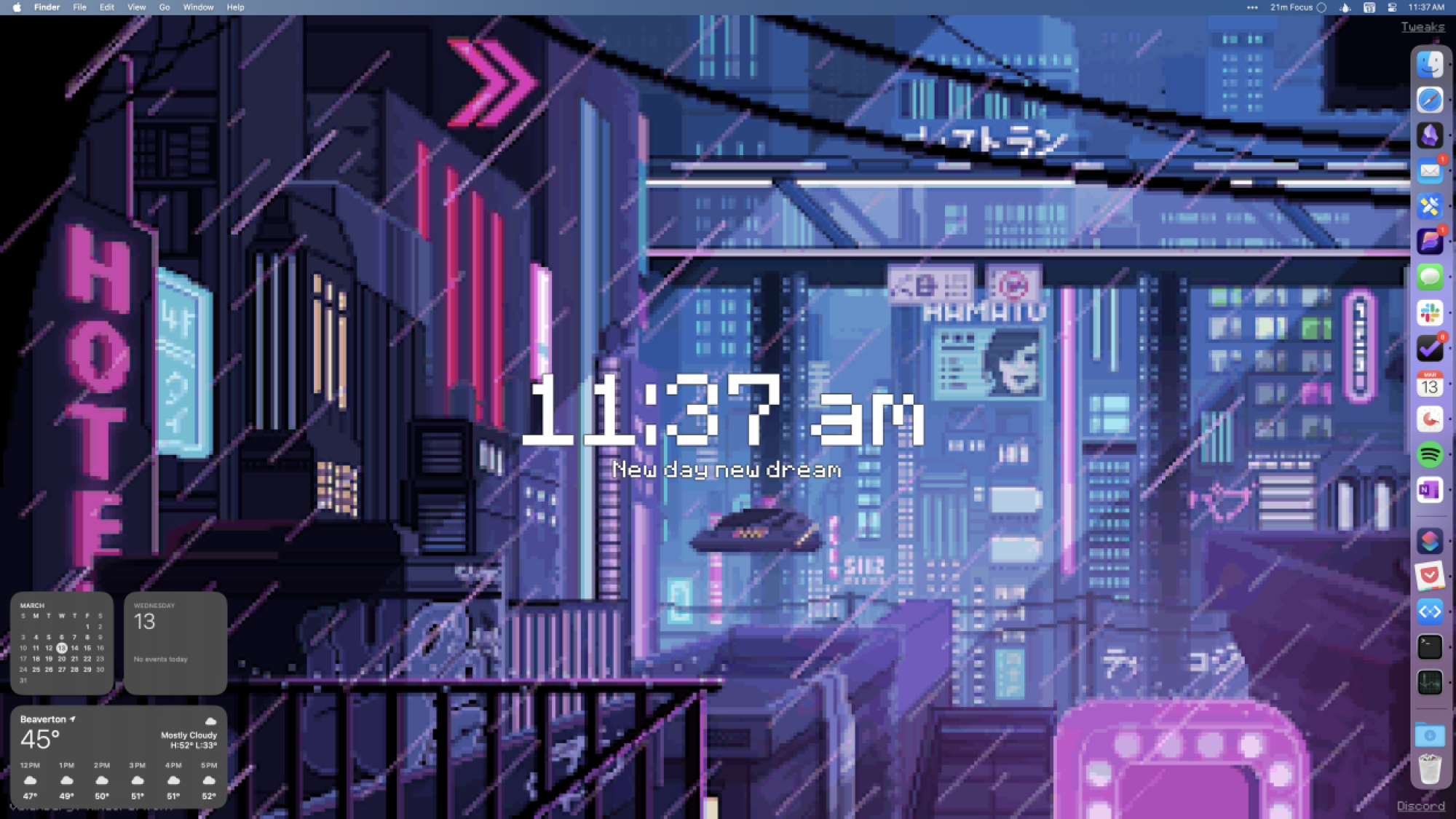
Enter Plash. This free application lets you turn any website into a macOS wallpaper, which opens up all kinds of interactive possibilities. A few sites included let you look out a random stranger’s window, see real-time weather data, or take in some animated pixel art, but you can use any website you can think of. It’s a lot of fun to play around with.
Clean up the menu bar
Credit: Justin Pot
The macOS menu bar is a bit of a mess. Windows makes it relatively easy to hide icons by dragging them to a secondary area. Apple hasn’t offered anything like this until Tahoe, which added a way to disable any icon in the settings. The problem: it’s all or nothing. Hide an icon in the settings and there’s no quick way to access it other than going back into the settings and turning it back on.
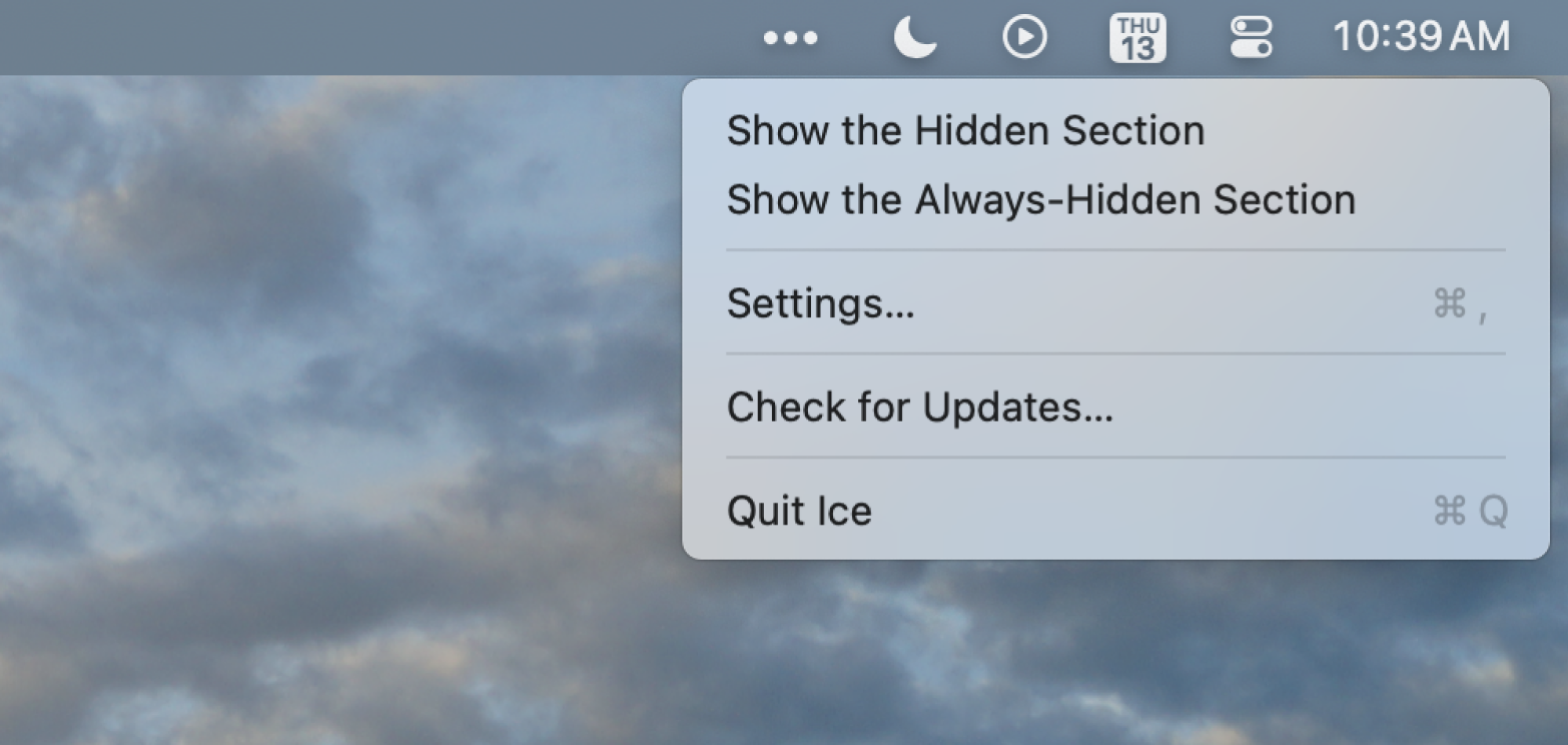
For that, you’ll need a third party app. I personally recommend Ice, which is the best free app for cleaning up your menu bar. My coworker Pranay recommends Barbee, another great option. Both make it easy to hide menu bar icons in a secondary bar accessible by hitting an icon, similar to how it works on Windows. Every Mac user should install some sort of tool like this.
Change your folder icons
Credit: Justin Pot
This one isn’t unofficial, exactly, but it’s so buried it might as well be. You can change the icon for any folder, document, or even application by right-clicking it, clicking “Get Info”, then dragging an image to the icon in the window that opens. Weird, right? But it works, meaning you can customize folders to look however you want. I talked about this in an article with more details.
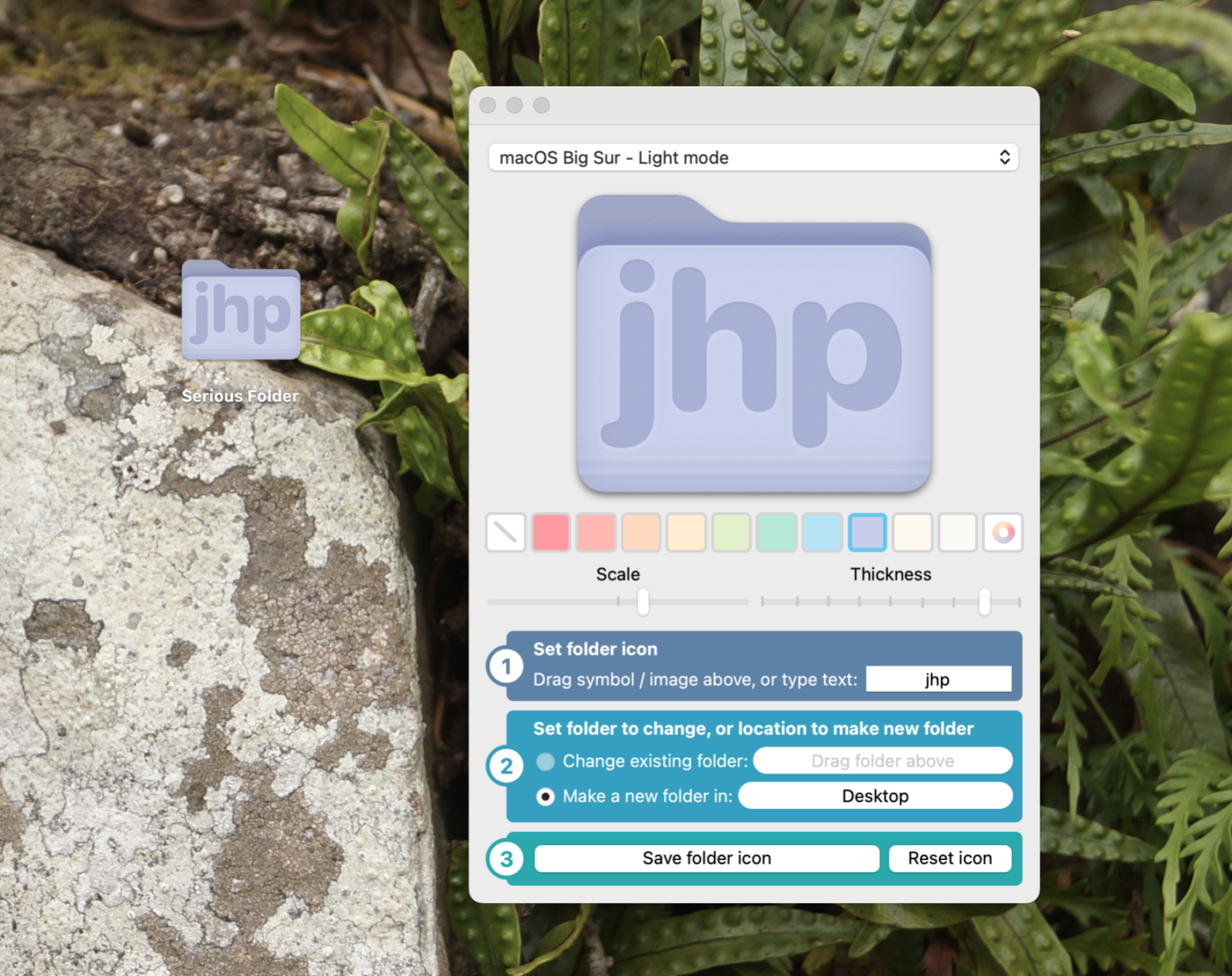
This gets really fun if you install Fancy Folders, a free application seen in the image above which allows you to create folder icons in the color of your choice, complete with either the text or icon of your choice. It’s a lot of fun to play with, and can be very useful for visually keeping things organized.
A few months ago, Anthropic published a report detailing how its Claude AI model had been weaponized in a “vibe hacking” extortion scheme. The company has continued to monitor how the agentic AI is being used to coordinate cyberattacks, and now claims that a state-backed group of hackers in China utilized Claude in an attempted infiltration of 30 corporate and political targets around the world, with some success.
In what it labeled “the first documented case of a large-scale cyberattack executed without substantial human intervention,” Anthropic said that the hackers first chose their targets, which included unnamed tech companies, financial institutions and government agencies. They then used Claude Code to develop an automated attack framework, after successfully bypassing the model’s training to avoid harmful behavior. This was achieved by breaking the planned attack into smaller tasks that didn’t obviously reveal their wider malicious intent, and telling Claude that it was a cybersecurity firm using the AI for defensive training purposes.
After writing its own exploit code, Anthropic said Claude was then able to steal usernames and passwords that allowed it to extract “a large amount of private data” through backdoors it had created. The obedient AI reportedly even went to the trouble of documenting the attacks and storing the stolen data in separate files.
The hackers used AI for 80-90 percent of its operation, only occasionally intervening, and Claude was able to orchestrate an attack in far less time than humans could have done. It wasn’t flawless, with some of the information it obtained turning out to be publicly available, but Anthropic said that attacks like this will likely become more sophisticated and effective over time.
You might be wondering why an AI company would want to publicize the dangerous potential of its own technology, but Anthropic says its investigation also acts as evidence of why the assistant is “crucial” for cyber defense. It said Claude was successfully used to analyze the threat level of the data it collected, and ultimately sees it as a tool that can assist cybersecurity professionals when future attacks happen.
Claude is by no means the only AI that has benefited cybercriminals. Last year, OpenAI said that its generative AI tools were being used by hacker groups with ties to China and North Korea. They reportedly used GAI to assist with code debugging, researching potential targets and drafting phishing emails. OpenAI said at the time that it had blocked the groups’ access to its systems.
This article originally appeared on Engadget at https://www.engadget.com/ai/anthropics-ai-was-used-by-chinese-hackers-to-run-a-cyberattack-142313551.html?src=rss
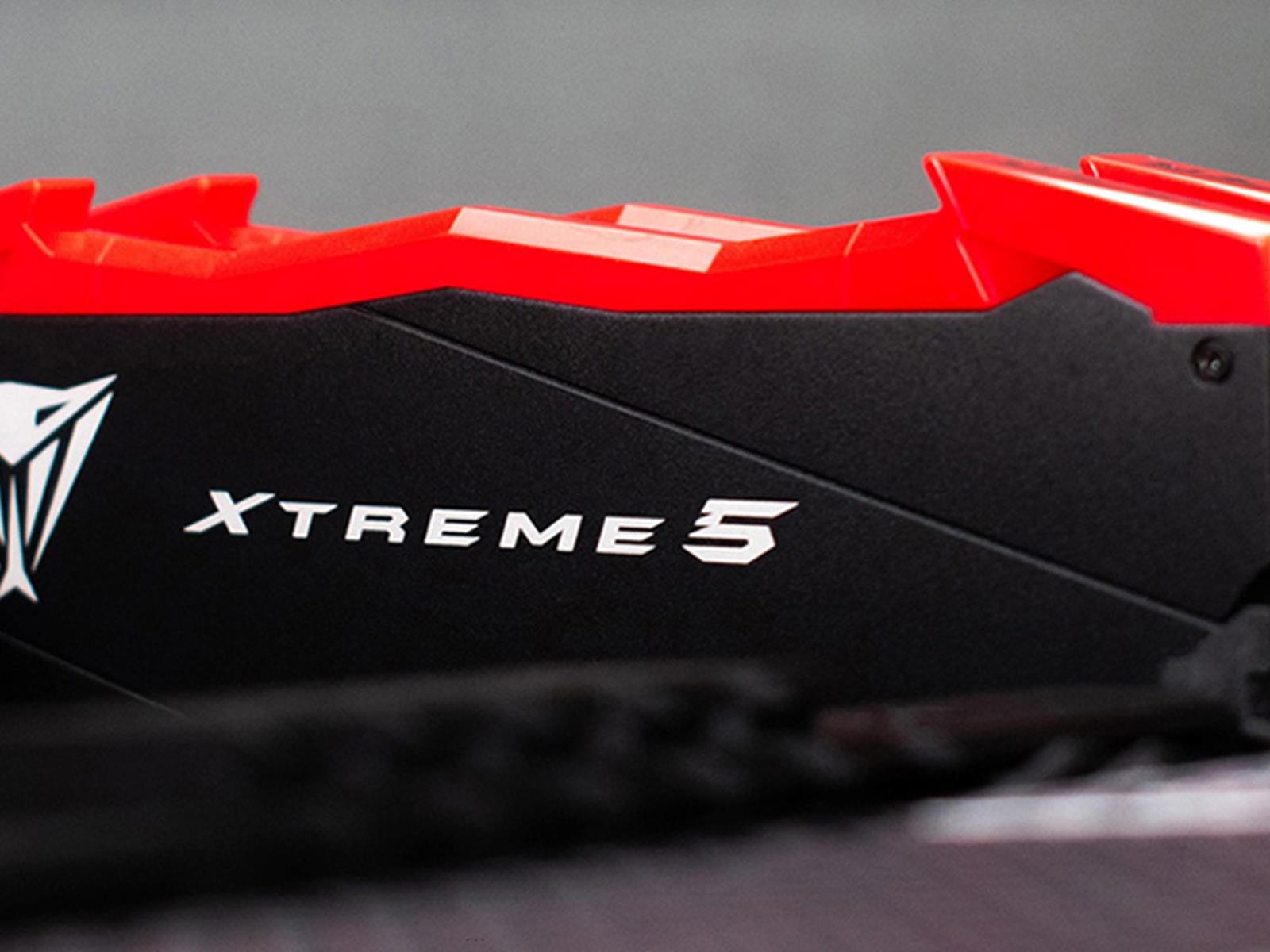
One thing that’s often said in sports is that records are meant to be broken. That applies to the sport of overclocking, and to that end, Patriot Memory’s Viper Xtreme 5 DDR5 memory just set a validated memory frequency record, with overclocker AiMax hitting 13,211.4 MT/s (6605.7 MHz) to leapfrog previous records set with Adata, G.Skill, and
The rocket company founded a quarter-century ago by billionaire Jeff Bezos made history Thursday with the pinpoint landing of an 18-story-tall rocket on a floating platform in the Atlantic Ocean.
The on-target touchdown came nine minutes after the New Glenn rocket, built and operated by Bezos’ company Blue Origin, lifted off from Cape Canaveral Space Force Station, Florida, at 3:55 pm EST (20:55 UTC). The launch was delayed from Sunday, first due to poor weather at the launch site in Florida, then by a solar storm that sent hazardous radiation toward Earth earlier this week.
“We achieved full mission success today, and I am so proud of the team,” said Dave Limp, CEO of Blue Origin. “It turns out Never Tell Me The Odds (Blue Origin’s nickname for the first stage) had perfect odds—never before in history has a booster this large nailed the landing on the second try. This is just the beginning as we rapidly scale our flight cadence and continue delivering for our customers.”
Abstract of a working paper [PDF] published by NBER: This paper examines the impact of the UK’s decision to leave the European Union (Brexit) in 2016. Using almost a decade of data since the referendum, we combine simulations based on macro data with estimates derived from micro data collected through our Decision Maker Panel survey. These estimates suggest that by 2025, Brexit had reduced UK GDP by 6% to 8%, with the impact accumulating gradually over time.
We estimate that investment was reduced by between 12% and 18%, employment by 3% to 4% and productivity by 3% to 4%. These large negative impacts reflect a combination of elevated uncertainty, reduced demand, diverted management time, and increased misallocation of resources from a protracted Brexit process. Comparing these with contemporary forecasts — providing a rare macro example to complement the burgeoning micro-literature of social science predictions — shows that these forecasts were accurate over a 5-year horizon, but they underestimated the impact over a decade.
Earlier this year, I played Metroid Prime for the first time in at least a decade. Back in 2023, Nintendo released a remastered version of the 2002 classic for the Switch, and I felt like dusting it off once we finally knew Metroid Prime 4: Beyond would arrive this year after about a decade in development. The original Metroid Prime holds up surprisingly well for a 23-year-old game, but there were plenty of times where it showed its age. The platforming often felt overly clunky, as precise control over Samus Aran is not the game’s strong suit. Similarly, dealing with larger hordes of energy-sucking Metroids could get pretty frustrating, again due to a lack of precision.
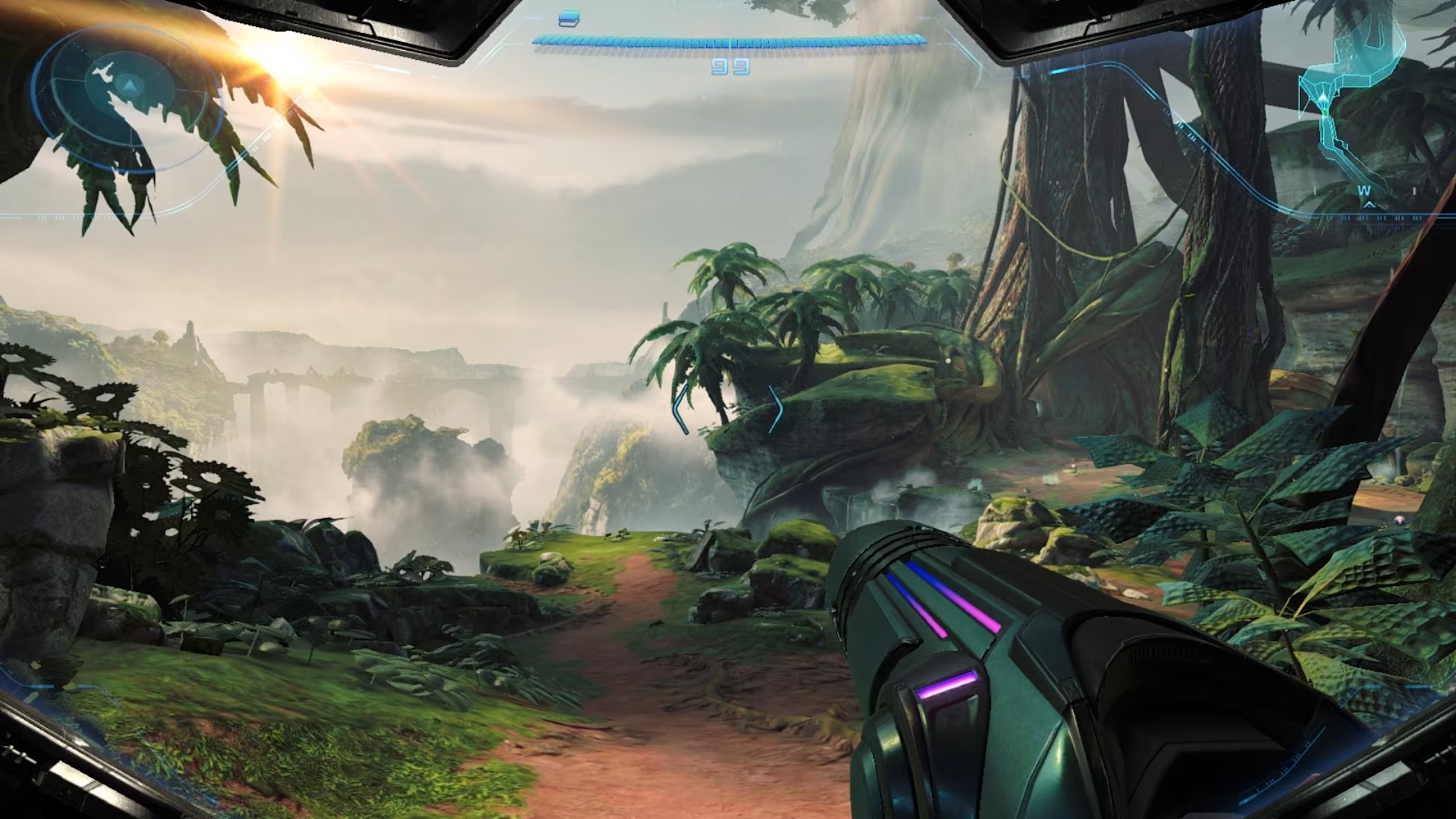
But the main feeling I came away from the game with was excitement over a fully modernized Metroid Prime experience. I’ve been interested in seeing how the lush alien worlds, monstrous enemies and first-person combat would feel on a current console, built with today’s technology and the many improvements that have come to game design since 2002. I finally got a chance to play about 90 minutes of Metroid Prime 4: Beyond last week and nothing I saw diminished my excitement for the series being brought into the current decade — even if the game felt almost too familiar at times.
I played two segments of Metroid Prime 4: Beyond. The first is an opening sequence that Nintendo made available for people to try at the Switch 2 demo experiences earlier this year before the console launched, while the second is a longer slice that takes place on a gorgeous alien planet where it seems the bulk of the game will likely take place. That first segment is the classic “get the player acquainted with the controls” level where Samus flies in to help defend a base under attack. Since I had played the Switch version of Metroid Prime recently, I felt right at home with the controls even though a few buttons were remapped. All of the classic Metroid moves, including charge blasts, the morph ball, the missile cannon, the scanning visor and more are intact here, and I quickly slipped back into the routine of scanning enemies for weak points and blasting away.
Right from the jump, the game looks fantastic. There’s an extensive cutscene (at least for a Metroid game) that shows Samus flying in to save the day through a battle-torn base, and everything from the flash of fireball explosions to small details on Samus’s ship give off a level of detail that we simply haven’t seen in a Metroid game before.
I was playing the game on the Switch 2, in both handheld mode and hooked up to a TV and it looked great either way. The aforementioned explosions popped nicely in HDR and the frame rate never stuttered in a way that I picked up on. As usual, Nintendo’s art direction is top-notch, but this is the first Metroid Prime game made on a console with some power behind it (remember, Metroid Prime 3: Corruption came out on the original Wii). The game isn’t quite aiming for photorealistic graphics, but it’s closer than almost any other Nintendo game I can think of. The combo of impeccable style and a modern resolution that finally lets the Metroid world shine is thrilling, and I can’t wait to see more variety in the worlds that Samus explores.
There’s also a lot more voice chatter than in the original Metroid Prime. As you get dropped into defending the base under attack, plenty of other soldiers recognize Samus, ask for help, tell her where to go and generally praise her for being a badass. It’s a lot more voice work than I’m used to in a Metroid game, and it goes a long way towards making the journey feel less isolated.
A screenshot showing the jungle world of Metroid Prime 4: Beyond.
Nintendo
The second area I got to explore looks even better than the somewhat generic base where the game kicks off. It’s a classic Metroid world that mixes natural beauty with a mysterious, alien culture. And, of course, a lot of the nature wants to kill you for invading its territory (or possibly because it is being controlled by outside forces). The big boss of the demo was cut from this cloth: a giant tentacled plant flinging its giant spiked arms at you and firing off poisonous flowers. A classic Metroid battle if ever there was one, albeit one that felt not wildly different from some of the boss battles from Metroid Prime. That said, the scope of the battle felt bigger, due to the size of the arena and how the plant’s tentacles made maneuvering and getting off clear shots a challenge. While the boss clearly had a central body right in the middle of the room, the tentacles made it feel like it was all around me, at all times
This boss felt like an upscaled but familiar version of ones from past games, and it was far from the only thing that felt familiar. For example, the game still uses save stations scattered throughout the map to save your progress rather than just autosaving at significant points. That’s a throwback I didn’t exactly miss and didn’t expect to see in 2025. Plenty of the music cues and sound effects felt like they could have been lifted straight from other Metroid Prime games, and the basic move set and weapons Samus has early in the game is nearly identical to how you start Metroid Prime. Naturally, something happens where she loses most of those abilities and has to regain them to progress — in the demo, I had to find the Morph Ball power up to move on, just as you do in nearly every Metroid game before.
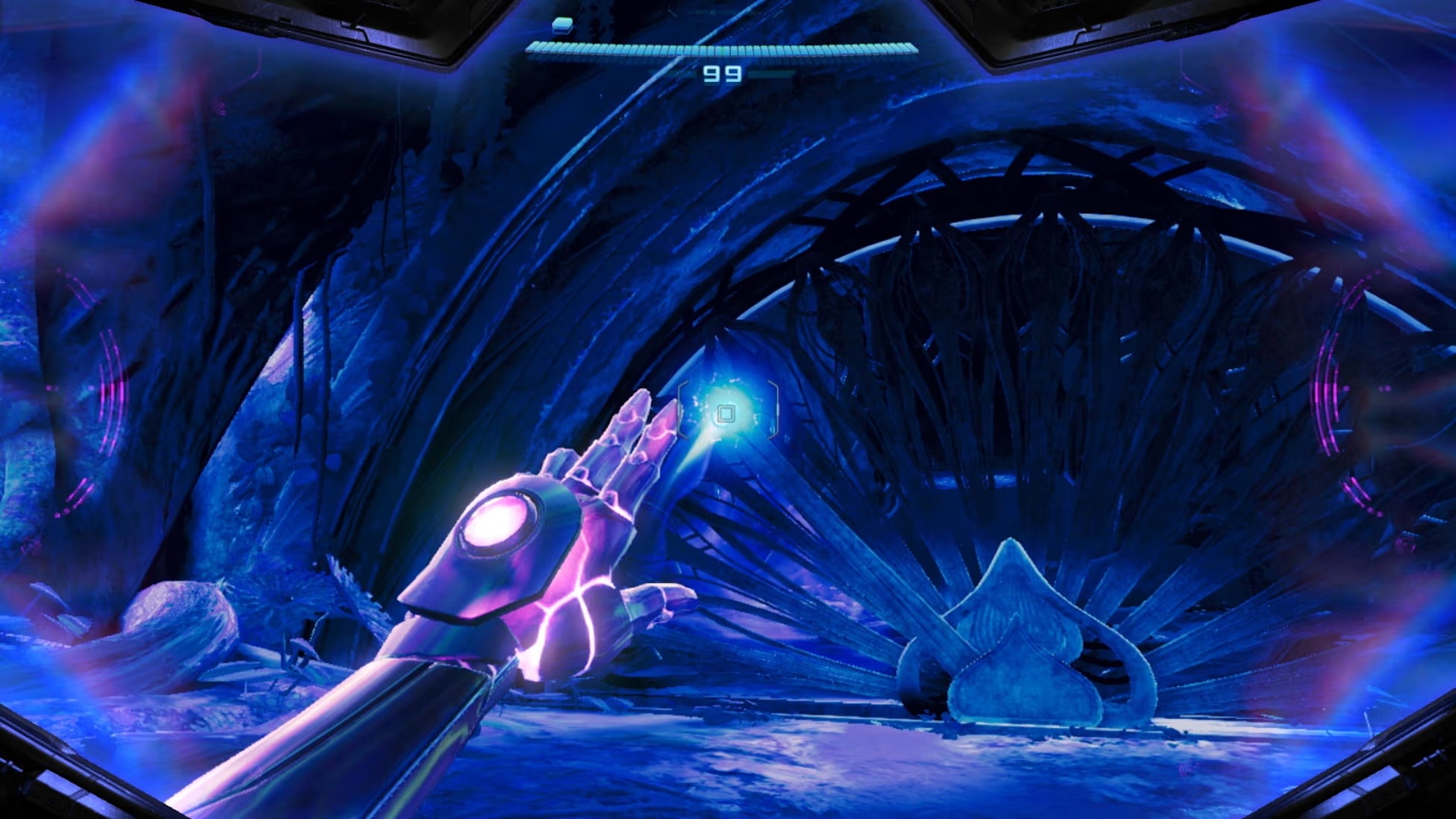
Samus Aran uses her new abilities to unlock a way forward.
Nintendo
At times, it felt like the game was leaning a bit too heavily on the already-established framework rather than trying something new. But given that I was early in the game, I’m allowing for there to be a lot of unexpected changes to come. And I did get a chance to try out the biggest gameplay change Nintendo has teased thus far (no, not the motorcycle): new psychic abilities.
These powers, at least in the demo, are primarily used for solving environmental puzzles, as they provide a new way to interact with various objects and structures. But there’s also a combat component that I needed to use to beat the aforementioned boss. You can charge and fire off a sort of psychic beam — once it leaves your blaster, time slows to nearly a crawl and you can take control of its direction with the analog stick. While fighting the boss, I had to guide the beam around a host of obstacles to hit each of the three tentacles; once I did that, the monster was vulnerable and I could then charge in and blast it with my conventional weapons. You can see some examples of this power in action in the video below.
I wish I got a chance to see how these powers would evolve throughout the game, and I’m definitely intrigued to see how they manage to separate the gameplay in Metroid Prime 4: Beyond from the aspects of it that feel merely like an updated version of what came before. And to be honest, I’m not sad the game feels familiar. Plenty of people haven’t experienced the Metroid Prime series before or haven’t played it in more than a decade, and many of the familiar aspects felt like a perfect example of “if it’s not broke, don’t fix it.” And it won’t be long before we can all find out if Metroid Prime 4: Beyond finds a way to really stand out from its predecessors after all this time. The game arrives on December 5 for Switch and Switch 2.
This article originally appeared on Engadget at https://www.engadget.com/gaming/nintendo/metroid-prime-4-beyond-thrillingly-brings-the-series-into-the-modern-era-140000932.html?src=rss
Meta has announced that BirdyChat and Haiket are the first third-party messaging services that will have interoperability with WhatsApp in the European Union. The company has been working on enabling third-party chats since 2023 after the rules of the bloc’s Digital Markets Act (DMA) came into effect. It apparently held small scale tests over the past few months to make sure WhatsApp does work with BirdyChat and Haiket, and it will roll out integration with the services across Europe “soon.”
Users will be able to send messages, images, voice messages, videos and files between the messaging services whether they’re on Android or iOS. To those wondering, any messaging service Meta teams up with will need to have the same level of end-to-end encryption as WhatsApp under DMA’s rules. Users will see a notification in their Settings tab on WhatsApp over the coming months when BirdyChat and Haiket integration becomes available, telling them how they can opt-in to third-party chats. They can choose not to enable the feature at all or to switch it off anytime they want.
When Meta released details detailing how WhatsApp will work with other messengers, the company said that users will be able to create group chats with their friends on its partner apps. That feature won’t be available at launch, though, and will come later when Meta’s partners are ready to support the capability. Meta also said that it will continue expanding WhatsApp’s interoperability with more apps, as it’s required to do so under the DMA.
This article originally appeared on Engadget at https://www.engadget.com/apps/whatsapp-enables-interoperability-with-two-other-messengers-in-the-eu-140000835.html?src=rss
An anonymous reader quotes a report from Reuters: Singapore’s central bank will hold trials to issue tokenized MAS bills next year and bring in laws to regulate stablecoins as it presses forward with plans to build a scalable and secure tokenised financial ecosystem, the bank’s top official said on Thursday. “Tokenization has lifted off the ground. But have asset-backed tokens achieved escape velocity? Not yet,” said Chia Der Jiun, Managing Director of the Monetary Authority of Singapore (MAS), a keynote address at the Singapore FinTech Festival.
He said MAS has been working on the details of its stablecoin regulatory regime and will prepare draft legislation, with the emphasis on “sound reserve backing and redemption reliability.”
MAS is also supporting trials under the BLOOM initiative, which explores the use of tokenized bank liabilities and regulated stablecoins for settlement, he added. “In the CBDC space, I am pleased to announce that the three Singapore banks, DBS, OCBC, and UOB, have successfully conducted interbank overnight lending transactions using the first live trial issuance of Singapore dollar wholesale CBDC,” he said. MAS will expand trials to include tokenized MAS bills settled with CBDC, he added.
The PlayStation Portal is the rare product that launched as a truly baffling device, but has evolved into something genuinely useful. At first, it could only stream games from your PlayStation 5, it lacked core features for a handheld like Bluetooth audio and it felt a bit overpriced at $200 for such a limited product. Add on the fact that home streaming can be notoriously unreliable, since it depends entirely on your ISP and home networking setup, and the Portal simply didn’t make much sense. But in 2024 Sony finally added limited cloud streaming for PS Plus titles, and last week it went even further by letting you stream games you own directly from the cloud. All of a sudden, the PlayStation Portal doesn’t seem so crazy after all.
It also helps that the Portal is still $200 (or less at Gamestop and other retailers), while the cheapest Digital Edition PlayStation 5 has jumped to $500 (up from $400 at launch). Sure, it’s still far from a perfect device, but at least it’s more functional and significantly less than the PS5 today. Just be aware you’ll need to subscribe to the $18 a month (or $160 a year) PlayStation Plus Premium plan to access the cloud streaming features.
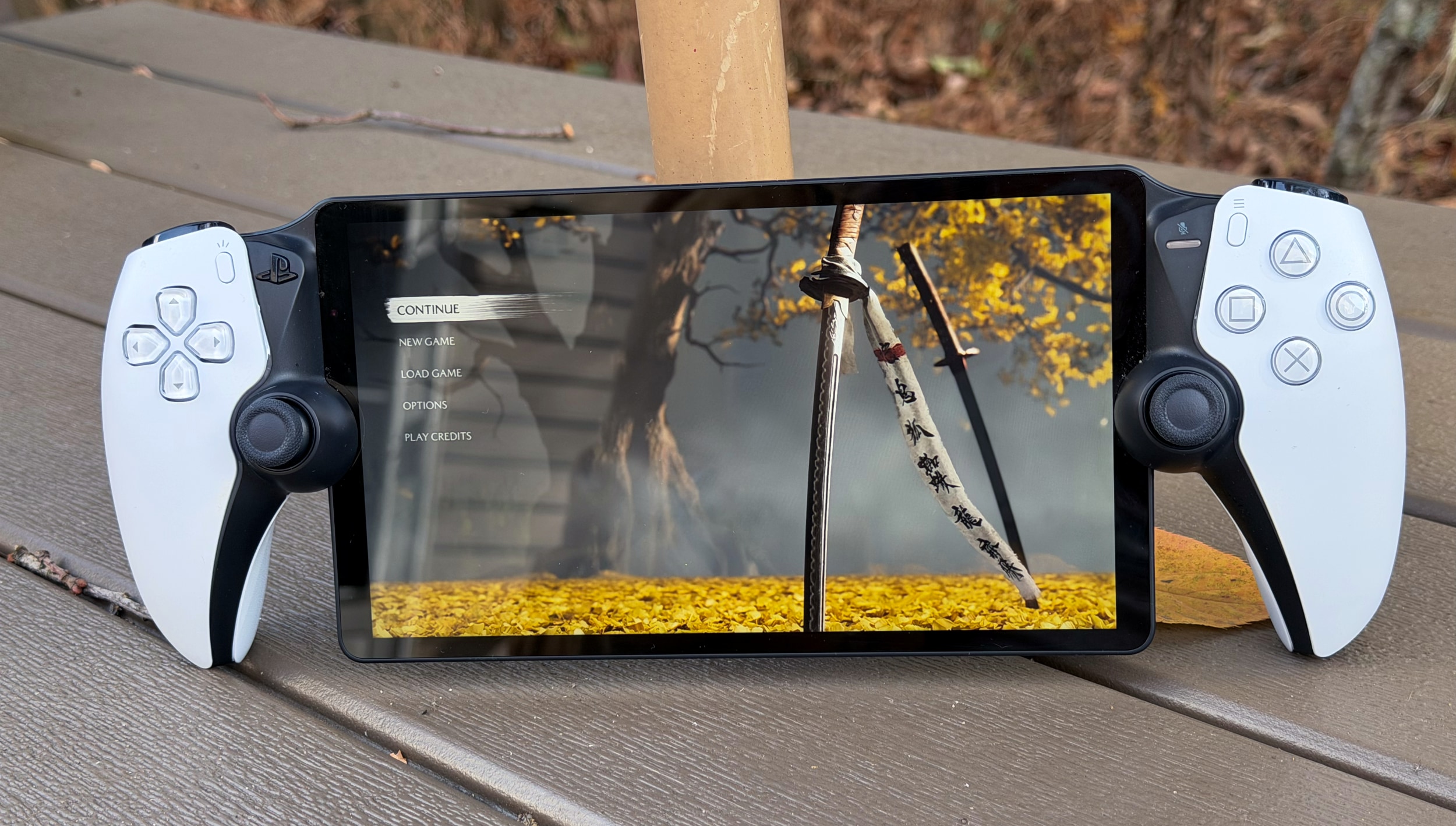
While my hardware frustrations with the PlayStation Portal remain (more on those later), I can’t deny that it’s a genuinely great handheld for streaming games from the cloud. Jumping into Ghost of Yotei typically takes between 15 to 30 seconds, and it often loads directly into the game world if I’m continuing from a recent session. The game also plays smoothly, with no noticeable stuttering or lag, and I can still choose between the graphics-heavy 30 fps modes or the smoother 60 fps performance option. It’s far from the ideal way to play Ghost of Yotei, which demands an enormous screen and capable speakers, but it’s fine in a pinch.
In comparison, using Remote Play to access my PlayStation 5 Pro remains as headache-inducing as it did when the PS Portal launched. The handheld can’t consistently wake up the PS5 Pro from standby mode, so I’m forced to turn on the console manually if I ever plan to use the Portal. If my PS5 Pro is on, the Portal can typically connect in around five seconds, and it takes another five to ten seconds to launch Ghost of Yotei. Gameplay is typically smooth via Remote Play, but there’s occasional stuttering that can interfere with intense combat sequences.
PlayStation Portal playing Ghost of Yotei.
Devindra Hardawar for Engadget
My main issue with the PlayStation Portal at launch was that I simply couldn’t trust it. Sometimes it would let me remotely connect to my console with no problems, and sometimes it would simply refuse. I’ve got a fairly robust Wi-Fi 6 networking setup and AT&T gigabit fiber, so my connectivity shouldn’t be much of an issue. But clearly something about my networking configuration doesn’t play well with the Portal for Remote Play, even if I connect my PS5 Pro via Ethernet.
Strangely enough, the PlayStation Portal is far more reliable at streaming games from servers thousands of miles away than it is remotely connecting to the console a few dozen feet away from me. That just goes to show how far cloud streaming has come — it practically feels like local gameplay now. I suppose that shouldn’t be too surprising for Sony, since it’s only pumping out 1080p streams. NVIDIA’s GeForce Now has proven it’s possible to stream PC games in 4K, so long as you have gobs of bandwidth to support it.
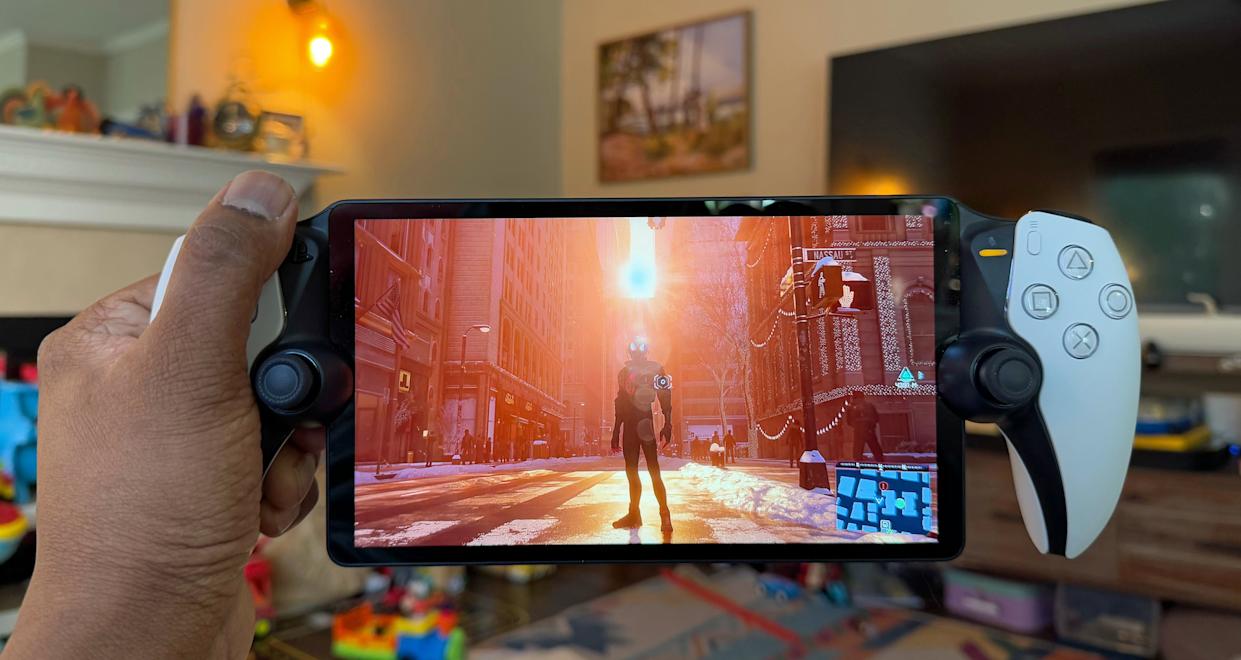
The best thing I can say about the PlayStation Portal now is that I can finally trust it — up to a point, anyway. I had no trouble signing onto its streaming servers to play Ghost of Yotei and Spider-Man 2 on my home network, and I was also able to stream games while tethering on my phone. But the Portal remains a useless device if you’re stuck somewhere without decent internet access. You can forget about using it on a plane, even with fast in-flight Wi-Fi, or at hotels with crummy internet and no cellular reception.
Spider-Man 2 on the PlayStation Portal
Devindra Hardawar for Engadget
Given its need for decent connectivity and its clunky design, the PlayStation Portal also remains a terrible gaming option on the go. You’ll need to find a large case to fit the Portal’s huge controller and delicate display, a combination that really does look like a tablet shoved between Sony’s DualSense gamepads. It’s simply smarter to travel with the slimmer Switch 2, and I’d argue even the massive Steam Deck is easier to stuff into a backpack. And it’s worth noting you can also use apps on the Steam Deck to Remote Play from your console, and you can install the PlayStation Plus Windows app to stream games from the cloud.
I’m also still annoyed that Sony didn’t include Bluetooth connectivity in the Portal. If you want wireless audio, you’ll either have to use Sony’s Pulse Explore earbuds or Pulse Elite headphones. You’ll have to plug in a separate Bluetooth receiver if you want to use AirPods or any other wireless headphones. You’ll definitely want to invest in some sort of audio solution if you plan to game on the Portal for long sessions, since its tinny speakers simply can’t do justice to Ghost of Yotei’s immersive soundscape.
Not surprisingly, cloud gaming didn’t change the Portal’s battery life much. I still saw between four and five hours of play time (broken into dad-friendly chunks, of course). And if you’re on some sort of marathon session, you can always plug in to charge. Since the Portal isn’t using any local hardware to power games — it’s really just decoding video and pushing data over its network connection — you can also expect more reliable battery life than other handhelds. The Switch 2, for example, could last between two to six hours, depending on what you’re playing.
While I still can’t wholeheartedly recommend the PlayStation Portal to every gamer, its latest updates make it a more viable option for PlayStation diehards. Maybe you’ll have better luck with Remote Play than me. And if you’re already a PS Plus subscriber, it’s the easiest way to access Sony’s cloud infrastructure. Or, like Engadget’s Jeff Dunn, it could also be the ideal way to game while you juggle the struggles of being a new parent. At the very least, the Portal is no longer truly baffling, but it’s also still not a Vita 2.
This article originally appeared on Engadget at https://www.engadget.com/gaming/playstation/playstation-portal-in-2025-from-home-streaming-dud-to-cloud-streaming-star-130000144.html?src=rss
Researchers from Anthropic said they recently observed the “first reported AI-orchestrated cyber espionage campaign” after detecting China-state hackers using the company’s Claude AI tool in a campaign targeting dozens of targets. Outside researchers are much more measured in describing the significance of the discovery.
Anthropic published the reports on Thursday here and here. In September, the reports said, Anthropic discovered a “highly sophisticated espionage campaign,” carried out by a Chinese state-sponsored group, that used Claude Code to automate up to 90 percent of the work. Human intervention was required “only sporadically (perhaps 4-6 critical decision points per hacking campaign).” Anthropic said the hackers had employed AI agentic capabilities to an “unprecedented” extent.
“This campaign has substantial implications for cybersecurity in the age of AI ‘agents’—systems that can be run autonomously for long periods of time and that complete complex tasks largely independent of human intervention,” Anthropic said. “Agents are valuable for everyday work and productivity—but in the wrong hands, they can substantially increase the viability of large-scale cyberattacks.”
Valve has announced a raft of new hardware, including a new VR headset, Steam Machine and Controller. The devices are all designed to usher in a new era of PC gaming, with Valve’s usual focus on the player. Steam Frame is a slender VR headset that connects wirelessly to your PC and has a built-in battery to rid you of those pesky cables. That focus on freedom extends to the Frame operating as a standalone device, like the Meta Quest.
At the same time, the company has revived its long-loved (but not massively successful) Steam Machine. This new model has semi-custom AMD silicon capable of running 4K games at 60 frames per second. Valve says it’s roughly six times as powerful as its portable unit, the Steam Deck. Rounding out the list is the controller, which looks like a Steam Deck with the screen cut out. But it’s not as if that’s a bad thing, especially as it’s got TMR sensors which, while using a different underlying technology, promise the same benefits as a Hall Effect stick.
As someone on the not particularly game-y end of the spectrum, I use announcements like this as an exercise to see how excited I would be. To that end, I’m curious how much Valve will charge for this gear when it makes its debut early next year. On one hand, the performance promises laid out here are fairly substantial but, on the other, this is also a company that sells the base model Steam Deck for less than a Switch 2.
That said, I would certainly get off the couch if there was a new Half-Life game in the works, and that seems plausible here. Nathan Ingraham is certainly getting his little hopes up that the revival of the Steam Machine might see Valve revive something else too.
I was a massive fan of Even Realities’ original smart glasses and was excited to see what Sam Rutherford thought of their successor. Sadly, he was testing the specs with a beta version of the new software and found them lacking in several important ways. He’s urging folks to hold off buying these until the gaps in the software have all been filled in.
For years, the world has clamored for a modular, upgradeable gaming laptop offering the same longevity as a desktop. Now, Framework has achieved where so many have failed, selling an NVIDIA GeForce RTX 5070 for its two-year-old Laptop 16. I reviewed the new GPU (and CPU), and I’m blown away by it — quite literally, thanks to the cooling issues that mean the fans are running at full speed whenever you put it under heavy load.
Apple is rolling out a Digital ID to its wallet that will, at some point in the near future, be legally accepted at TSA checkpoints. It’s coming to more than 250 US airports and can eventually be used as your ID for domestic flights. But, you know, probably worth reading all of the details before you declare your paper passport a thing of the past.
DJI’s Neo was good but not great — short battery life, noisy propellers and a lack of object avoidance all dulled its shine. Now, the company’s successor has addressed all of those issues, leading our Steve Dent to call it “the best personal drone on the market.”
Welcome to Edition 8.19 of the Rocket Report! Thursday was a monumental day in launch history with Blue Origin’s New Glenn rocket not just taking off successfully, but with the first stage masterfully returning to the surface of the ocean, hovering near the Jacklyn drone ship, and then making a landing in the center of the barge. It was fantastic to watch, and cements our new reality of reusable rockets. The future of space access is very bright indeed.
As always, we welcome reader submissions, and if you don’t want to miss an issue, please subscribe using the box below (the form will not appear on AMP-enabled versions of the site). Each report will include information on small-, medium-, and heavy-lift rockets as well as a quick look ahead at the next three launches on the calendar.
Private Chinese rocket fails. Galactic Energy’s solid-fuel Ceres-1 rocket lifted off from Jiuquan Satellite Launch Center in northwest China on Sunday, carrying three satellites toward low Earth orbit. The rocket’s first three stages performed well, according to media reports, but its fourth and final stage shut down too early, leading to the loss of all three payloads, Space.com reports.
About 170 Starshield satellites built by SpaceX for the US government’s National Reconnaissance Office (NRO) have been sending signals in the wrong direction, a satellite researcher found.
The SpaceX-built spy satellites are helping the NRO greatly expand its satellite surveillance capabilities, but the purpose of these signals is unknown. The signals are sent from space to Earth in a frequency band that’s allocated internationally for Earth-to-space and space-to-space transmissions.
There have been no public complaints of interference caused by the surprising Starshield emissions. But the researcher who found them says they highlight a troubling lack of transparency in how the US government manages the use of spectrum and a failure to coordinate spectrum usage with other countries.
According to Car and Driver, Hyundai has suffered a data breach that leaked the personal data of up to 2.7 million customers. The leak reportedly took place in February from Hyundai AutoEver, the company’s IT affiliate. It includes customer names, driver’s license numbers, and social security numbers. Longtime Slashdot reader sinij writes: Thanks to tracking modules plaguing most modern cars, that data likely includes the times and locations of customers’ vehicles. These repeated breaches make it clear that, unlike smartphone manufacturers that are inherently tech companies, car manufacturers collecting your data are going to keep getting breached and leaking it.