Some People Never Forget a Face, and Now We Know Their Secret

alternative_right shares a report from ScienceAlert: A new study from researchers in Australia reveals that the people who never forget faces look “smarter, not harder.” In other words, they naturally focus on a person’s most distinguishing facial features. “Their skill isn’t something you can learn like a trick,” explains lead author James Dunn, a psychology researcher at the University of New South Wales (UNSW) Sydney. “It’s an automatic, dynamic way of picking up what makes each face unique.”

To see what super-recognizers see, Dunn and his colleagues used eye-tracking technology to reconstruct how people surveyed new faces. They did this with 37 super-recognizers and 68 people with ordinary facial recognition skills, noting where and for how long participants looked at pictures of faces displayed on a computer screen. The researchers then fed the data into machine learning algorithms trained to recognize faces. The algorithms, a type known as deep neural networks, were tasked with deciding if two faces belonged to the same person. “These findings suggest that the perceptual foundations of individual differences in face recognition ability may originate at the earliest stages of visual processing — at the level of retinal encoding,” Dunn and colleagues write in their paper.

The findings have been published in the journal Proceedings of the Royal Society B: Biological Sciences.


Read more of this story at Slashdot.

Electric Vehicle Sales Are Booming In South America

Chinese automakers are rapidly expanding across South America, boosted by the new Chinese-built Port of Chancay, aggressive pricing, local partnerships, and growing regional demand. Reuters reports: China has been ramping up sales since the opening last year of the Port of Chancay, north of Lima. The Chinese-built megaport has halved trans-Pacific shipping times just as Chinese manufacturers face rising barriers to entry in the United States and greater trade restrictions in Europe.

BYD, which makes EVs, plug-in hybrids and combustion engine cars, plans to open a fourth dealership in Lima by the end of this year, while Chery and Geely have more than a dozen in total in Peru. Chinese carmakers face a profit-destroying price war at home and a growing surplus of new cars rolling out of Chinese factory lines. Much of this excess is being shipped overseas to the Middle East, Central Asia and Latin America, according to global automotive analyst Felipe Munoz at JATO Dynamics.

The Chinese have “carved out space,” across both electric and petrol-powered cars, said Martin Bresciani, president of Chile’s automotive business chamber, CAVEM. “The Chinese have already demonstrated that they match global standards in quality.” Chinese brands reached 29.6% of all new passenger car sales in Chile in the first quarter of this year. […] Part of China’s success has been partnering with trusted local importers to offer more affordable models tailored to regional tastes, according to seven dealerships Reuters spoke to in Peru, Chile, Uruguay and Argentina.


Read more of this story at Slashdot.

Finally, A Monthly Subscription AI App That Allows You To Chat With Deceased Loved Ones

Because ‘Black Mirror’ was actually just a regular mirror all along, AI app 2wai (pronounced 2-way) creates digital avatars that you can interact with, promising to connect the currently living with the currently dead for a monthly fee. Because that’s something we’ve been needing. Allegedly all that’s needed is a 3-minute video of the source human to create an AI clone. But what can it do if I only have a 10-second video, some doodles, and me throwing my voice? Since this video’s release, the app has been met with some hostility, presumably, at last from what I’ve been able to gather, because it deserves to be.

What if the loved ones we’ve lost could be part of our future? pic.twitter.com/oFBGekVo1R

— Calum Worthy (@CalumWorthy) November 11, 2025

Google Is Collecting Troves of Data From Downgraded Nest Thermostats

Even after disabling remote control and officially ending support for early Nest Learning Thermostats, Google is still receiving detailed sensor and activity data from these devices, including temperature changes, motion, and ambient light. The Verge reports: After digging into the backend, security researcher Cody Kociemba found that the first- and second-generation Nest Learning Thermostats are still sending Google information about manual temperature changes, whether a person is present in the room, if sunlight is hitting the device, and more. Kociemba made the discovery while participating in a bounty program created by FULU, a right-to-repair advocacy organization cofounded by electronics repair technician and YouTuber Louis Rossmann.

FULU challenged developers to come up with a solution to restore smart functionality to Nest devices no longer supported by Google, and that’s exactly what Kociemba did with his open-source No Longer Evil project. But after cloning Google’s API to create this custom software, he started receiving a trove of logs from customer devices, which he turned off. “On these devices, while they [Google] turned off access to remotely control them, they did leave in the ability for the devices to upload logs. And the logs are pretty extensive,” Kociemba tells The Verge. […] “I was under the impression that the Google connection would be severed along with the remote functionality, however that connection is not severed, and instead is a one-way street,” Kociemba says.


Read more of this story at Slashdot.

Microsoft Mitigated the Largest Cloud DDoS Ever Recorded, 15.7 Tbps

An anonymous reader quotes a report from Security Affairs: On October 24, 2025, Azure DDoS Protection detected and mitigated a massive multi-vector attack peaking at 15.72 Tbps and 3.64 billion pps, the largest cloud DDoS ever recorded, aimed at a single Australian endpoint. Azure’s global protection network filtered the traffic, keeping services online. The attack came from the Aisuru botnet, a Turbo Mirai-class IoT botnet using compromised home routers and cameras.

The attack used massive UDP floods from more than 500,000 IPs hitting a single public address, with little spoofing and random source ports that made traceback easier. It highlights how attackers are scaling with the internet: faster home fiber and increasingly powerful IoT devices keep pushing DDoS attack sizes higher. “On October 24, 2025, Azure DDOS Protection automatically detected and mitigated a multi-vector DDoS attack measuring 15.72 Tbps and nearly 3.64 billion packets per second (pps). This was the largest DDoS attack ever observed in the cloud and it targeted a single endpoint in Australia,” reads a report published by Microsoft. “The attack originated from Aisuru botnet.”

“Attackers are scaling with the internet itself. As fiber-to-the-home speeds rise and IoT devices get more powerful, the baseline for attack size keeps climbing,” concludes the post. “As we approach the upcoming holiday season, it is essential to confirm that all internet-facing applications and workloads are adequately protected against DDOS attacks.”


Read more of this story at Slashdot.

An AI Podcasting Machine Is Churning Out 3,000 Episodes a Week

fjo3 shares a report from TheWrap: There are already at least 175,000 AI-generated podcast episodes on platforms like Spotify and Apple. That’s thanks to Inception Point AI, a startup with just eight employees cranking out 3,000 episodes a week covering everything from localized weather reports and pollen trackers to a detailed account of Charlie Kirk’s assassination and its cultural impact, to a biography series on Anna Wintour. Its podcasting network Quiet Please has generated 12 million lifetime episode downloads and amassed 400,000 subscribers — so, yes, people are really listening to AI podcasts.

Inception Point CEO Jeanine Wright believes the tool is proof that automation can make podcasting scalable, profitable and accessible without human writers, editors or hosts. “The price is now so inexpensive that you can take a lot of risks,â Wright told TheWrap. âoeYou can make a lot of content and a lot of different genres that were never commercially viable before and serve huge audiences that have really never had content made for them.” At a cost of $1 an episode, Wright takes a quantity-over-quality approach. “I think very quickly we get to a place where AI is a default way that content is made, not just across audio, but across television and film and commercials and imagery, and everything. And then we will disclose when things are not made with AI instead of that they were made with AI,” Wright said. “But for now, we are perfectly happy leading the way.”


Read more of this story at Slashdot.

Trump admin axed 383 active clinical trials, dumping over 74K participants

When the Trump administration brutally cut federal funding for biomedical research earlier this year, at least 383 clinical trials that were already in progress were abruptly cancelled, cutting off over 74,000 trial participants from their experimental treatments, monitoring, or follow-ups, according to a study published today in JAMA Internal Medicine.

The study, led by researchers at Harvard, fills a knowledge gap of how the Trump administration’s research funding cuts affected clinical trials specifically. It makes clear not just the wastefulness and inefficiency of the cuts but also the deep ethical violations, JAMA Internal Medicine editors wrote in an accompanying editor’s note.

In March, the National Institutes of Health, under the control of the Trump administration, announced that it would cancel $1.8 billion in grant funding that wasn’t aligned with the administration’s priorities. The Harvard researchers, led by health care policy expert Anupam Jena, used an NIH database and a federal accountability tracking tool to find grants supporting clinical trials that were active as of February 28 but had been terminated by August 15.

Read full article

Comments

Google Calendar now lets you schedule tasks

Productivity setups are a personal thing. Some people swear by to-do lists and apps, some people like scheduling and planners. For those in the latter camp, Google has made a minor but valuable addition to the Workspace suite. Going forward, you’ll be able to block off segments of time in Google Calendar for working on specific tasks. You can add descriptions and set your preferences for that task in regard to do not disturb and visibility settings. It’s a nice step up from scheduling meetings with yourself when you have to focus on a particular assignment (which several of us at Engadget have been known to do).

Example of how to schedule a task in Google Calendar
Google

This option began appearing for Google’s Rapid Release domains earlier in November, while standard release domains will see a gradual release beginning December 1. Once it’s fully rolled out, it will be available by default, whether you’re a Google Workspaces customer or just using a personal Google account.

This article originally appeared on Engadget at https://www.engadget.com/apps/google-calendar-now-lets-you-schedule-tasks-231026000.html?src=rss

With a new company, Jeff Bezos will become a CEO again

Jeff Bezos is one of the world’s richest and most famous tech CEOs, but he hasn’t actually been a CEO of anything since 2021. That’s now changing as he takes on the role of co-CEO of a new AI company, according to a New York Times report citing three people familiar with the company.

Grandiosely named Project Prometheus (and not to be confused with the NASA project of the same name), the company will focus on using AI to pursue breakthroughs in research, engineering, manufacturing, and other fields that are dubbed part of “the physical economy”—in contrast to the software applications that are likely the first thing most people in the general public think of when they hear “AI.”

Bezos’ co-CEO will be Dr. Vik Bajaj, a chemist and physicist who previously led life sciences work at Google X, an Alphabet-backed research group that worked on speculative projects that could lead to more product categories. (For example, it developed technologies that would later underpin Google’s Waymo service.) Bajaj also worked at Verily, another Alphabet-backed research group focused on life sciences, and Foresite Labs, an incubator for new AI companies.

Read full article

Comments

5 plead guilty to laptop farm and ID theft scheme to land North Koreans US IT jobs

Five men have pleaded guilty to running laptop farms and providing other assistance to North Koreans to obtain remote IT work at US companies in violation of US law, federal prosecutors said.

The pleas come amid a rash of similar schemes orchestrated by hacking and threat groups backed by the North Korean government. The campaigns, which ramped up nearly five years ago, aim to steal millions of dollars in job revenue and cryptocurrencies to fund North Korean weapons programs. Another motive is to seed cyber attacks for espionage. In one such incident, a North Korean man who fraudulently obtained a job at US security company KnowBe4 installed malware immediately upon beginning his employment.

On Friday, the US Justice Department said that five men pleaded guilty to assisting North Koreans in obtaining jobs in a scheme orchestrated by APT38, also tracked under the name Lazarus. APT38 has targeted the US and other countries for more than a decade with a stream of attack campaigns that have grown ever bolder and more advanced. All five pleaded guilty to wire fraud, and one to aggravated identity theft, for a range of actions.

Read full article

Comments

UCLA faculty gets big win in suit against Trump’s university attacks

On Friday, a US District Court issued a preliminary injunction blocking the United States government from halting federal funding at UCLA or any other school in the University of California system. The ruling came in response to a suit filed by groups representing the faculty at these schools challenging the Trump administration’s attempts to force UCLA into a deal that would substantially revise instruction and policy.

The court’s decision lays out how the Trump administration’s attacks on universities follow a standard plan: use accusations of antisemitism to justify an immediate cut to funding, then use the loss of money to compel an agreement that would result in revisions to university instruction and management. The court finds that this plan was deficient on multiple grounds, violating legal procedures for cutting funding to an illegal attempt and suppressing the First Amendment rights of faculty.

The result is a reprieve for the entire University of California system, as well as a clear pathway for any universities to fight back against the Trump administration’s attacks on research and education.

Read full article

Comments

‘Buy Now, Pay Later’ is Expanding Fast, and That Should Worry Everyone

An anonymous reader shares a report: When Nigel Morris tells you he’s worried about the economy, you listen. As industry observers know, Morris co-founded Capital One and pioneered lending to subprime borrowers, building an empire on understanding exactly how much financial stress the average American can handle. Now, as an early investor in Klarna and other buy-now-pay-later companies like Aplazo in Mexico, he’s watching something that makes him deeply uncomfortable.

“To see that people are using [BNPL services] to buy something as basic and fundamental as groceries,” Morris told me on stage at Web Summit in Lisbon this week, “I think is a pretty clear indication that a lot of people are struggling.” The statistics back up his unease. Buy-now-pay-later services have exploded to 91.5 million users in the United States, according to the financial services firm Empower, with 25% using the services to finance their groceries as of earlier this year, according to survey data released in late October by lending marketplace Lending Tree.

These aren’t discretionary purchases — the designer bags and latest Apple headphones that BNPL was marketed for originally. Borrowers aren’t paying it all back, either. According to Lending Tree, default rates are accelerating: 42% of BNPL users made at least one late payment in 2025, up from 39% in 2024 and 34% in 2023.


Read more of this story at Slashdot.

Cities: Skylines II dev parts ways with publisher Paradox

Game publisher Paradox Interactive has split with Colossal Order, the studio behind Cities: Skylines II. Colossal Order, which also made the original Cities: Skylines back in 2015, will move on to something new after completing a few last updates. The intellectual property will remain with Paradox, which said today that work on Cities: Skylines II will be moved to Iceflake Studios. The Finland-based internal team will be responsible for all development, including future content updates and the long-awaited console version, starting in 2026.

The move comes after about two years of trying to salvage the citybuilding sequel and the reputations of all parties. While the game was initially expected to debut in October 2023 on PC and consoles, the launch was limited to PC, with higher minimum specs than previously announced and with a lot of bugs. The ongoing issues caused tension and toxicity between Colossal Order and the Cities: Skylines audience. Although the game has reached a more stable state, new content has been slow to arrive and there is still no sign of a console launch as the studio exits their project.

This article originally appeared on Engadget at https://www.engadget.com/gaming/cities-skylines-ii-dev-parts-ways-with-publisher-paradox-210229692.html?src=rss

What Are Passkeys, and Who Should Be Using Them?

We’ve been using passwords to protect our various accounts for a few decades now, and, to be honest, we’re not very good at it. Many of us use the same simple, easy to remember passwords for all of our accounts—convenient for logging in, but horrible for security. Not only will a bad actor (or computer) be able to guess that password easily, they’ll try it against your other accounts. Before you know it, you have multiple breaches, some of which may involve financial or private information.

There are a number of steps you can take to beef up your password security, of course. First, you can use a complex and unique password for each of your accounts, making sure to never reuse a password. A well-made password can be impossible for a human to guess, and virtually impossible for a computer to guess. But even if a company loses your password in a data breach, using two-factor authentication (2FA) can protect you further. Without a trusted device that either generates or receives a 2FA code, your password becomes essentially useless to hackers. And since you didn’t repeat passwords, they can’t try it on your other accounts. That’s what makes this combo a winning strategy.

But many, if not most, of us aren’t using this winning strategy. Many are still at risk, or putting their organizations at risk, with insecure authentication measures. As such, there’s a push for consumers to adopt a new form of authentication, something that combines the convenience of passwords, with the security of 2FA, all without you needing to remember a thing: passkeys.

What are passkeys?

Passkeys are a (relatively) new authentication method that offer a similar experience to passwords without actually involving a password of any kind. The measure relies on something called public key cryptography: When you create a new account with a passkey, or you create a passkey for your existing account, a “key pair” is generated. One of these keys is public, and is stored by the company that runs the account in question. This key is not a secret, and, theoretically, could be stolen or lost in a breach. However, the other key is a secret. This private key is stored on your device–such as a smartphone, tablet, or computer—and is what is used to actually authenticate your identity.

To create the passkey, you simply need to use your device’s built-in authentication method. That might mean a face scan, a fingerprint scan, or a PIN. Once you successfully authenticate yourself, the passkey is established. To log in in the future, you simply authenticate with one of those same three methods. If it goes through, the system then checks with the account that holds the public key to confirm your identity, and you’re in—no password required.

Your passkeys are securely stored on your devices, typically in a “vault” such as a keychain or password manager. Apple generates and stores passkeys in iCloud Keychain, for example. If you use a password manager, like Bitwarden or 1Password, you can create and store passkeys there. Any device that has access to that password manager can then also access the passkey for authentication.

However, you don’t need to log into your accounts on the device that contains the passkey. If you’re using a different device, say a friend’s computer or a tablet that doesn’t contain the passkey, you will have the option to use your trusted device to authenticate. For example, say you want to check your bank account on your PC, but your account uses a passkey stored on your iPhone. You can choose to authenticate using the passkey device, which will trigger the account’s site to present a QR code. You can scan the QR code on your iPhone, authenticate using Face ID, Touch ID, or your PIN, and you’ll log in. This is also how the feature works when signing into accounts on devices that don’t store passkeys directly, like a PlayStation 5.

Are passkeys secure?

The short answer? Yes. Passkeys are an extremely secure authentication method. While they’re way more secure than passwords, they’re even more secure than 2FA. 2FA is great, and certainly better than using a password alone, but it is possible for attackers to steal the authentication codes—especially when these codes are SMS-based. This can be as sophisticated as hacking into the platforms that send your codes, or as simple as a phishing scheme: Scammers can pose as representatives of the account in question, and trick you into sharing your 2FA codes with them. As such, 2FA, while secure, has an inherent phishing flaw.

Passkeys don’t have this flaw. You can’t be tricked into giving over one of your passkeys, nor can a hacker steal it from your device. The system won’t prompt you to authenticate unless you are visiting the exact domain for the platform, which means scammers can’t create dummy sites that trick you into logging in: The passkey process will simply not start. Importantly, signing in via a passkey requires the trusted device to be physically close to the device you’re logging into. As such, a hacker can’t send you an image of a QR code, trick you into scanning it, and then convince you to authenticate to log in. Unless you’re in the same room as the hacker, they’re not getting your passkey.

What if I lose my device?

One of the most common concerns regarding passkeys is what happens when you lose the device the passkey is stored on. After all, if the secret key is kept only on your smartphone, what happens if it is lost, stolen, or breaks?

As it turns out, there are a few possibilities here. First, it is true there is a risk of losing the passkey for good should you lose access to the trusted device. If you choose to store your passkeys on a physical security key, like a YubiKey, losing or breaking the key will mean losing your passkey. However, depending on the account, you may have recovery options—such as answering security questions to prove your identity. This will be case-dependent, of course: If your account only has a passkey set up, and that passkey is only stored on one device, you may lose access to the account. Check if your accounts offer recovery options, or even backup authentication measures. Some accounts may still have you create a password, even if you opt into passkeys, because of this possibility.

But more importantly, you don’t need to keep your passkeys to just one device. There are secure protocols that allow you to sync your passkeys between different devices. For example, if you create a passkey on your iPhone, iCloud Keychain securely syncs that passkey to your other connected Apple devices as well, such as an iPad and Mac. That way, when you want to log into your account on any of these devices, the option to authenticate with your passkey will be available on any—you just need to use Face ID, Touch ID, or present your PIN, and you’re in.

Can you export passkeys?

At this time, no. This is probably passkeys’ biggest drawback. Unlike passwords, which you can export to other password managers, passkeys are stuck to the service they’re generated with. If you set up a passkey for your Google Account on your iPhone, you won’t be able to directly transfer it to, say, an Android device. If your passkey lives in Bitwarden, you can’t transfer it to Google Password Manager. As such, you should try to create passkeys on the platform you most widely use. If you’re fully in the Apple ecosystem, Apple’s iCloud Keychain will work well for you. But if you have a mix of devices from different manufacturers, you’d be better off creating passkeys on a cross-platform password manager. You can always authenticate with your iPhone, of course, but the true convenience of passkeys is quickly logging in on a device that already contains the passkey.

That doesn’t mean you need to keep this service forever, however: You can set up new passkeys for existing accounts on other services, so you can securely get rid of your old passkey devices. However, make sure to keep the old device until you have the passkey established on a new one. If something goes wrong, and you’re not able to set up a new passkey on another device, you’ll need the old device to confirm your identity—unless you have an alternative authentication option, like a password.

Passkeys aren’t perfect: In practice, they can be a bit complicated, especially when working across different devices. But at their best, they offer both convenience and security. If you aren’t particularly tech savvy, or if you’re not totally entrenched in one tech company’s ecosystem, it might be a bit too early to go all-in on passkeys. But passkeys can keep your accounts safe and secure, so long as you understand these other weaknesses.

Harvard Has Almost Half a Billion Dollars in Crypto

An anonymous reader shares a report: Harvard is ramping up its holdings in cryptocurrency. The nation’s oldest university reported a $443 million investment in BlackRock’s iShares Bitcoin Trust in the third quarter. The school now holds 6.8 million shares of the exchange-traded fund, up from 1.9 million in the second quarter.

The digital currency amounts to a little less than 1% of the school’s $57 billion endowment. Other schools are bullish on crypto as well. Brown University reported holding $13 million of the BlackRock bitcoin ETF in the second quarter and Emory University reported holding $20 million of Grayscale’s Bitcoin Mini Trust ETF as of March.


Read more of this story at Slashdot.

Facebook rolls out new tools for creators to track accounts stealing their content

Creators on Facebook and Instagram have long griped about accounts that lift their videos without permission. Now, Meta is rolling out a new tool that allows creators to more easily track when their videos have been reposted by others.

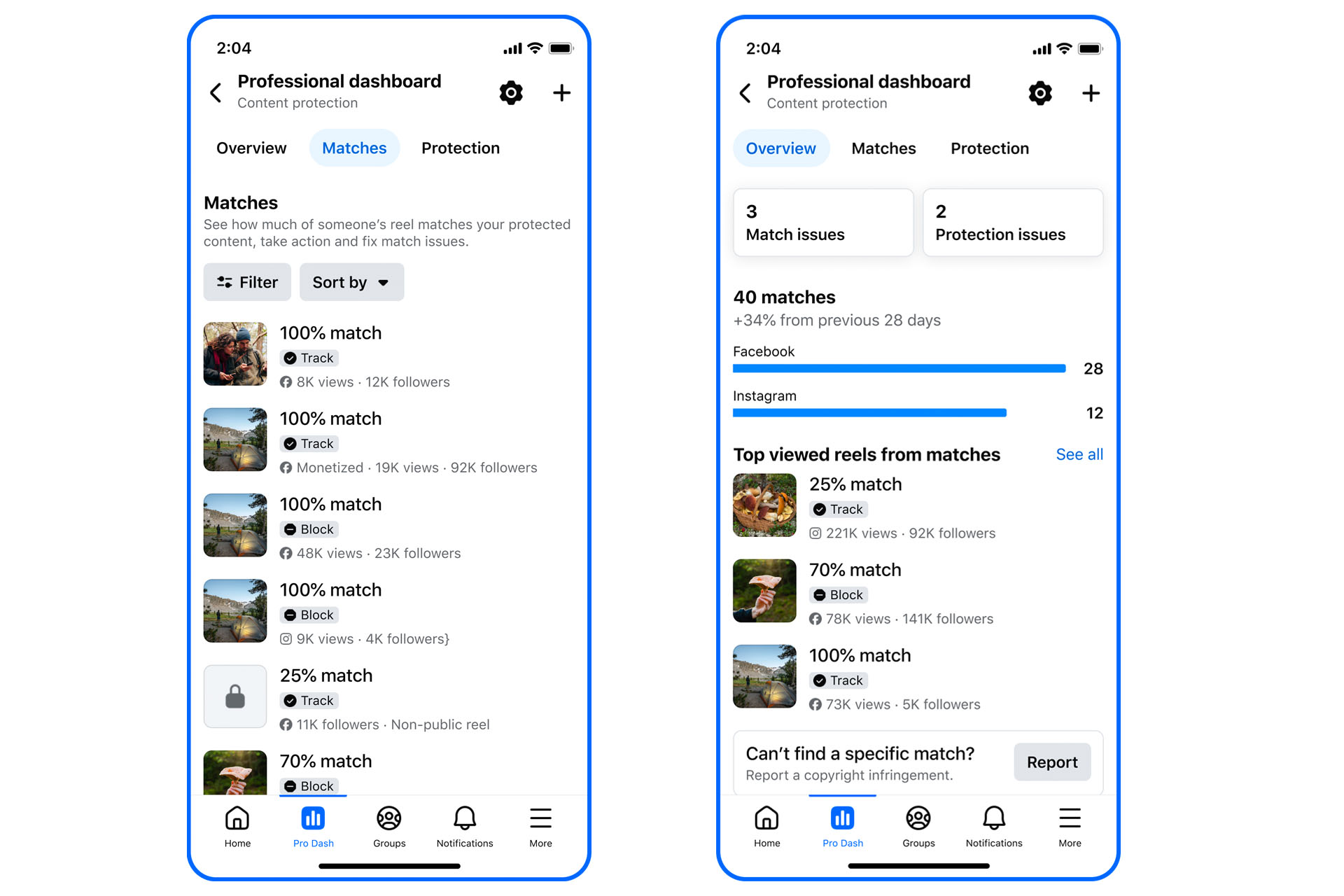
The company introduced a new tool for creators called “content protection,” which can automatically detect when a creator’s original reel is reposted, either fully or partially, on Facebook or Instagram. Creators who are enrolled will be able to see which accounts have shared their work and will be able to take a range of actions on the clip. 

Available actions include “track,” which allows the creator to add a label indicating the clip originally came from their account. In addition to the link back, creators will also be able to keep tabs on the number of views it’s getting. Creators can also opt to block a clip entirely, which will prevent anyone else from being able to view the reel. (Meta notes choosing this option won’t impose additional penalties on the account that lifted the original content.) Finally, creators can choose to “release” the video, which removes it from their dashboard so they will no longer have any visibility into how it’s performing.

The dashboard tracks instances of reused content,
Meta

The dashboard also provides some other details that could help creators decide how to respond. For example, they can see whether the video using their content is being monetized, which may influence their decision to track with attribution or block entirely. On the other hand, if a reel was lifted from an account with few followers, they may opt to simply keep an eye on it. 

Meta has already offered Facebook creators some of these abilities in the past through its rights manager platform, but the company says making the features available directly in the Facebook app will make it accessible to more people. Notably, the company is only offering content protection to creators who share reels on Facebook. So even though the feature will detect copycats on Instagram, it will only do so if the original video has been posted to Facebook. 

Meta says content protection is rolling out now to creators in its monetization program “who meet enhanced integrity and originality standards” as well as those already using rights manager. Creators can also apply for access directly.

This article originally appeared on Engadget at https://www.engadget.com/social-media/facebook-rolls-out-new-tools-for-creators-to-track-accounts-stealing-their-content-201020255.html?src=rss

Dell Announces PowerEdge AI Servers Fueled By AMD Instinct MI355X GPUs And EPYC CPUs

Dell Announces PowerEdge AI Servers Fueled By AMD Instinct MI355X GPUs And EPYC CPUs
If you’re among the massive horde of companies looking to integrate AI services into your workflow yet unwilling to pay OpenAI, Google, Microsoft, or Anthropic exorbitant API fees for their advanced models, why not host it yourself? That’s exactly the pitch from Dell, who has just launched a new family of server products offering extremely

Is Video Watching Bad for Kids? The Effect of Video Watching on Children’s Skills

Abstract of a paper on NBER: This paper documents video consumption among school-aged children in the U.S. and explores its impact on human capital development. Video watching is common across all segments of society, yet surprisingly little is known about its developmental consequences. With a bunching identification strategy, we find that an additional hour of daily video consumption has a negative impact on children’s noncognitive skills, with harmful effects on both internalizing behaviors (e.g., depression) and externalizing behaviors (e.g., social difficulties). We find a positive effect on math skills, though the effect on an aggregate measure of cognitive skills is smaller and not statistically significant. These findings are robust and largely stable across most demographics and different ways of measuring skills and video watching. We find evidence that for Hispanic children, video watching has positive effects on both cognitive and noncognitive skills — potentially reflecting its role in supporting cultural assimilation. Interestingly, the marginal effects of video watching remain relatively stable regardless of how much time children spend on the activity, with similar incremental impacts observed among those who watch very little and those who watch for many hours.


Read more of this story at Slashdot.

Apple Prepares Massive iPhone Overhaul With New Designs & Features

Apple Prepares Massive iPhone Overhaul With New Designs & Features
The iPhone Air may be struggling to move the needle sales wise, but that isn’t stopping Apple from pushing forward in its efforts to revamp its iPhone lineup. According to Bloomberg’s Mark Gurman, the company is still planning on releasing a foldable model next year and debut a high-end model in 2027.

The foldable iPhone will go up against

Judge smacks down Texas AG’s request to immediately block Tylenol ads

A Texas Judge has rejected a request from Texas Attorney General Ken Paxton to issue a temporary order barring Tylenol’s maker, Kenvue, from claiming amid litigation that the pain and fever medication is safe for pregnant women and children, according to court documents.

In records filed Friday, District Judge LeAnn Rafferty, in Panola County, also rejected Paxton’s unusual request to block Kenvue from distributing $400 million in dividends to shareholders later this month.

The denials are early losses for Paxton in a politically charged case that hinges on the unproven claim that Tylenol causes autism and other disorders—a claim first introduced by President Trump and his anti-vaccine health secretary, Robert F. Kennedy Jr.

Read full article

Comments