How Louvre thieves exploited human psychology to avoid suspicion—and what it reveals about AI

On a sunny morning on October 19 2025, four men allegedly walked into the world’s most-visited museum and left, minutes later, with crown jewels worth 88 million euros ($101 million). The theft from Paris’ Louvre Museum—one of the world’s most surveilled cultural institutions—took just under eight minutes.

Visitors kept browsing. Security didn’t react (until alarms were triggered). The men disappeared into the city’s traffic before anyone realized what had happened.

Investigators later revealed that the thieves wore hi-vis vests, disguising themselves as construction workers. They arrived with a furniture lift, a common sight in Paris’s narrow streets, and used it to reach a balcony overlooking the Seine. Dressed as workers, they looked as if they belonged.

This strategy worked because we don’t see the world objectively. We see it through categories—through what we expect to see. The thieves understood the social categories that we perceive as “normal” and exploited them to avoid suspicion. Many artificial intelligence (AI) systems work in the same way and are vulnerable to the same kinds of mistakes as a result.

The sociologist Erving Goffman would describe what happened at the Louvre using his concept of the presentation of self: people “perform” social roles by adopting the cues others expect. Here, the performance of normality became the perfect camouflage.

The sociology of sight

Humans carry out mental categorization all the time to make sense of people and places. When something fits the category of “ordinary,” it slips from notice.

AI systems used for tasks such as facial recognition and detecting suspicious activity in a public area operate in a similar way. For humans, categorization is cultural. For AI, it is mathematical.

But both systems rely on learned patterns rather than objective reality. Because AI learns from data about who looks “normal” and who looks “suspicious,” it absorbs the categories embedded in its training data. And this makes it susceptible to bias.

The Louvre robbers weren’t seen as dangerous because they fit a trusted category. In AI, the same process can have the opposite effect: people who don’t fit the statistical norm become more visible and over-scrutinized.

It can mean a facial recognition system disproportionately flags certain racial or gendered groups as potential threats while letting others pass unnoticed.

A sociological lens helps us see that these aren’t separate issues. AI doesn’t invent its categories; it learns ours. When a computer vision system is trained on security footage where “normal” is defined by particular bodies, clothing, or behavior, it reproduces those assumptions.

Just as the museum’s guards looked past the thieves because they appeared to belong, AI can look past certain patterns while overreacting to others.

Categorization, whether human or algorithmic, is a double-edged sword. It helps us process information quickly, but it also encodes our cultural assumptions. Both people and machines rely on pattern recognition, which is an efficient but imperfect strategy.

A sociological view of AI treats algorithms as mirrors: They reflect back our social categories and hierarchies. In the Louvre case, the mirror is turned toward us. The robbers succeeded not because they were invisible, but because they were seen through the lens of normality. In AI terms, they passed the classification test.

From museum halls to machine learning

This link between perception and categorization reveals something important about our increasingly algorithmic world. Whether it’s a guard deciding who looks suspicious or an AI deciding who looks like a “shoplifter,” the underlying process is the same: assigning people to categories based on cues that feel objective but are culturally learned.

When an AI system is described as “biased,” this often means that it reflects those social categories too faithfully. The Louvre heist reminds us that these categories don’t just shape our attitudes, they shape what gets noticed at all.

After the theft, France’s culture minister promised new cameras and tighter security. But no matter how advanced those systems become, they will still rely on categorization. Someone, or something, must decide what counts as “suspicious behavior.” If that decision rests on assumptions, the same blind spots will persist.

The Louvre robbery will be remembered as one of Europe’s most spectacular museum thefts. The thieves succeeded because they mastered the sociology of appearance: They understood the categories of normality and used them as tools.

And in doing so, they showed how both people and machines can mistake conformity for safety. Their success in broad daylight wasn’t only a triumph of planning. It was a triumph of categorical thinking, the same logic that underlies both human perception and artificial intelligence.

The lesson is clear: Before we teach machines to see better, we must first learn to question how we see.

Vincent Charles, Reader in AI for Business and Management Science, Queen’s University Belfast and Tatiana Gherman, Associate Professor of AI for Business and Strategy, University of Northampton.

This article is republished from The Conversation under a Creative Commons license. Read the original article.

Read full article

Comments

Watch Out for These Health Insurance Scams During Open Enrollment

Many Americans are in the middle of making hard decisions about their health insurance, in part because open enrollment, the period in which consumers can change their plan, is happening now. That means scammers are also busy contacting people, impersonating insurance providers in an effort to collect personal, financial, and medical information.

Common health insurance scams

Fraudsters especially love to impersonate representatives from Medicare, targeting older adults and others who qualify for the federal program with unexpected calls. As the Federal Trade Commission warns, scammers may have some of your personal information already and will ask you to confirm your Medicare, bank account, and/or credit card number under the guise of sending you a new Medicare card. In reality, Medicare cards are free and sent automatically, so you should never need to provide payment.

Scammers may also target consumers on Marketplace, Medicaid, and Children’s Health Insurance Program (CHIP) plans with a similar tactic, claiming that you may lose or be disqualified from health coverage unless you make a payment.

In addition to impersonating government officials, bad actors will pretend to represent a legitimate insurer, promising discounted plans (that are available only for a limited time) or enrollment assistance (for a fee). Plans that seem too good to be true probably aren’t health insurance at all and may not provide the coverage promised. And you shouldn’t have to pay anyone to sign up for a plan.

Note that while scammers may ramp up efforts during open enrollment, health insurance scams can happen year-round. A Federal Communications Commission (FCC) advisory warns consumers about common tactics like calls and texts in which scammers—impersonating government agencies or insurance companies—offer health screening, free gifts, or other promotional benefits in exchange for your personal information.

Bad actors can pretty easily spoof phone numbers (so it looks like you’re getting a call from a reputable insurance provider like Medicare or Blue Cross Blue Shield) as well as set up phishing websites designed to steal your credentials and financial information.

Insurance scam red flags

As always, unsolicited communication that pressures you to take action is almost always a scam. Medicare representatives will never call, email, or text you to verify information or demand payment, nor will legitimate government officials try to sell you anything or threaten you unless you pay up. If someone claims they represent an insurer and asks for money or sensitive personal information, or if they threaten you with legal action, hang up.

Don’t share any data, including your social security number, bank account number, or medical history with anyone—that is, unless you have contacted the Medicare office or other legitimate agency directly and first and need to verify your identity. (The number for Medicare is 1-800-MEDICARE, and you can reach a Marketplace representative through HealthCare.gov).

Always verify a representative’s identity using official contact information found on a .gov website, legitimate company page, or an account statement, and never send money via gift card, prepaid debit, or crytocurrency in exchange for anything. You should also ensure your credentials for your insurance accounts (like HealthCare.gov and Medicare.gov) are strong and secure, and enable multi-factor authentication wherever possible.

ASUS ROG Matrix RTX 5090 Quad Fan GPU Gets A Big Price & Hyper-Limited Stock

ASUS ROG Matrix RTX 5090 Quad Fan GPU Gets A Big Price & Hyper-Limited Stock
ASUS has begun accepting preorders for its funktastic ROG Matrix Platinum GeForce RTX 5090, though you’ll need a big wad of cash to bring one home. The custom GPU sports a unique design with four fans, including three on the front side of the cooling shroud and one around back, and is a limited edition run in celebration of 30 years of cranking

2025 Porsche Macan Electric review: The obvious choice when the budget allows

You have to give Porsche credit for going in early on EVs. The Taycan is a stellar sedan/wagon that’s only gotten better. But even for a niche manufacturer like Porsche, it’s not exactly a mass-market machine. To really move the needle on EVs, you need something more family friendly, and for the brand from Stuttgart, that’s the Macan.

Porsche’s gas-powered crossover SUV is its best-selling machine in the US, so it’s an absolutely vital piece of the company’s success. It’s also Porsche’s second full-on, battery-powered machine to hit the market. The Macan Electric doesn’t replace its internal combustion predecessor, rather living alongside it on the dealership floor, creating a brutal sibling rivalry and a potentially difficult choice for buyers: gas or electric? 

Actually, Porsche made it a pretty easy decision. This is the right one.

Hardware tour

The Macan Electric shares a silhouette and a segment with that other Macan, but from a technology standpoint, there’s little the two agree upon. The Macan Electric is built on a new platform called PPE, which at one point was destined to be the underpinnings of a smorgasbord of electrified offerings from both Porsche and Audi, including the A6 E-Tron and Q6 E-Tron.

For now, at least, Americans’ increasingly fickle attitudes toward EVs have stymied some of those plans, meaning this Macan and the upcoming Cayenne Electric are the only two Porsches built from those bones. The Macan is the smaller of the two, powered by a variety of different configurations, starting with a single-motor, rear-drive configuration with 355 horsepower on the low end, up to the 630-hp, dual-motor Macan Turbo Electric on the high end. Buyers can also select the dual-motor Macan 4 Electric, speedier 4S Electric or quicker still GTS Electric.

I tested a base Macan Electric, its rear-mounted, 355-hp motor enough to scoot this 5,004-pound SUV from zero to 60 mph in 5.4 seconds. The top-shelf Macan Turbo Electric gets to 60 in 3.1 seconds, absolutely humiliating the quickest exhaust-spewing Macan GTS’s 4.3-second time.

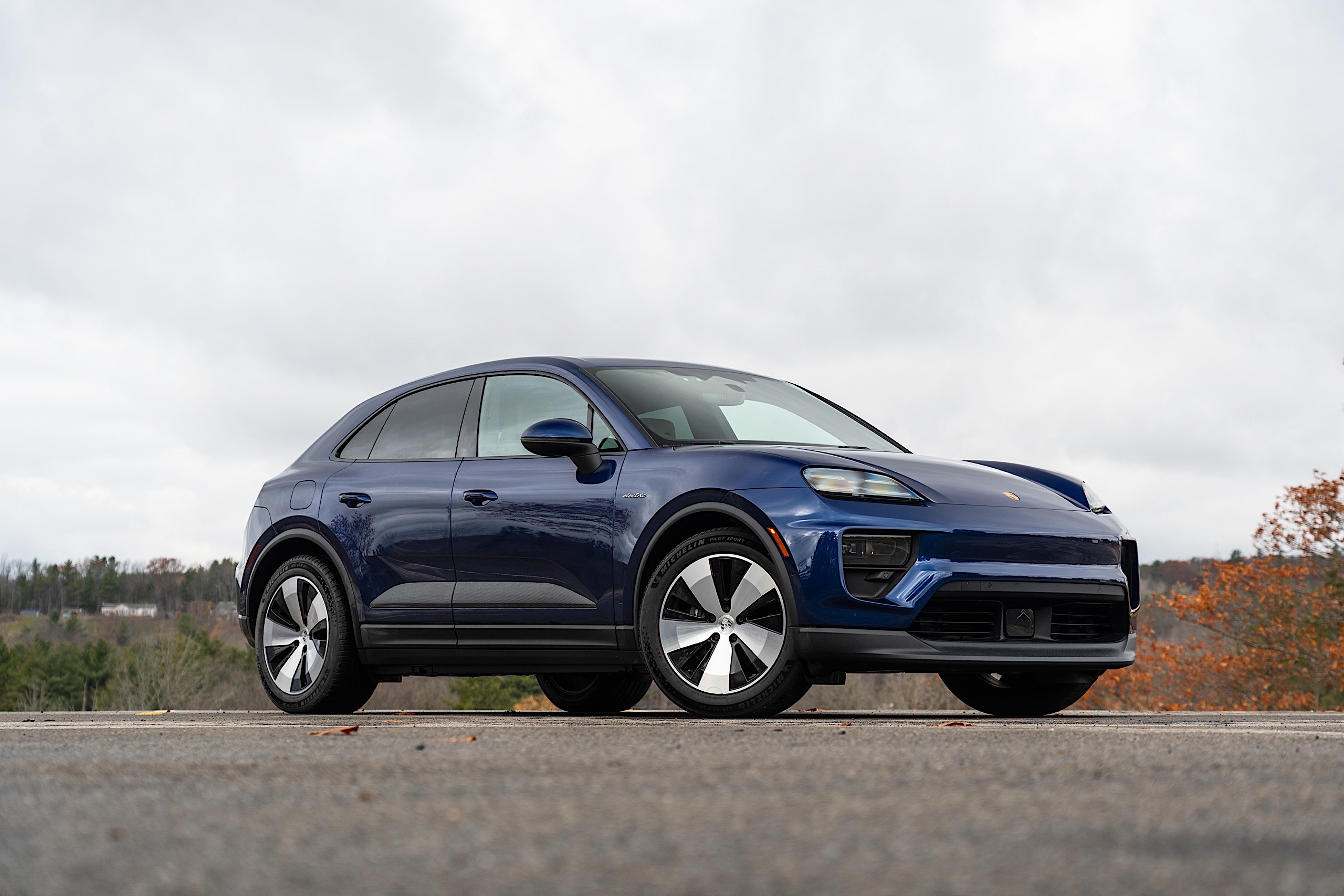
At first glance, the electric Macan looks like a Tesla Model Y -- especially in dark blue.
At first glance, the electric Macan looks like a Tesla Model Y — especially in dark blue.
Tim Stevens for Engadget

Of course, this is a Porsche, not a drag machine, and so cornering is key. Helping with the handling is an adaptive air suspension that not only lets you go from stiff to firm at the twist of a knob but also raises or lowers dynamically. When you’re hunting for range or speed, the SUV gets down into an aerodynamic tuck low to the earth. If you’re looking to head off-road, it’ll hike itself up by 1.6 inches. 

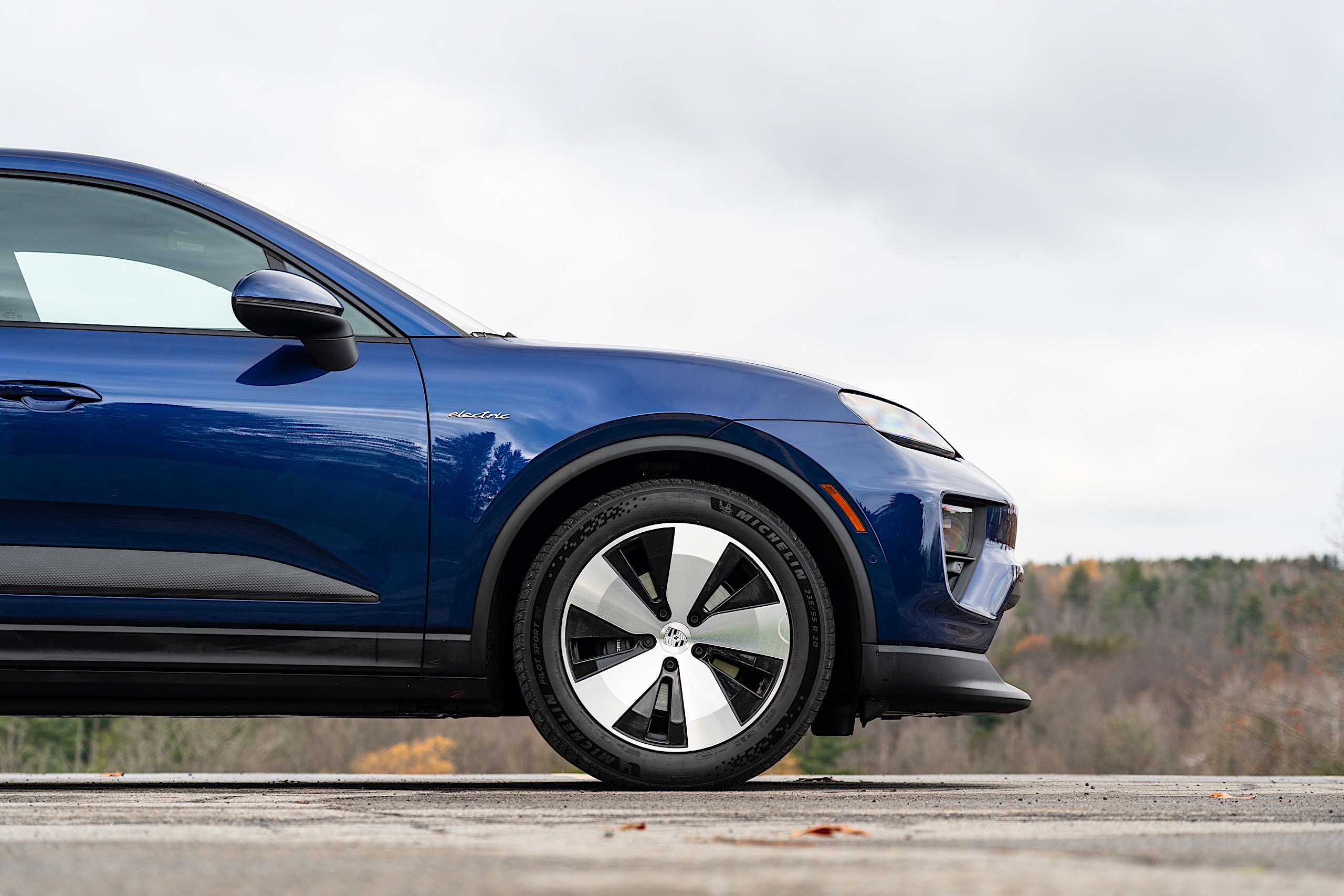
While I wouldn’t consider this an off-roader as such, the dual motor configurations should be competent in lower-grip situations. Open differentials at either end will keep your all-roading aspirations limited, but on some icy, slippery roads during the week I spent living with one, even the rear-drive Macan proved sure-footed and easy to handle, despite its summer-oriented Pilot Sport EV tires. 

At the heart of all that is a 100-kilowatt-hour battery, which offers the Macan Electric an EPA-rated range of up to 315 miles, depending on which trim you go with. In my testing, which included extended periods of driving with my foot flat to the floor, I managed 2.8 miles per kWh. That’s a theoretical maximum range of 280 miles if you’re driving like you stole it. Anyone doing the school run in a more sedate way will have no problem meeting or beating that EPA rating. 

User interface

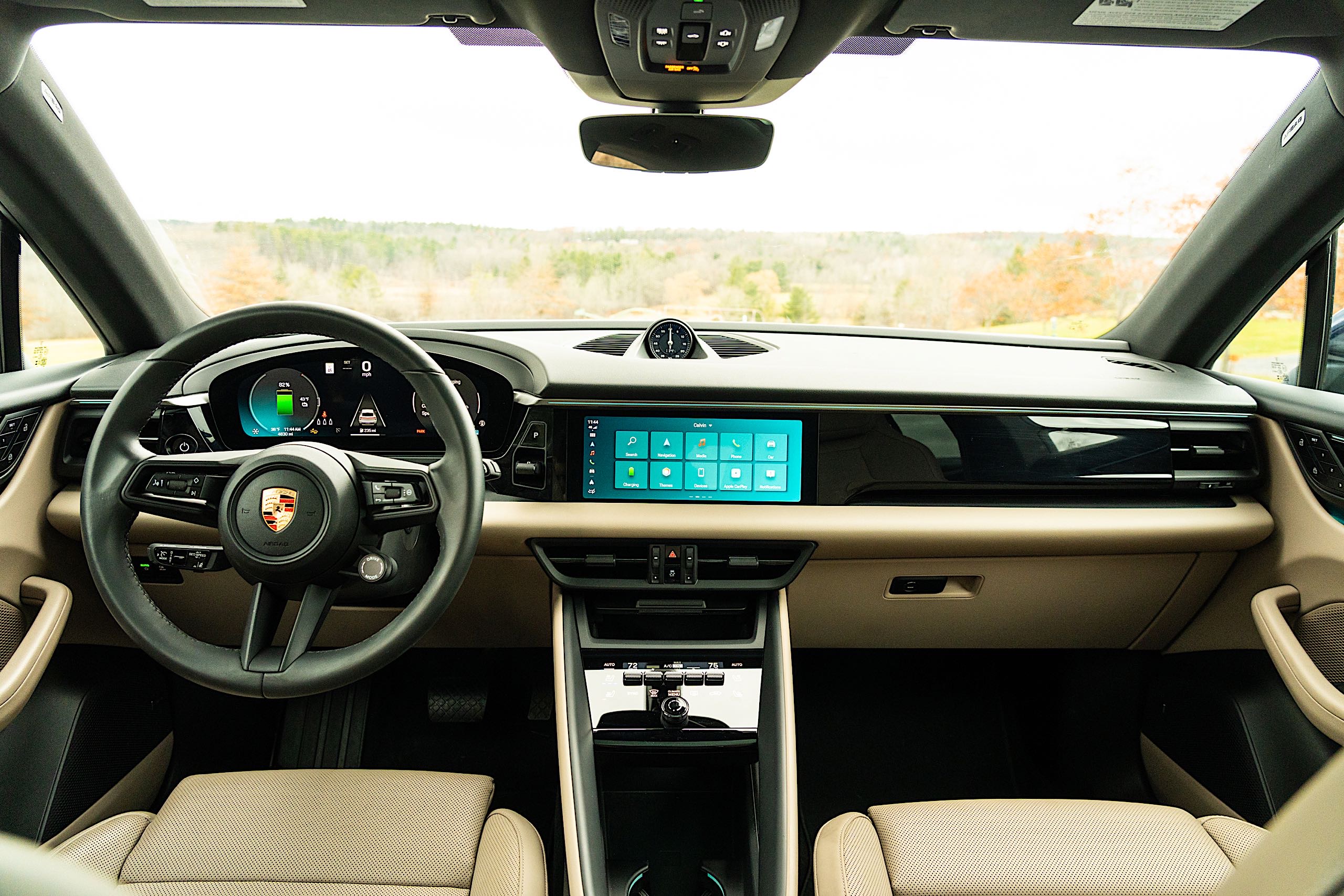
The Macan's interior is equipped with multiple displays.
The Macan’s interior is equipped with multiple displays.
Tim Stevens for Engadget

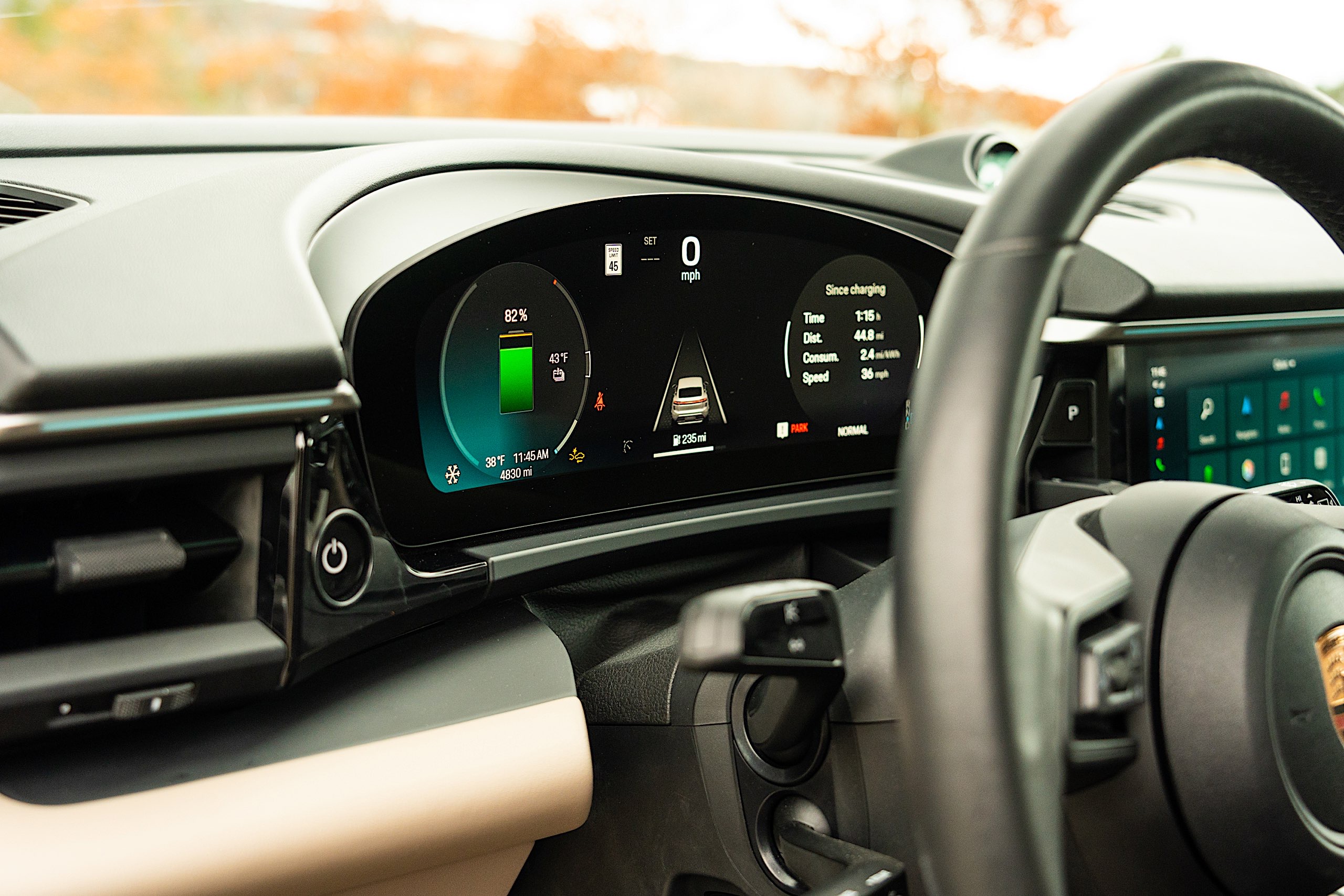
Beyond performance, the Macan Electric has another advantage over its internal combustion counterpart: it has a more modern interior. The highlight is the 12.6-inch, curved gauge cluster. Using buttons on the steering wheel, you can cycle through various views and telemetry elements to suit your desire for data or need to remain undisturbed.

That’s paired with a 10.9-inch touchscreen in the middle, and you can even opt for a third display embedded way over on the right side of the dashboard. This one allows you to access streaming services like YouTube. I’ve never seen the point in that, though, but that’s only because I’ve yet to meet a passenger who wouldn’t rather just use their smartphone.

Porsche’s PCM interface on that central touchscreen is simple and clean, with more than a passing iOS resemblance. Perhaps that’s why the company has been an early adopter of CarPlay Ultra. For the Android faithful, wireless Android Auto is here too, and it works great, looking nearly native on the widescreen display.

The Macan's gauge cluster is a curved 12.6-inch display.
The Macan’s gauge cluster is a curved 12.6-inch display.
Tim Stevens for Engadget

Through simple menus, you can do everything from track lap times to enable or disable the augmented digital engine tone, which Porsche calls Electronic Sport Sound. I confess the futuristic whirring and whooshing does make driving aggressively a bit more fun, but most of the time I prefer to have it off.

Thankfully, not everything is controlled through the touchscreen. There’s a separate, capacitive-touch panel just below it for climate-related functions, including toggling the prodigiously warm heated seats (which I’m enjoying as I write this). You’ll find a physical volume knob there, too.

The Macan seats five comfortably, though I’d stick to four for anything longer than a quick run to a team lunch. Front and rear seats are comfortable, and there’s a tolerable amount of legroom in the back. Headroom back there, though, is limited. If you have tall co-workers, they’ll be tripping over each other to call shotgun.

Dynamics

Despite it's size, the Macan is surprisingly agile, which is partly due to its unique suspension.
Despite it’s size, the Macan is surprisingly agile, which is partly due to its unique suspension.
Tim Stevens for Engadget

In the grand spectrum of SUVs on the roads today, the 188.3-inch-long Macan Electric is on the smaller side. But, as an EV, it’s heavy for a crossover. At just a tick over 5,000 pounds, it’s a substantial 850 pounds heavier than a regular base Macan.

Porsche’s engineers addressed that as best they could with the aforementioned fancy suspension, plus larger, 20-inch wheels on each corner. The result is an SUV that is, in Sport or Sport Plus modes, remarkably fun to drive. Its steering is extremely quick for an SUV, which makes this thing feel lighter than it is. 

All the grip provided by those tires and suspension really gives you the confidence to push through the corners, too. And, when you push too hard, it breaks away quickly and predictably. I enjoyed romping on the throttle hard mid-corner to kick the tail out, the Macan giving me just enough time to grin and give a bit of a steering correction before everything was right and the tires were stuck again.

It’s not a sports car, no doubt about that, and it tends to wallow a bit on bumpy roads thanks to all that weight, but it is far more engaging and fun than just about anything else in this category. Even this base model is quick off the line, but its breakneck initial throttle response is tempered by a somewhat flat acceleration at higher speeds. It just doesn’t have the kind of Autobahn-dominating top-end that Porsches are typically known for.

The electric Macan's biggest flaw is the complete lack of lift-off regenerative braking.
The electric Macan’s biggest flaw is the complete lack of lift-off regenerative braking.
Tim Stevens for Engadget

I suppose I’d have to cough up the extra $10,000 for the GTS, or a further $20,000 for the $109,000 Turbo if I really wanted that. Yes, these things get expensive quick. The base Macan Electric I drove started at $73,500, but carried enough options to drive its out-the-door price to $86,865. 

You are, at least, getting a machine that readily does double-duty. Despite its responsiveness and eager handling, the Macan Electric does a stellar job of settling down when you twist that Drive Mode knob on the steering wheel to the left, unwinding the suspension and relaxing the experience. The SUV manages excellent compliance over broken roads, flying over railroad tracks without complaint, and just generally being a calm and competent cruiser. 

But there’s one, undeniable flaw that drove me absolutely nuts in the Macan Electric: a complete lack of lift-off regenerative braking. Porsche continues its adamant refusal to offer anything even approaching a one-pedal driving experience. That’s a frustrating thing to me — maybe not quite as frustrating as GM phasing out Android Auto and Apple CarPlay, but pretty close. 

Wrap-up

The electric Macan commands (at least) a $10,000 premium over its gas-powered sibling.
Tim Stevens for Engadget

After driving a few different prototypes of the Macan Electric during its development phase, I very much enjoyed my time with a final, production version on some familiar roads around my home. It excelled in the dry and on slippery, early winter roads, made me smile when I was feeling rowdy, and then disappeared into the background when I just wanted to get home. 

It isn’t a perfect machine. I’d hoped for a little more roominess inside, I lament the lack of one-pedal driving, and honestly, I wish Porsche’s exterior designers had gone a little crazier. At a quick glance, it looks a lot like a first-gen Tesla Model Y, especially in Gentian Blue Metallic, which is a dead ringer for Tesla’s Deep Blue Metallic. 

And there’s also the significant premium that you’ll have to pay to get into one: $10,000 over a base, gas-powered Macan. For that, you’re getting a lot of extra performance, a dose of extra tech and all the joys and simplicities that come with living the EV lifestyle. That makes it well worth it in my book.

This article originally appeared on Engadget at https://www.engadget.com/transportation/evs/2025-porsche-macan-electric-review-the-obvious-choice-when-the-budget-allows-140000851.html?src=rss

Twin suction turbines and 3-Gs in slow corners? Meet the DRG-Lola.

We’re in something of a purple patch if you’re a fan of clever new technology in single-seat race cars. Out in the Middle East, the autonomous A2RL crew held another race at Yas Marina, one that by all accounts was a lot more impressive than the last time the self-driving race cars competed against a human. Formula E teams are getting ready for the debut next year of their Gen4 era, which sees cars with real downforce and almost twice as much power. Meanwhile we only have a few months left before we see the results of F1’s new technical rules change, as the sport adopts far more powerful electrical propulsion and active aerodynamics. But what if there was an electric single-seater that was faster around a track than any of these?

That’s the idea behind the DRG-Lola, a racing concept designed from the ground up by Lola Cars, the storied-now-reborn British race car manufacturer, and Lucas di Grassi, veteran of the hybrid LMP1 sportscar days and FIA Formula E champion. Di Grassi is one of the more thoughtful racing drivers out there and is a passionate advocate of clean technologies in racing—in 2020 he shared his earlier thoughts on where Formula E could take its technical direction.

The DRG-Lola is much closer to reality than that 2020 concept; di Grassi has relied on existing battery and motor technology, rather than some uninvented unobtanium to make it all work. It generates 804 hp (600 kW) from a pair of electric motors driving the front and rear axles and is powered by a 60 kWh battery pack that’s arranged in modules on either side of the driver’s cockpit.

Read full article

Comments

This Samsung Galaxy Tab S10+ Is Already $250 Off for Black Friday

We may earn a commission from links on this page. Deal pricing and availability subject to change after time of publication.

The Samsung Galaxy Tab S10+ in Platinum Silver is currently priced at $749.99, down from its regular $999.99, and price trackers confirm this is the tablet’s lowest price to date. That discount alone makes a premium device more approachable, especially one that PCMag didn’t hesitate to call “excellent” in their review. They also named it their Editor’s Choice and their pick for the best Android tablet of 2024, which sets a certain expectation. The S10+ meets most of it.

The 12.4-inch Dynamic AMOLED 2X display looks sharp and handles colors cleanly, and its anti-reflective coating makes a difference when you’re using it outdoors. It still struggles under direct sunlight, but you won’t be tilting the screen around during a casual commute or on your couch. The tablet also feels sturdy in the hand, thanks to Samsung’s Armor Aluminum frame and Gorilla Glass 5 on the front, and the IP68 rating means it can handle dust and water better than any iPad.

Performance-wise, the MediaTek Dimensity 9300+ chip paired with 12GB of RAM keeps apps running smoothly without hesitation, and the 256GB of storage (with support for up to 1.5TB via microSD) makes it easy to load up with work files or games. Demanding games like Genshin Impact run smoothly, and not surprisingly, everyday tasks like email, browsing, reading, and hopping between apps don’t strain it either. Battery life lands at a little over eight hours in continuous playback at full brightness, which is decent, though anyone hoping for an all-day endurance champion might want to keep expectations in check.

​​Samsung’s software and AI tools round out the experience. Android 14 with One UI 6.1.1 brings multitasking shortcuts, a desktop-like DeX mode, and Galaxy AI tools such as Circle to Search, automatic note cleanup, and webpage summaries. These small conveniences add up and make the tablet feel more helpful in day-to-day use. Samsung also promises four years of OS updates and seven years of security patches. That said, the cameras feel like the most compromise-heavy part of the tablet. The 13MP main camera and 8MP ultra-wide do fine for video calls and scanning pages, but colors skew oversaturated and lack detail compared to what you’d expect at this price. Still, this is one of the best tablets you can buy in 2025, according to our Associate Tech Editor Michelle Ehrhardt.


Our Best Editor-Vetted Early Black Friday Deals Right Now


Apple AirPods 4 Wireless Earbuds


—
$117.00

(List Price $129.00)


Amazon Fire HD 10 (2023)


—
$69.99

(List Price $139.99)


Sony WH-1000XM5


—
$248.00

(List Price $399.99)


Amazon Fire TV Stick 4K Plus


—
$24.99

(List Price $49.99)

Deals are selected by our commerce team

Netgear Accused by Rival of China Smear To Fan Security Fear

An anonymous reader shares a report: California-based TP-Link says it may take a sales hit of more than $1 billion because of erroneous reports that the networking company’s technology has been “infiltrated” by Beijing. In a lawsuit, TP-Link claims its competitor, Netgear, orchestrated a smear by planting false claims with journalists and internet influencers with the goal of scaring off customers.

Closely held TP-Link, which makes wireless routers, alleges in a complaint filed Monday that Netgear’s campaign “threatens injury to well over a billion dollars in sales” and violates a 2024 settlement of a patent fight. That accord, in which TP-Link agreed to pay Netgear $135 million, includes a provision that the public company promises not to disparage its rival, according to the suit in Delaware federal court.

The suit comes as TP-Link faces growing scrutiny in Washington over national-security issues. US lawmakers from both parties have expressed concern that TP-Link’s wireless equipment could be exploited by Chinese hackers following a series of attacks on its routers.


Read more of this story at Slashdot.

Cloudflare Apologizes For Massive Outage & Details What Went Horribly Wrong

Cloudflare Apologizes For Massive Outage & Details What Went Horribly Wrong
An event at Cloudflare that crippled large portions of the internet yesterday was not caused by a cyber attack or malicious activity, either directly or indirectly, the company confirmed in a blog. If that’s the case, then what caused all the ruckus? Turns out it was a change in permissions to one of Cloudflare’s databases that triggered an

Unity games are coming to Fortnite

Unity and Epic Games, the creators of today’s biggest video game engines, have announced a partnership that will make Unity games available in Fortnite. Epic has allowed creators to publish their own experiences (or “islands”) within Fortnite since 2018, and the number of experiences has grown considerably over the recent years. In 2024, 198,000 islands were published within the game, double the number from the previous year. This partnership has the potential to grow Fortnite experiences even further by welcoming Unity developers and can give existing developers more freedom.

“Just like the early days of the web, we believe that companies need to work together in order to build the open metaverse in a way that’s interoperable and fair,” said Tim Sweeney, the CEO of Epic Games, in a statement. “Working alongside Unity we’re helping developers build fun games, reach bigger audiences, and find success.” Sweeney announced the partnership with Unity CEO Matt Bromberg at Unity’s annual developer conference. They said that developers will be able to publish games that use Unity’s game engine on Fortnite sometime next year. The companies promised to announce more details and exact timing in the future.

Just announced at Unity’s Unite 2025 show in Barcelona: Unity has built an amazing new networking protocol enabling Unity games to come into Fortnite next year. This will enable an incredible variety of games to reach a new audience in new ways! https://t.co/varnV2ybCu

— Tim Sweeney (@TimSweeneyEpic) November 19, 2025

In addition, Unity has announced that the cross-platform commerce management dashboard it launched in October will support Unreal Engine. The dashboard allows developers to manage pricing and promotions across websites and stores for mobile and PC from one place. It will start supporting Unreal Engine in early 2026.

This article originally appeared on Engadget at https://www.engadget.com/gaming/unity-games-are-coming-to-fortnite-133000076.html?src=rss

Amazon’s Echo Spot smart speaker drops to $50 for Black Friday

Amazon is selling the Echo Spot smart speaker for just $50 as part of a Black Friday promotion. The sale applies to multiple colorways and represents a discount of $30. This isn’t a record low price, but it’s extremely close.

For the uninitiated, the Echo Spot is a diminutive little speaker/alarm clock hybrid unit. It’s a cute little doodad and looks great on a nightstand. The screen is customizable, so it doesn’t have to display a clock. It can show song titles, smart home control dashboards, the weather and a lot more. Of course, there are numerous clock faces to choose from.

The Spot not only integrates with Amazon’s smart assistant Alexa, but it provides access to the newfangled Alexa+. This is a smarter and more conversational version of the iconic smart assistant. Like most modern AI products, it’s still working out some bugs. The underlying tech, however, is promising.

The speaker is decent enough for the size, though you won’t be using it to fuel any house parties. It’s a great tool for bedroom-based listening. This version doesn’t have a camera, which is actually great news for the privacy conscious.

This article originally appeared on Engadget at https://www.engadget.com/deals/amazons-echo-spot-smart-speaker-drops-to-50-for-black-friday-130550875.html?src=rss

Read AI is building a note-taking app that works nearly anywhere

You probably haven’t heard of Read AI. The company has quietly been making a name for itself in the crowded AI space, signing up 50,000 customers daily in recent months. At first glance, Read AI resembles apps like Otter.ai. You can use the software to transcribe and summarize meetings, but it’s also more ambitious than that. 

“It’s AI on standby,” Read AI CEO David Shim explains, adding that the company’s vision is to give people a tool that can record, transcribe and analyze nearly every professional conversation they have, no matter where those discussions take place and whether they occur online or in-person. Today, Read AI is taking a major step toward realizing that vision with the release of its new Operator agent (I’ll admit, the company could have picked a more original name), and new apps for Windows, macOS and Android. 

Between its own software, including an existing iOS app, and third-party integrations, Read AI users can now connect their accounts to more than 22 other platforms. Some of the more notable inclusions there are Gmail, Outlook, Slack, HubSpot and Notion. More importantly, with Read AI’s mobile apps, you can record impromptu in-person meetings; the company has data showing that more than half of professional conversations occur outside of online spaces.   

In any case, no matter where you talk to your colleagues, Operator is there to generate notes and insights. “We don’t just look at meetings,” Shim says. “We look at topics that are interesting to you.” To that end, Read AI has built a series of in-house multimodal models that look for context beyond what’s said during any interaction you record. For example, the company’s systems are designed to catch when you enthusiastically answer a question or look away in disinterest, and use that data to decide how the software goes about summarizing your meetings. 

“That context is what enables us to identify what is valuable to you, and make that discoverable,” says Shim. One way Read AI will surface those insights is through a feature the company calls Monday Brief. At the start of every week, you’ll get a summary of all the calls and conversations you had over the last seven days, with suggestions for follow-up actions you can take.

Now, you might be wondering, like I was, how Read AI hopes to compete in a market where a company like Microsoft is aggressively pushing Copilot on its users. If Shim is worried about the big players, he doesn’t show it. “There’s a need for an independent third party,” he says. “There’s always something new coming out. And that ability to be the independent third-party that plugs into different solutions is actually what consumers want and need.” To his point, since the launch of Copilot two years ago, Read AI has seen a 20x increase in the daily number of people using its software alongside Microsoft Teams. “We’ve seen the same thing along those lines for Zoom and Google Meet.”   

He believes the company’s approach to data privacy is another differentiator. By default, users are opted out of their data being used for training Read AI’s future models. Shim also notes the company takes recording disclosure seriously. “You need to notify people that you’re [recording] a call, and we put that front and center every single time.” 

If you want to try Read AI, the company offers a free plan that includes five meeting transcripts per month. Pricing for its paid subscriptions start at $19.75 per month.    

This article originally appeared on Engadget at https://www.engadget.com/ai/read-ai-is-building-a-note-taking-app-that-works-nearly-anywhere-130000235.html?src=rss

The Innovation Engine Under Threat: Why the Bayh-Dole Coalition Is Fighting for America’s Future

For nearly half a century, the United States has relied on a powerful, quiet engine to drive its innovation economy. It’s not in Silicon Valley or on Wall Street, but in the research labs of universities and non-profit institutions across the country. This engine, created by the Bayh-Dole Act of 1980, is the single most successful piece of economic legislation of the past 50 years. It has been responsible for countless life-saving drugs, world-changing technologies and entirely new industries.

Today, that engine is under direct threat from an unexpected source: the U.S. government itself.

A recent proposal from Commerce Secretary Howard Lutnick—suggesting the government should seize half of all patent royalties from federally funded university research—represents a profound misunderstanding of what makes this system work. Standing in firm opposition is the Bayh-Dole Coalition, a group of universities, researchers, patient-advocacy groups and business leaders who understand the stakes. They are fighting to protect a law that has been the cornerstone of American innovation, and their fight is one we should all be paying attention to.

Understanding Bayh-Dole: The Law That Unlocked Innovation

To understand the current battle, one must first understand the world before Bayh-Dole. Prior to 1980, the U.S. government funded billions in research at universities. When that research led to an invention, the patent rights defaulted to the federal government. This sounds reasonable until you look at the results. As detailed in the Bayh-Dole Coalition’s digital library, the government had amassed 28,000 patents by 1980 and had successfully licensed less than 5% of them. The Government was, quite literally, sitting on a treasure trove of innovation and letting it gather dust on a shelf.

The Bayh-Dole Act, a bipartisan effort co-sponsored by Senators Birch Bayh (D-IN) and Bob Dole (R-KS), introduced a simple, revolutionary change. It allowed universities, non-profits and small businesses to retain ownership of the inventions they created with federal funding.

This was not a giveaway. As the Coalition’s technical summary of the Act explains, this ownership came with a critical new responsibility: a mandate to actively pursue commercialization. Universities were now incentivized to file for patents and, most importantly, license those patents to private-sector companies—startups and established firms alike—that could shoulder the risk and cost of turning a raw idea into a marketable product.

The results have been staggering. The impact of Bayh-Dole and technology transfer is undeniable. It has spurred the creation of over 15,000 startup companies, supported millions of jobs and contributed trillions of dollars to the U.S. economy. From the Google search algorithm to life-saving cancer treatments, the fingerprints of Bayh-Dole are everywhere.

A New Threat to a Proven System

This proven system now faces a grave threat from Commerce Secretary Howard Lutnick. His recent proposal suggests that the government should simply “take” 50% of the patent royalties universities earn from these inventions. The rationale seems to be that since the government provided the initial grant funding, it is entitled to a direct cash-back return.

This proposal fundamentally misunderstands the government’s true “return on investment (ROI).” The government’s ROI was never meant to be a simple royalty check. Its return is a stronger economy, the creation of new high-tech jobs, global leadership in science and new medicines that save lives. The Bayh-Dole system was designed to produce those outcomes, which it has done spectacularly.

Lutnick’s plan treats the complex, delicate ecosystem of innovation like a simple ATM, and in doing so, it threatens to break the entire machine.

The Coalition’s Stand: A Unified Voice Against “A Tax That Would Kill Innovation”

The reaction from the innovation community, led by the Bayh-Dole Coalition, has been swift, unified and overwhelmingly negative. As the Coalition’s official statement declared, the proposal “would dismantle the innovation ecosystem” and “undermine U.S. leadership.”

To back this up, the Coalition released survey results from its members—the very people on the front lines of technology transfer. The findings were not just clear; they were practically unanimous. A full 99% of respondents said the proposal would harm their ability to commercialize technology, and 98% said it would make them less likely to license patents to companies.

This isn’t just about money; it’s about incentives. As Joseph Allen, the Coalition’s Executive Director, wrote in a scathing Wall Street Journal op-ed, this proposal is nothing short of “a tax that would kill innovation.”

Why? Because university patent royalties are not “profits.” This money is immediately reinvested into the research enterprise. It pays for the high costs of filing and maintaining patents—a risky, expensive venture that often fails. It funds the technology transfer offices that bridge the gap between labs and industry. Most importantly, it provides seed funding for new, high-risk research, supports graduate students and buys critical lab equipment.

Taking 50% of that money doesn’t just reduce the pie; it shatters the incentive structure. With half the potential return gone, universities will be forced to abandon thousands of promising, early-stage inventions. They will only be able to afford to patent the “safest bets,” letting potentially revolutionary (but less certain) ideas die in the lab. Private companies, seeing the university support system gutted, will be less willing to partner and invest the millions needed to bring a product to market. The pipeline of innovation would slow to a trickle.

Wrapping Up

The Bayh-Dole Act is perhaps the most successful and least-understood law of our time. It transformed the U.S. from a passive funder of research into an active cultivator of innovation, creating a system that is the envy of the world. The Bayh-Dole Coalition is fighting to protect this system not for the sake of universities, but for the sake of the entire nation.

Secretary Lutnick’s proposal is a short-sighted cash grab that would sever the link between public research and public benefit. It would disincentivize discovery, destabilize partnerships and ultimately surrender America’s competitive edge. The government’s role should be to champion and strengthen the Bayh-Dole framework, not dismantle it for a fraction of its true value.

OnePlus 15 review: The end of range anxiety

OnePlus got its start courting the enthusiast community by offering blazing-fast phones for a low price. While the prices aren’t quite as low as they once were, the new OnePlus 15 still delivers on value. Priced at $899, this phone sports the latest and most powerful Snapdragon processor, the largest battery in a mainstream smartphone, and a super-fast screen.

The OnePlus 15 still doesn’t deliver the most satisfying software experience, and the camera may actually be a step back for the company, but the things OnePlus gets right are very right. It’s a fast, sleek phone that runs for ages on a charge, and it’s a little cheaper than the competition. But its shortcomings make it hard to recommend this device over the latest from Google or Samsung—or even the flagship phone OnePlus released ten months ago.

US buyers have time to mull it over, though. Because of the recent government shutdown, FCC approval of the OnePlus 15 has been delayed. The company says it will release the phone as soon as it can, but there’s no exact date yet.

Read full article

Comments

Meta asks the Oversight Board to weigh in (a little) on Community Notes ahead of expansion

When Meta announced last year that it was ditching third-party fact checkers in favor of an X-style Community Notes system, the company was careful to note that it would only implement the changes within the United States to start. Now, nearly a year later, the social media company is getting ready to expand the crowd-sourced fact checks to more countries, and is asking the Oversight Board for advice on a potential rollout. 

The company has requested that board weigh in on “factors we should consider when deciding which countries, if any, to omit from the international roll out” of Community Notes. Notably, Meta isn’t asking the Oversight Board to advise on the merits of replacing traditional fact-checking organizations. Instead, the company wants guidance on how to approach country-specific challenges and whether there should be any carveouts. 

“We respectfully ask the Board to focus its examination on the country-level factors relevant to omitting countries from the international roll-out, and not on topics such as general product design or the operation of the Community Notes algorithm,” the company wrote in its request shared by the board. 

Up to now, Meta has been experimenting with Community Notes on Facebook, Instagram and Threads in the United States only. People who want to be able to author notes still need to be approved, but the company allows anyone to rate notes. However, it seems that the feature so far hasn’t gained as much traction for Meta as it has on X. In September, the company said that just 6 percent of the more than 15,000 notes that had been contributed had actually been published. 

In a statement from the Oversight Board, the group said it would consider issues like whether a crowd-sourced fact checking system would make sense in countries with “low levels of freedom of expression” or without a free press, as well as places with “low levels of digital literacy.” It also said it was hoping to hear public comments from researchers who have studied different approaches to countering misinformation.

Unlike with a typical case from the Oversight Board, which deals with specific content moderation decisions, Meta has no obligation to implement any of the group’s recommendations. But, the company has previously chosen to follow its suggestions in previous policy advisory opinions, including its decision to roll back COVID-19 misinformation rules following a recommendation from the board.

This article originally appeared on Engadget at https://www.engadget.com/social-media/meta-asks-the-oversight-board-to-weigh-in-a-little-on-community-notes-ahead-of-expansion-110000208.html?src=rss

Man Who Cryogenically Froze Late Wife Sparks Debate By Dating New Partner

A Chinese man who cryogenically preserved his wife after her death has sparked a heated online debate after it emerged he began dating a new partner in 2020. Some argue it’s natural for him to move on, while others say he’s being selfish or disrespectful to both his late wife and his current partner. The BBC reports: As a sign of his devotion, Gui Junmin decided to freeze his wife Zhan Wenlian’s body after she died from lung cancer in 2017, aged 49, making her China’s first cryogenically preserved person. But after a November interview revealed he had been dating a different partner since 2020, Chinese social media has been torn on Mr Junmin’s predicament. Whilst some asked why the 57-year-old didn’t just “let go” another commenter remarked he appeared to be “most devoted to himself.”

After Zhan Wenlian was given months to live by doctors, Gui Junmin decided to use cryonics – which is scientifically unproven – to preserve her body once she died. Following her death, he signed a 30-year agreement to preserve his wife’s frozen body with the Shandong Yinfeng Life Science Research Institute. Since then, Zhan’s body has been stored in a 2,000-litre container at the institute in a vat of -190C liquid nitrogen.

Chinese newspaper Southern Weekly revealed that although Mr Junmin lived alone for two years after the procedure, in 2020 he began dating again, despite his wife remaining in cryopreservation. He told the newspaper that a severe gout attack which left him unable to move for two days began to change his mind about the benefits of living alone. Soon after, he started seeing his current partner Wang Chunxia, although Mr Junmin suggested to the paper the love was only “utilitarian” and that she hadn’t “entered” his heart.


Read more of this story at Slashdot.

Cloudflare outage was not caused by a cyber attack

Cloudflare wrongly suspected that the widespread outage that took numerous websites offline on November 18 was caused by a DDoS attack, the company’s CEO has admitted. In his blog post that breaks down what happened, however, Matthew Prince explained that after realizing their mistake, his team was able to fix the issue. “The issue was not caused, directly or indirectly, by a cyber attack or malicious activity of any kind,” he wrote. It was instead caused by a change to its database systems’ permissions, which led to an issue with a file used by its Bot Management system.

The company’s Bot Management system uses a machine learning model to score bots for every request they make when they crawl Cloudflare’s network. Its clients rely on those bot scores to decide whether to allow or to block specific bots from accessing their websites. One the uses of having bot scores is being able to block AI companies’ bots so they can’t use a website’s content to train their LLMs. In July, Cloudflare launched an experiment called “pay per crawl,” which allows website owners to let an AI bot crawl their pages if they get paid for access.

Prince said the model relies on a “feature” configuration file to make a prediction on whether a bot request was automated or not. The feature file is refreshed every few minutes, and a change in the underlying mechanism generating that file caused a change in its size that triggered the error. “As a result, HTTP 5xx error codes were returned by the core proxy system that handles traffic processing for our customers, for any traffic that depended on the bots module,” Prince wrote.

This recent event has been Cloudflare’s worst outage in years. The company said it hasn’t had an outage that has “caused the majority of core traffic to stop flowing through [its] network” since 2019. Prince apologized for the issue on behalf of his team.

On November 18 Cloudflare experienced a service outage, triggered by an issue with a Bot Management feature, impacting multiple Cloudflare services. Here’s a detailed breakdown of what happened. https://t.co/7WArlr5ghI

— Cloudflare (@Cloudflare) November 18, 2025

This article originally appeared on Engadget at https://www.engadget.com/cybersecurity/cloudflare-outage-was-not-caused-by-a-cyber-attack-053000551.html?src=rss

TikTok will let users tone down the amount of AI content in their feed

TikTok is the latest social platform to hand users more control over the amount of AI-generated content they see. The app is experimenting with a new setting that will allow users to request to “see less” AI in their “For You” feed.

The new toggle will be available in “the coming weeks” in the app’s “manage topics” section that lets people personalize the types of videos more likely to appear in their feed. In a blog post, TikTok says the control is meant to help users “dial things down” if they want to see less AI content in their recommendations. The update follows a similar move from Pinterest, which has faced complaints about AI slop drowning out authentic images on the platform.

TikTok, like most other platforms, has seen an influx of AI-generated content in recent years. The company, which requires users to label such creations, says that there are more than 1.3 billion videos with these labels. At the same time, the company notes that its existing methods for detecting AI content aren’t perfect, Currently, TikTok relies on a widely-used watermarking system called Content Credentials that adds metadata to AI-generated content. But these signals can get harder to detect when images or videos are edited in other apps or copied and reshared to other sites, as often happens with viral content. 

To address this, TikTok says that it will also experiment with an additional “invisible watermarking” system that could help it identify and label AI content more reliably. “‘Invisible watermarks’ add another layer of safeguards with a robust technological ‘watermark’ that only we can read, making it harder for others to remove,” the company explained.

This article originally appeared on Engadget at https://www.engadget.com/social-media/tiktok-will-let-users-tone-down-the-amount-of-ai-content-in-their-feed-050100596.html?src=rss

TikTok now has an in-app ‘affirmation journal’ and sound machine

TikTok is replacing its screen time management page with a Time and Well-being space, which also comes with new wellness features. You can now find an affirmation journal, where you can set your intentions for the day using the 120-plus cards the app provides. You can, say, choose the “grace” card that reminds you to be free of the expectation of others. The card is downloadable on your device, and you can share it with others.

You’ll also find an in-app soothing sound generator that you can use to listen to relaxing audio, such as those featuring the sound of rain, waves and white noise. The sounds stop after a few minutes when the timer ends, so you can play them to induce sleep when you go to bed. TikTok says its users are 14 percent more likely to listen to music to help them relax or go to sleep than non-users. You’ll also find different types of breathing exercises you can do in the new space.

In addition, TikTok is rolling out new well-being missions, expanding the original set it launched in July. These missions, which are particularly designed for teens, will reward you with badges for completing challenges related to balanced digital habits. The new Sleep Hours Mission will award you with a badge if you stay off TikTok at night, while the daily screen time mission will earn you another if you set a screen time limit and manage to stick to it. There’s also a new weekly screen time mission that will prompt you to check your screen time report every week, as well as a well-being ambassador mission that will earn you badges if you invite others to do the missions.

This article originally appeared on Engadget at https://www.engadget.com/social-media/tiktok-now-has-an-in-app-affirmation-journal-and-sound-machine-050100713.html?src=rss

US Backs Three Mile Island Nuclear Restart With $1 Billion Loan To Constellation

An anonymous reader quotes a report from CNBC: The Trump administration will provide Constellation Energy with a $1 billion loan to restart the Crane Clean Energy Center nuclear plant in Pennsylvania, Department of Energy officials said Tuesday. Previously known as Three Mile Island Unit 1, the plant is expected to start generating power again in 2027. Constellation unveiled plans to rename and restart the reactor in Sept. 2024 through a power purchase agreement with Microsoft to support the tech company’s data center demand in the region.

Three Mile Island Unit 1 ceased operations in 2019, one of a dozen reactors that closed in recent years as nuclear struggled to compete against cheap natural gas. It sits on the same site as Three Mile Island Unit 2, the reactor that partially melted down in 1979 in the worst nuclear accident in U.S. history. The loan would cover the majority to the project’s estimated cost of $1.6 billion. The first advance to Constellation is expected in the first quarter of 2026, said Greg Beard, senior advisor to the Energy Department’s Loan Programs Office, in a call with reporters. The loan comes with a guarantee from Constellation that it will protect taxpayer money, Beard said.


Read more of this story at Slashdot.

Chinese Spies Are Trying To Reach UK Lawmakers Via LinkedIn, MI5 Warns

MI5 has warned U.K. lawmakers that Chinese intelligence operatives are using LinkedIn and recruitment fronts to target them for information gathering and long-term cultivation. PBS reports: Writing to lawmakers, House of Commons Speaker Lindsay Hoyle said a new MI5 “espionage alert” warned that Chinese nationals were “using LinkedIn profiles to conduct outreach at scale” on behalf of the Chinese Ministry of State Security. “Their aim is to collect information and lay the groundwork for long-term relationships, using professional networking sites, recruitment agents and consultants acting on their behalf,” he said. MI5 issued the alert because the activity was “targeted and widespread,” he added.

The MI5 alert cited LinkedIn profiles of two women, Amanda Qiu and Shirly Shen, and said other similar recruiters’ profiles were acting as fronts for espionage. Home Office Minister Dan Jarvis said that apart from parliamentary staff, others including economists, think tank consultants and government officials have been similarly targeted. Jarvis said the government is rolling out a series of measures to tackle the risk, including investing 170 million pounds ($224 million) to renew encrypted technology used by civil servants to safeguard sensitive work. Opposition parties say authorities are not doing enough and are too wary of jeopardizing trade ties with China.


Read more of this story at Slashdot.