Hypixel Studios shows off new Hytale footage the day after it brought the game back to life

Hypixel Studios just dropped a massive new gameplay video for the upcoming adventure Hytale, which features over 15 minutes of footage. This comes just a day after the company brought the game back to life by buying the rights back from Riot. In other words, this new footage is quite the flex.

It’s worth noting that this isn’t a AAA-style trailer. It’s barely edited live footage from the game that was “recorded in a single morning and put together” by Hypixel co-founder Simon Collins-Laflamme. The developer says there are no “bells and whistles” included with this footage, as it features “just the game as it is.” The description goes on to call the video “raw and broken, but still beautiful.”

Hypixel says that this footage uses the original legacy engine which dates back to 2018. It’s also running on a four-year-old build. Collins-Laflamme wrote that it was important to “release raw footage today so we can break the curse once and for all.”

As for that curse, Hytale was recently canceled by Riot Games after nearly a decade of development. Just a few months later, the company managed to purchase the rights and get the game back on track. It also rehired around 30 staffers. The developer says “there’s a long road ahead, but early access is coming soon.” We don’t have a date on that early access build, but we sure do like the word “soon.”

For the uninitiated, Hytale is a fun-looking adventure game that looks like an open world take on Minecraft. Today’s footage highlights some of the game’s action and RPG mechanics, with a harrowing look at nighttime gameplay.

This article originally appeared on Engadget at https://www.engadget.com/gaming/pc/hypixel-studios-shows-off-new-hytale-footage-the-day-after-it-brought-the-game-back-to-life-173159607.html?src=rss

This Is the Best AirPods Pro Deal Ahead of Black Friday

We may earn a commission from links on this page. Deal pricing and availability subject to change after time of publication.

As someone who’s still rocking an M1 MacBook Air, an iPhone 12 Pro Max, the Apple Watch SE (Gen 1), and the AirPods Pro (Gen 1), I can proudly say that using older devices is a great lifestyle decision. It saves me a lot of money and I still get access to premium products with almost all of the features I need. And now that the AirPods Pro 3 are out, it’s a great time to start looking for deals on the older AirPods Pro 2 before stocks are cleared. This Walmart deal brings the AirPods Pro 2 to an all-time low price of $139 (which is $100 off the list price), and they’re an absolutely fantastic piece technology for that price.

AirPods Pro 2 early Black Friday deal

Although the AirPods Pro 2 launched a few years ago, they’ve received enough software updates to make them far more capable than they were at launch. Now, the AirPods Pro 2 are also approved for use as a hearing aid in the US, and still offer excellent noise isolation with great sound quality. I live in a really noisy city and I cannot roam around without wearing my AirPods for fear of triggering my migraines. My AirPods Pro (Gen 1) do a good job at cutting out the noise, but the AirPods Pro 2 take the cancellation to another level. I’ve used and compared all three generations of AirPods, and the noise cancellation on the Pro 2 is solid. It’s not as good as that on the Pro 3, but it’s better than on the Pro 1, and the difference isn’t big enough to spend nearly twice the price for the latest product.

The AirPods Pro 2 are everything I need to keep migraines away. They block out the worst of the loud noises around me while being light and comfortable enough to wear all day. My city has extremely humid weather, which makes it near impossible to wear over-ear headphones outdoors. However, I feel quite comfortable with my AirPods, and I’ve been waiting for nearly four years to upgrade mine. While I was saving up for the AirPods Pro 3, this deal is too good to resist, and I may just get the Pro 2 instead and save the rest of my cash to upgrade my Apple Watch.

The Growing Problem With China’s Unreliable Numbers

Chinese economist Gao Shanwen told a Washington panel in December that China’s real GDP growth might be around 2% rather than the official figure near 5%. By January, Gao was no longer chief economist at SDIC Securities and went silent for almost a year.
As FT points out in a long piece, China does not publish quarterly GDP breakdowns showing consumption, investment and net exports. Every other major economy produces these figures.

The IMF in 2024 gave China a C grade for national accounts. The rating puts China on par with India and below Vietnam. Fixed asset investment data showed negative growth in 2025 for only the second time in decades. Property investment has fallen consistently since 2022. But official GDP investment data shows no signs of declining.

The National Bureau of Statistics stopped publishing sectoral breakdowns of fixed asset investment in 2018. It discontinued a price series in 2021 and a land sales series in 2023. Beijing has restricted researcher access rather than addressing longstanding questions about data quality. China says it disagrees with the IMF’s C rating. The government argued its production-side GDP approach is appropriate.

Why does it matter? China is too large and too interconnected with the global economy for unreliable data to be a purely domestic issue. The lack of transparency creates problems for everyone trying to make decisions based on understanding China’s economic trajectory. As Eswar Prasad, a professor at Cornell University and former IMF official, told FT: China is one of the two biggest economies in the world. “It would be nice to know what is really going on.”


Read more of this story at Slashdot.

European policymakers want to ease AI and privacy laws

European policymakers have proposed sweeping changes to the way the EU regulates the tech industry. In just the last few months, the likes of Meta and Google have questioned strict EU policies relating to privacy and AI expansion, but if the European Commission’s new package of proposals are passed, a number of big tech roadblocks will be removed. Or at least lifted up a bit. 

Changes to rules around AI, cybersecurity and data will, according to policymakers, generate growth for European businesses, while “promoting Europe’s highest standards of fundamental rights, data protection, safety and fairness.” Among the proposals are amendments to the AI Act that Google has recently expressed concerns about, which would allow AI companies to access shared personal data for training models.

It also wants to simplify paperwork for smaller companies, and to make AI literacy a requirement for member states. AI oversight would also be centralized into the AI Office where general-purpose AI models are being used, a move intended to “reduce governance fragmentation.” In addition, strict rules around the use of AI in areas deemed to be high-risk, which were expected to come in next summer, could be delayed until the Commission confirms that “the needed standards and support tools” are available to affected companies.

The infamous (and admittedly very annoying) cookie banners that are foundational to the EU’s General Data Protection Regulation (GDPR) will also be rethought under the Commission’s proposals. If approved, people would see these banners pop up with less regularity, give their consent with one click, and save their cookie preferences so they presumably could be automatically applied within a browser.

The European Commission’s “digital omnibus” now goes to the European Parliament for approval, where it could face serious opposition. While the proposals are likely to be welcomed by the rapidly-growing AI industry, sceptics could argue that watered down privacy and AI legislation is evidence of Europe bowing to pressure from big tech and Donald Trump, who has publicly criticized the EU’s digital regulation.

This would represent a marked turnaround from the EU’s long-standing reputation as the tech industry’s most stubborn adversary. Back in September, it rejected calls from Apple to repeal its Digital Markets Act (DMA), a legal framework that Apple has repeatedly been accused of violating by the EU. In the summer, Meta refused to sign the EU’s AI Code of Practice, with its global affairs officer, Joel Kaplan, calling the code an “over-reach.”

This article originally appeared on Engadget at https://www.engadget.com/big-tech/european-policymakers-want-to-ease-ai-and-privacy-laws-171118149.html?src=rss

More Than 60 US and Canadian Police Units Now Use Boston Dynamics’ Robot Dog

Boston Dynamics’ Spot robot is now deployed by more than 60 bomb squads and SWAT teams across the US and Canada. The 75-pound four-legged machine starts at around $100,000 and has been used in armed standoffs, hostage rescues and hazardous materials incidents since its commercial debut five years ago. The Massachusetts State Police operates two Spot units purchased in 2020 and 2022. Each cost about $250,000 including add-ons funded through state grants. Last year one of the robots helped corner a suspect who had taken his mother hostage at knifepoint in Hyannis. Houston operates three units and Las Vegas has one.

ICE recently spent around $78,000 on a similar robot from Canadian manufacturer Icor Technology that can also deploy smoke bombs. Civil liberties groups have raised concerns about normalizing militarized policing. The NYPD suspended its limited Spot program in 2021 after public backlash over cost and surveillance concerns before later reinstating it and purchasing two units. The Electronic Frontier Foundation says there should be state and federal laws providing guidance on appropriate use of such technology. About 2,000 Spot units now operate globally.


Read more of this story at Slashdot.

Porsche has electrified the Cayenne and it’s a beast

Porsche just revealed the long-awaited Cayenne Electric luxury SUV, which is being called the “most powerful production Porsche of all time.” The specs back this up, as the new Cayenne seems like an absolute beast.

It boasts up to 1,139hp of power, translating to 850kW. The vehicle can hit 162MPH and go from 0 to 60 miles per hour in just 2.4 seconds. The recently-released rear-wheel drive electric Taycan sedan takes 4.5 seconds to reach 60 miles per hour. Of course, these specs vary depending on several configuration options.

The EV Cayenne does include the company’s “push to pass” button, which provides a ten second power boost. This adds approximately 173hp to let you squeeze past a slowpoke on the highway.

Porsche is also claiming that the Cayenne Electric is a towing powerhouse. The company says it can tow up to 3.5 tons, which works out to over 7,700 pounds, when properly equipped. That’s an absolutely insane metric, as 3.5 tons is heavier than a modern pickup truck with all possible bells and whistles.

This is an EV so we gotta get into charging. Porsche says it features up to 400kW of charging power under ideal conditions, which should let it go from 10 to 80 percent in under 20 minutes. It’s also the first electric Porsche to support inductive charging. The vehicle will come equipped with a Tesla Supercharger/NACS fast-charging port on the driver side and a CCS/AC port on the passenger side.

A car on a pad.
Porsche

It’s also the first EV SUV to get the company’s Active Ride technology. This is the hydraulic suspension system found on the Taycan and Panamera.

As for the interior, you can’t miss the unique bending screen. This is called the Flow Display, and it’s a vertically-installed screen in the center that curves toward the bottom. It’s the largest display ever in a Porsche and will run on the company’s brand-new OS. We don’t have actual measurements for this display, but we do know that it’s bookended by a separate 14.25-inch OLED instrument cluster. There’s also an optional passenger display.

Some rich dude fiddling with a display.
Porsche

The OS includes a new AI-powered voice assistant. Porsche says this system can understand complex instructions and take actions accordingly. We’ll have to see how that works out in the real world. Porsche says the assistant can adjust climate controls, seat heating and ambient lighting, while also taking stuff like traffic and local points of interest into account.

Now onto the bad news. This is a Porsche so the new Cayenne will absolutely demolish any and all bank accounts. The standard version starts at $111,000, while the Cayenne Turbo Electric starts at $165,350. Preorders are open right now, with customer deliveries expected in the summer.

This article originally appeared on Engadget at https://www.engadget.com/transportation/evs/porsche-has-electrified-the-cayenne-and-its-a-beast-163443958.html?src=rss

What’s New on Netflix in December 2025

Netflix’s December lineup has a little something for everyone, from familiar original series to live sports. Emily in Paris returns for a fifth season (Dec. 18), this time set in Rome. The final installment of Stranger Things is coming at the end of the month—the first half of season five premiered in November—with volume two releasing at 5 p.m. PT on Christmas Day and the finale at 5 p.m. PT on New Year’s Eve.

There’s also Love Is Blind: Italy (Dec. 1) and My Next Guest with David Letterman and Adam Sandler (Dec. 1), in which Letterman joins Adam Sandler backstage on his comedy tour, and What’s In The Box? (Dec. 17), a new game show hosted by Neil Patrick Harris.

On the film side, Daniel Craig returns as Detective Benoit Blanc in a new Knives Out mystery called Wake Up, Dead Man (Dec. 12). The standalone sequel to Glass Onion also stars Josh O’Connor, Glenn Close, Josh Brolin, Jeremy Renner, Mila Kunis, Kerry Washington, and Andrew Scott.

Goodbye June (Dec. 24) also has a stacked cast, including Helen Mirren, Toni Collette, Andrea Riseborough, Johnny Flynn, and Kate Winslet—the film is her directorial debut. Four siblings are dealing with their mother’s nearing death over the holiday season.

Finally, the live events lineup in December includes Jake vs. Joshua: Judgment Day (Dec. 19) and two Christmas Day NFL match-ups: Cowboys vs. Commanders and Lions vs. Vikings.

Here’s everything else coming to Netflix in December, and everything that’s leaving.

What’s coming to Netflix in December 2025

Coming soon

  • Cashero—Netflix Series

  • Pro Bono—Netflix Series

  • Robby Hoffman: Wake U—Netflix Comedy Special

Available December 1

  • All The Empty Rooms—Netflix Documentary

  • CoComelon Lane: Season 6—Netflix Family

  • Love is Blind: Italy—Netflix Series

  • My Next Guest with David Letterman and Adam Sandler—Netflix Series

  • Playing Gracie Darling—Netflix Series

  • Troll 2—Netflix Film

  • A League of Their Own

  • As Good as It Gets

  • Bad Teacher

  • Big Momma’s House

  • Big Momma’s House 2

  • Brightburn

  • Burlesque

  • Cheaper by the Dozen

  • Cheaper by the Dozen 2

  • Christmas Break-In

  • Downton Abbey

  • Godzilla

  • Hollow Man

  • Joy for Christmas

  • Kung Fu Panda

  • Kung Fu Panda 2

  • Kung Fu Panda 3

  • Little Women

  • Pulp Fiction

  • Stripes

  • The Ugly Truth

  • Victoria: Seasons 1-3

  • What Lies Beneath

  • The Wolf of Wall Street

  • Zero Dark Thirty

Available December 2

Available December 3

Available December 4

Available December 5

Available December 7

  • Babylon

  • Cast Away

Available December 8

  • Elmo and Mark Rober’s Merry Giftmas—Netflix Family

Available December 9

Available December 10

Available December 11

Available December 12

Available December 13

  • The Talented Mr. Ripley

Available December 14

  • PAW Patrol: The Mighty Movie

Available December 15

  • A Cowboy Christmas Romance

  • Christmas at the Chalet

  • The Christmas Classic

  • Christmas on the Alpaca Farm

  • The Creature Cases: Chapter 6—Netflix Family

Available December 16

Available December 17

  • The Manny: Season 3—Netflix Series

  • Murder in Monaco—Netflix Documentary

  • What’s In The Box?—Netflix Series

Available December 18

Available December 19

Available December 22

Available December 23

Available December 24

  • Downton Abbey: A New Era

  • Goodbye June—Netflix Film

  • Tom Segura: Teacher—Netflix Comedy Special

Available December 25

Available December 26

  • Cover-Up—Netflix Documentary

Available December 29

Available December 30

  • Evil Influencer: The Jodi Hildebrandt Story—Netflix Documentary

  • Ricky Gervais: Mortality—Netflix Comedy Special

Available December 31

What’s leaving Netflix in December 2025

Leaving December 1

  • Austin Powers in Goldmember

  • Austin Powers: International Man of Mystery

  • Austin Powers: The Spy Who Shagged Me

  • Back to the Future

  • Back to the Future Part II

  • Back to the Future Part III

  • Beverly Hills Cop

  • Beverly Hills Cop II

  • Beverly Hills Cop III

  • Billy Madison

  • Clueless

  • Cold Pursuit

  • The Dark Tower

  • Downton Abbey

  • E.T. the Extra-Terrestrial

  • Edge of Tomorrow

  • Escape Room

  • Game Night

  • The Goonies

  • The Happytime Murders

  • Inglourious Basterds

  • Kicking and Screaming

  • The Nutty Professor

  • The Nutty Professor II: The Klumps

  • Paddington

  • Wonka

Leaving December 3

  • How I Met Your Mother: Seasons 1-9

Leaving December 5

  • Compliance

Leaving December 7

  • Gods of Egypt

Leaving December 9

  • Daddy’s Home

  • Daddy’s Home 2

Leaving December 17

  • Teenage Mutant Ninja Turtles

  • Teenage Mutant Ninja Turtles 2

Leaving December 18

  • The 100: Seasons 1-7

  • Arrow: Seasons 1-8

  • Supernatural: Seasons 1-15

Leaving December 25

  • Transformers

  • Transformers: Age of Extinction

  • Transformers: Dark of the Moon

  • Transformers: Revenge of the Fallen

Leaving December 29

  • 10 Things I Hate About You

  • Idiocracy

  • Sweet Home Alabama

Leaving December 30

  • Ready Player One

Leaving December 31

  • Evil: Seasons 1-3

Celebrated game developer Rebecca Heineman dies at age 62

On Monday, veteran game developer Rebecca Ann Heineman died in Rockwall, Texas, at age 62 after a battle with adenocarcinoma. Apogee founder Scott Miller first shared the news publicly on social media, and her son William confirmed her death with Ars Technica. Heineman’s GoFundMe page, which displayed a final message she had posted about entering palliative care, will now help her family with funeral costs.

Rebecca “Burger Becky” Heineman was born in October 1963 and grew up in Whittier, California. She first gained national recognition in 1980 when she won the national Atari 2600 Space Invaders championship in New York at age 16, becoming the first formally recognized US video game champion. That victory launched a career spanning more than four decades and 67 credited games, according to MobyGames.

Among many achievements in her life, Heineman was perhaps best known for co-founding Interplay Productions with Brian Fargo, Jay Patel, and Troy Worrell in 1983. The company created franchises like Wasteland, Fallout, and Baldur’s Gate. At Interplay, Heineman designed The Bard’s Tale III: Thief of Fate and Dragon Wars while also programming ports of classics like Wolfenstein 3D and Battle Chess.

Read full article

Comments

CDC Data Confirms US is 2 Months Away From Losing Measles Elimination Status

An anonymous reader shares a report: Federal health officials have linked two massive US measles outbreaks, confirming that the country is about two months away from losing its measles elimination status, according to a report by The New York Times. The Times obtained a recording of a call during which officials from the Centers for Disease Control and Prevention confirmed to state health departments that the ongoing measles outbreak at the border of Arizona and Utah is a continuation of the explosive outbreak in West Texas that began in mid- to late-January. That is, the two massive outbreaks are being caused by the same subtype of measles virus.

This is a significant link that hasn’t previously been reported despite persistent questions from journalists and concerns from health experts, particularly in light of Canada losing its elimination status last week. The loss of an elimination status means that measles will once again be considered endemic to the US, an embarrassing public health backslide for a vaccine-preventable disease.


Read more of this story at Slashdot.

The iPad Has Never Been More Like a Mac, but Can It Replace One?

With iPadOS 26, Apple is finally giving the iPad a software experience that’s worthy of its increasingly powerful hardware. But it’s still very much a start. Answering calls to make the iPad more like a Mac, Apple has added much-requested features like freeform window multitasking, background app processes, better file management, and more. It’s surprising how much you can now do on an iPad that was just not possible before. And for many users, especially school/college students and some business users, the new changes can actually translate to tangible productivity gains. But for most, it’s probably still worth holding onto your Mac.

The iPad’s new windowing system is good, but a bit messy

Apple now offers three different multitasking modes on the iPad. And it can be a bit overwhelming. There’s the default Full-Screen mode, the new Windowed Apps mode, and the old-school Stage Manager mode.

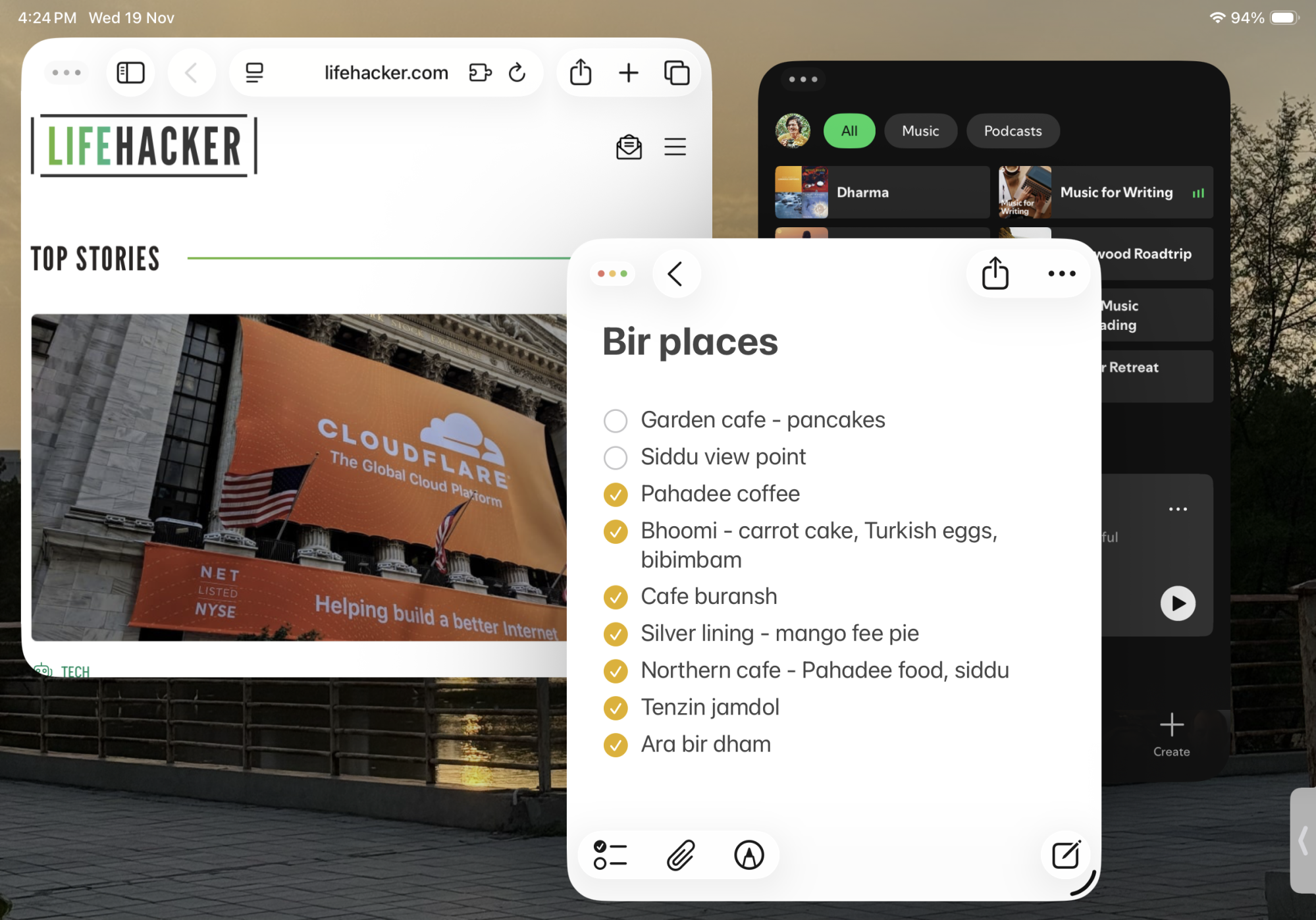
Three apps open at the same time on the iPad.

Credit: Khamosh Pathak

But for most users, I think defaulting to the Windowed Apps mode is the best option. This is where you can use the handle icon in the bottom-right corner of any window to resize it and move it anywhere you want. Need to open another app? Just repeat the process (although I think it’s pretty jarring that every new app first opens full-screen, and then needs to be resized down).

If you have a newer, more powerful iPad, Windowed mode lets you comfortably use seven or ten apps together in the same desktop without missing a beat. That’s not a limit with iPadOS 26, to be clear, but once you go over 10 apps, things start to get a bit laggy. I can pull off opening a couple of apps together on my aging iPad Pro from 2018, but that’s about it.

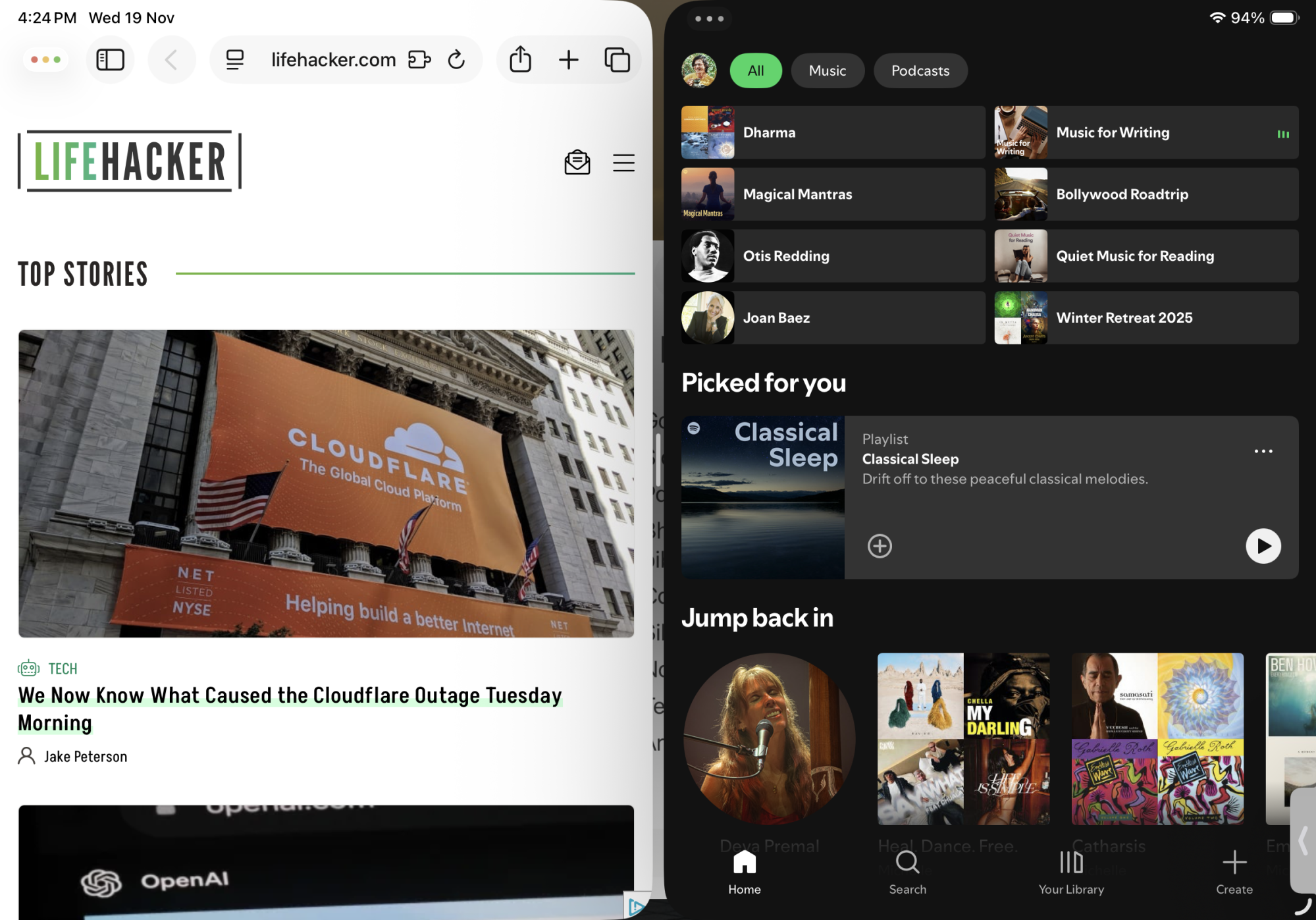
Two apps side by side in iPadOS 26.

Credit: Khamosh Pathak

You can use the new traffic-light buttons (straight from macOS) to close, minimize, or expand your windowed apps (something I’m still not used to). You can also swipe down from the top to access a Mac-like menu bar. This will hold app-related shortcuts and offer ways to move or dock apps to the left or right.

The Windowed app mode also has a version of the classic Split View, if you just want to dock two apps side by side. Pick up a window, and flick it to the left or right. When there are just two windows on the screen, you’ll see a little handle in the middle to freely resize the windows.

iPad app pinned in Slide Over.

Credit: Jake Peterson

With the iPadOS 26.1 update, Apple also brought back Slide Over, a crowd favorite that lets key apps slide in and out of view as needed, but it works in a slightly different manner now. From the menu bar, you can pin any window to the top of the screen to be your Slide Over app. And because this window itself is freeform, you can now resize it to any size you want (something that wasn’t possible before). Though, it’s still a downgrade in a sense because you can only pin one window at a time (before, you could pin multiple windows in Split View and switch between them like you do on the iPhone).

I’ll admit that all of this can seem like a bit much on such a small, touch-based screen, especially for the iPad users who are used to the traditional approach to Split View and Slide Over. Apple really isn’t helping the case by separating out the different modes. Though, like most things, it’s a learning curve that you can get over pretty quickly. In time, I think the gesture for resizing windows will become second nature.

How the iPad is inching closer to the Mac

Beyond Windowed mode, The iPadOS 26 update rights many other wrongs, all of which bring over key functionality from the Mac, though there are still sometimes caveats.

External monitor support is finally worth using, and doesn’t require you to use Stage Manager. Now, the display automatically adapts to the 16:9 aspect ratio of the monitor, so no more black bars. But you still can’t use the external display as the primary display, as you can on the Mac (the menu bar and Control Center still only work on the iPad). That means you always have to have the iPad display on, and you can’t connect to more than one external monitor.

New Columns view on the Files app.

Credit: Khamosh Pathak

The Files app is also much improved, combining a column layout with the ability to expand nested folders while in the same view. You can also add custom-colored icons. Plus, you can now add folders to the Dock for quick access. And finally, you can assign a default app for file extensions right in the Files app. The new Preview app makes it easy to view and mark up PDFs and images, too.

There’s also support for background tasks in the Files app and some third-party apps. That means longer actions, like moving large folders or downloading large files, can continue in the background (monitored via Live Activities). Switching to a different app won’t kill large exports of render jobs. There’s even a new Local Capture feature that lets you record professional audio from any attached microphone, and it supports independent audio capture from multiple microphones at once. A boon for podcasters and YouTubers.

How the iPad still falls behind the Mac

The iPadOS 26 update has a lot of useful, desktop-like features. But at its core, it’s still iPadOS, built on iOS. It is still sandboxed, and installing apps from outside of the App Store is not intended and requires lengthy workarounds. Many popular desktop-class apps also just won’t work on the iPad (like the full version of Adobe Premiere, the macOS version of Final Cut Pro, Logic Pro, coding IDEs, and more). Even Safari on the iPad is limited, and doesn’t offer desktop-class support. A lot of heavy/dynamic sites refuse to function on the iPad, but work well on Safari on a Mac.

There’s also no Terminal, so you can’t do things like running Homebrew projects, automation scripts, and more. iPadOS 26, is still single-user focused, so you can’t create multiple accounts like you can on the Mac. As discussed above, the external display mode, while a nice addition, is also severely limited.

Can you replace a Mac with an iPad?

Can an iPad replace your MacBook? The answer to that question is more personal than ever. Subjectively, I can say not yet. While the new windowing system and background processes are a great start, it still lacks the core features that make a Mac so helpful. For someone like me who relies on desktop-class apps, dynamic websites, and loves the hundred little utilities that are only possible on the Mac, the iPad really can’t replace my MacBook.

But the iPad can be a great companion for me, and is. I love using the iPad for research, reading, taking notes, and watching media. Now, with the new features in the iPadOS 26 update, I can see podcasters and even content creators take up an iPad as their main computer. It really depends on your workflow. For light workflow like editing documents, managing PDFs, taking notes, emails, and online meetings, the iPad is very much comparable to the Mac. And thanks to its cellular connectivity, it might even have an edge for people who are always on the road. If you like the idea of a light-weight tablet that’s built-really well, or if you’re a creative, the iPad can make a lot of sense for you.

For everyone else, I would recommend you pick up at least an M4 MacBook Air, which goes on sale regularly and costs less than an iPad Pro.

DeepMind’s latest: An AI for handling mathematical proofs

Computers are extremely good with numbers, but they haven’t gotten many human mathematicians fired. Until recently, they could barely hold their own in high school-level math competitions.

But now Google’s DeepMind team has built AlphaProof, an AI system that matched silver medalists’ performance at the 2024 International Mathematical Olympiad, scoring just one point short of gold at the most prestigious undergrad math competition in the world. And that’s kind of a big deal.

True understanding

The reason computers fared poorly in math competitions is that, while they far surpass humanity’s ability to perform calculations, they are not really that good at the logic and reasoning that is needed for advanced math. Put differently, they are good at performing calculations really quickly, but they usually suck at understanding why they’re doing them. While something like addition seems simple, humans can do semi-formal proofs based on definitions of addition or go for fully formal Peano arithmetic that defines the properties of natural numbers and operations like addition through axioms.

Read full article

Comments

NASA Monitoring Asteroids The Size Of A Bus Hurtling Towards Earth

NASA Monitoring Asteroids The Size Of A Bus Hurtling Towards Earth
NASA’s has been busy tracking a trio of sizable asteroids hurtling past Earth’s orbit, one traveling as close as 361,000 miles from us. While scientists at the Jet Propulsion Laboratory (JPL) assured the public that there’s no immediate danger with any of these objects, these flybys are fantastic opportunities to improve our own planetary

Chinese University Collected More AI Patents Than MIT, Stanford, Princeton and Harvard Combined

Tsinghua University collected 4,986 AI and machine learning patents between 2005 and the end of 2024. The Beijing institution has received more than 900 patents last year alone. The total exceeds the combined patent count from MIT, Stanford, Princeton and Harvard during the same period. China now accounts for more than half of all active patent families globally in AI and machine learning fields, according to data analytics service LexisNexis.

The university also has more AI research papers among the 100 most cited than any other school at last count. The US still holds the most influential AI patents and the top performing models. Harvard and MIT consistently rank ahead of Tsinghua in patent influence. American institutions produced 40 notable AI models in 2024 compared to 15 from Chinese organizations, according to Stanford’s AI Index Report. China’s share of the world’s elite AI researchers — the top 2% — rose from 10% in 2019 to 26% in 2022. The US share fell from 35% to 28% during the same period, according to the Information Technology & Innovation Foundation.


Read more of this story at Slashdot.

Inside Snapdragon X2 Elite: Qualcomm’s Next-Gen PC Chip Promises Big Gains

Inside Snapdragon X2 Elite: Qualcomm’s Next-Gen PC Chip Promises Big Gains
Qualcomm Snapdragon X2 Elite: MSRP TBD Qualcomm’s second generation PC processor, the Snapdragon X2 Elite, improves upon its predecessor in virtually every way, with more cores, increased performance, and enhanced efficiency. Higher Core Count (Up To 18) Increased Performance Per Core More Powerful GPU More Powerful NPUs Higher Memory Bandwidth…

Best Black Friday Mega Deals On 100-Inch TVs Priced From $999

Best Black Friday Mega Deals On 100-Inch TVs Priced From $999
The year is 2025 (for a few more weeks, anyway) and guess what? We’ve reached a point where buying a monster-sized TV doesn’t have to require a beastly budget. We took a look around at some early Black Friday deals and found several 100-inch and 98-inch models priced below two grand. We even found a couple that are a penny shy of one grand!
Insignia’s

A Ghost of Yōtei update will add a New Game+ mode, harder difficulties and more on November 24

Ghost of Yōtei is a lengthy game with tons of activities to do. But if you’ve beaten it and are already itching to jump back in, it might be best to wait until at least November 24 to do so. That’s when developer Sucker Punch will release an update that will introduce a bunch of new features to the PS5 title, including a New Game+ mode. 

That means you’ll be able to experience Atsu’s mission for revenge from the beginning again with all of the weapons, abilities and armor sets you unlocked from your first playthrough. Those early-game enemies are about to feel the wrath of many a flaming kusarigama. 

You’ll need to finish the main story before you can unlock New Game+, which includes tougher difficulty options and a pair of new trophies to snag. The free update will introduce extra upgrades for existing weapons and armor sets, along with a new ghost flowers currency that you can swap for fresh armor sets, weapon dyes and charms while playing New Game+.

There are a number of features coming to the base game as well (i.e. for all players, not just those who dip into New Game+). Directional button remapping is one of several new accessibility options. Photo Mode will gain new filters, a shutter speed tool and a composition grid. Also, after you’ve beaten the main story, you’ll be able to replay missions and quests. With a new stats display, you’ll be able to see how long it took you to win a given duel, for instance.  

Ghost of Yōtei isn’t getting an expansion quite yet. We’re crossing our dual katana for an Iki Island-style DLC for the game. In any case, Sucker Punch has already confirmed that Ghost of Yōtei Legends — which will be akin to the multiplayer mode in Ghost of Tsushima — is on the way in 2026.

This article originally appeared on Engadget at https://www.engadget.com/gaming/playstation/a-ghost-of-yotei-update-will-add-a-new-game-mode-harder-difficulties-and-more-on-november-24-150750632.html?src=rss

NVIDIA’s Shift To Smartphone-Style Server Memory Could Double DRAM Costs

NVIDIA's Shift To Smartphone-Style Server Memory Could Double DRAM Costs
Driven by the explosive demand for artificial intelligence, server memory could double in price by late 2026. The disruption originates from two prime sources: a recent shortage of DDR4/DDR5 legacy memory chips plus NVIDIA, the primary engine of the AI boom, pivoting its next-generation AI servers away from DDR5 memory toward LPDDR chips traditionally

Office Fitness Gadgets Are Selling You a Fantasy

To me, the under-desk treadmill is the ultimate symbol of productivity culture (read: late-stage capitalism). And I’m exactly the type to buy into the under-desk treadmill appeal. Why shouldn’t I want to walk while I work, burn calories during calls, and transform my sedentary office prisons into a wellness wonderland—all without sacrificing a single billable hour? (Never mind that I don’t work in an office or bill my hours.) Office fitness is the perfect hack for our optimization-obsessed culture, promising that we can have it all: career success and physical health, no trade-offs required.

But when I see an under-desk treadmill, I also remember when we all swore that replacing our desk chairs with yoga balls would change our lives. Or that a standing desk, or a balance board, or some kind of pedaling contraption would do the same. In other words, nothing ever changes. I’m not denying that there’s a problem with fully sedentary work days; it’s just that no one gadget ever seems to be the solution. And the problem isn’t that we lack willpower or that the products are inherently flawed. The problem is that we’re buying solutions to the wrong problem.

The allure of multitasking your way to health

I’m not immune to the fantasy either. When you’re drowning in deadlines and meetings bleed into evenings, the idea that you could somehow merge your workout with your workday feels like a lifeline. Why carve out an hour for the gym when you could just walk while answering emails? It’s efficient! It’s smart! It’s…probably not going to work the way you hope.

“I think these products can and do work for some people, but there’s an important caveat: there’s no replacement for actually getting away from your desk for a mental and physical break,” says Jen Fisher, formerly the chief wellbeing officer at Deloitte. “There’s a real irony here—these products aim to solve one problem (sedentary behavior) but reinforce another (never truly disconnecting from work).”

Therein lies the paradox: We’re trying to optimize ourselves into working more, not better. An under-desk treadmill might give you movement, sure, but it keeps you tethered to your screen, always available, always productive.

You might think that if anyone could make office fitness gadgets work, it would be Google—a company famous for its wellness perks and campus amenities. But even there, this pattern persists. “I love the treadmill desks that we have available whenever I’ve used them,” says Shosh Brodman, a senior Google Workspace program manager with over 13 years at the company. “But I think I’ve used it maybe less than five times.” Brodman’s experience with an under-desk pedaling device was similar: initial excitement followed by abandonment.

She says that despite access to gyms, treadmill desks, and a culture that supports movement, the fundamental problem remains: the structure of modern work doesn’t actually allow for these interventions. The one thing that did work for her? Step-tracking contests that encouraged actual breaks and movement, creating social motivation to escape the desk entirely. Compared to an under-desk treadmill, a real lunch walk gives you something far more valuable: a little mental space, entirely separate from work.

Fitness gadgets become another source of anxiety

The fitness gadget industrial complex has convinced us that the path to wellness is paved with data, tracking, and technology. But for many people, these tools become yet another thing to feel bad about.

“When it specifically comes to products that people use to mitigate their sedentary lifestyle, gadgets are never the answer,” says Melissa Painter, founder of Breakthru, an app that guides users through two-minute movement breaks. “Especially not gadgets that cause us inadvertently to outsource our body’s intelligence to a piece of tech. The minute we’re staring at data in the face of what we’ve ‘done wrong,’ the more likely we’re going to put it in a drawer and step away.”

This points to a pattern many of us recognize: the sleep tracker that made us more anxious about sleep, the step counter that turned movement into a guilt-inducing scorecard. Tools are only useful if they nudge us toward feeling better, rather than becoming another metric of inadequacy.

The absurdity becomes clear when we consider what actually helps us think and solve problems. “The reason going for a walk helps you solve a problem is because you’re moving and untethered,” Painter says. “The space and time away from your screen is an invitation for your mind to wander just enough so that instinctual solutions can emerge. Walking on a treadmill is not going to have the same impact. It’s like trying to do the wrong kinds of thinking at once.”

Breaking free from productivity culture

Here’s what makes our gadget obsession even more frustrating: We already know what works, but we just don’t want to hear it, because it requires actually stepping away from work. “It’s very American to think we don’t need breaks,” Painter says. Trapped in non-stop productivity culture, we fall prey to this idea that “wellness” requires an enormous amount of time and money. We live in a culture that treats rest as laziness and breaks as luxuries.

Fisher says that the type of work matters: “For passive tasks—listening to a meeting, reading documents—these tools might genuinely help. But I worry about the cultural message when we’re optimizing to work more rather than building in real breaks that actually support our wellbeing.” If these gadgets work in addition to actual breaks, great. But if you’re thinking “now I can skip my lunch walk because I have a treadmill desk,” that’s where we’ve gone wrong.

Fitness gadgets around the office allow us to maintain this idea that we can always be productive without any downtime. As if our bodies are just machines that need the right accessories to run indefinitely. We’d rather invest in expensive gadgets that let us keep working than accept that you might need to actually stop and rest. As a result, most of us end the workday feeling overwhelmed, fatigued, nowhere near the end of our to-do lists, and nowhere close to wanting to go to the gym.

The problem isn’t the under-desk treadmill itself, but the slippery slope of non-stop-optimization it represents. So, what’s the solution?

How to actually prioritize your wellness at work

The irony is that the effective solutions are free and simple—they just require us to challenge the “always on” culture we’ve normalized.

What people need instead are genuinely brief interventions that help them feel better and reconnect with their bodies. Getting up to see the sun. Watering a plant. Taking a walking meeting. These aren’t fancy, and they don’t require a $1,200 piece of equipment, but they do require something that feels even more expensive in our work culture: permission to stop working, even briefly.

There’s no need to swear off all office fitness products. Standing desks with decent ergonomics have real value for shifting body position throughout the day. If you genuinely use that balance board or under-desk elliptical regularly for passive tasks, and it’s in addition to real breaks, keep at it.

But for most of us, the better investment isn’t another gadget—it’s the harder work of time management and cultural change:

  • Set actual boundaries around breaks. Block time for a real lunch away from your desk. Schedule walking meetings. Stand up and stretch between Zoom calls. These sound obvious because they are, but we skip them because we’ve internalized the message that real breaks are indulgent.

  • Question the productivity narrative. Just like your doctor has been telling you for years: more movement throughout your day, across your lifetime, improves thinking, mood, focus, and attention span. If you still want to think in terms of productivity, consider that taking breaks isn’t sacrificing productivity, but actually promoting it.

  • Start absurdly small. You don’t need a $1,500 treadmill desk. You need to get up once an hour and walk to the window. Water a plant, step outside for a coffee, or try to touch your toes.

The bottom line

The fitness gadget industry thrives on our desire to optimize, to find the one weird trick that lets us have it all. But the actual hack is much less sexy: we need to accept that human bodies require breaks, that our brains need space to wander, and that no piece of equipment will let us cheat these fundamental needs.

The treadmill desk isn’t evil. It’s just a symptom of our broader refusal to accept that rest is productive, and that being fully present for our work sometimes means being fully absent from our screens.

So before you click “buy” on that under-desk elliptical, ask yourself: Am I solving my sedentariness problem, or am I buying permission to never truly step away from work? Because if it’s the latter, you already know where it’s going to end up—right next to that dusty yoga ball in the corner.

Cloudflare Explains Its Worst Outage Since 2019

Cloudflare suffered its worst network outage in six years on Tuesday, beginning at 11:20 UTC. The disruption prevented the content delivery network from routing traffic for roughly three hours. The failure, writes Cloudflare in a blog post, originated from a database permissions change deployed at 11:05 UTC. The modification altered how a database query returned information about bot detection features. The query began returning duplicate entries. A configuration file used to identify automated traffic doubled in size and spread across the network’s machines. Cloudflare’s traffic routing software reads this file to distinguish bots from legitimate users. The software had a built-in limit of 200 bot detection features. The enlarged file contained more than 200 entries. The software crashed when it encountered the unexpected file size.

Users attempting to access websites behind Cloudflare’s network received error messages. The outage affected multiple services. Turnstile security checks failed to load. The Workers KV storage service returned elevated error rates. Users could not log into Cloudflare’s dashboard. Access authentication failed for most customers.

Engineers initially suspected a coordinated attack. The configuration file was automatically regenerated every five minutes. Database servers produced either correct or corrupted files during a gradual system update. Services repeatedly recovered and failed as different versions of the file circulated. Teams stopped generating new files at 14:24 UTC and manually restored a working version. Most traffic resumed by 14:30 UTC. All systems returned to normal at 17:06 UTC.


Read more of this story at Slashdot.

How Louvre thieves exploited human psychology to avoid suspicion—and what it reveals about AI

On a sunny morning on October 19 2025, four men allegedly walked into the world’s most-visited museum and left, minutes later, with crown jewels worth 88 million euros ($101 million). The theft from Paris’ Louvre Museum—one of the world’s most surveilled cultural institutions—took just under eight minutes.

Visitors kept browsing. Security didn’t react (until alarms were triggered). The men disappeared into the city’s traffic before anyone realized what had happened.

Investigators later revealed that the thieves wore hi-vis vests, disguising themselves as construction workers. They arrived with a furniture lift, a common sight in Paris’s narrow streets, and used it to reach a balcony overlooking the Seine. Dressed as workers, they looked as if they belonged.

This strategy worked because we don’t see the world objectively. We see it through categories—through what we expect to see. The thieves understood the social categories that we perceive as “normal” and exploited them to avoid suspicion. Many artificial intelligence (AI) systems work in the same way and are vulnerable to the same kinds of mistakes as a result.

The sociologist Erving Goffman would describe what happened at the Louvre using his concept of the presentation of self: people “perform” social roles by adopting the cues others expect. Here, the performance of normality became the perfect camouflage.

The sociology of sight

Humans carry out mental categorization all the time to make sense of people and places. When something fits the category of “ordinary,” it slips from notice.

AI systems used for tasks such as facial recognition and detecting suspicious activity in a public area operate in a similar way. For humans, categorization is cultural. For AI, it is mathematical.

But both systems rely on learned patterns rather than objective reality. Because AI learns from data about who looks “normal” and who looks “suspicious,” it absorbs the categories embedded in its training data. And this makes it susceptible to bias.

The Louvre robbers weren’t seen as dangerous because they fit a trusted category. In AI, the same process can have the opposite effect: people who don’t fit the statistical norm become more visible and over-scrutinized.

It can mean a facial recognition system disproportionately flags certain racial or gendered groups as potential threats while letting others pass unnoticed.

A sociological lens helps us see that these aren’t separate issues. AI doesn’t invent its categories; it learns ours. When a computer vision system is trained on security footage where “normal” is defined by particular bodies, clothing, or behavior, it reproduces those assumptions.

Just as the museum’s guards looked past the thieves because they appeared to belong, AI can look past certain patterns while overreacting to others.

Categorization, whether human or algorithmic, is a double-edged sword. It helps us process information quickly, but it also encodes our cultural assumptions. Both people and machines rely on pattern recognition, which is an efficient but imperfect strategy.

A sociological view of AI treats algorithms as mirrors: They reflect back our social categories and hierarchies. In the Louvre case, the mirror is turned toward us. The robbers succeeded not because they were invisible, but because they were seen through the lens of normality. In AI terms, they passed the classification test.

From museum halls to machine learning

This link between perception and categorization reveals something important about our increasingly algorithmic world. Whether it’s a guard deciding who looks suspicious or an AI deciding who looks like a “shoplifter,” the underlying process is the same: assigning people to categories based on cues that feel objective but are culturally learned.

When an AI system is described as “biased,” this often means that it reflects those social categories too faithfully. The Louvre heist reminds us that these categories don’t just shape our attitudes, they shape what gets noticed at all.

After the theft, France’s culture minister promised new cameras and tighter security. But no matter how advanced those systems become, they will still rely on categorization. Someone, or something, must decide what counts as “suspicious behavior.” If that decision rests on assumptions, the same blind spots will persist.

The Louvre robbery will be remembered as one of Europe’s most spectacular museum thefts. The thieves succeeded because they mastered the sociology of appearance: They understood the categories of normality and used them as tools.

And in doing so, they showed how both people and machines can mistake conformity for safety. Their success in broad daylight wasn’t only a triumph of planning. It was a triumph of categorical thinking, the same logic that underlies both human perception and artificial intelligence.

The lesson is clear: Before we teach machines to see better, we must first learn to question how we see.

Vincent Charles, Reader in AI for Business and Management Science, Queen’s University Belfast and Tatiana Gherman, Associate Professor of AI for Business and Strategy, University of Northampton.

This article is republished from The Conversation under a Creative Commons license. Read the original article.

Read full article

Comments