Ukraine Is Jamming Russia’s ‘Superweapon’ With a Song

Longtime Slashdot reader fahrbot-bot shares a report from 404 Media: The Ukrainian Army is knocking a once-hyped Russian superweapon out of the sky by jamming it with a song and tricking it into thinking it’s in Lima, Peru. The Kremlin once called its Kh-47M2 Kinzhal ballistic missiles “invincible.” Joe Biden said the missile was “almost impossible to stop.” Now Ukrainian electronic warfare experts say they can counter the Kinzhal with some music and a re-direction order. […] Kinzhals and other guided munitions navigate by communicating with Russian satellites that are part of the GLONASS system, a GPS-style navigation network. Night Watch uses a jamming system called Lima EW to generate a disruption field that prevents anything in the area from communicating with a satellite. Many traditional jamming systems work by blasting receivers on munitions and aircraft with radio noise. Lima does that, but also sends along a digital signal and spoofs navigation signals. It “hacks” the receiver it’s communicating with to throw it off course.

Night Watch shared pictures of the downed Kinzhals with 404 Media that showed a missile with a controlled reception pattern antenna (CRPA), an active antenna that’s meant to resist jamming and spoofing. “We discovered that this missile had pretty old type of technology,” Night Watch said. “They had the same type of receivers as old Soviet missiles used to have. So there is nothing special, there is nothing new in those types of missiles.” Night Watch told 404 Media that it used this Lima to take down 19 Kinzhals in the past two weeks. First, it replaces the missile’s satellite navigation signals with the Ukrainian song “Our Father Is Bandera.”

Any digital noise or random signal would work to jam the navigation system, but Night Watch wanted to use the song because they think it’s funny. “We just send a song… we just make it into binary code, you know, like 010101, and just send it to the Russian navigation system,” Night Watch said. “It’s just kind of a joke. [Bandera] is a Ukrainian nationalist and Russia tries to use this person in their propaganda to say all Ukrainians are Nazis. They always try to scare the Russian people that Ukrainians are, culturally, all the same as Bandera.” Once the song hits, Night Watch uses Lima to spoof a navigation signal to the missiles and make them think they’re in Lima, Peru. Once the missile’s confused about its location, it attempts to change direction. These missiles are fast — launched from a MiG-31 they can hit speeds of up to Mach 5.7 or more than 4,000 miles per hour — and an object moving that fast doesn’t fare well with sudden changes of direction.


Read more of this story at Slashdot.

Magician Forgets Password To His Own Hand After RFID Chip Implant

A magician who implanted an RFID chip in his hand lost access to it after forgetting the password, leaving him effectively locked out of the tech embedded in his own body. The Register reports: “It turns out,” said [said magician Zi Teng Wang], “that pressing someone else’s phone to my hand repeatedly, trying to figure out where their phone’s RFID reader is, really doesn’t come off super mysterious and magical and amazing.” Then there are the people who don’t even have their phone’s RFID reader enabled. Using his own phone would, in Zi’s words, lack a certain “oomph.”

Oh well, how about making the chip spit out a Bitcoin address? “That literally never came up either.” In the end, Zi rewrote the chip to link to a meme, “and if you ever meet me in person you can scan my chip and see the meme.” It was all suitably amusing until the Imgur link Zi was using went down. Not everything on the World Wide Web is forever, and there is no guarantee that a given link will work indefinitely. Indeed, access to Imgur from the United Kingdom was abruptly cut off on September 30 in response to the country’s age verification rules.

Still, the link not working isn’t the end of the world. Zi could just reprogram the chip again, right? Wrong. “When I went to rewrite the chip, I was horrified to realize I forgot the password that I had locked it with.” The link eventually started working again, but if and when it stops, Zi’s party piece will be a little less entertaining. He said: “Techie friends I’ve consulted with have determined that it’s too dumb and simple to hack, the only way to crack it is to strap on an RFID reader for days to weeks, brute forcing every possible combination.” Or perhaps some surgery to remove the offending hardware.


Read more of this story at Slashdot.

Iran’s Capital Is Moving. The Reason Is an Ecological Catastrophe

An anonymous reader quotes a report from Scientific American: Amid a deepening ecological crisis and acute water shortage, Tehran can no longer remain the capital of Iran, the country’s president has said. The situation in Tehran is the result of “a perfect storm of climate change and corruption,” says Michael Rubin, a political analyst at the American Enterprise Institute. “We no longer have a choice,” said Iranian president Masoud Pezeshkian during a speech on Thursday. Instead Iranian officials are considering moving the capital to the country’s southern coast. But experts say the proposal does not change the reality for the nearly 10 million people who live in Tehran and are now suffering the consequences of a decades-long decline in water supply. Iran’s capital has moved many times over the centuries, notes the report. “But this marks the first time the Iranian government has moved the capital because of an ecological catastrophe.” Yet, Rubin says, “it would be a mistake to look at this only through the lens of climate change” and not factor in the water, land, and wastewater mismanagement and corruption that have made the crisis worse.

Linda Shi, a social scientist and urban planner at Cornell University, says: “Climate change is not the thing that is causing it, but it is a convenient factor to blame in order to avoid taking responsibility” for poor political decisions.


Read more of this story at Slashdot.

Cryptographers Cancel Election Results After Losing Decryption Key

The International Association of Cryptologic Research (IACR) was forced to cancel its leadership election after a trustee lost their portion of the Helios voting system’s decryption key, making it impossible to reveal or verify the final results. Ars Technica reports: The IACR said Friday that the votes were submitted and tallied using Helios, an open source voting system that uses peer-reviewed cryptography to cast and count votes in a verifiable, confidential, and privacy-preserving way. Helios encrypts each vote in a way that assures each ballot is secret. Other cryptography used by Helios allows each voter to confirm their ballot was counted fairly. “Unfortunately, one of the three trustees has irretrievably lost their private key, an honest but unfortunate human mistake, and therefore cannot compute their decryption share,” the IACR said. “As a result, Helios is unable to complete the decryption process, and it is technically impossible for us to obtain or verify the final outcome of this election.”

The IACR will switch to a two-of-three private key system to prevent this sort of thing from happening again. Moti Yung, the trustee responsible for the incident, has resigned and is being replaced by Michael Abdalla.


Read more of this story at Slashdot.

SEC Dismisses Case Against SolarWinds, Top Security Officer

The SEC has officially dismissed its high-profile case against SolarWinds and its CISO that was tied to a Russia-linked cyberattack involving the software company. Reuters reports: The landmark case, which SEC brought in late 2023, rattled the cybersecurity community and later faced scrutiny from a judge who dismissed many of the charges. The SEC had said SolarWinds and its chief information security officer had violated U.S. securities laws by concealing vulnerabilities in connection with the high-profile 2020 Sunburst cyber attack. The SEC, SolarWinds and CISO Timothy Brown filed a motion on Thursday to dismiss the case with prejudice, according to a joint stipulation posted on the agency’s website. A SolarWinds spokesperson said the firm is “clearly delighted” with the dismissal.

“We hope this resolution eases the concerns many CISOs have voiced about this case and the potential chilling effect it threatened to impose on their work,” the spokesperson said.


Read more of this story at Slashdot.

Cryptography group cancels election results after official loses secret key

One of the world’s premier security organizations has canceled the results of its annual leadership election after an official lost an encryption key needed to unlock results stored in a verifiable and privacy-preserving voting system.

The International Association of Cryptologic Research (IACR) said Friday that the votes were submitted and tallied using Helios, an open source voting system that uses peer-reviewed cryptography to cast and count votes in a verifiable, confidential, and privacy-preserving way. Helios encrypts each vote in a way that assures each ballot is secret. Other cryptography used by Helios allows each voter to confirm their ballot was counted fairly.

An “honest but unfortunate human mistake”

Per the association’s bylaws, three members of the election committee act as independent trustees. To prevent two of them from colluding to cook the results, each trustee holds a third of the cryptographic key material needed to decrypt results.

Read full article

Comments

Malaysia’s Palm Oil Estates Are Turning Into Data Centers

An anonymous reader quotes a report from Bloomberg: Malaysia’s palm oil giants, long-blamed for razing rainforests, fueling toxic haze and driving orangutans to the brink of extinction, are recasting themselves as unlikely champions in a different, potentially greener race: the quest to lure the world’s AI data centers to the Southeast Asian country (source paywalled; alternative source). Palm oil companies are earmarking some of the vast tracts of land they own for industrial parks studded with data centers and solar panels, the latter meant to feed the insatiable energy appetites of the former. The logic is simple: data centers are power and land hogs. By 2035, they could demand at least five gigawatts of electricity in Malaysia — almost 20% of the country’s current generation capacity and roughly enough to power a major city like Miami. Malaysia also needs space to house server farms, and palm oil giants control more land than any other private entity in the country.

The country has been at the heart of a regional data center boom. Last year, it was the fastest-growing data center market in the Asia-Pacific region and roughly 40% of all planned capacity in Southeast Asia is now slated for Malaysia, according to industry consultant DC Byte. Over the past four years, $34 billion in data center investments has poured into the country — Alphabet’s Google committed $2 billion, Microsoft announced a $2.2 billion investment and Amazon is spending $6.2 billion, to name a few. The government aims for 81 data centers by 2035. The rush is partly a spillover from Singapore, where a years-long moratorium on new centers forced operators to look north. Johor, just across the causeway, is now a hive of construction cranes and server farms — including for firms such as Singapore Telecommunications, Nvidia and ByteDance. But delivering on government promises of renewable power is proving harder.

The strains are already being felt in Malaysia’s data center capital. Sedenak Tech Park, one of Johor’s flagship sites, is telling potential tenants they’ll need to wait until the fourth quarter of 2026 for promised water and power hookups under its second-phase expansion, according to DC Byte. The vacancy rate in Johor’s live facilities is just 1.1%, according to real estate consultant Knight Frank. Despite its rapid growth, the market is nowhere near saturation, with six gigawatts of capacity expected to be built out over time, said Knight Frank’s head of data centers for Asia Pacific, Fred Fitzalan Howard. That potential bottleneck has incentivized palm oil majors such as SD Guthrie Bhd. to pitch themselves as both landowners and green-power suppliers. The $8.9 billion palm oil producer, SD Guthrie, is the world’s largest palm oil planter by acreage, with more than 340,000 hectares in Malaysia. “SD Guthrie is pivoting to solar farms and industrial parks, betting that tech giants hungry for server space will prefer sites with ready access to renewable energy,” reports Bloomberg. “The company has reserved 10,000 hectares for such projects over the next decade, starting with clearing old rubber estates and low-yielding palm plots in areas near data center and semiconductor investment hubs.”

“The company’s calculation is based on this: one megawatt of solar requires about 1.5 hectares. Helmy said SD Guthrie wants one gigawatt in operation within three years, enough to power up to 10 hyperscale data centers used for AI computing. The new business is expected to make up about a third of its profits by the end of the decade.”


Read more of this story at Slashdot.

X’s handle marketplace is open and there are some… interesting names if you’re willing to pay

After previewing its plans to open a marketplace to “redistribute” dormant handles last month, X has made the feature available to all Premium+ subscribers on the platform. The feature allows subscribers to request new handles that up to now have been unavailable because they belonged to accounts that have since become inactive. 

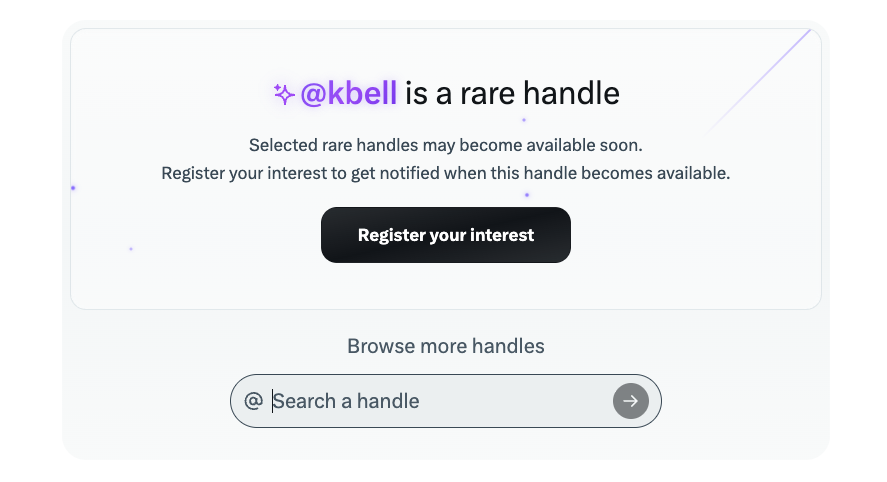
The marketplace offers two types of handles: “priority” and “rare.” For priority handles, X has suggested the goal is to give people the chance to have a handle that more closely reflects their name. In practice, though, it’s not at all clear how X is determining what’s considered a “priority” versus a “rare” handle. I signed up for a $40/month subscription and searched for both @kbell and @karissa only to be told that both are considered “rare” and thus not available to me. I was able to “register” my “interest” in the names, and include a brief description of why I wanted the handles. 

My first initial and last name is, apparently, "rare."
My first initial and last name is, apparently, “rare.”
X

The company says that rare handles are “the most valuable” names and are “often words, slang, or containing few characters. Some options that may one day be available, according to my searching, include @memelord, @phone, @gr0k and @AIchat. The exact process for acquiring one of these, though, isn’t exactly clear. X says that handles on your watchlist “may be released in a public drop where you, and others can apply to receive the handle for free via a merit based application system.” The company has also said that it will make some especially sought-after handles available for purchase on an invitation-only basis, with prices “anywhere from $2,500 to over seven figures.” 

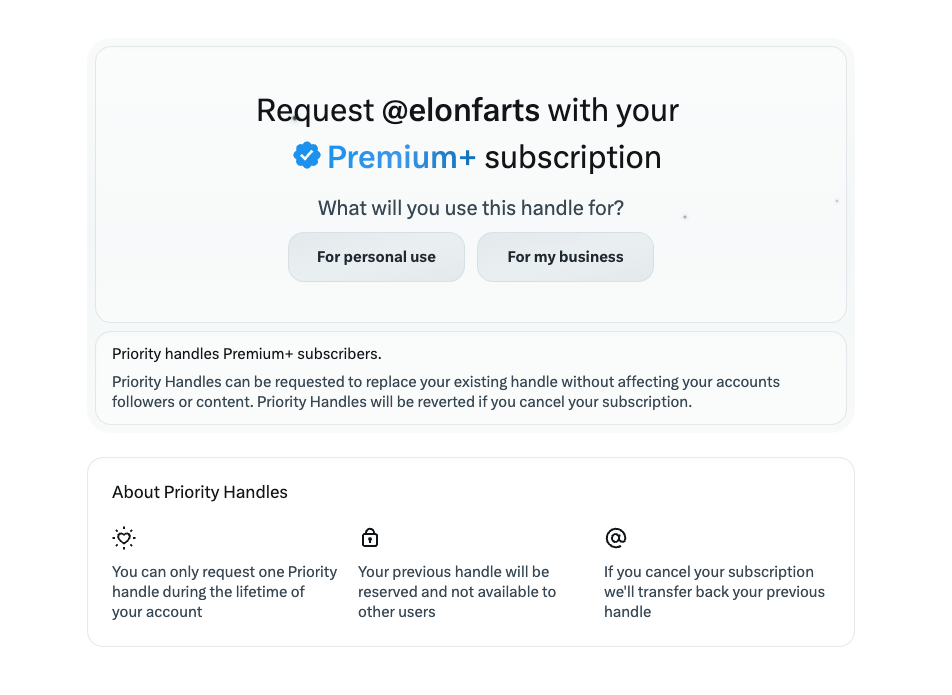
There's some good meme potential here, if you can get it.
There’s some good meme potential here, if you can get it.
X

After a bit of perusing, I did find that there were a few entertaining options that are theoretically available now as “priority” handles, including @six_seven, @elonfarts, @grokfacts and @kbchat. Honestly, all of these were at least a little tempting, though I’m not at all confident X would approve @elonfarts or @grokfacts. You also have to consider these requests at least a little carefully because X is only giving users the ability to request one priority handle during the entire lifetime of their account. 

There are also some significant strings attached to the whole process. In addition to being required to maintain a $40/month or $395/year Premium+ subscription, X has a rather strict set of rules for “maintaining your handle.” These include:

-Create content regularly. If an account is active but the associated handle remains largely dormant – for example, where little or no original or engaging content is published – X may reclaim the handle.

-Use the handle in a way that reflects the spirit of participation and expression on X.  That means active involvement in platform activities (replying, reposting, discussing topics) that help build a vibrant community for sharing ideas and expressions.  X’s intent is to ensure that handles remain available for active voices and creators who help advance the mission of the platform, not for speculation or inactivity. 

-Ensure regular activity on the platform, with a minimum of 1 device login within a 30 day period. For details, see our Inactive Account Policy.

The terms also state that “X owns and can reclaim any handle,” which is more than theoretical. The company has a long history of commandeering desirable handles from users that were actively using them including, infamously, @X. 

Given all that, I still have yet to follow through on requesting any of the available “priority” handles I’ve found. I might just stick with the same handle (@karissabe) I’ve been using for the last 16 years. It’s only two letters off from the supposed “rare” variation of my first name only, and it won’t cost anything extra to keep.

This article originally appeared on Engadget at https://www.engadget.com/social-media/xs-handle-marketplace-is-open-and-there-are-some-interesting-names-if-youre-willing-to-pay-000020665.html?src=rss

Google Must Double AI Serving Capacity Every 6 Months To Meet Demand

Google’s AI infrastructure chief told employees the company must double its AI serving capacity every six months in order to meet demand. In a presentation earlier this month, Amin Vahdat, a vice president at Google Cloud, gave a presentation titled “AI Infrastructure.” It included a slide on “AI compute demand” that said: “Now we must double every 6 months…. the next 1000x in 4-5 years.” CNBC reports: The presentation was delivered a week after Alphabet reported better-than-expected third-quarter results and raised its capital expenditures forecast for the second time this year, to a range of $91 billion to $93 billion, followed by a “significant increase” in 2026. Hyperscaler peers Microsoft, Amazon and Meta also boosted their capex guidance, and the four companies now expect to collectively spend more than $380 billion this year.

Google’s “job is of course to build this infrastructure but it’s not to outspend the competition, necessarily,” Vahdat said. “We’re going to spend a lot,” he said, adding that the real goal is to provide infrastructure that is far “more reliable, more performant and more scalable than what’s available anywhere else.” In addition to infrastructure build-outs, Vahdat said Google bolsters capacity with more efficient models and through its custom silicon. Last week, Google announced the public launch of its seventh generation Tensor Processing Unit called Ironwood, which the company says is nearly 30 times more power efficient than its first Cloud TPU from 2018.

Vahdat said the company has a big advantage with DeepMind, which has research on what AI models can look like in future years. Google needs to “be able to deliver 1,000 times more capability, compute, storage networking for essentially the same cost and increasingly, the same power, the same energy level,” Vahdat said. “It won’t be easy but through collaboration and co-design, we’re going to get there.”


Read more of this story at Slashdot.

Hytale will only cost $20 because it isn’t good yet, its developer says

Hytale, a more action-packed take on Minecraft, will be available for $20 when it relaunches in early access, Hypixel Studios announced on X. The developer shared that it planned to relaunch Hytale earlier this week after successfully reacquiring the rights to the game from Riot Games.

Alongside its $20 “Standard” edition, Hypixel also plans to offer $35 “Supporter” and $70 “Cursebreaker” editions of Hytale with additional in-game cosmetics. Pricing the game at $20 is an acknowledgement of how unfinished it is, according to Hypixel Studios co-founder Simon Collins-Laflamme. “I’m pricing Hytale as aggressively low as possible,” Collins-Laflamme said in an X post. “The game is unfinished and runs on a build from over four years ago. Charging more didn’t feel right. I don’t think the game is good yet.”

I’m pricing Hytale as aggressively low as possible. I’m taking on a considerable personal risk after repurchasing the game and getting it ready for early access for a growing team of now 50 talented individuals. I said I was all in, and I am delivering on that promise.

The game… https://t.co/KxBmOLxMQN

— Simon (@Simon_Hypixel) November 21, 2025

Hypixel Studios shared footage of Hytale the day after it announced its deal with Riot Games. The game was originally cancelled by Riot in June 2025, after five years of development and “a major reboot of the game engine,” Hypixel CEO Aaron Donaghey said at the time. 

Riot Games bought Hypixel Studios during a period of expansion that included the launch of the company’s publishing label Riot Forge, which was responsible for League of Legends spinoffs like Ruined King: A League of Legends Story. Riot eventually decided to sunset Riot Forge in 2024, alongside mass layoffs at the studio.

This article originally appeared on Engadget at https://www.engadget.com/gaming/hytale-will-only-cost-20-because-it-isnt-good-yet-its-developer-says-213747982.html?src=rss

British Army Will Use Call of Duty To Train Soldiers

British soldiers are using computer games such as Call of Duty to sharpen their “war-fighting readiness,” an Army chief has said. From a report: General Sir Tom Copinger-Symes, the deputy commander of Cyber and Specialist Operations Command, said the war in Ukraine, where remote-operated drones have become crucial on the battlefield, proved the worth of having soldiers skilled in video gaming.

The Ministry of Defence on Friday announced the launch of the International Defence Esports Games (IDEG), a video gaming tournament that will pit the best of Britain’s “future cyber warriors” against military teams from 40 other countries.


Read more of this story at Slashdot.

Aoostar Teases A Slick Mini PC With AMD Ryzen AI Max+ 395 Strix Halo Chip

Aoostar Teases A Slick Mini PC With AMD Ryzen AI Max+ 395 Strix Halo Chip
Aoostar released an updated teaser image of its AMD Ryzen Strix Halo-powered mini PC, the Aoostar Nex395, with a much different design than the original. The new design looks much smoother and more streamlined, whereas the former  had sharper edges and a darker color scheme.

The new teaser image (originally spotted by @realVictor_M on X/Twitter),

wBlock Is the Best Way to Block Ads on Safari

Want to block ads on your Mac, iPhone, or iPad? wBlock is quickly becoming my favorite solution: it’s free, open source, fast, and customizable.

Ad blocking is in a weird place. Google, the company that makes more money from advertising than any other on Earth, is actively working to make ad blockers worse on Chrome while it also makes it harder to block ads on YouTube. Basically, it’s a good time to not use Chrome.

So it’s nice that Apple users have another choice: Safari. And, as luck would have it, Safari has an extremely efficient API for ad blocking built right in. The ad blocker wBlock uses this, and the result is ads are blocked in a way that doesn’t slow down your browsing.

I wrote a few months ago about uBlock Origin for Safari, which doesn’t use Apple’s native blocking feature. I enjoyed how effective that application was at blocking ads, but over time I’ve found it does impact the performance of my browser a little. After setting up wBlock, everything feels snappy.

You can install wBlock from the App Store on your Mac, iPhone, or iPad. After doing so, you can choose which filter lists you want to use. Several are offered, or you can just stick with the defaults.

The onboarding for wBlock, asking which filters you'd like to enable.

Credit: Justin Pot

You will also be asked if you want to enable any userscripts. The ones offered bring back YouTube’s old interface and bypass paywalls. You can also install custom userscripts, if you want, meaning you won’t need a separate application for that functionality.

After that, you’ll need to open Safari, head to the settings, and turn on all the wBlock entries you see on the extensions page. Do that and you should be able to browse the web without any ads.

If you’re curious about how this extension works and how it compares to other Safari ad blockers, I recommend checking out the documentation on Github—it goes over how this tool works and how it differs from other applications. I also encourage you to think about the pros and cons of blocking ads overall.

Japan Says World’s Largest Nuclear Plant To Restart

The Japanese government said that the world’s biggest nuclear plant would restart operations. Semafor: The Kashiwazaki-Kariwa site closed in 2012, as Japan — which previously generated 30% of its electricity from nuclear power — shuttered most of its fleet in the wake of the Fukushima meltdown. But like much of the world, it is looking once again to nuclear power for reliable, low-carbon energy, especially in the face of high gas and oil prices following Russia’s invasion of Ukraine. It has restarted 14 out of 54 plants and announced plans for a first new reactor since the disaster.


Read more of this story at Slashdot.

You can now search the Epstein emails in a simulated Gmail tab

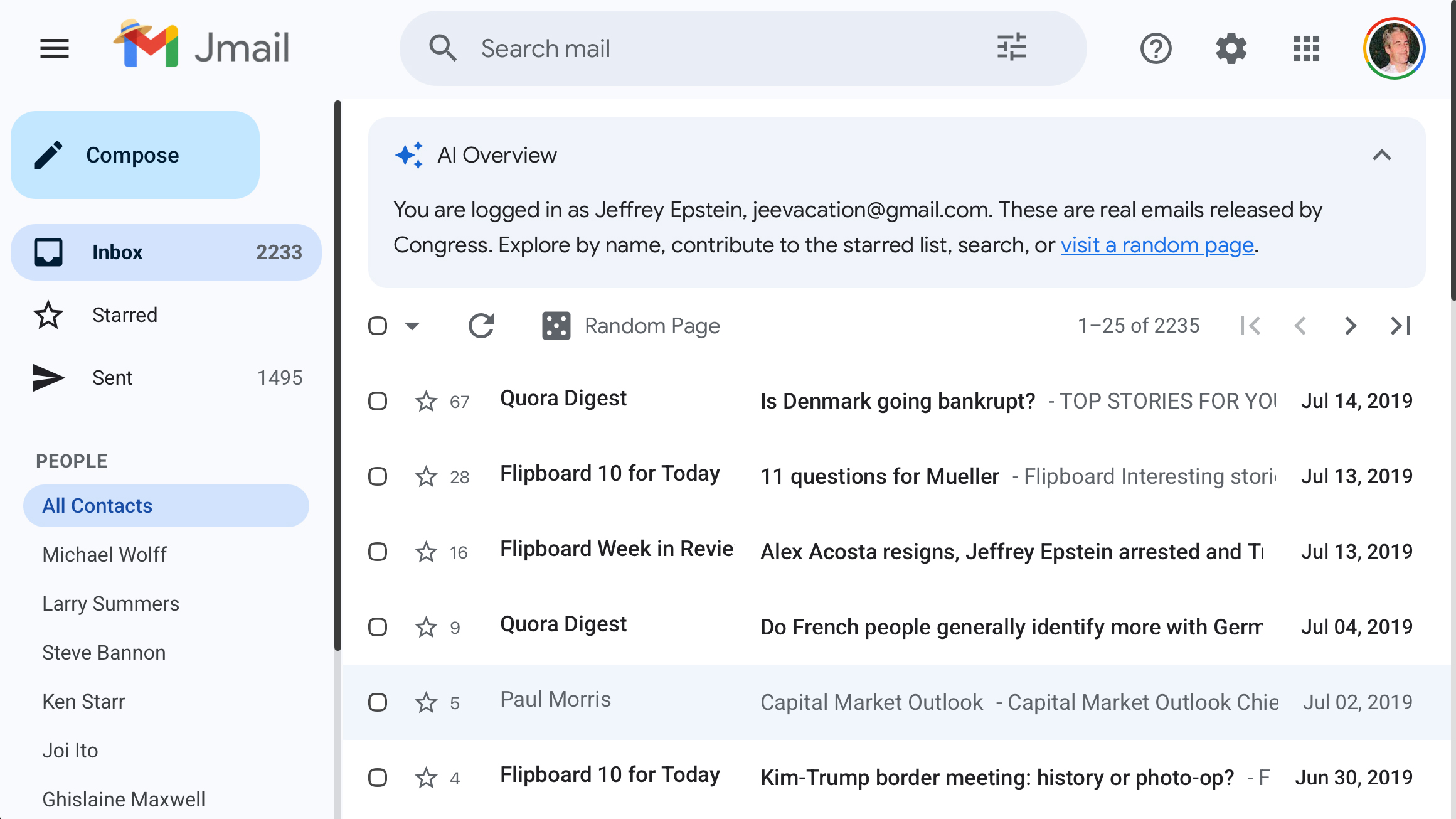
Here’s some light — and revolting! — reading while we wait for the Epstein Files to be released (or stonewalled). You can now peruse the Jeffrey Epstein emails, recently released by Congress, in a simulated Gmail account.

“You’re logged in as Jeffrey Epstein,” the Jmail website reads. (Ick.) Luke Igel, CEO of Kino, and software engineer Riley Walz collaborated on the project. The latter is one of the creators of the Panama Playlists, which (in a similar light) turned Spotify’s lax privacy into a website for public figures’ “leaked” musical tastes.

Jmail is about as faithful a recreation of Gmail as you could imagine. Just like a real inbox, the messages are sorted from the most recent, up to the eve of Epstein’s 2019 arrest for the sex trafficking of minors. It includes a working search feature.

Screenshot of the Jmail project. A simulated Gmail inbox of Jeffrey Epstein, using real emails released by Congress.
Luke Igel / Riley Walz

The US House Oversight Committee released the emails on November 12. Their revelations put Donald Trump’s relationship with the sex trafficker back in the spotlight. The president’s name appears many times in the more than 20,000 documents. In one, the late sex offender claimed Trump “knew about the girls.”

In a 2011 email to Ghislaine Maxwell, Epstein said Trump “spent hours at my house” with someone whose name was redacted. (The committee said it was a victim.) In a 2017 thread, Epstein described the current president as “worse in real life and upclose.” In 2018, the disgraced financier boasted he was “the one able to take [Trump] down.”

Another public figure who came out looking even worse than before was the Andrew formerly known as “Prince” (Andrew Mountbatten-Windsor). He told Epstein in 2011, “We’re in this together.” Then there’s former Treasury Secretary Larry Summers. He stayed in touch with Epstein as recently as 2019, long after the latter’s 2008 arrest for soliciting underage sex. In the wake of the email dump, Summers was put on leave from Harvard and resigned from OpenAI’s board.

You can check out Jmail at the project’s website. Nobody will fault you if you need to shower afterward (and perhaps douse yourself in bleach).

This article originally appeared on Engadget at https://www.engadget.com/entertainment/you-can-now-search-the-epstein-emails-in-a-simulated-gmail-tab-203818438.html?src=rss

Apple TV+ Black Friday deal: Get six months of access for only $36

Apple TV+ is offering six months of access for only $36 for Black Friday. The deal is live now for new and eligible returning subscribers and runs through December 1, giving you a chance to stream shows like Silo, The Morning Show and For All Mankind for less. It’s a short-term offer, so you’ll want to grab it while it’s available. The biggest caveat to the deal is that you must subscribe directly through Apple and not through a third-party service.

Apple TV+ continues to build one of the strongest lineups in streaming. Its library includes standout originals like Ted Lasso, Severance, Slow Horses, For All Mankind, Foundation and Silo, along with newer releases such as The Studio and Dope Thief. On the film side, you’ll find the 2022 Best Picture winner CODA, plus Killers of the Flower Moon, Blitz and Tetris.

Apple’s streaming service has earned plenty of recognition since launch. Apple TV+ shows picked up 10 Emmy Awards in 2024, including a win for Slow Horses for outstanding writing in a drama series.

Apple TV+ also offers a polished streaming experience. All content is ad-free and available in up to 4K HDR, with Dolby Vision and Dolby Atmos support where available. The app works on nearly every device, from iPhone and iPad to smart TVs, PlayStation, Xbox and Roku. You can also download episodes and movies to watch offline, which is handy for travel or long commutes.

If you’re already invested in Apple’s ecosystem, the integration is seamless. You can share your subscription with up to five other people through Family Sharing, and playback syncs across devices so you can start a show on your iPhone and finish it on your TV. Apple TV+ is also part of the Apple One bundle if you prefer to manage multiple Apple services under a single plan.

This deal is available to new and qualified returning subscribers, meaning those who haven’t had an active subscription in the past 30 days. You’ll need to sign up directly through Apple rather than a third-party service or carrier. Once the three-month period ends, the plan renews at the standard $13 per month, so be sure to cancel before the renewal date if you don’t want to continue.

With a growing slate of original series, award-winning films and a slick interface, Apple TV+ has turned into one of the best streaming services for premium content. And with this limited-time deal, you can catch up on its biggest hits without paying full price.

This article originally appeared on Engadget at https://www.engadget.com/deals/apple-tv-black-friday-deal-get-six-months-of-access-for-only-36-203322621.html?src=rss

You Can Now Directly Import Apple Music Playlists to Spotify

If you’ve spent years curating playlists in Apple Music or another streaming service, you can now easily transfer your playlist to your Spotify library without needing to start from scratch or pay for a third-party service. Playlist transfers are now built into Spotify thanks to a new integration with TuneMyMusic, which facilitates music syncing, sharing, transfers, and backups across platforms.

To initiate a playlist transfer from Apple Music or another streaming service (YouTube Music, Amazon Music, SoundCloud, etc.), open the Spotify mobile app and tap Your Library. Scroll to the bottom of the page, tap Import your music > Get Started, and follow the on-screen prompts to connect with TuneMyMusic. You can choose which platform to transfer music from, and your playlists will populate in Spotify. Your playlists will remain on the original platform, as they are simply being copied into Spotify. (This feature is currently rolling out to users, so you may need to update your Spotify app.)

Data portability across music streamers has been very limited, but it’s getting better: TuneMyMusic was already compatible with Spotify, but users had to sign up for a free trial with the service and were capped at just 500 songs before needing to upgrade to a paid plan. (Other third-party playlist transfer tools include FreeYourMusic and Soundiiz.)

Apple Music has a music transfer feature built into its iOS and iPadOS (under Settings > Apps > Music) as well as the Apple Music app for Android and via the web. YouTube Music supports playlist imports and exports but requires a third-party service for platforms that don’t permit direct transfers.

Tech company CTO and others indicted for exporting Nvidia chips to China

The US crackdown on chip exports to China has continued with the arrests of four people accused of a conspiracy to illegally export Nvidia chips. Two US citizens and two nationals of the People’s Republic of China (PRC), all of whom live in the US, were charged in an indictment unsealed on Wednesday in US District Court for the Middle District of Florida.

The indictment alleges a scheme to send Nvidia “GPUs to China by falsifying paperwork, creating fake contracts, and misleading US authorities,” John Eisenberg, assistant attorney general for the Justice Department’s National Security Division, said in a press release yesterday.

The four arrestees are Hon Ning Ho (aka Mathew Ho), a US citizen who was born in Hong Kong and lives in Tampa, Florida; Brian Curtis Raymond, a US citizen who lives in Huntsville, Alabama; Cham Li (aka Tony Li), a PRC national who lives in San Leandro, California; and Jing Chen (aka Harry Chen), a PRC national who lives in Tampa on an F-1 non-immigrant student visa.

Read full article

Comments

Australia is adding Twitch to its social media ban for children

The breadth and reach of Australia’s pioneering social media ban grows as livestream platform Twitch has now been added to the list of banned platforms for users under 16 years of age. The nationwide ban is the first of its kind and encompasses Facebook, X, TikTok, Snapchat, YouTube and recently Reddit.

According to the BBC, Australia’s eSafety Commissioner Julie Inman Grant said Twitch had been included because it was “a platform most commonly used for livestreaming or posting content that enables users, including Australian children, to interact with others in relation to the content posted.”

No other platforms are expected to be added before the law goes into effect next month. Grant also said on Friday that Pinterest would not be included in the ban because the core purpose of the platform was not online social interaction.

Under the ban, platforms are expected to take “reasonable steps” to prevent underage users from accessing their platforms, and face steep fees for failure to comply. While VPNs may provide a workaround in some instances, the law still creates an enormous barrier to entry for users under 16.

Earlier this month, Denmark announced its lawmakers had reached a bipartisan agreement to enact a similar ban for users under 15, though details were scarce. In the US, several states have attempted to enact such a ban including Texas and Florida, though these measures either failed to pass or are held up in court. Even laws that don’t go as far, such as Utah’s law requiring parents to grant permission for teens to open social media accounts, are facing stiff opposition on First Amendment grounds.

Concern around minors’ social media continues to grow in the zeitgeist as evidence mounts surrounding the potential ill effects these platforms have on their youngest users.

This article originally appeared on Engadget at https://www.engadget.com/social-media/australia-is-adding-twitch-to-its-social-media-ban-for-children-202033276.html?src=rss

Data-driven sport: How Red Bull and AT&T move terabytes of F1 info

LAS VEGAS—A Formula 1 car runs on soon-to-be-synthetic gasoline, but an F1 team runs on data. It’s always been an engineering-driven sport, and while you can make decisions based on a hunch, the kinds of people who become good engineers prefer something a little more convincing. And the volumes of data just continue to get bigger and bigger each season. A few years ago we spoke to Red Bull Racing about how it stayed on top of the task, but a lot has changed in F1 since 2017, as we found out at this year’s Las Vegas Grand Prix.

It’s hugely popular now, for one thing, even in the United States: a 200 mph soap opera now with 24 episodes a season. Superficially the cars look the same—exposed wheels, front and rear wings, the driver in between some side pods. And the hybrid powertrains that make the cars move are still the same format: 1.6 L turbocharged V6 engines that recover energy from the rear wheels under braking as well as the turbine as it gets spun by hot exhaust gases.

But the cars are actually fundamentally different, particularly the way they generate their aerodynamic grip mostly via ground effect generated by the specially sculpted underside of their floors rather than the front and rear wings. A bigger change lurks in everyone’s accounts. The days where teams were free to spend as much money as they could find are gone.

Read full article

Comments