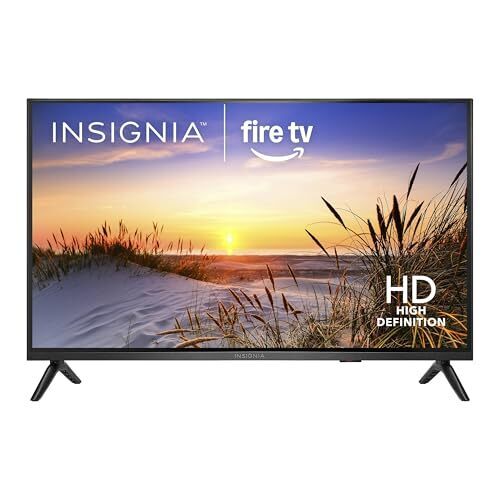
This Amazon Big Spring Sale deal on a TV is remarkable: A Hisense 32″ LED television for $74.99—that’s cheaper than dinner and drinks in most U.S. cities. This isn’t going to be the greatest TV of all time, but from all available accounts, its at least a solid set. It’s an older model—released in 2020—but that means there are over 3,000 reviews on Amazon, and the score is a respectable 4.1 stars out of 5. Critics generally were positive when it first came out, too.
The screen is 32″ screen, so it’s big enough to be watchable, and the picture is 720p so it’s technically “high-def,” if not “full high-def.” It even comes with built-in Alexa and FireTV.
Bottom line: I could totally see having this in a bedroom as a second TV, as an interim TV while you wait to get your real set, or a TV if you’re the kind of person who low-key hates watching TV, but you don’t want to feel totally disconnected with the larger world. And hey, if it doesn’t work out, you’re not out too much money.
Our Best Editor-Vetted Amazon Big Spring Sale Deals Right Now
WhatsApp shared multiple quality of life updates coming to its messaging platform starting today. The first is a long awaited option to have two accounts on a single iOS device. The option has been available for years on Android, and iPhone users can now be logged into two separate accounts at once. The profile photo for the account will be visible in the bottom tab to double-check which persona you’re messaging as.
The other new features allow for easier movement of chat histories, both between platforms and devices in the same ecosystem. This chat transfer should make it easier to retain messages when upgrading to a new phone, especially if you’re switching between iOS and Android. There’s also a new option to delete large files directly from a WhatsApp chat to avoid storage clutter. It’s available under the Manage Storage option when you tap a chat’s name. It includes an option to delete just media files from a conversation.
And of course it wouldn’t be a tech news announcement without at least some AI features present. WhatsApp now supports using Meta AI for light photo editing, including removing backgrounds, changing aesthetic styles and deleting elements from the composition. There’s also a Writing Help prompt that uses AI to help draft a message, although Meta’s blog post states that using this still keeps chats private. The above features should be arriving to all WhatsApp users “soon,” according to the company.
This article originally appeared on Engadget at https://www.engadget.com/social-media/whatsapp-rolls-out-updates-including-multiple-accounts-for-ios-130000252.html?src=rss
It’s been a rough couple of years for Sonos. In mid-2024, the company released a redesigned and thoroughly busted update to its app, which Sonos owners need to set up new products, manage their speaker groups, play music and access a host of other crucial features. The fallout from that was far-reaching — the company replaced its CEO, canceled a few planned products and released no new hardware in 2025.
The Sonos Play, announced earlier this month, is the company’s reset button, a way to remind people what the company does well. The Play is a portable speaker that sits between the $499 Sonos Move 2 (which is large, expensive and extremely loud) and the $179 Roam 2 (the cheapest Sonos speaker and tiny enough to bring anywhere). The $299 Play sits right in the middle of the company’s portable lineup in both size and price — and after spending a few weeks listening to it, I think it’s a very smart addition to the collection. Thanks to its impressive sound quality, versatility and portability, the Play is immediately one of the best speakers Sonos sells. The timing couldn’t be better, either, with warmer weather finally on the way.
Feature set
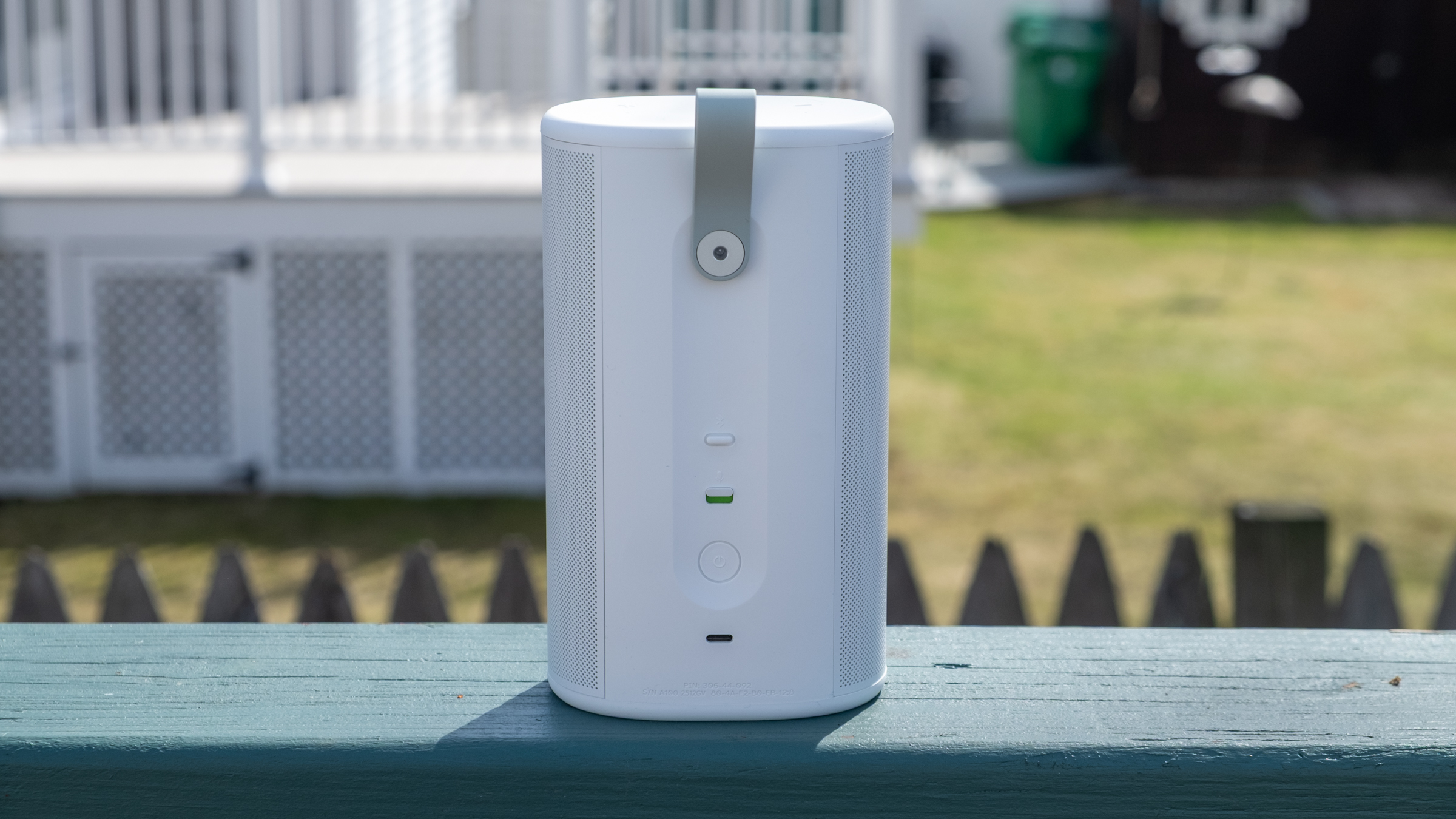
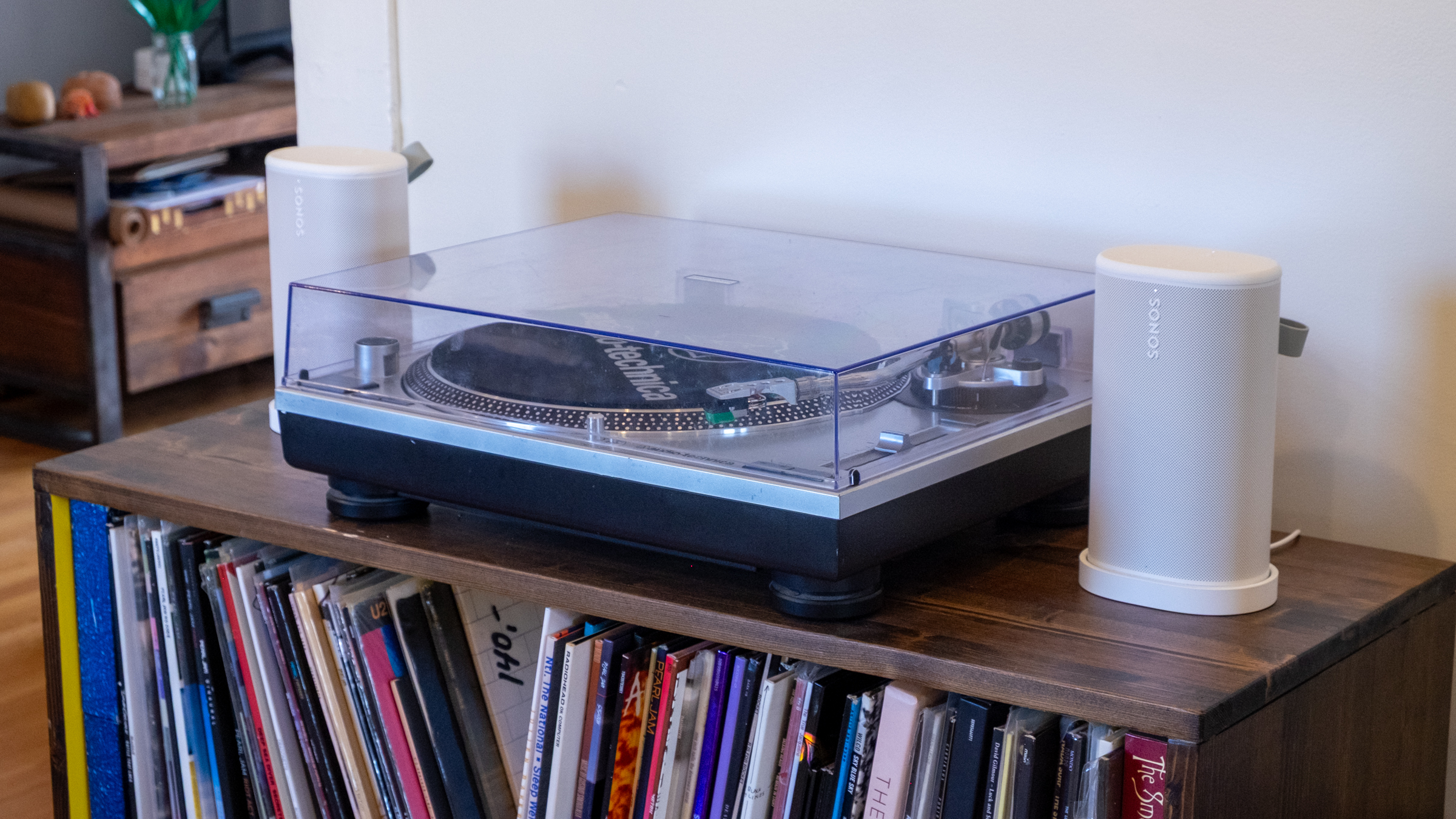
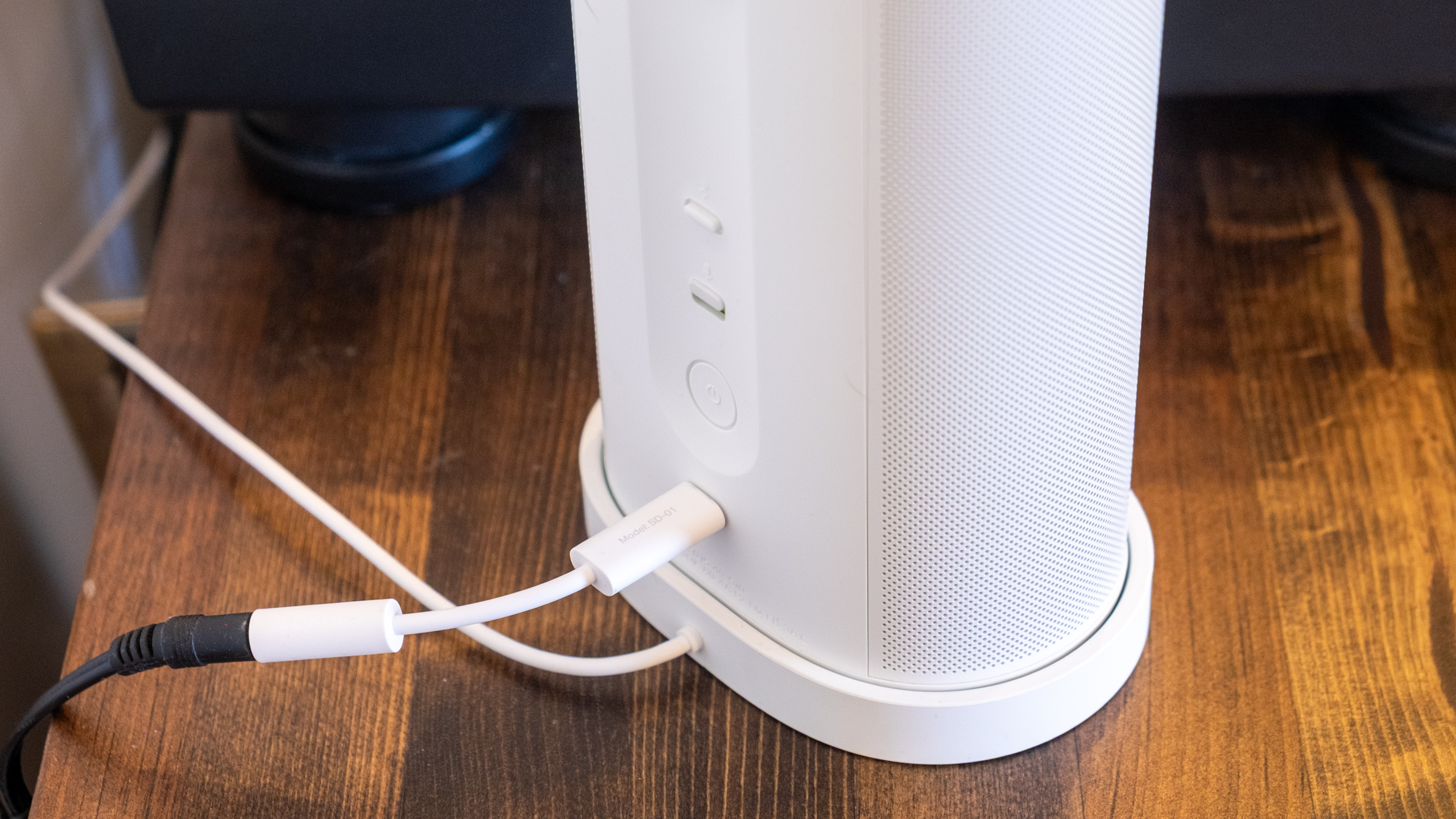
Like all other Sonos speakers, the Play is a Wi-Fi smart speaker that can stream audio from dozens of services; you can also play content on it via AirPlay 2, Spotify Connect and Bluetooth. The USB-C port on the back also lets you connect to turntables, CD players and other audio devices via a line-in dongle, or you can also use that port for an Ethernet connection (again with the corresponding dongle). Finally, you can also control the Play via Amazon Alexa or the Sonos Voice Assistant. And like the Roam, the Play is IP67 rated for water and dust resistance.
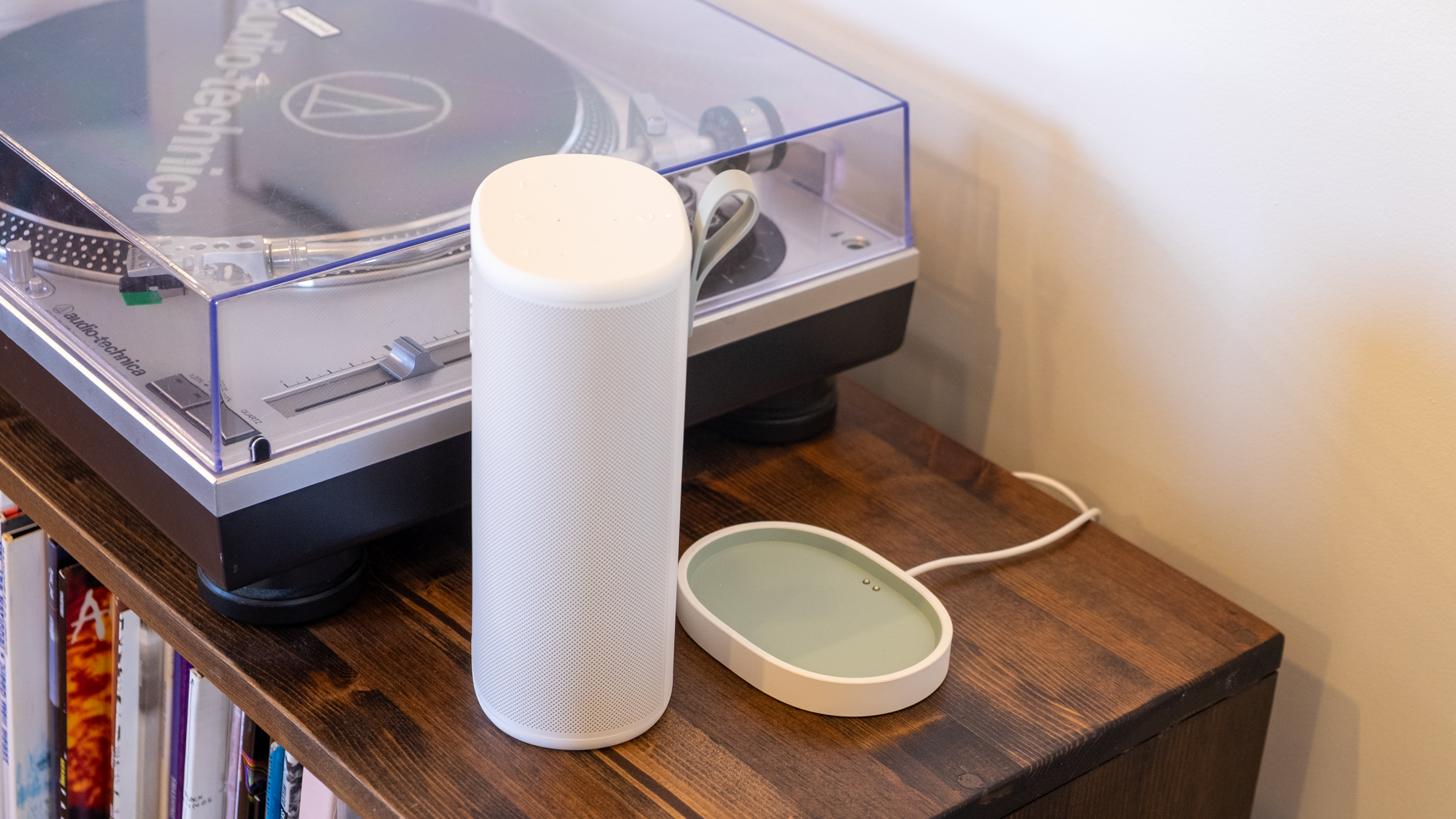
That’s all standard fare at this point, but I appreciate that Sonos included Ethernet and line-in capabilities, two things the Roam doesn’t support. It makes the Play a much more versatile option for being a centerpiece of your indoor setup as well as something you can take on the go. And since the Play comes with a wireless charging base, it’s easy to keep it charged up during indoor duty and equally simple to just grab it and go without fussing with cables. (Strangely enough, it does not come with a power adapter, so you’ll need to provide your own USB-C brick.)
The real panel of the Sonos Play.
Nathan Ingraham for Engadget
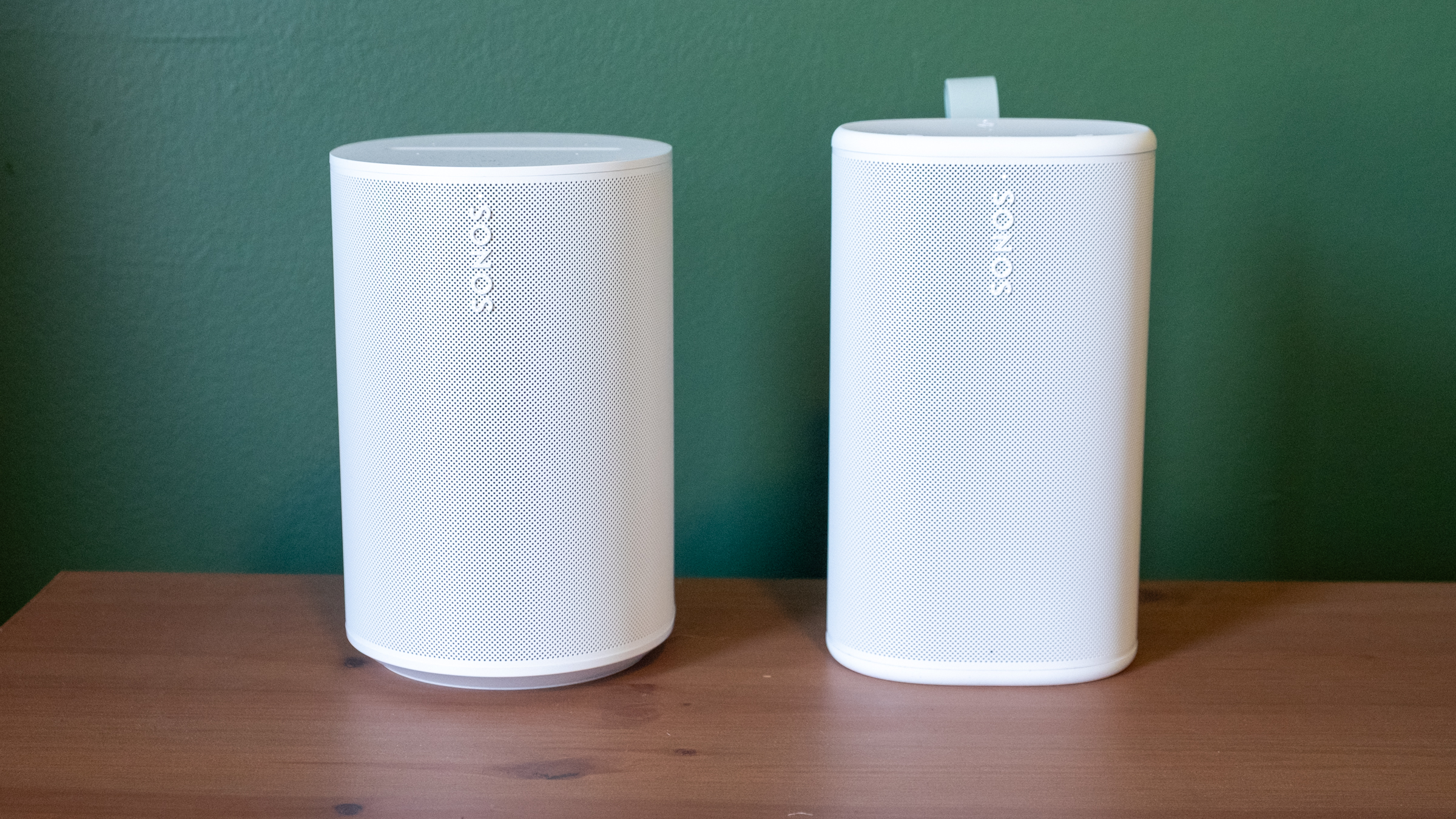
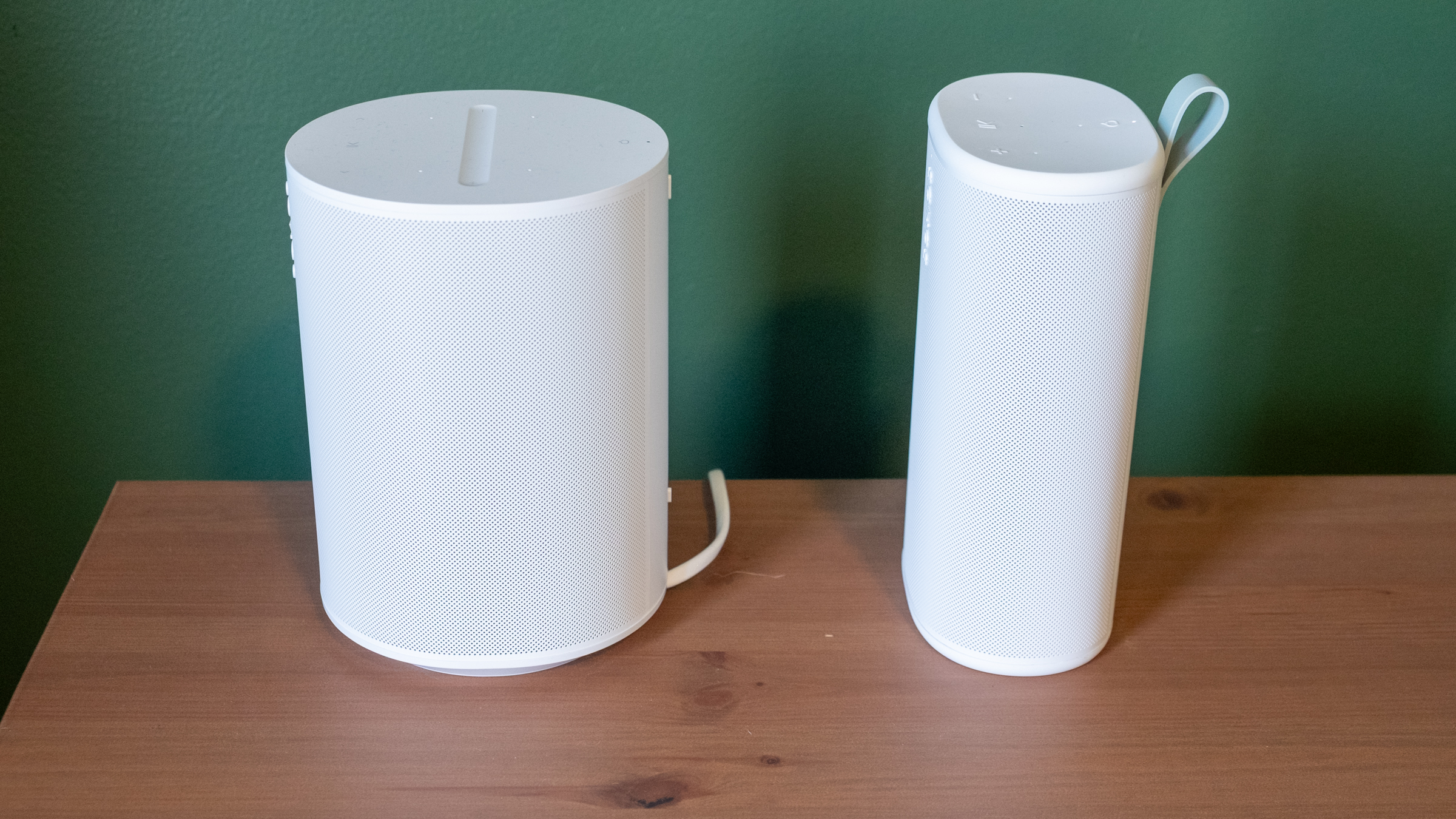
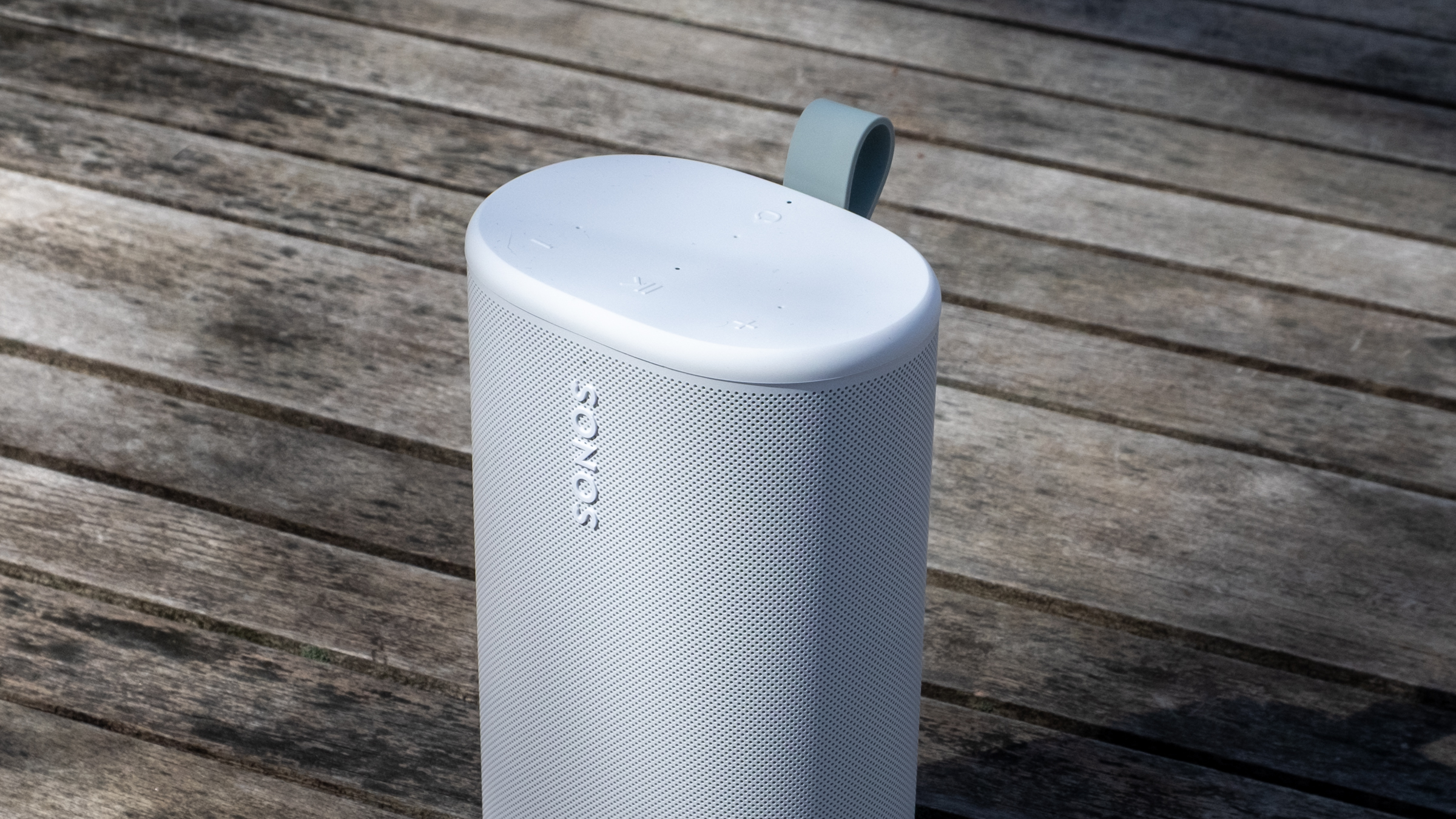
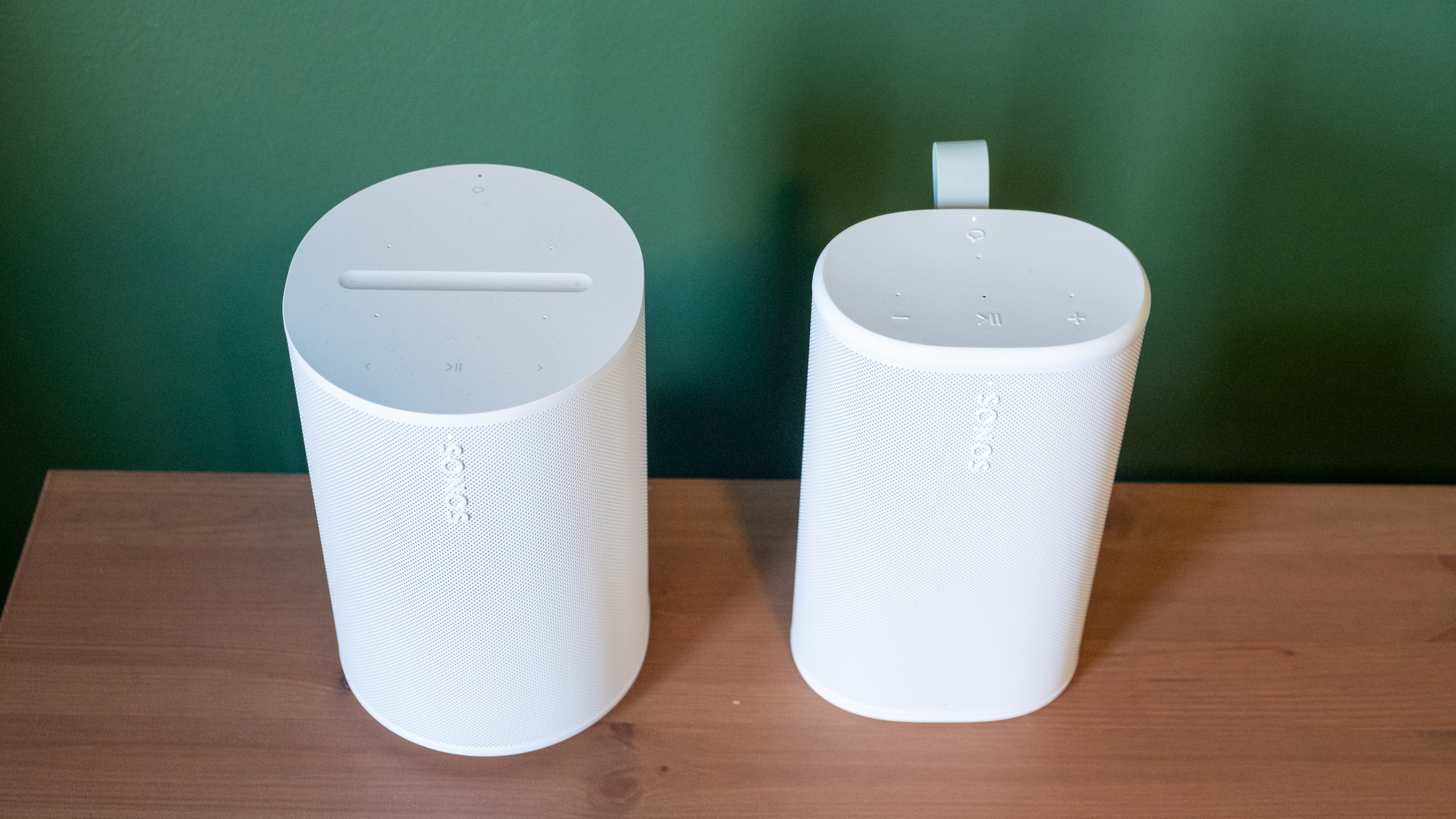
Physically, the Play reminds me of the Sonos Era 100 with its width squished down to make it more portable. Unsurprisingly, it comes in the same white and black color options; I had been hoping for a few more options like the vibrant Roam colors. The one touch of color you’ll see is on the light green grab loop attached to the back; you can remove it if you’re not a fan. At 7.6 inches, it’s slightly taller than the Era 100, but it’s much thinner and lighter. Based on the initial product renders, I expected the Play to be larger than it is in reality, but it feels quite compact and easy to move around. It’s not a “throw in your bag and forget it” speaker like the Roam, but it’s far more portable than the Move. The Move is a speaker I’d really only use in my house or in the backyard, whereas I’d toss the Play into a backpack and take with me — unless I really needed to save space or weight.
The Era 100 (left) and the Play (right).
Nathan Ingraham for Engadget
Side view of the Sonos Era 100 and Play.
Nathan Ingraham for Engadget
Its diminutive size is even more impressive when you consider the audio components Sonos packed inside. The Play features a speaker array nearly identical to that of the larger Era 100. It has two tweeters angled at 90 degrees for some stereo separation, along with a mid-woofer and two passive radiators for bass performance. The passive radiators are unique to the Play, specifically included to help bass levels in settings where there aren’t walls for the sound to reflect off of — like anywhere outside you might take a portable speaker.
Two Sonos Play speakers paired in stereo.
Nathan Ingraham for Engadget
Audio quality
The Play’s flexibility only matters if it sounds good. Fortunately, Sonos has never struggled with producing a speaker that’s a pleasure to listen to, and the Play certainly fits the bill. My top-level and unscientific analysis is that the Play sounds nearly as good as the Era 100, an impressive feat considering its comparatively small frame.
I tested a single Play speaker as well as a stereo pair in my small office, where I typically listen to music through a stereo pair of Era 100 speakers. I also used them in stereo on my larger and more open first floor, both streaming music and playing on my turntable via the line-in jack. Finally, I got to test them outside on my deck on a few lovely early Spring days that the Boston area was graced with recently. I used the auto Trueplay tuning feature throughout; it uses the Play’s built-in microphone to optimize audio for whenever you’ve placed the speaker. Sonos has offered various versions of Trueplay for over a decade now and it consistently makes its speakers sound better. And given you don’t have to do the old “wave your phone around the room” method to use Trueplay, there’s really no reason not to have it on.
While in my office, I did a lot of A/B testing of the Era 100 vs. the Play, typically playing Apple Music lossless via the Sonos app, but I also tried AirPlay and Spotify Connect as well as other music services including YouTube Music and Bandcamp. The biggest differences I noticed between the two speakers are the Era 100 is louder and has a more pronounced mid-range. The Play comparatively feels like its EQ is “scooped,” and it just isn’t quite as loud at the same volume level. The Play also doesn’t maintain quality quite as well through the full volume range — I wouldn’t say that it got distorted when I was playing it at 75 percent volume, but it’s not as clear as the Era 100 either.
These differences I mostly only noticed when I was flipping back and forth between the two speakers — when I just sat back and listened, I was extremely happy with the Play’s sound. When listening to a single Play, the angled tweeters did provide a small degree of stereo separation when things were hard-panned to the left or right channels. For example, the backing vocals in the chorus of Soundgarden’s “Black Hole Sun” jump from one channel to the other, and I did pick up on that effect.
Top controls on the Sonos Play.
Nathan Ingraham for Engadget
The Play sounds very well-balanced and neutral, capable of reproducing songs without over-emphasizing any particular frequency. My usual listening habits include a ton of ‘90s-era alternative and more modern indie rock, plus some modern pop and the occasional film or video game score, and the Play sounded great across the board. Daughter’s “Be On Your Way” is an atmospheric track juggling strings, electronic underpinnings, reverb-drenched guitar and a gorgeous vocal track, and all those elements shined here. The dance-influenced beats of Nine Inch Nails’ “Less Than” had appropriate thump and power behind them, and “Stay Down” by Boygenius sounded great, whether it was the acoustic-tinged intro or the layered, full-band climax. Heavier fare like Metallica’s “Battery” and Tool’s “Fear Inoculum” hit with the appropriate intensity as well, particularly when I was running two Play speakers in stereo.
My go-to film score for these kinds of tests is Howard Shore’s Lord of the Rings: The Two Towers, and it’s often the case that doesn’t sound as majestic on smaller speakers. But the Play did a great job with the intricate orchestral arrangements that jump between delicately intimate moments and full-throated majesty — the first song “Glamdring” has all these elements in less than four minutes, and it sounded excellent. I also love Gustavo Santaolalla’s score for The Last of Us with its tortured strings and host of organic acoustic sounds alongside unsettling electronics, and all its various elements were faithfully conveyed here.
The line-in connection on the Sonos Play.
Nathan Ingraham for Engadget
Using the speaker’s line-in capabilities with a USB-C to 3.5mm audio input worked easily as well. The only real issue I noticed is that my particular turntable’s output meant I had to turn the Play up much louder than I would when streaming music, so its top volume level is much lower. That wasn’t exactly a problem, but if you really want to push a lot of volume from a line-in source, this might not be the speaker for you. I was also worried that I’d switch from line-in to streaming and forget to adjust the volume down, but the speaker is smart enough to re-adjust from the line-in volume down to wherever it was set previously.
While the Play isn’t the loudest speaker out there, it has plenty of power when outside. I set the volume to around 60 and walked from my porch to the sidewalk and could still faintly hear the music (though not loud enough to be too offensive to passers-by or neighbors). Back up on the deck, the Play maintained its detailed profile despite the lack of surfaces for the sound to reflect off. It feels like a great device to have playing in the background when you’re entertaining outdoors, but something like the Move 2 will do better if you want music to be the centerpiece of a gathering.
The Play’s Wi-Fi connection is strong enough that I didn’t need to switch to Bluetooth when I was outside, but it’s simple to use if you need it. There’s a dedicated Bluetooth button on the back; pressing it turns it on, while holding puts the speaker in pairing mode. Bluetooth is probably the easiest way to give someone else control over your Sonos system. If you start streaming music to it, you can then group other speakers with the Play to get those tunes anywhere in the house without having to give a guest access to your Sonos system.
The Sonos Play and its charging base.
Nathan Ingraham for Engadget
Sonos included a new Bluetooth feature with the Play that they’re also bringing to the Move 2. If you’re away from Wi-Fi and playing audio via Bluetooth, other Play or Move 2 speakers can join a group just by pressing and holding the play/pause button. This works with Play or Move 2 speakers that have previously been set up on the same Sonos system, and it’s as simple as it sounds. I just paired my phone to one speaker, started playing some music and then held the play/pause button on the second speaker to get them in sync.
As for battery life, the Play is a huge step up over the Roam’s rather paltry 10-hour estimate. The Play is rated for up to 24 hours of playback, same as the Move 2, and I think Sonos just about hit that mark. I spent several work days playing music for eight-plus hours and the Play’s battery only dropped about 30 percent each time. Your mileage may vary, but I think the Play has plenty of battery life considering its smaller size — and given how easy it is to just drop on a charging base when you’re done, I don’t think most people will run its battery down too often. Sonos also made the battery in the Play user-replaceable, a good option to keep the speaker running for years to come.
Side-by-side comparison of the Sonos Era 100 and Play.
Nathan Ingraham for Engadget
Competition
While there are loads of portable Bluetooth speakers out there, the Play’s position as a Wi-Fi speaker that can group with others in a household as well as be used on-the-go with Bluetooth makes it a rather unique option. The $269 Bose SoundLink Plus sounds great, can be paired in stereo or grouped in “party mode,” and is a similar size as the Play. But its battery doesn’t last as long and, more crucially, it only works via Bluetooth. Some people won’t care, but I prefer the much wider variety of playback options that the Play provides. JBL also has a host of portable Bluetooth speakers, as well as Wi-Fi enabled options meant for home use — but again, the combo of Wi-Fi playback and portability seems to be mainly limited to Sonos right now.
As such, the main competition for the Play comes from Sonos itself, with the Move 2, Roam and Era 100 all offering different pluses and minuses depending on what you’re looking for.
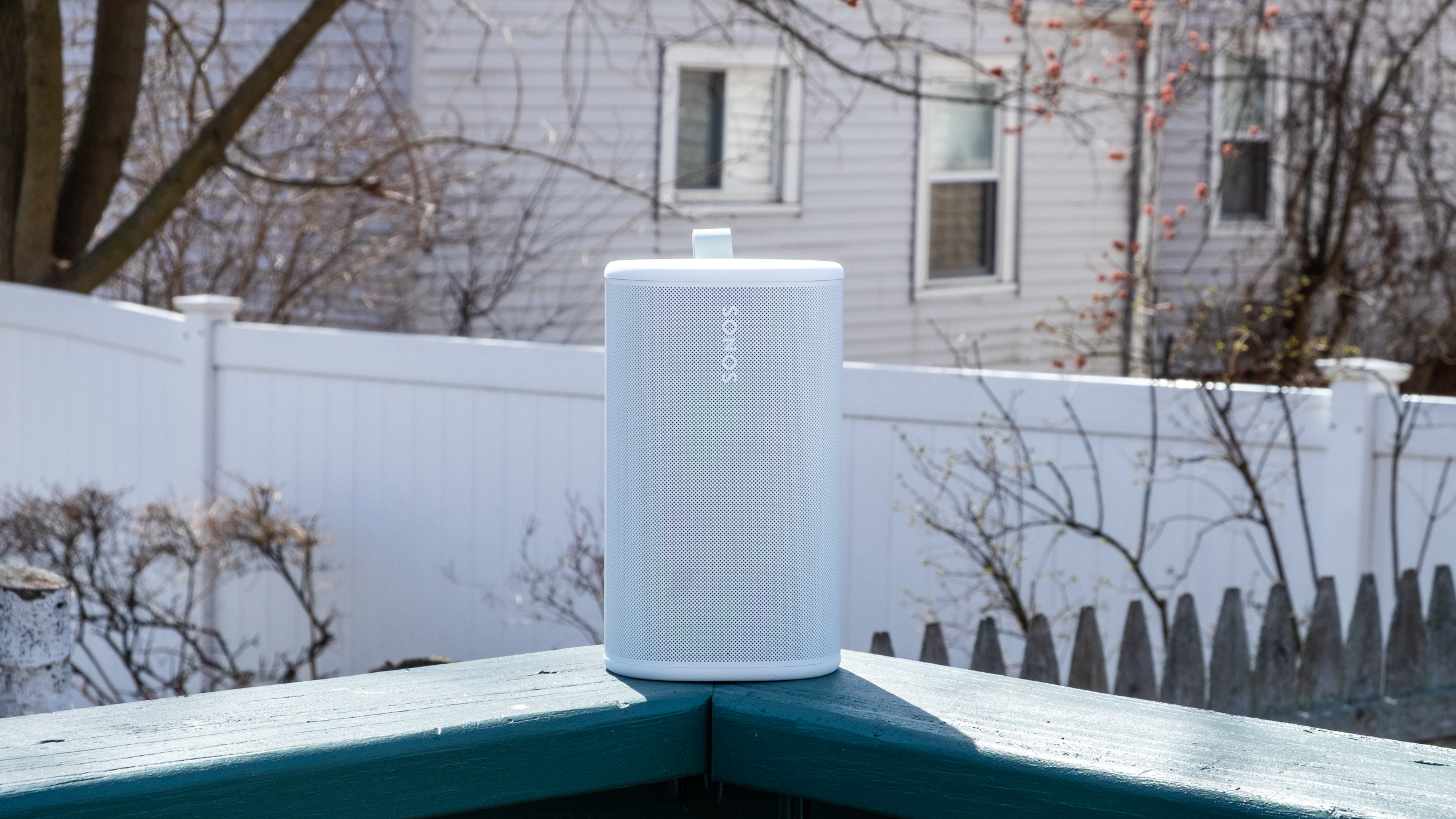
Sonos Play speaker sitting outside.
Nathan Ingraham for Engadget
Wrap-up
If it isn’t obvious, I’m a pretty big fan of the Sonos Play. While it’s not quite as portable as the tiny Sonos Roam, it sounds significantly better than the smallest Sonos speaker while still being easy to carry around. It’s probably the most versatile speaker in the Sonos lineup right now, and a smarter choice than the $499 Move 2 for most people. Unless you really need massive outdoor volume, the Play is the best portable Sonos speaker.
The only catch is its price. $299 is fair when you consider its sound quality and feature set. But it’s also $80 more than the Era 100, or $110 more than the Era 100 SL (which drops the microphone but is otherwise identical to its more expensive counterpart). So you’ll have to decide how much portability is worth to you. For me, the Play is an excellent addition to my existing setup. But if you’re likely to do most of your listening indoors, the Era 100 and its superior sound quality might make more sense.
To be clear, that’s not a knock against the Play. The latest Sonos speaker offers impressive sound quality, flexibility and portability, and it’s the kind of product that can help Sonos rebuild its reputation after its recent difficulties.
This article originally appeared on Engadget at https://www.engadget.com/audio/speakers/sonos-play-review-the-companys-best-portable-speaker-so-far-130000688.html?src=rss
These are large, mostly plastic over-ear headphones with a design that leans into the original Aviator look. They weigh about 290g or 10.2 ounces, so you’ll notice them on your head, but the thick padding helps offset that during long listening sessions. Noise canceling is decent, but not on par with top-tier models from competitors. It cuts down a large portion of ambient noise, but higher-pitched sounds like traffic or metal screeches still come through. The bigger compromise is sound quality. The default tuning leans heavy on bass, which can make modern tracks (electronic and hip-hop) feel punchy but can also overshadow vocals and mids. Some higher frequencies can also come across as sharper than expected, especially at louder volumes.
As for its controls, instead of touch controls or relying on an app, there’s a joystick on the right earcup that handles playback, EQ presets, and navigation, paired with a small display that shows what you just changed, so you are not guessing your inputs. On the left side, a textured wheel switches between active noise cancellation and transparency mode. It’s a system that feels different at first, but can be more intuitive once you get used to it.
Beyond that, you also get features like THX spatial audio, customizable EQ, a built-in hearing test, and Spotify Tap for quick playback. On the connectivity side, Bluetooth 5.3 with multipoint support makes it easier to switch between a laptop and phone without re-pairing, and there’s a 3.5mm jack for wired listening. Battery life is strong, rated at up to 60 hours without ANC and around 50 hours with it enabled, though your mileage may vary depending on usage.
Our Best Editor-Vetted Amazon Big Spring Sale Deals Right Now
Amazon’s Fire TV Stick 4K Plus is one of Amazon’s most popular Fire TV Stick options. In fact, it’s a renamed version of the 2nd Gen Fire TV Stick 4K launched back in 2023. Still, it’s no slouch. It’s powerful enough for 4K entertainment, and at $25 for the Amazon Big Spring Sale (down from $49.99), it’s a worthwhile deal as well.
The Fire TV Stick Plus sits above the base Fire TV Stick HD (also discounted right now), and offers a quad-core 1.7 GHz processor coupled with 2GB RAM for fast app launches and smooth navigation. The main draw here, of course, is the 4K Ultra HD streaming support. You can watch 4K content with support for Dolby Vision, HDR10+, and immersive Dolby Atmos audio, meaning you can watch 4K HDR content on most 4K TVs out there.
The Fire TV Stick has Wi-Fi 5 built-in, and Bluetooth 5.2 support for adding game controllers, headphones, and other Bluetooth accessories. The device features the newly redesigned Fire TV interface, with support for the new Alexa+ AI service, which is free for Prime members and costs $19.99/month for non-Prime members. Amazon has partnered with Microsoft, so you can play hundreds of Xbox games using Xbox Game Pass cloud gaming. All you need is a Bluetooth game controller, and a strong internet connection (and, of course, Xbox Game Pass). You can also pair two Echo speakers with a Fire TV Stick to create a wireless home theater setup on a budget.
In PCMag’s Expert Review, the Fire TV Stick 4 Plus received an “Outstanding” rating and an Editor’s Choice award.
After months of benchmark leaks, the Core Ultra 9 290K Plus was a no-show when Intel unveiled its first Arrow Lake Refresh processors, which saw the launch of the Core Ultra 7 270K Plus and Core Ultra 5 250K Plus on the desktop (see our review), along with a couple of mobile variants, the Core Ultra 9 290HX Plus and Core Ultra 270HX Plus.
We may earn a commission from links on this page. Deal pricing and availability subject to change after time of publication.
Google’s Pixel 10 launched in August 2025 at $799, which already made it a reasonable flagship then, if you liked Google’s software-first approach to Android. Now it’s down to $549 for the 128GB unlocked model on Amazon’s Spring Sale—a $250 drop and its lowest price yet, according to price trackers. The Pixel 10 Pro is also discounted to $749 from $999, which puts both phones in a much more competitive place than they were at launch. Buying an unlocked Pixel 10 means you are not tied to any carrier, so you can switch networks, use local SIMs while traveling, or avoid long-term contracts.
What you’re getting here is Google’s latest Tensor G5 chip paired with 12GB of RAM. That extra memory helps when using on-device AI features like Magic Cue, which processes tasks locally instead of relying on the cloud. In practice, this shows up in faster photo edits, smarter suggestions, and less waiting when switching between apps. Compared to the Pixel 9a’s 8GB of RAM, the Pixel 10 feels better prepared for heavier use over the next few years. As for its camera setup, this is the first standard Pixel to include a telephoto lens, so zoom shots hold detail better instead of falling apart past 2x or 3x. This PCMag review also noted better detail retention and more accurate colors compared to the previous generation. You also get the new Qi2 magnetic charging system, which works with MagSafe-style accessories, something Android phones have largely skipped until now.
That said, the Tensor chips don’t match the raw performance of Apple’s A-series or Qualcomm’s top Snapdragon chips, so heavy gaming or sustained workloads can show some limits, according to our associate tech editor Michelle’s review. Battery life is also decent but not class-leading, especially if you lean into AI features or camera use. Still, what the Pixel 10 does well is balance. It gives you strong cameras, a clean Android version with fast updates, and useful AI features in a compact design. And at $549, it becomes easier to recommend, especially if you want a smart, camera-first Android phone that will age well.
Our Best Editor-Vetted Amazon Big Spring Sale Deals Right Now
After achieving action camera success, Insta360 invaded DJI’s turf with the first mass-market panoramic drone, the Antigravity A1. It had instant appeal for drone pilots, offering 8K 360 video and features like subject tracking, obstacle detection and FPV flying.
Though beaten to the punch, DJI has responded quickly with the Avata 360, aided by its drone experience and camera tech from the new Osmo 360 action cam. It has a lot in common with its rival, but it’s safer to fly around people and offers single camera 4K footage on top of 8K 360 video.
To find out how the Avata 360 stacks up against the A1, I tested it both indoors and out, around people and even “stunt” horses. The Avata 360 isn’t perfect, but it is far more polished than its rival. As with other DJI drones of late, though, US availability remains unclear.
How the Avata 360 works
The 360 camera makes the Avata 360 different from any other DJI drone. It features two ultrawide cameras with f/1.9 lenses and 1.1-inch 64-megapixel sensors, with one pointing up and the other down for unobstructed 200-degree views. Those are then stitched together by software to create 360 degree video at up to 8K 60 fps.
This setup fundamentally changes the way you pilot a drone and capture video. Since the 360 camera records everything around it, you can focus on flying and reframe shots later in DJI’s Studio app. That 360 view is also handy when piloting in FPV mode. With the head tracking on DJI’s Goggles N3, you can look all around you simply by turning your head.
Unlike the Antigravity A1 that only shoots 360 video, the Avata 360 supports regular single-camera shooting as well. When you switch to that mode, the camera rotates forward and shoots 4K video at up to 60 fps with a 28mm field of view. DJI’s drone also works with a regular controller, which isn’t an option on the A1. You have to use the Insta360’s goggles at all times.
Design
Because of the chunky 360 camera, the Avata 360 is slightly bigger than the Avata 2. It’s also quite a bit heavier at 455 grams (one pound) and so, unlike the 249-gram Antigravity A1, you’ll need a permit to fly one in most regions.
The Avata 360’s propellers are shielded to protect the drone and keep it safe indoors or around people, unlike the open-prop A1. For additional protection it has two omni obstacle sensors on the side, a Lidar sensor up front, landing sensors on the bottom and, of course, a camera that points in all directions. To keep the lenses off of bare ground, it comes with a foldable 18×18-inch landing mat.
DJI’s Goggles N3 (available with the RC Motion 3 controller as an option) are comfortable and allow you to wear eyeglasses. Unlike the Goggles 3, though, there’s no external camera to see outside. If you’d rather pilot conventionally, you can get the Avata 360 bundled with DJI’s RC 2 screen controller in another kit.
Performance and features
As an FPV drone, the Avata 360 is fast and agile. It can hit speeds up to 40 MPH in sport mode (without obstacle avoidance) or 35 MPH in normal mode. When used with the optional FPV Remote Controller 3, you can do flips, rolls and other “cinewhoop” style maneuvers. Once you get used to flying it that way, it’s incredibly fun.
The 38.7Wh batteries have 26 percent more capacity than the Avata 2’s cells, but rated endurance is about the same at 24 minutes. I never got more than about 18 minutes in real-world flying though, so it’s a good idea to buy the Fly More kit with three batteries and a fast charger that can replenish them all in about 100 minutes.
Samuel Dejours for Engadget
Part of my testing of the Avata 360 was capturing “trick riding” horses, so it was important that the drone noise didn’t spook them. At 81db the Avata 360 is louder than the Mini 4 Pro (67 db) and less banshee-like than the Neo 2 due to the larger propellers, so the horses weren’t alarmed.
Video is transmitted to the Goggles N3 and RC Motion 3 controller (or the RC screen controller) at 1080p 60 fps via DJI’s OcuSync 4.0+ system. The maximum flying range is 20 km (12.4 miles), double that of the Avata 2. This is an impressive distance for an FPV drone.
The 45GB of internal storage (42GB usable) can fill up quickly when you’re shooting 8K video, but the drone also has a microSD slot. To get your footage onto a PC or smartphone, you can transfer it via the USB-C port or over Wi-Fi using DJI’s Fly app.
The Avata 360 has DJI’s usual tracking and obstacle detection features, but they’re available only with the RC 2 controller and not the Goggles N3. To follow a subject, simply draw a box around them on the controller to enable Focus Track and its three modes: Spotlight, Point of Interest and ActiveTrack. The latter tracks a subject automatically and lets you control the drone’s position via an on-screen “steering wheel.”
Steve Dent for Engadget
To test that, I biked in a narrow forested lane and walked around a bamboo-covered obstacle course. When using Focus Track, the drone dodged most obstacles and was only confused by small leaves and branches. If it did contact one of those, it sailed right through without crashing thanks to the propeller guards.
Subject tracking works in both 360 and single camera modes, but when using the latter, The Avata 360 can’t see and avoid obstacles behind it. It contacted branches several times during my testing, but fortunately the prop guards prevented crashes. Other automatic features include Dronie, Rocket and Quickshot modes that let you capture clips for social media.
Video
The Avata 360 prioritizes FPV freedom and flexibility over pure video quality. Though the specs promise 8K, that only applies to the full 360 degree video — your final, flat video will actually be 4K or less after processing. And the 360 camera zooms digitally (not optically), which further reduces resolution. On top of that, you can often see a “seam” in the video where stitching occurs, and dewarping (used to output flat video) can create softness at the edges. With all that, video is less sharp than DJI’s regular Mini, Air and Mavic drones.
Because the camera is fixed when shooting 360 video, the Avata 360’s gimbal can’t smooth out jolts or correct for roll. Instead, it uses action cam-style electronic stabilization. What’s more, that type of smoothing causes motion blur and artifacts in low light due to the lower shutter speeds — something I also noticed with the Osmo 360.
Steve Dent for Engadget
With that said, video quality was as sharp and color-accurate as the Osmo 360, and a touch better than the Antigravity A1 when filming in daylight. For tricky, contrasty conditions like a shaded path on a sunny day, the D-LogM option boosted dynamic range, helping me bring out shadow detail and tone down overly-bright highlights. However, the cityscape I shot at night was soft and occasionally blurry due to the aforementioned stabilization issues.
In exchange for this lower video quality, the 360 camera provides incredible flexibility. For a vlog style tracking shot, for instance, I usually need to film twice to show the forward and backward directions. With the Avata 360, though, I was able to get both POVs from the same shot and output an overhead view too for good measure.
DJI Studio is where you go to select your desired framing and output the flat video. It’s not quite as versatile as Insta360’s app, but it allows you to reframe shots and create smooth transitions between camera angles. And to save time, you can use the Intelligent Tracking feature to center your subject. The app also offers color correction and other features, but I found it easier to export the final shots to DaVinci Resolve for any additional work.
Flat video a mixed bag. Sharpness is mildly better than the 360 video, but the lack of a gimbal roll axis means that the camera can’t level itself when the drone banks into the wind. As a result, most of my footage was tilted and often unusable.
Wrap-up
Steve Dent for Engadget
With the Avata 360, DJI has a surprisingly sophisticated drone that offers better video quality and more features than its only rival, Insta360’s Antigravity A1. It can do everything you’d expect from a DJI FPV drone like tracking, obstacle avoidance and acrobatics, while operating safely around people (or horses).
DJI also managed to undercut Insta360 on price, with the Avata 360 starting at 459 euros (approx. $530), or 939 euros ($1,089) in a kit with a screen controller, three batteries and a charger. It’s also available with the extra batteries and charger, DJI’s FPV Goggles N3 and the RC Motion 3 controller for 939 euros ($1,089). As mentioned, there’s no word yet on US pricing, but the Avata 360 has been approved by the FCC so it could appear in the US soon.
Like 360 action cams though, this is a niche product. If you’re a vlogger, extreme action shooter, FPV pilot or solo filmmaker who wants speed and flexibility, the Avata 360 is a great choice. If it’s pixel perfect image quality you want, however, you’re better off with DJI’s Mini 5 Pro, Air 3S or Avata 4 Pro drone.
This article originally appeared on Engadget at https://www.engadget.com/cameras/dji-avata-360-drone-review-360-video-hits-new-highs-120014666.html?src=rss
OpenAI has “indefinitely” abandoned plans to release an a erotic chatbot for adults following concerns from employees and investors, the company confirmed to The Financial Times. Plans for such a feature, first announced in October 2025 for release in December last year, had already been delayed while company debated whether to release it all. It’s the second app OpenAI has decided to shelf this week, after announcing on Tuesday that it was shutting down its Sora video generator.
The adult-oriented chatbot, reportedly called “Citron mode,” is now on hold with no planned release date. The company reportedly had difficulty training models that previously avoided erotic content and also removing illegal behavior like bestiality or incest, two people familiar with the matter told the FT.
Open AI said that it wanted to conduct long-term research on the effects of erotic chats and user attachment to AI, adding that there was currently not yet enough “empirical evidence” on the subject. The company also said it wanted to focus on its core productivity tools like coding assistants and drop “side quests” like Sora and the erotic chatbot.
The idea for adult features came after OpenAI announced that it would add parental controls and automatic age detection features for ChatGPT. CEO Sam Altman said back in October that the company had always been careful about such issues over concerns around unhealthy AI attachments, but felt comfortable that it could “safely relax the restrictions in most cases.”
However, the adult mode had reportedly caused concern among investors, particularly amid the controversy caused by rival xAI’s Grok model that generated deepfake nudes of real people and children. Staff also worried about the feature, with one senior employee even leaving the company over the issue. “AI shouldn’t replace your friends or your family; you should have human connections,” he told the FT.
Another challenge is OpenAI’s age-checking tech, introduced following lawsuits from families who said that ChatGPT harmed their children. The tech reportedly has an error right higher than ten percent, which would still give a large number of young people access to the tech. OpenAI said that figure is in the industry standard range and that it is continuing to work on its accuracy.
This article originally appeared on Engadget at https://www.engadget.com/ai/openai-drops-plans-to-release-an-adult-chatbot-113121190.html?src=rss
Reddit is rolling out human-verification checks for accounts that show signs of bot-like behavior, while also labeling approved automated accounts that provide useful services. The social media company stressed that these checks will only happen if something appears “fishy,” and that it is “not conducting sitewide human verification.” TechCrunch reports: To identify potential bots, Reddit is using specialized tooling that looks at account-level signals and other factors — like how quickly the account is attempting to write or post content. Using AI to write posts or comments, however, is not against its policies (though community moderators may set their own rules).
To verify an account is human, Reddit will leverage third-party tools like passkeys from Apple, Google, YubiKey, and other third-party biometric services, like Face ID or even Sam Altman’s World ID — or, in some countries, the use of government IDs. Reddit notes this last category may be required in some countries like the U.K. and Australia and some U.S. states, because of local regulations on age verification, but it’s not the company’s preferred method. “If we need to verify an account is human, we’ll do it in a privacy-first way,” Reddit co-founder and CEO Steve Huffman wrote in the announcement Wednesday. “Our aim is to confirm there is a person behind the account, not who that person is. The goal is to increase transparency of what is what on Reddit while preserving the anonymity that makes Reddit unique. You shouldn’t have to sacrifice one for the other.”
Uber and Chinese company Pony.ai are gearing up to launch a robotaxi service for Europe, starting with Zagreb in Croatia. The companies are working with Croatian company Verne, which will provide the service ecosystem and operational framework for the service. They’re using Arcfox Alpha T5 vehicles made by Beijing-based automaker BAIC Motor powered by Pony.ai’s Gen-7 autonomous driving system. Initially, the autonomous rides will be offered on Verne’s app, but they will eventually be available through Uber.
In their announcement, the companies said they have already started on-road testing in Zagreb, where the service will be available “soon.” They’re hoping to expand it to other European cities in the future, and then to more markets, with the goal of deploying a fleet with thousands of robotaxis over the next few years. Verne will be in charge of securing regulatory approval for the rollouts, while Uber has agreed to invest in the Croatian company.
This is but one of Uber’s partnerships centering around its efforts to offer more and more driverless rides to its passengers. Just earlier this month, it announced that it was launching a pilot program for a robotaxi service in Tokyo in late 2026 with Nissan and UK self-driving startup Wayve. Uber also started offering robotaxi rides to passengers in Las Vegas at the same time. The fleet deployed in the city is made up of Hyundai Ioniq 5 autonomous EVs, developed in partnership with Motional.
This article originally appeared on Engadget at https://www.engadget.com/transportation/uber-and-ponyai-are-testing-a-robotaxi-service-for-europe-104811944.html?src=rss
Meta didn’t consult its Oversight Board last year when it announced sweeping policy changes to content moderation and a rollback of third-party fact checking in the United States in favor of Community Notes. But the company did ask the board for advice on how to expand the crowd-sourced fact checks to other countries.
Now the Oversight Board is publishing its advice to Meta. In a 15,000-word policy advisory opinion, the group urged Meta to be cautious with an international rollout, warning that an expansion of the program could “pose significant human rights risks and contribute to tangible harms” if safeguards are not put in place.
The board, notably, was asked to weigh in on a fairly narrow set of questions, including how it should evaluate whether to withhold the feature in certain countries. Meta “respectfully” asked the Oversight Board to avoid “general” critiques about the system, which it has said is modeled after X.
In its opinion, the Oversight Board said that Community Notes “could enhance users’ freedom of expression and improve online discourse” with enough safeguard. But it recommended Meta withhold the feature in countries with “high polarization,” as well as countries in the midst of a crisis or “protracted conflict.” The board also said that Meta should avoid countries with a history of organized disinformation networks, because the notes may be more easily manipulated in such places, and countries with “linguistic complexity” that Meta may be ill-equipped to understand.
Depending on how you interpret that advice, that could exclude quite a few countries, though the board stopped short of making country-specific recommendations. Still, it raises questions about how closely Meta will follow the suggested guidelines. For example, the United States could be considered a country with “high polarization.” (Community Notes has been live in the US for more than a year.)
While the Oversight Board was careful to say it “neither endorses nor opposes” an expansion of Community Notes, it did discuss Meta’s approach to fact checking, noting that its partnerships with outside fact-checking organizations are still largely in place outside of the US. And the opinion cautions against ending these relationships, noting that research into Community Notes on X shows that authors writing notes often rely on work done by professional fact checkers.
“Community Notes and fact checking are not mutually exclusive,” Oversight Board member Paolo Carozza tells Engadget. “One doesn’t have to replace or substitute for the other, they can coexist. And in some situations, there are really important reasons for them to coexist. The board really deliberately stayed away from any kind of suggestion that the introduction of Community Notes ought to result in the removal or ending of fact checking.”
This article originally appeared on Engadget at https://www.engadget.com/social-media/oversight-board-tells-meta-expanding-community-notes-outside-of-us-poses-significant-risks-100000213.html?src=rss
Longtime Slashdot reader theodp writes: In Melania and the Robot, the New York Times reports on First Lady Melania Trump’s inaugural Fostering the Future Together Coalition Summit, which brought together international leaders, First Spouses from around the world, tech leaders, educators, and nonprofits to collaborate on practical solutions that expand access to educational tools while strengthening protections for children in digital environments (Day 2 WH summary). The Times begins:
“On Wednesday, Mrs. Trump appeared at the White House alongside Figure 3, a humanoid, A.I.-powered robot whose uses, according to the company that makes it, include fetching towels, carrying groceries and serving champagne. But Mrs. Trump joins tech executives and some researchers in envisioning a world beyond robot butlery. She is interested in how these robots could cut it as educators. Both clad in shades of white, the first lady and the visiting robot walked into a gathering of first spouses from around the world, a group that included Sara Netanyahu of Israel, Olena Zelenska of Ukraine, and Brigitte Macron of France. The dulcet tones from a (presumably human) military orchestra played as the first lady and her guest entered the event. Both lady and robot extolled the virtues of further integrating robots into the educational and social lives of children. In the history of modern first-lady initiatives, which have included building a national book festival (Laura Bush), reshuffling the food pyramid (Michelle Obama) and advocating for free community college (Jill Biden), Mrs. Trump’s involvement of a humanoid robot in education policy was a first.”
“Figure 3 delivered brief remarks and delivered salutations in several languages. With its sleek black-and-white appearance, Figure 3 would fit right in with the first lady’s branding aesthetic, which includes a self-titled coffee table book and movie, not least because the name “MELANIA” was emblazoned on the side of its glossy plastic head. After Figure 3 teetered gingerly away, Mrs. Trump looked around the room and told them that the future looked a lot like what they had just witnessed. ‘The future of A.I. is personified,’ she told her audience. ‘It will be formed in the shape of humans. Very soon artificial intelligence will move from our mobile phones to humanoids that deliver utility.’ She invited her guests to envision a future in which a robot philosopher educated children.”
Thirty years after the alleged 1996 “ET of Varginha” encounter, debate continues to rage over the events that happened in Brazil’s self-styled UFO capital. An anonymous reader quotes an excerpt from the Guardian: The skies over this far-flung coffee-growing hub went charcoal black, the heavens opened and one of Brazil’s greatest mysteries was born. “It really was something unique,” recalls Marco Antonio Reis, a zoo director, who was at his ranch outside Varginha one stormy day in January 1996 when, he says, an otherworldly creature came to town. Reis and other locals claim the unusually ferocious downpour heralded a series of disturbing and seemingly paranormal events. At least six of the zoo’s animals, including a spider monkey, a tapir and a raccoon, died mysteriously after a horned interloper with bulging red eyes was spotted in the vicinity by a woman who had gone out for a smoke. When a vet examined their corpses, “they were all black inside,” Reis claims.
On a nearby wasteland, three young women spotted a peculiar and malodorous being with a heart-shaped face and three lumps on its head cowering beside a wall. “I’ve seen the devil,” one of those witnesses would later tell her mum. Soon afterwards, an unexplained infection was rumored to have killed a strapping police intelligence officer who was said to have grappled with the oleaginous unidentified being. Three decades later, Reis says he is convinced Varginha received a non-human visit. His only doubt was from where it came.
“We don’t know if it was extraterrestrial or intraterrestrial,” the 71-year-old says as he climbs a staircase to the veranda where the smoker claims to have seen what, in reference to Steven Spielberg’s 1982 film, became known as the “ET of Varginha”. A 2ft statue of a two-toed alien now marks the spot. “It’s possible it was an intraterrestrial, from inside the Earth They don’t just come from space,” Reis says. “It might have come from the depths of the Earth, too. We don’t even know what it’s like at the bottom of the sea, do we?”
The U.S. Postal Service plans to impose its first-ever fuel surcharge on packages (source paywalled; alternative source), adding an 8% fee starting in April as it struggles with rising fuel costs and ongoing financial pressure. The surcharge will not apply to letter mail and is currently expected to remain in place until January 2027. The Wall Street Journal reports: Other parcel carriers, including FedEx and United Parcel Service, have imposed fuel surcharges, as well as a basket of other surcharges and fees, for years. Both FedEx and UPS have dramatically raised their fuel surcharges in recent weeks as the price of oil has increased amid the turmoil in the Middle East. […] The post office has been trying to increase the volume of packages it delivers. It previously differentiated itself from commercial carriers by saying that it doesn’t apply residential, Saturday delivery or fuel or remote-delivery surcharges.
Because some people are still out there having fun (crazy to think about), this is a video of Youtuber Handy Geng making a giant sword (inspired by Ichigo’s Soul-Cutter sword from manga Bleach), then attaching it to the business end of an excavator. Well, provided the business end is the excavator’s arm, MY business end is the rear *wink* The swordcavator lacks the speed to do any real slashing damage, but it’s still plenty capable of piercing (like my roommate’s voice) and crushing (like the weight of life). *runs AI feel-good check on post, AI terminates its own session* Sometimes they be like that though.
New submitter haroldbasset writes: Canada’s Immigration Department rejected an applicant because the duties of her current job did not match the Canadian work experience she had claimed, but the Department’s AI assistant had invented that work experience. She has been working in Canada as a health scientist — she has a Ph.D. in the immunology of aging — but the AI genius instead described her as “wiring and assembling control circuits, building control and robot panels, programming and troubleshooting.” “It’s believed to be the first time that the department explicitly referred to the use of generative AI to support application processing in immigration refusals,” reports the Toronto Star. “The disclaimer also noted that all generated content was verified by an officer and that generative AI was not used to make or recommend a decision.”
The applicant’s lawyer was shocked “how any human being could make this decision.” “Somehow, it hallucinated my client’s job description,” he said. “I would love to see what the officer saw. Something seriously went wrong here.”
The applicant’s refusal came just as Canada’s Immigration Department released its first AI strategy, which frames artificial intelligence as a way to improve efficiency, service delivery, and program integrity. The department says it has long used digital tools like analytics and automation to flag fraud risks and triage applications, and is now also experimenting with generative AI for tasks such as research, summarizing, and analysis. In this case, however, the department insisted the decision was made by a human officer and that generative AI was not involved in the final decision.
We may earn a commission from links on this page. Deal pricing and availability subject to change after time of publication.
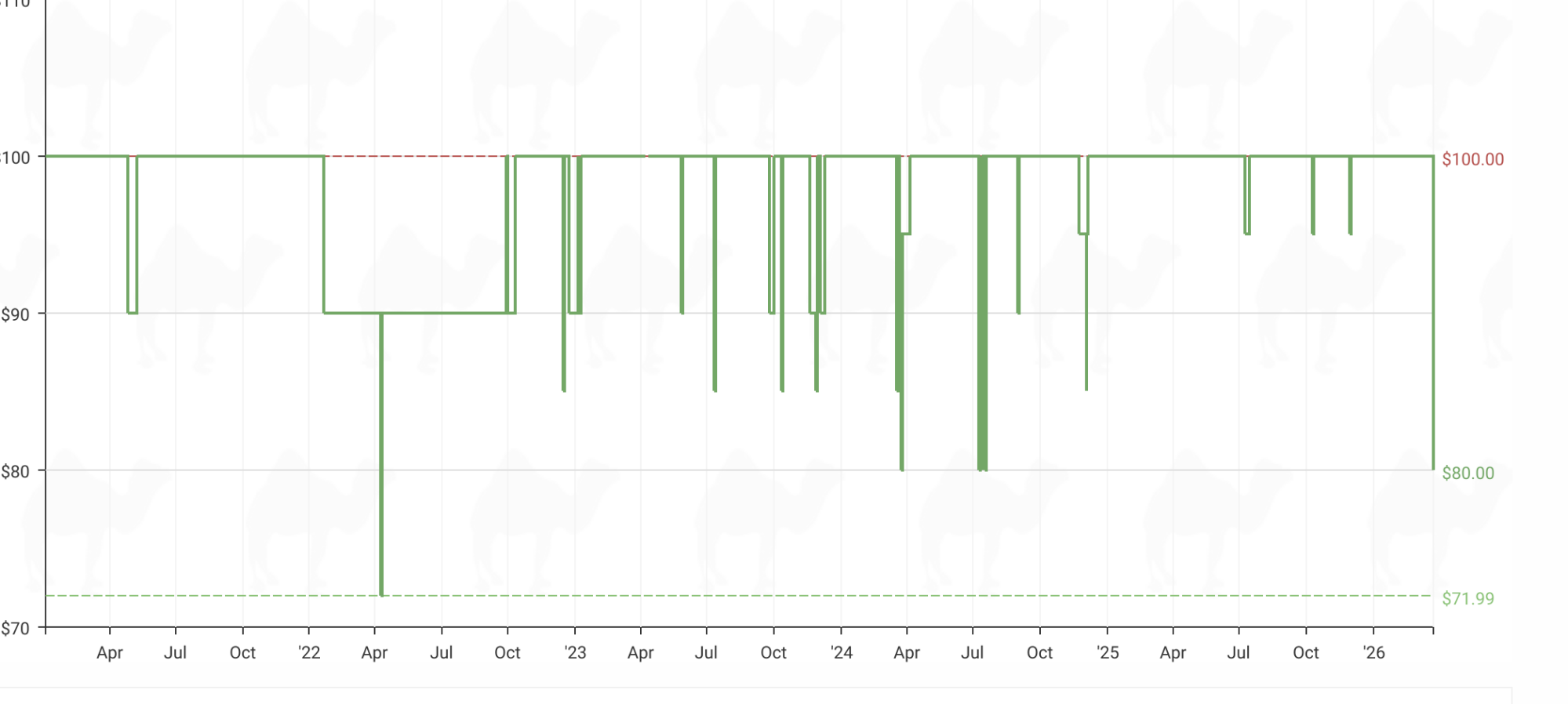
If money was on sale 20% off, you’d buy a ton of it, right? Well, this Roblox gift card is “worth” $100 in Robux, the online currency used on the gaming platform Roblox, but it’s on sale for $80 during Amazon’s Big Spring Sale. If you’re reading this, chances are good that at some point in the next day/week/month, your child is going to hassle you for Robux anyway, so you might as well pay 20% less. (Your purchase also comes with a free “virtual item,” but your child doesn’t care about that.)
Speaking of children, parents, listen up: If you keep a bunch of these cards around, you’ll never have to scramble for a last minute present again, whether for your kid’s Easter basket or the birthday party you forgot about until the invite reminder showed up on your phone. The chances are very good that any kid who gets a Roblox gift card is going to like it better than all the stupid educational toys they were given, making your kid the hero of the day.
Amazon doesn’t put these cards on sale often, and not usually at such a deep discount. Here’s a chart to show you how relatively rare an occurrence it is:
Credit: Amazon
The point is, don’t wait. It will hurt 20% less next time your kid asks you to give them real money to spend on virtual items in a game they will probably tire of within a week. I love Roblox.
In order to take advantage of the deal, T-Mobile customers simply need to log into the T Life app, navigate to the Benefits tab and then hit Redeem after clicking the banner for a free season of MLB.TV. From there, you just need to download the latest version of the MLB app to your mobile device and sign in or create an account. That said, this is a time-limited offer, so if you want the ability to stream regular season baseball for free, you’ll need claim the deal prior to March 31 at 4:59 AM ET. For anyone on a different carrier, this may be enough time to switch providers and still get in on the savings.
Unfortunately, MLB.TV is subject to blackouts and market restrictions, so depending on where you live and where your favorite team is playing that day, you may not be able to catch every game. Sadly, this includes tonight’s 8:05 PM ET matchup between the New York Yankees and the San Francisco Giants, which is streaming exclusively on Netflix. Even so, with a one-year subscription to MLB.TV currently going for $150, this is one of the best perks available from any of the big cellular carriers.
In addition to full season of games, an MLB.TV subscription also includes access to a collection of baseball documentaries, game streams from previous years, World Series films, highlights, news and more. And with over 1.25 million customers having redeemed last year’s offer, this is potentially one of T-Mobile’s biggest offers of the year, with the company claiming to have delivered more than $1 billion in savings since it first started running the promotion 10 years ago in 2016.
This article originally appeared on Engadget at https://www.engadget.com/entertainment/streaming/psa-t-mobile-customers-have-a-week-to-sign-up-for-a-free-year-of-mlbtv-211306444.html?src=rss
We may earn a commission from links on this page. Deal pricing and availability subject to change after time of publication.
Flagship Apple Watches tend to start at $399, but the price only goes up from there. If you want a larger size, that’s a slight bump in cost; if you want cellular connectivity, that’s an even larger hit. But the titanium Apple Watch—the “premium” material, if you will—is the most expensive upgrade outside of the Ultra line. These models typically start at $699, but cost $749 for the larger size, and a whopping $799 if you want the stainless steel band. Right now, you can get a titanium Apple Watch for as low as $449 during Amazon’s Big Spring Sale—so long as you’re okay with using last generation’s watch.
Here’s the deal: Amazon currently has the titanium versions of the Apple Watch Series 10 on discount for the Big Spring Sale. You can get the Natural or Slate models with rubber sport bands for $449, or if you want the stainless steel band, you can get the watch in gold for $499. That’s a pretty great price, considering the watch once retailed for $799.
Now, this is the Series 10. The Series 11 is Apple’s newest flagship watch. If you ask me, however, that isn’t a big deal. The Series 10 is still the best Apple Watch for most people, since it has most of the Series 11’s features, while often being available at a discount. They both have large displays that can reach 2,000 nits of brightness; they both have heart rate and sleep tracking with alerts for each; they both support Emergency SOS, and are water resistant up to 50m; they both have the same S10 chip, and support the same gestures; and both have Precision Finding, so you can use your iPhone if you misplace it.
Really, the key advantages of the Series 11 are few, but noteworthy: The battery life is better, up to 24 hours instead of 18 hours; you get 38 hours in Low Power Mode versus 36 hours; and while both watches support fast charging (0-80% in 30 minutes), the Series 11 can get eight hours of battery life in 15 minutes of charge time. The Series 11 also supports 5G, if you opt for the cellular plan. That’s largely it, however. Other than that, the Series 10 is virtually the same watch. Amazon does have the Series 11 discounted at this time, starting at $649. You just need to ask yourself whether those extra features are worth $200.
Our Best Editor-Vetted Amazon Big Spring Sale Deals Right Now







![Roblox Digital Gift Code for 10,000 Robux [Redeem Worldwide - Includes Exclusive Virtual Item] [Online Game Code]](https://www.prime-wow.com/wp-content/uploads/2026/03/hero-imagefillsize_autoxautov1723661614.jpg)
![Apple Watch Series 10 [GPS + Cellular 46mm case] Smartwatch with Natural Titanium Case with Stone Grey Sport Band - M/L. Fitness Tracker, ECG App, Always-On Retina Display, Water Resistant](https://www.prime-wow.com/wp-content/uploads/2026/03/hero-imagefillsize_autoxautov1774284107.jpg)