The UK government will ‘look into’ Rockstar’s firing of union-organizing workers

Rockstar Games may have to answer for what appears to be union-busting behavior. UK Prime Minister Keir Starmer, under pressure from parliament, said the government will “look into” the firing of 31 employees in October.

The sacked workers were all part of a private trade union chat group on Discord. The company claimed the firings were “for gross misconduct” and accused the workers of sharing confidential information outside of the company.

But based on what we know, it’s hard to see that characterization as anything but union-busting in search of legal cover. The Independent Workers’ Union of Great Britain (IWGB) described the case as “the most blatant and ruthless act of union busting in the history of the games industry.”

In November, IWGB issued legal claims against the Grand Theft Auto developer. The next day, over 200 staff at Rockstar North signed a letter condemning the firings and pressuring management to reinstate the workers. Earlier that month, the fired workers and their supporters protested outside Rockstar North’s Edinburgh headquarters. Others picketed in Paris, London and New York.

People protesting and holding picket signs outside Rockstar North headquarters
Fired workers and supporters protesting outside Rockstar’s headquarters
IWGB

“It’s clear to everyone close to this situation that this is a blatant, unapologetic act of vicious union busting,” one of the fired staffers said anonymously in a November statement. “Rockstar employs so many talented game developers, all of whom are crucial to making the games we put out.”

Edinburgh East and Musselburgh MP Chris Murray, who prompted Starmer’s response, said in parliament that he recently met with Rockstar to discuss the case. “The meeting only entrenched my concerns about the process Rockstar used to dismiss so many of their staff members,” he said. “I was not assured their process paid robust attention to UK employment law, I was not convinced that this course of action was necessary, and alarmingly, I did not leave informed on exactly what these 31 people had done to warrant their immediate dismissal.”

Murray added that Rockstar initially refused entry to the MPs unless they signed a non-disclosure agreement. The company eventually relented on that front.

On Wednesday, Murray triggered Starmer’s response in parliament. The MP asked the Prime Minister if he agreed that “all companies, regardless of profit size, must follow UK employment law and all workers have the right to join a union?”

Starmer replied that he found the case “deeply concerning.” He added that “every worker has the right to join a trade union, and we’re determined to strengthen workers’ rights and ensure they don’t face unfair consequences for being part of a union. Our ministers will look into the particular case the member raises and will keep him updated.”

This article originally appeared on Engadget at https://www.engadget.com/gaming/the-uk-government-will-look-into-rockstars-firing-of-union-organizing-workers-174216696.html?src=rss

Amazon Changes How Copyright Protection is Applied To Kindle Direct’s Self-Published Ebooks

Amazon says it will allow authors to offer their DRM-free ebooks in the EPUB and PDF formats through its self-publishing platform, Kindle Direct Publishing. Starting on January 20, 2026, authors who set their titles as DRM-free will see their books made available in these more open formats. From a report: The decision to use Digital Rights Management (DRM), a copyright protection mechanism, is set by the authors when they publish their ebooks on Amazon’s platform. The company notes these changes won’t impact previously published titles. If authors want to change the status of older titles, they’ll have to log into the Kindle Direct Publishing (KDP) author portal and change an option in the settings. (Instructions on how to make that change are on Amazon’s KDP support site here.) This move may actually incentivize authors to apply DRM to their ebooks.


Read more of this story at Slashdot.

This Rugged Soundcore Bluetooth Speaker Is Nearly 40% Off Right Now

We may earn a commission from links on this page. Deal pricing and availability subject to change after time of publication.

The Soundcore Boom 2 is built for people who don’t want to baby their speakers. With an IPX7 rating and a floatable design, it’s something you can toss in the pool, hose off after a beach trip, or take out on a boat without much worry. And right now, the black model is $89.99, down from $139.99, its lowest price ever according to price trackers.

Note: While the Boom 2 floats, Bluetooth doesn’t work underwater. So your playlist cuts off as soon as it dips below the surface. Still, for outdoor parties where someone will eventually knock the speaker over, that floatability is peace of mind.

The Boom 2 pumps out 80 watts of sound thanks to two 15W tweeters and a 50W woofer. Turn off BassUp mode, though, and output drops to 60W, so if you’re into room-shaking bass, you’ll want to leave it on. And while you can link a second Boom 2 for stereo sound, you’ll be working with Bluetooth only, since there’s no wifi support. The speaker’s LED lights sync to your music, which is fun at night but does drain the battery faster. On that note: Expect around 24 hours of playback with lights and bass boost off, but less if you’re maxing out the volume. It takes about 5.5 hours to charge fully via USB-C. That might be a long wait if you’re in a rush, but decent for overnight charging.

There’s a companion app where you can tweak the sound profile and control the light settings. That adds a level of customization some speakers skip. But this isn’t a speaker for someone who wants elegant design or deep audio fidelity, notes this PCMag review. The JBL Flip 6 might feel nicer in the hand, and the Sony SRS-XB23 offers slightly better balance across mids and highs. What the Boom 2 does well is give you bold sound, big volume, and enough durability to handle messy environments.


The next Nintendo Switch Online additions are N64 games Rayman 2: The Great Escape and Tonic Trouble

Nintendo has announced its Nintendo Switch Online additions for December, which are for all the N64-era 3D platformer fans out there. On December 17, Rayman 2: The Great Escape and Tonic Trouble are joining the Switch’s Nintendo Classics library. As a reminder, N64 games are exclusive to Switch Online + Expansion Pack subscribers, along with the emulators for the Game Boy Advance, Sega Genesis and GameCube.

For retro gaming completionsists, Tonic Trouble might actually be the more interesting get for NSO, despite being far less well known than the Rayman series. It was Ubisoft’s first 3D platformer, but a number of delays meant it ended up releasing in the same year as Rayman 2, and therefore has become a bit lost to time. The game stars an alien janitor named Ed, who accidentally drops a powerful green tonic out of his spaceship and all over Earth, making a mutated mess of the planet that he has to clean up.

Tonic Trouble was also conceptualized by Rayman creator Michel Ancel, but Ubisoft clearly only had room for one limbless mascot going forward. Arriving in 1999, Rayman 2: The Great Escape was the series’ Super Mario 64 moment, reimagining the original 2D game as a 3D platformer that was met with critical acclaim at launch. These days, the superb Rayman Legends would probably be most fans’ pick for the best game in the long-running series, but Rayman 2 would likely be near the top of the list.

Today’s announcement means that Rayman arrives on the N64 NSO app before Nintendo’s own Donkey Kong 64, which has been one of the most requested games for years. Why the company still hasn’t handed that one over in a year when the big ape made his triumphant 3D platformer comeback remains a mystery. But with the Rayman series kicking off its 30th anniversary celebrations back in September, the arrival of Rayman 2 makes a lot of sense.

Nintendo updated its N64 app for the launch of the Switch 2 earlier this year. Fire it up on today and you can make use of a rewind function, as well as a new CRT filter for optimum nostalgia.

This article originally appeared on Engadget at https://www.engadget.com/gaming/nintendo/the-next-switch-online-additions-are-n64-games-rayman-2-the-great-escape-and-tonic-trouble-171500122.html?src=rss

This is the oldest evidence of people starting fires

Heat-reddened clay, fire-cracked stone, and fragments of pyrite mark where Neanderthals gathered around a campfire 400,000 years ago in what’s now Suffolk, England.

Based on chemical analysis of the sediment at the site, along with the telltale presence of pyrite, a mineral not naturally found nearby but very handy for striking sparks with flint, British Museum archaeologist Rob Davis and his colleagues say the Neanderthals probably started the fire themselves. That makes the abandoned English clay pit at Barnham the oldest evidence in the world that people (Neanderthal people, in this case) had learned to not only use fire, but also create it and control it.

A cozy Neanderthal campfire

Today, the Barnham site is part of an abandoned clay pit where workers first discovered stone tools in the early 1900s. But 400,000 years ago, it would have been a picturesque little spot at the edge of a stream-fed pond, surrounded by a mix of forest and grassland. There are no hominin fossils here, but archaeologists unearthed a Neanderthal skull about 100 kilometers to the south, so the hominins at Barnham were probably also Neanderthals. The place would have have offered a group of Neanderthals a relatively quiet, sheltered place to set up camp, according to Davis and his colleagues.

Read full article

Comments

The Apple Watch Ultra 2 With GPS and Cellular Is $200 Off Right Now

We may earn a commission from links on this page. Deal pricing and availability subject to change after time of publication.

The rugged 49mm Apple Watch Ultra 2 with GPS and Cellular is down to a record-low $549 (originally $760), making it a notably lower entry point for Apple’s most durable smartwatch—and the perfect time to invest in this adventure-ready tech wearable. 

Powered by Apple’s S9 chip, it’s faster, larger, and more responsive than the original. A new “double tap” gesture lets wearers control the watch with their thumb and index finger to answer calls, control music, and more, which is helpful when one hand is occupied. 

It has a 3,000-nit display (50% brighter than its predecessor), making it easier to read in sunlight and improving visibility for small text, the compass, and the built-in flashlight. Everything is housed within a durable titanium case. This model comes with an Alpine Loop band, a lightweight nylon weave ideal for outdoor adventures.

The Ultra 2 has three microphones, dual speakers, an 86-decibel emergency siren, and an underwater depth gauge of up to 40 meters compared to the Series 10’s six meters. It also supports altitudes up to 9,000 meters, compared to the predecessor’s 3,000-meter limit.

According to PCMag, real-world battery testing yielded around 55 hours on a full charge, despite brightness updates—almost an entire day longer than the Apple Watch Series 10. Along with the usual stats and fitness tracking, this OS offers many preinstalled health, fitness, safety, and lifestyle tools, including sleep apnea notifications, blood oxygen readings, and training insights.

If you want a bright, long-lasting, and durable smartwatch built for outdoor use with comprehensive fitness tracking and access to a wide range of Apple and third-party apps, the Apple Watch Ultra 2 with GPS and Cellular is a capable choice, especially at the current discount. However, if you don’t plan to use it much for outdoor activities and its many features, the cheaper Apple Watch Series 10 at under $400 may be sufficient.

OpenAI’s house of cards seems primed to collapse

OpenAI is in a far less commanding position than it was following the public release of ChatGPT a few short years ago. 

Back in 2022, the sudden popularity of ChatGPT sent Google into a panic. The company was so worried about the possibility of the upstart chatbot disrupting its Search business, executives sounded a “code red” alert inside of the company and called Sergey Brin and Larry Page out of retirement to help it formulate a response to OpenAI. It then rushed out Bard, announcing its first commercial chatbot on February 6, 2023. Google’s stock tanked days later when the AI incorrectly answered a question about NASA’s James Webb Space Telescope during a public demo. 

But it wasn’t just Google that wanted a piece of OpenAI, while the search giant sought to compete with it, others — including Microsoft and Apple — made deals with the company to bring its technology to their products and services, all the promise that AI would eventually revolutionize every facet of the economy. 

Since then, OpenAI has seen its lead against Google and much of the AI industry evaporate, culminating in a series of successive blows throughout 2025. On January 20, the same day Altman was busy rubbing shoulders with other tech oligarchs at Donald Trump’s inauguration, China’s DeepSeek quietly released its R1 chain-of-thought model. A week later, the startup’s chatbot surpassed ChatGPT as the most-download free app on the US App Store. The overnight success of DeepSeek eliminated $1 trillion worth of stock market value, and almost certainly left OpenAI blindsided.

In response, the company showed a newfound urgency. In one week, for instance, OpenAI released both o3-mini and Deep Research. It even went so far as to announce the latter on a Sunday evening. But for all its new urgency, OpenAI’s biggest, most important release of the year was a miss. 

It’s safe to say GPT-5 hasn’t lived up to anyone’s expectations, including OpenAI’s own. The company touted the system as smarter, faster and better than all of its previous models, but after users got their hands on it, they complained of a chatbot that made surprisingly dumb mistakes and didn’t have much of a personality. For many, GPT-5 felt like a downgrade compared to the older, simpler GPT-4o. That’s a position no AI company wants to be in, let alone one that has taken on as much investment as OpenAI.    

Anthropic was quick to take advantage of the weakness, signing a deal with Microsoft to bring its Claude models to Copilot 365. Previously, Microsoft depended exclusively on OpenAI for partner models in Copilot. Before the company announced the integration, reporting from The Information said Microsoft made the decision based on the strength of Anthropic’s Sonnet 4.0 model, judging it “perform[ed] better in subtle but important ways” relative to OpenAI’s offerings.   

However, what will likely go down as the defining moment occurred a few short weeks after OpenAI announced the conclusion of its restructuring. On November 18, Google released Gemini 3 Pro, and immediately the new model leap-frogged the competition, including GPT-5. As of the writing of this article, Google’s new model is at the top of LMArena, the site where humans compare outputs from different AI systems and vote on the best one. GPT-5, by contrast, is currently ranked sixth overall, behind models from Anthropic and Elon Musk’s xAI.  

According to a December 2 report from The Wall Street Journal, Sam Altman sent a companywide memo following the release of Gemini 3 Pro. Echoing the words Google used to describe the situation it found itself against OpenAI in 2023, he called for a “code red” effort to improve ChatGPT. Altman reportedly told employees there would be temporary reassignments and that the company would delay some products, all in an effort to catch up to Google and Anthropic.    

The few numbers these companies are willing to share don’t paint a promising picture for OpenAI. Each month, about 800 million people use ChatGPT. On paper, that’s impressive, but Google is catching up there too. In October, the company said the Gemini app had 650 million users, up from 450 million just a few months earlier in July, thanks to the popularity of its Nano Banana Pro image generator. 

More importantly, OpenAI has an inherent disadvantage against Google. For the search giant, AI may touch everything the company does now, but Gemini is just one product in an extensive portfolio that includes many other popular services. Google can fund its AI advancements with money it makes elsewhere. OpenAI cannot say the same. The company is constantly raising money to stay afloat, and according to a financial roadmap obtained by The Journal, it will need its revenue to grow to about $200 billion annually to become profitable by 2030. In November, Altman said on X the company was on track to hit above $20 billion in annualized revenue this year. 

In an effort to grow revenue, Altman and company have adopted an incredibly risky strategy. In recent months, OpenAI has signed more than $1.4 trillion worth of infrastructure deals in a bid to outscale the competition that is already beating it. Many of those agreements can only be described as circular, and I think the fears about a financial bubble are real. In the first half of 2025, investment in data centers accounted for nearly all of US GDP growth. Even if there’s not a repeat of the 2008 housing market crisis or the dot-com crash, the AI boom is at the very least poised to make everyday electronics (and utilities) more expensive for regular people in the short term.

Since late October, demand for server-grade computer components, including memory and storage, has sent the price of consumer PC parts skyrocketing as manufacturers devote more of their production capacity and wafers to high-margin customers like OpenAI and Google. Since late October, the cost of most RAM kits has doubled and tripled. In November, the price of some SSDs went up by as much as 60 percent. Next year, the cost of LPDDR5X memory, which is used in both smartphones and NVIDIA servers, is expected to climb as well.  

“Be it carmakers, smartphones or consumer electronics, everyone that uses memory is facing pressure from price hikes and supply constraints in the coming year,” Zhao Haijun, the co-CEO of memory manufacturer SMIC told analysts, per Bloomberg.

Gita Gopinath, former chief economist for the International Monetary Fund, recently estimated that if the AI bubble were to burst, it would wipe out $20 trillion in wealth held by American households. The Great Recession, considered the worst financial meltdown since the Great Depression, reduced US household net worth by $11.5 trillion, and it took years before for American families to rebuild their wealth to pre-recession levels.   

The modern AI bubble may have been started by ChatGPT, but given the crowded field of chatbots and LLMs, it won’t necessarily pop should OpenAI go bust. With novelty and technical prowess no longer on its side though, it’s now on Altman to prove in short order why his company still deserves such unprecedented levels of investment. 

This article originally appeared on Engadget at https://www.engadget.com/ai/openais-house-of-cards-seems-primed-to-collapse-170000900.html?src=rss

Reddit is starting to verify public figures

Like it or not, the checkmark has become an almost universal symbol on most social platforms, even though its exact meaning can vary significantly between services. Now, Reddit, which historically hasn’t cared that much about its users’ identity, is joining the club and starting to test verification for public figures on its platform.

The company is beginning “a limited alpha test” of the feature with a small “curated” group of accounts that includes journalists from major media outlets like NBC News and the Boston Globe. Businesses that are already using an “official” badge, which Reddit started testing in 2023, will also now have a grey “verified” checkmark instead of the “official” label. 

Verification has long been a thorny issue for many platforms. For users, it’s at times been a source of confusion, especially on sites where verified badges only require a paid subscription. Reddit’s approach, at least for now, is closer to how Twitter handled verification prior to Elon Musk’s takeover of the company.

The company has handpicked the initial group who will get checkmarks indicating they have verified their identity and seems to be geared around high-visibility accounts. “This feature is designed to help redditors understand who they’re engaging with in moments when verification matters, whether it’s an expert or celebrity hosting an AMA, a journalist reporting news, or a brand sharing information,” Reddit explains in a blog post. “Our approach to verification is voluntary, opt-in, and explicitly not about status. It’s designed to add clarity for redditors and ease the burden on moderators who often verify users manually.” 

For now, Reddit users — even notable ones — won’t be able to apply for verification. But the company notes that its intention isn’t to limit checkmarks to famous people only. A Reddit spokesperson tells Engadget that “our goal is that anyone who wishes to self-identify will be able to do so in the future.” 

The company also notes that verification doesn’t come with any exclusive perks, like increased visibility or immunity from the rules of individual subreddits. Reddit requires accounts to be in good standing and already active on the platform in order to be eligible for verification. Accounts that are marked NSFW or that “primarily engage in NSFW-tagged communities” won’t be eligible. 

This article originally appeared on Engadget at https://www.engadget.com/social-media/reddit-is-starting-to-verify-public-figures-170000833.html?src=rss

Sperm donor with rare cancer mutation fathered nearly 200 children in Europe

A single sperm donor who carries a rare cancer-causing genetic mutation has fathered at least 197 children across 14 countries in Europe, according to a collaborative investigation by 14 European news groups.

According to their investigative report, some of the children have already died, and many others are expected to develop deadly cancers.

The man—Donor 7069, alias “Kjeld”—carries a rare mutation in the TP53 gene, which codes for a critical tumor suppressor called protein 53 or p53. This protein (which is a transcription factor) keeps cells from dividing uncontrollably, can activate DNA repair processes amid damage, and can trigger cell death when a cell is beyond repair. Many cancers are linked to mutations in p53.

Read full article

Comments

HDMI Forum Continues To Block HDMI 2.1 For Linux, Valve Says

New submitter emangwiro shares a report: The HDMI Forum, responsible for the HDMI specification, continues to stonewall open source. Valve’s Steam Machine theoretically supports HDMI 2.1, but the mini-PC is software-limited to HDMI 2.0. As a result, more than 60 frames per second at 4K resolution are only possible with limitations. In a statement to Ars Technica, a Valve spokesperson confirmed that HDMI 2.1 support is “still a work-in-progress on the software side.” “We’ve been working on trying to unblock things there.”

The Steam Machine uses an AMD Ryzen APU with a Radeon graphics unit. Valve strictly adheres to open-source drivers, but the HDMI Forum is unwilling to disclose the 2.1 specification. According to Valve, they have validated the HDMI 2.1 hardware under Windows to ensure basic functionality.


Read more of this story at Slashdot.

What’s New on Netflix in January 2026

Netflix’s January lineup is on the lighter side, but includes the return of period romance series Bridgerton (Jan. 29). Season four centers on Benedict, the second-eldest sibling, and Sophie, who he meets at Lady Bridgerton’s masquerade ball. The first four episodes drop in January, with the remaining four coming at the end of February.

Another original series worth watching is Agatha Christie’s Seven Dials (Jan. 15), an adaptation of crime author’s novel The Seven Dials Mystery. Mia McKenna-Bruce plays sleuth Lady Eileen “Bundle” Brent, who is attempting to solve a murder mystery at a country house party in 1920s England. Martin Freeman and Helena Bonham Carter also star.

On the film side, rom-com People We Meet on Vacation (Jan. 9) is an adaptation of Emily Henry’s novel of the same name and stars Tom Blyth and Emily Bader. The Rip (Jan. 16) is an action thriller starring Ben Affleck and Matt Damon as Miami cops who discover millions of dollars in cash at a stash house.

Netflix is also releasing true crime documentary Kidnapped: Elizabeth Smart (Jan. 21) about the 2002 abduction of the 14-year-old from her home in Salt Lake City, and her return several years later.

In addition to hosting WWE’s Monday Night Raw every week, Netflix is also streaming Skyscraper Live (Jan. 23), in which free solo climber Alex Honnold will attempt one of the world’s tallest skyscrapers in Taipei, Taiwan.

Here’s everything else coming to Netflix in January, and everything that’s leaving.

What’s coming to Netflix in January 2026

Coming soon

  • Free Bert—Netflix Series

  • Take That—Netflix Documentary

  • Undercover Miss Hong—Netflix Series

Available January 1

  • Dr. Seuss’s Red Fish, Blue Fish: Season 2—Netflix Family

  • Love from 9 to 5—Netflix Series

  • My Korean Boyfriend—Netflix Series

  • Run Away—Netflix Series

  • Time Flies—Netflix Series

  • 12 Years a Slave

  • 30 Minutes or Less

  • Becky

  • Brüno

  • Colombiana

  • Conan the Destroyer

  • Dawn of the Dead

  • Despicable Me

  • Despicable Me 2

  • District 9

  • Dune

  • Erin Brockovich

  • Falling Skies: Seasons 1-5

  • Forever My Girl

  • Free Solo

  • Ghostbusters: Answer the Call

  • Green Room

  • Harry and the Hendersons

  • Hellboy

  • Johnny Mnemonic

  • Just Go With It

  • Lone Survivor

  • Man on Fire

  • Monty Python’s The Meaning of Life

  • My Girl

  • Only the Brave

  • Pitch Perfect

  • Priscilla

  • Twins

  • Wild Things

Available January 2

Available January 3

  • The Following: Seasons 1-3

Available January 5

Available January 6

Available January 7

Available January 8

Available January 9

Available January 12

Available January 13

Available January 14

Available January 15

Available January 16

Available January 19

Available January 20

Available January 21

Available January 22

Available January 23

Available January 26

Available January 27

  • Mike Epps: Delusional—Netflix Comedy Special

Available January 29

What’s leaving Netflix in January 2026

Leaving January 1

  • Agatha Christie’s Crooked House

  • Aquaman and the Lost Kingdom

  • Baby Driver

  • Blue Beetle

  • Blue Crush

  • Blue Streak

  • Captain Phillips

  • Clear and Present Danger

  • Coach Carter

  • Crazy Rich Asians

  • Death Becomes Her

  • Dirty Dancing

  • Doctor Sleep

  • Don’t Worry Darling

  • Dreamgirls

  • Fifty Shades Darker

  • Fifty Shades Freed

  • Fifty Shades of Grey

  • G.I. Joe: Retaliation

  • G.I. Joe: The Rise of Cobra

  • Ghost

  • The Goonies

  • The Hangover

  • The Hangover: Part II

  • The Hangover: Part III

  • How to Be Single

  • I Love You, Man

  • Isn’t It Romantic

  • Kung Fu Panda

  • Kung Fu Panda 2

  • Kung Fu Panda 3

  • Lara Croft Tomb Raider: The Cradle of Life

  • Lara Croft: Tomb Raider

  • Life of the Party

  • Lost: Seasons 1-6

  • Mad Max: Fury Road

  • The Martian

  • The Mask

  • Meet Joe Black

  • Ocean’s 8

  • Runaway Bride

  • Scarface

  • Star Trek

  • Star Trek Beyond

  • Star Trek Into Darkness

  • The Sweetest Thing

  • Taxi Driver

  • Training Day

  • Zero Dark Thirty

Leaving January 2

  • Dodgeball: A True Underdog Story

Leaving January 3

  • Mr. Robot: Seasons 1-4

Leaving January 9

  • Maze Runner: Death Cure

  • Maze Runner: The Scorch Trials

  • The Maze Runner

Leaving January 16

  • Confessions of a Shopaholic

Leaving January 18

  • Donnie Darko

Leaving January 23

  • House of Lies: Seasons 1-5

Leaving January 29

  • Prison Break: Seasons 1-5

Petco accidentally exposed heaps of customer information

Petco has accidentally exposed a whole lot of customer data and personal information, according to a report by TechCrunch. This is thanks to a security lapse involving its Vetco clinics website, forcing the company to take a portion of that site offline.

Petco has confirmed the leak and TechCrunch noted that the security lapse allowed anyone to download customer records without login information. The exposed data includes customer names, driver’s license numbers, dates of birth, Social Security numbers and even financial information. It also includes customer records from visits to Vetco, like medical histories, pet names, vaccination records and other stuff like that.

This was due to an incorrect software setting that made a number of files accessible online, according to a notice filed by California’s attorney general and reported on by Mashable. The company has since corrected the setting, removed the exposed files and implemented security measures.

However, Petco hasn’t said if any data was actually extracted during the security lapse or if it even has the means to suss out that kind of thing. Vetco customers should probably perform some due diligence to shore up personal security. The company is offering credit and identity monitoring services to impacted customers, but only in some states. We recommend giving Petco a call to discuss options. 

Data breaches of this sort are becoming an unfortunate part of modern life. Recent security breaches have impacted entities like AT&T, Discord, the social network Tea and the human resources company Workday, among others.

This article originally appeared on Engadget at https://www.engadget.com/big-tech/petco-accidentally-exposed-heaps-of-customer-information-163825302.html?src=rss

This Volume App for Mac Lets You Do More With Your Earbuds and Speakers

SoundSource, my preferred volume control app on the Mac, just got a major upgrade. The developer, Rogue Amoeba, recently released SoundSource 6 for Mac, which adds support for AirPlay devices, per-app equalizers, output device groups, and much more. It’s an incredibly polished app packed with features, but my favorite feature is its ability to turn any random group of earbuds and speakers into a multi-room audio setup.

Multi-room audio with SoundSource 6

SoundSource on the Mac, showing grouped audio devices

Credit: Pranay Parab

You can use SoundSource 6 to create a group of audio output devices, including Bluetooth speakers, wired headphones, AirPods, AirPlay speakers, and literally any other audio device your Mac can connect to. Then, you can send audio from any app to all of these devices at the same time, making for the ideal multi-room audio setup. I’ve used this to play Apple Music songs simultaneously on my AirPods, Bluetooth speakers, my Mac’s speaker, and my HomePod. It’s a great way to get music playing throughout your whole house.

To get started, click SoundSource’s menu bar icon to open the app, and click the drop-down menu next to any app’s volume slider. You’ll see a button called Create Output Group or Edit Output Groups. Click this button and select New Group. You can now add as many audio devices as you want to the group.

In theory, you could also use this to chain a bunch of Bluetooth speakers from different brands to enjoy a more immersive audio experience while watching a movie, but in practice, latency makes the experience less than ideal. Even a slight lag in one of the speakers can ruin an immersive audio experience, but that’s not SoundSource’s fault. It’s a difficult job to get multiple speakers from different brands, which use different audio output standards, to work as a perfect surround sound setup. Given the barriers in place, SoundSource does an admirable job with its task.

I found that the multi-room audio feature works best when you’re listening to music with one speaker in each room. That way, the slight latency won’t bother you at all, and you can have music to keep you company as you run through household chores.

AirPlay support is great to have

SoundSource on the Mac, showing AirPlay speakers

Credit: Pranay Parab

As someone who’s used SoundSource since 2017, I’ve always missed the ability to send audio to AirPlay devices. Until recently, Rogue Amoeba had left that feature to another of its apps—Airfoil. However, SoundSource’s latest release adds support for AirPlay devices, which means that you can finally use it to send audio from any app on your Mac to a HomePod, Apple TV, or other AirPlay-enabled device.

I use SoundSource to redirect audio from certain apps to specific speakers, and with AirPlay support, I can send music straight to my HomePod, while restricting notification sounds from messaging apps to the Mac’s built-in speakers.

Per-app EQ is a big deal

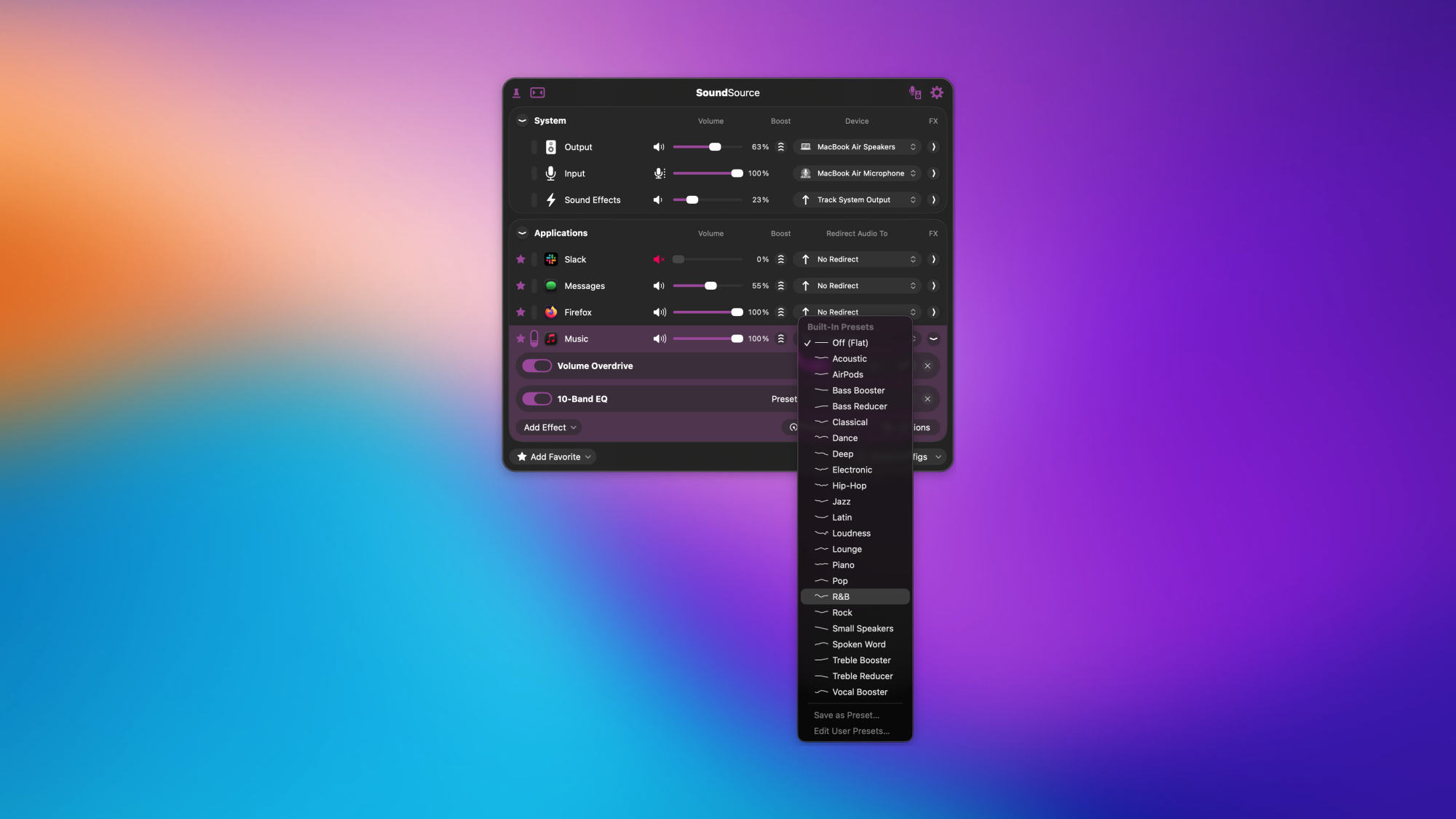
SoundSource on the Mac, with the per-app EQ feature displayed

Credit: Pranay Parab

I first started using SoundSource for its ability to let you set a custom volume level for each app on your Mac. I used this to reduce the volume of notifications from Messages and Slack, while keeping sounds from other apps at a higher level. SoundSource 6 has added another layer to this feature by shipping a per-app equalizer, which lets you set a different sound profile for every single app you use. It ships with nearly two dozen EQ presets for you to choose from. You can choose one EQ preset for music streaming apps and a different one for the apps you use to watch movies. You can locate this feature by clicking the right-arrow button under the FX section in SoundSource.

Set a custom audio level for each device

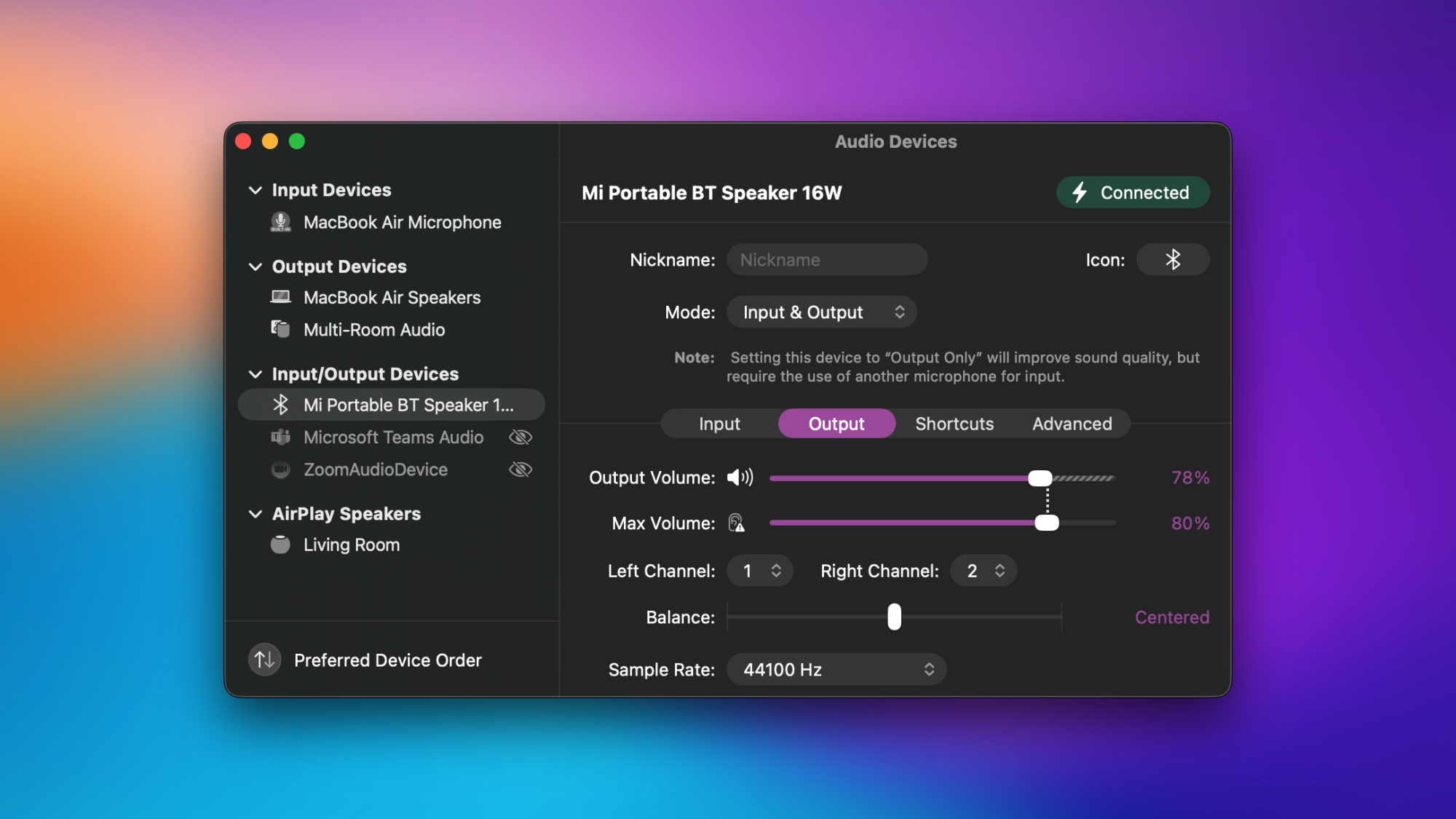
SoundSource on the Mac, with the max volume feature on-screen

Credit: Pranay Parab

SoundSource also lets you set a custom volume level for each audio device your Mac is connected to. This lets me reduce the volume on a particularly loud Bluetooth speaker I own, while keeping my Mac’s speaker volume a little higher. The app also allows you to set a maximum volume limit for each audio device, which you should use for two reasons: To prevent hearing loss if you’re using headphones, and to avoid damaging your speakers. I’ve accidentally damaged a speaker by keeping it at 100% volume for a few hours in an outdoor venue, which isn’t what the speaker was designed for. Since then, I’ve shied away from running speakers at full volume, and you can use the maximum volume limit feature here to help with that.

To use this feature, open SoundSource and click the speaker icon in the top-right corner. This will show you all your input and output devices. Select any device and locate the Output tab in the right pane. Here, move the Max Volume slider to an acceptable limit.

More features

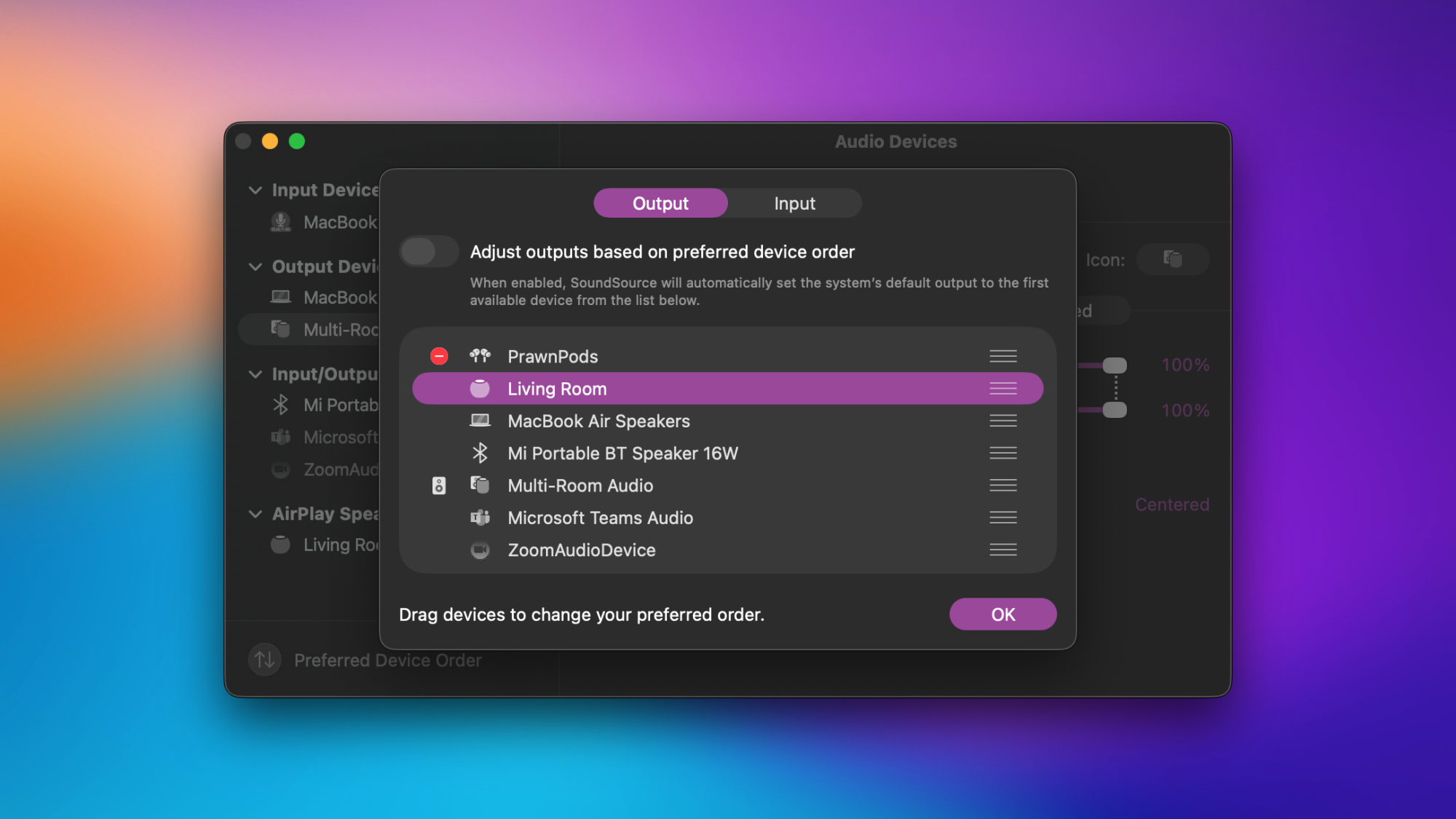
SoundSource on the Mac, with the device order settings page displayed

Credit: Pranay Parab

SoundSource 6 has many other new features that make it worth the upgrade. You can set a preferred device order to ensure that your Mac doesn’t accidentally connect to the wrong audio devices. I use this to set my AirPods as my preferred speaker, followed by my HomePod, my Mac’s own speakers, and my Bluetooth speaker comes in last. The app also allows you to add volume controls for individual apps to the menu bar, which means that you can control the audio level of Chrome, Music, Spotify, or any other app without opening the main SoundSource window. This is great for the times when you only want to adjust a single app’s volume.

There’s also a neat feature where SoundSource can set your AirPods to ‘output-only’ mode, which means that every app will use the Mac’s built-in mic for input and send the audio to the AirPods. Rogue Amoeba says this improves audio quality on the AirPods significantly.

There are many such quality-of-life improvements in this app, which made it an easy decision for me to buy its sixth version. If you’ve never used SoundSource before, you’ll have to pay $49 to use the app. There is a trial mode that lets you try the app for up to 20 minutes for free, after which it degrades the audio. Those upgrading from previous versions of SoundSource can get the updated app for $25.

Meta’s New AI Superstars Are Chafing Against the Rest of the Company

Meta’s newly recruited AI “superstars” have developed an us-versus-them mentality against the company’s longtime executive leadership, creating internal friction over whether the team should focus on catching up to rivals like OpenAI and Google or improving Meta’s core advertising and social media businesses. Alexandr Wang, the 28-year-old entrepreneur Mark Zuckerberg hired in June to be chief AI officer, leads a team called TBD Lab from a siloed space next to Zuckerberg’s office. In meetings this fall, Wang privately told people he disagreed with chief product officer Chris Cox and chief technology officer Andrew Bosworth, according to the New York Times.

Cox and Bosworth wanted Wang’s team to use Instagram and Facebook data to train Meta’s new foundational AI model for improving feeds and advertising. Wang pushed back, arguing the goal should be catching up to rival models before focusing on products. TBD Lab researchers view many Meta executives as interested only in the social media business, while the lab’s ambition is to create “godlike A.I. superintelligence.” Bosworth was recently asked to slash $2 billion from Reality Labs’ proposed budget for next year to fund Wang’s team — a claim Meta disputes.


Read more of this story at Slashdot.

These Nearly Indestructible JBL Earbuds Are 40% Off Right Now

We may earn a commission from links on this page. Deal pricing and availability subject to change after time of publication.

For gym-goers and fitness enthusiasts, finding earbuds that are the right blend of durable and comfortable can be difficult —especially if you’re on a budget. JBL excels in this area; they’re known for delivering strong, bass-y sound, and some models, like the JBL Endurance Peak 3 earbuds, can withstand even the toughest workouts. Right now, they’re $59.95 (originally $99.95),  a 40% drop that brings them down to their lowest price ever. 

These exercise earbuds don’t include active noise cancellation, but they do have what PCMag—which gives them an Editors’ Choice Award—calls a “powerful, bass-forward sound signature.” They’re also completely waterproof and dust-tight with an IP68 rating, meaning they can be submerged in water for more than 30 minutes, making them suitable for heavy rain or rinsing under running water.

To keep them in place during intense movement, the earpieces have sport ear hooks that gently but securely clamp them into place without interfering with glasses. The hooks also double as a power switch: wWhen the tips magnetically connect with the main body of the earpiece, they turn off. This can be frustrating if you need to take them off briefly, since you’ll need to stop the tips from touching the body to avoid powering down. Touch controls are on the outside of each earbud.

They last around 10 hours per charge, and the IPX charging case holds an extra 40 hours of battery life. According to JBL, around 10 minutes of charging will get you an hour of playback, and they fully charge in about two hours. The case, it should be said, is large, clunky, and hard to open, and its slippery exterior makes it hard to grip. The companion app allows you to adjust EQ, view battery life, switch between or turn off Ambient Aware and TalkThru modes, and customize touch controls.

These might not be the best choice if you’re looking for noise-canceling buds or a more compact case. However, if you’re in the market for ultra-durable workout earbuds with a secure fit, long battery life, and great value, the JBL Endurance Peak 3 earbuds are a solid choice for sporty people, especially at the $60 price point. 

GeForce RTX 50 Gaming PC Deals: Save Hundreds On These Holiday Desktop Sales

GeForce RTX 50 Gaming PC Deals: Save Hundreds On These Holiday Desktop Sales
The writing is on the wall in bright neon colors for gamers on the PC platform—pricing is going up and, if you’re planning to buy a new system, do it now before we enter into 2026. That’s not just coming from us, but directly from manufacturers like Maingear and others. Driving the point home, Micron recently announced it was ending its Crucial

CloverPit, a Balatro-style game with a grungy slot machine, hits iOS and Android on December 17

CloverPit is one of my favorite games of the year so far. Developer Panik Arcade took the formula that helped make Balatro so successful — using various tools to bend the rules of the game to help you rack up obscenely high scores — and based it around a slot machine rather than poker. It’s been a hit so far on PC, where it has sold more than a million copies since September, and on Xbox. CloverPit has been among the top 20 most-played titles on Game Pass since its surprise debut there last month. Now, the horror-tinged roguelite is venturing into new territory, as it’s coming to iOS and Android on December 17.

The mobile versions of the game are said to have a fully-optimized interface, as well as all of the post-launch updates, such as the Hard Mode that Panik Arcade recently added. CloverPit will cost $5 on mobile and it will have no microtransactions or “predatory mechanics.” That might seem surprising for a game centered around a slot machine, but CloverPit isn’t really about gambling (which the developers say they don’t like anyway). It’s about breaking the rules to tilt the odds in your favor.

The setup is pretty straightforward. You’re imprisoned in a rusty cell and you have a rapidly increasing debt to pay off. The only way to do that, and hopefully leave through the door, is to earn enough coins from the slot machine to pay what you owe. There are more than 150 items (which are called charms here) to experiment with that affect things like the number of spins, how much each symbol or pattern is worth and how many tickets you earn. Tickets are what you need to buy more charms.

Figuring out combinations of items that work well together is key to quickly scaling up the number of coins and tickets you can earn from each visit to the slot machine. Fail to pay off your debt by a deadline (i.e. after a certain number of spins) and it’s game over, as you plunge into the titular pit.

CloverPit is strange and beguiling and heaps of fun. I’ve plowed around 39 hours into it on Steam, and I’m sure it’ll take up much of my attention on my phone after it hits mobile next week. Doomspinning seems slightly healthier for my brain than doomscrolling.

This article originally appeared on Engadget at https://www.engadget.com/gaming/cloverpit-a-balatro-style-game-with-a-grungy-slot-machine-hits-ios-and-android-on-december-17-154500028.html?src=rss

Pebble’s Affordable $75 AI Ring With On-Device LLM Never Needs Charging

Pebble's Affordable $75 AI Ring With On-Device LLM Never Needs Charging
Eric Migicovsky, the visionary who captivated the early wearable market with the beloved Pebble smartwatch (as well as its recent relaunch), is diversifying the product range with a minimalist, AI-powered device called the Index 01 ring. It’s not a smart ring (because technically it isn’t) and has only one function: to capture fleeting thoughts.

So

10 Hacks for Online Privacy That Everyone Should Know

The internet has become a vital tool for human connection, but it comes with its fair share of risks, with the biggest being your privacy and security. With the big tech giants hungry for every ounce of your data they can get and scammers looking to target you every day, you do need to take a few precautions to protect your online privacy and security. There’s no foolproof approach to these two things, and unfortunately, the onus is on you to take care of your data.

Before you start looking for a VPN or ways to delete your online accounts, you should take a moment to understand your privacy and security needs. Once you do, it’ll be a lot easier to take a few proactive steps to safeguard your privacy and security on the internet. Sadly, there’s no “set it and forget it” solution for this, but I’m here to walk you through some useful hacks that can apply to whatever risks you might be facing.

Don’t use real information, unless you have to

When you install an app on your phone, you’ll often be bombarded with pop-ups asking for permission to access your contacts, location, notifications, microphone, camera, and many other things. Some are necessary, while most are not. The formula I use is to deny every permission unless it’s absolutely necessary to the app’s core function. Similarly, when you’re creating a profile anywhere online, you should avoid giving out any personal information unless it’s absolutely necessary.

You don’t have to use your legal name, real date of birth, or an email address with your real name on most apps you sign up for. Some sites also still use antiquated password recovery methods such as security questions that ask for your mother’s maiden name. Even in these fields, you don’t have to reveal the truth. Every bit of information that you put on the internet can potentially be exposed in a breach. It’s best to use information that’s either totally or partially fake to safeguard your privacy.

You can remove yourself from Google search results

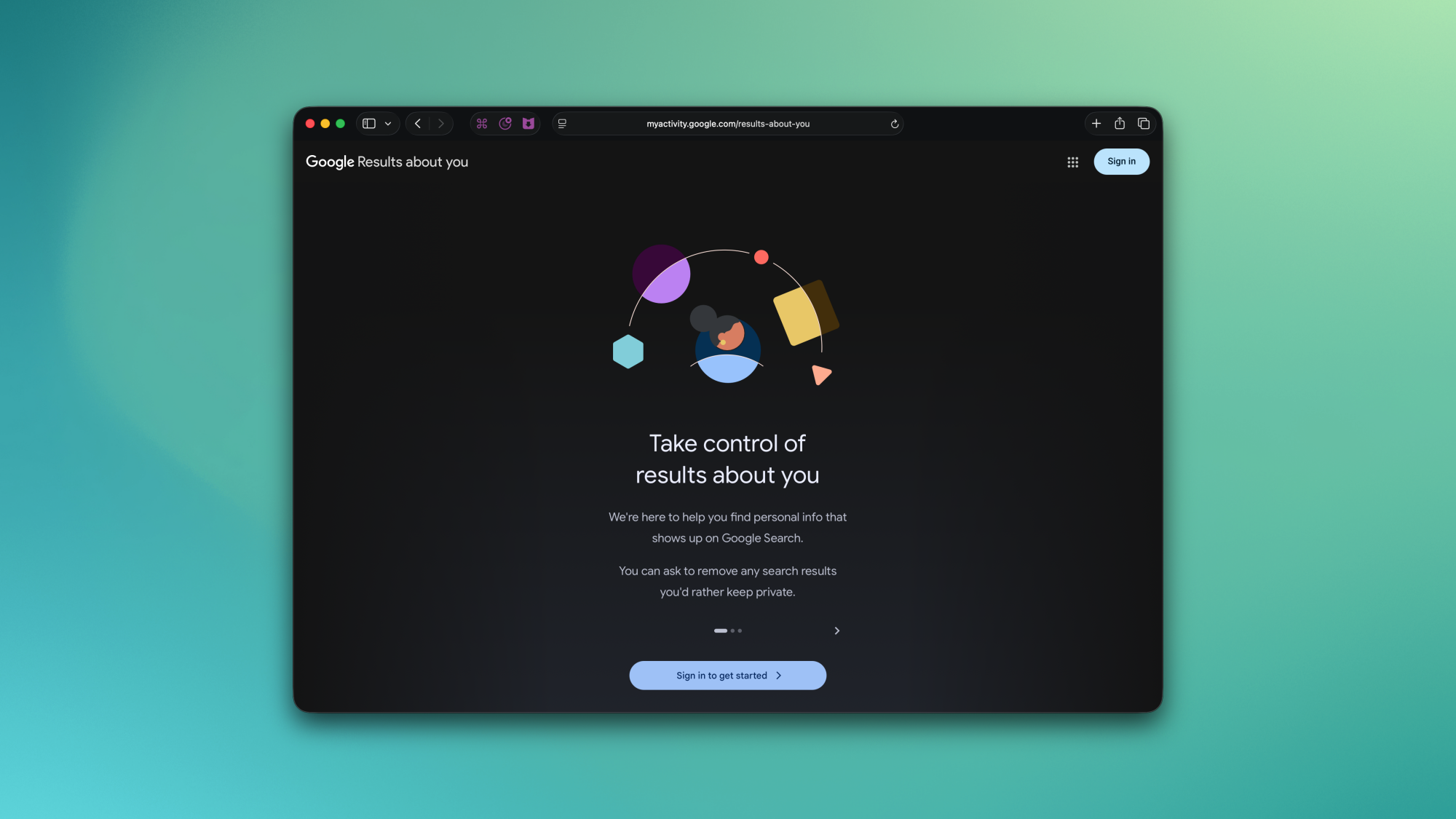
Google's Results About You page.

Credit: Pranay Parab

If your personal information is easily available on Google, and you want to get it removed, you can send Google a request to remove it. Check Google’s support page for how to remove results to see specific instructions for your case. For most people, the simplest way to remove results about yourself is to go to Google’s Results About You page, sign in, and follow the instructions on screen.

Use email aliases to identify where your data was leaked from

Most modern email services let you create unlimited aliases, which means that you don’t need to reveal your primary email address each time you sign up for a new service. Instead of signing up with realemail@gmail.com, you can use something like realemail+sitename@gmail.com. Gmail lets you create unlimited aliases using this method, and you can use that to identify who leaked your data. If you suddenly start getting a barrage of spam to a particular alias, you’ll know which site sold your data.

Your photos reveal a lot about you

When you take a photo, the file for it contains a lot of information about you. By default, all cameras will store EXIF (exchangeable image format) data, which logs when the photo was taken, which camera was used, and photo settings. You should remove exif data from photos before posting them on the internet. If you’re using a smartphone to take photos, it’ll also log the location of each image, which can be used to track you. While social media sites may sometimes remove location and exif data from your pictures, you cannot always rely on these platforms to protect your privacy for you.

You should take a few steps to strip exif data before uploading images. The easiest way to get started is to disable location access for your phone’s camera app. On both iPhone and Android, you can open the Settings app, navigate to privacy settings or permissions, and deny location access to Camera. This will mean that you won’t be able to search for a location in your photos app and identify all photos taken there, and you’ll also lose out on some fun automated slideshows that Apple and Google create. However, it also means that your privacy is protected. You can also use apps to quickly hide faces and anonymize metadata from photos.

While you’re at it, don’t forget that screenshots can also leak sensitive information about you. Some types of malware steal sensitive information from screenshots, so be sure to periodically delete those, too.

Think about what you use AI for

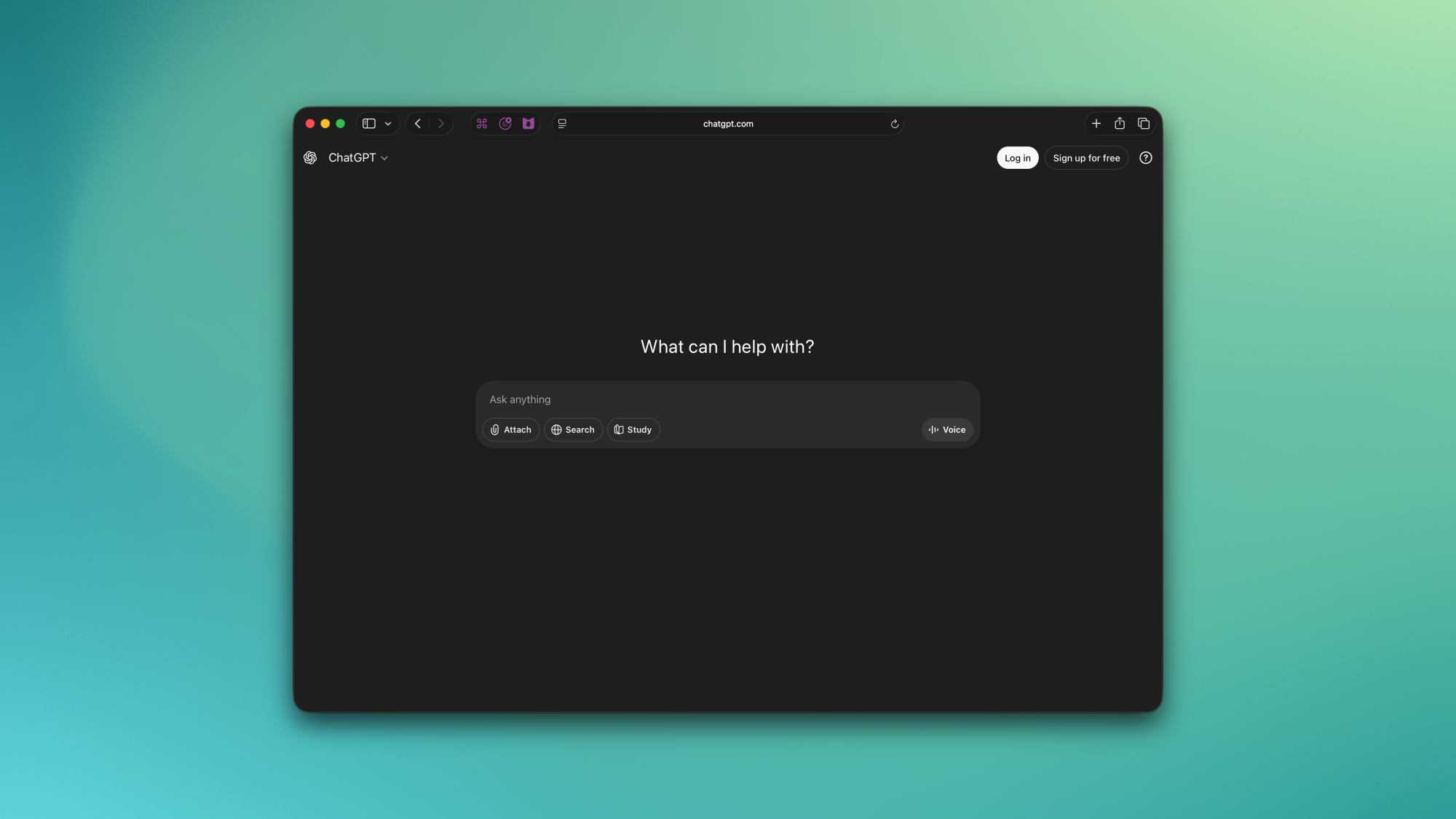
ChatGPT's website on Safari

Credit: Pranay Parab

Nearly every single AI tool is mining your data to improve its services. Sometimes, this means it’s using everything you type or upload. At other times, it could be using things you’ve written, photos or videos you’ve posted, or any other media you’ve ever uploaded to the internet, to train its AI models. There’s not much you can do about mass data scraping off the internet, but you can and should be careful with your usage of AI tools. You can sometimes stop AI tools from perpetually using your data, but relying on these companies to honor those settings toggles is like relying on Meta to keep your data private. It’s best to avoid revealing any personal information to any AI service, regardless of how strong a connection you feel with it. Just assume that anything you send to an AI service can, and probably will, be used to train AI models or even be sold to advertising companies.

You can delete information stored with data brokers

Yes, big companies like Facebook or TikTok can track you even if you don’t have an account with them. Data brokers collect vast troves of information about your internet visits, and sell it to advertisers or literally anyone who’s willing to pay. To limit the damage, you can start by following Lifehacker’s guide to blocking companies from tracking you online. Next, you can go ahead and opt out of data collection by data brokers. If that’s not enough, you can also use services that remove your personal information from data broker sites.

A VPN isn’t always the right answer

Now, I’m sure some of you are thinking that using a VPN will protect you from most of the tracking on the internet. That may be true in some cases, but using a VPN 24/7 is not the right approach for most people. For starters, it just routes all your traffic via the VPN company’s servers, which means that you need to place your trust in the company’s promises not to log your information, and its ability to keep your data safe and private. It also won’t protect you from the types of data leaks that might happen from, say, publicly posting photos tagged with location data.

Many VPN providers claim to be able to protect you, but there are downsides to consider. Some companies such as Mullvad and Proton VPN have earned a solid reputation for privacy, but using a VPN all the time can create more problems than it solves. Your internet speed slows down a lot, streaming services may not work properly, and lots of sites may not load at all because they block VPN IP addresses. In most cases, you’ll probably be better off if you use adblockers and an encrypted DNS instead.

Try a different combination of privacy tools

For most people, ad blockers are a good privacy tool. Even though Google is cracking down on ad blockers, there are ways to get around those restrictions. I highly recommend using uBlock Origin, which also has a mobile version now. Once you’ve settled on a good ad blocker, you should consider also using a good DNS service to filter out trackers, malware, and phishing sites on a network level.

Having a DNS service is like having a privacy filter for all your internet traffic, whether it’s on your phone, laptop, or even your router. I’ve been using NextDNS for a few years, but you can also try AdGuard DNS or ControlD. All of these services have a generous free tier, but you can optionally pay a small annual fee for more features.

Use a good firewall for your computer

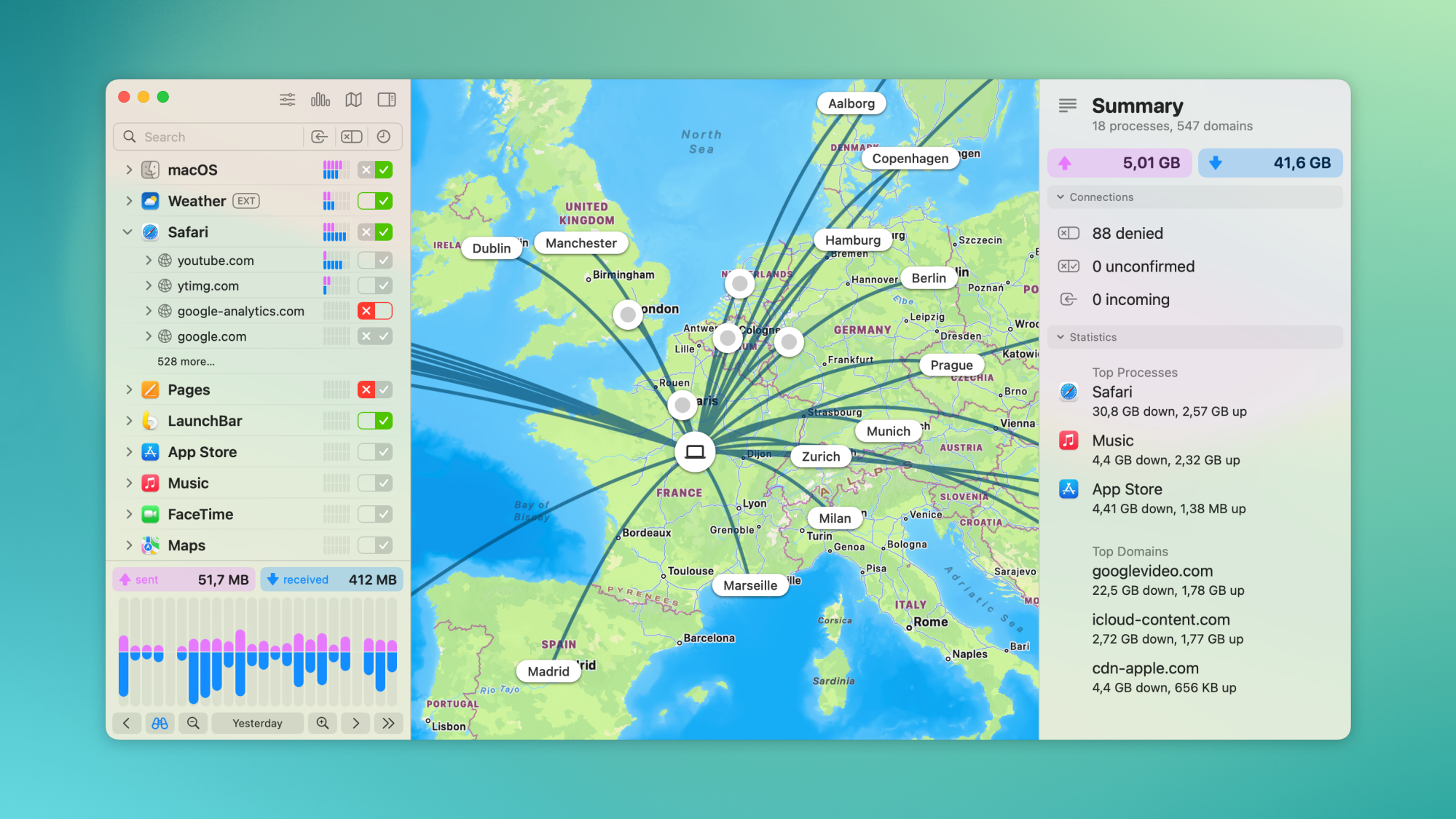
Little Snitch on the Mac

Credit: Little Snitch

Almost all apps these days send telemetry data to remote servers. This isn’t too much of a problem if you only use apps from trusted sources, and can help with things like automatic software updates. But malicious apps or even poorly managed ones may be more open with your data than you would like.

You can restrict some of that by using a good firewall app. This lets you monitor incoming and outgoing internet traffic from your device, and restrict devices from sending unwanted data to the internet. Blocking these requests can hamper some useful features, like those automatic app updates, but they can also stop apps from unnecessarily sending data to online servers. There are some great firewall apps for Mac and for Windows, and you should definitely consider using these for better online privacy.

Switch to a good password manager

I’ve probably said this a million times, but I will repeat my advice: use a good password manager. You may think it’s a bit annoying, but this single step is the easiest way to greatly improve your security on the internet. Password managers can take the hassle of remembering passwords away from you, and they’ll also generate unique passwords that are hard to crack. Both Bitwarden and Apple Passwords (which ships with your Mac, iPhone, and iPad) are free to use, and excellent at their job. Go right ahead and start using them today. I guarantee that you won’t regret it.


Same Product, Same Store, but on Instacart, Prices Might Differ

A study this week has found that shoppers using Instacart are often charged different prices for identical products at the same store at the same time, even when selecting in-store pickup rather than delivery. The Groundwork Collaborative, a progressive policy group, and Consumer Reports organized nearly 200 volunteers across four cities to simultaneously check prices on 20 grocery items. Price differences appeared on nearly three-quarters of the items tested. In one test, more than 40 participants selected the same Safeway in Washington, D.C. and the same brand of eggs. Prices ranged from $3.99 to $4.79 — a 20% spread. At a Target in North Canton, Ohio, Skippy peanut butter was $2.99 for some shoppers and $3.59 for others. The full 20-item basket varied by about 7% within each store.

An Instacart spokeswoman said retailers on its platform set their own prices and that some run short-term, randomized pricing tests. The company said tests were “never based on personal or behavioral characteristics.” Instacart acquired Eversight, an AI-driven pricing optimization company, in 2022. A Target spokesman said the company is not affiliated with Instacart and bears no responsibility for prices on the platform. Safeway and parent company Albertson’s declined to comment.


Read more of this story at Slashdot.