WhatsApp Is Now Rolling Out Missed Call Messages

They say no one actually uses their phones for phone calls anymore. That’s not really true, though maybe the “Phone” app does get underused. Instead, many of us have turned to chat apps for our calls. FaceTime, WhatsApp, Messenger—these apps are now our go-to choices for getting in immediate touch with friends and family. (Not that I’m complaining: The call quality is usually better, anyway.)

But one thing the Phone app—and traditional phone calls—have on these chat apps is voicemail. For decades, when you called someone and they didn’t answer, you could “leave a message after the tone.” That way, when the person saw they had a missed call, they didn’t need to guess what you wanted to say. If it was important, they’d hear about it, and call you back. If it wasn’t, they could choose to call back when it was convenient.

Voicemail isn’t dead: You can still leave these messages if you call someone the old fashioned way. But since many of us choose to use our chat apps of choice, we’ve largely lost this practice. It’s been wholly replaced with text messages and voice notes: If they don’t answer the call, you can simply text them what you wanted to talk about, or record a voice note to achieve a similar end.

Some chat apps are trying to bring voicemails back, however. The first major player on my radar was FaceTime: Back in 2023, Apple made it possible to leave video and audio messages for people whenever they didn’t pick up a FaceTime call. It’s a small but logical feature: Sure, there are other ways to leave a message. But it just makes sense given the history of phone calls to present the option as soon as someone misses your call.

How WhatsApp voicemails work

Now, WhatsApp is getting in on the feature. The company first started testing missed call messages in August, before rolling out the option in full on Thursday. Now, when you try calling someone in WhatsApp and they miss it, you have the option to leave either a video or an audio message—depending on what type of call you started.

Again, these are functions you could initiate already in the app itself: You could simply record a video saying what you want to say, and send it to the recipient, or record an audio note letting them know to call you back. But this built-in option isn’t only convenient, it establishes voice messages as a standard for missed WhatsApp calls.

Interestingly, WhatsApp says this new feature “will make voicemails a thing of the past.” As it see it, it’s actually keeping them alive.

‘Apple Tax is Dead in the USA’

The Ninth Circuit Court of Appeals has almost entirely upheld a scathing April ruling that found Apple in willful violation of a 2021 injunction meant to open up iOS App Store payments in its long-running legal battle against Epic Games. A three-judge panel affirmed that Apple’s 27% fee for developers using outside payment options had a “prohibitive effect” and that the company’s design restrictions on external payment links were overly broad.

The appeals court also agreed that Apple acted in “bad faith” by rejecting viable, compliant alternatives in internal discussions. One divergence from the lower court: the appeals court ruled that Apple should still be able to charge a “reasonable fee” based on its actual costs to ensure user security and privacy, rather than charging nothing at all. What qualifies as “reasonable” remains to be determined.

Epic CEO Tim Sweeney told reporters he believes those fees should be “super super minor,” on the order of “tens or hundreds of dollars” every time an iOS app update goes through Apple for review. “The Apple Tax is dead in the USA,” he wrote on social media. Sweeney also alleged that a widespread “fear of retaliation” has kept many developers paying Apple’s default 30% fees, claiming the company can effectively “ghost” apps by delaying reviews or burying them in search results.


Read more of this story at Slashdot.

Inside A Simulated Steam Machine: 27 Games Tell The Real Story

Inside A Simulated Steam Machine: 27 Games Tell The Real Story
The year is 2013. Valve Software, whose Steam digital delivery service has just hit the ten-year mark, has decided it’s time to launch a series of gaming PCs, along with a custom operating system. The project continues through 2015 and but doesn’t catch on, mostly because the software situation simply wasn’t ready. SteamOS at that time could…

Doom studio id Software forms ‘wall-to-wall’ union, with 165 employees voting in favor

Id Software, the company behind Doom, has voted in favor of forming a “wall-to-wall” union. The term “wall-to-wall” refers to a union that includes every employee, regardless of duties. The vote wasn’t unanimous, with 165 of 185 total employees in favor of the union.

The union will work in conjunction with the Communications Workers of America (CWA), which is the same organization involved with parent company ZeniMax’s recent unionization efforts. Microsoft, who owns ZeniMax, has already recognized this new effort, according to a statement by the CWA. It agreed to a labor neutrality agreement with the CWA and ZeniMax workers last year, paving the way for this sort of thing.

“The wall-to-wall organizing effort at id Software was much needed; it’s incredibly important that developers across the industry unite to push back on all the unilateral workplace changes that are being handed down from industry executives,” id Software producer and CWA committee member Andrew Willis wrote in a statement to Engadget.

From the onset, this union will look to protect remote work for id Software employees. “Remote work isn’t a perk. It’s a necessity for our health, our families, and our access needs. RTO policies should not be handed down from executives with no consideration for accessibility or our well-being,” said id Software Lead Services Programmer Chris Hays. He also said he looks forward to getting worker protections regarding the “responsible use of AI.”

Workers at id began organizing around 18 months ago, according to a report by Aftermath. Things sped up after Microsoft closed several Bethesda studios in the middle of last year.

“We look forward to sitting across the table from Microsoft to negotiate a contract that reflects the skill, creativity and dedication these workers bring to every project,” said CWA Local 6215 President Ron Swaggerty.

The developer’s latest game is Doom: The Dark Ages, which we loved. It scooped up an award for accessibility at last night’s The Game Awards. 

This article originally appeared on Engadget at https://www.engadget.com/big-tech/doom-studio-id-software-forms-wall-to-wall-union-with-165-employees-voting-in-favor-164808311.html?src=rss

Doom studio id Software forms ‘wall-to-wall’ union, with a majority of employees voting in favor

Id Software, the company behind Doom, has voted in favor of forming a “wall-to-wall” union. The term “wall-to-wall” refers to a union that includes every employee, regardless of duties. The vote wasn’t unanimous, though a majority did vote in favor of the union.

The union will work in conjunction with the Communications Workers of America (CWA), which is the same organization involved with parent company ZeniMax’s recent unionization efforts. Microsoft, who owns ZeniMax, has already recognized this new effort, according to a statement by the CWA. It agreed to a labor neutrality agreement with the CWA and ZeniMax workers last year, paving the way for this sort of thing.

“The wall-to-wall organizing effort at id Software was much needed; it’s incredibly important that developers across the industry unite to push back on all the unilateral workplace changes that are being handed down from industry executives,” id Software producer and CWA committee member Andrew Willis wrote in a statement to Engadget.

From the onset, this union will look to protect remote work for id Software employees. “Remote work isn’t a perk. It’s a necessity for our health, our families, and our access needs. RTO policies should not be handed down from executives with no consideration for accessibility or our well-being,” said id Software Lead Services Programmer Chris Hays. He also said he looks forward to getting worker protections regarding the “responsible use of AI.”

Workers at id began organizing around 18 months ago, according to a report by Aftermath. Things sped up after Microsoft closed several Bethesda studios in the middle of last year.

“We look forward to sitting across the table from Microsoft to negotiate a contract that reflects the skill, creativity and dedication these workers bring to every project,” said CWA Local 6215 President Ron Swaggerty.

The developer’s latest game is Doom: The Dark Ages, which we loved. It scooped up an award for accessibility at last night’s The Game Awards. 

This article originally appeared on Engadget at https://www.engadget.com/big-tech/doom-studio-id-software-forms-wall-to-wall-union-with-a-majority-of-employees-voting-in-favor-164808829.html?src=rss

China Leads Research in 90% of Crucial Technologies – a Dramatic Shift this Century

China is leading research in nearly 90% of the crucial technologies that “significantly enhance, or pose risks to, a country’s national interests,” according to a technology tracker run by the Australian Strategic Policy Institute (ASPI) — an independent think-tank. Nature: The ASPI’s Critical Technology Tracker evaluated research on 74 current and emerging technologies this year, up from the 64 technologies it analyzed last year. China is ranked number one for research on 66 of the technologies, including nuclear energy, synthetic biology, small satellites, while the United States topped the remaining 8, including quantum computing and geoengineering.

The results reflect a drastic reversal. At the beginning of this century, the United States led more than 90% of the assessed technologies, whereas China led less than 5% of them, according to the 2024 edition of the tracker. “China has made incredible progress on science and technology that is reflected in research and development, as well as in publications,” says Ilaria Mazzocco, who researches China’s industrial policy at the Center for Strategic and International Studies, a non-profit research organization based in Washington DC.

Mazzocco says the general trend identified by the ASPI is not a surprise, but it is “remarkable” to see that China is so dominant and advanced in so many fields compared with the United States.


Read more of this story at Slashdot.

Framework Raises DDR5 Prices By 50%, Accuses Apple & Dell Of Price Gouging

Framework Raises DDR5 Prices By 50%, Accuses Apple & Dell Of Price Gouging
Framework is on a mission to change the status quo when it comes to laptops, having introduced several modular models with replaceable parts that go beyond the DIY boundaries of what is typical for a laptop. Be that as it may, Framework is susceptible to the same market conditions as everyone else. As a result, it’s being forced to raise DDR5

The Immediate Post-College Transition and its Role in Socioeconomic Earnings Gaps

A new study of roughly 80,000 bachelor’s degree recipients from a large urban public college system finds that characteristics of a graduate’s first job can explain nearly two-thirds of the otherwise-unexplained earnings gap between students from low-income and high-income families five years after graduation.

The research [PDF], published as an NBER working paper by economists at Columbia University, tracked graduates from 2010 to 2017 using administrative education data linked to state unemployment insurance records. Low-income students — defined as those receiving Pell grants throughout their undergraduate enrollment — earned about 12% less than their high-income peers at the five-year mark. A substantial gap of roughly $4,900 persisted even after the researchers controlled for GPA, college attended, major, and other pre-graduation characteristics. That residual gap fell to about $1,700 once first-job variables entered the equation.

Graduates from lower-income families tended to start at employers paying lower average wages and were less likely to have their first job secured before graduation. Just 34% of low-income graduates continued at a pre-graduation employer compared to 40% of their higher-income peers. The firms employing low-income graduates paid average wages that were 18% lower than those employing high-income graduates. The researchers say that while the study cannot establish causation, the patterns suggest that supporting low-income students during their transition from college to the labor market may be a fruitful area for policy intervention.


Read more of this story at Slashdot.

Epic celebrates “the end of the Apple Tax” after appeals court win in iOS payments case

Back in April, District Court Judge Yvonne Gonzalez Rogers delivered a scathing judgment finding that Apple was in “willful violation” of her 2021 injunction intended to open up iOS App Store payments. That contempt of court finding has now been almost entirely upheld by the Ninth Circuit Court of Appeals, a development that Epic Games’ Tim Sweeney tells Ars he hopes will “do a lot of good for developers and start to really change the App Store situation worldwide, I think.”

The ruling, signed by a panel of three appellate court judges, affirmed that Apple’s initial attempts to charge a 27 percent fee to iOS developers using outside payment options “had a prohibitive effect, in violation of the injunction.” Similarly, Apple’s restrictions on how those outside links had to be designed were overly broad; the appeals court suggests that Apple can only ensure that internal and external payment options are presented in a similar fashion.

The appeals court also agreed that Apple acted in “bad faith” by refusing to comply with the injunction, rejecting viable, compliant alternatives in internal discussions. And the appeals court was also not convinced by Apple’s process-focused arguments, saying the district court properly evaluated materials Apple argued were protected by attorney-client privilege.

Read full article

Comments

Philips Hue’s New Security Camera Is Surprisingly Useful

We may earn a commission from links on this page.

Philips Hue is one of the most well-respected and popular brands in smart lights—but what about its smart security cameras? Parent company Signify has been developing Hue cameras for a couple of years now, with a video doorbell and 2K camera upgrades recently added to the portfolio of devices. (Note: This 2K version hasn’t yet landed in the U.S., but the existing 1080p versions are quite similar.)

I got a chance to test out the new 2K Hue Secure camera, and alongside all the basics of a camera like this, it came with an extra bonus that worked better than I expected: seamless integration with Philips Hue lights. These two product categories actually work better together than you might think.

While you can certainly connect cameras and lights across a variety of smart home platforms, Philips Hue is one of very few manufacturers making both types of device (TP-Link is another). That gives you a simplicity and interoperability you don’t really get elsewhere.

Setting up a Hue camera

Philips Hue app
All the basic security camera features are covered.
Credit: Lifehacker

Hue cameras are controlled inside the same Hue app for Android or iOS as the Hue lights. You don’t necessarily need a Hue Bridge to connect the camera, too, as it can link to your wifi directly, but the Bridge is required if you want it to be able to sync with your lights—which is one of the key features here. (If you already have the lights, you’ll already have the Bridge anyway.)

The 2K Hue Secure wired camera I’ve been testing comes with a 2K video resolution (as the name suggests). two-way audio, a built-in siren, infrared night vision, and weatherproofing (so you can use it indoors or out). As well as the wired version I’ve got here, there’s also a battery-powered option, and a model that comes with a desktop stand.

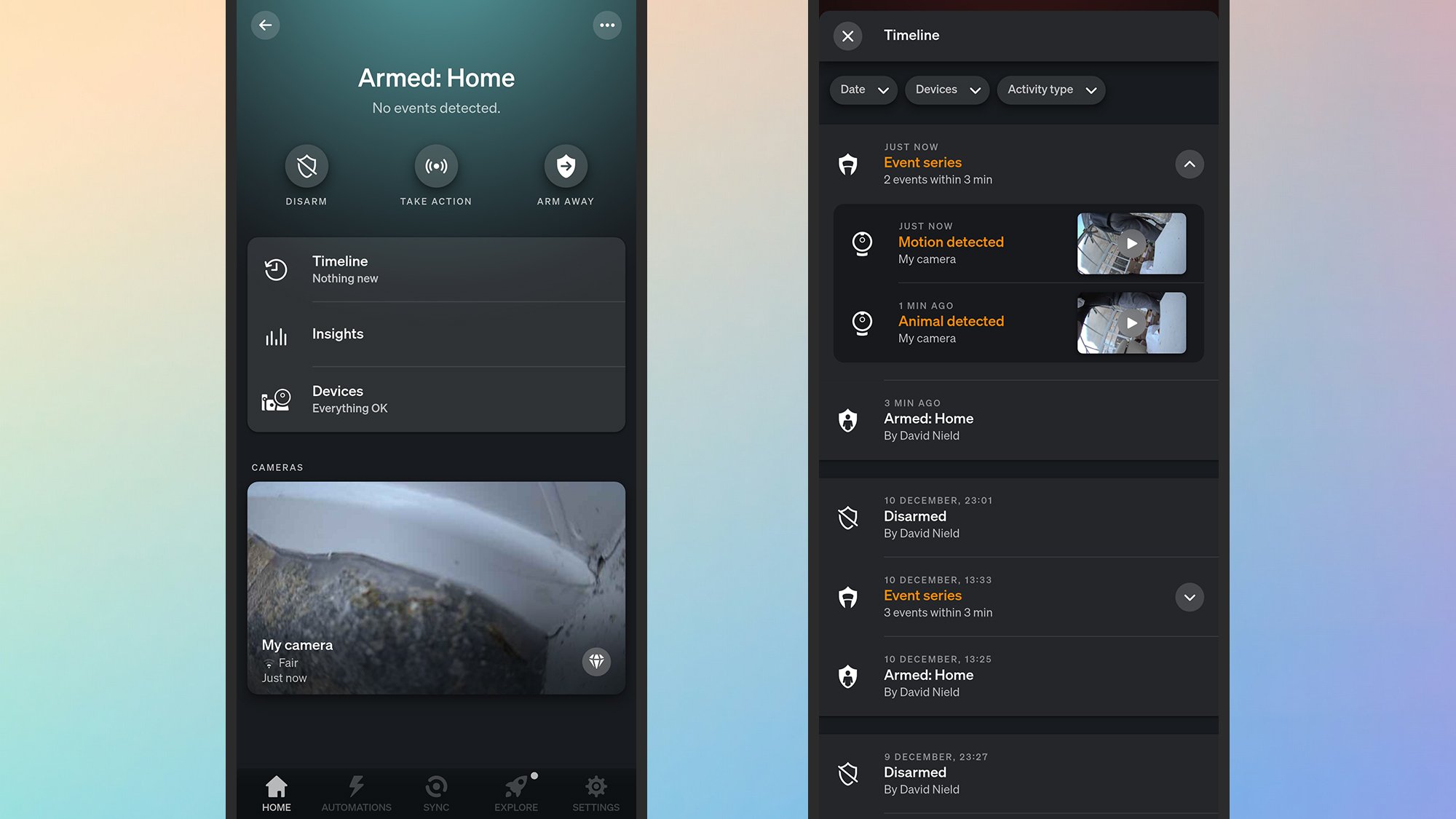
Once configured, the camera lives in the same Home tab inside the mobile app as any Philips Hue lights you’ve got. The main panel doesn’t show the camera feed—instead, it shows the armed status of the camera, which can be configured separately depending on whether you’re at home or not. The idea is that you don’t get disturbed with a flurry of unnecessary notifications when you’re moving around.

The basic functionality is the same as every other security camera: Motion is detected and you get a ping to your phone with details, with a saved clip of the event that stays available for 24 hours. You can also tap into the live feed from the camera at any time, should you want to check in on the pets or the backyard.

As is often the case with security cameras, there is an optional subscription plan that gives you long-term video clip storage, activity zone settings, and AI-powered identification of people, animals, vehicles, and packages. That will set you back from $4 a month, with a discount if you pay for a year at a time.

Syncing a camera with smart lights

Philips Hue app
Your cameras can be used as customized triggers for your lights.
Credit: Lifehacker

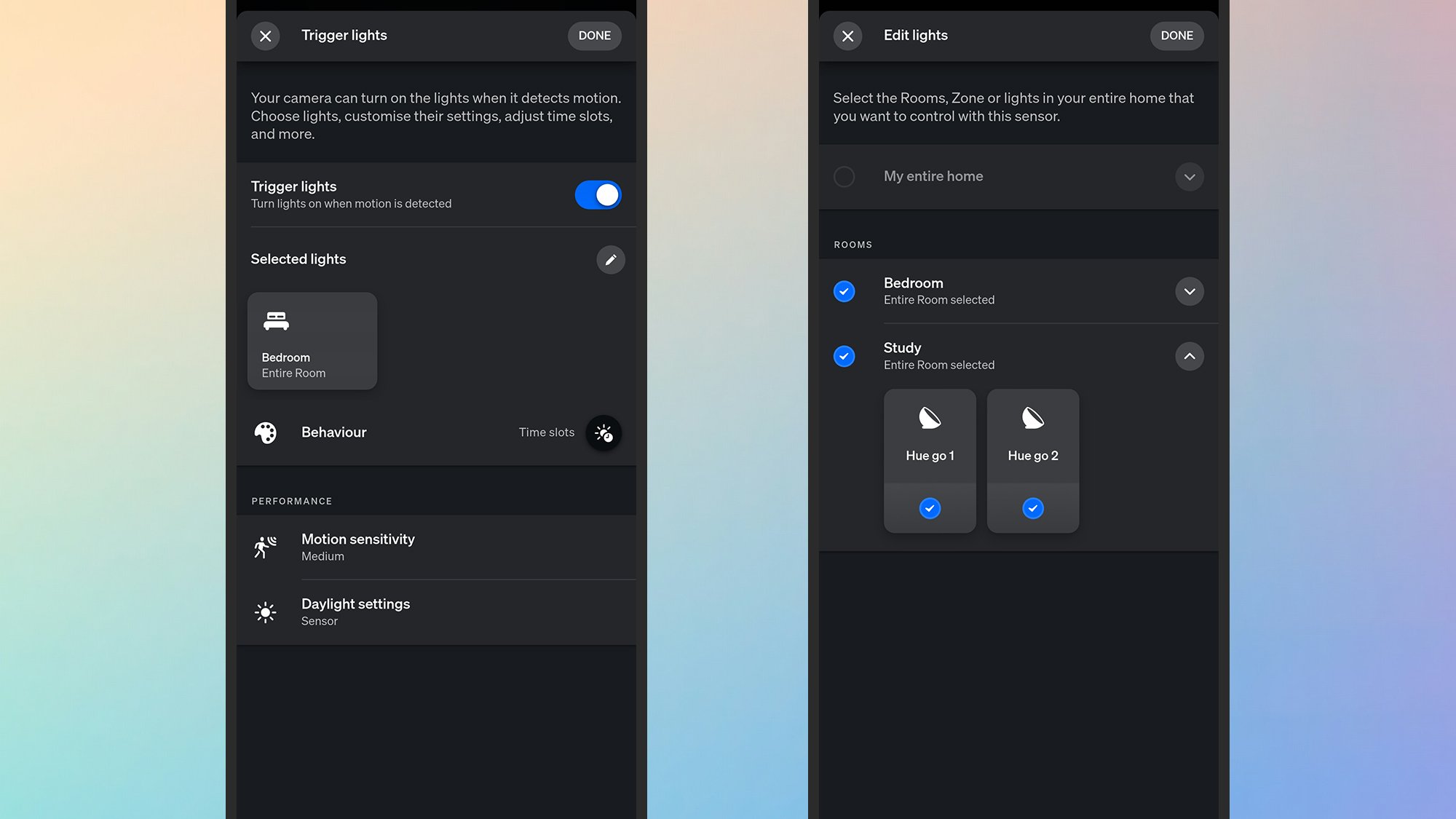
I started off a little unsure about just how useful it would be to connect up the Hue cameras and Hue lights—it’s not a combination that gets talked about much—but it’s surprisingly useful. If you delve into the camera settings inside the Hue app, there’s a Trigger lights section especially for this.

You get to choose which of your lights are affected—they don’t all have to go on and off together—and there are customizations for color and brightness across certain time schedules. You could have your bulbs glowing red during the night, for example, or turning bright blue during the daytime. The duration the lights stay on for can also be set.

It’s not the most sophisticated system, but it works: If someone is loitering around your property, you can have a selected number of lights turn on to put them off, or to suggest that someone is in fact at home. This is in addition to everything else you can do, including sounding a siren through the camera, and because it works through the Hue Bridge it all happens pretty much instantaneously.

You can also set specific cameras as basic motion sensors for you and your family—lighting up the way to the bathroom late at night, for example. This can work even when the system is disarmed, so there’s no wifi video streaming happening, but the cameras are still watching out for movement and responding accordingly.

There’s one more option worth mentioning in the security settings in the Hue app: “mimic presence.” This can randomly turn your lights on and off at certain points in the day, and the schedule you choose can be controlled by whether or not your Hue security is armed or disarmed (so nothing happens when everyone is at home).

Senator endorses discredited doctor’s book that claims chemical treats autism, cancer

For years, Sen. Ron Johnson has been spreading conspiracy theories and misinformation about COVID-19 and the safety of vaccines.

He’s promoted disproven treatments for COVID-19 and claimed, without evidence, that athletes are “dropping dead on the field” after getting the COVID-19 vaccination. Now the Wisconsin politician is endorsing a book by a discredited doctor promoting an unproven and dangerous treatment for autism and a host of ailments: chlorine dioxide, a chemical used for disinfecting and bleaching.

The book is “The War on Chlorine Dioxide: The Medicine that Could End Medicine” by Dr. Pierre Kory, a critical care specialist who practiced in Wisconsin hospitals before losing his medical certification for statements advocating using an antiparasite medication to treat COVID-19. The action, he’s said, makes him unemployable, even though he still has a license.

Read full article

Comments

Your Android Can Now Share Live Video to 911

If you find yourself in an emergency or crisis situation, the more information you can give first responders, the better. Android users can now share a live stream of their surroundings with 911, allowing emergency services to assess and provide guidance in real time while you wait for help to arrive onsite.

Emergency services on Android

Your Android already shares some information with first responders via Emergency Location Services (unless you disable this feature). This built-in tool sends an accurate location as well as contextual information, such as language settings, when you call or text an emergency number. Now, that includes live video from your device’s camera.

You don’t need to do anything to set up Emergency Live Video. Once available in your area, responders can send a request during an emergency call or text to securely share your camera’s live video. You’ll see a prompt on your screen to start sharing with one tap.

According to Google, Emergency Live Video is encrypted by default. Users can choose whether to share their video from the prompt as well as stop the share at any time by clicking the onscreen Stop sharing button.

Live video sharing is rolling out now to U.S. users, as well as those in parts of Germany and Mexico, on Android phones running Android 8 and up. Google says they are partnering with public safety organizations to expand the feature to more users.

Other Android safety features

Emergency Live Video is the latest in Google’s suite of safety features designed to make help more accessible—more quickly—in an emergency. Pixel users in Australia, North America, and several dozen countries across Europe now have access to Satellite SOS, which allows you to call emergency services even without a cellular or wifi connection. Car Crash Detection contacts emergency services and shares your location in the event of severe crash, while Fall Detection and Loss of Pulse Detection will call for help based on Pixel Watch sensor data.

Washington Post’s AI-Generated Podcasts Rife With Errors, Fictional Quotes

The Washington Post’s top standards editor Thursday decried “frustrating” errors in its new AI-generated personalized podcasts, whose launch has been met with distress by its journalists. From a report: Earlier this week, the Post announced that it was rolling out personalized AI-generated podcasts for users of the paper’s mobile app. In a release, the paper said users will be able to choose preferred topics and AI hosts, and could “shape their own briefing, select their topics, set their lengths, pick their hosts and soon even ask questions using our Ask The Post AI technology.”

But less than 48 hours since the product was released, people within the Post have flagged what four sources described as multiple mistakes in personalized podcasts. The errors have ranged from relatively minor pronunciation gaffes to significant changes to story content, like misattributing or inventing quotes and inserting commentary, such as interpreting a source’s quotes as the paper’s position on an issue.

According to four people familiar with the situation, the errors have alarmed senior newsroom leaders who have acknowledged in an internal Slack channel that the product’s output is not living up to the paper’s standards. In a message to other WaPo staff shared with Semafor, head of standards Karen Pensiero wrote that the errors have been “frustrating for all of us.”


Read more of this story at Slashdot.

Investors commit quarter-billion dollars to startup designing “Giga” satellites

A startup established three years ago to churn out a new class of high-power satellites has raised $250 million to ramp up production at its Southern California factory.

The company, named K2, announced the cash infusion on Thursday. K2’s Series C fundraising round was led by Redpoint Ventures, with additional funding from investment firms in the United States, the United Kingdom, and Germany. K2 has now raised more than $400 million since its founding in 2022 and is on track to launch its first major demonstration mission next year, officials said.

K2 aims to take advantage of a coming abundance of heavy- and super-heavy-lift launch capacity, with SpaceX’s Starship expected to begin deploying satellites as soon as next year. Blue Origin’s New Glenn rocket launched twice this year and will fly more in 2026 while engineers develop an even larger New Glenn with additional engines and more lift capability.

Read full article

Comments

GeForce RTX 5070 Is Slashed Below MSRP Just In Time For Christmas

GeForce RTX 5070 Is Slashed Below MSRP Just In Time For Christmas
PC memory prices are getting out of control, there’s no doubt about that, and storage could be next. You can blame AI and its growing appetite for hardware, which has left consumers in a precarious spot. Somewhat ironically, however, GPU prices continue to level out and sometimes even drop below MSRP. That’s the case with a factory overclocked

The Case for Ditching Your Fitness Trackers

I have a love–hate relationship with the smartwatch on my wrist. This relationship is no doubt shaped by the fact that I write about fitness tech for a living, but I know I’m not alone in succumbing to an obsession with numbers from my wearables. Did I hit 10,000 steps? What’s my resting heart rate today? Is my sleep score better than yesterday’s? When did progressive overload turn into screen time overload, too?

The fitness tech boom is showing no signs of slowing down any time soon—and with it, we consume a constant stream of promises that this data will make us healthier, stronger, and faster. With the sheer amount of health insights potentially available to us at any time, it’s easy to get overwhelmed. I’ve watched my least health-anxious friends become consumed by metrics they’d never heard of two years ago. They’re tracking bone density trends, obsessing over cortisol levels, panicking about stress scores that fluctuate for reasons no algorithm can fully explain. I can feel my fitness trackers pull me away from genuine wellness and into a mental health disaster. The good news: When I look up from my screens and start talking to real people, I see I’m not alone in wanting to unplug and push back against the overly quantified self.

A growing anti-tech fitness movement

When I put out a call on Instagram asking people about their relationship with posting workout data and fitness content, I received hundreds of responses from people exhausted by the performance of fitness. Even if your only audience is your own reflection, simply owning a wearable can create a real barrier between feeling good about your body and your fitness journey. Did I work out enough today? Will my friends see that I skipped a workout? Should I push through injury to maintain my streak?

For these reasons, celebrity trainer Lauren Kleban says she doesn’t like to rely on wearables at all. “Counting steps or calories can quickly spiral into a bit of an obsession,” says Kleban, and that “takes the joy out of movement and away from learning what’s truly best for us.” She says her clients want to focus on their mind and body connection, now more than ever. There’s a real, growing desire to rebuild a sense of intuition that doesn’t depend on feedback from a watch.

Similarly, Marshall Weber, a certified personal trainer and owner of Jack City Fitness, says that he’s “definitely been surprised by the growing push towards unplugged fitness,” but that he “totally gets it.” Weber says he’s had clients express feeling “overwhelmed with their Fitbit or Apple Watch micromanaging their training.” When every workout becomes about numbers and keeping up with an average, it’s all too easy to lose touch with your body. “The anti-tech movement is about taking back that personal connection,” Weber says. After all, when was the last time you finished a workout and didn’t immediately look at your stats, but instead just noticed how you felt?

This is the paradox at the heart of fitness technology. Tools designed to help us understand our bodies have created a new kind of illiteracy. Maybe you can tell me why you’re aiming for Zone 2 workouts, but can’t actually recognize what that effort feels like without a screen telling you. In a sense, you might be outsourcing your own intuition to algorithms.

If nothing else, the data risks are real. (Because if you think you own all your health data, think again.) Every heart rate spike, every missed workout, every late-night stress indicator gets recorded, stored, and potentially shared. Still, for me, the more insidious risk is psychological: the erosion of our ability to know ourselves without consulting a device first.

How to unplug and exercise intuitively

So what does unplugged fitness actually look like in practice? It’s not about rejecting all technology or pretending GPS watches and heart rate monitors don’t have value—I promise. Look, I crave data and answers as much as—and maybe more than—the average gym-goer. I’m simply not woo-woo enough to ditch my Garmin altogether.

Instead, I argue for re-establishing a hierarchy in which technology serves your training, not the other way around. “Sometimes, the best performance boost is just learning to listen to what your body is saying and feeling,” says Weber. But what does “listening to your body” actually look like?

If you’re like me, and need to rebuild a connection with your body from the ground-up, try these approaches:

  • Start with tech-free workouts. Designate certain runs, yoga sessions, or strength workouts as completely unplugged. No watch, no phone, no tracking. Notice what changes when there’s no device to check.

  • Relearn your body’s signals. Can you gauge your effort level without looking at a heart rate monitor? Do you actually know what “recovery pace” feels like for you, or are you just matching a number? Practice assessing fatigue, energy, soreness, and readiness without checking your watch.

  • Replace metrics with sensory awareness. Instead of tracking pace, notice your breathing pattern. Instead of counting calories burned, pay attention to how your muscles feel. Instead of obsessing over sleep scores, ask yourself a simple question in the morning: how do I actually feel?

  • Set goals that can’t be gamified. Rather than chasing step counts or streak days, aim for qualitative improvements. Can you hold a plank with better form? Does that hill feel easier than last month? Are you enjoying your workouts more? These are the markers of real progress.

  • Create tech boundaries. Maybe you use your GPS watch for long runs but leave it home for everything else. Perhaps you track workouts but delete the social features. Find the minimum effective dose of technology that serves your goals without dominating your headspace.

  • Reconnect with in-person community. The loss of shared gym culture—people actually talking to each other instead of staying plugged into individual screens—represents more than just nostalgia. There’s real value in working out alongside others, in having conversations about training instead of just comparing data, in building knowledge through shared experience rather than algorithm-driven insights.

The bottom line

Unplugging is easier said than done, but you don’t need to go cold turkey. Maybe in the new year, you can set “body literacy” as a worthwhile resolution. At the end of the day, exercise should add to your life, not become another source of performance anxiety. It should be energizing, not exhausting—and I don’t just mean physically. The never-ending irony of modern fitness culture is that in our pursuit of optimal health, we keep inventing new forms of stress and anxiety. When all forms of wellness come with trackable metrics and social pressure, I think we’ve fundamentally missed the point.

B&O’s New Phantom And Mirage Speakers Rock Pretentious Vibes Starting At Least $190K

B&O's New Phantom And Mirage Speakers Rock Pretentious Vibes Starting At Least $190K
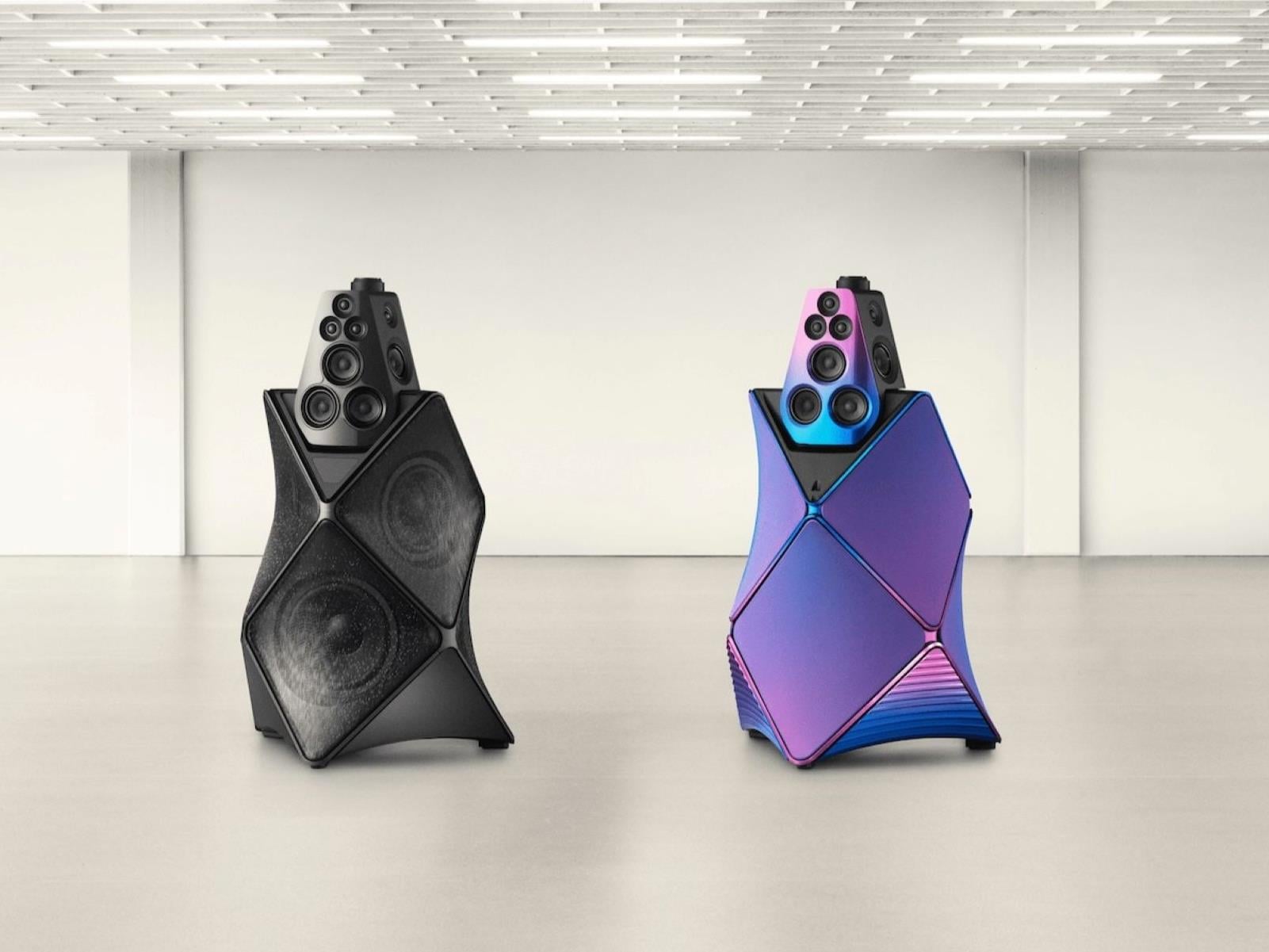
Bang & Olufsen has once again blurred the lines between high fidelity audio and sculptural fine art with the reveal of two flagship loudspeakers, the Beolab 90 Phantom Edition and Mirage Edition. Whether they’re worthy of their six-figure price tag is a whole other discussion altogether.

The remarkable, reimagined. Introducing Beolab 90

Geminids Meteor Shower Is Your Best Chance To Catch A Shooting Star

Geminids Meteor Shower Is Your Best Chance To Catch A Shooting Star
As one last big hurrah for the year, the celestial display of the Geminids meteor shower is expected to dazzle us with some celestial fireworks, as long as you’re in the right viewing spot and weather conditions, of course.

Skygazers in the Northern Hemisphere can look forward the peak of the Geminids shower on the night of the 13th (tomorrow),

Hollywood Director Found Guilty of Blowing $11 Million Netflix Budget on Crypto and Ferraris

Carl Rinsch, the director behind the 2013 Keanu Reeves film “47 Ronin,” has been found guilty of defrauding Netflix out of $11 million that was meant to fund a science fiction series called “Conquest,” which the streaming company ultimately cancelled in 2021 after Rinsch failed to meet any production milestones. A jury in the Southern District of New York convicted the 48-year-old on seven charges: one count each of wire fraud and money laundering, and five counts of transacting in illicitly obtained property.

Prosecutors alleged that Rinsch funneled the $11 million through multiple bank accounts into a personal brokerage account, lost more than half of it on securities within two months, and then began speculating on cryptocurrency. Court records show he also spent $2.4 million on a Ferrari and five Rolls Royces, $3.3 million on furniture and antiques, and $387,000 on a Swiss watch. Netflix has written off $55 million in total and has not recovered any funds. Rinsch faces up to 90 years in prison and is scheduled for sentencing on April 17, 2026.


Read more of this story at Slashdot.

Reddit sues Australia over underage social media ban

Reddit has filed a lawsuit in Australia’s High Court aiming to overturn the country’s under-16 social media ban, Reuters reported. The forum platform called the law contrary to Australia’s constitution as it intrudes on free political discourse. It also argued that Reddit shouldn’t have been included in the ban since it isn’t a social media site, based on the law’s definition. The action is likely to set in motion a protracted legal battle, given Reddit’s resources and its popularity in Australia

Australia’s minimum age social media ban, the first of its kind in the world, went into effect on December 10. The ten platforms affected, including Reddit, must bar underage users or face a fine of up to A$49.5 million ($33 million). Platforms are using a variety of means to determine age, including age inference based on activity and selfies.

However Reddit argued that the law comes with some “serious privacy and political expression issues” for users. “Australian citizens under the age of 16 will, within years if not months, become electors. The choices to be made by those citizens will be informed by political communication in which they engage prior to the age of 18,” it wrote in the filing.

The government disagreed, noting that Reddit filed the lawsuit to protect is profits, not children’s right to free expression. “It is action we saw time and time again by Big Tobacco against tobacco control and we are seeing it now by some social media or big tech giants,” said Health Minister Mark Butler. 

With a market capitalization of $44 billion, Reddit certainly has the means to sustain a long fight. It would be motivated to do so as well, given that Australia is its fourth-largest market after Canada, the UK and the United States.

This article originally appeared on Engadget at https://www.engadget.com/social-media/reddit-sues-australia-over-underage-social-media-ban-143018208.html?src=rss