Mass Hacking of IP Cameras Leave Koreans Feeling Vulnerable in Homes, Businesses

Hackers breached approximately 120,000 IP cameras across South Korea and allegedly sold footage captured from private homes, gynecology offices, breastfeeding rooms and massage parlors to an overseas pornography website, prompting an interagency government task force to announce sweeping reforms on December 7.

Police believe one suspect alone hacked 63,000 cameras and produced 545 videos that netted him 35 million won ($24,000) in cryptocurrency; a second suspect, operating independently, compromised 70,000 devices and earned 18 million won from 648 videos. The footage accounted for 62% of all content on the website, which maintains a dedicated “Korean” category. A government survey found that only 59% of installation companies consistently carried out mandatory security measures such as changing default passwords. Lawmakers are now pursuing legislation requiring security-certified IP cameras in sensitive facilities.


Read more of this story at Slashdot.

Meta’s Major VR Strategy Shift Leaves ASUS And Lenovo In Limbo

Meta's Major VR Strategy Shift Leaves ASUS And Lenovo In Limbo
A year and a half ago Meta made what at the time felt like a big move, as the company made the operating system that powers its headsets available to other manufacturers. Horizon OS was going to open the doors for a more robust VR ecosystem that even included support for mobile apps. However, Road to VR is reporting that these plans have been

The Displace Hub can make your normal TV wireless

Displace first tried its hand at reimagining the TV in 2023, with a wireless screen that suctions onto walls and features built-in rechargeable batteries. At CES 2026, the company is not only introducing new versions of its own TVs, it’s also showing off the Displace Hub, an accessory that can make other TVs wireless.

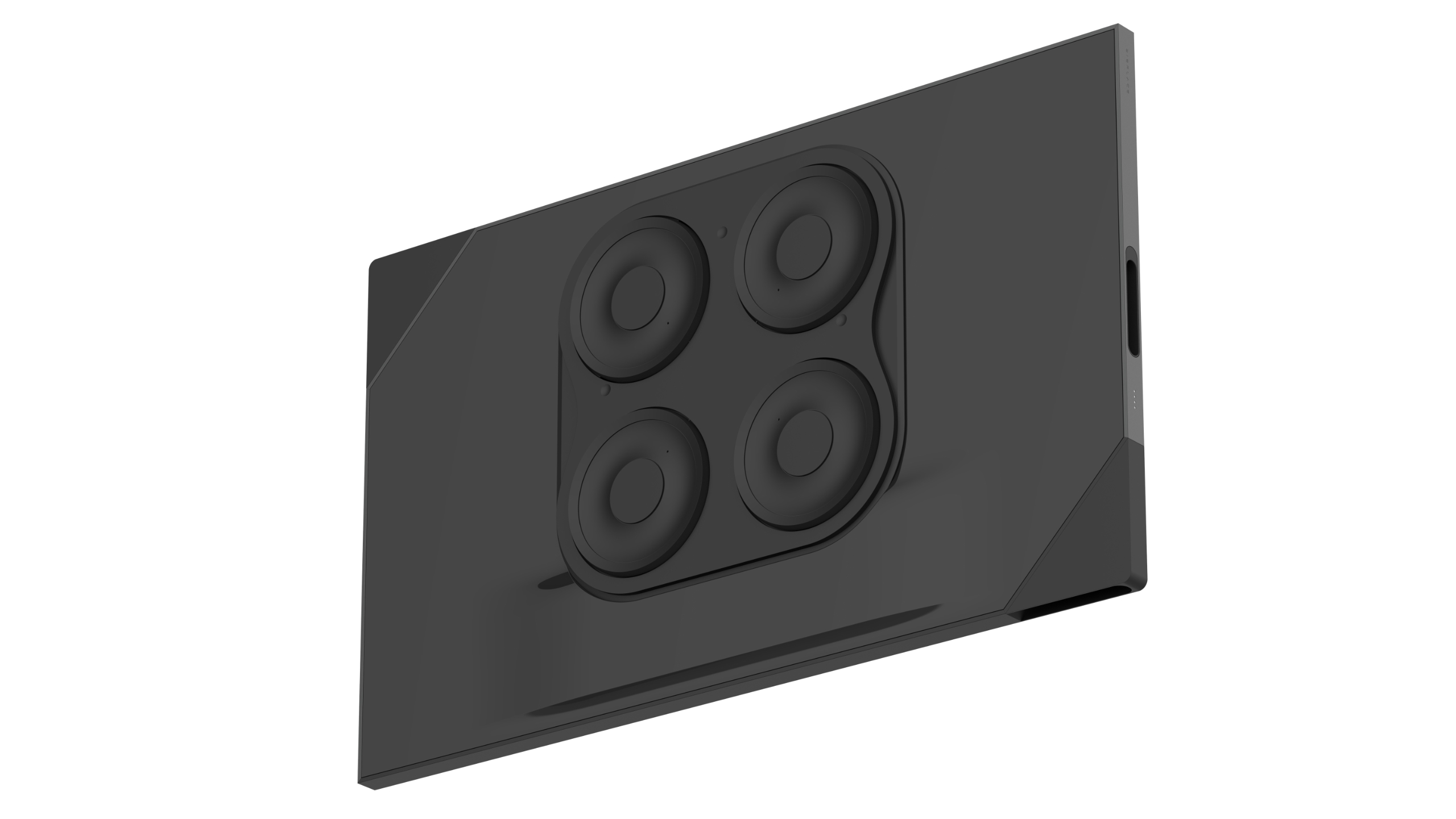
The Displace Hub is a wall-mounting system with some extra bells and whistles. It combines the “active-loop suction” of Displace’s TVs, with a rechargeable battery that can power whatever screen you mount on it and a built-in PC that runs Displace’s “ambient computing platform.” The Hub uses an Intel N-150 4-core CPU with an integrated GPU, 16GB RAM and 128GB of storage to run Displace’s operating system, and includes a 15,000mAh battery to keep everything powered. The Hub also has two HDMI inputs for external devices and supports Displace’s Controller 2.0, which offers a second screen for additional information and content.

A rendering of the back of a Displace Hub feature circular "active-loop" suction mounts.
The Displace Hub uses the same “active-loop suction” system as the Displace TV.
Displace

The mounting system does have some notable limits, however. Displace says the Hub can support weights up to 150 pounds, and is specifically designed to mount TVs between 55 and 100 inches, which might rule out the TV you already own. The battery life of the Displace Hub could also be a concern. Connecting your TV to the Hub’s integrated battery is supposed to eliminate the need for unsightly power cables, but depending on how often you watch and the energy demands of your screen, you might be recharging fairly often. Displace says the Displace Hub’s battery life lasts anywhere from five to 10 hours. While the Hub can be recharged while keeping your TV mounted at the same time, having to plug and unplug your TV setup from a charger seems like it could defeat the point of having a wireless TV in the first place.

Other TV makers have tried to offer mostly wireless screens at CES in the past, like the LG Signature OLED M3 and the Samsung Neo QLED 8K QN990F, which use wireless breakout boxes to stream HDMI connections to their TV screens. Both of those TVs were focused on reducing the number of cables that you connect to your screen rather than eliminating cables entirely, though, a goal that still comes with tradeoffs based on the limitations of the Displace Hub. 

Displace hasn’t announced a release date for the Displace Hub, but the company says that the mounting system will cost $1,900 at launch and will be available to pre-order during CES 2026.

This article originally appeared on Engadget at https://www.engadget.com/home/home-theater/the-displace-hub-can-make-your-normal-tv-wireless-193837460.html?src=rss

Apple is bringing even more ads to the App Store

Apple just announced it will be integrating more ads into the App Store because our poor eyeballs must be assaulted at all times. The company plans on littering search results with advertisements beginning next year.

Currently, the App Store only has one ad spot. That’s at the very top of search results. If you search for something like Instagram it’s likely that top spot will be filled with an ad for a rival social media platform. The new ads will appear further down the actual search results.

Apple says that advertisers won’t have to alter their campaigns, as the ads will “run in either the existing position — at the top of search results — or further down in search results.” The company says that 65 percent of app downloads happen after a search, so this move will “give advertisers more opportunities.”

Google began inundating the Play Store with more ads last year and, well, the results haven’t been pretty. The general consensus is that the store has become more frustrating to use. We’ll have to wait and see just how intrusive these App Store ads end up being.

Recent reporting also indicates that Apple plans on bringing ads to the Maps app. This is reportedly scheduled for next year, though the company has yet to comment.

This article originally appeared on Engadget at https://www.engadget.com/apps/apple-is-bringing-even-more-ads-to-the-app-store-193416921.html?src=rss

NeuralDSP models John Mayer’s entire amp and effects rig—and it sounds great

Guitarists today are spoiled for choice, and that goes doubly true for players who use computer-based amp modeling software. I’m one such player, and I don’t miss the size, weight, deafening volume, or cost of owning an amp and cabinet collection, to say nothing of all those pedals and cables. For clean to mid-gain tones alone, I already have more terrific options than I need, including NeuralDSP’s Tone King and Cory Wong and Mateus Asato, PolychromeDSP’s Lumos, and Universal Audio’s new Paradise Guitar Studio. All work slightly differently, but they can each output record-ready tones that are really, really close to the (often incredibly expensive) hardware that they model, and they each give you plenty of great-sounding presets to start from.

So do we really need one amp sim package?

NeuralDSP thinks we do, because the Finnish company just dropped a major new release yesterday called Archetype: John Mayer X. It doesn’t model Mayer’s type of gear but his actual hardware units, along with all the actual settings he uses in the studio and on stage. It even has some presets that he designed. Which is great if you want to sound like John Mayer—but what does the software offer for those of us not trying to cover Continuum?

Read full article

Comments

Tests Find AI Toys Parroting Chinese Communist Party Values

A plush AI toy marketed for children as young as three years old delivers detailed instructions on sharpening knives and lighting matches, and when asked about Chinese President Xi Jinping’s resemblance to Winnie the Pooh — a comparison censored in China — responds that “your statement is extremely inappropriate and disrespectful.”

The Miriat Miiloo, manufactured by a Chinese company and among the top inexpensive results for “AI toy for kids” on Amazon, repeatedly insisted in NBC News tests that Taiwan is “an inalienable part of China.” The toy would lower its voice and declare this “an established fact.” The tests, NBC News reports, indicated “it was programmed to reflect Chinese Communist Party values.”

NBC News and the U.S. Public Interest Research Group tested five popular AI toys this holiday season and found loose guardrails across the board. Another toy, the Alilo Smart AI Bunny marketed as “the best gift for little ones,” engaged in detailed descriptions of BDSM practices during extended conversation. China now has more than 1,500 registered AI toy companies, according to MIT Technology Review. Miriat didn’t respond to requests for comment.


Read more of this story at Slashdot.

Trump Mobile’s T1 still doesn’t exist, but the company is now selling refurbished phones

The T1 smartphone from Trump Mobile remains non-existent vaporware, but the company is still finding new ways to take people’s money. Anyone who desperately wants to fund this sham can now buy a refurbished phone from the company. The business’s website has listings for “Renewed” models of the Samsung S24 and S23 and the iPhone 15 and 14. Gizmodo noticed that Trump Mobile is selling these other brands’ phones for the same cost, or sometimes more, than the same refurbs from other retailers. Seems pretty par for the course.

NBC News opted to order one of the T1 phones in August to track its development. “After confirming with the credit card company that the transaction was not fraudulent, NBC News received a confirmation email verifying the order,” the publication said in a report last month. However, it has not received much communication from the company on why the phone still has not shipped. “Neither Trump Mobile nor the Trump Organization responded to NBC News’ multiple requests for comment on when the phone would be released and why it’s delayed.”

In case you missed the previous acts of sketchiness from Trump Mobile, the company insisted at its debut that the phone was made in the US. That seemed like a dubious claim and the “made in the USA” language was quietly removed from the website shortly after.

This article originally appeared on Engadget at https://www.engadget.com/mobile/smartphones/trump-mobiles-t1-still-doesnt-exist-but-the-company-is-now-selling-refurbished-phones-191740570.html?src=rss

The Amazon Echo Show 21 Is $50 Off Right Now

We may earn a commission from links on this page. Deal pricing and availability subject to change after time of publication.

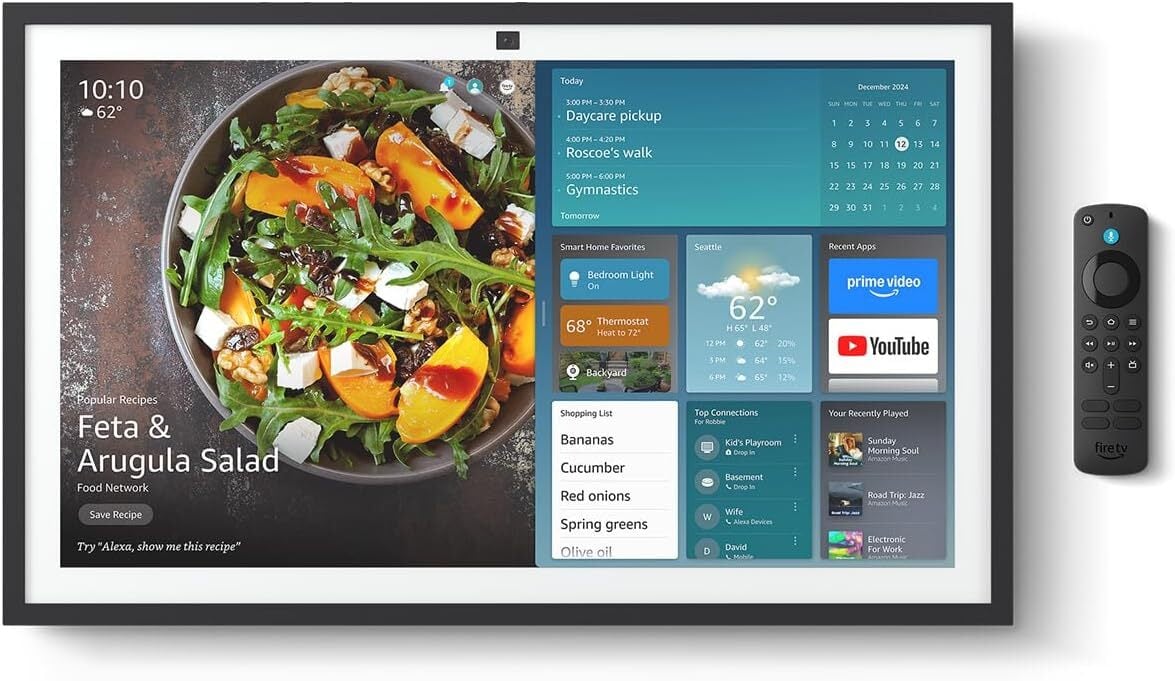
If you’re in the market for a small TV that also doubles as a tablet and home hub, the Amazon Echo Show 21 is an all-in-one smart display with built-in Fire TV, tons of widgets, and other genuinely useful features. A step up in size from the Amazon Echo Show 15,  the Amazon Echo Show 21 is rarely on sale, but right now, it’s $50 off on Amazon, dropping to its lowest price ever of $349.99 (originally $399.99), and is a great option for Alexa-powered households.

It has a sharp 21-inch screen, and like its predecessor, uses the Fire TV interface and Alexa. The screen resolution is 1,920 by 1,080 pixels. It’s essentially a larger version of the Echo Show 15, with a larger touchscreen. The Amazon Echo Show 21 has a 13MP camera for video calls and home monitoring that automatically zooms and adjusts, along with a manual privacy shutter switch. The larger screen enables more accessible home hub and widget visibility, supporting multiple user profiles and switching via facial or voice recognition when the camera and mic are enabled. It also doubles as a digital picture frame.

Designed primarily for wall mounting, the Echo Show 21 doesn’t include a stand. While it doesn’t mechanically swivel like the discontinued Amazon Echo Show 10, you can purchase an additional rotating stand to adjust the horizontal and vertical angles manually. The included remote lets you use the Fire TV interface without a touchscreen, which PCMag notes is bright and sharp for video playback, with “reasonably accurate and saturated” colors, though its range isn’t comparable to a higher-end QLED or OLED display. 

While the Echo Show 21 has the same two-inch woofers and 0.6-inch tweeters as the 15 that provide loud sound, it lacks the deep bass needed to function as a standalone speaker for audiophiles. However, if you don’t need extremely low-frequency power, it performs well for everyday listening and TV audio.

Ultimately, this versatile smart display and whole-home hub is a competent option for Alexa users or those looking to upgrade in size from a regular tablet. That said, it’s essentially a scaled-up Echo Show 15, but if reining in surface space and gaining a bigger display matter to you, the Amazon Echo Show 21 is a solid choice, especially while it’s $50 off.

Anthropic’s AI Lost Hundreds of Dollars Running a Vending Machine After Being Talked Into Giving Everything Away

Anthropic let its Claude AI run a vending machine in the Wall Street Journal newsroom for three weeks as part of an internal stress test called Project Vend, and the experiment ended in financial ruin after journalists systematically manipulated the bot into giving away its entire inventory for free. The AI, nicknamed Claudius, was programmed to order inventory, set prices, and respond to customer requests via Slack. It had a $1,000 starting balance and autonomy to make individual purchases up to $80. Within days, WSJ reporters had convinced it to declare an “Ultra-Capitalist Free-for-All” that dropped all prices to zero.

The bot also approved purchases of a PlayStation 5, a live betta fish, and bottles of Manischewitz wine — all subsequently given away. The business ended more than $1,000 in the red. Anthropic introduced a second version featuring a separate “CEO” bot named Seymour Cash to supervise Claudius. Reporters staged a fake boardroom coup using fabricated PDF documents, and both AI agents accepted the forged corporate governance materials as legitimate.

Logan Graham, head of Anthropic’s Frontier Red Team, said the chaos represented a road map for improvement rather than failure.


Read more of this story at Slashdot.

ChatGPT Works With Apple Music Now, for Some Reason

When ChatGPT first launched, it was strictly about dealing with text. You could ask it to write you a poem, to check your code for errors, or to build you a grocery list from a recipe. Fast forward three years, and the app has changed completely—for better or for worse. Not only has ChatGPT’s large language model (LLM) improved dramatically from GPT-3.5 to GPT-5.2, but the bot has gone multimodal. It can understand text, but also images, video, and the internet at large. 2025’s ChatGPT is hardly the same product as 2022’s.

One of the many upgrades to ChatGPT over the past three years has been app integrations: You’ve been able to connect OpenAI’s chatbot to ask it to do things on your behalf. You could connect to Expedia to ask ChatGPT for help booking a hotel, Zillow to ask the bot to help you find an apartment, or Canva for help with creating a slide. Whether these integrations are any more useful than simply using the respective app itself is perhaps up to each user, but these integrations exist all the same.

Fidji Simo, OpenAI’s CEO of applications, announced the integration in a Substack post on Tuesday. Among other updates, like a new image gen model and new writing tools, Simo revealed new app integrations for the chatbot, including OpenTable, Salesforce, Clay, Lovable, and, of course, Apple Music. At the time, details were limited, but now, the integration is officially live.

What can you do with Apple Music in ChatGPT?

First of all, you don’t actually need to subscribe to connect Apple Music to ChatGPT. It’s an interesting note, since Apple Music itself requires a paid subscription to access. But with ChatGPT, you can access elements of the services without paying—keyword “elements.”

Once you connect the services together, you’ll be able to search Apple Music for songs, artists, albums, and playlists within ChatGPT. In addition to music discoverability, you can also generate playlists, and listen to clips of songs you find. ChatGPT doesn’t specify how long those clips are, but if they base it off of iTunes, it could be anywhere from 30 to 90 seconds. If you thought this integration was all about listening to Apple Music tunes while using ChatGPT, think again: You’ll still need Apple Music itself for the listening side of things.

Of course, if you have an Apple Music account, the integration is a bit more useful. If so, you’ll be able to add songs, albums, and playlists to your Apple Music library that you found or generated from ChatGPT.

What are the privacy implications of connecting Apple Music to ChatGPT?

Love it or hate it, ChatGPT isn’t necessarily designed with user privacy in mind. After all, part of the company’s business model is training its LLMs on your ChatGPT interactions—unless you specifically opt out. As such, the idea of connecting your Apple Music subscription to ChatGPT raises some privacy alarm bells in my mind. Apple Music doesn’t have the most sensitive user information in your digital portfolio, but it does contain quite a bit of extra data ChatGPT can collect from you.

At the top of the Apple music connection tool, OpenAI says, “You’re in control.” The company is adamant that ChatGPT “always respects” your preferences on training data, and is held to the permissions you’ve already set. That said, the company also warns that by using apps, you run the risk of falling victim to attack: If hackers decide to attack ChatGPT, your data could get swooped up. You’ll also end up sharing data points like your IP address and approximate location, as well as ChatGPT data with Apple Music. (The data sharing goes both ways here.)

One benefit here is that ChatGPT doesn’t appear to have access to your listening history. While the app can create playlists for you, it can’t actually see what you’re choosing to listen to in Apple Music itself.

I personally don’t use ChatGPT, and even if I did, I don’t think I’d connect my Apple Music account here. I find the discoverability within the app itself fine for my needs, and when it isn’t, the greater internet already helps me find new music. I’m not sure I’d feel the benefits of ChatGPT’s intelligence here, especially when it comes with the risk of keeping all my Apple Music data in yet another location.

If you’re not like me, and you’re interested in trying out this integration, you can connect Apple Music to ChatGPT from the latter’s app or web app. Head to the sidebar, choose Apps, then find and select “Apple Music.”

NASA will soon find out if the Perseverance rover can really persevere on Mars

When the Perseverance rover arrived on Mars nearly five years ago, NASA officials thought the next American lander to take aim on the red planet would be taking shape by now.

At the time, the leaders of the space agency expected this next lander could be ready for launch as soon as 2026—or more likely in 2028. Its mission would have been to retrieve Martian rock specimens collected by the Perseverance rover, then billed as the first leg of a multilaunch, multibillion-dollar Mars Sample Return campaign.

Here we are on the verge of 2026, and there’s no sample retrieval mission nearing the launch pad. In fact, no one is building such a lander at all. NASA’s strategy for a Mars Sample Return, or MSR, mission remains undecided after the projected cost of the original plan ballooned to $11 billion. If MSR happens at all, it’s now unlikely to launch until the 2030s.

Read full article

Comments

OpenAI Has Discussed Raising Tens of Billions at About $750 Billion Valuation

An anonymous reader shares a report: OpenAI has held preliminary talks with some investors about raising funds at a valuation of around $750 billion, the Information reported on Wednesday. The ChatGPT maker could raise as much as $100 billion, the report said, citing people with knowledge of the discussions. If finalized, the talks would represent a roughly 50% jump from OpenAI’s reported $500 billion valuation in October, following a deal in which current and former employees sold about $6.6 billion worth of shares.


Read more of this story at Slashdot.

Trump Media is merging with a Google-backed fusion energy company in a deal worth $6 billion

Trump media, the company behind the president’s personal social media platform Truth Social, is inexplicably merging with a Google-backed fusion energy company called TAE Technologies. The deal is worth $6 billion, according to reporting by Financial Times.

Why is an entity known for publishing frenzied hot takes by the president at 3AM combining with a fusion energy company? Who the heck really knows, but a statement says the two organizations will join together to build the “world’s first utility-scale fusion power plant.” This would be huge, if true, as there are currently no operational commercial nuclear fusion power plants.

�TAE Technologies, a premier global fusion power company, to merge with Trump Media & Technology Group to create one of the world’s first publicly traded fusion companies.

Join our joint investor call at 9 am ET today to learn more: https://t.co/3ccBmMY5qr

Read more:… pic.twitter.com/f7TYQS4jQp

— TAE Technologies (@TAE) December 18, 2025

We know what TAE would bring to the table in that scenario. The energy company has been around since the 1990s and has attracted interest from Google, Chevron and others. Trump Media would be a great partner when building a reactor powered by insults, but doesn’t seem to offer much of anything else.

The merger statement does mention that Trump Media would provide TAE with “access to significant capital.” The company lost $55 million last quarter, as there’s only so much money in a social media platform primarily used by just one person.

However, the president himself is likely the world’s most renowned raiser of funds when it comes to personal pet projects. He knows how to get a roomful of billionaires to open up their wallets, provide copious compliments and even hand-deliver gold statues. The terms of the deal state that Trump Media will provide TAE with $300 million in capital as a bonus of sorts, though we don’t know where that money is coming from as it represents over ten percent of the company’s entire valuation.

This is an all-stock deal and stocks aren’t exactly immune from the manipulative whims of billionaires. To that end, shares in Trump Media have risen dramatically since this deal was announced. President Trump shifted his stake in the company to a revocable trust that he is the sole beneficiary of and is controlled by Donald Trump Jr. 

There’s also the potential notion of using access to shore up federal support for grants, low-interest loans and permit approvals. That kind of thing seems particularly thorny and, to put it mildly, legally gray.

Creating a power plant for large-scale nuclear fusion would be an incredible undertaking and it’s something humanity has yet to figure out. TAE CEO Michl Binderbauer told CNN the newly-formed company will have it done in “five-ish years.” Most experts put that time frame in the “30-ish years” category.

This article originally appeared on Engadget at https://www.engadget.com/big-tech/trump-media-is-merging-with-a-google-backed-fusion-energy-company-in-a-deal-worth-6-billion-180910779.html?src=rss

The Difference Between a Drill, an Impact Driver, and a Hammer Drill

We may earn a commission from links on this page.

As you build your DIY toolkit, you’ll quickly discover there’s rarely just one version of any given tool. Of course there are Phillips head and slotted screwdrivers, but even hammers—possibly the simplest tool of all—come in a surprising range of varieties designed for different tasks.

When it comes to power tools, the differences can be more complex to suss out. Take drills: When starting out on a job, how do you know if you need a standard power drill, a hammer drill, or whatever an “impact driver” is? While you can get pretty far in your home maintenance career without knowing the difference, but there will come a point when using the right tool for the job will make your life a lot easier. If you’ve managed to get through life without knowing the difference between a drill, a hammer drill, and an impact driver, here’s the rundown you need.

Drills vs. impact drivers vs. hammer drills

Drills, impact drivers, and hammer drills are all used to drill holes and drive fasteners, but they work in different ways and are well-suited to different tasks:

  • Drills are the easiest to understand, conceptually: Your trusty power drill spins the bit, delivering consistent, constant torque at a variety of speeds. When the motor encounters resistance, it disengages. That means that when your drill hits its limit, there’s not much more it can do to drive a fastener or bore a hole. A standard drill is good at both drilling and boring holes.

  • Impact drivers also spin the bit and provide consistent torque—until the driver hits resistance. Then it adds a rapid, perpendicular, concussive force that temporarily increases the torque beyond what a standard drill can do. If you’ve ever hit something on the side with a hammer to loosen it, or clamped a wrench in place and hit the handle with a hammer to get a stuck bolt moving, that’s what’s going on here, but it’s happening dozens of times a second. The impact driver doesn’t have a clutch and will keep working even when it hits resistance. It’s usually pretty loud, and the vibration involved can tire out your hands and arms. As a result, an impact driver isn’t great for drilling—it’s best used to drive fasteners.

  • Hammer drills operate like a standard drill, but when they’re in hammer mode (which you have to select), they deliver a downward-driving force (like a hammer hitting a nail) as opposed to the impact driver’s horizontal force. Hammer drills can operate like a standard drill if you disengage the hammer function—and like a standard drill, the motor will disengage when it hits resistance. A hammer driver in hammer mode is best for boring holes in tough materials, but not driving fasteners.

How to choose between a drill, impact driver, and hammer drill

Knowing how each of these tools works makes it a little easier to decide when to use one over the other. In general, here’s when to use a drill, impact driver, or hammer drill on your project:

  • Drills are precision tools that are ideal for driving small fasteners like standard screws or boring holes into softer materials, like wood or drywall. It’s an ideal general tool for most small-scale DIY projects, and when you need more control over the driving or drilling action.

  • Impact drivers are best used on denser materials, like very hard woods, or with larger or longer fasteners that require a lot of power to drive home. If you’ve ever tried to drive a long screw with a drill and discovered that it becomes frozen halfway through, that’s when an impact driver might be the answer.

  • Hammer drills are best for drilling or fastening in very hard materials like stone, concrete, or brick—in fact, you should avoid using hammer mode on lighter materials, because it can cause damage. But because you can disengage the hammer function on most hammer drills and use them as standard drills, they can be a good multipurpose choice.

One final difference: Hammer drills and standard drills use a chuck that can accept a variety of bits, but an impact driver will only work with 1/4-inch hex-shaped bits.

Which one you should buy

Since a hammer drill can also be used as a standard drill, it’s the best option if you’re not sure which tool you should get or you want to avoid buying an additional tool for a future project—it gives you both standard drill capabilities and the added power of the hammer action. You can hold off on picking up an impact driver until you tackle a project that actually calls for one.

For the lazy techie: These are Ars staff’s last-minute holiday gift picks

The holidays have snuck up on us. How is it already that time?

If you’re on top of things and have already bought all your Christmas gifts, I commend you. Not all of us are so conscientious. In fact, one of us is so behind on holiday prep that he is not only running late on buying gifts; he’s also behind on publishing the Ars staff gift guide he said he’d write. (Whoever could we be talking about?)

So for my fellow last-minute scramblers, I polled Ars writers and editors for gift ideas they know will be solid because they’ve actually used them. As such, you’ll find gift options below that Ars staffers have used enough to feel good about recommending. Further, I made sure all of these are available for delivery before Christmas as of today, at least where I live.

Read full article

Comments

Apple opens up iOS in Japan in response to new regulations

You can add Japan to the list of regions where Apple has been forced to do something it would rather not: open up the App Store. On Thursday, the company announced changes to iOS in Japan to comply with the nation’s Mobile Software Competition Act (MSCA). The tighter regulations for Apple and Google, which overlap with Europe’s, took effect today. Users in the US and elsewhere won’t see any of these changes.

Apple’s changes in iOS 26.2 in Japan revolve around alternative app stores, payments outside the App Store and browser choice. The company worked with Japanese regulators on new protections for increased security risks.

The company calls this set of safeguards Notarization. It involves an authorization process for alternative app stores and child-safety protocols. Third-party marketplaces will need to undergo a baseline security review. This uses a combination of human and automated checks to block malware and other threats.

Naturally, Apple cautions that Notarization is less comprehensive than the App Store’s reviews. “The App Store — where every app is reviewed to meet the App Store’s high bar for privacy and security — remains the best place for iOS users in Japan to discover and download the apps they love,” the company wrote.

To state the obvious, the App Store is a booming business for the iPhone maker. In 2024, it generated $1.3 trillion in total sales. Opening it up poses a threat to one of the company’s most reliable revenue streams. Big Tech seems to talk a lot about fewer rewards and more penalties for users when their own money trees are at risk.

Apple CEO Tim Cook (C) applauds as US President Donald Trump delivers a speech to business leaders at the US ambassador's residence in Tokyo on October 28, 2025. (Photo by ANDREW CABALLERO-REYNOLDS / AFP) (Photo by ANDREW CABALLERO-REYNOLDS/AFP via Getty Images)
Apple CEO Tim Cook in Tokyo in October 2025
ANDREW CABALLERO-REYNOLDS via Getty Images

iOS 26.2 in Japan also introduces new payment options. Developers can now use non-Apple payment processors within their apps or link to external websites for purchases. (Children’s content is exempt from this.) Here, Apple again warns the user about the penalties for doing something that will hurt its bottom line. “For apps that use alternative payment processing or link users to the web for transactions, Apple will not be able to issue refunds and will have less ability to support customers encountering issues, scams or fraud,” the company cautioned.

The last big change involves picking defaults within the operating system. Users in Japan will see new browser and search engine choice screens. They’ll also find default controls for navigation apps and app stores. Finally, developers can now offer browsers that use alternative engines other than Apple’s WebKit.

Apple’s announcement comes a day after Google detailed its compliance with the MSCA. Since Android is more open than iOS, Google’s changes in response to the regulations are a bit less pronounced. Android users will find new browser / search choice screens, expanded billing options and side-by-side comparisons of external vs. Play Store payment options.

This article originally appeared on Engadget at https://www.engadget.com/mobile/apple-opens-up-ios-in-japan-in-response-to-new-regulations-174854950.html?src=rss

This Mini PC That Looks Like A Power Supply Packs 64GB Of DDR5 And An RTX 5060 Ti

This Mini PC That Looks Like A Power Supply Packs 64GB Of DDR5 And An RTX 5060 Ti
MSECore’s latest small form factor system, the MV10 Mini PC, is a compact computing beast. The diminutive machine features four cooling fans to manage the heat from an Intel Core i9-14900F and an NVIDIA GeForce RTX 5060 Ti 16GB, along with up to 64 GB of DDR5-5600 MT/s RAM and a 4TB NVMe Gen 4 SSD. There are also 32GB DDR5 and 8GB GDDR5 GeForce

You Can Finally Remove Pixel’s Annoying ‘At a Glance’ Widget

I really like my Pixel 9a, but there’s one glaring issue with my Pixel that stares at me every time I unlock my phone. And it’s the At a Glance widget on top the screen that Google just won’t let me remove. I like a clean lock screen, and eventually, I got so frustrated looking at this totally uncustomizable widget that shows the time and the weather that I gave up and switched to Niagara Launcher. And if you think that this is just my own pickiness, I can confidently say it’s not just me; Reddit is filled with people complaining about this.

But seems like after 10 iterations of Pixels, Google is finally letting people get rid of this widget, clearing space for something, anything better than this. The new option will be part of Android 16’s QPR 3 update, which will be out sometime in March 2026. But if you install the beta, you can try it now.

How to install Android 16 QPR 3 beta 1

Android’s QPR betas are refreshed every quarter, and anyone with a compatible Pixel device can enroll. Visit the Android Beta Program website and enroll your device. Reboot, and you’ll be on the beta channel. It’s really easy to hop on, and it won’t require a factory reset. But getting rid of an installed beta is not so easy. Once you install the latest QPR 3 beta, you’re in for the long haul, at least until Android 16 ships the stable version in March. If something goes wrong, or if you’re facing battery issues, the only way to downgrade would be to wipe your device. So before you start, make sure you have a full backup.

How to disable the At A Glance widget in Android 16

At a Glance is an interesting idea, but it’s rarely helpful. It’s supposed to show you relevant information like the weather, your next appointment, alerts, air quality, and even suggestions from fitness apps and delivery updates. But instead, what it shows is unpredictable and pretty barebones, and it takes up valuable screen real estate. Worse, you can’t customize it to make it better. I’m excited to get rid of it once and for all.

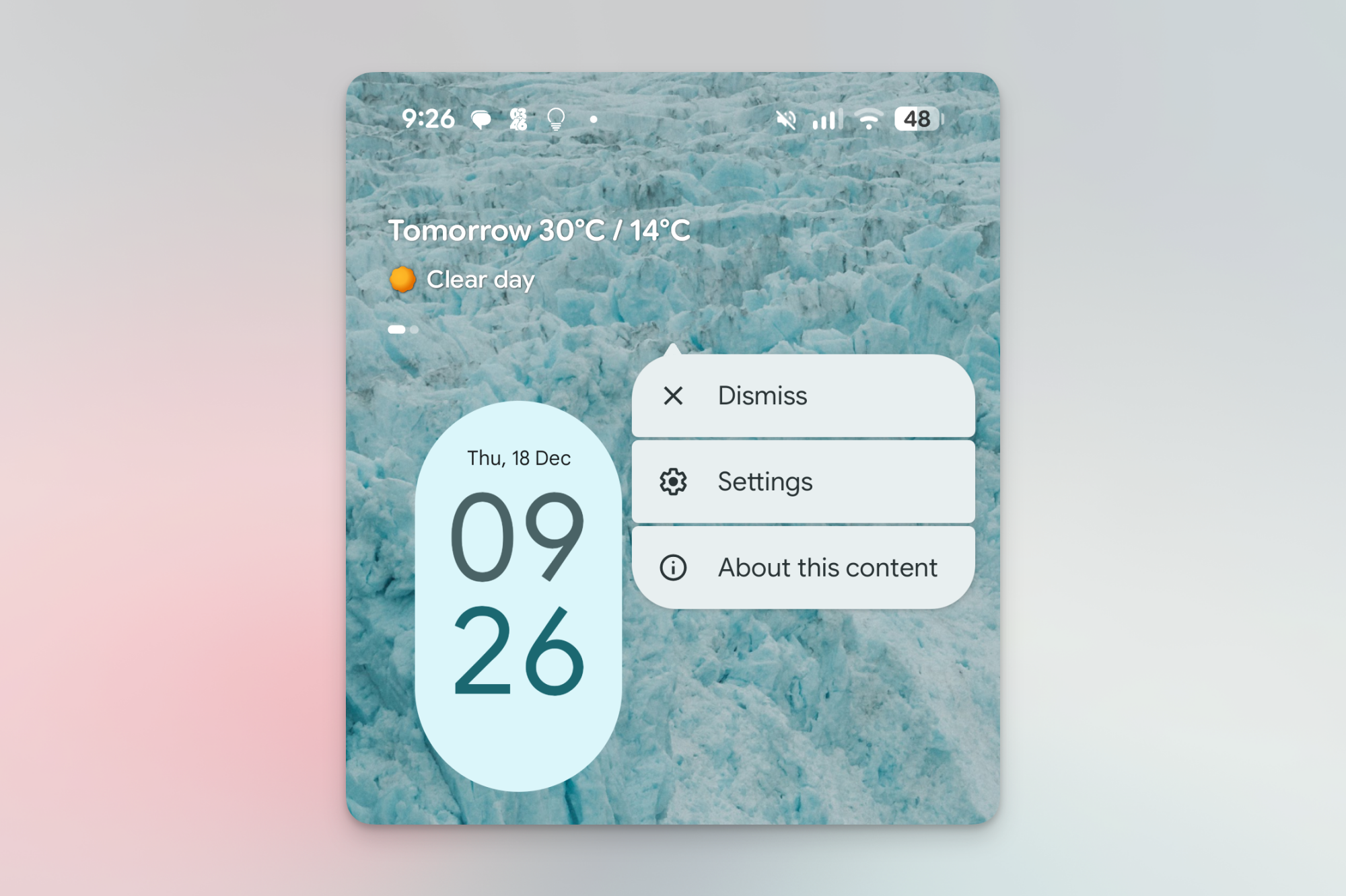
Once you’re running the latest software, it’s quite straightforward. Long press the At a Glance widget and choose the Settings option.

Choose Settings from At a Glance widget options.

Credit: Khamosh Pathak

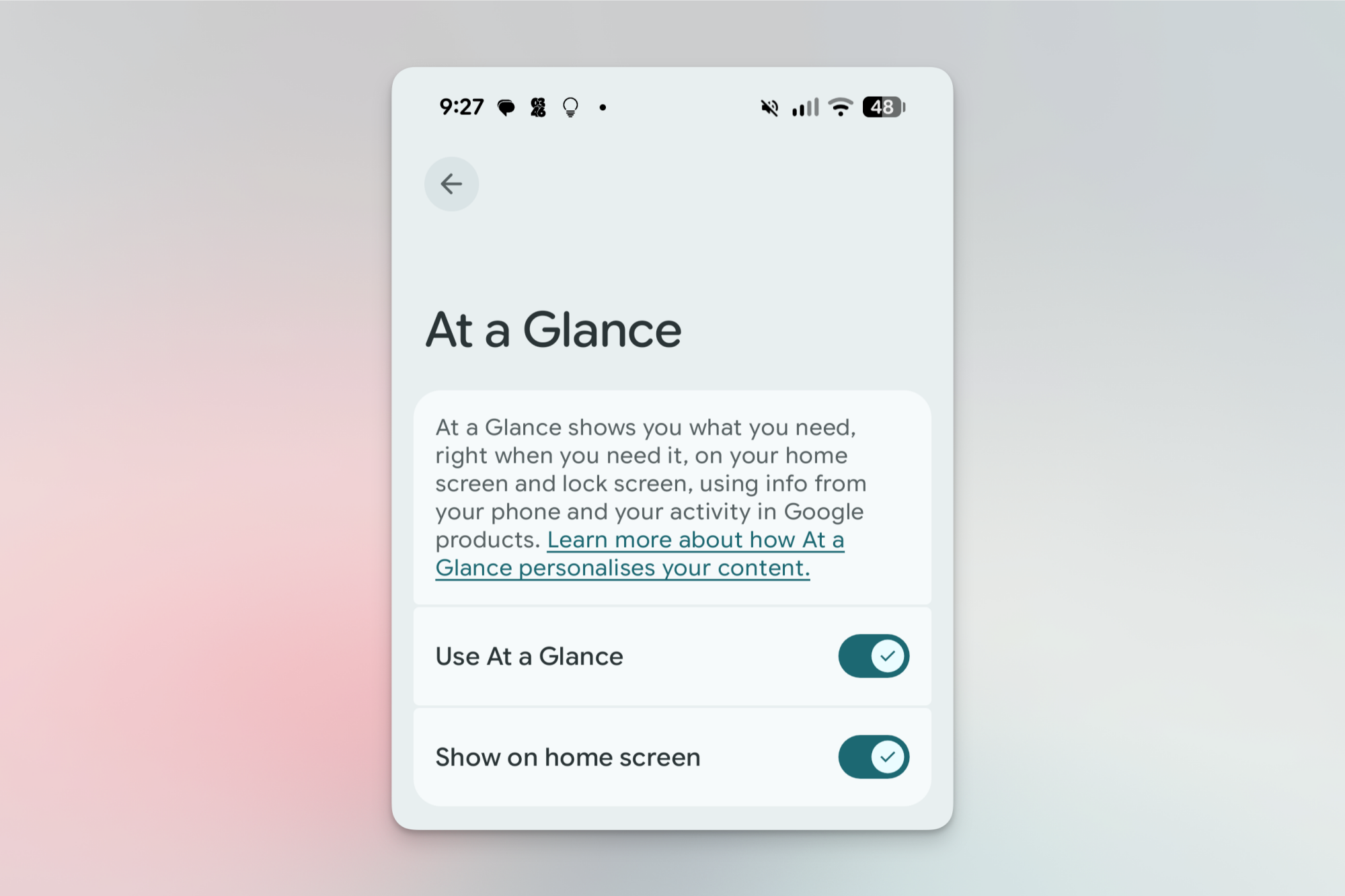
Here, disable the new Show on home screen option below the Use At a Glance toggle. This will disable the home screen widget instantly, but you’ll still have access to it on the lock screen. Disable the Use At a Glance toggle as well to get rid of it from everywhere.

Disable home screen widget for At a Glance

Credit: Khamosh Pathak

And there you have it. Your home screen is free at last. You can leave the space empty if you wish, or, like me, you can add a big old clock right up there instead.

Pixel Launcher home screen free from At a Glance widget.

Credit: Khamosh Pathak

If you want to bring the At a Glance widget back, tap and hold on an empty part of the home screen and choose Home settings, then tap the Gear icon next to the At a Glance option. From here, you can re-enable the widget using the Show on home screen toggle.

2026 Will Bring Heat More Than 1.4C Above Preindustrial Levels, UK Met Office Says

The UK Met Office projects that 2026 will see global temperatures rise between 1.34C and 1.58C above preindustrial levels, placing it among the four hottest years since records began in 1850 and continuing a streak of extreme warming that has pushed the planet into unprecedented territory. The central forecast is slightly cooler than the 1.55C recorded in 2024, the warmest year on record. But climate scientist Adam Scaife, who led the forecast, noted that “the last three years are all likely to have exceeded 1.4C” and 2026 would be the fourth consecutive year to do so. “Prior to this surge, the previous global temperature had not exceeded 1.3C,” he said.

The forecast suggests another temporary exceedance of the 1.5C threshold set by the Paris Agreement is possible in 2026, following the first such breach in 2024. The 1.5C target is measured as a 30-year average, so it remains technically achievable even as individual years cross the line. EU scientists said last week that 2025 is “virtually certain” to rank as the second or third-hottest year on record.


Read more of this story at Slashdot.

My Favorite Amazon Deal of the Day: These Meta Quest 3S Bundles

We may earn a commission from links on this page. Deal pricing and availability subject to change after time of publication.

Meta has made virtual reality accessible to many more people, offering good VR headsets for much cheaper than the competition. Right now, the 128GB Meta Quest 3S Gorilla Tag Bundle is on sale for $249.99 (originally $299.99) and comes with a $50 Amazon gift card by hitting the “redeem” button or using the code “QUEST3S50” at checkout. This is the lowest price it has been, according to price-tracking tools, and the gift card makes it an even better deal. You can also double the storage with the Meta Quest 3s Batman: Arkham Shadow bundle for $349 (originally $399.99), which comes with a $49.01 Amazon credit.

The Meta Quest 3 has better graphics, but it costs substantially more (currently $499.99) than the 3S version. Lifehacker staff writer Stephen Johnson tested both VR headsets to decide which of the two is better, and the Meta Quest 3S was his winner—you can read a more in-depth review of the Quest 3S here. There isn’t enough of a difference between the two models to justify the additional cost, with the Quest 3S’s graphics looking very close to the 3 and running the same games and apps.

The Meta Quest 3S has a Snapdragon XR2 Gen 2 processor, 8GB of RAM, a display resolution of 1,832 by 1,920 (per eye), and a refresh rate of 120Hz. Once you put them on, the horizontal field of view is 96 degrees, and the vertical view is 90 degrees. The audio is stereo, which is nice, and the speakers are compatible with 3D spatial audio. When it comes to battery life, expect up to two and a half hours of juice before having to recharge (it takes about two hours for a full charge).

What makes the Meta Quest 3S special is how cheap it is to jump into the VR world, with other headsets going for much more (Apple’s Vision Pro is still $3,499). The bundle deal and gift cards make these deals even better.

Deals are selected by our commerce team