LG Will Let TV Owners Delete Microsoft Copilot After Customer Outcry

LG said it will let owners of its TVs delete Microsoft’s Copilot shortcut after several reports highlighted the unremovable icon. In a statement to The Verge, LG says the company “respects consumer choice and will take steps to allow users to delete the shortcut icon if they wish.” From the report: Last week, a user on the r/mildlyinfuriating subreddit posted an image of the Microsoft Copilot icon in their lineup of apps on an LG TV, with no option to delete it. “My LG TV’s new software update installed Microsoft Copilot, which cannot be deleted,” the post says. The post garnered more than 36,000 upvotes as people grow more frustrated with AI popping up just about everywhere.

Both LG and Samsung announced plans to add Microsoft’s Copilot AI assistant to their TVs in January, but it appears to be popping up on LG TVs following a recent update to webOS. [LG spokesperson Chris De Maria] clarifies that the icon is a “shortcut” to the Microsoft Copilot web app that opens in the TV’s web browser, rather than “an application-based service embedded in the TV.” He also adds that “features such as microphone input are activated only with the customer’s explicit consent.” There’s no word on when LG will roll out the ability to delete the Copilot icon.


Read more of this story at Slashdot.

Trump’s TikTok deal is another step closer to finally actually happening

Remember back in September when President Donald Trump signed an executive order that seemingly finalized some of the terms of a deal to spin off TikTok’s US business? Three months later, that same deal is apparently one step closer to being official.

According to Bloomberg, TikTok CEO Shou Chew told employees that TikTok and ByteDance had signed off the agreement for control of TikTok’s US business. It sounds like terms of the deal are roughly the same as what Trump announced earlier this year. A group of US investors, including Oracle, Silver Lake and MGX will control a majority of the new entity while ByteDance will keep a smaller stake in the venture. 

According to Chew’s memo, the deal is expected to close January 22, 2026. “Upon the closing, the US joint venture, built on the foundation of the current TikTok US Data Security (USDS) organization, will operate as an independent entity with authority over US data protection, algorithm security, content moderation and software assurance,” he wrote according to Bloomberg.  TikTok didn’t immediately respond to a request for comment.

Notably, it’s still not clear where Chinese officials stand on the deal. Trump said back in September that China was “fully on board,” but subsequent meetings between the two sides have so far produced vague statements. In October, China’s Commerce Ministry said it would “work with the U.S. to properly resolve issues related to TikTok.” 

If a deal is indeed finalized by next month, it will come almost exactly a year after Trump’s first executive order to delay a law that required a sale or ban of the app front taking effect. He has signed off several other extensions since.

This article originally appeared on Engadget at https://www.engadget.com/social-media/trumps-tiktok-deal-is-another-step-closer-to-finally-actually-happening-001813404.html?src=rss

Compromised Apple Gift Card Leads to Apple Account Lockout

An Apple developer was locked out of his Apple Account after redeeming a compromised Apple Gift Card, exposing how automated fraud systems can effectively cut users off from their digital lives with little explanation or recourse. TidBITS reports: After attempting to redeem a $500 Apple Gift Card purchased from a well-known retailer, Apple developer, author, and /dev/world conference organizer Paris Buttfield-Addison found himself locked out of his Apple Account. He writes: “I am writing this as a desperate measure. After nearly 30 years as a loyal customer, authoring technical books on Apple’s own programming languages (Objective-C and Swift), and spending tens upon tens upon tens of thousands of dollars on devices, apps, conferences, and services, I have been locked out of my personal and professional digital life with no explanation and no recourse.”

As far as I can tell from his extensively documented story, Buttfield-Addison did nothing wrong. Personally, I wouldn’t have purchased an Apple Gift Card to pay for Apple services — he planned to use it to pay for his 6 TB iCloud+ storage plan. I presume he bought it at a discount, making the hassle worthwhile compared to simply paying with a credit card. But I have received Apple Gift Cards as thank-yous or gifts several times, so I can easily imagine accidentally trying to redeem a compromised card number and ending up in this situation. […] For now, we can hope that ongoing media attention pushes Apple to unlock Buttfield-Addison’s account. More troublingly, if this can happen to such a high-profile Apple user, I have to assume it also afflicts everyday users who lack the media reach to garner coverage.


Read more of this story at Slashdot.

Parasites plagued Roman soldiers at Hadrian’s Wall

It probably sucked to be a Roman soldier guarding Hadrian’s Wall circa the third century CE. W.H. Auden imagined the likely harsh conditions in his poem “Roman Wall Blues,” in which a soldier laments enduring wet wind and rain with “lice in my tunic and a cold in my nose.” We can now add chronic nausea and bouts of diarrhea to his list of likely woes, thanks to parasitic infections, according to a new paper published in the journal Parasitology.

As previously reported, archaeologists can learn a great deal by studying the remains of intestinal parasites in ancient feces. For instance, in 2022, we reported on an analysis of soil samples collected from a stone toilet found within the ruins of a swanky 7th-century BCE villa just outside Jerusalem. That analysis revealed the presence of parasitic eggs from four different species: whipworm, beef/pork tapeworm, roundworm, and pinworm. (It’s the earliest record of roundworm and pinworm in ancient Israel.)

Later that same year, researchers from the University of Cambridge and the University of British Columbia analyzed the residue on an ancient Roman ceramic pot excavated at the site of a 5th-century CE Roman villa at Gerace, a rural district in Sicily. They identified the eggs of intestinal parasitic worms commonly found in feces—strong evidence that the 1,500-year-old pot in question was most likely used as a chamber pot.

Read full article

Comments

North Korean Infiltrator Caught Working In Amazon IT Department Thanks To Lag

An anonymous reader quotes a report from Tom’s Hardware: A North Korean imposter was uncovered, working as a sysadmin at Amazon U.S., after their keystroke input lag raised suspicions with security specialists at the online retail giant. Normally, a U.S.-based remote worker’s computer would send keystroke data within tens of milliseconds. This suspicious individual’s keyboard lag was “more than 110 milliseconds,” reports Bloomberg. Amazon is commendably proactive in its pursuit of impostors, according to the source report.

The news site talked with Amazon’s Chief Security Officer, Stephen Schmidt, about this fascinating new case of North Koreans trying to infiltrate U.S. organizations to raise hard currency for the Democratic People’s Republic of Korea (DPRK), and sometimes indulge in espionage and/or sabotage. Schmidt says that Amazon has foiled more than 1,800 DPRK infiltration attempts since April 2024. Moreover, the rate of attempts continues apace, with Amazon reckoning it is seeing a 27% QoQ uplift in North Koreans trying to get into the Amazon corporation. However, Amazon’s success can be almost entirely credited to the fact that it is actively looking for DPRK impostors, warns its Chief Security Officer. “If we hadn’t been looking for the DPRK workers,” Schmidt said, “we would not have found them.”


Read more of this story at Slashdot.

Building A Human-Sized Pokeball You Can Hang Out Inside

This is a video of Youtuber Carlos 3D Print constructing a human-sized Pokeball using a wooden frame and a ton of 3D printed panels. He then covered the ball with fiberglass and resin before painting. It looks good. Plus it has an interior that reminds me of Darth Vader’s masturbation station meditation chamber. Of course, if Snorlax can fit in a regular size Pokeball, aren’t all Pokeballs already human size? FOOD FOR THOUGHT. True story: I just Googled what Pokemon would taste the best because I was going to end this article with a joke about them, but the fact there’s so much information written about the subject just made me sad for humanity so I’m going to go close my computer and sit in the bath with some aromatherapy candles. No water, all my clothes on plus an extra sweatshirt.

Keep going for the video, final reveal at 15:00.

Steam Winter Sale discounts Clair Obscur, Silent Hill f and more

Holiday shopping is in full swing, which means it’s about time for the Steam Winter Sale. This go-around, Valve’s sale runs from December 18, 2025 through January 5, 2026, and includes discounts on some of this year’s hit games, like Clair Obscur: Expedition 33, Silent Hill f and Assassin’s Creed Shadows.

Clair Obscur is available for $40, down from its normal $50, Silent Hill f is 40 percent off, bringing its price down to $42, and the normally $70 Assassin’s Creed Shadows is selling for $35, a solid deal on what was somewhat of a comeback for the long-running Ubisoft series. On top of those sales, you can get Stardew Valley for $9, or the difficult-to-master walking sim Baby Steps for $13. I’m also considering picking up Consume Me for $10 and Ball x Pit for $12, just to round out my collection of indie hits from 2025.

Valve runs Steam sales on a pretty regular cadence, so if the game you’re eyeing isn’t on sale, there’s a good chance it could be soon. With holiday vacations coming up, and hopefully time to play games on the menu, though, now’s the perfect time to pick up something new. And if you don’t get to it this year, consider it an investment of sorts for the Steam Machine you might purchase in 2026.

This article originally appeared on Engadget at https://www.engadget.com/gaming/pc/steam-winter-sale-discounts-clair-obscur-silent-hill-f-and-more-230834279.html?src=rss

Trump commits to Moon landing by 2028, followed by a lunar outpost two years later

A couple of hours after a judge formally swore in private astronaut Jared Isaacman as the next administrator of NASA on Thursday, President Donald Trump signed an executive order outlining his space policy objectives for the next three years.

The executive order, titled “Ensuring American Space Superiority,” states that the country must “pursue a space policy that will extend the reach of human discovery, secure the nation’s vital economic and security interests, unleash commercial development, and lay the foundation for a new space age.”

White House sets priorities

There is nothing Earth-shattering in the new executive order, as much of it builds on previously announced policies that span multiple administrations. There are some notable points in the document that clearly reflect the White House’s priorities, though, and Isaacman’s leadership of NASA.

Read full article

Comments

Google’s NotebookLM introduces Data Tables feature

Google’s latest addition to its NotebookLM artificial intelligence research platform is a feature called Data Tables. The tool can collect and synthesize information across multiple sources into a chart that can be exported to Google Sheets. All Pro and Ultra users will have access to the feature today, and Data Tables will roll out to all users over the coming weeks.

In practice, Google suggested that Data Tables can be used to organize scattered notes, create price comparison charts or aggregate results from multiple research projects. The example of the interface shows the desired table components requested in natural language statements.  

Last month, Google added a Deep Research mode to NotebookLM. Deep Research was initially unveiled for its Gemini chatbot in late 2024 as an option for handling complex user queries.

This article originally appeared on Engadget at https://www.engadget.com/ai/googles-notebooklm-introduces-data-tables-feature-225548565.html?src=rss

AI’s Water and Electricity Use Soars In 2025

A new study estimates that AI systems in 2025 consumed as much electricity as New York City emits in carbon pollution and used hundreds of billions of liters of water, driven largely by power-hungry data centers and cooling needs. Researchers say the real impact is likely higher due to poor transparency from tech companies about AI-specific energy and water use. “There’s no way to put an extremely accurate number on this, but it’s going to be really big regardless… In the end, everyone is paying the price for this,” says Alex de Vries-Gao, a PhD candidate at the VU Amsterdam Institute for Environmental Studies who published his paper today in the journal Patterns. The Verge reports: To crunch these numbers, de Vries-Gao built on earlier research that found that power demand for AI globally could reach 23GW this year — surpassing the amount of electricity used for Bitcoin mining in 2024. While many tech companies divulge total numbers for their carbon emissions and direct water use in annual sustainability reports, they don’t typically break those numbers down to show how many resources AI consumes. De Vries-Gao found a work-around by using analyst estimates, companies’ earnings calls, and other publicly available information to gauge hardware production for AI and how much energy that hardware likely uses.

Once he figured out how much electricity these AI systems would likely consume, he could use that to forecast the amount of planet-heating pollution that would likely create. That came out to between 32.6 and 79.7 million tons annually. For comparison, New York City emits around 50 million tons of carbon dioxide annually. Data centers can also be big water guzzlers, an issue that’s similarly tied to their electricity use. Water is used in cooling systems for data centers to keep servers from overheating. Power plants also demand significant amounts of water needed to cool equipment and turn turbines using steam, which makes up a majority of a data center’s water footprint. The push to build new data centers for generative AI has also fueled plans to build more power plants, which in turn use more water and (and create more greenhouse gas pollution if they burn fossil fuels).

AI could use between 312.5 and 764.6 billion liters of water this year, according to de Vries-Gao. That reaches even higher than a previous study conducted in 2023 that estimates that water use could be as much as 600 billion liters in 2027. “I think that’s the biggest surprise,” says Shaolei Ren, one of the authors of that 2023 study and an associate professor of electrical and computer engineering at the University of California, Riverside. “[de Vries-Gao’s] paper is really timely… especially as we are seeing increasingly polarized views about AI and water,” Ren adds. Even with the higher projection for water use, Ren says de Vries-Gao’s analysis is “really conservative” because it only captures the environmental effects of operating AI equipment — excluding the additional effects that accumulate along the supply chain and at the end of a device’s life.


Read more of this story at Slashdot.

YouTube bans two popular channels that created fake AI movie trailers

Google is generally happy to see people using generative AI tools to create content, and it’s doubly happy when they publish it on its platforms. But there are limits to everything. Two YouTube channels that attracted millions of subscribers with AI-generated movie trailers have been shuttered.

Screen Culture and KH Studio flooded the site with fake but often believable trailers. The channels, which had a combined audience of more than 2 million subscribers, became a thorn in Google’s side in early 2025 when other YouTubers began griping about their sudden popularity in the age of AI. The channels produced videos with titles like “GTA: San Andreas (2025) Teaser Trailer” and “Malcom In The Middle Reboot (2025) First Trailer.” Of course, neither of those projects exist, but that didn’t stop them from appearing in user feeds.

Google demonetized the channels in early 2025, forcing them to adopt language that made it clear they were not official trailers. The channels were able to monetize again, but the disclaimers were not consistently used. Indeed, many of the most popular videos from those channels in recent months included no “parody” or “concept trailer” disclosures. Now, visiting either channel’s page on YouTube produces an error reading, “This page isn’t available. Sorry about that. Try searching for something else.”

Read full article

Comments

Peacock showing ads upon launch opens the door for more disruptive streaming ads

Peacock subscribers will see ads immediately upon opening the streaming app or website next year. It’s a bold new strategy for attracting advertisers—something that’s been increasingly important to subscription-based streaming services—but it also risks alienating viewers

As reported by Variety, the new type of ads will display on the profile selection page that shows when a subscriber launches Peacock. Starting next year, instead of the profile page just showing your different Peacock profiles, most of the page will be dominated by an advertorial image. The circles of NBCUniversal-owned characters selected for user profiles will be relegated to a vertical column on the screen’s left side, as you can see here.

To avoid seeing what NBCUniversal is calling “Arrival Ads” every time you open Peacock, you need to subscribe to Peacock’s most expensive plan, which is ad-free and starts at $17 per month (Peacock’s ad-based plans start at $8/month.)

Read full article

Comments

Appropriate: Merriam-Webster Chooses ‘Slop’ As Word Of The Year

Refusing to be drawn into their fray by Oxford’s choice of ‘rage bait’ for word of the year, Merriam-Webster has just announced their own word of the year: slop. I wold have gone with sloppy, but that was pretty much 2025 in a nutshell.

We define slop as “digital content of low quality that is produced usually in quantity by means of artificial intelligence.” All that stuff dumped on our screens, captured in just four letters: the English language came through again.

The flood of slop in 2025 included absurd videos, off-kilter advertising images, cheesy propaganda, fake news that looks pretty real, junky AI-written books, “workslop” reports that waste coworkers’ time… and lots of talking cats. People found it annoying, and people ate it up.

The direction we’re headed in: it isn’t a good one. Other words Merriam-Website considered:

GERRYMANDER – to divide a state, school district, etc. into political units or election districts that give one group or political party an unfair advantage
TOUCH GRASS – to participate in normal activities in the real world especially as opposed to online experiences and interactions)
TARIFF – a schedule of duties imposed by a government on imported or in some countries exported goods
6-7 – mostly used as an interjection — such as a thing you might chant, for no particular reason
PERFORMATIVE – made or done for show — as to bolster one’s own image or make a positive impression on others

Wow, every single one of those managed to depress me even more than the last. Honestly, I’m not even sure we could turn this boat around if we wanted to. I feel like our best bet may just be collectively praying for an asteroid. 2026, though — it’s really going to be our year, isn’t it?!

School security AI flagged clarinet as a gun. Exec says it wasn’t an error.

A Florida middle school was locked down last week after an AI security system called ZeroEyes mistook a clarinet for a gun, reviving criticism that AI may not be worth the high price schools pay for peace of mind.

Human review of the AI-generated false flag did not stop police from rushing to Lawton Chiles Middle School. Cops expected to find “a man in the building, dressed in camouflage with a ‘suspected weapon pointed down the hallway, being held in the position of a shouldered rifle,’” a Washington Post review of the police report said.

Instead, after finding no evidence of a shooter, cops double-checked with dispatchers who confirmed that a closer look at the images indicated that “the suspected rifle might have been a band instrument.” Among panicked students hiding in the band room, police eventually found the suspect, a student “dressed as a military character from the Christmas movie Red One for the school’s Christmas-themed dress-up day,” the Post reported.

Read full article

Comments

6 PC Gaming Accessories To Level Up Your Battlestation

6 PC Gaming Accessories To Level Up Your Battlestation
You’re a PC gamer. Maybe you’re new to the hobby, or maybe you’ve been blasting away on your old faithful peripherals: an ancient 1080p LCD monitor, the rubber dome keyboard you stole from the office, an Xbox 360 gamepad where one of the bumpers doesn’t work right. Look, brother — it’s time to upgrade your rig, and I’m not talking about your

A Look Inside ChatGPT’s New ‘App Store’

Earlier this year, OpenAI announced ChatGPT apps. Not the ChatGPT app, mind you: That’s been out for more than a couple years now. ChatGPT apps, on the other hand, are programs that work within ChatGPT. You can access them in any given conversation with ChatGPT—in fact, they may appear based on the context of the conversation.

These aren’t necessarily apps that OpenAI builds itself, either; rather, you’ll find options here based on apps you may use yourself. The initial batch of apps included with the feature’s rollout included Booking.com, Canva, Coursera, Figma, Expedia, Spotify, and Zillow—big apps you’ve likely used before.

While in a conversation with ChatGPT, you could ask the bot to help you book a flight to Paris via Expedia, find a particular listing through Zillow, or create a slide for a presentation with Canva. From OpenAI’s perspective, this adds a host of additional functionality to ChatGPT the company couldn’t offer itself. OpenAI doesn’t need to build an apartment-hunting tool into ChatGPT; it can just pull in Zillow. It also doesn’t escape me that the more apps that OpenAI folds into ChatGPT, the less likely it is you’ll need to leave ChatGPT to do something in another app—but that’s none of my business.

ChatGPT’s “app store” isn’t really a store

chatgpt app directory

Credit: Lifehacker

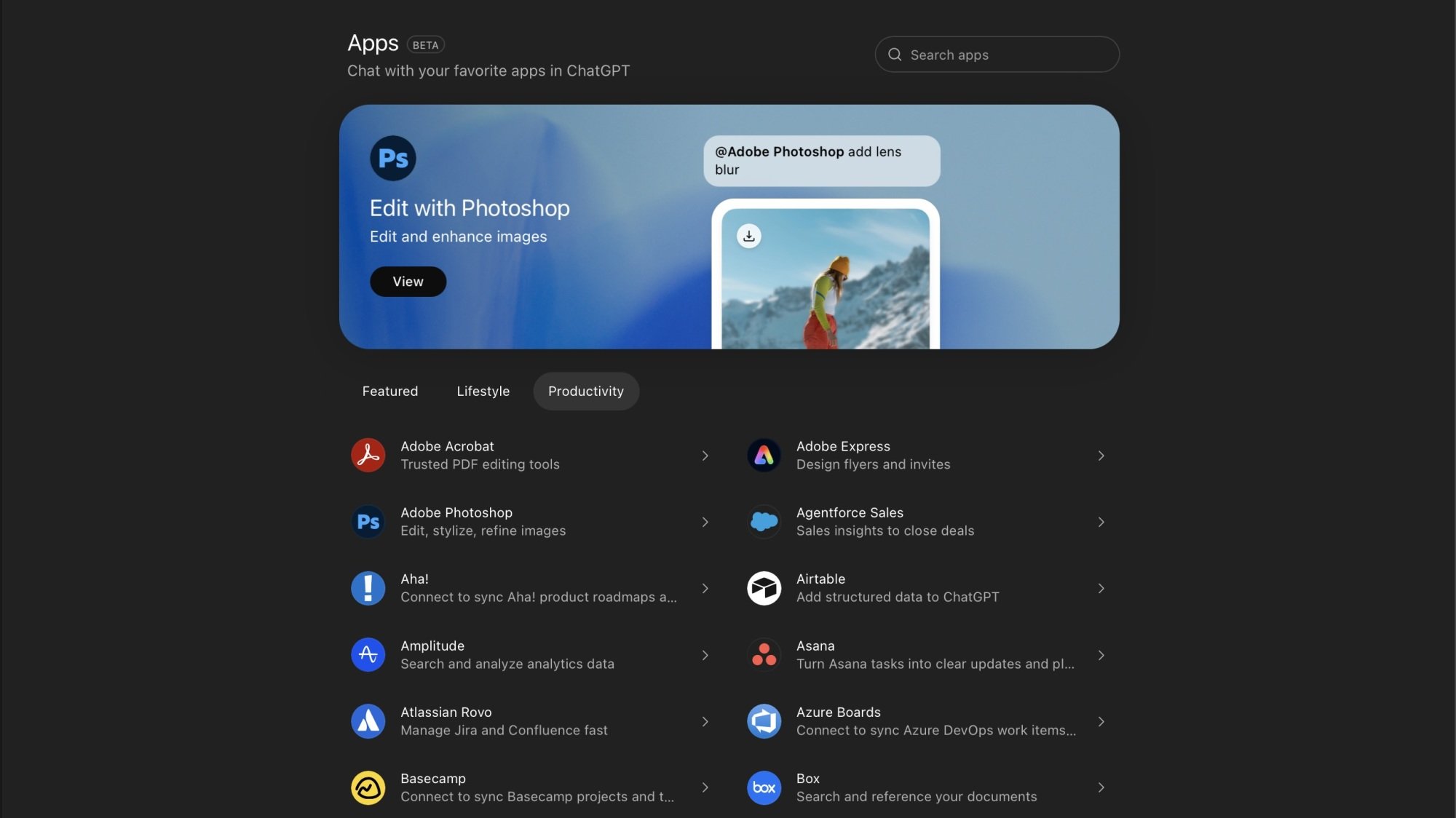
Speaking of more apps, the company plans to expand these apps overtime, as developers create ChatGPT-compatible extensions for their programs. That was part of yesterday’s news: OpenAI is now letting developers submit apps to ChatGPT en masse. What’s more, these apps will be hosted in an “app directory,” though many online are taking to calling it an app store. (There’s no payment necessary, however, so app directory might really be a more apt description.) You’ll find this new app directory in the sidebar of ChatGPT, appropriately called “Apps.”

Apps is apparently in beta, according to a label affixed to its title in ChatGPT. Here, you’ll find a rotating slide featuring an ad for some of the service’s biggest apps, like Canva and Zillow, and, below it, rows of apps to choose from. Right now, the apps are sorted into “Featured,” “Lifestyle,” and “Productivity,” with no option that includes all the apps. (But they seem to be entirely split across Lifestyle and Productivity.) There are a lot of options here already. Some made headlines this week, like Photoshop and Apple Music, while others arrived more quietly, like Asana, Uber, and Target. It’s not just traditional apps like Zillow or Spotify that are getting the app treatment here, either. OpenAI is also considering “connector” services, like Google Drive, as “apps.”

You can click on any app in the directory to see what you can do with it. Slack, for example, says you can look up your chats and messages to summarize threads, generate recaps, and come up with responses. You can check on your Asana tasks to generate progress reports and status updates. Outlook says you can create “talking points” and generate follow-ups from your emails and calendar events. While there’s a brief summary underneath each title, you’ll need to click through to each service to see the full picture of what it actually offers.

Here are the apps I’m seeing at this time. Just note this might not be a complete list, especially as OpenAI continues to add more apps to the service:

  • Adobe Acrobat

  • Adobe Express

  • Adobe Photoshop

  • Agentforce Sales

  • Aha!

  • Airtable

  • AllTrails

  • Amplitude

  • Apple Music

  • Asana

  • Atlassian Rovo

  • Azure Boards

  • Basecamp

  • Booking.com

  • Box

  • Canva

  • Clay

  • Cloudinary

  • Conductor

  • Coursera

  • Daloopa

  • DoorDash

  • Dropbox

  • Egnyte

  • Expedia

  • Figma

  • GitLab Issues

  • Google Drive

  • Help Scout

  • Hex

  • HighLevel

  • Hugging Face

  • Instacart

  • Intuit Credit Karma

  • Intuit Mailchimp

  • Intuit TurboTax

  • Khan Academy

  • Klaviyo

  • Linear

  • Lovable

  • LSEG

  • Monday.com

  • Morningstar

  • Netlify

  • Notion

  • OpenTable

  • Outlook Calendar

  • Outlook Email

  • Peloton

  • Pipedrive

  • PitchBook

  • Ramp

  • Replit

  • SharePoint

  • Slack

  • Spotify

  • Stripe

  • Target

  • Teams

  • Teamwork.com

  • TheFork

  • Thumbtack

  • Tripadvisor

  • Uber

  • Uber Eats

  • Vercel

  • Zillow

  • Zoho

  • Zoho Desk

  • Zoom

If you’re an avid ChatGPT user and frequently switch between it and any of the apps on this list, there might be some utility here. Maybe coders will find the integration with Hugging Face and Lovable to be beneficial, while Photoshop users might take advantage of the AI image editing tools this integration provides. But I’m still left feeling like this is more gimmick than anything else: I don’t need to connect my Slack to ChatGPT to generate follow-ups for me: I’m perfectly capable of responding to emails myself, and managing my own calendar, so no need to connect Outlook or another email client to the bot. Maybe a future update will sell me on connecting generative AI to all aspects of my work and personal life, but so far, I’m still not convinced.

LLMs’ impact on science: Booming publications, stagnating quality

There have been a number of high-profile cases where scientific papers have had to be retracted because they were filled with AI-generated slop—the most recent coming just two weeks ago. These instances raise serious questions about the quality of peer review in some journals—how could anyone let a figure with terms like “runctitional,” “fexcectorn,” and “frymblal” through, especially given the ‘m’ in frymblal has an extra hump? But it has not been clear whether these high-profile examples are representative. How significantly has AI use been influencing the scientific literature?

A collaboration of researchers at Berkeley and Cornell have decided to take a look. They’ve scanned three of the largest archives of pre-publication papers and identified ones that are likely to have been produced using Large Language Models. And they found that, while researchers produce far more papers after starting to use AI and the quality of the language used went up, the publication rate of these papers has dropped.

Searching the archives

The researchers began by obtaining the abstracts of everything placed in three major pre-publication archives between 2018 and mid-2024. At the arXiv, this netted them 1.2 million documents; another 675,000 were found in the Social Science Research Network; and bioRxiv provided another 220,000. So, this was both a lot of material to work with and covered a lot of different fields of research. It also included documents that were submitted before Large Language Models were likely to be able to produce output that would be deemed acceptable.

Read full article

Comments

YouTube Shuts Down Channels Using AI To Create Fake Movie Trailers

An anonymous reader quotes a report from Deadline: YouTube has terminated two prominent channels that used artificial intelligence to create fake movie trailers, Deadline can reveal. The Google-owned video giant has switched off Screen Culture and KH Studio, which together boasted well over 2 million subscribers and more than a billion views. The channels have been replaced with the message: “This page isn’t available. Sorry about that. Try searching for something else.”

Earlier this year, YouTube suspended ads on Screen Culture and KH Studio following a Deadline investigation into fake movie trailers plaguing the platform since the rise of generative AI. The channels later returned to monetization when they started adding “fan trailer,” “parody” and “concept trailer” to their video titles. But those caveats disappeared In recent months, prompting concern in the fan-made trailer community. YouTube’s position is that the channels’ decision to revert to their previous behavior violated its spam and misleading-metadata policies. This resulted in their termination. “The monster was defeated,” one YouTuber told Deadline following the enforcement action.

Deadline’s investigation revealed that Screen Culture spliced together official footage with AI images to create franchise trailers that duped many YouTube viewers. Screen Culture founder Nikhil P. Chaudhari said his team of a dozen editors exploited YouTube’s algorithm by being early with fake trailers and constantly iterating with videos. […] Our deep dive into fake trailers revealed that instead of protecting copyright on these videos, a handful of Hollywood studios, including Warner Bros Discovery and Sony, secretly asked YouTube to ensure that the ad revenue from the AI-heavy videos flowed in their direction.


Read more of this story at Slashdot.

AirTags are back on sale, with a four-pack retailing for $65

Apple keeps most of its product pricing on a tight leash, but we do see the company’s AirTags go on sale pretty frequently. Another cost cut has come around for this item just in time for the holidays. Amazon is currently selling a four-pack of AirTags for $65. At a third off the regular cost, that price is pretty close to the record low discount of $63 we’ve seen for these Bluetooth trackers. 

If you place an order quickly, the AirTags should arrive in time for Christmas, making this a solid choice as a gift for someone with a tendency to misplace stuff. AirTags can also be useful for people who travel frequently, helping you to keep track of essentials like your passport as well as a way to keep tabs on luggage while you’re on the go.

If you do purchase some AirTags, we have some recommendations for useful accessories to go along with them, such as different styles of cases to best attach the trackers to different types of items. These are worth looking over and adding to your shopping cart in order to make the most of the product. 

AirTags have an IP67 rating for water and dust resistance and their replaceable batteries should last for about a year. They can also support Precision Finding, which gives more exact directions to a lost item, when paired with most models after the iPhone 11. Up to five people can share an AirTag’s location, which is helpful for families or large travel groups. 

Follow @EngadgetDeals on X for the latest tech deals and buying advice.

This article originally appeared on Engadget at https://www.engadget.com/deals/airtags-are-back-on-sale-with-a-four-pack-retailing-for-65-202333979.html?src=rss

Auto chip shortage: Honda will pause production in Japan and China

The ripples of the auto industry’s chip shortage are still being felt, as evidenced by Honda. Bloomberg reported on Wednesday that the automaker will suspend production in Japan on January 5 and 6. (Honda didn’t specify the affected factories.) In addition, all three of the automaker’s Guangqi Honda Automobile plants in China will shut down from December 29 to January 2.

The halt is an outgrowth of a chip shortage stemming from a recent geopolitical proxy war in the Netherlands, of all places. In October, the Dutch government, bowing to pressure from the Trump administration, seized control of the Chinese-owned chipmaker Nexperia. The company, which operates in the Netherlands, makes low-end chips that power automobiles, appliances and other tech.

The Dutch government’s official explanation for the seizure was that Nexperia had “serious governance shortcomings.” It cited a concern that Nexperia’s Chinese majority owner, Wingtech, would move key technology out of Europe. However, the New York Times later reported that the Dutch government had known about those plans since 2019.

Regardless, China retaliated by blocking exports of Nexperia-made chips. The Netherlands eventually suspended its intervention, following “constructive talks.” China then relaxed (but did not entirely remove) its restrictions through exemptions to export controls. The uneasy resolution hasn’t been enough to help supply chains fully recover.

Honda initially anticipated that production would return to normal starting in late November. So much for that. “No one [in the auto industry] prepared for geopolitical disruption,” automaker consultant Ambrose Conroy, CEO of Seraph Consulting, told Reuters in November. “And they’re still not prepared.”

This article originally appeared on Engadget at https://www.engadget.com/transportation/auto-chip-shortage-honda-will-pause-production-in-japan-and-china-200857591.html?src=rss