State of Play: Who Holds the Power in the Video Games Industry in 2025?

The video games industry in 2025 finds itself caught between the familiar forces of consolidation and job losses that have plagued creative industries, and a newer development: governments and the ultra-wealthy have begun treating games as tools of political influence. Saudi Arabia’s Public Investment Fund closed a $55 billion deal for EA this year and acquired Niantic, the makers of Pokemon Go, in March.

Microsoft’s 2023 acquisition of Activision already signaled the direction of travel. The workforce has borne the costs of this consolidation. More than 5,000 jobs have been lost in the industry this year, and several studios have shuttered, including Monolith Productions. The instability has pushed unions into greater prominence: United Videogame Workers formed in the US and Canada in March as part of the Communications Workers of America, and the firing of 30 staff from Rockstar Games in the UK brought the IWGB Game Workers Union into the spotlight.

Meanwhile, the Trump administration has posted AI-generated images of the president as Halo’s Master Chief and used Pokemon and Halo memes to recruit for ICE.


Read more of this story at Slashdot.

You Can Now Customize ChatGPT’s ‘Personality’ to Suit Your Tastes Even More

When Spike Jonze’s movie Her dropped back in 2013, I thought it was a great work of total fiction. Who would actually befriend an AI bot, let alone fall in love with them? Fast forward 12 years, and I couldn’t have been more wrong. Not only do people love chatting with AI bots, they are actually developing deep connections with them. I still don’t get it, but I can’t deny it: People like these chatbots a lot.

Part of what people like about conversations with generative AI is the “personality” of each bot—or, at least, its perceived personality. After all, ChatGPT isn’t a monolith: You can adjust the bot to sound wildly different than it does on someone else’s app, which raises some questions for me regarding these curated companions. But I digress: This article isn’t necessarily a critique of how people are attaching themselves to ChatGPT; rather, I’m sharing the news that OpenAI is now giving you more control over how the bot sounds and responds in your conversations.

Curate your perfect AI companion

On Friday, OpenAI announced new controls for ChaGPT’s “Personalization.” In a post on X, the company revealed that users can now adjust their chatbot’s “characteristics,” or, in other words, its overall personality. These are adjustments to the personality types that OpenAI has already let you choose from, which include one of eight options: “Default” (preset style and tone); “Professional” (polished and precise); “Friendly” (warm and chatty); “Candid” (direct and encouraging); “Quirky” (playful and imaginative); “Efficient” (concise and plain); “Nerdy” (exploratory and enthusiastic); and “Cynical” (critical and sarcastic).

But no matter which of these personalities you pick, you now have four “characteristics” to adjust to fine-tune the overall experience. There’s “Warm,” “Enthusiastic,” “Headers & Lists,” and “Emoji,” with the option to have more or less of each, or the default amount, as OpenAI sees fit. For Warm, you can either have ChatGPT be friendlier and more personable, or more professional and factual. With Enthusiastic, you can choose the bot to have more energy and excitement, or be calmer and more neutral. “Headers & Lists” lets you choose between clear formatting and lists, or more paragraphs. And, of course, you can control whether ChatGPT uses more emoji, or fewer, depending on your sense of fun and joy.

As usual, you can take advantage of custom instructions to guide ChatGPT’s personality in a direction you like, especially when the presets don’t give you those options. For example, if you’d like ChatGPT to talk to you like a pirate, or if you want it to end every response with a certain catchphrase, here’s your chance to influence the bot.

I’m really not someone who uses ChatGPT outside of testing it for coverage, so I can’t speak to whether these additional controls are useful. But if you want to try making your version of ChatGPT your ideal “AI companion,” the controls are at your disposal. You’ll find these options wherever you access ChatGPT. You can either access it from Settings > Personalization, or from the Personalization shortcut in the ChatGPT menu.

Uber allows violent felons to drive on its platform, investigation finds

An investigation by the New York Times into Uber’s background checks and safety procedures for its drivers found a patchwork approach that opens the door for violent felons to drive for the ride-hailing platform.

Uber outright rejects applicants convicted of murder, sexual assault, kidnapping and terrorism. However, in 22 states, the Times found Uber can approve applicants convicted of many other offenses including child abuse, assault and stalking, if the convictions are at least seven years old. The extensive investigation also found that in 35 states, these checks are based largely on where someone has lived in those seven years, meaning convictions from other locations could be missed.

In 2017, Massachusetts conducted an audit of ride-hailing drivers in the state and ended up banning more than 8,000 drivers (about 11 percent) who were previously approved. Lyft, for its part, does not allow drivers with previous violent felony convictions regardless of how long ago the conviction was.

In a document from 2015 reviewed by the Times, Uber executives discussed a strategy to “shift the conversation about safety from background checks to [less costly] initiatives proven to reduce incidents.” A 2018 email from Uber’s then head of safety communications described the company’s background check policy as “a bare minimum.”

The Times compiled half a dozen examples of serious cases where Uber drivers with past violent convictions were later accused by passengers of sexual assault or rape. Two of those cases resulted in criminal convictions.

Between 2017 and 2022, Uber’s US operations received a report of sexual assault or sexual misconduct among almost every eight minutes, according to the company’s own internal data. Uber said 75 percent of these reports were for “less serious” incidents such as flirting or making comments about a rider’s appearance, and claimed that 99.9 percent of its rides take place without incident.

This article originally appeared on Engadget at https://www.engadget.com/big-tech/uber-allows-violent-felons-to-drive-on-its-platform-investigation-finds-162721155.html?src=rss

5 Last Minute Holiday Stocking Stuffer Deals For Geeks Under $100

5 Last Minute Holiday Stocking Stuffer Deals For Geeks Under $100
Call it a Christmas miracle, but there’s actually still time to order a gift online and have it arrive in time for the holiday. That’s not the case for every product out there, but we found a bunch of great gift ideas are suitable candidates for a stocking stuffer (also check out our staff roundup of ho-ho-hot tech gifts). And by that, we

Samsung Is Putting Google Gemini AI Into Your Refrigerator, Whether You Need It or Not

BrianFagioli writes: Samsung is bringing Google Gemini directly into the kitchen, starting with a refrigerator that can see what you eat. At CES 2026, the company plans to show off a new Bespoke AI Refrigerator that uses a built in camera system paired with Gemini to automatically recognize food items, including leftovers stored in unlabeled containers. The idea is to keep an always up to date inventory without manual input, track what is added or removed, and surface suggestions based on what is actually inside the fridge. It is the first time Google’s Gemini AI is being integrated into a refrigerator, pushing generative AI well beyond phones and laptops.


Read more of this story at Slashdot.

Why I Won’t Be Getting an AI Home Gym

I’ve been getting relentless Instagram ads for AI-powered home gyms lately. You’ve probably seen them, too—sleek wall-mounted screens with impossibly toned instructors, testimonials promising “the future of fitness,” and before-and-after transformations that make it all look effortless.

The smart home gym equipment market is booming. According to Business Wire, the industry was valued at $3.2 billion in 2024 and is projected to reach $4 billion by 2030. The numbers show plenty of people are investing in fitness technology that offers personalized, convenient, and effective home workouts. Fitness is yet another way to feed the AI beast, transforming boring old equipment into highly sophisticated systems capable of delivering real-time feedback, tracking performance, and adjusting workouts to each user’s needs. It all sounds impressive—revolutionary, even. But here’s the thing about fitness trends: It takes a lot more than the latest technology to make them stick.

After months of watching these ads follow me around the internet, I got curious enough to actually dig into what these things are and whether they’re worth the hype, and if the math really adds up for most people.

Fitness trends rarely have staying power

Whatever your fitness goal is, the way to get it done is going to be time-tested and probably not too glamorous. Look at Tae Bo, Zumba, shake weights, even the world of Crossfit—most fitness fads don’t have staying power once the novelty wears off. 

Sure, exercise science evolves, but not nearly as fast as whatever trendy gadget cycles through the cultural zeitgeist. In this way, we see “fitness” get reduced to a consumer product—something to be purchased, used briefly, and then tossed aside when something shinier comes along. In 2025, spin classes are out, while Pilates and strength training are in, and that Bowflex is probably collecting dust in your mom’s basement. 

In fact, in 2024 both Bowflex and American Home Fitness, two companies that bet big on the home fitness boom, filed for bankruptcy. In more recent history, Peloton once seemed unstoppable. Now, Peloton’s revenue declined 2.8% in 2024 to $2.71 billion, marking its third consecutive year of declining revenue. What was once a cultural phenomenon now struggles to retain members and justify its premium pricing.

For something to stick in fitness, three questions matter: Is it affordable? Does it work? Will you personally keep coming back to it?

AI home gyms might work, and you might keep coming back, but that first question is where things get complicated.

What exactly is an AI home gym?

AI home gyms are digital fitness systems that combine hardware with software to create a personalized workout experience at home. The most well-known is probably Tonal, but there’s also Tempo, Speediance, Amp, and others.

Here’s how they typically work: Tonal, for instance, is a wall-mounted unit about the size of a large TV that uses electromagnetic resistance instead of traditional weights. You pull cables attached to adjustable arms, and the system can provide up to 200 pounds of resistance digitally. Built-in cameras and sensors track your movements, and the AI adjusts the weight in real-time based on your form and performance. A screen displays instructors leading classes, tracks your reps and sets, and the system learns your strength patterns over time to suggest when you should increase weight or modify exercises.

Other systems work differently—Tempo uses free weights with 3D sensors that watch your form, while some use smart cables or connected dumbbells—but the core promise is the same: sophisticated technology that monitors your workout, corrects your form, tracks your progress, and adapts to your fitness level, all from your living room.

The benefits of an AI-powered home gym

Smart home gyms do offer legitimate benefits, including compact convenience, personalization, time savings, structured workouts, and potentially better injury prevention through form monitoring. And for many, devices like Tonal, Amp, and others are here to stay. “As a professional home gym equipment tester,” says Jose Guevara of ShreddedDad, “I’ve seen more of these continue to pop up not only in full training stations, but also in specific equipment, like cable machines, dumbbells, and sometimes a combination of both. They’ll never have the longevity of weight plates or barbells, but there is an audience for them.”

According to Guevera, these systems appeal to “those people who need guidance and want a done-for-you system where they can choose on-demand workouts where they can just follow along and not have to think about what to do for their workout.”

There is an audience for these products, just as there’s an audience for Peloton bikes and high-end boutique fitness studios. But to me, the relevant question isn’t whether they work for some people—it’s whether they’re the revolutionary solution to home fitness they’re marketed as, or just another expensive piece of equipment that most people will use enthusiastically for a few months before the novelty wears off.

Still, another Tonal user told me that comparing these AI systems to a Bowflex machine from the 1990s is like comparing a surgical robot to using a rusty scalpel. But this analogy assumes your body is a machine where the logic of “endless innovation” holds up. A smart gym isn’t exactly a medical solution. It’s an accessory, a luxury good that depends on who can afford it. I don’t think the problem with working out at home has never been that we lacked sophisticated enough technology. The problem is that working out is hard, consistency is harder, and no amount of AI can fundamentally change that human reality. There are some things you just can’t hack. 

Running the numbers on an AI home gym

There are hefty upfront costs for these products. Take Tonal, one of the leading AI home gym systems. It’s around $4,300 for the unit itself, $295+ for mandatory professional installation, plus bundled smart accessories. Then comes the recurring monthly membership fee of around $60 for full access to classes and features. All told, you’re looking at roughly $5,300 in the first year, followed by $720 annually for the subscription.

Compare that to traditional gym memberships. According to a 2023 report, the average monthly cost of a gym membership is $58, which works out to about $696 per year. Budget options like Planet Fitness run as low as $15 to $23 per month, or $180 to $276 annually. Even mid-tier gyms like LA Fitness typically cost $40 to 56 per month.

So, to break even on a Tonal, compared to a mid-range gym membership at $50/month:

Year 1: Tonal costs $5,300. A gym membership costs $600. You’re already $4,700 in the hole.

Year 2: You pay $720 for Tonal’s subscription. The gym still costs $600. You’re now $4,820 behind.

Year 3: Another $720 vs. $600. Now you’re $4,940 in deficit.

By Year 5: You’ve spent $8,180 on Tonal versus $3,000 at a gym.

It would take roughly eight years of consistent use before Tonal becomes cost-competitive with a traditional gym membership. Eight years. That’s assuming the hardware doesn’t malfunction, the company doesn’t go under (remember, Bowflex and Peloton couldn’t sustain their models), and you actually use it consistently for nearly a decade.

And the subscription costs are real. Unlike traditional weights that work whether or not you’re paying a monthly fee, many digital fitness products require a subscription as long as you want to access workouts. “I’ve seen some of these companies also go out of business,” Guevara says, “so if that happens, you’re stuck with a product that doesn’t function if their software is not kept up with.” We’ve watched other companies’ subscription traps effectively brick your hardware.

Now, proponents will argue that you save on commute time and costs. Fair enough. But for the Tonal investment to be “worth it” financially, you’d need to use it at least three to four times per week for those eight years straight. If you weren’t driving to a gym you pay $50/month for, are you sure you’ll consistently use your smart gym for years and years once the novelty wears off? 

There’s another unspoken cost to at-home convenience, akin to people who struggle with WFH setups: the absence of gym culture. Don’t underestimate the power of casual human interaction, personal trainers who can physically adjust your form, accountability from workout buddies, the ritual of leaving your house to exercise, or maybe even the silent camaraderie of shared suffering. If you’re like me, that separation between home and workout space is a major psychological boost. 

The bottom line

The best exercise is the one you’ll actually keep doing. If you run the numbers and a Tonal makes sense for your budget and workout habits, great. Personally, as AI creeps into every other corner of my life, I find a lot of comfort in my workouts as a rare screen-free activity. 

My gripe with AI home gyms is when they’re marketed as must-have solutions, instead of what they are: luxury goods, something available only to those with disposable income and spare square footage. On a grand scale, given their current costs, AI home gyms look like a passing trend to me. And two years from now, when the next fitness innovation promises to finally solve at-home workouts, I bet someone will write this same article all over again.

Welcome To America’s New Surveillance High Schools

Beverly Hills High School has deployed an AI-powered surveillance apparatus that includes facial recognition cameras, behavioral analysis software, smoke detector-shaped bathroom listening devices from Motorola, drones, and license plate readers from Flock Safety — a setup the district spent $4.8 million on in the 2024-2025 fiscal year and considers necessary given the school’s high-profile location in Los Angeles.

Similar systems are spreading to campuses nationwide as schools try to stop mass shootings that killed 49 people on school property this year, 59 in 2024, and 45 in 2023. A 2023 ACLU report found that eight of the ten largest school shootings since Columbine occurred at schools that already had surveillance systems, and 32% of students surveyed said they felt like they were always being watched. The technology has a spotty track record, however.

Gun detection vendor Evolv, used by more than 800 schools including Beverly Hills High, was reprimanded by the FTC in 2024 for claiming its AI could detect all weapons after it failed to flag a seven-inch knife used to stab a student in 2022. Evolv has also flagged laptops and water bottles as guns. Rival vendor Omnilert flagged a 16-year-old student at a Maryland high school reaching for an empty Doritos bag as a possible gun threat; police held the teenager at gunpoint.

Not every school is buying in. Highline Schools in Washington state cancelled its $33,000 annual ZeroEyes contract this year and spent the money on defibrillators and Ford SUVs for its safety team instead.


Read more of this story at Slashdot.

GeForce RTX 5060 Ti 16GB GPUs Are Still In Stock Amid Rumors Of A Production Pause

GeForce RTX 5060 Ti 16GB GPUs Are Still In Stock Amid Rumors Of A Production Pause
A shortage of memory chips caused by a surge in demand in the data center to fuel artificial intelligence (AI) workloads is wreaking havoc on the consumer market, and especially in the realm of home computers where DDR5 DRAM kits have shot up in price. The ramifications run even deeper than overpriced DRAM, however, and could impact the availability

Don’t Fall for This ‘Out of Stock’ Purchase Scam

Scammers frequently target shoppers who are looking for a good deal or a rare find (or both). As holiday sale season winds down, the Better Business Bureau is warning buyers about a scheme in which fraudsters charge you for “out of stock” goods and fail to refund your money.

The out-of-stock purchase scam is simple: After you buy a product online, scammers send you a notification that said item is no longer available, cancel your order, and tell you that you’ll get your money back. Obviously, the refund never arrives, and no one ever responds to further inquiries.

As the BBB points out, in most cases, the item you thought you bought probably never existed in the first place—rather, scammers are selling fake stock, charging customers, and vanishing in hopes you won’t notice that you didn’t receive your refund. Some consumers who submitted reports to the BBB Scam Tracker said that they did receive products, but items were of poor quality or not what they ordered, and no refund was ever issued.

Spot out-of-stock purchase scams

These fake purchase schemes may have the usual red flags, like prices that are too good to be true, especially those promoted on social media. Personalized items are ripe for scams, as are hard-to-find products or collectibles. If you find an amazing deal from a company or seller you don’t recognize, search the name with “scam” and read reviews on Google and Reddit to identify patterns of suspicious activity (or poor-quality products).

You should also be wary of websites that aren’t secure—those that don’t start with HTTPS or have a lock icon in the browser bar—as these are more vulnerable to hackers looking to intercept credit card info and other personal data. Legitimate vendors collect payment securely.

Shop with a credit card

Shopping scams are a good reason to use a credit card for online purchases, as they offer protection against fraudulent charges. If you don’t receive a refund from a seller, you can file a chargeback—while this isn’t as simple or swift a process, it is likely you’ll get your money eventually.

Always keep receipts, order confirmations, and any communication with sellers in case you need to make a claim for a scam purchase.

Paramount has an updated Warner Bros. Discovery bid

Paramount Skydance isn’t giving up on obtaining Warner Bros. Discovery just yet. The company has amended its $108 billion offer to include Larry Ellison’s “irrevocable personal guarantee” equaling $40.4 billion. Ellison is the founder or Oracle and a backer of Skydance, created by his son David Ellison, Paramount Skydance’s CEO. 

On December 17, WBD formally recommended shareholders reject Paramount’s offer. WBD had already accepted an $82.7 billion offer from Netflix, set to close some time next year following regulatory approval. “[The board] has unanimously determined that the tender offer launched by Paramount Skydance on December 8, 2025 is not in the best interests of WBD and its shareholders and does not meet the criteria of a ‘Superior Proposal’ under the terms of WBD’s merger agreement with Netflix announced on December 5, 2025,” WBD stated. 

The Paramount deal included backing by sovereign wealth funds in places like Saudi Arabia and Qatar. But the Ellisons previously said that, if the other funders dropped out, they would “backstop the full amount of the bid.” That wasn’t enough of a guarantee for WBD. 

Now, Paramount has returned with the irrevocable personal guarantee and an agreement that the senior Ellison won’t “revoke” or “adversely transfer” the Ellison family trust’s assets while the transaction is pending. WBD had stated that a personal guarantee was the only fix to Paramount’s inadequate offer. 

Paramount might have taken this step, but not with a smile on its face: “None of these concerns, nor the demand for a personal guarantee, were raised by WBD or its advisors to Paramount in the 12-week period leading up to WBD agreeing to the inferior transaction with Netflix, Inc.,” the company stated about its updated offer. 

“Our $30 per share, fully financed all-cash offer was on December 4th, and continues to be, the superior option to maximize value for WBD shareholders. Because of our commitment to investment and growth, our acquisition will be superior for all WBD stakeholders, as a catalyst for greater content production, greater theatrical output, and more consumer choice,” David Ellison stated. “We expect the board of directors of WBD to take the necessary steps to secure this value-enhancing transaction and preserve and strengthen an iconic Hollywood treasure for the future.”

Paramount’s updated offer also includes publishing the trust’s assets, more flexible transaction terms and an increase from $5 billion to $5.8 billion of its “regulatory reverse termination fee” — in line with Netflix’s. 

Paramount’s offer will expire on January 21, 2026. 

This article originally appeared on Engadget at https://www.engadget.com/entertainment/paramount-has-an-updated-warner-bros-discovery-bid-144348321.html?src=rss

iRobot Founder Says FTC Treated Blocked Deals ‘Like Trophies’ as Bankruptcy Follows Failed Amazon Acquisition

Colin Angle, the founder of iRobot who built the company from his living room over 35 years and sold more than 50 million Roomba vacuums, watched his creation file for Chapter 11 bankruptcy earlier this month after what he describes as an “avoidable” regulatory ordeal that killed Amazon’s $1.7 billion acquisition bid. In an interview with TechCrunch, Angle recounted the 18-month investigation by the FTC and European regulators that preceded Amazon’s January 2024 decision to abandon the deal. The process consumed over 100,000 documents and a significant portion of iRobot’s discretionary earnings. Angle said the deal should have taken “three, four weeks of investigation” given iRobot’s declining market position — 12% and falling in Europe, where the leading competitor was only three years old.

During his deposition, Angle said he walked the halls of the FTC and noticed examiners had “printouts of deals blocked, like trophies” on their office doors. He entered the process “looking for a friend” and instead encountered the question: “Why should we ever let them do this?”

Further reading: WSJ Editorial Board Says Lina Khan Killed iRobot.


Read more of this story at Slashdot.

From Ban To Fee: NVIDIA May Ship 80,000 H200 AI Chips To China By Lunar New Year

From Ban To Fee: NVIDIA May Ship 80,000 H200 AI Chips To China By Lunar New Year
NVIDIA is not only hoping to finally begin shipping previously-banned H200 AI chips to China in the very near future, it’s expecting to start fulfilling orders in mid-February just before the Lunar New Year, according to Reuters. Citing multiple people who are purportedly familiar with the matter, the site reports NVIDIA expects to ship 5,000

Spotify Says ‘Anti-Copyright Extremists’ Scraped Its Library

A group of activists has scraped Spotify’s entire library, accessing 256 million rows of track metadata and 86 million audio files totaling roughly 300TB of data. The metadata has been released via Anna’s Archive, a search engine for “shadow libraries” that previously focused on books.

Spotify described the activists as “anti-copyright extremists who’ve previously pirated content from YouTube and other platforms” and confirmed it is actively investigating the incident. The activists claim this represents “the world’s first ‘preservation archive’ for music which is fully open” and covers “around 99.6% of listens.”

They appear to have used Spotify’s public web API to scrape the metadata and circumvented DRM to access audio files. Spotify insists that this is not a security breach affecting user data. Though the more pressing concern for the music industry may be AI training rather than pirate streaming services — similar YouTube datasets have reportedly been used by unlicensed generative AI music services.


Read more of this story at Slashdot.

This Multi-Platform Mobile Gaming Controller Is Over 20% Off Right Now

We may earn a commission from links on this page. Deal pricing and availability subject to change after time of publication.

The Backbone Pro mobile gaming controller is currently down to $134.99 from $169.99, its lowest price yet, according to price trackers. That drop helps justify its somewhat in-between status—it’s more expensive than basic clamp-on controllers but still cheaper than buying both a dedicated phone grip and a standalone Bluetooth gamepad.

The appeal here is flexibility. The Backbone Pro snaps directly onto your phone through USB-C, but it can also work wirelessly over Bluetooth with a PC, tablet, or TV. That means one controller can live in your bag and handle quick mobile sessions, cloud gaming on a laptop, or couch gaming on a bigger screen without extra mounts or adapters. PCMag rated it “excellent,” which tracks with how polished it feels, though it’s not without trade-offs.

In hand, the Backbone Pro feels noticeably better than the original Backbone One. The rounded grips and full-size analog sticks make longer sessions easier, especially for shooters or racing games where precision matters. The sticks are the same size as an Xbox controller’s and track movement reliably. Buttons are smaller than a full-size gamepad but clicky and well-spaced, which helps avoid accidental presses. Triggers are responsive, though their shorter pull takes some adjustment in games that rely on fine throttle control. That said, the controller lacks haptic motors, so there is no rumble feedback, which makes it feel a bit hollow compared to traditional console controllers. It is still solid and well-built, just not as weighty or immersive as something like a full-size gamepad.

Where things get more complicated is the software. Plugging the Backbone Pro into a USB-C phone is simple, and it works with most Android phones and iPhone 15 and newer models, even large devices like the Samsung Galaxy S25 Ultra. Wired mode gives you access to the Backbone app, where you can update firmware, remap buttons, and use the screenshot capture button. Many of the more appealing features, though, are locked behind the Backbone+ subscription, which costs $39.99 per year. That includes game launching, video capture, 1080p recording, Twitch streaming, or retro emulation for iPhone users. That’s a bit of a letdown considering the already steep price tag. Still, you’re getting a compact and dual-purpose controller that can travel with you, hook onto your phone, or connect wirelessly to just about anything that supports XInput.


Instacart is ending its controversial price tests

Instacart has announced it will be ending price testing on its platform. This comes after a study published earlier this month revealed pricing experiments that led to some customers seeing higher prices than others and the FTC saying last week it would be investigating the grocery delivery app.

“Effective immediately, Instacart is ending all item price tests on our platform. Retailers will no longer be able to use Eversight technology to run item price tests on Instacart,” an Instacart spokesperson shared with Engadget. The blog post called out “misconceptions and misinformation,” maintaining that these price experiments were never the result of dynamic pricing and were never based on any personal or behavioral information about shoppers.

In an earlier blog post responding to the study’s allegations, Instacart said pricing changes were a “form of short-term, randomized A/B testing.” The post referred to this process as “common in the grocery industry” and continued to paint the practice as a way to “invest in lower prices.” It also highlighted that Instacart does not set the prices on its platform, which are set by retailers listed on the app.

The company made clear that its retail partners will continue to set their own prices on the platform, which may vary by location just as they do in brick-and-mortar stores, but that Instacart will no longer support any item price testing services.

This article originally appeared on Engadget at https://www.engadget.com/big-tech/instacart-is-ending-its-controversial-price-tests-134552152.html?src=rss

Foldable phone makers have solved every issue except one

It might be hard to believe, but foldable phones have already been around for the better part of a decade. Granted, the first one I saw back in 2019 — which actually predates Samsung’s Galaxy Fold — was a cobbled-together mess. But since then, phone makers have been steadily iterating and tweaking their designs, and this year,  manufacturers have finally addressed all the major issues about foldable phones except one: price.

Let’s go back to the OG Fold. Even though it was chunky and heavy, had a tiny exterior display and suffered from a hinge that let too much detritus inside (which is probably how The Verge’s review unit got wrecked), it still showed so much promise. It was a true multitasker — a phone that could turn into a small tablet at a moment’s notice. What’s not to like?

This scene would have sent shivers down my spine in previous years, but thanks to an IP68 rating for dust and water resistance, the Pixel 10 Pro Fold isn't bothered.
This scene would have sent shivers down my spine in previous years, but thanks to an IP68 rating for dust and water resistance, the Pixel 10 Pro Fold isn’t bothered.
Sam Rutherford for Engadget

From there, Samsung upgraded its foldables with water resistance and S Pen support on the Z Fold 3, followed by eliminating the gap between the two halves of a closed Z Fold 5. And as competition grew from OnePlus and Google (not to mention all the Chinese rivals like Oppo, Xiaomi and others), we saw design and software improvement across the category . 

In 2025, two phones in particular brought major upgrades to foldables as a whole. Even though its shape didn’t change much from its predecessor, Google managed to get the Pixel 10 Pro Fold an IP68 rating for dust and water resistance — finally putting protection for both dirt and liquid in the same foldable for the first time. Now, for all the folks out there with regular phones, that might not sound like a big deal. But on devices with complicated hinges where you really don’t want random garbage getting inside, that’s a massive relief and a big improvement to the handset’s general usability. 

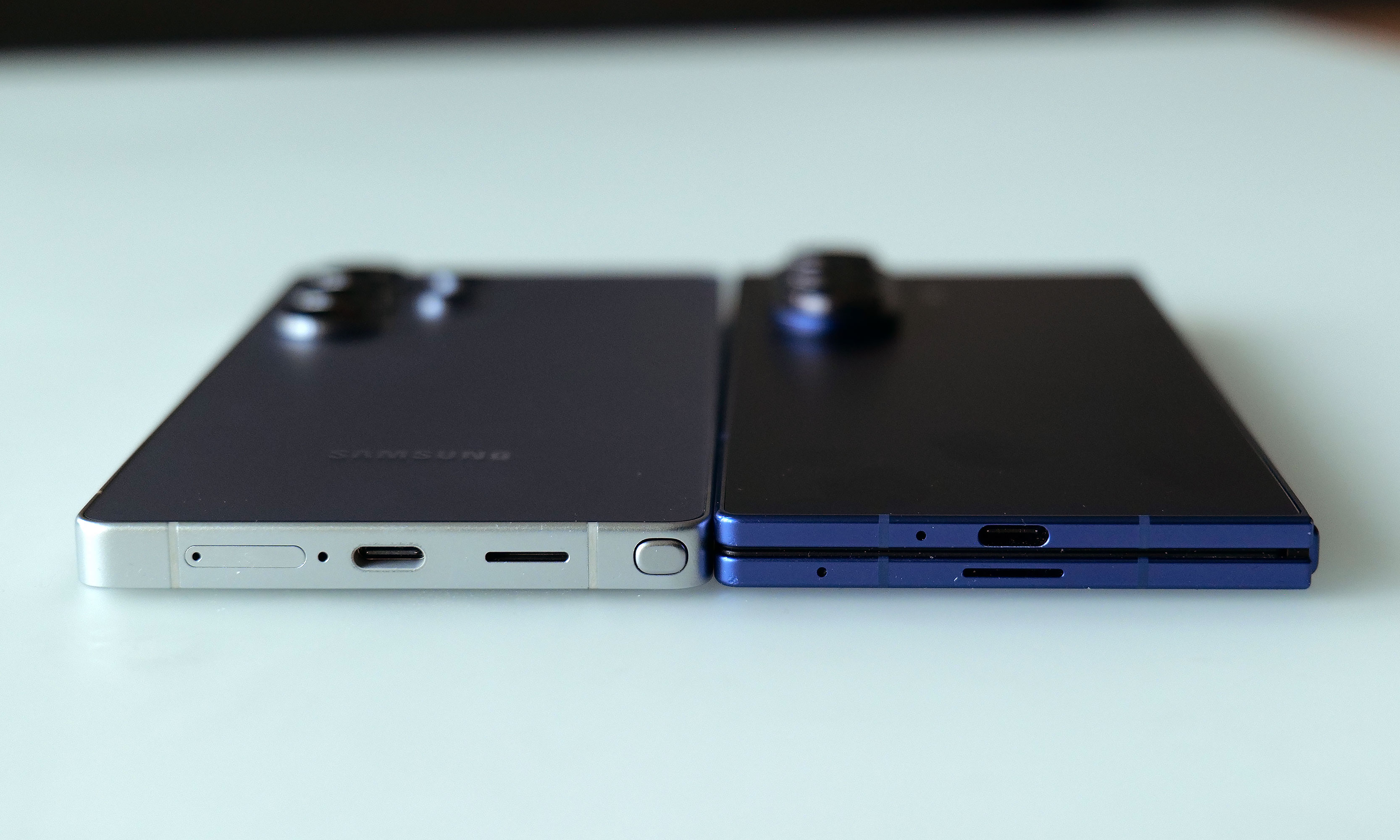
If you only look at their dimensions, you'd be hard pressed to tell the difference between the Galaxy Z Fold 7 (right) and an S25 Ultra (left).
If you only look at their dimensions, you’d be hard pressed to tell the difference between the Galaxy Z Fold 7 (right) and an S25 Ultra (left).
Sam Rutherford for Engadget

Meanwhile, with the Galaxy Z Fold 7, Samsung achieved what may be an even bigger accomplishment by creating a foldable phone that was essentially the same size and weight as a traditional glass brick handset — with a massive 8-inch interior display no less. In fact, if you compared the Z Fold 7 to Samsung’s other flagship — the S25 Ultra — the fold is actually a touch lighter (7.58 ounces vs 7.69 ounces) and practically just as thin (8.9mm vs 8.2mm). That’s huge because one of the biggest issues with previous generations of foldables was excess bulk and heft, to the point where often I had to wear a belt just so my pants wouldn’t sag when carrying one around. 

Unfortunately, there isn’t a phone maker that has put both of these advancements into a single gadget just yet. But this is still a big deal, and based on how things are trending, I’m sure that won’t be the case for long.

What about the crease, you say? Yes, even the latest and greatest foldables still have a small depression that runs down the screen where the phone bends in half. Let me be clear: that’s not really an issue. Sure, it would be nice if it weren’t there, but getting mad about the crease is kind of like being annoyed at a convertible car that has some extra panel gaps because it has a retractable roof. Not only is the crease basically invisible when you are looking at it head-on (which is the vast majority of the time), in reality, people don’t touch the dead center of their phone’s display all that often — especially on a screen the size of a small tablet.

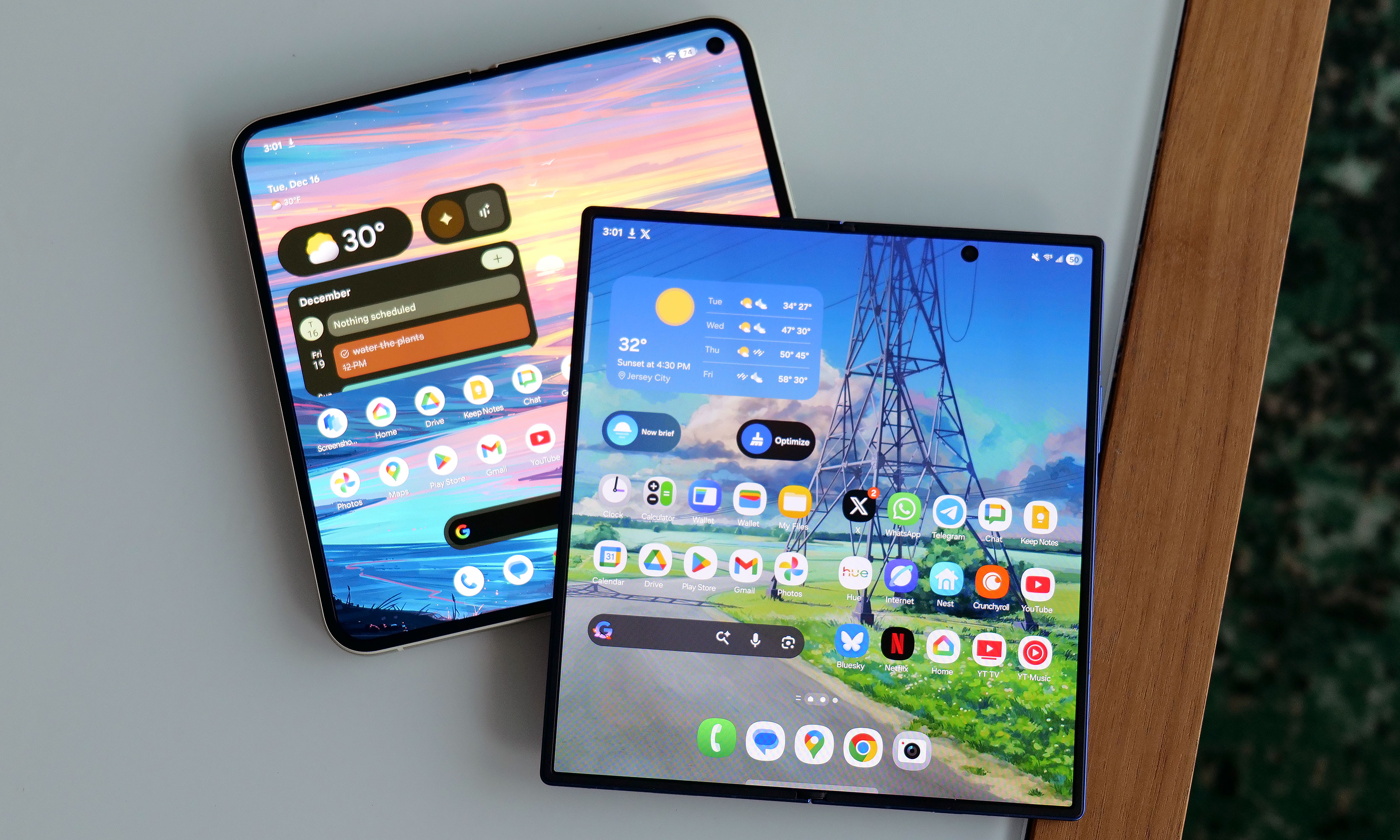
The Z Fold 7 has made bulky foldables a thing of the past while the Pixel 10 Pro Fold shows how these phones don't need to be afraid of dirt anymore.
The Z Fold 7 has made bulky foldables a thing of the past while the Pixel 10 Pro Fold shows how these phones don’t need to be afraid of dirt anymore.
Sam Rutherford for Engadget

Really, the one thing the makers of big foldables haven’t figured out is how to make them affordable. OnePlus sort of came close in 2023 with the Open, which cost $1,500 after rebates that included trading in literally any phone (even broken ones). In fact, things are actually kind of going backwards. The launch price of the Z Fold 7 ($2,000) is $200 more than what the Z Fold 5 debuted at just a couple of years ago. Even with high prices, I’ve started seeing more and more foldable phones in the wild than ever before and the data backs up my sentiment. Sales of the Galaxy Z Fold 7 are up 50 percent compared to the previous generation while global foldable phone sales reached a new high in Q3 of this year, and I’m willing to bet that there are millions of others out there who would be interested in them — if only they didn’t cost so much. 

This article originally appeared on Engadget at https://www.engadget.com/mobile/smartphones/foldable-phone-makers-have-solved-every-issue-except-one-130000891.html?src=rss

How to pair controllers with the Nintendo Switch 2

The Nintendo Switch 2 supports a wide range of controllers, from Nintendo’s own Pro Controller to many Bluetooth gamepads you might already have. Whether you’re setting up your new console for the first time or adding extra controllers for multiplayer games, pairing them is simple as long as you know where to look. Here’s how to connect the Switch 2 Pro Controller, how to sync additional Bluetooth controllers and what to do if something doesn’t pair correctly.

Before you start: What you’ll need

To pair any controller with the Switch 2 you’ll need the console powered on and updated to the latest system software. Navigate to System Settings, System then System Update to check. It also helps to have the controller charged, since some models need enough battery to begin pairing.

On the Switch 2, all controller settings reside in the Controllers & Sensors section of System Settings. You can pair up to four controllers depending on the game and the controller type.

How to pair the Switch 2 Pro Controller

Nintendo’s Switch 2 Pro Controller is the simplest device to connect, and it can be paired in two different ways: wired and wireless. If you’re setting it up for the first time, the wired method is the fastest and most reliable.

To pair the Switch 2 Pro Controller using a USB cable:

  • Connect the Pro Controller to the Switch 2 using a USB-C cable.

  • Wake the console and open the Controllers menu from the Home screen.

  • The console will automatically detect the controller and pair it.

Once the controller is paired, you can unplug the cable and continue using it wirelessly. This method ensures an instant connection and is useful if the controller has low battery.

To pair wirelessly:

  • Turn on the Switch 2 and navigate to System Settings, Controllers & Sensors then Change Grip/Order.

  • Press and hold the small Sync button on top of the Pro Controller until the indicator lights begin flashing.

  • The Switch 2 will detect the controller and confirm the pairing.

How to pair other Bluetooth controllers to Switch 2

The Switch 2 supports a wide range of Bluetooth controllers, including many gamepads designed for PC, Android and iOS devices. Pairing these controllers uses a similar process, but you’ll start by putting the controller into Bluetooth pairing mode.

Each controller handles this differently. On most models, you’ll hold a dedicated sync button or press a combination of buttons until lights begin flashing. If you’re not sure which buttons to press, check the controller’s manual.

On the Switch 2, navigate to the Home Menu and select Controllers then Change Grip/Order. This page is always used for wireless pairing. The console will search for available Bluetooth devices as soon as it opens.

Once your controller appears on the screen, select it to finish the pairing process. The lights on the controller should stop blinking and settle into an assigned player slot. Some controllers may prompt you to confirm the button layout or adjust settings after pairing.

The Switch 2 can use up to four wireless controllers at once. For local multiplayer games, each controller will automatically be assigned a player number once connected.

Troubleshooting pairing issues

If your controller doesn’t appear in the pairing menu, make sure Bluetooth is enabled on the Switch 2 by navigating to System Settings then Controllers & Sensors. It’s also worth restarting the controller and checking that it has enough battery to stay in pairing mode. Moving closer to the console can help reduce interference as well. If you’re trying to connect a controller that supports multiple device profiles, verify that it’s set to Nintendo Switch mode or a standard Bluetooth gamepad mode.

With Pro Controllers, a wired connection usually solves pairing problems. Plug the controller into the Switch 2 using a USB-C cable and allow it to sync before trying wireless mode again.

Reconnecting paired controllers

Once you’ve paired a controller, reconnecting it is as simple as pressing any button. The Switch 2 will wake and recognize it automatically as long as the controller is still linked to the console. If you pair the controller with another device later, you may need to repeat the pairing process.

Pairing controllers with the Switch 2 is quick once you know where the settings live. The Pro Controller offers the most seamless experience, especially if you start with a wired connection, but the console’s Bluetooth support gives you plenty of flexibility for multiplayer games or different play styles.

This article originally appeared on Engadget at https://www.engadget.com/gaming/nintendo/how-to-pair-controllers-with-the-nintendo-switch-2-130000126.html?src=rss

Is Xbox Betting on Cross-Platform Gaming?

A “slew of layoffs, price hikes and studio closures” for Microsoft’s Xbox “have led many to declare — not for the first time — that the Xbox is dead,” reports CNBC.

Or is it just changing its business model?

The company’s overall gaming revenue decreased 2% year-over-year, with a 29% dip in Xbox hardware sales, according to Microsoft’s first-quarter earnings for fiscal 2026. The broader console industry has been in a major slump, with hardware spending down 27% year-over-year in November, which is typically a busy shopping month, according to a recent report from research firm Circana. It was the worst November in two decades, IGN reported, citing Circana data. Combined Switch and Switch 2 unit sales were down more than 10% during the month and PS5 sales were down more than 40%, IGN said. But the Xbox Series hardware took the biggest beating, with a dramatic 70% drop in sales…Microsoft’s Xbox Series S and Series X, at 1.7 million units, couldn’t outsell the original Nintendo Switch, which launched in 2017 and has sold 3.4 million units so far this year, data from game sales tracking site VGChartz estimated…

Microsoft CEO Satya Nadella said in a recent interview with the TBPN podcast that the company’s gaming business model will look to be “everywhere in every platform,” from consoles to TV to mobile. His comments also hinted that the next Xbox may function more like a PC. “It’s kind of funny people think about the console and PC as two different things,” Nadella said. “We built a console because we wanted to build a better PC, which could then perform for gaming. So I kind of want to revisit some of that conventional wisdom….” A source familiar with Xbox strategy told CNBC that the company is looking at creating an open system that enables players to jump between console, PC and cloud gaming — and any form of entertainment beyond gaming. [Wedbush analyst Michael Pachter told CNBC] that while Microsoft is not completely abandoning hardware, the company is splitting its audience into existing buyers interested in specialized consoles and everyone else.

Xbox Game Pass subscription service, which gives subscribers access to games from a variety of publishers, is a clear example of this strategy… The growth in cloud gaming has been blistering. Xbox reported a record 34 million Game Pass subscribers in 2024 and a total Game Pass revenue of almost $5 billion over the last fiscal year. Xbox said in a November blog post that the number of cloud gaming hours from Game Pass subscribers was up 45% compared to the same time last year. The Microsoft subsidiary also said console players are “spending 45% more time cloud streaming on console and 24% more on other devices…”

Despite gaming’s scaling limitations, Microsoft seems committed to doing what it has done with the rest of its products — moving it to the cloud… [Xbox President Sarah] Bond recently said in an interview with Mashable that the idea of exclusive games is “antiquated” as the company has leaned into cross-platform gaming… Xbox is betting that cloud and cross-platform gaming are the future. For a decade, claims have been made about the death of the Xbox, and what comes next could fully spell the end, or bring a metamorphosis.


Read more of this story at Slashdot.

Waymo vehicles are operating again in San Francisco following a power outage

Waymo has resumed its robo-taxi service in San Francisco after a power outage stranded vehicles around the city, CNBC reported. The blackout, caused by a Pacific Gas & Electric (PG&E) substation fire, caused traffic light disruptions that affected Waymo’s automated driving systems. 

“Yesterday’s power outage was a widespread event that caused gridlock across San Francisco, with non-functioning traffic signals and transit disruptions,” a Waymo spokesperson told CNBC in a statement. “While the failure of the utility infrastructure was significant, we are committed to ensuring our technology adjusts to traffic flow during such events.”

Following the outage, which began at around 1:09 PM Saturday and peaked around two hours later, Waymo responded by suspending its ride-hailing services in the city. However, images and videos on social media showed the autonomous taxis stopped at intersections with hazard lights on.

The company blamed its disruption on the size of the outage. “While the Waymo Driver [automated system] is designed to treat non-functional signals as four-way stops, the sheer scale of the outage led to instances where vehicles remained stationary longer than usual to confirm the state of the affected intersections. This contributed to traffic friction during the height of the congestion,” the spokesperson explained, adding that Waymo’s actions were “closely coordinated with San Francisco city officials.” 

Still, the service disruption is a black mark for Waymo, as the sudden halt in service exacerbated traffic problems caused by the blackout. Elon Musk bragged on X that Tesla, Waymo’s latest robo-taxi rival in the city, was “unaffected” by the power outage. However, Tesla’s ride-hailing service is not yet fully autonomous and requires a human driver behind the wheel at all times. 

This article originally appeared on Engadget at https://www.engadget.com/transportation/waymo-vehicles-are-operating-again-in-san-francisco-following-a-power-outage-112924838.html?src=rss