Australia’s largest pension fund is planning to reduce its allocation to global equities this year, amid signs that the AI boom in the US stock market could be running out of steam. Financial Times: John Normand, head of investment strategy at the A$400bn (US$264bn) AustralianSuper, told the Financial Times that not only did valuations of big US tech companies look high relative to history, but the leverage being used to fund AI investment was increasing “very rapidly,” as was the pace of fundraising through mergers, venture capital and public listings.
“I can see some forces lining up that we are looking for less public equity allocation at some point next year. It’s the basic intersection of the maturing AI cycle with a shift towards Fed[eral Reserve] tightening in 2027,” Normand said in an interview.
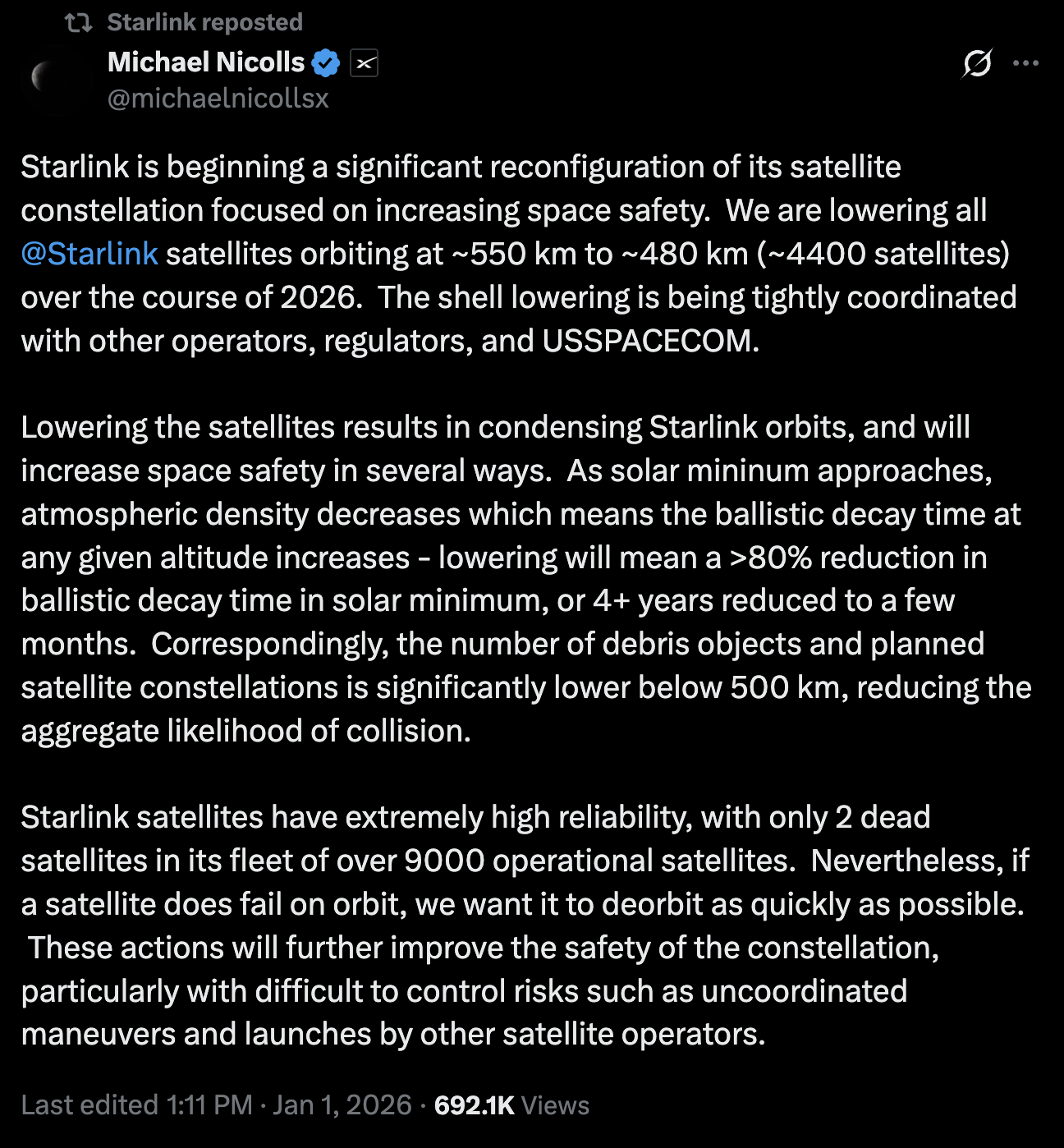
Starlink will lower the orbits of roughly 4,400 satellites this year as a safety measure, according to engineering VP, Michael Nicolls. In a post on X, Nicolls wrote that the company is “beginning a significant reconfiguration of its satellite constellation,” in which all satellites orbiting at around 550 kilometers (342 miles) will be lowered to around 480 km (298 miles). The move is intended to reduce the risk of collisions, putting the satellites in a region that’s less cluttered and will allow them to deorbit more quickly should an incident occur.
“Lowering the satellites results in condensing Starlink orbits, and will increase space safety in several ways,” Nicolls wrote, also pointing to the coming solar minimum — a period in the sun’s 11ish-year cycle when activity is lower — as one of the reasons for the move. The next solar minimum is expected to occur in the early 2030s. “As solar minimum approaches, atmospheric density decreases which means the ballistic decay time at any given altitude increases – lowering will mean a >80% reduction in ballistic decay time in solar minimum, or 4+ years reduced to a few months,” Nicolls wrote.
A screenshot of an X post by Starlink VP of engineering Michael Nicolls announcing that satellites orbiting at around 500 kilometers will be lowered to 480km
The announcement comes a few weeks after Starlink said one of its satellites had experienced an anomaly that created some debris and sent it tumbling. Just a few days earlier, Nicolls posted about a close call with a batch of satellites he said were launched from China seemingly without any attempt to coordinate with operators of existing satellites in the space. With his latest announcement, Nicolls added that lowering Starlink’s satellites “will further improve the safety of the constellation, particularly with difficult to control risks such as uncoordinated maneuvers and launches by other satellite operators.”
This article originally appeared on Engadget at https://www.engadget.com/science/space/starlink-is-lowering-thousands-of-satellites-orbits-to-reduce-risk-of-collisions-030509067.html?src=rss
MacRumors: Apple is not expected to release a standard iPhone 18 model this year, according to a growing number of reports that suggest the company is planning a significant change to its long-standing annual iPhone launch cycle.
Despite the immense success of the iPhone 17 in 2025, the iPhone 18 is not expected to arrive until the spring of 2027, leaving the iPhone 17 in the lineup as the latest standard model for over 18 months. This would mark the first time Apple skips an entire calendar year without releasing a new generation of its flagship non-Pro iPhone.
Samsung has upgraded its Freestyle portable projector for 2026. The company announced a new model, the Freestyle+, ahead of CES, touting twice the brightness of its predecessor at 430 ISO lumens, and AI-powered screen optimization features. As with Freestyles past, the Freestyle+ offers 180-degree rotation and 360-degree audio. This one also supports Q-Symphony so it’ll work with some Samsung soundbars. Samsung hasn’t revealed much else in the way of specs or pricing, but it’ll be showing off the Freestyle+ at CES 2026, so we’re likely to learn more details soon.
While previous iterations of Samsung’s compact projector offered automatic screen adjustment features, like auto focus and auto leveling, the Freestyle+ uses AI to take optimization a step further. With AI OptiScreen, as the company is calling it, the projector offers 3D auto keystone to fix distortion on uneven or non-flat surfaces, real-time focus when the projector is moved, automatic screen fit for compatible accessories and wall calibration to reduce visual distractions from the projection surface. It’ll also support Samsung’s Vision AI Companion.
The company hasn’t announced a specific release date yet for the new projector, but says it’s targeting the first half of the year. It’ll be released in phases globally.
This article originally appeared on Engadget at https://www.engadget.com/home/home-theater/samsungs-latest-freestyle-portable-projector-is-brighter-and-smarter-014026804.html?src=rss
Apple’s Chinese manufacturing partner Luxshare halted production of the Vision Pro headset at the start of 2025, according to market research firm IDC, after the device shipped 390,000 units during its 2024 launch year. The $3,499 headset has also seen its digital advertising budget cut by more than 95% year to date in the US and UK, according to market intelligence group Sensor Tower.
IDC expects Apple to ship just 45,000 new units in the fourth quarter of 2025. Apple launched an upgraded M5 version in October featuring a more powerful chip, extended battery life, and a redesigned headband. The company sells the device directly in 13 countries and did not expand availability in 2025.
Every human body contains a small population of cells that are not genetically its own — cells that crossed the placenta during pregnancy and that persist for decades after birth. These “microchimeric” cells, named after the lion-goat-serpent hybrid of Greek mythology, have been found in every organ studied so far, though they are exceedingly rare: one such cell exists for every 10,000 to 1 million of a person’s own cells.
The cells were first noticed in the late 1800s when pathologist Georg Schmorl described placenta-like “giant cells” in the lungs of people who had died from eclampsia. In 1969, researchers detected Y-chromosome-containing white blood cells in people who would later give birth to boys. For more than two decades, scientists presumed these cells were temporary. That changed in 1993 when geneticist Diana Bianchi found Y-chromosome cells in women who had given birth to sons up to 27 years earlier.
The cells appear to have regenerative properties, transforming into blood vessels or skin cells to promote wound healing. They also challenge a central assumption of immunology — that the immune system classifies cells as either “self” or “non-self” and rejects foreign material. Microchimeric cells should trigger rejection but do not. Higher-than-typical concentrations have been found in people with autoimmune conditions including diabetes, lupus, and scleroderma.
Costco’s consistency — from its $1.50 hot dog and drink combo to its functional shopping carts and satisfied employees — has produced what The Atlantic calls a “cultlike loyalty” among members at more than 600 locations across the U.S.
Its annual membership costs $65. The model traces back to Fedco, a nonprofit wholesale collective for federal employees founded in Los Angeles in the 1940s. Costco’s private label Kirkland Signature has become one of the world’s largest consumer packaged goods brands while maintaining deliberately understated branding. The company relies on word-of-mouth marketing from satisfied members rather than traditional advertising.
Atlantic staff writer Jake Lundberg, who shops at the Granger, Indiana location, describes the stores as spaces of “cooperation, courtesy, and grown-ups mostly acting like grown-ups.” Shoppers follow unwritten rules: move along, don’t block the way, step aside to check your phone. Checkout lines form orderly queues. The exceptions come near sample stations and before major holidays, when spatial awareness and common courtesy break down.
Marvel Studios decided to ring in the new year with a fresh trailer for Wonder Man, its eight-episode miniseries premiering later this month on Disney+. Part of the MCU’s Phase Six, the miniseries was created by Destin Daniel Cretton (Shang-Chi and the Legend of Five Rings) and Andrew Guest (Hawkeye), with Guest serving as showrunner.
As previously reported, Yahya Abdul-Mateen II stars as Simon Williams, aka Wonder Man, an actor and stunt person with actual superpowers who decides to audition for the lead role in a superhero TV series—a reboot of an earlier Wonder Man incarnation. Demetrius Grosse plays Simon’s brother, Eric, aka Grim Reaper; Ed Harris plays Simon’s agent, Neal Saroyan; and Arian Moayed plays P. Clearly, an agent with the Department of Damage Control. Lauren Glazier, Josh Gad, Byron Bowers, Bechir Sylvain, and Manny McCord will also appear in as-yet-undisclosed roles
Rounding out the cast is Ben Kingsley, reprising his MCU role as failed actor Trevor Slattery. You may recall Slattery from 2013’s Iron Man 3, hired by the villain of that film to pretend to be the leader of an international terrorist organization called the Ten Rings.Slattery showed up again in 2021’s Shang-Chi and the Legend of the Ten Rings,rehabilitated after a stint in prison; he helped the titular Shang-Chi (Simu Liu) on his journey to the mythical village of Ta Lo.
Iran is offering to sell advanced weapons systems including ballistic missiles, drones and warships to foreign governments for cryptocurrency, in a bid to use digital assets to bypass western financial controls. From a report: Iran’s Ministry of Defence Export Center, known as Mindex, says it is prepared to negotiate military contracts that allow payment in digital currencies, as well as through barter arrangements and Iranian rials, according to promotional documents and payment terms analysed by the Financial Times.
The offer, introduced during the past year, appears to mark one of the first known instances in which a nation state has publicly indicated its willingness to accept cryptocurrency as payment for the export of strategic military hardware. Mindex, a state-run body responsible for Iran’s overseas defence sales, says it has client relationships with 35 countries and advertises a catalogue of weapons that includes Emad ballistic missiles, Shahed drones, Shahid Soleimani-class warships and short-range air defence systems.
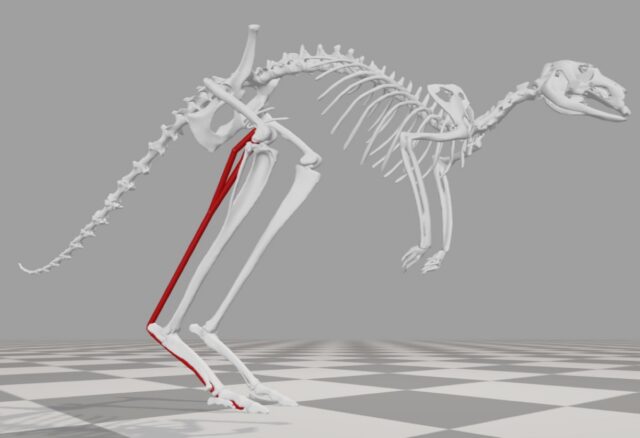
It’s a regrettable reality that there is never enough time to cover all the interesting scientific stories we come across each month. In the past, we’ve featured year-end roundups of cool science stories we (almost) missed. This year, we’ve experimented with a monthly collection. December’s list includes a fossilized bird that choked to death on rocks; a double-detonating “superkilonova”; recovering an ancient seafarer’s fingerprint; the biomechanics of kangaroo movement; and cracking a dark matter puzzle that stumped fictional physicists on The Big Bang Theory, among other tantalizing tidbits
Kangaroos and wallabies belong to a class of animals called macropods, with unique form and style of movement. Their four limbs and tail all contact the ground at slow speeds, while they use a hopping gait at higher speeds. Typically, high-speed movements are more energy-intensive than slow-speed motion, but the opposite is true for macropods like kangaroos; somehow the hopping speed and energy cost become uncoupled. According to a paper published in the journal eLife, this may be due to changes in a kangaroo’s posture at higher hopping speeds.
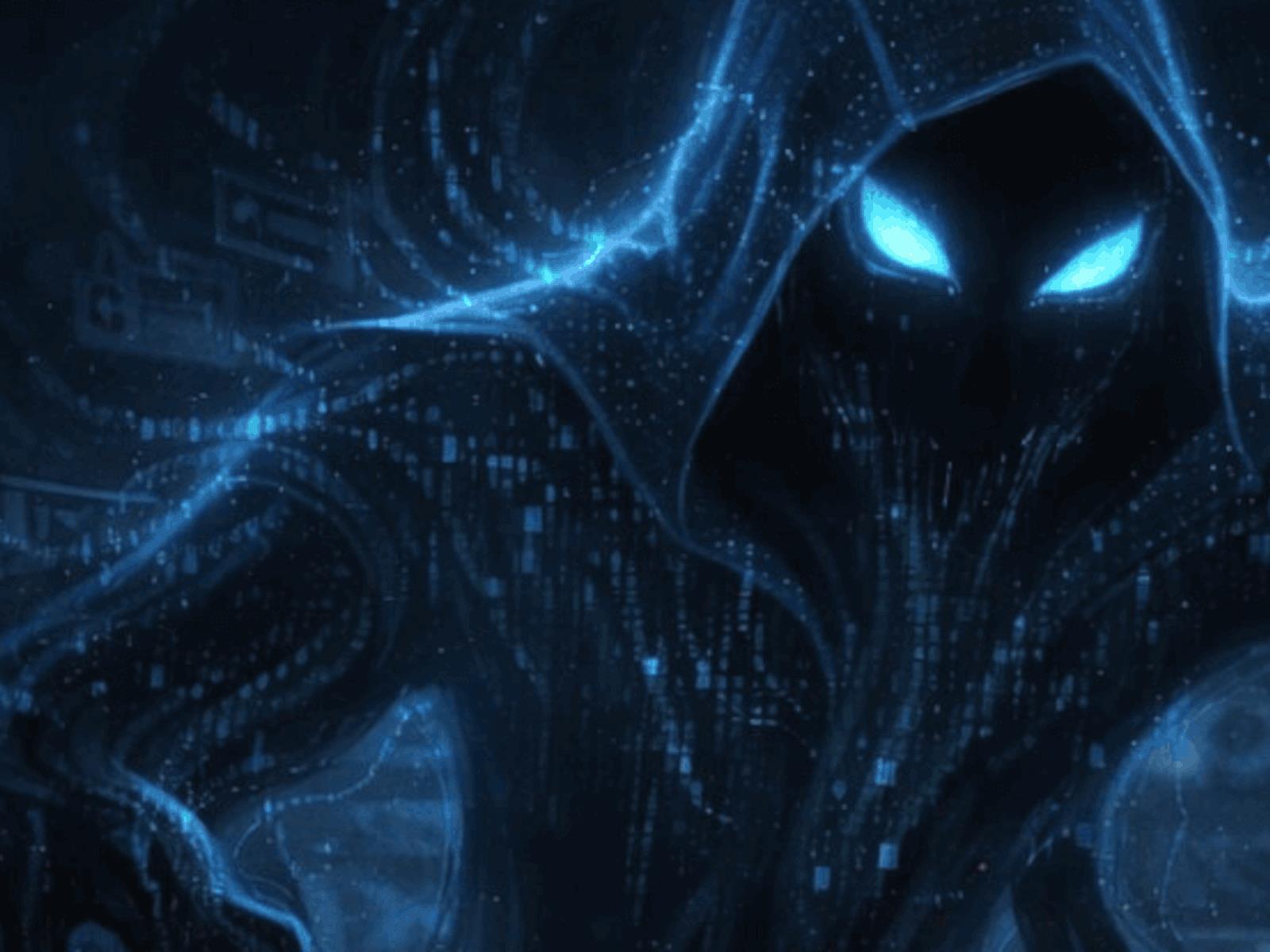
The security researchers at Koi have uncovered a bombshell—a coordinated spyware campaign across 100+ Google Chrome, Microsoft Edge, and Mozilla FireFox extensions, which function legitimately but (eventually) exhibit malicious behavior tied to a threat actor called DarkSpectre. This behavior includes stripping security protections, installing
A look at Hyundai’s Holographic Windshield Display. (Hyundai)
While it often feels like a full-on auto show, the car vibes feel somewhat lessened at CES 2026. Yes, the Afeela electric vehicle from the Sony-Honda joint venture will be back on the floor, but with the Trump administration yanking most EV incentives from the market, the industry isn’t offering a full-court press of new vehicles in Las Vegas this year. That said, there’s still plenty of in-cabin car tech on display, including Hyundai’s Holographic Windshield Display.
Indeed, the company’s Mobis subsidiary will present “more than 30 mobility convergence technologies” during CES. And we’ll also get to see Hyundai’s AI Robotics Strategy, which will showcase its new Atlas robot fresh out of the lab.
How to watch Hyundai’s presentation at CES 2026
Hyundai’s presentation takes place on January 5 at 4PM ET, and you can livestream it on either its HyundaiUSA YouTube channel or its global YouTube channel. We’ll embed the stream here once it’s available.
What to expect
As mentioned above, Hyundai will have its Holographic Windshield Display for viewing. It’s essentially a next-gen heads-up display that projects key data from the vehicle’s dash on the windshield for less distraction, and without obstructing the driver’s view. It’s a vertically expandable 18.1-inch large display, and passengers can even watch videos without being visible to the driver.
Hyundai Mobis collaborated with German optics specialist Zeiss to develop the “world’s first system to utilize holographic film to transform the entire front windshield into an ultra-large display surface.” It says it will begin mass production in 2029, so don’t expect to see this on the market anytime soon.
Beyond automotive, though, we’ll also get a first-ever look at the company’s new Atlas robot. In the teaser image shown in the press release, Atlas looks rather dog-like, which makes sense when you remember that Boston Dynamics was purchased by the Korean multinational back in 2020.
“This next-generation Atlas represents a tangible step toward the commercialization of AI Robotics, highlighting the Group’s commitment to building safe and adaptable robotic co-workers,” the company said in the same press release.
Hyundai said it will also discuss its other tech areas, including electronics and chassis system safety, as well as an AR head-up display, low-power display solutions and EV drive systems.
This article originally appeared on Engadget at https://www.engadget.com/transportation/how-to-watch-hyundais-ces-2026-presentation-live-190051181.html?src=rss
Three decades after RFC 1883 promised to future-proof the internet by expanding the available pool of IP addresses from around 4.3 billion to over 340 undecillion, IPv6 has yet to achieve the dominance its creators envisioned. Data from Google, APNIC and Cloudflare analyzed by The Register shows less than half of all internet users rely on IPv6 today.
“IPv6 was an extremely conservative protocol that changed as little as possible,” APNIC chief scientist Geoff Huston told The Register. “It was a classic case of mis-design by committee.” The protocol’s lack of backward compatibility with IPv4 meant users had to choose one or run both in parallel. Network address translation, which allows thousands of devices to share a single public IPv4 address, gave operators an easier path forward. Huston adds: “These days the Domain Name Service (DNS) is the service selector, not the IP address,” Huston told The Register. “The entire security framework of today’s Internet is name based and the world of authentication and channel encryption is based on service names, not IP addresses.”
“So folk use IPv6 these days based on cost: If the cost of obtaining more IPv4 addresses to fuel bigger NATs is too high, then they deploy IPv6. Not because it’s better, but if they are confident that they can work around IPv6’s weaknesses then in a largely name based world there is no real issue in using one addressing protocol or another as the transport underlay.” But calling IPv6 a failure misses the point. “IPv4’s continued viability is largely because IPv6 absorbed that growth pressure elsewhere — particularly in mobile, broadband, and cloud environments,” said John Curran, president and CEO of the American Registry for Internet Numbers. “In that sense, IPv6 succeeded where it was needed most.” Huawei has sought 2.56 decillion IPv6 addresses and Starlink appears to have acquired 150 sextillion.
An anonymous reader shares a report: Only the government could spend 20 years creating a national ID that no one wanted and that apparently doesn’t even work as a national ID. But that’s what the federal government has accomplished with the REAL ID, which the Department of Homeland Security (DHS) now considers unreliable, even though getting one requires providing proof of citizenship or lawful status in the country.
In a December 11 court filing [PDF], Philip Lavoie, the acting assistant special agent in charge of DHS’ Mobile, Alabama, office, stated that, “REAL ID can be unreliable to confirm U.S. citizenship.” Lavoie’s declaration was in response to a federal civil rights lawsuit filed in October by the Institute for Justice, a public-interest law firm, on behalf of Leo Garcia Venegas, an Alabama construction worker. Venegas was detained twice in May and June during immigration raids on private construction sites, despite being a U.S. citizen. In both instances, Venegas’ lawsuit says, masked federal immigration officers entered the private sites without a warrant and began detaining workers based solely on their apparent ethnicity.
And in both instances officers allegedly retrieved Venegas’ Alabama-issued REAL ID from his pocket but claimed it could be fake. Venegas was kept handcuffed and detained for an hour the first time and “between 20 and 30 minutes” the second time before officers ran his information and released him.
The PlayStation 5 has essentially been cracked, just in time for 2026, and it would appear that short of releasing a new hardware revision, there’s not much Sony can do about it. This is because PlayStation 5 hackers have found the BootROM (Level 0) keys for the PlayStation 5, which enables decryption of the bootloader and, from there, allows
As the calendar flips to January 1, 2026, thousands of copyrighted works from 1930 are entering the US public domain alongside sound recordings from 1925, making them free to copy, share, remix and build upon without permission or licensing fees. The literary haul includes William Faulkner’s As I Lay Dying, Dashiell Hammett’s full novel The Maltese Falcon, Agatha Christie’s first Miss Marple mystery The Murder at the Vicarage, and the first four Nancy Drew books. The popular illustrated version of The Little Engine That Could also joins the commons. Betty Boop makes her public domain debut through her first appearance in the Fleischer Studios cartoon Dizzy Dishes.
The original iteration of Disney’s Pluto — then named Rover — enters as well. Nine additional Mickey Mouse cartoons and ten Silly Symphonies from 1930 are now available for reuse. Films entering the public domain include the Academy Award-winning All Quiet on the Western Front, the Marx Brothers’ Animal Crackers, and John Wayne’s first leading role in The Big Trail. Musical compositions going public include George and Ira Gershwin’s “I Got Rhythm,” Hoagy Carmichael’s “Georgia on My Mind,” and “Dream a Little Dream of Me.”
Sound recordings from 1925 now available include Bessie Smith and Louis Armstrong’s “The St. Louis Blues” and Marian Anderson’s “Nobody Knows the Trouble I’ve Seen.” Piet Mondrian’s Composition with Red, Blue, and Yellow rounds out the artistic entries.
Instagram head Adam Mosseri dropped a telling Threads post suggesting that we’re approaching a tipping point where AI will be so deeply integrated into media creation that distinguishing fake content from the real thing will be impossibly difficult. Instead of chasing the infinite tide of AI-generated pixels, the future of digital trust may
The European Space Agency has acknowledged yet another security incident after a cybercriminal posted an offer on BreachForums the day after Christmas claiming to have stolen over 20GB of data including source code, confidential documents, API tokens and credentials.
The attacker claims they gained access to ESA-linked external servers on December 18 and remained connected for about a week, during which they allegedly exfiltrated private Bitbucket repositories, CI/CD pipelines, Terraform files and hardcoded credentials. ESA said that the breach may have affected only “a very small number of external servers” used for unclassified engineering and scientific collaboration, and that it has initiated a forensic security analysis.
One of the many concerns about artificial intelligence these days is how the rush to build data centers is impacting local communities. Data centers can create a drain on resources, and some utility companies have already said customers can expect to see their electricity bills growing as these facilities increase demand. There have been some discussions of what other power sources could support the AI engine, and wind power specialist Airloom is one company that’s looking to address the problem. Ahead of the business’ upcoming appearance at CES, we’ve learned a bit about what Airloom has accomplished this year and what it is aiming for next.
Rather than the very tall towers typically used for this approach, Airloom’s structures are 20 to 30 meters high. They are comprised of a loop of adjustable wings that move along a track, a design that’s akin to a roller coaster. As the wings move, they generate power just like the blades on a regular wind turbine do. Airloom claims that its structures require 40 percent less mass than a traditional one while delivering the same output. It also says the Airloom’s towers require 42 percent fewer parts and 96 percent fewer unique parts. In combination, the company says its approach is 85 percent faster to deploy and 47 percent less expensive than horizontal axis wind turbines. Airloom broke ground on a pilot site in June for testing out its approach and confirming how those figures work in practice.
It’s not feasible to bring a wind farm, even a small one, into CES, but Airloom will have a booth at the event with materials about its technology and engineering. While the business isn’t in a consumer-facing field, the impact of Airloom’s work could have a future positive impact on people if the data center boom continues.
This article originally appeared on Engadget at https://www.engadget.com/science/airloom-will-showcase-its-new-approach-to-wind-power-at-ces-160000063.html?src=rss
If you’re not feeling the whole ‘New year, new me’ thing, then how about, ‘New year, new laptop’ instead? It’s an opportune time to buy a new gaming laptop because (A) the future is murky with RAM and storage prices trending in the wrong direction, and (B) there are a bunch of models with GeForce RTX 50 series firepower that are on sale right