These Popular Chrome Extensions Are Stealing Your AI Chats

Hackers continue to find ways to sneak malicious extensions into the Chrome web store—this time, the two offenders are impersonating an add-on that allows users to have conversations with ChatGPT and DeepSeek while on other websites and exfiltrating the data to threat actors’ servers.

Beware these Chrome extensions

On the surface, the two extensions identified by Ox Security researchers look pretty benign. The first, named “Chat GPT for Chrome with GPT-5, Claude Sonnet & DeepSeek AI,” has a Featured badge and 2.7K ratings with over 600,000 users. “AI Sidebar with Deepseek, ChatGPT, Claude and more” appears verified and has 2.2K ratings with 300,000 users.

However, these add-ons are actually sending AI chatbot conversations and browsing data directly to threat actors’ servers. This means that hackers have access to plenty of sensitive information that users share with ChatGPT and DeepSeek as well as URLs from Chrome tabs, search queries, session tokens, user IDs, and authentication data. Any of this can be used to conduct identity theft, phishing campaigns, and even corporate espionage.

Researchers found that the extensions impersonate legitimate Chrome add-ons developed by AITOPIA that add a sidebar to any website with the ability to chat with popular LLMs. The malicious capabilities stem from a request for consent for “anonymous, non-identifiable analytics data.” Threat actors are using Lovable, a web development platform, to host privacy policies and infrastructure, obscuring their processes.

Researchers also found that if you uninstalled one of the extensions, the other would open in a new tab in an attempt to trick users into installing that one instead.

How to avoid malicious browser add-ons

If you’ve added AI-related extensions to Chrome, go to chrome://extensions/ and look for the malicious impersonators. Hit Remove if you find them. As of this writing, the extensions identified by Ox no longer appear in the Chrome Web Store.

As I’ve written about before, malicious extensions occasionally evade detection and gain approval from browser libraries by posing as legitimate add-ons, even earning “Featured” and “Verified” tags. Some threat actors playing the long game will convert extensions to malware several years after launch. This means you can’t blindly trust ratings and reviews, even if they’ve been accrued over time.

To minimize risk, you should always vet browser extensions carefully (even those that appear legit) for obvious red flags, like misspellings in the description and a large number of positive reviews accumulated in a short time. Head to Google or Reddit to see if anyone has identified the add-on as malicious or found any issues with the developer or source. Make sure you’re downloading the right extension—threat actors often try to confuse users with names that appear similar to popular add-ons.

Finally, you should regularly audit your extensions and remove those that aren’t essential. Go to chrome://extensions/ to see everything you have installed.

CES 2026 Day 3: The most interesting tech that’s still on the show floor

Even as CES 2026 wraps up soon, there’s no shortage of standout hardware hiding in plain sight. From genuinely quieter yard tools to ultra-light EVs and companion robots that want to remember your family, Day 3 was all about tech that felt a little more considered — and in some cases, refreshingly practical.

If you can’t get enough of CES, be sure to check out our picks for best of CES 2026, which highlights the most impressive new tech we’ve seen in Las Vegas. We’ve also rounded up the CES gadgets you can buy right now if you’re itching to place an order, along with a look at the weirdest tech at CES 2026, because it wouldn’t be CES without a few delightfully unhinged ideas.

Tone Outdoors T1 leaf blower

Tone Outdoors T1
Tone Outdoors T1
Billy Steele for Engadget

The Tone Outdoors T1 leaf blower is one of the rare CES gadgets that makes an immediate, obvious impression — mostly because it’s shockingly quiet. Whisper Aero’s aerospace-derived motor redesign delivers 880 CFM of airflow at around 52 decibels, which we could confirm even amid the noise of the show floor. It also runs up to 50 minutes in Eco mode, supports a forthcoming battery backpack and even includes an LED for nighttime cleanup. Pre-orders are open now for $599, with shipping expected in September.

GE Profile Smart Fridge

Finally! A reasonably sized fridge screen.
Sam Rutherford for Engadget

The GE Profile Smart Fridge is the first smart fridge we’ve seen that feels like it was designed around real problems instead of just slapping a massive screen on the door. GE’s AI assistant can answer practical questions like where your water filter is, scan groceries via a built-in barcode reader and keep tabs on produce with a crisper drawer camera. The eight-inch display feels refreshingly restrained, while integrations with Instacart and recipe suggestions add utility. It launches in March for $4,899, and for once, we’re genuinely curious what it would be like to live with it.

Longbow Motors Speedster EV

Longbow Motors Speedster
Billy Steele for Engadget

Longbow Motors brought one of the most emotionally compelling EVs we’ve seen to CES, and it’s unapologetically minimalist. The Speedster uses in-wheel motors from Donut Labs to hit a jaw-dropping curb weight of just 2,200 pounds, lighter than a Miata. Its stripped-back interior, mystery shift lever and exposed motors feel like a direct rejection of touchscreen-heavy modern cars. It’s wildly expensive at just under $100,000, but also one of the few EVs here that got us excited to drive.

OlloBot companion robot

A robot with eyes on top of a screen showing a smile.
Cheyenne MacDonald for Engadget

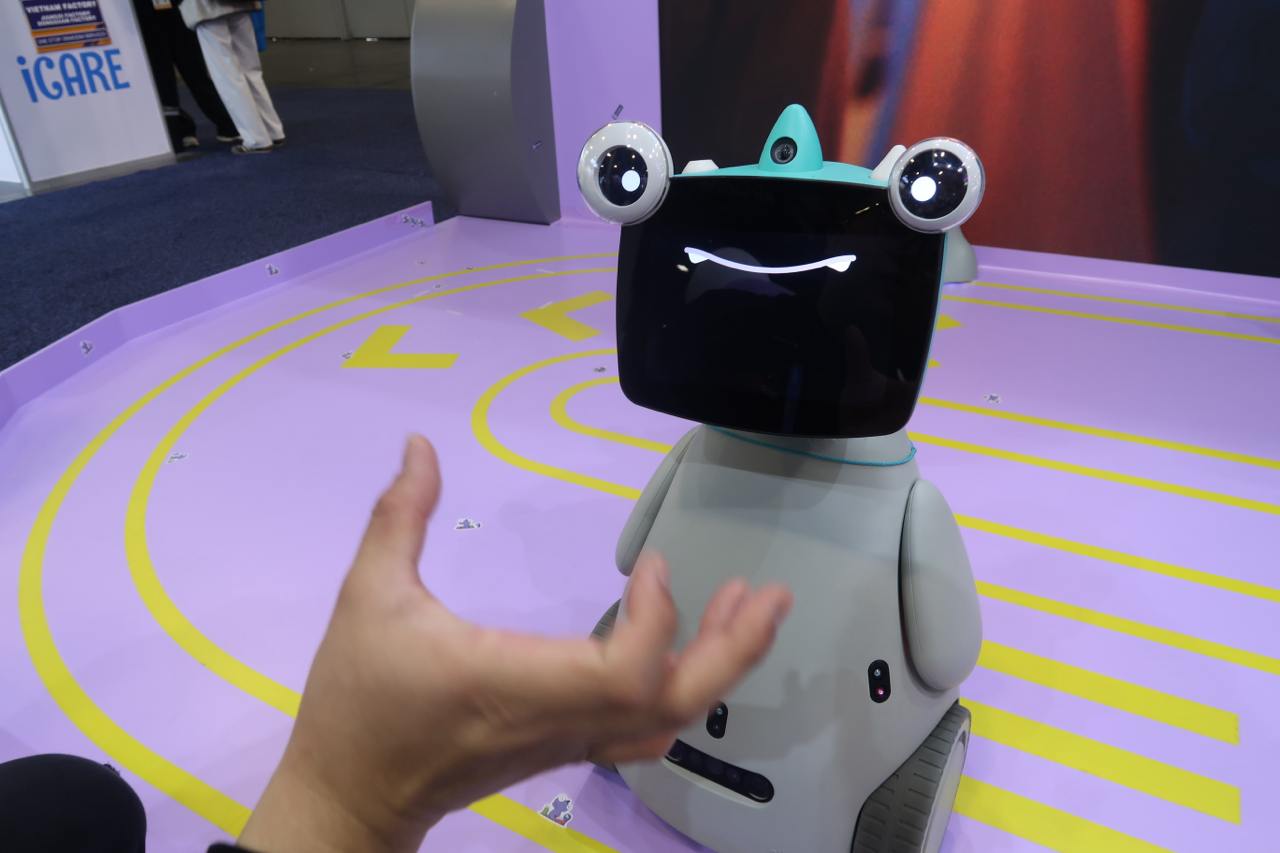
OlloBot might win the award for most charmingly strange robot on the show floor. Designed as a family “cyber pet,” it responds to voice and touch, develops a personality over time and stores all its memories locally in a removable heart-shaped module. The robot can help find lost items, make calls and eventually control Matter smart home devices. A Kickstarter is planned for summer, with pricing starting around $1,000.

Bluetti Charger 2

Image demonstrating the setup for Bluetti's Charger 2
Here’s how the Bluetti Charger 2 would work with dual charging sources.
Bluetti

Bluetti’s Charger 2 fixes a very specific but real problem for off-grid users: charging from your engine and solar panels at the same time. The dual-input system supports up to 600W from solar and 800W from an alternator, dramatically speeding up battery top-ups. It also works with multiple Bluetti power stations and can even jump-start your vehicle in a pinch. Early pricing is $349 through February 7, after which it jumps to $499.

CES is ending, but we’ve got more stories to tell

The CES show floor will soon be closing down, but Engadget still has a lot of stories in our pipeline. As the crowds thin out, we’re continuing to surface the tech that actually stands out — whether it’s solving everyday annoyances or simply doing something bold and different. Stay tuned to our CES 2026 hub for more hands-ons, deep dives and final takeaways even after CES 2026 comes to a close at the end of this week.

This article originally appeared on Engadget at https://www.engadget.com/big-tech/ces-2026-day-3-the-most-interesting-tech-thats-still-on-the-show-floor-134724231.html?src=rss

This Samsung 65-Inch QLED TV Is $400 Off Right Now

We may earn a commission from links on this page. Deal pricing and availability subject to change after time of publication.

The 65-inch Samsung QN90F Neo QLED TV is currently $1,199.99 on Woot in “factory-reconditioned” condition. That undercuts a new unit, which sits around $1,600 on Amazon, and even slips below what some retailers ask for “like-new” stock. This deal runs for seven days or until it sells out. Shipping is free for Prime members, while everyone else pays a flat $6 fee. One thing to note before checkout: This item doesn’t ship to Alaska, Hawaii, or PO boxes, and you’ll need to provide a valid phone number and physical shipping address.

The QN90F isn’t a midrange panel dressed up with buzzwords. It’s Samsung’s current flagship mini-LED 4K TV, built to get extremely bright (over 2,500 nits) while still holding deep blacks and tight contrast. The screen uses Samsung’s glare-reducing coating, which won’t defeat direct sunlight but does take the edge off harsh overhead lighting. In daily use, the QN90F feels more polished than most LED TVs. The bezel-free design keeps attention on the screen, and the compact metal stand doesn’t dominate your media console. Around back, you get four HDMI ports, two USB ports, Ethernet, optical audio, and an antenna input, all tucked into a side-facing recess that keeps cables tidy. The included SolarCell Remote is refreshingly practical. It charges via USB-C or ambient light, so you’re not cycling through disposable batteries. Picture quality is where this TV earns its flagship status. Mini-LED backlighting delivers OLED-like blacks with minimal bloom, and colors stay balanced rather than oversaturated. That said, there’s no Dolby Vision support, which is still a sticking point for some buyers, but HDR10 and HDR10+ performance here is strong enough that many viewers won’t miss it.

This TV also leans hard into gaming and smart features. The panel runs at 120Hz natively and supports VRR up to 165Hz, along with AMD FreeSync Premium Pro. Input lag stays under 10ms, which is well within “good for gaming” territory, according to PCMag’s “excellent” review of this smart TV. PC gamers can even use ultrawide 21:9 or 32:9 modes. Sound is better than average, too, thanks to a 60W 4.2.2-channel system with Dolby Atmos and support for Samsung’s Q-Symphony if you add a compatible soundbar. Tizen OS covers every major streaming service and supports Alexa, Apple AirPlay, and Matter smart-home control, though the interface still feels busy and occasionally buried under layers of menus. At this price, the reconditioned QN90F makes sense for buyers who want top-tier brightness and gaming performance without paying the full flagship price.


Deals are selected by our commerce team

The ‘Now You See Me’ Franchise Explained in 10 Infographics

What if a team of super magicians used their talent and training to stage elaborate heists? That’s the high concept that drives the Now You See Me franchise. Critics were lukewarm when Now You See Me was released in 2013, categorizing the film as a heist flick with thin characters and a plot that fell apart as often as it twisted, but Now You See Me pulled off its own escape act—audiences loved the movie’s flashy style, whipsaw pace, and all-star cast featuring names like Jesse Eisenberg, Mark Ruffalo, Woody Harrelson, and Morgan Freeman. The result was box office magic: a movie with a $75M budget that returned over $300M worldwide. Now You See Me has since grown into an internationally successful, long-term franchise for distributor Lionsgate: The third installment was released on Nov. 14, and a fourth Now You See Me film is already in development.

Like any long-running franchises, the Now You See Me-verse can be confusing, so we put together 10 infographics to pull back the curtain on Now You See Me’s magic. First, a quick recap of each movie:

  • Now You See Me (2013): The initial entry in the series introduces us to the thieves/illusionists known as the “Four Horsemen.” These best-in-the-business magicians are recruited by a mysterious secret society called The Eye to pull off large-scale heists in front of live audiences, then distribute the money to the needy.

  • Now You See Me 2 (2016): The sequel expands the world of the first film, with bigger heists, deeper secrets, and funnier jokes. Having gone into hiding at the end of Now You See Me, The Horsemen resurface a year later and are coerced into a global heist by a tech mogul trying to steal all the privacy in the world. 

  • Now You See Me: Now You Don’t (2025): Set a decade after the last film, Now You See Me: Now You Don’t features all five Horsemen teaming up with three cocky young criminals/illusionists to pull off their most audacious caper yet: the theft of the world’s most valuable diamond.

The real-life magicians behind The Horsemen

The Now You See Me movies present stage magic in a semi-realistic (though highly stylized) way. To nail the realism, the films draw inspiration from some of the greatest magicians in history, including:

  • David Copperfield: The Horsemen’s larger-than-life illusions/heists like stealing the contents of a bank vault while performing a Vegas show seem inspired by the feats of magician David Copperfield, whose magical feats include flying over the Grand Canyon and vanishing the Statue of Liberty. 

  • David Blaine: Street magician David Blaine’s shadow is all over the Now You See Me Movies. Without the popularity of Blaine’s modern, gritty take on magic, the Now You See Me movies would likely not exist.

  • Harry Houdini: Anything about stage magic is ultimately inspired by Houdini, the greatest magician of all time. Houdini’s daring escape tricks inspired the series’ inciting incident, the death of magician Lionel Shrike, as well as the opening set piece where Henley Reeves escapes a water tank. 

  • Andrei Jikh: Jikh’s cardistry skills are evident in all the Horsemen, particularly in Jack Wilder. Jikh served as a consultant on Now You See Me.

  • Keith Barry: Another Now You See Me magic consultant, Irish mentalist Keith Barry pioneered and popularized many of the hypnosis and mentalism feats used by character Merritt McKinney.

The Horsemen’s greatest heists

The Horsemen are known as much for their larceny as their skills at illusion. Below are their most memorable heists, hold-ups, schemes, and burglaries.

The Paris-to-Vegas bank robbery

In the caper that introduces us to the Horsemen, the magicians rob a bank in Paris while performing before a crowd in Vegas. They choose a seemingly random person from the crowd and tell him he’s going to rob his own bank, the Crédit Républicain de Paris. Then they appear to teleport him to France, where he breaks into a bank vault, hits a button on a vacuum machine, and the money is seemingly sucked from Paris to Vegas where it rains down on the audience. 

The Tressler Insurance heist

At a show in New Orleans, the Horsemen introduce their benefactor, insurance magnate Arthur Tressler, then proceed to drain his personal bank account while they’re onstage, depositing the money in the accounts of audience members, who all turn out to be victims of Hurricane Katrina that Tressler’s insurance company stiffed on repayments. 

The Macau data chip theft

In Now You See Me 2, The Horsemen are coerced by evil tech magnate Walter Mabry to steal a cutting-edge computer chip that can decrypt and expose every system in the world. Housed in a highly secure research facility in Macau, China, the chip is conveniently the size of a playing card, allowing the Horsemen to use cardistry and sleight-of-hand skills to remove it from the building while being searched by guards. 

The Magic Castle: the real-life Château de Roussillon

In Now You See Me Now You Don’t, the Château de Roussillon is an ultimate magician’s playground. The Eye’s headquarters in a mansion in the French countryside is decked out with mind-bending large-scale illusions like rotating rooms and halls of mirrors. The Château de Roussillon is a real castle, but the filmmakers used Nádasdy Castle for the exterior shots in the movie. A main inspiration for the building is a real place: Los Angeles’ Magic Castle.

Opened in 1963, the Magic Castle is a restaurant/club/clubhouse for magicians housed in a stately Victorian mansion overlooking Hollywood. Not only is The Magic Castle credited as magic consultants on Now You See Me: Now You Don’t, much of the cast trained at the Castle to prepare for their roles.

If you’d like to visit, it won’t be easy: The Magic Castle is an invitation-only private club, so you have to be a member of the Academy of Magical Arts or be invited by a member. But if you aren’t friends with a magician, you can book a night at the nearby Magic Castle Hotel, where a stay comes with an invitation to the Castle.

“How do they do that?”

I analyzed the tricks in the movies with professional magician Dave Cox, and as over the top as the Horsemen’s heists are, all but two of the many magic tricks presented in the Now You See Me movies could technically be done in real life—but the word “technically” is doing a lot of work here. The tricks are possible within the context of a stylized blockbuster, but would be extremely unlikely to work as well in real life: an extended, impromptu cardistry routine involving four magicians passing a playing card between themselves while security guards thoroughly search them makes for exciting cinema, but almost definitely wouldn’t go that smoothly in reality. 

But, here is how three of the most iconic tricks from the franchise could be done in real life.

How to do Atlas’s “riffle force” card trick

Now You See Me opens with a unique piece of cinematic trickery. Street magician J. Daniel Atlas is performing for a crowd on a city street. He riffles quickly through a deck of cards and asks a spectator to “see one card.” When his subject has a card in mind, a nearby building is lit up revealing a giant seven of diamonds, the card the subject was thinking of.  

It’s amazing if you’re “playing along at home,” because the chances are very good that you chose the seven of diamonds too. The trick is done in real life the same way it’s done in the movies: The magician uses sleight of hand or a gimmicked deck to pause on the desired card imperceptibly longer than the other cards. The director of Now You See Me added a frame or two to “pause” on the seven of diamonds, making it more likely that you think of that card.

How Jack Wilder throws cards as weapons

While it’s probably not possible to throw a card as accurately or forcefully as the characters in Now You See Me, you can throw playing cards really fast with the right technique and a lot of practice. 

How Henley Reeves escaped the water tank

Henley Reeves’ introduction is a trick where she escapes from a water tank filled with piranhas, a variation of the kind of classic escape artist illusions popularized by Houdini. Water escapes are dangerous, but not as dangerous as they might seem because they’re rigged—no sane person is really going to try to escape from handcuffs and chains while underwater.

Real-life heists that seem right out of the Now You See Me movies

A group of thieves publicly “performing” large-scale robberies is strictly Hollywood, but the three real-life crimes below share some of the showmanship and audacity of the Horsemen’s heists:

  • Louvre heist (2025): A recent jewelry-jacking at the Louvre involved a highly professional and brazen plan executed in broad daylight. The thieves used a truck-mounted mechanical lift to break into a second-floor balcony window and were in and out in less than eight minutes. The robbers have all been caught, but won’t say where the jewels are.

  • Stockholm helicopter robbery (2009): This thrilling heist involved a gang using a stolen police helicopter to land on the roof of a G4S cash management service building in the Stockholm suburb of Västberga. The brazen thieves smashed through a skylight, lowered themselves into the building, and stole millions while police were stymied by fake bombs placed near the police helicopter. Seven men were sentenced to prison, but authorities suspect as many as ten more people may have gotten away with the crime, and the 39 million Swedish krona loot was never recovered.

  • Isabella Stewart Gardner Museum heist (1990): This heist involved two men who disguised themselves as Boston police officers to gain entry into the museum just before it opened. The pair convinced one security guard to let them in, then handcuffed the rest of the guards and stole 13 priceless works of art valued at over $500 million. Despite a $10 million dollar reward, the art has never been recovered and no one has been charged with the crime.

Seven more movies for fans of Now You See Me

If you’ve watched all three NYSM movies and you’re still craving magical entertainment, check out these seven, all-killer no-filler movies about magic and magicians:

  • The Prestige (2006): The Prestige is set in the late 19th century, before you could just google how any magic trick was done. Back then, the secret of sawing a lady in half was closely guarded, and The Prestige’s rival magicians–played by Hugh Jackman and Christian Bale–will go to any length to keep the hidden knowledge of their craft.

  • The Illusionist (2010): This animated, silent feature provides a complete contrast to the Now You See Me movies. There’s no glitz or flash, just a quietly devastating character study of a magician’s relationship with the last person in his world who still believes in magic. Adapted from a screenplay by French cinema legend Jacques Tati, The Illusionist tells its intimate story through the evocative animation of Sylvain Chomet. It will definitely make you cry.

  • The Incredible Burt Wonderstone (2013): The Now You See Me movies go to great lengths to deny it, but magic is cheesy and magicians are weirdoes. Burt Wonderstone leans into the goofiness by casting Steve Carell and Steve Buscemi as Burt Wonderstone and Anton Marvelson, past-their-prime Vegas magicians bedeviled by Jim Carrey’s Steve Gray, a Criss Angel-esque magic man who’s a different flavor of cheesy.

  • The Magician (1958): Max von Sydow plays the title character in The Magician, where everything is shot in black-and-white and no one gets away with a bunch of money or engages in any witty banter.

  • The Illusionist (2006): Yes, I’m recommending two movies with the same title. 2006’s The Illusionist is a moody, slow-burn mystery/romance that’s tonally a world away from Now You See Me’s glitz, but both films share a love of clever misdirection, intricate magic, “woah” reveals, and head-spinning plot twists. If you like the “magic as a means of social justice” theme of NYSM, you’ll like The Illusionist.

  • The Sorcerer’s Apprentice (2010): The Sorcerer’s Apprentice stars Nicolas Cage, who brings his own magic to every role, as a bonafide sorcerer who lives in modern New York City and fights a lonely war against dark magic on behalf of all mankind. Jay Baruchel plays his apprentice, and the pair use magical spells to battle a rival sorcerer.

  • Sleight (2016): This scrappy, low-budget flick provides a very different vision of an illusionist turning to crime. Jacob Latimore plays a young street magician who’s left to care for his sister after their parents die. Magic isn’t paying the bills, so he turns to drug dealing, and must use his skills at deception and sleight-of-hand to stay alive. 

Kia’s budget EV2 arrives with up to 240 miles of range

Kia has unveiled its new entry level electric vehicle, the EV2. The boxy model strongly resembles the company’s Soul (Kia did make an electric Soul at one point) and has very similar dimensions, though it’s slightly shorter in height and length. It’s not exactly a range monster and will charge a bit slower than the competition. The EV2 launched at the Brussels Motor Show and the company said it has no plans for US availability at this point. 

The EV2 uses Kia/Hyundai’s E-GMP platform and slots into the bottom of its EV lineup as an “entry point to electric mobility,” according to the automaker. Though nearly the same size, it certainly looks nicer than the dowdy Soul and has more room inside. Competition-wise, it’s going up against Volvo’s EX30 and may cost about the same, though Kia has yet to divulge pricing. 

Kia's budget EV2 arrives with up to 240 miles of range
Kia

The EV2 will be offered with two battery options: a 42kWh battery with 197 miles of WLTP range (likely around 170 miles by EPA standards) and 61kWh with 278 miles of WLPT range (around 240 EPA miles). That’s not a lot, especially compared to the 261 mile EPA max range of the EX30 — so Kia’s pricing for the EV2 will be key. As for charging speeds, Kia says the EV2 will charge from 10 to 80 percent in about 30 minutes — a bit slower than the 69 kWh EX30. Like other Kia vehicles, the EV2 supports vehicle-to-grid and vehicle-to-load (V2L/V2G) charging. 

Kia calls the vehicle’s interior a “Picnic Box” as a way to describe the small but useful space. Kia says its “comparable to larger vehicles” in terms of space, with generous rear legroom and rear cargo capacity up to 403 liters. It will come in four- and five-seat versions. 

Kia's budget EV2 arrives with up to 240 miles of range
Kia

As for tech inside, it offers a generous screen setup, with a 12.3-inch instrument cluster, 12.3-inch infotainment screen and a 5-inch climate display. Ambient lighting in the cabin syncs up with specific vehicle functions. At the same time, it offers a fully array of manual controls climate, volume control and more. It comes with multiple USB-C ports (three up front) that support up to 100W charging.

The company has yet to reveal performance figures other than range. Production is set to start in Q1, so deliveries should commence in Europe and other regions later in the year. It doesn’t look like the EV2 will arrive stateside any time soon, though, as the company said it “has not announced plans for the US market.” 

This article originally appeared on Engadget at https://www.engadget.com/transportation/evs/kias-budget-ev2-arrives-with-up-to-240-miles-of-range-130038144.html?src=rss

Spotify is no longer running ads for ICE

There are no recruitment ads for Immigration and Customs Enforcement (ICE) running on Spotify at the moment, the streaming service has told Variety. A spokesperson has confirmed the news after an ICE agent fatally shot Renee Good in Minneapolis, but they also clarified that the ads stopped running in late 2025. “The advertisements mentioned were part of a US government recruitment campaign that ran across all major media and platforms,” they explained.

Spotify caught flak back in October for playing ICE ads, asking people to “join the mission to protect America,” in between songs for users on the ad-supported plan. The advertisements even promised $50,000 signing bonuses for new recruits. Campaigns were launched to urge users to cancel their subscriptions and to boycott the service, and even music labels called on the company to stop serving ICE advertisements. Spotify said back then that the ads don’t violate its policies and that users can simply mark them with a thumbs up or down to let the platform know their preferences.

The company reportedly received $74,000 from Homeland Security for the ICE ads, but that’s a tiny amount compared to what other companies received. According to a report by Rolling Stone, Google and YouTube were paid $3 million for Spanish-language ads that called for self-deportation, while Meta received $2.8 million.

This article originally appeared on Engadget at https://www.engadget.com/entertainment/streaming/spotify-is-no-longer-running-ads-for-ice-130000672.html?src=rss

Lego is trying to make tech invisible with Smart Play

Probably my favorite thing about the Lego Smart Play system unveiled this week at CES is that it was designed for kids, first and foremost. In the past 10 years or so, Lego has increasingly courted an older audience with more expensive and elaborate sets. But when it was time to bring more advanced technology to Lego, the idea right from the beginning was more social and interactive play. 

If you haven’t heard about Smart Play yet, its a way for Lego to make its sets more interactive. A Smart Brick filled with sensors makes it so sets can respond to each other, know when they’re moving, play sounds and know when the corresponding Smart Minifigures are near them. Tiny Smart Tags, meanwhile, help the Smart Brick know the context of how it’s being used — whether it’s in a helicopter, car or duck for example.

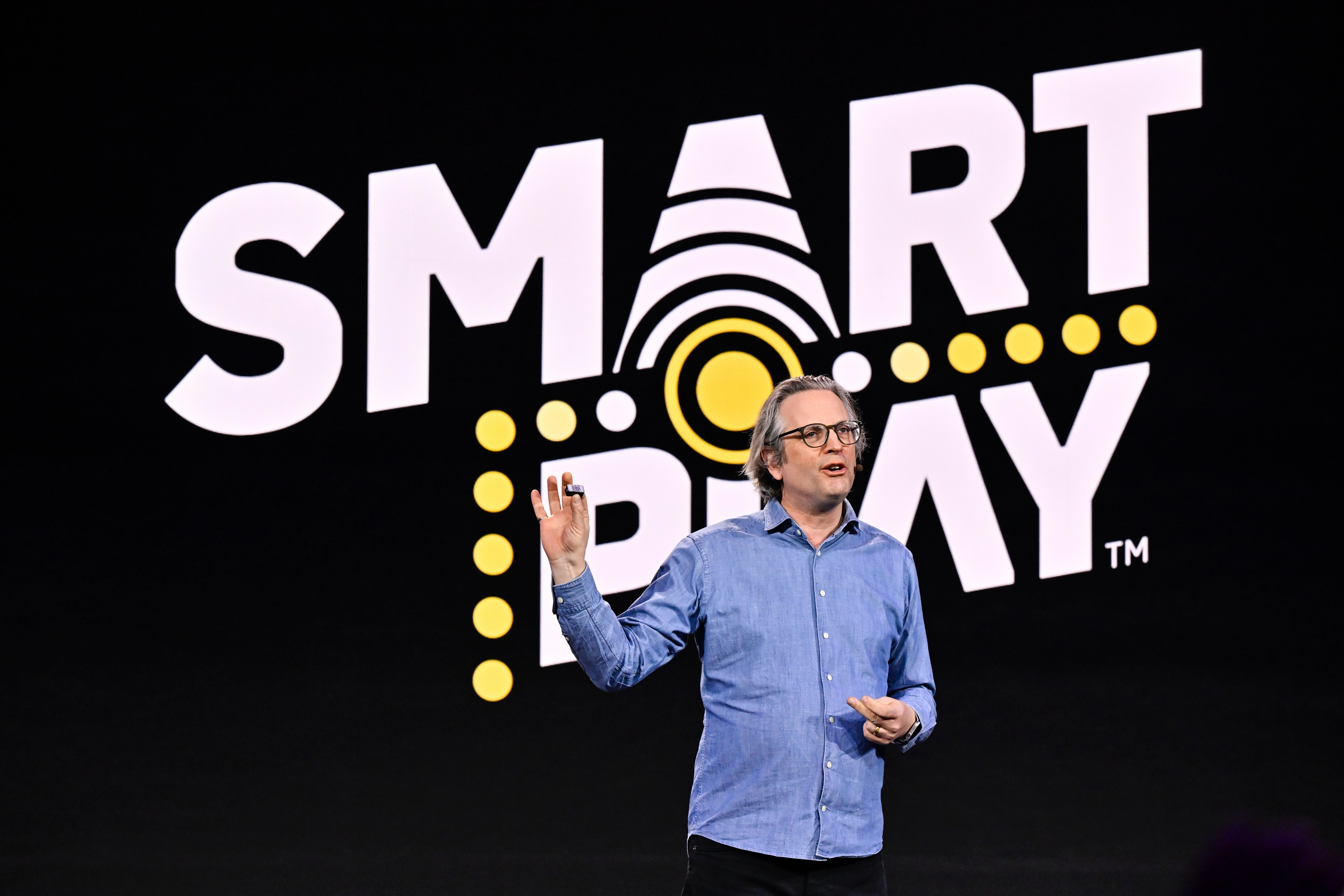
Tom Donaldson, senior VP and Head of Creative Play Lab at the LEGO Group, told Engadget that the company worked on Smart Play for about eight years before introducing it this week, and that social play was the starting point. “We started really looking at consumer needs, and this idea that kids really like social play,” said Donaldson “Kids really like the sort of things that change when they come back to them, and the kids really like agency. They want to be able to change things.” 

Lego's Tom Donaldson demoing Smart Play at CES.
Lego’s Tom Donaldson demoing Smart Play at CES.
LEGO

But a big part of the creation process was making the Smart Brick as flexible and powerful as possible and then seeing what scenarios could take advantage of it. “We wanted to build a really powerful platform,”  he said. “What we shouldn’t do is say, ‘this is what we think we’re gonna need.’ We needed to say, ‘let’s create something that has a lot of capabilities that we can then figure out how to use.’”

One of the conflicts with the tech-packed Smart Play system, though, might be the cost. Obviously, Lego has been successful at most ventures it has undertaken in recent years, but the pricing of Smart Play sets could make adoption a bit challenging. The biggest Smart Play set, Star Wars Throne Room Duel & A-Wing, for example, has almost 1,000 pieces and costs $160. That’s quite a bit more than comparably sized sets. The dual factors of the Star Wars license and Smart Play tech certainly impacted the cost. 

Lego Smart Play Star Wars set
LEGO

The set includes two Smart Bricks, five Smart Tags and three Smart Minifigures, the most “smart” gear included in any of the initial three Star Wars Smart Play sets. Will parents shell out for the more advanced capabilities that Smart Play offers, or will they stick with standard sets?

For now, Lego is betting the extremely broad appeal of Star Wars will help these new Smart Play sets find an audience. About three years ago, Lego got its team focused on the Star Wars franchise involved, as well as Lucasfilm, to figure out how to roll Smart Play out to the world. “Very early on, we all decided that starting with the original trilogy would be great,” said Derek Stothard, Disney’s Director of Global Licensing “These are such well-known scenes and characters, and they cross generations, so parents can introduce them to  their kids. All that works really well together.” 

Unsurprisingly, Lego is being coy about where things go beyond the initial three Star Wars sets, but it’s clear that after eight years of development, they’ll want to bring it to as many product lines as possible. “We’re announcing a platform that you can see has tremendous growth [potential], Donaldson said. “We made the analogy with the minifigure as something that you’ll see across the entire [Lego] system, maybe not in every single SKU but it’ll reappear in many different places. But ultimately we’re a company that really focuses on giving kids what they want, what they love, and we’ll have to see how it lives in a market.”

That last point about how it lives in the market is a good one, particularly given the pricing. We probably won’t know for sure until Lego moves beyond the safe confines of Star Wars and really shows us what Smart Play can do across more varied scenarios. And going to non-licensed sets might be where Smart Play really takes off — it’s easy to imagine a cheaper Smart Play add-on kit that can bring sets to life at a lower cost. But the idea of transforming anything kids create into something more interactive has a ton of potential if Lego can broaden its appeal beyond Star Wars fans. 

This article originally appeared on Engadget at https://www.engadget.com/entertainment/lego-is-trying-to-make-tech-invisible-with-smart-play-130000979.html?src=rss

Xbox is bringing Avowed to PS5

Another first-party Xbox game is making the leap to PlayStation 5. This time around, Obsidian’s Avowed — one of our favorite games of last year — is crossing the great divide. The fantasy action RPG will hit Sony’s console on February 17, one day shy of the game’s first anniversary. 

As it happens, an anniversary update is set to go live on all platforms at the same time. This includes a new game+ mode (allowing those who have beaten the RPG to replay it with all their gear and upgrades from their previous run), a photo mode, a new weapon type and more. 

Avowed is set in the same universe as Obsidian’s Pillars of Eternity games. It tasks you with investigating a fungal plague that has infested the world. “The writing is stellar throughout, though the sidequests that reveal your companions’ backstories are particularly poignant,” Engadget senior reporter Jessica Conditt wrote. “Avowed is gorgeous, its combat systems are fully customizable, its characters are intriguing and its encumbrance limit is generous. There’s a real sense of magic about the entire game — and no, that’s not just the mind-altering mushrooms talking.”

Microsoft has brought a string of first-party Xbox games to PS5 over the last couple of years, freeing them from console exclusivity. Forza Horizon 5, Indiana Jones and the Great Circle, Senua’s Saga: Hellblade II and Sea of Thieves are among the games that have crossed over to PlayStation. Later this year, you’ll even be able to play a Halo game on PS5, something that was utterly unthinkable not too long ago. 

This article originally appeared on Engadget at https://www.engadget.com/gaming/playstation/xbox-is-bringing-avowed-to-ps5-120000035.html?src=rss

Fusion Physicists Found a Way Around a Long-Standing Density Limit

alternative_right shares a report from ScienceAlert: At the Experimental Advanced Superconducting Tokamak (EAST), physicists successfully exceeded what is known as the Greenwald limit, a practical density boundary beyond which plasmas tend to violently destabilize, often damaging reactor components. For a long time, the Greenwald limit was accepted as a given and incorporated into fusion reactor engineering. The new work shows that precise control over how the plasma is created and interacts with the reactor walls can push it beyond this limit into what physicists call a ‘density-free’ regime.

[…] A team led by physicists Ping Zhu of Huazhong University of Science and Technology and Ning Yan of the Chinese Academy of Sciences designed an experiment to take this theory further, based on a simple premise: that the density limit is strongly influenced by the initial plasma-wall interactions as the reactor starts up. In their experiment, the researchers wanted to see if they could deliberately steer the outcome of this interaction. They carefully controlled the pressure of the fuel gas during tokamak startup and added a burst of heating called electron cyclotron resonance heating.

These changes altered how the plasma interacts with the tokamak walls through a cooler plasma boundary, which dramatically reduced the degree to which wall impurities entered the plasma. Under this regime, the researchers were able to reach densities up to about 65 percent higher than the tokamak’s Greenwald limit. This doesn’t mean that magnetically confined plasmas can now operate with no density limits whatsoever. However, it does show that the Greenwald limit is not a fundamental barrier and that tweaking operational processes could lead to more effective fusion reactors. The findings have been published in Science Advances.


Read more of this story at Slashdot.

Ultimate Camouflage Tech Mimics Octopus In Scientific First

Researchers at Stanford University have created a programmable synthetic “skin” that can independently change color and texture, “a feat previously only available within the animal kingdom,” reports the Register. From the report: The technique employs electron beams to write patterns and add optical layers that create color effects. When exposed to water, the film swells to reveal texture and colors independently, depending on which side of the material is exposed, according to a paper published in the scientific journal Nature this week. In an accompanying article, University of Stuttgart’s Benjamin Renz and Na Liu said the researchers’ “most striking achievement was a photonic skin in which color and texture could be independently controlled, mirroring the separate regulation… in octopuses.”

The research team used the polymer PEDOT:PSS, which can swell in water, as the basis for their material. Its reaction to water can be controlled by irradiating it with electrons, creating textures and patterns in the film. By adding thin layers of gold, the researchers turned surface texture into tunable optical effects. A single layer could be used to scatter light, giving the shiny metal a matte, textured appearance. To control color, a polymer film was sandwiched between two layers of gold, forming an optical cavity, which selectively reflects light.


Read more of this story at Slashdot.

NASA orders “controlled medical evacuation” from the International Space Station

NASA officials said Thursday they have decided to bring home four of the seven crew members on the International Space Station after one of them experienced a “medical situation” earlier this week.

The space agency has said little about the incident, and officials have not identified which crew member suffered the medical issue. James “JD” Polk, NASA’s chief health and medical officer, told reporters Thursday the crew member is “absolutely stable” but that the agency is “erring on the side of caution” with the decision to bring to return the astronaut to Earth.

The ailing astronaut is part of the Crew-11 mission, which launched to the station August 1 and was slated to come back to Earth around February 20. Instead, the Crew-11 astronauts will depart the International Space Station (ISS) in the coming days and head for reentry and a parachute-assisted splashdown in the Pacific Ocean off the coast of California.

Read full article

Comments

Some Super-Smart Dogs Can Learn New Words Just By Eavesdropping

An anonymous reader quotes a report from NPR: [I]t turns out that some genius dogs can learn a brand new word, like the name of an unfamiliar toy, by just overhearing brief interactions between two people. What’s more, these “gifted” dogs can learn the name of a new toy even if they first hear this word when the toy is out of sight — as long as their favorite human is looking at the spot where the toy is hidden. That’s according to a new study in the journal Science. “What we found in this study is that the dogs are using social communication. They’re using these social cues to understand what the owners are talking about,” says cognitive scientist Shany Dror of Eotvos Lorand University and the University of Veterinary Medicine, Vienna. “This tells us that the ability to use social information is actually something that humans probably had before they had language,” she says, “and language was kind of hitchhiking on these social abilities.”

[…] “There’s only a very small group of dogs that are able to learn this differentiation and then can learn that certain labels refer to specific objects,” she says. “It’s quite hard to train this and some dogs seem to just be able to do it.” […] To explore the various ways that these dogs are capable of learning new words, Dror and some colleagues conducted a study that involved two people interacting while their dog sat nearby and watched. One person would show the other a brand new toy and talk about it, with the toy’s name embedded into sentences, such as “This is your armadillo. It has armadillo ears, little armadillo feet. It has a tail, like an armadillo tail.” Even though none of this language was directed at the dogs, it turns out the super-learners registered the new toy’s name and were later able to pick it out of a pile, at the owner’s request.

To do this, the dogs had to go into a separate room where the pile was located, so the humans couldn’t give them any hints. Dror says that as she watched the dogs on camera from the other room, she was “honestly surprised” because they seemed to have so much confidence. “Sometimes they just immediately went to the new toy, knowing what they’re supposed to do,” she says. “Their performance was really, really high.” She and her colleagues wondered if what mattered was the dog being able to see the toy while its name was said aloud, even if the words weren’t explicitly directed at the dog. So they did another experiment that created a delay between the dog seeing a new toy and hearing its name. The dogs got to see the unfamiliar toy and then the owner dropped the toy in a bucket, so it was out of sight. Then the owner would talk to the dog, and mention the toy’s name, while glancing down at the bucket. While this was more difficult for dogs, overall they still could use this information to learn the name of the toy and later retrieve it when asked. “This shows us how flexible they are able to learn,” says Dror. “They can use different mechanisms and learn under different conditions.”


Read more of this story at Slashdot.

YouTube Will Now Let You Filter Shorts Out of Search Results

YouTube is updating search filters so users can explicitly choose between Shorts and long-form videos. The change also replaces view-count sorting with a new “Popularity” filter and removes underperforming options like “Sort by Rating.” The Verge reports: Right now, a filter-less search shows a mix of longform and short form videos, which can be annoying if you just want to see videos in one format or the other. But in the new search filters, among other options, you can pick to see “Videos,” which in my testing has only showed a list of longform videos, or “Shorts,” which just shows Shorts.

YouTube is also removing the “Upload Date – Last Hour” and “Sort by Rating” filters because they “were not working as expected and had contributed to user complaints.” The company will still offer other “Upload Date” filters, like “Today,” “This week,” “This Month,” and “This Year,” and you can also find popular videos with the new “Popularity” filter, which is replacing the “View count” sort option. (With the new “Popularity” filter, YouTube says that “our systems assess a video’s view count and other relevance signals, such as watch time, to determine its popularity for that specific query.”)


Read more of this story at Slashdot.

Lawsuit Over OpenAI For-Profit Conversion Can Head To Trial, US Judge Says

Longtime Slashdot reader schwit1 shares a report from Reuters: Billionaire entrepreneur Elon Musk persuaded a judge on Wednesday to allow a jury trial on his allegations that ChatGPT maker OpenAI violated its founding mission in its high-profile restructuring to a for-profit entity. Musk was a cofounder of OpenAI in 2015 but left in 2018 and now runs an AI company that competes with it.

U.S. District Judge Yvonne Gonzalez Rogers in Oakland, California, said at a hearing that there was “plenty of evidence” suggesting OpenAI’s leaders made assurances that its original nonprofit structure was going to be maintained. The judge said there were enough disputed facts to let a jury consider the claims at a trial scheduled for March, rather than decide the issues herself. She said she would issue a written order after the hearing that addresses OpenAI’s bid to throw out the case.

[…] Musk contends he contributed about $38 million, roughly 60% of OpenAI’s early funding, along with strategic guidance and credibility, based on assurances that the organization would remain a nonprofit dedicated to the public benefit. The lawsuit accuses OpenAI co-founders Sam Altman and Greg Brockman of plotting a for-profit switch to enrich themselves, culminating in multibillion-dollar deals with Microsoft and a recent restructuring. OpenAI, Altman and Brockman have denied the claims, and they called Musk “a frustrated commercial competitor seeking to slow down a mission-driven market leader.”

Microsoft is also a defendant and has urged the judge to toss Musk’s lawsuit. A lawyer for Microsoft said there was no evidence that the company “aided and abetted” OpenAI.

OpenAI in a statement after the hearing said: “Mr Musk’s lawsuit continues to be baseless and a part of his ongoing pattern of harassment, and we look forward to demonstrating this at trial.”


Read more of this story at Slashdot.

Illinois Health Department Exposed Over 700,000 Residents’ Personal Data For Years

Illinois Department of Human Services disclosed that a misconfigured internal mapping website exposed sensitive personal data for more than 700,000 Illinois residents for over four years, from April 2021 to September 2025. Officials say they can’t confirm whether the publicly accessible data was ever viewed. TechCrunch reports: Officials said the exposed data included personal information on 672,616 individuals who are Medicaid and Medicare Savings Program recipients. The data included their addresses, case numbers, and demographic data — but not individuals’ names. The exposed data also included names, addresses, case statuses, and other information relating to 32,401 individuals in receipt of services from the department’s Division of Rehabilitation Services.


Read more of this story at Slashdot.

Google Is Adding an ‘AI Inbox’ To Gmail That Summarizes Emails

An anonymous reader quotes a report from Wired: Google is putting even more generative AI tools into Gmail as part of its goal to further personalize user inboxes and streamline searches. On Thursday, the company announced a new “AI Inbox” tab, currently in a beta testing phase, that reads every message in a user’s Gmail and suggests a list of to-dos and key topics, based on what it summarizes. In Google’s example of what this AI Inbox could look like in Gmail, the new tab takes context from a user’s messages and suggests they reschedule their dentist appointment, reply to a request from their child’s sports coach, and pay an upcoming fee before the deadline. Also under the AI Inbox tab is a list of important topics worth browsing, nestled beneath the action items at the top. Each suggested to-do and topic links back to the original email for more context and for verification.

[…] For users who are concerned about their privacy, the information Google gleans by skimming through inboxes will not be used to improve the company’s foundational AI models. “We didn’t just bolt AI onto Gmail,” says Blake Barnes, who leads the project for Google. “We built a secure privacy architecture, specifically for this moment.” He emphasizes that users can turn off Gmail’s new AI tools if they don’t want them. At the same time Google announced its AI Inbox, the company made free for all Gmail users multiple Gemini features that were previously available only to paying subscribers. This includes the Help Me Write tool, which generates emails from a user prompt, as well as AI Overviews for email threads, which essentially posts a TL;DR summary at the top of long message threads. Subscribers to Google’s Ultra and Pro plans, which start at $20 a month, get two additional new features in their Gmail inbox. First, an AI proofreading tool that suggests more polished grammar and sentence structures. And second, an AI Overviews tool that can search your whole inbox and create relevant summaries on a topic, rather than just summarizing a single email thread.


Read more of this story at Slashdot.

Lumus brought a massively wider FOV to smartglasses at CES 2026

Lumus got a major boost in brand recognition when one of its waveguides was selected for use in the Meta Ray-Ban Display glasses. But that already feels like old tech now because at CES 2026, the company brought some of its latest components to the show and based on what I saw, they seem poised to seriously elevate the optical quality of the next wave of high-end smartglasses. 

When the Meta Ray-Ban Displays glasses came out, they wowed users as they were (and still are) one of a handful of smartglassess to feature a full-color in-lens display with at least a 20-degree field of view. But going by the specs on Lumus’ newest waveguides, we’re set for a major upgrade in terms of future capabilities. 

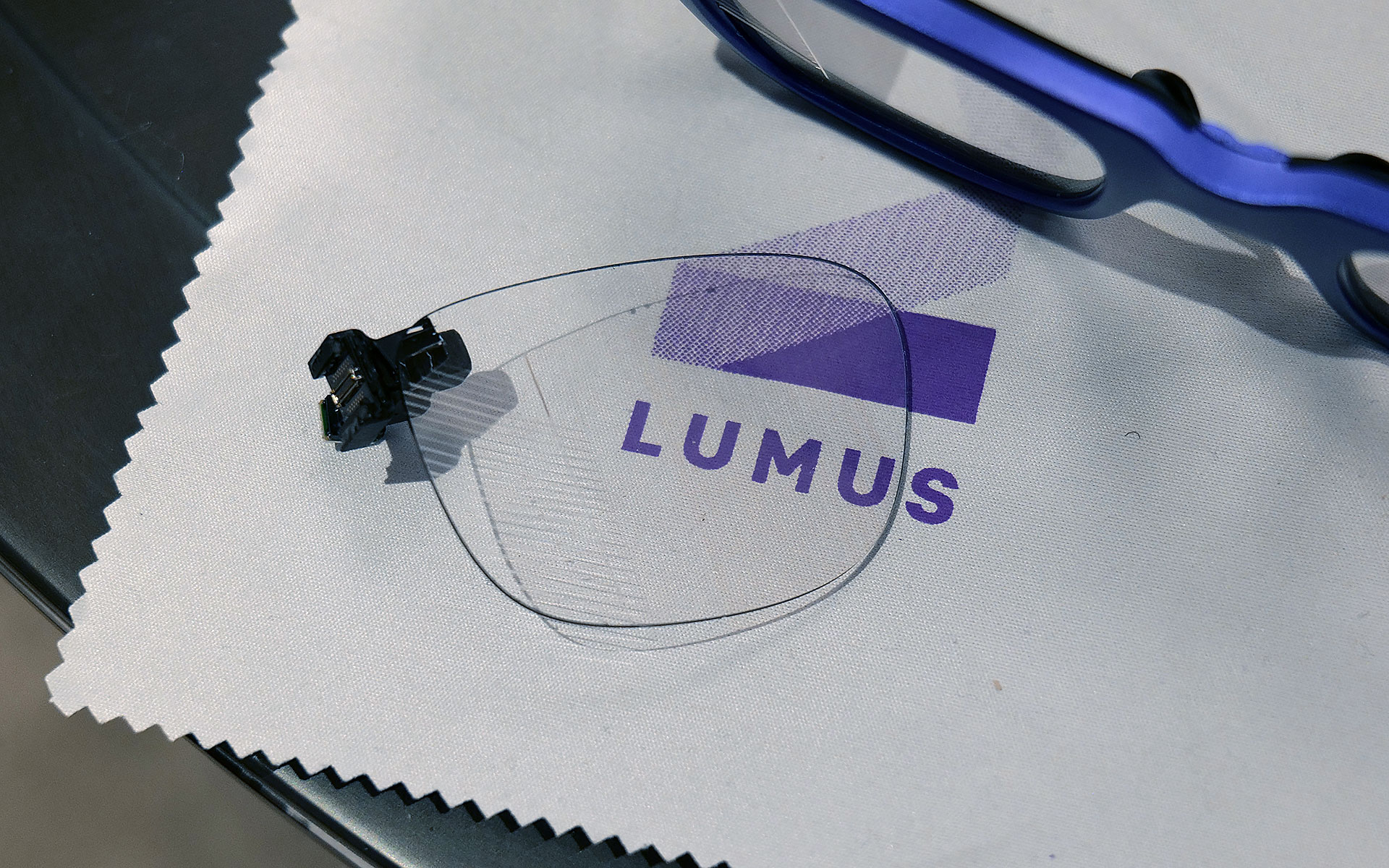
If you look closely, you can see where light from the waveguide propagates into the one of the smartglasses' lenses.
If you look closely, you can see where light from the waveguide propagates into the one of the smartglasses’ lenses.
Sam Rutherford for Engadget

The first model I tried featured Lumus’ optimized Z-30 waveguides, which not only offer a much wider 30-degree FOV, they are also 30 percent lighter and 40 percent thinner than previous generations. On top of that, Lumus says they are also more power efficient with the waveguides capable of hitting more than 8,000 nits per watt. This is a big deal because smartglasses are currently quite limited by the size of batteries they can use, especially if you want to make them small and light enough to wear all day. When I tried them on, I was dazzled by both the brightness and sharpness I saw from the Z-30s despite them being limited to 720 x 720 resolution. Not only did the increase in FOV feel much larger than 10 degrees, colors were very rich, including white, which is often one of the most difficult shades to properly reproduce.

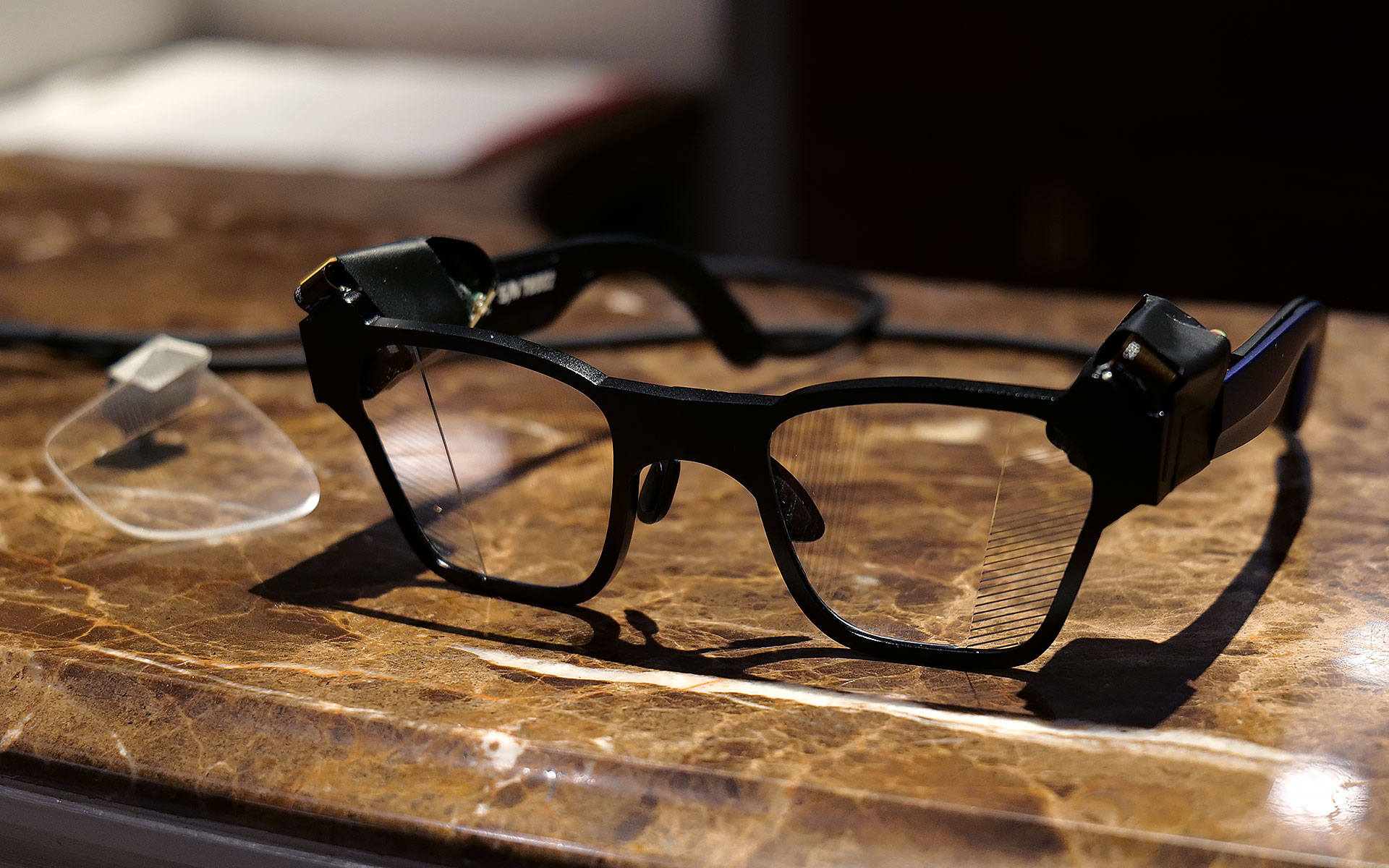
I had to take a photo of one of Lumus' non-functioning smartglasses with the company's 70-degree FOV waveguide, because two out of three of the working ones had already broke and the last one that I used was being held together by tape.
I had to take a photo of one of Lumus’ non-functioning smartglasses with the company’s 70-degree FOV waveguide, because two out of three of the working ones had already broke and the last one that I used was being held together by tape.
Sam Rutherford for Engadget

However, even after seeing how good that first model was, I was totally not prepared for Lumus’ 70-degree FOV waveguides. I was able to view some videos and a handful of test images and I was completely blown away with how much area they covered. It was basically the entire center portion of the lens, with only small unused areas around the corners. And while I did notice some pincushion distortion along the sides of the waveguide’s display, a Lumus representative told me that it will be possible to correct for that in final retail units. But make no mistake, these waveguides undoubtedly produced some of the sharpest, brightest and best-looking optics I’ve seen from any smartglasses, from either retail models or prototypes or. It almost made me question how much wider FOV these types of gadgets really need, though to be clear, I don’t think we’ve hit the point of diminishing returns yet. 

This is one of Lumus' thinnest waveguides measuring in at just 0.8mm.
This is one of Lumus’ thinnest waveguides measuring in at just 0.8mm.
Sam Rutherford for Engadget

Other advantages of Lumus’ geometric reflective waveguides include better overall efficiency than their refractive counterparts along with the ability to optically bond the displays to smartglasses lenses. That means unlike a lot of rivals, Lumus’ waveguides can be paired with transitions lenses instead of needing to resort to clip-on sunglass attachments when you go outside. Lumus also claims its designs also simplifies the manufacturing process, resulting in thinner waveguides (as small as 0.8mm) and generally higher yields. 

Unfortunately, taking high-quality photos of content from smartglasses displays is incredibly challenging, especially when you’re using extremely delicate prototypes, so you’ll just have to take my word for now. But with Lumus in the process of ramping up production of its new waveguides with help from partners including Quanta and SCHOTT, it feels like there will be a ton of smartglasses makers clamoring for these components as momentum continues to build around the industry’s pick for the next “big” thing. 

This article originally appeared on Engadget at https://www.engadget.com/wearables/lumus-brought-a-massively-wider-fov-to-smartglasses-at-ces-2026-233245949.html?src=rss

French Court Orders Google DNS to Block Pirate Sites, Dismisses ‘Cloudflare-First’ Defense

Paris Judicial Court ordered Google to block additional pirate sports-streaming domains at the DNS level, rejecting Google’s argument that enforcement should target upstream providers like Cloudflare first. “The blockade was requested by Canal+ and aims to stop pirate streams of Champions League games,” notes TorrentFreak. From the report: Most recently, Google was compelled to take action following a complaint from French broadcaster Canal+ and its subsidiaries regarding Champions League piracy.. Like previous blocking cases, the request is grounded in Article L. 333-10 of the French Sports Code, which enables rightsholders to seek court orders against any entity that can help to stop ‘serious and repeated’ sports piracy. After reviewing the evidence and hearing arguments from both sides, the Paris Court granted the blocking request, ordering Google to block nineteen domain names, including antenashop.site, daddylive3.com, livetv860.me, streamysport.org and vavoo.to.

The latest blocking order covers the entire 2025/2026 Champions League series, which ends on May 30, 2026. It’s a dynamic order too, which means that if these sites switch to new domains, as verified by ARCOM, these have to be blocked as well. Google objected to the blocking request. Among other things, it argued that several domains were linked to Cloudflare’s CDN. Therefore, suspending the sites on the CDN level would be more effective, as that would render them inaccessible. Based on the subsidiarity principle, Google argued that blocking measures should only be ordered if attempts to block the pirate sites through more direct means have failed.

The court dismissed these arguments, noting that intermediaries cannot dictate the enforcement strategy or blocking order. Intermediaries cannot require “prior steps” against other technical intermediaries, especially given the “irremediable” character of live sports piracy. The judge found the block proportional because Google remains free to choose the technical method, even if the result is mandated. Internet providers, search engines, CDNs, and DNS resolvers can all be required to block, irrespective of what other measures were taken previously. Google further argued that the blocking measures were disproportionate because they were complex, costly, easily bypassed, and had effects beyond the borders of France.

The Paris court rejected these claims. It argued that Google failed to demonstrate that implementing these blocking measures would result in “important costs” or technical impossibilities. Additionally, the court recognized that there would still be options for people to bypass these blocking measures. However, the blocks are a necessary step to “completely cease” the infringing activities.


Read more of this story at Slashdot.

Microsoft Turns Copilot Chats Into a Checkout Lane

Microsoft is embedding full e-commerce checkout directly into Copilot chats, letting users buy products without ever visiting a retailer’s website. “If checkout happens inside AI conversations, retailers risk losing direct customer relationships — while platforms like Microsoft gain leverage,” reports Axios. From the report: Microsoft unveiled new agentic AI tools for retailers at the NRF 2026 retail conference, including Copilot Checkout, which lets shoppers complete purchases inside Copilot without being redirected to a retailer’s website. The checkout feature is live in the U.S. with Shopify, PayPal, Stripe and Etsy integrations.

Copilot apps have more than 100 million monthly active users, spanning consumer and commercial audiences, according to the company. More than 800 million monthly active users interact with AI features across Microsoft products more broadly. Shopping journeys involving Copilot are 33% shorter than traditional search paths and see a 53% increase in purchases within 30 minutes of interaction, Microsoft says. When shopping intent is present, journeys involving Copilot are 194% more likely to result in a purchase than those without it.


Read more of this story at Slashdot.