This App Brings Some of My Favorite Windows Features to Mac

As someone who regularly switches between the Mac and PC, I really can’t live without the PowerToys app on Windows. It adds little missing features that I really like on the Mac, like a Spotlight Search alternative, auto dark mode, screen awake, on-screen OCR (which lets you pull text from images), and more.

But the reverse is also true. When I’m on MacOS, I start to miss the little features and commands that I’ve been used to Windows having for decades now (I started using Windows in school, but was only exposed to macOS when I was in college).

It’s the little things, like not being able to cut and paste files in Finder. And why must I accidentally open the Music app every time I press the play button? This is just the beginning.

Enter Supercharge, a utility from prolific indie developer Sindre Sorhus. Think of it not as a single app, but as a Swiss army knife for your menu bar—a collection of micro-utilities designed to patch the specific usability holes that Apple has left open, many of which Microsoft has already plugged. The app offers an unlimited free trial (with a prompt to upgrade every 12 hours), or you can buy it outright for $18. It’s also available as part of a Setapp subscription.
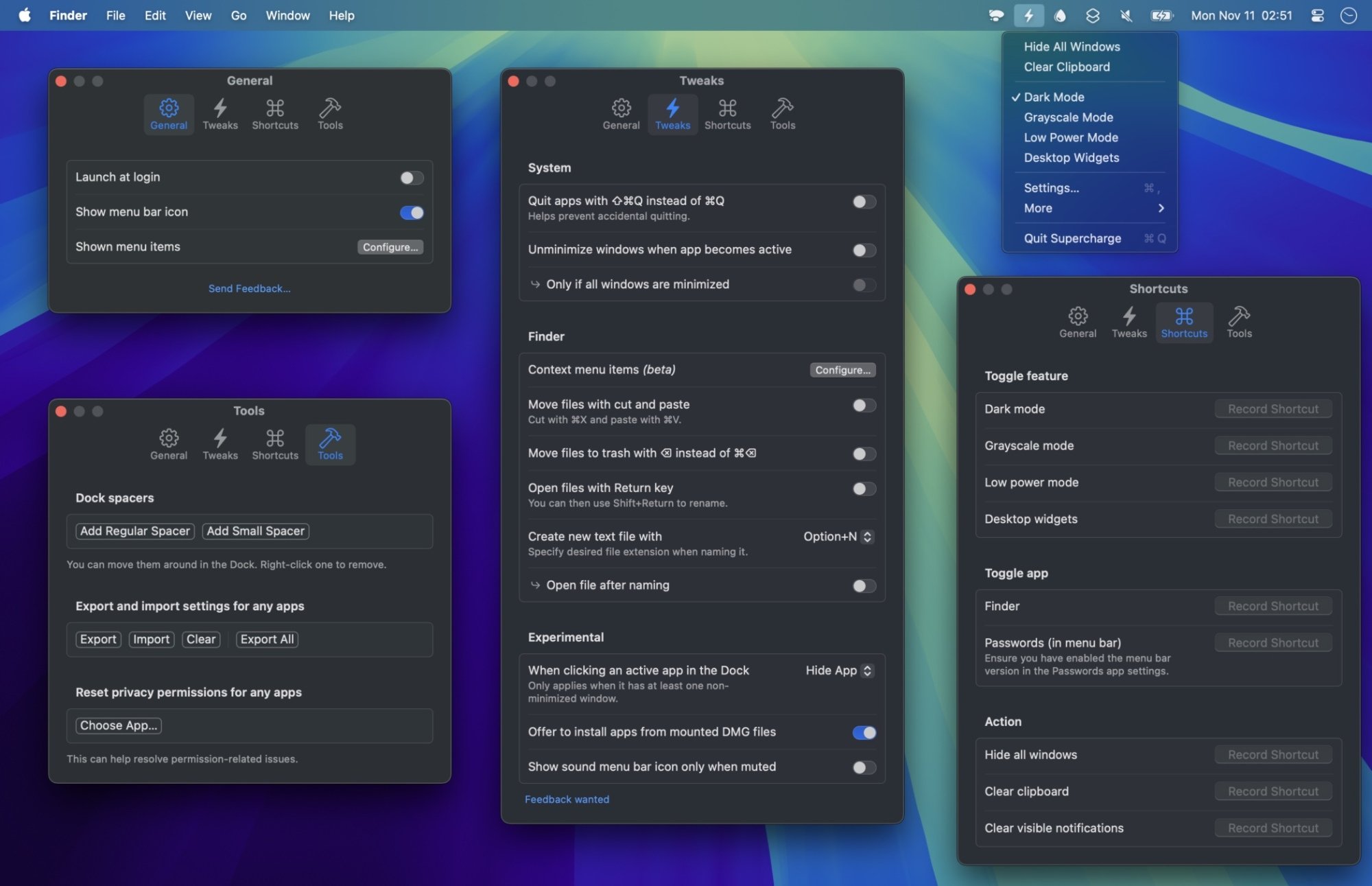
Supercharge settings for Mac.

Credit: Supercharge

The best Supercharge tweaks that you should enable

The Supercharge app works in two ways. The first is by giving you a set-and-forget settings menu. Secondly, it adds a menu bar app where you can quickly access small features on the fly.

The tweaks part, to me, is a lot more interesting. Once the app is installed, open the menu bar app and go to Settings. Go to the Tweaks tab and take some time to customize your Mac’s behavior.

Make Finder work more like Windows File Explorer
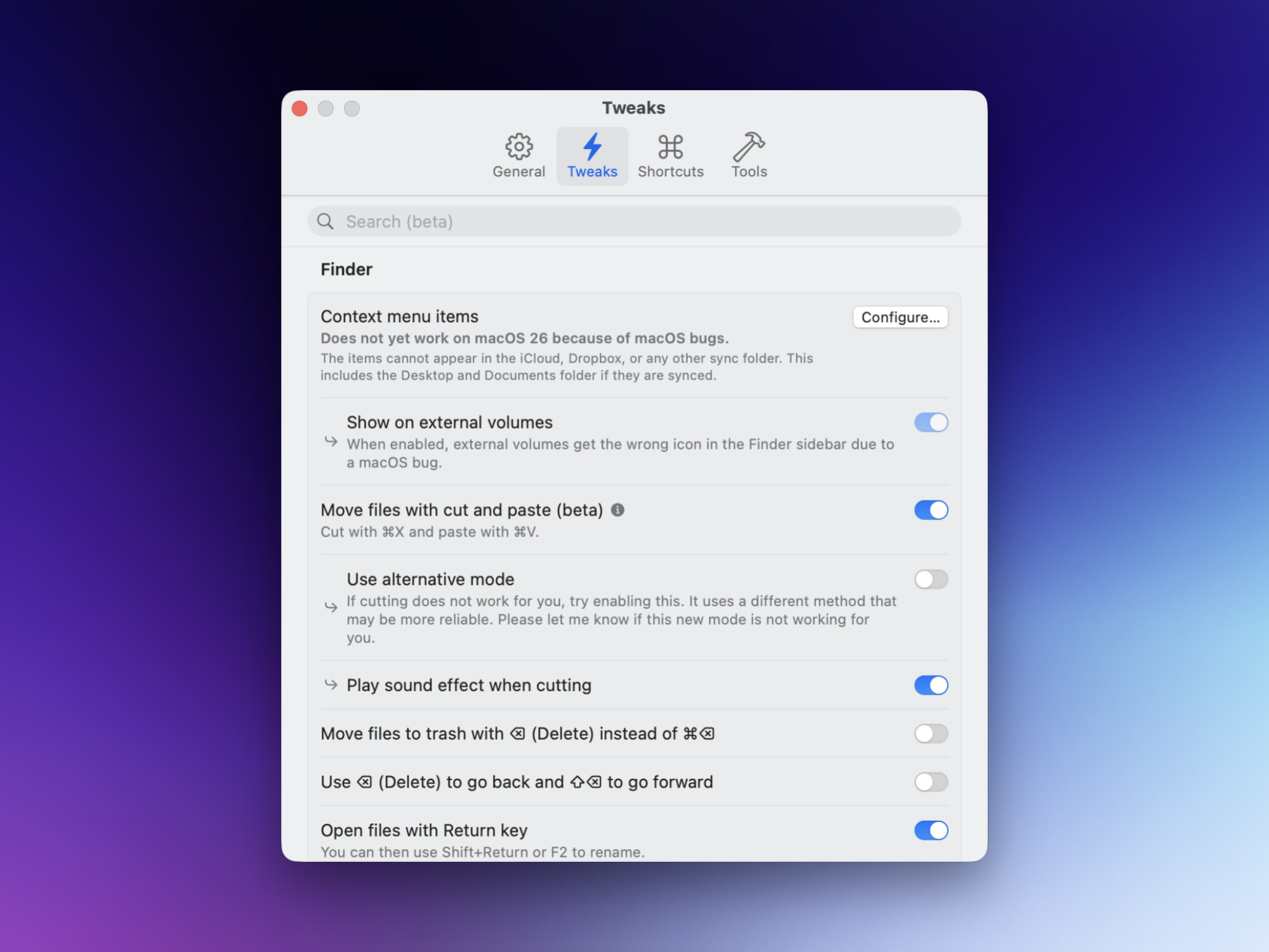
Finder tweaks in Supercharge.

Credit: Khamosh Pathak

The Finder is where Supercharge shines, fixing legacy behaviors that have frustrated Windows switchers for years. The first thing I enabled was the “Cut and Paste” functionality. Finally, you can use Cmd+X to cut a file and Cmd+V to move it, eliminating the awkward Cmd+C followed by Cmd+Option+V dance required by default.

Beyond moving files, the app allows you to enable the Option+N shortcut to instantly create a new text file in your current folder—another Windows muscle memory I’ve had for decades. Additional tweaks include toggling the Enter key to open a file instead of renaming it, and an option to show hidden files by default.

Mission Control features

Apple’s Mission Control provides a bird’s-eye view of all your windows, but it’s hardly interactive. Supercharge changes that by adding window management buttons directly to the overlay. You can now add dedicated Close, Minimize, and Quit buttons for every window inside Mission Control, helping you clear cluttered app windows in seconds, and in a fairly visual way.

Dock enhancements

Supercharge also brings much-needed flexibility to the Dock, making it more like the taskbar on Windows or Linux. Enable the Click-to-Hide feature, and you can minimize or hide an app simply by clicking on the app icon. My favorite, though, is the option to open folders directly in the Finder from the Dock. You can also set Supercharge to add spacers to the Dock, and quit apps using the middle-click mouse button.

The Apple Music app fix

Perhaps the most useful fix in the entire suite is the ability to stop Apple Music from launching automatically. This feature stops the app from popping up when you press Play on your keyboard or Bluetooth headphones. If you are a dedicated Spotify user or simply dislike it when your headphones accidentally wake up Apple Music, this feature alone makes a Supercharge installation worth it.

Other useful features

The Supercharge app includes several other quality-of-life improvements. The Notification Nuke feature allows you to set a global hotkey to instantly clear all notifications from Notification Center, acting as a panic button for focus. To prevent accidents, you can also enable Accidental Quit Prevention, which requires a double-press or a Shift + Cmd + Q combo to actually quit an application.

Add these features to the Supercharge menu bar app
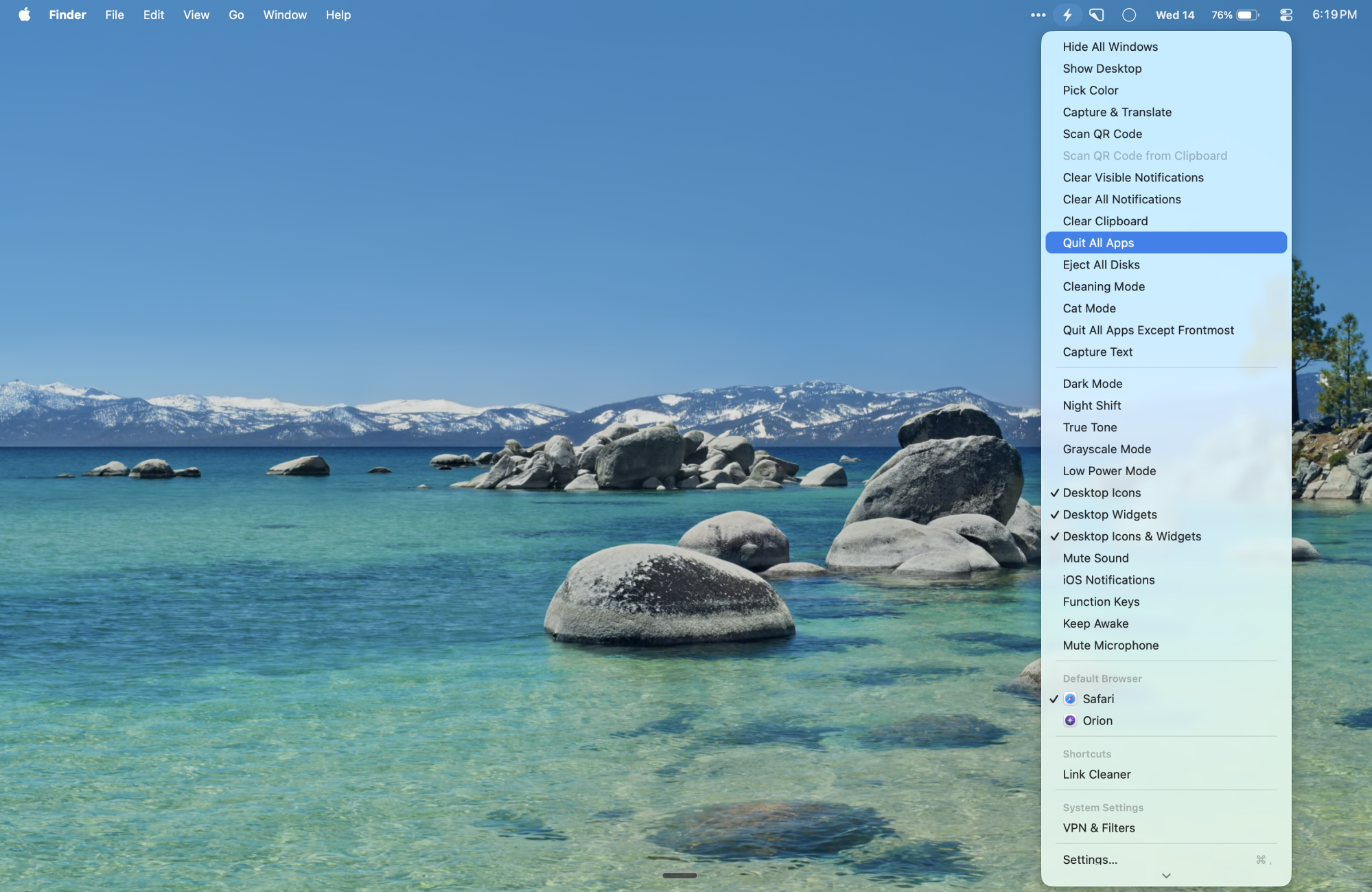
Array of options for Supercharge menu bar app.

Credit: Khamosh Pathak

The second part of the equation here is the menu bar app. Here, you can add small missing features that usually require downloading separate apps. There are more than two dozen options. Go to Settings > General > Show Menu Items to see the whole list.

Here, you can add options to quickly capture and copy any text from an image (or translate it). There are one-click options for hiding all windows, showing the desktop, quitting all apps except the current one, clearing all notifications, and more. There’s also a simple Keep Awake feature that will keep your Mac active even when the screen is off.

And there’s also a simple default browser switcher built-in, though I prefer using Sindre’s dedicated Default Browser app.

The Nintendo Switch 2025 year in review is finally here

We’re almost exactly halfway through January, but Nintendo has clearly taken a better-late-than-never approach to its 2025 year in review feature, which finally went live this week for Switch and Switch 2 users. All you need to do is head here and sign into your Nintendo account to see your 2025 breakdown.

Like most annual gaming wrap-ups, Nintendo’s shows how many games you played over the calendar year, as well as your total playtime. It also shows you your most-played titles for each month, your preferred genres by percentage, and if you scroll all the way to the bottom you can choose your favorite game of the year. You can also download a shareable image that shows off your taste, but there’s no way to directly share your results on social media through the website.

2025 was a massive year for Nintendo, with the Switch 2 launching in early June. If you bought one, the year in review site will naturally congratulate you for doing so, but it doesn’t separate your results by games you played on the original Switch versus its successor.

Nintendo’s rivals went live with their own 2025 recap features in December. First came Sony’s, which is unfortunately no longer live, and Steam followed shortly after. That one is still available to view if you want to see how your Switch 2 playtime stacks up against your Steam Deck hours. Microsoft decided to skip a 2025 wrap-up altogether, which Windows Central’s Jez Corden previously suggested could be due to a reallocation of marketing budget towards a number of significant anniversaries happening this year, including the 25th anniversary of Xbox.

This article originally appeared on Engadget at https://www.engadget.com/gaming/nintendo/the-nintendo-switch-2025-year-in-review-is-finally-here-145810913.html?src=rss

Acer Slaps AT&T, T-Mobile And Verizon With Lawsuit Over 4G/5G Wireless Patents

Acer Slaps AT&T, T-Mobile And Verizon With Lawsuit Over 4G/5G Wireless Patents
Acer has filed individual lawsuits against all three major wireless carriers in the United States, including AT&T, T-Mobile, and Verizon. According to Acer, the three carriers collectively infringed on half a dozen U.S. patents “covering key advancements in cellular networking,” and now it’s taken them to court after failing to reach a licensing

Europe is Rediscovering the Virtues of Cash

After spending years pushing digital payments to combat tax evasion and money laundering, European Union ministers decided in December to ban businesses from refusing cash. The reversal comes as 12% of European businesses flatly refused cash in 2024, up from 4% three years earlier.

Over one in three cinemas in the Netherlands no longer accept notes and coins. Cash usage across the euro area dropped from 79% of in-person transactions in 2016 to just 52% in 2024. Sweden leads the digital shift where 90% of purchases now happen digitally and cash represents under 1% of GDP compared to 22% in Japan.

The policy change stems from concerns about financial inclusion for elderly and poor populations who struggle with digital systems. Resilience worries also drove the decision after Spaniards facing nationwide power cuts last spring found themselves unable to buy food. European officials worry about dependence on American payment giants Visa and MasterCard. The EU now recommends citizens store enough cash to survive a week without electricity or internet access.


Read more of this story at Slashdot.

Smart Glasses Are About to Have a Big Year

We may earn a commission from links on this page.

The expected release of glasses from huge players like Apple and Google has industry analysts predicting sales of smart glasses will rise from six million units in 2025 to 20 million in 2026. In other words, this year is looking like an inflection point, where tech-enabled spectacles make the transformation from tech wear for early adopters to everyday gear for regular folks. Whether you’re looking for a pair of audio-first glasses, display glasses, or full augmented reality, here’s what to expect from the major players and smaller operators in the smart-glasses space.

CES’s major smart glasses announcements

This year’s Consumer Electronics Show saw a ton of companies introducing new smart glasses, including “been in the space forever” firms like XReal and “these are the first smart glasses for us” companies like XGimi. Below are four of the most notable new smart glasses announced at CES.

XReal 1S

XReal 1S

Credit: XReal

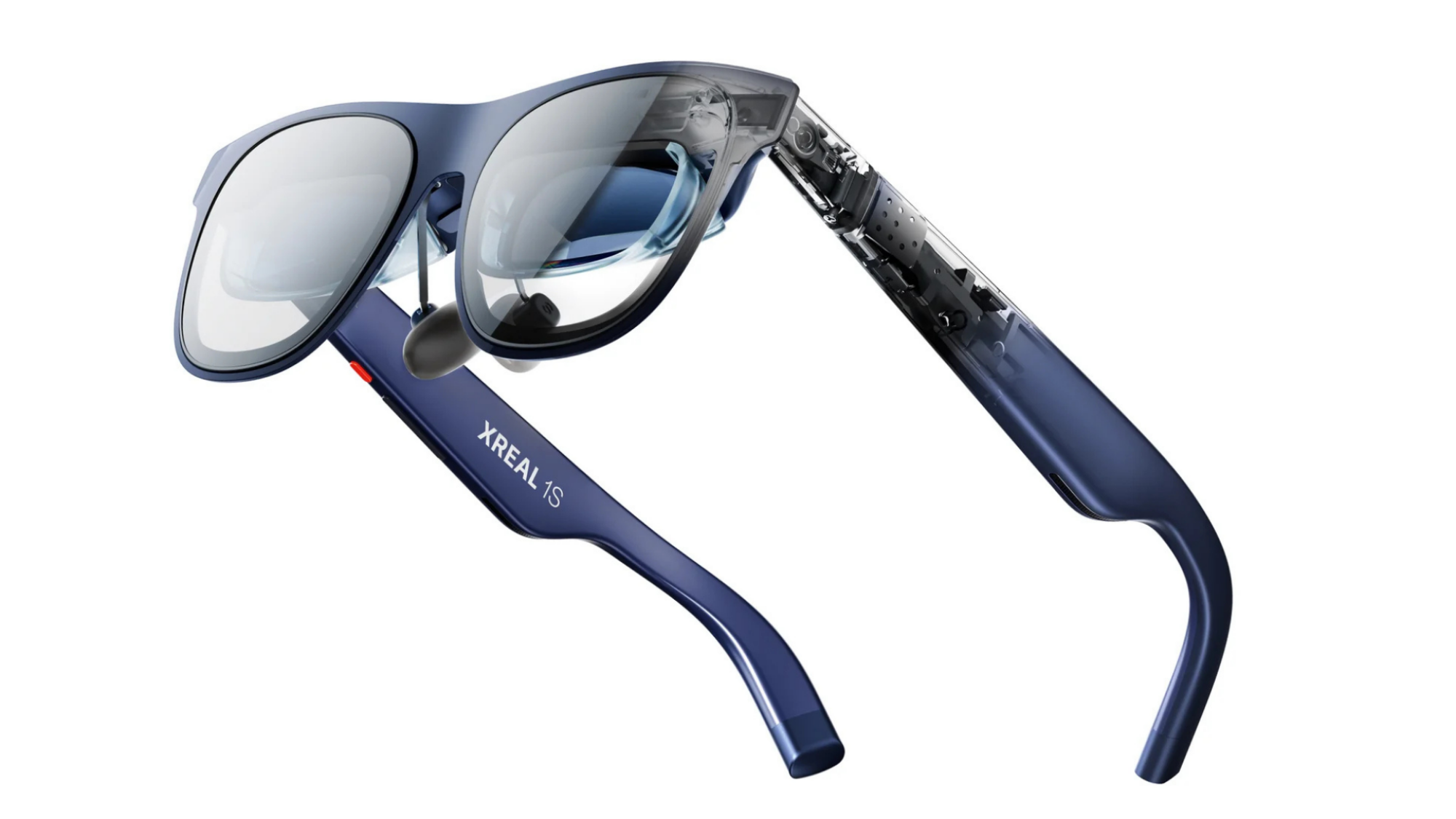
XReal was an early player in the smart glasses space. They’ve been releasing high-end, display-first glasses like the Xreal One Pro since 2019. They’re the go-to if you want specs that put a high-def display in your pocket. At CES, the company unveiled the 1S: Glasses that promise a massive virtual display as large as 500″, 3Dof augmented reality capability, and a smooth as silk refresh rate of 120Hz, all powered by an onboard X1 chip. XReal 1S is available now for $449.

Even Reality G2

Even Reality G2

Credit: Even Reality

Even Reality is aiming for people who wanted fashionable glasses that do extraordinary things. The company followed its excellent G1 smart glasses with the G2, a new model with a bigger, sharper monochrome display, “contextual AI” that can flash helpful conversation suggestions to users, and an integrated smart ring to make all of it easier to control. They also don’t look dorky, so no one needs to know you’re wearing smart glasses. Even Reality G2 glasses are available now for $599 and up.

RayNeo Air 4 Pro

RayNeo Air 4 Pro

Credit: Stephen Johnson

Released in 2025, RayNeo’s impressive X3 glasses provided a glimpse into the future, where we’ll have instantly available HUDs. The Air 4 Pro, on the other hand, is more about the present. Display glasses that are for streaming games and movies instead of wearing all the time, Air 4 Pros feature dual Micro-OLEDs creating a virtual 200-inch screen, HDR10 support for high dynamic range video, a Vision 4000 custom processor for upscaling, and Bang & Olufsen-tuned audio. They’re aggressively priced at $299 and set to be released on Jan. 25.

XGimi Memomind Air Display

Memomind glasses

Credit: XGimi

XGimi is known for projectors, but its first line of smart glasses, dubbed Memomind Air Display, made waves at CES for their lightweight, stylish frames, monochrome display integrated with AI, and a battery that lasts all day. Memomind glasses are available with a dual lens display, single lens display, and audio-only. There’s no set release date for these, but the company is expecting them to hit the market around March.

Upcoming smart glasses releases

As the year rolls on, we’ll be seeing new models of smart glasses dropping from huge companies like Google and Snap, not to mention smaller companies that are likely to surprise us with something unexpected.

Google and Samsung

Google was the first company on the smart glasses scene with the release of Google Glass, and in 2026, it’s getting back in the game. Google is collaborating with Samsung, Gentle Monster, and Warby Parker to release two different Android-powered smart glasses: an audio-first pair that will allow users to access Gemini AI, and glasses with an in-lens display that displays things like directions and language translations.

Apple

After the relatively lukewarm response to Apple’s VR gear, the company is rumored to be shifting its resources into smart glasses. The company hasn’t officially announced anything, but the rumor mill says Apple’s glasses will include camera, microphone, and AI capabilities, and could be released this year.

Snap

The company behind Snapchat is planning to release some high-powered augmented reality smart glasses sometime in 2026. Snap’s Spectacles are designed to allow you to “interact with digital objects the same way you interact with the physical world, using voice, gesture, and touch.”

Amazon

If you were hoping for a consumer release of Amazon smart glasses in 2026, it’s not happening, but the company is planning to equip its army of nearly 400,000 delivery drivers with smart delivery glasses designed to help them “identify hazards, seamlessly navigate to customers’ doorsteps, and improve customer deliveries.”

Meta

All the companies above are essentially gunning for Meta, whose smart glasses make up about 73% of the total market in 2025, a dominant position it earned by making smart glasses feel normal and futuristic. Meta hasn’t announced any plans for 2026, as its Meta Display glasses and second generation of Ray-Bans and Oakleys came out in late 2025.

The end goal for smart glasses: replacing your phone

If you combined the best features from each kind of smart glasses, you’d have a wearable that essentially does everything your phone does and corrects your vision. Replacing phones is the game behind the game, and it explains the number of companies fighting for the same real estate.

Maybe a pair of smart glasses will eventually come out that’s so easy to use, cool-looking, and powerful that everyone ditches their smart phone, but probably not in 2026—the tech is not quite there and neither is the public acceptance. Still, a lot more people will be using smart glasses this year.

Nuclear Weapons Are Now ESG Compliant

The European Union published guidance on December 30 that reclassified nuclear weapons as acceptable investments under its sustainable finance framework, completing a policy change approved in November that narrowed the definition of banned armaments from “controversial” to “prohibited.”

The shift addresses earlier vagueness that the Commission said hindered efforts to raise $932 billion in defense investments over four years. Under the revised rules, only four weapon categories remain expressly outlawed by a majority of EU states: personnel mines, cluster munitions, and biological and chemical weapons. Nuclear weapons manufacturers avoided exclusion because only Austria, Ireland and Malta signed the Treaty on the Prohibition of Nuclear Weapons, though all EU members support non-proliferation under the Non-Proliferation Treaty.

The updated guidance also permits ESG labeling for companies handling depleted uranium for anti-tank ammunition and white phosphorus, which is toxic but not classified as a chemical weapon. European ESG funds currently hold minimal defense stocks, according to Jefferies data. The Commission’s notice now makes these investments eligible for funds operating under Article 8 and Article 9 sustainable investment mandates.


Read more of this story at Slashdot.

China Allegedy Issues De Facto Ban On NVIDIA H200 AI Chip Imports

China Allegedy Issues De Facto Ban On NVIDIA H200 AI Chip Imports
There have been plenty of twists and turns in NVIDIA’s ongoing efforts to resume AI chip shipments to China, the latest of which involves a de facto ban by Beijing. In what could be a move to bolster China’s bargaining power, people who are purportedly familiar matter told Reuters that Beijing has instructed customs agents not to permit NVIDIA’s

EPA makes it harder for states, tribes to block pipelines

The Trump administration on Tuesday proposed a new rule aimed at speeding up and streamlining the permitting process for large energy and infrastructure projects, including oil and gas pipelines and facilities tied to artificial intelligence.

The rule, which does not require action by Congress, includes a suite of procedural changes to section 401 of the Clean Water Act—a law enacted in the 1970s that is the primary federal statute governing water pollution in the United States.

For decades, section 401 has granted states and tribes the authority to approve, impose conditions on, or reject, federal permits for projects that they determine will pollute or damage local waterways.

Read full article

Comments

NVIDIA rolls out DLSS 4.5 to all RTX GPUs

Just a week after announcing the latest version of its image-upscaling tech at CES, NVIDIA is rolling out DLSS 4.5. The company released a beta version of the update last week. Starting today, all NVIDIA app users with a GeForce RTX GPU will be able to upgrade to the full release of DLSS 4.5.

NVIDIA says DLSS 4.5 Super Resolution (to give its full name) delivers sharper visuals and improved temporal stability. The 2nd Generation Super Resolution Transformer reduces ghosting and improves anti-aliasing in more than 400 games and apps, the company claims. “This second-generation model is our most sophisticated yet, utilizing five times the compute power of the original transformer model, having been trained on a significantly expanded, high-fidelity dataset,” NVIDIA added.

The company plans to bring an upgraded frame generation feature to DLSS 4.5 sometime this spring for those with GeForce RTX 50 Series GPUs. It says the Dynamic 6x Frame Generation feature can generate up to five extra frames for each traditionally generated one, delivering up to 4K 240Hz path traced performance.

This article originally appeared on Engadget at https://www.engadget.com/gaming/nvidia-rolls-out-dlss-45-to-all-rtx-gpus-140000322.html?src=rss

Betterment Users Are Being Targeted in This Crypto Scam

Customers of automated investment platform Betterment are being targeted with a cryptocurrency rewards scam following a data breach that allowed threat actors to obtain some user data and send fake emails promising huge returns on Bitcoin and Ethereum deposits.

According to a Jan. 12 security update posted on Betterment’s website (and sent to users via email), hackers gained unauthorized access on Jan. 9 to a third-party platform used for marketing and operations. Following the breach, they sent fraudulent messages to some customers with offers to triple crypto investments.

Betterment crypto rewards scam

The scam emails were sent to Betterment users on Jan. 9, soon after the data breach, with subject lines like “We’ll triple your crypto!” The message inside claimed that Betterment was “giving back” for a limited time and tripling Bitcoin and Ethereum deposits as large as $750,000 to specified wallets. Threat actors tried to create a sense of urgency with an expiration deadline for the promotion (a typical scam tactic).

The messages came from support@e.betterment.com, which is a legitimate Betterment subdomain, allowing them to appear verified in users’ inboxes. Note that this is the same email address Betterment used to send the security update to all of its customers.

A nearly identical crypto scheme targeted Grubhub users in December with emails—also sent from a real Grubhub subdomain—promoting a 10x return on $1,000 in deposited bitcoin.

Betterment data hacked

Cybercriminals were able to steal some customer information from the compromised system, including names, email addresses, mailing addresses, phone numbers, and dates of birth. Betterment has said that no passwords or credentials were included in the breach, nor did threat actors gain access to user accounts. While few official details have been published, the company is reportedly being extorted as the target of the distributed denial-of-service (DDoS) attack.

If you’re a Betterment customer, be wary of any unsolicited communication in the coming days and weeks about your account. Scammers will use events like this as a phishing opportunity. Know that Betterment (and other legitimate companies) will not request your password or other personal information via email, text, or phone call. If you are concerned about your account or want to update your credentials or other data, go directly to the website or app and do so there—this is generally safer than clicking links in communication, even if messages from Betterment are (or seem) legitimate.

Fender’s guitar lessons are coming to Samsung TVs later this year

We’ve all heard of couch surfing, but Fender and Samsung have made it their 2026 mission to make couch shredding a thing. Samsung TV users will soon be able to take guitar lessons from the comfort of their living rooms, with the first TV edition of the Fender Play app set to arrive in the first half of this year.

Debuted at CES, players can choose from video-based lessons for both electric and acoustic guitar, as well as bass and — for all the wannabe Jake Shimabukuros or George Formbys (one for the Brits) among you — the ukulele. There are on-demand courses for different levels of skill, with each lesson built around a wide spectrum of well-known songs, everything from The Beatles’ “Blackbird” to Olivia Rodrigo’s “Drivers License“. 

If you’re a bit more confident in your axe-wielding prowess, Jam Mode allows you to play along to genre-specific playlists. Call in the kids to watch and you’ve got your very own Woodstock.

Fender Play is already available on a variety of screens via the App Store and Google Play, but with your TV likely being the largest one you own, you won’t have to squint to make out those chord progressions. You can already use the app on a TV by pairing your iPhone or Android device to your Apple TV or Chromecast, but Samsung’s native TV app is more immediate.

Fender Play first launched way back in 2017 and has a number of virtual instructors who teach all levels of guitar players. A subscription costs $20 per month or $150 annually, and there’s a seven-day trial if you want to see what it’s all about. It will, for some reason, only be available on Samsung TVs released in 2025 or later (no word on support for older models at a later date) in the coming months.

This article originally appeared on Engadget at https://www.engadget.com/entertainment/fenders-guitar-lessons-are-coming-to-samsung-tvs-later-this-year-134551816.html?src=rss

Is 2026 the year buttons come back to cars? Crash testers say yes.

Like any industry that’s led by designers, the automotive world is subject to trends and fashions. Often, these are things the rest of us complain about. Wheels that used to be 16 inches are now 20s, because the extra size makes the vehicle they’re fitted to look smaller, particularly if it’s an SUV with a slab of electric vehicle battery to conceal. Front seat passengers now find themselves with their own infotainment screen, often with some kind of active filter tech to prevent the driver from being distracted by whatever it is they’re doing. And of course le buzz du jour, AI, is being crammed in here, there, and everywhere.

But the thing about fashion and trends is that they don’t remain in style for ever. For a few years, it was hard to drive a new car that didn’t use piano black trim all over the interior. The shiny black plastic surfaces hide infotainment screens well when the display is not turned on, but they scratch and show every speck of dust and lint and every smudge and fingerprint. And that’s true for the cheap econobox to the plush luxobarge. The industry finally cottoned on to this, and “black gloss has had its time—we can do without it,” Kia designer Jochen Paesen told me a few years ago.

Many of those design trends may have been annoying, but the switch away from buttons isn’t just about aesthetics; it’s affecting safety. And increasingly, safety regulators are pushing back. A couple of years ago, we learned that the Euro New Car Assessment Programme (NCAP) organization that crash tests cars for European consumers decided that from 2026, it would start deducting points for basic controls that weren’t separate, physical controls that the driver can easily operate without taking their eyes off the road. And now ANCAP, which provides similar crash testing for Australia and New Zealand, has done the same.

Read full article

Comments

Bandcamp prohibits music made ‘wholly or in substantial part’ by AI

Bandcamp has addressed the AI slop problem vexing musicians and their fans of late. The company is banning any music or audio on its platform that is “wholly or in substantial part” made by generative AI, according to its blog. It also clarified that the use of AI tools to impersonate other artists or styles is “strictly prohibited” by policies already in place.

Any music suspected to be AI generated may be removed by the Bandcamp team and the company is giving users reporting tools to flag such content. “We believe that the human connection found through music is a vital part of our society and culture, and that music is much more than a product to be consumed,” the company wrote.

The announcement makes Bandcamp one of the first music platforms to offer a clear policy on the use of AI tech. AI-generated music (aka “slop”) has increasingly been invading music-streaming platforms, with Deezer for one recently saying that 50,000 AI-generated songs are uploaded to the app daily, or around 34 percent of its music. 

Platforms have been relatively slow to act against this trend. Spotify has taken some baby steps on the matter, having recently promised to develop an industry standard for AI disclosure in music credits and debut an impersonation policy. For its part, Deezer said it remains the only streaming platform to sign a global statement on AI artist training signed by numerous actors and songwriters. 

Bandcamp has a solid track record for artist support, having recently unveiled Bandcamp Fridays, a day that it gives 100 percent of streaming revenue to artists. That led to over $120 million going directly to musicians, and the company plans to continue that policy in 2026.

This article originally appeared on Engadget at https://www.engadget.com/entertainment/streaming/bandcamp-prohibits-music-made-wholly-or-in-substantial-part-by-ai-130050593.html?src=rss

Microsoft’s Latest Patch Tuesday Fixes 114 Vulnerabilities

Microsoft has released its “Patch Tuesday” update for January, and you should ensure your computer receives these security fixes as soon as possible. This update addresses 114 vulnerabilities in total, including three zero-days (bugs that have been actively exploited or publicly disclosed before an official fix is available from the developer).

As reported by BleepingComputer, security flaws were found across the following categories: 57 elevation-of-privilege vulnerabilities, three security feature bypass vulnerabilities, 22 remote code-execution vulnerabilities, 22 information disclosure vulnerabilities, two denial of service vulnerabilities, and five spoofing vulnerabilities. Six of the remote code execution vulnerabilities and two of the elevation of privilege vulnerabilities are considered “critical.”

Your machine should receive security updates automatically when Patch Tuesday drops, which is around 10 am PT on the second Tuesday of the month. You can check to confirm by going to Start > Settings > Windows Update and selecting Check for Windows updates

Three zero-days patched in January

One of the three zero-days fixed this month has been actively exploited in the wild. The flaw, labeled CVE-2026-20805, is an information disclosure vulnerability in the Desktop Windows Manager that allows attackers access to memory addresses from a remote ALPC port. Microsoft Threat Intelligence Center (MSTIC) & Microsoft Security Response Center (MSRC) have been credited with identifying this bug.

The other two zero-days have been publicly disclosed. CVE-2026-21265 is a security bypass feature vulnerability that allows threat actors to bypass Secure Boot on systems that have not updated certificates issued in 2011 and nearing expiration. CVE-2023-31096 is an elevation of privilege vulnerability in third-party Agere Soft Modem drivers that ship with supported Windows operating systems installed. Microsoft has removed these drivers from Windows.

Microsoft released other non-security updates today, as well as additional patches for Microsoft Edge and Mariner vulnerabilities earlier this month.

This App Updates All Your Mac Apps in One Place

Are you tired of every application you open offering to install an update before you can use it? Do you wish you could take care of all those updates at once? Updatest is an application made for exactly this.

I’ve talked about Homebrew for Mac, which is a command line tool for installing and updating Mac software. Updatest scans all the software on your computer and updates it using Homebrew, even if you didn’t initially install it that way. But there’s more. Many applications use an open source tool called Sparkle to offer updates, and Updatest can find and update all of them. The application can also identify applications downloaded from GitHub that have newer releases, along with any application you downloaded from the Mac App Store.

Basically, if an application has updates, Updatest can find them and install them for you. To get started, click the download button on the app’s website (you can also install using Homebrew, if you’ve already set that up). The application will tell you a bit about how it works, ask you which categories of applications you want to update using the tool, and offer to install Homebrew if you haven’t done that already.

Once you’re done with all of that, you will see a list of all the applications on your system. You can filter to see only the apps that need updates, if you want.

Click any application to learn more about the update. From here you can install the update. Alternatively, you can click the Bulk Update button below the search bar to update all of your outdated applications at once. You can watch the updates happen by clicking the Terminal button in the top-right corner, or you can let the application do its thing while you work on something else.

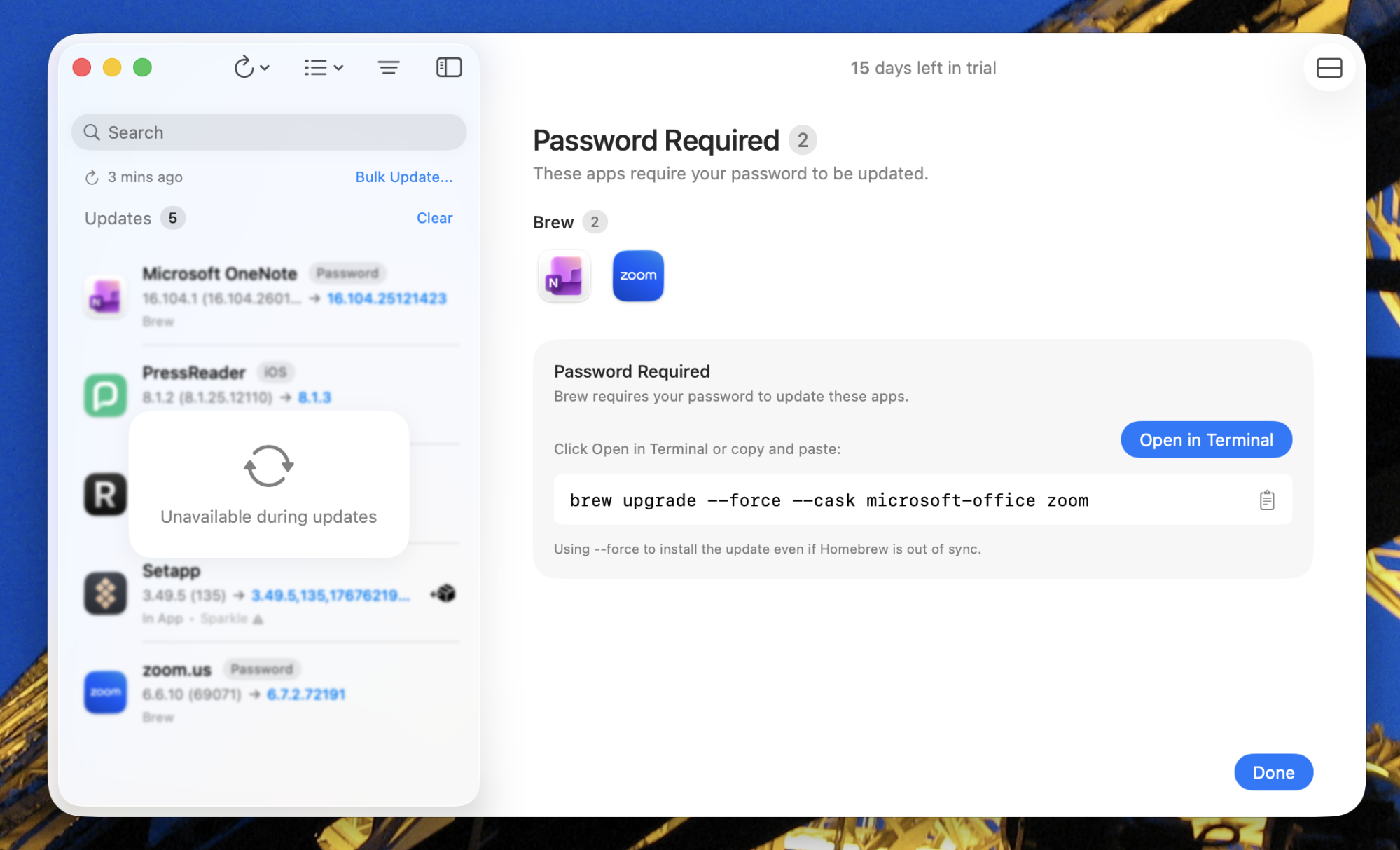
Some updates require passwords, in which case you’ll be asked to run the update command in the Terminal.

Updatest offers to install software in the Terminal

Credit: Justin Pot

And in some cases, applications from the Mac App Store won’t update—in my tests, this was mostly iPad apps I’ve installed. The application will instead give you a link to open the App Store and install the update.

These minor annoyances are inevitable, and not too burdensome. And it’s nice to be able to check all of my applications for updates in once place. If you’re interested, there’s a 15-day free trial, allowing you to get a feel for how the application works. After that you can buy a personal license, which works on up to three Macs, for $9.99; a household license, which works on up to 10 Macs, costs $19.99.

Never-Before-Seen Linux Malware Is ‘Far More Advanced Than Typical’

An anonymous reader quotes a report from Ars Technica: Researchers have discovered a never-before-seen framework that infects Linux machines with a wide assortment of modules that are notable for the range of advanced capabilities they provide to attackers. The framework, referred to as VoidLink by its source code, features more than 30 modules that can be used to customize capabilities to meet attackers’ needs for each infected machine. These modules can provide additional stealth and specific tools for reconnaissance, privilege escalation, and lateral movement inside a compromised network. The components can be easily added or removed as objectives change over the course of a campaign.

VoidLink can target machines within popular cloud services by detecting if an infected machine is hosted inside AWS, GCP, Azure, Alibaba, and Tencent, and there are indications that developers plan to add detections for Huawei, DigitalOcean, and Vultr in future releases. To detect which cloud service hosts the machine, VoidLink examines metadata using the respective vendor’s API. Similar frameworks targeting Windows servers have flourished for years. They are less common on Linux machines. The feature set is unusually broad and is “far more advanced than typical Linux malware,” said researchers from Checkpoint, the security firm that discovered VoidLink. Its creation may indicate that the attacker’s focus is increasingly expanding to include Linux systems, cloud infrastructure, and application deployment environments, as organizations increasingly move workloads to these environments. “VoidLink is a comprehensive ecosystem designed to maintain long-term, stealthy access to compromised Linux systems, particularly those running on public cloud platforms and in containerized environments,” the researchers said in a separate post. “Its design reflects a level of planning and investment typically associated with professional threat actors rather than opportunistic attackers, raising the stakes for defenders who may never realize their infrastructure has been quietly taken over.”

The researchers note that VoidLink poses no immediate threat or required action since it’s not actively targeting systems. However, defenders should remain vigilant.


Read more of this story at Slashdot.

Matthew McConaughey fights unauthorized AI likenesses by trademarking himself

Matthew McConaughey filed trademark applications to prevent his likeness from being used by AI companies without permission, and the US Patent and Trademark Office has approved eight so far. According to the Wall Street Journal, the trademarks were for video and audio clips featuring the actor staring, smiling and talking. One was for a video of him standing on a porch, while another was for an audio recording of him saying “alright, alright, alright,” his signature catchphrase from the movie Dazed and Confused.

Under the law, it’s already prohibited for companies to steal someone’s likeness to sell products. However, McConaughey is taking a proactive approach due to the nebulous rules around the use of someone’s likeness for artificial intelligence and what’s considered commercial use involving the technology. His lawyer, Kevin Yorn, admits that they don’t know how the court would decide if an offender challenges the trademarks. But they’re hoping that the threat of a lawsuit would deter companies from using McConaughey’s likeness for AI in the first place. Actors have been trying to protect themselves from AI since the technology blew up, and it was one of the sticking points in the negotiations between SAG-AFTRA and Hollywood studios when the labor union went on a strike in 2023.

McConaughey isn’t anti-AI by any means: He is an investor in ElevenLabs and has partnered with the AI startup to create a Spanish version of his newsletter. He said in a statement sent to The Journal that he just wants to make sure that if his voice or likeness is ever used, it’s because he approved and signed off on it. “We want to create a clear perimeter around ownership with consent and attribution the norm in an AI world,” he added.

This article originally appeared on Engadget at https://www.engadget.com/ai/matthew-mcconaughey-fights-unauthorized-ai-likenesses-by-trademarking-himself-130000567.html?src=rss

Tesla’s Full Self-Driving is switching to a subscription-only service

Tesla will stop selling its $8,000 Full Self-Driving (FSD) option and make it strictly a monthly subscription service after February 14, CEO Elon Musk announced on his X platform. Musk didn’t reveal the price or why he’s making the switch, though FSD is already available by subscription for $99 per month or $999 per year. 

The shift could be advantageous for buyers, particularly if they decide to dump their new Tesla or trade it in. It will also allow prospective owners to hedge their bets, as Tesla has overpromised on the feature since it was first announced. 

Tesla will stop selling FSD after Feb 14.

FSD will only be available as a monthly subscription thereafter.

— Elon Musk (@elonmusk) January 14, 2026

Full Self-Driving has never done what the name suggests as humans must constantly supervise the system and frequently take control. Because of that, it’s more of a “driver assist” system and doesn’t even qualify as Level 3 self-driving (conditional automation), let alone as a truly autonomous Level 4 or Level 5 category. Musk has been touting self-driving capabilities on Tesla vehicles since 2015, promising at the time “complete autonomy” by 2018. 

Branding for the system as “Autopilot” and “Full Self-Driving” has been called out as false advertising by consumer watchdogs and government for years, but so far, regulators have yet to take action. A California judge recently ruled that Tesla used “deceptive language to market Autopilot and recommended suspending Tesla’s sales in the state for 30 days. However, the company has 90 days to comply and could still avoid punishment.  

This article originally appeared on Engadget at https://www.engadget.com/transportation/evs/teslas-full-self-driving-is-switching-to-a-subscription-only-service-120053137.html?src=rss

UK scraps digital ID requirement for workers

The UK government has backtracked on a plan to require all workers to have a digital ID following a backlash. It will no longer be mandatory to register with the digital ID program to prove one has the right to work in the country, as the BBC reports.

The government announced the now-scrapped digital ID requirement in September. “You will not be able to work in the United Kingdom if you do not have digital ID,” Prime Minister Sir Keir Starmer said at the time. “It’s as simple as that.” 

The government still plans to fully transition to digital right-to-work checks by 2029, using the likes of biometric passports, as it seeks to do away with paper-based systems. Those are “open to fraud and abuse,” a government spokesperson said. 

Officials have still not explained exactly how the digital ID program will work. The government originally framed digital IDs as a way to make it easier to identify immigrants who are working in the country without having the legal right to do so. It is now said to be focusing more on pressing home the message that digital IDs will help people access public services. 

A service called One Login will be part of the digital ID system — this currently can be used for things like applying for a veteran card and canceling a lost passport. More than 12 million people have signed up so far. Another service called Wallet will let people store their digital ID on their phone. This would contain their name, date of birth, nationality, residence status and a photo.

Almost 3 million people signed an official parliamentary petition to protest the introduction of digital IDs. “We think this would be a step towards mass surveillance and digital control, and that no one should be forced to register with a state-controlled ID system,” the petition states. “We oppose the creation of any national ID system.”

This article originally appeared on Engadget at https://www.engadget.com/cybersecurity/uk-scraps-digital-id-requirement-for-workers-105740207.html?src=rss

NASA, Department of Energy To Develop Lunar Surface Reactor By 2030

NASA and the U.S. Department of Energy plan to deploy a nuclear fission reactor on the Moon by 2030 to provide continuous, long-duration power for lunar bases, science missions, and future Mars exploration. space & defense reports: NASA said fission surface power will provide a critical capability for long-duration missions by delivering continuous, reliable electrical power independent of sunlight, lunar night cycles or extreme temperature conditions. Unlike solar-based systems, a nuclear reactor could operate for years without refuelling, supporting habitats, science payloads, resource utilisation systems and surface mobility.

NASA Administrator Jared Isaacman said achieving long-term human presence on the Moon and future missions to Mars will require new approaches to power generation. He said closer collaboration with the Department of Energy is essential to delivering the capabilities needed to support sustained exploration and infrastructure development beyond Earth orbit. The fission surface power system is expected to produce safe, efficient and scalable electrical power, forming a foundational element of NASA’s Moon-to-Mars architecture. Continuous power availability is seen as a key enabler for permanent lunar bases, in-situ resource utilisation and expanded scientific operations in permanently shadowed regions. Further reading: You Can Now Reserve a Hotel Room On the Moon For $250,000


Read more of this story at Slashdot.