
Trump administration imposes a 25 percent tariff on high-end chips

President Trump has signed a proclamation imposing a 25 percent tariff on “certain advanced computing chips,” the White House has announced. As The New York Times notes, the administration previously threatened much bigger and broader tariffs for chips. Trump even said that he was going to impose a 100 percent tariff on companies unless they invest on semiconductor manufacturing in the United States.

The new tariff will only affect advanced chips imported into the US and are meant to be re-exported to other countries to sell. In its announcement, the White House specifically named AMD MI325X and NVIDIA H200 as two products that will be affected by the tariff. The president recently approved H200 for export to China, saying that it isn’t NVIDIA’s most advanced AI chip anyway and that the company now has newer and more powerful products, such as its Blackwell semiconductors. “[W]e’re going to be making 25 percent on the sale of those chips, basically,” Trump said.

Semiconductors imported into the US for use in products to be sold in America or for use in data centers in the country, will not be affected by the new tariff. “This tariff will not apply to chips that are imported to support the buildout of the US technology supply chain and the strengthening of domestic manufacturing capacity for derivatives of semiconductors,” the White House wrote. But that could still change: The administration said that it may still impose broader tariffs on semiconductor imports and the products that use them in the near future.

This article originally appeared on Engadget at https://www.engadget.com/big-tech/trump-administration-imposes-a-25-percent-tariff-on-high-end-chips-140000138.html?src=rss
OpenAI quietly rolls out a dedicated ChatGPT translation tool

OpenAI has debuted a dedicated ChatGPT-powered translation tool. While folks have been using the main chatbot for translation for some time, you can now find ChatGPT Translate on its own webpage, as Android Authority spotted. 

The tool can translate text, voice inputs and images into more than 50 languages in seconds, OpenAI says. There’s an automatic language detection function too.

Most interestingly, ChatGPT Translate can rewrite the output to take various contexts and tones into account, much in the same way that more general text-generating AI tools can do. With a single tap, it can rewrite the translation into something “more fluent,” for a business formal audience, to make it more child-friendly or for academic purposes. The tool’s webpage says ChatGPT Translate understands “tone, idioms and context.”

While those tone and context considerations are intriguing, ChatGPT Translate is a little underbaked compared with the likes of Google Translate — which has been around for decades and just got its own Gemini-based makeover with better support for understanding idioms and slang. The desktop version of ChatGPT Translate does not yet allow for voice inputs, though the mobile one does, as Android Authority notes. Despite claims that ChatGPT can translate text in an image, there’s currently no way to upload one to the tool. There’s no website, document or handwriting translation support as yet either. 

Perhaps most crucially, ChatGPT Translate lives on a webpage right now and there’s no dedicated app. So using it offline appears to be out of the question as things stand. No app with on-device translation support could make ChatGPT Translate a no-go for travelers in rural areas with no Internet access. There’s no support for translating real-time conversations as yet either. Google’s Pixel 10, on the other hand, now supports voice translations for calls.

It’s not exactly clear when ChatGPT Translate debuted — it arrived with zero fanfare from OpenAI. There’s a snapshot of the webpage from November on The Internet Archive’s Wayback Machine that looks just like the current one, but that may have simply been a case of OpenAI testing a live version of the tool. 

This article originally appeared on Engadget at https://www.engadget.com/ai/openai-quietly-rolls-out-a-dedicated-chatgpt-translation-tool-133000974.html?src=rss

‘Pipit’ Is a Great Voice-to-Text App for Mac, and It’s Free

Say what you will about AI (and I’ve said plenty) but the progress in transcription and speech-to-text software is genuinely impressive. Whereas before such software was either clumsy or expensive, there are now all kinds of great open source tools that work well.

Which brings me to Pipit, a free Mac dictation app that works offline, meaning it’s totally private. Even more interesting, it can be used to do more than just transcribe speech—it can launch apps, toggle settings, and even launch a web search or query an AI service.

The first time you open the application, it will ask for permission to use your microphone before downloading the Parakeet model for offline transcription. Once everything is set up you can use the application by pressing and holding the Option key, then talking—the application will record what you say, turn that into text, and paste the text into the currently active text field.

I’ve been trying this for a couple of days and find that the transcriptions are generally pretty accurate, complete with punctuation. There is optional post-processing, which can turn unstructured speech into a properly formatted document, but using that requires an OpenRouter API key.

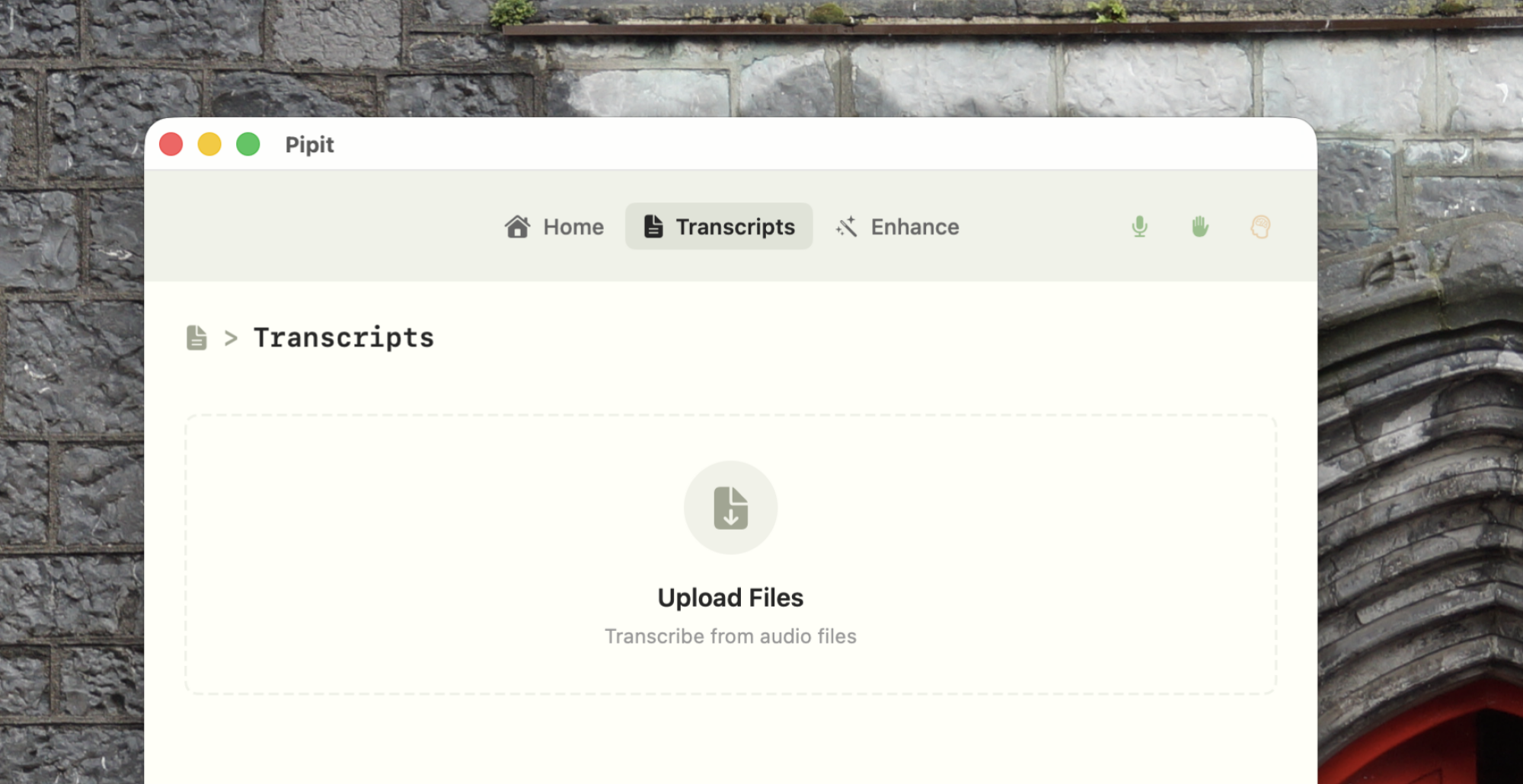
The settings window lets you change the trigger key, choose an input device, and toggle the menu bar icon. There’s also a tool for transcribing audio files, complete with speaker identification. Just drag over a file and you get a transcription.

The uploads screen for Pipit
The uploads screen for Pipit, allowing you to transcribe audio files.
Credit: Justin Pot

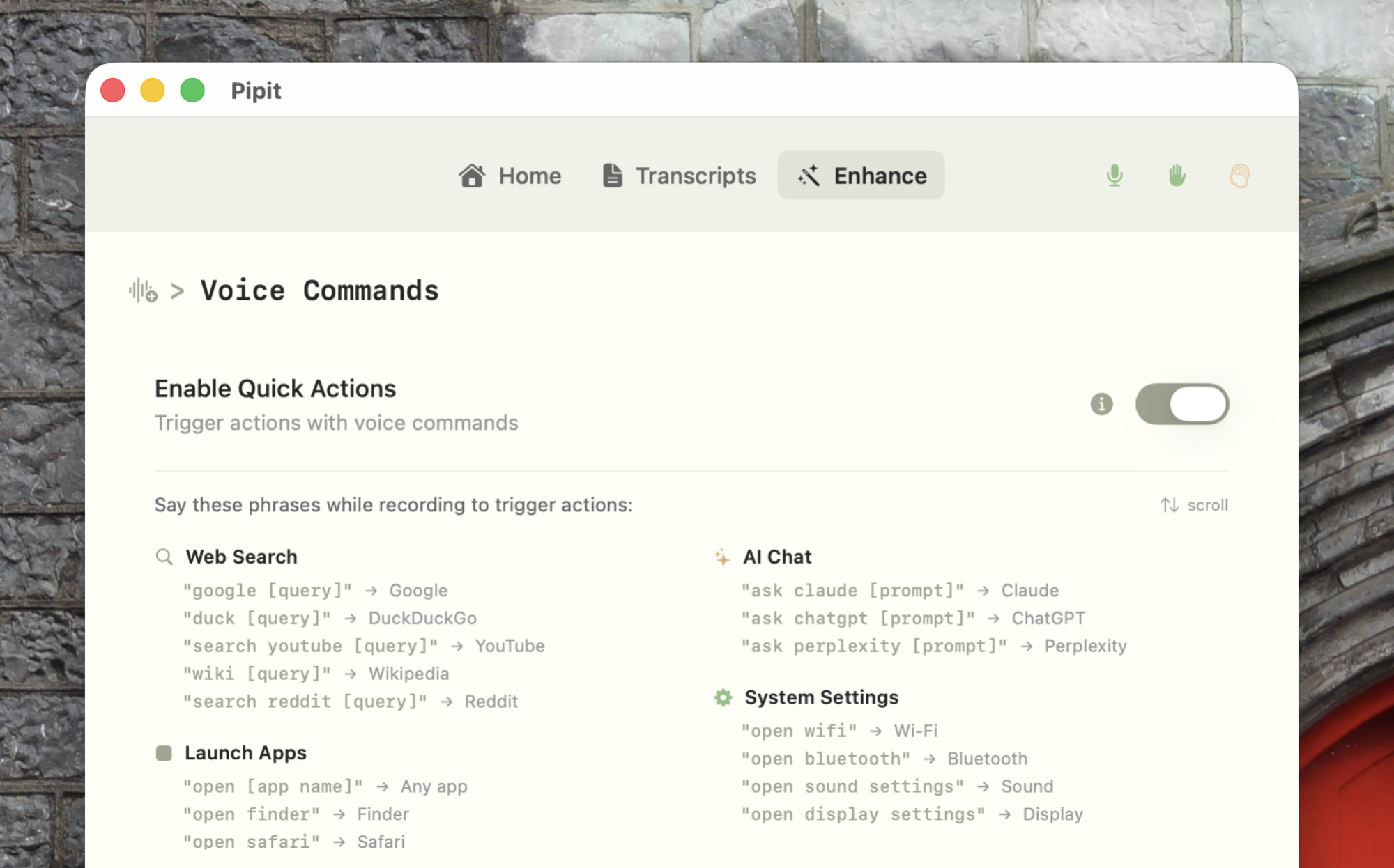
Finally, on the Enhance tab, you can enable the Quick Actions feature. This allows you to verbally tell your computer what to do and see it happen. To use this, start transcription as normal, but say something like “open Safari” to open an app or “ask Claude” followed by a question to launch a conversation with that AI assistant in your browser. It’s a little gimmicky, granted, but I enjoyed using it.

Pipit settings
The voice commands you can use with Pipit, as seen in the settings.
Credit: Justin Pot

It’s excellent that tools like this are broadly free now, and Pipit has an interesting collection of features.

Spotify is getting a buck more expensive in February

Spotify is raising the prices for its premium subscriptions by $1 to $2 across the board, starting this February. Those are similar figures to the company’s last price hike in 2024. Subscribers across the US, Estonia and Latvia will soon receive an email, notifying them that they’ll be paying a larger amount for their February bill.

The streaming service said it’s raising its prices occasionally to “reflect the value that Spotify delivers,” “to continue offering the best possible experience” and to “benefit artists.” It reported last year that it paid out $10 billion to music rights-holders in 2024. However, it’s worth noting that several Grammy-nominated songwriters boycotted an awards event it hosted to protest the supposed decreasing royalties songwriters are getting from Spotify plays.

Subscribers who choose to keep their accounts will now have to pay $13 instead of $12 a month for an individual plan or $7 instead of $6 for a student plan. The Duo plan will now cost users $19 a month instead of $17, while the Family plan will cost them $22, up $2 from its previous price of $20. Meanwhile, those who decide to cancel their plans can follow our guide right here.

Spotify came under fire late last year for running recruitment ads for ICE. It said the advertisements were part of a larger campaign by the US government that ran across platforms, including Meta and Google. The company also recently confirmed that the campaign has ended that there are no ICE ads currently running on the service.

This article originally appeared on Engadget at https://www.engadget.com/entertainment/music/spotifys-getting-a-buck-more-expensive-in-february-132300118.html?src=rss

FTC finalizes GM punishment over driver data sharing scandal

After reaching a proposed settlement last year, the FTC has banned General Motors from sharing specific consumer data with third parties, TechCrunch reported. The finalized order wraps up one of the more egregious cases of a corporation collecting its customers’ data and then using it against them. 

Two years ago, the New York Times report released a report detailing how GM’s OnStar “Smart Driver” program collected and sold detailed geolocation and driving behavior data to third parties, including data brokers. Those brokers in turn sold the data to insurance providers, which jacked up the rates for some drivers based on the data. “It felt like a betrayal,” said a Chevy Bolt owner that saw his insurance rise by 21 percent based on the data. “They’re taking information that I didn’t realize was going to be shared and screwing with our insurance.”

According to the terms of the settlement, GM is barred from sharing specific user data with consumer reporting agencies for a five year period. The automaker is also required to request user permission before collecting, using or sharing vehicle data with any third party. It must do that when a consumer purchases a car at a dealership, with the customer asked in person whether they agree or not with the data collection, GM said. 

Some of the settlement is moot as GM stopped its Smart Driver program for all brands in April 2024. The company unenrolled all customers and stopped its third-party relationship with LexisNexis and Verisk, the brokers that sold driver data to insurance companies. 

GM faced other actions over the data collection, including lawsuits from Texas, Nebraska and other states. “Our investigation revealed that General Motors has engaged in egregious business practices that violated Texans’ privacy and broke the law. We will hold them accountable,” said Texas AG Ken Paxton at the time. 

In a statement to TechCrunch, GM said: “The Federal Trade Commission has formally approved the agreement reached last year with General Motors to address concerns. As vehicle connectivity becomes increasingly integral to the driving experience, GM remains committed to protecting customer privacy, maintaining trust, and ensuring customers have a clear understanding of our practices.” 

This article originally appeared on Engadget at https://www.engadget.com/transportation/ftc-finalizes-gm-punishment-over-driver-data-sharing-scandal-130012313.html?src=rss

AI Models Are Starting To Crack High-Level Math Problems

An anonymous reader quotes a report from TechCrunch: Over the weekend, Neel Somani, who is a software engineer, former quant researcher, and a startup founder, was testing the math skills of OpenAI’s new model when he made an unexpected discovery. After pasting the problem into ChatGPT and letting it think for 15 minutes, he came back to a full solution. He evaluated the proof and formalized it with a tool called Harmonic — but it all checked out. “I was curious to establish a baseline for when LLMs are effectively able to solve open math problems compared to where they struggle,” Somani said. The surprise was that, using the latest model, the frontier started to push forward a bit.

ChatGPT’s chain of thought is even more impressive, rattling off mathematical axioms like Legendre’s formula, Bertrand’s postulate, and the Star of David theorum. Eventually, the model found a Math Overflow post from 2013, where Harvard mathematician Noam Elkies had given an elegant solution to a similar problem. But ChatGPT’s final proof differed from Elkies’ work in important ways, and gave a more complete solution to a version of the problem posed by legendary mathematician Paul Erdos, whose vast collection of unsolved problems has become a proving ground for AI.

For anyone skeptical of machine intelligence, it’s a surprising result — and it’s not the only one. AI tools have become ubiquitous in mathematics, from formalization-oriented LLMs like Harmonic’s Aristotle to literature review tools like OpenAI’s deep research. But since the release of GPT 5.2 — which Somani describes as “anecdotally more skilled at mathematical reasoning than previous iterations” — the sheer volume of solved problems has become difficult to ignore, raising new questions about large language models’ ability to push the frontiers of human knowledge.
Somani examined the online archive of more than 1,000 Erdos conjectures. Since Christmas, 15 Erdos problems have shifted from “open” to “solved,” with 11 solutions explicitly crediting AI involvement.

On GitHub, mathematician Terence Tao identifies eight Erdos problems where AI made meaningful autonomous progress and six more where it advanced work by finding and extending prior research, noting on Mastodon that AI’s scalability makes it well suited to tackling the long tail of obscure, often straightforward Erdos problems.

Progress is also being accelerated by a push toward formalization, supported by tools like the open-source “proof assistant” Lean and newer AI systems such as Harmonic’s Aristotle.


Read more of this story at Slashdot.

The difficulty of driving an EV in the “most beautiful race in the world”

On the first day of this year’s Mille Miglia, a voice rose from the crowds gathered on the shore of Lago di Garda to shout “no sound, no feeling!”at my Polestar 3. Italians love their cars, and they revealed a clear preference for internal combustion engines over the next four days and over 1,200 km of driving. But plenty of other spectators smiled and waved, and some even did a double-take at seeing an electric vehicle amid the sea of modern Ferraris and world-class vintage racers taking on this modern regulation rally.

I flew to Italy to join the Mille Miglia “Green,” which, for the past five years, has sought to raise awareness of sustainability and electric cars amid this famous (some might say infamous) race. And despite mixed reactions from the Italian crowds, our Polestar 3 performed quite well as it traced a historical route from Brescia to Rome and back.

The route snaked a trail through the Italian countryside based on the original speed race’s first 12 outings, but instead of going for overall pace, we spent five days competing against six other EVs for points based on time, distance, and average speed. Our team included a Polestar 2 and 4, and we faced a Mercedes-Benz G 580 with EQ Technology, an Abarth 600e, a Lotus Eletre, and a BYD Denza Z9GT saloon.

Read full article

Comments

ISS mission splashes down after medical issue

The SpaceX Dragon spacecraft carrying the Crew-11 astronauts has splashed down into the ocean after they left the ISS a month earlier than planned due a medical issue. It’s the first time NASA cut a mission short due to a medical concern. The agency didn’t name the crew member and their condition but stated that they were stable and that it wasn’t a case of medical evacuation. NASA merely decided to end the mission early out of an abundance of caution, because the ISS didn’t have the tools for a proper diagnosis.

NASA astronauts Mike Fincke and Zena Cardman, JAXA’s Kimiya Yui and Russian cosmonaut Oleg Platonov — the members of Crew-11 — left for the space station on August 1 and were supposed to stay there until February. Despite the mission being cut early, they still stayed 167 days in space before they made their way back home. The Dragon capsule carrying the members splashed down off the coast of San Diego, California at 3:41AM on January 15. A SpaceX medical doctor was the first person who checked in on them, though that is routine procedure and not because of one member’s medical issue.

With Crew-11 back on Earth, there are now only three people aboard the orbiting lab. Two are Russian cosmonauts, while the other one is NASA astronaut Chris Williams. NASA is now looking at options to be able to send Crew-12 to the ISS earlier than its planned February 15 launch.

LIVE: After undocking from the @Space_Station, Crew-11 is on their way back to Earth. Tune in to watch them splash down off the coast of California, scheduled for 3:41am ET (0841 UTC). https://t.co/mIUojli3XW

— NASA (@NASA) January 15, 2026

This article originally appeared on Engadget at https://www.engadget.com/science/space/iss-mission-splashes-down-after-medical-issue-103000302.html?src=rss

Warhammer Maker Games Workshop Bans Its Staff From Using AI In Its Content or Designs

Games Workshop, the owner and operator of a number of hugely popular tabletop war games, including Warhammer 40,000 and Age of Sigmar, has banned the use of generative AI in its content and design processes. IGN reports: Delivering the UK company’s impressive financial results, CEO Kevin Rountree addressed the issue of AI and how Games Workshop is handling it. He said GW staff are barred from using it to actually produce anything, but admitted a “few” senior managers are experimenting with it. Rountree said AI was “a very broad topic and to be honest I’m not an expert on it,” then went on to lay down the company line:

“We do have a few senior managers that are [experts on AI]: none are that excited about it yet. We have agreed an internal policy to guide us all, which is currently very cautious e.g. we do not allow AI generated content or AI to be used in our design processes or its unauthorized use outside of GW including in any of our competitions. We also have to monitor and protect ourselves from a data compliance, security and governance perspective, the AI or machine learning engines seem to be automatically included on our phones or laptops whether we like it or not.

We are allowing those few senior managers to continue to be inquisitive about the technology. We have also agreed we will be maintaining a strong commitment to protect our intellectual property and respect our human creators. In the period reported, we continued to invest in our Warhammer Studio — hiring more creatives in multiple disciplines from concepting and art to writing and sculpting. Talented and passionate individuals that make Warhammer the rich, evocative IP that our hobbyists and we all love.”


Read more of this story at Slashdot.

A car you can chat with and that gets you? Volvo dishes on AI-wielding EX60.

Next week, Volvo shows off its new EX60 SUV to the world. It’s the brand’s next electric vehicle, one built on an all-new, EV-only platform that makes use of the latest in vehicle design trends, like a cell-to-body battery pack, large weight-saving castings, and an advanced electronic architecture run by a handful of computers capable of more than 250 trillion operations per second. This new software-defined platform even has a name: HuginCore, after one of the two ravens that collected information for the Norse god Odin.

It’s not Volvo’s first reference to mythology. “We have Thor’s Hammer [Volvo’s distinctive headlight design] and now we have HuginCore… one of the two trusted Ravens of Oden. He sent Hugin and Muninn out to fly across the realms and observe and gather information and knowledge, which they then share with Odin that enabled him to make the right decisions as the ruler of Asgard,” said Alwin Bakkenes, head of global software engineering at Volvo Cars.

“And much like Hugin, the way we look at this technology platform, it collects information from all of the sensors, all of the actuators in the vehicle. It understands the world around the vehicle, and it enables us to actually anticipate around what lies ahead,” Bakkenes told me.

Read full article

Comments

Britain Awards Wind Farm Contracts That Will Power 12 Million Homes

The UK government has awarded guaranteed electricity prices to offshore wind projects totaling 8.4 GW in a bid to revive wind development, attract nearly $30 billion in private investment, and stabilize energy costs. The New York Times reports: On Wednesday, the British government said that it would provide guaranteed electricity prices for a group of wind farms off England, Scotland and Wales that would, once built, provide power for 12 million homes. The 8.4 gigawatts, a power capacity measure, that won support is the largest amount that has been achieved in an auction in Britain. The government said that these wind farms could lead to 22 billion pounds, or almost $30 billion, in private investment.

The government holds regular auctions, roughly on an annual basis. Results have been improving after a failed auction in 2023 that produced no bids from developers. The government almost doubled its original budget for the recent auction to about 1.8 billion pounds per year. To encourage renewable energy sources like offshore wind, Britain offers a price floor to provide certainty for investors. The average floor, or strike price, from the auction on Wednesday was about 91 pounds, or $122 per megawatt-hour, in 2024 prices, up about 11 percent from the last auction.

Over the past year the wholesale price for electricity in Britain was on average about 79 pounds, according to Drax Electric Insights, a market analysis website. The bulk of the planned wind farms that won price supports will be off eastern England. Support will also go to wind farms off Scotland and Wales. The British government wants at least 95 percent of the country’s electricity generation to come from clean sources by 2030. Political consensus for ambitious climate goals is eroding in Britain, but the government of Prime Minister Keir Starmer believes that an enormous bet on clean energy, especially offshore wind, is necessary to protect consumers from volatile fossil fuel prices.


Read more of this story at Slashdot.

The Swedish Start-Up Aiming To Conquer America’s Full-Body-Scan Craze

An anonymous reader quotes a report from DealBook: Fifteen years ago, Daniel Ek broke into America’s digital-content wars with his streaming music start-up, Spotify, which has turned into a publicly traded company with a $110 billion market value. Now he and his business partner, the Swedish entrepreneur Hjalmar Nilsonne, aim to crack a higher-stakes consumer market: American health care. The pair plan to bring Neko Health, the health tech start-up they founded in 2018, to New York this spring, DealBook is first to report.

Mr. Ek and Mr. Nilsonne hope to capitalize on the growing number of prevention-minded Americans who are hungry to track their biometric data. Whether through wearables like Oura rings or more intensive screenings, consumers are turning to technology to improve their health and help spot the early onset of some big killers, including cardiovascular and metabolic diseases. The United States will be the third market, after Sweden and Britain, for Neko Health, which offers full-body diagnostic scans and is valued at roughly $1.7 billion.

[…] Mr. Nilsonne and Mr. Ek said Neko Health’s big aim was to change the health care model, in which spending across much of the developed world skyrockets but longevity gains have stalled. They want to make their noninvasive scans as routine as an annual checkup. The company, which advertises its service as “a health check for your future self,” did not say what the U.S. scans would cost. But in Stockholm, an hourlong visit at one of its clinics costs 2,750 Swedish krona (about $300). Prenuvo’s and Ezra’s most comprehensive scans can cost $3,999.

[…] Neko Health’s technology differs from that of many of its U.S. rivals. It does not use M.R.I. or X-rays, instead relying on scores of sensors and cameras and a mix of proprietary and off-the-shelf technologies to measure heart function and circulation, and to photograph and map every inch of a patient’s body looking for cancerous lesions. At the moment, the company’s biggest challenge is scaling.

[…] Mr. Nilsonne said Neko Health scans have detected the early onset of diseases or serious medical conditions for thousands of its patients. But the medical community is divided on the need for proactive screening technologies. The fear is that mass adoption could spur a wave of false positives and send healthy people to seek follow-up medical advice, overwhelming an already swamped health care system. Mr. Ek and Mr. Nilsonne believe they have built a better solution. And now they’re ready to test it in the U.S. market.


Read more of this story at Slashdot.

Are QWERTY Phones Trying To Make a Comeback?

After nearly two decades of touchscreen dominance, QWERTY smartphones are staging a niche comeback, with Clicks and Unihertz unveiling new physical-keyboard phones at CES 2026. Gizmodo reports: At CES 2026, Clicks, the company behind the Clicks keyboard case and the new Power Keyboard, announced plans to sell the Communicator, a “second phone” with a QWERTY keypad. Clicks pitches the $500 phone, launching later this year, as a device primarily intended for messaging — sending texts, DMs, Slack messages, whatever. The company didn’t have a functional unit — only a mockup dummy to fondle at the show — but it looked cool enough, even if it’ll be a very niche product. It’s a cool idea, but how many people will carry a companion phone to their main phone just to shoot off a few DMs? $500 is a lot to ask for that satisfaction.

But Clicks isn’t the only one trying to bring back QWERTY phones. Unihertz, makers of the really tiny Jelly Android phones and also Tank phones with massive battery capacities, also teased a new phone with a physical keyboard. The Titan 2 Elite seems to be a less gimmicky version of the Titan 2, which itself was a BlackBerry Passport knockoff but with a bizarre square screen on the backside.

Look closely, and there are some weird similarities between the Clicks Communicator and the Titan 2 Elite. We don’t have dimension specs yet, but the screens seem to have the same rounded corners, and even the hole-punch camera is in the same upper-left corner. The only difference seems to be the keyboards; the Communicator uses individual keys, whereas the Titan 2 Elite’s keyboard is more BlackBerry-esque. After digging into the Clicks Communicator’s specs, a few other features stood out that Slashdotters might appreciate. There’s a dedicated 3.5mm headphone jack, a physical “kill switch” (essentially an alert slider), fingerprint scanner and even a customizable notification LED. The last time we saw a phone with a dedicated notification LED was around 2019!


Read more of this story at Slashdot.

Digg Launches Its New Reddit Rival To the Public

Digg is officially back under the ownership of its original founder, Kevin Rose, along with Reddit co-founder Alexis Ohanian. “Similar to Reddit, the new Digg offers a website and mobile app where you can browse feeds featuring posts from across a selection of its communities and join other communities that align with your interests,” reports TechCrunch. “There, you can post, comment, and upvote (or ‘digg’) the site’s content.” From the report: [T]he rise of AI has presented an opportunity to rebuild Digg, Rose and Ohanian believe, leading them to acquire Digg last March through a leveraged buyout by True Ventures, Ohanian’s firm Seven Seven Six, Rose and Ohanian themselves, and the venture firm S32. The company has not disclosed its funding. They’re betting that AI can help to address some of the messiness and toxicity of today’s social media landscape. At the same time, social platforms will need a new set of tools to ensure they’re not taken over by AI bots posing as people.

“We obviously don’t want to force everyone down some kind of crazy KYC process,” said Rose in an interview with TechCrunch, referring to the ‘know your customer’ verification process used by financial institutions to confirm someone’s identity. Instead of simply offering verification checkmarks to designate trust, Digg will try out new technologies, like using zero-knowledge proofs (cryptographic methods that verify information without revealing the underlying data) to verify the people using its platform. It could also do other things, like require that people who join a product-focused community verify they actually own or use the product being discussed there.

As an example, a community for Oura ring owners could verify that everyone who posts has proven they own one of the smart rings. Plus, Rose suggests Digg could use signals acquired from mobile devices to help verify members — for instance, the app could identify when Digg users attended a meetup in the same location. “I don’t think there’s going to be any one silver bullet here,” said Rose. “It’s just going to be us saying … here’s a platter of things that you can add together to create trust.”


Read more of this story at Slashdot.

‘Are You Dead Yet’ App A Viral Hit In China

‘Are You Dead Yet’ is an app recently released in China that asks a user daily if they’re still alive. After two missed button-press confirmations, it notifies the emergency contact they entered when they signed up via an email. I want to read that email.

[App developer] Guo and his colleagues initially charged users a one-time payment of 1 RMB (14 cents) to use the app; amid the heightened attention this week, they raised the price to 8 RMB ($1.15), still a minimal amount considering there’s no subscription required.

“On Tuesday, the developers announced on Chinese social media that Are You Dead Yet would officially change its name to Demumu in order to better serve the global market. That name, which was also used for the app’s overseas version previously, was inspired by another Chinese business success. Guo says Demumu is a combination of the word “death” and the naming pattern of Labubu”

Really, trying to hitch your wagon to the Labubu star? That’s a mistake if you ask me — Labubu is already on its way out. Besides, the original name was half the appeal. Are You Dead Yet? For quite some time now, just look at my eyes. “Super glassy.” Right? And that’s not just all the gin and tonics talking either.

Cerebras Scores OpenAI Deal Worth Over $10 Billion

Cerebras Systems landed a more than $10 billion deal to supply up to 750 megawatts of compute to OpenAI through 2028, according to a blog post by OpenAI. CNBC reports: The deal will help diversify Cerebras away from the United Arab Emirates’ G42, which accounted for 87% of revenue in the first half of 2024. “The way you have three very large customers is start with one very large customer, and you keep them happy, and then you win the second one,” Cerebras’ co-founder and CEO Andrew Feldman told CNBC in an interview.

Cerebras has built a large processor that can train and run generative artificial intelligence models. […] “Cerebras adds a dedicated low-latency inference solution to our platform,” Sachin Katti, who works on compute infrastructure at OpenAI, wrote in the blog. “That means faster responses, more natural interactions, and a stronger foundation to scale real-time AI to many more people.”

The deal comes months after OpenAI worked with Cerebras to ensure that its gpt-oss open-weight models would work smoothly on Cerebras silicon, alongside chips from Nvidia and Advanced Micro Devices. OpenAI’s gpt-oss collaboration led to technical conversations with Cerebras, and the two companies signed a term sheet just before Thanksgiving, Feldman said in an interview with CNBC. The report notes that this deal helps strengthen Cerebras’ IPO prospects. The $10+ billion OpenAI deal materially improves revenue visibility, customer diversification, and strategic credibility, addressing key concerns from its withdrawn filing and setting the stage for a more compelling refile with updated financials and narrative.


Read more of this story at Slashdot.

Piano That Lights Up Bioluminescent Algae As It’s Played

This is an entirely non-CGI video created by He Tongxue of HTX Studio featuring a piano keyboard attached to a tank filled with bioluminescent algae. As the piano is played it releases air bubbles, disturbing the algae and making them glow around the bubbles as they travel to the top. How whimsical! And you know how I feel about whimsy. “It’s all you have left in the world.” And it’s getting harder and harder to find, like decent candy cigarettes.

DoorDash and UberEats Cost Drivers $550 Million In Tips, NYC Says

An anonymous reader quotes a report from Gothamist: City regulators on Tuesday accused Uber and DoorDash of deliberately altering their app interfaces to discourage customers from tipping food delivery workers, a move that has cost the employees more than $550 million over the last two years. A report (PDF) published by the Department of Consumer and Worker Protection argues that food delivery app giants retaliated against minimum wage rules for delivery drivers that took effect in December 2023 by implementing “design tricks” that obscure opportunities to offer a tip in their mobile apps.

DoorDash explicitly blames the new wage rules for removing the simpler tipping option. “In response to regulations in New York City, you will now only be able to add a tip for your Dasher after they have been assigned,” a message on the app’s checkout page states. Other food delivery apps like GrubHub allow customers the option to add a tip before checking out. The average tip for DoorDash and Uber Eats drivers in the city fell from $2.17 to 76 cents per delivery after the companies made the changes to their apps, the report found. Both companies also issue messages to customers in the city telling them the prices for their orders were “set by an algorithm using your personal data.” Further reading: Uber and DoorDash Try To Halt NYC Law That Encourages Tipping


Read more of this story at Slashdot.

A British redcoat’s lost memoir resurfaces

History buffs are no doubt familiar with the story of Shadrack Byfield, a rank-and-file British redcoat who fought during the War of 1812 and lost his left arm to a musket ball for his trouble. Byfield has been featured in numerous popular histories—including a children’s book and a 2011 PBS documentary—as a shining example of a disabled soldier’s stoic perseverance. But a newly rediscovered memoir that Byfield published in his later years is complicating that idealized picture of his post-military life, according to a new paper published in the Journal of British Studies.

Historian Eamonn O’Keeffe of Memorial University of Newfoundland in St. John’s, Canada, has been a Byfield fan ever since he read the 1985 children’s novel, Redcoat, by Gregory Sass. His interest grew when he was working at Fort York, a War of 1812-era fort and museum, in Toronto. “There are dozens of memoirs written by British rank-and-file veterans of the Napoleonic Wars, but only a handful from the War of 1812, which was much smaller in scale,” O’Keeffe told Ars. “Byfield’s autobiography seemed to offer an authentic, ground-level view of the fighting in North America, helping us look beyond the generals and politicians and grapple with the implications of this conflict for ordinary people.

Born in 1789 in Wiltshire’s Bradford-on-Avon suburbs, Byfield’s parents intended him to follow in his weaver father’s footsteps. He enlisted in the county militia when he turned 18 instead, joining the regular army the following year. When the War of 1812 broke out, Byfield was stationed at Fort George along the Niagara River, participating in the successful siege of Fort Detroit. At the Battle of Frenchtown in January 1813, he was shot in the neck, but he recovered sufficiently to join the campaigns against Fort Meigs and Fort Stephenson in Ohio.

Read full article

Comments

Pentagon’s “Arsenal of Freedom” tour borrows name from Star Trek episode—about killer AI

This week, SpaceX CEO Elon Musk and Secretary of Defense Pete Hegseth touted their desire to “make Star Trek real”—while unconsciously reminding us of what the utopian science fiction franchise is fundamentally about.

Their Tuesday event was the latest in Hegseth’s ongoing “Arsenal of Freedom” tour, which was held at SpaceX headquarters in Starbase, Texas. (Itself a newly created town that takes its name from a term popularized by Star Trek.)

Neither Musk nor Hegseth seemed to recall that the “Arsenal of Freedom” phrase—at least in the context of Star Trek—is also the title of a 1988 episode of Star Trek: The Next Generation. That episode depicts an AI-powered weapons system, and its automated salesman, which destroys an entire civilization and eventually threatens the crew of the USS Enterprise. (Some Trekkies made the connection, however.)

Read full article

Comments