‘RageCheck’ Points Out Manipulative Language in News Articles

If you don’t like how the internet makes you feel right now, you’re not alone. The entire ecosystem seemingly exists to manipulate you, which can make finding clarity hard. I’ve written about how to avoid anxiety bait, which can be an important step toward healthy and productive engagement, but an important step is recognizing when you’re being manipulated. RageCheck is a potentially useful tool here.

Built using concepts from social science research, this website can analyze any link or screenshot. It points out examples of potentially manipulative language, from us-versus-them framing to emotionally loaded phrasing. “The system analyzes text for linguistic patterns commonly associated with manipulative framing—language optimized to provoke high-arousal reactions over understanding,” says the methodology page. “It does not assess factual accuracy or political bias.”

Using the site is simple: just paste a link to an article and hit Enter. After a few moments, you’ll see a statistical breakdown of the potentially manipulative language in the piece across five categories—emotional heat, us versus them, moral outrage, black-and-white thinking, and fight picking. The article is excerpted below, with examples of these tactics highlighted. In the left panel you’ll see a “Bait Score,” which is an attempt to calculate how manipulative the article is being. Below that, you’ll see a list of the potentially manipulative techniques employed in the article.

None of this is intended to be used as an alternative to fact checking or serve as some kind of truth-detecting machine. “A high score means content uses manipulative framing—it doesn’t mean the underlying claims are false,” says the about page. “Conversely, a low score doesn’t mean content is true.”

It’s worth pointing out that the techniques this tool detects also aren’t necessarily bad. Some news stories really should inspire moral outrage, especially in the context of an opinion piece or editorial. Regardless, there’s still value in identifying those techniques.

Basically, this is a tool that can help you think critically about the media you’re consuming, not do that critical thinking for you. Use it if you want to learn a little bit about the kinds of rhetorical tricks you might be vulnerable to.

Italian regulators are investigating Activision Blizzard’s monetization practices

The Italian Competition Authority (AGCM) has opened two investigations into Microsoft-owned game studio Activision Blizzard, centered around the mobile games Diablo Immortal and Call of Duty: Mobile. The AGCM alleges the free-to-play games use “misleading and aggressive practices” to encourage in-game purchases.

Regulators say the games rely on a “deceptive user interface design” meant to encourage longer and more frequent play sessions while bombarding players with reminders and opportunities to spend real money in-game. Players might be reminded to buy a limited-time item before it’s gone or urged not to miss out on rewards, with in-app messages and push notifications that reach players during and outside gameplay. The authority also raised concerns about virtual currency and in-game currency bundles that can make it harder to understand real-world costs.

Parental control settings are also being scrutinized as the AGCM says the default settings are too permissive, such as allowing in-game purchases and unlimited play time. The watchdog will also investigate potential violations of consumer contractual rights and practices that may encourage players to unknowingly give up those rights, such as the EU’s 14-day right of withdrawal.

Free-to-play games have long leaned on loot boxes and other in-game purchases to drive monetization. Unlike full-priced games like Diablo IV, these systems can blur the line between natural progression and pay-to-win. For an idea of how quickly costs can add up, consider one player who reportedly spent $100,000 on Diablo Immortal.

This article originally appeared on Engadget at https://www.engadget.com/gaming/italian-regulators-are-investigating-activision-blizzards-monetization-practices-135057481.html?src=rss

XREAL files lawsuit against rival smart glass maker Viture

San Francisco-founded Smart glasses maker Viture has been sued in a US court by rival XREAL over claims it infringed on its patents, XREAL announced in a press release. The complaint, lodged in a federal Texas court, accuses Viture of illegally incorporating XREAL’s patented tech into its products including the Luma Pro, Luma Ultra and Beast models. 

“The lawsuit is not merely about enforcing a single patent,” the company wrote. “It is about stopping a pattern of intellectual property infringement that undermines the integrity of innovation and endangers continued technological development in this industry.” 

XREAL has already won a preliminary injunction against Viture in Germany. That resulted in a sales freeze in that country, which could spread to nine other European nations including France, Italy and Spain. That injunction affects Viture’s Pro, Luma and Luma Pro smart glasses.

Both companies make augmented reality (AR) glasses with built-in displays that connect to smartphone or laptops, letting you play games, watch movies or do productivity tasks. Their products offer similar display resolutions and fields of view, both of which are key specifications for those products. 

In response, Viture issued its own statement: “Our product does not infringe upon the cited patent in any way,” the company told Tom’s Guide. “We encourage everyone to look closely at the patent itself and form their own judgment, it becomes clear very quickly how weak and questionable it is. XREAL has simultaneously circulated false claims suggesting that Viture is ‘banned across nine European countries.’ This is entirely untrue.” The company added that it’s taking legal action itself because of XREAL’s comments. 

Viture is a relatively new player in the AR/VR world, but XREAL’s lawsuit could be a prelude to similar actions, judging by the wording in its press release. XREAL holds over 800 patent and patent applications around the world around AR, VR and other tech, and claims that Viture has fewer than 70 and none in the US and Europe. At CES 2026, XREAL unveiled several new products, including the ROG X R1 AR glasses built in conjunction with ASUS. 

This article originally appeared on Engadget at https://www.engadget.com/wearables/xreal-files-lawsuit-against-rival-smart-glass-maker-viture-133018692.html?src=rss

ASUS changes mind, will continue selling the RTX 5070 Ti after all

After telling the YouTube channel Hardware Unboxed that it was putting its RTX 5060 Ti 16GB and 5070 Ti into “end-of-life status,” ASUS has backtracked on those comments and now says the GPUs will remain on sale. 

“Certain media may have received incomplete information from an ASUS PR representative regarding these products,” the company said in a dedicated press release.” The GeForce RTX 5070 Ti and GeForce RTX 5060 Ti 16 GB have not been discontinued or designated as end-of-life (EOL). ASUS has no plans to stop selling these models.”

ASUS further clarified that supply fluctuations, primarily due to memory supply constraints, have temporarily affected production output and stocks. “As a result, availability may appear limited in certain markets, but this should not be interpreted as a production halt or product retirement. ASUS will continue to support the GeForce RTX 5070 Ti and RTX 5060 Ti 16 GB and is working closely with partners to stabilize supply as conditions improve.”

Yesterday, Hardware Unboxed said that ASUS “explicitly told us this model is currently facing a supply shortage and, as such, they have placed the model into end-of-life status.” In a new pinned comment, the channel noted that the new information “completely walks back their original statement to us.”

Hardware Unboxed learned of the shortage by speaking to resellers in Australia, who said that the 5070 Ti is “no longer available to purchase from partners and distributors,” adding they expect that to be the case throughout at least the first quarter of the year. Based on that, along with ASUS’s statement, they released the video in question yesterday. 

Although ASUS now says that it will still make both of those GPUs, being able to buy one could be next to impossible, based on what retailers told Hardware Unboxed. The AI boom has sent the cost of memory soaring, leading to price hikes for GPUs and other PC components. That in turn has led to anger among gamers, and the problem may get much worse before it gets better. 

This article originally appeared on Engadget at https://www.engadget.com/computing/accessories/asus-changes-mind-will-continue-selling-the-rtx-5070-ti-after-all-130934271.html?src=rss

Amazon Is Buying America’s First New Copper Output In More Than a Decade

An anonymous reader quotes a report from the Wall Street Journal: Amazon is turning to an Arizona mine that last year became the first new source of U.S. copper in more than a decade, to meet its data centers’ ravenous appetite for the industrial metal.
The mine was restarted as a proving ground for Rio Tinto’s new method of unlocking low-grade copper deposits. Rio signed a two-year supply pact with Amazon Web Services, a vote of confidence for its Nuton venture, which uses bacteria and acid to extract copper from ore that was previously uneconomical to process. The move by Amazon is the latest example of a technology company rushing to secure the power and critical materials necessary to build and operate artificial-intelligence data centers. The Nuton copper will satisfy only a sliver of Amazon’s needs. The biggest data centers each require tens of thousands of metric tons of copper for all the wires, busbars, circuit boards, transformers and other electrical components housed there. The 14,000 metric tons of copper cathode that Rio expects the Arizona Nuton project to yield over four years wouldn’t be enough for one of those facilities.

Rio deployed its bioleaching process in the recent restart of a mine east of Tucson and has partnerships to take the technology to several others in the Americas. The idea is to uncork the low-grade ore left behind at old mines and is key to Rio’s plans to boost output when new discoveries are harder than ever to bring online and copper demand is surging. […] “We work at the commodity level to find lower carbon solutions to drive our business growth,” said Chris Roe, Amazon’s director of worldwide carbon. “That means steel, and that means concrete, and it absolutely means copper with regard to our data centers.” Roe said the copper will be routed to companies that produce components for Amazon’s data centers. As part of the deal, Amazon is supplying Rio with cloud-computing and data analytics to optimize Nuton’s recovery rates and help the miner expand production.


Read more of this story at Slashdot.

TikTok tightens age verification across Europe

TikTok is bolstering its age-verification measures across Europe. In the coming weeks, the platform will roll out upgraded age-detection tech in the European Economic Area, as well as in the UK and Switzerland.

The systems will assess the likely age of a user based on their profile information and activity. When the tech flags an account that may belong to a user aged under 13 (the minimum age to use TikTok), a specialist moderator will assess whether it should be banned. TikTok will send users in Europe a notification to tell them about these measures and offer them a chance to learn more.

Also, if a moderator is looking at content for other reasons and thinks an account might belong to an underage user, they can flag it to a specialist for further review. Anyone can report an account they suspect is used by someone under 13 as well. TikTok says it removes about 6 million underage accounts in total from the platform every month.

Those whose accounts are banned can appeal if they think their access was wrongly terminated. Users can then provide a government-approved ID, a credit card authorization or selfie for age estimation (the latter process has not gone well for Roblox as of late, as kids found workarounds for age checks).

TikTok acknowledged that there’s no single ideal solution to the issue as things stand. “Despite best efforts, there remains no globally agreed-upon method for effectively confirming a person’s age in a way that also preserves their privacy,” it stated in a blog post. “At TikTok, we’re committed to keeping children under the age of 13 off our platform, providing teens with age-appropriate experiences and continuing to assess and implement a range of solutions. We believe that a multi-layered approach to age assurance — one in which multiple techniques are used — is essential to protecting teens and upholding safety-by-design principles.”

TikTok is rolling out these practices after a pilot in Europe over the last year. That project helped the platform to identify and remove thousands more underage accounts. It worked with the Data Protection Commission (its main privacy regulator in the EU) to help ensure it complied with the bloc’s strict data protection standards.

These measures are coming into force amid intensifying calls to keep kids off social media. A social media ban for under 16s in Australia went into effect last month. Affected platforms have collectively closed or restricted millions of accounts as a result. Reddit has filed a lawsuit over the ban. 

A similar ban might be on the cards in the UK amid public pressure and cross-party support. Prime Minister Keir Starmer said “all options are on the table” and that he was watching “what is happening in Australia.”

The House of Lords is set to vote on proposals for an under-16 social media ban next week. If an amendment passes, members of parliament will hold a binding vote on the matter in the coming months.

This article originally appeared on Engadget at https://www.engadget.com/social-media/tiktok-tightens-age-verification-across-europe-130000847.html?src=rss

Windows 11’s “Chrome Moment”: Why the Desktop Monopoly is Finally Dying-And Why Linux, Android, Or The MacOS Is Likely To Replace It

In the history of technology, there is perhaps no greater cautionary tale of complacency than the death of Internet Explorer. Once the undisputed gatekeeper of the World Wide Web with a 95% market share, it now exists only as a punchline and a technical fossil. Today, we see a chillingly similar pattern emerging with the Windows operating system. As Microsoft struggles to push a reluctant user base toward Windows 11, the platform faces a growing “IE moment” a period where a dominant product becomes so disconnected from its users’ needs that it creates a vacuum for a more agile competitor to fill.

The Chrome Revolution: A Blueprint for Displacement

To understand why Windows is at risk, we must look at how Google Chrome displaced Internet Explorer. In the early 2000s, Microsoft used its OS dominance to bundle IE, effectively suffocating Netscape. However, once the competition was dead, Microsoft stopped innovating. IE became bloated, slow, and famously insecure. It ignored web standards, forcing developers to build “IE-only” sites, which frustrated the burgeoning tech community.

When Google launched Chrome in 2008, it didn’t just compete on features; it changed the paradigm. Chrome introduced the V8 JavaScript engine, which made web applications run orders of magnitude faster than they did on IE. It was minimalist, secure through sandboxing, and updated silently in the background. While Microsoft treated the browser as a static piece of the OS, Google treated it as a living service. By 2012, Chrome surpassed Internet Explorer as the world’s most popular browser. The lesson was clear: ubiquity is not a permanent defense against a superior user experience.

The Windows 11 Resistance: A Billion-Device Bottleneck

The parallels with the current state of Windows are striking. As of January 2026, Windows 11 has failed to achieve the dominance Microsoft envisioned. Despite Windows 10 officially reaching its end-of-life in late 2025, a massive portion of the user base—estimated at nearly 45% of Windows desktops—refuses to upgrade.

The resistance is not merely stubbornness; it is rooted in three distinct categories of friction:

  1. Artificial Hardware Barriers: Microsoft’s strict requirement for TPM 2.0 and specific CPU generations has orphaned hundreds of millions of perfectly functional PCs. Recent reports suggest there is a billion-device bottleneck, consisting of 500 million PCs that cannot upgrade and another 500 million that will not because users see no value in the transition.
  2. Unwanted Feature Bloat: The integration of AI tools like “Recall” (which originally drew heavy fire for privacy concerns) and the constant push for cloud-integrated Microsoft accounts have alienated privacy-conscious power users.
  3. The “If It Ain’t Broke” Factor: For the average user, Windows 11 feels like a cosmetic skin on Windows 10 with more advertising and less control over the user interface.

This stagnation leaves the platform vulnerable. When a dominant player stops serving its customers’ best interests—by forcing hardware refreshes or intrusive telemetry—users begin looking for the exit.

Assessing the Contenders: Who Wins the Desktop?

If Windows follows Internet Explorer into obsolescence, the replacement must be more than just a different brand; it must solve the problems Microsoft has created.

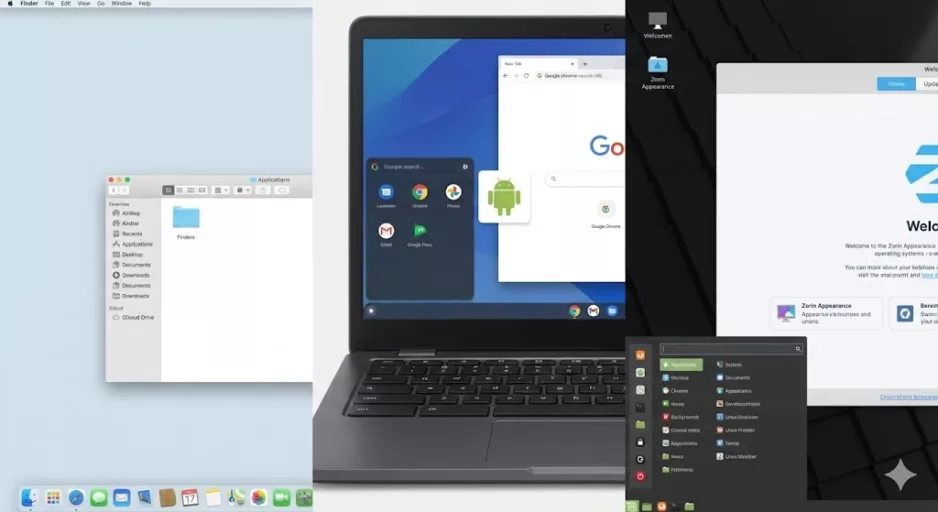
MacOS: The Premium Stronghold Apple is the most obvious beneficiary of Windows friction. MacOS has seen a steady climb to roughly 15-16% of the global desktop market. For users who want a “it just works” experience and are willing to pay the hardware premium, the Mac is a natural destination. However, the closed nature of the Apple ecosystem and the high entry cost mean it is unlikely to ever capture the 70%+ market share Windows currently enjoys.

Desktop Android and ChromeOS Flex Google’s strategy for the desktop mirrors its strategy for the browser: simplify. ChromeOS Flex allows users to turn aging, “incompatible” Windows 10 PCs into fast, cloud-centric machines. While “Desktop Android” remains niche, the convergence of Android apps with ChromeOS makes Google a formidable threat in the education and light-enterprise sectors. If the “browser is the OS” trend continues, Google is perfectly positioned to repeat its Chrome victory but they’ll need to market the result to get people to switch and Google is historically poor at staffing and funding marketing adequately and they have the attention span of a 4-year-old on sugar. They have the funding and the greatest potential, but their historically poor execution offsets both sharply. 

The Rise of the Linux Desktop: Mint and Zorin OS Perhaps the most interesting development in 2025-2026 has been the surge of Linux. The Linux desktop share recently hit a record high of over 6%. Two distributions are leading the “refugee” movement:

  • Linux Mint: Known for its “Cinnamon” desktop, Mint provides a UI that is nearly identical to the Windows 7/10 workflow. It is incredibly stable, respects user privacy, and runs beautifully on older hardware that Windows 11 rejects.
  • Zorin OS: This distribution is designed specifically for Windows switchers. It includes a “Zorin Appearance” tool that can mimic Windows or MacOS layouts with a single click. Following the end of Windows 10 support, Zorin OS reported over one million downloads, with the vast majority coming from Windows users looking for a safe harbor.

The Verdict: The Most Likely Replacement

If Windows truly collapses, no single OS will likely hold a 90% monopoly again. Instead, we will see a fragmented landscape. MacOS will dominate the high-end and creative professional space, while ChromeOS will capture the budget and education sectors.

However, for the traditional PC power user and the “orphaned” hardware market, Linux (specifically Zorin OS and Mint) is the most likely functional successor. Unlike MacOS, Linux can run on existing hardware. Unlike Android, it offers a full-powered desktop experience. For the first time in thirty years, the “Year of the Linux Desktop” isn’t a meme; it’s a migration strategy for a billion users who feel abandoned by Redmond.

Wrapping Up

Microsoft is currently walking the same path of complacency that led to Internet Explorer’s demise. By prioritizing AI telemetry and forced hardware upgrades over user trust and compatibility, they have created the perfect conditions for a mass exodus. While Windows 11 will likely remain the corporate standard for the next few years due to legacy software, the consumer and small business markets are rapidly reaching a breaking point. Whether the future is the polished simplicity of MacOS or the privacy-focused flexibility of Linux, the era of the Windows monopoly is finally drawing to a close.

The Morning After: ASUS stops making some NVIDIA GPUs due to memory supply crunch

If you thought we were exaggerating, the hunger for memory and GPUs is making many companies reassess their priorities. YouTube channel Hardware Unboxed discovered ASUS has stopped producing the RTX 5070 Ti and 5060 Ti 16GB due to the ongoing memory crunch. Both GPUs are 16GB models, making them more expensive to manufacture in the current climate.

“Demand for GeForce RTX GPUs is strong, and memory supply is constrained. We continue to ship all GeForce SKUs and are working closely with our suppliers to maximize memory availability,” an NVIDIA spokesperson told Engadget.

At CES 2026, we saw PCs and computing in the next 12 months will have higher prices and more limited availability for consumers. At the end of 2025, RAM prices skyrocketed, driven by demand from AI data centers. That’s not stopping anytime soon.

— Mat Smith

The other big stories (and deals) this morning


Matthew McConaughey just trademarked himself

In the fight against AI.

TMA
Getty

Matthew McConaughey filed trademark applications to prevent AI companies from using his likeness without permission, and the US Patent and Trademark Office has approved eight so far.

Trademarks were for video and audio clips featuring the actor staring, smiling and talking. One was for an audio recording of him saying “alright, alright, alright,” his catchphrase from the movie Dazed and Confused. Under the law, it’s already prohibited for companies to steal someone’s likeness to sell products. However, given the vague rules governing the use of someone’s likeness, McConaughey is taking a proactive approach. McConaughey himself is an investor in ElevenLabs and has partnered with the AI startup to create a Spanish version of his newsletter. Está bien, está bien, está bien.

Continue reading.


Amazon is making a Fallout competition reality TV show

Addiction! Radiation poisoning! Skeletal law enforcement?

TMA
AMAZON

The second season of Amazon’s excellent Fallout show is currently streaming, but the company is already looking to generate more revenue from its license to the well-regarded game series. Prime Video has greenlit an unscripted reality show titled Fallout Shelter. It will be a 10-episode run with Studio Lambert, the team behind reality projects including Squid Game: The Challenge and The Traitors.

Continue reading.


X says Grok will no longer edit images of real people into bikinis

But image generation isn’t going anywhere.

Following numerous complaints and several state and national investigations, X is revising its policies on Grok’s image-editing capabilities. New safeguards will place Grok’s image-generating features behind X’s subscription offering, and it will geoblock all users’ ability to generate images of real people in… well, less clothing, in regions where it’s illegal.

California Attorney General Rob Bonta cited one analysis that found “more than half of the 20,000 images generated by xAI between Christmas and New Year depicted people in minimal clothing.” That’s been the primary use?

Continue reading.

This article originally appeared on Engadget at https://www.engadget.com/general/the-morning-after-engadget-newsletter-121506027.html?src=rss

Rocket Report: Ariane 64 to debut soon; India has a Falcon 9 clone too?

Welcome to Edition 8.25 of the Rocket Report! All eyes are on Florida this weekend as NASA rolls out the Space Launch System rocket and Orion spacecraft to its launch site in Florida for the Artemis II mission. NASA has not announced a launch date yet, and this will depend in part on how well a “wet dress rehearsal” goes with fueling the rocket. However, it is likely the rocket has a no-earlier-than launch date of February 8. Our own Stephen Clark will be in Florida for the rollout on Saturday, so be sure and check back here for coverage.

As always, we welcome reader submissions, and if you don’t want to miss an issue, please subscribe using the box below (the form will not appear on AMP-enabled versions of the site). Each report will include information on small-, medium-, and heavy-lift rockets as well as a quick look ahead at the next three launches on the calendar.

MaiaSpace scores a major launch deal. The ArianeGroup subsidiary, created in 2022, has inked a major new launch contract with satellite operator Eutelsat, Le Monde reports. A significant portion of the 440 new satellites ordered by Eutelsat from Airbus to renew or expand its OneWeb constellation will be launched into orbit by the new Maia rocket. MaiaSpace previously signed two contracts: one with Exotrail for the launch of an orbital transfer, and the other for two satellites for the Toutatis mission, a defense system developed by U-Space.

Read full article

Comments

‘Star Wars’ Boss Kathleen Kennedy Steps Down From Lucasfilm

After more than 13 years leading Lucasfilm, Kathleen Kennedy is stepping down. “When George Lucas asked me to take over Lucasfilm upon his retirement, I couldn’t have imagined what lay ahead,” said Kennedy. “It has been a true privilege to spend more than a decade working alongside the extraordinary talent at Lucasfilm.” The Associated Press reports: The Walt Disney Co. announced Thursday that it will now turn to Dave Filoni to steer “Star Wars,” as president and chief creative officer, into its sixth decade and beyond. Filoni, who served as the chief commercial officer of Lucasfilm, will inherit the mantle of one of the movies marquee franchises, alongside Lynwen Brennan, president and general manager of Lucasfilm’s businesses, who will serve as co-president.

Kennedy, Lucas’ handpicked successor, had presided over the ever-expanding science-fiction world of “Star Wars” since Disney acquired it in 2012. In announcing Thursday’s news, Bob Iger, chief executive officer of the Walt Disney Co. called her “a visionary filmmaker.” Kennedy oversaw a highly lucrative but often contentious period in “Star Wars” history that yielded a blockbuster trilogy and acclaimed streaming spinoffs such as “The Mandalorian” and “Andor,” yet found increasing frustration from longtime fans.

Under Kennedy’s stewardship, Lucasfilm amassed more than $5.6 billion in box office and helped establish Disney+ as a streaming destination — achievements that easily validated the $4.05 billion Disney plunked down for the company. But Kennedy also struggled to deliver the big-screen magic that Lucas captured in the original trilogy from the late 1970s and early 1980s, and her relationship with “Star Wars” loyalists became a saga of its own.


Read more of this story at Slashdot.

US Carbon Pollution Rose In 2025, a Reversal From Prior Years

In a reversal from previous years, U.S. carbon emissions rose 2.4% in 2025 compared with the year before. NBC News reports: The increase in greenhouse gas emissions is attributable to a combination of a cool winter, the explosive growth of data centers and cryptocurrency mining and higher natural gas prices, according to the Rhodium Group, an independent research firm. Environmental policy rollbacks by President Donald Trump’s administration were not significant factors in the increase because they were only put in place this year, the study authors said. Heat-trapping gases from the burning of coal, oil and natural gas are the major cause of worsening global warming, scientists say.

American emissions of carbon dioxide and methane had dropped 20% from 2005 to 2024, with a few one- or two-year increases in the overall downward trend. Traditionally, carbon pollution has risen alongside economic growth, but efforts to boost cleaner energy in recent years decoupled the two, so emissions would drop as gross domestic product rose. But that changed last year with pollution actually growing faster than economic activity, said study co-author Ben King, a director in Rhodium’s energy group. He estimated the U.S. put 5.9 billion tons (5.35 billion metric tons) of carbon dioxide equivalent in the air in 2025, which is 139 million tons (126 million metric tons) more than in 2024.

The cold 2025 winter meant more heating of buildings, which often comes from natural gas and fuel oil that are big greenhouse gas emitters, King said. A significant and noticeable jump in electricity demand from data centers and cryptocurrency mining meant more power plants producing energy. That included plants using coal, which creates more carbon pollution than other fuel sources. A rise in natural gas prices helped create an 13% increase in coal power, which had shrunk by nearly two-thirds since its peak in 2007, King said.


Read more of this story at Slashdot.

Study Finds Weak Evidence Linking Social Media Use to Teen Mental Health Problems

An anonymous reader quotes a report from the Guardian: Screen time spent gaming or on social media does not cause mental health problems in teenagers, according to a large-scale study. […] Researchers at the University of Manchester followed 25,000 11- to 14-year-olds over three school years, tracking their self-reported social media habits, gaming frequency and emotional difficulties to find out whether technology use genuinely predicted later mental health difficulties. Participants were asked how much time on a normal weekday in term time they spent on TikTok, Instagram, Snapchat and other social media, or gaming. They were also asked questions about their feelings, mood and wider mental health.

The study found no evidence for boys or girls that heavier social media use or more frequent gaming increased teenagers’ symptoms of anxiety or depression over the following year. Increases in girls’ and boys’ social media use from year 8 to year 9 and from year 9 to year 10 had zero detrimental impact on their mental health the following year, the authors found. More time spent gaming also had a zero negative effect on pupils’ mental health. “We know families are worried, but our results do not support the idea that simply spending time on social media or gaming leads to mental health problems — the story is far more complex than that,” said the lead author Dr Qiqi Cheng.

The research, published in the Journal of Public Health, also examined whether how pupils use social media makes a difference, with participants asked how much time spent chatting with others, posting stories, pictures and videos, browsing feeds, profiles or scrolling through photos and stories. The scientists found that actively chatting on social media or passive scrolling feeds did not appear to drive mental health difficulties. The authors stressed that the findings did not mean online experiences were harmless. Hurtful messages, online pressures and extreme content could have detrimental effects on wellbeing, but focusing on screen time alone was not helpful, they said.


Read more of this story at Slashdot.

New York Introduces Legislation To Crack Down On 3D Printers That Make Ghost Guns

New York Governor Kathy Hochul is proposing first-of-its-kind legislation that would require 3D printers sold in the state to include built-in software designed to block the printing of gun parts used to make “ghost guns.” The plan would also add criminal penalties for making 3D-printed firearms and hold printer owners or manufacturers liable if safety controls aren’t in place. 3D Printing Industry reports: “From the iron pipeline to the plastic pipeline, these proposals will keep illegal ghost guns off of New York streets, and enhance measures to track and block the production of dangerous and illegal firearms in our state,” Hochul said.

In addition to mandating printer-level safeguards and restricting access to CAD files, the proposed legislation would require law enforcement agencies to report any recovered 3D printed firearms to a statewide database. The measure also includes a provision requiring commercial gun manufacturers to redesign pistols so they cannot be easily converted for automatic fire. “These illegal firearms are being manufactured in homes and used in crimes right now, which is why I have been working with my colleagues in Albany and the private sector over the past several years to stop their proliferation. Passing these measures will reduce crime and strengthen public safety for all New Yorkers,” said Manhattan District Attorney Alvin Bragg.


Read more of this story at Slashdot.

Iran’s Internet Shutdown Is Now One of the Longest Ever

Iran has imposed one of the longest nationwide internet shutdowns in its history, cutting more than 92 million people off from connectivity for over a week as mass anti-government protests continue. TechCrunch reports: As of this writing, Iranians have not been able to access the internet for more than 170 hours. The previous longest shutdowns in the country lasted around 163 hours in 2019, and 160 hours in 2025, according to Isik Mater, the director of research at NetBlocks, a web monitoring company that tracks internet disruptions.

Mater said that the current shutdown in Iran is the third longest on record, after the internet shutdown in Sudan in mid-2021 that lasted around 35 days, followed by the outage in Mauritania in July 2024, which lasted 22 days. “Iran’s shutdowns remain among the most comprehensive and tightly enforced nationwide blackouts we’ve observed, particularly in terms of population affected,” Mater told TechCrunch.

The exact ranking depends on how each organization measures a shutdown. Zach Rosson, a researcher who studies internet disruptions at the digital rights nonprofit Access Now, told TechCrunch that according to its data, the ongoing shutdown in Iran is on a path to crack the top 10 longest shutdowns in history. Further reading: Iran Shuts Down Musk’s Starlink For First Time


Read more of this story at Slashdot.

Kathleen Kennedy steps down as Lucasfilm president, marking a new era for the Star Wars franchise

Kathleen Kennedy is stepping down as president of Lucasfilm. Although she will continue as a producer for several Star Wars projects, including upcoming movie The Mandalorian and Grogu, the company will now be helmed by a duo in Dave Filoni and Lynwen Brennan. It’s a big changing of the guard for Star Wars fans, and marks the start of a fresh chapter for the sci-fi universe. 

Before taking over at Lucasfilm, Kennedy had seen great success as a producer with a couple little films you may have heard of: E.T. and Jurassic Park. She became Lucasfilm’s president in 2012 when the company was acquired by Disney. At that point, it had been several years since the last Star Wars movie; Revenge of the Sith closed out the generally panned prequel trilogy in 2005. Fans’ best option for Star Wars content was The Clone Wars, a standalone film and animated series which were well-regarded but primarily popular among the hardcore devotees rather than reaching the widespread cultural relevance of the prior feature films. 

During Kennedy’s tenure, Star Wars returned to the big screen with The Force Awakens in 2015. Although that J.J. Abrams-led trilogy was also a roller coaster for many fans, it marked a renaissance for the franchise. Lucasfilm embarked on two standalone movies in Rogue One and Solo, which generated yet more buzz and more money for the company. Star Wars got the full cinematic universe treatment, with critically acclaimed live-action television projects and several new video games. The world fell in love with Baby Yoda. Ewan McGregor finally got to don his Obi-Wan Kenobi robe in a better vehicle. The franchise was back in the mainstream, with the budgets and expectations of media behemoth Disney at its back. No matter your feelings on the current state of Star Wars, it’s an impressive accomplishment by Kennedy and a big legacy that she leaves behind at Lucasfilm.

So now that Lucasfilm has arguably ended this phase on a high note, what’s next? Dave Filoni moving into the top spot isn’t much of a surprise. He’s long been seen by fans and seemingly by the company as George Lucas’ spiritual successor. Filoni was also the showrunner on The Clone Wars back in the day and has been involved in some capacity with many of the recent TV series, most notably The Mandalorian and Ahsoka. All that history means his new role of President and Chief Creative Officer is pretty expected, and the Star Wars faithful likely feel that they are in good hands. 

As the title implies, Filoni will be responsible for the artistic side of the operation, while as Co-President, Lynwen Brennan will be in charge of the business side. Brennan may be a less familiar name, but her tenure with Lucas’ businesses dates back to 1999 when she joined the legendary effects studio Industrial Light & Magic. Dividing the art and the commerce can yield good results if the two are able to find a good synergy. Star Wars has proven that it’s a moneymaker even when the films and series aren’t particularly well-received, but here’s hoping that Filoni and Brennan will each be able to maintain high standards for Lucasfilm and the Star Wars fandom.

This article originally appeared on Engadget at https://www.engadget.com/entertainment/kathleen-kennedy-steps-down-as-lucasfilm-president-marking-a-new-era-for-the-star-wars-franchise-003407687.html?src=rss

Astronauts Splash Down To Earth After Medical Evacuation From ISS

An anonymous reader quotes a report from the BBC: Four astronauts evacuated from the International Space Station (ISS) have landed back on Earth after their stay in space was cut short by a month due to a “serious” medical issue. The crew’s captain, Nasa astronaut Mike Fincke, exited the spacecraft first, smiling and wobbling slightly on his feet before lying down on a gurney, following normal procedures. Nasa’s Zena Cardman, Japan’s Kimiya Yui and cosmonaut Oleg Platonov followed, waving and beaming at cameras. “It’s so good to be home!”, said Cardman.

It is the first time astronauts have been evacuated due to a health issue since the station was put into Earth’s orbit in 1998. The team, known as Crew-11, will now receive medical checks before being flown back to land after the splash down off the coast of California. In a news conference after splash-down, Nasa administrator Jared Isaacman said the sick astronaut is “fine right now” and in “good spirits.” Judging by past Nasa communications about astronauts’ health, it is unlikely that the identity of the crew member or details of the health issue will be released to the public.

Control of the ISS has been handed over to Russian cosmonaut Sergey Kud-Sverchkov and two other crew members. The astronauts arrived on the ISS on August 1 expecting to complete a standard six and a half month stay. They were due to come home in mid-February. But last week, a scheduled spacewalk by Fincke and Cardman was called off at the last minute. Hours later, Nasa revealed a crew member had become ill.


Read more of this story at Slashdot.

ASUS Stops Producing Nvidia RTX 5070 Ti and 5060 Ti 16GB

Reports suggest ASUS has effectively ended production of NVIDIA’s RTX 5070 Ti and 5060 Ti 16GB GPUs due to a severe memory crunch driven by AI infrastructure demand, even as NVIDIA insists it’s still shipping all GeForce SKUs. YouTube channel Hardware Unboxed broke the news in its most recent video where it states ASUS “explicitly” told them the RTX 5070 Ti is “currently facing a supply shortage” and has “placed the model into end of life status.” The shift leaves PC gamers facing fewer high-VRAM options just as modern games increasingly demand more than 8GB. Engadget reports: Hardware Unboxed also spoke to retailers in Australia, who told the channel the 5070 Ti is “no longer available to purchase from partners and distributors,” adding they expect that to be the case throughout at least the first quarter of the year. The 5060 Ti 16GB “is almost done as well,” with ASUS stating it no longer plans to produce that model going forward either. Both GPUs are 16GB models, making them more expensive to produce in the current economic climate. And while there might be some hope of the 5070 Ti and 5060 Ti 16GB returning later this year, the channel suggests both are unlikely to make a comeback. NVIDIA will reportedly focus on 8GB models like the RTX 5050, 5060, and 5060 Ti 8GB, with the 12GB 5070 set to stick around for now. The 5080 and 5090 are seemingly safe as well, as more expensive, higher margin models, they offer more space for manufacturers to absorb component price increases.

“Demand for GeForce RTX GPUs is strong, and memory supply is constrained. We continue to ship all GeForce SKUs and are working closely with our suppliers to maximize memory availability,” a NVIDIA spokesperson told Engadget. The company did not say 5070 Ti and 5060 Ti 16GB are going out of production. However, it also didn’t confirm they’re sticking around either. ASUS did not immediately respond to Engadget’s comment request.


Read more of this story at Slashdot.

Senate passes minibus bill funding NASA, rejecting Trump’s proposed cuts

After a tumultuous 2025 that saw it lose around 4,000 employees, NASA finally has an operating budget for 2026, and one that largely preserves its scientific capabilities. On Thursday, the Senate passed an appropriations bill funding NASA, alongside the National Science Foundation and a handful of other federal agencies. 

Going into the appropriations process, the president called for a 24 percent year over year reduction to NASA’s total operating budget. As part of that plan, the White House wanted to reduce the Science Mission Directorate’s funding by nearly half, a move that would have forced NASA to cancel 55 ongoing and planned missions, including efforts like OSIRIS-APEX. The bill effectively rejects President Trump’s plan, reducing NASA’s total operating budget by just 1.6 percent year over year to $24.4 billion. 

Per the new appropriations, NASA’s science budget will stand at $7.25 billion, 1.1 percent less relative to fiscal 2024, while shuffling the remaining funds to focus on different priorities. For instance, the House and Senate allocated $874 million (+8.7 percent) for the agency’s heliophysics work; planetary sciences, which oversees missions like New Horizons, was cut to $2.5 billion (-6.5 percent) compared to 2024. At the same time, NASA’s STEM engagement office, which the president proposed eliminating, escaped unscathed with its funding maintained at parity.

“It’s almost everything we had been asking for, and it’s very encouraging to see a House and Senate run by the president’s own party agreeing that we need to keep investing in things like NASA science,” says Casey Drier, chief of policy at the Planetary Society, a nonprofit founded by Carl Sagan that advocates for the exploration and study of space. “It contains very clear and direct language that not only is this funding made available to these projects, but that it will be spent on the initiatives that Congress states.”

Lawmakers also rejected Trump’s effort to scuttle the Space Launch System after its third flight. NASA’s heavy-lift rocket is billions of dollars over budget, but remains — as of now — the only spacecraft ready to ferry astronauts to the Moon. Compared to the rest of NASA, the fate of the SLS was never really in doubt. Senator Ted Cruz (R-TX) secured funding for the rocket as part of Trump’s Big Beautiful Bill. “I’ve been saying for a long time you should never underestimate the political coalition behind the SLS, and I think that was very much validated this year,” says Drier. 

More importantly, it appears the Goddard Space Flight Center will be safe from further damage. Over the summer, the future of the facility, known for its work on projects like the James Webb Space Telescope, was put in jeopardy. By some estimates, the campus has lost a third of its staff due to workforce cuts, and dozens of buildings, including some 100 laboratories, have been shut down by management. One of the casualties was NASA’s largest library, which houses irreplaceable documents chronicling the history of the space race. As part of a “consolidation” effort, many of those documents will be thrown out.

Under the appropriations bill, the Senate has directed NASA to “preserve all the technical and scientific world-class capabilities at Goddard.” It has also instructed the agency to ensure employees of the Goddard Institute for Space Studies are able to continue their work with “minimal disruption.” The New York-based office, one of America’s leading climate labs, was sent into limbo last spring after the Trump administration moved to shut it down. 

The bill also provides a lifeline for NASA’s to bring back samples of Martian dirt collected by the Perseverance rover. Congress has effectively cancelled the official program tied to that ambition, the Mars Sample Return (MSR), but has set aside $110 million for the agency to continue developing technologies for future science missions to the Red Planet. MSR advocates have argued the mission could lead to significant scientific discoveries, but Drier notes the program was “ripe for cancellation” after it became mired in mismanagement. 

“I worry MSR now has this stink of bloat, excess cost and threat of overruns that are really going to make it challenging to restart this without having a dramatically different approach,” says Drier, adding that deciding what to do with mission will likely be top of mind for the agency’s new administrator, Jared Isaacman. 

The 2026 budget leaves NASA with fewer resources. Even in areas where Congress allocated the same amount of funds as it did in 2024, the agency will need to do more with less due to inflation. Compared to the absolute blood bath that would have been Trump’s proposed budget, a marginal funding cut is the best case scenario given the circumstances, but the circumstances remain less than ideal. 

“There will be another presidential budget request coming out in the next couple of months,” Drier said. “They could do this all over again if they wanted to.”

In the immediate future, NASA and its employees are at least protected from the potential fallout of another impending government shutdown. Congress has until January 30 to fully fund the federal government, and as of earlier this week, it has yet to find a way forward on appropriations for agencies like the Department of Labor.  

This article originally appeared on Engadget at https://www.engadget.com/science/space/senate-passes-minibus-bill-funding-nasa-rejecting-trumps-proposed-cuts-231605536.html?src=rss

“I am very annoyed”: Pharma execs blast RFK Jr.’s attack on vaccines

Pharmaceutical executives are finally saying how they really feel about the extreme anti-vaccine agenda Health Secretary Robert F. Kennedy Jr. has been ruthlessly implementing—and it’s not pretty.

According to reporting from Bloomberg at the J.P. Morgan Healthcare Conference that ended today in San Francisco, pharmaceutical executives who had previously been careful to avoid criticizing the Trump administration appear to have reached a breaking point, with Pfizer CEO Albert Bourla offering some of the most candid comments.

“I am very annoyed. I’m very disappointed. I’m seriously frustrated,” Bourla said. “What is happening has zero scientific merit and is just serving an agenda which is political, and then antivax.”

Read full article

Comments