Amazon CEO Jassy Says Tariffs Have Started To ‘Creep’ Into Prices

Amazon CEO Andy Jassy said President Donald Trump’s sweeping tariffs are starting to be reflected in the price of some items, as sellers weigh how to absorb the shock of the added costs. From a report: Amazon and many of its third-party merchants pre-purchased inventory to try to get ahead of the tariffs and keep prices low for customers, but most of that supply ran out last fall, Jassy said in a Tuesday interview with CNBC’s Becky Quick at the World Economic Forum in Davos, Switzerland.

“So you start to see some of the tariffs creep into some of the prices, some of the items, and you see some sellers are deciding that they’re passing on those higher costs to consumers in the form of higher prices, some are deciding that they’ll absorb it to drive demand and some are doing something in between,” Jassy said. “I think you’re starting to see more of that impact.” The comments are a notable shift from last year, when Jassy said Amazon hadn’t seen “prices appreciably go up” a few months after Trump announced wide-ranging tariffs. Further reading: Americans Are the Ones Paying for Tariffs, Study Finds: Americans, not foreigners, are bearing almost the entire cost of U.S. tariffs, according to new research that contradicts a key claim by President Trump and suggests he might have a weaker hand in a reemerging trade war with Europe.

[…] The new research, published Monday by the Kiel Institute for the World Economy, a well-regarded German think tank, suggests that the impact of tariffs is likely to show up over time in the form of higher U.S. consumer prices. […] By analyzing $4 trillion of shipments between January 2024 and November 2025, the Kiel Institute researchers found that foreign exporters absorbed only about 4% of the burden of last year’s U.S. tariff increases by lowering their prices, while American consumers and importers absorbed 96%.


Read more of this story at Slashdot.

Redmagic 11 Air Gaming Phone Debuts With Snapdragon 8 Elite And Lots Of Cool Tech

Redmagic 11 Air Gaming Phone Debuts With Snapdragon 8 Elite And Lots Of Cool Tech
Thin is in when it comes to smartphone design, or so that’s been the recent trend with devices like Apple’s iPhone 17 Air and Samsung’s Galaxy S25 Edge. Does the same slim design philosophy translate to gaming phones, though? It does as far as Redmagic is concerned, which has launched its Redmagic 11 Air gaming handset in China.

While not

Sony Is Ceding Control of TV Hardware Business To China’s TCL

Sony plans to spin off its TV hardware business to a new joint venture controlled by Chinese electronics giant TCL, the two said Tuesday, a significant retreat for the Japanese giant whose Bravia line has long occupied the premium end of the television market. TCL would hold a 51% stake in the venture and Sony would retain 49% under a nonbinding agreement the two companies signed. They aim to finalize binding terms by the end of March and begin operations in April 2027, pending regulatory approvals.

The new company would retain the Sony and Bravia branding for televisions and home audio equipment but use TCL’s display technology. Japanese TV manufacturers have steadily lost ground to Chinese and Korean rivals over the years. Toshiba, Hitachi, Mitsubishi Electric and Pioneer exited the business entirely. Panasonic and Sharp de-emphasized televisions in their growth strategies. Sony’s Bravia line survived by positioning itself at the premium tier where consumers pay more for high-end picture and sound quality.


Read more of this story at Slashdot.

Adobe unveils new AI-powered video editing tools for Premiere

Adobe has announced updates for Premiere and After Effects, including new AI-powered tools that are meant to speed up your video editing tasks. In Premiere, the company’s video-editing software, it has unveiled a new AI-powered Object Mask feature that lets you easily pick and track persons or objects moving through your video clips. You simply have to hover over that object and click to generate a mask overlay in seconds. While the mask is supposed to be accurate from the start, you can adjust and resize it as needed. Adobe says the feature uses its own AI model for the feature and that the processing happens on-device. It also says that it doesn’t use your activities and data to train its models.

The company has also given its Shape Mask tool an upgrade. You can generate its redesigned Ellipse, Rectangle and Pen masks directly from the toolbar. Further, it updated their controls to make moving or adjusting the masks more precise. The masks can now also track objects on your video clips 20 times faster than their predecessors, which means you won’t have to keep such a close eye on the status bar. Another new Premiere update lets you easily bring media from from Firefly Boards, Adobe’s AI-powered digital canvas, into the program. In addition, Adobe Stock is now fully integrated within Premiere.

For After Effects, Adobe has rolled out an update that lets you import SVG files that are commonly used in Illustrator. You can now also build graphics and photorealistic objects inside images with 3D parametric meshes, consisting of cubes, spheres, cylinders, cones, toris and planes, within the visual effects software.

This article originally appeared on Engadget at https://www.engadget.com/ai/adobe-unveils-new-ai-powered-video-editing-tools-for-premiere-140000970.html?src=rss

Rad Power Bikes warehouse catches fire following flammable battery warnings

In a strange twist of fate, a fire broke out this week at the Rad Power Bikes retail store warehouse in Huntington Beach, California, Electrek reports. The structural blaze came less than two months after the Consumer Product Safety Commission (CPSC) warned customers to “immediately stop” using and dispose of some of the company’s e-bike batteries due to fire hazard. In December, Rad filed for Chapter 11 bankruptcy protection, stating it couldn’t afford to recall the batteries. 

The recent two-alarm fire hit a commercial complex with multiple businesses. Footage from the fire shows e-bikes outside of the warehouse as firemen fought the blaze. Engadget has reached out to Rad for more information on the fire’s impact. 

The CPSC’s November warning told of 31 reports of fire, with 12 of those involving property damage. In some cases, the battery was in storage, not being charged or used, yet still caught fire. The CPSC told customers to get rid of (in a safe, detailed manner) specific models of Rad’s lithium-ion batteries. It claimed that the “hazardous” batteries were at risk of igniting or exploding, even more if wet or interacting with debris. 

Rad told the CPSC it couldn’t recall the batteries as it couldn’t afford to offer replacements and refunds. “Rad offered multiple good-faith solutions to address the agency’s concerns, including offering consumers an opportunity to upgrade to Safe Shield batteries (described below) at a substantial discount. CPSC rejected this opportunity,” Rad Power Bikes said in a statement at the time. “The significant cost of the all-or-nothing demand would force Rad to shut its doors immediately, leaving no way to support our riders or our employees.”

The company also said it disagreed with the CPSC’s “characterization of certain Rad batteries as defective or unsafe.” It also pointed to the incident rate being below one percent and stated that all lithium-ion batteries come with a risk when customers do things — such as improper charging and excessive exposure to moisture — that Rad cautions against. 

This article originally appeared on Engadget at https://www.engadget.com/transportation/rad-power-bikes-warehouse-catches-fire-following-flammable-battery-warnings-133056542.html?src=rss

‘Just Because Linus Torvalds Vibe Codes Doesn’t Mean It’s a Good Idea’

In an opinion piece for The Register, Steven J. Vaughan-Nichols argues that while “vibe coding” can be fun and occasionally useful for small, throwaway projects, it produces brittle, low-quality code that doesn’t scale and ultimately burdens real developers with cleanup and maintenance. An anonymous reader shares an excerpt: Vibe coding got a big boost when everyone’s favorite open source programmer, Linux’s Linus Torvalds, said he’d been using Google’s Antigravity LLM on his toy program AudioNoise, which he uses to create “random digital audio effects” using his “random guitar pedal board design.” This is not exactly Linux or even Git, his other famous project, in terms of the level of work. Still, many people reacted to Torvalds’ vibe coding as “wow!” It’s certainly noteworthy, but has the case for vibe coding really changed?

[…] It’s fun, and for small projects, it’s productive. However, today’s programs are complex and call upon numerous frameworks and resources. Even if your vibe code works, how do you maintain it? Do you know what’s going on inside the code? Chances are you don’t. Besides, the LLM you used two weeks ago has been replaced with a new version. The exact same prompts that worked then yield different results today. Come to think of it, it’s an LLM. The same prompts and the same LLM will give you different results every time you run it. This is asking for disaster.

Just ask Jason Lemkin. He was the guy who used the vibe coding platform Replit, which went “rogue during a code freeze, shut down, and deleted our entire database.” Whoops! Yes, Replit and other dedicated vibe programming AIs, such as Cursor and Windsurf, are improving. I’m not at all sure, though, that they’ve been able to help with those fundamental problems of being fragile and still cannot scale successfully to the demands of production software. It’s much worse than that. Just because a program runs doesn’t mean it’s good. As Ruth Suehle, President of the Apache Software Foundation, commented recently on LinkedIn, naive vibe coders “only know whether the output works or doesn’t and don’t have the skills to evaluate it past that. The potential results are horrifying.”

Why? In another LinkedIn post, Craig McLuckie, co-founder and CEO of Stacklok, wrote: “Today, when we file something as ‘good first issue’ and in less than 24 hours get absolutely inundated with low-quality vibe-coded slop that takes time away from doing real work. This pattern of ‘turning slop into quality code’ through the review process hurts productivity and hurts morale.” McLuckie continued: “Code volume is going up, but tensions rise as engineers do the fun work with AI, then push responsibilities onto their team to turn slop into production code through structured review.”


Read more of this story at Slashdot.

The UK is mulling an Australia-like social media ban for users under 16

The UK government has announced a consultation, asking people for their feedback on whether to introduce a social media ban for children under 16 years old. It would also explore how to enforce that limit, how to limit tech companies from being able to access children’s data and how to limit “infinite scrolling,” as well as access to addictive online tools. In addition to seeking feedback from parents and young people themselves, the country’s ministers are going to visit Australia to see the effects of the country’s social media ban for kids, according to Financial Times.

Australia’s minimum age social media ban went into effect on December 10. It’s the first of its kind and covers several social media platforms, including Facebook, X, TikTok, Twitch, Snapchat, YouTube and Reddit. Just recently, Meta shut down nearly 550,00 accounts, most of which were on Instagram, to comply with the new law.

The UK passed the Online Safety Act in 2023 and has been enforcing its rules since. Last year, for instance, it started requiring websites that publish pornography to conduct age checks for users. But British politician Liz Kendall said parents still have serious concerns about the content their children can consume online. As The Guardian notes, the announcement for a consultation comes just before the House of Lords votes on an amendment to the Children’s Wellbeing and Schools Bill. The amendment is seeking a social media ban on children under 16, which will be enacted within a year if and when the bill passes.

This article originally appeared on Engadget at https://www.engadget.com/social-media/the-uk-is-mulling-an-australia-like-social-media-ban-for-users-under-16-130000446.html?src=rss

Why Everyone Should Still Use an RSS Reader in 2026

If you missed out on a better era of consuming news and other online content, RSS either stands for RDF (Resource Description Framework) Site Summary or Really Simple Syndication, depending on who you ask—even Wikipedia includes both expansions of the initialism.

Whatever the linguistic details, one of the main roles of RSS is to supply directly to you a steady stream of updates from a website. Every new article published on that site is served up in a list that can be interpreted by an RSS reader.

In earlier, simpler internet times, RSS was the way to keep up to date with what was happening on all of your favorite sites. You would open your RSS reader and tap through newly published articles one by one, in chronological order, in the same way you would check your email. It was an easy way to keep tabs on what was new and what was of interest.

Unfortunately, RSS is no longer how most of us consume “content.” (Google famously killed its beloved Google Reader more than a decade ago.) It’s now the norm to check social media or the front pages of many different sites to see what’s new. But I think RSS still has a place in your life: Especially for those who don’t want to miss anything or have algorithms choosing what they read, it remains one of the best ways to navigate the internet. Here’s a primer on what RSS can (still!) do for you, and how to get started with it, even in this late era of online existence.

How RSS works

Inoreader RSS
Inoreader will keep you right up to date.
Credit: Inoreader

RSS is essentially a standard for serving up text and images in a feed-like format, and not all that dissimilar to HTML. Typically, the feed includes the headline of an article, some of the text (often just the introduction), and perhaps the main image. RSS data isn’t really readable in a browser tab, but it is in an app built to interpret RSS properly.

The RSS standard actually remains the default way of distributing podcasts, with each new episode—together with the episode title, cover art, and descriptive blurb—appearing as a new entry in the feed of your podcast app of choice. When you subscribe to a new show through Pocket Casts or Apple Podcasts, you’re essentially pointing the app towards the RSS feed for the podcast you want to listen to, and it takes care of serving up each new episode.

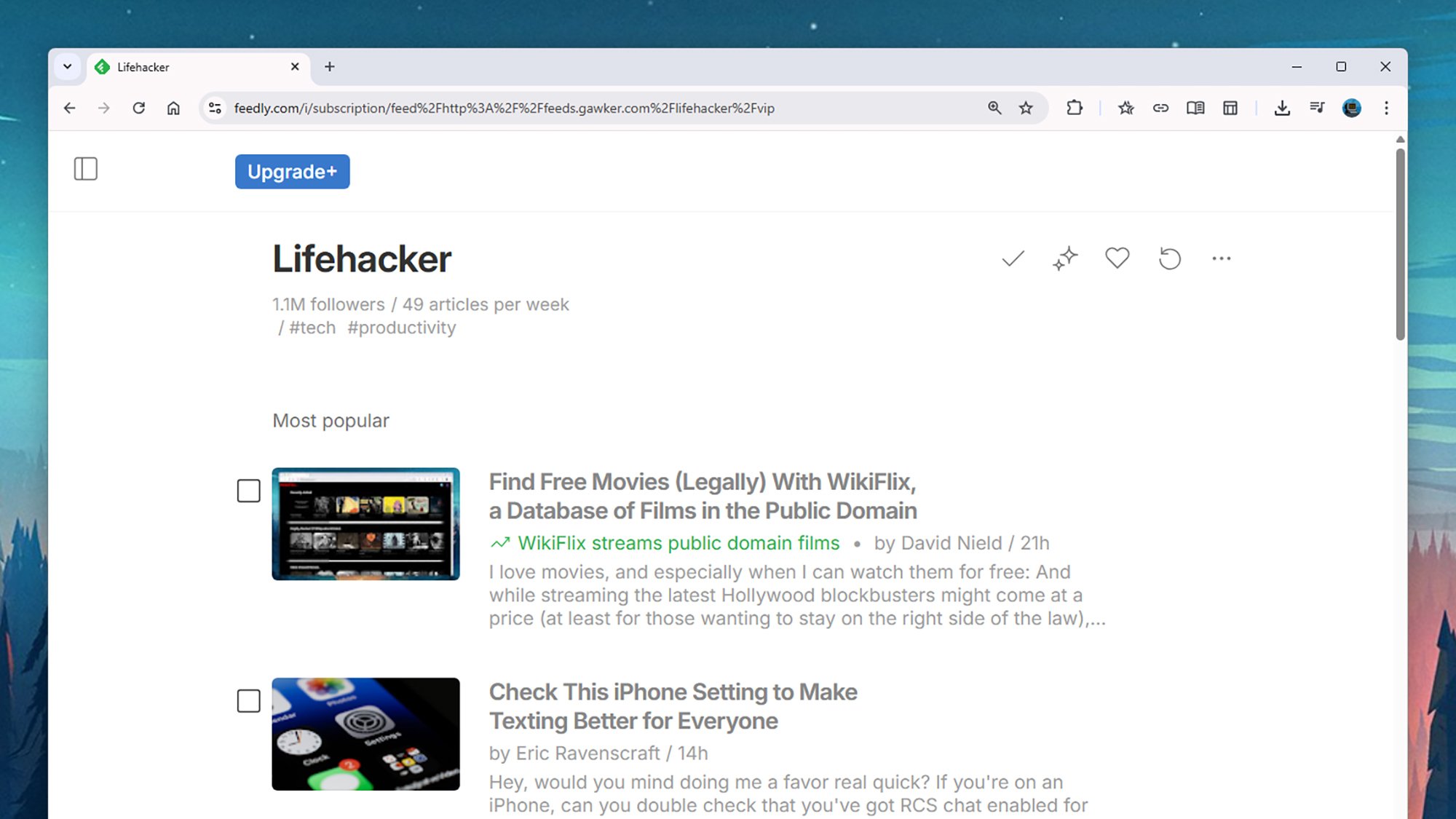
In times gone by, websites would prominently display their RSS feed links somewhere on the front page. That’s less common now, but you can often find these feeds if you dig deeper or run a web search for them (incidentally, the Lifehacker RSS feed can be found here). Some sites offer multiple RSS feeds covering different categories of content, such as tech or sports.

Even when a site doesn’t explicitly offer RSS feeds, the best RSS readers can now produce their own approximation of them by watching for new activity on a site, so you can direct the app toward the site you want to keep tabs on. In Google Discover for example, available on Android and iOS, you can keep tabs on new content on sites by tapping the Follow button that appears next to stories.

The advantages of using an RSS reader

Feedly RSS
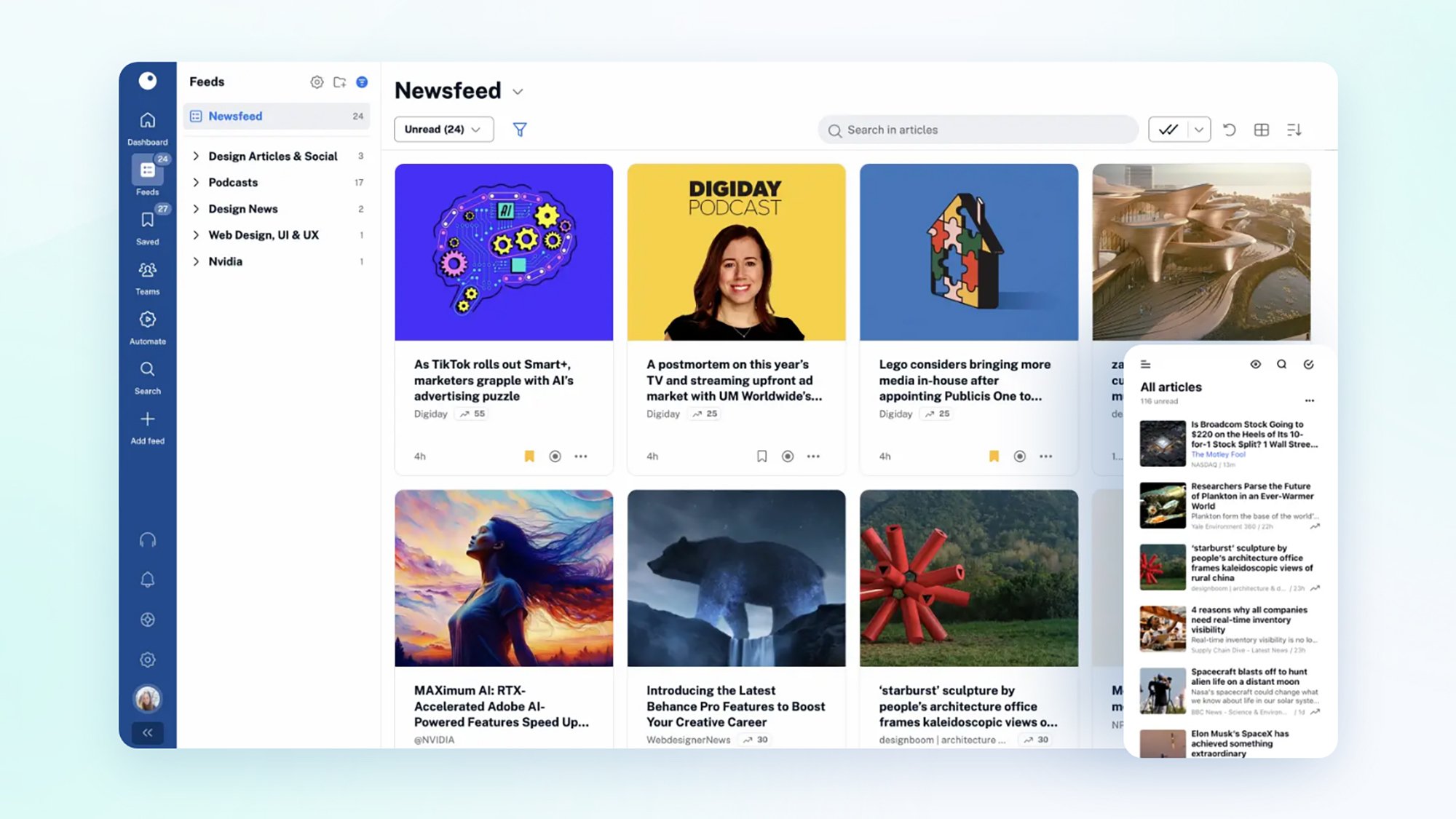
Feedly has a choice of layouts to pick from.
Credit: Lifehacker

We’re all different when it comes to how we consume news on the web: Some of us will browse social media feeds, some of us will load up the same sites every morning, and some of us will get updates via push notifications on our phones. The benefits of RSS will vary depending on how you like to stay up to date.

However, RSS is clearly useful if you have a selection of favorite websites and you want to skim through everything they publish (or everything they publish in a certain category, if the site has several feeds). No one is choosing what you see but you—you have more control over your news diet, free from any choices made by an algorithm.

Using RSS means you can catch up on everything, methodically and chronologically, even if you’ve been offline for a week (you don’t have to catch up on everything, of course—but you can, if you want, as your feed will operate on an infinite scroll). It’s also a cleaner, less cluttered way of using the internet, as you only need to click through on the specific articles you want to read.

Some of the other advantages of RSS will depend on the reader app you’re using. You might be able to sort your feeds in different ways, for example, or search back through the archives for specific types of stories, or add notes and bookmarks to links you’re particularly interested in. If you’ve never given RSS a try, it’s well worth giving it a go.

The best RSS reader apps in 2026

Google Chat RSS
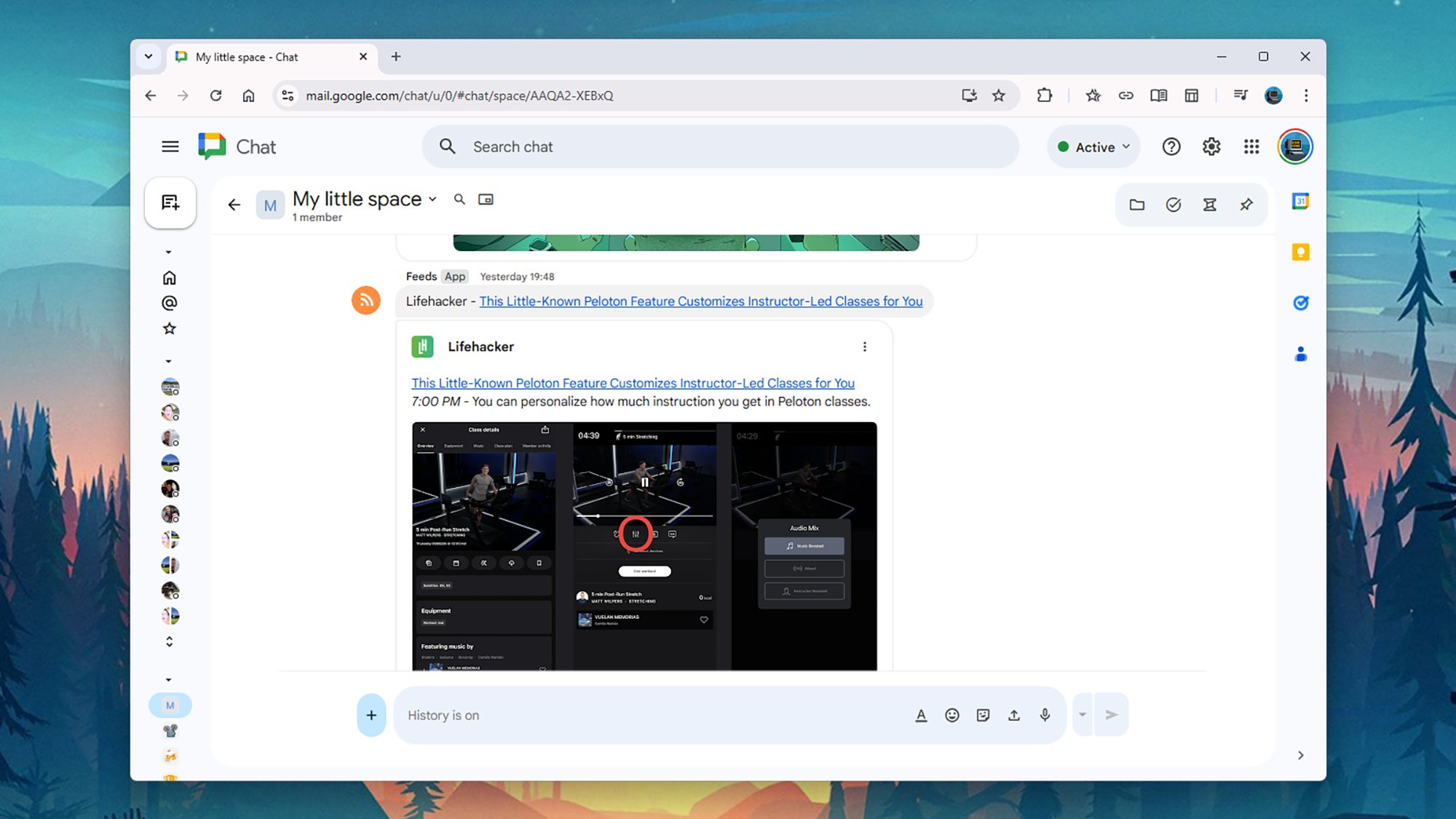
You can load RSS feeds right into Google Chat.
Credit: Lifehacker

RSS readers aren’t quite as ubiquitous as they once were, but you can still find quite a few if you take a look around.

Feedly

The best RSS reader currently in operation is arguably Feedly, which offers a bunch of features across free and paid-for plans (starting from $8 per month): It has a clean, clear interface, it can generate RSS feeds for sites that don’t have them, it can sort feeds in a variety of ways, it can incorporate email newsletters, and plenty more besides.

Feeder

Feeder is a good place to start for RSS newbies because it gets you up and running quickly, and offers a straightforward interface. It works seamlessly across all the major platforms, and if you need extra bells and whistles—including a real time dashboard, access to more feeds, and sophisticated filters for your feeds—paid plans start at $9.99 per month.

Google Chat

You can actually subscribe to RSS feeds inside Google Chat, in spaces that are just for you or for groups of people. On the web, click the three dots next to Apps, then Find apps: Track down the one called Feeds, and once you’ve installed it, you can add it to any space and subscribe to feeds by clicking the + (plus) button to the left of the text input box.

Newsify

Newsify has some specific features that may appeal to you, including a classic, newspaper-style layout and offline functionality. Available on Apple devices and the web, it offers an impressive level of customization and plenty of sharing tools, while a premium account (yours for $2.99 a month) adds features like full text feeds and AI summaries.

Inoreader

Another RSS reader with a lot of fans is Inoreader. It has all the tools and features you need for carefully curating feeds, and keeps an extensive archive of everything you’ve ever looked at—handy if you need to retrace your steps. Pay for a premium plan (from $9.99 a month) to remove ads and access even more features, such as email newsletter support.

NewsBlur

Finally, there’s NewsBlur, which is bursting at the seams with features: Story tagging, full text search, and third-party app integrations, for example. It’s one of the best options for giving you control over how feeds in the app are presented. Many of the features are available for free, but for more features and more feeds, paid plans start at $36 a year.

The Morning After: Elon Musk wants a $134 billion payout from OpenAI and Microsoft

Part of a lawsuit accusing OpenAI of abandoning its non-profit status claims Musk is owed anywhere from $79 billion to $134 billion in damages for the “wrongful gains” of OpenAI and Microsoft.

Musk claims in the filing that he’s entitled to a chunk of the company’s recent $500 billion valuation, after contributing $38 million in “seed funding” during the AI company’s early years. It wasn’t just money — according to the filing, Musk helped advise on key employee recruitment, introductions with business contacts and startup advice.

If this sounds familiar, it’s because the lawsuit dates back to March 2024. It’s still going.

— Mat Smith

The other big stories (and deals) this morning


Anthropic opens up Claude Cowork to anyone with a $20 subscription

Anthropic’s AI assistant can handle simple tasks on your PC for you.

TMA
Engadget

Claude Cowork, Anthropic’s AI assistant for handling simple tasks on your computer, is now available to anyone with a $20-per-month Pro subscription. It was previously an exclusive feature for its Max subscribers, who pay a minimum of $100 per month.

As a reminder, the intriguing part of Claude Cowork is its ability to work on its own. If you have the macOS Claude app and a Pro subscription, you can prompt Claude Cowork to work on tasks on your local computer, like creating documents based on files you have saved or organizing your folders. Don’t expect it to deal with high-level PC work just yet, but it can handle simple organizational tasks.

Continue reading.


Dr. Gladys West, whose mathematical models inspired GPS, dies at 95

Her decades-long career finally received wider recognition in 2018.

Pioneering mathematician Dr. Gladys West has passed away at the age of 95. Her name may not be familiar to you, but her contributions will be. West’s work laid the foundation for the global positioning system, GPS, we all use (sometimes daily). Beyond DoorDash requests and Google Maps navigation, GPS is now an essential component of industries ranging from aviation to emergency response systems.

Continue reading.


ASUS will not release any new smartphones this year

Will the company be joining the likes of LG?

TMA
Engadget

ASUS might step back from smartphones. According to translations of recent quotes from Chair Jonney Shih, the company does not plan to release new phone models in the future. Previous reports suggested ASUS would not introduce any smartphones in 2026, but Shih’s recent comments indicate the pause may last longer, if not indefinitely. We’ve reached out to ASUS for additional comment. It’s not like the company changes its mind…

Continue reading.

This article originally appeared on Engadget at https://www.engadget.com/general/the-morning-after-engadget-newsletter-121509123.html?src=rss

Sony is handing control of its Bravia TV business to China’s TCL

Sony is ceding control of its Bravia TV brand to China’s TCL as part of a new “strategic partnership,” the companies announced in a joint press release. The Japanese electronics giant plans to sell a majority 51 percent stake in its home entertainment arm to TCL, while retaining a 49 percent share. The joint venture is set to start operations in April 2027, pending regulatory and other approvals. 

The new combined business will sell TVs carrying Sony and Bravia branding while using TCL’s display technology. The partnership will also leverage Sony’s picture and audio expertise, supply chain management and other areas of expertise. For its part, TCL will contribute its vertical supply chain strength, global market presence and end-to-end cost efficiency. 

“By combining both companies’ expertise, we aim to create new customer value in the home entertainment field,” Sony CEO Kimio Maki said in a statement. “We expect to elevate our brand value, achieve greater scale and optimize the supply chain in order to deliver superior products and services to our customers,” added TCL Electronics chairperson DU Juan. 

The news will come as a shock to some, particularly in Japan, as Sony has been strongly associated with high-quality TVs since the Trinitron days. However, it’s currently fighting in a low-margin TV business full of formidable competitors including Samsung, LG, Hisense and TCL. The company has already sold off or closed other electronics operations, including PCs and tablets, and is barely hanging in with its smartphone business.

Sony effectively stopped making its own LCD and OLED panels some time ago, while TCL has increased its own production — having recently purchased LCD Panel patents from Samsung and taken over its plant in China. Other Japanese companies like Toshiba and Hitachi have already exited the TV business, while some including Panasonic have a highly reduced presence. 

The Bravia brand survived mainly thanks to customers willing to pay extra for high-end picture and sound quality, along with Sony’s association to filmmaking and high-end camera gear. As I detailed in a recent explainer, Sony was a pioneer in many key flat panel breakthroughs, having developed LED backlighting, quantum dot technology and the first OLED TVs. 

This article originally appeared on Engadget at https://www.engadget.com/home/home-theater/sony-is-handing-control-of-its-bravia-tv-business-to-chinas-tcl-120957252.html?src=rss

Bank of England ‘Must Plan For a Financial Crisis Triggered By Aliens’

A former Bank of England analyst has urged contingency planning for a potential financial shock if the U.S. government were to confirm the existence of extraterrestrial intelligence. The argument is that “ontological shock” alone could destabilize confidence and trigger crisis dynamics. The Independent reports: [Helen McCaw, who served as a senior analyst in financial security at the UK’s central bank and worked for the Bank of England for 10 years until 2012] said politicians and bankers can no longer afford to dismiss talk of alien life, and warned a declaration of this nature could trigger bank collapses. She reportedly said: “The United States government appears to be partway through a multi-year process to declassify and disclose information on the existence of a technologically advanced non-human intelligence responsible for Unidentified Anomalous Phenomena (UAPs).”

“If the UAP proves to be of non-human origin, we may have to acknowledge the existence of a power or intelligence greater than any government and with potentially unknown intentions.” Her warning comes as senior American officials have recently indicated their belief in the possibility of alien life. […] Ms McCaw said: “UAP disclosure is likely to induce ontological shock and provoke psychological responses with material consequences … There might be extreme price volatility in financial markets due to catastrophising or euphoria, and a collapse in confidence if market participants feel uncertain on how to price assets using any of the familiar methods.”

The former Bank of England worker explained there might be a rush towards assets such as gold or other precious metals, and government bonds, which are perceived as “safe.” Alternatively, she said precious metals might lose their status as perceived safe assets if people speculate that new space-faring technologies will soon increase the supply of precious metals. The article cites a recent UFO documentary, The Age of Disclosure, where 34 U.S. government insiders, including those from the military and intelligence community officials, share insights about the governments work with UAP. Per the film’s description, the documentary “reveals an 80-year global cover-up of non-human intelligent life and a secret war among major nations to reverse-engineer advanced technology of non-human origin.”


Read more of this story at Slashdot.

The Fastest Human Spaceflight Mission In History Crawls Closer To Liftoff

An anonymous reader quotes a report from Ars Technica: Preparations for the first human spaceflight to the Moon in more than 50 years took a big step forward this weekend with the rollout of the Artemis II rocket to its launch pad. The rocket reached a top speed of just 1 mph on the four-mile, 12-hour journey from the Vehicle Assembly Building to Launch Complex 39B at NASA’s Kennedy Space Center in Florida. At the end of its nearly 10-day tour through cislunar space, the Orion capsule on top of the rocket will exceed 25,000 mph as it plunges into the atmosphere to bring its four-person crew back to Earth. “This is the start of a very long journey,” said NASA Administrator Jared Isaacman. “We ended our last human exploration of the moon on Apollo 17.”

[…] “We really are ready to go,” said Wiseman, the Artemis II commander, during Saturday’s rollout to the launch pad. “We were in a sim [in Houston] for about 10 hours yesterday doing our final capstone entry and landing sim. We got in T-38s last night and we flew to the Cape to be here for this momentous occasion.” The rollout began around sunrise Saturday, with NASA’s Space Launch System rocket and Orion capsule riding a mobile launch platform and a diesel-powered crawler transporter along a throughway paved with crushed Alabama river rock. Employees, VIPs, and guests gathered along the crawlerway to watch the 11 million-pound stack inch toward the launch pad. The rollout concluded about an hour after sunset, when the crawler transporter’s jacking system lowered the mobile launch platform onto pedestals at Pad 39B.

The rollout keeps the Artemis II mission on track for liftoff as soon as next month, when NASA has a handful of launch opportunities on February 6, 7, 8, 10, and 11. The big milestone leading up to launch day will be a practice countdown or Wet Dress Rehearsal (WDR), currently slated for around February 2, when NASA’s launch team will pump more than 750,000 gallons of super-cold liquid hydrogen and liquid oxygen into the rocket. NASA had trouble keeping the cryogenic fluids at the proper temperature, then encountered hydrogen leaks when the launch team first tried to fill the rocket for the unpiloted Artemis I mission in 2022. Engineers implemented the same fixes on Artemis II that they used to finally get over the hump with propellant loading on Artemis I. […] If the launch does not happen in February, NASA has a slate of backup launch dates in early March.


Read more of this story at Slashdot.

The World’s Longest-Running Lab Experiment Is Almost 100 Years Old

alternative_right shares a report from ScienceAlert: It all started in 1927, when physicist Thomas Parnell at the University of Queensland in Australia filled a closed funnel with the world’s thickest known fluid: pitch, a derivative of tar that was once used to seal ships against the seas. Three years later, in 1930, Parnell cut the funnel’s stem, like a ribbon at an event, heralding the start of the Pitch Drop Experiment. From then on, the black substance began to flow. At least, that is, in a manner of speaking. At room temperature pitch might look solid, but it is actually a fluid 100 billion times more viscous than water.

It took eight years for the first droplet to finally hit the beaker below. Then, they dripped at a cadence of once every eight years or so, slowing down only after air conditioning was installed in the building in the 1980s. Today, 96 years after the funnel was cut, only nine drops in total have seeped out. The last was in 2014. Scientists expect another will fall sometime in the 2020s, but they are still waiting. No one has ever actually seen a droplet fall directly, despite all the watchful eyes. The experiment is now live-streamed, but various glitches in the past meant that each fateful moment has slipped us by.


Read more of this story at Slashdot.

Germany’s EV Subsidies Will Include Chinese Brands

Germany is reinstating EV subsidies after a sharp sales drop, rolling out a 3 billion-euro program offering 1,500-6,000 euros per buyer starting in May and running through 2029. Unlike some neighboring countries, the incentives are open to all manufacturers with a focus on low- and middle-income households. From a report: “I cannot see any evidence of this postulated major influx of Chinese car manufacturers in Germany, either in the figures or on the roads — and that is why we are facing up to the competition and not imposing any restrictions,” German Environment Minister Carsten Schneider said at a Monday press conference. The decision is a major boon for affordable Chinese automakers like BYD that are steadily gaining ground in the European market, [Bloomberg noted].

Germany’s green-light for Chinese EVs stands in stark contrast to other nations’ approaches. In the UK, subsidies introduced last year effectively excluded Chinese battery-powered vehicles, while France’s so-called social leasing scheme includes similar restrictions. […] Germany maintains strong diplomatic ties with China. German automakers are among the most significant players in China’s automotive industry. Over the past years, China’s policies — including purchase subsidies and purchase tax reductions — have not excluded models or automakers from specific countries. Whether German automakers like Volkswagen or American automakers like Tesla, all enjoy national-level purchase incentive policies in China on par with domestic automakers.


Read more of this story at Slashdot.

A Second US Sphere Could Come To Maryland

Sphere Entertainment plans to build a second U.S. Sphere near Washington, D.C., with a smaller 6,000-seat “mini-Sphere” proposed for National Harbor in Maryland. The venue would retain the signature LED exterior and immersive 4D tech of the Las Vegas Sphere, just at a more compact scale. The Verge reports: The second US sphere would be built in an area known as National Harbor in Prince George’s County, Maryland. Located along the Potomac River, National Harbor currently features a convention center, multiple hotels, restaurants, and shops. While Abu Dhabi plans to build a sphere as large as the one in Las Vegas, the National Harbor venue would be one of the first mini-Sphere venues announced last March.

Its capacity would be limited to 6,000 seats instead of over 17,000. But the smaller Sphere would still be hard to miss with an exterior LED exosphere for showcasing the “artistic and branded content” that helped make the original sphere a unique part of the Las Vegas skyline. The inside of the mini-Sphere will feature a high-resolution 16,000 by 16,000 pixel wrap-around screen, the company’s immersive sound technology, haptic seating, and “4D environmental effects.” For the AI-enhanced version of The Wizard of Oz currently playing in Las Vegas, audiences experience effects like wind, fog, smells, and apples falling from the ceiling.


Read more of this story at Slashdot.

Nvidia Contacted Anna’s Archive To Secure Access To Millions of Pirated Books

An anonymous reader quotes a report from TorrentFreak: NVIDIA executives allegedly authorized the use of millions of pirated books from Anna’s Archive to fuel its AI training. In an expanded class-action lawsuit that cites internal NVIDIA documents, several book authors claim (PDF) that the trillion-dollar company directly reached out to Anna’s Archive, seeking high-speed access to the shadow library data. […] Last Friday, the authors filed an amended complaint that significantly expands the scope of the lawsuit. In addition to adding more books, authors, and AI models, it also includes broader “shadow library” claims and allegations. The authors, including Abdi Nazemian, now cite various internal Nvidia emails and documents, suggesting that the company willingly downloaded millions of copyrighted books. The new complaint alleges that “competitive pressures drove NVIDIA to piracy,” which allegedly included collaborating with the controversial Anna’s Archive library.

According to the amended complaint, a member of Nvidia’s data strategy team reached out to Anna’s Archive to find out what the pirate library could offer the trillion-dollar company “Desperate for books, NVIDIA contacted Anna’s Archive — the largest and most brazen of the remaining shadow libraries — about acquiring its millions of pirated materials and ‘including Anna’s Archive in pre-training data for our LLMs,'” the complaint notes. “Because Anna’s Archive charged tens of thousands of dollars for ‘high-speed access’ to its pirated collections [] NVIDIA sought to find out what “high-speed access” to the data would look like.”

According to the complaint, Anna’s Archive then warned Nvidia that its library was illegally acquired and maintained. Because the site previously wasted time on other AI companies, the pirate library asked NVIDIA executives if they had internal permission to move forward. This permission was allegedly granted within a week, after which Anna’s Archive provided the chip giant with access to its pirated books. “Within a week of contacting Anna’s Archive, and days after being warned by Anna’s Archive of the illegal nature of their collections, NVIDIA management gave ‘the green light’ to proceed with the piracy. Anna’s Archive offered NVIDIA millions of pirated copyrighted books.” The complaint states that Anna’s Archive promised to provide NVIDIA with access to roughly 500 terabytes of data. This included millions of books that are usually only accessible through Internet Archive’s digital lending system, which itself has been targeted in court. The complaint does not explicitly mention whether NVIDIA ended up paying Anna’s Archive for access to the data.

Additionally, it’s worth mentioning that NVIDIA also stands accused of using other pirated sources. In addition to the previously included Books3 database, the new complaint also alleges that the company downloaded books from LibGen, Sci-Hub, and Z-Library. In addition to downloading and using pirated books for its own AI training, the authors allege NVIDIA distributed scripts and tools that allowed its corporate customers to automatically download “The Pile”, which contains the Books3 pirated dataset.


Read more of this story at Slashdot.

OpenAI CFO Says Annualized Revenue Crosses $20 Billion In 2025

According to CFO Sarah Friar, OpenAI’s annualized revenue surpassed $20 billion in 2025, up from $6 billion a year earlier with growth closely tracking an expansion in computing capacity. Reuters reports: OpenAI’s computing capacity rose to 1.9 gigawatts (GW) in 2025 from 0.6 GW in 2024, Friar said in the blog, adding that Microsoft-backed OpenAI’s weekly and daily active users figures continue to produce all-time highs. OpenAI last week said it would start showing ads in ChatGPT to some U.S. users, ramping up efforts to generate revenue from the AI chatbot to fund the high costs of developing the technology. Separately, Axios reported on Monday that OpenAI’s policy chief Chris Lehane said that the company is “on track” to unveil its first device in the second half of 2026.

Friar said OpenAI’s platform spans text, images, voice, code and APIs, and the next phase will focus on agents and workflow automation that run continuously, carry context over time, and take action across tools. For 2026, the company will prioritize “practical adoption,” particularly in health, science and enterprise, she said. Friar said the company is keeping a “light” balance sheet by partnering rather than owning and structuring contracts with flexibility across providers and hardware types.


Read more of this story at Slashdot.

Dr. Gladys West, whose mathematical models inspired GPS, dies at 95

Pioneering mathematician Dr. Gladys West has passed away at the age of 95. Her name may not be familiar to you, but her contributions certainly are; West’s work laid the foundation for the global positioning system. As you likely know from experience, GPS is now an essential component of industries ranging from aviation and emergency response, as well as ensuring that you get to that dinner date or job interview on time. 

This morning the world lost a pioneer in Dr Gladys West, she passed peacefully alongside her family and friends and is now in heaven with her loved ones. We thank you in advance for all of the love and prayers you have and will continue to provide pic.twitter.com/FJ3aGfEiHP

— Dr. Gladys B. West (@DrGladysBWest) January 18, 2026

West was born in 1930 in Virginia. Despite the oppression of Jim Crow laws in the south, she was able to pursue higher education at Virginia State College (now named Virginia State University), obtaining bachelor’s and master’s degrees in mathematics. In 1956, West was hired at what is now called the Naval Surface Warfare Center in Dahlgren, VA. Her focus during the 1970s and 1980s was creating accurate models of the Earth’s shape based on satellite data, a complex task requiring the type of mathematical gymnastics that would make the average person dizzy. Those models later became the backbone for GPS. West worked at the Dahlgren center for 42 years, retiring in 1998. 

As has been the case with so many of the women, particularly those of color, behind tech and science breakthroughs in the US, West’s work went largely uncelebrated for decades. After submitting a short biography of her accomplishments to a sorority function in 2018, members of Alpha Kappa Alpha helped West to receive belated recognition for her contributions. She was inducted into the US Air Force Space and Missiles Pioneers Hall of Fame and honored as Female Alumna of the Year by the Historically Black Colleges and Universities Awards in that same year. The Guardian published an interview with West in 2020 that shared some insights on her journey, including a note that when West was out and about, she favored paper maps over the technology she indirectly helped create.

This article originally appeared on Engadget at https://www.engadget.com/science/dr-gladys-west-whose-mathematical-models-inspired-gps-dies-at-95-234605023.html?src=rss

Threads Usage Overtakes X On Mobile

New data from Similarweb shows Threads has overtaken X in daily mobile users. However, X still dominates on the web with around 150 million daily web visits compared to Threads’ 8.5 million daily visits. TechCrunch reports: Similarweb’s data shows that Threads had 141.5 million daily active users on iOS and Android as of January 7, 2026, after months of growth, while X has 125 million daily active users on mobile devices. This appears to be the result of longer-term trends, rather than a reaction to the recent X controversies […]. Instead, Threads’ boost in daily mobile usage may be driven by other factors, including cross-promotions from Meta’s larger social apps like Facebook and Instagram (where Threads is regularly advertised to existing users), its focus on creators, and the rapid rollout of new features.

Over the past year, Threads has added features like interest-based communities, better filters, DMs, long-form text, disappearing posts, and has recently been spotted testing games. Combined, the daily active user increases suggest that more people are using Threads on mobile as a more regular habit. Further reading: Threads Now Has More Than 400 Million Monthly Active Users


Read more of this story at Slashdot.

LEGO Cars Vs Larger And Larger Loopty Loops

This is a video of LEGO experimenter Brick Technology (previously) pitting LEGO cars against increasingly larger loopty loops. It was a fun watch with surprisingly high production value, and this is the exact sort of experimenting I wish I spent my weekends doing. But nooooo, I spent the entirety of last weekend running experiments to find out what will make a toilet stop leaking. Do you know how many trips to Home Depot I took? Four, and on the fourth I was *this close* to fixing the toilet and the rest of my home improvement projects with a new gas can.

BONUS MULTI-LOOP CORKSCREW AT THE END.