Fitness Culture Has a Hyper-Personalization Problem

The latest craze in the fitness world—from gym culture, to nutrition planning, to recovery protocols— is hyper-personalized optimization. But is there really a benefit to at-home microbiome tests that reveal the optimal diet for your gut bacteria? How about a device that tells you whether you’re burning carbs or fat with each breath?

Personalized fitness advice used to be largely limited to factors like height and weight, but now you might have a Whoop, Oura, or Apple Watch wearable tracking your track heart rate variability, skin temperature, blood oxygen, and so much more. Continuous glucose monitors, once reserved for diabetics, are now worn by biohackers and CrossFit enthusiasts trying to optimize their carb timing.

On the one hand, the appeal of having unprecedented insight into your body’s unique needs is understandable. On the other, there’s a looming shadow behind all this data: As the metrics multiply, so does the potential for anxiety. When every workout, meal, and bedtime becomes a referendum on dozens of competing data points, decision fatigue is likely to set in. And as your algorithms suggest targeted interventions for every perceived deficiency, someone else—likely a giant corporation getting fat off of user data—is profiting. The question looms larger with each new device metric: Does more data actually lead to better health outcomes?

More data isn’t always better

Your wearable spits out a sleep (or stress) report every morning. How is this data serving you? “Metabolic testing, biomechanics, and body composition are all forms of objective data that can be pretty powerful when collected in validated settings and interpreted by professionals who understand physiology and adaptation,” says Lekshmi Kumar, a performance physiologist at Boston-based Human Powered Health. But consumer devices, while improving, exist in a different category: “Consistent research has bolstered consumer-facing tools and significant improvements have been made over the past several years. But they’re still not considered substitutes for professional-grade assessments,” Kumar says. In other words, for a lot of bio-hacking endeavors, there’s a major gap between the numbers you see and their potential real-life applications. 

Kumar sees three critical prerequisites for data to actually improve outcomes: data quality, proper context, and accurate interpretation. “Absent these, we often see expensive and excessive supplementation, conflicting recommendations, and decision fatigue,” she says. The real danger, she says, isn’t the data itself—it’s the illusion of expertise it creates.

Hyper-personalized data might add unnecessary confusion

Many direct-to-consumer tests lack the clinical validation of their medical-grade counterparts. Interpretation of the data is frequently automated, missing nuance that a trained professional might catch. And the recommendations often trend toward more—more supplements, more tracking, more intervention—rather than identifying changes that might actually move the needle. It’s a hard truth that no wellness product actually cares more about your health than its company’s profits. 

Perhaps the most insidious cost of hyper-personalization is less financial, and more psychological: When every metric matters, decision-making becomes paralyzing. Should you work out today even though your HRV is down? Is that meal worth the glucose spike? Did last night’s 6.5 hours of sleep doom today’s training session?

The constant feedback loop can transform exercise from a joyful practice into an optimization problem to be solved. This isn’t the first time I’ve pointed out the trappings of wellness culture. The internal compass—how do I actually feel?—gets drowned out by all the external data streams. Ironically, the tools meant to “empower” can instead create dependency, where you can’t trust their own bodily sensations without technological confirmation.

Does hyper-personalization actually work? 

When implemented thoughtfully (with quality data, proper interpretation, and professional guidance), personalized approaches can obviously aid you in optimizing training, recovery, and nutrition in ways generic programs cannot. Elite athletes have long used sophisticated testing—VO2 max assessments, lactate threshold testing, motion capture analysis—to gain advantages, however marginal. As these tools become more accessible, it makes sense their benefits can extend beyond the professional realm.

But accessibility without expertise? That’s a different matter. Consider two hypothetical people concerned about their fitness: Person A tracks sleep quality, HRV, resting heart rate, blood oxygen, skin temperature, glucose levels, and workout strain—but lacks a framework to understand how these metrics interact, or what to do when they conflict. Person B follows a simple evidence-based program: strength training three times per week, 30 minutes of cardio on alternate days, eight hours of sleep, and a balanced diet with adequate protein. Even absent all that data, Person B will likely see better results and experience far less angst about their health.

Again, there are the economic incentives to consider too. Companies profit from selling more tests, more devices, more subscriptions, and more supplements. The business model depends on convincing consumers they need increasingly granular data to achieve their goals. This creates an environment where the answer to “what should I track?” is almost always “more than you’re tracking now,” regardless of whether the additional data actually serves you.

When personal health tracking actually makes sense

“The biggest gains won’t come from chasing every single flashy metric,” says Kumar. “They’ll come from identifying the variables that matter most to the specific individual, and working with a credentialed professional who can assist in translating the information into meaningful takeaways and actions.”

What does smart, targeted tracking look like in practice? Here are scenarios where specific metrics can genuinely help:

  • For a runner struggling with fatigue: Tracking HRV and resting heart rate can reveal when you’re not recovering adequately between training blocks. If these metrics trend downward over weeks, it’s a signal to dial back intensity or add rest days—something that matters far more than monitoring glucose fluctuations after breakfast.

  • For someone with persistent digestive issues: A food diary paired with symptom tracking (not necessarily a microbiome test kit) can help identify genuine patterns. Working with a registered dietitian to systematically eliminate or reintroduce foods provides actionable insights, unlike a $200 test suggesting you eat more fermented foods.

  • For someone desperate to improve sleep: Use your gadgets to track total sleep time and sleep consistency. That matters more than obsessing over REM percentages. Focus on establishing a regular pre-sleep routine and measuring whether you feel rested, rather than achieving some algorithm’s “optimal” sleep score.

  • For the lifter hitting a plateau: Remember that linear gains are for beginners. Instead of stressing over daily scale readings, focus on your training log tracking progressive overload and consider following these tips.

You’ll notice a patter here: Each tracking approach is targeted, time-bound, and directly connected to a specific goal or problem—not a fruitless pursuit to optimize every single thing all the time.

The bottom line

In a culture obsessed with optimization, it’s getting harder and harder to cut through the noise. But maybe your goal shouldn’t be to track everything. As hyper-personalization continues its ascent, think about how you’re engaging with every new tool. The wisest approach may be a picky one: choosing one or two key metrics that align with specific goals. Because more information isn’t automatically better, and consumer tools have real limitations, and that the human body is beautifully, frustratingly complex—not exactly reducible to a dashboard of numbers.

What People Are Getting Wrong This Week: Does Measles Cure Cancer?

The totals are in for 2025, and it’s been a great year for measles. According to the CDC, the number of cases of the disease identified in the US has risen from 285 in 2024 to 2,144 in 2025, the highest number of measles cases since 1990. We’ve already seen at least 171 measles cases in the first two weeks of 2026.

As you’d probably guess, experts pin the rise in measles to lower vaccination rates. I covered a number of vaccination and measles myths in this column months ago, but there is a new spin on measles that seems to be gaining some traction: A lot of people think contracting measles is good for your heath.

“There’s a lot of studies out there that show that if you actually do get the wild infection, you’re protected later. It boosts your immune system later in life against cancers, atopic diseases, cardiac disease, etc.,” Robert F. Kennedy Jr., the Department of Health and Human Services secretary said in a recent Fox interview. Online, there are posts like this one from a chiropractor’s Instagram page, using a clip from The Brady Bunch to argue that contracting measles and other diseases “prepares a child’s immune system for a long-term resiliency to chronic problems like cancers and heart disease.” Others point to news stories like this from CNN to bolster claims that measles fights cancer.

Can measles fight cancer?

There is no evidence that measles infection can protect against cancer. Full stop. But whether measles can treat cancer is a little more complex. There is a small grain of truth here, but it’s wrapped in a lot of misconceptions.

The most basic is the meaning of the word “measles.” Oncolytic virus therapy uses genetically altered viruses, including the measles virus, to target cancer cells. A modified version of the measles virus was used successfully to treat a specific kind of cancer and boost immune response to the cancer. Mayo Clinic researchers report that one patient’s incurable cancer went into remission, thanks to the virus. “But that’s totally a therapeutic application of viruses, completely different than what happens with natural infections,” said John Bell, a senior scientist at the Ottawa Hospital Research Institute in an interview, so it’s not “measles cures cancer,” it’s “scientists weaponize a virus under controlled conditions.”

The bottom line: The wild measles virus is a dangerous pathogen, not a cancer cure. Not only that, but part of the reason the virus therapy worked so well on the patient CNN covered was because she had been vaccinated for measles, so if genetically modified measles ever end up being used as cancer treatment, it’s better to have been vaccinated than not.

Does contracting measles prevent heart disease?

One study in Japan found an association between measles and mumps infections and a lower risk of death from atherosclerotic heart disease. But critics have pointed out that this research relies on self-reporting within a pre-vaccine population. Given the virulence of measles, all of the people in the survey would likely have been exposed to measles as children even if they didn’t remember it, so it’s hard to draw any conclusions from this study.

Does contracting measles boost your immune system?

While being infected with the disease will likely result in being immune to measles afterwards, it harms your immune system as a whole. A 2019 study from Harvard Medical School published by Science, found that the measles virus can cause “immune amnesia,” the wiping out of up to three-quarters of antibodies protecting against other infections like the flu or the bacteria that cause pneumonia. “The measles virus is like a car accident for your immune system,” Harvard University geneticist Stephen Elledge, the senior author of the Science study, told The Los Angeles Times.

“If your child gets the measles and then gets pneumonia two years later, you wouldn’t necessarily tie the two together. The symptoms of measles itself may be only the tip of the iceberg,” said the study’s first author, Dr. Michael Mina.

Meanwhile, we have extremely strong evidence that the measles vaccine doesn’t cause a general weakening of the immune system—note, for example, the dramatic reductions in childhood deaths from other diseases in places where measles immunization programs are introduced. After measles vaccinations began in the United States in the 1960s, deaths from diseases like pneumonia and diarrhea were cut by half, and in populations where infectious diseases are more common, the reduction in mortality has been up to 80 percent.

Playing devil’s advocate on measles

Let’s assume critics are right, for the sake of argument. Even if contracting measles in childhood makes you less likely to get heart disease later in life and gives you a stronger immune system, it would still make sense to get immunized instead of infected.

Measles is a serious disease. Regardless of any future benefit, contracting measles is deadly in up to three of every 1,000 cases. About one child out of every 1,000 who get measles will develop encephalitis (swelling of the brain) that can lead to convulsions, hearing loss, and intellectual disability.

Vaccination for measles, on the other hand, is very safe. The most serious side effects come from severe allergic reactions, and that happens about in a one in a million doses. The measles vaccine generates immunity without the risk of encephalitis, without immune amnesia, and without gambling a child’s life on a hypothetical future payoff. If measles exposure truly primes the immune system in some beneficial way, vaccination captures the immune response while stripping out the damage. No matter how generous you are to the “infection is good” argument, infection is a dangerous and inefficient way to get there.

Meta wants to block data about social media use, mental health in child safety trial

As Meta heads to trial in the state of New Mexico for allegedly failing to protect minors from sexual exploitation, the company is making an aggressive push to have certain information excluded from the court proceedings.

The company has petitioned the judge to exclude certain research studies and articles around social media and youth mental health; any mention of a recent high-profile case involving teen suicide and social media content; and any references to Meta’s financial resources, the personal activities of employees, and Mark Zuckerberg’s time as a student at Harvard University.

Meta’s requests to exclude information, known as motions in limine, are a standard part of pretrial proceedings, in which a party can ask a judge to determine in advance which evidence or arguments are permissible in court. This is to ensure the jury is presented with facts and not irrelevant or prejudicial information and that the defendant is granted a fair trial.

Read full article

Comments

Spotify’s ‘Prompted Playlist’ Feature Is Finally Coming to the US

Last month, Spotify announced “Prompted Playlist,” a new feature the company claimed let users “steer the algorithm.” This was a bold—if not vague—claim, to be sure, but it was backed by everyone’s favorite tech trend of the last three years: AI. The pitch was that Spotify would let subscribers use the company’s AI models to better control their listening experience, so long as they lived in the country of New Zealand. That’s a very small slice of Spotify’s very large user base.

Luckily for those of us in the United States and Canada, Prompted Playlist is expanding to our side of North America. Spotify announced the move today, Jan. 21: Now, Premium subscribers in any of these three countries can access the feature, if they want to hand over the playlist reigns to Spotify’s machine learning models.

What is Prompted Playlist?

Prompted Playlist is Spotify’s AI-powered tool that lets you use natural language to create custom playlists. The idea is, rather than look for songs to add to a playlist, you tell Spotify’s AI what you’re in the mood to listen to, and it adds songs automatically for you. That can include genres and existing songs, but also ideas, deeper descriptions, and, for lack of a better word, vibes.

To understand what I mean, here are some of the suggested prompts Spotify suggests you try:

  • “Make me a playlist of songs I’ve saved to my Library (playlists or Liked Songs) that I either haven’t played yet or have only listened to once. The goal is to round up those songs I found, saved, and then totally forgot to revisit. Give me a chance to finally hear what I’ve been missing.”

  • “What are the first tracks I ever listened to on Spotify? Order them by the very first track I ever streamed – with date and time – and keep going.”

  • “Knowing what I listen to today, make me a playlist of songs from 2016 that match my current taste, mixing the biggest tracks from that year with songs that feel timeless now.”

  • “Make me a playlist to help me learn Spanish, with clear vocals and easy-to-follow lyrics. Mix popular Spanish-language songs with slower tracks that make it easier to catch the words, and include music that reflects different Spanish-speaking cultures to keep it engaging.”

Spotify says that Prompted Playlist takes your existing listening history into account as well. While you and a friend might give Spotify’s AI the same prompt, in theory, you should each receive different playlists, since the AI will make adjustments based on the music you like and don’t like. You also don’t have to wonder why the AI put a specific song in the playlist: Each track starts with a “quick one-liner” that explains why Spotify chose it in the first place. I could see that being either insightful, or extremely annoying.

The thing is, Spotify has rolled out a feature like this before, appropriately dubbed “AI Playlist.” Lifehacker’s David Nield covered it in September of 2024, and catching up on that feature, it sounds pretty similar to Prompted Playlist. AI Playlist isn’t actually going away now that Prompted Playlist is here: Spotify tells me that these are two separate features, and that the major differences are that Prompted Playlist factors in your entire Spotify listening history, going back to your first song, as well as real-time information about “trends, charts, culture, and history” in the industry today. You can also schedule playlists if you like, so the mix refreshes every day or week, something you can’t do with AI Playlist.

From my seat, it also seems like Prompted Playlist is designed to handle more complex prompts, as well. While the company advertised AI Playlist as a way to build playlists from prompts like “upbeat pop music for my road trip,” the company’s suggested Prompted Playlist prompts are much more intricate, and include multiple levels of instruction for the AI. Perhaps part of that is the result of improvements in the technology over the past year and half.

How to try Spotify’s Prompted Playlist

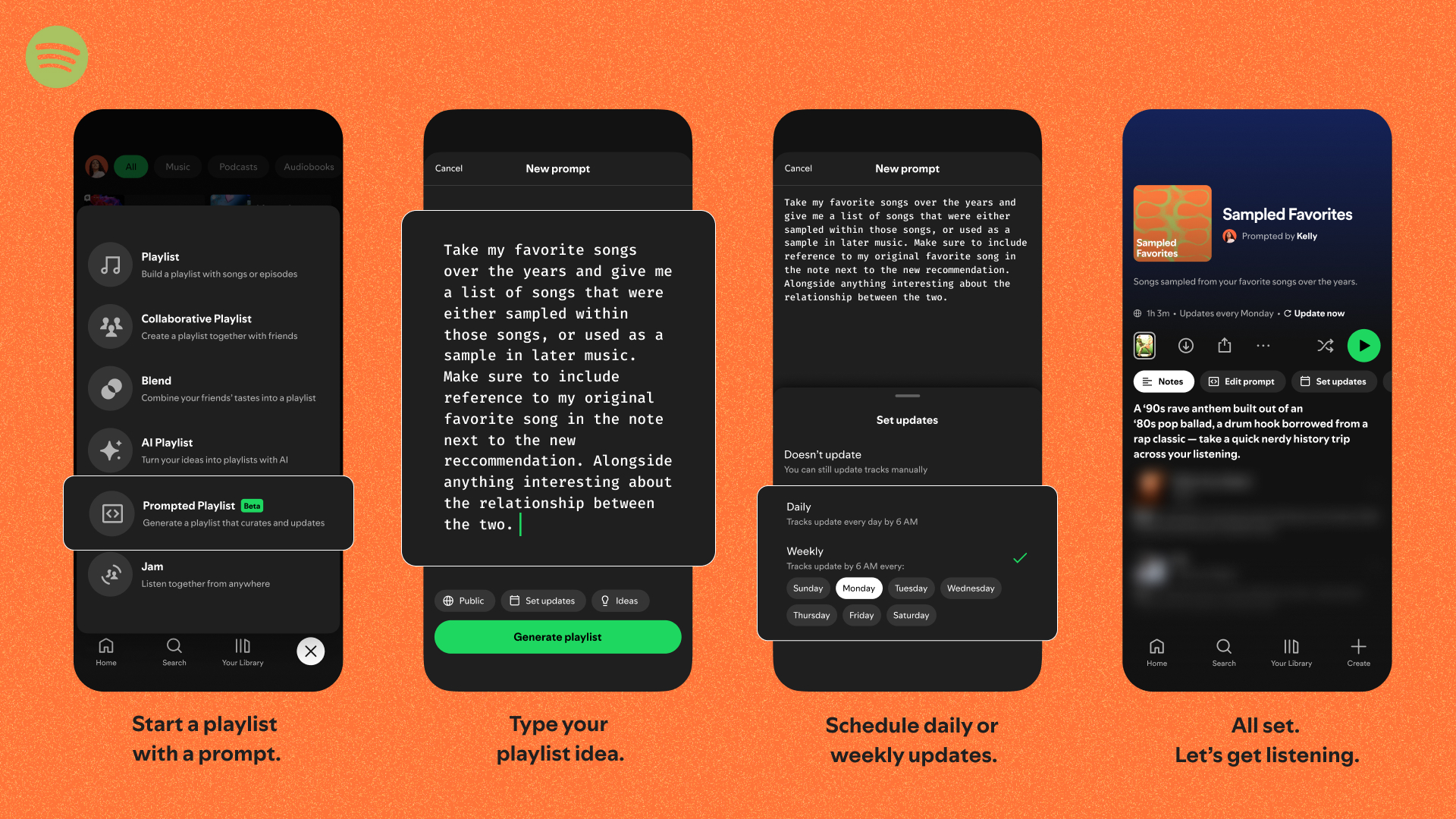
Prompted Playlist is launching as a Premium-only feature, so if you don’t pay for Spotify, you unfortunately can’t access it. If you do have a Premium account, you’ll need to head to Spotify, tap “Create,” then choose “Prompted Playlist.”

As explained above, from here, you can describe what kind of playlist you want the tool to make. From here, you’ll be able to set how often it refreshes (if it refreshes at all). If you’re not happy with the results, you can choose “Edit Prompt” to adjust it. You can share the playlist with friends, but know that Spotify will adjust the playlist to match their listening histories instead.

‘No Reasons To Own’: Software Stocks Sink on Fear of New AI Tool

The new year was supposed to bring opportunities for beaten-down software stocks. Instead, the group is off to its worst start in years. From a report: The release of a new artificial intelligence tool from startup Anthropic on Jan. 12 rekindled fears about disruption that weighed on software makers in 2025.

TurboTax owner Intuit tumbled 16% last week, its worst since 2022, while Adobe and Salesforce, which makes customer relationship management software, both sank more than 11%. All told, a group of software-as-a-service stocks tracked by Morgan Stanley is down 15% so far this year, following a drop of 11% in 2025. It’s the worst start to a year since 2022, according to data compiled by Bloomberg.

While unproven, the tool represents just the type of capabilities that investors have been fearing, and reinforces bearish positions that are looking increasingly entrenched, according to Jordan Klein, a tech-sector specialist at Mizuho Securities. “Many buysiders see no reasons to own software no matter how cheap or beaten down the stocks get,” Klein wrote in a Jan. 14 note to clients. “They assume zero catalysts for a re-rate exist right now,” he said, referring to the potential for higher valuation multiples.


Read more of this story at Slashdot.

Spotify’s Prompted Playlist lets you describe exactly what you want to hear

Ahead of its upcoming price hike, Spotify is rolling out a more advanced AI playlist feature in the US and Canada. Prompted Playlist, which the company trialed in New Zealand late last year, lets subscribers “control the Spotify algorithm,” as the company describes it. “You’re not just asking for music, you’re shaping how Spotify goes about discovering it for you.”

For example, you can guide it to make a playlist of songs you’ve saved to your Library but haven’t listened to yet. (It can tap into your entire Spotify history.) Or, you can tell it to round up songs from a specific television show or movie. (It uses real-time information about pop culture, charts, and history.)

The feature includes options to refresh the playlist over time (daily or weekly). You can edit each playlist’s prompt at any time. Each track will include a short note to explain why it was chosen.

Four screens showing the steps to produce a Spotify Prompted Playlist
The standard AI Playlist creator will remain alongside the new Prompted Playlist.
Spotify

Spotify says beta testers have used Prompted Playlist to revisit songs tied to specific moments and filter out tracks they’ve overplayed lately. “Others are asking for long, lyric-free electronic playlists to power through a workday, or mixing in artists connected to current pop culture moments and viral trends,” the company wrote.

There’s room for some confusion here because Spotify already has an “AI Playlist” feature. That simpler type will stick around alongside the new “Prompted” variety, which allows for finer tuning and can sift through more data.

Prompted Playlist will be available to Spotify Premium subscribers in the US and Canada “by the end of the month.” Once you have access, you can try it by tapping Create, then selecting Prompted Playlist.

This article originally appeared on Engadget at https://www.engadget.com/audio/spotifys-prompted-playlist-lets-you-describe-exactly-what-you-want-to-hear-140000153.html?src=rss

A-List creatives sign up to fight AI, say it enables ‘theft at a grand scale’

Scarlett Johannsson, R.E.M., Vince Gilligan and over 700 other artists are demanding that tech companies stop “stealing” their work in order to train AI models. A new campaign called “Stealing isn’t Innovation” demands that AI companies take “the responsible, ethical route” through licensing and partnerships, according to the website.

“America’s creative community is the envy of the world and creates jobs, economic growth and exports,” a statement on the website reads. “But rather than respect and protect this valuable asset, some of the biggest tech companies, many backed by private equity and other funders, are using American creators’ work to build AI platforms without authorization for copyright law.”

The group adds that the “illegal intellectual property grab” has resulted in an information ecosystem dominated by “misinformation, deepfakes and a vapid artificial avalanche of low-quality materials [‘AI slop’]… threatening America’s AI superiority and international competitiveness.”

OpenAI once argued that it’s “impossible” to train AI without copyrighted materials, since “copyright today covers virtually every sort of human expression.” However, actors, musicians and authors take issue with that idea, particularly when they see their likenesses or work repurposed as slop or worse by large language models (LLMs).

Johansson, for one, previously threatened OpenAI with legal action in 2024 over a ChatGPT voice assistant that effectively cloned her voice. More recently, Elon Musk’s Grok has been accused of creating millions of sexualized images of real people in just days, according to a report today from The New York Times.

“Big Tech is trying to change the law so they can keep stealing American artistry to build their AI businesses — without authorization and without paying the people who did the work. That is wrong; it’s un-American, and it’s theft on a grand scale,” the group proclaimed.

This article originally appeared on Engadget at https://www.engadget.com/ai/a-list-creatives-sign-up-to-fight-ai-say-it-enables-theft-at-a-grand-scale-140000475.html?src=rss

1Password adds an extra layer of phishing protection

1Password has a new tool designed to counteract the advantages AI has given to phishing scammers. A new feature for the company’s browser extension gives you a “second pair of eyes” to help you catch a bogus website before entering your login info.

Before AI, phishing attempts often included telltale signs like obvious typos or rudimentary graphic design. Now that AI makes it much easier to design and code convincingly, scams are on the rise. According to Fortune, 60 percent of companies reported an increase in fraud-related losses from 2024 to 2025. And the advent of AI browsers could make things even worse.

“Our new phishing feature adds an extra layer of protection,” 1Password says. Once the feature is activated, the extension actively watches for suspicious sign-ins. To be clear, even before this feature’s arrival, 1Password wouldn’t autofill saved credentials for a bogus website impersonating it. But that still left room for people to manually paste their login info, handing it over to those with the worst intentions.

That moment when you try to paste your login manually is where the new feature comes in. “The website you’re on isn’t linked to a login in 1Password,” the feature’s warning pop-up reads. “Make sure you trust this site before continuing.”

1Password says that’s the “breakthrough” moment that can help you avoid a major hassle. “That single moment of pause, that tiny bit of friction, is often all it takes to disrupt the attackers’ entire plan.”

The new feature is available today. You can enable it in the 1Password browser extension’s settings. Under the Notifications section, activate the setting for “Warn about pasted logins on non-linked websites.”

This article originally appeared on Engadget at https://www.engadget.com/cybersecurity/1password-adds-an-extra-layer-of-phishing-protection-140000293.html?src=rss

These Bose Open Earbuds Are More Than Half Off Right Now

We may earn a commission from links on this page. Deal pricing and availability subject to change after time of publication.

The Bose Ultra Open Earbuds don’t block out the world—they sit just outside your ears and let everything in. Traffic noise, conversations, the doorbell—all of it stays audible while your music plays alongside it. That makes these earbuds a better match for people who move around outdoors or just don’t like feeling sealed off. Right now, a certified refurbished pair in White Smoke is $125.99 on Woot. That’s a noticeable drop from the roughly $179 (refurbished) price on Amazon, where a brand-new pair still lists for $299. Bose handles the refurbishment directly, includes all original accessories, and backs the earbuds with a one-year manufacturer’s warranty. Shipping is free for Prime members, with a $6 fee for everyone else, and the deal runs for nine days or until it sells out.

Each earbud clips onto your ear using a flexible silicone band instead of resting inside your ear canal. Once you find the right fit (which may take a few tries), you should find them surprisingly stable. Runners and walkers will appreciate that they stay put without squeezing or irritating the ears, and with IPX4 water resistance, they can handle sweat and light rain, which is enough for most daily use. The earbuds support Bluetooth 5.3 with AptX Adaptive, so Android users get a small audio edge over iPhone users, but connection quality is solid across the board. Battery life averages about 7.5 hours per charge and stretches to roughly 27 hours with the case.

Sound quality is better than most open-style earbuds manage. Vocals come through cleanly, highs stay sharp, and the midrange has enough body to keep music from sounding hollow. Deep bass is where you feel the compromise. It’s there, but it doesn’t hit hard, which is most noticeable with bass-heavy genres. For podcasts, calls, and casual listening, though, the tuning feels balanced and easygoing. According to this PCMag review, the earbuds sound best around 70 percent volume, where detail stays intact without distortion. If you want high-quality, open-ear audio and don’t mind a little trial-and-error with the fit, this is one of the better ways to try Bose’s latest without paying full price.

Deals are selected by our commerce team

Half of Fossil Fuel Carbon Emissions In 2024 Came From 32 Companies

An anonymous reader quotes a report from Inside Climate News: Just 32 companies accounted for over half of global fossil carbon emissions in 2024, according to a report published Wednesday by the U.K.-based think tank InfluenceMap. That is down from 36 companies responsible for half the global CO2 emissions in 2023, and 38 companies five years ago. The analysis is the latest update to the Carbon Majors database, which tracks the world’s largest oil, gas, coal and cement producers and uses production data to calculate the carbon emissions from each entity’s production. The database, first developed by researcher Richard Heede and now hosted by InfluenceMap, quantifies current and historical emissions attributable to nearly 180 companies and provides annual updates. It is the only database of its kind tracking corporate-generated carbon emissions dating back to the start of the Industrial Revolution, research that’s being used in efforts to hold major polluters accountable for climate harms.

Despite dire warnings from scientists about the consequences of accelerating climate change, fossil fuel production is continuing apace. Last year, fossil fuel CO2 emissions reached a record high, topping 38 billion metric tons. In 2024 these emissions were 37.4 billion metric tons — up 0.8 percent from 2023 — and traceable to 166 oil, gas, coal and cement producers, according to the report. Much of the global carbon emissions in 2024 came from state-owned entities, which represented 16 of the top 20 emitters. The five largest emitters overall — Saudi Arabia’s Aramco, Coal India, China’s CHN Energy, National Iranian Oil Co. and Russia’s Gazprom — were all state-controlled, and accounted for 18 percent of the total fossil CO2 emissions in 2024.

ExxonMobil, Chevron, Shell, ConocoPhillips and BP — the top five emitting investor-owned companies — together were responsible for 5.5 percent of the total emissions in that year. Historically, ExxonMobil and Chevron rank in the top five for fossil carbon emissions generated from 1854 through 2024, accounting for 2.79 percent and 3.08 percent of overall carbon pollution, respectively. According to the analysis, the 178 entities in the database have generated 70 percent of fossil CO2 emissions since the start of the Industrial Revolution, and just 22 entities are responsible for one-third of these emissions. “Each year, global emissions become increasingly concentrated among a shrinking group of high-emitting producers, while overall production continues to grow. Simultaneously, these heavy emitters continue to use lobbying to obstruct a transition that the scientific community has known for decades is essential,” said Emmett Connaire, senior analyst at InfluenceMap. The findings of the new analysis, he added, “underscore the growing importance of this kind of rigorous evidence in efforts to determine accountability for climate-related losses.”


Read more of this story at Slashdot.

How to find an affordable GPU during the great RAMageddon of 2026

If you’re thinking about upgrading to a new graphics card this year, your window for doing so at MSRP has closed. When I first reported on this at the start of December, things were looking bleak but you could still find GPUs from both AMD and NVIDIA at close to their recommended prices. That changed last week when YouTube channel Hardware Unboxed reported that ASUS had stopped producing the RTX 5070 Ti and 5060 Ti 16GB due to ongoing memory shortages. 

After Engadget published the news, NVIDIA disputed the report. “Demand for GeForce RTX GPUs is strong, and memory supply is constrained. We continue to ship all GeForce SKUs and are working closely with our suppliers to maximize memory availability,” a company spokesperson told us. 

The next day, ASUS walked back its previous statements. After “explicitly” telling Hardware Unboxed it had placed the 5060 Ti 16GB and 5070 Ti into “end-of-life status,” the company said “certain media may have received incomplete information from an ASUS PR representative regarding these products,” adding it had “no plans to stop selling these models.”  

Whether or not the 5060 Ti 16GB and 5070 Ti remain in production, one thing is certain: the AI boom has created a great deal of uncertainty in the GPU market. After the news, panic buying sent the price of the 5070 Ti through the roof. Right now, it’s impossible to find that model priced at its MSRP of $749. As of the writing of this article, the most affordable version of the 5070 Ti I could find on Newegg was $1,199. 

The bigger problem is that the 5070 Ti isn’t the only GPU selling for far more than MSRP. Tom’s Hardware has been tracking GPU prices for months, and there’s not a single model you can buy at either AMD or NVIDIA’s recommended price. That puts PC builders in a tough spot. What do you do if you want to upgrade to a new graphics card this year? 

If you’re sitting on an older GPU, the best advice I can give is to stick with your current hardware. If you’re fine with the performance of your video card right now, it’s best to wait a year or two for the market to settle down.

On the other hand, if your current GPU is not up to the task of running the games you want to play, try to buy a card with at least 12GB of VRAM — preferably 16GB if your budget allows for it. Unless you plan to play mostly older games on a 1080p monitor, it’s not worth considering a model with 8GB of VRAM — it won’t last you long enough to warrant the purchase price. 

For the most part, the recommendations in Engadget’s recent GPU guide are still as relevant today as they were a few months ago. The recommendations I provide here are pulled from that guide and are grouped from most affordable to most expensive. Where possible, I’ve tried to find options from both Newegg and Amazon. As you go about looking for a new GPU, your best friend is a website like PCPartPicker where you can track pricing across multiple retailers.  

Recommendations

AMD Radeon RX 9060 XT 16GB

The Radeon RX 9060 XT 16GB is the best mainstream option right now.
Devindra Hardawar for Engadget

Unfortunately if you’re on a tight budget, there aren’t many great options under $400. For that reason, I would steer you to the Radeon RX 9060 XT as the best “entry-level” option. AMD offers two different versions of this GPU: one with 8GB of VRAM and the other with 16GB. Of the two, the latter is the better purchase, but if it’s outside your budget, the more affordable model is probably the best 8GB GPU on the market right now.

While I couldn’t find the 16GB variant at its recommended price of $350, I did find a few models that weren’t far off. Newegg has options from ASRock and Sapphire priced at $400 and $450. At Amazon, meanwhile, you can find models from PowerColor for $400 and $430.     

NVIDIA GeForce RTX 5070 

A Founders Edition NVIDIA RTX 5080 sits on a wood desk.
Devindra Hardawar for Engadget

I’m somewhat hesitant to recommend the RTX 5070. Don’t get me wrong, it’s a decent enough card, but with only 12GB of VRAM, you may end up replacing it sooner than you think. That said, it’s one of the few NVIDIA GPUs that hasn’t shot up massively in price, and I suspect that’s because people have been passing it over in favor of other 50-series models. If you value NVIDIA’s feature set over raw frames, then the 5070 is about the only GPU that makes sense to buy from the company right now.    

On Newegg, I found a 5070 model from Gigabyte for $650. The retailer also has a handful of different MSI variants priced at $630. Amazon has fewer options, but it does have one 5070 from Gigabyte for $585, which is the closest to the card’s $549 MSRP.    

AMD Radeon RX 9070 

If you're a fan of Team Red, the Radeon RX 9070 and 9070 XT are among the best cards of this generation.
If you’re a fan of Team Red, the Radeon RX 9070 and 9070 XT are among the best cards of this generation.
Devindra Hardawar for Engadget

For a card that offers better price-to-performance than the 5070, the Radeon RX 9070 is your best bet. AMD’s take on NVIDIA features like DLSS aren’t as polished, but the RX 9070 offers more VRAM and excellent performance across the latest AAA games. 

It’s unlikely you’ll find one at its MSRP of $550, which was always more of an aspirational price, but I found a few models priced between $590 and $640. Both Newegg and Amazon have a PowerColor model for $590. The two also have a Gigabyte model priced at $600 after $40 rebate with coupon.      

AMD Radeon RX 9070XT

For those with more to spend, the RX 9070 XT is probably where I would cap things. Beyond that, you’re looking at GPUs like the 5080 that cost far more than MSRP. On Newegg, I found a model from ASRock selling for $730. Amazon, meanwhile, has options from Gigabyte and ASUS for $720. None of those are great deals, but that’s to be expected with a card that’s at the top of the stack.    

This article originally appeared on Engadget at https://www.engadget.com/gaming/pc/how-to-find-an-affordable-gpu-during-the-great-ramageddon-of-2026-130000654.html?src=rss

AI 2026: Navigating the Supersonic Tsunami of Agents, Scarcity, and Broken Promises

As we move through 2026, the narrative surrounding Artificial Intelligence has shifted from the breathless hype of “what if” to the cold, hard reality of execution. For the technology industry, 2026 is becoming a year of reckoning. We are seeing a massive bifurcation between the promise of “Agentic AI” and the fragmented, often frustrating experience of the “AI-PC.” While data centers continue to inhale silicon and power, the devices on our desks and in our pockets are struggling to define their new identity.

The AI-PC Identity Crisis: Fragmentation and Friction

The “AI-PC” was supposed to be the Great PC Renaissance. Instead, it has hit a significant wall characterized by a lack of local application support and a jarring lack of consistency between hardware OEMs. While Microsoft has pushed its Copilot+ standards, the actual user experience varies wildly depending on whether you are running an Intel, AMD, or Qualcomm-based system.

The most significant friction point remains the battle over the Neural Processing Unit (NPU). Microsoft’s vision for the AI-PC is centered on the NPU—a low-power engine designed for always-on background tasks like eye contact correction and local data indexing. However, NVIDIA, the undisputed king of AI hardware, has largely refused to play by Microsoft’s NPU rules. NVIDIA argues, quite effectively, that their RTX GPUs offer significantly more TOPS (Trillion Operations Per Second) than any integrated NPU, making the dedicated NPU redundant for high-end users.

This creates a “split-brain” problem for developers. Do they code for the low-power NPU to ensure battery efficiency, or do they target the massive power of the NVIDIA GPU? Because there is no unified execution layer, we are entering 2026 with a dearth of “killer” local AI apps. Most users are still just using their “AI-PC” to access cloud-based tools, which defeats the purpose of the expensive hardware sitting under the hood.

Generative AI: The Survival of the Smartest

In the realm of Generative AI, the landscape in 2026 is dominated by a few “God-models.” GPT-5 and Claude 4 have moved beyond simple text generation into complex “chain-of-thought” reasoning. These platforms are no longer just predicting the next word; they are simulating outcomes before they present them.

Google’s Gemini 3 is currently performing exceptionally well due to its deep integration into the Android ecosystem and Google Workspace, making it the most “convenient” AI for the average user. However, the shift in 2026 is moving away from these monolithic chat interfaces toward specialized, multimodal models. We are seeing a rise in “Sovereign AI,” where companies and even nations are training smaller, high-quality models on proprietary data rather than relying on the “strip-mined” public internet data that fueled the early versions of GPT.

The Rise of Agentic AI: From Tools to Teammates

If 2024 was the year of the Chatbot, 2026 is the year of the Agent. We are moving from “Prompt-based AI” to “Goal-based AI.” An agentic platform doesn’t wait for you to tell it what to do every step of the way; you give it a goal (e.g., “Organize a marketing campaign for the new Jaguar club newsletter”), and it coordinates with other agents to execute the task.

Microsoft’s AutoDev and Palantir’s AIP are currently the frontrunners in this space, providing robust frameworks for multi-agent orchestration. On the flip side, we are seeing “Agentic Bloat” in the consumer sector, where poorly designed agents from smaller startups are failing due to “jagged intelligence”—the tendency for an AI to solve a complex coding problem but fail at basic scheduling. In 2026, the best-performing agentic systems are those that treat AI as a “microservice,” where specialized agents handle discrete tasks under a central controller.

The AGI Mirage: Is 2026 the Turning Point?

The debate over Artificial General Intelligence (AGI) has reached a fever pitch. While Elon Musk and some tech optimists have predicted AGI could appear in 2026, the consensus among researchers is more tempered.

We are seeing “sparks” of AGI, particularly in the way models can now transfer knowledge between completely unrelated domains. However, the “scaling wall” is real. We are running out of high-quality human data to train on, and synthetic data is creating “model collapse” in some instances. While 2026 may be remembered as the year AI became “useful enough” to replace many white-collar functions, a true, self-aware, or fully autonomous AGI remains just out of reach for most.

The Memory Shortage: A Logistics War

The AI explosion has created a catastrophic shortage of High Bandwidth Memory (HBM) and DDR5. AI servers are consuming the world’s supply of DRAM, driving up costs for PCs and smartphones. This is where the “logistics advantage” becomes the primary competitive differentiator.

Lenovo is currently in the best position to weather this storm. Their massive, vertically integrated supply chain and deep relationships with memory suppliers in Asia have allowed them to stockpile components while others are forced to cut production or raise prices. In 2026, the “best” PC will often be the one that is actually available and affordable, giving Lenovo a significant edge in the enterprise market.

AI Security: The New Arms Race

As AI agents become more autonomous, the attack surface for corporations has exploded. “Prompt injection” has evolved into “Agent hijacking,” where a malicious actor can trick an AI agent into exfiltrating data or bypassing security protocols.

Companies like HP are positioning themselves as the “safe” harbor in this storm. HP’s Wolf Security has pivoted to address AI-specific threats, focusing on hardware-level isolation. By using “Privileged Access Workstations” and strong application isolation, they are aiming to contain AI-assisted attacks that traditional antivirus software simply cannot catch. In 2026, security is no longer about detecting the threat; it’s about isolating the AI so that even if it is compromised, it cannot touch the core enterprise data.

Hardware Roadmaps: Smartphones vs. PCs vs. The New Class

Smartphones continue to eclipse PCs in the AI race because they are “always-on” and “always-with-you.” The Pixel 10 and iPhone 17 (expected later this year) are becoming the primary interfaces for personal AI agents.

However, we are seeing the emergence of a new class of AI-centric hardware—wearables like refined AI glasses and “neck-worn” compute units—that threaten to make both the smartphone and the PC obsolete. These devices prioritize voice and visual “intent” over keyboards and touchscreens. If these devices gain enough traction in late 2026, the PC may be relegated to a specialized tool for “heavy lifting,” much like the mainframe became a back-end tool for the PC.

Transportation: The Level 4 Inflection Point

2026 is the year autonomous vehicles (AVs) move from “beta” to “baseline” in major urban centers. Companies like Waymo and Zoox are expanding rapidly, but the real story is the integration of AI into personal vehicles.

We are seeing Level 3 (L3) autonomy—where the car drives itself but the driver must be ready to take over—becoming a standard option in high-end models from BMW and Mercedes. Meanwhile, the partnership between Lucid and Nuro is pushing the boundaries of “personal robocars.” The AI in these vehicles is no longer just following rules; it is using “World Models” to predict the behavior of pedestrians and other drivers with uncanny accuracy.

Preparing for the AI-Driven 2026

For individuals and companies to survive this transition, the priorities must shift:

  1. Redesign Work, Don’t Just Automate: Follow the 80/20 rule. 80% of the value comes from redesigning workflows so agents can handle the routine, allowing humans to focus on strategy.
  2. Fix the Data Foundation: AI is only as good as the data it accesses. Companies must prioritize “data hygiene” to ensure their agents aren’t making decisions based on “garbage” data.
  3. Invest in “AI-Forward” Talent: The most valuable employees in 2026 are not those who can “prompt” an AI, but those who can orchestrate multiple AI systems.

Wrapping Up

The AI landscape of 2026 is one of incredible power but deep fragmentation. The AI-PC is struggling to find its footing due to hardware-software friction and a lack of local apps, while the cloud-based “Agentic AI” revolution is moving at light speed. Companies like Lenovo and HP are leveraging logistics and security to maintain their dominance, even as new classes of hardware threaten the traditional PC model. Whether or not we reach AGI this year is almost secondary to the fact that AI is now a permanent, autonomous “partner” in the global economy. The winners of 2026 won’t be those with the fastest chips, but those who can most effectively manage the “Supersonic Tsunami” of intelligent automation.

Snapchat gives parents more info on who their kids are talking to

Snapchat is updating its parental control features to give parents more detailed information about who their kids are connecting with in the app and which features they use the most. The app’s Family Center already gives parents visibility into their child’s friend list, but it will now surface contextual details when a new friend is added.

For example, the feature could highlight that the two share mutual friends or have each other’s contact info saved in their phones. It could also indicate that they are classmates if both users have joined the same in-app “community.” If the two have no commonalities, then that could be a sign for a parent to “start a productive conversation,” Snap says. 

The company has long been criticized for making it too easy for teenagers to talk to strangers. The issue has come up in safety-related lawsuits, including an ongoing case brought by New Mexico’s Attorney General. Snap says that adding additional “trust signals” to its parental control features “make it easier for parents to understand new connections and have greater confidence that their teen is chatting with someone they know in real life.”

The update is also adding more granular stats about how exactly teens are spending their time in the app. Family Center’s screen time dashboard now includes a breakdown of how much of their time spent in the app is in its messaging, camera, map or shortform video features. It will still be up to parents to decide what, if any, limits they want to put on their teens. But at a time when there’s increasing conversation around banning teens from social media entirely, having access to more stats could better help parents understand their kids’ relationship with Snapchat.

This article originally appeared on Engadget at https://www.engadget.com/social-media/snapchat-gives-parents-more-info-on-who-their-kids-are-talking-to-120000077.html?src=rss

Wikipedia’s Guide to Spotting AI Is Now Being Used To Hide AI

Ars Technica’s Benj Edwards reports: On Saturday, tech entrepreneur Siqi Chen released an open source plugin for Anthropic’s Claude Code AI assistant that instructs the AI model to stop writing like an AI model. Called “Humanizer,” the simple prompt plugin feeds Claude a list of 24 language and formatting patterns that Wikipedia editors have listed as chatbot giveaways. Chen published the plugin on GitHub, where it has picked up over 1,600 stars as of Monday. “It’s really handy that Wikipedia went and collated a detailed list of ‘signs of AI writing,'” Chen wrote on X. “So much so that you can just tell your LLM to… not do that.”

The source material is a guide from WikiProject AI Cleanup, a group of Wikipedia editors who have been hunting AI-generated articles since late 2023. French Wikipedia editor Ilyas Lebleu founded the project. The volunteers have tagged over 500 articles for review and, in August 2025, published a formal list of the patterns they kept seeing.

Chen’s tool is a “skill file” for Claude Code, Anthropic’s terminal-based coding assistant, which involves a Markdown-formatted file that adds a list of written instructions (you can see them here) appended to the prompt fed into the large language model (LLM) that powers the assistant. Unlike a normal system prompt, for example, the skill information is formatted in a standardized way that Claude models are fine-tuned to interpret with more precision than a plain system prompt. (Custom skills require a paid Claude subscription with code execution turned on.)

But as with all AI prompts, language models don’t always perfectly follow skill files, so does the Humanizer actually work? In our limited testing, Chen’s skill file made the AI agent’s output sound less precise and more casual, but it could have some drawbacks: it won’t improve factuality and might harm coding ability. […] Even with its drawbacks, it’s ironic that one of the web’s most referenced rule sets for detecting AI-assisted writing may help some people subvert it.


Read more of this story at Slashdot.

Blue Origin’s Satellite Internet Network TeraWave Will Move Data At 6 Tbps

Blue Origin has unveiled an enterprise-focused satellite internet network called TeraWave, which promises up to 6 Tbps speeds via a mixed low- and medium-Earth orbit constellation. TechCrunch reports: The TeraWave constellation will use a mix of 5,280 satellites in low-Earth orbit and 128 in medium-Earth orbit, and Blue Origin plans to deploy the first ones in late 2027. It’s not immediately clear how long Blue Origin expects it will take to build out the whole network. The low-Earth orbit satellites Blue Origin is building will use RF connectivity and have a max data transfer speed of 144 Gbps, while the medium-Earth variety will use an optical link that can achieve the much higher 6 Tbps speed. For reference, SpaceX’s Starlink currently maxes out at 400 Mbps — though it plans to launch upgraded satellites that will offer 1 Gbps data transfer in the future. “We identified an unmet need with customers who were seeking enterprise-grade internet access with higher speeds, symmetrical upload/download speeds, more redundancy, and rapid scalability for their networks. TeraWave solves for these problems,” Blue Origin said in a statement.


Read more of this story at Slashdot.

X is also launching Bluesky-like starter packs

X is rolling out a new feature called “Starterpacks” to all users in the coming weeks, the company’s head of product has announced. It’s made up of compilations of accounts new users can follow based on their interests. If that sounds familiar, it’s because Bluesky launched a very similar feature that’s also called “starter packs” back in 2024. Bluesky allows ordinary users to curate their own packs as long as each one doesn’t exceed 50 accounts. They can then share those lists broadly on the platform or directly with new users via QR code. X, on the other hand, compiled and curated its own lists.

In his announcement, X head of product Nikita Bier said the company “scoured the world for the top posters in every niche and country.” X then compiled them into Starterpacks “to help new users find the best accounts — big or small — for their interests.” Before X announced its own take on the feature, other social media services had already launched their clones of Bluesky’s tool. Threads’ version, which rolled out in late 2024, puts collections of recommended profiles as suggestions in the feeds of new users. Mastodon launched its own in 2025, which gives existing users the freedom to choose whether they can or can’t be included in the lists.

This article originally appeared on Engadget at https://www.engadget.com/social-media/x-is-also-launching-bluesky-like-starter-packs-050057033.html?src=rss

Weight-Loss Drugs Could Save US Airlines $580 Million Per Year

An anonymous reader quotes a report from the New York Times: Weight-loss drugs like Ozempic have transformed millions of lives with easily administered treatments and quick results. Now it turns out the dropped pounds may have a surprising perk for airlines, too: lower fuel costs, as slimmer passengers lighten their aircraft’s loads.

According to a study published last week by Jefferies, a financial services firm, the four largest U.S. carriers — American Airlines, Delta Air Lines, Southwest Airlines and United Airlines — could together save as much as $580 million per year on fuel thanks to weight-loss drugs, known as GLP-1s. One in eight U.S. adults said they were taking a GLP-1 in a November survey published by KFF, a nonprofit health research group. Fuel is among airlines’ largest expenses. The Jefferies study estimates that the four airlines will together consume 16 billion gallons of fuel in 2026 at a total cost of $38.6 billion, nearly 20 percent of their total expenses.

The savings from skinnier passengers would amount to just 1.5 percent of fuel costs. But airlines and pilots must scrutinize even the smallest changes to a plane’s weight and balance, and a lighter payload means each jet burns less fuel to generate the thrust necessary to fly. Investors could also stand to benefit: The researchers estimated that a 2 percent reduction in aircraft weight could boost earnings per share by about 4 percent. “Please note savings are before any lost snack sales,” the Jefferies analysts added.


Read more of this story at Slashdot.

FBI’s Washington Post Investigation Shows How Your Printer Can Snitch On You

alternative_right quotes a report from The Intercept: Federal prosecutors on January 9 charged Aurelio Luis Perez-Lugones, an IT specialist for an unnamed government contractor, with “the offense of unlawful retention of national defense information,” according to an FBI affidavit (PDF). The case attracted national attention after federal agents investigating Perez-Lugones searched the home of a Washington Post reporter. But overlooked so far in the media coverage is the fact that a surprising surveillance tool pointed investigators toward Perez-Lugones: an office printer with a photographic memory. News of the investigation broke when the Washington Post reported that investigators seized the work laptop, personal laptop, phone, and smartwatch of journalist Hannah Natanson, who has covered the Trump administration’s impact on the federal government and recently wrote about developing more than 1,000 government sources. A Justice Department official told the Post that Perez-Lugones had been messaging Natanson to discuss classified information. The affidavit does not allege that Perez-Lugones disseminated national defense information, only that he unlawfully retained it.

The affidavit provides insight into how Perez-Lugones allegedly attempted to exfiltrate information from a Secure Compartmented Information Facility, or SCIF, and the unexpected way his employer took notice. According to the FBI, Perez-Lugones printed a classified intelligence report, albeit in a roundabout fashion. It’s standard for workplace printers to log certain information, such as the names of files they print and the users who printed them. In an apparent attempt to avoid detection, Perez-Lugones, according to the affidavit, took screenshots of classified materials, cropped the screenshots, and pasted them into a Microsoft Word document. By using screenshots instead of text, there would be no record of a classified report printed from the specific workstation. (Depending on the employer’s chosen data loss prevention monitoring software, access logs might show a specific user had opened the file and perhaps even tracked whether they took screenshots).

Perez-Lugones allegedly gave the file an innocuous name, “Microsoft Word – Document1,” that might not stand out if printer logs were later audited. In this case, however, the affidavit reveals that Perez-Lugones’s employer could see not only the typical metadata stored by printers, such as file names, file sizes, and time of printing, but it could also view the actual contents of the printed materials — in this case, prosecutors say, the screenshots themselves. As the affidavit points out, “Perez-Lugones’ employer can retrieve records of print activity on classified systems, including copies of printed documents.” […] Aside from attempting to surreptitiously print a document, Perez-Lugones, investigators say, was also seen allegedly opening a classified document and taking notes, looking “back and forth between the screen corresponding the classified system and the notepad, all the while writing on the notepad.” The affidavit doesn’t state how this observation was made, but it strongly suggests a video surveillance system was also in play.


Read more of this story at Slashdot.

‘America Is Slow-Walking Into a Polymarket Disaster’

In an opinion piece for The Atlantic, senior editor Saahil Desai argues that media outlets are increasingly treating prediction markets like Polymarket and Kalshi as legitimate signals of reality. The risk, as Desai warns, is a future where news coverage amplifies manipulable betting odds and turns politics, geopolitics, and even tragedy into speculative gambling theater. Here’s an excerpt from the report: […] The problem is that prediction markets are ushering in a world in which news becomes as much about gambling as about the event itself. This kind of thing has already happened to sports, where the language of “parlays” and “covering the spread” has infiltrated every inch of commentary. ESPN partners with DraftKings to bring its odds to SportsCenter and Monday Night Football; CBS Sports has a betting vertical; FanDuel runs its own streaming network. But the stakes of Greenland’s future are more consequential than the NFL playoffs.

The more that prediction markets are treated like news, especially heading into another election, the more every dip and swing in the odds may end up wildly misleading people about what might happen, or influencing what happens in the real world. Yet it’s unclear whether these sites are meaningful predictors of anything. After the Golden Globes, Polymarket CEO Shayne Coplan excitedly posted that his site had correctly predicted 26 of 28 winners, which seems impressive — but Hollywood awards shows are generally predictable. One recent study found that Polymarket’s forecasts in the weeks before the 2024 election were not much better than chance.

These markets are also manipulable. In 2012, one bettor on the now-defunct prediction market Intrade placed a series of huge wagers on Mitt Romney in the two weeks preceding the election, generating a betting line indicative of a tight race. The bettor did not seem motivated by financial gain, according to two researchers who examined the trades. “More plausibly, this trader could have been attempting to manipulate beliefs about the odds of victory in an attempt to boost fundraising, campaign morale, and turnout,” they wrote. The trader lost at least $4 million but might have shaped media attention of the race for less than the price of a prime-time ad, they concluded. […]

The irony of prediction markets is that they are supposed to be a more trustworthy way of gleaning the future than internet clickbait and half-baked punditry, but they risk shredding whatever shared trust we still have left. The suspiciously well-timed bets that one Polymarket user placed right before the capture of Nicolas Maduro may have been just a stroke of phenomenal luck that netted a roughly $400,000 payout. Or maybe someone with inside information was looking for easy money. […] As Tarek Mansour, Kalshi’s CEO, has said, his long-term goal is to “financialize everything and create a tradable asset out of any difference in opinion.” (Kalshi means “everything” in Arabic.) What could go wrong? As one viral post on X recently put it, “Got a buddy who is praying for world war 3 so he can win $390 on Polymarket.” It’s a joke. I think.


Read more of this story at Slashdot.

Apple Reportedly Replacing Siri Interface With Actual Chatbot Experience For iOS 27

According to Bloomberg’s Mark Gurman, Apple is reportedly planning a major Siri overhaul in iOS 27 and macOS 27 where the current assistant interface will be replaced with a deeply integrated, ChatGPT-style chatbot experience. “Users will be able to summon the new service the same way they open Siri now, by speaking the ‘Siri’ command or holding down the side button on their iPhone or iPad,” says Gurman. “More significantly, Siri will be integrated into all of the company’s core apps, including ones for mail, music, podcasts, TV, Xcode programming software and photos. That will allow users to do much more with just their voice.” 9to5Mac reports: The unannounced Siri overhaul will reportedly be revealed at WWDC in June as the flagship feature for iOS 27 and macOS 27. Its release is expected in September when Apple typically ships major software updates. While Apple plans to release an improved version of Siri and Apple Intelligence this spring, that version will use the existing Siri interface. The big difference is that Google’s Gemini models will power the intelligence. With the bigger update planned for iOS 27, the iOS 26 upgrade to Siri and Apple Intelligence sounds more like the first step to a long overdue modernization.

Gurman reports that the major Siri overhaul will “allow users to search the web for information, create content, generate images, summarize information and analyze uploaded files” while using “personal data to complete tasks, being able to more easily locate specific files, songs, calendar events and text messages.” People are already familiar with conversational interactions with AI, and Bloomberg says the bigger update to Siri will be support both text and voice. Siri already uses these input methods, but there’s no real continuity between sessions.


Read more of this story at Slashdot.