Roblox launched an open-source AI model that generates 3D objects on the fly early last year and now that toolset is getting a massive boost. The platform has introduced a model that whips up “4D” objects. I put 4D in quotes because it doesn’t actually allow access to the fourth dimension, but rather lets users make interactive 3D objects via prompts.
As suggested, these aren’t static 3D models. They are fully functional and interactive objects that move and react to players. The beta toolset can’t be used to make anything, as it’s rather limited for now. There are just two templates for users to choose from. Folks can make cars and solid 3D objects, like a box or a sculpture.
Roblox
The cars are fully driveable, however, and are made from five separate parts. The parts work independently of one another, allowing for spinning wheels and opening doors. The company says the physics should be accurate, so prepare for a whole lot of user-generated racing games.
There’s already a game on the platform that uses the 4D tools called Wish Master. It lets players generate cars, planes and all kinds of other stuff.
Roblox
As for those limited templates, Roblox says it plans to eventually let creators make their own but didn’t release a timetable for this. It also says it is developing technology that will generate 3D models based on a reference image.
This article originally appeared on Engadget at https://www.engadget.com/gaming/robloxs-4d-creation-toolset-is-now-available-in-open-beta-191510664.html?src=rss
A sprawling informal economy of rogue streaming devices has taken hold across the U.S., as consumers fed up with rising TV subscription costs turn to cheap Android-based boxes that promise free access to thousands of live channels, sports events, and on-demand movies for a one-time $200 to $400 purchase.
The two dominant players — SuperBox and vSeeBox — are manufactured by opaque Chinese companies and distributed through hundreds of American resellers at farmers markets, church festivals and Facebook groups, according to a report by The Verge. The hardware is generic and legal, but both devices guide users toward pirate streaming apps not available on any official app store.
vSeeBox directs users to a service called “Heat”; SuperBox points to “Blue TV.” One user estimated access to between 6,000 and 8,000 channels, including premium sports networks and hundreds of local affiliates. A 2025 Dish Network lawsuit against a SuperBox reseller alleged that some live channels on the device were being ripped directly from Dish’s Sling TV service — Sling’s logo was still visible on certain feeds. Dish has pursued resellers aggressively, winning $1.25 million in damages from a vSeeBox seller in 2024 over 500 devices and $405,000 from another over 162 devices. None of this has meaningfully slowed adoption. The market has roots in earlier Chinese-made devices like TVPad that targeted Asian expat communities and reportedly sold 3 million units before being litigated out of existence. SuperBox and vSeeBox simply broadened the audience to mainstream America.
Blizzard is running a series of showcases for several of its major franchises and on Wednesday, it was time for Overwatch to step up to the plate. That’s Overwatch, by the way, and not Overwatch 2. The studio is formally nixing the number from the game’s name.
“Overwatch is more than just a digit: it’s a living universe that keeps growing, keeps surprising, and keeps bringing players together from around the world,” the Overwatch team said in a statement. “This year marks a huge turning point in how the development team envisions the future of Overwatch, so we are officially dropping the ‘2’ and moving forward as Overwatch.”
Blizzard made a big hullabaloo about Overwatch 2 being a sequel to the original game when it went live in October 2022 as part of a shift to a free-to-play model. There were a ton of major changes, not least a format switch from 6v6 to 5v5, with one tank being dropped from each team — a contentious decision that has been walked back with the return of 6v6 modes.
The grand vision Blizzard originally had for Overwatch 2 never quite came together. The studio canceled its planned hero missions, which were going to have RPG-like talent trees and long-term progression, but it carried some of that DNA over to the Stadium mode.
We only got one round of co-op story missions as well. That paid expansion reportedly sold poorly, leading Blizzard to scrap work on the player vs. environment elements of Overwatch to focus on the competitive player vs. player modes.
Over the last couple of years, though, Blizzard really seems to have steadied the ship. Overwatch is arguably in the best shape it’s been in for a long time.
This is shaping up to be a big year for Overwatch. May will mark its 10th anniversary (I have to imagine the team has something significant planned for that). Blizzard laid out much of the roadmap for 2026 during the Overwatch Spotlight showcase. We won’t have to wait long at all to see significant changes to the game.
New heroes
Blizzard Entertainment
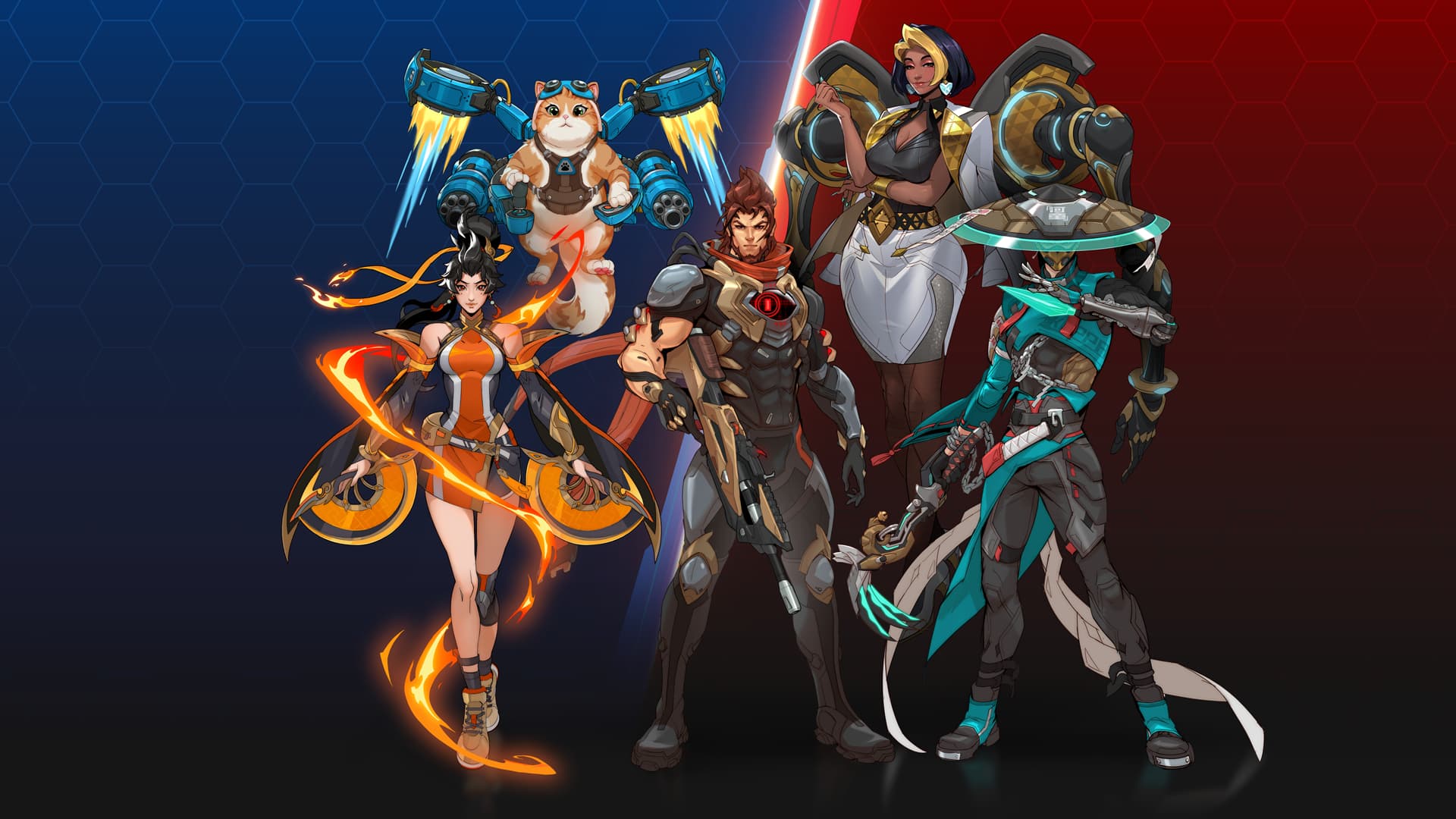
When the next season goes live on February 10, it will be the biggest update to Overwatch at least since the Stadium mode and perks system went live last year, and arguably since the dawn of the Overwatch 2 era. That’s partly because Blizzard is adding five new heroes to the mix all at once next week.
One of those is a character that the studio said in 2017 it had experimented with but ultimately, um, scratched. Jetpack Cat is alive after all, and is coming to Overwatch in a matter of days.
This is a support hero with a permanent flight ability who can “tow” an ally — providing a speed boost while healing them. Jetpack Cat’s ultimate ability sees the kitty diving into the ground to knock down enemies and tether the closest one to them. It’s called Catnapper, which is delightful. Also, the hero’s primary weapon is called Biotic Pawjectiles, so I adore Jetpack Cat already. It’s fun to see weird Wrecking Ball-type characters coming to Overwatch again.
Blizzard Entertainment
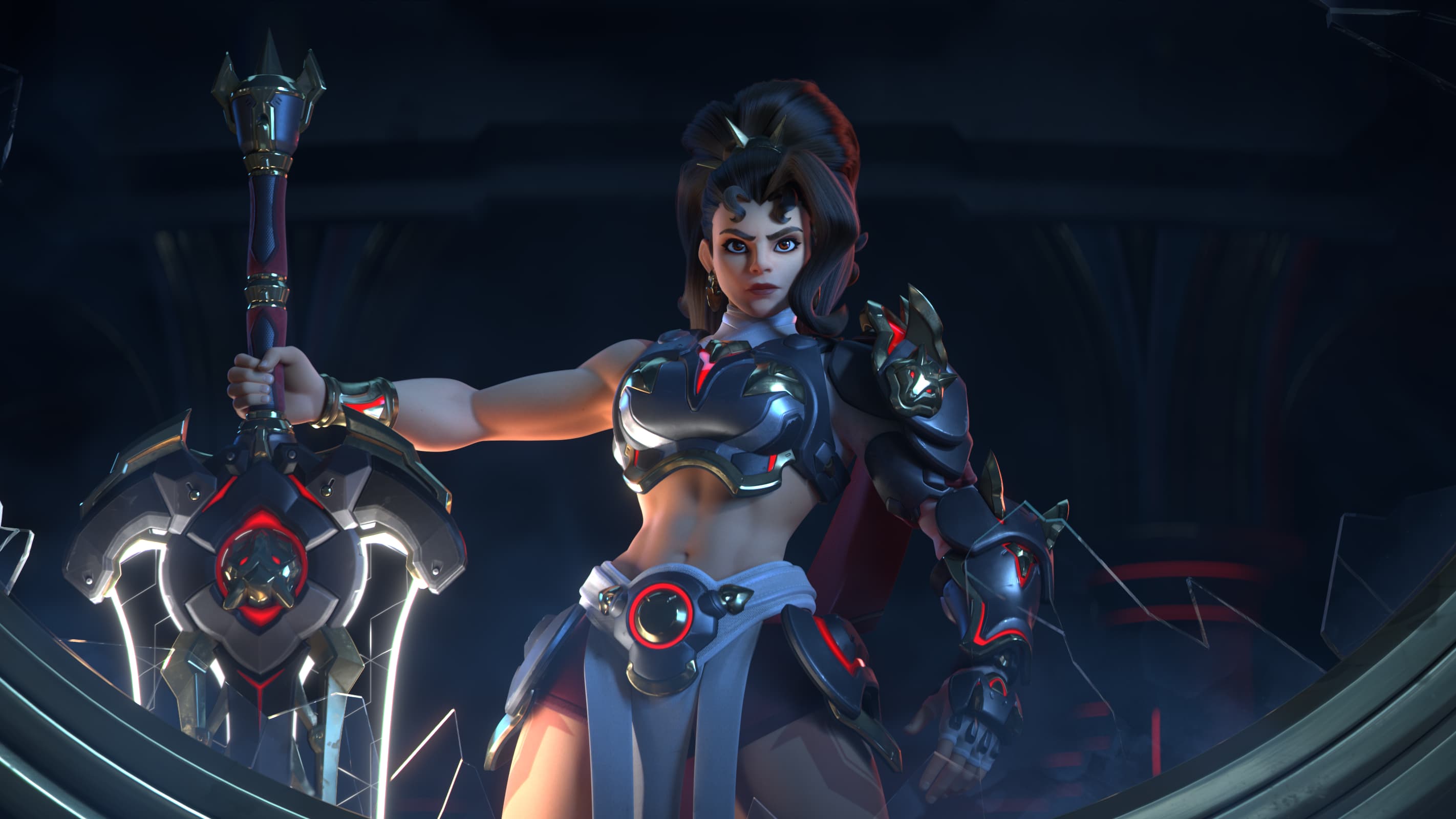
The other new heroes joining the fray next week are Domina (a zone-control tank with “long-range precision”), damage dealer Emre (a “fast‑paced, mobile soldier archetype with conflicting identity due to cybernetic modification”), Mizuki (a support who can throw a hat to heal allies) and Anran (a high-mobility hero who deals fire damage and can self-resurrect with their ultimate).
As with Jetpack Cat, the latter of those is aligned with the Overwatch faction. You can try Anran out starting February 5 as part of a hero trial. The other three have ties to the villainous Talon organization. Expect another hero to join the fray every couple of months this year as each new season gets under way. That means more heroes will be added to Overwatch in 2026 than in any year since the game’s debut.
A “story-driven era”
Blizzard Entertainment
The next season spells the beginning of what Blizzard is calling a “new story-driven era” for Overwatch, starting with a year-long narrative arc called The Reign of Talon. All of the lore, heroes, events and so on that emerge over the next 12 months will be tied to the rise of Talon.
The studio says this is the “the first fully connected annual storyline in Overwatch history.” A new arc will begin next year with Season 1 of 2027 (Blizzard is resetting the season counter when The Reign of Talon begins).
Elsewhere, each role will be split into sub-roles, and the heroes in each will share a passive ability. For instance, “initiator” tanks heal more while they’re in the air, several damage heroes can detect enemies that are below half health through walls after damaging them and some supports have excess ultimate charge that carries over after you use their most powerful ability.
Also on the way soon is a “meta event” called Conquest. This is billed as a faction war between Overwatch and Talon that will run for five weeks, with dozens of loot boxes and other rewards (such as some legendary Echo skins) up for grabs.
Blizzard Entertainment
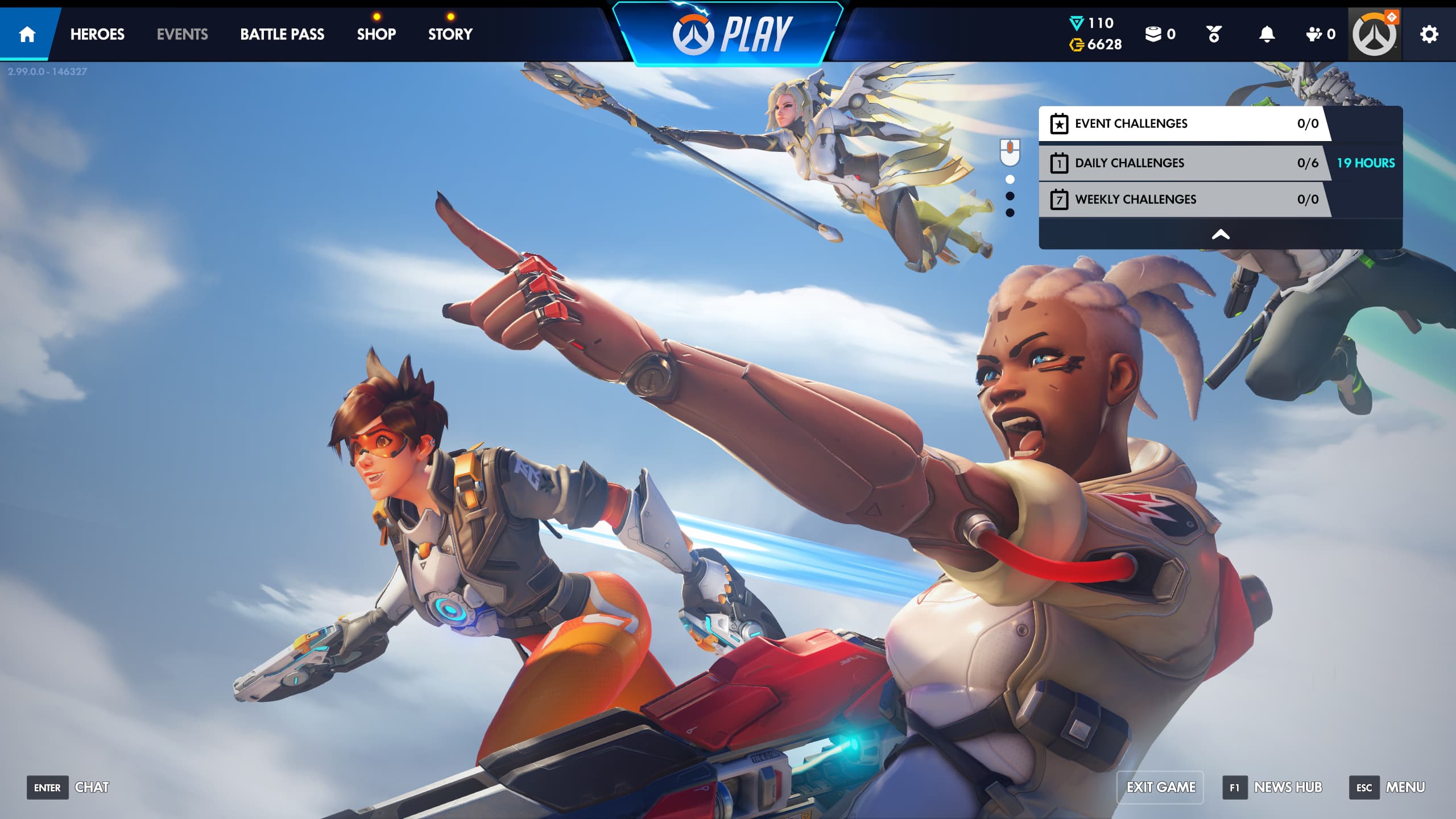
Blizzard has overhauled the Overwatch interface too, with updated menus, a new hero lobby, a notification hub and the promise of faster navigation. Stadium will have some updates, such as refreshed ability icons and recommended builds based on global data that will be updated between rounds. Vendetta is joining that mode’s roster as well.
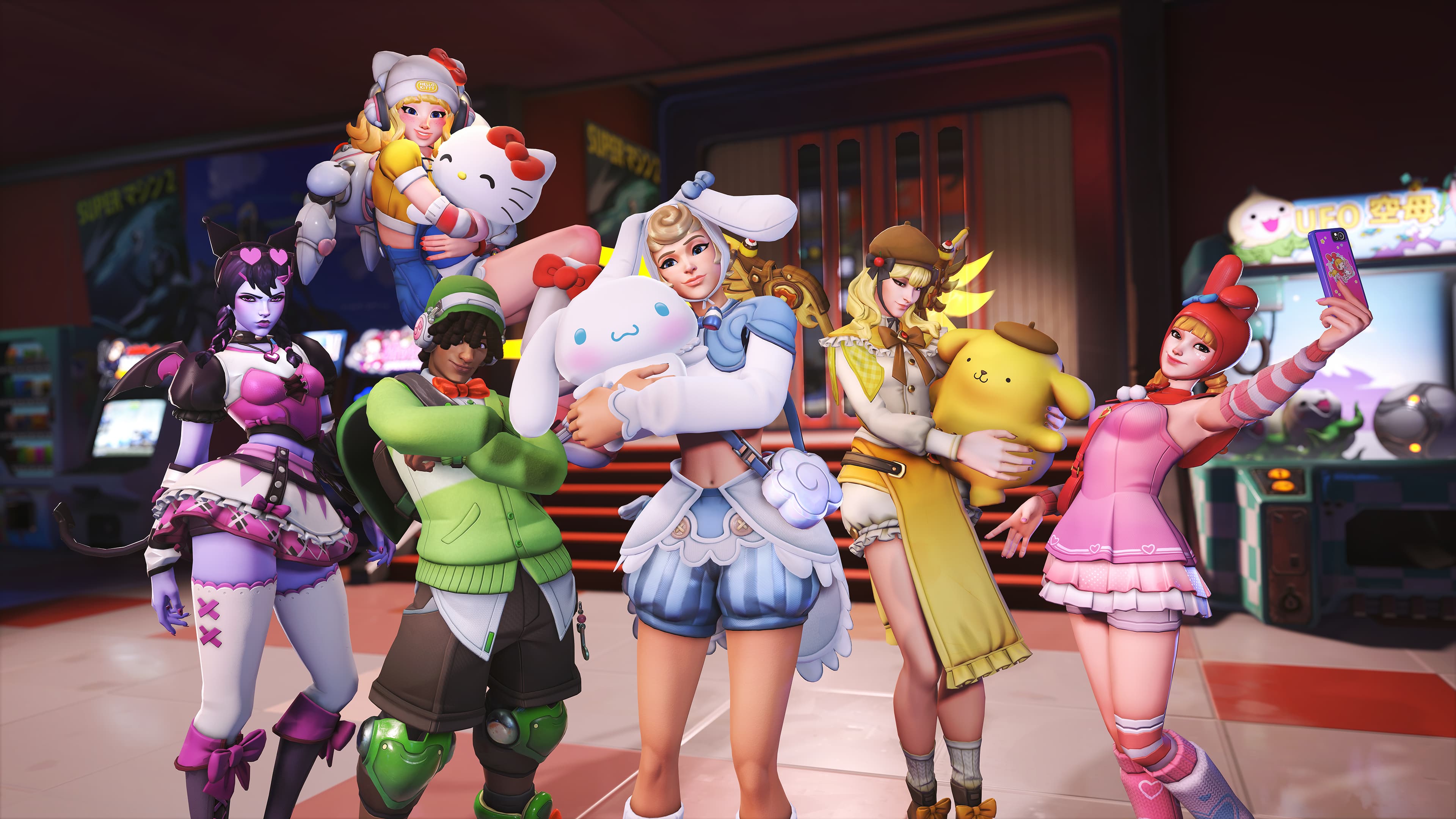
Along with all the new heroes and other updates, a Hello Kitty collaboration will run for two weeks starting on February 10 with themed cosmetics for several heroes. Lots of other cosmetics are in the pipeline, including Crimson Wolf weapon skins you can unlock using competitive points, and rainy day and Valentine’s items. Shop items from the last six seasons are going into loot boxes, while mythic cosmetics for Mercy, Juno and Mei will be available in Season 1.
Blizzard Entertainment
Looking further ahead, a Nintendo Switch 2 version of Overwatch will arrive alongside Season 2, which will start in April. Some heroes will be getting their second mythic skins, including Ana and Genji. Genji, Hanzo and Sojourn will have mythic weapon skins in the coming months. Two new maps, including a Japan Night one, for the main modes are coming, along with the return of post-match accolades.
There’s so much on the way for my go-to game. I don’t know how I’m going to be able to take a long-enough break from Overwatch to play cool indies ever again.
This article originally appeared on Engadget at https://www.engadget.com/gaming/overwatch-will-drop-the-2-as-jetpack-cat-and-four-other-heroes-arrive-on-february-10-184500327.html?src=rss
Senator Edward J. Markey (D-Mass.) demanded that Immigration and Customs Enforcement (ICE) confirm or deny the existence of a “domestic terrorists” database that lists US citizens who protest ICE’s immigration crackdown.
ICE “officers and senior Trump administration officials have repeatedly suggested that the Department of Homeland Security (DHS) is building a ‘domestic terrorists’ database comprising information on US citizens protesting ICE’s actions in recent weeks,” Markey wrote in a letter yesterday to Acting ICE Director Todd Lyons. “If such a database exists, it would constitute a grave and unacceptable constitutional violation. I urge you to immediately confirm or deny the existence of such a database, and if it exists, immediately shut it down and delete it.”
Creating a database of peaceful protesters “would constitute a shocking violation of the First Amendment and abuse of power,” and amount to “the kinds of tactics the United States rightly condemns in authoritarian governments such as China and Russia,” Markey said.
Starting with 2024’s Galaxy S24 series, Samsung started promising seven years of software support for its new phones, following a precedent Google set with the Pixel 8. It was a surprisingly user-friendly and even environmentally conscious move, letting buyers more easily keep their phones for longer while also reducing e-waste generated from constant upgrades. Unfortunately, it didn’t apply to previous models, and now we’re starting to see the consequences of that.
In Samsung’s February 2026 security updates (first spotted by SamMobile), the Galaxy S21, S21+, and S21 Ultra are nowhere to be seen, indicating that they’ve reached their end of support. The only phone from this line still listed was the S21 FE 5G, which makes sense, since it was released a year after the rest of the S21 line. That means these phones will no longer get regular monthly or quarterly security updates, although if a critical vulnerability pops up, Samsung might still issue an emergency fix.
None of this should be surprising, but it can still be confusing if you’re an S21 owner. To be fair to Samsung, the company only ever pledged five years of support for the S21 series on release, and only four years of Android updates. But as far as hardware goes, your phone is probably still running just fine. The Snapdragon 888 chip powering the S21 series is snappy enough for casual use, even if it can be a bit power hungry. Do you really need to replace it, especially so soon after launch?
Can you keep using the Galaxy S21 series?
As far as browsing the internet, watching videos, and scrolling social media apps goes, your Galaxy S21 phone should still hold up well. Gaming and other more demanding tasks might suffer, but there shouldn’t be anything physically wrong with your phone aside from aging. The problem comes when you start to consider safety.
Regular security updates help patch holes hackers can use to get into your data or accounts. And these days, hackers have gotten pretty smart. While you might know to avoid sketchy websites or high-risk apps, there are exploits hackers can use now that don’t need any interaction from you. Sometimes, all it takes is having a Bluetooth radio in your device, or for the hacker to know your phone number.
Getting hit by one of these hacks might be rare, but it’s not a good idea to leave yourself open to the possibility if you can avoid it. It’s like driving in a car without a seatbelt—you probably won’t get in a crash, but you’ll wish you had one if you do. Upgrading to a phone getting official security updates from the manufacturer is the best way to ensure your handset has the most up-to-date safety, but if you can’t, there are a few steps you can take to protect yourself.
Install Google Play System Updates to enhance security on an unsupported phone
Getting over-the-air updates directly from your phone’s manufacturer is the best way to stay safe while using your phone, but they’re not the only way to get security updates. Starting with Android 10, which the Galaxy S21 series does fall under, Google’s Project Mainline began delivering partial security updates via Google Play System Updates.
These won’t close all vulnerabilities, but they do allow Google to patch holes in media codecs and components, permissions, and a few other features hackers like to exploit, even on devices that no longer get official manufacturer support. “With Project Mainline, we can deliver faster security fixes for critical security bugs,” the company said in a blog post. “For example, by modularizing media components, which accounts for nearly 40% of recently patched vulnerabilities.”
Project Mainline can’t fix everything, especially problems related to your specific device, but if you do find that your phone is out of date, it’s worth ensuring your Google Play System Updates are updated to the most recent version until you can find a new one. How to check this will differ from device to device, but you’ll generally find these updates under Settings > System > Software updates. Here, you’ll see a date showing which Google Play system update your phone is running. These should normally update manually every month, but if the date looks a little old, you can simply tap it to search for a fresh update and download it.
When you should upgrade your Samsung phone
Ideally, you should take the end of software support as a sign to upgrade to a new phone, even if it appears to be working fine. But I get any hesitation you might be feeling. I’m still on Windows 10, which is facing its own security update issues, even though my device still works perfectly for everything I want from it. I’m glad to see companies catching on with extended security updates, so hopefully this will become less of an issue in the future. Tech timelines move fast, but a five-year upgrade cycle feels a lot more wasteful than even a seven-year one.
For now, though, keep in mind that any Samsung phone released before 2024 is going to face an end-of-life sooner than you might think, so it’s time to start planning for it accordingly. The company might have moved on to seven years of updates now, but that promise doesn’t apply retroactively. So Galaxy S22 owners, it’s time to start thinking about what you’ll do with your own devices next year.
When X’s engineering team published the code that powers the platform’s “for you” algorithm last month, Elon Musk said the move was a victory for transparency. “We know the algorithm is dumb and needs massive improvements, but at least you can see us struggle to make it better in real-time and with transparency,” Musk wrote. “No other social media companies do this.”
While it’s true that X is the only major social network to make elements of its recommendation algorithm open source, researchers say that what the company has published doesn’t offer the kind of transparency that would actually be useful for anyone trying to understand how X works in 2026.
The code, much like an earlier version published in 2023, is a “redacted” version of X’s algorithm, according to John Thickstun, an assistant professor of computer science at Cornell University. “What troubles me about these releases is that they give you a pretense that they’re being transparent for releasing code and the sense that someone might be able to use this release to do some kind of auditing work or oversight work,” Thickstun told Engadget. “And the fact is that that’s not really possible at all.”
Predictably, as soon as the code was released, users on X began posting lengthy threads about what it means for creators hoping to boost their visibility on the platform. For example, one post that was viewed more than 350,000 times advises users that X “will reward people who conversate” and “raise the vibrations of X.” Another post with more than 20,000 views claims that posting video is the answer. Another post says that users should stick to their “niche” because “topic switching hurts your reach.” But Thickstun cautioned against reading too much into supposed strategies for going viral. “They can’t possibly draw those conclusions from what was released,” he says.
While there are some small details that shed light on how X recommends posts — for example, it filters out content that’s more than a day old — Thickstun says that much of it is “not actionable” for content creators.
Structurally, one of the biggest differences between the current algorithm and the version released in 2023 is that the new system relies on a Grok-like large language model to rank posts. “In the previous version, this was hard coded: you took how many times something was liked, how many times something was shared, how many times something was replied … and then based on that you calculate a score, and then you rank the post based on the score,” explains Ruggero Lazzaroni, a pHD researcher at the University of Graz. “Now the score is derived not by the real amounts of likes and shares, but by how likely Grok thinks that you would like and share a post.”
That also makes the algorithm even more opaque than it was before, says Thickstun. “So much more of the decisionmaking … is happening within black box neural networks that they’re training on their data,” he says. “More and more of the decisionmaking power of these algorithms is shifting not just out of public view, but actually really out of view or understanding of even the internal engineers that are working on these systems, because they’re being shifted into these neural networks.”
The release has even less detail about some aspects of the algorithm that were made public in 2023. At the time, the company included information about how it weighted various interactions to determine which posts should rank higher. For example, a reply was “worth” 27 retweets and a reply that generated a response from the original author was worth 75 retweets. But X has now redacted information about how it’s weighing these factors, saying that this information was excluded “for security reasons.”
The code also doesn’t include any information about the data the algorithm was trained on, which could help researchers and others understand it or conduct audits. “One of the things I would really want to see is, what is the training data that they’re using for this model,” says Mohsen Foroughifar, an assistant professor of business technologies at Carnegie Mellon University. “if the data that is used for training this model is inherently biased, then the model might actually end up still being biased, regardless of what kind of things that you consider within the model.”
Being able to conduct research on the X recommendation algorithm would be extremely valuable, says Lazzaroni, who is working on an EU-funded project exploring alternative recommendation algorithms for social media platforms. Much of Lazzaroni’s work involves simulating real-world social media platforms to test different approaches. But he says the code released by X doesn’t have enough information to actually reproduce its recommendation algorithm.
“We have the code to run the algorithm, but we don’t have the model that you need to run the algorithm,” he says.
If researchers were able to study the X algorithm, it could yield insights that could impact more than just social media platforms. Many of the same questions and concerns that have been raised about how social media algorithms behave are likely to re-emerge in the context of AI chatbots.”A lot of these challenges that we’re seeing on social media platforms and the recommendation [systems] appear in a very similar way with these generative systems as well,” Thickstun said. “So you can kind of extrapolate forward the kinds of challenges that we’ve seen with social media platforms to the kind of challenges that we’ll see with interaction with GenAI platforms.”
Lazzaroni, who spends a lot of time simulating some of the most toxic behavior on social media, is even more blunt. “AI companies, to maximize profit, optimize the large language models for user engagement and not for telling the truth or caring about the mental health of the users. And this is the same exact problem: they make more profit, but the users get a worse society, or they get worse mental health out of it.”
This article originally appeared on Engadget at https://www.engadget.com/social-media/xs-open-source-algorithm-isnt-a-win-for-transparency-researchers-say-181836233.html?src=rss
Investors were assessing on Wednesday whether a selloff in global software stocks this week had gone too far, as they weighed if businesses could survive an existential threat posed by AI. The answer: It’s unclear and will lead to volatility. From a report: After a broad selloff on Tuesday that saw the S&P 500 software and services index fall nearly 4%, the sector slipped another 1% on Wednesday. While software stocks have been under pressure in recent months as AI has gone from being a tailwind for many of these companies to investors worrying about the disruption it will cause to some sectors, the latest selloff was triggered by a new legal tool from Anthropic’s Claude large language model (LLM).
The tool – a plug-in for Claude’s agent for tasks across legal, sales, marketing and data analysis – underscored the push by LLMs into the so-called “application layer,” where these firms are increasingly muscling into lucrative enterprise businesses for revenue they need to fund massive investments. If successful, investors worry, it could wreak havoc across a range of industries, from finance to law and coding.
The Pixel 10a is official, though details are limited. On Wednesday, Google posted a teaser video showing the mid-range phone dancing around colorful backgrounds. You can pre-order the Pixel 10a on February 18.
Google hasn’t yet revealed the phone’s specs. In the short video, we can see a blue model that’s virtually indistinguishable on the outside from the Pixel 9a. And alleged leaks point to a phone with few changes on the inside. That (unconfirmed) list includes a 6.285-inch display, dual rear cameras (48MP wide and 13MP ultra-wide) and a 5,100mAh battery.
Google
The teaser’s tagline appears to be an attempt to assure Pixel fans that there will, in fact, be meaningful upgrades. “A phone with more in store, in store soon,” it reads. Hopefully, its pricing and specs will be “in store” for us soon as well.
In the meantime, you can visit the Google Pixel website to register for more info.
This article originally appeared on Engadget at https://www.engadget.com/mobile/smartphones/you-can-pre-order-the-pixel-10a-on-february-18-180712018.html?src=rss
Built-in lyrics are one of my favorite features of modern music streaming services. Back in ancient times, I had to google the lyrics to the songs I was listening to—which was fine if I was near a computer, but impossible when I was on the go with my iPod. This is probably why there are so many songs I think I know the words to, only to discover, once I read the actual lyrics, that I am sorely mistaken. Built-in lyrics are thus a feature that is equal parts useful and humbling.
As it happens, Spotify’s existing lyrics features are getting some upgrades to kick off February. The company announced three key updates on Wednesday—two that impact free users, and one exclusive to Premium subscribers. Spotify might not offer Apple Music’s dynamic lyrics, but these updates should still be welcomed by anyone who likes reading along to their music.
Spotify now supports offline lyrics
The biggest announcement of the day—in my opinion, anyway—is offline support for lyrics. This is always something that frustrates me whenever I’m using my phone without cellular service. Say I download some albums to listen to on a flight: When I try to listen to them in airplane mode, lyrics are unavailable. Being able to download the lyrics when you grab a song or album is a small but actually meaningful upgrade.
Unfortunately, offline lyrics are not available free of charge: At this time, the feature is only available to Premium subscribers, which makes sense, given that free users can’t download music for offline listening anyway—only podcasts.
Lyrics are moving to a new location in the Spotify app
Traditionally, lyrics have appeared at the bottom of the player window in the Spotify app. To view them, you need to scroll down, then tap on the lyrics window to fully expand it. It seems Spotify wasn’t content with this UI. The company says that in its testing, it finds that placing the lyrics directly below the album art, rather than below the player, makes them easier to interact with. And so that’s where the lyrics are moving.
The company calls these “lyrics previews,” as you see just a snippet of the lyrics at one time. This change is rolling out to both free and Premium users on iOS and Android. If you’d rather not see the lyrics at all, you can tap the three-dot menu and choose “Lyrics Off.”
Spotify is adamant that this new placement won’t change lyric sharing. You’ll still be able to send specific lyrics to friends and social media platforms. You’ll just need to do so from the new lyrics window.
Spotify now support lyrics translations worldwide
Spotify’s lyrics translation feature makes it easy to figure out what artists are singing about when you don’t speak their particular language. When you listen to a song that doesn’t match your device’s system language, you’ll find a translate button in the lyrics window. Tap that, and Spotify will include translations beneath each line of the song, so you can follow along.
According to Spotify, this feature was available in more than 25 markets as of the end of last year, but now, the company is rolling out the feature worldwide.
Adobe has canceled plans to discontinue its 2D animation software Animate.
On Monday, Adobe announced that it would stop allowing people to sell subscriptions to Animate on March 1, saying the software had “served its purpose.” People who already had a software license would be able to keep using Animate with technical support until March 1, 2027; businesses had until March 1, 2029. Per an email sent to customers, Adobe also said users would lose access to Animate files and project data on March 1, 2027. Animate costs $23 per month.
After receiving backlash from animators and other users, Adobe reversed its decision on Tuesday night. In an announcement posted online, the San Jose, California-headquartered company said:
If you tried talking to ChatGPT this morning, you might have found it unresponsive—something unusual for the bot that always has something say. It’s not your internet connection, and it isn’t your OpenAI account: ChatGPT is down.
According to Downdetector, owned by Lifehacker parent company Ziff Davis, users started reporting issues with ChatGPT at 11:56 a.m. ET. Those reports ballooned by 12:11 p.m., as the total number of incidents as of this article currently sits above 7,000. If you’re an avid ChatGPT user, you might have also had issues with the bot yesterday: Downdetector shows over 25,000 reports of down time starting at 2:56 p.m. Tuesday and resolving around 4:11 p.m. the same day.
As with all outages, OpenAI will likely figure out a patch for the issue soon enough. But these outages are becoming more common. There was the Verizon outage, of course, but other services like TikTok have also experienced intermittent periods of downtime.
Rumors of the demise of Intel’s GPU business have been greatly exaggerated. Even before the launch of the first Alchemist-based Intel Arc GPUs, naysayers were insisting that Intel would kill the brand, kill the project, or cut the whole team. Intel has done some restructuring, to be sure, but the company’s GPUs are not going anywhere, and
We may earn a commission from links on this page. Deal pricing and availability subject to change after time of publication.
The Amazon Echo Dot line has long been a good choice if you’re seeking compact, budget-friendly way to enter the Alexa smart home ecosystem, combining decent sound quality with versatile smart home capabilities. And right now, the newest Amazon Echo Dot Max, released late last year, and offering improved audio and connectivity features, is on sale for $79.99 (originally $99.99) in every color.
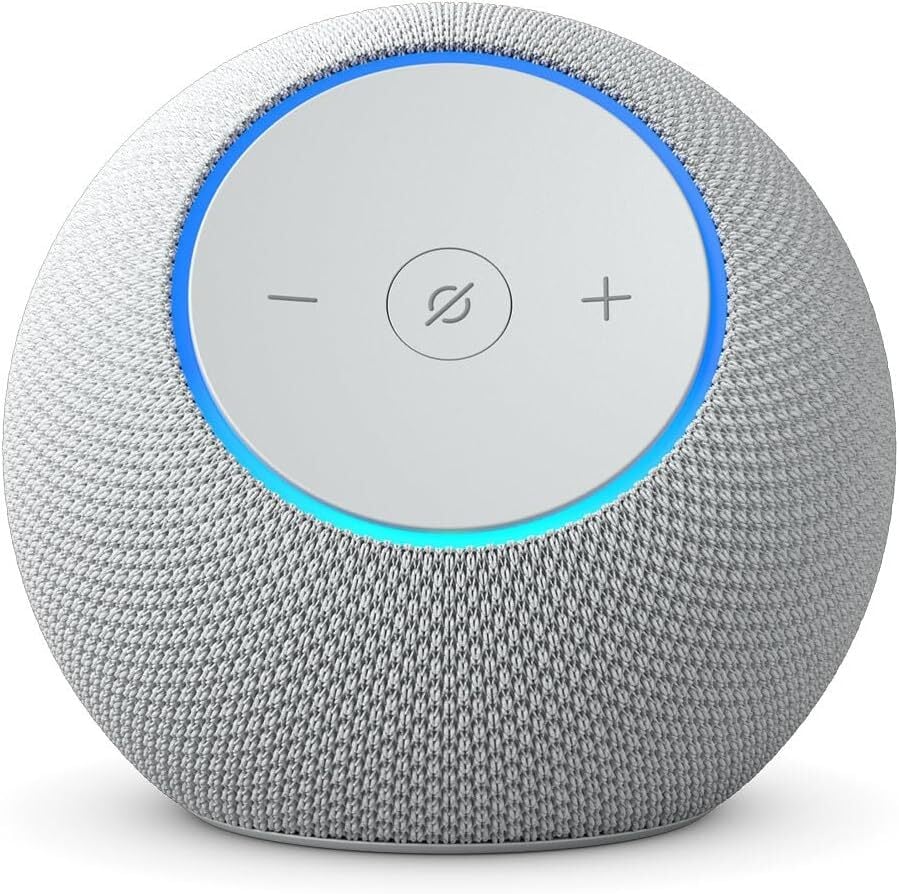
This speaker earned an Editors’ Choice Award from PCMag, which noted it delivers “fairly strong low-end frequencies considering its puny size.” At 6.1 x 5.6 x 5.8 inches, it’s more compact than the previous Echo, with a new look that might remind you of the Death Star—it’s a sphere with a large, flattened volume plate that makes the buttons more visible and a light ring that shines towards where you’re speaking and displays the volume level as a white arc. (One downside: The smaller size means a smaller woofer than its predecessor, though PCMag said the bass is still “reasonably deep.”)
One of the Dot Max’s main draws its usefulness as a voice assistant. It has Amazon Alexa built-in, and Amazon Prime members can get a free upgrade to the Alexa+ AI assistant (normally $20/month). The Amazon Echo Dot Max supports Bluetooth 5.3 and Wi-Fi 6E, serves as a hub for smart home devices like Zigbee, Thread, and Matter, and includes Wi-Fi radar, ultrasonic, temperature, and ambient light sensors that detect your presence in the room.
While the Echo Dot Max is a good choice at this discount, if you mostly plan to use it for listening to music, the latest Echo Dot (currently $50) may suffice.
Anthropic has announced that its chatbot Claude will remain ad-free. This is in direct contrast to rival company OpenAI, which recently brought ads to ChatGPT for many users.
The company says that “including ads in conversations with Claude would be incompatible” with the chatbot becoming a “genuinely helpful assistant for work and for deep thinking.” The reasoning here is rather simple. People tend to share personal details with chatbots, for better or for worse, and getting ads based on that stuff would be creepy. Imagine asking for mental health advice and getting an ad for St. John’s wort or something.
Anthropic notes that other conversations “involve complex software engineering tasks, deep work or thinking through difficult problems. The appearance of ads in these contexts would feel incongruous—and, in many cases, inappropriate.”
The company said that integrating advertising would “work against” the Claude Constitution, which counts “being generally helpful” as a core principle. “Introducing advertising incentives at this stage would add another level of complexity. Our understanding of how models translate the goals we set them into specific behaviors is still developing; an ad-based system could therefore have unpredictable results,” it writes in a blog post.
There are some real world concerns here. AI companies gobble up all money in sight and the returns haven’t exactly been stellar. Ads are an easy way to recoup some of that investment, which is likely why OpenAI went that route. Engadget reached out to Anthropic to inquire about any kind of forthcoming financial hurdles that could force it to change course. A representative pointed to today’s blog post and said it’s “all the information we have to share at this time.”
We do know that Anthropic remains committed to commerce-based agentic AI. It said it will “continue to build features that enable our users to find, compare or buy products, connect with businesses and more.”
This article originally appeared on Engadget at https://www.engadget.com/ai/anthropic-says-it-wont-bring-ads-to-claude-unlike-rival-chatgpt-171243642.html?src=rss
In the old days, we’d post our photos and videos on social media for the world to see. Right now, it’s far more common to send these pictures and clips to friends and family through private chat groups—but what you might not have realized is that they get pretty heavily compressed along the way.
There are many reasons for this: It means the files get sent faster, for example, and that the companies behind these messenger apps don’t have to spend quite so much on cloud storage (imagine millions of images being sent by millions of users, all the time). However, the recipients of these photos and videos are missing out, and getting copies that are of a much lower quality.
A lot of the time, you can’t really tell the difference on a small phone screen, which is why apps can get away with it. But if you’re looking at something on a computer screen or trying to print something out to get a permanent physical copy, the compression quickly becomes apparent. It’s something most messenger apps do—but there is a workaround if you want your photos and videos shared at full resolution.
How much do messenger apps compress your files?
Look out for the HD button when sharing on Instagram. Credit: Lifehacker
Messenger apps are rather coy when it comes to revealing just how much compression they apply: Search the web and you’ll hit Reddit threads and support forums rather than actual official documents. Apple admits iMessage applies compression “when necessary”, and Google acknowledges files “may have a lower resolution” when sent through Google Chat, but it’s all rather vague.
To try and get a bit more clarity, I ran a quick test myself, with a 12MP, 4,000 x 3,000 pixel, 3.4MB image taken on a Pixel. Bearing in mind that compression levels will vary depending on what you’re sending, and this was just a test with a single image, here’s how the file was changed after it got sent through various DMs:
Facebook Messenger: 2,048 x 1,536 pixels, 392KB
Google Chat: 1,600 x 1,200 pixels, 324KB
Google Messenger: 4,000 x 3,000 pixels, 3.4MB.
iMessage: 4,000 x 3,000 pixels, 3.2MB
Instagram: 1,000 x 750 pixels, 138KB
WhatsApp: 2,000 x 1,500 pixels, 390KB
You can see there’s a lot of compression going on here, but Google Messages and iMessage are the clear winners when it comes to retaining original quality (at least with images)—a good advert for both Apple’s proprietary messaging system and for RCS.
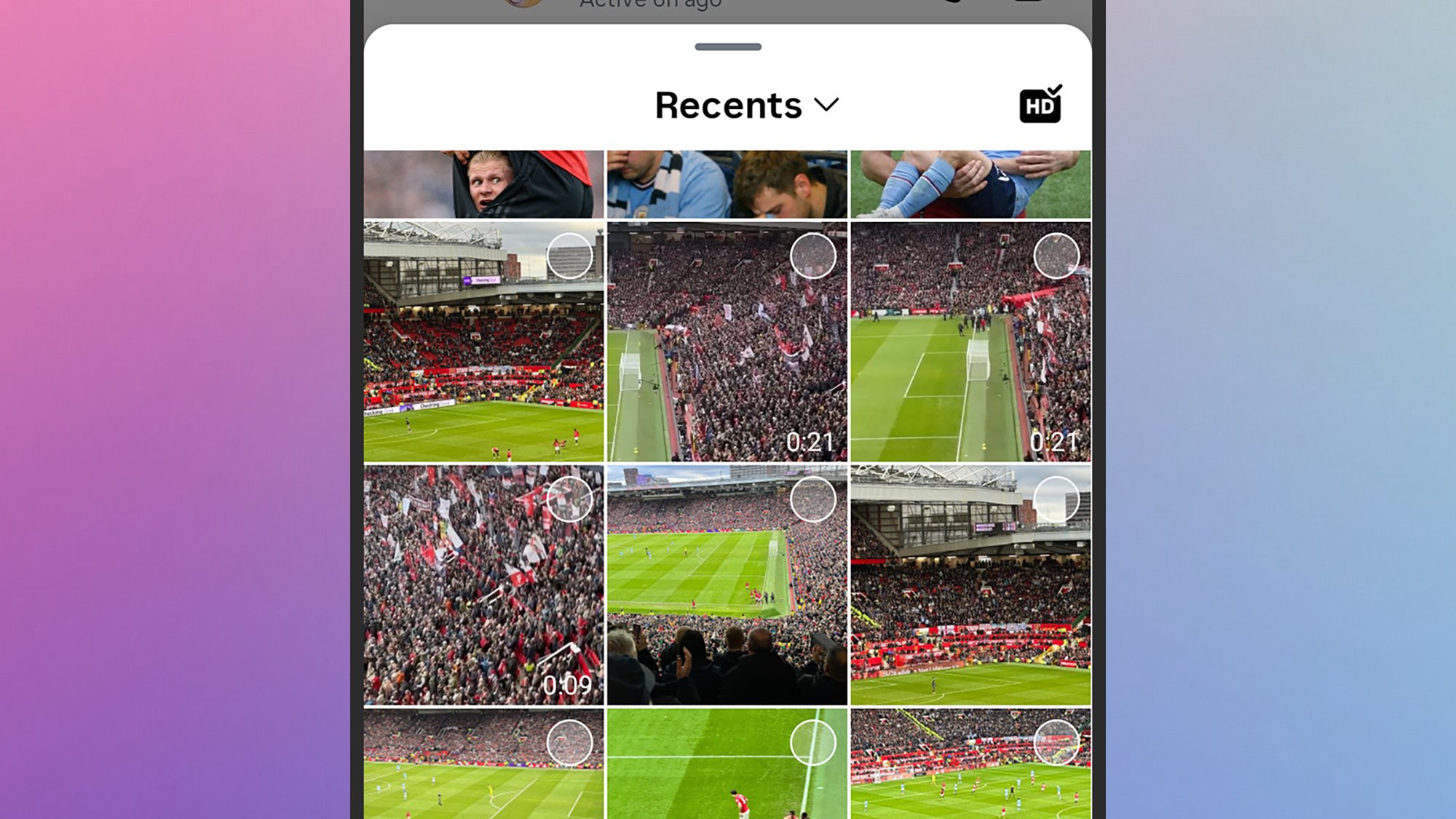
It’s also worth delving into the settings for each app. In Instagram, for example, there’s a HD button next to the photo and video picker: When I selected this, Instagram shrank my original photo down to 2,000 x 1,500 pixels, with a file size of 421KB.
In its help section, Instagram says it automatically adjusts image compression based on current network conditions, which is something else to think about—you might want to do all your photo and video sharing over wifi (which is what I did here).
How to send files in their original quality through messenger apps
It only takes a couple of taps to get iCloud links in Apple Photos. Credit: Lifehacker
You can make sure your photos and videos get to your friends and family in their glorious, original quality, but you lose a bit of convenience along the way. Essentially, you need to pick a cloud storage service where your images and videos will be stored in full resolution, and then share links to these files—rather than sharing the files themselves.
It’s not quite the same immediate experience if you’re sending around baby pictures or party pictures: Your recipients will just see a rather dull-looking link instead of thumbnails right inside their apps (though in some cases, there might be a small preview attached). If quality is what matters most to you, this is the way to go when it comes to sharing photos and videos.
You’re free to use your cloud storage provider of choice, but if there is one made by the same company behind your favorite messaging app, it makes sense to combine them together. In Google Photos on Android, for example, you can tap on a photo to view it, then choose Share and Share again to find the Create link feature: You can then share this link with any contact in any app.
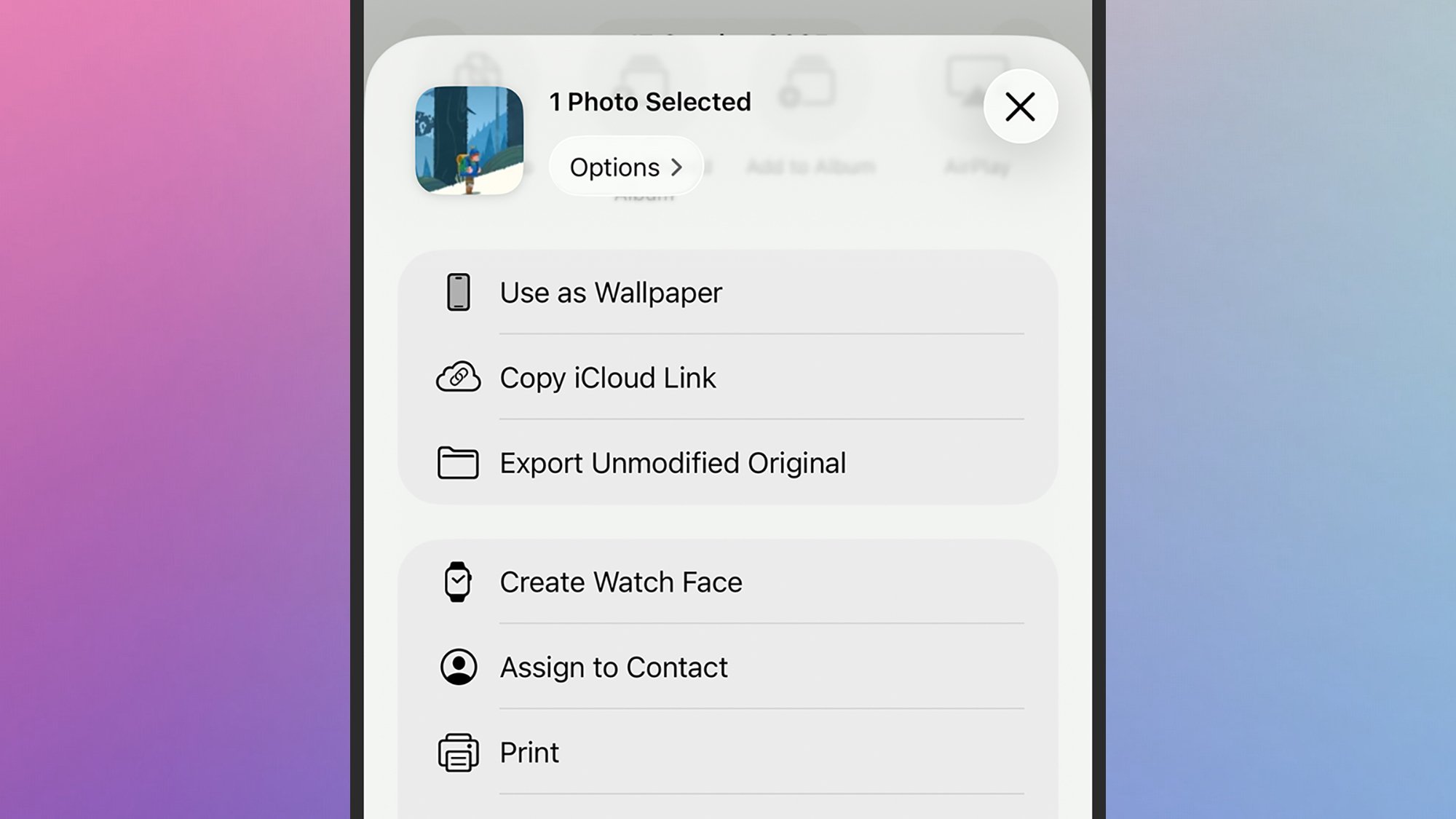
For Apple Photos on the iPhone, you can get a link to a photo once you’ve opened it up by tapping the share button (lower left), then Copy iCloud Link. Again, you can paste this anywhere you like, and it’s not much more difficult to share entire folders of pictures rather than individual images.
There is an extra advantage to sharing photos and videos this way, in that you can revoke sharing permissions any time you like: New people can be added and other people can be removed from albums showing your toddler growing up for example. It’s not as fast and easy as direct file sharing, but you do get a bit more control (and higher resolutions).
If you bought a Windows computer in the past couple years, there’s a good chance that it a “Copilot” key where the right ctrl key used to be. But what if you actually used the right ctrl key? Or what if you prefer Claude or ChatGPT to Copilot? Whatever your reason for not loving the Copilot key, don’t worry—you can change it. Here’s how to do so in the Windows settings or, if necessary, using Microsoft Powertoys.
How to change the Copilot key in settings
Open the Settings application and head to the Personalization section. You should find a Customize Copilot key option here, assuming you’re using a recent-ish version of Windows 11. Click the drop-down menu and you’ll have three options: Copilot, Search, and Custom. You can change the button to Search if you’d rather use the key to bring up the Windows search tool instead of Copilot.
Alternatively, you can use the Custom option to launch any application on your computer instead of Copilot. This could be a useful way to open the Claude or ChatGPT desktop apps instead of Copilot. Or, if you’re not a big AI fan, you could just have it open your browser.
This is a limited number of options, granted, but it’s easy and doesn’t require any sort of tools. It’s your simplest option.
How to change the Copilot key using Microsoft Powertoys
You may have noticed that the options in Settings don’t let you remap the Copilot key to the ctrl key, or any other key—all you can do is launch an application. For that, you’re going to need to install Powertoys, the secret Microsoft app that improves Windows.
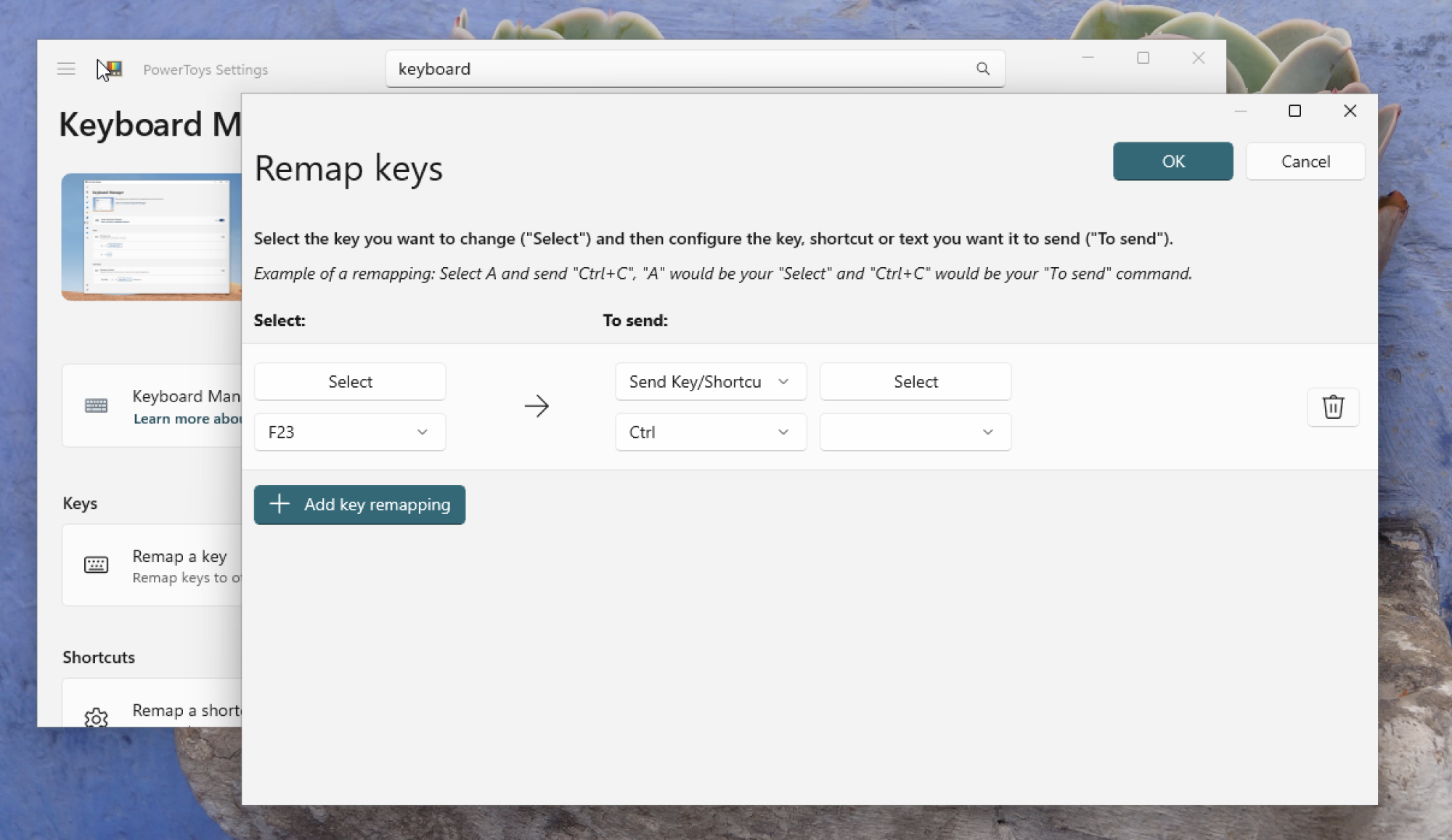
After installing, go to the Keyboard Manager section. The simplest thing to do, which may or may not work on your computer, is to click Remap keys. You should be able to press your Copilot key to remap it (it will show up as F23, which we’ll get to). Now you can choose what you want the key to serve as. This could be ctrl, if you like, or it could be any other key. Click OK, and you should be done.
Credit: Justin Pot
There’s a chance this won’t work for you. Why? Because the Copilot key works a little differently depending on what kind of laptop you have. Buckle up: This gets complicated in a very Microsoft-y way.
On many computers, the Copilot key functions as an F23 key. This is a workaround, of sorts, allowing Microsoft to add a key without changing the operating system very much. Most modern keyboards only have one row of function keys—around 12 in total. Keyboards in the 80’s and 90’s sometimes had two rows of keys—around 24 in total. Windows, to this day, still supports all 24 keys, even though basically no one has that many function keys. Microsoft took advantage of this—on many laptops the Copilot key functions as an F23 key.
But this is Windows, so of course it’s more complicated than that. On some laptops, pressing the Copilot key triggers a keyboard shortcut: Windows-Shift-F23. This means you can’t use the Remap keys function in Powertoys to remap the Copilot key, because the Copilot key already triggers a keyboard shortcut.
What you can do is use the Remap a shortcut option. Use this, then press the Copilot key as your selection. You should see the keyboard shortcut Windows-Shift-F23 show up. Now choose what you want to remap your Copilot key to.
This works, with a caveat: You really can’t use it to bring back your ctrl key, as users have noted on Github. The issue is that you can’t remap a keyboard shortcut to a modifier key, just to a single keypress. It’s not clear what could fix this, and I suspect users of such laptops are just stuck. Which is all to say that you might not be able to get your control key back, but least you can remap the key to do something else.
You can find a lot of good deals for Presidents’ Day, but to say it’s a tech-deal boon would be an overstatement. The best Presidents’ Day deals are usually on mattresses, appliances and furniture, but you can find some decent tech sales thrown in as well. This year, Presidents’ Day comes right after Valentine’s Day and Super Bowl 2026, which means there are even more chances to save as sales and discounts overlap. If you’re looking for a new streaming device, a fresh iPad or an upgraded vacuum so you can enter the spring-cleaning season properly, we have you covered. These are the best President Day sales on tech we could find this year.
Presidents’ Day deals under $50
Roku Streaming Stick Plus 2025 for $24 (40 percent off): This is one of the most affordable ways to get 4K streaming on almost any TV set. The dongle has a sleek design, it comes with handy remote that can also control your TV’s power and volume and the device gives you access to Roku’s TV operating system, which has tons of ways to watch free content.
Anker Nano 45W USB-C charger for $30 ($10 off): Anker’s latest 45W charger has a small smart display on it that can show you real-time charging stats. It’s compact design is great for travel, as are its foldable prongs.
Blink Mini 2K+ — 2 cameras for $45 (50 percent off): Blink’s latest plug-in security cameras support 2K video and improved audio quality. Like previous versions, these cameras have two-way talk, motion alerts and support for Alexa voice commands.
Anker Nano 5K ultra-slim magnetic power bank for $46 (16 percent off): This Qi2 power bank measures less than a half inch thick and snaps onto the backs of the latest iPhones for wireless charging. Its 5K capacity will be enough to top up your phone when it’s close to empty, preventing you from searching for a charger or outlet.
Apple Watch Series 11 for $299 ($100 off): The latest flagship Apple Watch has excellent performance, a boosted battery life and a lightweight design that you can comfortably wear all day long — and even into the night to track sleep.
iPad mini (A17 Pro ) for $399 ($100 off): The updated iPad mini runs on the A17 Pro chip for improved performance, plus it has an 8.3-inch Liquid Retina display, a 12MP ultra wide camera with Center Stage, USB-C charging and compatibility with the Apple Pencil Pro.
Beats Studio Pro for $170 (51 percent off): Beats updated these cans to have improved sound quality, and you can really hear the difference from models that came before it. These headphones also have solid Transparency mode, good voice performance and USB-C audio.
Beats Solo 4 headphones for $130 (35 percent off): These on-ear headphones support spatial audio and dynamic head tracking, and they have up to 50 hours of battery life. The “fast fuel” feature allows them to get up to five hours of playback time with just a quick 10-minute power-up.
This article originally appeared on Engadget at https://www.engadget.com/deals/presidents-day-sales-2026-the-best-tech-deals-from-apple-sony-roku-and-others-163000379.html?src=rss
Egyptian regulators have banned Roblox, a popular children’s video game, Bloombergreports. The nation’s Supreme Council for Media Regulation is coordinating with the National Telecommunications Regulatory Authority on the decision to ensure its enforcement.
The state-owned outlet reported that Senator Walaa Hermas Radwandid had proposed regulation of the platform to “protect children’s moral and educational values.” The senator outlined his concerns with the nature of the Roblox platform, including the ability to communicate directly with strangers as well as “potential psychological and behavioral effects on young users.” In a statement to Bloomberg, Roblox stated that it has “built rigorous safeguards that go beyond those of many other platforms.”
Egypt joins others including Iraq, Algeria, Saudi Arabia and the UAE that have banned or heavily restricted the US-based gaming platform; Turkey and Russia also enacted blanket bans on Roblox recently, citing the “promotion of homosexuality” and “LGBT propaganda.”
Roblox has a significant presence in the Middle East and North Africa (MENA) region. The company’s most recent economic impact report claims it added $15 million to total GDP across Egypt, Saudi Arabia, Morocco, Qatar and the UAE between 2021 and 2024.
Roblox recently tightened its age verification requirements for certain in-game features following pressure from numerous US state attorneys general over child safety, though the new system is reportedly a mess.
All of this comes against the backdrop of globally internet restrictions, especially for social media services. A raft of nations including Australia, Spain and Denmark have moved to ban social media entirely for children.
This article originally appeared on Engadget at https://www.engadget.com/gaming/egypt-to-block-roblox-for-all-users-161343443.html?src=rss
Right on schedule to welcome the new month, the Sun has turned into a solar firing range of sorts this week, unleashing a sequence of strong solar flares that continue to put power grid managers and satellite operators on alert. Northern light displays can also expected.
NASA’s Solar Dynamics Observatory captured these images of the solar
Anthropic said today that its AI assistant Claude will not carry advertising of any kind — no sponsored links next to conversations, no advertiser influence on the model’s responses, and no unsolicited third-party product placements — calling Claude a “space to think” that should remain free of commercial interruption. The announcement comes days after Anthropic’s chief rival, OpenAI, announced plans to bring ads to some of its ChatGPT offerings.
Anthropic said its internal analysis of Claude conversations found that a significant share involve sensitive or deeply personal topics. An advertising-based model would also create incentives to optimize for engagement and time spent rather than usefulness, Anthropic said, noting that the most helpful AI interaction might be a short one that doesn’t prompt further conversation.
Anthropic generates revenue from enterprise contracts and paid subscriptions. The company said it is exploring agentic commerce — Claude handling a purchase or booking on a user’s behalf — but stressed that all such interactions should be user-initiated, not advertiser-driven. Anthropic has also brought AI tools to educators in over 60 countries and said it may consider lower-cost subscription tiers and regional pricing.