A few Senate Democrats introduced a bill called the ‘‘ICE Out of Our Faces Act,” which would ban Immigration and Customs Enforcement (ICE) and Customs and Border Protection (CBP) from using facial recognition technology.
The bill would make it “unlawful for any covered immigration officer to acquire, possess, access, or use in the United States—(1) any biometric surveillance system; or (2) information derived from a biometric surveillance system operated by another entity.” All data collected from such systems in the past would have to be deleted. The proposed ban extends beyond facial recognition to cover other biometric surveillance technologies, such as voice recognition.
The proposed ban would prohibit the federal government from using data from biometric surveillance systems in court cases or investigations. Individuals would have a right to sue the federal government for financial damages after violations, and state attorneys general would be able to bring suits on behalf of residents.
In January, the FBI made headlines after it raided the home of Washington Post reporter Hannah Natanson. It was a shocking case of law enforcement not just overriding one journalist’s privacy, but the integrity of the entire news organization. The devices the FBI seized—which included personal devices as well as a Washington Post-issued laptop—contained Natanson’s personal contacts, correspondences, and the Slack channels of the Washington Post itself.
But while the FBI was able to access some of the devices, it was not able to access Natanson’s iPhone. That’s because the device was in Lockdown Mode, which prevented the FBI’s Computer Analysis Response Team (CART) from breaking into it. This isn’t a setting that is exclusive to journalists: You have this option baked into your iPhone as well, and can choose to turn it on at any time. The thing is, unless you’re a high-profile target, you probably don’t want to.
How does Lockdown Mode work?
Lockdown Mode is an option on iPhones, iPads, Apple Watches, and Macs, designed for users who could be the target of sophisticated cyberattacks. Think politicians, businessmen, activists, and, of course, journalists—really, anyone high-profile that works or takes action in a way that could draw the ire of powerful organizations or governments.
Because attackers target devices with spyware, the goal of Lockdown Mode is to reduce the attack surface of your device in order to prevent potential cyberattacks from working. Attackers can install spyware on a target’s device in a number of ways, through links, attachments, wired connections, and file downloads, the same way you can install malware by clicking a malicious link in an email, or downloading a corrupt extension from the web. Lockdown Mode locks down these vulnerabilities and eliminates as many potential attack routes as possible.
To achieve this, Lockdown Mode severely impacts a number of functions you may use on your device every day. According to Apple, that includes the following:
Messages: Lockdown Mode will block most message attachment types, other than “certain images, video, and audio.” Links and link previews are blocked.
Web browsing: The feature blocks “complex web technologies,” which could impact how certain websites load or function. You may not see certain web fonts, and you may see missing image icons in place of pictures.
FaceTime: Incoming FaceTime calls are blocked, except for contacts you have called within the past 30 days. You can’t use SharePlay or take Live Photos in FaceTime calls.
Apple services: Invitations to Apple services like invites to manage a smart home are blocked, unless you have previously invited that person. GameCenter will not work, and Focuses will not work “as expected.”
Photos: Lockdown Mode strips photos of their location data when you share them, and shared albums are taken out of your Photos app. You won’t be able to receive new shared album invites. You can still see shared albums on devices that don’t have Lockdown Mode enabled.
Device connections: Your device needs to be unlocked before it can communicate with another computer. In addition, your Mac also requires your explicit approval before the connection can be made.
Wireless connectivity: You won’t automatically join non-secure wifi networks, and you will disconnect from existing non-secure wifi networks. Lockdown Mode also blocks 2G and 3G cellular support.
Configuration profiles: You can’t install configuration profiles, and the device can’t enroll in Mobile Device Management.
Apple makes a point to say that phone calls and “plain text messages” will work as normal, however incoming calls won’t ring on your Apple Watch. Emergency SOS also will continue to work.
These restrictions make it much more difficult for a bad actor to install spyware on your device, though it also makes it more difficult to use your device. A shared album invite could contain malware, but by removing the feature entirely, you miss out on photos from friends and family. Any spyware coming from a malicious link or image will be blocked, but if you frequently send photos, videos, and other attachments in Messages, you’ll miss out.
That’s why these measures are really designed only for individuals who think they’ll be targeted by sophisticated actors. It seems that could include governments secretly installing spyware on targets’ devices, or the FBI stealing your device in a raid. It’s worth noting that the FBI was able to access Natanson’s other devices, including a MacBook Pro that unlocked with her fingerprint. The agency’s warrant compelled Natanson to unlock her devices with biometrics if they were enabled. Lockdown Mode could not have prevented that, so it’s not clear why the FBI didn’t force Natanson to unlock the iPhone in question, too.
How to turn on Lockdown Mode
If you understand the restrictions, but still want to try Lockdown Mode, you’ll need to be running the following software version on each of the Apple devices you want to use Lockdown Mode with:
iPhone: iOS 16 or later
iPad: iPadOS 16 or later
Apple Watch: watchOS 10 or later
Mac: macOS Ventura or later
Apple says “additional protections” are available for iOS 17, iPadOS 17, or macOS Sonoma or later. In addition, you should update your device to the latest software version before turning on Lockdown Mode if you want all the latest protections.
You can turn on Lockdown Mode on any of your Apple devices, but you must do so individually on each. You’ll find the option at the bottom of the “Privacy & Security” section in Settings (System Settings on Mac). Hit “Turn On Lockdown Mode,” then review the pop-up that appears and choose “Turn On Lockdown Mode” again. You’ll need to choose to “Turn On & Restart,” then enter your device’s password or passcode for the feature to take effect.
The Steam Machine is back from the dead. Not as a Valve-supported program for manufacturers to create living room PCs, but instead a home console sibling to the Steam Deck. Valve introduced its second attempt at ruling the living room in a surprise hardware announcement in November 2025, and paired the new Steam Machine with a new Steam Controller and a wireless VR headset it calls the Steam Frame. Since the announcement, as is often the case with Valve, some details remain elusive, however.
While we wait for the release of the company’s new hardware lineup in 2026, and more information straight from the horse’s mouth, here’s everything we know about the hardware, software and price of the Steam Machine.
What’s the Steam Machine’s hardware like?
Valve
Like the Steam Deck, the Steam Machine is utilitarian and bespoke. The PC is a black, 5.98 x 6.39 x 6.14 inch (152 x 162.4 x 156mm) box, with ports and a grille for a fan in the back and a removable faceplate and customizable LED light strip in the front. Inside, Valve says the Steam Machine features a “semi-custom” AMD Zen 4 CPU with six cores and up to 4.8GHz clock speeds, and a “semi-custom” RDNA3 AMD GPU, along with 16GB DDR RAM, 8GB GDDR6 VRAM and either 512GB or 2TB of storage.
While these specs make the Steam Machine more powerful than the aging Steam Deck (which shipped in 2022 with its own custom AMD chip) Valve has been careful not to oversell the capabilities of the box. In a blog post, the company said that “the majority of Steam titles play great at 4K 60FPS” using AMD’s FidelityFX Super Resolution (FSR) frame generation and upscaling technology, but some titles require more upscaling than others, and it “may be preferable to play at a lower framerate with [variable refresh rate] to maintain a 1080p internal resolution.”
In a hands-on preview of the Steam Machine, Digital Foundry expressed concern with what Valve’s claims and the device’s stated specs could mean for future performance. “The decision to opt for 8GB of GDDR6 memory has been proven to be a limiting factor on many modern mainstream triple-A games and falls short of the maximum VRAM pools and memory bandwidth available on both Xbox Series X and base PS5,” Digital Foundry writes.
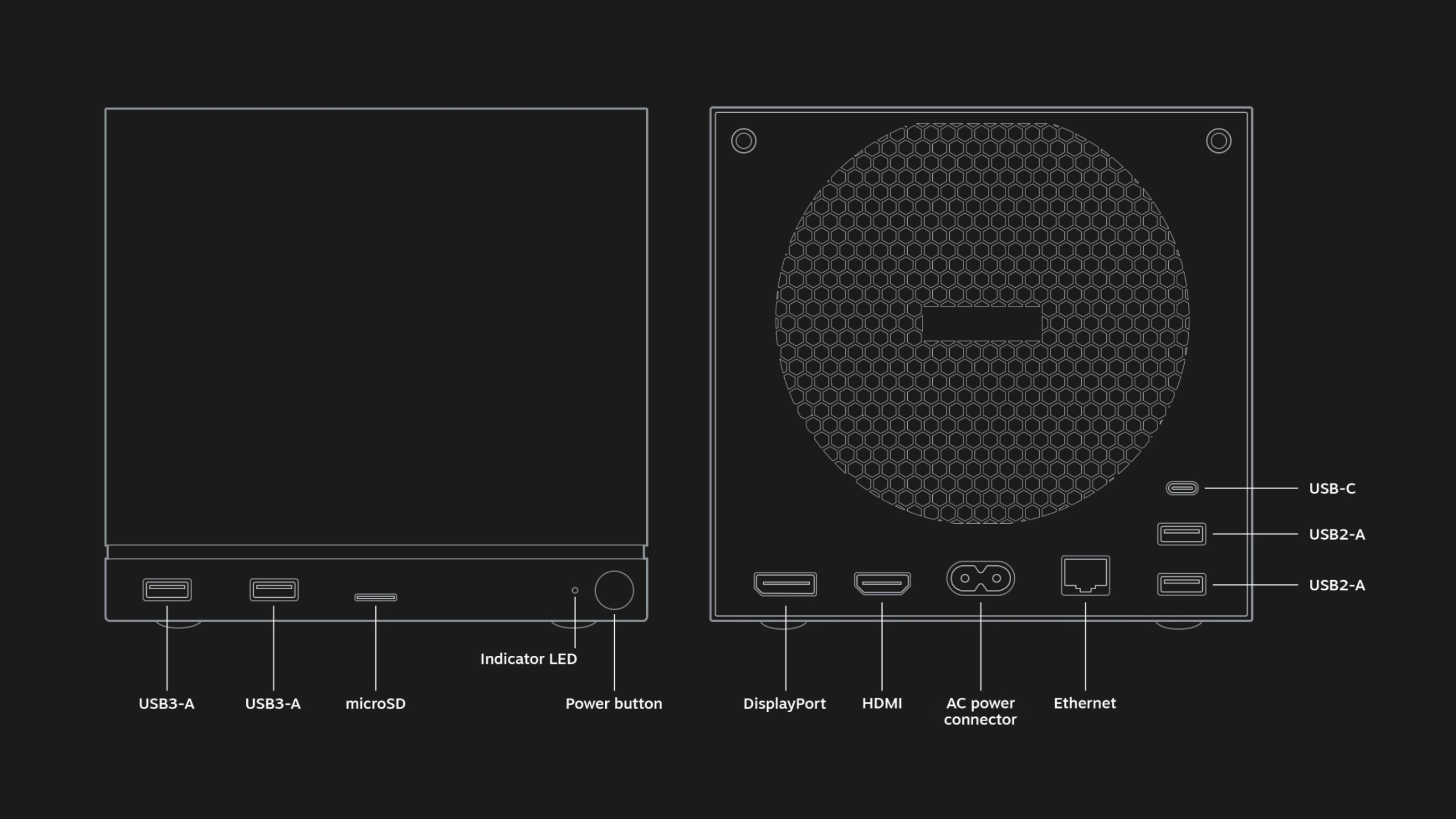
The Steam Machine supports Bluetooth 5.3, Wi-Fi 6E and includes an integrated 2.4GHz adapter for the new Steam Controller. In terms of port selection, there’s DisplayPort 1.4 and HDMI 2.0 inputs for connecting the box to external monitors and TVs, four USB-A ports (divided between two USB 2.0 ports and two USB 3.2 Gen 1 ports) and one USB-C port on the back.
Engadget will have to try out the Steam Machine to really know what it’s capable of, but there’s nothing to suggest it couldn’t be as flexible as the Steam Deck, especially with more power to play with.
What games will be able to run on the Steam Machine?
Valve
Any game that runs on SteamOS, Valve’s Linux-based operating system, will run on the Steam Machine, provided the device’s technical specs will support it. For games running natively on Linux, the Steam Machine will download the Linux version. For Windows games and everything else, it’ll be able to use Steam’s built-in Proton compatibility layer to translate games to Linux, just like the Steam Deck does.
Proton is developed by both Valve and CodeWeavers, the team behind the macOS compatibility app CrossOver. Valve’s compatibility layer translates a game’s API calls and other software features into something Linux understands, essentially tricking the game into thinking it’s running on Windows when it isn’t. Proton has worked remarkably well so far, in some cases helping some PC games run more efficiently on Linux than they do on Windows, but it does have some limitations. Because some anti-cheat software doesn’t support Linux, many competitive multiplayer games aren’t playable on SteamOS. Valve hopes the Steam Machine will help change that.
“While [the] Steam Machine also requires dev participation to enable anti-cheat, we think the incentives for enabling anti-cheat on Machine to be higher than on Deck as we expect more people to play multiplayer games on it,” Valve told Eurogamer. “Ultimately we hope that the launch of Machine will change the equation around anti-cheat support and increase its support.”
To help users find what games work well on the Steam Machine, Valve plans to expand its program for verifying games on the Steam Deck to include the Steam Machine and Steam Frame. Valve looks at things like controller support, the default resolution of the game, whether or not it requires a separate launcher and whether the game and its middleware work with Proton to determine a game’s rating. Then the company sorts games into four categories: Verified (where the game works with Steam hardware at launch), Playable (where a user might have to make modifications to run smoothly), Unplayable (where some or all of the game doesn’t function) and Unknown.
According to an announcement Valve sent to developers, games that were Verified for the Steam Deck will automatically be verified for the Steam Machine. The system is helpful, but far from definitive — some Unplayable games are in fact playable — which is why online, community-run databases like ProtonDB fill in the gaps with more granular information.
How much will the Steam Machine cost and when will it launch?
Valve
Valve hasn’t announced a price or a release date for the Steam Machine or any of its new hardware. In terms of price, however, the company has suggested it might not be a deal in quite the same way the $399 Steam Deck LCD was. Valve designer Pierre-Loup Griffais told The Verge that the “Steam Machine’s pricing is comparable to a PC with similar specs” and that its price would be “positioned closer to the entry level of the PC space” but be “very competitive with what you a PC you could build yourself from parts.”
That means the Steam Machine will likely cost more than the $499 PS5, and that the rising costs of memory could make it even more expensive. Valve has already publicly admitted that memory and storage shortages are affecting its plans. In February, the company said that it was delaying the launch of its hardware (though it still hopes to ship in the first half of 2026) and rethinking pricing, particularly around the Steam Machine and Steam Frame, because of the “limited availability and growing prices” of critical components like RAM.
The changes Framework had to make to the pricing of the Framework Desktop are an illustrative example of the position Valve is in. Framework pitched its compact desktop PC as being great for gaming, with an AMD Ryzen AI Max chip (originally meant for gaming laptops) and a minimum of 32GB of RAM that lets it run games at 1440p. The company originally sold the base configuration of the Framework Desktop for $1,099, but announced in January 2026 that it would now cost $1,139 due to the rising cost of RAM. The price situation got even worse for configurations with more RAM. A Framework Desktop with 128GB of RAM now costs $2,459.
The blame for rising costs lies squarely with the AI industry, whose demand for RAM has led to the collapse of consumer RAM brands and a dearth of true deals on the in-demand component. At this point, PC makers have no solution to the problem other than riding the shortage out and raising prices. Valve clearly isn’t immune to those same issues.
That doesn’t rule out the company offering its Linux PC at multiple different price points, or in some kind of bundle deal with multiple pieces of new Steam hardware. But it does mean that the Steam Machine will likely be priced like a premium device. Same for the Steam Controller and Steam Frame. In the case of the Frame, UploadVR reports that Valve wants to sell the headset for less than the $1,000 Valve Index, but that doesn’t mean it won’t be significantly more expensive than the $300 Meta Quest 3S.
What accessories will work with the Steam Machine?
Valve
The Steam Machine is designed to work with a variety of different Bluetooth controllers and other wireless accessories, and also whatever you can plug into its multiple USB-A ports and single USB-C port. With a built-in 2.4GHz Steam Controller dongle inside the Steam Machine, Valve’s controller should be an ideal option for controlling games, particularly because of its multiple control options, like touchpads and gyroscopes. Support for Steam Link, Valve’s tech for streaming PC games over local wireless, means you can also send games from a Steam Machine to the Steam Deck, Steam Frame or the Steam Link app and play them there.
This article originally appeared on Engadget at https://www.engadget.com/gaming/pc/everything-we-know-about-valves-new-steam-machine-200458817.html?src=rss
Elon Musk told podcast host Dwarkesh Patel and Stripe co-founder John Collison that space will become the most economically compelling location for AI data centers in less than 36 months, a prediction rooted not in some exotic technical breakthrough but in the basic math of electricity supply: chip output is growing exponentially, and electrical output outside China is essentially flat.
Solar panels in orbit generate roughly five times the power they do on the ground because there is no day-night cycle, no cloud cover, no atmospheric loss, and no atmosphere-related energy reduction. The system economics are even more favorable because space-based operations eliminate the need for batteries entirely, making the effective cost roughly 10 times cheaper than terrestrial solar, Musk said. The terrestrial bottleneck is already real.
Musk said powering 330,000 Nvidia GB300 chips — once you account for networking hardware, storage, peak cooling on the hottest day of the year, and reserve margin for generator servicing — requires roughly a gigawatt at the generation level. Gas turbines are sold out through 2030, and the limiting factor is the casting of turbine vanes and blades, a process handled by just three companies worldwide.
Five years from now, Musk predicted, SpaceX will launch and operate more AI compute annually than the cumulative total on Earth, expecting at least a few hundred gigawatts per year in space. Patel estimated that 100 gigawatts alone would require on the order of 10,000 Starship launches per year, a figure Musk affirmed. SpaceX is gearing up for 10,000 launches a year, Musk said, and possibly 20,000 to 30,000.
We may earn a commission from links on this page. Deal pricing and availability subject to change after time of publication.
Not everybody needs, wants, or can afford the “best” headphones available, especially when they can easily cost half a grand. If the Sony XM6, which I called the best over-ear headphones of 2025 (and 2026 so far), are not in your budget, then perhaps the more affordable Sony WH-CH720N could be. While they’re not quite as premium, they’re significantly cheaper and offer good enough quality for most people. You can get them for $97 (originally $179.99) on Amazon right now.
Sony WH-CH720N Noise Cancelling Wireless Headphones
$98.00 at Amazon
$179.99 Save $81.99
$98.00 at Amazon
$179.99 Save $81.99
Sony WH-CH720N headphones
$98.00 at Amazon
$179.99 Save $81.99
$98.00 at Amazon
$179.99 Save $81.99
Sony WH-CH720N headphones
$98.00 at Amazon
$179.99 Save $81.99
$98.00 at Amazon
$179.99 Save $81.99
These are Sony’s entry-level over-ear headphones, and Sony mostly made cuts in the design and build. When you hold them, they might feel hollow and light, but they’re still comfortable since the earcups are well-cushioned, according to CNET’s review. However, Sony did not make a lot of sacrifices in the audio or ANC department, which, at the end of the day, is what’s most important.
While they’ve dropped below $100 before, all three colorways have not been available at their current price at the same time—until now. These headphones use the same Sony Sound Connect app as the flagship models and share some of the same features, like multipoint technology to connect to up to two devices. They also come with Google Fast Pair and Find My Device support, nice features to have for convenience, and if you misplace them. You can get 35 hours of battery life with ANC on and 50 hours with ANC off, and the charging is quick, with three minutes giving you three hours of juice.
The ANC is not as good as the latest XM6, but it works great for under $100, according to Mashable’s review and they’ll block most ambient noise outdoors or indoors. Transparency mode is also great, allowing you to have conversations and hear bikes or cars passing by. The adjustable EQ in the app means you can tweak the crisp and vibrant sound of the WH-CH720N to your liking.
Microsoft hasn’t had an easy time with Windows 11 updates as of late, but in an unexpected move, the company just offered a very thoughtful, uncontroversial addition to Windows 11—the popular Sysmon (System Monitor) utility, which launched over ten years ago. While users will be required to enable it manually (either through Settings -> System
Budget conscious Google Pixel fans typically wait for the A-series phones, which often pack high-end internals into a more affordable package. Months after releasing its latest iteration of mobile devices, the excellent Pixel 10 series, the company has officially unveiled the Pixel 10a and is offering some extra perks for those who sign up
The hype for Grand Theft Auto VI continues unabated, as publisher Take-Two Interactive shares that GTA 6 is still on track for a November release. As monumental as this game’s release is likely to be, however, it still can’t escape the discourse of AI in game development. In an interview with GamesIndustry.biz, CEO Strauss Zelnick spoke about
If you haven’t yet played Alan Wake 2, here’s your chance to immerse yourself in its terrors for free. Prime members can play it this month on Amazon’s Luna cloud gaming service at no additional charge.
The “fantastic” Alan Wake 2 oozes “psychedelic terror,” as Engadget’s Jessica Conditt put it in our review. The 2023 horror-survival game uses a dual-protagonist motif, alternating between the lost author Wake and the stoic FBI agent Saga Anderson. It “tells a twisted, serpentine story of paranormal murder, shifting realities and demonic possession, with two brooding investigators at its core.” Not a bad way to sublimate the all-too-real horrors of life in 2026.
The Order of Giants DLC for Indiana Jones and the Great Circle also arrives on Luna this month. Ditto for Disney Universe, a knockoff of the Lego game franchise starring the Mouse’s IP.
Setting Luna aside, Amazon also has downloadable PC games that Prime members can claim for free this month. Starting today, you can snag the Borderlands spinoff Tiny Tina’s Wonderlands from the Epic Store. Later this month, you can also claim the highly rated strategy title Total War: Attila (Epic Store, Feb. 26).
This article originally appeared on Engadget at https://www.engadget.com/gaming/prime-members-can-play-alan-wake-2-for-free-on-luna-193509728.html?src=rss
One of the weirdest corners of the Internet is suddenly hard to find on Bing, after the search engine inexplicably started blocking approximately 1.5 million independent websites hosted on Neocities.
Founded in 2013 to archive the “aesthetic awesomeness” of GeoCities websites, Neocities keeps the spirit of the 1990s Internet alive. It lets users design free websites without relying on standardized templates devoid of personality. For hundreds of thousands of people building websites around art, niche fandoms, and special expertise—or simply seeking a place to get a little weird online—Neocities provides a blank canvas that can be endlessly personalized when compared to a Facebook page. Delightedvisitors discovering these sites are more likely to navigate by hovering flashing pointers over a web of spinning GIFs than clicking a hamburger menu or infinitely scrolling.
That’s the style of Internet that Kyle Drake, Neocities’ founder, strives to maintain. So he was surprised when he noticed that Bing was curiously blocking Neocities sites last summer. At first, the issue seemed resolved by contacting Microsoft, but after receiving more recent reports that users were struggling to log in, Drake discovered that another complete block was implemented in January. Even more concerning, he saw that after delisting the front page, Bing had started pointing users to a copycat site where he was alarmed to learn they were providing their login credentials.
January 2026’s ten most-streamed TV series are a balanced group, including six reality-based dramas and four fantasy/sci-fi hits. One the side of realism, we’ve got medical drama vérité The Pitt, a pair of spy shows (The Night Manager and Ponies), and a gay hockey romance in Heated Rivalry. The fantasy side includes the post-apocalyptic black humor of Fallout, the suburban supernatural seriesStranger Things, and a trip back to Westeros with A Knight of the Seven Kingdoms.
A more important running theme this month: These shows are all critical darlings, including a couple perfect Rotten Tomatoes 100% winners (The Night Manager and Pluribus) and five other shows above 95% (The Pitt, Fallout, Heated Rivalry, Ponies, and A Knight of Seven Kingdoms). Even the “worst” of the bunch, Landman, is sitting at a solid 78%. Good job watching good shows, America!
Here’s the full list of the top 10 most-streamed shows of January 2026 across all major streaming services, as compiled by JustWatch.
The Night Manager
If you’re into high-stake international espionage, you have to check the most-streamed series this week. The Night Manager is based on John le Carre’s best-selling novel and stars Tom Hiddleston as Jonathan Pine, an MI-6 agent whose mission is to infiltrate the inner circle of dangerous arms trader Richard “Dickie” Onslow Roper, played by Hugh Laurie. It has been ten long years since the show first premiered, but both seasons of this BBC-made series are available in full as of Feb. 1, so binge it up, man.Stream The Night Manager on Prime Video.
HBO’s gritty, hyper-realistic medical drama has earned acclaim from critics and audiences for its relentless pace, following a single 15-hour shift at the Pittsburgh Trauma Medical Center. Starring Noah Wyle as Dr. Michael Robinavitch, The Pitt ditches the “disease-of-the-week” format of many medical shows in favor of a study of the toll the modern medical system places on everyone involved. Season one earned five Emmy awards, and judging from the first few episodes, season two might win more. Stream The Pitt on HBO Max.
Post-apocalyptic action-comedy Fallout is like nothing that’s been on TV before. Staying true to the gritty, gruesome, and irreverent spirit of the video games upon which it is based, it follows naive former vault dweller Lucy MacLean (Ella Purnell) as she leaves her protected bunker to track down her father in the irradiated Wasteland. The show’s standout characters include Lucy’s duplicitous pop (Kyle MacLachlan), conflicted mech-warrior Maximus (Aaron Moten), and The Ghoul (Walton Goggins), the walking, talking, noseless, undead remains of a pre-apocalypse Hollywood cowboy. Season one earned a staggering 17 Emmy nominations in 2024, and the just-finished season two earned even greater critical acclaim for its expansion into the iconic ruins of New Vegas. Stream Fallout on Prime Video.
If you want explicit hockey player-on-hockey player action with a 98% “fresh” rating on Rotten Tomatoes, HBO’s Heated Rivalry is a must-watch. Set against the hyper-masculine, hyper-homophobic world of professional sports, the series brings emotional depth to the story of a years-long secret romance between Canadian “golden boy” Shane Hollander (Hudson Williams) and Russian bad boy Ilya Rozanov (Connor Storrie). Stream Heated Rivalry on HBO Max.
A Knight of the Seven Kingdoms takes fans back to Westeros, 100 years before the events of Game of Thrones. Based on George R.R. Martin’s Tales of Dunk and Egg novellas, the series is less about world-spanning politics and more about smaller, character driven moments in the lives of humble, towering knight Ser Duncan the Tall (Peter Claffey) and his diminutive, mysterious squire Egg (Dexter Sol Ansell). It’s shorter, lighter, and funnier than its forebears (but not too light—this is still Westeros, after all). Stream Knights of the Seven Kingdoms on HBO Max.
A veritable streaming institution, Stranger Things reached its end with season five. Set in November 1987, the final chapter follows the Hawkins gang in a mission to find and kill Vecna (Jamie Campbell Bower) while navigating a town under strict military quarantine. From Eleven (Millie Bobby Brown) evading a new government threat to Will Byers (Noah Schnapp) unlocking his psychic potential to protect his friends, the series remains an emotional masterclass in supernatural sci-fi horror—despite a divisive finale. Stream Stranger Things on Netflix.
Creator and executive producer Vince Gilligan takes a hard turn from Breaking Bad and Better Call Saul with Pluribus, a slow-burn post-apocalyptic sci-fi series starring Rhea Seehorn as Carol Sturka, a stubborn and irascible novelist in Albuquerque who finds herself one of the last 13 individuals on Earth in the wake of viral outbreak that has turned the rest of the species into a hive mind. “They” aren’t (isn’t?) exactly evil, but they are extremely persistent about trying to get the mysteriously immune Carol to join their ranks (as nicely but firmly as possible).Stream Pluribus on Apple TV+.
Yellowstone creator Taylor Sheridan’s Landman is is a gritty modern Western set in the oil fields of West Texas. Billy Bob Thornton stars as Tommy Norris, a “crisis executive” for an oil company who must navigate a law-light landscape of roughnecks, billionaires, and dangerous drug cartels in order to make sure fuel keeps getting dug out of the ground. Stream Landman on Paramount+.
Based on the 2020 novel by Alice Feeney, His & Hers is a twisty mystery thriller series that stars Tessa Thompson as Anna Andrews, a disgraced Atlanta journalist who returns to her small Georgia hometown to cover a brutal murder, only to find her estranged husband, Detective Jack Harper (Jon Bernthal), leading the investigation. As the former couple competes to solve the case, each grows more suspicious that the other is the killer. The six-episode run makes it a great series if you’re longing for an engaging drama with a definite conclusion. Stream His & Hers on Netflix.
In international espionage parlance, “ponies” are “persons of no interest.” In this case, that Bea (Emilia Clarke) and Twila (Haley Lu Richardson), two American women in Cold War Moscow whose “normal” lives are upended when their CIA agent husbands die in a mysterious plane crash. The pair convince the U.S. government to let them try to infiltrate the KGB and find out the truth of what happened, using their ordinariness as the ultimate cover. Boasting a 96% “Fresh” rating on Rotten Tomatoes, the eight-episode season balances steamy romance with intense espionage. Stream Ponies on Peacock.
Meta is developing a standalone app for Vibes, its feed of AI-generated videos, according to reports from TechCrunchand Platformer. Vibes was introduced as a feature in the Meta AI app in September 2025. Similar to OpenAI’s Sora app, Vibes lets users prompt Meta AI to create TikTok-style vertical videos.
“Following the strong early traction of Vibes within Meta AI, we are testing a standalone app to build on that momentum,” Meta said in a statement. “We’ve seen that users are increasingly leaning into the format to create, discover, and share AI-generated video with friends. This standalone app provides a dedicated home for that experience, offering people a more focused and immersive environment. We will look to expand the app further based on what we learn from the community.”
Meta has yet to share specific numbers for how many people actually use Vibes, but the company does claim that Meta AI usage has continued to grow since Vibes launched. Breaking the feature out into its own app could allow Meta to add more functionality without cluttering the existing Meta AI app. The company believes AI-generated content will be the next big source of engagement on platforms, and said in an October 2025 earnings call that it planned to push more AI images and videos into its recommendation algorithm. A dedicated app for creating videos like Vibes could be one way Meta hopes to do that.
As Meta’s main competitor in the burgeoning field of AI-first social media, OpenAI has continued to iterate on its Sora app, adding ways for characters and pets to cameo in videos, and signing a deal with Disney to allow users to generate content with Disney characters. Considering the company has licensed celebrity likenesses in the past, it doesn’t seem impossible that Meta could pursue similar deals. Whatever happens, AI-generated videos appear like they’ll be increasingly inescapable.
This article originally appeared on Engadget at https://www.engadget.com/ai/meta-is-giving-its-ai-slop-feed-an-app-of-its-own-192208200.html?src=rss
The upcoming science fiction film Project Hail Maryis getting a LEGO set. This is fascinating because LEGO typically makes sets based on long-standing franchises like Star Wars and Harry Potter. Project Hail Mary doesn’t even hit theaters until March 20.
It’s not an entirely new IP. The movie is based on a 2021 book written by Andy Weir, the same author behind The Martian. It’s cool to see a LEGO set based on something more contemporary than its usual fare.
The 830-piece set looks pretty nifty. It includes a replica of The Hail Mary spaceship in all of its glory, complete with minifigures of teacher-turned-astronaut Ryland Grace and his ultra-cute alien buddy that the whole world will likely fall in love with once the film hits.
LEGO
The set also comes with a functional display stand and a crank that moves the components around to simulate centrifugal gravity. The minifigures can even be arranged to recreate an iconic scene from the book and, likely, the movie.
LEGO’s Project Hail Mary set is available for preorder right now and costs $100. It ships on March 1, giving fans around 20 days to build it before the movie hits theaters.
The film involves a reluctant astronaut attempting to solve a mystery as to why the sun is dying. It stars Ryan Gosling and is directed by Phil Lord and Chris Miller, the duo behind the Spiderverse films and, incidentally, The LEGO Movie.
This article originally appeared on Engadget at https://www.engadget.com/entertainment/tv-movies/project-hail-mary-is-getting-its-own-lego-set-191106809.html?src=rss
Little kids hosting make-believe tea parties is a fixture of childhood playtime and long presumed to be exclusively a human ability. Researchers at Johns Hopkins University presented evidence in a new paper published in the journal Science that a bonobo named Kanzi was also able to participate in pretending to hold a tea party. For the authors, this suggests that apes are capable of using their imagination just like human toddlers.
“It really is game-changing that their mental lives go beyond the here and now,” said co-author Christopher Krupenye. “Imagination has long been seen as a critical element of what it is to be human, but the idea that it may not be exclusive to our species is really transformative. Jane Goodall discovered that chimps make tools, and that led to a change in the definition of what it means to be human, and this, too, really invites us to reconsider what makes us special and what mental life is out there among other creatures.”
Per Krupenye et al., by the age of two, human children are able to navigate imaginary scenarios like a tea party, pretending there is real tea present even if the teapot and cups are actually empty. Cognitively speaking, it’s an example of secondary representation, because it involves decoupling an imagined or simulated state (pretending there is actual tea in the cup) with the reality (the cup is empty).
Automattic and the Internet Archive have released a free, open-source WordPress plugin that automatically detects broken outbound links on a site and redirects visitors to archived Wayback Machine copies instead of serving them a 404 error.
The Internet Archive Wayback Machine Link Fixer, which launched last fall and is available on WordPress.org, runs in the background scanning posts for dead links, checking for existing archived versions, and requesting new snapshots when none exist. It also archives a site’s own posts whenever they are updated. If the original link comes back online, the plugin stops redirecting.
Pew Research has found that 38% of the web has disappeared over the past decade, and WordPress powers more than 40% of websites online.
I’ve always said there’s no good reason to buy an older model Whoop band, since the company will give you the latest model for free when you subscribe. But on Reddit, some people who already own Whoop 5.0 bands are buying up old 4.0 bands to get a bargain on the subscription price.
There have been a few posts on this, but perhaps the master of this hack is Redditor u/thelifeofcb, who found Whoop 4.0 bands, new in box, at a T. J. Maxx store for $39 each, and bought several. This allowed them to extend their existing subscription—they wear a Whoop 5.0—for several years at essentially a $200/year discount.
How the discount Whoop hack works
When new Whoop bands are sold through retailers, they come packaged with a one-year subscription. The idea is that you’ll create an account on the app, pair the band you bought through the app, and get credit for a 12-month subscription—since that was the main thing you paid for when you bought the band at full price.
Back in the Whoop 4.0 days, there was only one tier of membership. When tiers were introduced, those subscriptions rolled over to a Peak subscription, the one that currently goes for $239/year. That means a 4.0 device—however much you pay for it—can give you a year-long Peak subscription.
Redditors have found that pairing one of these new Whoop 4.0 devices added a year’s subscription to their accounts, whether they were a new customer or not. That means you can buy a few discount bands, pair them all, and enjoy several years’ worth of discounted membership. That $39 band is thus a $200 discount on each year’s membership. Some say that they received an offer to upgrade to a Whoop 5.0 band if they added two years’ worth of membership (paired two bands).
That $39 price is an unusually good one, but you can still get a significant discount anywhere new Whoop 4.0 devices are sold. For example, Amazon has 4.0 devices right now for $124, which is still about half the price of a Peak subscription. You can find them cheaper on eBay, but I’d be wary of buying a box that may have been opened. I’ll explain that below.
Scoring a cheap Whoop won’t always work, though
While Redditors say this works—and it does fit with my understanding of how subscriptions are paid for and claimed in the app—there are a few pitfalls to beware of.
The first is that this applies to new-in-box devices that (1) are sold with a subscription, and (2) have never been paired. The hack would not work with a hand-me-down device that has already been used, nor with a new one that has already been paired and its subscription claimed. For example, you can’t pass the same band to a friend and expect it to give both of you a subscription.
This means you have to be sure the band you buy has not been opened. If a store accepts returns of opened items, they may not realize that the valuable item here—the digital subscription—has already been claimed. If they put it back on the shelf, and you buy it, you’re out the purchase price and you still don’t have a subscription.
The other issue is just the e-waste that this causes. You’re buying a device just to throw it in the trash. But I’d argue that’s Whoop’s fault, not yours—those devices are obsolete and headed for the landfill (or responsible electronics recycling program, if you can find one) regardless of what you do.
A poor night’s sleep might leave you feeling like your eyelids have filled with lead—and keeping them open is the ultimate dead lift. But for some, bad sleep brings on eyelids so droopy and floppy that they can do curl ups on their own.
That was the unfortunate case for a 39-year-old woman who sought care at an ophthalmology clinic in Brooklyn, New York. She told the doctors that for six weeks she felt like she had something in her eyes, and they were watery. By the time of her appointment, her eyelids had rolled up, flipping inside-out on their own—and were staying that way. In the latest issue of the New England Journal of Medicine, doctors report her eye-opening case—and its unexpected solution.
(You can see images of her eyelids—flipped and recovered—here. The images may seem graphic to some, but they are not much worse than that kid in elementary school who would flip their eyelids just to freak everyone out for laughs. You know the one.)
Overclocking used to be easy, man. Just move a jumper, fiddle with a DIP switch; did it boot? Hallelujah! Things haven’t been that simple in a long time, but they’ve gotten even more complicated with the introduction of chiplet processors, and especially on Intel’s tiled CPUs. Intel wants to make it clear to enthusiasts that the game has changed,
The US Central Intelligence Agency is ending one of its popular services, The World Factbook. Over the decades, this reference has provided readers with information about different countries and communities around the world. The post from the CIA announcing the news didn’t provide any information about why it will stop offering The World Factbook. The agency was subject to the same buyouts and job cuts that decimated much of the federal workforce in 2025, so maybe this type of public-facing tool is no longer a priority.
This reference guide was first published in 1962 as The National Basic Intelligence Factbook. That original tome was classified, but as other government departments began using it, an unclassified version for the public was released in 1971. It became a digital resource on the CIA website in 1997.
This article originally appeared on Engadget at https://www.engadget.com/big-tech/the-cia-stops-publishing-the-world-factbook-184419024.html?src=rss
We may earn a commission from links on this page. Deal pricing and availability subject to change after time of publication.
If you’re a competitive gamer, OLED displays are widely recommended for their speedy pixel response times, which virtually eliminate motion blur and ghosting. The result is smoother, sharper visuals with better contrast, so you don’t have to deal with the dreaded slow-motion lag when you’re in the zone. LG’s UltraGear monitors are known for leading the charge in this area, and right now, the highly rated 27-inch LG 27GX700A-B Ultragear OLED monitor is 41% off at $473.99 (originally $799.99), taking more than $300 off the price tag.
This QHD OLED monitor delivers deep blacks and infinite contrast with vibrant colors and 1300 nit brightness (very high for an OLED, though the tradeoff may be some color accuracy), as well as a 240Hz refresh rate and 0.03 response time for smoother gameplay. Dark scenes are enhanced by DisplayHDR True Black 400 plus OLED per-pixel lighting, while FreeSync Premium Pro and G-Sync keep frames steady and eliminate tearing. It’s also UL-certified as anti-glare with a matte screen compared to similar models from competitors with a TrueBlack Glossy coating—and it’s flicker-free with low blue light emission.
For serious gamers looking to upgrade to crisp OLED visuals with maximum brightness, better motion clarity thanks to a high refresh rate and best-in-class contrast, the LG 27GX700A-B Ultragear OLED monitor takes blurry guesswork out of the equation. While it doesn’t have 4K detail or the immersive scale of a larger curved monitor, at a rare 41% discount, you’ll be hard-pressed to find comparable quality at a sub-$500 price point.