AI.com Sells for $70 Million, the Highest Price Ever Disclosed for a Domain Name

Kris Marszalek, the co-founder and CEO of cryptocurrency exchange Crypto.com, has paid $70 million for the domain AI.com — the highest price ever publicly disclosed for a website name, according to the deal’s broker Larry Fischer of GetYourDomain.com.

The entire sum was paid in cryptocurrency to an undisclosed seller. Marszalek plans to debut the site during a Super Bowl ad this weekend, offering a personal “AI agent” that lets consumers send messages, use apps and trade stocks. The previous domain sale record was nearly $50 million for Carinsurance.com, per GoDaddy.


Read more of this story at Slashdot.

Fractal Design’s New North Momentum PC Cases Push Airflow And Style Even Further

Fractal Design’s New North Momentum PC Cases Push Airflow And Style Even Further
Fractal Design just debuted a successor to its hit series of Fractal Design North cases, the North Series Momentum Edition. Fractal Design North Momentum PC cases offer a similar internal layout to the originals, but with overhauled cooling and aesthetics. The wooden slats up front are now composed blackened oak to blend better with the rest

Big Tech’s $1.1 Trillion Cloud Computing Backlog

An anonymous reader shares a report: Amazon, Google, and Microsoft each reported hundreds of billions in RPO (remaining performance obligations) — signed contracts for cloud computing services that can’t yet be filled and haven’t yet hit the books. Collectively, the big three cloud providers reported a $1.1 trillion backlog of revenue.


Read more of this story at Slashdot.

Driven: The 2026 Lamborghini Temerario raises the bar for supercars

While mainstream vehicles usually get comprehensive updates every few years, low-volume exotics tend evolve more gradually. Supercar platforms often remain unchanged for a decade or more, with manufacturers instead focusing on what can be tuned, massaged, added, or subtracted to keep their lineups fresh. Every once in a while, though, a performance car debuts that truly earns the label “all-new,” and the Lamborghini Temerario is one of them.

As the replacement for the Huracán, Lamborghini’s best-selling sports car to date, the Temerario has big shoes to fill. At first glance, it might seem like a more subdued affair than its predecessor, but the Huracán debuted in a similar fashion before wilder iterations like the STO and Sterrato were introduced to the lineup.

During a technical briefing late last year, Lamborghini sales chief Frederick Foschini noted that the Temerario’s streamlined look is intentional. The team sought to increase downforce by more than 100 percent compared with the Huracán Evo through the car’s core design, rather than relying on big wings, splitters, and other racy aerodynamic bits. Designers were also tasked with creating an all-new car that was distinctive yet instantly recognizable as a Lamborghini. Judging by the number of heads this car turned during my time with it, I’d say the company was successful.

Read full article

Comments

Spotify now lets you swipe on songs to learn more about them

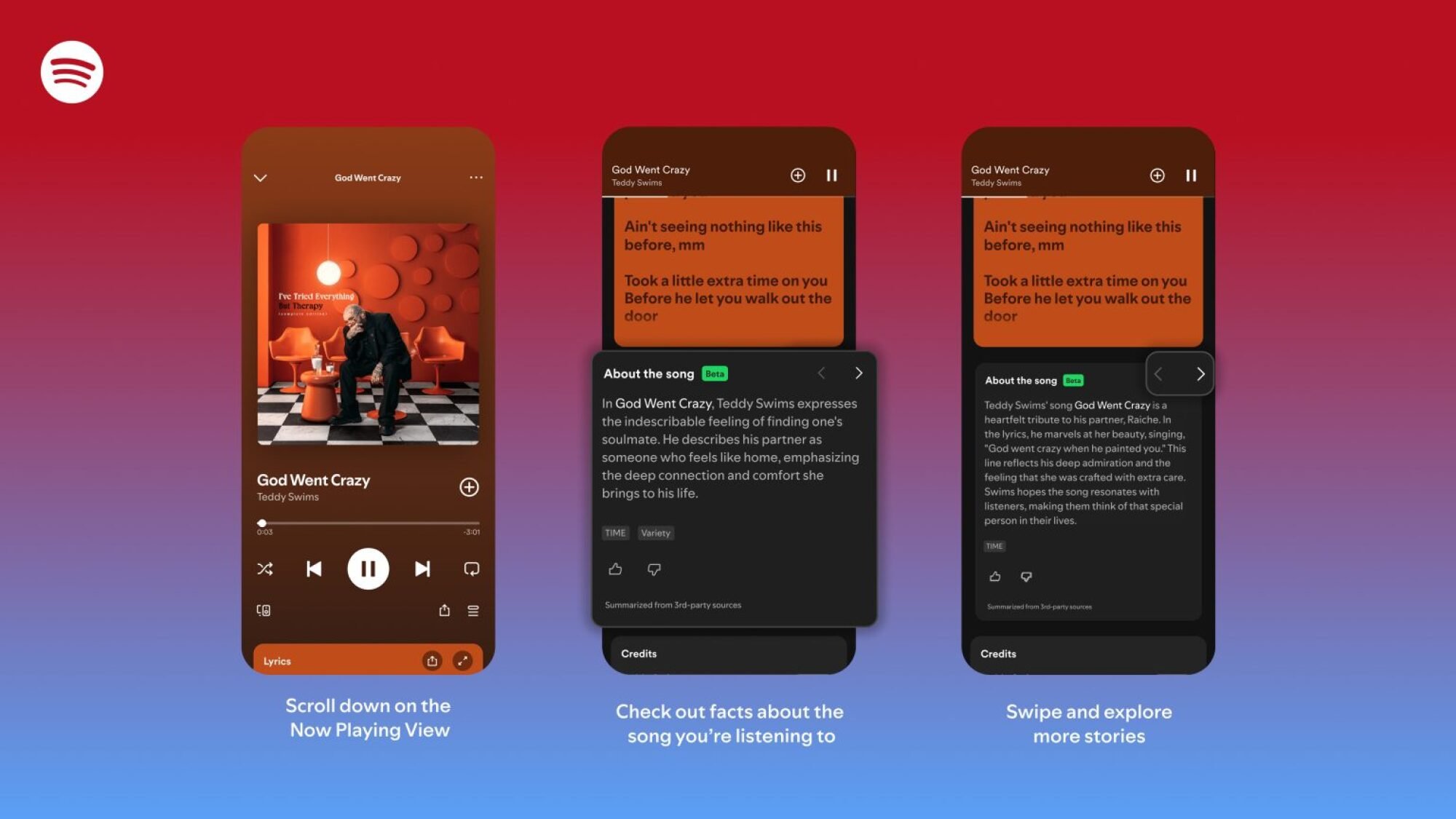
Spotify is rolling out a feature called About the Song which lets fans learn a bit more about their favorite tunes. This “brings stories and context” into the listening experience, sort of like that old VH1 show Pop Up Video.

How does it work? The Now Playing View houses short, swipeable story cards that “explore the meaning” behind the music. This information is sourced from third parties and the company promises “interesting details and behind-the-scenes moments.” All you have to do is scroll down until you see the card and then swipe.

This is rolling out right now to Premium users on both iOS and Android, but it’s not everywhere just yet. The beta tool is currently available in the US, UK, Canada, Ireland, New Zealand and Australia.

Spotify has been busy lately, as this is just the latest new feature. The platform recently introduced a group messaging feature and prompt-based playlists.

This article originally appeared on Engadget at https://www.engadget.com/audio/spotify-now-lets-you-swipe-on-songs-to-learn-more-about-them-164558366.html?src=rss

Get a four-pack of first-gen AirTags for only $64

Good deals on Apple products aren’t as frequent as we’d like them to be, but if there’s one of the company’s products that does seem to enjoy pretty regular price cuts, it’s the AirTag. Right now you can pick up a four-pack of Apple’s diminutive first-generation Bluetooth trackers for $64, which translates to 35 percent off and a near record low price.

Bear in mind that this deal brings the price per AirTag down to about $16 if you were to buy them individually, and when not on sale they usually cost $29. The single first-gen AirTags are also on sale right now, and you can pick one up for 41 percent off at $17.

If you use Apple devices and consider yourself to be a serial thing-misplacer, AirTags are extremely useful. Adding one to your account takes a single tap, and with Apple’s Find My network so well established, locating missing items has never been easier.

Using your iPhone you can trigger a sound from the AirTag’s built-in speaker, or alternatively Precision Finding can be used to pinpoint its location via Find My. You just follow the instructions on your iPhone, paying attention to the vibrations that signal you’re getting closer.

A reminder again that the above deals apply to the first-generation AirTag only. Apple introduced a refreshed tracker with greater range and a louder speaker last month, which retails at the same price as its predecessor. For deals on the new AirTag, you may have to wait a bit.

Follow @EngadgetDeals on X for the latest tech deals and buying advice.

This article originally appeared on Engadget at https://www.engadget.com/deals/get-a-four-pack-of-first-gen-airtags-for-only-64-163619159.html?src=rss

KPMG Pressed Its Auditor To Pass on AI Cost Savings

An anonymous reader shares a report: KPMG, one of the world’s largest auditors of public and private companies, negotiated lower fees from its own accountant by arguing that AI will make it cheaper to do the work, according to people familiar with the matter. The Big Four firm told its auditor, Grant Thornton UK, it should pass on cost savings from the rollout of AI and threatened to find a new accountant if it did not agree to a significant fee reduction, the people said.

The discussions last year came amid an industry-wide debate about the impact of new technology on audit firms’ business and traditional pricing models. Firms have invested heavily in AI to speed up the planning of audits and automate routine tasks, but it is not yet clear if this will generate savings that are passed on to clients.

Grant Thornton is auditor to KPMG International, the UK-based umbrella organisation that co-ordinates the work of KPMG’s independent, locally owned partnerships around the world. Talks with Grant Thornton were led by Michaela Peisger, a longtime audit partner and executive from KPMG’s German member firm, who became KPMG International’s chief financial officer at the beginning of 2025.


Read more of this story at Slashdot.

Spotify Will Now Tell You the Meaning Behind Your Favorite Songs

Streaming services make it easy to listen to a lot of music, but they don’t necessarily tell you much about the songs themselves. You can see how long each track is, who performed it, and maybe even the song writing credits, but you don’t know why the artist wrote the song, or what each song is supposed to mean. You can, of course, scour the internet, looking at articles and blogs to learn more about your favorite music—or, you can skim Spotify’s new summary cards that offer fun facts about each track.

Spotify announced the new feature, called “About the Song,” on Friday. The feature, which is launching in beta, is available in the app’s Now Playing View. When you select it, you’ll see story cards you can swipe through that tell you more about the song you’re listening to. Spotify says the stories are summarized from “third-party sources,” though it doesn’t share what those sources are in the press release, or how the app summarizes those sources. (However, as I’ve tested the feature, I’ve seen sources like Hypebeast, Wikipedia, and fan sites.) I’ve reached out to ask whether the company is using AI for these summaries, and will update this article if I hear back.

about the song

Credit: Spotify

As with many of Spotify’s new features, About the Song is only available for Premium subscribers. At this time, it’s also limited to English accounts in the U.S., UK, Canada, Ireland, New Zealand, and Australia. If you pay for Spotify in one of these regions, the feature is exceptionally easy to find. When you’re listening to a song, just scroll down on the page until you see the “About the Song” card. If you don’t see it, that song likely doesn’t support the feature. Some songs will only have one summary card, but others may have more. If so, you’ll see icons in the top right of the card window telling you which card you’re reading. You can swipe left on the card to open the next.

I’ve seen songs with as many as four of these cards, though it’s possible some songs have even more. Some of those are all summarized from the same source—say, one Wikipedia article—while others pull from multiple sources to generate multiple About the Song cards. There are thumbs-up and thumbs-down options on each card to rate the summary, implying these are AI-generated. The summaries appear to be static once generated though—when I quit the app and return, the summaries are the same. I’d be curious to know if the summaries are the same for everyone who chooses a song, or if they’re generated for each individual listener.

Spotify has had a busy week. On Thursday, one day before announcing “About the Song,” the company revealed its plans to start selling physical paper books, which sync with its digital audiobooks. The day before that, Spotify revamped its lyrics feature, including the option to download lyrics for offline viewing.

New critique debunks claim that trees can sense a solar eclipse

Last year, a team of scientists presented evidence that spruce trees in Italy’s Dolomite mountains synchronized their bioelectrical activity in anticipation of a partial solar eclipse—a potentially exciting new insight into the complexities of plant communication. The findings naturally generated media interest and even inspired a documentary. But the claims drew sharp criticism from other researchers in the field, with some questioning whether the paper should even have been published. Those initial misgivings are outlined in more detail in a new critique published in the journal Trends in Plant Science.

For the original paper, Alessandro Chiolerio, a physicist at the Italian Institute of Technology, collaborated with plant ecologist Monica Gagliano of Southern Cross University and several others conducting field work in the Costa Bocche forest in the Dolomites. They essentially created an EKG for trees, attaching electrodes to three spruce trees (ranging in age from 20 to 70 years) and five tree stumps in the forest.

Those sensors recorded a marked increase in bioelectrical activity during a partial solar eclipse on October 22, 2022. The activity peaked mid-eclipse and faded away in its aftermath. Chiolerio et al. interpreted this spike in activity as a coordinated response among the trees to the darkened conditions brought on by the eclipse. And older trees’ electrical activity spiked earlier and more strongly than the younger trees, which Chiolerio et al. felt was suggestive of trees developing response mechanisms—a kind of memory captured in associated gravitational effects. Older trees might even transmit this knowledge to younger trees, the authors suggested, based on the detection of bioelectrical waves traveling between the trees.

Read full article

Comments

AirDrop Is Coming to Even More Android Phones This Year

Last November, Google announced that it had managed to make Apple’s AirDrop compatible with Quick Share on its Pixel 10 phones, allowing them to easily share photos and files with iPhones, iPads, and Macs. The feature was intuitive, and to quote my colleague Jake Peterson, it’s worked so seamlessly that it was almost like Quick Share and AirDrop “were built this way from the beginning.” But for other Android users, it continued to be business as usual, leading to awkward texts and emails to share files across iOS and Android. Now, though, Google confirmed it’s working to bring AirDrop to other Android phones, too, including phones it doesn’t make. At an event attended by Android Authority, Android Vice President of Engineering Eric Kay said, “Last year, we launched AirDrop interoperability. In 2026, we’re going to be expanding it to a lot more devices.”

To a degree, we kind of knew this was coming. While many Pixel only features are implemented via a special Pixel-only system component, Google added AirDrop compatibility to the Pixel 10 by upgrading Quick Share from a system level feature to a full-on app, with its own APK. That laid the groundwork for other Android phones to eventually get AirDrop compatibility of their own, since they can all use this app. For instance, Nothing CEO Carl Pei said in November that his team was “already exploring” adding AirDrop compatibility to Nothing phones, while chipmaker Qualcomm said it “can’t wait” for the feature to be enabled on Snapdragon—commonly used in Samsung’s Galaxy phones—in the “near future.”

Now, it seems like the wait for AirDrop across the rest of Android won’t be much longer. While Kay didn’t give an exact timeline beyond 2026, he did say that Google is already “working with our partners to expand it into the rest of the ecosystem, and you should see some exciting announcements very soon.” That’s it as far as official communication goes, but I’ve reached out to Google for additional comment and will update if I can snag more details. In the meantime, we do have a few possible dates where we could expect the feature to be announced.

The soonest might be the next Samsung Unpacked, where the company is expected to announce the S26 lineup of phones. According to rumors, that’ll take place on Feb. 25, and it’s not unusual for Google to make an appearance during Unpacked to discuss new features coming to Android that the new phones can take advantage of. Alternatively, Google might save the announcement for its next Google I/O event, which would likely be sometime in May. Or it could just drop the feature online without the fanfare of an official event.

Either way, I can’t wait. I take a lot of photos on my phone for this job, and while sending them from my personal iPhone to my work Mac usually isn’t an issue, getting them off an Android phone I might be reviewing can be a much bigger pain. As someone who’s got an Android tablet, an iPhone, a MacBook, and a Windows PC all within 5 feet of me right now, anything that helps bridge these ecosystems together is a good move in my book.

Stellantis swallows $26 billion costs as it rethinks its EV strategy

The automotive industry’s big bet on a rapid adoption of electric vehicles—at least here in the United States—continues to unwind. Today, Stellantis, which owns brands like Jeep and Dodge, as well as Fiat, Peugeot, and others, announced that it has “reset” its business to adapt to reality, which comes with a rather painful $26.2 billion (22.2 billion euro) write-down.

It wasn’t that long ago that everyone was more bullish on electrification. Even the US had relatively ambitious plans to boost EV adoption into the next decade, including a big commitment to charging infrastructure. Ten new battery factories were announced, and the future looked bright.

Not everyone agreed. Some automakers, having been left behind by the push toward battery EVs and away from simple hybrids that offered little in the way of true decarbonization, lobbied hard to relax fuel efficiency standards. Car dealers, uncomfortable with the prospect of investing in and learning about new technology, did so, too. When the Republican Party won the 2024 election, the revanchists got their wish.

Read full article

Comments

Apple AirTag 2 Spills Its Guts In Teardown Videos And It’s Already On Sale Too

Apple AirTag 2 Spills Its Guts In Teardown Videos And It's Already On Sale Too
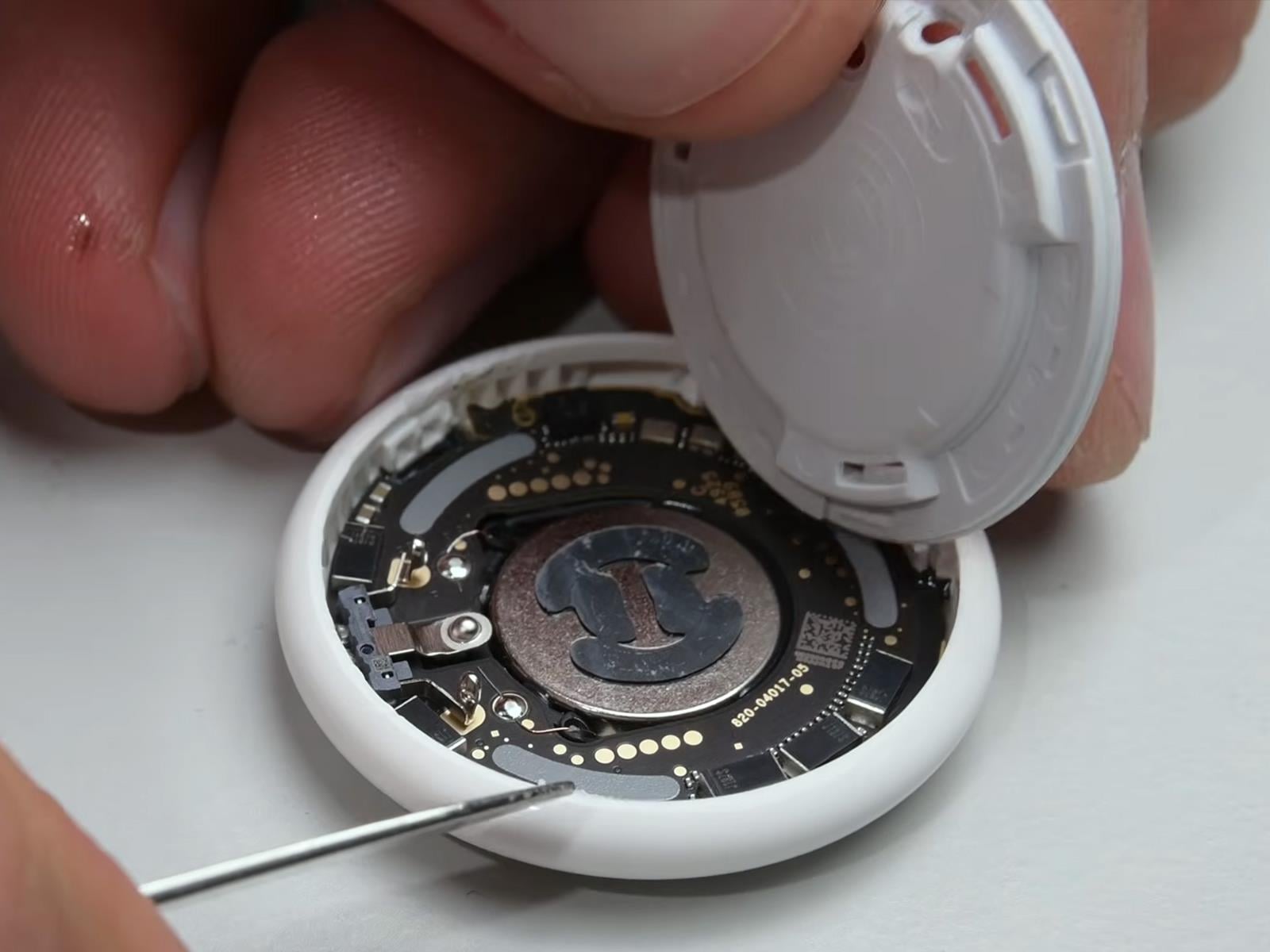
Apple’s second-generation AirTag tracker has gone under the knife in multiple teardown videos, giving us a clear view of the redesigned internal structure compared to the first-generation tracker. In case you missed the launch announcement, Apple announced several key changes, including an expanded Bluetooth range, a louder built-in speaker,

Lawmakers ask what it would take to “store” the International Space Station

Members of the House Science, Space, and Technology Committee voted to approve a NASA authorization bill this week, advancing legislation chock full of policy guidelines meant to give lawmakers a voice in the space agency’s strategic direction.

The committee met to “mark up” the NASA Reauthorization Act of 2026, adding more than 40 amendments to the bill before a unanimous vote to refer the legislation to the full House of Representatives. Wednesday’s committee vote was just one of several steps needed for the bill to become law. It must pass a vote on the House floor, win approval from the Senate, and then go to the White House for President Donald Trump’s signature.

Ars has reported on one of the amendments, which would authorize NASA to take steps toward a “commercial” deep space program using privately owned rockets and spacecraft rather than vehicles owned by the government.

Read full article

Comments

The Bizarre Enhancement Claims Rocking Ski Jumping

German newspaper Bild reported in January that some ski jumpers have been injecting their penises with hyaluronic acid ahead of the Milan Cortina Winter Olympics — the theory being that temporarily enlarged genitalia would yield looser-fitting suits when measured by 3D scanners, and those looser suits could act like sails to produce longer jumps.

A study published last October in the scientific journal Frontiers found that a 2cm suit change translated to an extra 5.8 metres in jump distance. No specific athletes have been accused. The World Anti-Doping Agency said Thursday it would investigate if presented with evidence, noting its powers extend to banning practices that violate the “spirit of sport.” The claims arrive as ski jumping already faces scrutiny — two Norwegian coaches and an equipment manager received 18-month bans in January for illegally manipulating suit stitching.


Read more of this story at Slashdot.

Scans Reveal An Ancient Surprise Hiding In Martian Meteorite That Fell To Earth

Scans Reveal An Ancient Surprise Hiding In Martian Meteorite That Fell To Earth
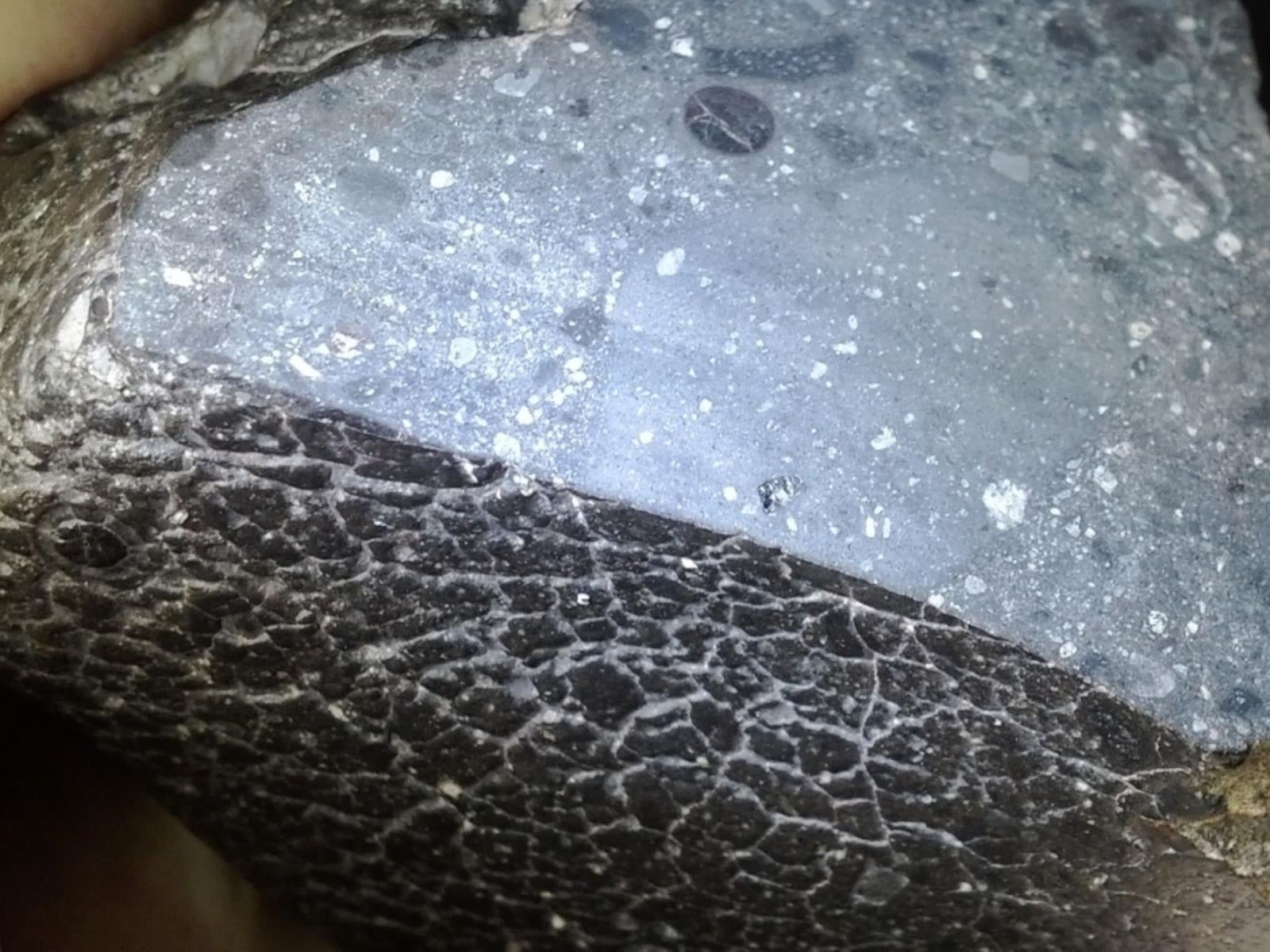
Remember the famous meteorite NWA 7034, a.k.a Black Beauty found in Northwest Africa? Researchers using neutron scanning technology have discovered a hidden reservoir of ancient water locked inside the Martian rock and in higher concentration than expected.

The study, led by Estrid Buhl Naver and her team at the Technical University of

NVIDIA May Push Back Launch Of RTX 50 Super And Next-Gen RTX 60 GPUs

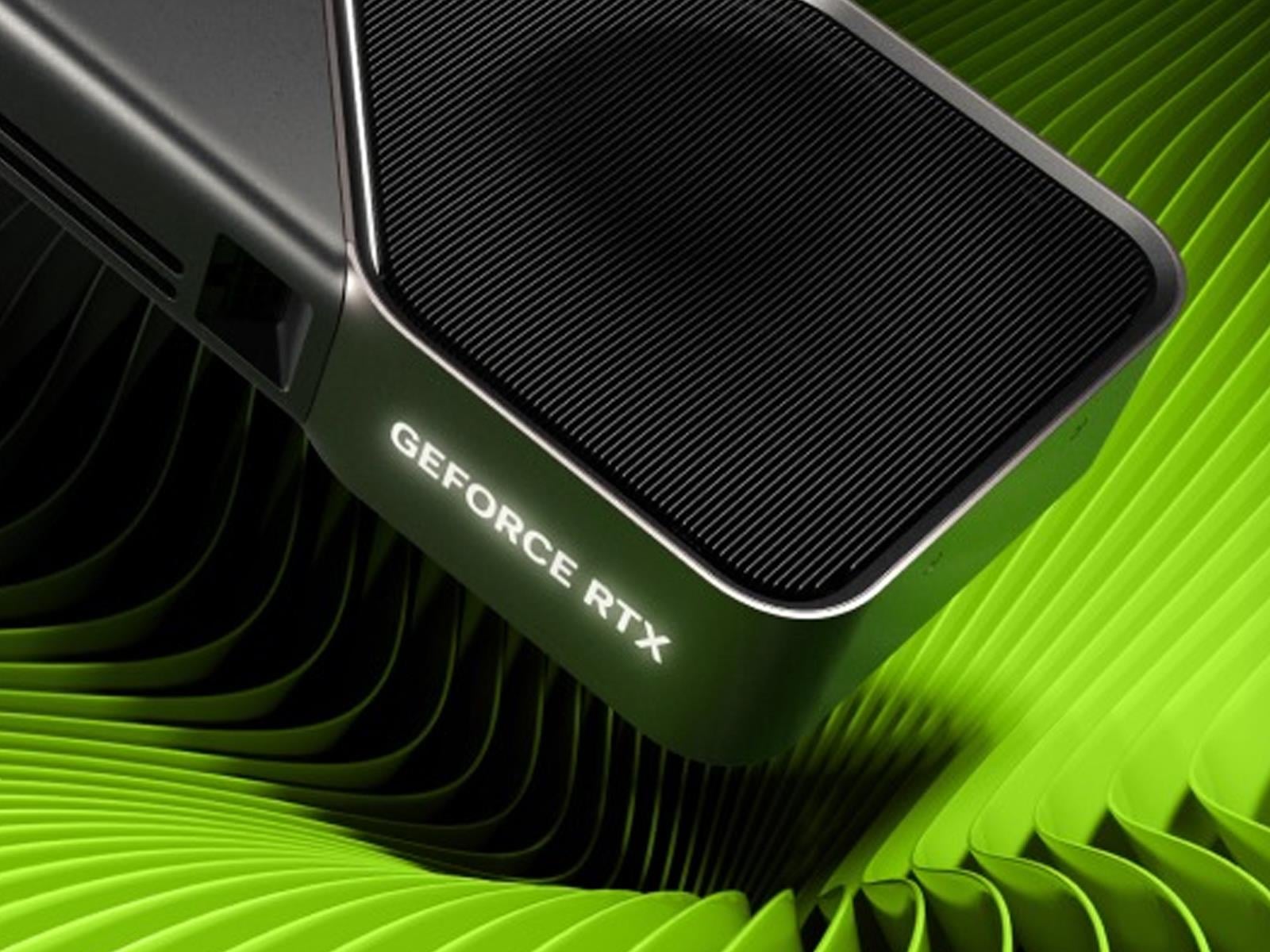
NVIDIA May Push Back Launch Of RTX 50 Super And Next-Gen RTX 60 GPUs
We’re a little over a month into 2026 and one thing is already abundantly clear—it’s going to be a tough year PC gaming upgrades. Hot on the heels of a rumored delay to Intel’s not-yet-announced Core G3 and G3 Extreme Panther Lake CPUs for handhelds and Valve’s Steam Machine potentially getting a price adjustment before pricing is even announced,

NASA will now allow astronauts to take their smartphones to space

Most people wouldn’t leave their phones behind when they so much as go for a drive, but NASA astronauts have had to leave their phones on Earth while they went to work 250 miles away at the International Space Station. That is, until now.

In a post on X, NASA Administrator Jared Isaacman shared that the Crew-12 and Artemis II astronauts will be allowed to bring smartphones along for the journey to the ISS and beyond. “We are giving our crews the tools to capture special moments for their families and share inspiring images and video with the world,” Isaacman said.

While these won’t be the first smartphone images captured in space — that distinction belongs to a trio of miniature phone-based satellites sent into Earth orbit in 2013 which succeeded where the earlier British STRaND-1 project failed. But thanks to the upcoming Artemis II mission, we can look forward to the first smartphone images from the moon’s orbit. The March (for now) launch will be the agency’s first crewed moon mission since Apollo 17 in 1972.

The crews’ personal devices will be far less cumbersome to use than the old Nikon DSLRs they were previously limited to for high-quality still images. Ideally, this means more spontaneous pictures that can be shared with friends and family back on Earth.

This article originally appeared on Engadget at https://www.engadget.com/science/space/nasa-will-now-allow-astronauts-to-take-their-smartphones-to-space-151310548.html?src=rss

I Tried Malwarebytes’ ChatGPT App, and It’s Actually Good at Detecting Scams

A few months ago, ChatGPT got an app store of its own, which means you can access tools like Photoshop and Apple Music right inside the ChatGPT prompt box. Now Malwarebytes has joined the ChatGPT app store, which means you can get some expert help when investigating web links, emails, text messages, domains, and phone numbers you think might be suspicious.

The app is free to use for everyone, whether or not they’re signed up to a paid ChatGPT subscription, and you can enable the tool via the ChatGPT app store or by entering the prompt “Malwarebytes, is this a scam?” Once you’ve used the app for the first time, you can access it again via the + (plus) button on the prompt box.

Malwarebytes’ ChatGPT app can test links, sites, and phone numbers

Malwarebytes in ChatGPT
Malwarebytes will do a deep security dive into links you provide.
Credit: Lifehacker

You can paste just about anything you like into a conversation with the Malwarebytes plugin, but there are certain approaches that scammers will often take—including links contained in phishing emails—that make for good candidates to test this thing out. I dived deep into my email spam folder to find some URLs to test Malwarebytes on, and gave it a few trustworthy web addresses as well—you just copy the link into the prompt box and ask the app for an assessment.

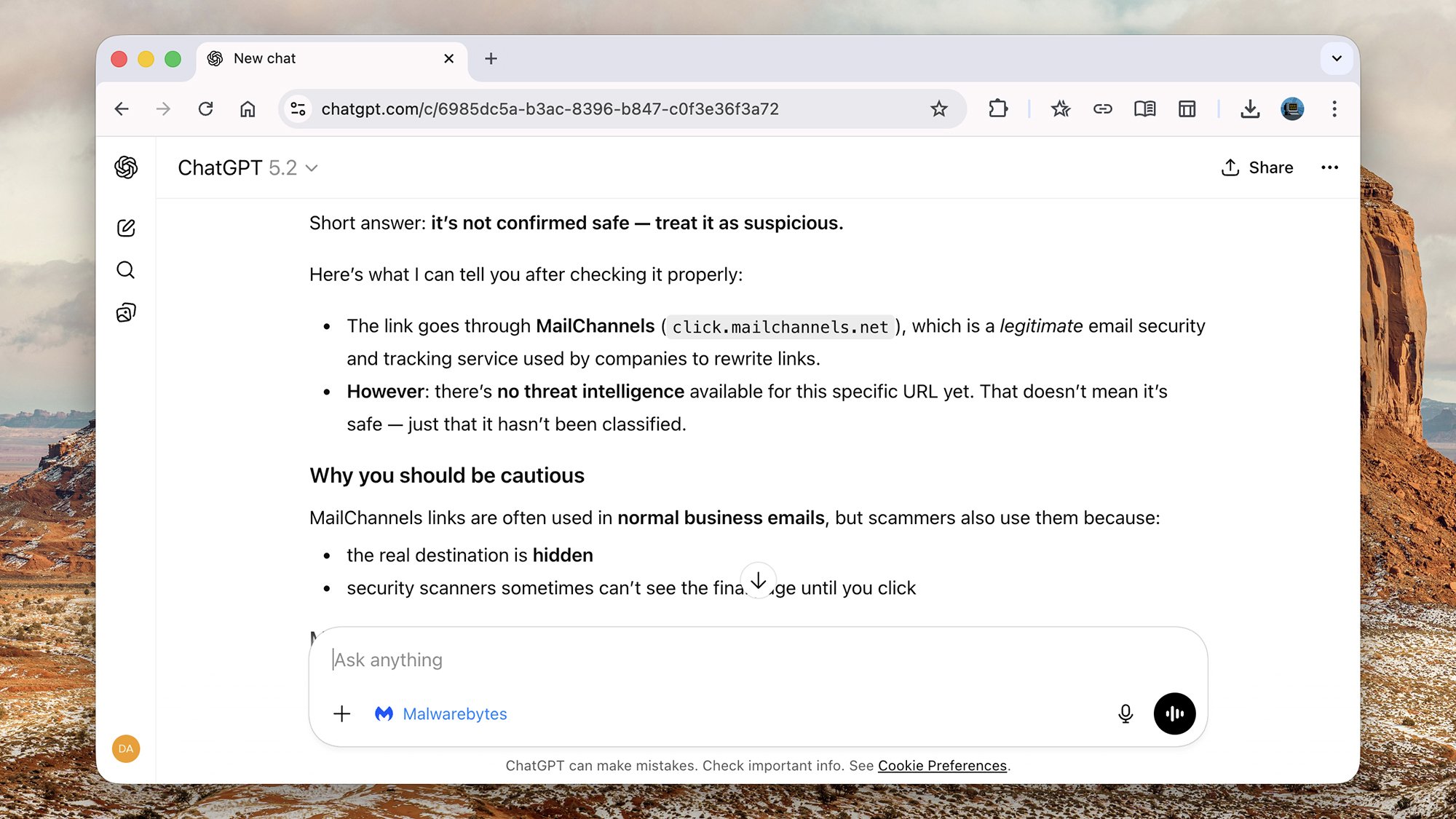
Malwarebytes successfully sifted out the scam links from the safe ones, even when it didn’t have any specific information in its databases about the links I was providing. When it was unsure, it said so, with lots of extra context: For example, for one URL I was told the address was “a legitimate email security and tracking service used by companies to rewrite links” but one that scammers also used to conceal the link destination.

You also get an assessment of the domain name: When given a link to a Lifehacker article, the plugin correctly identified that it was a legitimate domain with a registered owner, even though it didn’t have any specific information about the URL. Malwarebytes was also able to spot domain redirecting, a trick frequently used by scammers.

Phone numbers can be given to Malwarebytes as well: When I tested this out with a few scam calls I’ve had, these numbers were correctly identified as coming from scammers or at least being suspicious. I like the way the app gives you some context to its thinking (explaining how spam call centers work, for example), and will also offer up advice about next steps and how to stay safe.

Something else I appreciated was that the Malwarebytes app has a memory inside ChatGPT: If you post a series of links and numbers in the same chat thread, as I did, then it will try and put them all in context (explaining why one URL is potentially more dangerous than another, for example).

The Malwarebytes ChatGPT app can also look at messages and emails

Malwarebytes in ChatGPT
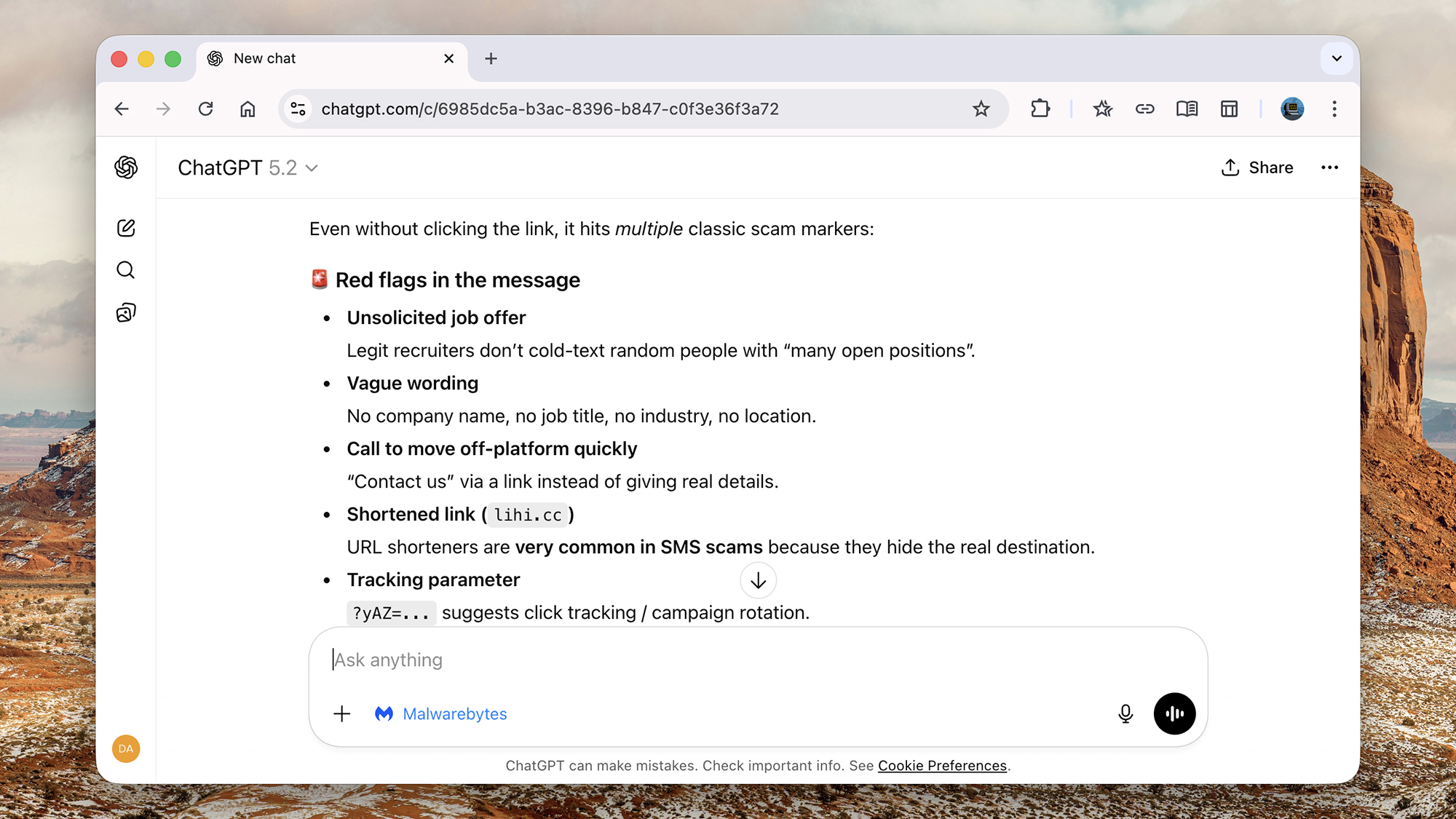
You’ll get a list back of red flags in email and text message content.
Credit: Lifehacker

You can also give the Malwarebytes app some text you’ve come across in an email or text message and get a verdict on this too—you can even type in a transcript of a conversation you’re having on the phone, if you want. The plugin will scan the text for phrasing that scammers often use and will alert you of any other red flags.

I tried this out with a variety of spammy text, and again Malwarebytes scored highly in terms of recognizing anything dodgy. As before, if it came across something it wasn’t sure about, it would explain the reasons why and suggest some next steps.

The responses also include some detail on why different scam approaches are taken and why they sometimes work, and how they might escalate—so if you get a message purporting to be from a family member asking for help, Malwarebytes tells you why these scams are common and how they’re used to steal identities or money.

It’s an intelligent system, in that it’ll ask you questions about the texts or emails you’ve received: If it’s not sure about something, you’ll be told about extra checks you can run (like looking at the “reply to” address on an email). However, the usual ChatGPT sycophancy does start to grate a bit, as you’re constantly told that you’re doing the right thing and that you’re right to be suspicious.

The app taps into Malwarebytes Threat Intelligence, so it should be able to keep you protected against the latest threats (making it more helpful than a Google search or just a regular ChatGPT query). From the examples I used at least, it comes across as a security tool that’s accurate, comprehensive, and easy to use—one that’s well worth keeping close at hand if you come across potential scams you’re not sure about.

Disclosure: Ziff Davis, Mashable’s parent company, in April 2025 filed a lawsuit against OpenAI, alleging it infringed Ziff Davis copyrights in training and operating its AI systems.

NASA stage show explores “outer” outer space with Henson’s Fraggles

Move over Snoopy, because NASA has a new character helping to promote its deep space exploration plans. His name is Uncle Traveling Matt.

No really, move over.

Fraggle Rock: A Space-y Adventure has taken over the same theater the Kennedy Space Center Visitor Complex in Florida previously used for “All Systems Are Go,” featuring the comic strip beagle. The new stage show stars the Jim Henson Company’s subterranean Muppets as they discover outer (outer) space for the first time.

Read full article

Comments

EU says TikTok needs to drop “addictive design”

Brussels has warned TikTok that its endlessly scrolling feeds may breach Europe’s new content rules, as regulators press ahead with efforts to rein in the social effects of big online platforms.

In preliminary findings issued on Friday, the European Commission said it believed the group had failed to adequately assess and mitigate the risks posed by addictive design features that could harm users’ physical and mental wellbeing, particularly children and other vulnerable groups.

The warning marks one of the most advanced tests yet of the EU’s Digital Services Act, which requires large online platforms to identify and curb systemic risks linked to their products.

Read full article

Comments