If you receive an event invitation via email, verify it’s legit before you RSVP, as you may not actually be invited to anything. Malwarebytes Labs has identified a new scam in which threat actors are using party invites to trick users into installing a remote access tool (RAT) that gives them full control over infected devices. (This specific campaign seems to be limited to the UK, but similar tactics could easily spread.)
These malicious invites contain a ScreenConnect installer
The scam starts with an innocuous-looking email invitation with an informal “Save the Date” vibe that may appear to come from a friend or acquaintance. The message contains a link to “View Invitation” for event details. If you click through, you’ll end up on a landing page with a bold “You’re Invited” header and a button to download your invitation, but you don’t actually need to take any further action—your browser automatically triggers the download of a .msi file, which is not actually a party invitation or RSVP form but an installer.
The MSI silently installs ScreenConnect Client, a legitimate IT support tool that allows remote access into the user’s machine. Once this connection is established, attackers have the ability to see your screen, control your mouse and keyboard, and upload or download files—even if you restart your computer. All of this happens in the background with no obvious indicators that a remote access tool has been installed and is now running, so victims are unlikely to have cause for concern.
You should know these remote access red flags
As Malwarebytes points out, this scheme is successful because it relies on normal human behavior around a seemingly low-risk situation: opening an event invitation. What’s unusual is that there’s little pressure or urgency in the initial message. Instead, the landing page has language like “a friend has sent you an invitation” and “I opened mine and it was so easy,” which is a form of social proof that guides users to take the desired action.
You should always be alert to unsolicited invites sent via regular email with a link to an external site as well as any communication that prompts you to download or install software. These days, invitations are commonly delivered through apps and digital services like Partiful, Paperless Post, Evite, or Apple Invites, which are generally more trustworthy than random emails with hyperlinked text. If you’re unsure whether the invite is real, verify with the sender through another channel before clicking or downloading anything.
As mentioned, victims of this scam may not immediately notice that a RAT has been installed on their device. But there are some red flags, such as unexplained cursor movement or windows opening or closing on their own. You can check your machine for a file named “RSVPPartyInvitationCard.msi” or a service called ScreenConnect Client with additional random characters in the title.
If you’ve already downloaded ScreenConnect from a malicious invite, Malwarebytes recommends disconnecting from the internet and uninstalling the program immediately. Run a security scan to check your devicefor malware, and change important passwords from a separate device.
The first PlayStation State of Play livestream of 2026 has been announced. The stream will take place on February 12 at 5PM ET. It will run for over an hour and feature PlayStation Studios titles as well as third-party projects and indie games that are bound for PS5. You can watch it on PlayStation’s official YouTube channel (in English, Japanese or with English subtitles) or on Twitch.
As the first State of Play of the year, Sony is going to want to drum up some more hype for its upcoming release slate. Since Bungie’s Marathon is due to arrive on March 5, that will surely make an appearance. MLB The Show 26, which is out on March 17, will likely get a look in too. We could also get another peek at Saros, the highly anticipated follow-up to Housemarque’s Returnal, which will arrive on March 20. A new trailer for Marvel’s Wolverineisn’t out of the question, but Sony could wait until a summer showcase to give us another look at that one.
The last State of Play took place in November, but that one was focused solely on games coming out of Asia and Japan. Before that, Sony also had a showcase during Tokyo Game Show in September, which featured a first look at gameplay from the aforementioned Wolverine, which is due to arrive later in 2026.
This article originally appeared on Engadget at https://www.engadget.com/gaming/playstation/the-first-playstation-state-of-play-of-2026-will-air-on-february-12-145747775.html?src=rss
A big day in streaming has finally arrived: HBO Max has finally announced it’s coming to the United Kingdom and Ireland. The two countries join over 110 territories worldwide that already offer HBO Max. Some HBO shows, like Euphoria, have already been available in these regions through other platforms. HBO Max will bring titles like The Pitt, One Battle After Another and Sinners. It will also air the upcoming Harry Potter series.
An HBO Max subscription will be available in the UK and Ireland starting on Thursday, March 26. Plans will start at Basic with Ads for £5 per month, offering all titles except movies that first stream on HBO Max after a theatrical release. Then there’s Standard with Ads for £6 per month, which includes those releases and 30 downloads. Both can stream on two devices at a time.
Anyone who wants an ad-free experience can purchase a Standard or Premium plan. The former has all titles available on two devices, up to 30 downloads and, of course, no ads. The Premium plan comes with four devices in 4K Ultra HD with Dolby Atmos — if the system has capabilities.
Interestingly, the expanded area comes as Netflix prepares to own Warner Bros., including HBO and HBO Max. While there’s no indication of whether this had any influence, Netflix has long been available in the UK and Ireland.
This article originally appeared on Engadget at https://www.engadget.com/entertainment/streaming/hbo-max-is-finally-coming-to-the-uk-and-ireland-145126162.html?src=rss
As more than 120 million people tuned in to the Super Bowl for kickoff on Sunday evening, SpaceX founder Elon Musk turned instead to his social network. There, he tapped out an extended message in which he revealed that SpaceX is pivoting from the settlement of Mars to building a “self-growing” city on the Moon.
“For those unaware, SpaceX has already shifted focus to building a self-growing city on the Moon, as we can potentially achieve that in less than 10 years, whereas Mars would take 20+ years,” Musk wrote, in part.
Elon Musk tweet at 6:24 pm ET on Sunday.
Credit:
X/Elon Musk
This is simultaneously a jolting and practical decision coming from Musk.
Some existing subscribers to YouTube TV are being treated to $80 in cumulative discounts spread out over the course of four monthly payments, though to our knowledge, Google isn’t advertising or actively promoting the potential savings. If you’re a subscriber, this means you’ll have to put in some minor legwork to check if you’re eligible.
Things seemed very quiet this week in the world of youth culture, so I asked my always-connected son what kids were talking about. “Dad, the Epstein files,” he said. “That’s all anyone is talking about.”
I like to keep things light here, but it’s not possible at the moment; The Epstein files are the culture right now, no matter what age you are. Younger people are trying to figure out how to fit this massive thing into their idea of the world, just like you probably are. Smaller kids are contextualizing the files by visiting/making Roblox Epstein Islands and joking about it in school (then asking their folks what it really means). For young ‘uns, it seems like “Epstein’s Island” is becoming shorthand for a forbidden haunted place, like “Diddy Party” was 14 years ago—wait, I mean five months ago.
Among the many conspiracy theories circulating about the Epstein files is that Jeffrey Epstein was playing Fortnite last week. Even for conspiracy theories, this is a stretch, as it requires that Epstein be alive, but here’s the evidence: A YouTube receipt addressed to “littlestjeff1″ is included in the files, and there was a player using that handle playing Fortnite last week. That’s all. Despite a sane reaction being, “OK, so what?” the rumor apparently caused enough commotion that Fortnite’s parent company addressed it, saying it was a player who changed their handle after the name was posted online in connection with Epstein:
Like any internet theory, you can dig into it deeper, but you’ll find only unverifiable screenshot “evidence” that anyone could have made at any time, elaborate theories connecting unrelated data points to land on baseless conclusions, a lot of passionate people defending the theory, and a company doing desperate damage control. It’s a morass, and a really bleak look at the foreseeable future of American culture.
Jeffrey Epstein’s actual gaming connection
The Fortnite thing looks like bullshit, but Epstein actually was a gamer. Well, he had an XBox Live account, anyway. Among the documents in the files is an email from Microsoft, sent on December 19, 2013, permanently suspending the account associated with Epstein’s email address. It’s a boilerplate ban message, citing “harassment, threats, and/or abuse of other players” that has been “determined to be severe, repeated, and/or excessive.”
A follow-up email reveals that Epstein was banned from Live because Epstein was a registered sex offender. “This action is based on the New York Attorney General’s partnership with Microsoft and other online gaming companies to remove New York-registered sex offenders from online gaming services to minimize the risk to others, particularly children,” the email reads.
What does “phonk” mean?
Let’s talk about the word “phonk,” since it came up earlier in the column and it’s about art instead of depravity. “Phonk” has a complicated history. It was coined in the 2010s by rapper SpaceGhostPurrp to describe his take on 1990s Southern hip hop that featured slow, “chopped and screwed” production and the use of vintage Memphis rap vocals. Interestingly, the elements of phonk spread mainly through SoundCloud and other online outlets, so it’s a subgenre of music that grew without a geographic “base.”
(Bonus explainer: SpaceGhostPurrp is an underground rapper widely regarded as one of the most influential figures in the 2010s “internet rap” era.)
But when kids talk about “phonk” nowadays, they usually mean something else. In the late 2010s, a genre emerged from Russia that was dubbed “drift phonk.” Drift phonk began as the soundtrack of videos of cars drifting. It’s fast, often features heavy distortion—and, unlike SpaceGhost’s “phonk,” which is good, drift phonk is bad. To me. Judge for yourself. Anyway, “drift phonk” gradually just became “phonk” and spread from car videos to become the most common soundtrack to brainrot videos.
What is a “boy aquarium”?
More slang! “Boy aquarium” is a TikTok slang term that describes hockey games. The word is closely linked to the popularity of HBO’s hockey-player romance series Heated Rivalry, and posting videos about the boy aquarium is becoming popular on TikTok. Some are very funny:
What’s the deal with ChatGPT caricatures?
If your feed is filling up with weird cartoon version of the people you’re in parasocial relationships with, here’s the deal: The new trend is asking ChatGPT or another AI to come up with a caricature of you based on only the interactions you’ve had with it. It’s popular, because it’s easy to do, and kind of funny—or so I thought before I tried it.
Credit: Stephen Johnson/Gemini
Jesus—I want to punch myself in the face.
Viral video of the week: A duck with a clover on its head
This week’s viral video is a duck with a clover on its head.
Elon Musk says SpaceX has shifted its near-term priorities from Mars settlement plans to building what he called a “self-growing city on the Moon,” arguing the lunar target is faster and more achievable. In a post on X, Musk claims the company could complete this in less than 10 years, while doing the same on Mars would take over 20 years.
This marks a major shift for the aerospace company, as Musk points out that the logistics of first completing a proof of concept on the moon are easier with respect to launch windows and proximity to Earth. The SpaceX founder is notorious for promising optimistic timelines that never come to pass, and said in 2017 that a base on Mars would be ready for its first settlers as early as 2024.
In subsequent replies to other posts Musk predicted “Mars will start in 5 or 6 years, so will be done parallel with the Moon, but the Moon will be the initial focus.” He also said a manned Mars flight might happen in 2031.
Early last year Musk said in a post on X that SpaceX would be going “straight to Mars” and that “the Moon is a distraction.” This was in response to Space industry analyst Peter Hague pointing out that among other considerations, lunar regolith, a material found on the surface of the moon, is about 45 percent oxygen. In 2023 NASA proved this oxygen could be extracted, which would yield enormous payload savings as opposed to shipping liquid oxygen between Earth and Mars.
NASA’s Artemis missions, which SpaceX is a contractor for at certain stages, are planned to see humans back on the lunar surface by 2028. Artemis II, during which astronauts will circle the moon before returning to Earth, is set to launch in March of this year.
This article originally appeared on Engadget at https://www.engadget.com/science/space/spacex-is-pivoting-to-focus-on-a-moon-base-before-mars-141851264.html?src=rss
A mounting body of research is making it harder for companies to justify what most of them still do — push experienced workers out the door just as they’re hitting their professional peak. A 2025 study published in the journal Intelligence analyzed 16 cognitive, emotional and personality dimensions and found that while processing speed declines after early adulthood, other capabilities — including the ability to avoid distractions and accumulated knowledge — continue to improve, putting peak overall functioning between ages 55 and 60.
AARP and OECD data back this up at the firm level: a 10-percentage-point increase in workers above 50 correlates with roughly 1.1% higher productivity. A 2022 Boston Consulting Group study found cross-generational teams outperform homogeneous ones. UK retailer B&Q staffed a store largely with older workers in 1989 and saw profits rise 18%. BMW implemented 70 ergonomic changes at a German plant in 2007 and recorded a 7% productivity gain. Yet an Urban Institute analysis of U.S. data from 1992 to 2016 found more than half of workers above 50 were pushed out of long-held jobs before they chose to retire.
Discord is the latest company looking to bolster its child safety (again). Starting in March, all users will have a “teen-appropriate experience” by default. Unlocking adult content and age-gated spaces will require a (usually one-time) verification process.
The platform’s big safety update encompasses communication settings, restricted access to age-gated spaces and content filtering. Users who aren’t verified as adults will see blurred sensitive content. In addition, age-restricted channels, servers and app commands will be blocked. DMs and friend requests from unknown users will be routed to a separate inbox.
If you’re an adult, removing these restrictions will require one of two verification methods at launch. You can take a selfie video for age estimation or submit a government ID to Discord’s vendor partners. (Let’s just hope the age estimations work better than Roblox’s.) The company stresses that the video selfies you submit for age estimation never leave your device. And it claims ID documents sent to its vendor partners are deleted quickly, “in most cases, immediately after age confirmation.”
Although Discord says the process will be one-and-done for most people, some may be required to submit multiple forms of verification. It also says that additional verification options will arrive in the future, including an age inference model that runs in the background.
Alongside today’s changes, Discord is recruiting for a new Teen Council. The group will include 10 to 12 teens aged 13 to 17. The company says this “will help ensure Discord understands — not assumes — what teens need, how they build meaningful connections, and what makes them feel safe and supported online.” This sounds like the corporate equivalent of the parenting advice: “Don’t just talk to your children; listen to them, too.”
The child safety changes will start rolling out globally in early March. Both new and existing users will be required to submit verification for adult content.
This article originally appeared on Engadget at https://www.engadget.com/social-media/discord-will-soon-require-age-verification-to-access-adult-content-140000218.html?src=rss
We may earn a commission from links on this page. Deal pricing and availability subject to change after time of publication.
The Beats Powerbeats Fit earbuds are currently down to $179.95 on Amazon, their lowest price yet, according to price trackers. They’ve replaced the older Fit Pro in Beats’ lineup and made some meaningful improvements, especially in sound quality and fit.
The new design swaps the traditional ear hook for a redesigned fit wing, which does a good job of keeping the buds stable without pinching. Whether you’re mid-sprint or mid-squat, they stay put. The physical controls on each bud are simple to use, with a press-and-hold gesture that can be customized to toggle ANC modes, activate Siri, or control volume.
These are fitness earbuds first, so it’s not shocking that Beats prioritized a bass-forward sound over an even, studio-style profile. That said, the low end doesn’t drown everything out. Mids take a step back, but vocals and instruments still come through clearly enough to keep things engaging, especially during workouts. The 9.5mm drivers handle thump-y playlists with ease, and battery life holds up—roughly six hours with ANC on, stretching to 24 with the case. You’ll get another hour of playback if you skip ANC altogether. The case itself charges via USB-C and is water-resistant (IPX4), though there’s no wireless charging, which feels like a miss at this price point.
In terms of platform support, iPhone users will get the most out of these thanks to Apple’s H1 chip. That means easy device switching, built-in Siri control, and Find My integration. Android users get a solid experience too, with a well-designed app offering most of the same controls. Noise canceling on the Powerbeats Fit is decent, too—it cuts out low-end rumbles and some chatter, but it’s not full silence, notes this PCMag review. Overall, they’re a solid pick for active users who care about secure fit, strong bass, and iOS integration.
We may earn a commission from links on this page. Deal pricing and availability subject to change after time of publication.
Nothing’s Ear (a) earbuds launched at $109, which always felt a little ambitious for a midrange pair trying to punch above its weight. But at their current sale price of $58.99 right now, their lowest price to date (according to price trackers), they’re in a range where the design, sound quality, and software finally make sense for the money.
The Ear (a) look unmistakably Nothing, with a transparent shell that shows off the internals. They fit snugly without much fiddling, and the IP54 rating means sweat, dust, and light rain won’t be a problem. That said, the case itself is only IPX2, so it can handle splashes but not much else.
Sound is where these earbuds mostly earn their keep. The 11mm dynamic drivers deliver a bass-forward presentation that still manages to stay relatively balanced. Low-end hits with real weight, especially at moderate to higher volumes, and doesn’t immediately swallow vocals or guitars, notes this PCMag review. You can tweak things further in the Nothing app, either by choosing preset EQ modes or manually adjusting bass, mids, and highs. Codec support is strong for the money, with AAC, SBC, and LDAC all on board over Bluetooth 5.3, plus multipoint for two devices at once. Noise cancellation is effective for the price, particularly on the default High setting. It reduces low-frequency rumble and busy background sounds well, though rivals from Sony or Bose still do more heavy lifting in this area.
The controls are stem-based pinches and feel consistent once you learn them. Playback, calls, track skipping, and noise modes are all handled without needing to pull out your phone, and the app lets you customize most gestures. There’s even a pinch-to-speak ChatGPT feature if you’re using a Nothing phone. Battery life lands around 9.5 hours with ANC off or 5.5 hours with it on, with the case extending that to roughly 33 or 19 hours, respectively. Those numbers will drop if you use higher-quality codecs or listen at a loud volume, but they’re competitive. In short, Nothing Ear (a) makes the most sense for someone who values sound tuning, bass-heavy audio, and a slick design, all for under $60.
Since Apple finally put its mysterious and long-suffering Project Titan out to pasture, we’ve wondered what a Jony Ive-designed Apple Car might have looked like. Today, we might have a clue. This, though, is no Apple Car. It’s the Ferrari Luce (“light” in Italian), the actual name for the EV formerly known as Elettrica, and I’m fresh from getting a walkthrough of the thing from Sir Ive himself. At a glance things look like you might have expected, but there are a few surprises here.
While Ferrari has sold hybrids in some form or another since 2013’s LaFerrari, Luce (née Elettrica) will be the company’s first all-electric machine. We got our first look underneath back in October, when we saw the chassis, battery pack and other details that pointed to this being a larger, more family-friendly machine than your average Ferrari. Last week, I got a look at the next major component, the interior, which comes courtesy of LoveFrom.
LoveFrom is the house that Jony Ive founded after leaving Apple in 2019. The obsessive design firm, which currently numbers about 60 employees, was acquired by OpenAI for $6.5 billion last year. LoveFrom has thus far taken on a medley of projects, like the $60,000 Linn Sondek LP12 turntable, but the Luce could be among the company’s biggest projects so far — at least in terms of literal dimensions.
If you’re familiar with the designs that Apple produced under Ive’s tenure, particularly in the era beginning with the iPhone 4, you’ll feel right at home here. The overall aesthetic is one dominated by squircles and circles, all with absolute, minute perfection and symmetry.
Ferrari Luce interior designed by LoveFrom
Ferrari
At first blush, it’s a bit clinical, but dig deeper, start poking and prodding, and you’ll see there’s a real sense of charm here. Fun little details and genuinely satisfying tactility begin to reveal themselves. The key, for example, has a yellow panel with an E Ink background. Push the key into the magnetized receiver in the center console, and the yellow on the key dims, moving across to glow through the top of the glass shifter. It’s meant to symbolize a sort of transference of life.
The shifter isn’t the only thing that’s glass. There are 40-odd pieces of Corning Gorilla Glass scattered throughout the cockpit, everything from the shifter surround to the slightly convex lenses in the gauge cluster. What isn’t glass is aluminum, much of it anodized in your choice of three colors: gray, dark gray and rose gold.
Yes, all that sure does sound like I’m writing about a new iPhone and not the latest Ferrari. But where Apple has been pruning every physical control it possibly can from its devices lately, LoveFrom will insert some great tactility in the Luce. The shifter moves through its detents satisfyingly, the air vents open and close with a clear snick and the paddles behind the steering wheel pop with a great feel.
My favorite feature is the windshield wiper control, a little dial in the upper-right of the steering wheel face. It features a tiny lens that magnifies the current setting. It’s actually magnifying one of four custom OLED panels, 200 ppi units from Samsung, cut and shaped to deliver LoveFrom’s ornate style.
Ferrari Luce interior designed by LoveFrom
The gauge cluster behind the steering wheel, or binnacle as it’s more formally called here, is two OLED displays stacked on top of each other, with a physical needle sandwiched between serving as a pseudo-tachometer for this car without an engine. The gauges change and morph as you move from one mode to the next.
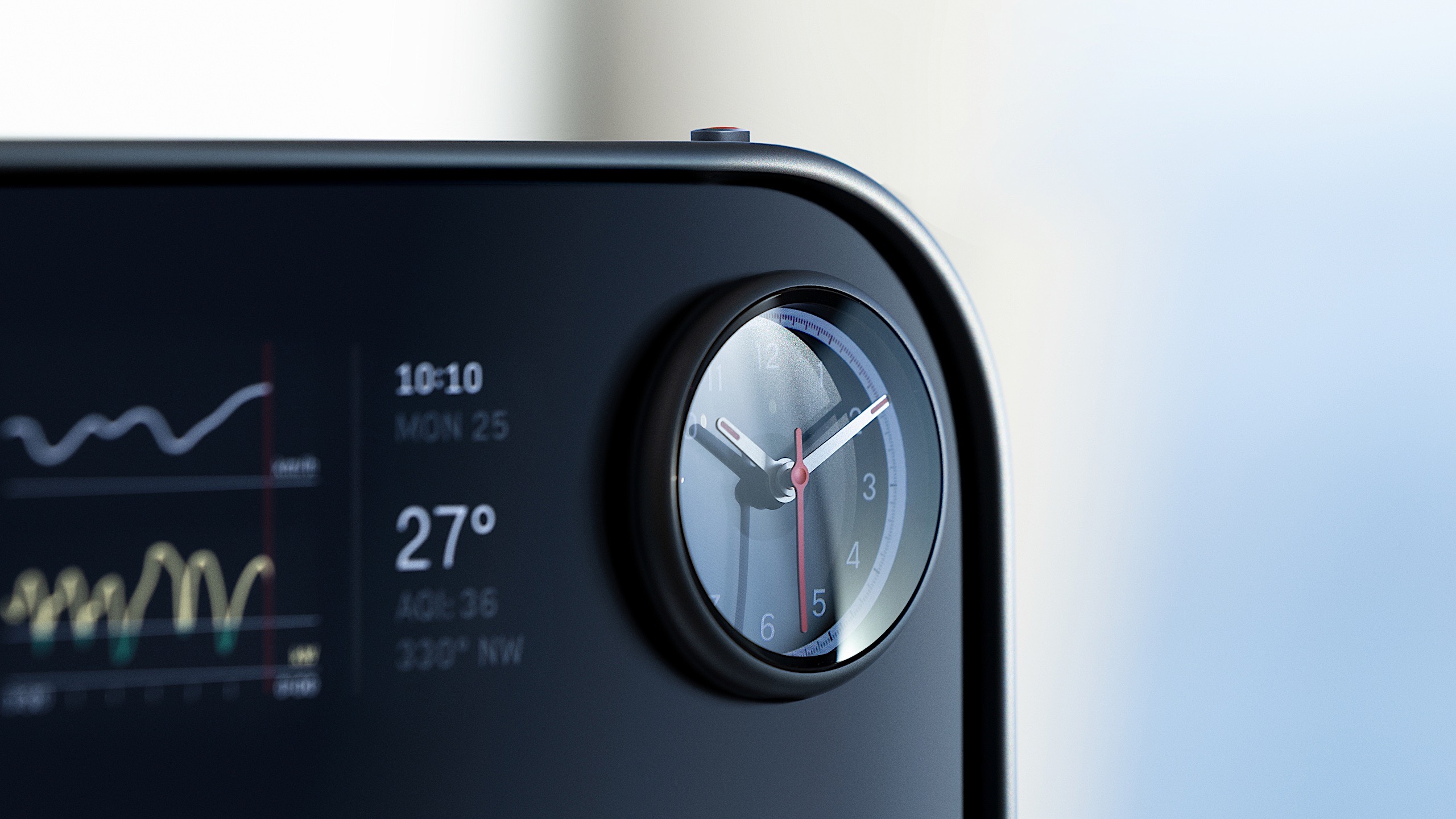
The center display is a 10.12-inch OLED perforated with plenty of holes to allow some pleasingly chunky toggle switches through, plus a glass volume knob. The little clock in the upper-right can turn into a stopwatch or a compass, with its needles swinging about depending on the mode. The whole central control panel pivots and swivels. Just grab the big handle below and drag it where you want it.
The attention to detail on everything is astonishing. Even the rails that hold the seats to the floor are gently shaped and anodized to match the rest of the interior.
Ive was on hand to unveil the interior, clearly a little nervous about showing all this for the first time. After five years of working confidentially on this topic, Ive said he was “enormously excited” and “completely terrified” to provide our first real glimpse at the Luce.
Marc Newson, who founded LoveFrom with Ive, said: “Jony and I share a really, really deep interest in automotive things and vehicles. Actually, I’d go so far as to say that that is probably a hobby of both of ours.”
Both Ive and Newson own many vintage machines, and Ive said that modern cars “are missing some things that we love about our old Ferraris.” Things like tactility. “It was very clear to us that we needed to figure out as many ways as possible to viscerally and physically connect to the interface,” Ive said.
Ferrari Luce interior designed by LoveFrom
So, while the Luce does have that pivoting touchscreen, it’s far from the vehicle’s primary interface. Ive said he hopes that physical connection and all the clever touches create a uniquely charming vehicle.
Ive told me that the LoveFrom team has genuinely enjoyed working with Ferrari. “It’s been really lovely,” he said, and he praised Ferrari CEO Benedetto Vigna’s dedication to this project and where it might lead down the road. “Benedetto is an amazing engineer,” he said, “he’s really interested in what can be learned more broadly.”
The biggest challenge might have been working within the automotive industry. Here, design, form and function are key, but safety is of the utmost importance. “It’s very hard,” Ive told me. “I’ve never worked in an area that’s so regulated. Some of it’s great, because you understand why, and people’s safety is certainly important, but some of it drives you nuts.”
It’s far and away the most exciting and fresh interior I’ve seen outside of the ultra-rare machines like the $4 million Bugatti Tourbillon. But it’s so clinically precise and refined that it lacks the rough and raw feel that typifies many classic Ferraris. Whether that’s a good or a bad thing will be debated endlessly, and I look forward to reading your comments, but I do figure it’ll go a long way to delivering the kind of new clientele that Ferrari must be targeting with the Luce.
Ferrari Luce interior designed by LoveFrom
Ultimately, whether anyone will want one is hugely dependent on how good the rest of the car looks and how much it will cost. Those are questions we still can’t answer, at least not until May, when CEO Vigna says we can expect the Luce’s full reveal.
For Ive, though, it seemed like that won’t be the end of the road for this automotive journey. “At the end of a project, there are two products. There’s what you’ve made, and there’s what you’ve learned. I’ve always been fascinated by what you’ve learned,” he told me. “And honestly, we’ve learned so much.”
This article originally appeared on Engadget at https://www.engadget.com/transportation/evs/inside-ferraris-luce-ev-the-jony-ive-interior-is-here-130000211.html?src=rss
The blog OMG Ubuntu reports that a new version of the Raspberry Pi 4 Model B has been (quietly) introduced. “The key difference? It now uses a dual-RAM configuration.”
The Raspberry Pi 4 Model B (PCB 13a) adopts a dual-RAM configuration to ‘improve supply chain flexibility’ and manufacturing efficiency, per a company product change notice document. Earlier versions of the Raspberry Pi 4 use a single RAM chip on the top of the board. The new revision adds a second LPDDR4 chip to the underside, with a couple of passive components also moved over… In moving to a dual-chip layout, Raspberry Pi can combine two smaller — and marginally cheaper — modules to hit the same RAM totals amidst fluctuating component costs…
This change will not impact performance (for better or worse). The Broadcom BCM2711 SoC has a 32-bit wide memory interface so the bandwidth stays identical; this is not doubling the memory bus, it’s just a physical split, not a logical one. Plus, the new board is fully compatible with existing official accessories, HATs and add-ons. All operating systems that support the Pi 4 will work, but as the memory setup is different a new version of the boot-loader will need to be flashed first.
The EU could take “interim measures” against WhatsApp as it investigates AI providers’ access to the app. On Monday, the EU’s regulatory arm announced its “preliminary view” that Meta, WhatsApp’s parent company, violated antitrust laws by blocking third-party AI assistants from operating on WhatsApp.
The European Commission’s is concerned that Meta’s actions will limit competitors from entering the AI assistant market. “We must protect effective competition in this vibrant field, which means we cannot allow dominant tech companies to illegally leverage their dominance to give themselves an unfair advantage,” Teresa Ribera, executive vice-president for Clean, Just and Competitive Transition said in a statement.
Ribera continued: “AI markets are developing at rapid pace, so we also need to be swift in our action. That is why we are considering quickly imposing interim measures on Meta, to preserve access for competitors to WhatsApp while the investigation is ongoing, and avoid Meta’s new policy irreparably harming competition in Europe.”
The issue arose in October when Meta announced updates to its WhatsApp Business Solution Terms. According to the European Commission, the January 15 update would “effectively” make Meta AI the only AI assistant available on WhatsApp. The regulatory agency opened an investigation into the matter on December 4.
Today’s update stands as a warning to Meta that the European Commission initially believes the company has violated antitrust regulation. A final decision is still to come. It also gave Meta a chance to respond to the allegations — which it swiftly did.
“The facts are that there is no reason for the EU to intervene in the WhatsApp Business API,” a Meta spokesperson told Reuters. “There are many AI options and people can use them from app stores, operating systems, devices, websites, and industry partnerships.”
This article originally appeared on Engadget at https://www.engadget.com/big-tech/eu-warns-meta-over-blocking-rival-ai-chatbots-on-whatsapp-121708895.html?src=rss
Lyft has officially introduced teen accounts for ages 13 to 17. This is a rideshare feature in which teenagers can request their own rides, which is similar to Uber’s pre-existing platform.
Teens request the rides on their own, but parents can keep an eye on things every step of the way. Lyft says that parents or guardians can see every ride in real time and manage the account. They also get updates at pickup and drop-off and the app allows communication with the driver when needed.
This is a rideshare service for teens, so there are several new safety features. The drivers must “meet the highest standards” on the platform. Lyft says they get annual background checks and must have “proven safe driving records, positive passenger interactions and experience behind the wheel.”
The teens have to enter a PIN to ensure the correct rider gets in the car, which is something Lyft has been experimenting with for adults. Audio recording of the ride is on by default, for an added layer of safety.
Lyft Teen is available right now, though not everywhere. The company has launched the platform in 200 markets, including New York City, Chicago, Atlanta and Miami, among others. It’s coming to more cities as the year winds on.
This article originally appeared on Engadget at https://www.engadget.com/apps/lyft-rolls-out-teen-accounts-with-enhanced-safety-protections-110002761.html?src=rss
YouTube Music has started putting lyrics — a previously free feature introduced in 2020 — behind a paywall, according to multiple users and 9to5Google. In the latest update, the “Lyrics” tab in the Now Playing screen displays a warning message: “You have [x] views remaining. Unlock lyrics with Premium.” Free users get lyrics for five songs, then after that, will only see a few lines before the rest of the song is blurred.
Google has been testing the feature since at least September with a limited number of users, according to previous reports. It’s been speculated that YouTube may have made the change to recuperate costs spent with lyric aggregators like Musixmatch. Spotify also put lyrics behind its Premium paywall in 2024, but a user backlash forced it to reinstate the feature for free users.
Google has yet to confirm the change, and while it appears to be a larger rollout, the feature change could still be in testing. YouTube Music’s Premium subscription costs $10.99 in the US with ad-free playback, offline downloads, AI features and more — the same as its main rivals Spotify, Apple Music and Amazon Music.
This article originally appeared on Engadget at https://www.engadget.com/entertainment/music/youtube-music-starts-limiting-lyrics-for-free-users-101258311.html?src=rss
“Elon Musk said on Sunday that SpaceX has shifted its focus to building a ‘self-growing city’ on the moon,” reports Reuters, “which could be achieved in less than 10 years.”
SpaceX still intends to start on Musk’s long-held ambition of a city on Mars within five to seven years, he wrote on his X social media platform, “but the overriding priority is securing the future of civilization and the Moon is faster.”
Musk’s comments echo a Wall Street Journal report on Friday, stating that SpaceX has told investors it would prioritize going to the moon and attempt a trip to Mars at a later time, targeting March 2027 for an uncrewed lunar landing. As recently as last year, Musk said that he aimed to send an uncrewed mission to Mars by the end of 2026.
As Super Bowl Sunday comes to a close, America’s National Football League “is challenging innovators to improve the facemask on football helmets to reduce concussions in the game,” reports the Associated Press:
The league announced on Friday at an innovation summit for the Super Bowl the next round in the HealthTECH Challenge series, a crowdsourced competition designed to accelerate the development of cutting-edge football helmets and new standards for player safety. The challenge invites inventors, engineers, startups, academic teams and established companies to improve the impact protection and design of football helmets through improvements to how facemasks absorb and reduce the effects of contact on the field…
Most progress on helmet safety has come from improvements to the shell and padding, helping to reduce the overall rate of concussions. Working with the helmet industry, the league has brought in position-specific helmets, with those for quarterbacks, for example, having more padding in the back after data showed most concussions for QBs came when the back of the head slammed to the turf. But the facemask has mostly remained the same. This past season, 44% of in-game concussions resulted from impact to the player’s facemask, up from 29% in 2015, according to data gathered by the NFL. “What we haven’t seen over that period of time are any changes of any note to the facemask,” [said Jeff Miller, the NFL’s executive vice president overseeing player health and safety]… “Now we see, given the changes in our concussion numbers and injuries to players, that as changes are made to the helmet, fewer and fewer concussions are caused by hits to the shell, and more and more concussions as a percentage are by hits to the facemask…”
Selected winners will receive up to $100,000 in aggregate funding, as well as expert development support to help move their concepts from the lab to the playing field.
Winners will be announced in August, according to the article, “and Miller said he expected helmet manufacturers to start implementing any improvements into helmets soon after that.”
“How Chinese is your car?” asks the Wall Street Journal. “Automakers are racing to work it out.”
Modern cars are packed with internet-connected widgets, many of them containing Chinese technology. Now, the car industry is scrambling to root out that tech ahead of a looming deadline, a test case for America’s ability to decouple from Chinese supply chains. New U.S. rules will soon ban Chinese software in vehicle systems that connect to the cloud, part of an effort to prevent cameras, microphones and GPS tracking in cars from being exploited by foreign adversaries.
The move is “one of the most consequential and complex auto regulations in decades,” according to Hilary Cain, head of policy at trade group the Alliance for Automotive Innovation. “It requires a deep examination of supply chains and aggressive compliance timelines.”
Carmakers will need to attest to the U.S. government that, as of March 17, core elements of their products don’t contain code that was written in China or by a Chinese company. The rule also covers software for advanced autonomous driving and will be extended to connectivity hardware starting in 2029. Connected cars made by Chinese or China-controlled companies are also banned, wherever their software comes from…
The Commerce Department’s Bureau of Industry and Security, which introduced the connected-vehicle rule, is also allowing the use of Chinese code that is transferred to a non-Chinese entity before March 17. That carve-out has sparked a rush of corporate restructuring, according to Matt Wyckhouse, chief executive of cybersecurity firm Finite State. Global suppliers are relocating China-based software teams, while Chinese companies are seeking new owners for operations in the West.
Thanks to long-time Slashdot reader schwit1 for sharing the article.
“You can hear the hum of the drone,” says a local newscaster, “but then the propellors come into contact with the building, chunks of the drone later seen falling down. The next video shows the drone on the ground, surrounded by smoke…
“Amazon tells us there was minimal damage to the apartment building, adding they are working with the appropriate people to handle any repairs.” But there were people standing outside, notes the woman who filmed the crash, and the falling drone “could’ve hit them, and they would’ve hurt.”
More from USA Today:
Cesarina Johnson, who captured the collision from her window, told USA TODAY that the collision seemed to happen “almost immediately” after she began to record the drone in action… “The propellers on the thing were still moving, and you could smell it was starting to burn,” Johnson told Fox 4 News. “And you see a few sparks in one of my videos. Luckily, nothing really caught on fire where it got, it escalated really crazy.” According to the outlet, firefighters were called out of an abundance of caution, but the “drone never caught fire….”
Amazon employees can be seen surveying the scene in the clip. Johnson told the outlet that firefighters and Amazon workers worked together to clean up before the drone was loaded into a truck.
Another local news report points out Amazon only began drone delivery in the area late last year.
The San Antonio Express News points out that America’s Federal Aviation Administration “opened an investigation into Amazon’s drone delivery program in November after one of its drone struck an Internet cable line in Waco.”