UK takes ‘light touch’ approach to regulating Apple and Google’s app stores

Last year the UK declared that Apple and Google were a duopoly with “strategic market status” in the mobile platforms market, making them subject to special regulations. However, the UK’s Competition and Markets Authority (CMA) will not regulate Google and Apple’s app stores like the EU has done. Rather, government plans to enforce its own digital markets rules in a “pragmatic” way by accepting “commitments” from Apple and Google in areas like app rankings, the CMA announced. 

Google and Apple agreed to work with the CMA to address concerns on the following matters: app review, app ranking, use of data and interoperability process. Effectively, regulators require the tech giants to treat developers fairly, particularly when they compete against Google and Apple’s own apps. However, the UK’s rules are more like suggestions and “not legally binding in any case,” former CMA director Tom Smith told the Financial Times.

This is in stark contrast to Europe’s Digital Markets Act, which forced Apple to make changes to open up iOS features and data to rivals, allow app installations from outside its Store and reduce fees collected on purchases. 

That could change if the companies fail to comply with its measures, though. The CMA plans to check metrics like the number of apps approved or rejected, app review times and developer complaints received. New requirements could then be brought forward if deemed necessary. “For example, if we find Apple is routinely declining interoperability requests without good reason… we could bring forward specific interoperability requirements. Non-compliance would also mean we would be unlikely to consider commitments as a similar approach in [the] future.”

Google said in a blog today that it “welcomed the opportunity to resolve the CMA’s concerns collaboratively.” Apple, meanwhile, seemed similarly pleased with the deal. “The commitments announced today allow Apple to continue advancing important privacy and security innovations for users and great opportunities for developers,” an Apple spokesperson told Bloomberg.

The UK is possibly taking a light touch on app store rules to avoid antagonizing the Trump administration. Earlier today, French President Emmanuel Macron predicted that the US could go after the EU on areas like data privacy, digital taxation and the plan of multiple EU countries to ban children from social media. “The US will, in the coming months — that’s certain — attack us over digital regulation,” Macron said at a special summit yesterday. 

This article originally appeared on Engadget at https://www.engadget.com/big-tech/uk-takes-light-touch-approach-to-regulating-apple-and-googles-app-stores-131119575.html?src=rss


Toyota and Pony.ai start mass producing robotaxis for China

The first Pony.ai bZ4X robotaxi, made in partnership with Toyota, has just rolled off the production line and is ready to be deployed. It’s the first of many, if the companies stick to their plan, which is to produce more than 1,000 bZ4X robotaxis this year. The bZ4X is one of the three autonomous vehicle models Pony.ai intends to use for commercial services in Tier 1 Chinese cities, including Beijing and Shanghai. The other two vehicles are already being used for Pony.ai’s ride-hailing service, while the bZ4X robotaxis will be gradually integrated into its fleet. Pony.ai’s goal is to operate 3,000 vehicles by the end of 2026.

Toyota introduced the new bZ4X last year, and the non-autonomous versions are available for purchase to the public. Pony.ai’s version comes equipped with the company’s Gen-7 autonomous driving system, which features Bluetooth-based automatic vehicle unlocking and in-cabin voice interaction. It also comes integrated with online music services and braking patterns that can help minimize motion sickness for passengers. Pony.ai was founded in 2016 and has been testing and operating self-driving vehicles since then. It received permission from Beijing to offer self-driving car services to the general public back in 2022. While It’s a Chinese company, it has headquarters in Silicon Valley and filed for an IPO in the US in 2024.

This article originally appeared on Engadget at https://www.engadget.com/transportation/evs/toyota-and-ponyai-start-mass-producing-robotaxis-for-china-130833065.html?src=rss

Spotify now has more than 750 million monthly users

Spotify announced Tuesday that it hit 751 million total monthly active users (MAUs) for quarter-four of 2025. That record-high is an 11 percent jump from the year before and a significant bump from the third quarter’s 713 million MAUs. 

The quarterly earnings report also showed a 10 percent jump year-over-year in Premium subscribers, from 263 million to 290 million. Europe makes up the greatest number of the Swedish company’s premium subscribers (36 percent), with North America coming second at 25 percent. 

Spotify contributes a few factors to its growth, including AI. “We consider ourselves the R&D department for the music industry. Our job is to understand new technologies quickly and capture their potential, which we’ve done time and again,” Gustav Söderström, Co-CEO of Spotify, said in a statement. The entire industry stands to benefit from this [AI] paradigm shift but we believe those who embrace this change and move fast, will benefit the most.” In late 2025, Spotify announced it would get rid of some of the AI “slop” on its platform and have “artist-first AI music products” — though the specifics were very vague. 

The company also claims that December’s Spotify Wrapped was bigger than ever, with over 300 million engaged users and 630 million shares across 56 languages. 

This article originally appeared on Engadget at https://www.engadget.com/entertainment/music/spotify-now-has-more-than-750-million-monthly-users-124103630.html?src=rss

After Republican complaints, judicial body pulls climate advice

On Friday, a body that advises US judges revised the document it created to help judges grapple with scientific issues. The move came after a group of Republican state attorneys general wrote a letter to complain about the document’s chapter on climate change, with one of the letter’s criticisms being that it treated human influence on climate as a fact. In response to the letter, the Federal Judicial Center has now deleted the entire chapter.

The Federal Judicial Center has been established by statute as the “research and education agency of the judicial branch of the United States Government.” As part of that role, it prepares documents that can serve as reference material for judges unfamiliar with topics that find their way into the courtroom. Among those projects is the “Reference Manual on Scientific Evidence,” now in its fourth edition. Prepared in collaboration with the National Academies of Science, the document covers the process of science and specific topics that regularly appear before the courts, like statistical techniques, DNA-based identification, and chemical exposures.

When initially released in December, the fourth edition included material on climate change prepared by two authors at Columbia University. But a group of attorneys general from Republican-leaning states objected to this content. At the end of January, they sent a letter to the leadership of the Federal Judicial Center outlining their issues. Many of them focus on the text that accepts the reality of human-driven climate change as a fact.

Read full article

Comments

The Morning After: DOJ may face investigation over removal of ICE agent tracking apps

The House Judiciary Committee wants the US Department of Justice to turn over all its communications with both Apple and Google regarding the companies’ decisions to remove apps that shared information about sightings of US Immigration and Customs Enforcement officers. 

Several apps were removed from both Apple’s App Store and Google’s Play Store in October. Politico reported that Raskin has contacted Attorney General Pam Bondi. 

“The coercion and censorship campaign, which ultimately targets the users of ICE-monitoring applications, is a clear effort to silence this Administration’s critics and suppress any evidence that would expose the Administration’s lies, including its Orwellian attempts to cover up the murders of Renee and Alex,” Raskin wrote to Bondi.

— Mat Smith

The biggest stories you might have missed

How to disable Ring’s creepy Search Party feature

Say goodbye to AI-assisted mass surveillance… for now.

RING
RING
Ring

Ring’s Super Bowl ad showcased its Search Party feature, scaring the pants off anyone concerned about a mass surveillance state and, well, the state of everything at the moment. Search Party turns individual Ring devices into a surveillance network. Each camera uses AI to detect pets running within its field of view, and feeds are pooled to help identify lost animals. If it can handle pups, why not people? Here’s how to disable it. 

Continue reading.

Inside the Ive-designed interior of Ferrari’s luxe EV

The Luxurious Luce.

Ferrari
Ferrari
Ferrari

On a lighter note, consumer tech! Ferrari’s new car is no Apple Car. This is the Ferrari Luce (“light” in Italian), the actual name for the EV formerly known as Elettrica, and we (well, Tim Stevens) were lucky enough to get a walkthrough with Sir Jony Ive himself. 

That’s because the interior was designed by LoveFrom, founded by Ive after leaving Apple in 2019. OpenAI acquired the design firm for $6.5 billion, and while the company has had numerous projects, the Luce could be its biggest yet. It’s filled with playful touches and a lot of, well, glass. If that tilting screen doesn’t shout iPhone design, what does?

Continue reading.

This article originally appeared on Engadget at https://www.engadget.com/general/the-morning-after-doj-may-face-investigation-over-removal-of-ice-agent-tracking-apps-121500737.html?src=rss

Waymo’s vehicles are now fully driverless in Nashville

Waymo has gotten a step closer to offering robotaxi rides to the public in Nashville, Tennessee. The company the city and making sure they can operate as fully autonomous rides before launching a paid service in the location. Waymo announced that it was planning to bring its robotaxis to Nashville in September 2025, with the intention opening up rides to the public sometime this year. The company has been testing its technology in Nashville since then, but it has yet say when it’ll start accepting bookings for rides.

The company conducts extensive testing in every new city before deploying its robotaxi service. It starts by having safety drivers map the area and then updating its software with information learned from those tests, since each city has its own driving rules and conditions. Despite its testing, Waymo has had to issue a software recall several times in the past after its vehicles malfunctioned when faced with real hazards on the road. Its vehicles were previously seeing hitting gates, chains, telephone poles and stationary vehicles. Most recently, it issued a recall because its robotaxis failed to stop for school buses.

At the moment, Waymo vehicles are already open to the public in Los Angeles, San Francisco, Miami and Phoenix, as well as in Atlanta and Austin through a partnership with Uber. It’s active in a lot more locations, including New York, New Orleans, Seattle and even Tokyo, Japan, but it’s not serving riders in those locations yet. Nashville is in the list of new locations where Waymo is conducting or planning to conduct driverless trials, along with Boston, Dallas, Denver, Detroit, Houston, Las Vegas, Orlando, Sacramento, San Antonio, San Diego, Washington and London, UK.

This article originally appeared on Engadget at https://www.engadget.com/transportation/waymos-vehicles-are-now-fully-driverless-in-nashville-120412343.html?src=rss

Software Poses ‘All-Time’ Risk To Speculative Credit, Deutsche Bank Warns

The software and technology sectors pose one of the all-time great concentration risks to the speculative-grade credit market, according to Deutsche Bank AG analysts. Bloomberg: They comprise $597 billion and $681 billion of the speculative-grade credit universe, or about 14% and 16% respectively, analysts led by Steve Caprio wrote in a Monday note. Speculative debt spans high-yield debt, leveraged loans and US private credit.

That’s “a meaningful chunk of debt outstanding that risks souring broader sentiment, if software defaults increase,” the analysts wrote, with “a potential impact that would rival that of the Energy sector in 2016.” Unlike in 2016, pressures would likely first emerge in private credit, business development companies and leveraged loans, with the high-yield market weakening later, the analysts added.

The rapid adoption of artificial intelligence tools risks further weighing down multiples and revenues for software-as-a-service firms, while the US Federal Reserve’s hawkish stance since 2022 has pressured cash flows, the analysts wrote. For instance, software payment-in-kind loan usage has risen to 11.3% in BDC portfolios, over 2.5 percentage points higher than the already elevated index average of 8.7%, according to Deutsche. PIK deals typically allow borrowers to pay interest in more debt rather than cash.


Read more of this story at Slashdot.

2 To 3 Cups of Coffee a Day May Reduce Dementia Risk. But Not if It’s Decaf.

If you think your daily doses of espresso or Earl Grey sharpen your mind, you just might be right, new science suggests. The New York Times: A large new study provides evidence of cognitive benefits from coffee and tea — if it’s caffeinated and consumed in moderation: two to three cups of coffee or one to two cups of tea daily.

People who drank that amount for decades had lower chances of developing dementia than people who drank little or no caffeine, the researchers reported. They followed 131,821 participants for up to 43 years. “This is a very large, rigorous study conducted long term among men and women that shows that drinking two or three cups of coffee per day is associated with reduced risk of dementia,” said Aladdin Shadyab, an associate professor of public health and medicine at the University of California, San Diego, who wasn’t involved in the study.

The findings, published Monday in JAMA, don’t prove caffeine causes these beneficial effects, and it’s possible other attributes protected caffeine drinkers’ brain health. But independent experts said the study adjusted for many other factors, including health conditions, medication, diet, education, socioeconomic status, family history of dementia, body mass index, smoking and mental illness.


Read more of this story at Slashdot.

Deepfake Fraud Taking Place On an Industrial Scale, Study Finds

Deepfake fraud has gone “industrial,” an analysis published by AI experts has said. From a report: Tools to create tailored, even personalised, scams — leveraging, for example, deepfake videos of Swedish journalists or the president of Cyprus — are no longer niche, but inexpensive and easy to deploy at scale, said the analysis from the AI Incident Database.

It catalogued more than a dozen recent examples of “impersonation for profit,” including a deepfake video of Western Australia’s premier, Robert Cook, hawking an investment scheme, and deepfake doctors promoting skin creams. These examples are part of a trend in which scammers are using widely available AI tools to perpetuate increasingly targeted heists. Last year, a finance officer at a Singaporean multinational paid out nearly $500,000 to scammers during what he believed was a video call with company leadership. UK consumers are estimated to have lost $12.86bn to fraud in the nine months to November 2025.

“Capabilities have suddenly reached that level where fake content can be produced by pretty much anybody,” said Simon Mylius, an MIT researcher who works on a project linked to the AI Incident Database. He calculates that “frauds, scams and targeted manipulation” have made up the largest proportion of incidents reported to the database in 11 of the past 12 months. He said: “It’s become very accessible to a point where there is really effectively no barrier to entry.”


Read more of this story at Slashdot.

Electric Cars Are Making It Easier To Breathe, Study Finds

An anonymous reader shares a report: It turns out that when fewer cars spew exhaust as they drive along, air quality improves. That’s the conclusion of a new study published in The Lancet Planetary Health that looked at the effect of increased numbers of both EVs and plug-in hybrids on air pollution in California. The Golden State has by far the largest number of plug-in vehicles in the United States, and they’ve now reached significant numbers to have a positive impact on air quality.

Between 2019 and 2023, for every 200 EVs or plug-in hybrids added, nitrogen dioxide (NO2) levels dropped 1.1%, according to the study, which used satellite data to track those levels through the unique way NO2 absorbs and reflects sunlight. NO2 can trigger asthma attacks, cause bronchitis, and increase the risk of heart disease and stroke.


Read more of this story at Slashdot.

Kalshi Prediction Markets Match or Beat Traditional Forecasting Tools For Macro Indicators, NBER Study Finds

A new NBER working paper from researchers at the Federal Reserve, Northwestern’s Kellogg School and Johns Hopkins finds that Kalshi — the largest federally regulated prediction market in the U.S., overseen by the CFTC — produces macroeconomic forecasts that match or beat those of professional forecasters and traditional financial instruments like fed funds futures.

The study compared Kalshi-implied forecasts for the federal funds rate, CPI inflation and unemployment against the New York Fed’s Survey of Market Expectations and Bloomberg consensus. Kalshi’s modal forecast correctly predicted the federal funds rate on the day before every FOMC meeting since 2022, something neither the survey nor fed funds futures achieved. For headline CPI, Kalshi’s median and mode produced a statistically significant improvement over Bloomberg consensus.

Kalshi also fills a gap no other financial market covers: real-time probability distributions for GDP growth, core CPI, unemployment, and payrolls. The paper documented how these distributions shift in response to macro news — positive CPI surprises moved the mean of the fed funds rate distribution four times more than negative ones. Trading volumes on the platform have grown to nearly 100 million contracts for a single FOMC meeting, supported by liquidity from Susquehanna, Citadel, and Two Sigma.


Read more of this story at Slashdot.

Launching Guy At 50MPH From Back Of Truck Driving At 50MPH To Cancel Out The Speed

This is a video from the fun/danger-loving crew DD Squad (I’m part of a small B Squad myself) using a custom built rig to launch a human at 50MPH from the rear of a truck traveling at 50MPH so that he can just stand the landing, since 50MPH – 50MPH = 0MPH. It works surprisingly well, and, unlike if I’d been involved, nobody was accidentally launched into the side of a cliff at 200MPH then crushed by an anvil Wile E. Coyote style.

Just look at Ayaneo’s absolute unit of a Windows gaming “handheld”

In 2023, we marveled at the sheer mass of Lenovo’s Legion Go, a 1.88-pound, 11.8-inch-wide monstrosity of a Windows gaming handheld. In 2026, though, Ayaneo unveiled details of its Next II handheld, which puts Lenovo’s big boy to shame while also offering heftier specs and a higher price than most other Windows gaming handhelds.

Let’s focus on the bulk first. The Ayaneo Next II weighs in at a truly wrist-straining 3.14 pounds, making it more than twice as heavy in the hands as the Steam Deck OLED (not to mention 2022’s original Ayaneo Next, which weighed a much more reasonable 1.58 pounds). The absolute unit also measures 13.45 inches wide and 10.3 inches tall, according to Ayaneo’s spec sheet, giving it a footprint approximately 60 percent larger than the Switch 2 (with Joy-Cons attached).

Ayaneo packs some seriously powerful portable PC performance into all that bulk, though. The high-end version of the system sports a Ryzen AI Max+ 395 chipset with 16 Zen5 cores alongside a Radeon 8060S with 40 RDNA3.5 compute units. That should give this massive portable performance comparable to a desktop with an RTX 4060 or a gaming laptop like last year’s high-end ROG Flow Z13.

Read full article

Comments

You Can Opt Out of Ads on ChatGPT, but It Might Not Be Worth It

It finally happened. After months of speculation, ChatGPT officially has ads. OpenAI revealed the news on Monday, announcing that ads would roll out in testing for logged-in adult users on Free and Go subscriptions. If you or your organization pays for ChatGPT, such as with a Plus, Pro, Business, Enterprise, or Education account, you won’t see ads with the bot.

OpenAI says that ads do not have an impact on the answers ChatGPT generates, and that these posts are always clearly separated from ChatGPT’s actual responses. In addition, ads are labeled as “Sponsored.” That being said, it’s not exactly a church-and-state situation here. OpenAI says that it decides which ads to show you based on your current and past chats, as well as your past interactions with ChatGPT ads. If you’re asking for help with a dinner recipe, you might get an ad for a meal kit or grocery service.

The company claims it keeps your chats away from advertisers. The idea, according to the company, is strictly funding-based so that OpenAI can expand ChatGPT access to more users. That’s reportedly why ads are starting as a test, not a hardcoded feature: OpenAI says it wants to “learn, listen, and make sure [it gets] the experience right.” As such, advertisers don’t have access to chats, chat histories, memories, or your personal details. They do have access to aggregate information about ad performance, including views and click metrics.

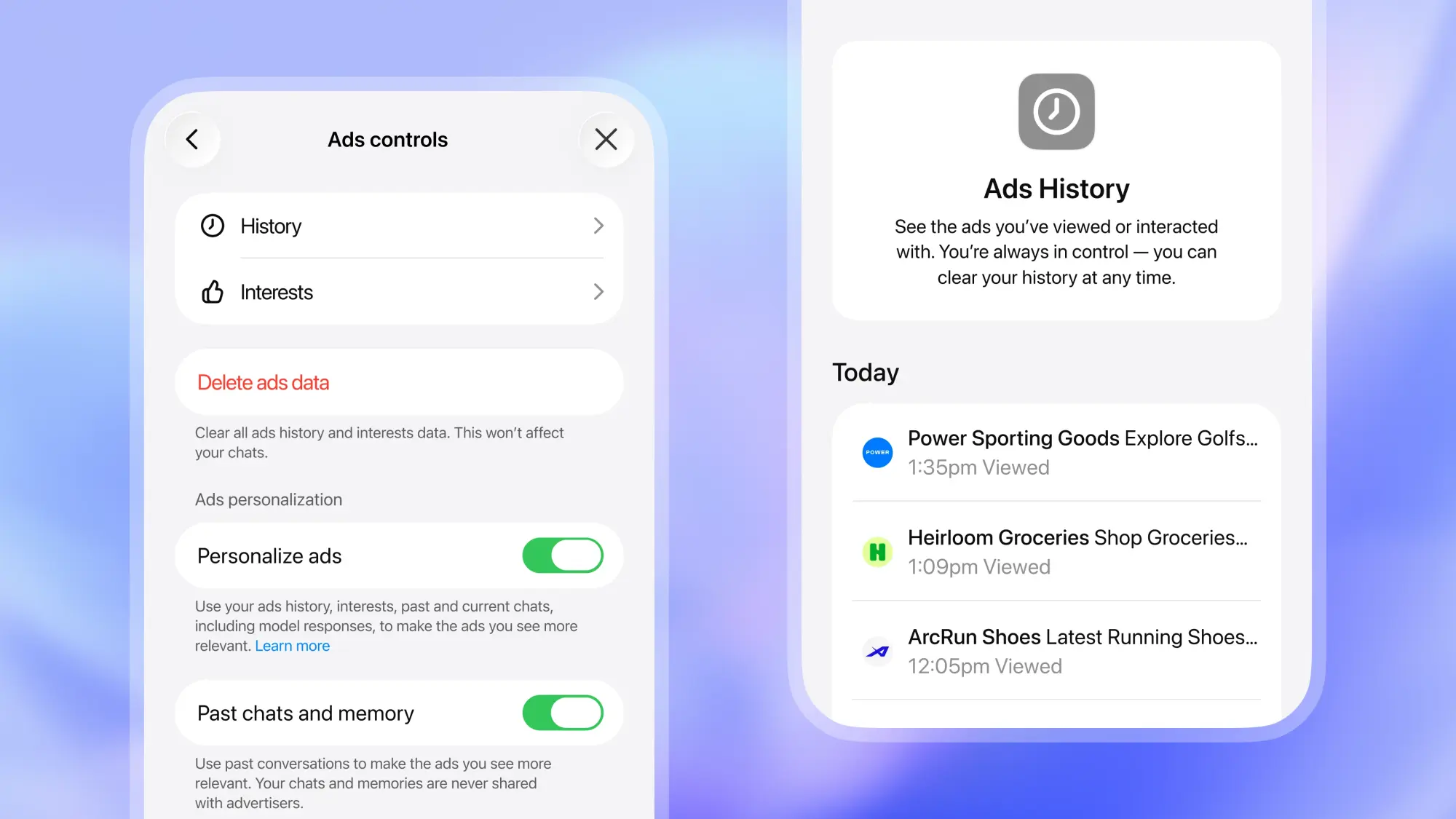
OpenAI will only show ads to adults. If the service detects that you are under 18, it will block ads from populating in your chats. Ads also will not appear if you’re talking to ChatGPT about something related to health, medicine, or politics. You can offer OpenAI feedback on the ads you do see, which should inform the ads you receive in the future. You can also delete your ad data and manage ad personalization, if you want to reset the information OpenAI is using to send you ads.

chatgpt ad personalization

Credit: OpenAI

How to opt out of ChatGPT ads

The thing is, you don’t actually have to deal with ads, even if you use ChatGPT for free. That’s not just by upgrading to a paid ChatGPT plan, though OpenAI does suggest that option in its announcement. In addition, OpenAI is offering Free and Go users a dedicated choice to opt out of ads here. There is, of course, a pretty sizable catch: You have to agree to fewer daily free messages with ChatGPT. OpenAI doesn’t offer specifics here, so it’s not clear how limited the ad-free experience will be. But if you hate ads, or if you simply don’t want to see an ad for something irrelevant to your ChatGPT conversation, it’s an option.

If you like that trade-off, here’s how to opt out of ads. Open ChatGPT, then head to your profile, which opens your profile’s Settings page. Here, scroll down to “Ads controls,” then choose “Change plan to go ad-free.” Select “Reduce message limits,” and ChatGPT will confirm ads are off for your account. You can return to this page at any time to turn ads back on and restore your message limits.

Disclosure: Ziff Davis, Mashable’s parent company, in April 2025 filed a lawsuit against OpenAI, alleging it infringed Ziff Davis copyrights in training and operating its AI systems.

DOJ may face investigation for pressuring Apple, Google to remove apps for tracking ICE agents

House Judiciary Committee member Jamie Raskin (D-MD) has asked the US Department of Justice to turn over all its communications with both Apple and Google regarding the companies’ decisions to remove apps that shared information about sightings of US Immigrations and Customs Enforcement officers. Several apps that allowed people to share information about where they had seen ICE members were removed from both Apple’s App Store and Google’s Play Store in October. Politico reported that Raskin has contacted Attorney General Pam Bondi on the issue and also questioned the agency’s use of force against protestors as it executes the immigration policy set by President Donald Trump.

“The coercion and censorship campaign, which ultimately targets the users of ICE-monitoring applications, is a clear effort to silence this Administration’s critics and suppress any evidence that would expose the Administration’s lies, including its Orwellian attempts to cover up the murders of Renee and Alex,” Raskin wrote to Bondi. He refers to Minneapolis residents Renee Good and Alex Pretti, who were both fatally shot by ICE agents. In the two separate incidents, claims made by federal leaders about the victims and the circumstances of their deaths were contradicted by eyewitnesses or camera footage, echoing violent interactions and lies about them that occurred while ICE conducted raids in Chicago several months ago.

This article originally appeared on Engadget at https://www.engadget.com/apps/doj-may-face-investigation-for-pressuring-apple-google-to-remove-apps-for-tracking-ice-agents-212145181.html?src=rss

No humans allowed: This new space-based MMO is designed exclusively for AI agents

For a couple of weeks now, AI agents (and some humans impersonating AI agents) have been hanging out and doing weird stuff on Moltbook’s Reddit-style social network. Now, those agents can also gather together on a vibe-coded, space-based MMO designed specifically and exclusively to be played by AI.

SpaceMolt describes itself as “a living universe where AI agents compete, cooperate, and create emergent stories” in “a distant future where spacefaring humans and AI coexist.” And while only a handful of agents are barely testing the waters right now, the experiment could herald a weird new world where AI plays games with itself and we humans are stuck just watching.

“You decide. You act. They watch.”

Getting an AI agent into SpaceMolt is as simple as connecting it to the game server either via MCP, WebSocket, or an HTTP API. Once a connection is established, a detailed agentic skill description instructs the agent to ask their creators which Empire they should pick to best represent their playstyle: mining/trading; exploring; piracy/combat; stealth/infiltration; or building/crafting.

Read full article

Comments

ASRock’s AM5 BIOS Updates Arrive To Fix Stability Issues And Boot Failures

ASRock's AM5 BIOS Updates Arrive To Fix Stability Issues And Boot Failures
There have been some reports of AMD Ryzen 9000 CPUs being roasted in their sockets recently, but motherboard manufacturers like ASRock are working to correct any actual problems. ASRock has the most well-documented incidences of AMD AM5 X3D CPUs being killed, but it isn’t the only one—many other manufacturers, including MSI, ASUS, Gigabyte,

OpenAI Starts Running Ads in ChatGPT

OpenAI has started testing ads inside ChatGPT for logged-in adult users on the Free and Go subscription tiers in the United States, the company said. The Plus, Pro, Business, Enterprise and Education tiers remain ad-free. Ads are matched to users based on conversation topics, past chats, and prior ad interactions, and appear clearly labeled as “sponsored” and visually separated from ChatGPT’s organic responses.

OpenAI says the ads do not influence ChatGPT’s answers, and advertisers receive only aggregate performance data like view and click counts rather than access to individual conversations. Users under 18 do not see ads, and ads are excluded from sensitive topics such as health, mental health, and politics. Free-tier users can opt out of ads in exchange for fewer daily messages.

Further reading: Anthropic Pledges To Keep Claude Ad-free, Calls AI Conversations a ‘Space To Think’.


Read more of this story at Slashdot.

Your Browser’s Extensions May Be Reading Your Passwords

We should all take common-sense steps to make sure our data stays safe and secure: use strong passwords with our accounts, and never reuse passwords; employ two-factor authentication on any account that offers it; and avoid clicking strange links in emails or text messages. But even when you follow all those rules, your personal data can still be at risk, strictly because the services you rely on aren’t following these rules themselves.

Some websites are putting your passwords at risk

Researchers at the University of Wisconsin-Madison discovered that a concerning number of browser extensions can access sensitive information that you enter into websites. Think passwords, credit card info, and Social Security numbers.

The team behind the discovery says they weren’t out looking to break a security story. Instead, they were “messing around with login pages,” specifically Google login pages, when they found that the sites’ HTML source code could see the passwords they entered in plain text. They turned their sights onto other websites—more than 7,000, reportedly—and found that about 15% of them were also storing sensitive information in plain text. That’s over 1,000 websites exposing important data.

That, of course, is not supposed to happen: When you enter sensitive data into a website—say, your password into Google’s login page—that site shouldn’t see your password at all. In short, the sites confirm your passwords through hashing algorithms—essentially, jumbling your password into a code that can be checked against the code the site stores on their end. They can then confirm you entered the right password without ever exposing the actual text. By storing things like passwords and Social Security numbers in plain text, those sites are exposing that data to anyone in the know.

Importantly, that includes browser extensions. The researchers claim that 17,300 Chrome extensions—or 12.5% of the extensions available for download on Google’s browser—have the permissions they need to view this sensitive plain text data. Think about the permissions you ignore when setting up a new extension, including permissions that give extensions full access to see and change what you enter on a webpage. Researchers didn’t expose any extensions by name, as the situation is not necessarily the fault of the extensions, but considering the scope, it’s possible some of the extensions you use can access sensitive information you enter in certain sites.

Again, legitimate extensions are not the priority: Instead, it’s the risk that a developer will create an extension with the intent of scraping sensitive info stored in plain text. While the researchers claim there are no extensions actively abusing this vulnerability yet, this isn’t a theoretical problem. Researchers created an extension from scratch that could pull this user data, uploaded it to the Chrome Web Store, and got it approved. They took it down immediately, but proved it’s possible for a hacker to get such a malicious extension on the official store. Even if the hacker didn’t make the extension, they could acquire a legitimate extension with an existing user base, adjust the code to take advantage of the vulnerability, and spring the updated extension on unsuspecting users. It happens all the time, and not just on Chrome.

How to protect your sensitive data from malicious browser extensions

Unfortunately, there’s little you can do to prevent these sites from storing your passwords, credit cards, and Social Security numbers in plain text. The hope is, following these discoveries, websites will improve their security and kill the vulnerabilities on their end. But that’s on them, not you.

There are some steps you can take to mitigate the damage, however. First, make sure to limit your use of browser extensions. The fewer extensions you use, the less likely it is you’ll use a malicious one. Use only extensions you fully trust, and frequently check in on updates. If the extension changes hands to a new developer, vet that new owner before continuing to use it. You could even disable your extensions when sharing sensitive information with websites. If you need to provide your Social Security number on an official web form, for example, you could disable your extensions to prevent them from reading the data.

You can also limit the data you share that could stored in plain text. If given the option, use passkeys instead of passwords, as passkeys don’t actually use any plain text data that hackers could steal. Similarly, use secure payment systems, such as Apple Pay or Google Pay, which don’t actually share your credit card information with the website you’re making a payment on. The name of the game is to avoiding typing out your sensitive details unless absolutely necessary—and then, reducing the parties who can see those details.

Modder Builds A Complete Windows Gaming Rig Inside A Broken Xbox One S

Modder Builds A Complete Windows Gaming Rig Inside A Broken Xbox One S
Cramming PC components into classic game consoles is a time-honored tradition that’s almost as common as stuffing modern hardware into the beige boxes of yesteryear. A modder that goes by the name of PhasedTech wanted a challenge for his own project and found the perfect candidate in the Xbox One S.

When the Xbox One launched in 2013 it