LA County lawsuit accuses Roblox of exposing children to ‘grooming and exploitation’

Los Angeles County has sued Roblox for “unfair and deceptive business practices,” claiming the platform’s moderation and age-verification systems are inadequate. “Roblox portrays its platform as a safe and appropriate place for children to play,” the complaint states. “In reality, and as Roblox well knows, the design of its platform makes children easy prey for pedophiles.” 

Representatives accused Roblox of failing to implement adequate platform safety features to prevent child endangerment. “Specifically, Roblox has not effectively moderated game content or enforced age-appropriate restrictions and warnings established by the creators, allowing the predatory and inappropriate language and interactions between users to persist,” the County stated. It also said the platform failed to disclose any danger to children, including sexual content and the risk of predators. 

Roblox rejected the allegations, saying the platform was built around safety. “We have advanced safeguards that monitor our platform for harmful content and communications, and users cannot send or receive images via chat, avoiding one of the most prevalent opportunities for misuse seen elsewhere online,” the company told the AFP. 

The LA county complaint is the latest in a string of lawsuits from US regions including Florida, Texas and Kentucky. The Attorney General in Louisiana also accused the company of having a “lack of safety protocols” that endanger the safety of children in favor of “growth, revenue and profits.” That state’s lawsuit cited a specific example of a subject arrested last year that used voice-altering tech to mimic a younger feminine voice to lure and sexually exploit young players.

Roblox has said that it has about 144 million daily active users around the world, with over 40 percent of them under the age of 13. However, it has faced repeated accusations that it doesn’t do enough to protect young players. In 2024, Roblox banned players under 13 from accessing some types of in-game content and restricted their ability to message with other players outside of specific games. Last year, the company also began asking tens of millions of children to verify their age with a selfie. 

This article originally appeared on Engadget at https://www.engadget.com/gaming/la-county-lawsuit-accuses-roblox-of-exposing-children-to-grooming-and-exploitation-124523028.html?src=rss

Pokémon FireRed and LeafGreen are coming to Switch next week for the series’ 30th anniversary

It’s a big month for Pokémon, with February 27 marking 30 years since the world’s highest-grossing media franchise first introduced itself in the shape of two Game Boy games. Pocket Monsters Red and Pocket Monsters Green, which later arrived in the West as Pokémon Red and Pokémon Blue, kicked off a craze in Japan that would soon spread worldwide. And to mark the series’ 30th anniversary, the little turn-based RPGs that started it all are being re-released on Nintendo Switch.

Well, sort of. The versions we’re actually getting are the Game Boy Advance remakes, Pokémon FireRed and LeafGreen, which originally came out in 2004. Explaining its decision to bring back the enhanced GBA titles rather than the originals, Nintendo said in an FAQ that it thought Switch owners would like the opportunity to revisit the “ultimate versions of the original Pokémon adventures in the Kanto region.”

Get ready to relive the Kanto region Trainers, Pokémon FireRed Version and Pokémon LeafGreen Version are coming to Nintendo Switch!

Pre-order here:https://t.co/WzCCWh1fn8https://t.co/5SdXjg75is https://t.co/XVYS5wVZYp

— Nintendo of America (@NintendoAmerica) February 20, 2026

These aren’t modern remakes or remasters. Pokémon FireRed and LeafGreen will look and play pretty much the same as they did in 2004, just on a far superior display, obviously. There’s no online play, but the original’s games’ local multiplayer features return via the Switch’s built-in wireless features. If you’re playing on Switch 2, you can also play using GameChat. Other than that, it doesn’t sound like there are any notable differences between the Switch and Switch 2 versions. 

In a move that might surprise some, Pokémon FireRed and LeafGreen won’t be available as part of the Nintendo Switch Online GBA library. In fact you don’t even need an NSO membership to play them. Instead, the games are being sold as standalone titles for $20 in the eShop. No physical release is planned outside of Japan. Nintendo added in its FAQ that there are no current plans for more old-school Virtual Console-style releases beyond these ones, with the company still committed to building out its NSO subscription offerings.

Pokémon FireRed and LeafGreen will be available to buy after a Pokémon Presents showcase that will air next Friday, February 27 (the day of Pokémon’s 30th anniversary), at 9am ET. And if you need yet more Pokémon after that, Pokémon Pokopia, which is the series’ long-awaited stab at a cozy Animal Crossing-like, arrives on March 5.

This article originally appeared on Engadget at https://www.engadget.com/gaming/nintendo/pokemon-firered-and-leafgreen-are-coming-to-switch-next-week-for-the-series-30th-anniversary-123505741.html?src=rss

The Morning After: What to expect from Apple’s March 4 hardware event

Apple has lined up its first event of the year. Already! It’s taking place in New York City on March 4 at 9AM ET, but the company hasn’t confirmed if it will stream the media event.

It seems likely the event will be mainly iPads and MacBooks — so business as usual. However, it could include new entry-level MacBooks in a fresh array of colors. I think that’s what everyone’s reading into the lemon-and-lime tinged invitation.

I’m very much up for a return of the colorful Mac. The first Mac I ever used was one of those bubbly orange iMacs, interning at a video-game magazine. Yes, a magazine.

We’re also expecting a 2026 MacBook Air and refreshed 14- and 16-inch MacBook Pros, with the M5 Pro and M5 Max chips also breaking cover. Is it too early for an iPhone 17e? Perhaps. We’ll be reporting from the event.

And for those asking about yesterday’s newsletter, thanks for your continued support and we’ll have more to say soon. 

— Mat Smith

The other big stories (and deals) this morning

Netflix’s first MMA livestream is coming in May

Rousey v. Carano.

Netflix is streaming its very first live MMA fight on May 16. The combatants are Ronda Rousey, (last match 2016) and Gina Carano (2009). The streamer has had to pluck fighters out of retirement because more contemporary stars are under contract with various promotional entities. The featherweight bout will take place inside a hexagon cage and stream globally — hopefully, Netflix can keep its stream up. The fight is co-hosted by Most Valuable Productions, Jake Paul’s production company. Because of course it is.

Continue reading.

The Pixel 10a is your next midrange Android phone

It launches March 5.

TMA
Engadget

The worst-kept secret in value-for-money phones remains Google’s Pixel A series. In recent years, the Android phone series has offered a great balance of specs, hardware design and software features that embarrass most phones in the same price point. Its camera performance is often better than devices that cost several hundred dollars more.

It’s more of the same with the Pixel 10a. For $500, you get a 6.3-inch OLED screen with a 120Hz refresh rate and 3,000 nits of peak brightness, 8GB of RAM and a 48MP main camera, paired with a 13MP ultra-wide. Also: No. Camera. Bump. Innovation for $500, right there.

Continue reading.

Dyson’s tiny PencilVac gets turned into a floorwasher

This is the PencilWash.

TMA
Engadget

I won’t shut up about floor cleaning. I’m 41. Dyson has crunched its wet-floor tech into the same cylindrical profile of its Penac. I like the size, but how does it clean? I’ll hold judgment till I’ve tried it.

$600 is a lot more than a mop. Yes, I know that’s not the point.

Continue reading.

This article originally appeared on Engadget at https://www.engadget.com/general/the-morning-after-engadget-newsletter-122534537.html?src=rss

Microsoft removes guide on how to train LLMs on pirated Harry Potter books

Following backlash in a Hacker News thread, Microsoft deleted a blog post that critics said encouraged developers to pirate Harry Potter books to train AI models that could then be used to create AI slop.

The blog, which is archived here, was written in November 2024 by a senior product manager, Pooja Kamath. According to her LinkedIn, Kamath has been at Microsoft for more than a decade and remains with the company. In 2024, Microsoft tapped her to promote a new feature that the blog said made it easier to “add generative AI features to your own applications with just a few lines of code using Azure SQL DB, LangChain, and LLMs.”

What better way to show “engaging and relatable examples” of Microsoft’s new feature that would “resonate with a wide audience” than to “use a well-known dataset” like Harry Potter books, the blog said.

Read full article

Comments

Rocket Report: Chinese launch firm raises big money; Falcon 9 back to the Bahamas

Welcome to Edition 8.30 of the Rocket Report! As I write this week’s edition, NASA’s Space Launch System rocket is undergoing a second countdown rehearsal at Kennedy Space Center, Florida. The outcome of the test will determine whether NASA has a shot at launching the Artemis II mission around the Moon next month, or if the launch will be delayed until April or later. The finicky fueling line for the rocket’s core stage is the center of attention after a hydrogen leak cut short a practice countdown earlier this month.

As always, we welcome reader submissions. If you don’t want to miss an issue, please subscribe using the box below (the form will not appear on AMP-enabled versions of the site). Each report will include information on small-, medium-, and heavy-lift rockets, as well as a quick look ahead at the next three launches on the calendar.

Who is actually investing in sovereign launch? No one will supplant American and Chinese dominance in the space launch arena anytime soon, but several longtime US allies now see sovereign access to space as a national security imperative, Ars reports. Taking advantage of private launch initiatives already underway within their own borders, several middle and regional powers have approved substantial government funding for commercial startups to help them reach the launch pad. Australia, Canada, Germany, and Spain are among the nations that currently lack the ability to independently put their own satellites into orbit, but they are now spending money to establish a domestic launch industry. Others talk a big game but haven’t committed the cash to back up their ambitions.

Read full article

Comments

Samsung updates Bixby to become more conversational

Bixby isn’t typically part of the conversation when it comes to virtual assistants for mobile devices, but Samsung is clearly hoping that you would use it more. The company has launched the latest version of Bixby with the new One UI 8.5 beta, and it has been tweaked to work as a “conversational agent.” Samsung says you’ll now be able to talk to it and give it tasks using natural language, like how you’d talk to other people or, these days, to chatbots.

You don’t have to remember exact commands or names for specific settings. You can just describe what you want to happen, such as “I don’t want the screen to time out while I’m still looking at it.” Bixby will then automatically turn on the “Keep Screen on While Viewing” setting. If you ask it a question, such as “Why is my phone screen always on when it’s inside my pocket,” it could provide several solutions you can choose from.

In addition, the assistant can now access new and up-to-date information on the web. You do searches without opening a browser, and Bixby will display web results right within its interface. At the moment, the updated Bixby is only available in Samsung’s home country of Korea, as well as in Germany, India, Poland, the UK and the US, but company will roll it out more widely in the future.

This article originally appeared on Engadget at https://www.engadget.com/mobile/smartphones/samsung-updates-bixby-to-become-more-conversational-112649179.html?src=rss

Google Play used AI to help block 1.75 million bad apps in 2025

Google has announced that with the help of AI, it blocked 1.75 million apps that violated its policies in 2025, significantly down from 2.36 million in 2024. The lower numbers this year, it said, are because its “AI-powered, multi-layer protections” are deterring bad actors from even trying to publish bad apps.

Google said it now runs more than 10,000 safety checks on every app and continues to recheck them after they’re published. Its use of the latest generative AI models helps human reviewers discover malicious patterns more quickly, it added. The company also blocked 160 million spam ratings, preventing an average 0.5-star rating drop for apps targeted by review bombing. Finally, Google stopped 255,000 apps from gaining excessive access to sensitive user data in 2025, down from 1.3 million the year before. 

Meanwhile, Google Play Protect, the company’s Android defense system, sniffed out over 27 million new malicious apps, either warning users or preventing them from running. The company added that Play Protect’s enhanced fraud protection now covers 2.8 billion Android devices in 185 markets and blocked 266 million risky “side-loading” installation attempts. 

“Initiatives like developer verification, mandatory pre-review checks, and testing requirements have raised the bar for the Google Play ecosystem, significantly reducing the paths for bad actors to enter,” the company said its blog. “This year, we’ll continue to invest in AI-driven defenses to stay ahead of emerging threats and equip Android developers with the tools they need to build apps safely.”

Google has steadfastly justified its relatively high fees on app purchases and subscriptions by touting its investments in app safety. However, its Play store has been under pressure from regulators in Europe and other regions that claim it amounts to a monopoly. Last year, the company changed its fee structure for developers using alternative payment channels, but EU regulators recently claimed the company still isn’t complying with Digital Markets Act regulations. 

This article originally appeared on Engadget at https://www.engadget.com/apps/google-play-used-ai-to-help-block-175-million-bad-apps-in-2025-102208054.html?src=rss

New York Drops Plan To Legalize Robotaxis Outside NYC

New York Governor Kathy Hochul has dropped a proposal that would have allowed limited commercial robotaxi deployments outside New York City, citing a lack of support among state legislators. “The move is a blow to Waymo and other robotaxi companies who saw New York, and especially New York City, as a potential goldmine,” reports The Verge. From the report: The plan, which was introduced by Hochul as part of the state’s budget proposal last month, would have allowed limited robotaxi deployment in cities other than the Big Apple — while leaving whether New York City would get autonomous vehicles up to the mayor and the City Council. But now that plan is DOA, as support in the legislature never materialized. “Based on conversations with stakeholders, including in the legislature, it was clear that the support was not there to advance this proposal,” Sean Butler, a Hochul spokesperson, said in a statement. “While we are disappointed by the Governor’s decision, we’re committed to bringing our service to New York and will work with the State Legislature to advance this issue,” Waymo spokesperson Ethan Teicher said in a statement. “The path forward requires a collaborative approach that prioritizes transparency and public safety.”


Read more of this story at Slashdot.

Trump Directs US Government To Prepare Release of Files on Aliens and UFOs

US President Donald Trump says he will direct US agencies, including the defence department, to “begin the process of identifying and releasing” government files on aliens and extraterrestrial life. From a report: Trump made the declaration in a post on Truth Social, after he accused Barack Obama earlier in the day of revealing classified information when the former president said “aliens are real” on a podcast last week. “He’s not supposed to be doing that,” Trump told reporters aboard Air Force One, adding: “He made a big mistake.”

Asked if he also thinks aliens are real, Trump answered: “Well, I don’t know if they’re real or not.” Former US President Obama told podcast host Brian Tyler Cohen that he thinks aliens are real in an interview released last Saturday. “They’re real, but I haven’t seen them, and they’re not being kept in Area 51,” Obama said. “There’s no underground facility unless there’s this enormous conspiracy and they hid it from the president of the United States.”


Read more of this story at Slashdot.

Newborn Chicks Connect Sounds With Shapes Just Like Humans, Study Finds

An anonymous reader quotes a report from Scientific American: Why does “bouba” sound round and “kiki” sound spiky? This intuition that ties certain sounds to shapes is oddly reliable all over the world, and for at least a century, scientists have considered it a clue to the origin of language, theorizing that maybe our ancestors built their first words upon these instinctive associations between sound and meaning. But now a new study adds an unexpected twist: baby chickens make these same sound-shape connections, suggesting that the link to human language may not be so unique. The results, published today in Science, challenge a long-standing theory about the so-called bouba-kiki effect: that it might explain how humans first tethered meaning to sound to create language. Perhaps, the thinking goes, people just naturally agree on certain associations between shapes and sounds because of some innate feature of our brain or our world. But if the barnyard hen also agrees with such associations, you might wonder if we’ve been pecking at the wrong linguistic seed.

Maria Loconsole, a comparative psychologist at the University of Padua in Italy, and her colleagues decided to investigate the bouba-kiki effect in baby chicks because the birds could be tested almost immediately after hatching, before their brain would be influenced by exposure to the world. The researchers placed chicks in front of two panels: one featured a flowerlike shape with gently rounded curves; the other had a spiky blotch reminiscent of a cartoon explosion. They then played recordings of humans saying either “bouba” or “kiki” and observed the birds’ behavior. When the chicks heard “bouba,” 80 percent of them approached the round shape first and spent an average of more than three minutes exploring it compared with an average of just under one minute spent exploring the spiky shape. The exploration preferences were flipped when the chicks heard “kiki.”

Because the tests took place within the chicks’ carefully supervised first hours of life outside their eggshell, this association between particular sounds and shapes couldn’t have been learned from experience. Instead it may be evidence of an innate perceptual bias that goes back way farther in our evolutionary history than previously believed. “We parted with birds on the evolutionary line 300 million years ago,” says Aleksandra Cwiek, a linguist at Nicolaus Copernicus University in Toru, Poland, who was not involved in the study. “It’s just mind-blowing.”


Read more of this story at Slashdot.

US Plans Online Portal To Bypass Content Bans In Europe and Elsewhere

The U.S. State Department is reportedly developing a site called freedom.gov that would let users in Europe and elsewhere access content restricted under local laws, “including alleged hate speech and terrorist propaganda,” reports Reuters. Washington views the move as a way to counter censorship. Reuters reports: One source said officials had discussed including a virtual private network function to make a user’s traffic appear to originate in the U.S. and added that user activity on the site will not be tracked. Headed by Undersecretary for Public Diplomacy Sarah Rogers, the project was expected to be unveiled at last week’s Munich Security Conference but was delayed, the sources said. Reuters could not determine why the launch did not happen, but some State Department officials, including lawyers, have raised concerns about the plan, two of the sources said, without detailing the concerns.

The project could further strain ties between the Trump administration and traditional U.S. allies in Europe, already heightened by disputes over trade, Russia’s war in Ukraine and President Donald Trump’s push to assert control over Greenland. The portal could also put Washington in the unfamiliar position of appearing to encourage citizens to flout local laws.


Read more of this story at Slashdot.

California’s New Bill Requires DOJ-Approved 3D Printers That Report on Themselves

California’s recently-proposed AB-2047 would require 3D printers sold in the state to be DOJ-approved models equipped with “firearm blocking technology,” banning non-certified machines after 2029 and criminalizing efforts to bypass the software. Adafruit notes that unlike similar legislation proposed in Washington State and New York, California’s version “adds a certification bureaucracy on top: state-approved algorithms, state-approved software control processes, state-approved printer models, quarterly list updates, and civil penalties up to $25,000 per violation.” From the report: Assembly Member Bauer-Kahan introduced AB-2047, the “California Firearm Printing Prevention Act,” on February 17th. The bill would ban the sale or transfer of any 3D printer in California unless it appears on a state-maintained roster of approved makes and models… certified by the Department of Justice as equipped with “firearm blocking technology.” Manufacturers would need to submit attestations for every make and model. The DOJ would publish a list. If your printer isn’t on the list by March 1, 2029, it can’t be sold. In addition, knowingly disabling or circumventing the blocking software is a misdemeanor.

[…] As Michael Weinberg wrote after the New York and Washington proposals dropped⦠accurately identifying gun parts from geometry alone is incredibly hard, desktop printers lack the processing power to run this kind of analysis, and the open-source firmware that runs most machines makes any blocking requirement trivially easy to bypass. The Firearms Policy Coalition flagged AB-2047 on X, and the reactions tell you everything. Jon Lareau called it “stupidity on steroids,” pointing out that a simple spring-shaped part has no way of revealing its intended use. The Foundry put it plainly: “Regulating general-purpose machines is another. AB-2047 would require 3D printers to run state-approved surveillance software and criminalize modifying your own hardware.”


Read more of this story at Slashdot.

Google Announces Gemini 3.1 Pro For ‘Complex Problem-Solving’

Google has introduced Gemini 3.1 Pro, a reasoning-focused upgrade aimed at more complex problem-solving. 9to5Google reports: This .1 increment is a first for Google, with the past two generations seeing .5 as the mid-year model update. (2.5 Pro was first announced in March and saw further updates in May for I/O.) Google says Gemini 3.1 Pro “represents a step forward in core reasoning.” The “upgraded core intelligence” that debuted last week with Gemini 3 Deep Think is now available in Gemini 3.1 Pro for more users. This model achieves an ARC-AGI-2 score of 77.1%, or “more than double the reasoning performance of 3 Pro.”

This “advanced reasoning” translates to practical applications like when “you’re looking for a clear, visual explanation of a complex topic, a way to synthesize data into a single view, or bringing a creative project to life.” 3.1 Pro is designed for tasks where a simple answer isn’t enough, taking advanced reasoning and making it useful for your hardest challenges.


Read more of this story at Slashdot.

Rumors Suggest Apple and Meta Are Betting Big on AI Wearables

We may earn a commission from links on this page.

The next generation of Meta’s Display smart glasses might come with a smart watch. According to a report from The Information, Meta’s watch, codenamed Malibu 2, could feature fitness tracking features and AI, but its real purpose is to replace the Display’s neural band and act as controller for the smart glasses. If the reports are accurate, Meta Display smart glasses with a smart watch could be available in 2026.

There aren’t any other details on the smart watch, so we don’t know the price or what features it may have—but I’d be surprised if this rumor doesn’t pan out eventually. Meta has discussed the idea of a smart watch before, and it makes sense: If you’re going to have a wrist-controller for your glasses, why not give it smart watch features as well? Especially if a glasses-and-watch combo potentially gives users a reason to switch away from their Apple Watches.

Apple is reportedly working on AI wearables too

Speaking of Apple, if the rumors about the company are true, Apple is pushing to release its own suite of AI-powered wearable devices. According to a report in Bloomberg, Apple could roll out smart glasses in early 2027. The company is also reportedly developing an AI-powered pendant that can “be pinned to a shirt or worn as a necklace,” as well as AirPods with expanded AI capabilities. The AirPods and pendant will be equipped with cameras designed to “help the AI work” as opposed to taking photos. Apple’s smart glasses will reportedly not feature a display, but will feature a higher end camera and superior build quality to Meta’s smart glasses. All of Apple’s devices are reportedly designed to work with iPhones.

Is the wearable war heating up?

None of this is confirmed, of course. The closest Apple has come to announcing these plans is CEO Tim Cook mentioning “categories of products” enabled by artificial intelligence at an all-hands meeting. However, everything points to Meta and Apple betting that consumers want a collection of connected AI-wearables. Each company is taking a different approach to hooking users into their ecosystem. Apple seems to be betting on devices integrated with iPhones and controlled with the kind of camera-based tech that powers the Apple Vision Pro headset. Meta seems to be aiming at replacing phones with an in-glasses display, and a biometric control scheme that works with muscle movements, like the existing neural band.

Both Meta and Apple seem to be competing to go beyond a screen or smart glasses to become the next interface for your life—but do people want that? Are consumers excited enough by the prospect of always-available AI and tied-together devices to buy them? That’s the big question, and the answer is anything but certain. Both Apple and Meta have made big bets on virtual reality, and, despite both companies’ VR devices being excellent, neither seems to have captured the market in way these firms would have liked. So, as they say, stay tuned.

Apple inks deal for IMAX screenings of live Formula 1 races

Formula 1 has been receiving star treatment from Apple for awhile, and now the racing series will literally be getting even bigger. Apple is partnering with IMAX to show five races from the 2026 season. The Miami Grand Prix on May 3, the Monaco Grand Prix on June 7, the British Grand Prix on July 5, the Italian Grand Prix on September 6 and the United States Grand Prix on October 25 will be aired live at select IMAX theaters in the US. 

Apple landed a five-year deal for the US broadcast rights to Formula 1 last fall and there’s already a dedicated channel for the car races on Apple TV ahead of the season’s start. It also got the rights for a splashy feature film about the racing league, which amassed more than $630 million at the global box office, including with some IMAX screenings. It’s unclear if IMAX will be paying to host more live F1 races at its theaters in future years, but it should be a fun way for fans to get the most immersive experience possible short of actually attending the racetrack.

This article originally appeared on Engadget at https://www.engadget.com/entertainment/apple-inks-deal-for-imax-screenings-of-live-formula-1-races-234003582.html?src=rss

Meta’s metaverse is going mobile-first

Meta is formally sectioning off Horizon Worlds, the closest thing it has to a metaverse, from its Quest VR platform, according to a new blog post from Samantha Ryan, Meta’s VP of Content, Reality Labs. While the decision runs counter to Meta’s original plan to own an immersive virtual world that could serve as the future home for all online interaction, it fits with the recent cuts it made to its costly Reality Labs division, and Mark Zuckerberg’s public commitment to focus the company on AI hardware like smart glasses going forward. 

“We’re explicitly separating our Quest VR platform from our Worlds platform in order to create more space for both products to grow,” Ryan writes in the blog post. “We’re doubling down on the VR developer ecosystem while shifting the focus of Worlds to be almost exclusively mobile. By breaking things down into two distinct platforms, we’ll be better able to clearly focus on each.”

Meta has been developing mobile and web versions of Horizon Worlds in parallel with its VR app since at least 2023. Switching Worlds to being a mobile-first software platform isn’t good for VR diehards, but it does make it a more natural competitor to something like Roblox or Fortnite, which also offer user-created and monetizable worlds and games. It’s also a business Meta believes it can more easily scale because of its ability to connect games to “billions of people on the world’s biggest social networks.”

While Meta shuttered several of its own VR game studios earlier this year, it still wants to support third-party developers publishing games on its platform. The company says new monetization tools, better discoverability, a “Deals” tab and more ways for developers to talk to their customers should help make a difference. Maintaining the Quest’s library of games could also be critical going forward. Business Insider reported in December 2025 that Meta was working on a gaming-focused Quest headset, and Meta CTO Andrew Bosworth confirmed earlier this February that the company still had multiple Quest devices on its roadmap.

This article originally appeared on Engadget at https://www.engadget.com/ar-vr/metas-metaverse-is-going-mobile-first-233030532.html?src=rss

Minecraft Java Is Switching From OpenGL To Vulkan

Minecraft: Java Edition is switching its rendering backend from OpenGL to Vulkan as part of the upcoming Vibrant Visuals update, aiming for both better performance and modern graphics features across platforms like Linux and macOS (via translation layers). GamingOnLinux reports: For modders, they’re suggesting they start making preparations to move away from OpenGL: “Switching from OpenGL to Vulkan will have an impact on the mods that currently use OpenGL for rendering, and we anticipate that updating from OpenGL to Vulkan will take modders more effort than the updates you undertake for each of our releases. To start with, we recommend our modding community look at moving away from OpenGL usage. We encourage authors to try to reuse as much of the internal rendering APIs as possible, to make this transition as easy as possible. If that is not sufficient for your needs, then come and talk to us!”

It does mean that players on really old devices that don’t support Vulkan will be left out, but Vulkan has been supported going back to some pretty old GPUs. You’ve got time though, as they’ll be rolling out Vulkan alongside OpenGL in snapshots (development releases) “sometime over the summer.” You’ll be able to toggle between them during the testing period until Mojang believe it’s ready. OpenGL will be entirely removed eventually once they’re happy with performance and stability.


Read more of this story at Slashdot.

I Was Skeptical of This Music App That Claims to Help With Focus, but It Actually Worked for Me

Sometimes a life hack works when I wish it didn’t. I, for example, am vulnerable to depression and anxiety. I also passionately hate running. I have, unfortunately, discovered that running regularly helps my mental health a great deal. I’m thankful (because I feel better) and resentful (because I have to run).

This is how I feel about Brain.fm, a music service I discovered a couple weeks ago when the company got in touch with me. I started using the service, mostly for the purposes of writing this article, and something unexpected happened: I noticed it’s a great deal easier to get started on my work in the morning. I like this (because I’m getting more done) but am also annoyed (because I’d rather be listening to the music I love).

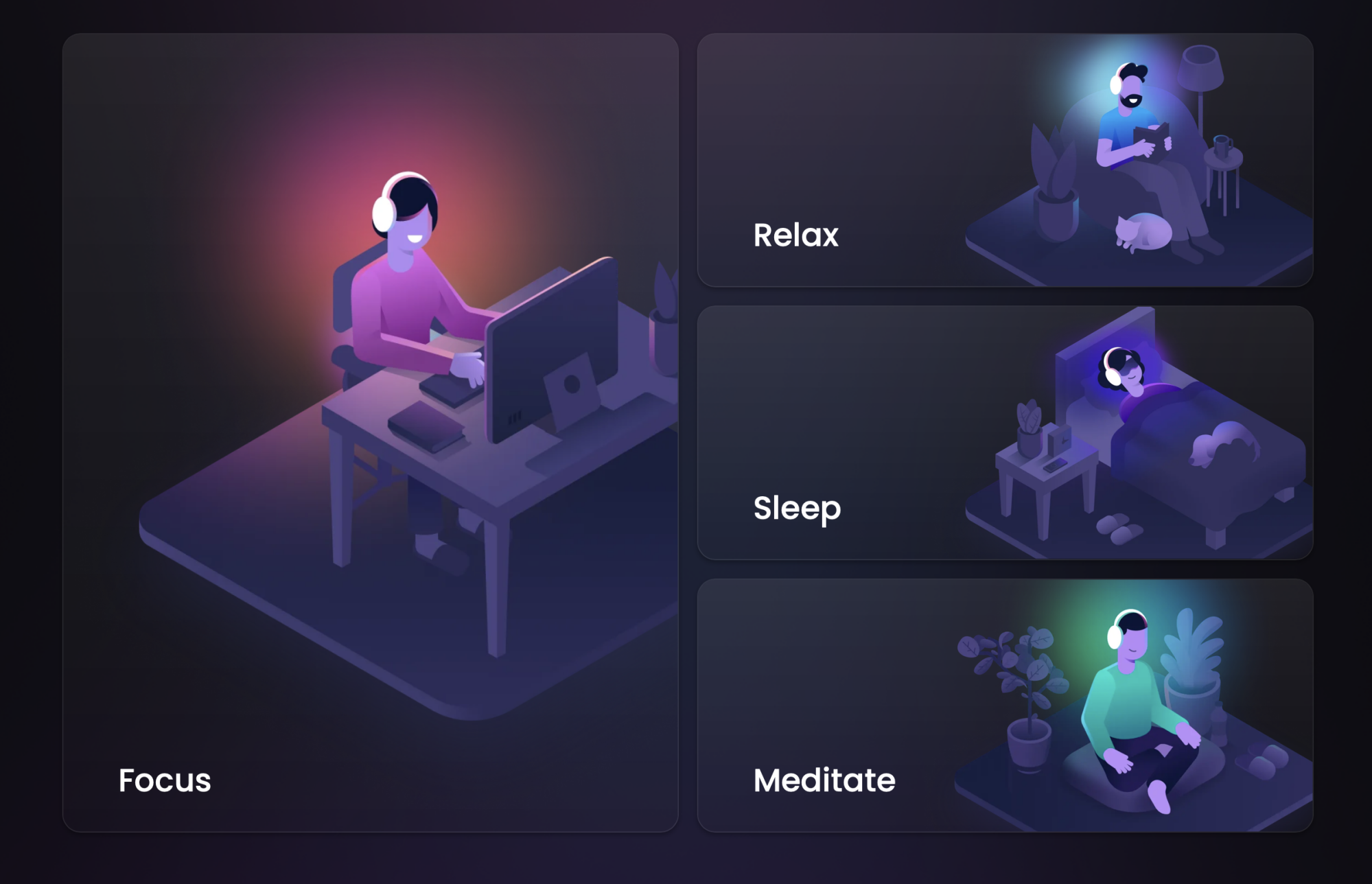
Four categories—focus, relax, sleep, and meditate—are offered here

Credit: Justin Pot

It’s a conundrum. Brain.fm is a subscription service that costs $14.99 per month, more than Spotify (which costs $12.99 per month). The product sells itself as having a collection of music backed by scientific research to increase your ability to focus, meditate, and sleep. There’s also a free trial, meaning you can get a feel for whether it works for you.

After a few weeks of testing, I feel it might be onto something. I don’t always trust my intuition, though, so I wanted to dig deeper. Is this for real? Or am I falling for snake oil? More importantly: can I go back to listening to KEXP in the morning?

Is the science behind Brain.fm legit?

After a few days of using the application, I couldn’t help but wonder. Is my increased focus real? Or is it a placebo?

So I wrote to Daniel J. Levitin, professor emeritus of neurology at McGill University, and author of This Is Your Brain on Music: The Science of a Human Obsession. He replied quickly, and concisely: “It’s all placebo,” he said.

It was a very concise email from an academic about a complex topic, which as a journalist is always nice. But Levitin didn’t stop there—he told me to get in touch with another neuroscientist, one who had published research on this type of modulated music. I’ll say more below about that research, but first, let’s take a look at what’s actually in those Brain.fm tracks.

What using Brain.fm is like

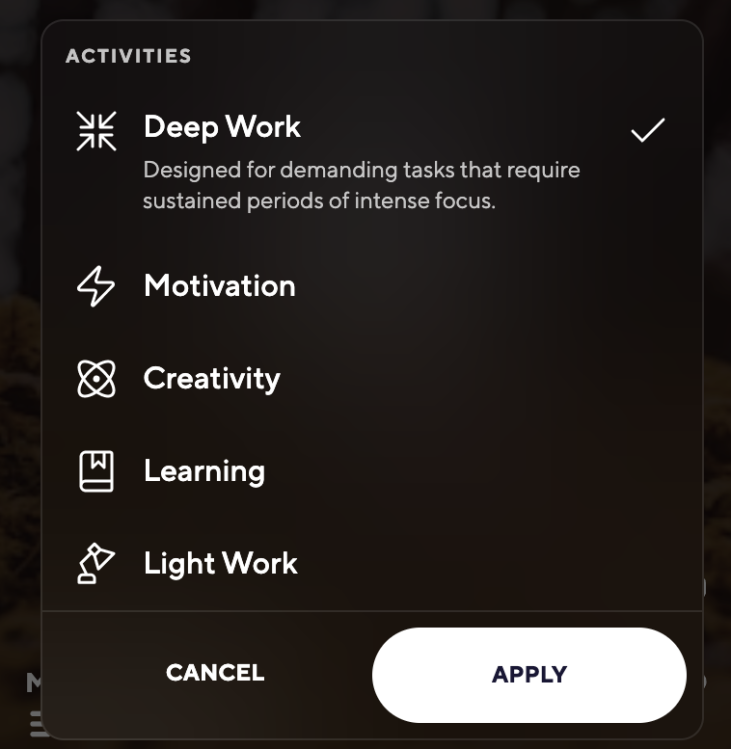
You can’t use this service to search for a specific artist—you instead let the application know what you’re trying to do (Focus, Relax, Meditate, or Sleep). In the Focus section, there are a few sub-options: Deep Work, Motivation, Creativity, Learning, and Light Work. Choose what you want to do and a track will start playing.

Deep Work, Motivation, Creativity, Learning, and Light Work are all offered as sub-categories in this screenshot

Credit: Justin Pot

The genres, such as they are, range from the kind of “chill beats” you can find on YouTube to post-rock and symphonic—though it’s all instrumental.

“The basic problem is that most music is made to grab your attention,” Kevin Woods, a neuroscience PhD who works for Brain.fm, told me. “If you talk to a music producer, they’ll tell you that their job is to make things punchy and bright, and to make somebody sit up and turn their head and favorite the song on Spotify.”

That attention seeking can make playing music during the work day distracting in a subtle way, according to Woods. “The problem is that a lot of the distraction is not overt in the sense of, ‘I can feel my attention breaking and I have to turn this off or turn down the volume’—it’s more like, ‘I’m working at 70, 80% capacity, and I’m not really sure why.'”

So the music at Brain.fm is written and performed by in-house composers who are intentionally trying not to keep your attention. But that alone doesn’t really set Brain.fm apart from using ambient music or video game soundtracks to focus, let alone the various “chill beats” playlists and live streams that are out there. And that’s where Brain.fm’s scientific claims come in.

Brain.fm says the key is “amplitude modulation”

Brain.fm points to several scientific studies on its homepage, also mentioning that its research was in part funded by that National Science Foundation. A lot of the claims are based on “amplitude modulation,” which Woods told me is what sets Brain.fm’s music apart.

But what is amplitude modulation? They’re “fast modulations added that do not usually occur in music,” according to Woods. If you listen to the music for a bit, you’ll hear an almost fluttering kind of sound. These sounds, which are added to compositions in post-production using AI, are available at three different levels for each track. The “ADHD Mode,” which is the highest of the three settings, is what I mostly used while testing.

I find this effect a little bit disorienting, so I sometimes needed to turn the setting down. It’s hard to deny the effect is a musical signature of Brain.fm. But does it work?

Research on amplitude modulation is limited, but promising

I became a bit less skeptical of the science after getting in touch with the expert that Levitin recommended: Psyche Loui, a neuroscientist, musician, and Associate Dean of Research at Northeastern University. Loui told me that “it’s not all placebo”, pointing to a paper she published alongside Woods and other neurologists in Communications Biology.

Now, to be clear, it’s not unusual for scientists to disagree about how things work—that’s part of the process. And the claims made by the paper are narrow—the conclusion is that music with amplitude modulation can help people focus on tasks when compared to both pink noise and music without amplitude modulation. The control music, according to Woods, were the same tracks—the only difference was whether amplitude modulation was added. The results of testing, and brain scans, suggest the effect is real.

“We did something which is rarely done in music research, which is a very well-controlled study that only changes one factor in the music,” Woods told me. As with all scientific research, there’s always more to learn. But to me, a study making these claims published in a Nature-affiliated publication suggests there might be something to this.

At the very least, Brain.fm helped me reflect on my relationship with music at work

Brain.fm, if nothing else, has been an opportunity to reflect on my relationship with music. I really enjoy discovering new music during the workday, but after using Brain.fm for a few weeks I wonder if that might have been the reason I have trouble focusing in the morning.

Maybe it’s best to listen to music that fades into the background when it’s time to focus, and save music discovery for when I only need part of my brain. And maybe I should save the music I really love for when I’m not working at all. Brain.fm, if nothing else, taught me that.

But I also find that the music really does work when I need to focus. I still am not fully sure if the effect is real, or if any music that blends into the background would do the job. I sometimes play the entire Boards of Canada discography when I need to focus, and find that works about as well.

All that having been said, I really think anyone who has read this much about Brain.fm should probably go ahead and see for themselves.


Lawsuit: ChatGPT told student he was “meant for greatness”—then came psychosis

A Georgia college student named Darian DeCruise has sued OpenAI, alleging that a recently deprecated version of ChatGPT “convinced him that he was an oracle” and “pushed him into psychosis.”

This case, which was first reported by ALM, marks the 11th such known lawsuit to be filed against OpenAI that involves mental health breakdowns allegedly caused by the chatbot. Other incidents have ranged from highly questionable medical and health advice to a man who took his own life, apparently after similarly sycophantic conversations with ChatGPT.

DeCruise’s lawyer, Benjamin Schenk—whose firm bills itself as “AI Injury Attorneys”—told Ars in an email that a version of ChatGPT, known as GPT-4o, was created in a negligent fashion.

Read full article

Comments

IRS Loses 40% of IT Staff, 80% of Tech Leaders In ‘Efficiency’ Shakeup

The IRS’s IT division has reportedly lost 40% of its staff and nearly 80% of its tech leadership amid a federal “efficiency” overhaul, the agency’s CIO revealed yesterday. The Register reports: Kaschit Pandya detailed the extent of the tech reorganization during a panel at the Association of Government Accountants yesterday, describing it as the biggest in two decades. … The IRS lost a quarter of its workforce overall in 2025. But the tech team was clearly affected more deeply. At the start of the year, the team encompassed around 8,500 employees.

As reported by Federal News Network (FNN), Pandya said: “Last year, we lost approximately 40 percent of the IT staff and nearly 80 percent of the execs.” “So clearly there was an opportunity, and I thought the opportunity that we needed to really execute was reorganizing.” That included breaking up silos within the organization, he said. “Everyone was operating in their own department or area.”

It is not entirely clear where all those staff have gone. According to a report by the US Treasury Inspector General for Tax Administration, the IT department had 8,504 workers as of October 2024. As of October 2025, it had 7,135. However, reports say that as part of the reorganization, 1,000 techies were detailed to work on delivering frontline services during the US tax season. According to FNN, those employees have questioned the wisdom of this move and its implementation.


Read more of this story at Slashdot.