We may earn a commission from links on this page. Deal pricing and availability subject to change after time of publication.
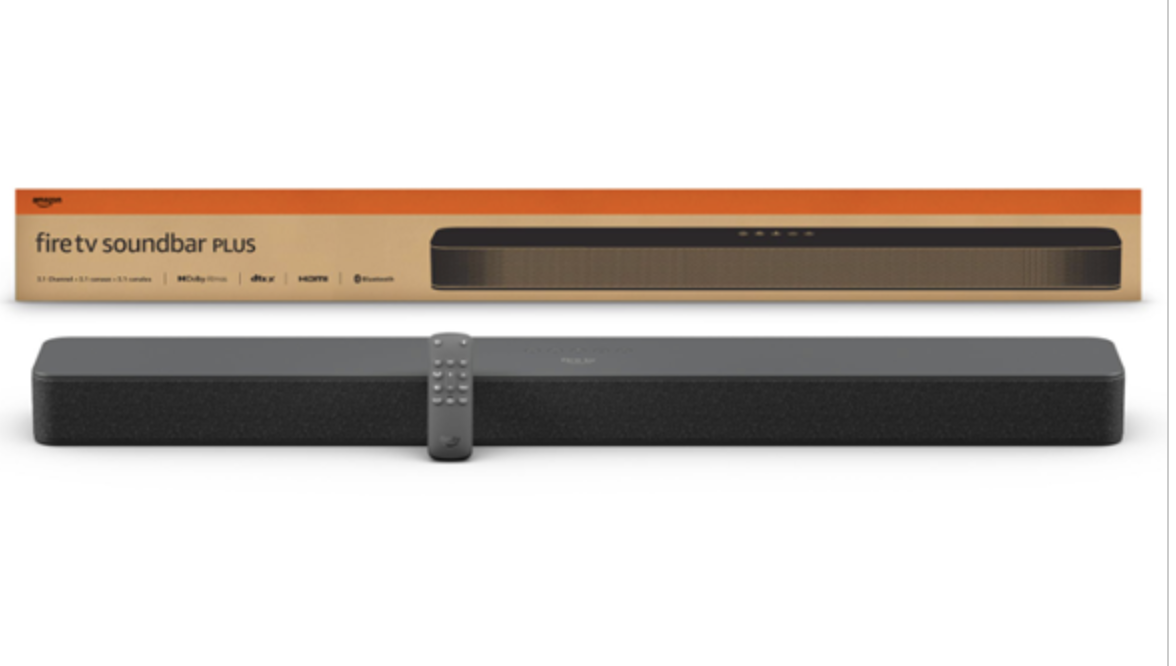
Finding a decent soundbar under $100 is rare, especially from a brand like Amazon. But right now, the Amazon Fire TV Soundbar Plus in an Open Box condition is $99.99 at Woot, as compared to its usual $249.99 price on Amazon. The previous low that price trackers tracked was $149, so this deal drops it by another $50. Prime members get free standard shipping, while non-Prime buyers pay a $6 shipping fee. That said, Woot does not ship this product to Alaska, Hawaii, APO addresses, or P.O. Boxes. The sale runs for six more days or until it sells out.
This is a 3.1-channel system with three forward-facing drivers and tweeter pairs and two built-in woofers. It’s 37 inches long, which gives it a more substantial presence under a TV. For connectivity, it includes HDMI eARC, optical audio input, USB-A, and a standard power port. You also get Bluetooth for streaming music from your phone, but no wifi, multi-room support, or built-in voice assistant. Despite the name, it does not run the Fire TV smart TV platform. It’s simply a soundbar, and it works with any TV that supports HDMI ARC or optical output, notes this PCMag review. The included remote lets you switch between a few preset EQ modes, adjust bass and treble, and control volume.
In everyday use, it’s a clear upgrade over standard TV speakers. Dialogue sounds crisp and easy to follow, and music has decent detail in the mids and highs, and it can get loud without distortion. The main limitation is bass. On its own, it doesn’t deliver deep low-end impact, so action scenes and bass-heavy tracks won’t feel especially full. Amazon does offer bundles with a wireless subwoofer for $374.99 or a 5.1 setup with surrounds for $489.99, if you want to add more weight and immersion. Also, while the bar supports Dolby Atmos, without height channels, the effect is limited.
HBO has another critically acclaimed hit with A Knight of the Seven Kingdoms, based on George R.R. Martin’s Tales of Dunk and Egg novellas, and it deserves every bit of the praise heaped upon it. The immensely satisfying first season wrapped with last night’s finale, dealing with the tragedy of the penultimate episode and setting the stage for the further adventures of Dunk and Egg. House of the Dragon is a solid series, but Knight of the Seven Kingdoms has reminded staunch GoT fans of everything they loved about the original series in the first place.
(Spoilers below, but no major reveals until after the second gallery. We’ll give you a heads up when we get there.)
A Knight of the Seven Kingdoms adapts the first novella in the series, The Hedge Knight, and is set 50 years after the events of House of the Dragon. Dunk (Peter Claffey) is a lowly hedge knight who has just buried his aged mentor, Ser Arlan of Pennytree (Danny Webb). Ser Arlan was perhaps not the kindest of mentors and often stone drunk, but at least he was hung like the proverbial horse—as viewers discovered in a full-frontal moment that instantly went viral. Lacking any good employment options, Dunk decides to enter a local tournament, since he has inherited Ser Arlan’s sword, shield, and three horses.
We may earn a commission from links on this page. Deal pricing and availability subject to change after time of publication.
A good pair of noise-canceling earbuds under $50 doesn’t happen often, but right now, these refurbished Beats Studio Buds are $49.99 at Woot. For context, new pairs of this model typically sell between $90 and $99 on Amazon, while used listings often hover around $69. As for their refurbished condition, they’ve undergone diagnostic testing to confirm that everything works properly and should show little to no cosmetic wear. Shipping is free for Amazon Prime members; everyone else pays $6. That said, Woot does not ship this product to Alaska, Hawaii, or P.O. Boxes. This deal runs for another three days or until it’s sold out, whichever comes first.
These IPX4-rated earbuds pair easily with both iOS and Android devices, which isn’t always a given for products owned by Apple. You still get the perks people expect, like simple one-tap pairing and Find My support on iPhone, but Android users aren’t left out. The buds themselves are small and lightweight, and once you find the right fit from the three included ear tip sizes, they stay secure. The glossy finish can make them slightly slippery when you’re putting them in, but they don’t feel bulky once seated. Sound-wise, these lean into bass. Vocals and instruments stay clear enough, but this isn’t a neutral, studio-accurate sound.
The active noise cancellation does a decent job with steady background noise like engine hum on a flight or the rumble of a train. It won’t block out higher-pitched sounds or conversations as effectively as premium models from Sony or Bose, but at this price, having usable ANC at all is notable, according to this PCMag review. There’s also a Transparency mode for when you need to hear what’s going on around you. You can play or pause music, answer calls, and switch between ANC and Transparency directly from the earbuds, though you’ll still need your phone to adjust volume. Battery life runs about five hours with ANC on, or up to eight without it, and the case provides another 10 to 16 hours depending on how you use them.
Mafia: The Old Country demands to be played on an enormous screen. As much as I love my 32-inch Alienware OLED gaming monitor, it doesn’t do justice to Mafia’s cinematic vistas of Sicily. But, I also wanted to play that game in its full 4K glory, with none of the compromises of today’s game consoles. So why not just shove a tiny gaming desktop under my home theater? Enter the Fragbox, Falcon Northwest’s revamped small form factor gaming PC. While it’s very expensive, starting at $3,997, it’s incredibly powerful and gives you the freedom to easily upgrade the hardware down the line.
I know what you’re thinking: “A $4,000 desktop, in this economy?” That pricing also doesn’t include upgrading from the stock NVIDIA’s RTX 5070 GPU, as well as adding more RAM and larger SSDs, all of which could drive the price up thousands more. I initially planned to review the FragBox back in early December 2025, before the AI-induced RAMaggedon made memory, storage and other components dramatically more expensive. Falcon Northwest is mainly known as a boutique and high-end system builder, so its wealthier clientele can likely weather the pricing storm. If you’re looking for a deal, though, you won’t find it here.
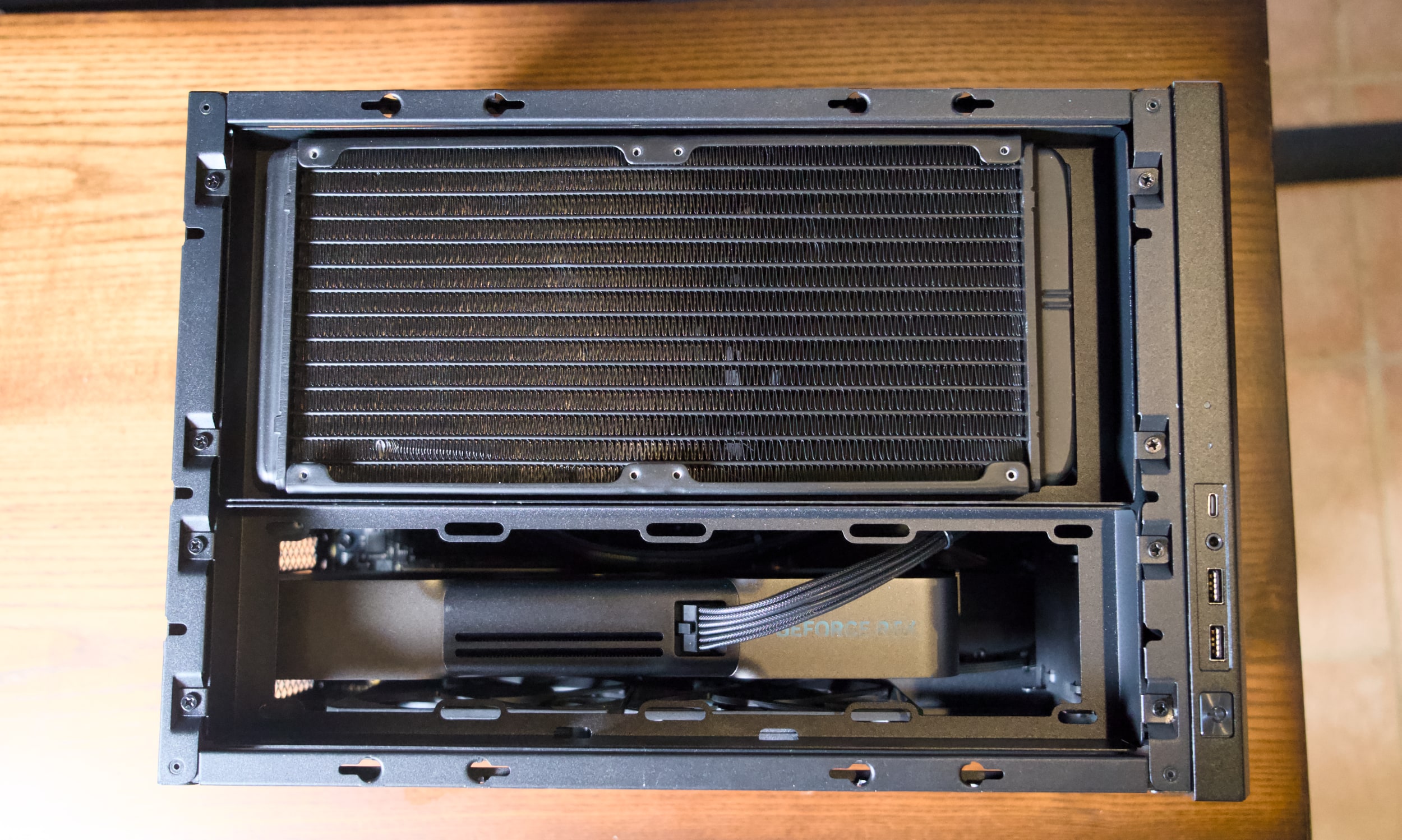
So what, exactly, is a FragBox? Imagine a typical mid-tower desktop squashed down to a system that’s only 10.2-inches tall, 10.5-inches wide and 15.9-inches deep. When Falcon initially debuted the FragBox in 2004, it was notable for being a genuinely small PC that used full-sized parts. That’s still a main selling point today: It can still fit in large NVIDIA GPUs, including the beefy RTX 5090, as well as either Intel’s latest Core Ultra chips or AMD’s Ryzen 9000 CPUs. A huge 280mm radiator sits at the top pulling out hot air, and it also serves as an All-in-One (AIO) liquid cooler for the CPU.
At 25 pounds, the FragBox isn’t exactly light, but its sturdy metal handle makes it easy to move around. Most mid-tower desktops usually weigh between 20 and 35 pounds, depending on their case material. But they’re also much larger and harder to squeeze into tight spaces. The FragBox’s relatively squat size makes it easy to shove into a home entertainment center, or just sit on the corner of your desk. I do wish the handle was removable, though. It was about half an inch too tall for one of my shelves.
Falcon Northwest FragBox
Devindra Hardawar for Engadget
Despite its density, the FragBox’s elegant design makes it a cinch to access to all of the system’s components. Just unscrew the side and top panels and you can easily remove the GPU, RAM, storage and other major components. There are three slots of M.2 SSDs, as well as two locations for 2.5-inch drives and a spot for a large 3.5-inch HDD. The system is bundled with a 1,200W power supply, which should be more than enough to handle future GPUs and CPUs.
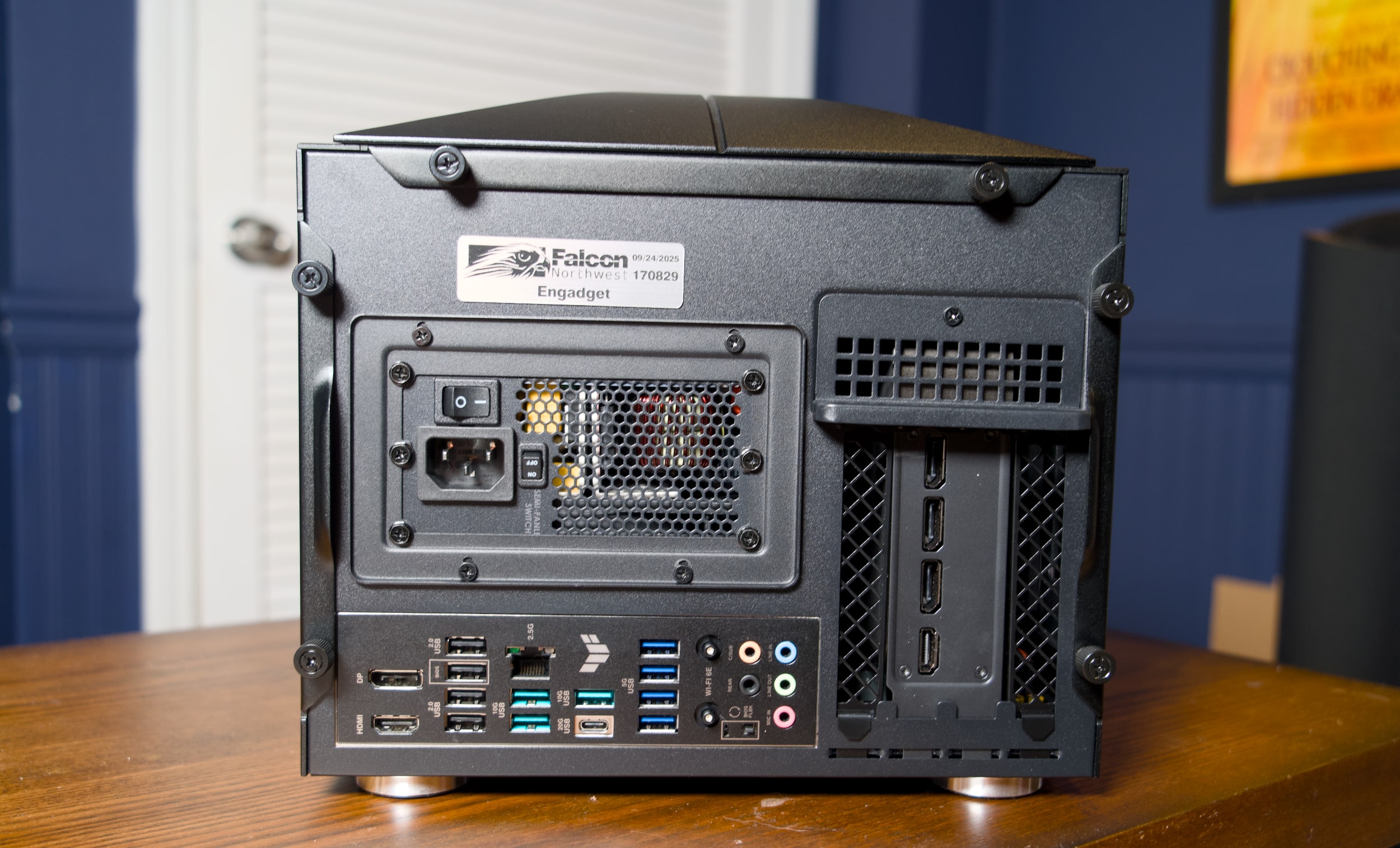
Ports are plentiful as well: There are two USB-A and one USB-C connections right up front, alongside a headphone jack. On the rear, you’ve got your typical assortment of mid-tower connections, including four USB-A 2.0 connections, seven USB-A 3 ports, one 20G USB-C 3.2 port, 2.5G Ethernet, HDMI and DisplayPort. Our RTX 5090 review unit also included three DisplayPort jacks and one HDMI connection (which you’ll see on most GPUs). Wi-Fi 6E is also built-in, though at this price it would have been nice to see Wi-Fi 7.
Falcon Northwest FragBox
Devindra Hardawar for Engadget
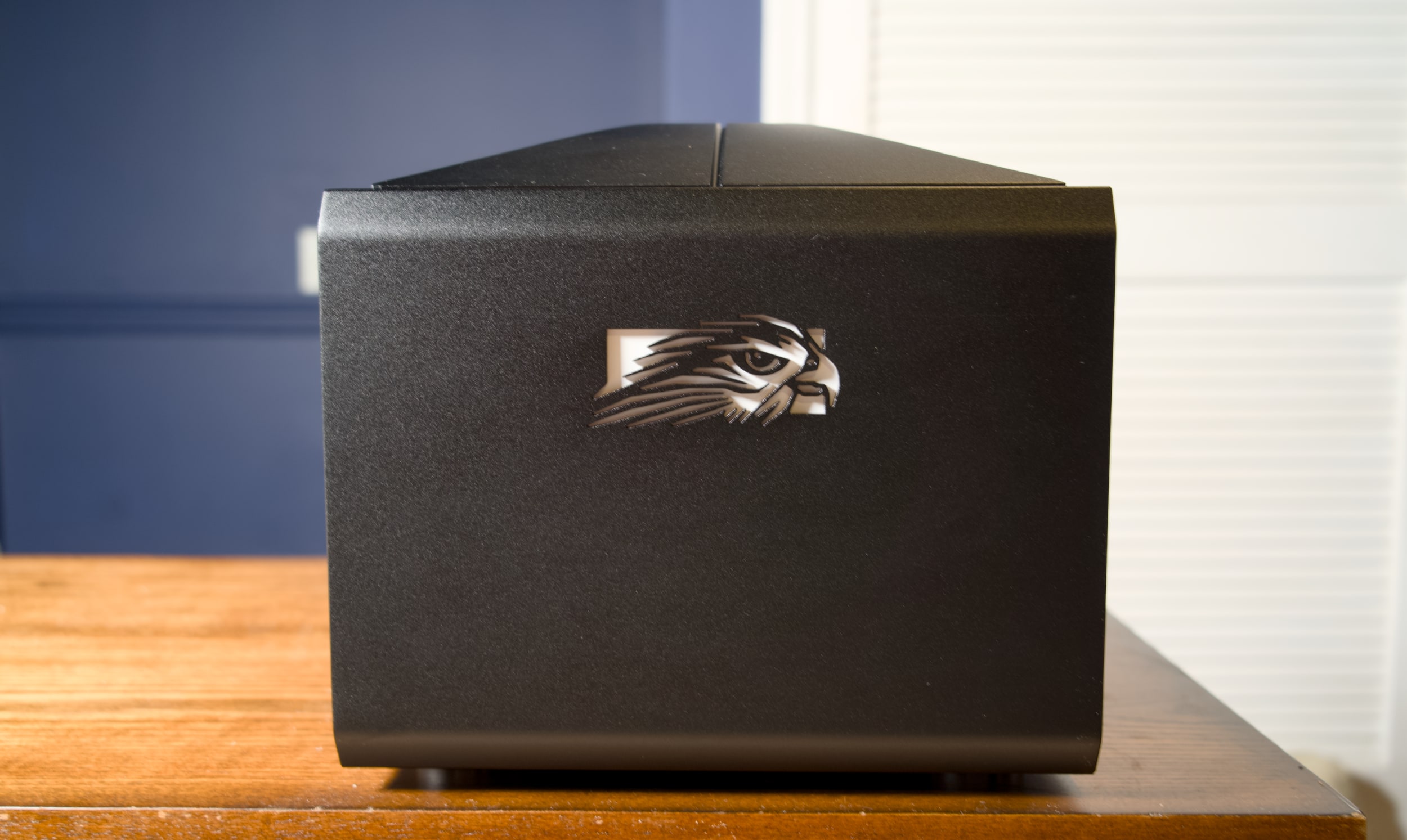
The FragBox, thankfully, lacks the garish LEDs and cheesy thermal glass you find on more ostentatious gaming rigs. Falcon Northwest’s aluminum case looks and feels stately, like an old-school luxury car. If you want something flashier, you can shell out an additional $400 for a custom UV printed case or $149 for a UV-printed front panel.
Our review unit was equipped with AMD’s Ryzen 9950X3D CPU, NVIDIA’s RTX 5090, 96GB of DDR5 RAM and a 2TB SSD. So sure, even before benchmarking or running any games, I expected it to be a beast. In PCMark 10, the FragBox scored a whopping 13,810, which is around 500 points higher than my mid-tower system with the same CPU and GPU. It also scored the highest 3DMark Speedway and Port Royal ray tracing scores I’ve ever seen. Even more impressive, the FragBox’s fans were barely audible under load, and the CPU and GPU sat at a chill 52C and 65C, respectively
CPU
GeekBench 6 CPU
GeekBench 6 GPU
Cinebench 2024
Falcon Northwest FragBox
3,445/22,787
390,148
N/A
Desktop with AMD Ryzen 9 9950X3D, RTX 5090
3,366/18,950
381,400
134/2,124
Desktop with AMD Ryzen 9 7900X, RTX 5090
2,822/14,216
358,253
113/1,103
Apple Mac Studio M4 Max
4,090/26,394
116,028
190/2066
To get back to my initial point, it ran Mafia: The Old Country in 4K flawlessly, with every graphics setting cranked all the way up. While playing on my 120-inch projector home theater setup, the game reached 62 fps natively, and flipping on DLSS upscaling and frame generation bumped that up to 120 fps. Not that you need a super higher framerate for a slow-paced, mostly cinematic action game. I was just happy to be playing without any compromises — even the PS5 Pro can’t reach the same level of graphical fidelity as the monstrously powerful RTX 5090.
Falcon Northwest FragBox
Devindra Hardawar for Engadget
I’m no stranger to big-screen PC gaming, but previously I’ve had to run a laughably long HDMI cable from my desktop to make it work. I’m just too old for that mess now. And it also doesn’t work consistently, especially at higher framerates, thanks to the massive bandwidth required to pump out 4K at high refresh rates. In-home game streaming is also an option, but that’s not great when you’re blowing games up to an enormous TV or projector screen. It’s just too hard to ignore the imperfections of streaming compression. (Admittedly, I need to test newer high-bandwidth options, especially after I was impressed by NVIDIA’s GeForce Now upgrade last year.)
The FragBox also made it easy to jump into all of my recent Steam titles, including Mewgeneics and Arc Raiders on a big screen. Unfortunately, Windows itself remains a key stumbling block for home theater PC gaming. You’ll still need to keep a keyboard and PC around to deal with the initial OS configuration. And even once I enabled Steam’s Big Picture mode, which offers excellent controller options, I still occasionally had to deal with Windows Updates and other annoyances.
Falcon Northwest FragBox
Devindra Hardawar for Engadget
Microsoft is currently trying to optimize Windows for gaming handhelds, and it’s reportedly doing even more to make a future PC-powered Xbox feel more console-like. For now, though, using a Windows PC in your home theater doesn’t feel much different than it did a decade ago. Steam is your savior, Windows is your enemy. Or you could just save thousands of dollars and buy a $500 PlayStation 5 or $700 PS5 Pro, instead. The latter will still get you smooth framerates and a healthy dose of ray tracing, without the annoyance of Windows, keyboards and mice.
But if you just want a compact and insanely powerful gaming desktop, and you don’t mind spending a premium, it’s hard to deny that the FragBox gets everything right.
This article originally appeared on Engadget at https://www.engadget.com/computing/falcon-northwest-fragbox-review-a-compact-gaming-rig-that-does-everything-right-130000837.html?src=rss
An immutable law of the universe is that no matter how big your house is, you eventually fill it up with stuff. And if you’re starting off with a small house to begin with, you hit maximum storage pretty quickly. That can make DIY home maintenance and other projects a challenge, because so many of the tools you need are kind of enormous and awkwardly-shaped, making their storage problematic even in spacious homes.
While hand tools like hammers and screwdrivers can usually be stashed creatively, larger items eat up your spare room pretty quickly—unless you opt for a folding or collapsible version. These tools do the same job, but shrink down when not in use so they can squeeze into tight spots or unexpected locations, solving your storage problems.
A folding ladder is easy to store in a garage or shed
Ladders can be some of the biggest storage challenges because they are, by their very nature, extremely large and rigid. If you don’t have enough vertical or horizontal space to store a ladder, it can wind up just sort of standing in an odd place, collecting dust in between uses and making your home look like a perpetual job site.
You have two small-space options to solve for this, though. The most common is a telescoping ladder, which collapses down to a portion of its height when not in use. This can make it a lot easier to find storage space in a closet or other location, and it can even be hidden behind furniture. Another option is a folding ladder like this one from DuoSaftey, which folds into a stick-like form when not in use, minimizing its horizontal footprint instead of its vertical footprint.
This wheeled cart can be store in a laundry room or closet
A sturdy, wheeled cart is incredibly useful in a lot of maintenance and repair jobs, making it easy to transport tools and materials around the area. But who has the space to have a whole cart just sitting around until it’s needed? A folding cart is the answer: It folds flat for easy storage, but snaps into a sturdy full-sized cart that can handle up to 300 pounds of weight when it’s needed.
Get a collapsible bubble level that folds around corners
A bubble level is a necessity if you want your home projects to look like a sane, rational person performed the work. But a full-size level is often difficult to find space for, and smaller levels aren’t as useful for larger projects.
This folding level not only collapses into a tiny form factor for storage, it can be bent and used to check level around corners, which is one of those DIY superpowers you don’t realize you need until you learn about its existence.
This folding saw is great for the occasional DIY project
Saws are another rigid tool that can be problematic to store. Hanging them on a wall is a good solution that gets them out of the way, but if you need to pack your tools out of sight, you need to consider a folding saw like this one. If you saw wood every day of your life, you might not want this, but if you need a saw for the occasional quick project around the house and don’t have storage space to spare, this will get the job done and fold up and away when not needed.
Store this pop-up workbench in the garage
Like rolling carts, workbenches are incredibly useful when you need a flat surface to work on, but become a real pain when it’s time to store them away. Luckily, you can pick up a folding workbench like this one from DeWalt. It’s a sturdy work surface that can support up to 1,000 pounds, but when the job is done, it folds up to be slid into the tightest spot you have available.
This collapsible bucket fits under the sink or in a utility closet
Everyone needs a job bucket in the house, but the traditional five-gallon bucket not only takes up more space than you realize, it also becomes a place to store stuff in, making it a chore to unpack every time you need to use it. A folding bucket like this one isn’t quite as large (it’s only three gallons), but it collapses into an easily-stored flat configuration when you’re not using it, preventing it from tempting you with all that empty space.
A folding hand truck can transport heavy stuff and then get tucked away in a closet
For years, I had a hand truck stored in my crawl space, because a hand truck was an incredibly useful thing. Any time I had to move bags of cement or large items around, I’d have to climb down into that nightmarish crawl space and retrieve the hand truck, which was a pain in the butt. Now I have this folding handtruck, which does the same job (it can handle more than 300 pounds) but can be tucked away in a closet when not in use.
Use this folding shovel for gardening and clearing out snow
Every house needs a shovel. You either have a garden or backyard where digging will occasionally be needed, or you’ll need to clear snow from your sidewalks and driveway. Or both! Shovels tend to be left in garages or outside when not in use, but if you need to store yours in a small space inside, a folding option is a real space-saver. It collapses into a compact square that will squeeze into any space, but it’s sturdy enough for the toughest jobs you can throw at it.
“In August 2025, TypeScript surpassed both Python and JavaScript to become the most-used language on GitHub for the first time ever…” writes GitHub’s senior developer advocate.
They point to this as proof that “AI isn’t just speeding up coding. It’s reshaping which languages, frameworks, and tools developers choose in the first place.”
Eighty percent of new developers on GitHub use Copilot within their first week. Those early exposures reset the baseline for what “easy” means. When AI handles boilerplate and error-prone syntax, the penalty for choosing powerful but complex languages disappears. Developers stop avoiding tools with high overhead and start picking based on utility instead.
The language adoption data shows this behavioral shift:
— TypeScript grew 66% year-over-year
— JavaScript grew 24%
— Shell scripting usage in AI-generated projects jumped 206%
That last one matters. We didn’t suddenly love Bash. AI absorbed the friction that made shell scripting painful. So now we use the right tool for the job without the usual cost.
“When a task or process goes smoothly, your brain remembers,” they point out. “Convenience captures attention. Reduced friction becomes a preference — and preferences at scale can shift ecosystems.”
“AI performs better with strongly typed languages. Strongly typed languages give AI much clearer constraints…”
“Standardize before you scale. Document patterns. Publish template repositories. Make your architectural decisions explicit. AI tools will mirror whatever structures they see.”
“Test AI-generated code harder, not less.”
No one knows exactly when the vehicles we drive will finally wrest the steering wheel from us. But the age of the autonomous automobile isn’t some sudden Big Bang. It’s more of a slow crawl, one that started during the Roosevelt administration. And that’s Theodore, not Franklin. And not in America, but in Spain, by someone you’ve probably never heard of.
His name was Leonardo Torres Quevedo, a Spanish engineer born in Santa Cruz, Spain, in 1852. Smart? In 1914, he developed a mechanical chess machine that autonomously played against humans. But more than a decade earlier, he pioneered the development of remote-control systems. What he wrought was brilliant, if crude—and certainly ahead of its time.
The first wireless control
It was called the Telekino, a name drawn from the Greek “tele,” meaning at a distance, and “kino,” meaning movement. Patented in Spain, France, and the United States, it was conceived as a way to prevent airship accidents. The Telekino transmitted wireless signals to a small receiver known as a coherer, which detected electromagnetic waves and transformed them into an electrical current. This current was amplified and sent on to electromagnets that slowly rotated a switch controlling the proper servomotor. Quevedo could issue 19 distinct commands to the systems of an airship without ever touching a control cable.
“A surprisingly ravenous black hole from the dawn of the universe is breaking two big rules,” reports Live Science. “It’s not only exceeding the ‘speed limit’ of black hole growth but also generating extreme X-ray and radio wave emissions — two features that are not predicted to coexist…”
“How is this rule-breaking behavior even possible? In a paper published Jan. 21 in The Astrophysical Journal, an international team of researchers observed ID830 in multiple wavelengths to find an answer….”
As they attract gas and dust, this material accumulates in a swirling accretion disk. Gravity pulls the material from the disk into the black hole, but the infalling material generates radiation pressure that pushes outward and prevents more stuff from falling in. As a result, black holes are muzzled by a self-regulating process called the Eddington limit… Its X-ray brightness suggests that ID830 is accreting mass at about 13 times the Eddington limit, due to a sudden burst of inflowing gas that may have occurred as ID830 shredded and engulfed a celestial body that wandered too close. “For a supermassive black hole (SMBH) as massive as ID830, this would require not a normal (main-sequence) star, but a more massive giant star or a huge gas cloud,” study co-author Sakiko Obuchi, an observational astronomer at Waseda University in Tokyo, told Live Science via email. Such super-Eddington phases may be incredibly brief, as “this transitional phase is expected to last for roughly 300 years,” Obuchi added.
ID830 also simultaneously displays radio and X-ray emissions. These two features are not expected to coexist, especially because super-Eddington accretion is thought to suppress such emissions. “This unexpected combination hints at physical mechanisms not yet fully captured by current models of extreme accretion and jet launching,” the researchers said in a statement. So while ID830 is launching massive radio jets, its X-ray emissions appear to originate from a structure called a corona, produced as intense magnetic fields from the accretion disk create a thin but turbulent billion-degree cloud of turbocharged particles. These particles orbit the black hole at nearly the speed of light, in what NASA calls “one of the most extreme physical environments in the universe.” Altogether, ID830’s rule-breaking behaviors suggest that it is in a rare transitional phase of excessive consumption — and excretion. This incredible feeding burst has energized both its jets and its corona, making ID830 shine brightly across multiple wavelengths as it spews out excess radiation.
Additionally, based on UV-brightness analysis, quasars like ID830 may be unexpectedly common, the researchers said. Models predict that only around 10% of quasars have spectacular radio jets, but these energetic objects could be significantly more abundant in the early universe than previously suggested. Most importantly, ID830 also shows how SMBHs can regulate galaxy growth in the early universe. As a black hole gobbles matter at the super-Eddington limit, the energy from its resultant emissions can heat and disperse matter throughout the interstellar medium — the gas between stars — to suppress star formation. As a result, ancient SMBHs like ID830 may have grown massive at the expense of their host galaxies.
When one company asked job applicants to submit a video where they answer a question, most of the 300 responses were “eerily similar,” reports the Washington Post (with a company executive saying it was “abundantly clear” they’d used AI.)
Job seekers are turning to AI to help them land jobs more quickly in a tough labor market…. Employers say that’s having an unintended consequence: Many applications are looking and sounding the same…
It’s easy to spot when candidates over-rely on AI, some employers said. Oftentimes, executive summaries will look eerily similar to each other, odd phrases that people wouldn’t normally use in conversation creep into descriptions, fancy vocabulary appears, and someone with entry-level experience uses language that indicates they are much more senior, they added. It’s worse when they use auto-apply AI tools, which will find jobs, fill out applications and submit résumés on the candidate’s behalf, some employers said. Those tend to misinterpret some of the application questions and fill in the wrong information in inappropriate spots. If these applications were evaluated alone, employers say they’d have a harder time identifying AI usage. But when hundreds of applications all have the same issue, they said, AI’s role in it becomes obvious.
The article acknowledges that some employers could be using AI tools to screen resumes too. One job-seeker in Texas even says he’ll stop submitting an AI-written résumé when the recruiter stops using AI to evaluate them. “You’re saying, ‘You shouldn’t be doing this’ when I know a good chunk of them do this!”
This week Raspberry Pi saw its stock price surge more than 60% above its early-February low (before giving up some gains at the end of the week). Reuters notes the rise started when CEO Eben Upton bought 13,224 pounds worth of shares — but there could be another reason. “The rally in the roughly $800 million company has materialised alongside social-media buzz that demand for its single-board computers could pick up as people buy them to run AI agents such as OpenClaw.”
The Register explains:
The catalyst appears to have been the sudden realization by one X user, “aleabitoreddit,” that the agentic AI hand grenade known as OpenClaw could drive demand for Raspberry Pis the way it had for Apple Mac Minis. The viral AI personal assistant, formerly known as Clawdbot and Moltbot, has dominated the feeds of AI boosters over the past few weeks for its ability to perform everyday tasks like sending emails, managing calendars, booking appointments, and complaining about their meatbag masters on the purportedly all-agent forum known as MoltBook… In case it needs to be said, no one should be running this thing on their personal devices lest the agent accidentally leak your most personal and sensitive secrets to the web… In this context, a cheap low-power device like a Raspberry Pi makes a certain kind of sense as a safer, saner way to poke the robo-lobster…
The Register argues Raspberry Pis aren’t as cheap as they used to be “thanks in part to the global memory crunch. Today, a top-specced Raspberry Pi 5 with 16GB of memory will set you back more than $200, up from $120 a year ago.”
“You know what’s cheaper, easier, and more secure than letting OpenClaw loose on your local area network? A virtual private cloud…”
Russia’s domestic intelligence agency claimed Saturday that Ukraine can obtain sensitive information from troops using the Telegram app on the front line, reports Bloomberg. The fact that the claims were made through Russia’s state-operated news outlet RIA Novosti signals “tightening scrutiny over a platform used by millions of Russians,” Bloomberg notes, as the Kremlin continues efforts to “push people to use a new state-backed alternative.”
Russia’s communications watchdog limited access to Telegram — a popular messaging app owned by Russian-born billionaire Pavel Durov — over a week ago for failing to comply with Russian laws requiring personal data to be stored locally. Voice and video calls were blocked via Telegram in August. The pressure is the latest move in a long-running campaign to promote what the Kremlin calls a sovereign internet that’s led to blocks on YouTube, Instagram and WhatsApp… Foreign intelligence services are able to see Russia’s military messages in Telegram too, Russia’s Minister for digital development, Maksut Shadaev, said on Wednesday, although he added that Russia will not block access to Telegram for troops for now.
Telegram responded at the time that no breaches of the app’s encryption have ever been found. “The Russian government’s allegation that our encryption has been compromised is a deliberate fabrication intended to justify outlawing Telegram and forcing citizens onto a state-controlled messaging platform engineered for mass surveillance and censorship,” it said in an emailed response.
It looks like a March launch is no longer in the cards for Artemis II, NASA’s first crewed trip to the moon’s vicinity since the final Apollo mission over 50 years ago. While preparations were underway at the Kennedy Space Center for a launch as soon as March 6, the space agency says it ran into an issue with the flow of helium to its SLS rocket’s upper stage this weekend and it now has to roll the rocket from the launch pad back to the Vehicle Assembly Building (VAB) to figure out what’s wrong and fix it. A media briefing is planned for sometime this week to discuss the problem and what’s next.
But in a post on X, NASA Administrator Jared Isaacman confirmed the rollback will “take the March launch window out of consideration.” NASA noted on its blog that the current effort “potentially preserves the April launch window, pending the outcome of data findings, repair efforts, and how the schedule comes to fruition in the coming days and weeks.” It’s a four-mile trip back to the VAB that will take hours to carefully transport the massive rocket and the Orion spacecraft. NASA says it’s eyeing February 24 for this trek.
The issue occurred overnight in the early hours of February 21, when NASA says it observed “interrupted flow of helium to the SLS (Space Launch System) rocket’s interim cryogenic propulsion stage.” The space agency explained:
The upper stage uses helium to maintain the proper environmental conditions for the stage’s engine and to pressurize liquid hydrogen and liquid oxygen propellant tanks. The systems worked during NASA’s Artemis II wet dress rehearsals, but teams were not able to properly flow helium during normal operations and reconfigurations following the wet dress rehearsal that concluded Feb. 19. Operators are using a backup method to maintain the environmental conditions for the upper stage engines and the rocket, which remains in a safe configuration.
The Artemis II crew — Commander Reid Wiseman, Pilot Victor Glover, Mission Specialist Christina Koch and Canadian Space Agency astronaut Jeremy Hansen, Mission Specialist — had just entered quarantine a day before the issue arose. NASA says the astronauts have since come out of quarantine.
At the start of this year, NASA announced an accelerated timeline for Artemis II, which was previously set for April 2026 after experiencing delays in 2024. For this 10-day mission, which will be the first crewed flight of the SLS rocket, the Artemis II astronauts will take a trip around the moon in the Orion spacecraft. While it initially targeted early February, the launch was pushed to March due to issues that popped up during the wet dress rehearsal. Now, we’re back to the beginning with a possible April launch, but that’ll depend on the fix being a quick one.
This article originally appeared on Engadget at https://www.engadget.com/science/space/nasas-crewed-artemis-ii-launch-gets-pushed-back-again-this-time-due-to-a-helium-issue-231010042.html?src=rss
Fossil fuels produce NO2, which is linked to asthma attacks, bronchitis, and higher risks of heart disease and stroke, according the EV news site Electrek. But the nonprofit news site Grist.org notes a new analysis showing that those emissions decreased by 1.1% for every increase of 200 electric vehicles — across nearly 1,700 ZIP codes.
“A pretty small addition of cars at the ZIP code level led to a decline in air pollution,” said Sandrah Eckel, a public health professor at the University of Southern California’s Keck School of Medicine and lead author of the study. “It’s remarkable.”
The study was done at the University of Southern California’s medical school, by researchers using high-resolution satellite data, reports Electrek:
The study, just published in The Lancet Planetary Health and partly funded by the National Institutes of Health, adds rare real-world evidence to a claim that’s often taken for granted — that EVs don’t just cut carbon over time, they also improve local air quality right now… The researchers ran multiple checks to make sure the trend wasn’t driven by unrelated factors. They accounted for pandemic-era changes by excluding 2020 in some analyses and controlling for gas prices and work-from-home patterns. They also saw the expected counterexample: neighborhoods that added more gas-powered vehicles experienced increases in pollution. The findings were then replicated using updated ground-level air monitoring data dating back to 2012…
Next, the researchers plan to compare EV adoption with asthma-related emergency room visits and hospitalizations. If those trends line up, it could provide some of the clearest evidence yet of what we already know: that electrifying transportation doesn’t just clean the air on paper; it improves public health in practice.
Thanks to long-time Slashdot reader jhoegl for sharing the article.
Jeopardy time. A. This company spurred CEOs to make huge speculative capital expenditures based on wild unverified claims of future demand, resulting in the layoffs of tens of thousands of workers to reduce the resulting expenses, harming their core businesses. Q. What is OpenAI? Sorry, the correct response is, “What is WorldCom?” In 2002, WorldCom, the second largest long-distance company in the U.S., entered Chapter 11 bankruptcy after disclosing accounting fraud that eventually totaled $11 billion, the biggest ever at the time. CEO Bernard Ebbers was subsequently sentenced to 25 years in prison.
CNBC reported that an employee of WorldCom’s Internet service provider UUNet set off a frenzy of speculative investment and infrastructure overbuild after he used Excel to create a best-case scenario model for the Internet’s growth that suggested in the best of all possible worlds, Internet traffic would double every 100 days, a scenario that would greatly benefit WorldCom, whose lines would carry it. Despite no evidence to support it, WorldCom’s lie became an immutable law and businesses around the world made important decisions based on the belief that traffic was doubling every 100 days. “For some period of time I can recall that we were backfilling that expectation with laying cables, something like 2,200 miles of cable an hour,” AT&T CEO Michael Armstrong said. “Think of all the companies that went out of business that assumed that that was real.”
In 2003, NBC News reported:
Armstrong and former Sprint CEO Bill Esrey struggled for years to understand how WorldCom could beat them so handily. “We would look at the conduct of WorldCom in terms of their pricing, revenue growth, margins, in terms of their cost structure… and the price leader almost every quarter was WorldCom,” Armstrong said. Added Esrey, “We couldn’t figure out how they were pricing as aggressively as they were…. How could they be so efficient in their costs and expenses?” AT&T and Sprint began cutting jobs to push down their costs to WorldCom’s level. “The market said what a marvelous management job WorldCom was doing and they would look over to AT&T and say, ‘these guys aren’t keeping up.’ So, my shareholders were hurt. We laid off tens of thousands of employees in an accelerated fashion [in a futile effort to match WorldCom’s phantom profits] and I think the industry was hurt,” Armstrong says. “It just wrecked the whole industry,” says Esrey.
A collective of Colorado lawmakers wants to put an end to “ghost guns” and their rising popularity. Earlier this week, the state’s House Judiciary Committee voted in a 7-4 majority to pass the bill, HB26-1144, along for a decision with the full House of Representatives. The proposed law would “prohibit the use of a three-dimensional printer, or similar technology, to make a firearm or a firearm component.”
Ghost guns are typically made from 3D printers or similar machines without serial numbers, making them virtually impossible to trace and allowing users to skirt the federal requirements for purchasing a firearm. While the bill targets using a 3D printer to make guns, large-capacity magazines and other related components, it even bans possessing and distributing the instructions to manufacture guns in this way. However, these rules would be exempt for federally licensed firearm manufacturers.
“These ghost guns are increasingly found at crime scenes, making it harder for law enforcement to track down a suspect because the gun isn’t traceable,” the bill’s sponsor, Lindsay Gilchrist, said in a press release.
Prior to this proposal, Colorado passed a law in 2023 that banned owning ghost guns or making frames for them. While SB23-279 laid the groundwork, HB26-1144 can be seen as the next step since it’s much more encompassing by targeting ghost guns even before they’re made. According to the bill, first-time violations will be treated as a misdemeanor, while repeat offenses will be upgraded to a felony charge. Looking ahead, HB26-1144 still has to secure a vote from both the Colorado Senate and House of Representatives before being delivered to the governor to be signed into law.
This article originally appeared on Engadget at https://www.engadget.com/science/colorado-is-working-on-a-bill-that-would-make-it-illegal-to-3d-print-firearms-and-gun-parts-211508169.html?src=rss
Samsung’s next flagship devices will offer Perplexity as part of an expansion to support multiple AI agents in Galaxy AI. Perplexity’s AI agent will work with apps including Samsung Notes, Clock, Gallery, Reminder and Calendar, according to the announcement. And, some third-party apps will support it, though Samsung hasn’t yet said which. The news comes just a few days before Samsung’s Galaxy Unpacked event, so we can expect to find out more about that integration and how it fits in with Samsung’s revamped Bixby very soon.
What we know so far is that the Perplexity agent will respond to the wake phrase, “Hey Plex” (not to be confused with the streaming service Plex). It can also be initiated by quick-access physical controls. In a statement, Samsung’s Won-Joon Choi, President, COO and Head of the R&D Office for Samsung’s Mobile eXperience Business, said the expansion of Galaxy AI is aimed at giving users more choice and flexibility in getting their tasks done. “Galaxy AI acts as an orchestrator, bringing together different forms of AI into a single, natural, cohesive experience,” Choi said.
This article originally appeared on Engadget at https://www.engadget.com/ai/samsung-is-adding-perplexity-to-galaxy-ai-for-its-upcoming-s26-series-203729539.html?src=rss
Google and Microsoft contributed $5 million to launch Alpha-Omega in 2022 — a Linux Foundation project to help secure the open source supply chain. But its co-founder Michael Winser warns that open source registries are in financial peril, reports The Register, since they’re still relying on non-continuous funding from grants and donations.
And it’s not just because bandwidth is expensive, he said at this year’s FOSDEM. “The problem is they don’t have enough money to spend on the very security features that we all desperately need…”
In a follow-up LinkedIn exchange after this article had posted, Winser estimated it could cost $5 million to $8 million a year to run a major registry the size of Crates.io, which gets about 125 billion downloads a year. And this number wouldn’t include any substantial bandwidth and infrastructure donations (Like Fastly’s for Crates.io). Adding to that bill is the growing cost of identifying malware, the proliferation of which has been amplified through the use of AI and scripts. These repositories have detected 845,000 malware packages from 2019 to January 2025 (the vast majority of those nasty packages came to npm)…
In some cases benevolent parties can cover [bandwidth] bills: Python’s PyPI registry bandwidth needs for shipping copies of its 700,000+ packages (amounting to 747PB annually at a sustained rate of 189 Gbps) are underwritten by Fastly, for instance. Otherwise, the project would have to pony up about $1.8 million a month. Yet the costs Winser was most concerned about are not bandwidth or hosting; they are the security features needed to ensure the integrity of containers and packages. Alpha-Omega underwrites a “distressingly” large amount of security work around registries, he said. It’s distressing because if Alpha-Omega itself were to miss a funding round, a lot of registries would be screwed. Alpha-Omega’s recipients include the Python Software Foundation, Rust Foundation, Eclipse Foundation, OpenJS Foundation for Node.js and jQuery, and Ruby Central.
Donations and memberships certainly help defray costs. Volunteers do a lot of what otherwise would be very expensive work. And there are grants about…Winser did not offer a solution, though he suggested the key is to convince the corporate bean counters to consider paid registries as “a normal cost of doing business and have it show up in their opex as opposed to their [open source program office] donation budget.”
The dilemma was summed up succinctly by the anonymous Slashdot reader who submitted this story.
“Free beer is great. Securing the keg costs money!”
Long-time Slashdot reader fahrbot-bot writes: Researchers have developed a robotic hand that can not only skitter about on its fingertips, it can also bend its fingers backward, connect and disconnect from a robotic arm, and pick up and carry one or more objects at a time.
This article in Science News includes footage of the robotic arm reattaching itself to the skittering robot hand, which can also hold objects against both sides of its palm simultaneously, and “can even unscrew the cap off a mustard bottle while holding the bottle in place.”
With its unusual agility, it could navigate and retrieve objects in spaces too confined for human hands. When attached to the mechanical arm, the robotic hand could pick up objects much like a human hand. The bot pinched a ball between two fingers, wrapped four fingers around a metal rod and held a flat disc between fingers and palm.
But the bot isn’t constrained by human anatomy… When the robot was separated from the arm, it was most stable walking on four or five fingers and using one or two fingers for grabbing and carrying things, the team found. In one set of trials with both bots, the hand detached from the robotic arm and used its fingers as legs to skitter over to a wooden block. Once there, it picked up the block with one finger and carried it back to the arm.
The crawling bot could one day aid in industrial inspections of pipes and equipment too small for a human or larger robot to access, says Xiao Gao, a roboticist now at Wuhan University in China. It might retrieve objects in a warehouse or navigate confined spaces in disaster response efforts.
First, we got iPhones in Hermès orange, and now we might get them in Louboutin red. According to Bloomberg‘s Mark Gurman, Apple is already mulling over what the next premium colorway will be for its iPhone Pro models. While we’re not expecting iPhone 18 announcements until later this year, Gurman reported that “red is the new flagship color in testing for the next iPhone Pros.”
Gurman added that there were rumors of purple and brown shades, but predicted that these could just be different shades of the main red option. Red is definitely a departure from Apple’s usual palette of more modest tones, but the company could be trying to continue the momentum of its flashier Cosmic Orange option that has been boosting sales in China. The bold orange option has been informally rebranded as Hermès orange among fans and is becoming somewhat of a status symbol in Chinese markets. With red as a potential frontrunner for the next iPhone Pro colors, Apple could capture even more sales in China, especially since the color is seen as lucky in Chinese culture.
It’s not the first time Apple has offered red iPhones, though. Previously, Apple manufactured iPhones in deep red hues in collaboration with Product Red, with the last available models being the iPhone SE, iPhone 14 and iPhone 14 Plus. On the other hand, Gurman reported that Apple will play it much safer when it comes to the rumored foldable iPhone, sticking with its basic tones.
This article originally appeared on Engadget at https://www.engadget.com/mobile/smartphones/apple-is-reportedly-considering-red-as-the-next-premium-color-for-its-iphones-185748052.html?src=rss
Imagine a 280-unit apartment complex offering no on-site leasing office with a human agent for questions. “Instead, the entire process has been outsourced to AI…” reports SFGate, “from touring to signing the lease to completing management tasks once you actually move in.”
Now imagine it’s far more than just one apartment complex…
At two other Jack London Square apartment buildings, my initial interactions were also with a robot. At the Allegro, my fiance and I entered the leasing office for our tour and asked for “Grace P,” the leasing agent who had emailed us. “Oh, that’s just our AI assistant,” the woman at the front desk told us… At Aqua Via, another towering apartment complex across the street, I emailed back and forth with a very helpful and polite “Sofia M.” My pal Sofia seemed so human-like in her responses that I did not realize she was AI until I looked a little closer at a text she’d sent me. “Msgs may be AI or human generated….” [S]he continued to text me for weeks after I’d moved on, trying to win me back. When I looked at the fine print, I realized both of these complexes were using EliseAI, a leading AI housing startup that claims to be involved in managing 1 in 6 apartments in the U.S…
[50 corporate landlords have funded a VC named RET Ventures to invest in and deploy rental-automating AI, and SFGate’s reporter spoke to partner Christopher Yip.] According to Yip, AI is common in large apartment complexes not just in the tech-centric Bay Area, but across the entire country. It all kicked off at the onset of the COVID-19 pandemic in 2020, he said, when contactless, self-guided apartment tours and completely virtual tours where people rented apartments sight unseen became commonplace. Technology’s infiltration into the renting process has only grown deeper in the years since, Yip said, mirroring how pervasive AI has become in many other facets of our lives. “From an industry perspective, it’s really about meeting the renter where they are,” Yip said. He pointed to how many renters now prefer to interact through text and email, and want to tour apartments at their convenience — say, at 7 p.m. after work, when a typical leasing office might be closed.
The latest updates in technology not only allow you to take a self-guided tour with AI unlocking the door for you, but also to ask AI questions by conversing with voice AI as you wander through the kitchen and bedroom at your leisure. And while a human leasing agent might ghost you for days or weeks at a time, AI responds almost instantly — EliseAI typically responds within 30 seconds, [said Fran Loftus, chief experience officer at EliseAI]… [I]n some scenarios, the goal does seem to be to eliminate humans entirely. “We do have long-term plans of building fully autonomous buildings,” Loftus said…. “We think there’s a time and a place for that, depending on the type of property. But really right now, it’s about helping with this crazy turnover in this industry.”
The reporter says they missed the human touch, since “The second AI was involved, the interaction felt cold. When a human couldn’t even be bothered to show up to give me a tour, my trust evaporated.”
But they conclude that in the years ahead, human landlords offering tours “will probably go the way of landlines and VCRs.”